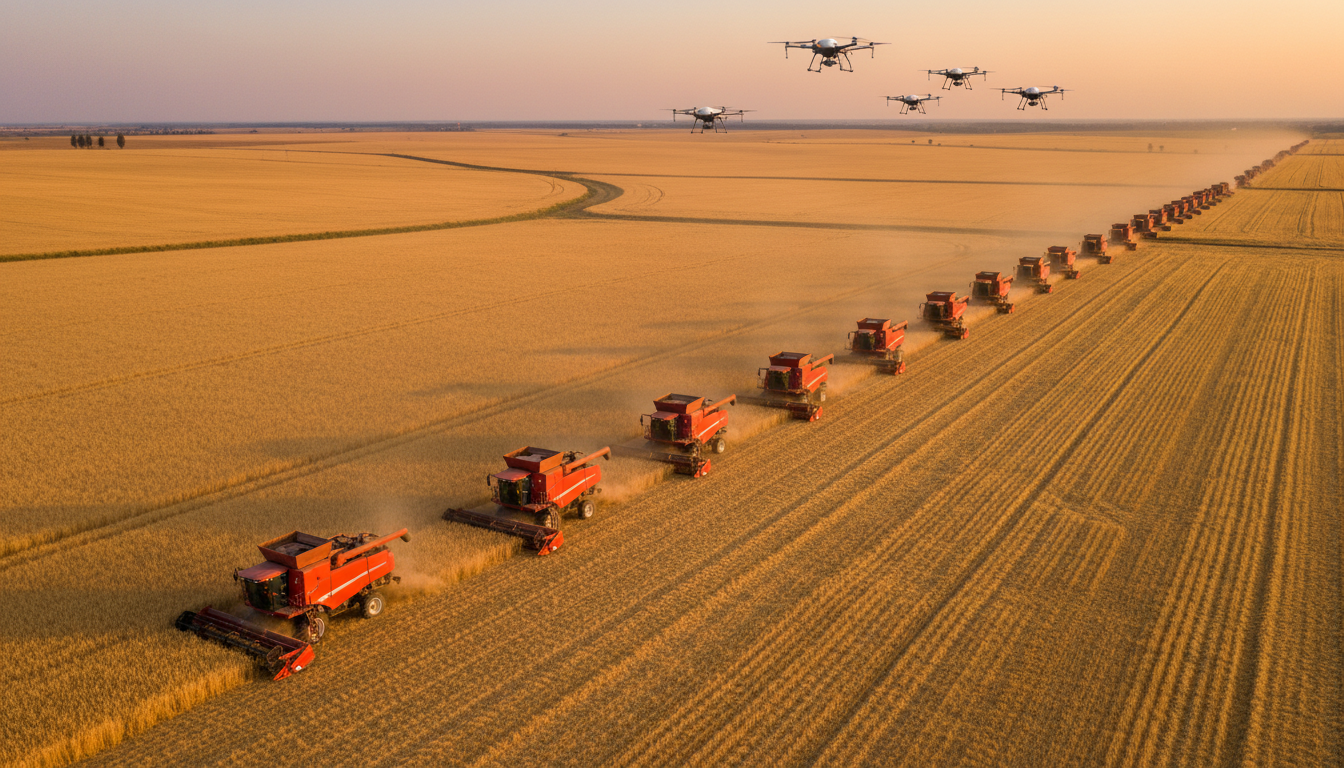

During the autumn harvest season of 2025, in a 10,000-mu rice paddy in Heilongjiang's reclamation zone, more than a dozen combine harvesters lined up and roared forward. They were not guided by operators hunched in cabs, but by BeiDou automatic navigation systems installed on each machine — advancing in straight lines with centimeter-level precision, turning and switching rows without any human intervention. Beneath their tracks lay China's most productive granary; the blueprints and control code came from China's own factories.
At the same time, on the banks of a paddy field in Hunan's Dongting Lake Plain, a crop-protection drone was at work. With a 30-liter payload capacity, a single sortie could cover 300 mu. The farmer controlling it sat on a field ridge, tapped a tablet to assign the task, and the aircraft took off autonomously, planned its flight path, finished spraying, and returned — all without manual guidance. That drone came from DJI Agriculture. Globally, this Chinese company commands nearly 60% market share in the same category. Over the past decade, shipments grew from 2,000 units to 200,000 units per year — the fastest single-category expansion in the history of agricultural mechanization.
These two scenes are a microcosm of Chinese agricultural machinery in 2025. They offer the most immediate illustration of where a nation's farm equipment industry stands.
In the first half of 2025, China's agricultural machinery exports reached RMB 34.9 billion, up 37% year on year; meanwhile, farm machinery imports totaled only RMB 1.7 billion, down 31% year on year. The dramatic reversal of trade flows is the clearest possible industry signal: China is no longer a net importer of agricultural machinery — it is becoming a major force in global farm equipment manufacturing. Behind this lies a supply chain being profoundly restructured, and four clear historical threads: high-horsepower upgrading and premiumization; intelligent unmanned operation; "Belt and Road" export expansion; and Stage IV non-road emission standard replacement.
This report attempts to complete that puzzle. Starting from a definition of agricultural machinery and a panoramic view of the supply chain, it moves through the global landscape, the policy environment, and market sizing, then dives deep into supply-chain anatomy, key companies, regional industrial clusters, thematic spotlights, technology evolution, and the risk map — culminating in a 2030 forecast and industrial verdict.
Chapter 1 Definition and Supply Chain: Where Does Agricultural Machinery End?
Industry Definition and Major Categories
Agricultural machinery refers to a broad range of mechanical equipment used in agricultural production and initial processing of farm products. Under China's national economic industry classification, the agricultural machinery manufacturing sector primarily encompasses the following categories:
Soil Preparation Machinery: Tractors are the core — covering wheeled tractors (the workhorse for dryland crops such as wheat, corn, and soybeans), tracked tractors (for paddy fields), and walking tractors (for small plots and hilly terrain). Rotary tillers, subsoilers, plowshares, disc harrows, and other tractor-mounted implements together constitute the soil preparation system. Tractors are classified by horsepower into small (under 25 hp), medium (25–80 hp), large (80–200 hp), and high-power (over 200 hp). The current premium end is focused on the 200 hp-plus segment; 300 hp and above is regarded as the breakthrough target for high-end domestication. As land consolidation accelerates nationally, demand for high-horsepower tractors from large family farms is rising rapidly, with prices jumping from roughly RMB 100,000–150,000 for an ordinary medium tractor to RMB 500,000–800,000 for a 200 hp-plus machine, and imported John Deere and Case IH machines above 300 hp costing over RMB 1 million.
Planting and Fertilizing Machinery: Includes rice transplanters (riding-type high-speed transplanters as the mainstay, walking-type for small plots), precision seeders (air-suction and finger-clip types for corn, soybeans, and peanuts), fertilizer applicators (base fertilizer and top-dressing applicators), and crop-protection sprayers (backpack electric sprayers and large trailing boom sprayers). Precision seeders combined with simultaneous seeding-and-fertilizing technology can significantly reduce seed use and improve seedling emergence rates — a key subsidy-target category in recent years.
Harvesting Machinery: The combine harvester (grain combine) is the core product, divided by drivetrain and chassis into tracked types (suited for paddy fields, primarily for rice and rapeseed) and wheeled types (suited for dry fields, for wheat, corn, soybeans, and peanuts). Corn harvesters (mounted or self-propelled), soybean harvesters, peanut harvesters, and cotton pickers each have dedicated machine types with their own category leaders.
Agricultural Drones: Multi-rotor crop-protection UAVs are dominant, alongside seeding drones (for broadcasting rice seeds and organic fertilizer), pollination-assist drones (for corn and kiwifruit), and multi-spectral mapping drones (for crop health monitoring and pest identification). Agricultural drones are the fastest-growing category of the past five years, with the most aggressive technological iteration — progressing from manual remote control to Level 3 fully autonomous operation, payload capacity rising from an early 10 liters to the current 100 liters (T100S), and single-sortie efficiency jumping from tens of mu per hour to hundreds of mu per hour.
Farmland Infrastructure Machinery: Irrigation and drainage equipment (axial-flow pumps, centrifugal pumps, sprinkler systems, drip irrigation), and facility agriculture equipment (greenhouse curtain-drive motors, internal-circulation fans, temperature-control systems, integrated water-and-fertilizer irrigation terminals). As high-standard farmland construction accelerates, the country adds more than 20 million mu of water-efficient irrigation area annually, driving sustained growth in sprinkler and drip irrigation demand.
Grain-Handling Machinery: Grain dryers (hot-air circulation and low-temperature circulation types), grain storage equipment (silos, 3D storage bins, intelligent ventilation systems), optical sorters (photoelectric sorting for rice, wheat, and legumes), rice hullers, flour mills, and corn shellers. Grain dryers have become standard equipment for large grain growers and grain-purchasing enterprises everywhere — the penetration rate rose from under 30% in 2020 to over 50% in 2025.
Livestock and Aquaculture Machinery: Feed processing machinery, poultry and livestock housing equipment (ventilation-cooling, automatic feeding and watering), etc. Their market logic and competitive landscape differ significantly from the mainstream farm equipment track; this report does not address them in depth.
Historical Evolution: From a Tractor-Manufacturing Giant to a Farm Equipment Power
China's agricultural mechanization has followed a trajectory closely synchronized with the development of its entire manufacturing sector. In the early years of the People's Republic, farm mechanization was virtually nonexistent — land was tilled by draft animals and harvested by sickle. The "socialist transformation of agriculture" and "agricultural collectivization" of the 1950s finally created the organizational conditions for mechanization to spread. The launch of the Luoyang Dongfanghong tractor in 1958 was the defining starting point of China's farm equipment industry, marking the moment China could mass-produce its own agricultural machines. But those Dongfanghong tractors were products of a planned economy — kept alive without market competition, inconsistent in quality, narrow in variety, with chronic supply shortages.
After the Reform and Opening Up, the "Household Responsibility System" transferred farmland management rights to individual farm households. Agricultural machinery demand became decentralized and smaller-scale. Tractors shifted from collectively used machines on state farms to personal investments by farm families. Low-horsepower walking tractors ("iron oxen") swept the country in the 1980s and 1990s, creating the first boom in China's farm equipment market. During this period, the market gradually opened; the number of competing enterprises grew rapidly; thousands of small and medium farm equipment manufacturers appeared — but the overall technology level remained low, with widespread imitation and commodity competition.
Entering the 21st century, the farm equipment industry reached a policy inflection point. In 2004, the state enacted the Agricultural Mechanization Promotion Law, and in the same year established the farm equipment purchase subsidy system — one of the most far-reaching policy designs in the history of China's farm equipment sector. By disbursing central government funds directly to farmers as subsidies, it dramatically lowered the threshold for buying farm equipment, releasing demand that hundreds of millions of Chinese farmers had long been unable to satisfy. Over the next 15 years, the farm equipment market entered a sustained high-speed growth phase, with market size expanding from under RMB 100 billion in 2004 to nearly RMB 500 billion in the early 2020s, and leading OEM companies growing from tens of billions to the hundred-billion yuan scale.
As of 2025, China's farm equipment industry stands at a historical juncture: the transition from "large but not strong" to "large and strong." Premiumizing high-horsepower tractors, intelligentizing agricultural drones, and internationalizing farm equipment exports are the three compulsory questions facing this generation's farm equipment practitioners — and all three answers point to the same underlying imperative: technological self-reliance and upgrading of the supply chain.
Supply Chain Overview: A Three-Tier Structure
China's farm equipment supply chain can be clearly decomposed into three tiers: upstream core components and materials; midstream OEM manufacturing; and downstream distribution, use, and service.
Upstream: Core Components and Materials
Upstream components are the determinants of OEM performance and the level where domestic farm equipment most visibly lags global leaders.
Diesel engines are the most critical powertrain assembly. Major domestic suppliers include Weichai Power (which, through its industrial synergy with Lovol, is the engine of choice for high-horsepower farm machines), Yuchai, Dongfeng Nongfa, and Changchai. In the small-to-medium horsepower range (under 80 hp), domestically made engines largely satisfy the needs of mainstream OEMs, with a relatively small gap from international best practice. In the high-horsepower range (above 200 hp), Chinese engines still lag measurably behind Deutz, John Deere PowerTech, and Perkins in torque-curve breadth-flatness, power reserve at altitude and high temperature, and manufacturing consistency of the precise common-rail injection systems required to meet the new emission standard — making this the supply chain's top breakthrough priority.
Gearboxes and transmission systems rank just below engines as critical assemblies. Ordinary synchromesh mechanical gearboxes are fairly mature domestically, but powershift transmissions (shifting without cutting power, ideal for large-plot high-speed continuous work) and continuously variable transmissions (CVT/IVT) remain primarily imported. John Deere's e23 powershift and Kubota's HST hydrostatic continuously variable system are the key enablers of high-efficiency large-field operation for their respective machines. Domestic manufacturers — YITUO's transmission division and Lovol's dedicated gearbox team — are ramping up R&D, but progress on domestic substitution in high-end power transmission remains relatively slow.
The hydraulic system (pumps, valves, cylinders, and hydraulic lift mechanisms) determines implement-depth precision, steering response, and auxiliary-work performance. The core problem with farm equipment hydraulics is manufacturing consistency of precision valve components — because farm machines operate in extremely harsh environments (mud dust, vibration, temperature swings), hydraulic component reliability requirements are very high. Hengly Hydraulics (SH: 601100) has reached international advanced levels in construction machinery hydraulics and is now extending its supply to the farm equipment hydraulics sector; Bosch Rexroth's China manufacturing center also supplies high-end hydraulic components to mainstream farm equipment OEMs.
BeiDou navigation and precision agriculture sensors are the new upstream inputs of the intelligent farm equipment era. The rollout of BeiDou RTK (real-time kinematic) base station networks has made centimeter-level positioning affordable; CHC Navigation (SH: 688322) and ComNav Technology (SZ: 002383) supply RTK modules and intelligent driving controllers and are becoming critical suppliers to smart farm equipment OEMs. Soil moisture sensors, crop yield-map sensors, and multi-spectral cameras are the "nerve endings" of the agricultural big-data ecosystem; many domestic sensor and AI-vision companies are actively entering this space.
Electronic control systems encompass vehicle control units (VCU), engine management systems (ECU), hydraulic control units (HCU), and more — another core upstream element of farm equipment intelligence. Bosch, United Automotive Electronic Systems, and domestic players such as Huawei (extending HiCar vehicle control into farm machinery) are all competing for this market.
Midstream: OEM Manufacturing
OEM manufacturers occupy the most central position in the value chain — responsible for final assembly integration, brand building, and channel management, while also handling partial in-house R&D and production of key components.
Domestic tractor OEM landscape: YITUO (Dongfanghong, No. 1); Weichai Lovol (Europard/Apos, No. 2); ZOOMLION Kingfarmer (fast-rising); Wuzheng; Shifeng (small four-wheel, regional market); Sinoagri South (small/medium). Foreign OEMs have limited direct participation in domestic tractor assembly — John Deere and Case IH primarily sell premium imported models; Kubota's China manufacturing focuses on transplanters and harvesters.
Combine harvester landscape: Weichai Lovol (No. 1 in wheat/corn harvesters and overall grain combines); Wodet (No. 1 in tracked rice harvesters); Kubota China (No. 1 foreign-brand rice harvester); Yanmar (rice); ZOOMLION Grain King series; Shandong Juming (wheat machines), etc.
Agricultural drones: DJI Agriculture (absolute No. 1); XAG (No. 2); Tietu Aviation (No. 3, minimal share).
Downstream: Distribution, Use, and Service
The farm equipment dealer network is the core of the downstream. China has roughly 40,000-plus specialized farm equipment dealers, organized at county level, handling new-machine sales, parts supply, repair service, and cross-region scheduling. Some large dealers have built multi-province networks and become key channels for OEM market penetration.
Large grain producers (family farms, agricultural machinery cooperatives, state farms) are the primary direct purchasers of large farm equipment — more professional in their purchasing behavior, more demanding on performance reliability, and more willing to pay for quality premiums. Agricultural machinery socialization services (cross-region operating teams) are a uniquely Chinese phenomenon: during the wheat harvest season, hundreds of thousands of combine harvesters form an "iron army" that transfers from province to province, south to north, dramatically boosting machine utilization. This model means that farm equipment purchase demand comes not just from farmers themselves, but also from professional service companies.
Bargaining Power Along the Supply Chain
Bargaining power distribution in China's farm equipment supply chain determines how profit is divided among the tiers — and understanding this is essential to assessing the business model quality of companies at different levels.
Upstream's bargaining power over OEMs: Weichai Power (engines) commands strong bargaining power over non-affiliated OEMs — the number of mature domestic suppliers in the high-horsepower diesel segment is limited, leaving OEMs with few alternatives. This explains why Weichai's engine business has a net margin well above 10%, significantly higher than Lovol's OEM business. Foreign hydraulic-component suppliers (Bosch Rexroth, Parker Hannifin) have meaningful pricing power over OEMs sourcing premium hydraulic parts. In BeiDou navigation and precision agriculture sensors, however, with CHC Navigation and ComNav Technology among multiple competing suppliers, OEMs have relatively stronger negotiating leverage.
OEMs' bargaining power over dealers: In mainstream categories (wheeled tractors, combine harvesters), several evenly matched OEMs compete; dealers typically carry multiple brands; OEM leverage over dealers is limited — they must compete through higher margins, better parts supply assurance, and stronger brand pull. In categories with highly concentrated market leadership (e.g., DJI agricultural drones, Wodet rice harvesters), OEMs have noticeably stronger leverage — dealers cannot easily walk away from brands their customers need.
OEMs' bargaining power over end-users: Chinese farmers' purchase decisions are influenced by subsidy policies, brand perception, neighbor referrals, and dealer recommendations. Large farms negotiate more rationally and possess stronger price leverage; small scattered farmers are guided by brand inertia and the subsidy catalog. Overall, the intense price competition among farm equipment OEMs drives them to differentiate via technology configuration (high-spec vs. entry-level) rather than brand premiums alone.
Value Distribution Along the Supply Chain
In a completed farm equipment OEM's ex-works value, the powertrain (engine + transmission) accounts for roughly 30–40% of cost; the hydraulic system 10–15%; BeiDou navigation and electronic control systems 5–10%; structural parts (frame, cutting platform, cutters, and other castings and forgings) 20–30%; the remainder goes to assembly and brand premium. The greatest cost pressure on premium domestic OEMs concentrates on import substitution in the powertrain and hydraulic system — every core component breakthrough toward domestic sourcing translates directly into shifted profit toward OEMs and improved export competitiveness.
Agricultural Machinery Socialized Services: China's Unique Mechanization Model
Before diving deeper into the supply chain, it is worth separately introducing a "China model" with no global parallel — agricultural machinery socialization services, especially the cross-region operation model centered on combine harvesters.
The operating logic of cross-region harvesting: China's wheat ripens in a north-advancing wave — Hubei, central Henan, northern Henan, Shanxi, Shandong, Hebei, Beijing — from early May to late June, tracing a clear "maturation frontier." Combine harvester cross-region operating teams flow north along this line: a machine finishes wheat in Hubei, immediately heads to Henan, then continues north to Shandong and Hebei. A single machine can traverse thousands of kilometers in one harvest season, accumulate hundreds to thousands of mu of work, and extend its annual operating days from a local-only 10–20 days to 40–60 days — dramatically improving utilization and economic returns. The same model exists during the rice harvest season (September–October, flowing south from north), with the rice machine's cross-region direction reversed.
Impact on the farm equipment market: The cross-region model significantly shapes the farm equipment ownership demand structure. Since one machine's actual utilized days can expand to three or four times the norm, the theoretical "economic service area" of a combine harvester expands accordingly — the same farmland could theoretically be harvested with fewer machines. This somewhat constrains unit sales growth, but raises each machine's per-unit revenue and drives operators to upgrade to "premium, high-efficiency" models (wider cutting platforms, high-efficiency threshing cylinders). Agricultural machinery cooperatives and socialized service companies (professional farm equipment service organizations) are gradually replacing individual operators as the organized protagonists of cross-region work — a key industry upgrading direction.
Full Life-Cycle Economics: Domestic vs. Imported High-Power Tractors
Using a 200 hp large wheeled tractor as an example, comparing a premium domestic model (priced at RMB 700,000) with an imported John Deere equivalent (priced at RMB 1.2 million):
Initial purchase cost: domestic roughly RMB 700,000 (after subsidy 500,000); imported ~RMB 1.2 million (RMB 1 million after subsidy). The domestic purchase cost advantage is significant.
Annual operating revenue: both calculated at 30,000 mu per year at RMB 50/mu service fee = ~RMB 1.5 million. — Identical, because users pay per mu worked, not per machine brand.
Annual fuel cost: domestic high-horsepower tractors generally have slightly higher specific fuel consumption (grams/kWh) than advanced imported models; estimated annual fuel cost difference ~RMB 10,000.
Annual repair and maintenance cost: imported machines (John Deere) have lower failure rates and longer major-overhaul cycles (10,000–15,000 hours vs. domestic 7,000–10,000 hours), estimated annual repair cost lower than domestic by RMB 10,000–20,000; but imported parts prices are significantly higher (often 30–50% above domestic equivalents), and major component breakdowns (transmission, hydraulic pump) mean longer repair waits due to parts supply lead times.
Residual value: imported large tractors hold value better in the used-equipment market; domestic models' residual rates are gradually improving but still trail imports by roughly 10 percentage points in the near term.
Overall, the full life-cycle cost gap between domestic and imported high-horsepower tractors is substantially smaller than the purchase price gap (price difference RMB 500,000; total life-cycle cost difference ~RMB 200,000–300,000). For medium-sized farm operators prioritizing low upfront investment, domestic models already offer strong value. For large farms (especially large reclamation-zone cooperatives) prioritizing minimum failure rate and downtime risk, the imported reliability premium is still supported.
Similarities and Differences with Construction Machinery
From a supply chain perspective, farm equipment and construction machinery (excavators, cranes, loaders) are highly similar: both use diesel engines as power, both rely on hydraulic systems for force transmission and control, and both need driveline and chassis structures. This is why ZOOMLION, SANY, and XCMG have all entered the farm equipment business, leveraging existing manufacturing capabilities and supply chain resources.
But there are fundamental differences. First, the operating environment is entirely different — construction machinery works in hard media (earth, rock, concrete); farm equipment must work in soft organic materials (soil, straw, seeds) and adapt to high humidity, high dust content, and muddy waterlogged conditions, with very different requirements for sealing, corrosion resistance, and anti-clogging design. Second, seasonality and regionality are extreme — construction machinery is usable year-round and location-agnostic; farm equipment has strict seasonal windows (wheat machines are only used during the May–June harvest; rice machines in September–October) and is tightly bound to specific agronomic practices, requiring high regional adaptability. Third, the user base is completely different — construction machinery users are contractors and construction companies with rational procurement; farm equipment users are farmers and agricultural cooperatives with limited purchasing power, decisions heavily influenced by subsidy policy, and brand loyalties often inherited from the previous generation.
Chapter 2 Global Landscape: John Deere and the Four Giants' Predicament
Global Market Size and Structure
In 2024, the global agricultural machinery market was approximately USD 170 billion (roughly RMB 1.2 trillion), second in scale among manufactured goods sectors only to construction machinery and automotive equipment. Geographically, North America accounts for approximately 35% (large U.S. and Canadian farms with very high average prices), Europe approximately 25% (Germany, France, Poland, etc.), Asia-Pacific (primarily China, India, and Southeast Asia) approximately 25%, and the rest of the world (Latin America, Africa, Middle East) approximately 15%. By product, tractors and combine harvesters together account for over 60% of the global market — the two most core categories.
In 2024–2025, the global farm equipment market was in a cyclical downturn. The root cause: the farm equipment replacement super-cycle generated by soaring global grain prices during 2021–2023 (when Ukraine's war disrupted grain trade) came to an end. North American and European large-farm equipment inventories are elevated; agricultural commodity prices are under pressure (corn, wheat, and soybean prices fell back from highs); farmer operating margins narrowed, prompting voluntary cuts in farm equipment spending. This headwind is sharply evident in the four major multinationals' financial reports. Notably, this cyclical downturn contrasts sharply with China's structural export growth — objectively creating a window for Chinese brands to accelerate global penetration.
John Deere (NYSE: DE)
John Deere is the unchallenged global No. 1 farm equipment brand, founded in 1837, headquartered in Moline, Illinois, with operations spanning large agricultural machinery, precision agriculture, construction equipment, and financial services. Deere's core advantage lies not only in its products but in the John Deere Operations Center digital platform — one of the world's largest farm equipment data platforms, connected to more than 3 million machines, providing work monitoring, remote diagnostics, and precision agriculture services, creating an extremely high data moat and user stickiness.
Financial performance (FY2025, through October 2025): full-year net sales and revenue fell to USD 45.6 billion (down 12% year on year), net sales USD 38.9 billion, attributed net income USD 5 billion. The Large Agriculture segment saw the steepest revenue decline; management noted that North American farmer confidence continued to slide and replacement demand had fallen sharply from super-cycle peaks.
AGCO Corporation (NYSE: AGCO)
AGCO is the world's second-largest farm equipment group, owning Massey Ferguson (century-old brand, broad mid/low-end market coverage), Fendt (German premium brand, the choice of European large farms), Challenger (rubber-tracked tractor specialist), and Gallie (Brazilian local brand), among others. AGCO's strategic positioning is "pure agricultural machinery" — no construction machinery or truck businesses.
Financial performance (FY2025): net sales approximately USD 10.1 billion (down 13.5% year on year), but adjusted operating margin reached 7.7%, generating a record free cash flow of approximately USD 740 million. AGCO's 2023 acquisition of PTx Trimble (Trimble's agricultural navigation business) for USD 2 billion — to close the digital agriculture gap and chase John Deere's platform advantage — was its most important strategic transformation of recent years.
CNH Industrial (NYSE: CNH)
CNH is the world's third-largest farm equipment group, owning Case IH (North American flagship, red machines) and New Holland (European flagship, blue machines), while also operating Iveco commercial vehicles and other businesses. In 2023–2024, CNH spun off the Iveco Group to focus on farm and construction equipment.
Financial performance (FY2024): agricultural net sales fell 23% year on year to approximately USD 14 billion; full-year total revenue approximately USD 19.8 billion (down 20%). In 2025, CNH expects agricultural sales to drop another 13–18%; management has explicitly stated that the industry is at a historic trough and definitive recovery is unlikely before 2027.
Kubota Corporation (TYO: 6326)
Kubota is Asia's largest farm equipment company; in Southeast Asia and China's small-to-medium horsepower market, its brand often outranks many domestic competitors — the legacy of decades of commitment to Asian agriculture.
Financial performance (FY2025, Japanese fiscal year): full-year revenue expected to fall 4.5% to approximately JPY 2.88 trillion (about RMB 137 billion), with the agricultural machinery segment at approximately JPY 2.48 trillion (down about JPY 150 billion year on year). Japan's domestic market showed relative strength due to 2025 rice price increases (up 8.7% year on year); China and North America were under pressure. Kubota has established a relatively complete manufacturing and sales structure in China, with bases in Suzhou and Tianjin producing riding transplanters and semi-feeding combine harvesters. Its after-sales service network (over 3,000 authorized service points in China) is one of its core competitive moats.
Global Precision Agriculture Competitive Landscape
United States: John Deere leads globally in precision agriculture, with its Operations Center platform, StarFire RTK network, and Blue River Technology (computer-vision-driven variable-rate weeding) forming the world's most complete precision agriculture technology ecosystem. AGCO's acquisition of PTx Trimble integrates Trimble's precision agriculture system into Fendt and Massey Ferguson brands to challenge Deere's platform advantage.
Europe: EU farm subsidy policy (CAP) strongly incentivizes precision input management, making European large farms among the most eager adopters of precision agriculture equipment. CLAAS, Fendt, and German LEMKEN each have their own precision agriculture technology strengths, though overall digital integration lags behind John Deere.
China: Chinese advantages include the global BeiDou navigation system (significantly lower infrastructure cost for smart farm equipment than GPS-dependent competitors), leading commercial deployment of precision crop-protection drones, and a rapidly scaling large-farm base (providing large-scale validation sites for precision agriculture). Gaps remain in precision agriculture data platform integration and cross-brand interoperability.
India: Precision agriculture technology development is at an earlier stage, but infrastructure improvements (4G/5G, smartphone penetration) are laying the groundwork. India's unique challenge is extremely fragmented land (average farm under 2 hectares), requiring small-scale, mobile-app-operated solutions rather than the large-machine precision agriculture systems used in North America and Europe.
Chapter 3 PEST Analysis: Six Variables Shaping China's Farm Equipment Market
Political: Strong National Strategy Backing
The Rural Vitalization Strategy is the most fundamental political backdrop for current farm equipment demand in China. "Agricultural and rural modernization" is explicitly enshrined in the Party Constitution and the 14th and 15th Five-Year Plans; agricultural mechanization and intelligentization are core pathways to agricultural modernization. Policy levers deployed simultaneously include farm equipment purchase subsidies, scrap-and-replace subsidies, large-scale equipment renewal programs, and high-standard farmland construction — forming a systemic policy support structure for the farm equipment market.
The purchase subsidy is the most direct market-stimulation policy. Central government finances allocate over RMB 25 billion annually to the subsidy program, with matching provincial contributions. Coverage spans tractors, combine harvesters, transplanters, agricultural drones, grain dryers, precision seeders, and other major categories; the scope is continuously adjusted to track agricultural production needs.
Economic: Dual Drivers of Grain Price Cycles and Scaled Operations
Agricultural commodity prices are the core economic variable determining farmers' equipment purchase intentions. Relative stability in domestic rice and wheat prices provides solid support for rice and wheat machinery demand; the 2024–2025 phase of corn price pressure somewhat dampened dryland farm equipment demand.
Land transfer and scaled operations are the structural foundation of the demand upgrade. As of end-2024, China had 3.95 million family farms, 2.03 million agricultural cooperatives, and 1.09 million socialized service operators, with an annual service area exceeding 2.1 billion mu-workings; total rural land-transfer area has surpassed 600 million mu — more than 30% of the contracted farmland area. Large farm operators' purchase logic differs fundamentally from that of small scattered farmers: they focus more on per-machine work efficiency, reliability, and total cost of ownership, with significantly stronger willingness to pay for high-horsepower, high-spec, and intelligent equipment.
Economic Supplement: Rural E-Commerce and Cold Chain as Indirect Demand Drivers
Rural e-commerce and origin-to-consumer cold chain logistics are economic variables that, while seemingly unrelated to farm equipment, actually have a profound indirect connection. As platforms like Alibaba, JD.com, and Pinduoduo mature their direct farm-sourcing models, the "quality standardization" requirements for farm output at the source have risen sharply — a box of apples ordered online needs every piece to be uniform in size and blemish-free. This standardization requirement pushes agricultural producers toward precision input management (uniform seed spacing, balanced nutrient delivery, automated harvest quality assessment) — and hence toward precision farm equipment and technology services. Cold chain investment (origin pre-cooling, refrigerated transport), by dramatically reducing post-harvest losses, improves farm economics and supports farmers' capacity and willingness to invest in equipment.
Social: Food Security Goals and the New Generation of Farmers
China's commitment to grain self-sufficiency — maintaining the 1.8-billion-mu arable land red line inviolate and keeping mechanization rates of staple crops at high levels — ensures long-term policy support for farm equipment R&D and procurement. New-type agricultural operators (large family farms, agri-machinery cooperatives) are becoming the most important decision-makers in farm equipment purchase; a new generation of agri-entrepreneurs (young returnees to rural areas, agri-science graduates) accepts intelligent machinery and digital farm management at far higher rates than older farmers, providing the user base for smart equipment penetration.
Technology: The Convergence of BeiDou, Emissions, and Electrification
Technology transformation is occurring simultaneously across multiple fronts in farm equipment: BeiDou III (completed 2020) makes centimeter-level precision positioning affordable; Stage IV non-road emission standards (implemented December 2022) drove industry-wide engine upgrade and forced low-end capacity exit; electric-drive technology exploration (battery-swap tractors, pure-electric micro farm machines) is accumulating experience, with meaningful commercial scale likely by 2027–2030; and breakthroughs in agricultural AI (pest identification, yield prediction, precision spray decision-making) will push intelligent farm equipment from "mechanical labor substitution" to "data-optimized agricultural decision-making."
Twenty Years of Subsidy Policy Effects
Since the farm equipment purchase subsidy system was established in 2004, it has been the single most important policy driver of the industry's growth. Central government subsidy funds rose from about RMB 70 million in 2004 to RMB 21.75 billion in 2013 to over RMB 25 billion in 2025. Each structural adjustment in subsidy policy has reshaped the competitive landscape: when subsidies tilted toward plant-protection drones (around 2017), DJI Agriculture enjoyed its first explosive wave; when they tilted toward high-horsepower tractors, OEMs all named 200 hp-plus products as strategic priorities; when scrap-and-replace subsidies focused on Stage IV replacement, old-machine retirement accelerated sharply.
International Trade Policy and Tariff Barriers
U.S. market: DJI was added to the U.S. entity list in 2020, creating high policy barriers to entry for Chinese drone companies. DJI Agriculture cannot sell products directly in the U.S., and if this restriction persists, it effectively blocks Chinese agricultural drones from the world's largest single agricultural economy.
EU market: EU Type Approval for Agricultural and Forestry Vehicles (Directive 2003/37/EC) requires compliance with EU emission, safety, and noise standards — a relatively high barrier that limits the speed at which Chinese premium tractors can enter Europe.
Belt and Road markets: Most Belt and Road target countries (Central Asia, Africa, Southeast Asia) have trade facilitation agreements with China, with generally low or zero tariff rates on Chinese farm equipment — an important policy foundation for the export high-growth narrative.
Environmental: Climate Change and Extreme Weather
Climate change — the rising frequency of extreme drought in northern dryland regions, extreme flooding in southern rice regions, and extreme heat in orchard and facility agriculture areas — is creating sustained demand for water-efficient irrigation equipment, higher-performance tracked harvesters capable of rescuing lodged rice, and more capable greenhouse ventilation and cooling systems. Overall, climate change acts as a structural "demand floor" for farm equipment, raising the importance of farm equipment inventories and preparedness.
Legal: Scrap Mandates and Safety Compliance
The mandatory farm equipment scrap system, combined with replacement subsidies, creates a healthy cycle of "retiring old machines and buying new ones." The scrap targets — mostly old machines with high fuel consumption, non-compliant emissions, and safety hazards — align with the comprehensive rollout of Stage IV standards and stimulate new-machine sales. Tightening pesticide residue and fertilizer application monitoring indirectly drives demand for precision application equipment.
Chapter 4 China's Market Size: A RMB 450 Billion Map
Total Market Size and Statistical Scope
In China, accurately understanding farm equipment market size requires first clarifying the statistical scope. Measured by the industrial output value of scale-and-above farm equipment manufacturers, the 2024 market was approximately RMB 450–500 billion; including farm equipment distribution, repair services, and financial leasing, the broad market reaches approximately RMB 580–600 billion. This report uses an approximately RMB 500 billion 2025 market size as the baseline.
From 2020 to 2025, China's farm equipment market compound annual growth rate was approximately 5.8%. In 2024–early 2025, some categories (wheeled tractors, wheat machines) showed single-digit to low-double-digit unit sales declines year on year, but the robust export growth and the product structure upgrade (toward high-horsepower, high-spec, and intelligent machines) partially offset the unit-count decline in value terms.
Sub-Segment Market Sizes
Tractors: approximately RMB 130–200 billion (including implements, ~180–200 billion). January–April 2025 national wheeled tractor sales of roughly 130,000 units at approximately RMB 11.7 billion sales. The 200 hp-plus segment — from under 1,000 units in 2020 to roughly 3,000 units in 2025 at average prices above RMB 700,000 — is the fastest-growing sub-segment in value terms.
Combine harvesters: approximately RMB 90–110 billion.
Agricultural drones: approximately RMB 20–25 billion, with a five-year CAGR exceeding 40%.
Rice transplanters and planting machinery: approximately RMB 15–20 billion.
Grain dryers and handling equipment: approximately RMB 30–40 billion.
Farmland water conservancy and irrigation equipment: approximately RMB 20–30 billion.
Other farm implements: rotary tillers, subsoilers, seeders, fertilizer applicators, balers, etc., approximately RMB 100 billion.
New Entrants and Cross-Sector Disruptors
China's farm equipment competitive landscape is not shaped solely by incumbent farm equipment companies — it also faces continuous disruption from players entering from adjacent sectors.
Construction machinery companies making the transition: ZOOMLION is the most emblematic case — using existing manufacturing capabilities and capital, it entered the large farm equipment market around 2020 and grew its farm equipment division from zero to RMB 4.65 billion revenue in 2024. SANY Heavy Industry has also entered with large-horsepower tractors and combine harvesters; XCMG has focused on large boom sprayers and agricultural service equipment. Construction machinery companies' core advantages are proven large-equipment manufacturing capabilities; their core disadvantage is the unique agronomic adaptability requirements (unknown to construction equipment) and the need to build dealer networks from scratch — typically requiring 5–8 years to catch up to specialist farm equipment leaders on product quality and market reputation.
New energy and AI tech companies: Several new energy vehicle companies have explored extending battery and electric drive technology into electric tractors, but because farm equipment operating scenarios (heavy load, high torque, long endurance) differ so fundamentally from passenger vehicles, these efforts remain largely at the concept stage. Tech companies like Alibaba Cloud, Huawei, and SenseTime are attempting to enter precision agriculture with software, algorithms, and platforms — though this direction remains early-stage, if AI agricultural applications reach scale, tech companies will become non-negligible partners or competitors in the OEM ecosystem.
Regional Farm Equipment Consumption Structure
Heilongjiang Province: One of China's most important single-province farm equipment consumer markets. With the highest mechanization rate nationally (full-process mechanization exceeding 98%), total farm equipment above 6 million units (sets), with the most 200 hp-plus large tractors in the country. Annual subsidy spending exceeds RMB 2 billion. The province is the primary application scene for high-horsepower tractors, large combine harvesters, and BeiDou intelligent-drive systems.
Xinjiang: The only major market for cotton pickers in China, along with large tractors for cotton field tillage and large-area sprinkler irrigation systems. Purchases are concentrated among large agri-business enterprises and Bingtuan; Case IH cotton pickers are the dominant brand; high-horsepowe domestic tractors and cotton pickers are a key demonstration zone.
Henan Province: The most important single wheat-growing province — wheat combine harvesters the largest-volume single category, with Lovol and ZOOMLION Grain King as top suppliers.
Jiangsu Province: One of the most important rice machinery consumer provinces — transplanters and rice combine harvesters are core categories. Among the most active farm equipment export provinces, with clusters of mid-small export-oriented manufacturers (rotary tillers, seeders) in central and northern Jiangsu.
Hunan Province: One of the most important rice-growing provinces in central China; also the province with the highest agricultural drone penetration rate — the complex hilly rice-field topography makes manual crop protection extremely inefficient, making drone substitution of manual spraying particularly compelling.
Market Cycle Characteristics and Counter-Cyclical Growth
China's farm equipment market has visible cyclical characteristics, highly correlated with a combination of agricultural commodity prices, policy subsidies, and weather. Historical data shows an approximate "three-year cycle": sustained high growth for two or more years, followed by roughly one year of inventory digestion and demand contraction. The key insight often misunderstood is the divergence between unit sales and value: even when a year sees a 5% unit sales decline for tractors, the rising share of high-horsepower-plus machines can mean the market value actually grows. Identifying this "volume vs. value divergence" is the key to correctly assessing the farm equipment industry's true vitality.
Chapter 5 Supply Chain Anatomy: The Critical Links from High-Horsepower Diesel to BeiDou Modules
Diesel Engines: The Core Breakthrough Battle in the High-HP Segment
The engine is the crown of the farm equipment supply chain. Weichai Power's unique advantage lies in its deep R&D collaboration and supply chain lock-in with Lovol — creating a "demand from OEM drives engine R&D; R&D results benefit OEM first" industrial synergy that is unique among peers. Stage IV implementation creates structural pressure: a diesel engine must be equipped with EGR or SCR aftertreatment systems, raising costs and requiring farmers to add urea. Over the next 3–5 years, Stage-IV-compliant large farm equipment diesel engines will further concentrate the domestic high-horsepower diesel engine market among fewer quality suppliers.
Gearboxes and Transmissions: The Hardest Link to Crack
Domestic powershift transmissions and CVT/IVT gearboxes — both primarily imported — are the greatest single technical bottleneck limiting domestic high-horsepower premium tractors from challenging the top segment. YITUO and Lovol each have ongoing projects, but product stability and longevity verification requires years of real-world use accumulation. Full domestic substitution in the near term is unlikely; closing this gap will likely require 3–5 years.
Hydraulics: The Hidden Master of Farm Equipment Reliability
Hengly Hydraulics is now approaching international advanced levels in construction machinery hydraulics and extending supply to farm equipment manufacturers. Bosch Rexroth's China manufacturing center supplies high-end hydraulic components to some premium-tier farm equipment OEMs. Deep domestic substitution of farm equipment hydraulics is a key direction for improving Chinese farm equipment's reliability reputation in overseas markets.
BeiDou RTK and Precision Agriculture Sensors
CHC Navigation (SH: 688322) is the leading domestic listed company specializing in high-precision navigation and measurement. Its farm equipment autonomous-drive system has been commercialized at scale across large farms in multiple provinces, with tested straight-line driving precision of ±2.5 cm — meeting the precision requirements of precision seeding. With BeiDou navigation module retail prices now at RMB 8,000–30,000 per complete autonomous driving kit, and costs falling rapidly, the mass-market tipping point is approaching.
Farm Equipment Insurance and Finance
Farm equipment finance (loans, installment plans, operating leases) and insurance are two critical downstream support links. Farm equipment purchase loans and installment plans, offered through rural commercial banks, agricultural policy banks, and OEMs' own finance companies, raise penetration rates and directly affect OEM sales velocity. Farm equipment insurance (machine damage coverage, third-party liability) is increasingly critical as single-machine values exceed RMB 500,000 for large tractors. Some provinces have introduced premium subsidies, further reducing holding costs.
OEM Manufacturing Models and Capacity Layout
Deeply vertically integrated (Lovol, YITUO): key sub-assemblies (engines, drivetrain, some hydraulics) are self-developed and self-produced; OEM final assembly is in-house. Strong cost control; key technologies proprietary; high capex.
Asset-light platform model (ZOOMLION Kingfarmer): leverages mature manufacturing capabilities from the construction machinery business; key components (engines, hydraulics) sourced externally; in-house OEM R&D, assembly, and brand. Advantage is rapid expansion; risk is dependence on external suppliers for core technology.
Specialized focused model (Wodet, Dayu Water Conservation): deep expertise in a single category (rice harvesters, water-saving irrigation), achieving very high market share, with scale economies and category specialization forming the moat.
Digital Platforms: The Data Accumulation Competitive Moat
Farm equipment intelligence ultimately converges toward a "machine + data + algorithm" closed-loop ecosystem. OEMs install sensors, BeiDou positioning, and communication modules to collect engine speed, fuel consumption, work area, and fault codes in real time, feeding cloud-based farm equipment management platforms for work records, remote diagnostics, fault alerts, and cross-region scheduling. Weichai Lovol's "Lovol Smart Farm" platform reportedly connects hundreds of thousands of machines; YITUO's "Dongfanghong Farm Equipment Cloud" is expanding rapidly; DJI Agriculture's "DJI Agriculture Operations Platform" has the world's largest agricultural drone operating data database. Whoever accumulates the largest real-world farm equipment operating dataset will be able to train the most precise agronomic models and build the most valuable precision agriculture value-added services.
Chapter 6 Key Companies: The Full Spectrum from YITUO to DJI
Framework for Evaluating Key Farm Equipment Companies
Analyzing key farm equipment companies requires going beyond simple financial metrics. The five-dimensional evaluation framework: (1) source and durability of competitive advantage (brand accumulation, technology accumulation, industrial synergy, channel network); (2) market positioning and product mix (single-category specialist vs. full-portfolio coverage); (3) export capability and internationalization progress; (4) technology R&D investment and results (R&D-to-revenue ratio, invention patents, key technology breakthroughs); (5) capital structure and financial health (debt-to-asset ratio, cash flow coverage of capex, receivables turnover).
YITUO Co., Ltd. (A-share: 601038, Dongfanghong brand)
China's leading state-owned tractor company, affiliated with China National Machinery Industry Corporation (Sinomach), headquartered in Luoyang, Henan. The Dongfanghong brand carries near-100% awareness among Chinese farmers — a brand asset built from 70+ years of continuous operation, impossible to replicate with any short-term capital investment.
FY2024 financial performance: total operating revenue RMB 11.9 billion (up 3.2% year on year), attributable net profit RMB 920 million (down 7.5% year on year). Large-and-medium tractor sales: 74,000 units (up 2.7%). Export of 7,100 tractors in 2024 (up 8.2%); Q1 2025 exports up approximately 22% year on year.
Strategic directions: 300 hp+ high-horsepower tractors as the R&D breakthrough target; BeiDou autonomous driving rapidly penetrating main-line models; leveraging Sinomach's international engineering contracting resources to enter Africa and Central Asian markets.
Weichai Lovol Smart Agricultural Technology (Lovol Group under Weichai Group)
China's farm equipment company with the strongest comprehensive capability — also the largest — headquartered in Weifang, Shandong, a controlled subsidiary of Weichai Power (000338/2938.HK).
FY2024: revenue RMB 17.4 billion, targeting RMB 20 billion in 2025. Comprehensive market share approximately 21% (farm equipment industry No. 1); smart farm equipment market share 46% (highest smart-equipment rate among domestic farm equipment companies). No. 1 in wheat harvesters, corn harvesters, peanut harvesters, and wheeled grain combines; No. 2 in tracked grain combines (rice machines). Overseas revenue up 37% year on year, showing strong export momentum.
Three moats: industrial synergy (engine + OEM vertical integration); full-category coverage (25 hp tractors through large wheat/corn/rice machines); smart leadership (BeiDou autonomous drive system installation rate far ahead of competitors).
Wodet Agricultural Machinery (Jiangsu Wodet, unlisted)
China's undisputed No. 1 in rice combine harvesters, headquartered in Wujin, Changzhou, Jiangsu. Market share in tracked grain combines: 30.24% in 2022 (up from 21.65% in 2021), and widening vs. second-place Lovol. IPO attempted (terminated December 2023 after reaching the registration stage, following RMB 4 billion in pre-IPO dividends drawing regulatory scrutiny). Export performance in Southeast Asia is strong — Vietnam, Bangladesh, Myanmar.
Star Agriculture Machinery (A-share: 603789, now *ST Xingnong)
Once a listed company focused on rice transplanters and harvesters, Star suffered significant 2024 losses (estimated full-year revenue only RMB 260–310 million, attributable net loss RMB 110–170 million) due to low grain prices, intensified market competition, and failed cotton picker diversification (large accounts-receivable write-offs). Now under Shanghai Stock Exchange delisting risk warning — a classic case of weak-player exit in an increasingly concentrated competitive landscape.
ZOOMLION Heavy Industry (A-share: 000157, Kingfarmer brand)
ZOOMLION is a large central enterprise with tower cranes and concrete machinery as its primary business. Its agricultural machinery (Kingfarmer brand) segment is its fastest-growing new business: FY2024 farm equipment revenue RMB 4.65 billion, up 122% year on year. Successfully rolled out a 350 hp hybrid tractor. Overseas coverage: more than 60 countries; large-and-medium tractor export share: No. 1 nationally for three consecutive years.
DJI Agriculture (Shenzhen, unlisted)
The absolute global leader in agricultural drones. Global agricultural drone market share: approximately 59%; China market: approximately 64%. Cumulative global sales (through October 2025): over 500,000 units across more than 100 countries. 2025 annual shipments approximately 200,000 units; revenue surpassed RMB 10 billion. The T100S, released November 2025, achieves Level 3 fully autonomous agricultural operation with omnidirectional obstacle avoidance, AI crop recognition, and precision variable-rate spraying — daily work capacity up to 2,400 mu per unit.
Global expansion follows a "crop similarity" principle — from Japan, Korea, and Southeast Asia (similar rice farming ecosystems to China), to Brazil, Mexico (sugarcane, soybeans, corn), and Eastern/Southeastern Europe. The U.S. entity list restriction redirected incremental market focus to Europe and Asia-Pacific, where demand is strong.
XAG (Guangzhou, Hong Kong IPO in progress)
Global No. 2 in agricultural drones, with differentiated positioning around an "agricultural robot operating system" (XEOS platform) integrating drones, autonomous ground vehicles (precision agricultural robot tractor kits), remote-sensing satellites, and soil sensors into a one-stop digital farming solution for large farms.
FY2024: revenue RMB 1.07 billion (up 73% year on year), turned profitable for the first time (attributable net profit RMB 70 million). Filed Hong Kong Main Board prospectus September 25, 2025, with Huatai International as sole sponsor. Global agricultural drone market share approximately 17%; China approximately 21%.
Other Notable Companies
Leo (SZ: 002131): China's largest agricultural water pump manufacturer, with strong market share in centrifugal and axial-flow farm pumps; robust exports to Southeast Asia, South Asia, and Africa.
CHC Navigation (SH: 688322): Leading BeiDou precision navigation specialist; farm equipment autonomous-drive systems deployed at scale in large farms in multiple provinces; over 300,000 sets installed cumulatively.
Suken Agri (SH: 601952): Jiangsu Suken Group's agricultural industrialization subsidiary, operating over 1 million mu of farmland; a key platform for demonstrating and promoting intelligent farm equipment.
Dayu Water Conservation (SZ: 300021): China's No. 1 in high-efficiency water-saving irrigation (sub-membrane drip, sprinkler, pipe systems); strong market position in Xinjiang cotton regions and Inner Mongolia; direct beneficiary of high-standard farmland construction policy.
Chapter 7 Industrial Belts and Regional Landscape: The Factory Map from Weifang to Xinjiang
Shandong Weifang: China's No. 1 Farm Equipment Manufacturing Hub
Shandong Weifang is the most important single city in China for farm equipment manufacturing. The Weichai Lovol Smart Agriculture headquarters and core manufacturing base are located here. The city's unique advantage is the depth of its industrial synergy: Weichai Power (the largest domestic engine manufacturer) and Lovol OEM (No. 1 comprehensive farm equipment manufacturer) are both in the same city, creating a vertical integration structure — supported by a dense cluster of transmission manufacturers, hydraulic component factories, sheet metal fabricators, and rubber sealing companies in Weifang and surrounding counties (Shouguang, Qingzhou, Anqiu, Gaomi). Scale-and-above farm equipment-related enterprises in Weifang exceed 200, generating annual industrial output exceeding RMB 30 billion, with Lovol alone contributing approximately RMB 17 billion. Shifeng (small four-wheel tractors, Liaocheng) and Wuzheng (agricultural three-wheelers, Zhucheng) round out Shandong's position as China's No. 1 farm equipment province.
天下工厂产业研究院 tracking of platform factory data shows that Weifang-system farm equipment factories' export capability is rapidly rising — Shandong's 2025 farm equipment export value ranks first nationally, with Weifang-system enterprises contributing a substantial share. More notable: a significant proportion of these factories take both domestic and export orders simultaneously, with "dual-track operations" making production schedules more stable and cyclical resistance stronger.
Henan Luoyang: The Dongfanghong Heartland
Luoyang is YITUO (Dongfanghong) headquarters; tractor R&D, OEM manufacturing, driveline components, and diesel engines are all concentrated here. The surrounding supplier ecosystem (Luoyang Bearing Research Institute, Luoyang Tractor Research Institute, dozens of local precision casting, gear, and hydraulic component suppliers) is one of Luoyang's most important manufacturing pillars.
Jiangsu Province: Wodet and the Core Basin of Paddy Field Machinery
Jiangsu is China's core production base for rice machinery. Wodet, in Wujin, Changzhou, is the national leader in rice combine harvesters. Northern Jiangsu (Taizhou, Yancheng, Suqian) clusters many component suppliers for Wodet, Kubota, and Yanmar. Jiangsu's farm equipment export, from January to May 2025, reached approximately RMB 7.8 billion (up 30% year on year), with tractor export volume up nearly 50%.
Anhui Province: Small-and-Medium Farm Equipment Component Cluster
Anhui plays an important role in the supply chain as a component supplier. Cities such as Wuhu, Anqing, Hefei, and Fuyang host many small-and-medium farm equipment enterprises — mainly rotary tiller blades (one of China's largest single exported farm equipment items), seeders, small crop-protection equipment, and related components. Anhui farm equipment exports are highly dispersed across many firms.
Heilongjiang Reclamation Zone and Xinjiang Production and Construction Corps: Large-Scale Farm Equipment Users
The Heilongjiang Reclamation Zone (Beidahuang Group, operating nearly 40 million mu — one of the world's largest single agricultural management entities) is China's most important high-horsepower farm equipment user base. Nearly every tillage and harvest operation has been fully mechanized here — the core application scene for 200 hp-plus tractors and large combine harvesters.
The Xinjiang Production and Construction Corps (primary cotton-growing zone) is the core market for large cotton pickers (currently dominated by imported Case IH and John Deere, with domestic brands catching up) and large-horsepower tractors for deep tillage of large fields.
Overseas Industrial Belts: Southeast Asia, Central Asia, Africa, and Latin America
Southeast Asia (Vietnam, Indonesia, Thailand, Myanmar, Philippines, Malaysia): Highly similar to China's rice farming ecosystem — the primary export destination for tracked rice harvesters and riding transplanters. Vietnam is the largest single market for Chinese rice machinery in Southeast Asia; DJI Agriculture drones dominate Southeast Asian rice crop-protection applications.
Central Asia (Kazakhstan, Uzbekistan, Kyrgyzstan): Large-scale wheat, cotton, and corn farming; core export market for high-horsepower tractors (150–300 hp) and large wheat combines. YITUO Dongfanghong and Lovol Apos have established relatively stable dealer networks in Kazakhstan.
Africa (Ethiopia, Kenya, Nigeria, Tanzania, South Africa, Morocco): Primary channels are government-to-government agricultural cooperation projects and dealer network building. YITUO has delivered hundreds of tractors to Nigeria through Sinomach engineering contracting channels and participated in agricultural technology assistance projects.
Latin America (Brazil, Argentina, Mexico, Paraguay): John Deere and Case IH dominate large agricultural machinery here. Chinese enterprises are in the early penetration stage for large farm machinery, but DJI Agriculture has already opened the door in Brazil's sugarcane and soybean markets for drone applications.
Regional Use Differences and Product Localization
Northern Plains (North China, Northeast China): Large wheeled high-horsepower tractors and wide-cut combine harvesters; flat, large-scale plots; high purchase budgets; best 5G infrastructure and highest smart farming penetration.
Southern Paddy Region (Jiangsu, Hunan, Sichuan, Guangdong): Tracked combine harvesters (soft-mud paddy adaptation); riding transplanters; smaller fields with many ridges; smaller, more maneuverable machines preferred.
Western Hilly Mountain Region (Yunnan, Guizhou, Chongqing, Sichuan hills): Extremely fragmented plots; steep slopes; large machinery cannot enter; mainly small walking tractors, tracked mini-tillers, and backpack electric sprayers. Electric farm machines penetrate earliest here — battery-powered mini-tillers and ditchers, requiring no diesel supply, are ideal for dispersed mountain agriculture.
Xinjiang Cotton Belt (Special Region): Very high mechanization rate; cotton pickers, large draft tractors for deep tillage; highest dependence on imported premium brands; highest per-unit machine purchase value (cotton pickers over RMB 2 million each); highest average price of any single region.
Chapter 8 Thematic Spotlights: Deep Dissection of Ten Sub-Tracks
Value Distribution and Investment Logic Across Sub-Tracks
A useful framework before diving into specific sub-tracks: from most-competitive to least:
- Most competitive: small walking tractors, basic rotary tillers, simple seeders (hundreds of competitors, extreme price pressure, negligible brand premium)
- Moderately competitive: medium wheeled tractors (50–150 hp), standard grain combines, walking transplanters (brand differentiation limited, mainly price and channel competition)
- Relatively orderly: 200 hp+ high-horsepower tractors, 8-row-plus riding transplanters, high-spec self-propelled large harvesters, agricultural drones (highly concentrated, two leaders)
- Least competitive: precision agriculture SaaS, large combine harvester adaptive-control software (no mature domestic competitor yet)
This distribution tells us: profit in farm equipment strongly concentrates toward premium hardware and software services. For OEMs, continuously shifting the product mix to premium (raising revenue share from high-horsepower tractors and high-spec harvesters) is the core path to margin improvement.
Spotlight 1: High-Horsepower Tractors (200 hp+) — The Main Battlefield of Premium Domestication
User Profiles and Decision Logic:
Type 1 — Large family farms (3,000–10,000 mu): Decision logic resembles corporate procurement — they calculate per-machine work efficiency (daily mu), fuel cost (RMB/mu), repair costs (RMB/mu-year), and residual value in detail. The imported premium (John Deere 8R, Case IH Magnum) is a real, quantifiable value — a machine failure during peak harvest that costs two days of operating revenue (potentially over RMB 10,000 for a high-efficiency combine) means the reliability arithmetic is very clear.
Type 2 — State farms and reclamation zones (Heilongjiang, Xinjiang Bingtuan): Highly planned and concentrated procurement; batch purchases of dozens to hundreds of identical machines; any downtime is a major incident; strict operator certification. Standardization preference makes identical-spec machines essential for simplified parts management and operator interchangeability. These users favor "most stable technology, best service network" brands — imported brands have long benefited from this; domestic high-end machines need to first accumulate a reputation in adjacent medium farms before gradually penetrating reclamation zones.
Type 3 — Farm equipment cooperatives and cross-region operators (30–100 machines): Decision logic between Type 1 and Type 2 — both value for money (total cooperative capital is limited) and reliability (cross-region operations far from home, roadside breakdowns are much harder to fix), with strong dependence on brand recognition (a known brand is easier to find parts and repairs in different provinces).
Market Outlook: Estimated growth from approximately RMB 10 billion in 2025 to over RMB 20 billion by 2030, CAGR exceeding 15% — the fastest-growing sub-segment across the entire tractor market.
Spotlight 2: Rice Transplanters and Combine Harvesters — Kubota's Moat and Domestic Rise
Japanese brands' core advantages in rice machinery: decades of deep adaptation to China's southern paddy field agronomics (soft mud, varying field widths), a fine national after-sales service network (Kubota with over 3,000 authorized service points nationally), and strong IP and process barriers in core mechanisms (transplanting claws, planting mechanisms, float boards). Domestic brands have rapidly expanded in mid-to-low-end markets (walking transplanters, entry-level riding models). Wodet holds 30%+ market share in tracked grain combines, with strong export reputation in Vietnam, Bangladesh, and Myanmar. Breaking Kubota's dominance in premium 8-row high-speed transplanters is one of the most important product breakthrough objectives for domestic brands over the next 3–5 years.
Spotlight 3: Agricultural Drones — China's Global High Ground
China has established global leadership in agricultural drones — the most thoroughly disrupted sub-segment. DJI and XAG's "duopoly" leaves almost no room for other competitors domestically — the two combine for over 99% of China's agricultural drone market and approximately 76% globally. Future market growth comes from: (1) expanding from single crop-protection function to seeding (rice broadcast, soybean broadcast), pollination, and multi-spectral monitoring; (2) expanding from staple crops (rice, wheat) to cash crops (tea, orchards, vineyards, tobacco); (3) continued global expansion — DJI's T100S has commercial validation in Brazilian sugarcane fields, Southeast Asian rice paddies, and Japanese apple orchards.
Spotlight 3 (continued): Drone Components and the "Invisible Supply Chain"
Brushless motors and ESCs; battery packs (LFP/NMC) with 200–400 charge-cycle replacement frequency creating persistent consumable demand; nozzle and spray-head assemblies (wear and clogging requiring regular replacement, with nozzle design directly affecting spray droplet size and application quality); and rapidly expanding authorized maintenance station networks (DJI Agriculture and XAG both covering most key farmland counties nationally) — all constitute a growing ecosystem of drone-related industrial activity.
Spotlight 4: Intelligent Farm Equipment and Autonomous Driving
Current commercial autonomous driving in Chinese farm equipment is at Level 2 (straight-line driving automatically controlled, turns and row-switching still require operator). As of 2025, BeiDou autonomous navigation configurations exceed 30% penetration in large-and-medium tractors. L3 (including headland turning and row-switching, full unattended operation in specific conditions) is commercially available in agricultural drones (DJI T100S); for manned tractors and combine harvesters, L3 remains at testing and small-scale demonstration stage, with expected mass production delivery in large flat dryland scenes (Heilongjiang reclamation zone standard plots, Xinjiang cotton fields) around 2027–2028.
China vs. U.S. Commercialization Paths:
U.S. path (John Deere): "Hardware + data + subscription service" three-layer model. Users get two years of free Operations Center basic features with a machine purchase; then pay annual subscription fees for premium data features (precision agriculture prescriptions, remote diagnostics, cross-machine coordination). Subscription fees range from hundreds to thousands of USD per year — core revenue of Deere's digital agriculture segment.
China path (fragmented exploration period): Smart features currently given away for free — BeiDou autonomous navigation as a package deal in high-spec models; platform use (work records, remote monitoring) primarily free. Chinese farm equipment users' willingness to pay for software subscriptions is still low; free is the current competitive reality. As large-format farm growth continues (2027 onwards), the first meaningful cohort of paying farm software service users — primarily large cooperatives and reclamation zones — is expected to emerge.
Spotlight 4 (continued): Precision Agriculture's "Last Mile" Problem
Three barriers: (1) the upfront cost of soil sampling (RMB 500–2,000 per 100 mu for comprehensive testing); (2) the technical capability to generate and execute prescription maps (most farmers lack the skills to translate soil data into variable-rate application commands); (3) long benefit-validation cycles (typically 2–3 years of continuous data needed for credible comparison). The most effective breakthrough path: a bundled "precision agriculture service package" — soil testing, precision agriculture analysis, and variable-rate application execution packaged as a single purchasable "result" service (yield maintained, fertilizer reduced) without requiring the farmer to understand any technical details.
Spotlight 5: BeiDou Navigation and Precision Agriculture — Data-Driven New Agriculture
BeiDou III is now global, and China's application progress in agricultural precision navigation leads the world — surpassing even the U.S. GPS penetration rate in its own agricultural sector. This is due to: domestic BeiDou module cost reduction, policy subsidization of BeiDou configurations in farm equipment, and the urgent need from China's large farms for precision operation.
As of 2025, over 300,000 new BeiDou farm equipment navigation devices were installed annually, with cumulative installations exceeding 2 million units covering major large-and-medium tractors and combine harvesters. At major farms (Heilongjiang reclamation zone, Xinjiang Bingtuan), cases show that using BeiDou precision driving and variable-rate fertilization reduced per-mu chemical fertilizer use by 15–20%, improved seed-row uniformity significantly to yield a 3–5% per-mu production increase, and reduced operator labor intensity by approximately 40%.
Spotlight 6: Facility Agriculture Equipment — Another Battlefield
China has the world's largest greenhouse and facility agriculture area (over 3 million hectares) — over 300 million mu. The sub-sector is highly fragmented, with mainly regional small-and-medium enterprises. Smart greenhouses (complete environment control integration) are emerging as the premium segment, with Dutch Priva and other premium imported brands serving high-end glass greenhouses; domestic brands are catching up rapidly in mid-range control systems.
Sub-track breakdown by technology complexity: basic hardware layer (greenhouse frames, shade nets) — low barriers, many competitors, thin margins; control system layer (environment controllers, auto-ventilation, irrigation timers) — moderate barriers, mostly domestic brands; precision environment control layer (CO₂ control, evapo-transpiration monitoring) — higher barriers, some imported systems remain in top-end facilities; plant factories and vertical farms (fully enclosed LED grow lighting, hydroponic nutrient film, AI growth control) — highest barriers, serving premium urban vegetable supply, economics still being validated.
Spotlight 7: Grain Dryers — A Structurally Underestimated Hidden Champion
Market size: approximately RMB 30–40 billion, 5-year CAGR approximately 12–15%, one of the fastest-growing mainstream farm equipment categories after agricultural drones. Domestic brands dominate completely (imported brands have retreated); CR5 approximately 30–35%; leading brands include Jiangsu Muyang, Hunan Sanying, Guangdong Boteng, and others. Key technical trends: low-temperature circulation drying (preserving germination rate and eating quality), heat pump drying (replacing coal/gas hot-blast with electricity-driven heat pumps, saving 50%+ energy), and remote intelligent monitoring (mobile-app real-time monitoring). Export potential is significant in Southeast Asia (high humidity, seasonal rains causing grain mold) and Central Asia (frequent rain disruption during Kazakhstan wheat harvest).
Spotlight 8: Belt and Road Export — Structural Upgrade Behind the Numbers
The 37% year-on-year growth in first-half 2025 farm equipment exports reflects deep structural changes. Export products are moving upmarket: 50 hp-plus tractors' share of total tractor exports rose to 23.8% (up approximately 5 percentage points year on year); large combine harvester export growth rates far exceed overall farm equipment export growth. Export regions are expanding to high-potential emerging markets: Kazakhstan, Uzbekistan, Kenya, Nigeria, and Brazil are all rapidly growing.
The organizational mode is also upgrading: early "trade exports" (manufactured in China, exported by dealers) are being partially replaced by "localized operations" (establishing repair service points and local spare-parts supply chains in target countries) — from selling products to exporting farm service systems. This is the necessary path to building long-term brand loyalty.
Spotlight 9: Farm Equipment Export Supply Chain and Service System Building
Parts supply is the most critical service capability: a combine harvester cannot afford two days of downtime waiting for parts during peak harvest season (daily operating value potentially over RMB 10,000). Kubota's 3,000+ authorized service points in China demonstrate this. Chinese OEMs' overseas parts supply assurance capability is generally far weaker than Japanese and European-American brands — the biggest soft spot in exported brand reputation.
Technician training determines service quality sustainability: Target markets are largely in early-stage mechanization developing countries, with severe shortages of farm equipment technicians. Successful export brands must build localized technical training systems in target countries.
Agronomic adaptation is often underestimated: Different countries' soil types, tillage systems, crop varieties, and farmer practices create differentiated technical specification requirements. Kazakhstan's highly fertile but hard-clod chernozem requires larger share areas and wider implements; Vietnam's Mekong soft-mud paddies require wider, lower-ground-pressure crawler tracks; African high-plateau's intense UV and extreme diurnal temperature swings require far greater rubber-component weathering resistance than domestic standards.
Spotlight 10: Balers and Forage Machinery — Overlooked Export Stars
Chinese-made small square balers and round balers have achieved considerable market share globally in the mid-to-low-end market segment. Low technical barriers, Chinese cost advantages, and strong value-for-money make them competitive in price-sensitive markets (Africa, Central Asia, Eastern Europe). Forage machinery (mowers, rakes, tedders) follows similar logic — Kazakhstan and Kyrgyzstan's vast pasturelands have high manual mowing labor costs, creating meaningful demand. These two categories reveal an important phenomenon: China's true farm equipment export map is far richer than the "tractors + harvesters + drones" mainstream narrative. Thousands of small-and-medium farm equipment export enterprises, with more niche product categories and more flexible pricing, are occupying their own positions in fragmented global farm equipment markets.
Chapter 9 Technology Evolution: From Stage IV Emissions to Agricultural AI Models
Historical Context: Four Decades from Mechanization to Digitization
Phase 1 (1950s–1970s): Planned economy era — Soviet-assisted imitation, chronically short supply, planned-allocation distribution. The Luoyang Dongfanghong (a modified Soviet TDT-40) was the starting point.
Phase 2 (1980s–1990s): Market liberalization and technology introduction. Japan (Kubota, Yanmar) and U.S. (Case IH) farm equipment technologies entered via joint ventures, technology transfer, and reverse engineering. The dominant paradigm was "learning and following" — limited domestic design capability.
Phase 3 (2000s–2010s): Policy-driven rapid expansion and scaling. Purchase subsidies (2004) unlocked pent-up demand and drove sustained high-speed market growth; leading domestic OEMs formed (YITUO, Lovol, Wodet); "quantity accumulation outpaced quality improvement" was the defining characteristic.
Phase 4 (2020s–present): Intelligence-driven era and premium breakthrough. BeiDou III (2020), Stage IV non-road emissions (2022), and explosive agricultural drone growth mark the transition. Some categories (drones) are now globally leading; mainstream categories are rapidly catching up in smart configuration; premium categories (high-horsepower CVT, full-chain precision agriculture) still have gaps from global leaders, but gaps are narrowing. Technology path dependence is a double-edged sword — providing a solid technical foundation for incumbents while creating bend-in-the-road opportunities for newcomers in emerging tracks. Agricultural drones' ability to leapfrog by starting from scratch — unconstrained by the incumbents' traditional path — is the clearest illustration.
Stage IV Non-Road Emissions: The Industry's Biggest Single Replacement Shock
Implemented December 1, 2022 — applicable to all sub-560 kW non-road diesel mobile machinery — Stage IV standards require EGR and/or SCR aftertreatment. Impact on farm equipment: OEM costs increased 3–5% for medium tractors (80–150 hp); SCR systems require periodic urea addition, changing farmer operating habits; old machinery retirement and replacement was activated, combined with scrap subsidies, generating a significant replacement-driven demand wave; low-end small manufacturers unable to afford compliance cost were forced to exit, accelerating industry concentration.
The Stage IV transition is now largely complete for new models, with market main models all compliant. The adjustment period for users of remaining old stock (especially small walking tractor and small harvester owners) is still ongoing, requiring continued policy guidance.
High-Power Diesel Engine Breakthrough Pathways
Weichai's route: using WD10/WD12 large-displacement common-rail diesels as the foundation, continuously optimizing combustion efficiency and aftertreatment coordinated control strategy, refining ECU algorithm precision for real-time load-responsive fuel injection optimization ("power on demand, avoid over-combustion"). YITUO's route: increasing self-developed engine proportion vs. external suppliers to reduce dependence and improve large-horsepower tractor cost competitiveness.
L2 to L3 Autonomous Driving: Technical Challenges
The gap from L2 (straight-line auto-control; manual turns/row-switching) to L3 (including headland turning and row-switching, full unattended in specific conditions) requires solving: headland turning algorithms (recognizing field boundaries, planning optimal turning paths in limited space, executing precise turning and row change — complex irregular field shapes demand high algorithm robustness); complex environment perception (identifying and avoiding ridges, ditches, trees, poles, other machines via multi-sensor fusion of LiDAR + vision cameras + millimeter-wave radar); low-latency remote control (5G dedicated network with ≤50ms latency for abnormal-situation takeover — uneven 5G coverage in remote farmland areas makes this requirement difficult to stably meet).
Expected L3 mass production delivery in large flat dryland scenes (Heilongjiang standard plots, Xinjiang cotton fields) around 2027–2028; small irregular plot L3 commercialization will lag by 3–5 years.
Electric Farm Equipment: Pilot Accumulation and Path Exploration
Battery-swap electric tractors are the current mainstream electrification route — end-of-day charging at centralized parking areas using off-peak electricity rates; modular battery packs with 15-minute swap time (following heavy-truck battery-swap model). Trials in Heilongjiang, Xinjiang, Zhejiang, and Shandong show good performance in facility agriculture (in-greenhouse operations) and short-haul transport; large-field high-load tilling range management remains a challenge. Pure-electric micro farm machines (walking electric tractors, electric transport vehicles, small electric mowers) are progressing smoothly in clearly defined scenarios (hilly terrain, facilities, peri-urban agriculture). Hydrogen fuel cell farm equipment (700-bar high-pressure or liquid hydrogen) faces the absence of roadside hydrogen infrastructure — mass commercialization before 2030 is unlikely.
Farm Equipment Information Technology and Digital Agriculture Platforms
Mass data collection: Modern smart farm equipment standard sensor packages collect GPS/BeiDou positioning, engine ECU parameters (speed, fuel consumption, torque, water temperature), and operational sensors (grain flow rate, cutting platform height, plow depth, suspension pressure) in real time, uploaded via 4G/5G to cloud management platforms.
Platform-scale operations: Weichai Lovol's "Lovol Smart Farm" connects 200,000+ machines; YITUO's "Dongfanghong Farm Equipment Cloud" covers ~100,000 machines; DJI Agriculture's "Operations Platform" covers 500,000+ agricultural UAVs nationally — the largest agricultural drone operating database in China.
Prescription farming: Integrating soil sampling (N, P, K, organic matter, pH spatial maps), historical yield maps (yield sensors on combine harvesters), satellite/UAV remote sensing (NDVI crop health heat maps), and AI decision models to generate optimized variable-rate application prescriptions — scaling rapidly in large farms, with cost-accessibility challenges for small farmers.
Farm equipment + agricultural credit linkage: Farm work records and crop monitoring data are being explored by agricultural banks as supplementary credit scoring data sources — verified operating records enabling better credit ratings than unsubstantiated traditional assessments.
Five-Dimension Technology Gap Assessment: China vs. International Leaders
Dimension 1 — High-hp tractor powertrain: Domestic powershift transmissions exist but have fewer gear positions and slower shift response than international leaders (John Deere e23, Fendt Vario CVT). CVT: domestic has zero mass-produced products; gap is the largest single technology deficit. Estimated 3–5 years to close.
Dimension 2 — Combine harvester adaptive control: Domestic leading models now have auto-row-following, cutting-platform height auto-control; yield mapping functionality is beginning to appear in high-end models but accuracy and reliability still under validation; hillside auto-leveling not yet in production. Gap: 1–2 generations behind international best practice.
Dimension 3 — Agricultural drone precision operation: China is the global technology leader here. DJI T100S (100-liter payload, up to 500 mu/hour work rate, AI pest recognition accuracy >90%) and XAG P100 Pro represent the world's highest level. European-American agricultural drones are still catching up.
Dimension 4 — BeiDou precision agriculture system integration: Each domestic OEM's platform is independent and non-interoperable; overall status is "multiple platforms, small individual scale, incomplete feature coverage." Hardware capability (BeiDou positioning) approaches international levels; data-layer (platform, standardization, cross-brand interoperability) construction still needs several years of investment.
Dimension 5 — Machine reliability and total life-cycle cost: International leaders' large tractors achieve 10,000–15,000 hour major overhaul cycles and 24–48 hour global parts delivery promises. Domestic high-hp tractors (200 hp+) average 5,000–8,000 hour major overhaul cycles; overseas parts supply infrastructure is nascent — a soft spot in export reputation.
Agricultural AI Models and Farm Equipment Integration
Pest and disease recognition + precision spraying: Multi-spectral or RGB cameras (on drones or in tractor cabs) feed AI models identifying pest/disease type and infection level, generating variable-rate spraying prescriptions (where and how much to apply by area), driving UAV or boom-sprayer execution. Already partially commercialized in DJI and XAG agricultural AI products.
Yield-map generation and precision fertilization: Combine harvesters equipped with yield sensors generate field yield heat maps during harvest, combined with historical fertilization data and soil type data to generate scientific variable-rate fertilization recommendations for the next season. Well-established at John Deere; domestic is rapidly catching up.
Predictive maintenance: Machine learning models trained on engine, transmission, and hydraulic system sensor data (temperature, speed, pressure, vibration spectra) detect early anomaly signals and alert before component failure. Both Weichai Lovol and DJI Agriculture have deployed basic predictive maintenance features in their farm equipment management platforms.
Chapter 10 Risk Map: Six Uncertainties
Risk Assessment Methodology
Farm equipment risks are not a single cyclical or policy risk but a composite system of multiple interacting factors. A key analytical error: confusing "industry sales decline" with "industry risk increasing." Short-term unit sales fluctuations are normal cyclical phenomena; the risks truly worth identifying are structural risks that could break long-term growth trends or irreversibly erode specific companies' competitive positions. By this standard, the importance ranking of the six risk dimensions below is: Risk 1 (grain prices) < Risk 2 (subsidy narrowing) < Risk 3 (Stage IV transition) < Risk 4 (export geopolitics) < Risk 5 (commercial closure) < Risk 6 (foreign counterattack). The most impactful risks are structural, not cyclical.
Risk 1: Grain Price Cycles and the Pendulum of Purchase Intentions
The most fundamental source of farm equipment demand volatility is grain price cyclicality transmitted through farmer income to purchase intentions. Historical data shows that single-year agricultural commodity price changes within ±20% have relatively contained impact (purchase cycles of 5–10 years mean small income swings don't change machine-replacement decisions); but two to three consecutive years of low prices create a systematic decline in purchase willingness. The 2024–2025 corn price weakness has already manifested in dryland farm equipment (corn machines, dryland tractors) unit sales, representing a real cyclical risk.
Risk 2: Subsidy Policy Marginal Narrowing
Purchase subsidies are an important demand safety-net. Historical precedent shows market booms during subsidy increases and sharp cooling during subsidy cuts — forming a "subsidy-dependent" market rhythm. 2025 policy maintains subsidy strength while optimizing structure (tilting toward green, intelligent, and high-horsepower categories), but whether long-term subsidy levels can be sustained under fiscal pressure is a material uncertainty.
Risk 3: Stage IV Transition Cost Pressure and Accelerated Small-Player Exit
Stage IV compliance has raised manufacturing costs, placing additional pressure on already-thin-margin small farm equipment manufacturers. Some are being forced to exit due to inability to fund compliance retrofits or failure to obtain certifications. This accelerated exit process creates risk of individual company financial distress from inventory backlog and cash flow interruption, and may cause localized supply contraction and short-term price volatility.
Risk 4: Geopolitical and Exchange-Rate Risks in Belt and Road Target Markets
Chinese farm equipment exports' high growth is partly dependent on political stability and bilateral economic relationships in Belt and Road target markets. Kazakhstan, Nigeria, and Ethiopia (among other important targets) carry relatively elevated political risk; RMB appreciation vs. target-market currencies erodes Chinese farm equipment price competitiveness; geopolitical disruptions (regime changes, trade policy shifts) can destabilize dealer networks. Additionally, U.S. and EU sanctions or technology export controls on specific Chinese farm equipment companies (especially DJI Agriculture) may constrain the sustainability of export growth.
Risk 5: Smart Farm Equipment Commercial Closure Challenges
Smart farm equipment's business model closure faces multiple barriers: uneven rural digital infrastructure (5G and broadband coverage gaps in remote farmland affecting real-time data transmission); most farmers' limited digital literacy and low willingness to pay for precision agriculture value-added services (willing to buy hardware, but low acceptance of subscription-based software services); and data silo problems among different OEM platforms (limiting cross-brand service integration). These are not technology problems — they are deep commercial model and market-development challenges.
Risk 6: Foreign Brand Strategic Counterattacks
Kubota continues deepening China-specific R&D, focusing specifically on China's southern paddy field agronomic requirements (soft mud, varying field widths, water turbidity), launching more China-tailored new local models; John Deere China JV is continuously upgrading product lines, using precision agriculture service lock-in at large farm accounts. Foreign brands' core advantages (technical leadership in premium models, multi-decade brand premiums, comprehensive national after-sales service networks) will not disappear in the near term.
Japan-brand penetration in Southeast Asian rice machinery (Kubota, Yanmar) and Mahindra's presence in African mid-to-low horsepower tractor markets mean that Chinese brand export expansion is not "free terrain" — it requires continuous investment in differentiated positioning and channel localization.
Comprehensive Risk Assessment and Response Strategy
Short term (2025–2026): Main risks are cyclical — grain price pressure (corn, soybeans) dampening dryland farm equipment demand, and post-Stage IV transition demand digestion. These are predictable, temporary, and do not change the long-term growth trend.
Medium term (2027–2029): Most important risks are whether high-hp tractor premiumization achieves technical breakthroughs on schedule (CVT transmissions, high-reliability hydraulics domestication) and whether export geopolitical pressure rises systemically in specific target markets.
Long term (2030+): The fundamental uncertainty is whether the farm equipment business model transitions from "one-time product sales" to "hardware + software + service" long-term revenue models — and which companies can build the platform ecosystems to capture the resulting valuation premium.
Key observable metrics: Lovol IPO outcome (determining leading company capitalization speed); first domestic mass-production CVT high-hp tractor market reception (determining credibility of premium breakthrough); DJI Agriculture U.S. market policy final direction (determining global market share ceiling).
Chapter 11 2026–2030 Forecast: The Evolution Rhythm of Four Main Threads
Market Size Forecast
Base scenario: China's farm equipment market (OEM industrial output value basis) approximately RMB 450–500 billion in 2025; RMB 650–750 billion by 2030, CAGR approximately 6–8%. Growth driven by: premiumization (average price per machine rising from medium tractors' RMB 200,000 toward large machines at RMB 500,000–1 million); smart farm equipment penetration rate increase (high-spec share expanding, lifting average unit prices); sustained export scaling (export share of total production rising from current ~8–10% to 15–20%).
Optimistic scenario: Policy acceleration + export growth >20% CAGR + domestic high-end breakthrough → market could exceed RMB 600 billion before 2028.
Pessimistic scenario: Sustained low grain prices + fiscal pressure reducing subsidies + Stage IV one-time demand exhausted → CAGR may fall to 3–4%; market growth substantially slows.
Smart Farm Equipment Penetration Forecast
By 2030: large-and-medium tractor BeiDou navigation configuration rate exceeding 65% (L2 autonomous driving standard for 150 hp-plus machines); combine harvester smart-configuration rate exceeding 50%; agricultural drone crop-protection work-area coverage rate rising from 30% to 55–65%; smart farm equipment (any of BeiDou, auto-drive, farm equipment networking) share of total farm equipment market value rising from current ~15% to over 30%.
Export Share and Internationalization Forecast
Estimated 2030 China farm equipment exports exceeding RMB 100 billion (from H1 2025's ~RMB 35 billion annualized run-rate, 2030 target is conservative doubling); export share of OEM total production rising from current ~7–8% to 15–20%. High-horsepower tractors (200 hp+), large harvesters, and agricultural drones will continue growing exports at rates far above mid-to-small models.
Belt and Road countries will continue contributing over 70% of export increment. Southeast Asia (rice machinery) and Central Asia (large dryland machinery) are the two largest regional markets by volume. Africa and Latin America will transition from nascent penetration to an accelerating phase, with some Chinese farm equipment companies establishing local operating service centers in target markets.
Major Company Competitive Landscape Evolution Forecast
YITUO: 2030 revenue expected to exceed RMB 20 billion; high-hp tractor (200 hp+) domestic market share exceeding 35% (from ~27% in 2025). Key variable: 300 hp CVT tractor mass production timeline.
Weichai Lovol: 2030 revenue expected to exceed RMB 30 billion; A-share listing likely 2027–2028 (if IPO proceeds smoothly); overseas revenue share exceeding 30% (from ~10% in 2024).
DJI Agriculture: 2030 global agricultural drone market share stable at 55–65%; domestic 60–70%. T-series flagship products (100-liter full-autonomous) becoming the standard for large-farm crop protection globally.
XAG: Post-Hong Kong IPO acceleration; 2030 revenue estimated RMB 4–6 billion; global agricultural drone market share 15–20%; integrated platform (drones + autonomous ground vehicles + satellite remote sensing) strengthening competitiveness in large-farm market.
ZOOMLION Kingfarmer: 2030 revenue exceeding RMB 10 billion; exports continuing to lead industry growth rates. Core risk: technology foundation relatively thin — construction-machinery-turned-farm-equipment companies typically need 5–10 years to match specialist farm equipment leaders on product quality and reputation; the real test will come 2027–2029.
Regional Market Forecasts
Northeast China: High-hp tractor (200 hp+) mechanization rate rising from ~50% to 75–80%; BeiDou auto-drive tractor reclamation-zone penetration from ~30% to 70–80%; first region to achieve full-process unmanned farming.
North and Northwest China: Dryland large machinery demand growing with scaling of agricultural operations; Xinjiang cotton mechanization (domestic cotton picker domestic substitution accelerating 2027–2030); 5G network coverage expansion enabling digital farm management and smart farm equipment.
East and South China: Rice mechanization rate already very high (full-process rate >90%); future growth primarily in smart upgrades and facility agriculture equipment renewal; XAG and DJI drones penetrating cash crop (tea, orchards, citrus, grapes) crop-protection scenes.
Southeast Asian rice machinery: Chinese brand market share rising from current ~35% to 50–60%; DJI Agriculture drone holdings in Southeast Asia surpassing 100,000 units.
Central Asian grain machinery: Kazakhstan and Uzbekistan becoming the largest single emerging markets for Chinese high-hp tractors (150–250 hp) and large combine harvesters; Chinese brand tractor share in Kazakhstan exceeding 40% by 2030 (from current ~15–20%).
African farm equipment market: Chinese brand penetration evolving from government-aided projects to commercial dealer networks and local service centers; Chinese brand mid-to-small tractor (40–100 hp) share in sub-Saharan Africa exceeding 35% by 2030 (from current ~20%).
Industry Concentration Forecast
CR10 (top-10 companies' combined market share) rising from current ~30–35% to 45–50% by 2030. YITUO + Lovol combined tractor market share rising from current ~51% to 55–60%. Agricultural drone DJI + XAG duopoly stable above 95%.
Electric and New Energy Farm Equipment Timeline
2026–2028: Battery-swap electric tractor cumulative inventory exceeding 20,000 units; pure-electric micro farm machine market exceeding RMB 3 billion, small-batch commercial operation.
2029–2030: As battery energy density improves (target: breakthrough 350 Wh/kg) and battery-swap station networks develop initial coverage in major grain-producing regions, battery-swap large tractors (150 hp+) begin batch commercial phase. Hydrogen fuel cell farm equipment remains demonstration-stage; mass production likely pushed to around 2033.
Market Valuation Re-Rating Logic
Under the old cognitive framework, farm equipment was a "cyclical traditional manufacturing" business — P/E multiples cycling with grain price cycles, capped around 20x at peak and 10–12x at trough. Under a new cognitive framework, farm equipment is being redefined as a "smart manufacturing + precision agriculture + global expansion" composite track:
- Agricultural drones' high growth and global market share make it impossible to simply categorize as "traditional farm equipment manufacturing."
- BeiDou smart-drive system penetration at scale is creating "per-unit ASP increase + software service potential" dual valuation upside.
- Accelerating international expansion provides a "higher growth ceiling, decoupled from single domestic grain-price cycle" incremental narrative.
This valuation logic restructuring explains why, even as overall farm equipment unit sales growth slowed somewhat in 2024–2025, leading companies' market valuations did not fall by a commensurate magnitude. Capital markets are gradually recognizing that farm equipment's true growth quality — rising per-unit value, higher smart configuration rate, high-speed export growth — reflects the sector's long-term value better than simple unit growth rates.
Chapter 12 Conclusions and Industry Verdict
This research has produced both clear verdicts and open questions. What is clear is the major direction — China's farm equipment sector is in a historic transition from "large but not strong" to "large and strong," and this directional certainty is high. What remains open is the timing — how many years to achieve the technical breakthrough in high-hp tractors, how many years to build overseas brand operations, at what point the smart farm equipment commercial loop closes. At the research level, we can describe trends and constraints, but precise prediction still carries considerable uncertainty, requiring continuous tracking and dynamic revision.
This is a genuine reflection of the farm equipment sector's complexity: it is important enough (one of the material foundations of food security), deep enough (technology spanning from precision mechanical machining to AI large models), and grounded enough (every machine that enters a field confronts real land and real farmers). It is precisely this complexity that has caused farm equipment to receive insufficient capital market attention for a long time — and that, once attention arrives, often delivers performance exceeding expectations.
Farm Equipment Sector's "China Moment": From Accumulated Technology to Tipping Point
If the current (2025–2026) Chinese farm equipment sector needs a historical analogy, the closest is perhaps 2008–2012 Chinese construction machinery: at that time, SANY, ZOOMLION, and XCMG — leveraging cost-performance advantages — significantly squeezed Caterpillar and Komatsu's domestic shares and began exporting to Africa, the Middle East, and Southeast Asia, transitioning from "made in China" to "Chinese brands." That era's construction machinery story is playing out in farm equipment with similar logic today.
The differences: farm equipment's technology barriers are more dispersed (tractors, harvesters, and drones each have independent technology moats); the market is more regionally differentiated and agronomically specific; and overseas expansion is harder — entering a new market means not just selling machines, but establishing local repair infrastructure, parts supply, and operator training networks. This is why farm equipment overseas expansion is more systematic, more time-consuming, and more patience-demanding than construction machinery internationalization.
But farm equipment's potential is, in some sense, larger than construction machinery's. Construction machinery is a capital good — demand is tightly correlated with infrastructure investment cycles. Farm equipment's demand is rooted in humanity's most fundamental food production need — as long as people grow food on arable land, there will be demand for farm equipment. This demand's sustainability is the farm equipment sector's ultimate foundation.
Valuation Re-Rating in Context: From "Traditional Manufacturing" to "Intelligent Manufacturing"
The capital market's perception of farm equipment is undergoing an important paradigm shift — and this shift is still in its early stages. Understanding the full valuation re-rating logic, rather than simply noting that "smart farm equipment is good," requires synthesizing the four growth narratives simultaneously: premiumization (ASP rising), smart-equipment penetration (mix upgrading), export globalization (growth ceiling expanding), and data platform accumulation (long-term moat building). The companies that can demonstrate progress on all four narratives simultaneously — Weichai Lovol being the clearest current example — are the ones most likely to attract re-rating-level attention from the market over the next 2–3 years.
Verdict 1: What China's farm equipment market is experiencing is not a simple business cycle — it is a structural upgrade. Domestic demand fluctuates in phases, but product average prices are rising (premiumization), exports are accelerating (H1 2025 up 37%), and smart-equipment penetration is improving. These three trends together mean that value-side market growth outpaces unit-sales growth; the industry's quality is continuously improving. Understanding this is foundational to understanding China's farm equipment sector's real five-year growth opportunity.
Verdict 2: The "YITUO + Lovol" dual-giant pattern is difficult to break in the near term, but ZOOMLION Kingfarmer's rapid expansion is creating a "2+1" triangular competition era. ZOOMLION's construction machinery background brings formidable manufacturing capability and capital resources, but it still trails YITUO and Lovol in farm equipment-specific technical accumulation and channel ecosystem. Over 3–5 years, the tripartite structure will clarify. If Lovol successfully IPOs, it will further widen the capital and R&D gap from pursuers — raising the risk of structure crystallization.
Verdict 3: Agricultural drones are China's "showroom" of global leadership in farm equipment — a pattern unlikely to be disrupted in the near term. DJI's 500,000 cumulative global units, presence in 100+ countries, and L3 fully autonomous operation capability are not single-point product advantages — they are a comprehensive moat of technology, supply chain, data accumulation, and global channels. XAG's Hong Kong IPO advancing will further reinforce the duopoly's capital and brand barriers.
Verdict 4: The breakthrough in domestic high-end high-hp tractors is the most compelling industrial story of the next five years. Whether 300 hp+ domestic high-hp tractors can replace John Deere and Case IH at scale in Heilongjiang reclamation zones and Xinjiang is the core test of China's farm equipment premiumization capability. Victory in this competition depends, in the technology dimension, largely on the speed of powershift transmission and hydraulic system domestication; in the commercial dimension, on after-sales network building and user trust accumulation.
Verdict 5: Overseas expansion is the largest incremental growth source for Chinese farm equipment companies over the next five years — but "getting products out" is only the first step. What ultimately determines overseas success is localized operating capability — local parts supply, local service systems, local agronomic adaptation (significantly different requirements from different countries' soils, climates, and crops), and sustained investment in long-term brand building in target markets. Chinese farm equipment companies' overseas evolution is progressing from "product export" to "brand export" and "service export" — a long road requiring patient investment.
Verdict 6: Supply chain depth determines the ceiling of farm equipment competitiveness. 天下工厂产业研究院's long-term tracking of manufacturing supply chains has always maintained a foundational judgment: an industry's real competitiveness depends not only on the technological capability of leading companies, but even more on the network of supporting factories that supply those leading companies. Among the 4.8 million verified real factories on the platform, tens of thousands supply Chinese farm equipment with castings, gears, hydraulic components, sensors, and sheet metal — they are the industrial base on which every tractor and harvester rolls off the production line, and the true source of China's farm equipment export cost competitiveness. The density and depth of this network is the hardest-to-replicate strategic moat of China's farm equipment industry.
The national fortunes in the harvest machines lie not only in the spectacular sight of those rows of machines roaring across the fields, but even more in those tens of thousands of factories quietly producing the components. As long as this network exists and continues to grow, China's farm equipment sector has its roots — and its future.
Research Methodology and Limitations
Data cited in this report comes from three levels: (1) listed company annual reports and prospectuses (YITUO Co., Ltd., Star Agriculture Machinery, ZOOMLION, Weichai Power, CHC Navigation, Dayu Water Conservation, and other A-share companies; XAG Hong Kong Stock Exchange prospectus); (2) authoritative industry association and government data (China Agricultural Machinery Industry Association, Ministry of Agriculture and Rural Affairs, China Chamber of Commerce for Import and Export of Machinery and Electronic Products); (3) cross-source-verified professional media and research reports (Southwest Securities agricultural machinery industry research, Frost & Sullivan global agricultural drone data, professional media including Nongjitong and Nongji360).
Key limitations: (1) Certain companies' (Weichai Lovol, Wodet, and other unlisted companies') financial data comes from prospectuses (audited for specific historical periods) or media disclosures — statistical scope may differ, and data may lag; readers should verify against the latest public information. (2) Farm equipment market size statistics differ across industry bodies; this report has stated the scope used, but cross-source numerical differences cannot be fully eliminated. (3) Competitive landscape data (market shares, concentration levels) changes quickly — especially in fast-growing sub-tracks (agricultural drones, high-hp tractors); this report's data cutoff is end-2025; subsequent changes require ongoing monitoring. (4) Forecast content (Chapter 11) is extrapolated from current trends and reasonable assumptions; it does not constitute investment advice. Actual results will inevitably deviate from forecasts, which readers should reference accordingly.
This report strives to use verifiable data as its foundation, maintaining a clear boundary between facts and inferences; all judgmental viewpoints are explicitly marked in the text. This is the research institute's foundational principle for producing deep agricultural machinery industry research reports.
Appendix Soft Link Resources: Farm Equipment Company and Platform Query Index
This report's major farm equipment companies and related categories can be researched in depth on the industrial data platform below. The following are core search entry points for extended reader reference.
Major OEM Company Factory Pages (Online Factory Database)
Tractor Companies
First Tractor Co., Ltd. (Dongfanghong brand, Luoyang HQ): China's leading state-owned tractor company, with a complete product line of large-and-medium tractors (25–300 hp), diesel engines, and farm equipment drivetrain components. Search "东方红拖拉机" or "洛阳拖拉机厂".
Weichai Lovol Smart Agricultural Technology (Europard/Apos brand, Weifang HQ): China's No. 1 comprehensive farm equipment manufacturer, covering tractors, combine harvesters, agricultural drones; FY2024 revenue RMB 17.4 billion. Search "潍坊农机" or "雷沃农业机械".
ZOOMLION (Kingfarmer) (Changsha HQ, fast-expanding farm equipment division): FY2024 farm equipment revenue RMB 4.65 billion, up 122%; large-and-medium tractor export share: No. 1 nationally. Search "中联耕王拖拉机".
Rice Machinery Companies
Jiangsu Wodet Agricultural Machinery (Wujin, Changzhou): China's No. 1 rice combine harvester; 30%+ market share; exports to Southeast Asia. Search "沃得收割机".
Kubota (China) (Suzhou/Tianjin manufacturing bases): Japan's Kubota manufacturing riding transplanters and semi-feeding combine harvesters in China; premium rice machinery market leader. Search "久保田农机".
Agricultural Drone Companies
DJI Agriculture, Shenzhen: Global agricultural drone market share 60%; 2025 cumulative holdings over 500,000 units; 200,000 units/year shipments. Search "大疆农业无人机".
XAG, Guangzhou: Global No. 2; 21% China market share; FY2024 revenue RMB 1.07 billion; filed Hong Kong prospectus September 2025. Search "极飞植保无人机".
Water-Saving Irrigation Companies
- Dayu Water Conservation (SZ:300021): China's No. 1 high-efficiency water-saving irrigation brand; drip irrigation, sprinkler, and pipe systems. Search "大禹节水".
Core Farm Equipment Category Product Search (Online Factory Query)
Tractors and Soil Preparation Machinery
- Large Tractors (200 hp+) — fastest-growing domestication sub-track
- BeiDou Autonomous Drive Tractors — core smart machinery category
- Rotary Tillers — one of the most active export farm implement categories
- Subsoilers — policy-driven soil improvement demand
- Seeders — precision seeding is the mainstream direction
Combine Harvesters and Harvesting Machinery
- Wheat Combine Harvesters — Lovol, ZOOMLION Grain King as major suppliers
- Rice Combine Harvesters — Wodet leads; large Southeast Asia export increment
- Corn Harvesters — Lovol No. 1 market share
- Peanut Harvesters — Lovol leads; Africa export market
- Soybean Harvesters — rapid domestic substitution progress
Planting Machinery
- Rice Transplanters — Kubota premium-led; domestic mid-low expansion
- Precision Seeders — subsidy focus; provincial promotion
- Fertilizer Applicators — precision fertilization reducing input
Crop Protection and Drones
- Crop-Protection Drones — DJI + XAG hold 99%
- Boom Sprayers — large-farm crop-protection mainstay
- Battery-Backpack Electric Sprayers — large Southeast Asia export volume
Grain Handling and Storage
- Grain Dryers — domestic substitution complete; fast-growing
- Optical Sorters — photoelectric sorting; Hefei/Anhui cluster
- Flour Mills — wheat processing end
- Rice Hullers — rice processing end
- Agricultural Storage Equipment — large-farm infrastructure
Irrigation and Facility Agriculture
- Agricultural Water Pumps — Leo leads
- Sprinkler Irrigation Equipment — core category for high-standard farmland construction
- Drip Irrigation Systems — Dayu Water Conservation; Xinjiang Tianye leads
- Greenhouse Curtain Drive Motors — facility agriculture accessories
Farm Equipment Core Components
- Farm Equipment Diesel Engines — Weichai, Yuchai as major suppliers
- Farm Equipment Gearboxes — transmission system domestication key target
- Farm Equipment Hydraulic Components — domestic substitution in progress
- BeiDou Farm Equipment Navigation — CHC Navigation, ComNav Technology leads
- Farm Equipment Sensors — "nerve endings" of precision agriculture
- Rotary Tiller Blades — one of China's largest farm equipment export component items
Core Farm Equipment Industrial Belt Regional Index
Shandong Province
- Shandong Weifang Farm Equipment — Weichai Lovol heartland
- Shifeng Agricultural Machinery — small four-wheel tractor leader
- Wuzheng Farm Equipment — agricultural vehicles + crop protection
Henan Province
- Henan Luoyang Farm Equipment — YITUO Dongfanghong heartland
- Henan Farm Equipment Components — precision casting and gear clusters supplying YITUO
Jiangsu Province
- Jiangsu Changzhou Farm Equipment — Wodet home base; rice machinery core cluster
- Jiangsu Taizhou Farm Equipment Components — rice machinery support components
Heilongjiang and Xinjiang
- Heilongjiang Reclamation Zone High-hp Farm Equipment — China's most important large-hp farm equipment application scene
- Xinjiang Cotton Pickers — Case IH + domestic brands competing intensely
Shenzhen and Guangzhou Drone Belt
- Shenzhen Agricultural Drone Companies — DJI Agriculture supply chain cluster
- Guangzhou Agricultural Drones — XAG home base
Farm Equipment × New Energy Cross-Sector
- Electric Tractors — battery-swap model as mainstream; 2025–2026 pilot phase
- New Energy Agricultural Machinery — covering tractors, transport vehicles, facility farm machines
- Agricultural LFP Batteries — power battery extension into farm equipment; new blue ocean
- Farm Equipment Battery-Swap Stations — early infrastructure stage; opportunity window opening
Precision Agriculture and Smart Farm Equipment Keywords
- Smart Agriculture Systems — covering farm management software, sensor networks, farm equipment connectivity
- Soil Moisture Monitoring Equipment — foundational data collection for precision irrigation
- Agricultural Multi-Spectral Cameras — core sensor for drone + AI pest and disease recognition
- Farm Equipment IoT Terminals — communication modules connecting farm equipment to cloud management platforms
- Yield Sensors — precision agriculture accessories for combine harvesters
The above 30+ soft links all point to real in-production factory information in the online factory database. The platform covers over 4.8 million verified real factories in China, searchable by category, region, scale, export capability, and other dimensions — suitable for B2B procurement decisions, market research, and supply chain mapping. Visit: www.tianxiagongchang.com.
Data Sources and Principal References
This report was prepared by the industrial research team based on factory and supply-chain data from the industrial data platform, combined with public sources, authoritative media coverage, and listed company disclosures. Principal data and factual sources:
- 天下工厂 Industrial Platform China Factory Database and Industrial Belt Data — 4.8 million nationwide in-production factories; farm equipment sector supply-chain factory distribution and regional data
- China Agricultural Machinery Industry Association (CAAMM), annual industry sentiment analysis and production/sales statistics
- China Chamber of Commerce for Import and Export of Machinery and Electronic Products, farm equipment import/export data dashboard (January–August 2025)
- YITUO Co., Ltd. (601038), 2024 Annual Report, 2025 Q1 Report (Sina Finance, March 2025)
- Weichai Lovol Smart Agricultural Technology Co., Ltd. Prospectus (Shenzhen Stock Exchange submission, 2023–2025)
- XAG Co., Ltd. Hong Kong Stock Exchange Prospectus (HKEX, September 2025)
- Star Agriculture Machinery (603789), 2024 Profit Warning Announcement (January 2025)
- ZOOMLION Heavy Industry (000157), 2024 Annual Report and investor relations materials
- Deere & Company (NYSE: DE), FY2025 Annual Report (SEC 8-K, November 2025)
- AGCO Corporation (NYSE: AGCO), FY2025 Annual Report Press Release (February 2026)
- CNH Industrial (NYSE: CNH), 2024 Annual Report and 2025 outlook (DTN, February 2025)
- Kubota Corporation (TYO: 6326), FY2025 Performance Announcement (AgriTech MEA, 2025)
- Ministry of Agriculture and Rural Affairs, "2025 Central Government Farmer-Support Policy List" (March 2025)
- Ministry of Agriculture and Rural Affairs General Office, Ministry of Finance General Office, "Notice on Implementing the 2025 Agricultural Machinery Scrap-and-Replace Subsidy Policy" (State Council website, February 2025)
- Ministry of Ecology and Environment of the People's Republic of China, Stage IV Non-Road Mobile Machinery Emission Standard Announcement (November 2022)
- Ministry of Agriculture and Rural Affairs, "14th Five-Year Plan for National Agricultural Mechanization Development" (January 2022)
- Ministry of Agriculture and Rural Affairs, "Summary of 2025 Agricultural Mechanization Development Results" (Guangming Daily, January 2026)
- Southwest Securities Research Institute, "Low-Altitude Economy Series Report: Agricultural Drones" (December 2025)
- Frost & Sullivan global agricultural drone industry data (cited in XAG Hong Kong prospectus)
- Nongjitong, Nongji360, China Agricultural Mechanization Herald, and other professional media industry data and company coverage
- Sina Finance, The Paper, 36Kr relevant company and industry coverage