
Abstract
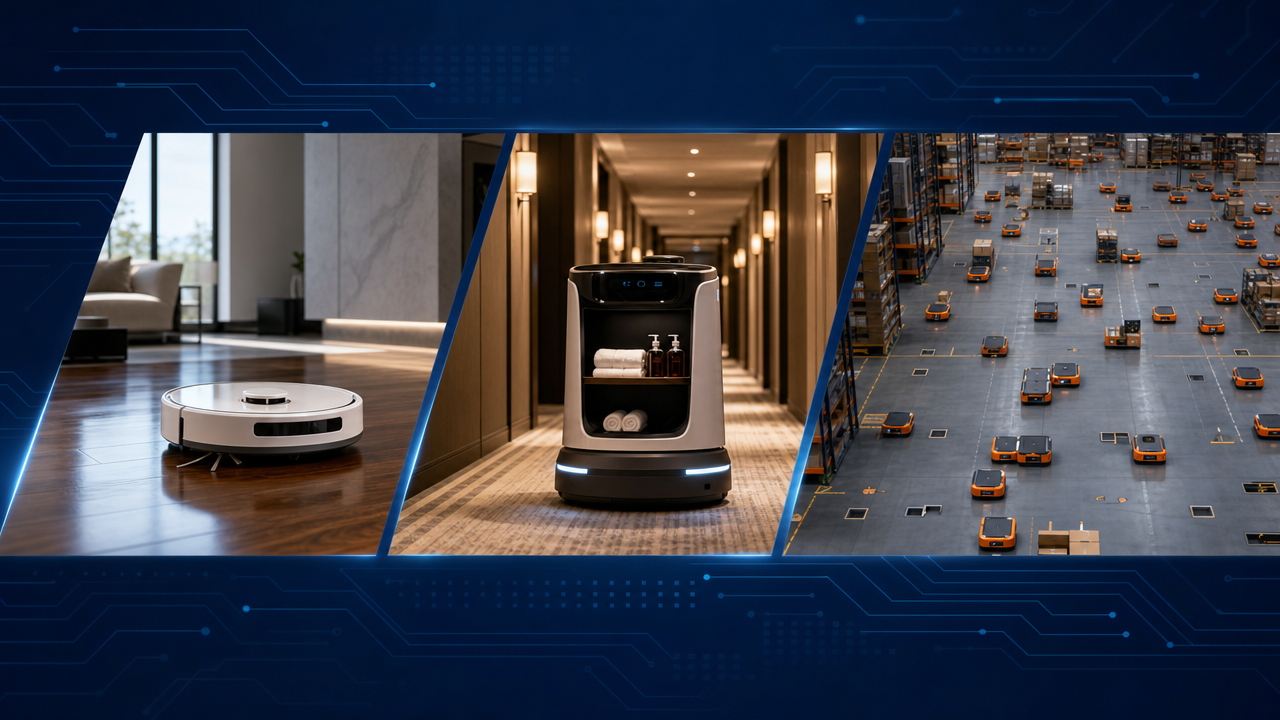
Service robots represent one of the most explosively growing sectors in Chinese manufacturing in 2025. Household robotic vacuums, restaurant delivery robots, hotel service robots, hospital logistics robots, commercial cleaning robots, and warehouse AGV/AMR systems are all growing simultaneously at high speed, collectively pushing China's service robot market toward approximately ¥200 billion (RMB), capturing roughly 40% of the global service robot market. This is not an ordinary industrial boom — Chinese companies have not only claimed the top position in shipment volumes, but have achieved leadership over incumbents in core technologies including AI algorithms, self-cleaning docking stations, multi-modal sensing, and warehouse scheduling systems.
The 2025 milestone list speaks for itself: Roborock (Stone Technologies) achieved revenues of ¥18.695 billion, up 56.5% year-on-year, with overseas revenue surpassing ¥10.4 billion for the first time, holding 21.7% global market share — the industry's undisputed leader; warehouse AMR giant Geek+ went public in Hong Kong in July at a market cap of HK$21.3 billion, maintaining its position as the world's #1 AMR supplier for six consecutive years; hotel robot leader Yunji Technology completed its Hong Kong IPO in October, surging 49% on its debut; and the pioneer of robotic vacuums, iRobot, filed for bankruptcy protection in December 2025 and was ultimately taken over by its Shenzhen contract manufacturer — marking the end of an era and the establishment of a new world order.
This report covers FY2025 and H1 2026 as its primary time window, providing a systematic analysis of China's service robot industry covering market scale, competitive dynamics, supply chain structure, technology roadmap, and forward projections.
Core Findings:
First, China's competitive advantage has evolved from "lowest cost" to "AI + cost" dual leadership. Roborock's RRmason algorithm, ECOVACS' YIKO-GPT, and Narwal's NarGPT each build proprietary on-device intelligence moats, while flagship product price bands remain at ¥3,000–9,000 — precisely why iRobot had no effective counter-strategy. Chinese brands possess faster iteration cycles (9–12 months vs. Western competitors' 18–24 months), more complete supply chain integration (Shenzhen LiDAR + Suzhou motors + Pearl River Delta control boards), and denser on-device AI data flywheels (real cleaning data from millions of active robots).
Second, commercial robot overseas deployment has moved beyond experimentation into core business operations. Keenon Robotics covers 60+ countries, PUDU Robotics covers 80+ countries, with cumulative shipments exceeding 120,000 units and overseas revenue accounting for over 80% of total revenue.
Third, warehouse AGV/AMR is the next major wave of overseas expansion. Geek+'s IPO day market cap exceeded HK$21 billion, with approximately 56,000 AMR units delivered to roughly 40 countries worldwide.
Fourth, commercial service robots and warehouse AMR will be the fastest-growing segments through 2026–2030, each with CAGR exceeding 35%. Household cleaning robots will enter a maturation phase, with technology competition shifting toward embodied AI and whole-home management.
Chapter 1 Definitions, Classification and Industry Chain Overview
1.1 The Essence of Service Robots
The International Federation of Robotics (IFR) defines service robots as semi-autonomous or fully autonomous robots that perform beneficial tasks for humans or equipment in non-industrial production environments. The core distinction from industrial robots lies in the degree of environmental non-structuredness and frequency of human-machine interaction. Service robots operate in environments filled with uncertainty — home living spaces, hotel corridors, hospital wards, restaurant floors, and warehouse aisles — where generalized perception, dynamic obstacle avoidance, human-robot collaborative safety, and multi-task scheduling are far more critical than absolute motion precision.
This distinction profoundly shapes technology choices. Multi-modal sensor fusion (LiDAR + cameras + IMU), SLAM mapping and navigation, natural language interaction, and on-device AI inference are the core competencies of service robots. This report covers four major categories: (1) household service robots (robotic vacuums, floor washers, companion robots); (2) commercial service robots (restaurant delivery, hotel delivery, commercial cleaning, medical logistics); (3) warehouse logistics robots (AGV, AMR, picking robots); and (4) specialty service robots (security patrol, outdoor delivery).
1.2 Industry Chain Structure
China's service robot supply chain is organized in five tiers:
| Tier | Key Segments | Domestic Supply Rate |
|---|---|---|
| Core sensors | LiDAR (SLAMTEC/RoboSense/Hesai), cameras, IMU, ToF | ~60% (mid-range) |
| Actuators | BLDC motors, servo motors, reducers, wheel systems | ~85% |
| Main chips/compute | Horizon Robotics Journey series, Rockchip RK3588, NXP | ~40% |
| Power systems | Li-ion battery packs, wireless charging, BMS | ~90% |
| System integration | Whole unit design, SLAM, AI models, cloud services, channels | ~95% |
The geographic concentration of this supply chain in the Suzhou/Shenzhen/Shanghai triangle creates a system-level competitive advantage: a new robotic vacuum model can move from product requirements to mass production in 9–12 months in China vs. 18–24+ months for Western competitors, enabled by having key suppliers within 100 km radius of final assembly.
Chapter 2 Global Landscape: iRobot's Exit, China's Five-Brand Dominance
2.1 iRobot's Bankruptcy: End of an Era
In December 2025, iRobot — the company that invented the Roomba and created the robotic vacuum cleaner category in 2002 — filed for Chapter 11 bankruptcy protection. The court confirmed the restructuring plan in January 2026, and Shenzhen-based contract manufacturer Shanchuan Robotics (its largest creditor and manufacturing partner) took over 100% of iRobot's equity. By H1 2025, iRobot's global smart vacuum market share had fallen to 7.9% — down more than 10 percentage points from H1 2023 — while it owed Shenzhen Shanchuan over $250 million (approx. ¥1.8 billion) against only $24.8 million in cash on hand.
iRobot's failure resulted from three compounding structural failures: failure to transition from vision SLAM to LiDAR SLAM during the 2016–2018 window (when Chinese manufacturers were aggressively rolling out affordable LiDAR-based navigation); reliance on the Amazon acquisition deal (announced at $1.7 billion in 2022, blocked by EU antitrust authorities in 2023, leaving iRobot without strategic backing or capital); and an inability to compete on the AI capability + price combination that Chinese brands had mastered by 2024. iRobot's demise is a textbook case of brand premium built on category leadership evaporating when it can no longer be backed by technology leadership.
2.2 Global Rankings — Household Cleaning Robots
In the first three quarters of 2025, global robotic vacuum market share by shipment volume:
| Rank | Brand | Parent Company | Global Share |
|---|---|---|---|
| 1 | Roborock | Stone Technologies (688169.SH) | 21.7% |
| 2 | ECOVACS | ECOVACS Robotics (603486.SH) | 14.1% |
| 3 | Dreame | Dreame Technology (unlisted) | 12.4% |
| 4 | Xiaomi | Xiaomi Group (1810.HK) | 10.0% |
| 5 | Narwal | Narwal (unlisted) | 7.5% |
| — | iRobot | Shanchuan Robotics (post-restructuring) | <7.9% |
The top five collectively hold 65.7% of global market share. Global clean robot market is forecast to ship approximately 32.1 million units in 2025, up 28.2% year-on-year, with Chinese brands accounting for more than 20 million units (IDC). The 2028 CAGR forecast is 26%.
2.3 Global Commercial and Warehouse Robot Landscape
In the commercial service robot segment, Chinese companies similarly dominate. Keenon Robotics held 22.7% global commercial service robot market share by shipments in 2024. PUDU held approximately 23% in 2023 (peak year) and remains a top-two global player. Both companies have expanded to 60+ and 80+ countries respectively, with overseas revenue exceeding 80% of total revenue.
In warehouse AMR, Geek+ (Geek Plus) holds 9.0% of the global warehouse fulfillment AMR market by revenue as of 2024 — the #1 position globally for six consecutive years. The overall market remains fragmented (top-4 players account for ~19.2% of revenue), with notable non-Chinese players including Exotec (France), MiR/OMRON (Denmark/Japan), and Locus Robotics (US).
European integrators — KION Group's Dematic (€11B revenue in 2024), Japan's Daifuku ($4.1B), and Germany's SSI Schäfer — remain competitive in fixed conveyor-based warehouse automation but have not matched the flexibility and cost trajectory of Chinese AMR systems.
Chapter 3 PEST: Policy, Economic, Social and Technology Environment
3.1 Policy Environment
China's "14th Five-Year Plan for Robotics Industry" (MIIT, 2021) targets >20% annual revenue growth in the robotics sector through 2025, with significant uplift in service robot application depth and breadth. The 2023 "Robot+" Action Plan (17 ministries) requires scaled deployments in medical, eldercare, construction, agriculture, and commercial logistics sectors.
Consumer subsidies for household service robots under China's 2025 "trade-in" program offer 15–20% discounts in multiple provinces, driving mid-range (¥2,000–4,000) product penetration. Medical robot procurement is supported by the National Health Commission's hospital intelligence upgrade requirements. On the export side, the US tariff regime (25–35% on Chinese robot products) has been effectively mitigated by Vietnamese manufacturing capacity — Roborock's Vietnam plant reached ~25% of total production capacity by 2025, leveraging Southeast Asian assembly rules of origin.
3.2 Economic Drivers
Labor cost inflation in China's service sector is irreversible and represents the fundamental demand driver for commercial robots. Average restaurant worker monthly wages exceeded ¥4,500 by 2025 (over ¥5,500 in tier-1 cities), making a delivery robot monthly rental of ¥1,500–2,500 (inclusive of maintenance) unambiguously cheaper than human labor. Simple ROI analysis yields 12–18 months payback — a clear positive economic case that overcomes B-end decision inertia.
The warehouse automation demand explosion is driven by China's daily parcel volume exceeding 170 million packages in 2025. Picker attrition rates in manual warehouses exceed 40% annually, making AMR deployment a competitive necessity for the top tier of e-commerce logistics operators.
Consumer premiumization continues to push household cleaning robot ASPs higher. The 6,000+ RMB tier's share of total unit sales grew by over 5 percentage points in 2025 year-on-year, reflecting sustained willingness to pay for advanced AI cleaning capabilities among urban households.
3.3 Social Drivers
China's 60+ population exceeded 320 million (22.7% of total population) by end-2025, entering deep aging society status. This demographic trajectory is the single most important long-term demand driver for service robots — from household cleaning and companion robots to hospital logistics and nursing assistance. Eldercare institutions and the National Civil Affairs Bureau's requirements for smart equipment in senior care facilities are creating structured institutional procurement demand.
Nationwide household robotic vacuum penetration at ~8% (vs. ~25% in tier-1 cities, ~18% in the US, ~15% in Germany) signals very substantial room for penetration uplift, especially in tier-2/3 cities and rural areas, driven by affordable mid-range product availability.
3.4 Technology Drivers
On-device AI maturation is the defining technology event of 2025. Three independently developed on-device AI inference engines — ECOVACS YIKO-GPT, Roborock RRmason, Narwal NarGPT — have entered mass production, enabling flagship household robots to understand complex natural language instructions like "clean the living room but avoid the cat's feeding area" and generate adaptive cleaning strategies based on household-specific learned preferences.
LiDAR cost deflation continues. SLAMTEC's RPLIDAR module batch pricing fell below ¥50/unit in 2025 for entry-level specifications, enabling mainstream mid-range vacuum robots to include LiDAR navigation. Industrial-grade LiDARs from RoboSense and Hesai saw machine robot segment shipments grow over 600% year-on-year as commercial and warehouse robots rapidly scaled deployment.
Chapter 4 China Market Size: Multi-Dimensional Breakdown of the ¥200 Billion Market
4.1 Total Market: ~¥200 Billion, +35% Growth
China's 2025 service robot market total is estimated at approximately ¥200–210 billion (RMB), representing roughly 35% year-on-year growth (absolute increase of approximately ¥50–55 billion). Breakdown by segment:
| Segment | 2025 China Market (est.) | Primary Channels |
|---|---|---|
| Household cleaning robots | ~¥120B | Online (JD/Tmall/TikTok) ~75% |
| Warehouse AGV/AMR | ~¥36B | Project-based B2B |
| Commercial delivery/service | ~¥30B | B2B, restaurant/hotel/medical |
| Commercial cleaning robots | ~¥15B | Commercial real estate, public spaces |
| Medical/specialty robots | ~¥10B | Hospital and institutional procurement |
Frost & Sullivan data supports a global warehouse AMR market of ¥360 billion growing to ¥1,725 billion by 2028 (CAGR 36.8%). China accounts for approximately 40–45% of this global market.
4.2 Penetration Rates and Headroom
Household cleaning robot penetration by city tier: tier-1 cities (25%), new tier-1 cities (12%), tier-3/4 cities (3–5%), national average (8%). Even a partial catch-up to Japan's ~18% would generate incremental demand for approximately 35 million units, worth over ¥100 billion at average ¥3,000 ASP.
Commercial robot penetration remains in the early stage: fewer than 5% of China's 6 million+ restaurant outlets use service robots; hotel penetration sits at ~8%; hospital inpatient logistics penetration at ~3%. All three segments have demonstrably positive ROI — the penetration constraint is decision inertia rather than economics, positioning them for accelerated growth as early adopters normalize the technology.
4.3 Export Dimension
China's service robot export revenue exceeded $4.2 billion (~¥30B) in 2025, combining household robot brand overseas revenue (Roborock at $1.45B + ECOVACS ~$1.23B + Dreame estimate + Narwal estimate) with commercial robot overseas sales (PUDU 80%+ overseas ratio × estimated total revenue). This export base, growing at 50–80% year-on-year, is transforming leading Chinese service robot companies from domestic champions into genuinely global companies.
Chapter 5 Supply Chain Deep-Dive: From Chips to Docking Stations
5.1 Sensor Layer: LiDAR as the Core Differentiator
SLAMTEC (Shenzhen) dominates low-cost rotating LiDAR for consumer vacuum robots (RPLIDAR series, batch price below ¥50). RoboSense and Hesai dominate commercial-grade solid-state and semi-solid LiDAR for commercial robots and warehouse AMR. The 600%+ YoY growth in robot LiDAR shipments in 2025 reflects rapid penetration of commercial and warehouse robot segments.
3D structured light cameras (Stone Technologies' approach) and Time-of-Flight depth cameras (ECOVACS's 3D dTOF) enable sub-1cm object recognition accuracy above 95% for common household obstacles, a critical functional threshold for flagship robot performance.
5.2 Main Controller Chip Ecosystem
Rockchip RK3588 (603893.SH, 8-core ARM + 6 TOPS NPU) is the dominant SoC for commercial service robots and mid-to-high-end household robots. Horizon Robotics J5/J6 (9660.HK, 10–40 TOPS) are crossing over from automotive to service robotics, with local Chinese toolchain (TogetherOS) enabling faster on-device AI integration for Chinese robot brands. NXP and STMicroelectronics dominate motor control MCUs, while Huichuan Technology (300124.SZ) continues gaining domestic share in servo drive modules.
5.3 Self-Cleaning Docking Station: Six Generations in Six Years
Narwal's 2019 innovation — automatic mop-cleaning base station — triggered one of the most impactful hardware innovation waves in the consumer robotics industry. By 2025, flagship docking stations offer up to seven integrated functions: automatic dust collection, automated wastewater drainage, automatic clean water replenishment, hot-air mop drying, cleaning fluid auto-dosing, 100°C steam sterilization (Roborock P10 Pro Ultra, Dreame X40 Ultra), and AI status monitoring. User intervention frequency has dropped from after-every-clean manual emptying to once every 30–60 days for consumables. This evolution transforms the product from a cleaning tool into a fully automated home cleaning system, and creates a consumables subscription revenue stream (dust bags, cleaning solutions) that increases long-term customer lifetime value.
5.4 Warehouse SLAM and Fleet Scheduling
Geek+'s FLASH scheduling system, capable of coordinating 1,000+ AMR units in a single warehouse, represents the current state-of-the-art in warehouse robot fleet management. Key capabilities: dynamic task assignment (real-time optimal task allocation across the fleet), multi-robot path planning with deadlock prevention, and reinforcement learning-based scheduling that improves picking efficiency by 15–20% over rule-based dispatch, while reducing deadlock probability by 90%+.
Chapter 6 Key Company Profiles: The Ten-Company Competitive Matrix
6.1 Stone Technologies / Roborock (688169.SH)
2025 revenue: ¥18.695 billion (+56.5% YoY). Overseas revenue: ¥10.442 billion (+63.46%) at 55.88% of total — overseas revenue surpassed domestic for the first time. Net profit: ¥1.363 billion (declined YoY due to strategic marketing investment increase). Global robotic vacuum market share: 21.7% (2025 Q1–Q3). Vietnam plant at ~25% of total production capacity. Core technology: RRmason algorithm v3.0 with 3D semantic mapping and contextual instruction understanding.
6.2 ECOVACS Robotics (603486.SH)
2025 revenue: ~¥19 billion (+15% YoY). Overseas revenue: ¥8.847 billion (+24.39%) — Europe +89.2%, US +86.5%. ECOVACS (DEEBOT series) + Tineco (FLOOR ONE floor washer) dual-brand platform covering automatic cleaning robots and active wet-cleaning appliances. Flagship products carry YIKO-GPT on-device AI, enabling multi-turn conversational control. Suzhou headquarters ecosystem anchors the household robot supply chain for the Yangtze River Delta.
6.3 Dreame Technology (unlisted)
Global robotic vacuum market share: 12.4% (2025 Q1–Q3), surpassing ECOVACS for the #3 global position. Strategy: flagship differentiation (X40 Ultra Complete with retractable robotic arm docking station, priced above ¥9,000) + aggressive overseas expansion (200%+ YoY growth in major European markets). Ongoing cross-category expansion into home appliances, smartphones (Dreame Space), and drones. Estimated valuation: >¥20 billion RMB.
6.4 Narwal (Narwal Intelligent / Cloud Whale, unlisted)
Global market share: 7.5% (rank #5, 2025 Q1–Q3). Flagship: Narwal J4 with NarGPT on-device AI and floating dual-disc cleaning technology. North American retail presence: ~300 Costco + Best Buy stores. European retail: 5,000+ outlets. Consumables ecosystem (dust bags, cleaning solution, antimicrobial components) drives high 12-month repurchase rates (>65% among premium user segment).
6.5 Keenon Robotics (擎朗智能, unlisted, IPO in progress)
Global commercial service robot market share: 22.7% by shipments (2024). Coverage: 60+ countries. Product lines: restaurant delivery (T-series), hotel service (T8 PRO), medical logistics (W3). Deep API integration with Meituan, Haidilao PMS, and Huazhu Group hotel systems enables full automation from order receipt to food delivery without restaurant infrastructure modification. Japan market entry via SoftBank Robotics partnership in 2025.
6.6 PUDU Robotics (普渡科技, unlisted, IPO in progress)
2025 financing: ~¥1 billion new round (Tencent, Changying Xin investors); post-money valuation >¥10 billion. Coverage: 80+ countries / 1,000+ cities. Cumulative shipments: 120,000+ units (10th milestone achieved). Overseas revenue ratio: >80%. 2025 revenue growth: >100% YoY. EBITDA approaching breakeven. Commercial cleaning robots (CC1 series) now account for >70% of revenue, up sharply from prior commercial delivery focus.
6.7 Yunji Technology (2670.HK)
Listed on Hong Kong Stock Exchange on October 16, 2025 (stock code 2670). Issue price: HK$95.6/share. Opening day surge: +49.37%. First-day market cap: ~HK$9.8 billion. 2024 revenue: ¥245 million (CAGR 23.2% from 2022–2024). Gross margin: 43.5% (up from 24.3% in 2022). Hotel scenario market share in China: 13.9% (exceeds #2–#5 combined). Total global hotel coverage: 34,000 hotels. Peak simultaneous active robots: 36,000 units/day. Annual service interactions: 500M+. H1 2025 AI agent application revenue: +194% YoY.
6.8 Geek+ (02590.HK)
Listed on Hong Kong Stock Exchange on July 9, 2025 (stock code 02590). Record-setting robot company HK IPO: raised HK$2.71 billion. First-day market cap: >HK$21 billion. Public tranche: 133x oversubscribed. International tranche: 30x oversubscribed (record for HK tech sector). 2024 revenue: ¥2.409 billion (CAGR 45% from 2021–2024). Adjusted EBITDA: first-ever positive. Global warehouse fulfillment AMR market share by revenue: 9.0%, #1 for six consecutive years. Global delivery: ~56,000 AMR units to ~40 countries. Key customers: Inditex (Zara), Amazon suppliers, global pharma.
6.9–6.10 Hikvision Robotics & SIASUN Robot
Hikvision Robotics (Hikvision subsidiary): 1,500+ customers in manufacturing AMR, leveraging parent company's camera and vision intelligence ecosystem. HK IPO in progress. SIASUN Robot (300024.SZ): China's oldest listed robot company (2009), with state-owned background providing access to medical logistics, rail transit, and government procurement. Solid but slower commercial velocity compared to Geek+ and Hikvision Robotics in the warehouse AMR segment.
Chapter 7 Industrial Clusters: Beijing, Shanghai, Suzhou, Hangzhou, Shenzhen
The Tianxia Gongchang factory database — covering 4.8 million real active manufacturing businesses — shows that service robot-related manufacturers are primarily concentrated in Guangdong, Jiangsu, and Shanghai, with Shenzhen having the highest density of robot OEM manufacturers and core component suppliers, and Suzhou forming a tightly clustered supply ecosystem around ECOVACS.
Beijing is the research and development hub: CASIA (Institute of Automation, Chinese Academy of Sciences), Tsinghua, PKU, and BUAA provide world-class robotics research. Keenon Robotics R&D center, Yunji Technology headquarters, and strategic research institutes for SIASUN are all based in Beijing. Yizhuang Robot Industrial Park has attracted 100+ robotics-related enterprises.
Shanghai is the commercial robot overseas deployment base: Keenon global sales HQ and PUDU Robotics headquarters are both located in Shanghai, together covering 140+ country markets. Quicktron (Alibaba ecosystem) and Hai Robotics maintain primary R&D centers in Shanghai. Cainiao (Alibaba logistics) Shanghai warehouse facilities represent some of the largest-scale AMR deployments globally.
Suzhou is the household robot manufacturing heartland: ECOVACS headquarters drives a supply ecosystem where BLDC motors, LiDAR modules, lithium battery packs, and injection-molded components can all be sourced within 100 km. Suzhou Hi-Tech Zone Robot Industrial Park hosts 80+ robot and component companies.
Hangzhou is the warehouse AMR algorithm hub and cross-border e-commerce AMR demand center: Geek+ algorithm R&D center focuses on FLASH scheduling; Cainiao (Alibaba) provides large-scale AMR test deployment; Yiwu cross-border e-commerce infrastructure (5M+ daily parcels) generates structural warehouse automation demand.
Shenzhen is the sensor cluster, OEM manufacturing base, and overseas production supply hub: SLAMTEC (low-cost LiDAR), RoboSense (high-end LiDAR), and DJI's technology spillover form the world's densest concentration of affordable LiDAR manufacturing capability. Shenzhen Shanchuan Robotics (iRobot acquirer) exemplifies the OEM/ODM capacity that supports global brands. Roborock's Vietnam plants draw supply chain heavily from Shenzhen for key components (main control boards, sensor modules, battery packs), enabling origin rule compliance while maintaining supply chain efficiency.
Vietnam overseas production lines are rapidly scaling: Roborock ~25% of total capacity (2025), ECOVACS Thailand/Vietnam growing, Dreame assessing Vietnam/India expansion. This Southeast Asian production diversification serves dual purposes: US tariff mitigation and geographic supply chain resilience.
Chapter 8 Segment Deep-Dives: Eight Application Scenarios
8.1 Robotic Vacuums: World's Largest Single SKU Category
Global robotic vacuum market: ~32.1 million units shipped in 2025, ~$12 billion market. China's five-brand oligopoly controls 65.7% of global volume share. Price band evolution: entry (¥500–1,500), mid-range (¥1,500–4,000), premium (¥4,000–6,000), flagship (¥6,000–9,000+). Price war intensity is highest in the mid-range where competitors are fighting to control the largest volume segment, with annual price declines of 15–20%.
8.2 Commercial Delivery Robots
Penetration logic: ¥1,500–2,500/month rental vs. ¥5,500+/month all-in labor cost → ROI approximately 12–18 months. McDonald's China completed 1,000+ restaurant deployments by 2025. Haidilao, Jiumaojiu, and Xibei Noodle Village completed scaled rollouts. Restaurant delivery robot core suppliers: Keenon (T8 Pro, T5E) and PUDU (BellaBot, KettyBot).
8.3 Hotel Service Robots
Yunji covers 34,000+ hotels globally, with particular strength in the Chinese market (13.9% market share). Core value: after-hours (22:00–08:00) deep service automation when labor costs are highest. Integration with hotel PMS systems and autonomous elevator control are key technical differentiators.
8.4 Warehouse AGV/AMR
Human picker throughput (manual): 50–80 items/hour. GTP + AMR system throughput: 300–500 items/hour (4–7x improvement). Cainiao, JD Logistics, and Vipshop core warehouse AMR coverage >80%, 60–70%, and 40–60% respectively. Geek+'s flagship P800/P1500 AMR: load capacity 800–1,500 kg, max speed 2.5 m/s, max single-warehouse deployment >1,000 units.
8.5 Commercial Cleaning Robots
Gausium (高仙机器人) is the dedicated specialist leader, with Zhilan series covering 2,000–3,000 m²/hour cleaning coverage across 40+ countries. PUDU CC1 series became PUDU's largest revenue segment in 2025 (>70% of total revenue). Gausium's differentiation: "human-robot collaborative cleaning" model where robots handle large regular-surface areas and humans handle corners, details, and edge cases.
8.6–8.8 Medical Logistics, Educational, and Security Robots
Hospital medical logistics (~¥30–40B market, growing toward ¥100B by 2030): high unit price (¥150,000–250,000/unit), long procurement cycles (6–12 months), complex system integration requirements. Security patrol robots (¥30–40B market, CAGR ~20%): GUOZI Robotics, DJI security, SIASUN specialty — primarily serving industrial parks, power facilities, and petrochemical facilities with IP66+ outdoor operation requirements.
Chapter 9 Technology Roadmap: From Rules to Foundation Models
9.1 Four-Generation Sensing Evolution
Generation 1 (2002–2015): Random collision, no mapping. Generation 2 (2019–2022): LiDAR SLAM, systematic path planning, <5% missed coverage. Generation 3 (2023–2024): LiDAR + camera + IMU multi-modal fusion, object recognition, <2% missed coverage, >95% recognition accuracy for objects >1cm. Generation 4 (2025–2026): On-device LLM (YIKO-GPT/RRmason/NarGPT), 3D semantic maps, natural language instruction understanding, contextual multi-turn dialogue, personalized adaptive cleaning strategy learning.
This four-generation evolution has driven on-device compute requirements from 1 TOPS to 6–40 TOPS, creating the market opportunity for domestic AI chip suppliers (Horizon Robotics J5/J6, Rockchip RK3588).
9.2 Self-Cleaning Base Station — Six Generations
2019: First auto mop-wash station (Narwal J1). 2021–2022: Auto wastewater drainage + auto water replenishment. 2023: Hot-air drying + auto cleaning fluid dosing. 2024–2025: Auto dust collection + auto sterilization + AI status monitoring. 2025–2026: 100°C steam sterilization + UV disinfection (Roborock P10 Pro Ultra, Dreame X40 Ultra). User intervention frequency: from after-every-clean manual emptying to once every 30–60 days for consumables. Base station functions now account for 40–60% of flagship robot BOM cost.
9.3 End-to-End AI in Warehouse AMR
Geek+'s next-generation AMR integrates Transformer-based end-to-end perception models, reducing obstacle reaction time from 500ms to <100ms and new warehouse mapping time from hours to <30 minutes. Reinforcement learning-based fleet scheduling (vs. rule-based dispatch) improves picking efficiency by 15–20% and reduces deadlock probability by 90%+ at 100+ AMR scale.
9.4 Data Flywheel: China's Deepest Moat
Roborock, ECOVACS, and Narwal together operate tens of millions of household robots in China, generating real-time cleaning data (trajectories, obstacle detections, user commands, cleaning quality feedback) that — once properly anonymized and consented — feeds model training to continuously improve AI algorithms. Dreame and Narwal's on-device model training datasets exceeded 1 billion frames in 2025. This data density is impossible for Western competitors to replicate on a 5-year horizon, representing China's most durable structural advantage.
Chapter 10 Risks: Price Wars, Tariffs, and Data Privacy
10.1 Price War: Structural Margin Erosion
Flagship-tier (¥6,000+) price declines: ~10–15% annually. Mid-range (¥2,000–4,000): >20% decline. Roborock's 2025 net income declined ~31% despite 56.5% revenue growth (strategic marketing and market share investment). Long-term: price war accelerates market share concentration, but compresses margin profiles and constrains absolute R&D spend for all participants.
10.2 Trade Barriers and Tariff Risk
US tariffs on Chinese robot products (25–35% for robot and component categories) are partially offset by Vietnamese production lines (25% of Roborock capacity). EU Cyber Resilience Act compliance costs estimated at ¥1.5–3M per product line. Ongoing Amazon-iRobot acquisition analogue: any Chinese robot company attempting overseas brand acquisitions may face similar antitrust scrutiny on data sovereignty grounds.
10.3 Data Privacy
European GDPR enforcement bodies initiated compliance investigations into several Chinese household robots in 2025, focused on cloud data transfer legality and user consent mechanisms. Roborock and Narwal's "edge-first, user-controlled" design is the industry's best-practice response, limiting sensitive household spatial data from leaving the device without explicit consent.
10.4–10.5 Reliability Challenges and Supply Concentration
Commercial delivery robot failure rates remain at ~2–3%/month in actual high-frequency deployments — peak-period capacity gaps remain an optimization target. Supply chain geographic concentration (Suzhou/Shenzhen/Shanghai triangle) creates systemic vulnerability to natural disaster or major disruption events; the 2022 Shanghai COVID lockdown demonstrated this weakness when quarterly shipments fell 30%+ across major brands.
Chapter 11 Forecast 2026–2030: Three-Track Globalization and CAGR Projections
11.1 Market Scale Projections
| Segment | 2025E (¥B) | 2027E (¥B) | 2030E (¥B) | CAGR 2025–2030 |
|---|---|---|---|---|
| Household cleaning robots | 120 | 158 | 242 | ~15% |
| Commercial delivery/service | 30 | 58 | 152 | ~38% |
| Commercial cleaning | 15 | 26 | 57 | ~30% |
| Warehouse AGV/AMR | 36 | 62 | 183 | ~38% |
| Medical/specialty | 10 | 16 | 35 | ~29% |
| Total | ~211 | ~320 | ~669 | ~26% |
11.2 Overseas Revenue Trajectory
Roborock's overseas revenue crossed 50% of total in 2025 (55.88%). By 2028, the entire household cleaning robot industry's overseas revenue is projected to exceed domestic by 20–50%. Commercial robots: PUDU already at 80%+ overseas, projected industry-wide commercial robot overseas revenue to surpass $5B by 2027–2028. Warehouse AMR: Geek+'s overseas revenue projected to exceed 40% of total by 2028.
11.3 Concentration Trends
Household: CR5 from 65.7% to 75–80% by 2030. Commercial delivery: Keenon/PUDU CR2 ~45%, projected CR5 >70% by 2030. Warehouse AMR: global CR5 from ~19% to ~35–40% by 2030, with Chinese companies holding 3–4 of the 5 positions.
11.4 Price Curves
Entry-tier household robots: flagship functions (LiDAR + path planning + auto-return) to drop below ¥800 by 2028. Flagship tier: AI capability + robotic arm base + whole-home semantic understanding to drive ASP up toward ¥12,000+. Standard warehouse AMR unit price to fall from ¥150,000–200,000 currently to ¥50,000–80,000 by 2030, enabling mid-tier warehouse enterprise adoption.
Chapter 12 Conclusions: China's Service Robots at the Global Pinnacle
Tianxia Gongchang's database — covering 4.8 million real active manufacturing businesses — records the scale, geographic distribution, and product iteration velocity of service robot OEMs and component suppliers across China in 2025. These data points corroborate this report's central thesis: China's service robot industry is completing the transition from "the world's largest production base" to "the world's leading center for R&D, innovation, and global brand deployment."
2025 is a historic watershed year for China's service robot industry.
iRobot's bankruptcy transferred global robotic vacuum market leadership from Boston to Beijing and Suzhou. Geek+'s IPO established Chinese companies as the architects of the global warehouse AMR capital narrative. Yunji's listing validated the commercial viability of robot-as-a-service models in non-consumer settings. PUDU's 120,000-unit deployment milestone across 80 countries established commercial robots as a genuine global business platform.
Three narrative threads converge in 2026:
Thread 1: AI + price dual dominance. A ¥3,000 mid-flagship robot delivers AI cleaning capabilities that iRobot's same-era products could not match. A ¥9,000 ultra-flagship creates the "embodied AI home agent" category. This is not a cost competition — it is simultaneous leadership on both technology capability and cost structure, which is the hallmark of true innovation-driven competitive superiority.
Thread 2: Overseas is the default operating mode. Roborock's overseas revenue exceeded domestic in 2025. Dreame and Narwal are in Costco and Best Buy. Keenon and PUDU service robots operate across six continents. As of 2026, "going global" is not a strategic option but the default business model. US tariff pressure catalyzed Vietnam production lines, inadvertently accelerating the maturation of China's global manufacturing network.
Thread 3: Commercial and warehouse robots are the next 10× growth. Household cleaning robots are maturing. Commercial delivery robots and warehouse AMR remain at sub-10% penetration with CAGR exceeding 35%. The Geek+/PUDU/Keenon Hong Kong IPO wave is providing the capital fuel for this segment's global acceleration. By 2030, combined commercial and warehouse robot revenues will exceed household cleaning robots, shifting the industry's center of gravity from consumer products to B2B infrastructure.
This global ascent is not without risks — price wars eroding margins, trade barriers constraining export growth, EU data privacy compliance pressure, acquisition path restrictions from the iRobot antitrust precedent. But the technology capabilities, supply chain advantages, and global channel networks that Chinese service robot companies have built represent a competitive moat that rivals cannot replicate within 5 years.
China's service robot globalization is a systematic offensive: AI capability as engine, complete supply chain as chassis, global distribution as wheels. This situation is irreversible.
Data Sources
The following data sources support the core factual judgments of this report. The Institute has used its factory database as a bottom-up verification baseline for supply chain distribution and manufacturing capability.
I. Industry Research Institutions
- IDC — Global Smart Home Cleaning Robot Market Tracker 2025 (Q3 2025 data): 32.1M units global shipments, 26% 2025–2028 CAGR
- Frost & Sullivan — China Service Robot Market Monthly Tracker 2025: market share data cited in Yunji and Geek+ IPO prospectuses
- Zhishui Consulting (Zhixin Consulting) — Global Warehouse AMR Solution Market Report (referenced in Geek+ HK prospectus): ¥360B in 2023, ¥1,725B by 2028
- Touyan Research Institute — Intelligent Service Robot Industry Report 2025
- IFR — World Robotics 2025 Service Robots Report
- Qianzhan Industry Research Institute — China Household Service Robot Industry Survey 2025
- OFweek Industry Research Center — China Robot LiDAR Industry Survey 2025
- Global Info Research — Logistics AGV & AMR Global Market Size and Trends 2025
II. Listed Company Filings and Corporate Announcements
- Stone Technologies (688169.SH) — 2025 Annual Report (April 2026): revenue ¥18.695B, overseas revenue ¥10.442B, net income ¥1.363B
- ECOVACS Robotics (603486.SH) — 2025 Annual Report: revenue ~¥19B, Europe +89.2%, US +86.5%
- Geek+ (02590.HK) — Hong Kong Stock Exchange IPO Prospectus (2025): revenue ¥2.409B, global AMR share 9.0%, 56,000 units to 40 countries
- Yunji Technology (2670.HK) — Hong Kong Stock Exchange IPO Prospectus (2025): 34,000 hotels covered, hotel market share 13.9%, IPO opening surge 49.37%
- SIASUN Robot (300024.SZ) — 2025 Performance Quick Report
III. Financial Media and Professional Analysis
- 21st Century Business Herald — "Global Robotic Vacuum Market: Roborock at Top, Dreame Overtakes ECOVACS" (May 2026)
- 36Kr — "Roborock Profits Double ECOVACS; Robotic Vacuum Wars Head Overseas" (May 2025)
- JieMian News / 21jingji.com — "Robotic Vacuums 2025: Old King Falls, New Powers Rise" (January 2026)
- Securities Times — "Robotic Vacuum Pioneer iRobot Bankrupt; Chinese OEM Takes Over"
- First Financial (Yicai) — "Chinese Commercial Robots 'Invade' Overseas: How Supply Chain Cost Reduction Drives Down Prices"
- OFweek Smart Home — "Chinese Robotic Vacuum Brands Rise: Roborock, ECOVACS, Others Reshape Global Landscape" (December 2025)
- Sina Finance — "PUDU's 100,000th Robot Off Production Line" (June 2025)
- Sina Finance — "Yunji Technology Officially Lists on HKEx: Opening Surge ~50%" (October 2025)
- Sina Finance — "Geek+ Officially Lists on HKEx: Global Smart Logistics Robot First Stock Born" (July 2025)
- VacuumWars — Inside iRobot's Sale: Reactions From Founders, Competitors, and the Industry
- 36kr EN — How iRobot Lost the Robot Vacuum Wars: From MIT Pioneer to Chinese Takeover
- CNBC — Roomba's Bankruptcy May Wreck More Than One Robot Vacuum Maker (December 2025)
- k2-partners.com — How iRobot Lost the Robot Vacuum Wars
- elevenflo.com — iRobot Corporation: Prepackaged Plan Transfers Ownership to Picea
IV. Policy Documents
- Ministry of Industry and Information Technology — "14th Five-Year Plan for Robotics Industry" (2021)
- MIIT and 16 Other Ministries — "Robot+" Application Action Plan (2023)
- National Health Commission — Action Plan for Improving Medical Experience and Patient Satisfaction (2023–2025 implementation)
- Beijing Municipal Science and Technology Commission — Beijing Robotics Industry Special Support Policy (2025)
- Qianzhan Industry Research Institute — Summary and Analysis of 2024 Service Robot Industry Policies for China and 31 Provinces
V. Research Institute Independent Verification
- Tianxia Gongchang Industrial Research Institute Factory Database — Service robot OEM and core component supplier geographic distribution statistics (December 2025 data cross-section), validating industrial cluster concentration characteristics and supply chain completeness