
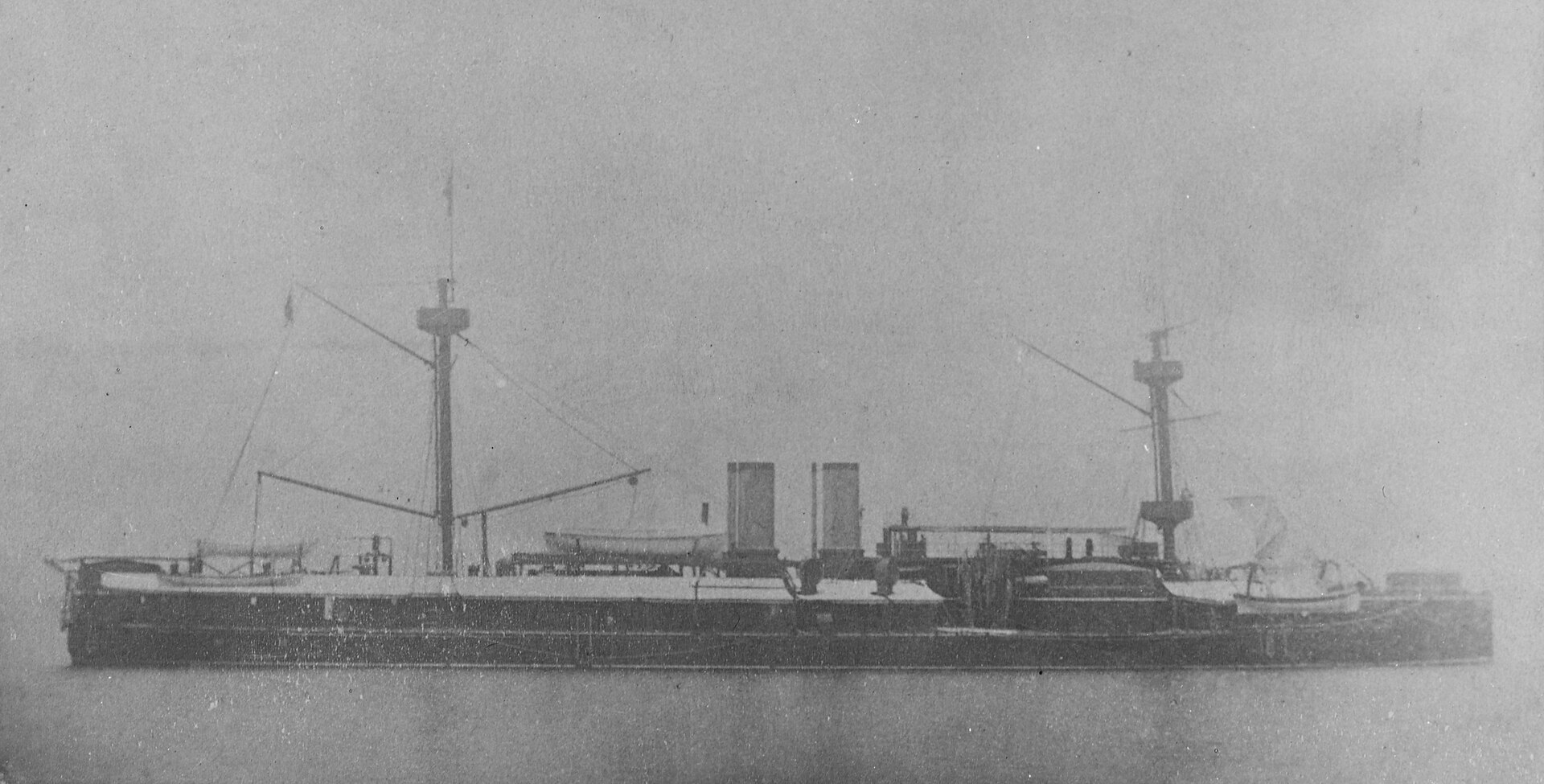
In August 1868, a wooden paddle-wheel gunboat slid down the ways at Gaochangmiao in Shanghai and into the Huangpu River. She was called the Tianji — a name chosen by Zeng Guofan to evoke "calm seas and a prosperous yard" — and later renamed the Huiji (originally named Tianji) to avoid a taboo on the Guangxu Emperor's given name. She displaced roughly 600 tons, was driven by a 392-horsepower steam engine, and was the first steam-powered warship built by Chinese hands. The factory that built her had just turned three years old.
One hundred and fifty-four years later, in June 2022, again in Shanghai and again at a berth near the mouth of the Huangpu River, an aircraft carrier displacing more than 80,000 tons was launched. She was named the Fujian, hull number 18, fitted with three electromagnetic catapults — China's first catapult-equipped carrier, and at the time the only conventionally powered carrier in the world to use electromagnetic launch technology.
The Jiangnan Arsenal (Jiangnan Machine Manufacturing Bureau) that built the Huiji and the Jiangnan Shipyard that built the Fujian share an unbroken lineage. The 1865 ordnance works spun off the Jiangnan Dock in 1905, was redesignated the Naval Jiangnan Shipbuilding Institute in 1912, formally renamed Jiangnan Shipyard in 1953, and in 2008 relocated entirely to Changxing Island at the mouth of the Yangtze. The name changed several times; the bloodline did not. From the Huiji to the Fujian, 154 years and six generations of shipbuilders.
Over those 154 years, a ship remained a ship — steel, propulsion, people, something that floats. What changed was the people who built it, and the nation standing behind them. This article sets out to answer a question that sounds simple: given the same city and the same institutional lineage, why could the ship launched in 1868 not sustain a nation, while the one launched in 2022 could?
Pulling that thread straight, one finds that this is not really a history of shipbuilding. It is a history of how an industrial system comes into being. What a shipyard can build has never depended on that one yard alone; it has always depended on the level of industrial development in the country behind it.
I. The Dockyards of the Self-Strengthening Era (1865–1894)
In September 1865, the Jiangnan Arsenal was established in Shanghai. It was born of an acquisition: Li Hongzhang purchased Thomas Hunt & Co., an American-owned ironworks operating in Hongkou, for tens of thousands of taels of silver, then merged into it two Western-arms bureaus from Suzhou and Shanghai to create what became China's largest government-run armaments factory of the modern era. The guiding mind behind the project was Zeng Guofan, who even allocated 68,000 taels of silver and commissioned Yung Wing — a Yale graduate — to travel to the United States and procure more than a hundred sets of machinery and equipment. Two years later, the factory moved from Hongkou to Chenjiagang in Gaochangmiao south of the city, dug its first earthen dry dock, and began building ships.
In the early years, it produced tangible results. The Huiji of 1868 was followed in 1869 by the Caojiang — China's first screw-propelled warship — and around 1872 by the Hai'an and the Yuyuan, each displacing roughly 2,800 tons and representing the first Chinese-built warships to exceed 2,000 tons. The construction of the Huiji was supervised by the father-and-son engineers Xu Shou and Xu Jianyin, together with Hua Hengfang — among the earliest self-taught engineers China produced. The steam engine and boiler aboard were manufactured in-house, however crude.
But the limits of this enterprise became apparent quickly. In the forty years from 1865 to 1905, the Jiangnan Arsenal launched a total of just fifteen vessels — building in fits and starts. In 1875 the shipbuilding program was suspended altogether, not for technical reasons but financial ones: it cost more to build a ship domestically than to buy two equivalent vessels from Britain. The cost inversion was severe.
The roots of that inversion lay outside the workshops. The steel, machinery, tools, and even bolts required for shipbuilding were almost entirely imported; even the coal to fire the boilers could not be sourced domestically to an adequate standard, so foreign coal had to be purchased as well. Technical oversight of the shipbuilding department remained for years in the hands of British engineers. The factory could assemble a hull, but it could not assemble the industrial foundation required to build ships on a sustained basis.
Beyond shipbuilding, the factory was engaged in another enterprise: the manufacture of knowledge. In 1868, the Jiangnan Arsenal established the Translation Bureau, hiring the Briton John Fryer and recruiting Chinese scholars such as Xu Shou and Hua Hengfang. Fryer worked at the bureau for twenty-eight years, collaborating with his Chinese colleagues to translate more than a hundred works spanning mathematics, chemistry, mining and metallurgy, mechanics, and military technology. Xu Shou presided there over the creation of a Chinese-language system of chemical nomenclature, and he was the first Chinese national to publish an article in the journal Nature. That a shipyard simultaneously operated a translation bureau is itself telling: what China lacked at that moment was not merely a ship, but the entire body of modern knowledge required to build one — from individual formulas and manufacturing processes to the complete vocabulary of industry, all of which had to be translated and learned from scratch.
Running in parallel with the Jiangnan Arsenal was another thread worth noting. In 1866, Zuo Zongtang founded the Fuzhou Navy Yard at Mawei in Fujian, with Shen Baozhen as superintendent and the Frenchman Prosper Giquel as director-general. Attached to it was the Fuzhou Naval Academy — its front school teaching shipbuilding, its rear school teaching navigation. The academy went on to train China's first generation of naval officers and marine engineers; many of the men who later held leading positions in the Beiyang Fleet and at shipyards across the country had passed through its gates. In an era when few good ships could yet be built, the Fuzhou Naval Academy was already producing the people who could build them — and that may have been the more durable legacy of the Self-Strengthening Movement. In 1888 the Fuzhou Navy Yard launched the Pingyuan, a full-steel warship of 2,100 tons: China's first warship designed and built entirely without foreign involvement in the design process.
The Pingyuan demonstrated that Chinese engineers could by then independently design and build a creditable modern warship. The irony, however, was that when the Qing court came to assemble a fleet, the domestically produced Pingyuan was little more than an afterthought. The Beiyang Fleet, commissioned in 1888, was built almost entirely on foreign purchases: the ironclads Dingyuan and Zhenyuan came from the German shipyard Vulcan; the Zhiyuan and Jingyuan were ordered from Armstrong in Britain; the Jingyuan (经远) and Laiyuan from Germany again. An entire fleet had been bought back from Europe with hard silver.
This was a revealing choice. It reflected a belief among the decision-makers of the day that "buying a ready-made fleet" and "sustaining an industry capable of building one" were separable objectives — and that they preferred the former. Purchasing ships produced results quickly; building up an industry did not. Buying a single Dingyuan was far simpler than maintaining the Jiangnan Arsenal. But the arithmetic was wrong. A single Dingyuan-class ironclad cost more than six million marks; the aggregate silver expended to assemble the entire Beiyang Fleet was a staggering sum. Had those resources been channelled into dockyards, steelworks, and machinery plants, they could have purchased the capacity to build warships continuously. Buying ships yielded a one-time stock of hardware; building industry cultivated a renewable capacity. The decision-makers spent vast sums of silver to acquire the former and forgo the latter — until the First Sino-Japanese War laid out the answer to that equation in blood.
The First Sino-Japanese War of 1894–1895 settled the account. At the Battle of the Yalu River, five Beiyang Fleet vessels — the Zhiyuan, Jingyuan (经远), Chaoyong, Yangwei, and Guangjia — were sunk. The following February, the remnant fleet was besieged at Weihaiwei on Liugong Island and finally annihilated. The warships that had been purchased, together with the silver that had been spent on them, sank together into the sea.
After the war, the lesson many drew was "our ships were inferior to Japan's." The more accurate formulation is this: thirty years of shipbuilding under the Self-Strengthening Movement produced the Huiji and the Pingyuan, but did not produce a country capable of building ships. Steel depended on imports; machinery depended on imports; propulsion systems depended on imports; the technical staff were foreigners; management operated as a government bureau. Every ship was an isolated product, floating on the water with no industrial system beneath it to hold it up.
This is the first time this article arrives at that judgment. It will not be the last.
II. Drift and a Flicker of Light (1895–1949)
As the twentieth century opened, the Jiangnan Arsenal underwent a significant reorganization. In 1904, Zhou Fu, the Governor-General of Liangjiang, submitted a memorial arguing that combining shipbuilding with arms manufacture produced inefficiency, and advocated separating the two functions. The following year, the shipbuilding operations were formally constituted as an independent entity: the Jiangnan Dock.
The results were immediate. In the first six years after the separation (1905–1911), the Jiangnan Dock built 136 vessels and repaired 524 — compared with a total of just 15 ships built over the preceding forty years under the Arsenal. The same workers, the same berths: once institutional constraints were loosened, productive capacity was released at once. That contrast alone makes the point: what had held back Chinese shipbuilding was never technology alone.
In 1912, following the establishment of the Republic, the Jiangnan Dock was transferred to the Ministry of the Navy and renamed the Naval Jiangnan Shipbuilding Institute, with Chen Zhaoqiang — a graduate of the Fuzhou Naval Academy — as its first superintendent. When he took over, the factory carried debts of 200,000 taels with a ten-year repayment schedule. He cleared them in one year.
The factory's true moment of distinction came in 1918.
That year, the First World War was drawing to a close. Germany's submarine campaign had inflicted devastating losses on Allied merchant shipping, and the U.S. government had established the U.S. Shipping Board and the U.S. Emergency Fleet Corporation, ordering transport vessels in large numbers around the world. Late in 1917, the American consul in Shanghai sent a letter of inquiry to the Naval Jiangnan Shipbuilding Institute; in 1918 the U.S. Emergency Fleet Corporation signed a formal contract for the construction of four 10,000-ton steel cargo ships, with a total contract value of approximately US$7.8 million. The ships were built to design designation EFC 1092 — a set of drawings produced by the Naval Jiangnan Shipbuilding Institute itself. The steel required for construction was purchased in the United States and shipped to China.
The four ships were named the Mandarin, the Celestial, the Oriental, and the Cathay, each with a deadweight tonnage of 10,000 tons, a full-load displacement of approximately 14,750 tons, and an overall length of 135 metres. The lead ship, the Mandarin, was launched in June 1920 and completed sea trials in February 1921, achieving a measured speed of 13 knots — exceeding the contractual specification. The American inspectors' verdict: the results were excellent; these were "the finest vessels" in the U.S. transport fleet.
This was the first time a Chinese shipyard had built large ocean-going vessels for an advanced industrial nation, and the first export orders ever received by the Chinese shipbuilding industry. Contemporary Chinese and foreign press alike declared it "a new epoch in the history of Chinese industry." Among the engineers involved in building these ships was one Ye Zaifu, a master's graduate in naval architecture from MIT who joined the Naval Jiangnan Shipbuilding Institute in 1918. By the eve of the Second Sino-Japanese War, he had designed close to 300 vessels of various types and went on to become one of the founding figures of modern Chinese naval architecture.
The four sister ships dispersed into the storms of the twentieth century on separate courses. The Celestial passed through several American shipping companies and several name changes; by the Second World War she had been renamed SS Arkansan. In June 1942, she was torpedoed by a German submarine off the west coast of the United States. A ship built in Shanghai came to rest on the far side of the Pacific. The Mandarin and her sisters had established one thing beyond doubt: China did not lack the hands to build ships, nor the minds to draw them.
But that light was isolated. Widening the lens to the full picture of Republican-era shipbuilding reveals a different scene. Between 1905 and 1937, the Naval Jiangnan Shipbuilding Institute built more than 700 vessels of various types, of which foreign orders accounted for 65 percent — it survived on overseas contracts. The facilities at Dalian Shipyard were controlled by Japan's South Manchuria Railway Company, with Japanese nationals filling every technical management post; Chinese workers could rise no higher than foreman. The Mawei Shipbuilding Works was paralysed by chronic funding arrears from Fujian Province and in 1921 had to borrow from American trading houses just to keep operating. Qiuxin Shipbuilding, the most prominent privately owned shipyard in Shanghai, suffered heavy losses from the wartime surge in steel prices during the First World War and was effectively absorbed by French capital, with the Chinese shareholding completely displaced.
In the era of warlord fragmentation, a comprador logic circulated through official circles: "Better to buy a ship than build one; better to rent one than buy one." For half a century, the Chinese shipbuilding industry survived on foreign orders, always an inexpensive subcontractor within someone else's system rather than an integrated element of its own.
When the Second Sino-Japanese War broke out, even that flicker nearly went out. In November 1937, Japanese forces occupied Jiangnan Shipyard; the following year it was transferred to the Japanese Navy and entrusted to Mitsubishi Heavy Industries, renamed "Mitsubishi Heavy Industries Jiangnan Shipbuilding Works," with Japanese personnel replacing the Chinese at every level from superintendent to foreman. Before the occupation, the workers had left another kind of record: after the Battle of Shanghai opened in 1937, they scuttled more than ten vessels to block the waterway, then crippled the Izumo — the Japanese Navy's flagship moored in the river — with homemade mines. Throughout eight years of Japanese occupation, organised go-slow resistance never ceased. These scattered acts of defiance could not alter the course of the war, but they attest that the people of this factory always knew for whom they were building ships, and by whom those ships had been taken from them.
In the midst of the war, Ye Zaifu and Guo Xifen led more than twenty engineers and technicians inland, carrying a consignment of equipment through Wuhan and Chenxi in Hunan Province before reaching Chongqing in the winter of 1939. By the eve of 1949, only twenty major shipyards remained nationwide, with a total workforce of fewer than 20,000. Before retreating, Nationalist forces destroyed Jiangnan Shipyard's dry docks, building berths, and principal workshops, then removed more than 5,000 tons of equipment and over 80,000 tools and materials to Taiwan. The factory that had built the Huiji and the Mandarin was left very nearly stripped bare.
The glory of the Mandarin and the ruins that followed were not contradictory. They pointed toward the same conclusion: a ship could be fine, but a country repeatedly torn apart by war, indemnities, comprador capitalism, and foreign capital could not offer shipbuilding the stable environment it needed to take root. The system behind the ships — that system, as late as 1949, still did not exist.
III. The Soviet Teacher (1949–1960)
In May 1949, the Shanghai Military Control Commission took over Jiangnan Shipyard. The workshops had been stripped bare, the dry docks blown apart; everything had to be rebuilt from rubble.
The years that followed brought sweeping nationalization. Jiangnan Shipyard received its formal name in 1953. The British-owned Mohler shipyard was requisitioned in 1952 and rechristened the state-owned Hudong Shipyard. Scattered dockyards and repair yards across the country were consolidated into a unified shipbuilding administration.
But what truly reshaped Chinese shipbuilding came from the north.
Among the Soviet-assisted 156 Projects, four fell within the shipbuilding sector, including Bohai Shipyard at Huludao and the expansion of Dalian Shipyard. In June 1953, China and the Soviet Union signed an agreement on naval procurement and technical assistance. Its centerpiece was licensed production: the Soviets would transfer complete blueprints, critical materials, and manufacturing licenses for a set of warship types, and Chinese yards would build them accordingly.
Six types were transferred. China assigned them its own designations: the Type 6601 frigate, the Type 6602 torpedo boat, the Type 6603 submarine, and others. The Type 6601 frigate was built by Hudong Shipyard; the lead ship, the Kunming, was laid down in 1955. The Type 6603 submarine was assigned jointly to Jiangnan Shipyard and Wuhan Shipyard, with Jiangnan building thirteen boats. The first Type 6603 launched by Jiangnan was commissioned in 1957 under the name "New China No. 15." That a shipyard and a submarine would both carry the name "New China" speaks to the spirit of the era: a shipbuilding industry interrupted for decades by successive wars and successive looting was reassembling itself, one hull at a time. In January 1956, Mao Zedong visited Jiangnan Shipyard to inspect the submarine construction — the only such visit he ever made. In 1959, the two countries signed a second agreement, transferring technology for a newer generation of vessels, including missile-carrying submarines.
From an industrial-systems perspective, the decade's significance lay not in the specific warship types, which would soon be obsolete, but in this: Chinese shipbuilding had, for the first time, seen what a complete system looked like.
Earlier encounters had been piecemeal. The Self-Strengthening Movement brought in individual foreign technicians; the Republic of China received one-off foreign orders. The Soviets offered something different — a view of what a shipbuilding nation actually looked like as a system: the grade standards for marine steel, the procedural specifications for welding, the division of labor among design institutes, steelmills, machinery plants, shipyards, and component suppliers. It was a coherent methodology spanning design, materials, processes, and management. Chinese shipbuilding had, for the first time, a systematic teacher.
Yet licensed production was, in the end, assembly by instruction. The blueprints were Soviet; many of the critical steel grades and components still had to be shipped from the USSR. In structural terms, Chinese yards remained downstream in the Soviet shipbuilding chain — the work had been upgraded from "procurement" to "contract manufacturing," but the dependency was unchanged. That chain had one fatal weakness: if the upstream supplier cut off supply, the downstream operations halted immediately.
In July 1960, the Soviet Union notified China that it was recalling all its experts in the country. Over 1,300 specialists departed in staged withdrawals. The first agreement had by then been substantially fulfilled, so its disruption was limited; the second agreement, barely a year into execution, suffered a far heavier blow — component supplies ceased, and a number of projects under construction stalled.
The teacher had left. He took the blueprints and the equipment, and with them the prospect of further technical support. But there was one thing he could not take: the fact that Chinese shipbuilding had now seen a complete industrial system. The question that remained was whether China could, on the strength of that exposure alone, build the system out on its own.
IV. Becoming One's Own Teacher (1960–1978)
In the decade and more following the Soviet withdrawal, the situation facing Chinese shipbuilding could be summarized in a single phrase: the shift from made in China to made by China.
"Made in China" meant assembling ships on Chinese slipways using Soviet blueprints, Soviet materials, and Soviet equipment. "Made by China" meant solving design, materials, propulsion, and components entirely on one's own. The distance between the two was precisely the distance of a complete industrial system.
During this period, Chinese shipbuilding produced several works of real weight. In 1968, Dalian Shipyard laid down the Type 051 (Luda-class) guided-missile destroyer; the lead ship, the Jinan, entered service in 1971 — China's first domestically built generation of guided-missile destroyers. In 1970, China's first attack nuclear submarine was launched at Bohai Shipyard in Huludao, commissioning in 1974. In 1977, Jiangnan Shipyard launched the space-tracking ship Yuanwang 1, built for spaceflight tracking and command missions — making China the fourth country in the world capable of independently building such a vessel, after the United States, the Soviet Union, and France.
These vessels shared a common condition: none of them had a teacher. There were no blueprints to copy, no experts to consult, and at the outset no certainty that they could be built at all. The Type 051 destroyer took three years from keel-laying to commissioning; the nuclear submarine program took the better part of a decade. Slowness was the defining characteristic of the era. But slowness had a counterpart: every problem solved meant that capability had been genuinely absorbed into China's own industrial fabric, and no one could ever take it away.
The most instructive vessel of this period, however, was a civilian freighter: the Dongfeng.
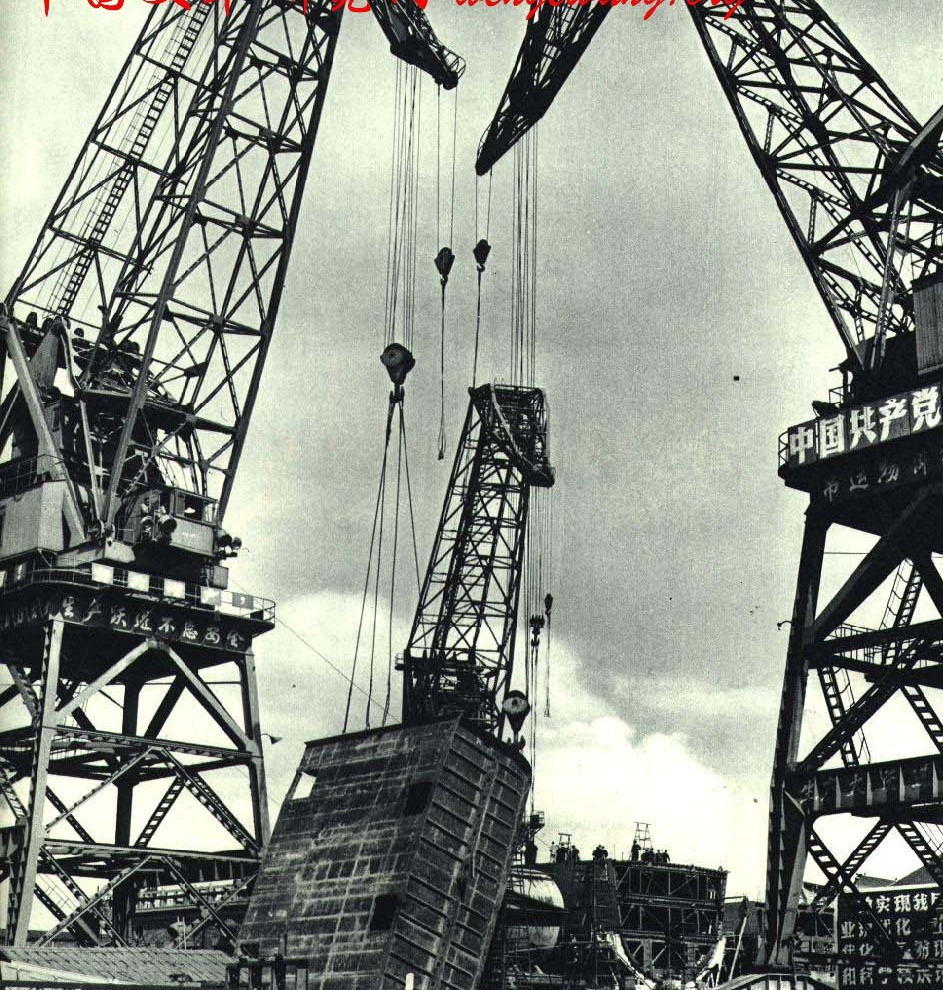
The Dongfeng was a 10,000-ton oceangoing cargo ship. Design work began in 1958 at Jiangnan Shipyard, led by chief designer Xu Xueyan — who led his team through the full technical and construction design in nine months and later became an academician in Chinese naval architecture. In April 1960, the hull slid from the slipway into the Huangpu River; but the ship was not delivered until late 1965. Between launching and delivery lay five and a half years — not idle time, but waiting: waiting for Chinese industry to supply, one by one, everything the ship required that China could not yet make.
The Dongfeng's real significance lies in two details.
The first is the contrast with the Yuejin. Launched at Dalian in 1958, the Yuejin was built from Soviet turnkey blueprints using Soviet-designed steam turbines; blocked from importing components, it struggled for years to operate reliably. It was, in substance, a Soviet ship built in China. The Dongfeng was different. It was designed entirely in China. Its main engine was China's first marine low-speed diesel, developing 8,820 horsepower, trial-produced by Hudong Shipyard — that engine did not complete its performance evaluation and arrive at Jiangnan until 1965. The high-tensile steel for the hull was a special-purpose domestic grade developed jointly by the Iron and Steel Research Institute and Ansteel, and produced by Ansteel. The ship's domestic content exceeded 95%. It was a Chinese ship.
The second detail is a number: 291. To build this single vessel, 291 organizations across the country took part in the effort — steelmills, diesel-engine plants, electrical machinery manufacturers, instrument makers, foundries and forge shops.
That figure marks the first appearance, in this narrative, of something resembling a supply chain. The Dongfeng offered the first proof that Chinese shipbuilding could complete the full chain from drawing board to finished vessel on its own terms — its own steel, its own main engine, its own components throughout. The industrial system whose absence had shadowed Chinese shipbuilding for so long acquired, for the first time, a rough outline.
It was still crude, still slow, and far from economical. But it was Chinese, for the first time. Most of the vessels built in this era are now museum pieces. The network of supply relationships strung between those 291 collaborating organizations, however, endured.
V. Joining the World (1978–2010)
In December 1977, Deng Xiaoping—then presiding over national affairs—issued guidance on the shipbuilding industry to the effect that China should actively adopt advanced foreign technology, that Chinese ships should be exported and compete in international markets, and that when importing, one should import completely rather than piecemeal.
Those words gave Chinese shipbuilding a new heading. In May 1982, the China State Shipbuilding Corporation was established, consolidating more than 150 enterprises and institutions from the former Sixth Ministry of Machine Building and the Ministry of Transport, together with 300,000 workers—the first company formed by reorganizing a government ministry under the State Council. It would later be split into two entities in 1999 and then reunited as the China State Shipbuilding Corporation (CSSC) in 2019, but that is a later chapter.
The direction was set; now a ship was needed to prove it. That ship was the Changcheng.
In 1980, Dalian Shipyard took on a contract to build a 27,000-ton bulk carrier for Hong Kong's Liansheng Shipping. Liansheng's owner was Bao Yuxing, elder brother of the shipping magnate Y.K. Pao. The ship was laid down in 1980, launched in 1981, and delivered in January 1982—the first export vessel of the People's Republic of China.
What mattered about the bulk carrier Changcheng (its name means "Great Wall") was not its 27,000 tons but a single word: standards. It was the first large Chinese vessel built entirely to the rules of an international classification society—Lloyd's Register—from the main engine specification down to the wall-mounted reading lamp in the crew's cabin, all conforming to someone else's requirements rather than the Soviet standards that Chinese yards had long known. When completed, the 197-metre hull had been constructed to a longitudinal tolerance of just two millimetres. This was an era without computer-aided design; the drawings and lofting for this export ship were produced almost entirely by engineers working with pencil and scale rule, line by line. The Changcheng signified something unprecedented: China's shipbuilding industry had voluntarily placed itself inside the world's standard-setting system and submitted to its most exacting scrutiny.
Almost simultaneously, Y.K. Pao himself directed orders toward the mainland. In 1980 he signed a contract with the relevant authorities for six ships, two of which—27,000-ton bulk carriers named the Shihu and the Shiyi—were assigned to Jiangnan Shipyard. When the Shihu was delivered in 1982, Pao attended the ceremony and remarked that the ship could stand alongside the product of any shipyard in Japan. A polite commercial compliment, perhaps, but in the factory history of Jiangnan Shipyard the words carried particular weight. More than sixty years earlier, Jiangnan had built the Mandarin, praised as the most beautiful vessel of its day; sixty years later, it was proving to the world once again that those hands had not lost their touch.
The decades that followed ran on a straightforward competitive advantage: cost. Foreign shipyard wages at the time accounted for more than 20% of construction costs; Chinese yards spent less than 5%. On the strength of that gap, Chinese shipyards took on large volumes of international orders for bulk carriers, tankers, and container ships. In 1980–1982 alone, China signed contracts for 77 export vessels. In 1987, the 64,000-ton Panamax bulk carrier that Jiangnan Shipyard built for a Hong Kong shipowner was designated the "China Jiangnan type" and became the only Chinese vessel type listed on the standard rate cards of the London chartering market. For a ship type to appear on London's standard quotations meant that charterers worldwide accepted without question that it was reliable enough to order sight unseen—a silent letter of credit issued by the market to Chinese shipbuilding.
The vessel types being tackled were also moving upmarket. The 1980s were dominated by bulk carriers with relatively modest technical demands; by the late 1990s, Dalian Shipyard pushed through the resistance to win VLCC (very large crude carrier) orders, delivering China's first 300,000-ton VLCC in 2002. From a 27,000-ton bulk carrier to a 300,000-ton tanker: over two decades, the deadweight tonnage of ships built by Chinese yards had increased tenfold, and the technical threshold had risen accordingly.
The ascent in world rankings traced a clean upward line. In 1995, China's shipbuilding completions surpassed Germany's, vaulting the country to third in the world. In 2005, new orders overtook Japan's. In 2008, all three key shipbuilding indicators—completions, new orders, and orderbook on hand—surpassed Japan's, lifting China to second place globally. In 2010, all three indicators surpassed South Korea's: for the first time, China became the world's largest shipbuilding nation. Completion tonnage grew from 1.18 million tons in 1995 to 61.2 million tons in 2010.
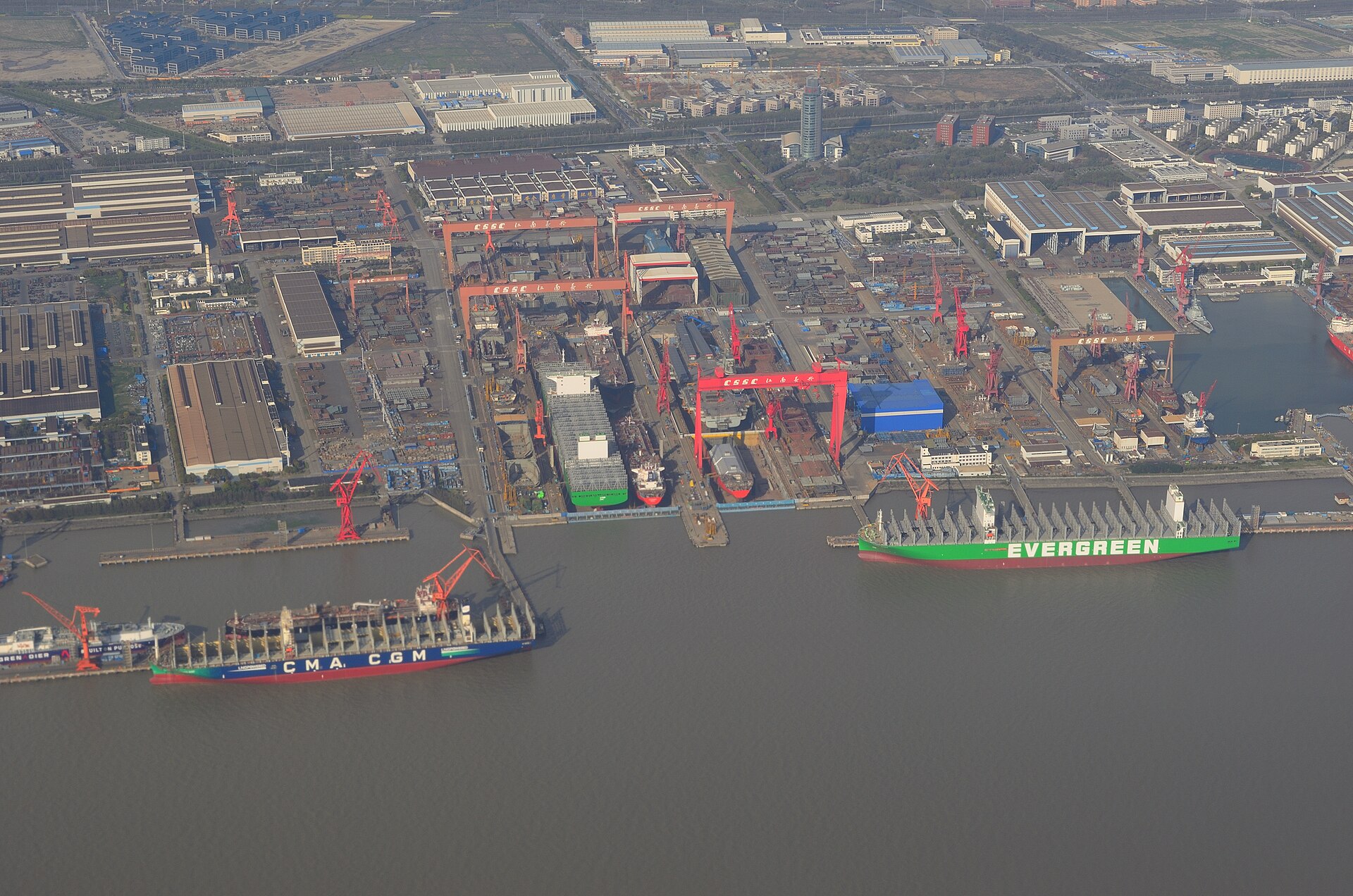
It was also during this upswing that Jiangnan's lineage changed its geographic coordinates. In 2002 Shanghai won its bid to host the World Expo, and the old yard site at Gaochangmiao on the Huangpu River fell within the redevelopment zone. In 2003, the supervising authority and the Shanghai municipal government decided to build a new shipbuilding base on Changxing Island at the mouth of the Yangtze. In June 2008, Jiangnan Shipyard completed its full relocation. The new base on Changxing Island covers 560 hectares and houses four large dry docks, the largest measuring 580 metres long and 120 metres wide—a yard many times the size of the Gaochangmiao era. The mud dock carved out at Chenjiagang 140 years earlier had at last given way to a world-class dry-dock complex at the mouth of the Yangtze.
What reform and opening-up gave to Chinese shipbuilding was less a stream of orders than an environment—an environment in which orders arrived continuously, global markets applied unrelenting scrutiny, and that pressure forced constant iteration. The system that produced the Dongfeng was constructed under conditions of isolation; the system that emerged over the thirty years after the Changcheng was ground into shape by the global market, pass after pass. The Tianxia Gongchang Industrial Research Institute, in mapping the growth trajectories of Chinese manufacturing sectors, encounters the same pattern repeatedly: an industrial system cannot become truly resilient through construction alone. It must be tested again and again by real, brutal markets—repeatedly challenged, repeatedly winnowed, repeatedly refined—before genuine durability takes hold. Chinese shipbuilding spent thirty years grinding its global market share from 3% in 1999 to first place in the world in 2010.
VI. The Three Pearls in the Crown (2010–2026)
Having taken the top position globally, China's shipbuilding industry faced a new question: market share is measured in tonnage, and the vessel types that generate the most tonnage—bulk carriers and tankers—are precisely those with the lowest technical complexity. The "quantity" of being number one was there; but where was the ceiling for "quality"?
Within the industry, a long-standing expression describes the ultimate challenge: the three pearls in the crown of shipbuilding—the large LNG carrier, the large cruise ship, and the aircraft carrier. Because of their extreme technical intensity and construction difficulty, these three vessel types are regarded as the true measure of a nation's shipbuilding ceiling. In November 2023, the head of the China Association of the National Shipbuilding Industry publicly stated that China had acquired the capability to build all three simultaneously, completing the set of three pearls.
There is a detail that often goes unnoticed: all three pearls come from the same city—Shanghai. LNG carriers are built by Hudong-Zhonghua Shipbuilding, large cruise ships by Waigaoqiao Shipbuilding, and aircraft carriers by Jiangnan Shipyard—three yards in a single city, making Shanghai the only place in the world capable of building all three simultaneously. And 160 years ago, the very first dry dock of modern Chinese shipbuilding was dug at Chenjiagang in Shanghai's Gaochangmiao district. The roots of this industry have never left the river.
Each of the three pearls deserves close examination. Each tests a different weak link in the industrial system.
The First Pearl: The LNG Carrier — A Test of Materials and Extreme Craftsmanship
An LNG carrier must transport liquefied natural gas at −163°C across the open sea. The membrane lining the cargo tank that comes into direct contact with the liquefied gas is made of a nickel-iron alloy called Invar steel, with sheet stock only 0.7 mm thick—as thin as paper, highly susceptible to corrosion, prone to rust at the mere touch of sweat from a worker's hand, and vulnerable such that a pinhole defect in a weld could cause a leak or even an explosion. Welding this material is considered the most technically demanding welding operation in the world: a weld seam of several metres requires a senior welder to work without interruption for five consecutive hours, completing it in a single continuous pass. More critically, the patent on the membrane containment system had long been monopolised by a single French company, which held roughly 90% of the global market. Any shipyard in any country seeking to build an LNG carrier was required to pay a licensing fee of approximately 5% of the vessel's construction cost per ship.
China's first large LNG carrier—the Dapeng Hao, built by Hudong-Zhonghua Shipbuilding—was laid down in 2004, delivered in 2008, and had a cargo capacity of 147,000 cubic metres. It filled a gap that had left China entirely without a foothold in this vessel type: before that delivery, the ability to build large LNG carriers was the exclusive domain of a small number of countries, and China had not even a full admission ticket. For a long time thereafter, China's share of this market remained below 10%, with the three major South Korean shipbuilders holding over 90%.
The turning point came in 2022. That year, Chinese shipbuilders saw a surge in new LNG carrier orders, capturing a market share exceeding 30% in a single bound. In an unprecedented LNG carrier procurement programme by Qatar, Hudong-Zhonghua's cumulative order count overtook its South Korean rivals; in 2024, it swept a single contract for twenty-four 270,000-cubic-metre ultra-large LNG carriers—at the time the largest shipbuilding contract in the world by value.
A still deeper breakthrough came in materials. In 2017, a specialty steel subsidiary of China Baowu obtained certification from the French patent holder for ship-grade Invar steel, making China the second country in the world—after France—capable of producing it. In November 2024, a complete set of Invar structural components manufactured from domestically produced Invar steel and domestic welding wire passed qualification testing. That 0.7 mm alloy—no thicker than a sheet of paper—China could now make itself.
The significance of this extends well beyond winning a few more orders. A substantial portion of an LNG carrier's construction cost had previously flowed abroad in the form of licensing fees and imported materials. As the hardest links in the chain—Invar steel, the membrane containment system—were brought into domestic production one by one, building an LNG carrier in China finally meant keeping the profits and the initiative within its own supply chain.
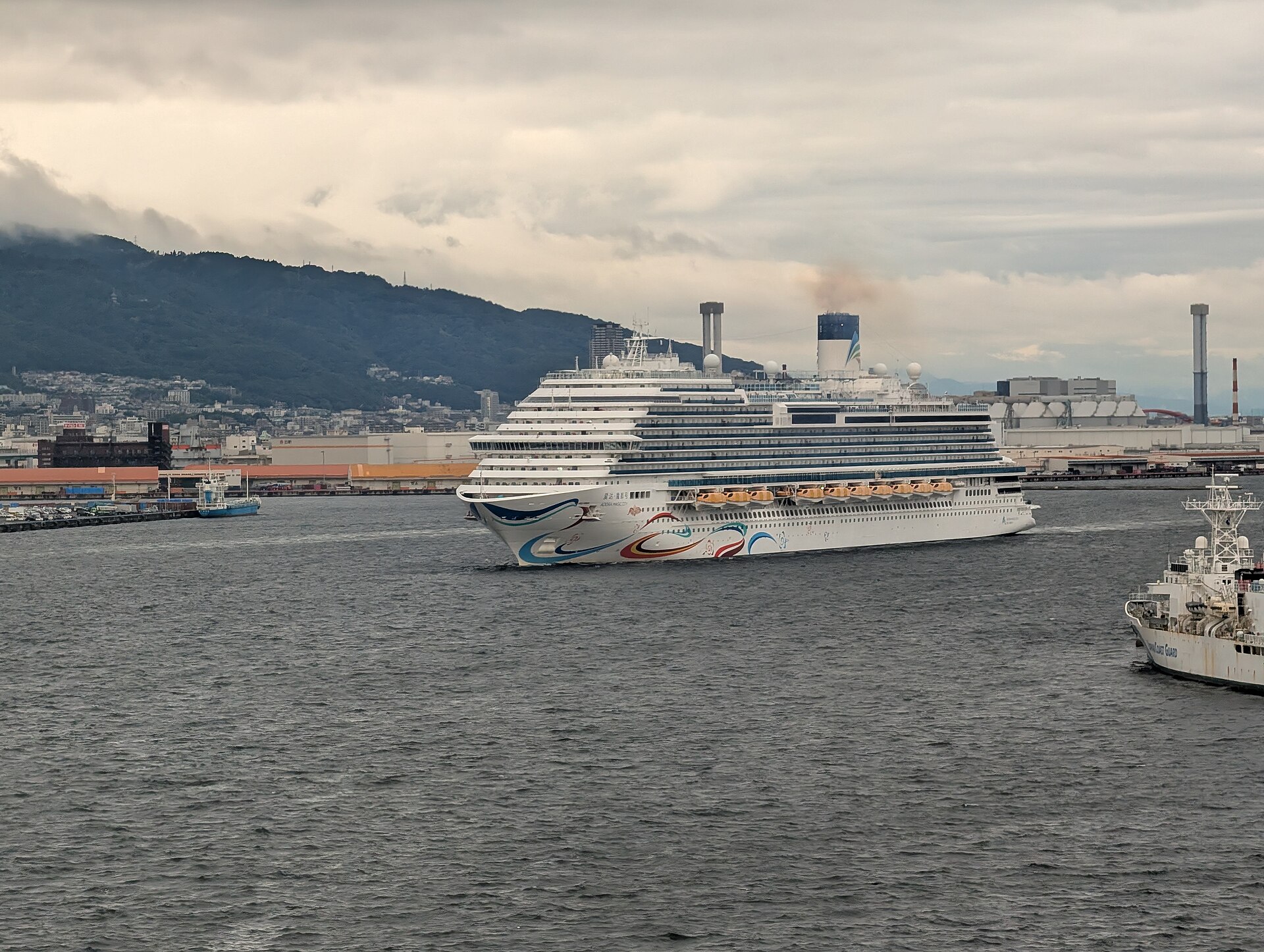
The Second Pearl: The Large Cruise Ship — A Test of Supply-Chain Coordination
In November 2023, China's first domestically built large cruise ship, Adora Magic City, was delivered by Waigaoqiao Shipbuilding in Shanghai and began its inaugural commercial voyage in January 2024. The vessel displaces 135,500 gross tons and stretches 324 meters in length. Its difficulty lies not in any single point of technology, but in one word: scale.
Adora Magic City contains approximately 25 million individual components — roughly five times the total part count of the domestically produced C919 narrowbody airliner and about thirteen times that of the Fuxing high-speed train. The ship's internal cabling runs 4,750 km in total length, equivalent to the distance from Shanghai to Lhasa. The fit-out work alone is comparable to constructing five five-star hotels on land simultaneously. The thinnest hull plating measures just four to five millimeters, and that steel must maintain geometric precision under both seawater corrosion and structural loading — welding-induced thermal distortion has to be controlled within the tightest of tolerances. Before delivery, the builder also had to master three core technical challenges: vibration and noise control, weight management, and safe-return-to-port capability. A cruise ship carrying several thousand passengers must be quiet enough, stable enough, and still able to return to port under its own power after hull damage — every one of these is a non-negotiable hard requirement.
Organizing 25 million parts and the output of thousands of suppliers into a single vessel is not a test of any one shipyard's workshop. It is a test of whether that shipyard can weave tens of thousands of factories into a coherent collaborative network. Building Adora Magic City, Waigaoqiao Shipbuilding coordinated more than 300 first-tier suppliers and over 1,000 second-tier component manufacturers. The Tianxia Gongchang Industrial Research Institute has noted a figure that is frequently misread: the domestic content ratio on this first-of-class cruise ship was only around ten percent. That figure is often cited as a shortcoming — but viewed from another angle, it demonstrates precisely that China has already mastered the hardest part of the entire enterprise: the general integration. What remains to be built out is the density of the supplier network at the sub-tier level. The second domestically built large cruise ship, Adora Flora City, began sea trials in May 2026, with overall construction efficiency approximately twenty percent higher than the first vessel. The pace of filling out that network is accelerating.
The Third Pearl: The Aircraft Carrier — A Test of Whole-System Integration
The shipyard that claimed this third pearl was none other than the protagonist of this article — Jiangnan Shipyard.
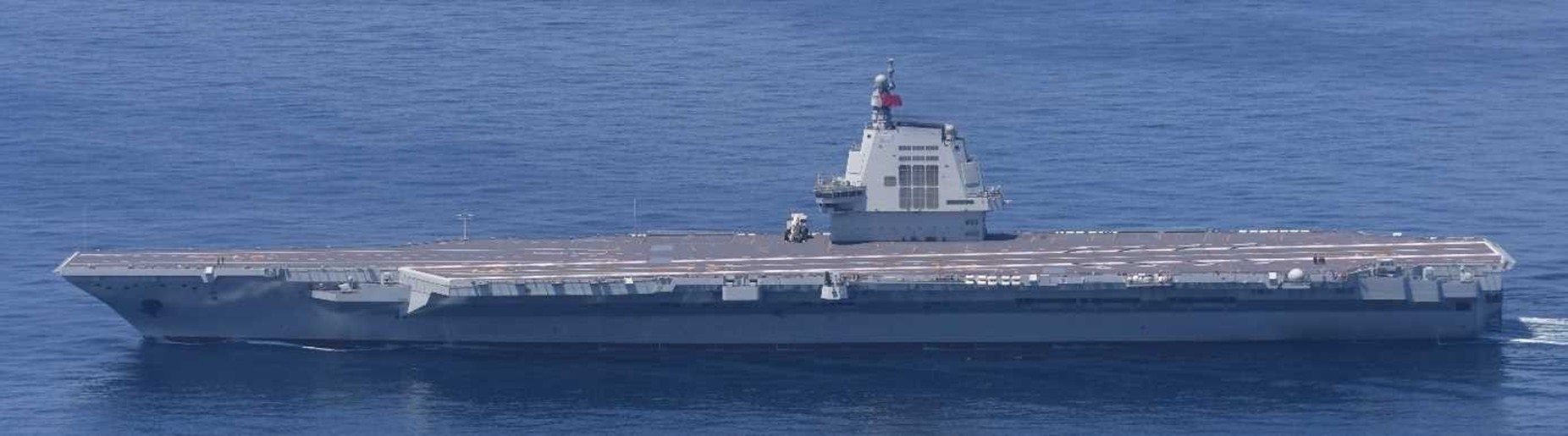
In June 2022, the Fujian was launched at Changxing Island. She is a Type 003 aircraft carrier displacing over 80,000 tons at full load and equipped with three electromagnetic catapult systems. Behind the electromagnetic catapults lies a medium-voltage DC integrated electric propulsion system, the product of years of research and development by Chinese engineering teams. Electromagnetic catapults had previously been exclusive to a handful of naval powers, and were used only on nuclear-powered carriers; the Fujian mounted them on a conventionally powered platform — a path without precedent. From May 2024 onward, the Fujian completed multiple rounds of sea trials. On 5 November 2025, she formally entered service. She is the world's first conventionally powered aircraft carrier to employ electromagnetic catapults, and her embarked air wing — including the J-15T, J-35, and KJ-600 — has already completed catapult launches and arrested landings.
Placing China's three carriers in sequence makes the magnitude of each step unmistakable. The Liaoning, the first, was completed and rebuilt from the unfinished Soviet hull of the Varyag; she entered service in 2012. The Shandong, the second, was China's first fully indigenous carrier; she entered service in 2019, but still relied on ski-jump takeoff. The Fujian, by contrast, achieved a generational leap from ski-jump to catapult, and was designed and built entirely by China.
It is worth pausing here. The shipyard that built the Fujian — Jiangnan Shipyard — is the direct lineal descendant of the Jiangnan Arsenal founded in 1865. One hundred and fifty-four years earlier, that same lineage produced the Huiji (originally named Tianji): a 600-ton wooden paddle-wheel gunboat whose very steel had to be imported and whose construction depended on foreign engineers. One hundred and fifty-four years later, the same lineage, in the same city, built an 80,000-ton aircraft carrier with electromagnetic catapults.
Stepping back to the industry as a whole, the generation that inherited China's shipbuilding sector received something fundamentally different from what had gone before. In 2024, China's share of the three key shipbuilding indicators stood at approximately 56 percent of global completions, 74 percent of new orders, and 63 percent of orderbook on hand. By 2025, China had led all three indicators worldwide for sixteen consecutive years. More than 85 percent of the ships built in China are ordered by foreign owners, and Chinese-built vessels are exported to more than 190 countries and territories. The China State Shipbuilding Corporation (CSSC) is the world's largest shipbuilding group, responsible for constructing roughly one-third of all ships delivered globally.
Why are these three achievements called a "crown"? Because each one tests the outer limits of industrial completeness in its own domain. The large LNG carrier tests materials and extreme precision manufacturing — behind a 0.7 mm sheet of Invar steel stands an entire specialty metallurgy industry. The cruise ship tests supply-chain coordination — 25 million components, thousands of supplier factories, and behind them a supplier network of extraordinary density. The aircraft carrier tests full-system integration across materials, propulsion, electrical power, electronics, and control. A nation that can claim all three simultaneously has demonstrated that the industrial system behind it has reached completeness across three dimensions: materials, manufacturing, and coordination.
Conclusion: A Ship Is the Sum of a Nation's Industry
We can now return to the question posed in the introduction: why was the Huiji of 1868 unable to sustain a nation, while the Fujian of 2022 can?
The true lesson of the First Sino-Japanese War is not that China could not build a ship. China could — the Pingyuan was Chinese-built, the Huiji was Chinese-built. What the war revealed was the absence of everything behind those ships: no steel, no machinery, no propulsion, no component industry, no supply chain capable of sustained production. A fleet purchased with silver from Europe cannot uphold a country that cannot buy its way to an industrial base. The Qing government of that era could acquire warships; it could not acquire the capability to build them.
One hundred and sixty years later, the three pearls are not three fortunate ships. Behind Adora Magic City stand more than a thousand suppliers. Behind the Fujian stands a complete industrial chain spanning materials, electrical systems, electronics, and control. Behind the LNG carriers stands a steel industry capable of producing 0.7 mm Invar steel domestically. A ship is only the tip visible above the waterline; below the surface lies an entire mountain of industry.
This is the particular quality that makes shipbuilding distinctive: it draws upon virtually every industrial category a nation possesses — metallurgy, mechanical engineering, electronics, chemicals, propulsion, information technology, precision manufacturing. What a nation can build in a ship is therefore roughly equivalent to what that nation's industry has become. A ship is a test paper; on its surface it examines the shipyard, but in substance it examines the entire national industrial system. A ship is the sum of a nation's industrial capacity.
Industrial capability cannot be purchased, and it cannot be skipped. That is the plainest sentence this lineage has earned across one hundred and sixty years and six generations. The late Qing court tried to buy a navy with silver; the fleet it purchased sank within two years. What it could not buy was the system behind the shipyards — a system that takes generations to build, layer by layer. The Soviet Union once provided a complete template through the 156 Projects, but the Soviet engineers eventually left. What truly remained was the 291 cooperating units that built the Dongfeng in 1965, the supply chains forged against the global market over thirty years of reform and opening, and today's supplier network woven from tens of thousands of factories.
This logic remains valid today. A country can, in a short time, purchase a very advanced product. But it cannot spend its way to the entire industrial apparatus required to manufacture that product — that apparatus is distributed across thousands upon thousands of factories, embedded in every link of materials, process, supply chain, and human expertise, and it can only be grown, one generation at a time, from within. This is also why measuring a nation's true industrial level should not mean fixating on its highest peak, but examining the foundation beneath that peak — how thick it is, how densely it is woven.
In its long-term tracking of Chinese manufacturing, the Tianxia Gongchang Industrial Research Institute has consistently held one conviction: the true depth of a nation's industry lies not in its most prominent product, but in how many factories are coordinating to supply that product. China today is a country constituted by factories numbering in the millions — among them, 4.8 million real factories have been identified and verified through Tianxia Gongchang. The Fujian and Adora Magic City float not because of any single shipyard, but because of the supply-chain coordination of tens of thousands of those 4.8 million factories. That is the true weight behind the words: a ship is the sum of a nation's industry.
Between the Huiji of 1868 and the Fujian of 2022, the distance has never been merely one hundred and fifty-four years of time. It is the full account of how one nation wrote out — from nothing, stroke by stroke — the six characters that mean "a complete industrial system."
The same Huangpu River. The same bloodline. To finish writing those six characters took six generations.
Sources and Key References
This article was compiled and analyzed by the Tianxia Gongchang Industrial Research Institute, drawing on factory data from the Tianxia Gongchang platform together with publicly available information, official sources, and authoritative media reporting. Its principal data and factual sources include:
- The factory database and industry-chain data of the Tianxia Gongchang platform (www.tianxiagongchang.com)
- Official corporate histories and public records of shipyards including Jiangnan Shipyard and the Fuzhou Navy Yard
- Historical materials on the Fuzhou Navy Yard released by the Fuzhou Municipal Government
- Reporting from authoritative media including Xinhua News Agency, the People's Daily, China News Service, and Wen Hui Bao
- Corporate materials and shipbuilding-industry information released by China State Shipbuilding Corporation
- Public materials on space-tracking ships released by the China National Space Administration
- Statistics on the three key shipbuilding indicators published over the years by the China Association of the National Shipbuilding Industry (CANSI)
- Official public materials from Hudong-Zhonghua, Waigaoqiao Shipbuilding, and other firms on large LNG carriers and large cruise ships
- Official communiques and authoritative media reporting on events relating to the carrier Fujian