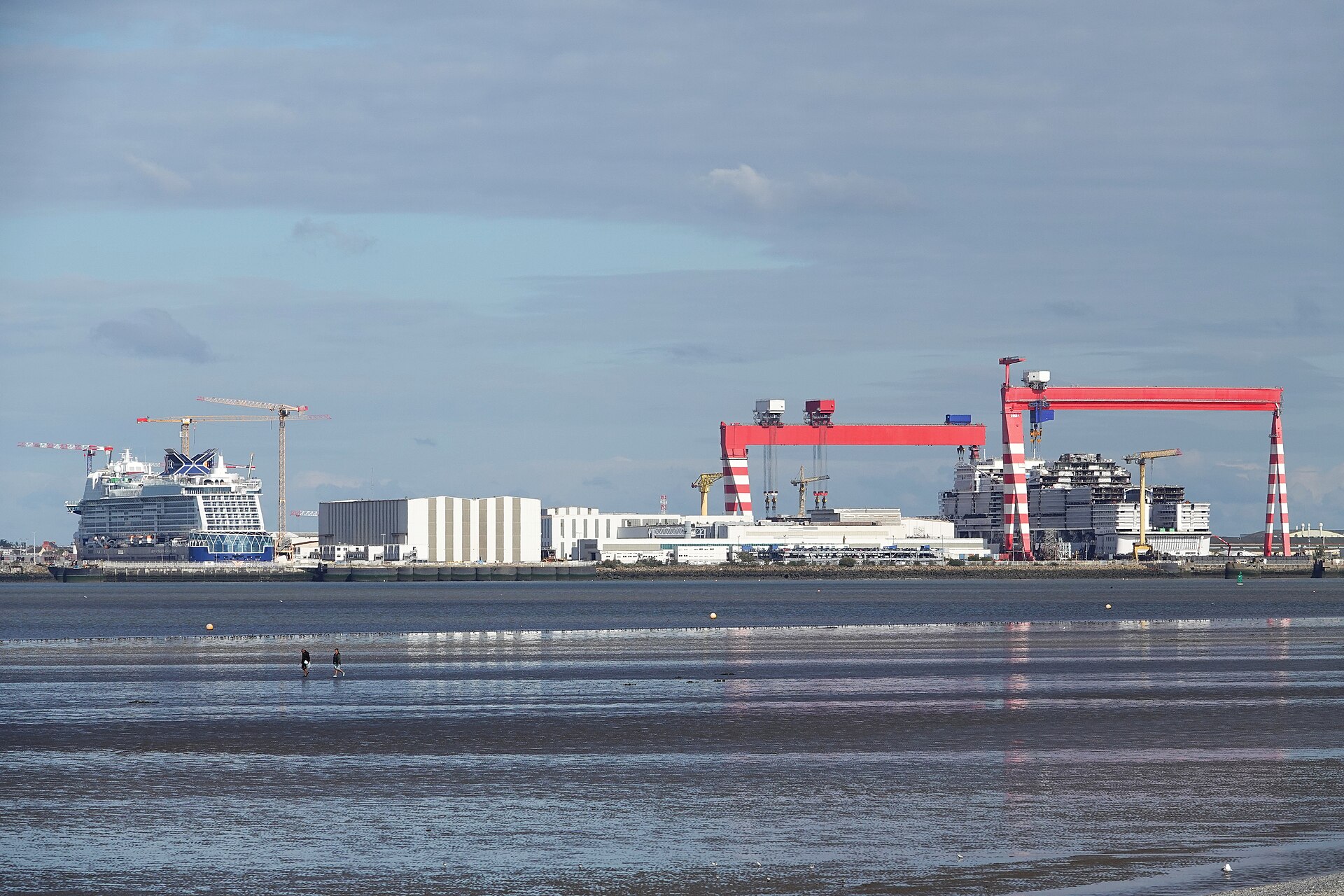

When a ship is launched, the news gives us one thing: a ship — vast, complete, and named. But take that ship apart and something else comes into view: a map of the industry chain.
A large vessel contains anywhere from hundreds of thousands to tens of millions of components. A large cruise ship carries roughly 25 million individual parts — five times as many as a domestically built wide-body jet, more than ten times the count of a Fuxing high-speed train. Even an ordinary merchant vessel consumes hundreds of thousands of components. Those parts come from over a thousand suppliers spanning nearly every industrial category: metallurgy, machinery, electronics, chemicals, interior outfitting, and information technology. Pull a ship apart and lay it flat, and what you see is not a single product but a cross-section of a nation's entire industrial system.
That is why analyzing the shipbuilding industry means looking beyond the shipyard's enormous drydock. What truly determines a country's shipbuilding capability is the invisible chain that runs outside the drydock — how long it is, how dense, and how many of its links are genuinely held in one's own hands.
This article is not a history. It is a dissection of the chain as it stands today: from upstream steel plate, through the tens of thousands of varieties of midstream marine equipment, down to the final-assembly shipyards downstream — tracing where money and technology have accumulated, and where China stands at each point. One of the things the Tianxia Gongchang Industrial Research Institute does consistently is map the industry chains of Chinese manufacturing, one chain at a time. This article maps shipbuilding.
I. Why Shipbuilding Is the Ultimate Sample for Observing an Industry Chain
Among all manufacturing industries, shipbuilding is the best lens through which to observe an industry chain. Three reasons explain why.
The first is the length of the chain. A ship begins as a steel plate and passes, in sequence, through metallurgy, machining, propulsion, electrical engineering, electronics, chemicals, precision manufacturing, and interior fitting before it becomes a vessel capable of putting to sea. There is almost no industrial category it does not draw upon. Very few chains in manufacturing span this many sectors — the supply chains for automobiles or home appliances are nothing this wide. And it is precisely because the chain is so wide that the strength or weakness of a country's shipbuilding industry serves as a near-perfect proxy for the strength or weakness of its industrial base overall: wherever an industrial sector is underdeveloped, it will sooner or later surface as a weakness in some component of some ship type.
The second reason is the sheer number of parts and the difficulty of coordination. Tens of millions of components from over a thousand suppliers must converge, without gaps, at a single delivery point inside a drydock, then be erected in rhythm with the final-assembly schedule into a finished ship. A modern drydock typically has several vessels under construction simultaneously. Each ship is divided into hundreds of blocks, and each block is itself a convergence point for hundreds or thousands of components. If any link in that chain breaks — say, a critical piece of equipment from one supplier arrives two weeks late — the delivery date for the entire vessel may slip, with knock-on effects for the next ship already queued in the dock. Shipbuilding is therefore fundamentally a business of coordination: what it tests is never how strong any single factory is, but how tightly organized the entire chain is and how freely information flows through it.
The third reason — the most important — is the distribution of value.
Many people assume that shipbuilding's money is captured mainly by the shipyard itself, by the enormous drydock and the final-assembly operation. The reality is the reverse. Break down the cost of a typical merchant vessel and the structure looks roughly like this: marine equipment accounts for 40% to 60% of the total; raw materials such as steel account for 20% to 30% (with steel alone representing about 70% of that raw-material cost); labor comes to roughly 30%; design and management together amount to only a few percentage points. In other words, the single largest share of a ship's value lies in the equipment installed aboard it — main engines, generator sets, all manner of machinery, electrical systems, navigation equipment, pumps, valves and piping — not in the final-assembly work that puts those components together.
If the value distribution looks like that, the profit distribution is even more pronounced. Specific figures will be presented later in this article, but the conclusion can be stated now: the final-assembly shipyards, which organize the entire chain, earn precisely the thinnest margin in it; the genuinely high gross margins are embedded in the unglamorous midstream equipment segments. The most expensive, most profitable, and most technically protected parts of a ship are typically not held by the shipyard itself — and that is the key to understanding the entire shipbuilding industry chain.
That key also resolves a question that is frequently confused: why "the world's top shipbuilding nation by volume" and "a genuine shipbuilding power" are not the same thing. Being number one in volume measures the tonnage that slides out of a drydock; being genuinely powerful means how many links, how much profit, and how many defensible technical barriers along the chain are truly in one's own hands. The former is a ranking table; the latter is an industry-chain map. The one this article sets out to draw is the latter.
This value structure defines the analytical framework for what follows. A shipbuilding industry chain divides cleanly into several tiers: the upstream materials tier, the midstream marine-equipment tier, the downstream final-assembly tier, and the aftermarket extending from both ends of the chain. The analysis proceeds tier by tier, examining China's actual position at each level.
II. Upstream — The Materials Tier: China Has Largely Held Its Ground
At the very top of the supply chain sits materials.
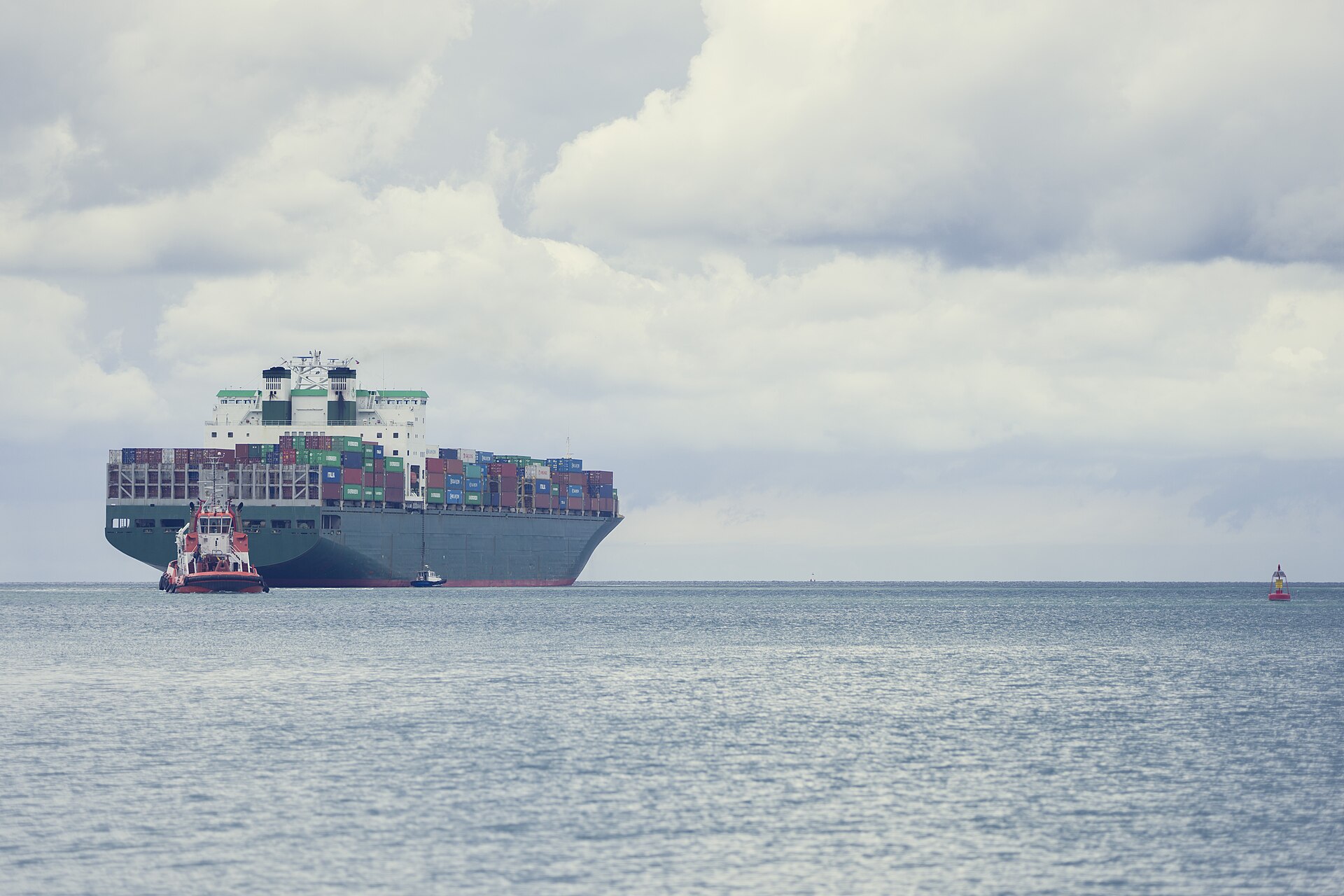
Building a ship starts with steel. Shipbuilding steel plate is not ordinary structural steel: it must withstand years of seawater corrosion, resist embrittlement at low temperatures, and endure the fatigue that accumulates under long-term cyclic loading. Different sections of a hull call for different grades of high-strength steel and crack-arrest steel plate. Steel accounts for roughly 70% of the total raw-material cost of a vessel. At this level, China has broadly passed the test: China operates the world's largest steel industry, the medium and heavy plate grades required for mainstream ship types are largely self-sufficient, and large steelmakers such as China Baowu and Ansteel supply the market reliably. Domestic coverage of marine coatings and welding consumables is also reasonably complete. Materials are not the weak link in Chinese shipbuilding.
What reveals more about the true state of the tier is the category of specialty materials — those are the genuine technical high ground within the materials tier.
The most instructive example is Invar steel. This is the alloy membrane that lines the inner wall of an LNG carrier's cargo tank and makes direct contact with liquefied natural gas at minus 163 degrees Celsius. The membrane is only 0.7 mm thick — barely thicker than a sheet of paper — and the specifications for nickel content, purity, and dimensional precision are unforgiving: a plate that falls short on any one parameter is scrapped entirely. A single French company held a monopoly on this material for forty years. In 2017, a specialty-steel subsidiary of China Baowu received certification from an internationally recognized body, making China the second country in the world capable of producing it. Duplex stainless steel, used in chemical tankers, is another example: its domestic-content rate climbed from below 50% to over 90%. High-grade crack-arrest steel plate for large container ships has also been fully substituted with domestic production.
Looking at these cases together, a pattern emerges: domestic substitution in each instance was not simply a matter of producing something that works. It required obtaining clearance from international certification bodies and classification societies. That certification threshold is the real barrier in the materials tier. China's ability to clear it, one material after another, rests on the accumulated depth of its metallurgical industry — sufficient variety in steel grades, sufficient process-testing capability — which has allowed it to rewrite "import-only" as "domestic option" across one specialty material after another. Each such rewriting saves more than the cost of a single procurement order; it buys a bargaining position that can be drawn upon indefinitely.
These breakthroughs share a common feature: every one of them is a victory in materials. Advancing the materials tier is, at root, advancing metallurgy — and metallurgy happens to be one of the deepest and most established foundations of Chinese industry. Upstream, then, China has not found the going particularly hard. There are still gaps: certain high-end specialty alloys and functionally advanced coatings remain import-dependent. But on the whole, China has held its ground in this tier.
There is one more reason why the materials tier has proved manageable, and it tends to be overlooked: steel is a highly concentrated industry. The nation's shipbuilding plate comes mainly from a countable handful of large steelmakers. Concentration means the sector is straightforward to organize, straightforward to mobilize for targeted breakthroughs, and straightforward to understand. That characteristic stands in the sharpest possible contrast to the tier below. The marine-equipment tier is not a few large enterprises — it is tens of thousands of small and medium-sized factories; its difficulty is half technical, and half a matter of sheer fragmentation.
The real problem begins in the next tier — and it is a large one.
III. Midstream — The Marine-Equipment Tier: The Longest, Most Fragmented, Weakest Link
If the materials tier is the foundation of the industry chain, then the marine-equipment tier is its longest, most complex, and highest-value segment. It is also where Chinese shipbuilding's real vulnerability lies.
"Marine equipment" refers to everything installed on a ship outside of the steel hull structure: the full range of systems and devices that make a vessel function. The categories are staggering in breadth — propulsion systems (main engines, generator sets, propulsors), deck machinery (windlasses, mooring winches, hatch covers, cranes), accommodation machinery, electrical and automation systems, navigation and communications, pumps, valves and piping, specialty systems (LNG membrane containment systems, ballast water treatment systems, exhaust scrubbers), and the enormous fit-out and interior-decoration scope on cruise ships and passenger vessels. As noted earlier, this tier accounts for between forty and sixty percent of a ship's total build cost. Most of the money in shipbuilding flows through here.
There is a second point worth keeping in mind: the marine-equipment tier is the real dividing line between shipbuilding powers. A country can scale up quickly in final assembly by leveraging labor costs and drydock capacity. The equipment tier is different — it requires long-term, independent technical accumulation across hundreds of distinct product categories, built up over generations of engineers and through the patient development of specialized supplier factories. Final assembly can be ramped up rapidly; the equipment supply base can only grow slowly, from the ground up. The true measure of a shipbuilding nation's strength, therefore, is not the size of its drydocks — it is how much of the equipment list it actually owns.
The Heart of the Ship: The Patent Ledger Behind a Main Engine
We begin with the highest-value, highest-barrier segment of this tier: propulsion.
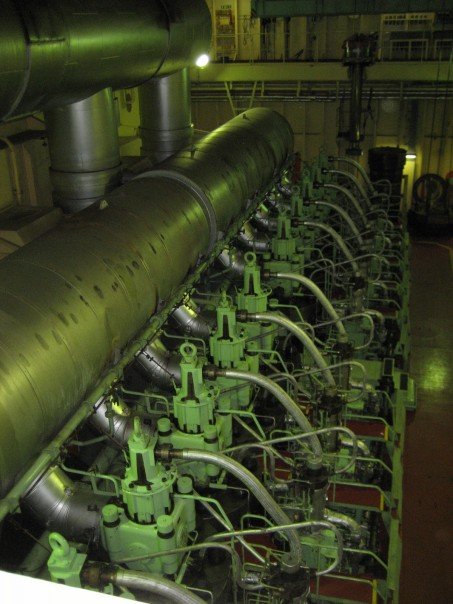
The "heart" of a large ship is the low-speed marine diesel engine — the main engine. A large low-speed main engine stands more than ten meters tall, weighs over a thousand tonnes, and is the single most expensive item on a ship. It is also the weightiest line on the equipment list.
The design patents for low-speed marine diesel engines have long been dominated by two companies: MAN Energy Solutions of Germany, which holds roughly three-quarters of the market, and WinGD of Switzerland, which holds about one-fifth, with the remaining sliver belonging to Japanese firms. Notably, neither of these patent holders actually manufactures engines — they focus solely on design and research and development, then license their patents to approved manufacturers around the world, who build the engines to their drawings.
The main engines installed in Chinese shipyards are, in the overwhelming majority of cases, produced this way: built under licensed production arrangements, with Chinese factories making the engines to foreign designers' drawings in exchange for royalty payments. China's manufacturing scale in low-speed engines is actually substantial — domestic producers hold more than seventy percent of the home market by power output and close to forty percent of the global market, with companies such as Hudong Heavy Machinery and CSSC Engines as key players. But "capable of building" and "capable of designing" are two entirely different things. A meaningful share of the profit margin on every main engine flows out as royalty payments. One major publicly listed Chinese marine-propulsion company, to take a concrete example, once paid close to about 700 million yuan in annual low-speed engine royalties. The company projects that as its own dual-fuel technology matures, that figure will gradually fall from about 700 million yuan to around 500 million, and eventually to about 200 million yuan over the long term. That declining royalty curve is itself a precise gauge of how far China has advanced in achieving genuine independence in main engine design.
Around this licensed-production model, a vast manufacturing network has taken shape over the years. MAN alone has more than ten licensed low-speed engine manufacturers in China, spread across Shanghai, Dalian, Yichang, Zhuhai, and other cities. This network has made China the world's main-engine "assembly workshop" — enormous capacity, reliable delivery, producing the main engines for a very large share of the world's new vessels. But no matter how large the workshop, without ownership of the drawings the builder's pricing power remains constrained by an invisible barrier. For Chinese shipbuilding to move up the value chain, that barrier must be worn away, piece by piece: either by localizing critical components within mature engine models one by one, or by securing genuine design ownership from the outset on new engine types.
There is one particularly telling twist in this patent ledger.
WinGD, the world's second-largest main-engine design brand, is now effectively controlled by China State Shipbuilding Corporation (CSSC). In 2015, CSSC partnered with Finland's Wärtsilä in a 70-to-30 joint venture to restructure the Swiss company into WinGD; in 2016, Wärtsilä transferred its remaining thirty percent stake in full, making WinGD one hundred percent Chinese-owned; in 2019, operational management was further transferred to the China Shipbuilding Power Engineering Institute. WinGD's headquarters remains in Winterthur, Switzerland, and its core research and development continues there — but the royalties Chinese shipyards pay on WinGD-brand engines now ultimately flow back into a Chinese corporate structure. This was a deliberate attempt to buy design rights outright. It signals that China's shipbuilding industry has arrived at a clear understanding: what actually captures the profit in a supply chain is never the drydock — it is the drawings. Acquiring a main-engine design brand is harder, and more consequential, than building ten more drydocks.
The larger opportunity lies in a new arena. As decarbonization pressure on the shipping industry intensifies, marine propulsion is shifting from conventional diesel toward dual-fuel engines running on LNG, methanol, or ammonia. This constitutes something of a reshuffling of the deck — old patent barriers are partially invalidated in the face of new fuels. On this new track, China is no longer merely a passive licensed producer: domestically designed methanol dual-fuel low-speed main engines have entered series production, and the world's highest-output methanol dual-fuel main engine is currently being built in Chinese factories for a series of 24,000 TEU ultra-large container ships; domestic ammonia-fuel low-speed engines, meanwhile, completed stable full-load, full-operating-range verification trials in 2025. On the old track, China was a follower. On the new one, China is pushing to become a rule-setter. This is the most significant shift to watch in the equipment tier.
Beyond the main engine, the propulsion system trails a long tail of associated equipment — propellers, shafting, propulsors, and marine auxiliary engines (generator sets). Progress here is equally uneven. High-stacking-height propellers for large container ships were long monopolized by foreign firms; only in recent years have Chinese manufacturers secured orders at the 24,000 TEU scale, finally filling that gap. The medium-speed diesel engines at the core of marine auxiliary systems, however, remain largely in the hands of German and Finnish majors; Chinese medium-speed engines currently serve mainly river and coastal vessels. Localizing a main engine is only the beginning of the propulsion sub-chain — the propellers, shafting, and auxiliary engines that follow it represent an even longer list.
From Pod Propulsors to Navigation Radar: An Uneven Chain
Beyond the main engine, the picture across the broader equipment tier is equally uneven — with both encouraging breakthroughs and stubborn gaps.
On the encouraging side: in a number of segments, China has moved from dependence to a genuine competitive position, and in some cases to outright leadership. Pod propulsors for large vessels were long monopolized by two European companies; in 2024, China completed full-power testing of a 10 MW-class pod propulsor and achieved one hundred percent domestic sourcing. Ballast water treatment systems — a specialty system now mandatory on ships under international environmental conventions — have seen Qingdao Sunrui reach the top position in global market share for medium and large vessels, with cumulative orders exceeding 4,000 vessel sets, more than eighty percent of which came from overseas clients. In exhaust scrubber installation and retrofitting, China has become the world's primary supplier. These are genuine case studies of Chinese equipment suppliers building capability from scratch, growing from weak to strong, and in certain product categories reaching global leadership.
Further along the chain lies a large class of "unglamorous" but high-volume segments — deck machinery and pumps, valves and piping. Windlasses, mooring winches, hatch covers, marine cranes, and the full range of marine valves and pumps: these items carry moderate unit prices and are not at the technological frontier, but every ship needs them, and in quantity. In this "mid-belt" of the equipment tier, China now has a cohort of manufacturers capable of reliable, stable supply. What they underpin is precisely the most substantial layer of the equipment supply base — the true foundation of a nation's shipbuilding chain is often not its most advanced products, but this broad, deep mid-section.
On the stubborn side: the higher-end the segment, the wider the gap. High-end navigation and communications equipment — marine radar, electronic chart systems — remains a market dominated primarily by Japanese and Norwegian brands. The membrane containment system patents for LNG carriers are held by a French company; every LNG carrier China builds requires a license fee payment. The most extreme example is the large cruise ship: China's first domestically built large cruise ship had a localization rate of only about ten percent measured by component count, with the overwhelming majority of its mechanical, electrical, and interior-fit systems imported, and roughly eighty percent of China's cruise interior firms operating as agents for foreign brands rather than building their own.
There is one more segment — the most invisible, and most easily overlooked: industrial software. Before a single steel plate is cut, a ship must first be designed, modeled, simulated, and optimized in software; the shipyard's production scheduling and block management all run on software too. China's external dependence for the industrial software on which ship design and manufacturing relies exceeds ninety percent. This is the hardest gap in the entire equipment chain to close: it takes up no physical space on a ship, draws no attention, yet it is embedded in every single link of the chain.
Assembling these pieces, a clear picture of China's marine-equipment reality emerges. For conventional vessel types, the localization rate is not low — bulk carriers can reach eighty percent or more, tankers and mid-size container ships above seventy percent. But the more technically advanced the vessel type, the faster the localization rate drops. The blended localization rate for propulsion and electro-mechanical equipment across the three main vessel categories is around forty percent; for large LNG carriers, domestic equipment content falls below forty percent — compared with eighty-five percent for South Korea and ninety percent for Japan at the same period — while for high-technology vessels and offshore engineering equipment, domestic-content rates stand at only 5% to 10%.
What does a low localization rate actually mean? It means that every time a Chinese shipyard wins an order for an advanced vessel, a substantial portion of the contract value flows out through that equipment list to foreign recipients — the main-engine designers, the navigation-system makers, the containment-system licensors, the industrial-software vendors. The shipyard earns the hard-won returns of final assembly; the greater share of equipment profit is captured by parties outside the chain. The gap between a country's "world number one" in tonnage completed and what that country's shipbuilding industry actually takes home in earnings is precisely this: the equipment tier.
One number captures this structural reality most concisely. The industry uses a metric called the "equipment-to-shipbuilding scale ratio" as a measure of a shipbuilding nation's maturity. In China, this ratio stands at roughly 1∶6. In Japan it is 1∶2.5; in South Korea, 1∶2.7; in Europe, where high-end equipment is the defining strength of the shipbuilding cluster, it can reach 3∶1. The larger the "equipment" share embedded in that ratio, the more substantial the supply base relative to final assembly. China's 1∶6 points to a single conclusion: China is a shipbuilding nation built on large-scale final assembly and a thin equipment base.
That 1∶6 carries a temporal dimension as well. Final-assembly capacity can multiply several times over in a decade — build the drydocks, hire the workers, take the orders. But the thickness of that "1" in the equipment ratio cannot catch up with Japan and South Korea in a decade, because it represents the accumulated technical depth of hundreds of distinct product categories and thousands of individual supplier factories. The equipment supply base is a domain where time cannot be compressed into speed. China's hardest battle in shipbuilding is not in final assembly, which is already won — it is in an equipment chain that still lags by a multiple in depth.
Being a great shipbuilding nation does not necessarily make a nation strong in marine equipment. This is the first conclusion that an honest dissection of this industry chain demands.
Another Trait of the Equipment Tier: Extreme Fragmentation
The marine-equipment tier has a second characteristic that is frequently overlooked yet critically important: it is extremely fragmented.
Final-assembly shipyards are visible. The country's large-ship final-assembly shipyards are countable; each has a name, a scale, a press profile. The equipment tier is not like this. China has more than one thousand above-scale enterprises in the marine industry, the vast majority of which are equipment suppliers, and most of those are small or medium-sized firms. In Jiangsu province alone, 1,539 marine equipment suppliers hold classification society certification; the single shipbuilding cluster on Changxing Island in Shanghai draws on a supply network of more than 7,000 equipment firms.
These factories — making main-engine components, valves and pumps, cables and electrical systems, deck machinery, coatings and interior fittings — are spread across cities, county towns, and townships throughout Jiangsu, Liaoning, Guangdong, Zhejiang, and Shandong. Individually, each is unremarkable. Taken together, they are the actual physical substance of what is meant by "the shipbuilding industry chain."
The contrast is striking. Anyone in the shipbuilding business can rattle off a dozen or more final-assembly shipyard names. But no one can give a complete account of the thousands and tens of thousands of equipment supplier factories in the midstream. They are the "silent majority" of this industry chain — contributing more than half of a completed ship's value, yet carrying almost no name recognition.
This gives rise to a fundamental practical problem: the true constituent units of this chain — the tens of thousands of equipment factories — are precisely the ones that are hardest to see clearly. If the factories that actually make up an industry chain cannot be mapped with any clarity, then talk of "analyzing the chain" or "positioning along the chain" is empty. This question matters greatly, and we return to it in Section VI for a dedicated discussion.
IV. Downstream — The Final-Assembly Tier: Firmly the "Chain Leader," Yet Earning the Thinnest Margin
Moving downstream, we arrive at the final-assembly tier.
Final assembly is where the steel plates from upstream and the marine equipment from midstream come together to form a complete vessel. Modern shipbuilding abandoned the old serial approach — "build the hull first, then install the equipment" — long ago. It now operates on a block-assembly logic: the entire ship is divided into discrete blocks, each fabricated simultaneously in workshops, with piping, cabling, and equipment pre-installed inside each block before it leaves the shop floor (a step known as pre-outfitting). The blocks are then lifted into the drydock and joined together like puzzle pieces to form the complete hull. The assembly sequence runs roughly as follows: steel plates are shot-blasted and primed, then CNC-cut to shape; individual sections and plates are welded into sub-assemblies, sub-assemblies grow into blocks, and blocks are outfitted with the bulk of their piping and electrical runs right there in the workshop. Several blocks are then combined into a grand block, and grand blocks are hoisted one by one into the drydock and joined into the full hull. Once the hull is launched, the vessel moves to the outfitting quay for remaining outfitting work before undergoing mooring trials and sea trials and being handed over to the owner.
Running construction and outfitting in parallel yields remarkable gains. Compared with the traditional serial method, block assembly roughly doubles labor productivity on the building berth, cuts the berth cycle by around two-thirds, reduces berth labor by about half, and lowers overall construction costs by roughly ten percent. All of these figures point to the same objective: minimizing drydock occupancy time. The drydock is the hardest, most expensive, and least expandable bottleneck in shipbuilding capacity. Whoever can launch more vessels from the same drydock in a given year wins.
At the final-assembly tier, China is the undisputed world leader. In 2024, China's three key indicators — completions, new orders, and orderbook on hand — accounted for 55.7%, 74.1%, and 63.1% of the global total, respectively; new orders alone represented nearly three-quarters of the worldwide market. By 2025, China had held the top position across all three key indicators for sixteen consecutive years.
China's final-assembly capacity is highly concentrated in three shipbuilding bases. The first is the Yangtze River Delta, anchored by Shanghai and Jiangsu: Jiangsu is China's largest shipbuilding province, holding close to half of the country's orderbook by deadweight tonnage, while Shanghai hosts Hudong-Zhonghua, Jiangnan Shipyard, and Waigaoqiao Shipbuilding — three high-end yards — and the riverside corridor of Jiangsu is so dense with capacity that the single county-level city of Jingjiang in Taizhou accounts for roughly one-fifth of the national orderbook. The second base is the Bohai Rim, spanning the Liaoning and Shandong coastlines: Dalian Shipbuilding has delivered over a hundred VLCCs, and Beihai Shipbuilding in Shandong ranks first globally by delivery volume for very large ore carriers. The third is the Pearl River Delta, centered on Nansha, Guangzhou: Guangzhou Shipyard International leads the world in car-carrier construction, while Huangpu Wenchong specializes in feeder container ships and a range of specialized vessels.
At the top of this industry, global scale belongs to China State Shipbuilding Corporation (CSSC), whose portfolio includes Hudong-Zhonghua, Jiangnan Shipyard, Waigaoqiao Shipbuilding, Dalian Shipbuilding, and Guangzhou Shipyard International, among others. Alongside this state-owned giant, private players are a formidable force: New Times Shipbuilding ranked first globally by compensated gross tonnage of new orders received in 2024, while Yangzijiang Shipbuilding, listed in Singapore, posted a net profit of RMB 6.6 billion in 2024, with clean-energy vessel types accounting for a high share of its order mix. Combined, the leading state-owned and private yards captured approximately 46.5% of global new orders in 2024.
Viewed in global context, the scale of China's final-assembly tier comes into even sharper relief. The overwhelming majority of ships built in China are destined for foreign buyers: export vessels account for close to ninety percent of completions, and China's ship export value exceeded US$40 billion in 2024, with buyers spanning more than 190 countries and territories. From Greek shipowners ordering tankers and container ships to Qatar commissioning LNG carriers, more than half of global shipping's new-vessel demand now flows into Chinese drydocks. As the chain leader, China's final-assembly shipyards no longer coordinate only a domestic supply chain; they sit at the center of a vast network that reaches upward to shipowners around the world and downward to tens of thousands of equipment suppliers at home and abroad.
The role the final-assembly shipyard plays in the industry chain is that of the chain leader. Externally, it takes orders and delivers vessels to owners. Internally, it orchestrates raw-material procurement from upstream, equipment sourcing and selection from midstream, and design compliance across the entire vessel — it is the organizing nucleus of the entire supply chain. Occupying the chain-leader position is no small achievement.
But there is a paradox that must be named.
The chain leader coordinates everything, yet captures the thinnest slice of margin in the entire chain. Between 2022 and 2023, operating profit margins at Chinese shipbuilding enterprises ran at only 3% to 4%. Meanwhile, companies supplying high-end marine equipment routinely achieve gross margins above 40%. On one side stands the final-assembly yard — the entity that organizes an entire industry chain, yet earns single-digit margins. On the other side are equipment suppliers tucked away in the midstream, quietly earning high margins. Value does not accumulate in the most visible, most imposing drydock.
"First in final assembly worldwide" and "first in industry-chain competitiveness worldwide," then, are not the same thing. China holds the chain-leader's seat with confidence, but a substantial share of the genuinely high margins and genuinely deep technological barriers along this chain still reside in the equipment tiers it coordinates — and as the previous section made clear, China is still catching up in those tiers.
V. The Chain Is Being Reshaped: Green Transition, Digitalization, and the Aftermarket
At this point, the three-tier anatomy of the shipbuilding industry chain — upstream, midstream, downstream — is complete. But the chain is not static: two forces are actively reshaping it. And for China, this period of restructuring is precisely the window in which to close the gap.
The first force is the green transition.
The International Maritime Organization (IMO) has adopted a net-zero framework for the shipping industry, backed by a carbon-pricing mechanism: vessels that exceed emission standards will be required to pay for their excess emissions, with the per-unit cost rising the further they overshoot. This regime is changing how shipowners do their arithmetic. A ship has a service life of twenty to twenty-five years, which means vessels being ordered and built today must be capable of running on low-carbon fuels across their entire operational life — failing that, they risk becoming stranded assets. In other words, "green" has ceased to be a distant aspiration and become a hard financial calculation that every shipowner must resolve at the moment of placing an order.
The result is a rapid structural shift in global new-build fuel choices. In 2024, vessels capable of running on alternative fuels — LNG, methanol, ammonia, and other dual-fuel configurations — accounted for half of global new-order tonnage, a share that stood at under ten percent a decade ago.
Within that "half," dual-fuel LNG ships currently carry the most weight, with dual-fuel methanol close behind and ammonia-fueled vessels only just beginning — ammonia is toxic, and both bunkering logistics and safety remain unresolved. Which fuel type ultimately prevails is an open question. For the equipment supply chain, however, the identity of the eventual winner matters less than what the transition demands of suppliers: regardless of which fuel pathway succeeds, it requires an entirely new set of equipment — new fuel tanks, new gas supply systems, new safety and monitoring systems — that differs fundamentally from what is needed for a conventional diesel vessel. The years of parallel competition among multiple fuel pathways are precisely the window in which equipment suppliers can spread their bets and stake out positions early.
What does the green transition mean for the industry chain? It means a reshuffling of the equipment tier's deck. A dual-fuel vessel requires a new dual-fuel main engine, a new gas supply system, new fuel storage tanks, and new safety and control systems — the technical specifications across a broad swath of equipment categories are being rewritten from scratch. For a country that has long been playing catch-up in legacy equipment segments, a rewrite of the standards is a rare bend in the track: everyone returns to somewhere near the starting line.
China has taken precisely this path. On the new track of green shipbuilding, China's share of international new-order tonnage climbed from 31.5% in 2021 to close to eighty percent by 2024. A more granular example: China's domestic-content rate for LNG carrier equipment has risen from roughly one-quarter to over eighty percent over the past decade or so, and the number of participating suppliers has grown from around twenty to more than 130. Every time the green transition rewrites a set of equipment standards, it opens another door for Chinese equipment factories to walk through.
The transition will not, of course, run in a straight line. In 2025, a combination of inadequate bunkering infrastructure, uncertain green-fuel supply chains, and volatile pricing caused the share of alternative-fuel vessel orders to dip somewhat — yet the underlying direction of fuel substitution has not changed; only the pace is uneven. For the equipment supply chain, this volatility is itself informative: it signals which links (bunkering infrastructure onshore, for instance) represent the true bottlenecks in the next phase.
The second force is digitalization. Ship digitalization and autonomous navigation are steadily advancing; the relevant regulations and testing protocols are progressively being put in place, and China has already delivered research vessels with intelligent navigation capabilities. Digitalization will generate an entirely new category of equipment demand: onboard sensor arrays, intelligent maintenance systems, shore-based remote-monitoring platforms, and digital twin infrastructure — stretching the equipment tier further and adding a new segment that integrates hardware and software. For Chinese equipment suppliers, this is yet another space in which standards are unsettled and competitive positions remain open. More importantly, digitalization will shift the competitive rules of the equipment tier: in the past, manufacturing a piece of marine equipment meant competing on machining precision and mechanical reliability; a "smart" piece of equipment competes on sensing, algorithms, and data — capabilities that happen to be among the most deeply developed in China through its accumulated strengths in consumer electronics, the internet, and artificial intelligence. Ship digitalization, in effect, connects part of the shipbuilding industry chain to another of China's stronger supply chains.
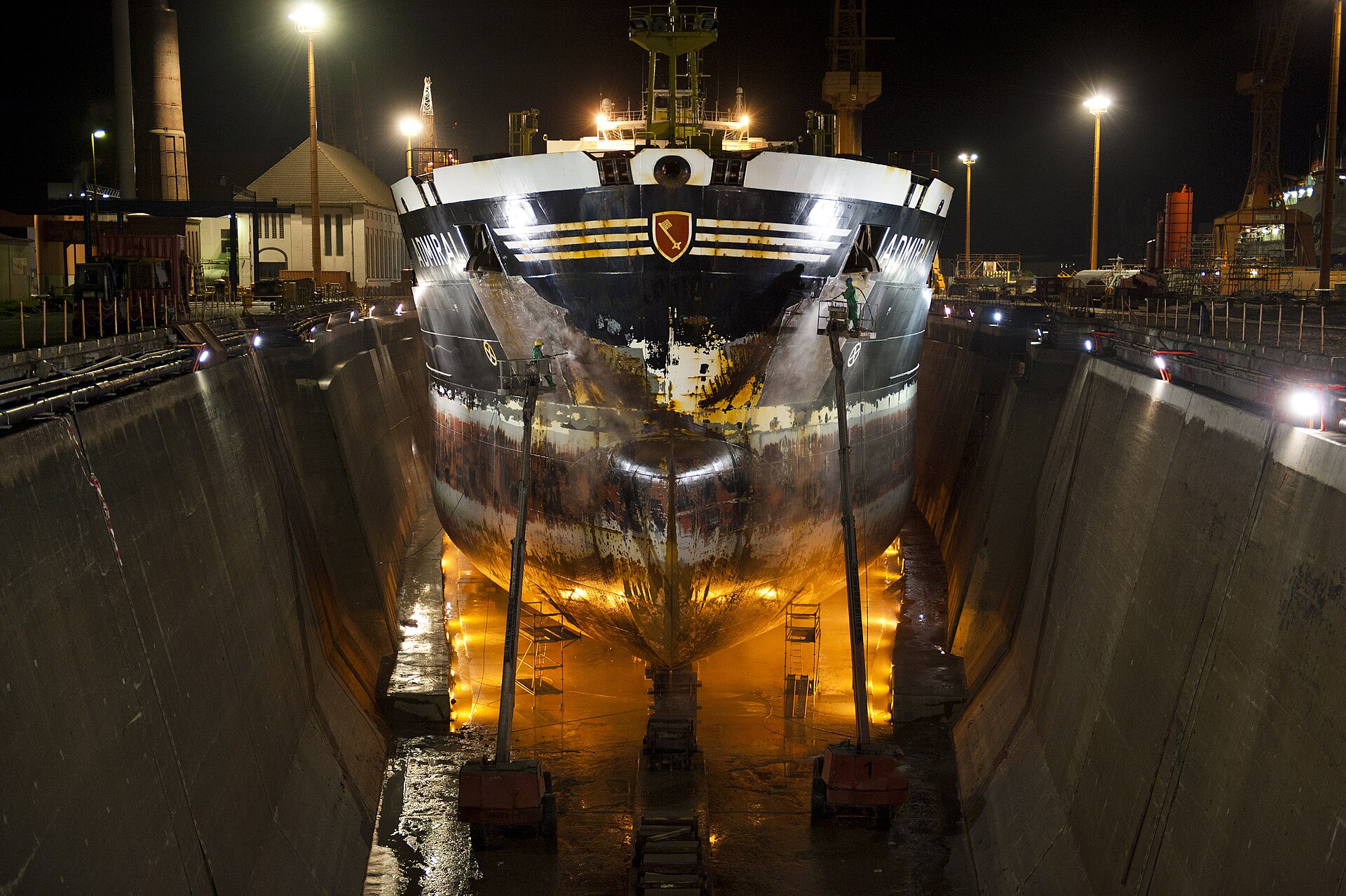
At both ends of the chain lies an aftermarket that is frequently overlooked. Once a vessel is delivered, it still has more than twenty years of maintenance and retrofitting ahead: installing scrubbers, installing ballast water treatment systems, undertaking green efficiency upgrades. China is the dominant force in this market — approximately 77% of global scrubber retrofits are completed in China, and China handles roughly half of global ship repair by volume. Notably, the green transition is opening a new growth pocket in the aftermarket: a large portion of the existing fleet, in order to meet tightening emission standards, will need to return to drydock for dual-fuel conversions and energy-efficiency retrofitting. This means demand flowing into the shipbuilding industry chain is no longer generated solely by new-build orders; it also comes from the greening of the in-service fleet. For equipment suppliers, this represents yet another fresh field.
At the other end of the chain is ship recycling. A telling shift has taken place here: China was once among the world's top three ship-recycling nations, but after it stopped importing foreign end-of-life vessels in 2017, the industry contracted rapidly — today, the tonnage dismantled in China accounts for less than 2% of the global total, and almost all of it consists of domestic owners' retired inland-waterway and coastal vessels. A single link in an industry chain can effectively disappear because of one regulatory decision, just as it can be reactivated by new emissions rules or subsidy policies. This is precisely why industry-chain analysis must be read dynamically rather than as a static snapshot.
Taken together, the green transition and digitalization point to a clear conclusion: the shipbuilding industry chain is in the midst of a profound restructuring. And a restructuring period is a window in which the equipment tier reshuffles and Chinese equipment factories can concentrate their catch-up efforts. In a window like this, the factories that get seen — that get connected to this chain as it is being rewritten — are the ones that secure their position in the next cycle.
VI. The Value of an Industry-Chain Map: Seeing the Chain Begins With Seeing the Factories
Follow this shipbuilding industry chain from the very top of the upstream all the way through to the aftermarket, and one pattern keeps surfacing.
The midstream tier is always the hardest to see clearly.
Final-assembly shipyards are visible — they are few in number, enormous in scale, and well-known by name. The large steelmakers upstream are visible too. But the midstream tier — the longest, highest-value stretch of the chain — is composed of thousands upon thousands of dispersed, invisible factories: makers of main-engine components, valves and pumps, cables and electrical systems, deck machinery, coatings and interior fittings. They are scattered across cities and county towns in every province. Individually, none of them stands out; together, they bear the full weight of what it means to call something a "shipbuilding industry chain."
This quality of being dispersed and invisible creates a concrete industrial problem.
An upstream supplier — a specialty steelmaker, a component manufacturer, a materials producer — that wants to sell into the shipbuilding supply chain faces an immediate challenge: finding the equipment-supplier factories that are its actual customers. Yet those suppliers are so widely scattered and so informationally opaque that the upstream seller often cannot locate them at all. It does not know who makes marine pumps and valves, does not know which equipment supplier is currently ramping up capacity for a particular vessel type, and cannot tell whether a given company is a manufacturer actually running production lines or a middleman who merely resells. The same difficulty runs in the opposite direction: a capable shipbuilding equipment supplier trying to gain visibility with a final-assembly shipyard or with upstream material vendors faces exactly the same wall. As long as the individual factories on the chain remain invisible, every conversation about "opportunity" stays suspended in the air.
What Tianxia Gongchang does is address precisely this problem — identifying China's factories, aggregating them, and connecting them into an industry-chain map that can be searched and traversed.
The pivotal word here is "identifying." In conventional business-information databases, genuine manufacturers running active production lines, trading companies that merely resell, and shell entities with no physical operations are all mixed together, and business-registration records alone rarely separate them. For industry-chain analysis, though, the very first question is whether a company is a real, producing factory — any meaningful examination of a supply chain requires extracting true manufacturers from the mass of enterprise data. This is Tianxia Gongchang's foundational capability: applying multiple verification mechanisms to determine and confirm whether a given company is a genuine factory. The map currently contains 4.8 million factories that have been identified and confirmed.
With that identification step in place, an industry chain becomes, for the first time, legible and computable. Looking at a supply chain is no longer limited to querying individual companies in isolation. It becomes possible to ask questions that were previously unanswerable: How many genuine factories exist in a given niche? In which provinces are they concentrated? Which industrial belt has the densest cluster? Who is currently expanding capacity for a particular vessel type? When thousands of invisible supplier factories are identified, mapped, and placed one by one, the blurry outline that once passed for an industry-chain map finally becomes something that can be seen, measured, and acted upon.
On this map, the shipbuilding industry chain is no longer a vague mass of "thousands of supplier enterprises." It becomes a set of specific, visible subjects: who makes marine equipment, which of them is a factory actually in production, where it is located, what exactly it makes, and which niche it belongs to. For an upstream supplier trying to enter the shipbuilding supply chain, Tianxia Gongchang is the map that points directly to equipment-supplier customers. For an equipment supplier trying to gain visibility, Tianxia Gongchang is the entry point through which final-assembly shipyards and upstream vendors can find them. At its core, Tianxia Gongchang is a platform that helps the upstream and downstream of manufacturing find each other — helping anyone doing sales or supply work locate, with precision, the real factory customers dispersed throughout the industry chain.
Shipbuilding is just one example.
Every industry chain in Chinese manufacturing — from ships to automobiles, from home appliances to heavy engineering equipment — rests on the same kind of network: dense, dispersed, and invisible, woven entirely from real factories. Seeing that network clearly is the precondition for capturing any opportunity along the chain, and the first step toward clarity is always the same: seeing each individual factory on the network. Whether you are an upstream supplier trying to sell into a supply chain or a factory trying to be found by downstream buyers, the starting point is one and the same map. That is what Tianxia Gongchang is building: turning China's 4.8 million genuine factories into an industry-chain map that can be seen and connected.
Conclusion
When a ship is launched, the cameras capture the ship. What this article has tried to show is that what truly deserves attention lies beyond the shipyard — the invisible chain.
Dissect that chain fully, and China's position in shipbuilding today can be captured in a single phrase: final assembly at the summit; marine equipment still catching up. In the downstream final-assembly segment, China has been the world's undisputed leader for sixteen consecutive years, accounting for more than half of all three key indicators globally. But in the midstream equipment tier — the stretch that represents roughly sixty percent of a vessel's value and carries the deepest technical barriers, from the design patents behind main engines to high-end navigation and communications systems, cruise-ship interior fitting, and industrial software — China is still closing gaps, section by section. The green transition and digitalization now reshaping the industry chain represent exactly the right window for that catch-up: when standards are being rewritten, latecomers have their best chance to break in. Over the past several decades, China's shipbuilding industry has used its final-assembly scale to prove it can grow large. The question for the years ahead is whether it can use this round of equipment-tier catch-up and industry-chain reshaping to grow deep.
But regardless of which gap is being closed, the starting point is always the same: first, see clearly which factories exist along the chain, what each one can do, and which of them is genuinely running production. Competition along any industry chain is, at bottom, competition between networks woven from countless real factories; and managing such a network requires being able to see it.
A ship is an industry-chain map. Reading that map requires reading the individual factories on it — one by one. This is both the method for analyzing the shipbuilding industry and the fixed vantage point from which the Tianxia Gongchang Industrial Research Institute examines every industry chain in Chinese manufacturing.
Sources and Key References
This article was compiled and analyzed by the Tianxia Gongchang Industrial Research Institute, drawing on factory data from the Tianxia Gongchang platform together with publicly available information, official sources, and authoritative media reporting. Its principal data and factual sources include:
- The factory database and industry-chain data of the Tianxia Gongchang platform (www.tianxiagongchang.com)
- Annual reviews of shipbuilding-industry economic performance and statistics on the three key shipbuilding indicators, published by the China Association of the National Shipbuilding Industry (CANSI)
- Research papers in Strategic Study of CAE, the journal of the Chinese Academy of Engineering, on marine equipment and on the development of the marine-equipment industry chain
- Public documents from the International Maritime Organization (IMO) on the net-zero framework for international shipping emissions
- Tracker reports on alternative-fuel vessels and green technology from Clarksons Research
- Annual analyses of alternative-fuelled newbuilding orders from Lloyd's Register
- The Rules for Intelligent Ships and related technical documents from the China Classification Society (CCS)
- Shipbuilding-industry statistics and development plans released by the Ministry of Industry and Information Technology
- Official public materials from China State Shipbuilding Corporation, MAN Energy Solutions, WinGD, and other companies
- Reporting by specialized maritime-industry media including Eworldship and Xinde Marine News