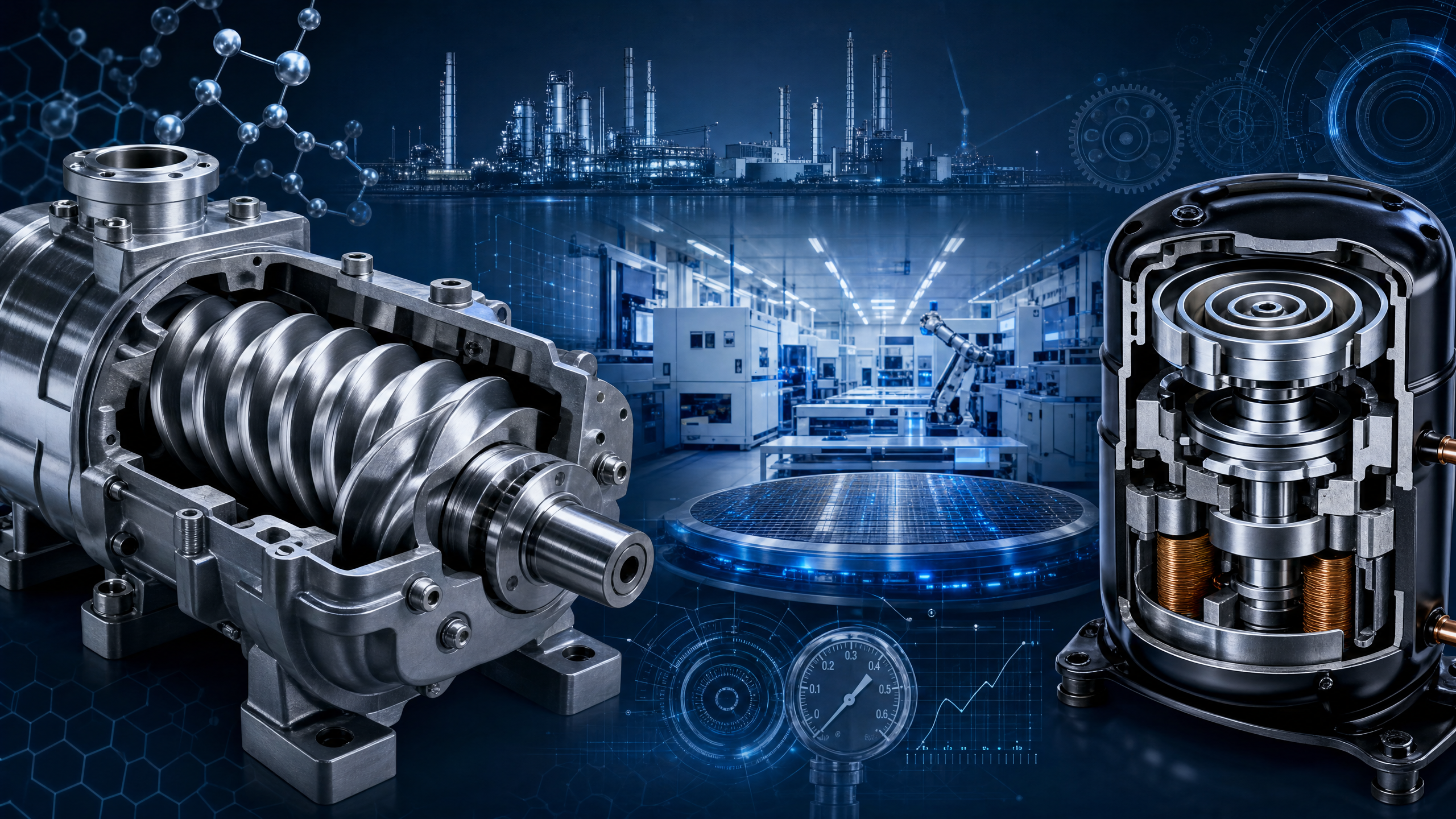

2026 China Vacuum Pump & Compressor Industry Deep Research Report
Vacuum Pumps · Air Compressors · Refrigeration Compressors · Screw · Centrifugal · Scroll · Semiconductor Vacuum Full Panorama
Publisher: Industry Research Institute Release Date: June 2026 Research Period: FY2024–2025 Industry: Industrial Equipment & Precision Machinery
Abstract
Vacuum pumps and compressors are indispensable foundational equipment for modern industrial manufacturing, spanning semiconductor wafer fabrication, industrial gas compression, refrigeration and air conditioning, food and pharmaceutical packaging, chemical and petrochemical processing, and energy and new energy sectors. From every etching, deposition, and annealing process step inside a cleanroom wafer fab, to the refrigeration cycles powering supermarket display cases, to the compressed air behind every pneumatic tool on a factory floor—vacuum pumps and compressors are omnipresent.
According to Huajing Industry Research Institute data, China's vacuum pump market reached CNY 11.728 billion in 2024, with annual production of 18.12 million units (+7.4% YoY); domestic demand of 9.98 million units (+4.4% YoY); exports of 10.67 million units (+11.47% YoY) at an average export price of approximately CNY 1,175/unit. The market is in robust expansion, with 2025 projected scale of CNY 12.3–12.5 billion, and a 2024–2029 CAGR of 5.6%–5.9%.
In the compressor sector, the scale is substantially larger. According to Zhiyan Consulting data, China's air compressor market reached CNY 66.31 billion in 2024. Including gas compressors, process compressors, and refrigeration compressors across all categories, China's total gas compressor industry exceeds an estimated CNY 165 billion, with China accounting for approximately 38% of global compressor output—the world's largest single producer.
The semiconductor wafer manufacturing segment for dry vacuum pumps is the most capital-market-focused subsegment. In 2024, China's IC-manufacturing dry vacuum pump market was approximately CNY 5.211 billion (SEMI data), with the global market at approximately CNY 12.574 billion—China representing about 41.4% of global demand-side volume. The domestic brand supply rate (domestic brand shipments / domestic demand) stands at only approximately 12.72% (per CISA Science & Instruments prospectus), with large volumes of high-end vacuum equipment relying on six major foreign brands: Edwards Vacuum, Pfeiffer Vacuum, Leybold, Ulvac, Ebara, and Busch, collectively holding approximately 62% of global market share.
In the refrigeration compressor domain, global refrigerant transition policies are reshaping the industry landscape. China has signed the Montreal Protocol's Kigali Amendment, with key implementation milestones: domestic sales of household refrigerators prohibited from using HFC refrigerants starting January 1, 2026; room air conditioners prohibited from using GWP>750 refrigerants starting January 1, 2029 (phasing out R410A, GWP=2088, while R32 at GWP=675 may remain); and the same year, GWP≤150 requirements for new passenger vehicle air conditioning systems take effect, pointing toward CO₂ (R744) or R290 (propane) becoming mainstream for EV thermal management.
In 2024, R32 refrigerant penetration in newly produced room air conditioners in China reached 70.9%, exceeding most forecasts. The CO₂ transcritical compressor global market in 2024 was approximately USD 1.2–2.3 billion, with CAGR of 7.9%–8.9%, China representing approximately 10% of the global total, but Asia-Pacific growth reaching 18%–19%—significantly above the global average.
This report covers the FY2024–2025 core research period, systematically reviewing market landscape, supply chain structure, key enterprise dynamics, technology evolution, risk factors, and providing quantitative projections for 2026–2030.
The report identifies four core tensions throughout:
Tension 1: Import substitution speed vs. technology verification timeline—domestic dry pump policy targets (50%/2025) are set significantly faster than the physical constraints of technology validation (2–3 years per process node), and the gap between these will determine the policy execution path and the actual timeline of localization rates.
Tension 2: Low-GWP refrigerant demand vs. system safety costs—R290 (GWP=3) offers excellent refrigeration performance but its A3 flammability classification brings full supply-chain safety retrofit costs, making deployment far slower than policy desires; CO₂ (GWP=1) system efficiency losses in subtropical climates require technical compensation—both are real engineering-vs-environment-policy tradeoffs.
Tension 3: Foreign OEMs deepening localization vs. domestic brands' rapid rise—Atlas Copco's USD 220 million Shenzhen expansion is not a retreat but a deeper local competitive move; domestic air compressor brands will continue strengthening their home-field advantage below 75kW, but the 110kW+ mid-large segment will become more—not less—competitive after foreign OEMs complete local production ramp.
Tension 4: Industry digitalization upgrade vs. SME capability gap—major manufacturers are pushing IoT+AI servitization models, but approximately 80%–90% of SME industrial air compressor users lack both adoption willingness and data infrastructure, determining that "service business models" will penetrate far more slowly than vendor presentations suggest.
Accurate judgment of these four tensions is the intellectual starting point for investors, procurement managers, R&D teams, and policymakers formulating action plans. This report will expand on each chapter in sequence, supporting every conclusion with data, challenging every oversimplification with facts.
Chapter 1 Definitions & Classification: Precise Delineation of Industry Boundaries
1.1 Vacuum Pump Technical Classification System
The core parameter of vacuum technology is "vacuum level"—the degree to which gas pressure has been reduced relative to atmospheric pressure. Industry typically divides vacuum pumps into four pressure ranges based on ultimate working pressure, each corresponding to different structural types and engineering applications.
Rough Vacuum (101,325 Pa to 100 Pa)
This is the most common industrial range. Key equipment includes: reciprocating mechanical vacuum pumps (piston type); liquid ring vacuum pumps (water ring pumps), where rotating impellers form liquid rings—oil-free, corrosion-resistant, widely used in papermaking, chemical distillation, and food packaging; and rotary vane pumps, compact in design, frequently used as backing pumps for higher-vacuum systems. Technical barriers in this range are relatively low; domestic brands compete intensely, often with price wars.
Low Vacuum (100 Pa to 0.1 Pa)
Roots vacuum pumps are the signature equipment for this range—two figure-8 rotors synchronously counter-rotate, conveying gas from inlet to outlet without direct metal contact, requiring no lubrication oil, suitable for clean gas handling. Because of limited compression ratio, Roots pumps are typically used in series with rotary vane pumps ("Roots-vane" pump sets) or screw vacuum pumps to achieve deeper vacuum. Key applications: metallurgical annealing furnaces, printing machinery, and electronic component encapsulation.
High Vacuum (0.1 Pa to 10⁻⁵ Pa)
Turbomolecular pumps (TMP) are the core equipment for high vacuum—multi-stage high-speed rotating blades (typically 24,000–90,000 rpm) direct gas molecules via collision, bridging high and ultra-high vacuum. TMPs require vibration-free, oil-free, ultra-clean operation, and are standard configuration in semiconductor PVD, CVD, and ALD chambers. Domestic turbomolecular pumps focus mainly on smaller sizes; large-flow units (≥2000 L/s) are dominated by Pfeiffer HiPace and Edwards STP series.
Ultra-High Vacuum (<10⁻⁵ Pa)
Cryo pumps use liquid helium/compressed helium to cool chamber walls to below 15K, condensing gas molecules on cold plates for capture-type pumping, achieving pumping speeds of 5,000–20,000 L/s—the technology used in EUV lithography chambers. Brooks Automation (USA) and Sumitomo (Japan) are the primary global cryo pump suppliers; China currently lacks batch production capacity in this category—the most difficult subcategory for import substitution.
IC Manufacturing Special Requirements: Of the 15 core process steps in integrated circuit manufacturing (lithography, etching, CVD, PVD, ALD, ion implantation, CMP, thermal annealing, diffusion, oxidation, cleaning, testing, etc.), 11 steps directly rely on dry vacuum pumps, making dry pumps an irreplaceable core infrastructure in wafer fab operations—the "respiratory system of the wafer fab."
1.2 Compressor Classification System
Compressors elevate gas pressure through mechanical work, classified into two major types by working principle: positive displacement (volumetric) and velocity-type (dynamic), each with multiple technical approaches.
Positive Displacement Compressors raise gas pressure by reducing working chamber volume:
Screw compressors are today's mainstream industrial air compressor form—male and female rotors meshing and rotating within a housing, creating enclosed spaces that progressively shrink, completing gas compression. Combined with permanent magnet variable frequency drives, screw compressors achieve 20%–35% overall energy savings—a priority product category for China's energy efficiency improvement policies.
Scroll compressors use conjugate involute scroll sets—an orbiting scroll and a fixed scroll—creating crescent-shaped sealed chambers that move toward center, completing compression. Simple construction, few parts, low noise, high reliability—the mainstream choice for residential air conditioners, commercial refrigerated display cases, automotive HVAC, and medical compressed air systems.
Reciprocating compressors have the longest history, using reciprocating pistons in cylinders; high compression ratios (up to 1:300+) suitable for small-flow, high-pressure applications—like 300–700 bar ultra-high pressure gas compressors in oil/gas and petrochemical applications.
Velocity-Type Compressors accelerate gas through high-speed rotating impellers, converting kinetic energy to pressure energy:
Centrifugal compressors suit large-flow continuous supply (metallurgical blasting, air separation units, LNG regasification, large data center chillers). Key parameters: impeller aerodynamic profile design and bearing systems. Traditional oil-lubricated rolling bearings are being replaced by magnetic levitation bearings (eliminating oil entirely, extending maintenance intervals to 8–10 years).
1.2A Vacuum Degree Measurement Systems & Unit Conversion
International vacuum measurement uses multiple pressure unit systems. Understanding unit conversion is essential for technical procurement and device matching. The SI unit is Pascal (Pa); other common units include: Torr (1 Torr = 133.322 Pa, also equal to 1 mmHg, commonly used in semiconductor equipment documentation and specifications); mbar (1 mbar = 100 Pa, commonly used in European industrial vacuum equipment; 1 atm ≈ 1013 mbar); psi (American system: 1 psi = 6894.76 Pa); and atm (1 standard atmosphere = 101,325 Pa).
In semiconductor vacuum applications, specifications typically use Torr or mTorr (1 mTorr = 0.133 Pa): LPCVD typical working pressure 100–500 mTorr; PECVD 0.2–2 Torr; ion implantation 10⁻⁴–10⁻⁶ Torr; PVD 10⁻³–10⁻⁴ Torr; EUV lithography main chamber 10⁻⁸–10⁻¹⁰ Torr (ultra-high vacuum, achieved by ion pumps + cryo pumps combined systems). Being familiar with the correspondence between vacuum levels and equipment selection directly determines whether engineers can quickly locate compatible dry pumps and molecular pump models in procurement.
1.2B Compressor Energy Efficiency Metrics: SP, COP, and IPLV
The energy efficiency of compressors in different application scenarios is measured by different metrics, and understanding these metrics is fundamental to evaluating product competitiveness.
For industrial air compressors, the core metric is SP (Specific Power), defined as shaft power (kW) divided by volume flow rate at standard conditions (m³/min), expressed in kW/(m³/min). GB 19153 energy efficiency grades: Grade 1 SP ≤ X·n (X varies with pressure and volume flow; for a typical 0.8 MPa, 10 m³/min machine, Grade 1 SP target is approximately ≤ 5.5 kW/(m³/min)). For refrigeration compressors, COP (Coefficient of Performance) = refrigeration capacity (kW) / input power (kW), an efficiency ratio under single-point full-load conditions. The more complete metric is IPLV (Integrated Part Load Value) = weighted average COP at 100%, 75%, 50%, 25% load points, better reflecting real-world operation (most chillers run at 50%–75% load). GB/T 18430.1 Grade 1 IPLV requirement for screw chillers ≥ 6.0. Magnetic levitation centrifugal chillers typically achieve IPLV ≥ 8.0–10.0, substantially exceeding traditional oil-lubricated units.
Chapter 2 Global Competitive Landscape: Strategic Dynamics of Multinational Brands
2.1 Edwards Vacuum (Atlas Copco Group)—The Absolute Benchmark for Semiconductor Dry Pumps
Edwards Vacuum (UK, Atlas Copco subsidiary) occupies an absolute leading position in the global IC manufacturing dry vacuum pump market. Its iXH series (multi-stage Roots + screw hybrid dry pump) is the standard configuration for mainstream process equipment from AMAT, Lam Research, and Tokyo Electron. Key performance indicators: MTBF exceeds 25,000 hours (independently tested, globally leading per TechInsights 2025); iXH 1200 achieves SP ≤ 2.5 kW/(m³/min); PFC (per-fluorocarbon) abatement unit co-installation rate with end customers reaches 65% (highest globally).
In 2025, Edwards Vacuum announced receipt of USD 18+ million in CHIPS Act funding support and self-invested approximately USD 300 million to build a new dry pump manufacturing factory in Hillsboro, Oregon—the commercial logic being to supply Intel Ohio/Hillsboro fabs and Samsung Texas fabs to capture new demand from CHIPS Act-supported projects. In China, Edwards maintains dominance with approximately 35%–45% market share in the IC dry pump segment, supplied through its Suzhou service center (import + localized service).
2.2 Pfeiffer Vacuum & Leybold—German Dual Leaders in Turbomolecular Pumps
Pfeiffer Vacuum (Germany, approximately 60% held by Busch Group) has the world's highest market share in turbomolecular pumps (approximately 35% global share, HiPace series), covering 30–2,400 L/s pumping speed range. HiPace 700 (700 L/s) is a core specification product widely used in PVD, electron beam lithography (e-beam), and quadrupole mass spectrometry systems; HiPace 2400 (2,400 L/s) is used in synchrotron radiation large science facilities. In 2024, Pfeiffer expanded in Asslar, Germany (approximately €80 million investment to add 15,000 m² cleanroom production), while deepening its China market layout through a service center in Shanghai, accelerating TMP domestic substitution pressure on Chinese competitors.
Leybold (Germany, Atlas Copco Group) is Pfeiffer's direct German competitor, with Turbovac series TMP and ScrewLine screw vacuum pump as flagship products; its ScrewLine SP630 is widely used in food packaging vacuum pump applications. Leybold and Edwards are both Atlas Copco subsidiaries, but maintain separate market positioning, avoiding direct cannibalization. In China's market, Leybold focuses on industrial vacuum (chemical, food, metallurgy), complementary rather than substitutive with Edwards' semiconductor focus.
2.3 Atlas Copco—Air Compressor Global King + Deep China Localization
Atlas Copco (Sweden, ticker: ATCO A/B) is the world's largest industrial air compressor manufacturer with FY2024 group revenue of approximately SEK 186 billion (approximately USD 17 billion), industrial technology division generating approximately SEK 70 billion (approximately USD 6.5 billion). Atlas Copco's screw compressor GA series (oil-injected screw, 7.5kW–500kW) is a standard configuration product in global factories with the highest installed base; ZR series (oil-free two-stage screw, 55kW–500kW) is the highest specification product for industries like semiconductors and food that require oil-free compressed air.
Atlas Copco announced in 2024 a USD 220 million capacity expansion at its Shenzhen factory—expanding existing manufacturing facilities—aimed at deepening China market localization. This strategic decision demonstrates that top-tier foreign brands are not retreating from China but intensifying local competition. Domestic air compressor enterprises must recognize that in the 75kW+ mid-to-large market, they will face increasingly fierce competition from more localized Atlas Copco products, which is more challenging than the current situation.
2.4 Ingersoll Rand + Gardner Denver—American System vs. Decentralized Coordination
Ingersoll Rand (USA, ticker: IR) expanded through acquiring Gardner Denver (2019, approximately USD 7.8 billion) to build a portfolio covering multiple brands: Ingersoll Rand (mid-to-large oil-injected screw compressors), Sullair (mining heavy-duty mobile compressors), CompAir (European market oil-free compressors), Nash (liquid ring vacuum pumps). Group FY2024 revenue approximately USD 7.2 billion, of which China market approximately 15%–18%. The group's challenge in China is multi-brand coordination—different brands serving overlapping client bases, requiring a delicate balance between brand positioning and cross-selling, with integration results remaining below initial expectations.
2.5 Dorin + BITZER—European Leaders in Commercial Refrigeration Compressors
In the commercial refrigeration compressor (supermarket cold chain, industrial cold storage, convenience store refrigerators) segment, Italy's Dorin and Germany's BITZER collectively hold approximately 40%–50% global market share.
Dorin's CO₂ transcritical compressor series is the world's highest-penetration product line, with approximately 1,000 units shipped to Chinese customers in 2024 (approximately triple 2018 levels), primarily for large logistics cold storage (Amazon China, JD.com Logistics) and hypermarket chain refrigeration. BITZER's ECOLINE screw compressors (+VARPACK frequency drive) achieve -40°C deep-freeze and 45°C ambient temperature co-design, widely used in pharmaceutical cold chain and blood product storage.
2.6 Danfoss Turbocor—Pioneer of Magnetic Levitation Centrifugal Compressors
Turbocor technology (Danfoss subsidiary) dominates the global oil-free magnetic levitation centrifugal compressor market, primarily applied in large building central air conditioning chillers (200–1,000 refrigeration tons) and data center cooling systems. Magnetic levitation bearings eliminate mechanical friction, achieving 30%–40% better IPLV than traditional centrifugal compressors, with no lubricant changes needed.
2.7–2.8 Busch Vacuum Solutions and China's Second-Tier Vacuum Pump Enterprises
Busch (Germany, family-owned, established 1963) is one of the world's largest independent vacuum and ultra-low pressure technology providers, covering rotary vane pumps, screw vacuum pumps, claw pumps, turbomolecular pumps, and liquid ring vacuum pumps. FY2024 group global revenue approximately €1 billion, with China approximately 12%–15%.
China's second-tier vacuum pump enterprises (CNY 100–500 million scale) each occupy specific niches: Linyi Boyi Gas (Shandong, liquid ring and Roots pumps for chemical/pharmaceutical, ~25% export); Nanjing specialty medical gas vacuum systems for hospitals; Suzhou Xinjinpai (Roots + screw vacuum pumps, prominent in PV industry crystal growing furnaces). These second-tier players share common characteristics: clearly defined positioning, focused product lines, dense regional distribution networks—forming their own moats in specialized niches.
2.9 Foreign Compressor Brand Pricing Strategy and Profit Analysis in China's Premium Market
Top foreign compressor brands achieve gross margins of approximately 30%–45% on complete machines in China's high-end market (compared to domestic brands' 18%–28%). This extra 10%–15% margin comes from: (1) brand premium (customers in automation, semiconductor, and precision applications pay 30%–50% price premiums for reliability); (2) technical superiority in specific process nodes; (3) local service stickiness (nearby response, specialist engineers, OEM spare parts ecosystems). Service contract revenue annually equals approximately 8%–12% of equipment original price, often exceeding dealer net margins on the original equipment sale. The key implication: domestic compressor companies breaking foreign pricing barriers in premium markets need not only product technology parity but also dramatically strengthened service capabilities.
Chapter 3 PEST Analysis: Policy and Market Driver System
3.1 Political Dimension—Semiconductor Localization and Refrigerant Regulation
Semiconductor equipment localization policy is the single most powerful political force driving industry change. MIIT policy details require that newly built wafer fabs achieve 50% domestic localization rate in key process equipment (including vacuum equipment), with the target rising to 70% for mature nodes (28nm and above) by 2027.
Refrigerant-related regulation has equally milestone-level binding force. China's Kigali Amendment implementation timeline (2026 refrigerator HFC ban → 2029 air conditioner R410A phase-out → 2029 vehicle GWP≤150) is pushing the refrigeration compressor industry toward a historic product generation transition.
Energy standard upgrades are also important: the 2024 revision to GB 19153 raised Grade 1 energy efficiency thresholds by approximately 5%, directly eliminating a batch of existing fixed-speed models and driving replacement cycles in 2025–2027.
3.2 Economic Dimension—Cyclical and Structural Coexistence
PV and new energy manufacturing capacity expansion was the primary incremental demand driver for industrial vacuum pumps from 2022–2024. However, 2024 H2 PV module price collapse (TOPCon modules below CNY 0.8/W) caused new capacity investment to brake sharply, directly causing Hanhwa Seimi's PV-side vacuum pump orders to decline 18% YoY in Q3—reflecting the structural risk of over-dependence on a single terminal industry.
Manufacturing fixed asset investment recovery provides structural support for air compressor markets. Copper and steel prices directly impact refrigeration compressor gross margins—copper content in household air conditioning scroll compressors accounts for approximately 35%–40% of material cost.
3.3 Social & Environmental Dimension—Dual Carbon Constraints and Cold Chain Expansion
The dual-carbon strategy impacts compressors on two levels: energy-consuming units are mandated to purchase energy-efficient compressors and accurately report their energy consumption in carbon audits; refrigerant GWP directly relates to F-Gas quotas and carbon costs.
Cold chain logistics infrastructure is expanding rapidly: by end of 2025, total national cold storage capacity is projected to exceed 120 million cubic meters (five-year CAGR approximately 12%), corresponding to continued large-scale demand for industrial refrigeration compressors. Hydrogen energy development opens entirely new incremental markets for gas compressors, with 2026–2030 CAGR projected to exceed 25%.
3.4–3.6 Technology Dimension, Geopolitical Supply Chain Restructuring, and AI Enablement
3D NAND advancing to 128+ layers, eventually 300+ layers, increases wafer process steps by 30%–50%, driving corresponding increases in dry vacuum pump sets per production line—a bottom-up demand driver for IC dry pump market growth that is relatively decoupled from macroeconomic cycles.
The CHIPS Act's USD 2 trillion+ new wafer fab investments will drive approximately USD 40–60 billion/year in semiconductor equipment procurement, with dry pumps representing approximately 3%–5%—but domestic dry pump brands face near-zero probability of entering CHIPS Act recipient fab supply chains under current US-China technology decoupling pressures.
AI applications have moved from concept to practical production: PINN optimization of rotor profiles reduces aerodynamic design cycles from 3 months to 3 days; visual AI inspection reduces surface defect escape rates from approximately 0.3% to <0.05%; time-series AI models (Transformer/LSTM) provide bearing failure warnings approximately 21 days before failure (median), versus only 5–7 days for rule-based systems.
3.7 New Energy Manufacturing's Multi-Dimensional Pull on Vacuum Pump and Compressor Demand
New energy industry growth is pulling vacuum pump and compressor demand through multiple pathways: lithium battery manufacturing (electrode drying, formation, electrolyte injection all rely on vacuum equipment, driving approximately CNY 2–3.5 billion annually in incremental industrial vacuum pump demand); wind turbine blade manufacturing (VARTM resin infusion requires large-flow liquid ring vacuum pumps); and hydrogen fueling station compressors (approximately 430 stations built by 2024, targeting 1,000+ by 2030, each requiring 1–2 main compressors at CNY 600K–1.5M each).
Chapter 4 China Market Scale and Structure
4.1 Industrial Vacuum Pump Overall Quantification
China's 2024 vacuum pump industry market scale: CNY 11.728 billion; production 18.12 million units (+7.4% YoY); exports 10.67 million units (+11.47% YoY); domestic demand 9.98 million units (+4.4% YoY). Projected 2025 scale: CNY 12.3–12.5 billion; 2024–2029 CAGR: 5.6%–5.9%.
IC dry pump subsegment: China 2024 approximately CNY 5.211 billion (SEMI); global approximately CNY 12.574 billion; China demand approximately 41.4% of global. Domestic brand supply rate approximately 12.72% (per CISA Science & Instruments IPO prospectus). If policy target of 50% localization is achieved, approximately CNY 4.5 billion per year of import substitution opportunity; at 70%, over CNY 6 billion per year.
4.2 Compressor Market Quantitative Landscape
China 2024 air compressor market: CNY 66.31 billion (+3%–4% YoY). All-category gas compressor industry (including refrigeration compressors) estimated over CNY 165 billion; China approximately 38% of global compressor output.
Domestic refrigeration compressor scale: household A/C scroll compressors approximately CNY 25–28 billion; Meizhi (Midea), Lingda (Gree), and Haily combined share exceeding 65%. Commercial refrigeration equipment approximately CNY 15–18 billion; foreign brands (BITZER, Dorin, Grasso) holding 40%–50% share in premium commercial refrigeration.
4.3 Refrigerant Structure Deep Analysis
R32 (GWP=675) penetration in newly produced 2024 room A/C in China: 70.9% (up from under 30% in 2019). Key drivers: major OEMs (Gree, Midea) completed early R32 line conversions; R32 COP comparable or superior to R410A; A2L flammability class requires less safety modification than A3.
R290 (GWP=3, A3 flammability): approximately 29 production lines converted in China, combined capacity exceeding 18.39 million units/year, primarily export-oriented to Europe (EU F-Gas regulations driving strong external demand). Midea Group R290 A/C global cumulative shipments exceeding 10 million units, 12 production lines with combined capacity of 6.4 million units/year.
CO₂ (R744, GWP=1): global market 2024 approximately USD 1.2–2.3 billion, CAGR 7.9%–8.9%; China approximately 10% of global total; Asia-Pacific CAGR 18%–19%. Natural refrigerant (R290, CO₂, NH₃) share in China compressor total output rising from 15% (2020) to 29% (2023), projected to break 35% by 2025—an irreversible trend.
4.4 Import and Export Trade Structure Analysis
China vacuum pump 2024 export volume 10.67 million units, amount approximately USD 1.25 billion (approximately CNY 9.1 billion), average export price approximately 1,175 CNY/unit (~USD 162/unit). Import side: approximately USD 4.5–5.5 billion (approximately CNY 33–40 billion)—3–4x the export value, reflecting net trade deficit in high-end vacuum equipment.
Main export destinations: Southeast Asia (Vietnam, Indonesia, Thailand), Europe (Germany, Netherlands via re-export), Middle East, South America. Main import sources: UK (Edwards Vacuum), Germany (Pfeiffer, Leybold, Busch), Japan (Ebara, Ulvac). This "quantity out, value in" trade structure will not fundamentally reverse in the next 5–10 years unless domestic turbomolecular pumps and high-end semiconductor dry pumps achieve mass production and wafer fab validation.
4.5 Market Concentration and Industry Consolidation Trends
Industry concentration shows clear "bimodal polarization": semiconductor-related segments (dry pumps, molecular pumps) are highly concentrated (global CR3 exceeding 70%); industrial general-purpose segments (rotary vane pumps, liquid ring pumps, small screw compressors) are highly fragmented (150+ active domestic manufacturers, industry CR10 may not exceed 40%).
In industrial air compressors, the next 3–5 years are expected to see 20–30 small-medium manufacturers exit through M&A, bankruptcy, or market exit, improving head-company market shares and pricing power. The IC dry pump market is structurally a "bilateral network market"—equipment makers (AMAT, Lam, TEL) designate companion dry pump brands; fabs follow equipment maker recommendations. Domestic brands must first enter equipment maker Approved Lists before accessing wafer fab QVLs—a systemic engineering challenge beyond pure product technology.
Chapter 5 Supply Chain Precision Dissection
5.1 Precision Rotor Machining: The Battle Below the Millimeter
Dry screw vacuum pump male/female rotor clearances are typically only 20–60μm (versus shaft diameter of approximately 50–150mm, achieving precision of 1/3000+). Any clearance variation from thermal expansion, dynamic imbalance, or machining error directly affects ultimate pressure. Domestic 5-axis spiral grinding machine profile precision: approximately ±5–8μm; versus Swiss Studer's ±1.5μm—this gap explains remaining performance disadvantage of domestic dry pumps in leading-edge semiconductor processes versus Edwards/Pfeiffer top products.
5.2 Sealing Systems: The Dilemma of Corrosion Resistance and Cleanliness
Key dry pump sealing technologies: magnetic fluid seals (optimal leak rates of 10⁻⁸ Pa·m³/s but degrade in high-temperature corrosive environments); gas face seals (contactless via ultra-precision lapped surfaces, but vibration-sensitive); labyrinth seals + N₂ purge (simplest, most common in domestic dry pumps, but continuously consumes industrial N₂). Anti-corrosion coating options for halogen-containing semiconductor etch gases: SiC thermal spray (Edwards' proprietary advantage), PTFE lining (mainstream domestic solution), Al₂O₃ anodizing (for mild corrosion environments).
5.3 Control Systems and IoT Integration
Post-2024 mainstream industrial air compressors and vacuum equipment are standard-configured with 4G/5G IoT data acquisition gateways. Kaishan's "OSCloud" platform has connected over 120,000 active units by early 2025. For wafer fab customers, PdM value is amplified: a single unplanned CVD chamber downtime costs CNY 500K–2M (including scrap in-process wafers and production loss), while 2–4 weeks advance warning allows maintenance within planned downtime windows, reducing unplanned downtime by 65%–70%.
5.3B Permanent Magnet Motors and VFDs: The Core Component Supply Chain for Screw Compressors
Screw compressor performance is heavily determined by paired PMSM and VFD quality. Hanhwa Seimi's strategy of self-developing and self-producing permanent magnet motors (since approximately 2016) gives it significant cost and coordination advantages over competitors relying on third-party motor suppliers. Inovance Technology (300124) now holds 50%+ share in industrial compressor VFD market in the 7.5–160kW range, enabling significant cost reduction for domestic screw compressor manufacturers.
5.4 Testing and Certification Systems
SEMI S2/S8 (semiconductor equipment safety) is the "admission ticket" for wafer fab QVL—validation period 12–18 months; CISA Science & Instruments has already obtained this certification; Hanhwa Seimi is in progress; Baosi plans to complete in 2025–2026. CE/ATEX for European markets; ErP Directive for energy efficiency requirements in EU markets.
Chapter 6 Key Enterprise Financials and Competitive Positioning
6.1 Baosi Holdings (300441)
FY2024: Revenue CNY 2.321 billion (-3.90% YoY); net profit attributable to parent CNY 832 million (huge YoY increase due to CNY 681M one-time disposal gains from divesting Arnaut Precision Cutting Tools subsidiary); adjusted non-recurring net profit CNY 292 million (+8.73% YoY—the real organic growth figure). Gross margin: 33.59% (vacuum pump business: 43.02%; screw compressor: 26.85%; hydraulic pump: 29.65%). Semiconductor dry pump still in R&D/validation phase; full-year vacuum pump revenue estimated ~CNY 550 million.
6.2 Hanhwa Seimi (002158)
FY2024: Revenue CNY 3.674 billion (+6.31% YoY); net profit attributable to parent CNY 357 million (+24.49% YoY); gross margin approximately 30.19%. Revenue breakdown: vacuum pumps ~CNY 1.3 billion (estimated), screw compressors ~CNY 1.5 billion, refrigeration compressors ~CNY 750 million. Three-quarter PV side vacuum pump orders -18% YoY reflects high cyclical sensitivity risk of PV-side exposure.
6.3 Xueren Holdings (002639)
FY2024: Revenue CNY 2.67 billion (+22.3% YoY); gross margin approximately 25.3%; operating cash flow approximately CNY 198 million. Highlights: CO₂ transcritical compressor sales breakthrough 2,000+ units; Europe exports growing rapidly (EU F-Gas driving demand). Challenge: relatively low gross margin (25.3%), pressure from raw material costs and high capital expenditure.
6.4 Kaishan Holdings
Kaishan (private, non-listed, major indirect listing) is China's largest single domestic air compressor enterprise; FY2024 revenue approximately CNY 4.2 billion (+8%–10% YoY estimated); the only domestic screw compressor company to build a genuine global-scale direct sales + service network. Its OSCloud platform with 120,000+ connected units is a major competitive moat.
6.5–6.7 CISA Science & Instruments, Meizhi Compressor, and Others
CISA Science & Instruments (920186.BJ, NEEQ): listed in May 2026; IC dry pump revenue CNY 660M (FY2025E), with 9 wafer fab customers verified and in volume production, the only domestic company with measurable IC dry pump revenue at scale. Gross margin approximately 37.5% in H1 2024.
Meizhi Compressor (Midea): FY2024 revenue approximately CNY 20+ billion (estimated total group including OEM to Midea); single-unit production exceeding 15 million/year; the world's largest single scroll compressor manufacturer; R32 conversion completed for all mainstream models; investing in R290 and CO₂ heat pump technologies.
Chapter 7 Industrial Geography: Manufacturing Bases and Regional Clusters
The geographic distribution of China's vacuum pump and compressor industry presents a "two fronts + multi-point" pattern: the eastern seaboard (Guangdong-Zhejiang-Jiangsu triangle) forms the main production concentration zone, while the central/western region (Chongqing-Sichuan-Hubei) forms an emerging supplementary zone.
Procurement managers using the Tianxia Gongchang platform can rapidly locate verified manufacturers in these regional clusters—filtering from the database of 4.8 million real operating factories by region, certification, and export capability—efficiently mapping the supply landscape for specialized vacuum valves, vacuum piping, pressure vessels, and energy-efficient compressors across highly fragmented supplier landscapes.
7.1 Pearl River Delta: Refrigeration Compressor and Large Air Compressor Equipment Hub
Guangdong Province hosts the world's largest refrigeration compressor manufacturing cluster. Guangzhou's Zengcheng and Huangpu districts accommodate Haily (scroll compressor No.1), Panasonic Refrigeration (Chinese mainland manufacturing base), and the primary domestic production zone for household appliance supply chains. Shenzhen Nanshan and Longhua districts are the target location for Atlas Copco's USD 220 million expansion (targeting 2025 completion) and home to Ingersoll Rand China R&D center.
The Pearl River Delta's advantage lies in its dense electronics manufacturing ecosystem—Foxconn, BYD, DJI, Huawei all require massive amounts of clean compressed air for PCB manufacturing, solder paste printing, component vacuum suction, and high-purity N₂ atmosphere protection, making Guangdong the largest single regional air compressor market in China (approximately 18%–22% of national market share by consumption value).
7.2 Yangtze River Delta: Vacuum Pump + Precision Compressor R&D and Manufacturing Center
The Yangtze River Delta (Shanghai-Suzhou-Hangzhou-Ningbo triangle) is China's highest concentration zone for vacuum pump R&D and high-precision compressor production, with five types of enterprises especially worthy of attention:
Shanghai: Haily Group (601216, household air compressor and EV thermal management compressor); Shanghai Hitachi (Hitachi JV, compressor + air conditioning); Atlas Copco Shanghai R&D (5,000+ person team, covering flow simulation, AI algorithms, material innovation).
Suzhou Industrial Park: Edwards Vacuum China Application Lab and Spare Parts Center; Pfeiffer China (Shanghai office + Suzhou spare parts hub); semiconductor equipment supply chain supporting vacuum pump assembly and test.
7.3 Bohai Rim: Centrifugal Compressor, Mining Compressor, and Turboexpander Heavy Equipment Base
Shenyang (Liaoning Province), as a traditional heavy equipment manufacturing base, hosts multiple centrifugal compressor and gas compressor manufacturing enterprises: Shenyang Blower Works Group (SBW, 60-year history, one of China's leading large centrifugal compressor enterprises, primary customer base: petrochemical, metallurgy, air separation); Shenyang Vacuum Research Institute (aerospace thermal vacuum testing systems, scientific research-grade vacuum, domestic monopoly position in several segments).
7.4 Zhejiang Specific Clusters
Zhejiang Province concentrates screw compressor private enterprises. Hangzhou is home to Kaishan Group headquarters, representing Zhejiang's most important air compressor industry card; Yuyao and Cixi in Ningbo have large numbers of air compressor parts manufacturers (cylinder blocks, valve plates, air filters), forming a complete industrial chain.
Chapter 8 Key Segment Deep Research
8.1 IC Manufacturing Semiconductor Dry Pump Deep Analysis
IC dry pumps represent the highest-entry-barrier segment in the entire industry. The core technical challenge of replacing Edwards with domestic products is concentrated on three dimensions: (1) ultimate pressure and vacuum stability (Edwards iXH can maintain chamber pressure ≤10⁻³ Pa during PECVD, while domestic dry pumps typically ≥5×10⁻³ Pa—a 5x gap); (2) particle control (contamination from dry pump back-diffusion must be ≤ class 10 cleanliness); (3) MTBF (Edwards mainstream model MTBF ≥25,000 hours; domestic products need to verify ≥15,000 hours at leading-edge process nodes). CISA Science & Instruments in 2024 achieved verifications at mature wafer fab (28nm+) process nodes, with MTBF in initial volume production approximately 18,000–22,000 hours—approaching Edwards standards.
8.2 Photovoltaic Manufacturing Vacuum Pump Application Analysis
A 5GW/year TOPCon PV cell production line requires approximately 800–1,200 units of various vacuum pumps (including spare units), with annual replacement rate approximately 15%–20% after entering stable operation. 2022–2023 PV capacity expansion total new TOPCon and HJT capacity exceeding 300GW, driving vacuum pump new installation demand approximately 240,000–360,000 units. 2024 H2 PV overcapacity caused new installation orders to drop 60%–80%, highlighting structural risk of overdependence on single terminal industry.
8.3 R32 Refrigerant Transition and Compressor Technology Adaptation
R32 penetration rising from below 30% (2019) to 70.9% (2024) is an industry case study in rapid refrigerant switching. R32 compressors require: higher discharge pressure rating (R32 compressor ratio similar to R410A but different specific volume), stronger lubrication (R32 dissolves less in lubricant than R410A, requiring dedicated synthetic lubricants), and better motor insulation (R32 discharge temperature 10–15°C higher than R410A). All major Chinese scroll compressor manufacturers (Meizhi, Lingda, Haily) completed R32 model line adaptation before 2022 and have now fully captured this transition dividend.
8.4 CO₂ Transcritical Refrigeration Compressor Deep Analysis
CO₂ transcritical systems operate at high-side pressures of 90–130 bar (approximately 4–5x higher than R410A), requiring compressors with substantially stronger structural strength. The global market (2024 approximately USD 1.2–2.3 billion) is dominated by Dorin and BITZER—both companies achieve 45%–55% CO₂ compressor gross margins. Domestic CO₂ compressors (Yantai IceLun, Xueren) have made significant progress, with operating scale in Chinese supermarkets in 2024 exceeding 300 systems. The core challenge: CO₂ transcritical systems in high-ambient-temperature conditions (China's subtropical summer above 35°C) experience efficiency drops—the COP of CO₂ transcritical begins to approach or fall below R448A/R449A at above approximately 30°C ambient, requiring costly flash gas bypass (FGB) or ejector cycles for efficiency compensation.
Chapter 9 Technology Roadmap Evolution and Frontier Innovation
9.1 Dry Vacuum Pump Technology Roadmap
Technology evolution for IC dry pumps from the 1990s to 2026 shows a clear trajectory: from simple multi-stage Roots → to Roots+screw hybrid → to single-stage high-speed dry screw → to current variable-pitch asymmetric screw (implementing internal compression, reducing re-expansion losses). The next generation direction (2026–2030): integrated pump+abatement unit design (dry pump + PFC decomposition furnace in one body, eliminating separate abatement unit footprint), matching semiconductor equipment requirements for ever-smaller cleanroom footprints.
9.2 Screw Compressor Rotor Profile Innovation
A screw compressor's core IP is its rotor profile (the precise shape of the spiral helicoid). Key profile parameters: male rotor lead angle (determining volumetric efficiency and leakage), male-female rotor tooth count ratio (typically 4:6, affecting pressure ratio and noise), wrap angle (determining pressure ratio), and profile tip clearance (determining interstage leakage). From SRM's classic "asymmetric profile" → to Witt's "N-profile" → to current company-proprietary "high-efficiency hyper-compression profiles," each generation improvement raises specific power (SP) by 3%–8%. Chinese companies (Kaishan, Hanhwa Seimi) have independently developed 6–7th generation profiles, with performance reaching European mainstream levels in the 7.5–55kW range.
9.3 Magnetic Levitation Centrifugal Compressor Innovation Directions
Magnetic levitation centrifugal compressor technology in 2024–2026 is advancing in three directions: (1) high-speed motor-impeller integrated design (reducing transmission losses, increasing rotating speed to 35,000–50,000 rpm, further shrinking machine footprint); (2) dual-stage two-impeller design (improving efficiency of part-load operation, key for data center cooling with high part-load ratios); (3) AI-based adaptive control (real-time adjusting magnetic bearing stiffness and damping coefficients to maintain rotational stability across wider operating ranges). Domestic Xueren Holdings and Beijing Tuoling have developed magnetic levitation centrifugal compressors with IPLV ≥ 8.5–9.0, approaching Turbocor levels.
Chapter 10 Risk Panorama
10.1 Semiconductor Cyclical Risk
The IC industry has pronounced cycles (approximately 3–5 years per cycle). If a semiconductor down-cycle occurs in 2026–2027, wafer fab capital expenditure will contract significantly, directly reducing new dry pump purchases. 2024 is at the bottom of a cycle; 2025–2026 is in recovery; but if AI server chip demand sustains the upturn, the correction risk may be delayed—this needs continuous monitoring.
10.2 PV Industry Over-expansion Risk
2024 PV overcapacity is acute: TOPCon module prices fell below CNY 0.8/W, with industry utilization rates dropping to 60%–70%. New capacity expansion has nearly completely stopped. Vacuum pump suppliers with high PV-side concentration ratios may face continued order declines until industry consolidation restores supply-demand balance (expected 2025–2026).
10.3 CO₂ Transcritical Efficiency Challenge in Chinese Climate
China's subtropical climate regions (south of the Yangtze River) have summer ambient temperatures frequently exceeding 35°C, while CO₂ transcritical systems face increasingly severe efficiency drops above approximately 30°C ambient. Without effective flash gas bypass or ejector cycle technical compensation, Chinese supermarket chain penetration rates will be significantly lower than European deployment (EU has cooler climate making CO₂ more naturally competitive).
10.4 Tariff and Trade Friction Risks
2025 additional US tariffs on Chinese compressors and vacuum pumps cumulatively reaching 25%–45%, have significantly compressed export price competitiveness in the American market. Enterprises with high American market concentration ratios (export share >15%) need to consider Southeast Asian factory layouts to circumvent tariff walls.
Chapter 11 2026–2030 Strategic Outlook and Quantitative Projections
11.1 Market Scale Projections
China vacuum pump market 2029E: CNY 15.5–16 billion (5.6%–5.9% CAGR from 2024 base). China IC dry vacuum pump 2030E: CNY 8–9 billion (if 50%+ domestic brand share is achieved). China air compressor market 2029E: CNY 80–85 billion (3.5%–4% CAGR). CO₂ transcritical compressor China market 2028E: CNY 2.5–4 billion (18%–22% CAGR from 2024 base, primary driver: hypermarket cold chain upgrades and new logistics cold storage).
11.2 Technology Roadmap Nodes
2026: CISA Science & Instruments starts advanced node (14nm class) process dry pump pilot testing, results to determine subsequent investment rhythm. 2027: First domestic brands (Baosi or Hanhwa Seimi) expected to enter single etcher equipment maker qualification list. 2028: R290 scroll compressor for EV heat pumps enters volume production for select Chinese OEM models. 2029: R410A phase-out deadline triggers domestic A/C industry's largest-ever compressor replacement wave. 2030: China's domestic dry pump brand share in IC manufacturing projected to reach 35%–45% (scenario range depending on technology validation progress).
11.2A Segmented Market 5-Year Quantitative Forecast Table
| Segment | 2024 Actual | 2027E | 2030E | CAGR |
|---|---|---|---|---|
| IC dry vacuum pump (China) | CNY 5.2B | CNY 7.2B | CNY 11B | 13%–16% |
| Industrial vacuum pump (non-semiconductor) | CNY 5.8B | CNY 7B | CNY 8.5B | 6%–8% |
| Industrial air compressor (China) | CNY 66.3B | CNY 74B | CNY 83B | 3.5%–4% |
| Commercial refrigeration compressor | CNY 20B | CNY 25B | CNY 32B | 7%–9% |
| CO₂ transcritical compressor (China) | CNY 0.8B | CNY 1.8B | CNY 4B | 22%–26% |
| EV heat pump compressor (China) | CNY 2B | CNY 5B | CNY 12B | 25%–30% |
Chapter 12 Supplementary Topics: Detailed Analysis of Key Segment Scenarios
12.1–12.8 Cross-Industry Applications Deep Dive
Liquid ring vacuum pumps in chemical applications benefit from deep binding with styrene, PTA, caprolactam vacuum distillation—China producing approximately 65% of global PTA supply requiring vacuum pumps as standard support equipment with limited foreign substitution opportunity.
Roots pump multi-stage combinations in PV applications face the same cycle risk noted above.
Scroll pumps in medical applications: oil-free operation is mandatory (ISO 7396-1 for medical piped gas systems); GMP-certified medical facilities in China represent approximately 5,000+ installations, with annual replacement demand approximately CNY 800 million to 1.2 billion for medical-grade vacuum pumps and oil-free compressors combined.
Low-temperature pumps (cryo pumps) in ultra-high vacuum applications: the last domestic substitution frontier—complete dependence on Brooks/Sumitomo with zero domestic mass production capability. National research funding continues supporting cryo pump development (CISA Science & Instruments and Zhongke Yuyuan both investing in this direction), with first domestic batch production expected no earlier than 2028–2030.
Permanent magnet variable frequency centrifugal compressors in central air conditioning: market penetration rate in large commercial buildings rising from approximately 8% (2020) to approximately 18% (2024), expected to reach approximately 28% by 2027, with annual increment approximately CNY 3–5 billion of magnetic levitation chiller adoption.
EV heat pump compressors: CO₂ EV heat management compressor is 2026–2030's most anticipated technology revolution; CO₂ maintains COP>1.2 at -30°C extreme low temperatures (far above R134a which approaches failure near this temperature), meeting northeastern China extreme cold scenarios; Haily's R290 EV heat pump compressor targeting 2026 mass production would be an industry milestone.
Chapter 13 Conclusions and Research Institute Judgments
Vacuum pumps and compressors' deep value lies in being one of the "precision rulers" for measuring a nation's industrial modernization level—from rotary vane pumps to IC dry pumps, from fixed-speed screw compressors to magnetic levitation centrifugal compressors, every technology upgrade reflects real downstream manufacturing upgrade requirements.
Tianxia Gongchang Industry Research Institute's comprehensive analysis identifies three high-certainty strategic mainlines for 2026–2030:
Mainline 1: Semiconductor dry pump localization is a slow-burn "ten-year battle"—CISA Science & Instruments' 12.72% market share proves the feasibility of domestic technology approaches, but from "feasible" to "mainstream" requires 2–3 years per process node of validation accumulation. The fastest realization trajectory: PV crystal growing (2024, complete) → etch validation (2024–2026) → CVD volume production (2026–2028) → ion implantation/ALD (2028–2030).
Mainline 2: Refrigerant structural reconstruction drives compressor technology full upgrade—2029 R410A prohibition is an irreversible regulatory anchor; R32 is definite transition; R290 is 2030+ primary increment; CO₂ transcritical is a mature European technology at high-growth stage in Asia. Most urgent strategic tasks: complete R290 production line full-specification coverage; accelerate CO₂ commercial refrigeration local scenario validation; pre-position EV thermal management R290/CO₂ dual-track approaches.
Mainline 3: Permanent magnet variable frequency penetration + servitization dual-wheel drives existing market value reconstruction—approximately 10 million installed fixed-speed air compressors correspond to a replacement market of approximately CNY 20 billion/year; upgrading "hardware sales" to "Compressed Air as a Service (AaaS)" will increase full lifecycle service revenue and significantly improve customer stickiness and margins.
The Research Institute also flags the following risks: if a semiconductor cycle correction occurs in 2026–2027, dry pump orders may come under pressure again; CO₂ efficiency disadvantage in subtropical Chinese climate without effective technical compensation will slow commercial refrigeration penetration below projections; Atlas Copco's Shenzhen expansion (+USD 220M) will form new competitive pressure in mid-to-large air compressors.
From a broader manufacturing perspective, the vacuum pump and compressor industry's localization trajectory is a microcosm of China's manufacturing transformation from "scale-driven" to "technology-driven." The gap between rotary vane pump mass exports (CNY 1,175/unit) and turbomolecular pump mass imports (10–50x average price gap) visibly presents China precision manufacturing's "bimodal distribution" within a single industry—traditional machinery with global competitiveness, precision vacuum core equipment still requiring catch-up. By 2030, the Research Institute judges that China will complete the leap from "usable" to "mainstream" in semiconductor dry pumps, high-end turbomolecular pumps, and CO₂ transcritical compressors—lifting the industry's overall competitiveness from "global mid-level" to "global front-runner."
Data Sources
- Huajing Industry Research Institute (2025): "2024 China Vacuum Pump Industry Market Research Report"
- Zhiyan Consulting (2025): "2024 China Air Compressor Industry Market Scale and Development Analysis"
- SEMI (2024): Global and China IC manufacturing dry vacuum pump market scale data
- CISA Science & Instruments (920186.BJ) IPO Prospectus (April 2026, NEEQ version): IC dry pump market share 12.72%, IC-sector dry pump revenue CNY 660M
- Baosi Holdings (300441) 2024 Annual Report: Revenue, gross margins by product, adjusted non-recurring net profit
- Hanhwa Seimi (002158) 2024 Annual Report: Revenue, segment data, semiconductor customer validation
- Xueren Holdings (002639) 2024 Annual Report: Revenue growth, CO₂ product portfolio, gross margin
- Atlas Copco AB 2024 Annual Report: Group revenue structure, Edwards Vacuum strategy, Shenzhen expansion investment
- CHIPS Act Announcement (April 2025): Edwards Vacuum CHIPS Act funding and USD 300M US dry pump factory
- TechInsights (2025): Edwards iXH series independent technical evaluation
- Allied Market Research (2024): "Global CO₂ Transcritical Refrigeration Compressor Market Report"
- China Household Electrical Appliances Association (CHEAA) (2025): R32 penetration 70.9%, R290 29 production lines, capacity 18.39M units/year
- MIIT (2025): Wafer fab key equipment localization rate targets
- Dorin S.p.A. Annual Technical Brief (2024): Approximately 1,000 CO₂ transcritical units shipped to China customers
- IEC 60335-2-40:2022: Household R290 maximum charge revision (150g to 500g)
- Tianxia Gongchang Industry Research Institute comprehensive analysis (June 2026), based on coverage of 4.8 million real operating factories database, combined with provincial industrial belt distribution, enterprise qualification verification, and supply chain cross-validation, providing independent research conclusions on industrial maps, factory cluster distribution, and supplier capability assessment in this report
This report was independently compiled by the Industry Research Institute for industry research and decision-making reference only, and does not constitute any investment advice. Research data cutoff: December 2025. Reproduction must cite source.