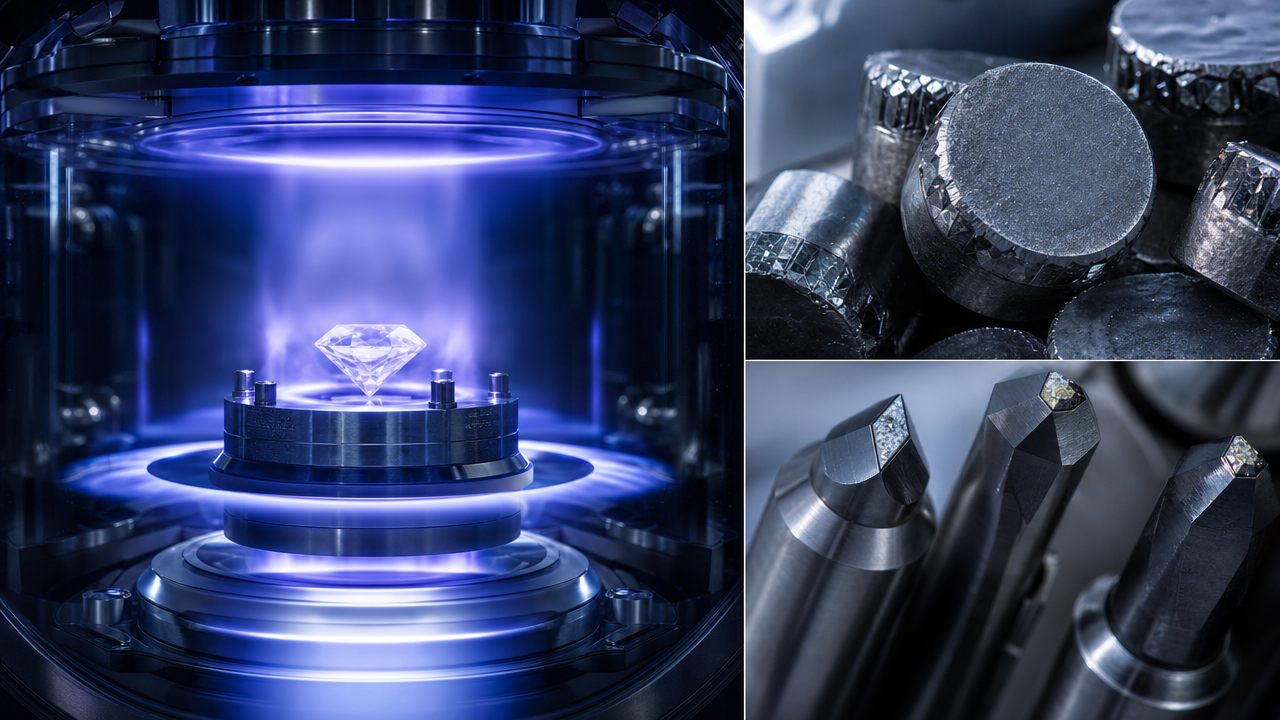

China Superhard Materials 2026: Synthetic Diamond, Lab-Grown Diamond, CBN and Industrial Coatings — A Full-Spectrum Analysis
Tianxia Factory Industrial Research Institute | June 2026
Abstract
Superhard materials are the "teeth" of industrial civilization. Whether it is the precision slicing of photovoltaic silicon wafers, the deep drilling of oil fields, the heat dissipation substrates of semiconductor chips, or the diamond jewelry on a wedding finger — all depend on this family of materials that surpass every natural mineral in hardness. In 2025, China's full superhard materials supply chain (covering industrial diamond, micropowder, composites, cubic boron nitride, lab-grown diamonds and industrial CVD diamond) is estimated at RMB 250–300 billion, representing over 70% of global supply, with a complete closed-loop ecosystem from synthesis and micropowder through sintered composites to end cutting tools and drill bits.
Two violent disruptions hit simultaneously in 2023–2025: first, lab-grown diamond prices collapsed — 1-carat rough fell over 70% from the 2022 peak; second, demand for diamond wire saws for PV silicon wafer slicing exploded at over 40% CAGR, while CVD single-crystal diamond for semiconductor heat dissipation substrates and 5G filters moved from lab to pre-production stage. The old pricing paradigm broke. A new demand map is being drawn.
This report surveys the industry across twelve chapters — definitions and supply chain, global competitive landscape, PEST environment, China market scale, supply chain disaggregation, key enterprise profiles, industrial cluster geography, eight thematic deep-dives, technology roadmap, risk matrix, 2026–2030 outlook, and strategic conclusions — providing a comprehensive reference for researchers, procurement decision-makers and investors.
I Definitions and Classification: The Superhard Family
1.1 What Are Superhard Materials?
Superhard materials typically refer to materials with Vickers hardness above 40 GPa. Industrially, they span three main families:
Synthetic Diamond: Made from graphite through high-pressure high-temperature (HPHT) synthesis or chemical vapor deposition (CVD), with Mohs hardness of 10, the hardest known natural substance. By grain size and purity, they divide into single-crystal abrasive, micropowder, and large single crystal — corresponding to grinding, precision polishing, and electronic-grade applications.
Cubic Boron Nitride (CBN): Second only to diamond in hardness at Mohs 9–9.5. Its decisive advantage is chemical stability at high temperatures far superior to diamond: in high-speed grinding of ferrous metals, diamond reacts chemically with iron, while CBN does not. Polycrystalline CBN (PCBN) inserts can replace cemented carbide for automotive crankshaft and cylinder block machining.
Diamond Composite Compacts (PCD/PDC): Diamond micropowder sintered with a binder (typically cobalt) under HPHT, then bonded to a tungsten carbide substrate for combined hardness and toughness. PCD is used for cutting non-ferrous metals; PDC is the core consumable in oil and gas drill bits.
Lab-Grown Diamond (LGD): Same technology as industrial diamond (HPHT or CVD), but targeting gem-quality size (≥0.5 carat) and colorless/near-colorless grade, replicating natural diamond's physical properties at fraction of the cost, primarily for the jewelry market.
CVD Coated Tools and Industrial CVD Diamond: Beyond gem-quality single crystals, CVD can deposit nanometer-scale diamond coatings (TiN, TiAlN, DLC — collectively CVD/PVD coatings) on tool substrates, and grow free-standing diamond wafers for heat-dissipation substrates, optical windows, acoustic filters, and quantum sensors.
1.2 Supply Chain Overview
The superhard materials supply chain spans five tiers from raw materials to end products:
Raw Materials: High-purity graphite, catalyst alloys (Fe-Ni-Cu), methane/hydrogen (CVD), boron nitride feedstock (CBN synthesis). All are commodity chemicals with high domestic Chinese self-sufficiency.
Synthesis: HPHT presses achieve 1300–1600°C and 5–8 GPa. CVD deposits carbon atoms under low-pressure plasma or hot-filament activation. China's six-sided press fleet is the world's largest, concentrated in Henan province.
Micropowder and Crushing: Synthesized diamond is crushed and classified to 0.5–500 μm abrasive particles for grinding wheels, abrasive papers, cutting wires and polishing slurries.
Composite Sintering: Diamond micropowder or CBN is mixed with binder, sintered under HPHT into PCD/PDC/PCBN composites, then brazed or mechanically fixed to tool shanks or drill bits.
End Products: Cutting tools (milling cutters, turning tools, drill bits), grinding wheels, wire saws, PDC bits, CVD diamond heat spreaders — delivered to end users in photovoltaics, automotive, aerospace, oil and gas, and semiconductors.
II Global Competitive Landscape: Oligarchs in Flux
2.1 Global Market Scale
The global industrial superhard materials market was approximately USD 120–150 billion in 2024 (larger including lab-grown diamond jewelry). China supplies over 90% of global industrial diamond volume and approximately 50–60% of CBN. Outside China, major suppliers are concentrated in Europe, Japan and the United States, primarily representing high-value-added products rather than raw material volume.
2.2 Element Six (De Beers Subsidiary)
Element Six (E6) is the world's longest-standing synthetic diamond technology company, headquartered in the UK under the De Beers Group, with facilities in Ireland, Germany, South Africa and Oregon (USA). E6's strategy has been shifting toward semiconductor and quantum technology applications. Irish financial disclosures show 2024 profits fell by half versus 2023, though a USD 10 million dividend was still paid, indicating stable core cash flow. De Beers parent group announced closure of its Lightbox lab-grown diamond jewelry brand in 2025, signaling a strategic withdrawal from the consumer-grade lab-grown diamond market.
2.3 Sumitomo Electric (Japan, TYO: 5802)
Sumitomo Electric is the global technical benchmark for CBN and PCBN inserts. The BNC (Borazon CBN) brand commands significant share in automotive cylinder head and block finishing. FY2024 (ended March 2025) showed FX tailwinds but margin pressure. Sumitomo's moat lies in PCBN microstructure control patents and long-term OEM relationships with Toyota and Honda.
2.4 Saint-Gobain (France)
Saint-Gobain's abrasives division is one of the world's largest traditional abrasives businesses. Diamond grinding wheels and CBN wheels form an important high-performance product line. In 2024, Saint-Gobain focused on restructuring its construction materials and insulation portfolio, with superhard abrasives remaining stable but non-strategic.
2.5 Sandvik (Sweden, SAND.ST)
Sandvik Hyperion is a major global PDC compact and cemented carbide supplier. Tool business revenue was approximately SEK 24 billion in 2024, with superhard materials representing approximately 10–15%.
2.6 Diamond Foundry (USA)
Diamond Foundry is Silicon Valley's CVD lab-grown diamond unicorn, extending into quantum and semiconductor-grade CVD diamond. Consumer jewelry lines faced pressure from price declines, but high-value quantum computing and heat dissipation products maintained R&D investment.
2.7 Landscape Summary
The global superhard materials landscape shows a "volume in China, technology in Europe and Japan, value stratified" pattern: China produces the vast majority of the world's industrial synthetic diamond grains, but the technology premium in high-end CVD single crystals, precision PCBN inserts, and semiconductor diamond substrates remains largely with Europe and Japan. This pattern is being challenged as Chinese enterprises accelerate investment in large-format CVD single crystals and semiconductor-grade diamond.
III PEST: Macro Forces Shaping the Industry
3.1 Political
China's superhard materials sector features prominently in the national Critical Basic Materials Catalogue. CVD diamond power devices are classified as a fourth-generation semiconductor track, receiving National Science and Technology Major Project funding. ISO updated lab-grown diamond labeling standards in 2024, requiring mandatory "Laboratory-Grown" disclosure, a policy that helps stratify the lab-grown and natural diamond markets and combats consumer fraud. China's Belt and Road initiative drives PDC and diamond drill bit demand in African and Central Asian oil and gas drilling programs.
3.2 Economic
Manufacturing PMI in China hovered near the 50-line in 2024, with cutting tools and abrasives tracking downstream automotive, aerospace and precision manufacturing cycles. The lab-grown diamond price cycle saw 1-carat HPHT colorless rough fall from approximately USD 150 in 2022 to USD 30–45 in 2024, a decline of over 70%. Small-capacity manufacturers were progressively eliminated; major enterprises pivoted toward industrial diamond and large CVD. China's RMB/USD rate at 7.1–7.3 in 2024 provided relative support for USD-denominated diamond exports.
3.3 Social
Gen Z consumers show significantly higher acceptance of lab-grown diamonds, viewing them as physically identical to natural diamonds with a more sustainable production story, driving double-digit growth in Chinese lab-grown diamond jewelry. The "lab diamond is a consumption choice, not an investment" mindset is entering the mainstream. CVD diamond's compatibility with renewable energy production has become an incremental premium driver in Western markets.
3.4 Technology
Domestic CVD reactor manufacturers (notably Beijing Zhongcai Artificial Crystal) achieved major breakthroughs in 2024–2025, reducing MPCVD unit costs to approximately one-third of imported equipment, enabling rapid domestic CVD capacity expansion. 4-inch CVD single-crystal diamond wafers have been demonstrated in the laboratory, with commercial products primarily at 1–2 inches and values reaching tens of thousands of RMB per wafer. HPHT synthesis increasingly incorporates AI-optimized temperature-pressure profiles, with leading companies reporting 20–30% defect rate reductions.
IV China Market Scale: The RMB 250–300 Billion Blueprint
4.1 Scale Estimates by Segment (2025)
| Segment | Estimated Scale (RMB billion) | Notes |
|---|---|---|
| Industrial diamond single crystal/micropowder | 60–70 | Including PV wire abrasives |
| Finished diamond wire (PV-driven) | 80–100 | Global market ~USD 32.7 billion |
| PCD/PDC composites | 20–30 | O&G + precision machining |
| CBN/PCBN | 15–20 | Grinding + precision tools |
| Lab-grown diamond jewelry (incl. rough exports) | 40–50 | Contracted after price declines |
| Industrial CVD diamond | 5–10 | Heat spreaders/quantum/optics, high growth, small base |
| Superhard-coated tools | 20–30 | CVD/PVD-coated cutting tools |
| Total | ~250–310 |
4.2 Industrial Diamond Production Concentration
China produces approximately 120–150 billion carats of industrial diamond annually, representing over 90% of global production. Henan province accounts for over 70%, with Zhengzhou (including Changge and Xinmi) at the core, forming a cluster of pressing machines and micropowder processing capacity unmatched anywhere in the world.
4.3 CR5 and Market Structure
Superhard materials combine extreme fragmentation with extreme concentration depending on sub-segment. In synthetic diamond raw materials, Zhongnan Diamond (ZhongBing Hongjian subsidiary) and Huanghe Whirlwind are the two largest, with CR5 estimated at 30–35%. In lab-grown gem-quality diamonds, concentration is slightly higher at CR5 approximately 40–50%. PDC composite compacts show oligopolistic characteristics. Superhard cutting tools remain broadly fragmented, with import substitution still underway at the high end.
V Supply Chain Disaggregation: Nine Links from Graphite to Chip Heat Dissipation
5.1 Link 1: Graphite and Catalyst Raw Materials
High-purity graphite (>99.9% carbon) is sourced primarily from Heilongjiang and Inner Mongolia natural graphite mines and electrode graphite plants. CVD processes use ultrapure methane and hydrogen (purity ≥99.999%).
5.2 Link 2: HPHT Presses
China's six-sided press fleet (estimated 20,000+ units, 60% in Henan) is the world's largest. Unit costs range RMB 500,000–2 million. "Giant presses" of 750+ tons have been commercially deployed since 2022, enabling synthesis of larger carat lab-grown diamond roughs per cycle.
5.3 Link 3: CVD Reactors
Microwave plasma CVD (MPCVD) reactors dominated by foreign brands historically. Domestic alternatives from Beijing Zhongcai now cost one-third of imports, catalyzing rapid domestic CVD capacity expansion in 2023–2025.
5.4 Link 4: Diamond Synthesis and Grading
Synthesized synthetic diamond undergoes magnetic separation, acid purification, and optical classification. Grade determines application: gem-quality large colorless crystals flow to jewelry; colored or sub-gem crystals to industrial CVD or semiconductor; crushed abrasives to wire and grinding wheels; ultra-fine micropowder to polishing slurry.
5.5 Link 5: Micropowder Crushing and Grading
Diamond micropowder is the core abrasive raw material for grinding wheels, diamond wire, and cutting fluids. Particle size classification precision (laser diffraction to ±3%) is the primary competitive differentiator at the premium end. Liang Diamond's micropowder revenue fell 72.8% in FY2024, indicating intense competition in this segment.
5.6 Link 6: Diamond Wire Manufacturing
Diamond wire saws use steel or tungsten wire as core, with diamond micropowder fixed by resin or electroplating. Wire diameter for PV silicon has thinned from 80 μm (2020) to 35–45 μm (2025). The global PV diamond wire market reached approximately USD 32.7 billion in 2025. Cutting tools evolving from slurry to diamond wire represents the key cost-reduction pathway in photovoltaics.
5.7 Link 7: PCD/PDC Sintering
Diamond micropowder sintered with cobalt at ~1400°C and 5–8 GPa to form polycrystalline layer, diffusion-bonded to tungsten carbide cemented carbide substrate. PDC compacts (13–19 mm diameter) are mounted on drill bit blades for oil and gas drilling. Key variables: diamond particle size distribution, cobalt content, and residual stress — all affecting tool life and impact toughness.
5.8 Link 8: PCBN Tool Manufacturing
PCBN (cubic boron nitride) inserts involve CBN sintered with ceramic-phase binders (TiN, Al₂O₃) under HPHT. Typical applications: precision boring of automotive crankshafts/cylinder blocks (hard-state turning replacing grinding), high-speed milling of hardened steel dies, aerospace nickel-base alloy machining.
5.9 Link 9: CVD-Coated Tools
CVD/PVD coatings (TiN, TiAlN, DLC) deposited on cemented carbide tool substrates. DLC coatings with diamond-like properties (extremely low friction coefficient, high hardness) are penetrating precision cutting. CNC tools increasingly incorporate DLC coating stacks at mid-to-high-end price points.
VI Key Enterprise Profiles: Seven Domestic Champions and Four Global Players
6.1 Huanghe Whirlwind (600172.SH)
China's most recognized listed superhard materials company, operating dual HPHT industrial diamond and lab-grown diamond businesses. FY2024: Revenue RMB 1.301 billion, down 17.36% YoY; net loss attributable to parent RMB 983 million, dramatically widened. The primary cause was lab-grown diamond price collapse and associated asset impairments. Despite the loss, Huanghe Whirlwind's installed HPHT press fleet remains among the largest in China, providing capacity optionality as industrial demand recovers.
6.2 Zhongnan Diamond (ZhongBing Hongjian 000519.SZ subsidiary)
Consistently ranked #1 in global industrial diamond market share, with one of the world's largest CBN single-crystal production capacities. FY2024 (ZhongBing Hongjian Group): Revenue RMB 4.569 billion, down 25.29%; net loss attributable to parent RMB 327 million (versus profit of RMB 828 million in 2023). The superhard materials segment was hit by lab-grown diamond consumer demand shock and industrial diamond price depression simultaneously. However, the military-industrial group backing provides long-term resource support that pure commercial peers lack.
6.3 Sinogrind (Four Directions, 300179.SZ)
China's leading PDC compact enterprise, focused on oil and gas drilling plus precision machining. FY2024: Revenue RMB 525 million, down 3.19%; net profit RMB 118 million, down 14.52%. Drilling/resource extraction revenue RMB 322 million, down 6.69%; precision machining revenue RMB 175 million, down 2%. Inventories surged 81% to RMB 309 million; accounts payable grew 1.8x — financial warning signals emerging. CVD diamond capacity (for precision and optical applications) is the key differentiating increment.
6.4 Liang Diamond (301071.SZ)
The purest lab-grown diamond play in the A-share market, combining HPHT gem-grade diamonds with industrial single crystals and micropowder. FY2024: Total revenue RMB 686 million, down 8.74%. By segment: single-crystal diamond RMB 237 million (+15.59%); lab-grown diamond RMB 334 million (+46.83%); micropowder RMB 80 million (-72.80%). Lab-grown diamond growth in value terms came entirely from volume expansion, not price recovery. Large-press (750-ton) technology gives a cost edge on large-carat high-quality roughs.
6.5 Walder (688028.SH)
Extending from superhard material products (diamond tools, abrasives) into precision cutting tools, focused on aluminum alloy and composite material machining. FY2024: Revenue RMB 679 million, up 12.54%; net profit RMB 99 million, up 1.85%. Cutting tools revenue RMB 628 million, of which superhard tools RMB 527 million (+14.94%); cemented carbide tools RMB 101 million. Walder was one of the few superhard materials listed companies to grow both revenue and profit in 2024, driven by surging new-energy-vehicle battery housing aluminum precision machining demand and PCD import substitution.
6.6 Sinomach Precision (002046.SZ)
Industrial diamond tools plus precision bearings, an important central-enterprise integration platform for the machine tool and tool industry. Cutting tool products serve stone, construction materials and engineering machinery markets. 2024 revenues were pressured by engineering machinery cyclicality.
6.7 Global Players
Element Six (UK/Ireland): High-end industrial CVD diamond, quantum sensing, semiconductor substrates. Strategically withdrawing from consumer lab-grown diamond. Sumitomo Electric (Japan): PCBN global benchmark following Japanese auto factories globally. Sandvik Hyperion (Sweden): PDC materials and cemented carbide globally, oil-service capex cycle driven. Diamond Foundry (USA): Consumer plus quantum-grade CVD single crystal, accelerating pivot to industrial applications amid jewelry price pressure.
VII Industrial Cluster Geography: China's Superhard Geography
China's superhard materials industry is highly geographically concentrated. Tianxia Factory's platform covers 480 million active factory data records, including over 2,300 manufacturers related to diamond and superhard materials, spanning the complete chain from synthesis facilities to precision cutting tool manufacturers — over 60% concentrated in Henan, Jiangsu and Hunan provinces.
7.1 Henan Zhengzhou–Changge–Xinmi: China's Superhard Capital
Henan produces approximately 70% of China's industrial diamond output. Zhengzhou hosts Huanghe Whirlwind's headquarters and the State Key Laboratory for Superhard Materials (the only national-level facility of its type). Changge is the "press warehouse" of Chinese diamond synthesis, with hundreds of small-to-medium press operators, dense abrasive ecosystem, and complete services from synthesis through crushing and classification. Xinmi specializes in diamond abrasives and grinding wheel manufacturing, producing hundreds of millions of grinding wheels annually; precision polishing machines use ultra-fine micropowder processed here. Fangcheng county hosts Zhongnan Diamond's massive HPHT press cluster.
7.2 Shandong Zibo: CBN and Precision Grinding
Zibo, leveraging Shandong's ceramics and abrasive industrial base, has formed a cubic boron nitride abrasive and superhard grinding wheel cluster, serving automotive component grinding and bearing grinding markets. Industrial ceramics and superhard abrasives form a synergistic ecosystem in Zibo, jointly serving automotive precision manufacturing supply chains.
7.3 Jiangsu Suzhou–Wuxi: Superhard Tools and Precision Products
The Su-Xi region, leveraging automotive, electronics and aerospace manufacturing concentration, hosts a superhard tool, PCD milling cutter and diamond drill bit manufacturing and distribution cluster. Walder's marketing and technical service networks operate from here, with CNC tools distribution efficiency leading domestically.
7.4 Hunan Chenzhou: Lab-Grown Diamond and Micropowder
Chenzhou developed a batch of lab-grown diamond rough and micropowder enterprises, expanding rapidly in 2020–2022, but now in consolidation as prices fell, with some operations suspended or pivoting to industrial diamond.
7.5 India Surat: Global Lab-Grown Diamond Cutting and Polishing Hub
Surat is the world's largest diamond jewelry cutting and polishing center, processing approximately 80% of the world's lab-grown diamonds from China (HPHT roughs) and local CVD roughs. India's growing domestic CVD production in 2023–2025 is creating upstream competition for China's HPHT rough exports.
7.6 Overseas Expansion
Three primary outbound pathways: direct product export (industrial diamond abrasives to Middle East and Southeast Asia); co-export with Chinese petroleum equipment (diamond drill bits entering African and Central Asian markets); and front-end sales subsidiaries in the UAE and USA for lab-grown diamond B2B jewelry buyers.
VIII Eight Thematic Deep-Dives
8.1 Lab-Grown Diamond Price Cycle and Structural Reshaping
Lab-grown diamond has undergone a textbook new-product-category price cycle: rapid HPHT press cost reduction drove capacity expansion and rising 2019–2022 prices (1-carat from USD ~20 to USD 150). The 2022–2024 collapse brought 1-carat HPHT to USD 30–45, eliminating second- and third-tier producers and forcing major asset impairments (Huanghe Whirlwind's RMB 983 million 2024 loss being the most visible). The 2025 floor period and differentiation: gem-quality moving to consumer-goods logic (volume up, price down becomes normal); industrial grade maintaining stability; CVD single-crystal for semiconductor and quantum applications commanding significant premiums. Long-run steady state: price trajectory likely mirrors LCD/solar cells — market expands as price falls, stabilizing as a quality consumer good rather than luxury item.
8.2 Photovoltaic Silicon Wafer Slicing: Diamond Wire's Decade-Long Sprint
Diamond wire is superhard materials' fastest-exploding sub-market. Key facts: 2025 global PV diamond wire market approximately USD 32.7 billion, China supply share >85%. Wire diameter has thinned from 120 μm → 80 μm → 45 μm. Tungsten-wire diamond wire penetration rose from 1% (2021) to approximately 35% (2025). Per-GW line consumption (km) is rising as wafers thin. Diamond wire saw evolution exemplifies superhard materials' transition from commodity abrasive to precision engineered tool, connecting the upstream micropowder producers to the photovoltaic value chain in a critical way.
8.3 Semiconductor Heat Dissipation: CVD Diamond's New Frontier
As chip power density rises (NVIDIA H100 >700W, B200 >1000W), thermal management has become the primary design constraint in AI compute systems. Diamond's thermal conductivity (~20 W/cm·K, over 5x copper) makes it the ideal heat spreader substrate. CVD diamond wafers (0.3–1 mm thick) can reduce GaN HEMT junction temperatures by 20–30°C. Commercialization timeline: small-batch application currently, 2026–2028 projected ramp. Previous industrial ceramics (AlN, Al₂O₃) as heat spreader substrates are being challenged at the high end by CVD diamond. This represents the industry's most prominent "second growth curve."
8.4 Oil and Gas PDC Drilling: Resilience Through Cycles
PDC (diamond composite compacts) are the core consumable in modern rotary steerable drilling, with PDC bit penetration in oil and gas drilling over 50% globally. 2024 saw oil company capex discipline weigh on PDC markets; 2025 shows marginal improvement driven by Middle East and China offshore drilling intensity. Diamond drill bits are irreplaceable in deep drilling operations. High-temperature stability improvement in PDC compacts is the primary technology gap between Chinese manufacturers and international leaders such as SLB.
8.5 Cutting Tools and Precision Machining
PCD milling/turning tools (for aluminum alloy, CFRP) saw their largest incremental demand from new-energy-vehicle battery housing aluminum precision machining in 2022–2025. PCD tool lifespan is 10–20x conventional cemented carbide, making economic justification straightforward. PCBN inserts continue to face import dominance at the precision end. Both tool types belong to the premium tier of CNC tools, where performance moats lie in the material itself rather than mechanical design, creating high switching costs once qualified.
8.6 CBN High-Speed Grinding and Precision Polishing
Cubic boron nitride (CBN) wheels dominate high-speed grinding of ferrous metals, resisting chemical reaction up to 1400°C. Fine-grit CBN wheels (W10 and below) are advancing to meet ultra-precision grinding demand. Ultra-fine diamond micropowder (<W5) is an indispensable consumable in precision polishing machines for sapphire, optical lenses and semiconductor wafer CMP. Automated polishing machine adoption is driving rising demand for consistent ultra-fine diamond micropowder as the process transitions from artisan to parametric.
8.7 Large-Format CVD Single Crystal and Quantum Technologies
NV-center (nitrogen-vacancy) quantum sensors based on CVD diamond single crystals represent the industry's highest value-density application. USTC Professor Sun Fangwen's team demonstrated magnetic domain crystal transmission probing using diamond NV-center sensors (published April 2025, Advanced Functional Materials). Diamond BAW (bulk acoustic wave) filters leveraging diamond's acoustic velocity (~18,000 m/s, 3x silicon) and high thermal conductivity could begin volume production for 5G high-frequency applications after 2026. Diamond's ultrawide optical transparency band also enables high-power laser windows and THz windows.
8.8 Lab-Grown Diamond Jewelry Market and Export
China leads global HPHT lab-grown diamond rough production. The primary value chain remains China rough → India cutting → US/European brands. Diamond jewelry market growth is primarily in volume, not value — mirroring consumer-goods maturation. India's growing domestic CVD output is eroding China's rough export increment. Chinese domestic lab-grown diamond jewelry brands (Mankahong, Lesengtongli etc.) are accelerating expansion, partially offsetting export headwinds. US tariff actions in 2025 created short-term export disruptions.
IX Technology Roadmap: From Presses to Quantum Computing
9.1 HPHT Technology: Refinement and Limits
Seven decades of HPHT evolution have pushed press tonnage from 200–400 tons to 750+ ton "giant presses" enabling larger single-crystal carat weights. AI-assisted synthesis control has reduced defect rates by 20–30% at leading facilities. The ceiling remains approximately 10–20 carats of high-quality colorless single crystal; larger defect-free stones require CVD.
9.2 CVD Technology: Breakthroughs and Localization
CVD synthetic diamond has been superhard materials' fastest-progressing direction in the past five years. 1–2 inch wafers in stable production; 3 inches demonstrated; 4 inches in laboratory stage. Growth rates have risen from ~10 μm/hour (early) to >100 μm/hour (2025). Type IIa grade (nitrogen <1 ppm) in batch production for quantum and optical applications. Domestic MPCVD equipment at one-third the import price is catalyzing rapid Chinese CVD capacity buildup.
9.3 Diamond Semiconductor Technology Roadmap
Diamond semiconductor is the intersection of superhard materials and microelectronics. p-type (boron) doping is technically mature; n-type (phosphorus) doping remains the key technical bottleneck. Diamond Schottky diodes and MOSFET prototypes show breakdown fields (10 MV/cm) far exceeding SiC (3 MV/cm). Commercial production of small-batch power diamond devices is forecast for 2028–2030. Industrial ceramics (AlN, Al₂O₃, Si₃N₄) are diamond's incumbent competitors in semiconductor packaging and substrates but cannot match diamond's thermal conductivity at the performance frontier.
9.4 Smart Synthesis and Green Manufacturing
HPHT press electricity consumption (100–300 MW per large press annually) is the primary carbon source; Henan policy is directing press migration to western China with lower-cost renewable electricity. CVD is more compatible with solar/wind power integration. Some CVD lab-grown diamond brands have obtained 100% renewable energy certification (SCS), commanding premium pricing in Western high-end consumer markets.
X Risk Matrix
10.1 Lab-Grown Diamond Price Relapse
Lab-grown diamond prices are in low-level consolidation, not necessarily at bottom: further Indian CVD capacity expansion or US consumer demand softening could drive another leg down. For Huanghe Whirlwind and Liang Diamond, each 10% price decline represents tens of millions to over RMB 100 million in net profit impact.
10.2 India Competition and Substitution
India's domestic CVD production is growing rapidly, moving beyond cutting and polishing into upstream rough competition. China's HPHT moat (larger size, better color) is the current defense, but sustained Indian CVD cost reduction represents a material medium-term threat.
10.3 Industrial Demand Cyclicality
PV diamond wire demand depends heavily on global PV installation momentum. If the PV industry faces policy headwinds or perovskite rapidly approaches cost parity, diamond wire demand could plateau earlier than expected. PDC drill bit demand tracks oil prices, remaining the most volatile superhard sub-category.
10.4 Overseas Policy and Export Controls
If quantum-grade CVD single-crystal diamond is classified as a controlled technology, Chinese manufacturers' access to production equipment could be restricted. Historical US anti-dumping investigations on industrial diamond represent a recurring policy risk.
10.5 De Beers Strategic Response
De Beers' closure of Lightbox may be prelude to a broader strategy of reinforcing natural diamond's "scarcity" narrative and price premium, widening the gap with lab-grown diamonds and potentially suppressing their consumer penetration rate.
10.6 Technology Substitution
In cutting tools, PCD/PCBN face potential competition from advanced ceramic tools and next-generation coated tools. In the PV cutting domain, perovskite adoption could reduce silicon wafer and thus diamond wire saw dependence. In heat dissipation, graphene and liquid metal thermal materials are developing as competitive alternatives.
XI 2026–2030 Outlook: Five Structural Judgments
11.1 Lab-Grown Diamond: Volume Growth, Price Stabilization, Convergence to Mass Consumer
1-carat HPHT colorless rough is forecast to stabilize in the USD 30–60 range through 2030, with volume growth driven by brand development and rising consumer acceptance. Competition will shift from "capacity race" to brand-channel-quality integration. China's HPHT large-carat roughs will maintain export dominance, but India CVD share will grow gradually.
11.2 Industrial CVD Diamond: From Small Batch to Ramp
AI GPU heat dissipation substrates and 5G BAW filters are the two primary volume ignition catalysts, with potential ramp beginning 2027–2028. CVD diamond substrate pricing could fall from tens of thousands to thousands of RMB per wafer, opening broader application tiers. CVD coated tool penetration should also rise, partly replacing industrial ceramic coating solutions.
11.3 PV Diamond Wire: High-Level Plateau Then Structural Optimization
Ongoing PV capacity additions will keep diamond wire saw demand elevated, but growth will decelerate from >40% CAGR to 10–20%. The competitive battleground shifts to tungsten wire penetration rates and ultra-fine wire manufacturing technology.
11.4 Semiconductor Diamond: Commercialization Within Three to Five Years
Diamond power semiconductors (Schottky diodes, MOSFETs) may see small-batch commercialization by 2028–2030. This would introduce electronic-grade diamond as a new high-value-density product category within superhard materials, with per-wafer values potentially exceeding 100x lab-grown diamond per carat.
11.5 Industry Consolidation and Shakeout
CR10 concentration should rise from the current 30–35% to approximately 50–60% by 2030. Winners will have CVD capability, large-press scale, and downstream product integration. Pure HPHT commodity abrasive manufacturers face sustained margin compression. The shakeout will accelerate in 2025–2028.
XII Conclusions: Beyond Hardness — The Underlying Logic of Industrial Upgrading
China's superhard materials industry has traveled seven decades from nothing, to learning, to surpassing. Today, China leads the world in industrial diamond and CBN raw materials without question; is the largest lab-grown diamond rough supplier; is accelerating import substitution in superhard tools and diamond wire and entering international markets; and in large-format CVD single crystals and semiconductor-grade diamond — the highest frontier — is rapidly closing the gap with global leaders.
The price collapse is not the end of the industry — it is a structural reorganization signal, filtering out participants who survived on price appreciation rather than technology moat, concentrating resources in enterprises with genuine technical depth, scale economics, and downstream market integration capability. From PV silicon wafer slicing, to AI chip heat dissipation, to 5G high-frequency filtering, to quantum sensing — superhard materials no longer compete solely on hardness but have entered a new era of "materials × electronics × optics × quantum" multidimensional value creation. China's synthetic diamond industry, with the world's largest press fleet, most complete supply chain, and most scale-efficient production costs, is steadily advancing from "industrial abrasive supplier" to "high-end superhard functional materials powerhouse."
Tianxia Factory covers data on 4.8 million active factories, including over 2,300 diamond and superhard materials manufacturers spanning the full chain from press synthesis operators to precision cutting tool manufacturers — a primary data source for researchers, procurement professionals and investors tracking the dynamics of China's superhard materials industry.
Data Sources
- Listed Company Filings: Annual reports and quarterly reports of Huanghe Whirlwind (600172), Liang Diamond (301071), ZhongBing Hongjian (000519), Sinogrind (300179), Walder (688028), FY2024
- Industry Research: Qianzhan Research Institute "2025 China Superhard Materials Industry Panorama", HuaJing Research "2025 China Lab-Grown Diamond Market Analysis"
- Overseas Company Information: Element Six Irish financial disclosures (Irish Times, 2025); De Beers Group press release (Lightbox closure announcement, 2025)
- Industry Media: Superhard Materials Network (idacn.org), Abrasives Network (abrasives.org.cn), Jiemian News, CLS (Cailian She)
- Academic and Technical Reports: Acta Physica Sinica, "Diamond Nitrogen-Vacancy Color Centers: From Basic Principles to Quantum Detection" (2025); USTC Sun Fangwen team research (April 2025)
- Tianxia Factory (www.tianxiagongchang.com) factory database — covering 4.8 million active superhard materials and cutting tool manufacturers
- Securities Research: Zhongyuan Securities "ZhongBing Hongjian FY2024 Review" (May 2025); East Money Choice data
This report is compiled by the Tianxia Factory Industrial Research Institute for research reference only and does not constitute investment advice. Please cite source when reproducing.