
China Wind Power Components Deep Report 2026: Blades · Towers · Main Shafts · Flanges · Gearboxes · Offshore Monopiles · Wind Power Castings
Published: June 2026 Author: TianxiaGongchang Industrial Research Institute
Abstract
In 2025, China's wind power component market reached an estimated RMB 150–180 billion in annual output value, standing at the intersection of two historic growth curves: the domestic offshore wind acceleration driven by turbine upscaling, and the maturing export wave that is establishing overseas capacity in Europe, the Middle East, and Central Asia. The debut of Dongfang Electric's 26 MW H26-313 featuring a 153-meter blade, the commercial validation of 500 kV flexible DC (VSC-HVDC) submarine cables, and the offshore installation of CRRC TMT's "Qihang" 20 MW floating turbine — these technical milestones clustered in 2025 mark China's wind power component industry crossing from "fast follower" to "co-leader or leader" in several sub-segments.
This report covers the seven core components — wind turbine blades, Times New Material (600458.SH), Riyue Heavy Industry (603218.SH), Oriental Cable (603606.SH), Tianshun Wind Energy (002531.SZ), and Dajin Heavy Industry (002487.SZ), as well as the latest operating conditions of Vestas, GE Vernova, and Siemens Gamesa.
I Definitions and Classification: The Full Wind Power Component Supply Chain
1.1 Turbine Architecture and Ten Major Component Sub-systems
A wind turbine determines energy conversion efficiency (power coefficient Cp, theoretical Betz limit 59.3%), while the internal structural architecture (adhesive bonds at leading and trailing edges, main spar caps, shear webs) governs structural reliability. The dominant material is glass fiber reinforced plastic (GFRP); blades of 90 m and beyond increasingly incorporate carbon fiber pultruded spar caps (PCPs) to reduce mass (−38%) and boost stiffness (bending modulus ~3× GFRP). By 2025, the mainstream offshore blade reached 110–153 m, and the longest onshore blade stood at 131 m (Sany SI-270150).
Towers carry the nacelle and rotor assembly vertically. Steel conical tubular towers — multiple flanged cones bolted together — are the dominant form for onshore applications. Onshore ultra-tall flexible steel towers exceed 180 m hub height to exploit low wind shear resources; concrete-steel hybrid flexible towers (Hybrid Towers) combine prefabricated ultra-high-strength concrete lower sections (C80–C100) with a steel upper cone, reaching 160–200 m total height while avoiding the 4.2 m road transport diameter limit. Offshore towers connect to monopile foundations via Transition Pieces (TP), and may reach diameters of 10–12 m and weights of 2,000–3,000 tonnes.
Main Shafts are the core forged transmission components connecting the hub to the gearbox or direct-drive generator. They must withstand combined overturning moments in the 100–300 MN·m range, requiring electro-slag remelted (ESR) or VIM+VAR ultra-clean steel, isothermal precision forging (forging ratio ≥ 6), full volumetric UT inspection, and precision machining to sub-0.03 mm roundness and Ra ≤ 1.6 µm. A 16 MW shaft exceeds 100 tonnes; 20 MW shafts are expected to surpass 120 tonnes.
Flanges are the most numerous precision forged ring components in a turbine. Types include blade root flanges (2.5–6.5 m diameter), tower section flanges (4–8 m), yaw bearing flanges (4–7 m), and monopile top connection flanges (6–10 m). Flatness tolerance is ≤ 0.5 mm across a 5 m-diameter face; bolt-hole position tolerance is ≤ 0.15 mm; manufacturing requires large radial-axial ring rolling mills and CNC vertical turn-mill-bore centers with ≥ 6 m table diameters.
Gearboxes (for DFIG and semi-direct-drive turbines) step up the low-speed, high-torque rotor input (up to ~20 MN·m at 15 MW) to generator operating speeds (1,000–1,800 RPM for DFIG; 150–400 RPM for MSPMS). Key technical requirements include ISO Grade 4–5 gear accuracy, case-hardened and ground tooth flanks (HRC 58–62), planet carrier hole-position tolerances of ±0.03 mm, and continuous online health monitoring via vibration and oil-quality sensors.
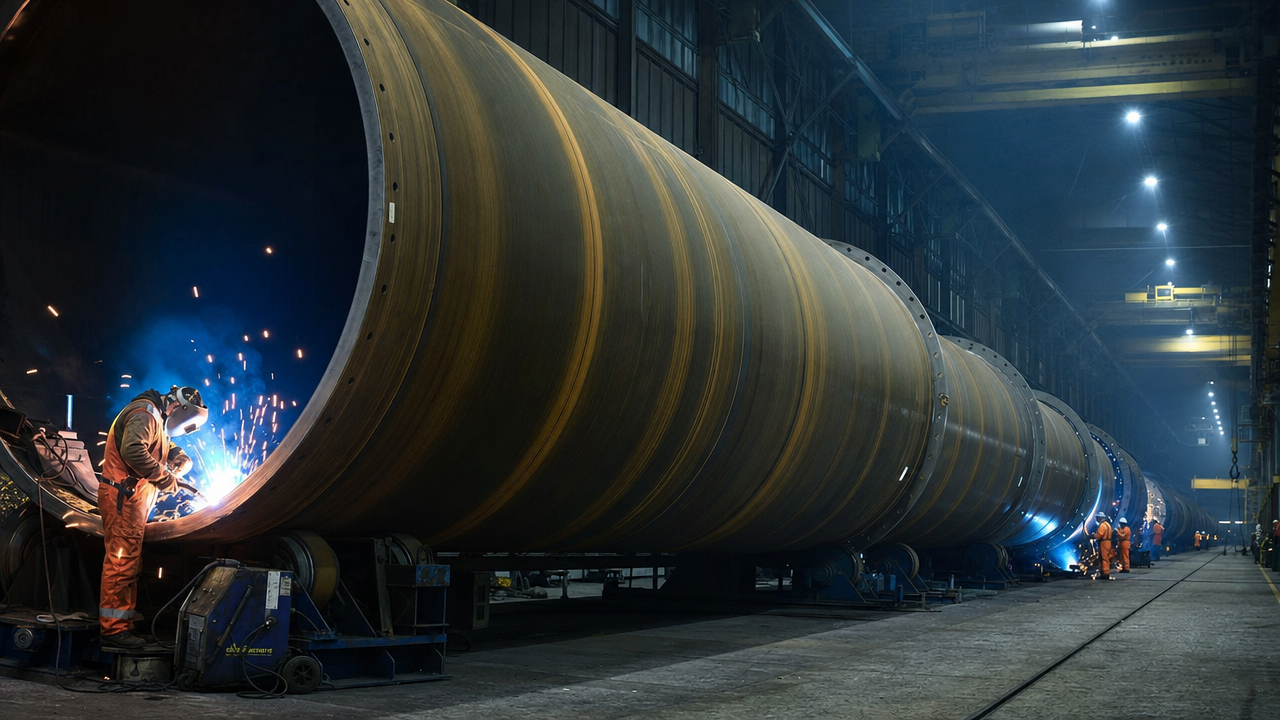
Offshore monopile foundations (for water depths < 50 m) are large-diameter steel hollow cylinders (7–11 m diameter, 60–120 mm wall thickness, 70–120 m total length, 1,000–3,500 tonnes per piece), driven into the seabed with hydraulic impact hammers delivering 3,500–8,000 kJ per blow. Jacket foundations serve 40–80 m water depth; floating foundations (semi-submersible, moored) apply to 60 m+.
Wind power castings encompass hubs (30–90 tonnes each, ductile iron QT400-18AL), main frames / bedplates (50–120 tonnes), and gearbox housings (5–30 tonnes). The critical quality parameter is graphite nodularity (spheroidization rate ≥ 90%) and low-temperature impact toughness (−40°C Charpy V-notch ≥ 12 J), which are particularly challenging to control in wall thicknesses exceeding 200 mm.
1.2 Value Chain Structure and Profit Distribution
The vertical value distribution follows a "dumbbell" pattern: upstream raw materials (glass fiber, carbon fiber, steel, copper, rare earths) and downstream OEM/operators hold stronger pricing power, while mid-stream component manufacturers face a bilateral squeeze at cycle troughs. However, during demand booms, scale leaders with technical moats can exploit capacity scarcity and recover pricing, delivering significant profit elasticity. One GW of offshore 15 MW capacity drives approximately RMB 60–90 billion in component value, and more than RMB 100 billion including the offshore substation, installation infrastructure, and O&M contracts — roughly 3–5× the onshore figure.
II Global Landscape: Leading OEMs and Component Supply Systems
2.1 Global Wind Turbine Market (FY2025 Summary)
Global new wind additions are estimated at approximately 165 GW in 2025 (vs. ~125 GW in 2024, +32%), driven by concurrent demand from Europe's energy independence push, the US Inflation Reduction Act (IRA) investment wave, and Asia-Pacific led by China. Total global installed capacity approaches 1,200 GW.
Vestas (Denmark, VWS.CO) reported FY2025 revenue of EUR 18.8 billion (+9%, record high), an underlying EBIT margin of 5.7% (top of the 5–6% guidance), and turbine deliveries of 14,537 MW (+12.7%), including 1,977 MW offshore (+46%). Order backlog reached EUR 71.9 billion — EUR 33.2 billion turbines, EUR 38.7 billion long-term service agreements. GE Vernova (NYSE: GEV) reported FY2025 group revenue of USD 38.1 billion (+18%), with the wind segment at approximately USD 85–90 billion, posting a significantly narrowed (though still negative) operating loss as quality remediation on the Cypress and HALIADE-X platforms advanced. Siemens Gamesa (part of Siemens Energy, ENR.DE) reduced its FY2025 wind-segment loss to approximately EUR −1.3 billion (vs. EUR −1.9 billion in FY2024) as structural remediation of the 4.X blade failures progressed. Nordex (Germany) continued to gain share in 4–6 MW onshore markets, with FY2025 revenue of approximately EUR 6.5 billion and improving EBIT margins of 3–4%.
2.2 Chinese OEMs' Rising Global Presence
China's wind turbine OEMs have moved from domestic-only players to globally competitive forces. Goldwind (002202.SZ) and Envision Energy together account for approximately 40% of global cumulative installed capacity (by volume). In 2025, MingYang Smart Energy (601615.SH) secured Europe's first commercial MSPMS contract and began Ardersier negotiations (later halted by UK national security review). CRRC TMT installed the world's highest-power floating offshore turbine (16 MW, Qihang) in January 2025. Sany Renewable Energy (688349.SH) installed a 15 MW onshore turbine with a 270 m rotor diameter (131 m blade) in Jilin — the world's largest onshore wind machine at that date.
III PEST Analysis: Drivers and Constraints
3.1 Policy Environment
China's 2030 carbon peak and 2060 carbon neutrality commitments are the fundamental policy anchor for wind development. During the 14th Five-Year Plan (2021–2025), actual new wind+solar additions exceeded the 120 GW annual target, reaching ~150+ GW. Under the 15th Five-Year Plan framework (2026–2030), industry consensus targets wind+solar additions of 200+ GW/year, with wind alone at 75–90 GW. Key policy enablers include: the revised Offshore Wind Development Administration Measures (September 2025) compressing project approval timelines from ~24 to ~12 months; the Green Certificate (GEC) system adding approximately RMB 0.03–0.05/kWh to operator revenues; RMB 2.5 billion in state demonstration subsidies for floating offshore (>50 m water depth); and the BRI framework providing export credit insurance and development bank financing for wind equipment exports to Central Asia, Africa, and Latin America.
3.2 Economic Dynamics
The levelized cost of electricity (LCOE) for Chinese onshore wind has fallen from approximately RMB 0.50/kWh in 2015 to RMB 0.25–0.30/kWh in 2025, matching or beating coal power (RMB 0.30–0.35/kWh). Offshore LCOE has fallen from approximately RMB 0.85/kWh to RMB 0.50–0.60/kWh, targeting RMB 0.40–0.45/kWh by 2030. Turbine upscaling (from 3–5 MW to 10–20+ MW over ten years) is the single largest driver: a 15 MW turbine has roughly 3× the swept area of a 5 MW turbine, and the same wind farm in GW capacity requires only one-third the number of installation events, dramatically cutting per-kWh civil, cable, and O&M costs.
3.3 Geopolitical Risks
The EU Foreign Subsidies Regulation (FSR) entered active enforcement in 2025, with multiple Chinese companies receiving investigation notices (primarily solar, EV — wind under secondary watch). The UK blocked MingYang's Ardersier project in March 2025 on national security grounds. US tariffs on Chinese wind turbines (combined ~50%+) make direct turbine export non-viable, though blade, casting, and flange duties (3–8%) preserve some economic headroom. The strategic response by leading Chinese component makers — establishing local manufacturing in Saudi Arabia, Australia, the EU, and South America — converts trade risk into supply-chain-localization opportunity.
IV Market Size: RMB 150–180 Billion and Growing
4.1 Domestic Market Sizing (2025)
China's FY2025 wind power component market reached approximately RMB 150–180 billion across the seven covered sub-segments, representing the single-largest advanced manufacturing sub-sector within the broader clean energy equipment industry. By sub-segment (estimated ranges):
- Blades: RMB 70–85 billion (driven by ~90–100 GW new additions at ~RMB 0.8–0.9 billion/GW average blade value)
- Tower + monopile: RMB 60–75 billion (onshore tower RMB 35–45 billion, offshore monopile RMB 15–20 billion, flanges RMB 5–8 billion)
- Submarine cable: RMB 15–20 billion (offshore segment; total including onshore wind and grid estimated RMB 50+ billion)
- Castings: RMB 20–25 billion
- Main shafts + flanges: RMB 6–8 billion combined (shaft component)
- Gearboxes: RMB 15–20 billion
- Power converters + controls: RMB 6–8 billion (wind share of broader inverter market)
4.2 Export Market Contribution
Chinese wind component exports to Europe, the Middle East, and Southeast Asia added approximately RMB 20–30 billion in incremental value in 2025, representing roughly 12–18% of total domestic output value. Dajin Heavy Industry's overseas revenue surged 196% YoY to RMB 22.4 billion (Q3 FY2025 cumulative), with Q3 gross margin reaching a record 35.91% — European monopile pricing premiums (30–40% vs. domestic) drove the margin expansion. Riyue Heavy Industry's casting exports to Vestas and Siemens Gamesa supplied approximately 30–35% of total revenue, with export-segment gross margins approximately 5–8 pp higher than domestic.
V Industrial Chain: Raw Materials to Finished Components
5.1 Upstream Raw Materials
The primary upstream inputs and their 2025 price dynamics:
Glass fiber (E-type, 2400 tex): domestic price approximately RMB 4,200–4,800/tonne (down from RMB 7,000+ peak in 2021), representing a key gross margin tailwind for blade makers. SINOMA Science & Technology benefits from upstream vertical integration through China National Building Material (3323.HK) subsidiary Zhengshi Holdings (~1.5 million tonne annual glass fiber capacity), reducing blended material cost 5–8% versus independent purchasing.
Carbon fiber (large-tow, 48K–50K): domestic price approximately RMB 90–120/kg (Toray Zoltek Panex import) or RMB 110–140/kg (domestic, including certification premium from Hengshen Fibre Technology 688309.SH). A 100 m blade uses approximately 5–8 tonnes of CF in pultruded spar caps, representing RMB 500,000–1,000,000 per blade in CF cost.
Steel (hot-rolled wide plate, Q355B/S355ML): domestic price RMB 3,500–3,800/tonne in 2025 (sustained low, vs. RMB 6,000+ peak in 2022), contributing approximately 3–5 pp of gross margin uplift for tower and monopile manufacturers.
Copper (for submarine cable conductors and generator windings): London Metal Exchange (LME) copper RMB 68,000–85,000/tonne range in 2025, with each km of 220 kV submarine cable requiring 8–15 tonnes of conductor-grade copper. Oriental Cable uses cost-plus pricing models to pass through copper cost fluctuations, but competitive bidding still compresses realized margins by approximately 1–2 pp at copper price peaks.
5.2 Technology Milestones in 2025
Five landmark technology events in 2025 reshaped the competitive landscape:
- 153 m blade mass production (DEC H26-313): the world's longest serial blade at the year-end, enabling 26 MW offshore turbines with a 313 m swept diameter.
- 500 kV VSC-HVDC submarine cable commercial validation (Oriental Cable): China's first 500 kV XLPE HVDC submarine cable completing full-system type testing to IEC 62067, positioned for the next-generation ±500 kV HVDC export cable market.
- 20 MW floating offshore turbine installation (CRRC TMT "Qihang," Dongying, January 2025): world's highest-power floating turbine at installation, four-column semi-submersible platform.
- Overseas factory ramp-up (MingYang Ardersier, subsequently blocked; Dajin Cuxhaven operational since 2024): Chinese manufacturers building European production beachheads.
- Pultruded carbon spar cap technology lock-in: SINOMA and MingYang's 5,000-tonne/year CF supply lock with Hengshen Fibre Technology formalized domestic CF supply chains for 20 MW+ blades.
VI Key Enterprises: Confirmed Leaders Across Sub-segments
6.1 Blade Segment — SINOMA Science & Technology (002080.SZ)
FY2025 consolidated revenue: RMB 30.195 billion (+25.90% YoY). Blade segment revenue: RMB 12.595 billion (+47.04%), volume 36.2 GW (+51%). Adjusted net income (excluding non-recurring): RMB 1.283 billion (+234.52%), reflecting peak operating leverage. Key competitive advantages: (1) 20-year blade manufacturing data across >2,000 product families; (2) ability to produce and type-test 153 m blades (world's longest serial production facility in Chengdu, net length >200 m); (3) US Oklahoma factory (~700–900 sets/year) and planned Central Asia/India capacity for local-content compliance; (4) vertical integration from glass fiber raw silk (parent co.) through blade manufacturing to surface protection coatings.
Times New Material (600458.SH): FY2025 revenue RMB 21.471 billion (+7.06%), net profit RMB 514 million (+15.45%), blade revenue broke RMB 10 billion for the first time; new-signed blade orders RMB 12.5 billion. Zhongfu Lianzhong (SCI Holdings 605286.SH): mid-scale blade specialist focused on offshore 100 m+ segment, estimated revenue RMB 6–7 billion.
6.2 Casting Segment — Riyue Heavy Industry (603218.SH)
FY2025 revenue: RMB 6.256 billion (+33.21%), casting output 25,984 pieces (+79.04%). As the world's single largest wind power casting supplier by volume, Riyue's moat rests on: (1) capability to produce and deliver 60–80 tonne single-piece castings (hubs for 15–20 MW turbines) with nodularity >90% in wall sections >200 mm thick; (2) approximately 8–10 years of continuous European customer (Vestas, Siemens Gamesa) certifications; (3) ISO Grade 3 ultrasonic acceptance (equivalent diameter ≤ 3 mm flat bottom reflector) across 100% of hub bore cross-sections. Europe export segment gross margins are approximately 5–8 pp above the domestic blended average.
6.3 Marine Cable Segment — Oriental Cable (603606.SH)
FY2025 revenue: RMB 10.843 billion (+19.26%), net profit RMB 1.271 billion (+26.11%), submarine cable revenue RMB 5.363 billion (+65.60%). Key technical barriers: (1) China's first 500 kV XLPE type-test completion (2023) and commercial readiness for 2026–2028 HVDC projects; (2) 600 m × 60 m uninterrupted production deck enabling single-run lengths of ~40–50 km for 66 kV or ~20–25 km for 220 kV cables (minimizing field joint risk); (3) in-house cable installation vessels (acquired 2022 via 52% equity purchase in Qichentongda), enabling EPC delivery.
6.4 Tower and Monopile — Dajin Heavy Industry (002487.SZ) and Tianshun Wind Energy (002531.SZ)
Dajin: FY2025 Q3 cumulative overseas revenue RMB 22.43 billion (+196%), Q3 gross margin 35.91% (+10.69 pp), driven by North Sea monopile deliveries at European premium pricing. Operates Germany Cuxhaven factory (1,200 t/year capacity) since 2024 — the first Chinese monopile maker with onshore EU production. Tianshun: FY2025 revenue RMB 5.388 billion (+10.85%), net loss RMB −236 million (−215.21% YoY), as domestic tower margins suffered from steel input costs and pricing pressure; gross margin 18.94% (−3.02 pp). Haili Wind Power (301155.SH): revenue RMB 1.641 billion (+134.73%), net profit RMB 142 million (+779.32%), monopile specialist riding China's offshore boom.
VII Industrial Clusters: Domestic Geography and Overseas Expansion
7.1 Domestic Regional Clusters
China's wind component industry exhibits pronounced geographic clustering:
Northeast Corridor (Shenyang–Dalian–Jinzhou): China's original wind manufacturing heartland; today specialized in large castings, shaft forgings, and mechanical sub-components. Key advantages: inherited heavy machinery equipment base, skilled metallurgy workforce, proximate steel supply (Ansteel, Benxi).
Yangtze River Delta Hub (Nantong–Shanghai–Zhoushan): center of offshore component excellence — monopiles (Haili at Rugao), submarine cable (Oriental Cable in Ningbo, Zhongtian at Nantong), precision machining clusters in Suzhou and Wuxi. Nantong's offshore wind equipment manufacturing output exceeded RMB 20 billion in 2024.
Bohai Rim (Tianjin–Tangshan–Qinhuangdao): historically the major onshore tower production base; today major tower makers (Dajin, Tianshun, Zhongbo) operate along this corridor, benefiting from steel proximity (Tangshan) and port access (Tianjin) for export.
Western New Cluster (Xinjiang–Gansu–Inner Mongolia): driven by Three-North Large Base construction; OEMs (Goldwind, Envision) maintain assembly factories here; SINOMA and Times New Material operate dedicated blade factories to serve local demand and reduce long-haul blade transport risk.
Pearl River Delta / Fujian (Guangzhou–Shantou–Fuzhou): rising cluster leveraging South China Sea offshore ambitions (Guangdong, Fujian ~100 GW combined planning); nascent monopile and casting sub-clusters supported by provincial investment funds.
7.2 Overseas Capacity Buildout — The "Made Near You" Strategy
As of 2025, Chinese wind component leaders have established or are establishing production capacity in eight overseas jurisdictions:
| Company | Location | Product | Capacity | Status |
|---|---|---|---|---|
| Dajin Heavy Industry | Cuxhaven, Germany | Monopile | 1,200 t/y | Operational 2024 |
| SINOMA Blades | Oklahoma, USA | Blades | 700–900 sets/y | Operational 2022 |
| SINOMA Blades | Jizzakh, Uzbekistan | Blades | TBD | Planned 2026 |
| Goldwind | Riyadh, Saudi Arabia | Turbine assembly | 3 GW/y | Planned 2028 |
| Envision Energy | Tamil Nadu + Gujarat, India | Turbine assembly | 4.5–5 GW/y | Operational |
| MingYang | Ardersier, Scotland | Turbine assembly | — | Blocked 2025 |
| Times New Material | Turkey | Blades | TBD | Planning |
| Dajin | Brazil, Camaçari | Monopile | TBD | Planning |
TianxiaGongchang tracks this overseas buildout in real time across its 4.8-million-factory database, enabling supply-chain professionals to identify co-located component suppliers and service providers in each new manufacturing jurisdiction.
VIII Specialist Segments: Carbon Fiber, Offshore Installation, Digital O&M
8.1 Carbon Fiber and Pultruded Spar Cap Ecosystem
The shift from glass-fiber-only to carbon-fiber pultruded main spar caps (PCPs) in blades ≥ 90 m is now irreversible. The PCP supply chain involves three stages: large-tow carbon fiber production (Hengshen ~30,000 t/y, Zhongfu Shenying ~20,000 t/y, Guangwei Composites ~10,000 t/y) → pultrusion processing (resin impregnation, continuous curing, inline non-destructive inspection) → blade manufacturer integration. Domestic CF self-sufficiency for wind applications rose from ~20% in 2019 to ~70% in 2025, with Hengshen's 5,000 t/y lock-up agreement with MingYang being the industry's milestone deal. Remaining import dependence concentrates in 48K/50K ultra-large tow (process consistency) and T800H-grade high-strength-intermediate-modulus fiber (blade tip performance requirements).
8.2 Offshore Installation Logistics
Heavy lift vessel installation (HVIV — Heavy Vessel Installation Vessel) efficiency improved from ~0.8 units/day for 5 MW turbines in 2015 to ~1.0–1.2 units/day for 15 MW turbines in 2025. China's self-owned HVIV fleet has grown to 8–10 vessels capable of installing 15 MW+ units (including Huahai Innovation, Tiankun, CCCC Tianzhu), compared with roughly 25–30 globally. Weather window constraints (installation viable ~40–60% of year-hours depending on sea area) and vessel day rates of RMB 500,000–1,000,000/day make logistics optimization a critical project economics lever.
8.3 Digital Operations and AI-Assisted Predictive Maintenance
Goldwind's "TianJing" platform manages >20 GW of connected assets with AI-driven features: leading-edge erosion (LEE) severity classification (DNVGL-RP-0171 Level 0–5), online oil particle counting (ISO 4406, sampled every 15 minutes), 5-minute ahead power output forecasting (MAE ≤ 3.5% of rated power), and predictive replacement scheduling for gearbox planet bearings (fatigue life remaining ±12% accuracy at 6 months horizon). Envision's EnOS platform connects >500 GW multi-energy assets globally and offers component-level lifecycle digital twins. Drone-based AI blade inspection (DJI Matrice 350 RTK + AI damage classifier) has cut per-blade inspection time from 4–6 hours (manual) to 15–25 minutes, with damage detection false-negative rates below 2%.
IX Technology Evolution: Upscaling, Carbon Fiber, and Floating Offshore
9.1 Quantitative Milestones of Ten-Year Technological Progress
Over 2015–2025, key performance parameters have evolved dramatically:
| Parameter | 2015 | 2020 | 2025 |
|---|---|---|---|
| Dominant offshore turbine rating | 3–4 MW | 6–8 MW | 15–20 MW |
| Offshore blade length | 55–65 m | 80–90 m | 110–153 m |
| Hub height (offshore) | 80 m | 100–110 m | 120–140 m |
| Offshore CAPEX | ~RMB 15,000/kW | ~RMB 13,000/kW | ~RMB 9,000–11,000/kW |
| LCOE (offshore China) | ~RMB 0.85/kWh | ~RMB 0.70/kWh | ~RMB 0.50–0.60/kWh |
| Single-vessel annual installation capacity | ~120 MW/vessel | ~300 MW/vessel | ~500–600 MW/vessel |
9.2 Floating Offshore Wind (FOWT) — China's Next Frontier
China's FOWT trajectory:
- 2022: MingYang "Wind-Fish Integration" (5.5 MW, three-column semi-sub, Jieyang, first grid-connected FOWT in China)
- January 2025: CRRC TMT "Qihang" (16 MW, four-column semi-sub, Dongying)
- 2027–2028 target: China Offshore Wind + Equinor "HYWIND China" project (~100 MW, ~10–12 units of 8–10 MW, Zhanjiang)
FOWT-specific supply chain requirements versus fixed: (1) dynamic submarine cables (withstanding >10⁸ bending fatigue cycles); (2) enhanced pitch/yaw systems for platform motion (±8–15° tilt angle vs. <0.5° for fixed); (3) mooring systems (anchor chains, fibre ropes) adding 100–200 tonnes per turbine. At 2025 FOWT CAPEX of USD 28,000–35,000/kW (vs. USD 10,000–12,000/kW fixed offshore), achieving commercial scale requires the learning curve to reduce floater fabrication costs by ~15–20% per production doubling.
9.3 Blade Recyclability and Circular Economy
With China's first commercial wind turbines (2005–2015 vintage) approaching design life, blade end-of-life (EOL) management is transitioning from future concern to near-term reality. Approximately 30,000–50,000 tonnes of glass and carbon fiber composite blade waste are expected to accumulate through 2030–2035. Leading EOL pathways: cement kiln co-processing (bulk treatment, 300–600 RMB/tonne, glass fiber becomes Si-Al mineral substitute); solvolysis recycling (recovered carbon fiber retains ~85–90% tensile strength, valued at ~RMB 80–120/kg); thermoplastic blade research (PA12/PA11 matrix enabling thermal re-processing and true closed-loop recycling, projected commercial readiness 2030+).
X Risks and Challenges
10.1 Structural and Cyclical Risks
Demand cycle volatility: China's wind demand is highly policy-sensitive. The 2019–2020 first subsidy-exit rush followed by a 2022–2023 price collapse demonstrated how quickly policy transitions can destroy component supplier profitability. The current 2024–2030 up-cycle appears more structurally robust (offshore vs. onshore subsidy independence, overseas diversification), but demand could weaken if grid absorption limits (curtailment) are reinstated in major northwestern bases.
Raw material price exposure: steel (55–70% of tower/monopile cost), glass fiber (40–50% of blade material cost), copper (30–40% of cable cost), and NdFeB rare-earth magnets (3–5% of direct-drive turbine cost) all expose component margins to commodity cycles. The 2022 raw material cost spike reduced component gross margins by 5–10 pp across the board.
Accounts receivable risk: average domestic payment terms remain 12–18 months (some smaller developers stretch to 24 months). SINOMA's total trade receivables and bills outstanding represent ~25% of annual revenue; Riyue's represent ~50%+. Supply chain finance (core-enterprise-backed SCF platforms) helps leading component makers accelerate cash collection at below-LPR rates, but small-cap component suppliers remain exposed.
10.2 Technology Transition Risks
Drivetrain technology bifurcation: the industry is splitting between (1) full direct-drive PMSG (Goldwind standard; higher nacelle weight, requires heavier installation vessels) and (2) semi-direct-drive MSPMS (MingYang, CRRC, Envision standard; lighter, but added gearbox maintenance). Neither has conclusively "won," and OEM technology switching decisions ripple through entire component ecosystems (gearbox makers face demand risk if PMSG/DD penetration rises; bearing makers face demand upside from MSPMS proliferation).
Blade size execution risk: 130–153 m blades introduce qualitatively new manufacturing challenges — mold transportation (200 m+ factory floor length), cure temperature uniformity across large areas (±15°C variation risk), carbon spar cap fiber tension uniformity (±1% tension tolerance requirement), leading-edge erosion at tip speeds of 90–110 m/s. Any batch defect in serial 153 m blades would create significant liability exposure for the blade maker.
XI Outlook: 2026–2030 Growth Projections
11.1 Domestic Volume and Value Growth
Under the 15th Five-Year Plan framework, industry consensus projects:
- Annual onshore wind additions: 55–65 GW/year (2026–2030)
- Annual offshore wind additions: 13–16 GW/year (2026–2030)
- Cumulative offshore wind installed capacity at 2030: ≥ 150 GW (from ~80 GW at end-2025)
Component market annual value implications (at 2025 unit pricing):
- Blades: RMB 80–100 billion/year by 2028 (vs. ~75 billion in 2025)
- Tower + monopile: RMB 70–90 billion/year
- Submarine cable: RMB 20–28 billion/year (offshore segment)
- Castings: RMB 25–35 billion/year
- Total 7-segment market: RMB 220–290 billion/year by 2030
11.2 International Market Expansion
China's wind component export market is expected to grow from ~RMB 20–30 billion (2025) to ~RMB 60–80 billion (2030), driven by:
- European offshore demand exceeding local supply: North Sea monopile supply gap (domestic EU production ~300,000 t/year vs. ~600,000 t/year demand by 2030) makes Chinese monopile imports structurally necessary
- Middle East/India large-scale buildout: Saudi Arabia 28.5 GW wind target (2030), India 100 GW target, require volume supply at competitive cost
- OEM overseas factory ramp-up: Chinese OEM local assembly factories in Saudi Arabia, India, Southeast Asia require parallel Chinese-origin component supply chains
11.3 Technology Frontiers Approaching Commercialization
- Thermoplastic blades (PA12 / PA11 matrix): commercial demonstrations at 80–90 m scale expected 2027–2028; full serial production at 120–153 m scale 2030+
- 500 kV VSC-HVDC subsea cable projects: first commercial HVDC cable installation in China expected 2026–2028 (Guangdong/Fujian deep-sea routes)
- Floating offshore commercial scale: 100 MW+ FOWT projects entering construction in 2027–2028 (HYWIND China, Zhejiang Zhoushan FOWT Phase 1)
- AI-integrated proactive O&M: component-specific remaining useful life (RUL) prediction with ±10% accuracy at 6-month horizon expected across major OEM fleets by 2027
XII Conclusions
12.1 Three Core Structural Shifts
China's wind power component industry has undergone three irreversible structural shifts since 2018 that collectively distinguish the current landscape from any prior cycle:
Shift 1 — Technical leadership in key sub-segments: 153 m blade serial production, 500 kV HVDC subsea cable qualification, and 60–80 tonne large ductile iron casting deliverability represent genuine world-leading capabilities, not merely "cost-competitive alternatives." Technology moats are now the primary basis of durable competitive advantage.
Shift 2 — Demand diversification from domestic to global: export revenues now represent 15–25% of leading component makers' total turnover (Dajin Heavy Industry overseas revenue exceeds 40%). This structural diversification materially reduces the sensitivity of earnings to any single domestic policy variable.
Shift 3 — Consolidation around scale/technology leaders: the top 3 players in blades, castings, and submarine cables collectively capture 50–75% of the relevant market. New entrants face certification timelines of 12–24 months, capital intensity of RMB 1–3 billion per greenfield plant, and engineering talent scarcity that together constitute effective entry barriers.
12.2 Investment Implications
For strategic investors, the fundamental outlook for the core seven component categories is highly constructive over the 15th FYP period (2026–2030). China's factory intelligence platforms — covering over 4.8 million active manufacturers with granular production-capability profiling across all wind component sub-segments — offer a data layer that enables supply-chain professionals and investors to validate capacity claims, identify regional cluster dynamics, and track new-entrant activity in real time, supporting both supply-chain sourcing decisions and market intelligence workflows.
Data Sources
- TianxiaGongchang (www.tianxiagongchang.com) — 4.8-million active factory database with wind component manufacturer distribution mapping
- SINOMA Science & Technology (002080) FY2025 Annual Report, SSE disclosure, March 2026
- Times New Material (600458) FY2025 Annual Report Summary, SSE, March 2026
- Riyue Heavy Industry (603218) FY2025 Annual Report, SSE, April 2026
- Oriental Cable (603606) FY2025 Annual Report, SSE, March 2026
- Tianshun Wind Energy (002531) FY2025 Annual Report, SSE, April 2026
- Dajin Heavy Industry (002487) Q3 FY2025 Quarterly Report, SSE, October 2025
- Haili Wind Power (301155) Q3 FY2025 Quarterly Report, SZSE, October 2025
- Vestas Wind Systems FY2025 Annual Report, January 2026 (Copenhagen, VWS.CO)
- GE Vernova FY2025 Annual Report, February 2026 (NYSE: GEV)
- Siemens Energy / Siemens Gamesa FY2025 Annual Report, November 2025 (ENR.DE)
- GWEC (Global Wind Energy Council), Global Wind Report 2025
- BloombergNEF, Wind Energy Market Outlook Q4 2025
- IRENA, Renewable Capacity Statistics 2025
- IEC 61400-1:2019, IEC 61400-3-1:2019, IEC 61400-5:2020 — International Electrotechnical Commission wind turbine standards
- DNV-ST-0126:2021, Offshore Substations and Support Structures for Wind Turbines
- China Wind Energy Association (CWEA), 2025 Annual Statistics Bulletin (preliminary)
- China Renewable Energy Engineering Institute (CREEI), Hydropower and New Energy Planning Institute, 2025 Wind Energy Development Report
- Hengshen Fibre Technology (688309) Corporate Announcements, 2025
- Xinhua Finance / 21st Century Business Herald, wind power industry tracking, 2025