
Abstract
From the autumn of 1945 to the early 1950s, Japan underwent the largest externally driven corporate reorganization of the 20th century. The General Headquarters of the Allied Powers (GHQ) successively deployed imperial ordinances, laws, and administrative directives to designate 83 holding companies and 56 members of 10 zaibatsu families, taking over and disposing of securities equivalent to 40 percent of all shares then issued nationwide; it subsequently relied on a dedicated piece of legislation to place 325 companies on a list for mandatory reorganization. The starting point of this action was not "excessive corporate size" in the economic sense, but war responsibility — the zaibatsu were determined to be the organizational foundation of the war of aggression, and dismantling them was one means of rendering Japan incapable of launching another war of aggression.
But this action was never carried through to completion. After 1948, U.S. policy toward Japan shifted from punishment and reform to recovery and support; within a year and a half, the list of 325 companies shrank to just 11 that were actually broken up; reparations removals were unilaterally terminated; business figures purged from public office gradually returned to their boards. When the Korean War broke out in June 1950, U.S. military procurement orders reconnected the power, within a matter of months, to a heavy-industrial system that had just been pushed to the brink of layoffs by deflation. After the San Francisco Peace Treaty took effect in 1952, the old trade names that had been banned from use came back one after another, the companies that had been broken up merged and were restored one after another, and shares that had been dispersed into individual hands were re-concentrated back into corporate hands.
This article traces the institution, not a corporate ranking. It seeks to answer three questions: what this dissolution actually dismantled and what it left standing; why it stopped halfway; and, 80 years later, why some of the names that reappeared on the market back then wearing civilian faces — looms, musical instruments, light bulbs, radios — have reappeared on procurement contracts issued by the Ministry of Defense. Toyota (Automatic Loom Works and Motor), Nissan, Tokyo Shibaura Electric, Nippon Gakki, Matsushita, and Sumitomo Metal are the six cases this article uses to illustrate the institution. Their wartime roles, the manner in which they were dealt with, and their paths to revival all differ, but taken together they trace out a clear thread: property rights can be rearranged within a few years, but organization and craft cannot — and a reform that stops at the level of property rights alone is inherently reversible.
Chapter 1 The Autumn of 1945: It Began with a Shareholder Register
On October 15, 1945, in the second month after Japan's surrender, Yasuda Hozensha convened a meeting and adopted a resolution that looked, at the time, distinctly abnormal: the holding company would dissolve itself, the entire Yasuda family would withdraw from every position it held in its affiliated enterprises, and all shares held by the family would be handed over. No one held a gun to its head to make it do this. The occupation authorities' formal directive on the zaibatsu question had not yet been issued at this point.
This resolution subsequently became the template for the Japanese government's own submission. On November 4, 1945, following the Yasuda Hozensha plan, the Japanese government submitted a government version of a zaibatsu dissolution plan to the General Headquarters of the Allied Powers (GHQ). The occupation authorities issued a directive that same month ordering the dissolution of holding companies, and the Japanese government promptly promulgated an imperial ordinance restricting the dissolution, liquidation, and disposal of assets of the relevant companies; the enterprises placed on the list were collectively called "restricted companies" — from that day forward, any appointment or dismissal of their directors, any sale of assets, and any transfer of equity had to be approved in advance.
An unprecedented corporate reorganization thus began in this peculiar way: the first draft of the dismantling plan was written by the very party being dismantled.
1.1 Why Dismantle Them
To understand the nature of this dissolution, one must first clarify one thing: what exactly the occupation authorities were trying to dismantle.
The answer is not "large corporations." In the U.S. government's initial policy documents on Japan, the defeated Japan of 1945 was designated a nation that had to be thoroughly remade, and on the list of reforms — alongside disbanding the military, abolishing the Ministry of Munitions, and trying war criminals — stood the dissolution of "the great industrial and financial combines that sustained militarism." The zaibatsu were placed on this list not because they impeded competition, but because they were determined to be the organizational foundation of the war of aggression.
This determination rested on solid grounds. Japan's wartime economy was a wartime controlled economy: the Ministry of Munitions issued quotas, and materials, labor, and foreign exchange were rationed according to plan, while the vehicle that carried out this planning was precisely the zaibatsu's pyramid structure — a holding company at the apex, with banks, trading companies, mines, shipyards, machinery makers, and chemical plants arrayed beneath it. A single order issued from the apex could mobilize capital, raw materials, fleets of ships, and factories all at once. A war of aggression required exactly this kind of organizational form, one capable of twisting an entire nation's industrial capacity into a single cord, and the zaibatsu supplied it.
The logic of the original dissolution plan was therefore clear: dismantle the apex of the pyramid, take the shares out of the family's hands, drive the family members out of the enterprises, and turn the subsidiaries below into independent legal entities with no ties to one another, each fending for itself. Once this was accomplished, even if someone in the future wanted to mobilize the nation's entire industrial capacity to wage another war, there would no longer be a single button he could press to do it.
This point must be stated plainly, because everything this article discusses afterward has to be measured against it. This dissolution was not an act of antitrust enforcement; it was part of the postwar reckoning. How far it went, and where it stopped, is not to be measured by market concentration, but by the extent to which the organizational foundation of that war of aggression was actually removed.
1.2 Four Pyramids
The first targets designated were the four houses of Mitsui, Mitsubishi, Sumitomo, and Yasuda. Their organizational forms were much alike: the family held shares in a batch of core subsidiaries through an unlisted holding company — Mitsui Honsha, Mitsubishi Honsha, Sumitomo Honsha, Yasuda Hozensha — and the core subsidiaries in turn held shares in the next tier of companies, spreading outward layer by layer. The family itself might number only a few dozen people, yet through this structure it controlled hundreds, even thousands, of enterprises ranging from banks to coal mines, from insurance to shipbuilding.
The dismantling began at the apex. Mitsui Honsha filed its application for dissolution in January 1946, received approval in February, and was formally dissolved by resolution of its general shareholders' meeting on September 30 of that year. The paths taken by the other three houses were broadly similar. By September 1946, the four holding companies, together with another company reorganized from a wartime aircraft manufacturer, were jointly designated as the first batch of holding companies. Where that aircraft company went from there is the subject of another article in this series, "The Second Life of the Zero," and will not be expanded on here.
Once the apex was dismantled, a problem arose immediately: who would take charge of the shares the families had handed over? Who would oversee the hundreds of companies beneath the dissolved holding companies? A dedicated institution was therefore created to handle it.
1.3 An Institution Built Solely to Dismantle
On April 20, 1946, the Japanese government promulgated an imperial ordinance establishing the Holding Company Liquidation Commission. The Commission formally opened for business in August of that year, with Tadao Sasayama as its chairman; including the chairman, it initially had 6 members, later increased to 8.
Its function can be summed up in one sentence: take custody, hold, and dispose. The shares handed over by the zaibatsu families and holding companies were first transferred into the Commission's name, to be held centrally under its custody; the Commission then decided by what method these shares would be sold and to whom. At the same time, it had the authority to determine which companies qualified as holding companies that ought to be dissolved, and the authority to issue instructions on personnel matters and asset disposal at designated companies.
A commission established by the government of a defeated nation and operating according to the will of the occupation authorities became, within a few years, Japan's largest shareholder. This status alone reveals the nature of the reform: it was not a market act but an administrative one; its driving force came not from within the enterprises but from the occupation regime. So how far it could go was, from day one, determined by how far the occupation regime wanted it to go.
Everything that happened after 1948 is a footnote to that sentence.
Chapter 2 The Anatomy of the Dismantling Machine: 83 Companies, 56 People, 40 Percent of the Shares
The Holding Company Liquidation Commission spent five years doing three things: designating companies, designating individuals, and disposing of shares. The three tasks corresponded respectively to the old zaibatsu's three pillars — organization, family, and property rights. Only by examining these three threads separately can one see exactly which one the later "abandonment halfway" actually abandoned.
2.1 83 Companies: The Organizational Thread
The designation of holding companies was carried out in five rounds.
- September 6, 1946 — first round, 5 companies
- December 7, 1946 — second round, 40 companies
- December 28, 1946 — third round, 20 companies
- March 15, 1947 — fourth round, 2 companies
- September 26, 1947 — fifth round, 16 companies
That comes to 83 companies in total. The five in the first round were the honsha of the four major zaibatsu plus one company reorganized from a wartime aircraft manufacturer; among the remaining 78, there were both the honsha of small and mid-sized zaibatsu and giant enterprises that were, in name, operating companies but in fact held a long string of subsidiary shares.
It is worth noting that "being designated" did not equal "being broken up." Of the 83 companies, only 28 were determined to require dissolution and liquidation. The remaining 50-odd companies were dealt with in a different way: they handed over the subsidiary shares they held, replaced executives connected to the zaibatsu families, and severed the honsha's controlling relationship over its subsidiaries, but the legal entity itself continued to exist and continued to run its own business.
This distinction matters a great deal, because it determined just how solid the results of this thread actually were. Liquidating a holding company was irreversible; taking away the shares a company held and replacing its directors was reversible — shares could be bought back, people could return, and severed ties could be reconnected. And among the 83 companies, the majority followed the latter path.
The handling of another key category of actor in Japan's wartime economy unfolded during this same period. On July 3, 1947, the occupation authorities issued dissolution orders to Mitsui Bussan and Mitsubishi Shoji. These two general trading companies were the nerves and blood vessels of the zaibatsu system: they controlled imports and exports, controlled raw-material procurement, controlled overseas networks, and during the war had been deeply involved in materials control. The dissolution was carried out quite thoroughly — rather than being split into several large companies, each was broken up into a large number of small trading companies founded by their former employees. Mitsui's own corporate history records that more than 200 companies founded by former employees "set out" from the dissolution of Mitsui Bussan; the number of companies into which Mitsubishi Shoji was broken up is given differently across sources, ranging from 100 to over 170, with Japanese financial media putting the figure at more than 160.
Whichever figure one accepts, one thing is clear: these two companies were shattered into the smallest pieces in 1947. And as later chapters will show, it was precisely the ones broken into the smallest pieces that were later restored the most completely.
2.2 56 People: The Family Thread
While dismantling the organization, the occupation authorities were also dismantling the people.
In June 1946, 56 members of 10 zaibatsu families were designated as "zaibatsu family members"; on March 22, 1947, the Holding Company Liquidation Commission issued its formal designation of these 56 individuals. Those designated were required to surrender their shareholdings, resign from every position they held in the enterprises, and were barred from ever again serving as an executive at an affiliated enterprise.
On January 7, 1948, Japan promulgated the Law for the Elimination of Zaibatsu Family Control (Showa 23 Law No. 2), elevating this practice to statute. What this law aimed to sever was "the bonds among people": it required close relatives of the zaibatsu families serving as executives to resign, and it prohibited holding executive positions concurrently across affiliated enterprises. If the Holding Company Liquidation Commission dealt with the equity network, this law dealt with the personnel network.
Far broader in its reach than the family designations was the purge from public office. The purge system was first established under an occupation authority directive dated January 4, 1946, initially targeting military personnel, war criminals, and extreme nationalists. On January 4, 1947, the Japanese government revised the purge order to extend its scope to the business world — the heads of major wartime enterprises and munitions industries were brought within it. According to figures compiled across several authoritative Japanese reference works, approximately 1,500 business figures resigned from directorships and similar positions as a result. Nationwide, the total number purged had reached 203,660 by May 1948.
The results of this thread were the hardest of the three. The zaibatsu families genuinely withdrew from the front lines of Japanese industry thereafter and never came back. 80 years on, not a single major Japanese corporation today is controlled by an old zaibatsu family. In the sense of "family," the dissolution of the zaibatsu was a complete success.
But the purge from public office itself soon reversed course. Starting in October 1950, the lifting of purge designations entered its implementation phase, with a cumulative total of 10,090 people cleared that month alone; 13,340 more were cleared over the course of 1951; and on April 28, 1952, with the San Francisco Peace Treaty taking effect, the purge order was abolished. A considerable proportion of the purged business figures returned to leadership positions at their companies in the early 1950s. What was permanently eliminated was the family's ownership, not the individual managers themselves.
2.3 40 Percent of the Shares: The Property Rights Thread
Of the three threads, the one with the biggest action and the least durable outcome was property rights.
The shares surrendered by the zaibatsu families and holding companies were first concentrated under the name of the Holding Company Liquidation Commission, which then disposed of them. According to figures compiled across several Japanese reference works, the Commission handled the transfer of a total of 165.67 million shares of securities, equivalent to roughly 40 percent of the total value of shares then issued nationwide in Japan. A far larger monetary figure also circulates, differing from the former by nearly a factor of 20; the two cannot be reconciled, so this article uses only the proportion — "roughly 40 percent of all shares issued nationwide" — and does not cite an absolute monetary amount.
Where these shares went was called "the democratization of securities": priority was given to selling them to the employees of the company in question, with the rest dispersed to ordinary investors through tender and public offering. The immediate effect was striking — according to Japanese statistics, by 1949 individual shareholders held 69 percent of all shares. An industrial system that had once been controlled at its apex by a dozen or so families had, within four or five years, become a system with highly dispersed shareholding, held by several million individual shareholders.
On paper, this was the most impressive stroke of the entire reform. In its consequences, it planted the seed of every reversal that followed.
The reason is not complicated. Dispersed shareholding meant a vacuum of control. At any decent-sized company, all it took was for someone to buy up 10 to 20 percent of the shares on the market to have a voice at the shareholders' meeting. For a Japanese business world that had just been stripped of family control and had just been released from occupation-era restrictions, this was an entirely new and deeply unsettling situation.
The instinctive corporate response was to buy the shares back. If they could not be brought back into family hands, they were brought back into each other's hands. The full course of this thread is the subject of Chapter 9 of this article; here it suffices to note only its endpoint: at the end of fiscal year 1973, the corporate shareholding ratio reached a stage-high of 66.9 percent. Over the span of 24 years, the structure of Japanese share ownership flipped from individuals holding nearly 70 percent to corporations holding nearly 70 percent.
The democratization of securities took the shares out of the families' hands, but it never specified whose hands they should ultimately end up in. So they fell back into the hands of the companies themselves.
2.4 A "Zaibatsu" Without a Family
Beyond the list of 83 companies and the list of restricted companies, a large number of other companies were likewise swept in. One of them illustrates especially well the ambiguity in how this reform was defined: Matsushita.
Matsushita Electric was founded in 1918. Its founder, Konosuke Matsushita, started out with 2 electrical sockets and had built it into one of Japan's largest household-appliance makers by the 1930s. It had no family branches, no bank, no trading company, no mine — it bore almost no resemblance to the family konzerns of Mitsui or Mitsubishi that had endured for two or three centuries. Going by the original meaning of the word "zaibatsu," it did not look like one.
But what it had done during the war made it impossible to exclude from the liquidation.
By the later stages of the war, steel and aluminum were in extreme shortage on the Japanese home islands, and the military turned its attention to wood. In 1943, Matsushita successively established two dedicated munitions subsidiaries: Matsushita Shipbuilding in April, and Matsushita Aircraft in October. By Matsushita's own account, both introduced the company's own assembly-line method, and by the time of defeat 56 ships and 3 aircraft had been completed — for the aircraft there are also figures of 4 and of 5, and Chapter 7 sets out the discrepancies among these counts. Matsushita's own materials go no further on the aircraft than calling it a "wooden aircraft of reinforced plywood"; three further details — that Matsushita Shipbuilding was headed by Toshio Iue as president, that the aircraft plant was located beside Tatetsu Airfield, and that the airframe was a training dive bomber called the "Meisei," trial-produced under the technical guidance of the Navy Air Technical Arsenal — come from Japanese encyclopedic sources and are not recorded in Matsushita's own materials, which is noted here for the record.
A company that made radios and light bulbs was pushed into building ships and aircraft not because it was capable of it, but because the machinery of the war of aggression had by then mobilized every scrap of productive capacity on the home islands that could be mobilized. These two subsidiaries were not any kind of "wartime diversification"; they were two hands that machine extended into the consumer electrical industry.
Liquidation followed. Matsushita Electric was designated a restricted company, and most of its executives, from Konosuke Matsushita and Toshio Iue on down, were purged from public office as wartime collaborators. Matsushita himself lodged a protest, arguing that his company had been built from nothing within a single generation, that it had not grown through acquisitions, and that it was not a zaibatsu.
It was not this protest that ultimately changed the outcome. According to records compiled from Matsushita's own corporate archives on the Japanese side, the company drew on its internal reserves during the difficult period and did its best to avoid layoffs, and its labor union submitted a petition to the occupation authorities on this basis; the designation as a restricted company was lifted not long afterward, and Konosuke Matsushita returned to the presidency in 1947, one condition of the lifting being that his personal assets remain frozen. As for Toshio Iue, after being purged in 1947 he obtained a factory and a bicycle-lamp business from Matsushita and struck out on his own to found Sanyo Electric — another mainstay of Japan's postwar household-appliance industry, born, in this way, out of the cracks left by the dissolution of the zaibatsu.
The value of the Matsushita case does not lie in its twists and turns, but in the way it exposes a structural difficulty at the heart of this reform: was what the occupation authorities were trying to liquidate a form of ownership, or an act of participation in the war? If the former, Matsushita should never have been included; if the latter, then thousands upon thousands of enterprises had been mobilized during the war, and where should the boundary of liquidation be drawn? This question was never given a clear answer. And when the direction of policy shifted in 1948, a liquidation with no clear boundary was the easiest kind to walk back.
Chapter 3 325 Companies: The Ambition of a Law
The Holding Company Liquidation Commission dealt with holding structures. But once the holding structures had been dismantled, a thornier problem surfaced: the operating companies that had fallen out of the zaibatsu system were, in and of themselves, already large enough. A steel company might account for more than half the country's pig-iron output; a heavy-industry company might simultaneously run shipbuilding, aircraft, locomotive, and machine-tool operations. Dissolving the holding company that sat above it did not make it any smaller itself.
Reaching this layer required a new law.
3.1 A Dedicated Law
On December 18, 1947, Japan promulgated the Deconcentration Law (Showa 22 Law No. 207).
The thinking behind this law differed fundamentally from that of the Holding Company Liquidation Commission's approach. The Commission acted on shareholding: who held whose shares, whether the family had withdrawn. This law acted on the form of the enterprise itself: whether a company had grown to an abnormal size within a given industry, and if so, it had to be cut down.
Judging from the orders actually issued afterward, the measures it could employ fell mainly into three categories: splitting a company into several independent legal entities; ordering it to transfer out specific plants, equipment, or assets; and ordering it to dispose of the shares it held in other companies. The intensity of the three categories declined in that order, and as will be seen later, the great majority of orders that were ultimately implemented used the two lowest-intensity categories.
On paper, this was a law of enormous ambition. What it sought to rearrange was not ownership but the industrial organization of the entire nation. Anyone familiar with industrial history could see at once that, were this law to be fully carried out, Japan's heavy and chemical industries would be forced back into a form made up of many mid-sized companies competing with one another — an entirely different form from the one dominated by a handful of giant enterprises that Japan had gradually grown into over the preceding 40 prewar years.
3.2 February 8, 1948
On February 8, 1948, the list of designations was published: a total of 325 companies were placed on it as enterprises found to have "excessive concentration of economic power."
This figure has long been cited, but it can easily be treated as a loose, rounded-off claim. There is a primary source from the corporate side that confirms it as solid: Toyota Motor Co., Ltd. records in its own official corporate history that the company was designated an enterprise of excessive concentration of economic power on February 8, 1948, under designation number 248. The numbering ran sequentially up to 248, which shows that the list was a concrete, item-by-item enumeration, not a rounded approximation.
What kinds of companies were on the list? Judging from the disposition records that followed, its coverage extended far beyond the honsha of the old zaibatsu. Heavy-industry and mining companies belonging to the old zaibatsu lines were on it; steel, papermaking, beer, canning, and textiles were on it; electric power was on it; and a truck maker then producing only a few thousand vehicles a year and worried about being unable to make payroll was on it too — Toyota Motor Co., Ltd., the company spun off from the automobile department of Toyoda Automatic Loom Works in 1937.
The case of Toyota deserves a further word, because it happens to illustrate how densely regulated companies were at the time. Besides its designation under the Deconcentration Law, Toyota at that point had two further layers of restriction weighing on it. One was its status as a restricted company: on April 27, 1946, Toyota Motor Co., Ltd. was designated a restricted company because it held a relatively high proportion of shares in affiliated companies, and from then on any major move involving assets or equity required prior approval. The other was its status as a reparations-preservation plant: from January 1946, its Aichi plant, Komono plant, and its two Kariya plants (north and south) were successively placed under reparations preservation, meaning they could not be freely disposed of during the preservation period — these plants had at the time been placed on a list of facilities that might be dismantled and shipped off as reparations to the countries Japan had invaded. Removal from this status was not completed until October 1948.
There was still another layer of control above these, bearing directly on the product itself. On September 25, 1945, the occupation authorities issued a memorandum on the operation of manufacturing industries that prohibited the production of passenger cars but permitted the production of trucks. This allowed Toyota to keep operating — what it had built during the war had, after all, mainly been military trucks, so its production lines did not need major alteration. This permission was the direct reason it survived the first years after the war.
A single enterprise was thus covered simultaneously by four sets of controls: what it could manufacture was set by the memorandum; whether its plants could be touched was decided by reparations preservation; whether its equity could be touched was decided by its status as a restricted company; and whether the company itself was to be broken up was decided by the Deconcentration Law. This was the common condition of large and mid-sized Japanese enterprises in early 1948.
3.3 The Most Radical Step, and the Most Fragile
The timing of the Deconcentration Law's passage was, in itself, already quite late.
By December 1947, the outlines of the Cold War were already clear in Europe. In March of that same year, the United States had announced its aid policy for Greece and Turkey; in June, the European Recovery Program was announced. Within the United States, an opinion was growing louder: that cutting Japan's industrial capacity to the bare minimum did not necessarily serve American interests. It was at precisely this juncture that this law pushed the target of the reckoning from "the zaibatsu" onward to "the entire industrial organization."
It was more radical than what had come before, and for that reason more fragile as well. There were three reasons.
First, the range of interests it touched was far larger. Breaking up a holding company harmed roughly 10 families; cutting 325 companies down to size disturbed nearly all of Japan's manufacturing industry worth the name.
Second, it directly conflicted with the goal of "making the Japanese economy self-sufficient." The occupation cost money. Around 1947, the United States had to pour a substantial amount of aid into Japan each year just to maintain basic supplies, and American domestic patience with this spending was running out. The only way to get Japan to feed itself was to get its industry running and earning money through exports. A law that meant cutting industrial enterprises down to size one by one ran directly against this goal.
Third, it had no fixed, unshakable standard of enforcement. What counted as "excessive"? On what basis had the list of 325 been drawn up? Once there was a will to pull back, it was possible at any moment to declare that a given company did not, in fact, constitute "excessive concentration," without having to amend the law itself.
There was also a factor that is often overlooked: over these years, Japanese industry regained a unified voice. On August 16, 1946, the Federation of Economic Organizations (Keidanren) was formed through the joint union of bodies including the Japan Economic Federation, the Japan Commerce and Industry Economic Association, the National Financial Groups Council, and the Japan Trade Associations Council. The Holding Company Liquidation Commission had opened for business that same August. In other words, in the very month the dismantling machine started up, the side being dismantled had also completed its own organization. For the years that followed, Japanese business circles remained an organized party of appeal on the issues of reparations, deconcentration, and the purge from public office alike.
A law of great ambition, high cost, and soft standards, running up against an enforcer who was changing his mind, plus an opposing side that had already organized itself — the outcome was almost preordained. In 1948, that enforcer did indeed change his mind.
Chapter 4 How the List Was Shortened
The list of 325 companies was published on February 8, 1948. Six weeks later, an internal U.S. government document undercut the entire foundation of this policy.
4.1 Spring 1948: Washington Changes Its Mind
On March 25, 1948, George Kennan, director of the U.S. State Department's Policy Planning Staff, submitted a report numbered PPS 28, titled "Recommendations with Respect to U.S. Policy toward Japan." This report is now widely recognized as the starting point of the "reverse course" toward Japan.

As for the overall direction of occupation policy, Kennan wrote this: in the period ahead, economic recovery should be established as the primary objective of U.S. policy toward Japan.
It is worth noting that MacArthur did not agree at the time. In a transcript of a conversation recorded in this report, he defended the zaibatsu dissolution program, saying that the zaibatsu leaders who had been purged were not superior talent, but rather the Japanese equivalent of the most incompetent playboys at a New York club. The disagreement between the occupation authorities and Washington on this question was, in the spring of 1948, out in the open.
The disagreement lasted only half a year. On October 7, 1948, National Security Council Executive Secretary Souers forwarded the report numbered NSC 13/2 to President Truman. Its wording was almost identical to Kennan's report from half a year earlier: second only to U.S. security interests, economic recovery should be established as the primary objective. It also gave the General Headquarters of the Allied Powers (GHQ) an explicit instruction: no further reform legislation should be imposed on the Japanese government.
On the purge from public office, item thirteen of NSC 13/2 recommended: those who had been purged solely for having held relatively harmless positions should be restored to eligibility for employment in government, business, and the public media. This sentence had already appeared in PPS 28 half a year earlier, almost word for word.
As for reparations, item twenty of NSC 13/2 contained only a single line: the question of Japanese reparations — recommendations on this subject would be submitted separately. At the drafting stage, the State Department and the Department of the Army disagreed so sharply on reparations that the entire section was simply removed.
Kennan's own assessment of this policy shift appears in the memoirs he published in 1967: aside from the Marshall Plan, establishing the reverse course in Japan was the most important contribution he was able to make during his time in government.
4.2 Reparations: From "Dismantling Most of It" to "Dismantling Nothing"
The evolution of the reparations plan for Japan illustrates, more quantifiably than any policy document, just how thorough this shift was.
The first version of the plan came from Edwin Pauley. He served as the U.S. president's ambassador for reparations from Japan starting in 1945, and submitted an interim report in December 1945. His thinking was two sides of the same logic as zaibatsu dissolution — in an April 30, 1946 memorandum to the U.S. Assistant Secretary of State, Pauley explicitly argued that the reparations program should be used to destroy the zaibatsu. In his plan, reparations were not simply about making Japan pay money, but about physically cutting away Japan's capacity to wage war again by removing its heavy-industrial equipment.
The second version came from Overseas Consultants, Inc., headed by Clifford Strike. The company conducted a six-month industrial survey of Japan in 1947 and submitted its report to the U.S. Secretary of the Army on February 26, 1948.
The third version came from the Department of the Army's Johnston Committee, dated April 26, 1948.
The gap between the three versions can be seen in a few concrete figures. In an April 30, 1948 letter to the Secretary of the Army, Overseas Consultants laid out a comparison between itself and the Johnston Committee: for shipbuilding facilities, Overseas Consultants recommended 385,000 gross tons of capacity available for reparations removal, versus the Johnston Committee's 162,000 tons; for nitric acid production capacity, the former recommended removing 107,000 metric tons, the latter 83,000 metric tons; and as for major munitions facilities, the Johnston Committee held that only about one-third of the value was available for removal.
Within a few months, what was available to be dismantled had been cut down to less than half.
And the final version was zero. On May 12, 1949, the U.S. Joint Chiefs of Staff issued Interim Directive No. 104 to MacArthur, titled "Advance Transfer of Japanese Reparations and Procedures for the Allocation of Reparations from Japanese Industrial Facilities." The body of the directive was extremely brief: the earlier Interim Directive No. 75 was hereby rescinded; items already processed under that directive could still be completed for transfer under its original terms.
In a word: from this point on, there would be no new reparations removals.
The weight of terminating reparations removals needs to be spelled out. Reparations removal was the most concrete, most measurable item in the postwar reckoning — it involved no abstract determination of responsibility, only the question of where the machines would go. Its unilateral termination meant that the material compensation Japan made to the countries it had invaded was frozen at that point at a very small amount. The treatment in Article 14 of the San Francisco Peace Treaty three years later followed the same line: the article, on one hand, acknowledged that Japan should pay reparations to the Allied Powers for the damage and suffering caused by the war, but on the other hand immediately noted that Japan's existing resources were insufficient to complete full reparations while also maintaining a viable economy, and so limited the form of reparations to the provision of services, to be settled through bilateral negotiations. The People's Republic of China was neither a party to this treaty, signed on September 8, 1951 and entering into force on April 28, 1952, nor was it invited to take part.
4.3 325, 297, 11
Back to the deconcentration track. The consequences of this policy shift were recorded precisely in a U.S. diplomatic document.
On August 25, 1949, Sebald, Acting U.S. Political Adviser in Japan, cabled the Secretary of State to report on the progress of the deconcentration program. The cable stated: of the 325 companies originally designated, 297 had already had their designation lifted; 11 had received final orders concerning reorganization, disposal of shares, or liquidation of specific assets; and another 6 had received similar proposed orders. The same cable also noted that, as of that date, only one company — Oji Paper — had completed reorganization.
From 325 to 11 had taken a year and a half.
It must be stressed that this was not "weak enforcement." The companies on the list did not escape through delay or resistance — they were formally released from designation. Toyota is a clear example: designated as No. 248 on February 8, 1948, released on January 21, 1949. Eleven months and thirteen days passed in between, during which the company itself did nothing. What changed was the policy.
This policy shift also had a dedicated executing body. In 1948, a review board made up of American personnel was sent to Japan specifically to re-examine every deconcentration case. Its arrival marked the point at which final decision-making authority was pulled back from the occupation authorities' economic division to Washington. Over the following year, the list shrank at a rate of several dozen companies a month.
4.4 The Eleven That Were Actually Broken Up
One point of confusion needs to be clarified here: the "11" in the previous section refers to the number of companies that had received final orders as of August 1949; the "11" below refers to the number of companies that were ultimately, actually broken up into multiple legal entities. The two figures come from different sources and carry different meanings — they simply happen to be the same number.
The eleven companies the Deconcentration Law ultimately, actually broke up were: Nippon Steel, Daiken Sangyo, Mitsubishi Heavy Industries, Mitsubishi Mining, Mitsui Mining, Seika Mining, Dai Nippon Breweries, Hokkaido Dairy Cooperative, Oji Paper, Teikoku Sen-i, and Toyo Seikan. The law itself was repealed on July 25, 1955.
Looking at this list, the first impression is that its distribution is strange. The pillar industries of Japan's postwar economy — electrical equipment, automobiles, chemicals, shipbuilding, machine tools, textile machinery — are largely absent. What appears instead is steel, mining, papermaking, beer, canning, dairy, hemp spinning. Apart from Nippon Steel and Mitsubishi Heavy Industries, most of the rest are consumer-goods or raw-material industries.
This distribution was not accidental. By 1949, the standard actually applied in deciding whether a company should be broken up was no longer "what role it played in the war," but "whether breaking it up would hinder Japan's economic recovery." Breaking up a brewery did not affect exports; breaking up a steelmaker required careful calculation. So the edge of the reckoning ultimately fell on the sectors most irrelevant to recovery.
The manner of breakup also varied. Nippon Steel was dissolved on April 1, 1950, split into four companies: Yawata Iron & Steel, Fuji Iron & Steel, Nittetsu Kisen, and Harima Refractories. Mitsubishi Heavy Industries was ordered by the Holding Company Liquidation Commission to split into three on June 4, 1949, and in 1950 was broken up into three heavy-industries companies — East Japan, Central Japan, and West Japan; its subsequent history is the subject of this series' companion piece, "The Second Life of the Zero." Dai Nippon Breweries was split into Nippon Breweries and Asahi Breweries — today's two largest brands in the Japanese beer market trace back to this one cut. Oji Paper was split into three.
As for the remaining 300-plus companies on the list, most did not even take a single cut. A few took one cut, but only had a single piece sliced off — Tokyo Shibaura Electric was of this type: in February 1950, it spun off the Aboshi Plant, which was established on the 21st of the same month as Nishishiba Electric Co., Ltd. A company spanning both heavy and light electrical equipment, and among the top ranks of Japan's electrical-equipment industry, ultimately paid a price of one plant.
4.5 Why the Reason for Stopping Must Be Spelled Out
At this point, an accurate explanation can be given for the phrase "abandoned halfway."
This dissolution did not stop because its goal had been achieved. In the Japan of 1949, the families had indeed stepped down, the holding companies had indeed been dissolved, but the industrial organization itself had gone almost untouched: steel was still steel held by the same few firms, heavy industry was still heavy industry held by the same few firms, banking was still banking held by the same few firms. The deconcentration track had been established as a law specifically to deal with this layer — and it was pulled back before it truly began to be enforced.
It stopped because the executor's goal changed. In the initial policy toward Japan drafted in 1945, dissolving the great industrial and financial combines was written in as part of the postwar reckoning, and its legitimacy derived from war responsibility. After 1948, the yardstick used to measure Japan policy was replaced with a different one: whether Japan could become self-sufficient as quickly as possible, and whether it could become a useful, stable presence within the Cold War order. Measured against this latter yardstick, zaibatsu dissolution was no longer a task that had to be completed — it had instead become a burden whose cost needed to be controlled.
This substitution was carried out without any public debate, and without any accounting whatsoever to the countries Japan had invaded. The claims of the countries Japan had invaded on the reparations question were terminated by a two-sentence interim directive; the reckoning with the zaibatsu's war responsibility was halted by a policy document stating that "no further reform legislation should be imposed."
For this reason, the revival that later chapters of this piece will describe — names returning, companies re-merging, shares re-concentrating, the gates of the arms industry reopening — is not normal commercial evolution following the completion of the historical reckoning. It is the result of a natural rebound of an interrupted process, after the reckoning was halted midway. This distinction is the key to understanding the relationship between Japan's industry today and that history of aggression.
One further layer must be made explicit here, because it bears on the final chapter of this article. The party that launched this reckoning and the party that terminated it were one and the same. Japan did not break free of the constraints; the party that had imposed them, its own strategic needs having changed, deliberately loosened them. It was the United States that decided in 1945 to dissolve the zaibatsu, and the United States that decided in 1948 not to carry the dissolution any further; it was the United States that placed reparations removals on the list, and the United States that terminated them with a single directive in 1949. Japan's first round of postwar remilitarization was, from the very beginning, externally permitted and even externally demanded, rather than the result of Japan unilaterally shaking off restraint. What the 1945 initial policy toward Japan set out to dismantle was the "great industrial and financial combinations" that supported militarism; three years later, the same executor judged that continuing to dismantle them no longer served its own interests, and stopped. The industrial base of militarism was not dismantled to completion; it was merely shelved.
Remember this structure. Eighty years later the same structure recurs, with the same actor and for much the same reasons. Chapter 11 of this article places the two rounds side by side.
Chapter 5 Where Japanese Industry Stood When the Dismantling Stopped
In 1949, as the deconcentration list shrank to a small fraction of its original length, Japanese industry did not, as a result, breathe any easier. Quite the opposite — that year was one of the hardest of the postwar period. The reason was that another policy was bearing down at the same time.
5.1 The Dodge Line
First, look at the problem it was meant to solve. The Japanese economy after defeat was propped up by inflation. The government issued bonds on one hand while injecting capital into key industries through the Reconstruction Finance Bank on the other, and used price subsidies to paper over the gap between cost and sale price for basic goods such as coal, steel, and fertilizer. This approach kept production going, at the cost of runaway prices — according to a scholarly history of the Japanese economy, prices in Japan rose by more than 700 percent between September 1945 and August 1948.
On December 18, 1948, GHQ issued the "Nine Principles for Economic Stabilization," calling for Japan to balance its budget, strengthen tax collection, restrict credit, stabilize wages, and tighten controls on goods. The man tasked with carrying out these principles arrived two months later: in February 1949, Detroit banker Joseph Dodge arrived in Japan as an economic adviser; on March 7 of the same year, the plan later known as the "Dodge Line" was formally announced.
The plan's core consisted of three points: draw up a "super-balanced budget" that accounted for the general account, special accounts, and government-affiliated agency accounts all together — meaning not merely no deficit was permitted, but a surplus was required; abolish all forms of subsidy across the board and halt new lending by the Reconstruction Finance Bank; and establish a single exchange rate, fixed in April 1949 at 360 yen to the dollar, replacing the earlier system of multiple rates that varied by commodity and industry, ranging from 160 to 600 yen.
The consequences were immediate. Prices were held down, but the funds companies relied on for working capital were also drained dry. Goods went unsold, payments went uncollected, banks refused to lend, and wages went unpaid. In the second half of 1949, Japanese industry broadly entered a round of contraction known as "enterprise retrenchment": cutting capacity, cutting wages, cutting personnel.
The figures come from the Japanese government's own statistics. According to the Economic Planning Agency's Annual Economic Report for Fiscal Year Showa 25, the average number of fully unemployed persons in fiscal year 1949 was 380,000, about 1 percent of the total labor force, twice the average of the previous fiscal year; the number of people working short hours — under 34 hours a week — rose by nearly 30 percent over the previous year. From January to December 1949, overall industrial production fell 9.3 percent, mining fell 10.5 percent — within which coal mining fell 11.4 percent — and machinery and equipment manufacturing fell 15 percent. The same report also admitted that in that year "the degree to which full unemployment became visible was relatively low," while "latent unemployment showed a rising trend" — an official document acknowledging that the statistical framework concealed part of the true extent of unemployment.
Layoffs in the public sector were more concentrated. Under the Administrative Organs Personnel Quota Law promulgated in May 1949, Japanese National Railways, then at a scale of roughly 600,000 employees, cut staff in two stages, issuing its first round of dismissal notices to 30,700 people on July 5, 1949; according to Japanese records, the cumulative total ultimately reached 94,312 people.
That year, Japanese industry therefore stood in a very peculiar position: the knife of dissolution had only just been set down, while the rope of deflation had already been drawn tight. The old organization had been dismantled halfway, and no new way to survive had yet appeared. The occupation authorities had lifted part of their control over companies, but had given them no orders.
5.2 A Truck Maker's June 1950
Toyota Motor Co., Ltd. is the most typical sample of this round of contraction, and also the one for which this piece has been able to obtain the most complete first-hand record.
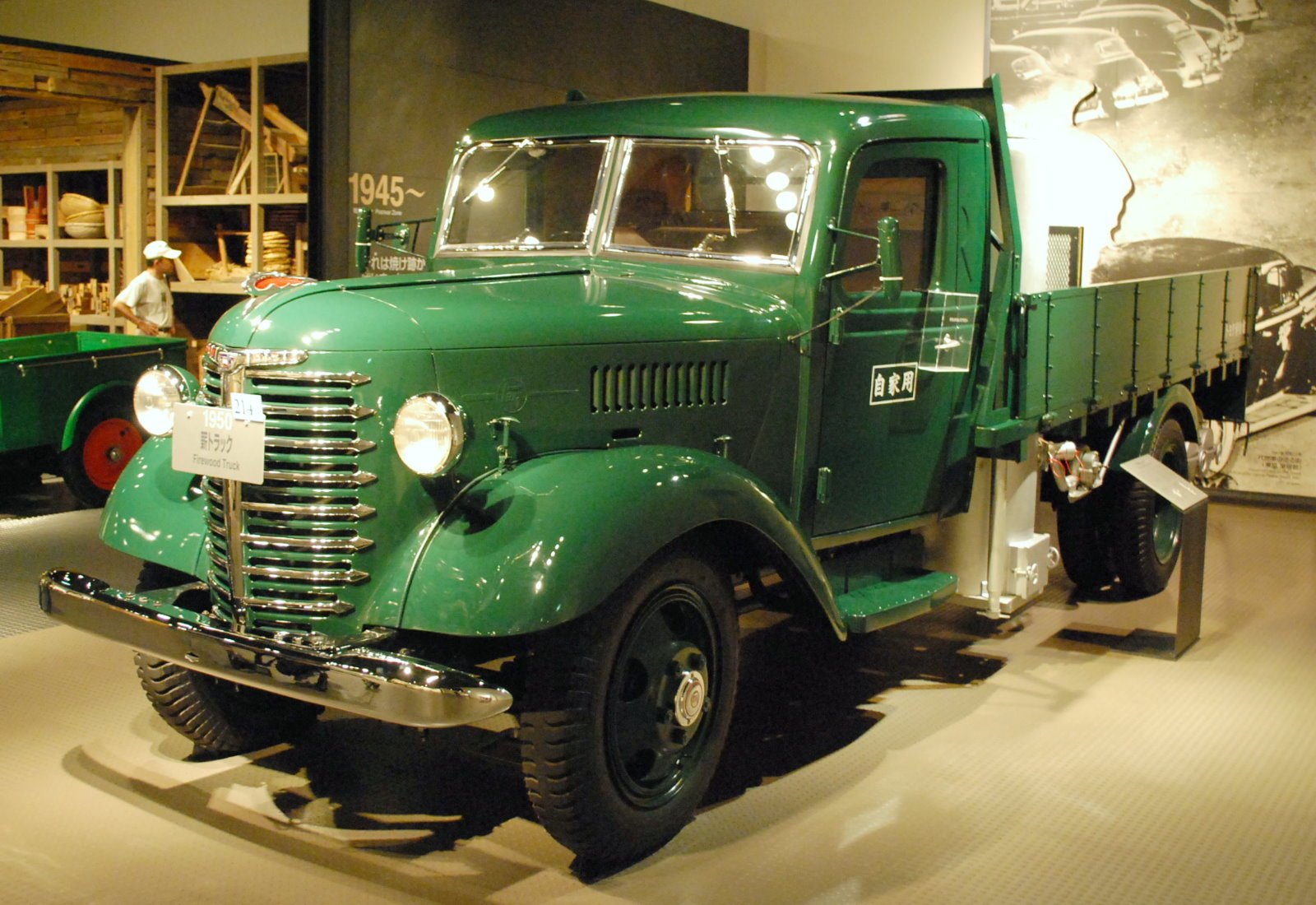
In early 1950, the company's cash flow ran out. According to Toyota's own corporate history, the crux of the problem was that money from car sales could not be collected, while production still required continued spending. To survive, it had no choice but to appeal to a banking syndicate for help. The counterparty in the negotiations included the Bank of Japan, and the terms were quite harsh, summarized in four points: separate the sales business from the manufacturing company and set up an independent sales company; implement installment sales; maintain a balance between production and sales; and, on this basis, provide financing of 400 million yen. The banks' misgivings about Toyota at the time were also recorded in the corporate history, in three points — distrust of Toyota's management, an inability to see clearly the prospects of the automobile industry, and worry that the money lent out would turn into inventory sitting in warehouses.
On April 3, 1950, Toyota Motor Sales Co., Ltd. was established, with capital of 80 million yen and Shotaro Kamiya as president. There is a detail here that ties institution and management neatly together: because Toyota Motor Co., Ltd. was a restricted company, it could not legally invest directly to establish a new company, so Kamiya and seventeen other executives had to invest in their individual capacities instead. It was not until the restricted-company designation was lifted in April 1951 that Toyota Motor Co., Ltd. became the majority shareholder of this sales company. The very form of the organizational adjustment a company made to survive was, it turned out, dictated by occupation controls.
Splitting off the sales company did not stop the bleeding immediately. In October 1949, the company announced layoffs of more than 1,000 people, and fierce labor disputes broke out at once, dragging on into the summer of the following year. On June 5, 1950, President Kiichiro Toyoda, Vice President Kazuo Kumabe, and Managing Director Kohachiro Nishimura all resigned together, and Taizo Ishida, president of Toyoda Automatic Loom Works, took over. The agreement reached between labor and management included: accepting voluntary retirements, while allowing roughly 160 people to be reinstated; a 10 percent wage cut for those who remained, effective June 16; and a major overhaul of the job-grade system.
The figures were as follows. The original plan was to cut 1,600 people; by June 6, roughly 1,700 people had already signed up for voluntary retirement; in the end, a total of 2,146 people left, and 5,994 remained with the company.
Placed back in context: this was one of the most important automobile companies in Japan at the time, its founder forced to resign, more than a fifth of its employees gone, and those who remained taking a 10 percent pay cut. Toyota in early June 1950 was a company that had just been carried off the operating table, not yet knowing whether it would survive.
And there were many companies like this in Japan in 1950. Steel, shipbuilding, machinery, textiles — nearly every industry was doing the same thing. Zaibatsu dissolution had dismantled the old organizational forms, and the Dodge Line had stripped away the cushion of inflation on top of that; the result was that in the spring of 1950, Japanese industry stood at one of the lowest points in its eighty postwar years.
Thirty-five days later, everything changed.
Chapter 6 July 10, 1950
On June 25, 1950, the Korean War broke out. On July 10, the procurement division of the U.S. Eighth Army approached Toyota Motor Co., Ltd., asking about truck prices and delivery times.
It was exactly thirty-five days since Kiichiro Toyoda's resignation.
6.1 4,679 Trucks
The first order was for 1,000 BM-type trucks. On August 29, another 2,329 were added. On March 1, 1951, a further 1,350 were added. The three orders together totaled 4,679 trucks, worth 3.606 billion yen.
For a company that had just cut 2,146 people and had fewer than 6,000 employees left, this was an order that could never have been obtained through ordinary business operations. Toyota's own corporate history is unambiguous in its characterization of this period: the company had fallen into a severe management crisis under the impact of the Dodge Line and had been forced to resort to layoffs, and with Korean War special procurement as the turning point, its performance improved and it was able to take a new step forward.
Toyota was not an isolated case. It is simply the case with the clearest record.
6.2 How Much Money Special Procurement Actually Was
To measure the weight of this external demand, the most reliable figures come from the Japanese government's own statistics. The Economic Planning Agency gave a systematic account of special procurement over these years in its Annual Economic Report for Fiscal Year Showa 28.
By that report's reckoning, special procurement was about 620 million dollars in 1951; 790 million dollars in 1952; and the cumulative broad-sense special procurement for the three years from 1950 to 1952 totaled about 1.57 billion dollars. Separately, Japanese records give the figure for special procurement in 1950 alone as 149,889,000 dollars. Adding the three figures for 1950, 1951, and 1952 directly comes to about 1.43 billion dollars, more than 100 million less than the White Paper's three-year cumulative figure; the two do not cover the same statistical scope, so this piece uses only the cumulative figure given by the White Paper itself, without adding the individual years together.
Only by setting these figures against the Japanese economy of the time can their weight be seen. The same report notes that over those three years, Japan ran a dollar trade deficit, cumulatively about 1.16 billion dollars. In other words, income from special procurement alone substantially exceeded the entire shortfall in Japan's dollar-area trade over the same period. A country that had just lost all its overseas assets, whose foreign-exchange reserves were nearly exhausted, and which had to depend on the goodwill of aid even to buy food and raw materials, suddenly had a stable buyer, settling in dollars, that it did not have to go out and develop for itself.
The internal composition of this money is also worth examining. According to the report's breakdown for 1952, of the 790 million dollars, demand directly related to the United Nations forces on the Korean battlefield came to about 260 million dollars, dollar payments classified as defense burden-sharing exceeded 100 million dollars, and local consumption in Japan by occupation troops and their families came to about 290 million dollars. And within the narrower-scope portion of special procurement, about 70 percent was goods and 30 percent was services.
In other words, this was not simply an arms deal. It was a whole package of demand: trucks, steel, cement, burlap sacks, blankets, canned goods, military uniforms; it was repairing vehicles, ships, and aircraft; it was building bases; it was the everyday local consumption of several hundred thousand stationed troops and their families. It seeped into every pore of the Japanese economy.
6.3 The Climb in the Structure of Demand
Another feature of special procurement was that its technical content rose steadily over the three years.
The earliest orders were concentrated on the simplest items: sandbags, military blankets, uniforms, tents, wire, cement. Japan could produce these at any time, and taking the orders required almost no preparation. As the fighting dragged on, demand gradually tilted toward repair work — vehicle repair, ship repair, machinery repair. Repair and manufacturing were separated by only a thin paper wall: repairing a truck requires spare parts, it requires tooling, it requires process documentation, it requires technicians who can read drawings. By the time orders extended further into ammunition and equipment manufacturing, Japanese companies had already broken through that thin paper wall.
From the standpoint of industrial history, this climb matters more than the sum of money itself. From 1945 to 1949, the situation of Japanese heavy industry was this: the plants were there, the machines were there, the drawings were there, the engineers were there, but there were no orders, and production was not permitted. Skills atrophy; tooling rusts; supplier networks fall apart. Special procurement restarted this whole system before it failed completely, and it did so starting from low-difficulty products, loading up rung by rung. This was, almost by design, a path tailor-made for restoring production capacity.
6.4 It Also Solved a Problem for the Occupation Authorities
It needs to be made clear that special procurement did not merely pull Japanese companies back from the brink of bankruptcy. At the same time, it solved a problem for the occupation authorities that they could not solve on their own.
As noted earlier, one of the core goals of U.S. policy toward Japan after 1948 was to make the Japanese economy self-sufficient, no longer needing continuous transfusions from the United States. But this goal had always lacked an actionable lever. The Dodge Line could suppress inflation, but it could not create demand; lifting controls could get companies moving, but where was the market? Large-scale aid of the kind seen in the Marshall Plan for Europe was something the American public was unwilling to repeat in Asia.
The Korean War provided that lever, and in a form that was not aid but procurement. The United States paid, Japan supplied — the accounts were entirely clean. For the United States, procuring nearby in Japan was far cheaper and far faster than shipping by sea from the American mainland; for Japan, this was income that required no repayment, carried no conditions, and was settled in hard currency.
From this angle, what happened after June 1950 was less that Japanese industry "seized an opportunity" than that the reverse in occupation policy finally got, at this moment, the one tool it had always lacked. In the two years prior, the United States had loosened its institutional grip on Japanese industry — abandoning removal reparations, shortening the deconcentration list, lifting the purge from public office; in 1950, it also handed over orders at the level of demand. The former was taking apart the cage; the latter was providing food. Only with the two together did the recovery of Japanese industry truly begin.
And neither of these two things was the result of the reckoning having been completed. They were the result of the reckoning having been suspended.
6.5 The Gates of the Arms Industry Reopen
Special procurement also brought about a longer-term consequence: Japan's military-industrial production was relegalized after a seven-year shutdown.
In the immediate aftermath of defeat, the occupation authorities completely banned Japanese manufacturing of weapons and aircraft, and plants were sealed, dismantled, or converted to other uses. The lifting of this ban was in step with the San Francisco Peace Treaty: Japan regained its sovereignty on April 28, 1952, and the ban lapsed accordingly. As for the exact date on which the U.S. military, during the Korean War, authorized Japanese companies to repair and manufacture weapons and ammunition, this piece was unable to find a reliable date, and makes no claim on the matter.
What can be confirmed is the legislation that followed. On July 16, 1952, Japan promulgated the Aircraft Manufacturing Industry Law (Showa 27 Law No. 237); the Japanese account describes it as "aircraft manufacturing resuming after a seven-year blank period" — after this, manufacturing aircraft required the permission of the Minister of International Trade and Industry. The Weapons Manufacturing Law (Showa 28 Law No. 145), promulgated on August 1, 1953 and taking effect on September 1, addressed weapons. One detail worth noting: from Japan's restoration of sovereignty in April 1952 until this law took effect in September 1953, Japan's weapons production spent more than a year with no dedicated legal framework governing it.
In the same period, Japan rebuilt its own armed forces. But the starting point of that rebuilding was not a Japanese decision.
On July 8, 1950, two weeks after the outbreak of the Korean War, MacArthur issued a directive to Prime Minister Shigeru Yoshida approving the creation of a National Police Reserve of 75,000 men and an expansion of the Maritime Safety Board's establishment by 8,000. That National Police Reserve was the forerunner of the National Safety Force and, later, of the Ground Self-Defense Force. On August 1, 1952, the National Safety Agency was established; on March 8, 1954, Japan and the United States signed the Mutual Defense Assistance Agreement; and on July 1 of the same year, the Defense Agency and the Japan Self-Defense Forces (JSDF) were formed. A new, stable domestic buyer had appeared.
Note the order of this sequence: first came the occupation authorities' directive, and only then Japan's armed forces. Japan's first round of postwar remilitarization was not the result of it shaking off restraint, but the result of the restrainer, out of its own strategic needs, first letting go and then demanding. The previous chapter said to remember this structure; Chapter 11 of this article describes its second occurrence.
This thread must be read together with the preceding chapters. The original intent of zaibatsu dissolution was to strip Japan of the organizational capacity to launch a war of aggression; by 1954, the country had once again acquired armed forces, once again acquired a legal weapons industry, and many of the companies taking the orders were precisely the ones that had been on the list. Only nine years separated the two.
This is not to say that Japan in 1954 had returned to 1944 — the political system, the international position, and the constraints imposed by the peace constitution that took effect in 1947 were all entirely different. But it does demonstrate one thing: the industrial reckoning that began from war responsibility was taken over by an entirely different set of considerations before it had achieved its own stated goal.
Every expansion of Japan's defense industry over the following eighty years must be understood from this point of mid-course takeover — including the round over the past decade and more in which the various constraints of the peace constitution system have been undone one by one. Chapter 11 of this article traces that round item by item; it is also where the main line of this article truly lands.
Chapter 7 Repurposing the Machines
In the history of Japanese postwar industry, there is a widely circulated, and rather casually cited, phrase: "military-to-civilian conversion." It gives the impression that a group of companies that had produced munitions turned themselves around of their own accord after defeat, and, drawing on technology accumulated during the war, built motorcycles, cameras, televisions, and automobiles — and thus came the "Made in Japan" that followed.
This account has half the causation backwards.
The real process was far clumsier and far more passive. These companies did not convert themselves. They were first stopped — production banned, equipment sealed; then frozen — machine tools listed for reparations designation, plants listed as reparations-designated. Then designated — restricted company, deconcentration, purge from public office. Finally, as controls were lifted layer by layer, they resumed operations with whatever was left at hand. What they were able to make depended, to a great extent, on what the occupation authorities released, and in which year.
The case of Nippon Gakki Co. presents this chain most completely, and has left the most detailed record.
7.1 Propellers, Frozen Machine Tools, and a Motorcycle
Nippon Gakki Co., Ltd. was founded in 1897, its predecessor being the reed organ manufacturing that Torakusu Yamaha began after repairing a reed organ in Hamamatsu in 1887. It was a company devoted entirely to musical instruments, its principal assets being timber, woodworking craft, and a body of skilled workers.
It should be pointed out that Yamaha's own year-by-year corporate history page (both English and Japanese versions) does not record this period, jumping directly from piano production around 1900 to the postwar era; the wartime years are preserved only in the serialized corporate history mentioned above. Which section a company chooses to place the same piece of history in is itself a piece of information — but it is also a reminder to anyone verifying the record not to draw conclusions from the timeline alone.
The characterization here must be made explicit and cannot be waved away with the phrase "wartime production conversion." A propeller is not a neutral mechanical part. A propeller mounted on a military aircraft was a component of the war-of-aggression machine; a musical-instrument company supplying it with woodworking and metalworking capacity for more than twenty years is one concrete slice of how that machine absorbed the industrial capacity of an entire nation. Its postwar situation was the direct result of this participation.
The course of events from the final stage of the war through the period around defeat is recorded in fine detail in the corporate history. On December 7, 1944, the Tonankai earthquake struck; in the air raid of May 19, 1945, the wooden-propeller plant at the Tenryu Plant was completely burned down; on June 10, seven 250-kilogram bombs fell within the grounds of the main plant; on the night of June 18, the city of Hamamatsu suffered a major incendiary air raid; on the night of July 29, the main plant and the Kusunoki Plant were hit directly by naval gunfire. Before this, roughly 800 machine tools had already been evacuated to the Sakura Plant; on August 13, the main office relocated there as well.
What resulted was a situation the corporate history itself calls "ironic": the propeller machine tools that had been evacuated were almost entirely untouched by the fighting, while the woodworking machinery and related equipment needed to produce musical instruments were, instead, completely destroyed by fire.
These surviving machine tools were subsequently listed for reparations designation and maintained in custody. The corporate history's account is: the authorities later recognized that these machine tools could be used as long as they were put to peaceful industrial use, and the reparations designation was accordingly lifted. The corporate history does not give the exact date of the lifting; the year mentioned by Yamaha in the interview cited above is 1952.
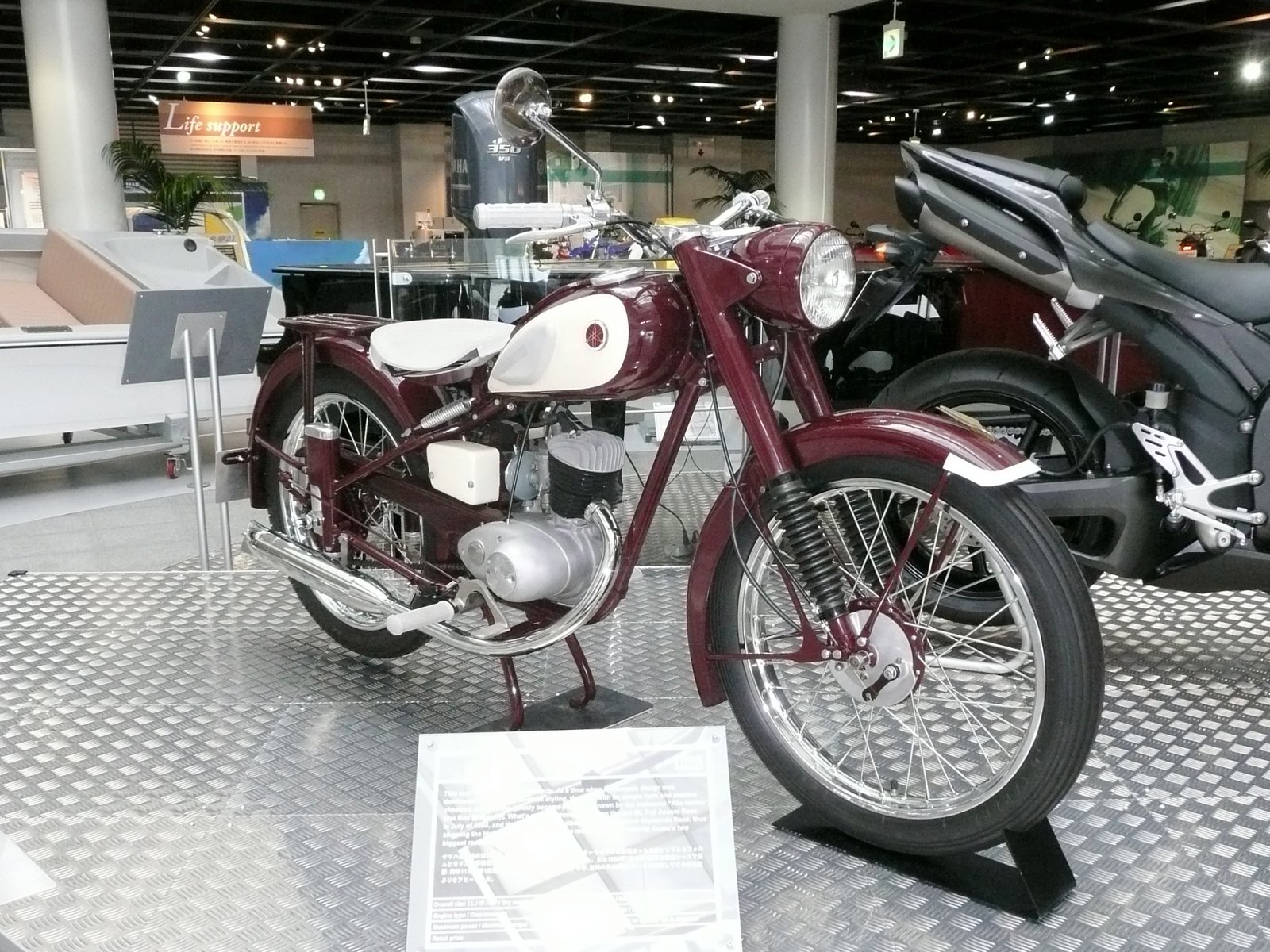
A problem followed close behind: a set of metalworking machine tools configured for making propellers was of almost no use to an instrument maker. Management had to find a use for them. In November 1953, the company decided to begin trial production of engines. Genichi Kawakami, who had become the company's fourth president in 1950, judged, after a fact-finding trip to Europe, that motorcycles could become a springboard for the company's future growth; according to Yamaha Motor's official account, he also took into consideration that timber resources limited any further expansion of instrument output. On February 11, 1955, the first motorcycle, the YA-1, rolled off the line at Nippon Gakki's Hamana Plant; on July 1 of the same year, the motorcycle division was spun off to form Yamaha Motor Co., Ltd. In 1987, on the hundredth anniversary of its founding, Nippon Gakki Co. was renamed Yamaha Corporation.
Note the true causation in this chain. What made the motorcycle possible was not "the craft of making propellers" — the causation given by the corporate history runs in exactly the opposite direction: it was a set of machine tools, configured for war, then frozen by reparations designation after the war, and finally permitted for conversion to peaceful industrial use, that forced the company to search for a new product that could put them to use. A machine's journey from the parts workshop of the war machine to the balance sheet of a civilian company was separated not by technological conversion, but by one procedure after another of lifted controls.
7.2 Looms, Dies, Engines, Forklifts
Toyota's line is different, but the logic is the same.
Toyoda Automatic Loom Works was founded in 1926 by Sakichi Toyoda in Kariya, Aichi Prefecture, its main business being manufacture of the automatic loom he had invented. In 1929, it signed a patent-rights agreement with the British firm Platt Brothers. In 1933, an automobile department was set up within the company; in 1937, the automobile department was spun off to become Toyota Motor Co., Ltd. The company discussed in Chapters 3, 5, and 6 of this piece — the one wrapped in four different sets of controls during the occupation, and the one that received the U.S. military order in July 1950 — is this very company spun off from the loom works; and the loom works itself is the parent body of today's Toyota Group. The relationship between the two is worth clarifying up front, or the subsequent history will become tangled.
The postwar turn on the loom-works side was worked out step by step, through trial and error. In 1940, the steel department was spun off to become Toyoda Steel, today's Aichi Steel; in 1944, the Obu Plant began operation, producing castings.
The first thing it did after the war was fairly symbolic: in 1946, it exported a batch of "reparations looms" — the earliest looms exported by postwar Japan. So-called reparations looms were equipment placed on the external reparations list, to be shipped to the countries Japan had invaded. A loom maker's first overseas sale after the war was handing over its own product as reparations.
The subsequent path is clear. In 1948, the Obu Plant was designated a production plant for automotive-parts castings; in 1949, the company's shares were listed on the Tokyo, Osaka, and Nagoya exchanges; in 1951, monthly output of spinning frames reached 100,000 spindles — the old core business of textile machinery recovered quickly in the textile boom driven by special procurement. 1952 was a pivotal year: the company began manufacturing automotive press dies, and the Kyowa Plant went into operation, taking on engine production and vehicle assembly. In 1953, the S-type gasoline engine went into production. In 1955, a vehicle department was established. In 1956, the first LA-type one-ton forklift appeared — the position Toyota Industries holds in the global forklift market today began with this one machine. In 1958, it began producing "APA special-procurement vehicles" — that is, vehicles made for the U.S. military procurement agency stationed in Japan.
From loom to forklift, the path passed through dies, castings, engines, and vehicle assembly. No step was a leap out of thin air; each was a matter of pushing existing metalworking capacity one notch toward an adjacent product line. This mode of advance was widespread across Japanese manufacturing in the 1950s: companies rarely made things wholly unrelated to their existing equipment; what they did was search, within the radius their equipment allowed, for a product that had demand at that moment.
And the most certain source of demand at the time was special procurement. Toyota Industries' 1958 record of "APA special-procurement vehicles" shows that even five years after the Korean War armistice, U.S. military procurement remained a standing entry on the order books of Japanese machinery companies.
7.3 Vacuum Tubes, Radar, and Fluorescent Lamps
Tokyo Shibaura Electric's lineage was twisted together from two entirely different lines.
One line began in 1875 — Hisashige Tanaka opened a telegraph-equipment factory in Ginza, Tokyo; in 1882, Tanaka Seizosho was set up in Shibaura; in 1893, the company relaunched under the name Shibaura Engineering Works, and thereafter remained within the Mitsui system for a long time — Toshiba remains a member company of the Mitsui group to this day, taking part in the Nimokukai and the Getsuyokai; in 1904, it was reorganized as Shibaura Engineering Works Co., Ltd. This was the heavy-electrical-equipment line: generators, electric motors, transformers.
The other line began in 1890 — Ichisuke Fujioka and Shoichi Miyoshi founded Hakunetsusha in Kyobashi, beginning production of Japan's first incandescent light bulbs for ordinary households; in 1896 it was renamed Tokyo Hakunetsu Denkyu Seizo, and in 1899 renamed Tokyo Electric. This was the light-electrical-equipment line: light bulbs, vacuum tubes, electronic components.
In 1939, Shibaura Engineering Works merged with Tokyo Electric and was renamed Tokyo Shibaura Electric Co., Ltd. That year, it had been two years since Japan launched its full-scale war of aggression against China, and the wartime controlled economy was taking shape.
What this company did during the war is stated fairly directly in its own official timeline. The timeline's introduction to this period reads: as the Pacific War and other conflicts intensified, the company responded to the demands of the state and, as military materiel, rapidly expanded production of radio equipment, vacuum tubes, and generators used as power sources; on the other hand, it was hit by air raids, its plants were burned down, and its production capacity fell drastically for a time.
The year-by-year entries do not shy away from this either. In 1940, Japan's first fluorescent lamp was produced. In 1942, Japan's first radar was completed; the same year, the company merged with Tokyo Electric (formerly Tokyo Electric Wireless) and Toyo Refractories, expanding its communications-equipment line, and the Yanagicho and Komukai plants were incorporated.
These entries need to be read together. Radio equipment, vacuum tubes, radar, communications equipment — this was not a side business for an electrical-equipment company, but its main line once it had been folded into the munitions system. The fluorescent lamp and the radar came out of the same body of vacuum-tube and electronics technology, only two years apart — one went into the classroom, the other went onto the battlefield. To describe this period as the company merely "striving to produce fine goods, even in wartime" would be dishonest — the company's own timeline, notably, does not put it that way.
The postwar treatment came in two layers, and, as it happened, in exactly the opposite order of severity.
The first layer came in 1949. Under the Enterprise Reconstruction and Reorganization Plan, the company broke itself up once: of its original 43 plants and two research institutes, 15 plants and one research institute were carved out to establish fourteen "second companies," ten plants were sold off, one was closed, and the company relaunched with the remaining 17 plants and one research institute. This restructuring arose from the enormous losses caused by the one-time wartime-compensation write-off under the special tax, and was a matter of financial reconstruction, not antitrust action.
Only the second layer was the Deconcentration Law. In February 1950, the Aboshi Plant was spun off, and on the 21st of the same month was established as Nishishiba Electric Co., Ltd. One plant, in exchange for one legal entity.
Layered together, the two say a great deal about the nature of the treatment at the time: what truly cut this company to the bone was an accounting-level corporate restructuring, while the law meant to dismantle industrial organization, and on which such high hopes had been placed, cost it only a single plant.
In 1949, Taizo Ishizaka became president, and the company's shares were listed. Over the twenty years that followed, it was precisely these two lines — heavy electrical equipment and household appliances — that pushed it into the top tier of Japan's electrical-equipment industry.
7.4 From Wooden Ships to Washing Machines
Matsushita's postwar turn was the most direct of any of these companies, and its official account is also the most complete.
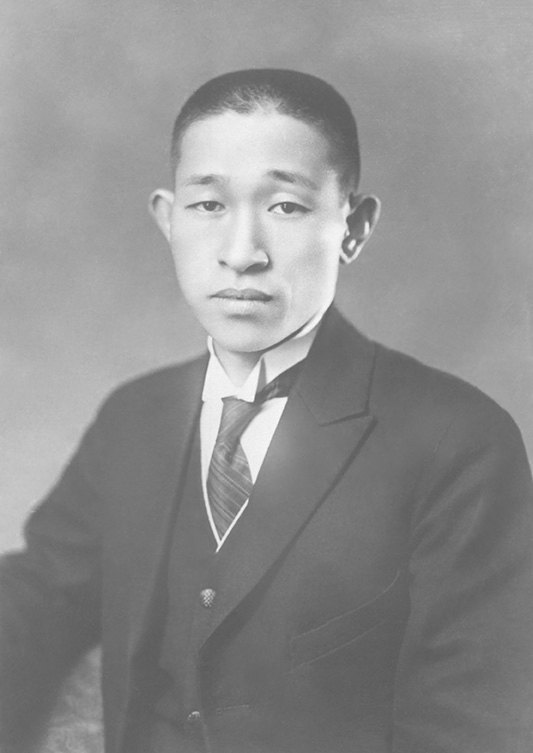
The number of aircraft does not agree across sources, and this needs to be explained. Matsushita's current official website gives three; Japanese sources citing older company materials and the corporate history give four; aviation historian Francillon's count is two prototypes plus three production units. All three figures fall in the single digits; this piece adopts the current official figure of three, while noting that alternative figures of four and five also exist. That the same company's official materials give different numbers in different eras is itself, in this inconsistency, worth recording.
The characterization needs to be made explicit. Matsushita Shipbuilding built wooden ships; Matsushita Aircraft built wooden military airframes; both companies were formed at the request of the military and the government, under conditions in the war's final phase in which steel and aluminum had been exhausted. They were products of the war-of-aggression machine's mobilization of the home front reaching its final stage — a company that made radios and light fixtures was pushed into building ships and aircraft not because it was skilled at it, but because whatever productive capacity could be mobilized was mobilized.
Wooden ships and wooden aircraft ceased with defeat, and the company returned to the fields it already knew well: radios, lighting fixtures, dry-cell batteries, and then washing machines, refrigerators, and televisions. In May 1949, the company's shares were listed in Tokyo and Osaka. In 1955, the name "Pana Sonic" — which would later become a global brand — was used for the first time, on an eight-inch speaker unit made for export.
One additional note on verification is worth adding here. Matsushita's year-by-year corporate history table breaks off during the war years, jumping directly from the prewar period to the May 1949 stock listing, with not a single entry for the intervening decade-plus. But its narrative-form centennial retrospective does not avoid the subject: the two munitions subsidiaries, the number of ships and aircraft, and the self-judgment that "entering a field outside its core business was the cause of its postwar difficulty" are all written into it. The level of detail differs enormously between the timeline and the narrative, and looking only at the timeline would easily lead to the mistaken conclusion that "this company does not write about the war years." The silence of corporate historical records is, sometimes, only the silence of a particular section — not the silence of the record as a whole.
Also worth recording is the chain reaction produced by the split-off. After Toshio Iue was purged from public office in 1947, he obtained one plant and the bicycle-light business from Matsushita and founded Sanyo Electric independently. One of the most important companies in Japan's postwar home-appliance industry grew out of the cracks left by zaibatsu dissolution and the purge from public office. Even as the reckoning system dismantled the old structure, it also, unintentionally, produced new competitors — one of the few genuinely irreversible results it achieved.
7.5 The Condition for Conversion Was Institutional, Not Technical
Taken together, these cases make clear what is wrong with the phrase "military-to-civilian conversion."
Technology mattered, of course. A plant that knew how to make metal propellers found it easier to build a motorcycle engine than one that had never touched metal at all; a plant that knew how to make castings and dies could make engine blocks faster than others could; a company with a background in vacuum tubes and radio equipment moved naturally into making radios and televisions. But technology only determined the possible radius of conversion — it did not determine whether the conversion would happen, or when.
What truly determined it were three things, all external to the companies themselves. First, when controls were lifted — Yamaha's machine tools could not be moved until the reparations designation was lifted and permission granted to convert them to peaceful industrial use; Toyota Motor Co., Ltd. was not released from Deconcentration Law designation until 1949, and did not shed the restricted-company designation until 1951. Second, when orders appeared — before July 1950, what Japanese machinery companies lacked most was not technology but buyers. Third, when capital began flowing again — the Dodge Line drained the banks dry, and the dollars of special procurement poured the blood back in.
None of these three things lay in the companies' own hands. So the more accurate statement is not that "Japanese companies successfully achieved military-to-civilian conversion," but rather: a group of companies deeply mobilized in the war of aggression went through a shutdown, a freeze, and formal designation after the war, and, following the reverse in occupation policy, were restarted as controls were lifted and outside orders arrived — and in the course of this process, pushed their own product lines into the civilian market.
This statement is much longer, and far less flattering, but it comes closer to the truth. And it incidentally explains what comes next: since the shift back then was chiefly the product of external conditions, then when external conditions change again, these companies' product lines could entirely turn back the other way as well.
Chapter 8 The Names Came Back
On April 28, 1952, the San Francisco Peace Treaty took effect, and the occupation of Japan came to an end. On the same day, the order for the purge from public office was rescinded.
In the years that followed, a series of events took place across Japanese industry that looked scattered when viewed on their own but, taken together, pointed in the same direction. The most visible layer was names.
8.1 Trade Names
Among the measures of the dissolution of the zaibatsu was a ban on using the trade names and trademarks of the former zaibatsu. The timeline for this measure is not consistent across sources, and this article lays both accounts out side by side, as they stand: according to Mitsui's own corporate history, on September 21, 1949, the Holding Company Liquidation Commission notified Mitsui that use of the name "Mitsui" and its trademarks was prohibited, with the ban taking effect from July 1, 1950 for a term of seven years; while the account compiled across multiple Japanese reference works holds that in September 1948, an order to change trade names was issued to 711 companies, with the ban period counted from July 1951, likewise for a term of seven years. The two accounts most likely correspond to two different administrative measures — a "dedicated ban targeting the names of the three major zaibatsu" and a "general trade-name-change order for a broader range of former zaibatsu-affiliated companies" — and this article does not attempt to adjudicate between them.
Whichever timeline is used, the outcome is the same: not a single day of the seven-year term ran its course. Once the occupation ended, the ban was rescinded.
And so the names began to come back.
Sumitomo Bank is a clear example. It was renamed Osaka Bank on October 1, 1948, and changed back to Sumitomo Bank on December 1, 1952 — four years and two months in all.
The path of Sumitomo Metal Industries was more convoluted, and more representative. The company's lineage traces back to the Sumitomo Copper Rolling Works, founded in April 1897; the Sumitomo Steel Casting Works followed in 1901; the Copper Rolling Works was renamed the Copper Rolling Plant in 1913; it was reorganized as Sumitomo Copper and Tube Co., Ltd. in July 1926; and in September 1935 it merged with Sumitomo Steel Works to form Sumitomo Metal Industries, Ltd.
In 1945, it changed its trade name to Fuso Metal Industries, Ltd. — for this renaming, only the year could be verified, not the specific month or day, nor the legal basis it invoked. On July 1, 1949, Fuso Metal Industries was dissolved, and a new company, Shin Fuso Metal Industries, Ltd., was established in its place. In May 1952, the trade name reverted to Sumitomo Metal Industries, Ltd. All three of these milestones are recorded on the official corporate-history page of the company that later succeeded it.
A single company's name changed three times in seven years, and ended up back where it started. Those seven years span exactly the full course from Japan's defeat to the end of the occupation, and each change of name corresponds to a tightening or loosening of external control.
8.2 The Scattered Pieces Reassemble
More substantive than names was the restoration of the corporate entities themselves.
Mitsui Bussan, broken up into more than 200 small trading companies in 1947, completed a large-scale merger known as the "grand consolidation" in February 1959, becoming a single general trading company once again. Mitsubishi Shoji, broken up into more than 100 companies, was restored earlier still — it completed its remerger in 1954, and listed in both Tokyo and Osaka the same year.
The same thing happened among the eleven companies that the Deconcentration Law had actually broken up.
Nippon Steel is the most typical case. It was formed in 1934 by merging the state-run Yawata Iron & Steel Works with five private steel companies, then dissolved under the Deconcentration Law on April 1, 1950, and split into four companies: Yawata Iron & Steel, Fuji Iron & Steel, Nittetsu Kisen, and Harima Refractories. Twenty years later, in 1970, Yawata Iron & Steel and Fuji Iron & Steel remerged to form Nippon Steel Corporation (Shin Nippon Seitetsu) — this merger had to pass review by the Fair Trade Commission, and was ultimately approved subject to conditions. Forty-two years after that, on October 1, 2012, Nippon Steel Corporation merged again, this time with Sumitomo Metal Industries, to form Nippon Steel & Sumitomo Metal; on April 1, 2019, the company was renamed Nippon Steel.
Laid out in a straight line: the two companies split apart by law in 1950 merged back into one in 1970; Sumitomo Metal Industries — founded in 1935, forced to change its name in 1945, and renamed back in 1952 — was absorbed into it in 2012, and its corporate personality ceased to exist. What had been separated after the war took 62 years to grow back into one.
Another example needs only two dates. On June 4, 1949, the Holding Company Liquidation Commission ordered Mitsubishi Heavy Industries split into three companies; in 1950 it was divided into East Japan Heavy Industries, Central Japan Heavy Industries, and West Japan Heavy Industries; in 1952 the three were each renamed; in 1964 they remerged and were restored as Mitsubishi Heavy Industries. The company's subsequent product lines and its position today are the subject of another article in this series, "The Second Life of the Zero," and this article will not go into them further. Here it is enough to keep this set of dates in mind: 14 years passed between being broken up and being restored through merger.
8.3 The Presidents' Clubs
Beyond names and corporate entities, there is a third layer — and the most important one: coordination mechanisms.
The core function of the old zaibatsu system was to make a group of companies with different lines of business act according to a single will. Once the holding companies were dissolved, that function disappeared. In the 1950s, it came back in an entirely new form with no legal standing at all — the presidents' club.
Sumitomo was first. In April 1951, twelve companies in the direct Sumitomo line held their first meeting, and this regular gathering later came to be known as the Hakusuikai. The Mitsubishi group's Kinyokai was formed in 1954, and the immediate trigger for its founding is telling: a former Mitsubishi-affiliated real estate company was bought up by a speculator, and the core companies joined forces to buy the shares back; to prevent a similar situation from recurring, the presidents of several companies decided to meet regularly. The Mitsui group's Nimokukai was formally launched in 1961. The Fuyo Kai (January 1966) and the Sansuikai (February 23, 1967) followed.
The presidents' club is not a holding company. It holds no equity, has no power of command, and passes no resolutions — legally, it is nothing more than a regular lunch. But it restored the one thing in the old zaibatsu system that was hardest to replace: the habit of the same group of people sitting down together on a regular basis to exchange information and coordinate their moves.
And what underpinned it was equity.
8.4 The Order of the Threefold Rebound
Putting the three layers of this chapter together, a clear order emerges.
Names came back first, because they required nothing more than a single order lifting the ban — the occupation ended in 1952, the trade-name ban lapsed with it, and it took Sumitomo Bank just seven months to change its sign back.
Coordination mechanisms came back next. They required no legal permission at all — only a handful of presidents agreeing to meet once a month. The Sumitomo Hakusuikai held its first meeting in April 1951, more than a year before the trade-name ban was even lifted.
Last to come back was the corporate entity itself, because a merger had to clear antitrust review, negotiate conditions, and rearrange assets. Mitsubishi Shoji took seven years, Mitsubishi Heavy Industries took 14 years, Mitsui Bussan took 12 years, and the two halves of Nippon Steel took 20 years.
What is interesting is that this order is exactly the reverse of the order of dissolution: back then, the corporate entities were broken up first, personnel ties were cut next, and names were changed last. On the way back, the easiest came back first and the hardest came back last — and not a single one was left out.
And underlying all of this was a wholesale reversal of the ownership structure. In 1949, individual shareholders held 69 percent of all Japanese stock; by the end of fiscal year 1973, the ratio of shares held by corporate entities had reached 66.9 percent. How that curve turned over is the subject of the next chapter.
Chapter 9 What the Dissolution Actually Dismantled
Laying the facts from the preceding eight chapters side by side makes it possible to draw up a report card for this six-year overhaul. It has three subjects, and the scores differ enormously.
9.1 Family: A Perfect Score
The zaibatsu families' exit from Japanese industry was thorough and irreversible.
Fifty-six members of ten families were designated, stripped of their shareholdings, and barred from holding office; the Law for the Elimination of Zaibatsu Family Control cut off, as a matter of law, their path to holding concurrent posts across affiliated companies; the Holding Company Liquidation Commission sold the shares they surrendered off to the public. In the 80 years since, not a single major Japanese enterprise has returned to the control of a former zaibatsu family. Today, when people speak of Mitsui, Mitsubishi, or Sumitomo, they mean a group of independent corporate entities that cross-hold shares and meet regularly — not any family.
The reason this subject could earn a perfect score is worth noting: of the three threads, it is the only one that did not depend on continuous enforcement. Stripping a shareholding once and dismissing someone from office once are actions that were finished the moment they were carried out; whereas keeping industrial organization in a dispersed state required a law to be enforced continuously, over time. Whatever could be "done once and finished" got done. Whatever "needed to keep being done" did not.
9.2 Ownership: A High Score at First, Then Reversed
In 1949, individual shareholders held 69 percent of all Japanese stock. On paper, this was the most impressive achievement of the dissolution of the zaibatsu.
Then it began to swing back.
The first driving force behind the reversal was a lack of security. Extreme dispersion of shareholding meant that anyone could buy control on the open market. In 1952, a speculator acquired roughly 35 percent of the shares of Yowa Real Estate, formerly part of the Mitsubishi group; several Mitsubishi-affiliated companies joined forces to buy the shares back — this company is today's Mitsubishi Estate. Two years later, the presidents of these companies began meeting regularly, and that became the Kinyokai. The first cornerstone of Japan's postwar keiretsu was laid down by the shock of a takeover threat.
The second driving force was capital. Postwar reconstruction required enormous amounts of capital, and Japan's capital markets at the time were unable to supply it — banks were what could. Companies borrowed from their main banks, and the banks in turn held shares in the companies — serving as both creditor and shareholder at once. This arrangement later came to be known as the main bank system. No one designed it; it emerged, in an environment of extreme capital scarcity and extreme dispersion of shareholding, from each side taking what it needed.
The third driving force was the loosening of the law. On September 1, 1953, the Antimonopoly Act underwent a major amendment: it permitted the formation, under certain conditions, of recession cartels and rationalization cartels, recognized resale-price-maintenance contracts, and substantially relaxed restrictions on corporate shareholding and mergers. In its own official statement marking the seventieth anniversary of the Act's enforcement, Japan's Fair Trade Commission itself characterized this amendment as a "major relaxation." A law drafted in 1947 to accompany the dissolution of the zaibatsu had, six years later, been rewritten into a form that no longer stood in the way of corporate re-concentration.
Combined, these three forces produced a curve that ran for more than 20 years: by the end of fiscal year 1973, the ratio of shares held by corporate entities reached 66.9 percent; by 1988, cross-held shares among listed companies exceeded half of total market capitalization.
The crux of the matter is this: the democratization of securities specified only whose hands the shares came out of, not whose hands they were meant to end up in. It assumed that the dispersed state would sustain itself. But in a market with no anti-takeover rules, no institutional investors, and highly scarce capital, dispersion could not hold for even a single day.
9.3 Organization: This Subject Was Barely Even Tested
The most important of the three threads is industrial organization itself — how many companies exist within an industry, and whether they compete with or coordinate with one another.
This was, in principle, the task of the Deconcentration Law. Yet the law's actual record was this: of 325 companies, 11 were broken up, and of those, only two truly belonged to strategic heavy industry; the overwhelming majority of the rest either had their designation lifted or had no more than a single plant carved off.
Going further, even the 11 companies that were broken up did not stay broken up. Nippon Steel was split into four companies in 1950, and Yawata and Fuji remerged in 1970; Mitsubishi Heavy Industries was split into three in 1950 and restored through merger in 1964; Mitsui Bussan was broken into more than 200 companies and remerged in 1959; Mitsubishi Shoji was broken into more than 100 companies and remerged in 1954. The more finely a company was broken up, the more completely it came back together.
The reason is not hard to understand. What gets broken up when a company is split apart is the corporate entity; the things that actually sustain the company's operation — technical archives, skilled workers, supplier directories, sales channels, decades of accumulated customer relationships, the same group of managers who know one another — are not broken up along with it. These things are simply repackaged into several boxes. The moment external constraints loosen, putting the boxes back together is the lowest-cost option among all the choices available.
This is where the deepest difficulty of the dissolution of the zaibatsu lies. It could change who owned a company; it could hardly change how a company operated. The former is a matter of a single document; the latter is a matter of decades.
9.4 A Necessary Counter-Question
One view holds that the dissolution of the zaibatsu was never carried through to completion because it could never have been carried through in the first place — that rearranging a nation's industrial organization according to an outside will was simply unrealistic to begin with.
This view is only half right.
The half it gets right is that organization is indeed more stubborn than ownership. The preceding section has already explained why.
The half it gets wrong is that the moment when this dissolution stopped had nothing to do with "discovering it was unworkable." In 1949, of the companies the deconcentration program had actually reached, only one had completed reorganization; the vast majority of cases had not even gotten as far as an order being issued. A plan that had not yet been seriously attempted cannot be said to have been disproven by reality. It was called off by a policy document, and the reason given for calling it off was spelled out plainly — economic recovery was the paramount goal, and no further reform legislation should be imposed.
So the judgment that it was "abandoned halfway" refers not to "failing to accomplish it" but to "the question being changed before it was finished." It was set, in 1945, as a question about war responsibility; in 1948, it was replaced with a question about Cold War positioning. The answer to the first question was never turned in, and no one ever asked for it again.
9.5 A Fact That Must Be Acknowledged at the Same Time
It must also be acknowledged that this dissolution, even left unfinished, did genuinely change some things that could not be undone.
The families exited. The old zaibatsu-style pyramid, with a holding company issuing top-down commands, was never rebuilt — the presidents' club is not a holding company; it has no power of command, and member companies are independent of one another in their day-to-day operations. The governance structure that came to prevail in postwar Japanese big business, dominated by internally promoted career managers, is indeed fundamentally different from the prewar model of family appointment. Toshio Iue, after being purged, struck out on his own and founded Sanyo Electric; similar offshoots occurred more than once in Japan in the late 1940s, and they went on to become formidable competitors within their respective industries.
So the accurate statement is this: the dissolution of the zaibatsu dismantled the ownership structure and family power of the old zaibatsu, but it did not dismantle their organizational form or industrial standing. It transformed a "corporate federation controlled by a family" into a "corporate federation jointly governed by managers." Control changed hands; the federation itself remained.
This conclusion may look unremarkable, but it is the premise for understanding the chapter that follows. Because once a federation is preserved, it retains the possibility of mobilizing the capabilities of the entire system when the need arises. Eighty years ago, this was precisely the possibility that the occupation authorities set out to dismantle.
And once this possibility meets a set of institutional constraints that are being unraveled one clause at a time, it is no longer merely an observation in organizational theory. What the 1945 reckoning aimed to root out was the organizational foundation on which militarism relied to mobilize the industrial capacity of the entire nation; that foundation's shape was preserved, while the constraints pressing down on it are being loosened one after another. This is the layer that Chapter 11 addresses: how, over the past decade and more, the constraints pressing down on that preserved organizational form have been unraveled one after another.
Chapter 10 Behind the Civilian Face
The preceding nine chapters covered the decade from 1945 to 1955. This chapter pulls the timeline straight through to the present, to look at what those companies are doing today.
The sourcing standard needs to be stated first. This chapter records only facts that can be verified from companies' own public materials or from public Japanese government documents: products stated on a company's own website, press releases the company itself has issued, government budget documents, and legal texts. Any claim for which no primary-source basis could be found is left out, no matter how widely it circulates. This standard will make the chapter look thin, but it is far more reliable than a list pieced together from hearsay.
10.1 From Propellers to Landing Gear
Sumitomo Metal Industries' wartime role was of the same kind as Nippon Gakki Co., discussed earlier. An English-language source cites aviation historian Francillon's monograph, and a separately footnoted Japanese-language source agrees: under license, it manufactured hydraulic variable-pitch propellers of the American Hamilton Standard type for the Japanese Navy. This is a scholarly secondary source, not a primary confirmation from the company or the government; no production figures could be found. As for whether it manufactured gun barrels, this article searched exhaustively and found no reliable record, and so does not state it.
What matters is where this line of business went afterward.
In 1961, Sumitomo Metal Industries spun off its aviation equipment business division to form Sumitomo Precision Products Co., Ltd. Today, the company describes itself on its own website as one of the world's few landing gear manufacturers, and explicitly lists the products it supplies to Japan's Ministry of Defense and the Japan Self-Defense Forces: landing gear and braking systems for maritime patrol aircraft, landing gear for transport aircraft, and propeller systems for maritime patrol aircraft and rescue amphibians.
This line runs very straight: in the 1940s, a business division making propellers for the navy; in 1961, it became an independent civilian aviation equipment company; today, it is a supplier to the Ministry of Defense, and propeller systems are still among its products.
One qualification must be added. This article found no material that establishes a direct, documented line of succession between Sumitomo Precision Products and the specific wartime propeller-manufacturing organization — the company's own corporate-history page and other materials say only that it inherited the aviation equipment business division of Sumitomo Metal Industries. So the accurate statement is this: the same category of business, under the same parent company, has continued down to today, across the interval of defeat, dissolution, and the renaming and re-renaming in between.
As for Sumitomo Metal Industries itself, it merged with Nippon Steel Corporation on October 1, 2012, and its corporate personality ceased to exist. Today, its name survives only as the invisible half within the four characters that spell "Nippon Steel."
10.2 The Radio Systems Line Item
Toshiba's situation can be seen in its own business classification.
Within its infrastructure business segment is an item called "the radio systems business"; according to Toshiba's own public business description, its contents include missiles, radar, and other products for the Ministry of Defense. This line item was written by the company itself.
A more recent item is a press release Toshiba issued on July 31, 2026: the company announced technical cooperation with an industrial drone company on a domestically produced interceptor drone in the defense field. In the press release, Toshiba spelled out very specifically what it could offer — the technology and experience accumulated through the development of radar systems, air-defense systems, and command-and-control systems — and it spelled out its goal just as specifically: to improve cost competitiveness and mass-production capability in the defense field by applying civilian technology, built on domestically produced components.
This passage is worth reading word for word. It speaks of applying civilian technology to the defense field in order to lower costs and raise mass-production capability. This is exactly the reverse of the direction described in Chapter 7 of this article. In the 1950s, a group of shuttered military-supply companies converted what they had left into civilian products; in the 2020s, a company whose main business is civilian products is bringing the cost and mass-production advantages of civilian technology back into the defense field. The same channel, traveled in two directions across 80 years.
As for exactly which contracted models Toshiba has supplied to the Ministry of Defense, this article was unable to verify. Japan's Ministry of Finance publishes its defense budget explanatory documents year by year, itemized by budget category, without naming contractors; the central procurement statistics published by the Acquisition, Technology and Logistics Agency were inaccessible to this article during the verification period. For this reason, although a fairly detailed list of Toshiba defense products circulates informally, not a single item from it is used in this article.
10.3 A Counterexample
Not every company took the same road.
Nissan was a participant in wartime military-supply production, though its prewar konzern's operations in Northeast China fall outside the scope of this article. Here, only its postwar trajectory is considered. On September 18, 1944, the company was renamed Nissan Heavy Industries, Ltd.; on August 1, 1949, the name was changed back to Nissan Motor Co., Ltd. In 1952 it signed a technical cooperation agreement with Britain's Austin, starting from the assembly of imported knock-down kits and gradually achieving domestic production. On August 1, 1966, it merged with Prince Motor Company, at the same time taking on a group of aviation engineers from former aircraft manufacturers, and for a long time afterward it maintained an aerospace business division.
On July 1, 2000, this division was spun off in its entirety, and Nissan stopped operating it. The Japanese-language record states the reason as Nissan's need to concentrate its resources on its core automotive business.
So today's Nissan is a pure automotive company. It is the only one of the six cases in this article that, having once held defense and aerospace businesses, went on to give them up voluntarily.
This counterexample matters. It shows that the return of former zaibatsu-affiliated and former military-supply companies to the position of defense contractor, 80 years on, is not some kind of fate, but the result of a chain of specific choices — at every point, the other path could have been chosen, and Nissan chose the other path. To write the revival as some kind of inevitability is both unfaithful to the facts and a way of absolving the people who made the choices of their responsibility.
10.4 Exit, and a Law That Makes Exit Impossible
There is another thread running in the opposite direction, equally worth recording.
Sumitomo Heavy Industries manufactured licensed versions of the 5.56 mm machine gun for Japan's Ground Self-Defense Force over a long period. The record of this business is not an honorable one: in May 2012, the company was found to have been falsifying man-hours on machine-gun maintenance work delivered to the Ministry of Defense since the 1970s, and the company and its subsidiary had their bidding eligibility suspended; on December 18, 2013, inspection-data falsification was uncovered as well, involving roughly 5,000 firearms across three models, and the company was given a five-month suspension from bidding; in October 2014, the company and the employees involved were referred for prosecution over unauthorized test-firing of the machine guns it manufactured.
In April 2021, the company announced its withdrawal from machine-gun manufacturing and from research and development of the 5.56 mm machine gun. The reason reported by the Japanese media was that shrinking defense-budget procurement volumes had made the business unsustainable.
Sumitomo Heavy Industries is not an isolated case of a company exiting defense production in Japan. On June 14, 2023, Japan promulgated the Act on Strengthening the Development and Production Base for Equipment Procured by the Ministry of Defense, commonly known as the Defense Industrial Base Strengthening Law. This law was designed to address exactly this problem: when a company withdraws from defense production because it is no longer commercially viable, the nation can lose its production capacity for certain equipment. The law grants the state a new power — to temporarily take over the relevant production lines and equipment when necessary.
Reading this 2023 law alongside the preceding nine chapters of this article is a suggestive exercise. In 1945, what the occupation authorities set out to dismantle was precisely the organizational mechanism by which the Japanese state could unify and mobilize its industrial capacity; in 2023, Japan enacted a law that provides the legal basis for the state to directly take over specific production lines. The political premises, constitutional environment, and scope of application of the two are entirely different, and they cannot simply be equated. But the fact that a function judged, 80 years ago, to require abolition has reappeared in another form, in another body of legal language, is itself worth recording.
10.5 This Layer Is Not the Whole Story
The four preceding sections have been about companies. But companies are the terminal end of this chain — what they can do depends on what the institutional framework allows them to do. And the changes that have taken place at that institutional layer over the past decade and more are more worth recording than any single order at the company level. The next chapter is devoted to that layer, and it is where the real endpoint of this article's main line lies.
One sentence about China belongs here first. This article is about someone else's industrial history, but its method is useful for our own. Which factories actually sit on an industrial chain, who is doing which segment, how far a company's actual capability diverges from its signboard — these questions can only be answered by identifying every single factory, one by one. This is exactly the groundwork that Tianxia Gongchang does. What Japan's industrial history from 80 years ago reminds us of is this: signboards can change, names can be altered, corporate entities can be split apart and merged back together, but the one thing that never lies is the machine on the shop floor and the person operating it. To see an industry clearly, you have to see down to that layer.
Chapter 11 How the Constraints Were Removed, One by One
Chapter 9 gave this dissolution a report card. Its conclusion: what was truly completed was the removal of the families and the shareholding; what was not completed was the organization — and a set of constraints that exist only on paper, dependent on the self-discipline of those enforcing them, is reversible. 80 years ago, it was proven reversible once.
This chapter tells the second time.
Let me start with the method, because this is the chapter most easily written badly. Every characterization below is pinned to something that can be checked word for word: the statement numbers and dates in the Diet proceedings, the formal titles and dates of Cabinet decisions, the numbers and promulgation dates of laws, the original wording of official documents and white papers. This chapter does not project military capability, does not compare equipment numbers, and does not predict anything. But once the facts are laid out clearly, this article will call it what it is.
11.1 The Three Principles, Rewritten Twice
On April 21, 1967, at the House of Representatives Committee on Audit, then-Prime Minister Eisaku Sato set out Japan's position on arms exports: exports would not be made to countries currently at war, to countries in the communist bloc, to countries to which arms exports are prohibited under United Nations resolutions, or to countries that are parties to an international dispute or where such a risk exists. This became what was later called the "Three Principles on Arms Exports."
9 years later, it was drawn tighter still. On February 27, 1976, the Takeo Miki Cabinet presented the "Unified Government View on Arms Exports" to the House of Representatives Budget Committee. Its opening line read: regarding the export of "weapons," from the standpoint of our country as a peace-loving nation, and in order to avoid contributing to the aggravation of international disputes, the government has historically dealt with this matter with prudence, and will henceforth handle it according to the policy set out below — it will not promote such exports. This view also defined "weapons" — items used by the military and directly intended for combat — and brought regions outside the areas covered by the Three Principles within the scope of "matters that should be subject to self-restraint." With this addition, the Three Principles turned from "three categories forbidden" into what amounted to a comprehensive ban.
It is worth pausing to look at the shape of this constraint. It was not a constitutional provision, nor a law: it was made up of a Diet response and a unified government view. It had no statute number, no penalty clause, and no external body that could enforce it. It was effective only because successive governments kept reaffirming it.
This is exactly the shape of the judgment in Chapter 9: a constraint that depends on the self-discipline of those enforcing it.
Its rewriting took three steps.
The first step came on April 1, 2014. Japan adopted the "Three Principles on Transfer of Defense Equipment" in the form of a National Security Council decision and a Cabinet decision, formally replacing the old regime made up of the 1967 Diet response and the 1976 unified view. The document's preamble explained its own reasoning: provisions such as the blanket ban on communist-bloc countries in the old rules "were no longer suited to the times," and the government had already repeatedly worked around them through individual exceptional measures. The new Three Principles switched to a different logic — explicitly enumerating the circumstances in which transfer is prohibited (violation of international agreement obligations, violation of Security Council resolutions, the recipient being a party to a dispute), and outside those circumstances, approval could be granted following strict review.
This was a reversal of logic. Under the old regime the principle was no export, with case-by-case exceptions; under the new regime the principle is export permitted, with case-by-case prohibition. The same matter, but the burden of proof had switched direction.
The second step was a series of revisions to the Implementation Guidelines. On December 22, 2023, the Three Principles themselves were partially amended, and the Implementation Guidelines were revised at the same time; one item provided that equipment produced under license, including finished products, could be supplied to the country that granted the license. On March 26, 2024, the Guidelines were revised again, establishing a case-by-case mechanism for transferring internationally jointly developed equipment to third countries outside the partnership — the specific projects and sales involved in this item are the subject of another article in this series; this article records only the change in the rule itself.
The third step took place four months ago. On April 21, 2026, the Three Principles on Transfer of Defense Equipment and the Implementation Guidelines were again partially amended. This time the change concerned the categories of equipment that could be transferred. What the restriction had been before the amendment was stated plainly by then-Prime Minister Sanae Takaichi at a press conference on the same day: previously only five categories of equipment — rescue, transport, surveillance, monitoring, and minesweeping — could be transferred overseas. After the amendment, this ceiling was broken through, and finished products entered the scope of transferable equipment in principle; for equipment with the capacity to kill and destroy, transfer is limited to countries that have concluded a defense equipment and technology transfer agreement with Japan, and transfer to countries currently engaged in combat is in principle not to be made — but an exception clause for "cases where special circumstances exist" was included. This article was unable to obtain the complete verbatim criteria for this exception clause, and therefore offers no comment on it.
Straighten out this line: the official wording in 1976 was "will not promote arms exports"; after April 2026, what can be exported is finished weapons and equipment. A full 50 years. In between, there was not a single constitutional revision, and almost no repeal of a law — because there was no law to repeal in the first place. What was replaced was a Diet response and a unified government view.
This shape, this article has already described once, in Chapter 8: the easiest things came back first, the hardest came back last, and nothing was left out. What came back then was the trade names, the corporate entities, and the coordinating mechanisms; what is coming back this time is export authority.
11.2 One Cabinet Decision Changes One Constitutional Interpretation
The second line is shorter, and harder.
On May 29, 1981, the Japanese government submitted a written reply to an inquiry from House of Representatives member Seiichi Inaba, which stated: under international law, states are considered to possess the right of collective self-defense, and Japan, as a sovereign state, of course possesses it as well; but the exercise of the right of self-defense permitted under Article 9 of the Constitution must be limited to the minimum extent necessary for the defense of our country, and the exercise of the right of collective self-defense exceeds that extent and is not permitted under the Constitution.
This was not an isolated statement. A document titled "The Relationship Between the Right of Collective Self-Defense and the Constitution," submitted by the Cabinet Legislation Bureau to the House of Councillors Committee on Audit on October 14, 1972, reached the same conclusion — that the exercise of the right of collective self-defense must be said to be impermissible under the Constitution. For more than 30 years afterward, this was the official interpretation repeatedly reaffirmed by successive governments.
On July 1, 2014, it was changed. That day's National Security Council decision and Cabinet decision, "On the Development of Seamless Security Legislation to Ensure Japan's Survival and Protect Its People," put forward the "new three conditions for the use of force": when an armed attack against a foreign country in a close relationship with Japan occurs, and as a result threatens Japan's survival and poses a clear danger of fundamentally overturning the people's constitutional right to life, liberty, and the pursuit of happiness, then, in order to eliminate this danger and ensure the nation's survival and protect its people, the exercise of the minimum necessary force, when there is no other appropriate means, should be regarded as a self-defense measure consistent with the basic logic of the government's long-standing view, and is permitted under the Constitution.
This decision specifically stated that what it invoked was precisely the "basic logic" set out in that 1972 document — that is, it claimed not to be overturning the old interpretation, but to be redrawing the boundary of "the minimum necessary" within the framework of the old interpretation.
The following year, the accompanying legislation was completed. On September 19, 2015, the Diet passed the "Act for the Partial Amendment of the Self-Defense Forces Act and Other Acts for Ensuring Japan's Peace and Security and That of the International Community," promulgated on the 30th of the same month as Heisei-era Law No. 76; also passed at the same time was another law commonly known as the "International Peace Support Act."
Place these two dates side by side: something that, without a single word of the constitutional text being changed, had been repeatedly confirmed by successive governments over more than 30 years as "not permitted under the Constitution," became "permitted under the Constitution" at a single Cabinet meeting on July 1, 2014.
This is the hardest evidence in the contemporary era for the proposition that "constraints are reversible" — harder, even, than the case 80 years ago. In 1948, halting the dissolution of the zaibatsu still required the United States to swap in an entire new set of policy documents, dispatch a review commission, and lift the designation company by company; in 2014, changing a constitutional interpretation required nothing more than a single decision by the country's own Cabinet.
11.3 How the Line of Exclusively Defense-Oriented Policy Moved
The third line concerns the four characters "senshu boei" — exclusively defense-oriented policy.
Its official definition is written in the Defense White Paper: defense capability is exercised for the first time only when Japan comes under armed attack from the other side; its manner is limited to the minimum necessary for self-defense; the defense capability maintained is likewise limited to the minimum necessary for self-defense; it is a passive defense strategic posture in keeping with the spirit of the Constitution.
On December 16, 2022, Japan adopted, in the form of a National Security Council decision and a Cabinet decision, three documents on the same day: the "National Security Strategy," the "National Defense Strategy," and the "Defense Buildup Program," collectively known as the "three security documents." Of the three, the one most directly related to exclusively defense-oriented policy is the acquisition of "counterstrike capability."
The National Security Strategy defines it as: when Japan comes under armed attack by means such as ballistic missiles, the capability of the Self-Defense Forces — employing long-range defense capabilities and the like — to carry out effective counterstrikes within the territory of the other party, as an unavoidable and minimum necessary self-defense measure to prevent such attacks, in accordance with the three conditions for the use of force.
The same document immediately goes on to state: this counterstrike capability, within the bounds of the Constitution and international law, does not change the concept of exclusively defense-oriented policy; it will be exercised only when the three conditions for the use of force are satisfied, and a first strike on Japan's own initiative at a stage when an armed attack has not yet occurred is not permitted.
The key lies in the next sentence. The document itself explains where this capability came from: as early as February 29, 1956, the government had already put forward the view that, to the extent it was judged that there was no other means available, striking bases from which missiles and the like were launched fell within the scope of self-defense as a matter of legal principle, and was feasible — but this was a capability that had, up to that point, deliberately not been possessed, as a matter of policy judgment.
This sentence holds up to verification. At the House of Representatives Cabinet Committee on February 29, 1956, Director-General of the Defense Agency Naka Funada read out, on behalf of the Ichiro Hatoyama Cabinet, a view whose wording matches the above almost word for word. The Japanese side later referred to it for a long time as "the capability to strike enemy bases," and for a long time did not possess it.
So the mechanism of this change is different again from the previous two lines: the interpretation was not overturned — merely an interpretation that had been shelved for 66 years was activated. The constraint was not abolished; it was bypassed by "activating a clause." This is the same technique used on the Deconcentration Law — the law was never declared a failure; it was simply had its designations lifted company by company, until it was quietly repealed in 1955.
The measure of money changed on the same day. The old "Medium Term Defense Program (Heisei 31–35)" was decided by the National Security Council and the Cabinet on December 18, 2018, and its "required expenditure," at Heisei 30 prices, was approximately 27.47 trillion yen. The "Defense Buildup Program" of December 16, 2022, states that the amount required to implement the defense buildup level of this program over the five fiscal years 2023 through 2027 is approximately 43 trillion yen; at the outset of the same document, the old Medium Term Defense Program was abolished.
The two figures are meaningful only when compared on the same basis: required expenditure against required expenditure, 43 trillion divided by 27.47 trillion, is approximately 1.57 times. It should be noted that the same document contains two other measures — "defense-related expenditure," approximately 40.5 trillion yen, and "contract value," approximately 43.5 trillion yen. The three must not be mixed together; this article consistently uses "required expenditure," the measure comparable to the old program.
The National Security Strategy further states: by fiscal year 2027, the budget level required for the fundamental strengthening of defense capability and its accompanying measures is to reach 2 percent of GDP at that time.
A single document did three things at once: it replaced a longstanding policy judgment, abolished the previous five-year plan, and raised the five-year expenditure to 1.57 times its former level.
11.4 Article 9 Is Still There
The fourth line is the most fundamental one.
The original text of Article 9 of the Constitution of Japan reads as follows: Aspiring sincerely to an international peace based on justice and order, the Japanese people forever renounce war as a sovereign right of the nation and the threat or use of force as means of settling international disputes. Paragraph 2: To accomplish the aim of the preceding paragraph, land, sea, and air forces, as well as other war potential, will never be maintained. The right of belligerency of the state will not be recognized.
These two sentences have not had a single word changed to this day.
The plan for constitutional revision takes a different route. In the "Draft Provisions and Discussion Base" published on March 26, 2018 by the Liberal Democratic Party's Headquarters for the Promotion of Constitutional Revision, the proposal for Article 9 is: keep Paragraphs 1 and 2 of the current Article 9 unchanged, and add after them a new "Article 9-2" — the provisions of the preceding article do not preclude the taking of necessary self-defense measures to protect the peace and independence of our country and to ensure the security of the state and its people, and to this end, maintaining, as provided by law, the Self-Defense Forces as an actual force organization with the Prime Minister as its supreme commanding and supervising authority.
The draft text explicitly notes: on the basis of retaining Article 9 in its entirety, a new provision is added after it.
As of August 2026, the House of Representatives Commission on the Constitution continues to operate and regularly publishes proceedings and materials; this article was unable to verify the specific progress of deliberations against the official proceedings clause by clause, and therefore makes no statement on it.
But the shape of the plan itself is already clear, and it is the kind this article's readers should find familiar: the old is not abolished; a new one is simply added alongside it. The name Sumitomo Metal Industries was not banned; it was merely changed to Fuso, and changed back a few years later. Nippon Steel was not prohibited from existing; it was merely split into four companies, and merged back into two 20 years later. Article 9 does not need to be deleted either — it only needs a new provision written beside it, declaring the Self-Defense Forces constitutional.
11.5 Who Is Doing the Unlocking
At this point, one actor must be added to the picture.
The preceding four sections describe entirely Japanese government actions: Cabinet decisions, revisions to the Implementation Guidelines, laws passed by the Diet. Looking only at these, it is easy to form the impression that Japan is breaking free of its postwar constraints on its own. That impression is incomplete, and it leaves out precisely the causal chain that the first half of this article has already laid out in full.
What happened the first time, Chapter 4 has already answered: the reckoning was left half-finished not because Japan broke free, but because the United States, which had set the constraints, actively called a halt because of the needs of the Cold War. Chapter 6 filled in the second half — MacArthur's directive of July 8, 1950 was the true starting point of postwar Japan's armed forces.
The second time, the actor has not changed.
The alliance framework. On April 27, 2015, the Guidelines for Japan-U.S. Defense Cooperation were revised for the first time in 18 years, writing the new conditions established by the 2014 Cabinet decision into the framework for joint Japan-U.S. response, and setting out "seamless, robust, flexible, and effective" joint Japan-U.S. response as its founding principle. The constitutional interpretation that Japan had unilaterally changed was written into a bilateral document in less than a year, becoming a precondition for how the alliance operates.
Formal endorsement. On January 11, 2023, the Japan-U.S. Security Consultative Committee (the "2+2") met in Washington, and its joint statement read: they welcomed Japan's updated national strategy documents, in particular its decision to acquire "counterstrike capabilities" and to substantially increase its defense budget over the next five years. Read this sentence alongside Section 3 of this chapter — Japan activated an interpretation that had been shelved for 66 years in December 2022, and 26 days later, the other party to the alliance put "welcome" in writing in a formal document. In the Japan-U.S. Joint Leaders' Statement of February 7, 2025, the U.S. side again expressed its welcome for Japan's commitment, backed by growth in its defense budget, to build the relevant capabilities by fiscal year 2027.
The gatekeeper. Counterstrike capability has an even more direct link: the capability itself must be approved for export by the United States. On November 17, 2023, the U.S. Defense Security Cooperation Agency issued a notification of an arms sale of cruise missiles to Japan, case number 23-69, at an estimated total value of US$2.35 billion. In other words, the material precondition for Japan's capability to "carry out effective counterstrikes within the territory of the other party" is a single export approval from Washington.
One detail here is worth recording. The specific types and the upper limits on quantity listed in that notification appear in the document the U.S. side submitted to its own legislature; the corresponding Japanese procurement documents leave the quantity column blank. What one document declines to state, another document states on its behalf — and the latter was issued by a party other than the buyer. The equipment and contract details are the subject of another article in this series; this article records only one thing: where the approval authority resides.
The direction of flow. On the item eased on December 22, 2023, the Cabinet Secretariat's explanatory material states plainly: licensed products, including those from non-U.S. sources, including finished products, may be supplied to the licensing country. According to Japanese industry media reports, on the very day of the revision Japan announced it would supply the United States with a type of surface-to-air missile produced in Japan under U.S. license. This article was unable to obtain a primary government document naming that specific model, and therefore records only the rule and the direction of flow: the first finished product to move after the system was loosened flowed back to the very country that had originally granted the license.
The command structure. The Japan-U.S. Security Consultative Committee joint statement of July 28, 2024, states: in order to deepen interoperability and cooperation in bilateral joint operations in peacetime and contingencies, the United States intends to reconstitute U.S. Forces Japan as a joint force headquarters reporting to the commander of U.S. Indo-Pacific Command. The corresponding move on the Japanese side was the establishment, on March 24, 2025, of the Joint Operations Command at Ichigaya, achieving unified, standing command over the Ground, Maritime, and Air Self-Defense Forces.
Burden-sharing. On May 30, 2026, the senior U.S. defense official speaking at the annual security conference in Singapore put forward a defense spending standard of 3.5 percent to allies and partners, and said a similarly significant shift was visible in Tokyo. It should be noted that in the original text of the speech, the figure of "3.5 percent" was addressed to allies and partners as a whole, and was not applied word for word to Japan specifically; whether the U.S. side has specifically put this figure to Japan, this article has found no official confirmation, and therefore makes no assertion on it.
Line these six items up, and the nature of the pattern becomes clear. Every time Japan removes a constraint, the other party to the alliance either requested it beforehand, welcomed it afterward, or itself held the key to that constraint. There is nothing hidden in any of this — every document cited above was publicly released, and anyone can go read it. It is a policy chain written on paper: as the United States retrenches in East Asia and shifts the security burden onto its ally, it is actively loosening the very constraints it set with its own hands 80 years ago.
The other half must be stated with equal clarity, or the picture will be distorted.
The forces within Japan pushing for constitutional revision and military buildup are an independent variable, not something being led around by anyone else. The Liberal Democratic Party's 2018 draft adding a new provision beside Article 9 was its own longstanding political position; when the 2022 National Security Strategy set down the 2-percent target, the wording it used was "as our country's own judgment"; and the legal reasoning behind counterstrike capability is not imported either — the interpretation the strategy document itself invokes is the constitutional interpretation the Japanese government made in 1956, a domestic asset already on hand.
So the accurate statement is: the push from within Japan is the independent variable, and the loosening by the United States is the enabling condition. Without either one, this round could not have reached where it stands today. To write it as a unilateral revival by Japan alone would leave out the hand doing the unlocking; to write it as something the United States orchestrated single-handedly would absolve Japan of its own responsibility.
And for China, the consequences of this chain are concrete: the constraints were set by others, and loosened by others too, and on neither occasion were the countries Japan invaded consulted; the countries that must face the consequences in the same waters, once the constraints are loosened, are the countries in this region that are closest by.
11.6 The Same Shape, Happening a Second Time
Lay the four lines side by side, and the same technique appears again and again.
- Arms exports: not abolished, but the document carrying it was replaced — from a Diet response and a unified government view, to a Cabinet decision, followed by successive revisions of the Implementation Guidelines.
- The right of collective self-defense: no constitutional revision, but a reinterpretation of the Constitution — a single Cabinet decision changing an official interpretation that had stood for more than 30 years.
- Exclusively defense-oriented policy and counterstrike capability: the interpretation was not overturned, but an interpretation shelved for 66 years was activated.
- Article 9: the provision was not deleted, but a new provision was added beside it.
These four approaches have one thing in common: not a single one was accomplished by amending the Constitution, and almost none was accomplished by repealing a law. What they changed was the level of the document, the boundary of the interpretation, and whether a shelved clause was activated.
This is precisely what happened to the law discussed in Chapters 3 and 4 of this article, played back in reverse. The Deconcentration Law was never declared a failure: it was simply had its designations lifted company by company, had its list shortened by a review commission, and was finally quietly repealed in 1955. The side dismantling the constraint back then used this same technique; the side unlocking the constraint today is using this very same technique.
And as laid out in the previous section, the party leading both episodes is the same one. The first time, it was the United States that first set the constraint, then actively loosened it because of Cold War needs, and directly ordered Japan in 1950 to rebuild its armed forces; the second time, it is the United States that, in the course of retrenching in East Asia and shifting the security burden, has supplied the requests, endorsements, and approvals for Japan's unlocking, one item at a time. The same shape, the same one doing the unlocking, happening a second time.
With the facts laid out this far, there is no need to hedge on how to characterize them.
This entire sequence of moves, examined item by item, has formal documents, decision dates, and law numbers behind it; taken together, what it constitutes is remilitarization. And when a country systematically dismantles the institutional constraints put in place after its defeat to prevent it from repeating that path, naming this trend the danger of a revival of militarism is not exaggeration — it is an accurate naming of the facts. Chapter 1 of this article said that what the dissolution program of 1945 aimed to dismantle was "the great industrial and financial combine that underpinned militarism"; Chapter 9 said that the organizational form of that combine was preserved. Now, the institutional constraints pressing down on it are being removed one clause at a time. It is these two things layered together that this article truly wants readers to see.
At the same time, the boundary must be drawn clearly, and this point cannot be skipped. What this article criticizes is the political forces and institutional design driving this process, not the Japanese people, and not the path of peaceful development Japan has walked since the war. In Chapter 7, it was this company's own labor union that submitted the 1946 petition to the occupation authorities on Konosuke Matsushita's behalf; in Chapter 5, it was Toyota's workers who, in 1949, stood off against the company for the better part of a year over a thousand jobs. Forces opposed to remilitarization have genuinely existed within postwar Japanese society all along. Japan's rise, through manufacturing, technology, and trade, to become a wealthy nation again is a path that has worked for itself and benefited the region as a whole, and this article hopes it will continue on it — but that is a hope, and it cannot substitute for the dates and numbers set out above.
Finally, one question must be answered: where does this time differ from 1945?
The difference does not lie in rhetoric, but in three verifiable facts.
First, the postwar international order and the historical verdict itself are not things any single country's Cabinet meeting can rewrite. The documents on which Japan's defeat and surrender were based, and the judgment of the International Military Tribunal for the Far East, are facts of international law established jointly by multiple nations; they do not change with the revision of a set of implementation guidelines.
Second, the industrial landscape of East Asia is entirely different now. The system of 1945 was able to be built in the first place because the countries Japan invaded were, industrially, almost powerless to resist; today China's own industrial and supply-chain capability is no longer on the same order of magnitude, and another article in this series presents the complete data on this point.
Third, and the most concrete point: every step this time is written into public documents, with numbers, dates, and proceedings. The policy turn of 1948 was carried out without public debate and without any accounting whatsoever to the countries Japan had invaded; but this round, today, has every decision that can be recorded and questioned, clause by clause. Verifiability is itself a constraint — provided someone is willing to go and verify, and to say out loud what they find.
Conclusion
This article began with a shareholder register and ends with a constitutional interpretation that has been changed. 81 years lie in between.
If these 81 years had to be compressed into a single sentence, it would be this: an industrial reckoning that began from war responsibility, having completed the removal of the families, stopped at the level of ownership — and whatever stopped at the level of ownership was, in the end, bought back.
This judgment needs three layers of evidence to support it, and this article has already presented them layer by layer.
The first layer is the numbers. 325 companies were designated, 297 had the designation lifted, and 11 were actually broken up. 83 holding companies were designated, and 28 head offices were dissolved. Of the shares, 40 percent changed hands; 24 years later, corporate shareholding was back to nearly 70 percent. The trading company that had been broken into more than 200 pieces was re-merged into one within 12 years; of the steel company split into four, the two core successors re-merged 20 years later, and 62 years after that merged again with another metals company that had been forced to change its name during the war and only changed it back afterward; the heavy-industry company split into three was reunited through merger 14 years later.
The second layer is the timeline. The list was published on February 8, 1948; on March 25 Kennan wrote that it was "sheer nonsense"; on October 7, NSC 13/2 called for no further reform legislation to be imposed; on May 12, 1949, reparations removals were terminated by a single directive; by August 25, only 11 companies remained on the list. Less than 18 months, start to finish. The reckoning was not defeated by reality — it was halted by an official document.
The third layer is the concrete things. A batch of machine tools frozen under reparations designation was cleared for conversion to peacetime industry, and within a few years that musical-instrument maker became a motorcycle maker; a truck plant laid off 2,146 workers in June 1950, and 35 days later received an order for 4,679 trucks; a division that had built propellers for the navy was, 65 years later, still building propeller systems for maritime patrol aircraft. These are the hardest evidence of all, because they are not opinions — they are equipment, orders, and product lines.
So what this article really wants to say is not "Japan's zaibatsu were never fully dismantled" — that is only half the conclusion. The other half is: why they could not be fully dismantled.
Because a reckoning that deals only with ownership deals only with a layer of paper. Paper can be torn up, and it can be pasted back on. What is truly difficult to deal with is what is not written on the shareholder register: a body of managers who knew one another, a supplier roster used for decades, the tacit understanding within an industry, the craft within a workshop. These things survived intact between 1945 and 1952, and afterward found their way back to an organizational form on their own.
All of this was possible, in the end, because those carrying it out changed the question midway. The question in 1945 asked: how can this country be made incapable of ever again launching a war of aggression. The question after 1948 asked: how can this country be made self-sufficient as quickly as possible, and made useful within the Cold War order. The second question was answered in earnest; the answer to the first has yet to be turned in.
This is why every expansion of Japan's defense industry today cannot be told starting only from today. The names that appear on contracts today are not new companies that sprang up out of nowhere — they are the newest link in a chain that was let go partway through.
And what Chapter 11 shows is that what has been let go along this chain has never been companies alone. The 1976 unified government view of "will not promote arms exports" was replaced by a 2014 Cabinet decision, then progressively relaxed in 2023, 2024, and April 2026 to the point where finished products can now be exported; the phrase "not permitted under the Constitution" from the 1981 written reply became "permitted under the Constitution" at a single Cabinet meeting on July 1, 2014; an interpretation that had already been declared "feasible as a matter of legal principle" in 1956, yet shelved unused for 66 years, was activated in December 2022; and Article 9 itself has not had a single word changed, while the plan for constitutional revision intends to write another provision beside it.
Dismantling and unlocking use the same technique: no declaration of failure, no outright abolition — only replacing the document that carries it, redrawing the boundary of the interpretation, and letting those responsible for enforcing it simply stop enforcing it. That is how the law back then had its edge ground down, and it is how these constraints are being unlocked today.
And it is the same hand doing the unlocking. It was the United States that set the constraints in 1945; it was the United States that decided in 1948 to stop enforcing them; it was the United States that, in July 1950, directly ordered Japan to build up its armed forces; 80 years later, every time Japan unlocks a constraint, the other party to the alliance either requests it beforehand, welcomes it afterward, or itself holds the key — the equipment needed for counterstrike capability still, to this day, requires export approval from Washington. The forces within Japan pushing for military buildup and constitutional revision are the independent variable; the loosening by the United States is the enabling condition; without either one, this round could not have reached where it stands today. To say this is a unilateral revival by Japan alone would leave out the hand doing the unlocking; to say this is something the United States orchestrated single-handedly would absolve Japan of its own responsibility. And on neither of the two occasions of loosening were the countries Japan invaded consulted.
So there are two final things to say, and neither can be left out.
The first is the characterization. The harm that war of aggression inflicted on China and on the whole of Asia cannot be offset, or softened, by any industrial achievement, any corporate history, any narrative of technology. The weight of the history of the zaibatsu dissolution being left half-finished lies not in how well Japanese companies went on to develop, but in the fact that when the reckoning was halted, no accounting whatsoever was given to the countries that had been invaded. And today, as the institutional constraints pressing down on that preserved organizational form are being removed one clause at a time, naming this remilitarization and remaining vigilant against the danger of a revival of militarism is the bare minimum of common sense that this history leaves to its neighbors. This account will not settle itself simply because time has passed, and it will not cease to exist simply because the documents are written in restrained language.
The second is the boundary. What is being criticized is the political forces and institutional design driving this process, not the Japanese people. The path Japan has walked over the 80 postwar years, grounded in manufacturing and paved with peaceful trade, has value, is worth its own cherishing, and is worth its neighbors being glad to see succeed — this article hopes it continues on that path. 80 years ago, this country's industrial capability was twisted into a single cord to do something that brought it, too, into ruins; over the 80 years since, that same industrial capability has produced world-class machine tools, materials, and precision components. Where the same workshops, the same craft, are put to use is a question a nation must answer anew again and again — and this question is, right now, being answered anew.
Names can be changed back, companies can be merged back, documents can be replaced, interpretations can be redrawn. The one thing that must never be changed back is the characterization of that war. This one point is not reversible; and if anyone attempts to make it reversible, that is precisely the moment it must be pointed out.
Sources and Key References
This article's main line is institutional history, and its sources fall into three tiers, disclosed here as they stand. For policy and reparations milestones of the occupation period, the original volumes of the U.S. Foreign Relations series are the authority; for law names, statute numbers, and promulgation dates, Japan's official statute database and legislative-branch pages are the authority; for contemporary institutional changes, the original text of Diet proceedings, Cabinet decisions, and official white papers is the authority; for macro statistics, the Japanese government's annual economic reports and planning documents are the authority; for corporate histories, wartime production, and order figures, companies' own official corporate histories, history pages, and press releases are the authority. There is, however, another set of institutional details — the number of companies and dates of the five rounds of holding-company designation, the number of members of the zaibatsu families, the share of nationally issued securities that had been subject to disposal, the list of the eleven companies actually broken up, the 1949 individual shareholding ratio, the founding years of the various group presidents' clubs, the number of people purged from public office, and certain details of Matsushita's two wartime subsidiaries (choice of president, plant location, aircraft model, and technical advisor) — for which the best sources currently obtainable are Japanese encyclopedic reference works and Wikipedia entries, which are secondary citations; readers should note that this tier is of a different sourcing grade from the tiers above it when citing it. Where figures conflict across sources, this article presents the different figures side by side, or uses only ratios that can be cross-verified, rather than choosing a single one; claims for which no basis could be obtained were not written into the body text. For the defense budget figure, this article consistently uses the "required expenditure" measure (the only measure comparable with the old Medium Term Defense Program), and has not mixed it with the "defense-related expenditure" or "contract value" measures.
- The Tianxia Gongchang industrial platform's database of Chinese factories and supply-chain data (www.tianxiagongchang.com)
- U.S. Department of State, Foreign Relations of the United States (FRUS), 1946 Volume VIII, 1948 Volume VI, 1949 Volume VII Part 2, including PPS 28 (March 25, 1948), NSC 13/2 (October 7, 1948), Joint Chiefs of Staff Interim Directive No. 104 (May 12, 1949), and the political adviser to Japan's telegram to the Secretary of State of August 25, 1949
- Official Japanese statutes and Diet records: the National Diet Library's "Index of Japanese Laws and Regulations," the e-Gov statute search database (including the text of the Constitution of Japan), House of Representatives law-item pages and written replies (Reply No. 32 of May 29, 1981), the Diet Proceedings Search System (House of Representatives Cabinet Committee of February 29, 1956; House of Representatives Committee on Audit of April 21, 1967; House of Representatives Budget Committee of February 27, 1976), and public materials from the Fair Trade Commission; also the draft provisions published by the Liberal Democratic Party's Headquarters for the Promotion of Constitutional Revision on March 26, 2018, and public materials from the House of Representatives Commission on the Constitution
- Public documents of the Cabinet Secretariat, the Prime Minister's Office, and the Ministry of Defense: the Cabinet decision of July 1, 2014, "On the Development of Seamless Security Legislation to Ensure Japan's Survival and Protect Its People"; the Three Principles on Transfer of Defense Equipment (decided April 1, 2014; partially amended December 22, 2023 and April 21, 2026) and its Implementation Guidelines; the three security documents (December 16, 2022); the Medium Term Defense Program (Heisei 31–35) (December 18, 2018); the Prime Minister's press conference of April 21, 2026; and the Reiwa 6 edition of the Defense White Paper and public explanatory materials from the Acquisition, Technology and Logistics Agency (ATLA)
- Japan Economic Planning Agency, Annual Economic Report, Showa 25, 28, and 31 volumes
- Toyota Motor Corporation, A 75-Year History of Toyota Motor, and the official corporate history of Toyota Industries Corporation (Toyoda Automatic Loom Works)
- Yamaha Motor Co., Ltd.'s serialized corporate history "The Yamamomo Tree Knows," the official corporate history of Yamaha Corporation, and public media coverage of an interview with Yamaha company representatives dated September 30, 2016
- Toshiba Corporation's official corporate history and public business descriptions (including a press release dated July 31, 2026), Panasonic Holdings Corporation's official centennial retrospective, the official corporate histories of Sumitomo Precision Products Co., Ltd. and Nippon Steel Corporation, and the Mitsui Public Relations Committee's The Dissolution of the Mitsui Zaibatsu
- The U.S. Defense Security Cooperation Agency's arms sale notification to Japan of November 17, 2023 (case number 23-69): its original page could not be opened despite repeated attempts, including via a read-only proxy; what this article relies on is the mutually consistent secondhand reporting of that agency's public release, a tier of evidence below all of the primary documents listed above. The body text therefore states only the fact of the approval and the estimated total value, and does not cite the types or quantities contained in it
- Relevant entries from Japanese reference works such as the Sekai Daihyakka Jiten (World Encyclopedia) and the Nihonshi Kojiten (Concise Dictionary of Japanese History), and the corresponding entries on Japanese Wikipedia (as noted above, this tier consists of secondary citations)
- Licensing description pages for relevant images on Wikimedia Commons