
1. Prologue: How Many Hours Does One Prospect List Cost on a Monday Morning
Lao Chen sells CNC cutting tools and fixtures in Ningbo; his customers are mold shops and precision machining shops. His Monday mornings usually go like this: open three or four company-information websites, run a round of searches on "Ningbo + mold," copy the company names that look relevant into a spreadsheet; then open a mapping app and check, one by one, whether each plant site looks like a real factory; then go through job boards to see whether the company has been hiring mold fitters lately — a shop that is hiring usually has work coming in. By noon he can assemble twenty or thirty names. In the afternoon he makes calls, gets through to ten, and of those, seven numbers belong to a receptionist or to someone who has already left, two say "we don't use cutting tools, we're a trading company," and the last one listens to the quote and says they'll be in touch.
This is not a matter of Lao Chen's ability. Prospecting in manufacturing sales has been stuck at the same point for years: the information is not missing, it is scattered across a dozen places that do not talk to each other, and it takes one person an entire morning to match it up by hand. What that entire morning produces is only a list of "possibly relevant" companies — not yet verified, not yet ranked.
Over the past two years, many salespeople have brought AI into this step. But the way they bring it in is usually this: open some AI assistant and ask, "find me factories in Ningbo that make injection molds." The assistant answers fluently, lists five to ten companies, and it all looks plausible. The salesperson takes the list and starts calling, and finds that two have been deregistered, one is in Dongguan, and one does not exist at all.
Where does the problem lie? Not in the model, but in the fact that the model has no roster of Chinese factories in hand. It can only stitch something together from the fragmentary memories it picked up in its training corpus — and China's small and medium manufacturers happen to be the thinnest-represented group in public corpora. They have no encyclopedia entries, no press releases; many do not even have a website. A factory in Cixi that has made small-appliance components for twenty years, with annual revenue of CNY 20–30 million, may have left only a single business-registration record and a long-abandoned yellow-pages entry as its entire trace on the internet. The model cannot read it — not for lack of effort, but because it truly was never written down.
This also explains a pattern that keeps recurring: the more mature the industrial cluster, the less reliable the list an AI produces. Because the small and medium plants that do the actual work inside a cluster are precisely the ones least inclined to leave a voice on the internet. And they are exactly the ones the salesperson is looking for.
What this article is about is what happens once that gap is filled. Beginning in July 2026, Tianxia Gongchang opened the platform's factory-data foundation to the outside through open interfaces and an MCP service, and released an official Agent Skill at the end of July. For the general reader, the meaning of these terms can wait; for a salesperson, the change can be summed up in one sentence: from today, your AI assistant can query the roster of China's 4.8 million factories directly, instead of making things up from impressions.
The six workflows below are what this looks like once it lands in a salesperson's daily routine. Every number in each case is a real result actually retrieved on the Tianxia Gongchang platform on August 4, 2026, and can be re-checked.
2. First, in One Passage: What Exactly Was Released
Tianxia Gongchang was originally a web product: a salesperson opens a browser, enters conditions, gets a list of factories, and unlocks the contact info they need. What the open platform does is turn the same capabilities from "buttons on a web page" into "interfaces a program can call" — five of them in total:
- factory search — find factories by product keyword, province/city/district-county, and industry category, returned with pagination;
- factory detail — the full record of a single factory: business-registration data, registered capital, founding date, operating status, business scope, products and services, tags, address;
- contact info — the contact records for a single factory, including the holder's name and job title;
- AI deep-dive — one round of in-depth verification on a single factory: what it actually does, and what its capability signals look like;
- natural-language search — hand a whole colloquial requirement over to the built-in sourcing agent, which decomposes the conditions, searches, verifies, and returns a filtered list on its own.
There are two ways to connect. One is MCP, the Model Context Protocol, which can be loosely understood as "a universal plug for AI assistants": if the assistant supports the protocol, it can use the five capabilities above directly as five of its own tools, with no development work. The other is an ordinary REST interface, for legacy systems and in-house programs that do not support MCP — the same five capabilities, the same inputs and returns.
On top of that there is one more layer, the Agent Skill. It is an instruction manual issued to the AI assistant, telling it when each of the five tools should be used, how to use them, how to read the return values, and what common errors mean. A salesperson does not need to understand this manual; they only need to install it once in the assistant, and after that they can state requirements in Chinese.
On what the open platform and MCP mean for manufacturing as a whole, the Institute has already published a dedicated long-form piece — Connecting 4.8 Million Factories to AI: What the Open Platform and MCP Mean for the Future of Manufacturing — which is not repeated here. This article answers a narrower and more concrete question: once a salesperson has it, how exactly do they use it.
3. Before Getting Started: The Division of Labor Between Two Kinds of Search
Two capabilities recur across the six cases. Let us make their division of labor clear up front, so it needs no further explanation later.
Factory search is structured: you supply definite keywords, a definite region, and a definite industry category, and it returns a definite list and a definite total. It is fast, cheap, paginated, and reproducible — ask with the same conditions today and tomorrow, and you get the same set of companies. It suits the situation where you already know what you want.
Natural-language search is fuzzy: you hand it a whole sentence, for example "plants around Zhejiang doing injection molds, with export experience, not too small," and it decides for itself what "not too small" should translate into as a condition and how "with export experience" should be constrained, then searches, verifies, and returns. It is somewhat slower and somewhat more expensive, but it can catch the requirements you cannot state precisely. It suits the situation where you know what problem you want to solve but cannot articulate exact conditions.
A rule of thumb: when your requirement can be written into the header row of a table, use factory search; when your requirement can only be spoken to another person, use natural-language search. In most salespeople's real workflows the two run as a relay — first ask a round in natural language to converge a vague idea into explicit conditions, then use factory search to pull out the full list under those conditions.
Three more free auxiliary interfaces are worth mentioning: the region tree, the industry taxonomy tree, and a machine-readable interface specification. The first two determine the legal values you can put into your search conditions — China has 1,965 detailed industry categories, and guessing a code will only get you an explicit error, rather than a list that looks normal but is quietly off target. This design detail saves someone's day in Case Two.
4. Case One: A Territory Prospecting Motion, Narrowed from 430 Companies to 34
Back to Lao Chen from the opening. What he wants are factories in Ningbo that make injection molds, and he wants the list to be callable — with phone numbers, and with companies of a certain size.
He typed one sentence into the assistant: "Find me factories in Ningbo that make injection molds, ones with some scale, and ideally with contact details for the person in charge."
The assistant called natural-language search, and the results came back carrying this set of numbers:
- Factories in Ningbo whose products and business scope match "injection molds": 430;
- Of those, with direct decision-maker contact: 299;
- Of those, with a social-insurance headcount above 50: 72;
- Meeting both conditions at once: 34.
These four numbers are themselves a business judgment. 430 is the total pool for this niche in Ningbo; it tells Lao Chen where the ceiling of this market lies and whether it is worth a full year of investment. 299 means seventy percent of the target factories can be reached directly, and that ratio determines whether the conversion efficiency of this motion is acceptable. 72 is the set of "factories with volume" — the ones genuinely worth sending a car out to visit. And 34 is his real battle list for the quarter.
If he wants to tighten the scope further, he can keep slicing down. Beilun District alone matches 89 — three visits in an afternoon, and half the district can be covered in a week. That granularity matters for a territory salesperson: visit routes are planned by district and county, not by city. If instead he wants to zoom out, the injection-mold niche matches 4,921 nationwide, and Ningbo's 430 accounts for nearly nine percent. That concentration is not an accident; it is the shape of an industrial cluster.
Compare this with how Lao Chen used to work, and the difference is not only in time. The twenty or thirty companies he compiled by hand over a morning were, in essence, the ones among these 430 that search engines ranked at the top — and they usually rank at the top because they have paid for promotion, and factories that pay for promotion have usually already been visited by competitors many times over. A manually assembled list is not a random sample; it is the most fiercely contested slice. The value of a complete list lies precisely in the fact that it includes the factories that do no promotion and have therefore never been bothered by a competitor. Those factories tend to be unusually courteous to the first salesperson who seriously comes knocking.
Once he has the 34, Lao Chen's actions change too. When he had only twenty or thirty names, he worked down the list in order and took whatever came. Now he has something to sort on — social-insurance headcount, registered capital, years since founding, whether the company is a "Little Giant" (specialized and innovative SME); these fields are all in the detail record. He sorts the 34 by size in descending order and calls the top ten first, because a large plant's annual cutting-tool consumption is enough to justify a dedicated technical visit. The middle dozen or so are scheduled for the second week. The rest go into a nurture pool, to be contacted once more at the end of the quarter.
This kind of sorting was not impossible in the past; it was simply too expensive to do. Looking up the social-insurance headcount for twenty companies one at a time was another morning's work in itself. Only when the sorting criteria arrive together with the list does the decision of "who to call first" acquire, for the first time, a basis whose cost is acceptable.
One more detail is worth mentioning. What Lao Chen feared most was calling a trading company — it sounds like a factory, and halfway through the conversation you discover the other party is only reselling. In this dataset, distinguishing factories from traders is something the underlying data layer already does, and it is the original reason the Tianxia Gongchang platform exists. For a salesperson selling cutting tools, this one point directly determines how many of his calls each day are wasted.
5. Case Two: Translating an "Ideal Customer Profile" into a CRM-Importable List
The protagonist of the second case is the sales lead at an industrial software company whose product is a production management system for discrete manufacturing. He holds a very typical ideal customer profile (ICP): general-purpose machinery manufacturing companies in Jiangsu Province, more than one hundred people, with a certain level of registered capital. Marketing assembled this profile from the common traits of closed customers, wrote it into a slide deck, and it looks perfectly clear.
But it never became a list. The reason is plain: nobody knew how many companies in Jiangsu actually fit this profile, and nobody had a way to enumerate them all at once. What the sales team actually did was fish piecemeal from trade show directories, industry association rosters, and their own personal networks. The leads they pulled up share one trait — they were all "fishable," and being fishable is itself a filter, one that screens out exactly those companies that do not exhibit, do not join associations, and are not in anyone's contact list.
Now this profile can be translated directly into search conditions. The industry taxonomy tree has a "general-purpose machinery manufacturing" entry; expand it together with every subcategory beneath it, add the Jiangsu Province region constraint, and the first number that comes back is: 39,747.
This number is bad news and good news at once. The bad news is that it is too large — thirty-nine thousand companies; a twenty-person sales team contacting ten a day each would need close to two years to work through it once. The good news is that it supplies a reliable denominator: the real market size corresponding to marketing's "profile" is exactly this large, and every prior estimate of market capacity can now be calibrated against it. Many manufacturing software companies set annual targets by guesswork rather than by calculation, and the reason is that they never had this denominator.
Next comes the narrowing. Add "100+ social-insurance headcount" and 2,014 remain; add "registered capital above CNY 10 million" and 1,707 remain. Two steps filtered out 95.7%, and the remaining 1,707 are what the profile on that slide actually looks like in reality.
Seventeen hundred is an executable number. Split across twenty salespeople, that is 85 each, and completing one round of outreach in a quarter is realistic. Before this, the team had never held a complete version of this list — they were merely bumping into each other repeatedly inside some random subset of those 1,700. Salespeople fighting over the same account, one company being called by three of them in succession while nobody touched the entire county next door: the root of that internal friction is not poor management, it is the absence of the full set.
What follows is the most valuable part of this case: how to export it.
Factory search pagination has an explicit ceiling: at most 50 records per page, and at most 100 pages, which means a single set of search conditions can yield at most 5,000 rows. This is not a restriction so much as a fact that must be faced squarely — 1,707 falls within the ceiling and can be paged through directly; but if this sales lead wants to widen the scope to all thirty-nine thousand companies in Jiangsu Province, or to work Suzhou alone, he will hit that wall.
Suzhou has 12,290 general-purpose machinery manufacturing companies, more than twice the ceiling. The right approach is not to force the paging but to slice — break Suzhou apart by district and county, search each separately, then merge and dedupe:
- Kunshan City: 3,316
- Wuzhong District: 1,680
- Wujiang District: 1,472
- Zhangjiagang City: 1,369
- Changshu City: 1,061
- Taicang City: 1,025
- Xiangcheng District: 978
- Gusu District: 702
- Huqiu District: 494
The nine districts and counties add up to 12,097, within 200 of the citywide 12,290 (a few jurisdictions are not listed separately), and every slice sits well within the 5,000-row ceiling. Dedupe the slices by company ID and you have the complete Suzhou list.
The operation sounds tedious, but it is the point in this entire article where the difference between "engineered" and "manual" shows most clearly. Doing it by hand requires one person to remember which districts have already been exported, how far each district was paged, and which companies were duplicates. Hand it to the assistant and it queues the districts itself, records its own progress, and dedupes on its own. What the salesperson cares about is the list, not the pagination cursor.
This is also where the industry taxonomy tree mentioned earlier saves people. Industry codes cannot be guessed — get one character wrong and you do not get an error, you get a list for a different industry, and that list looks just as tidy, contains just as many thousands of companies, and imports into a CRM just as cleanly; it is simply made up entirely of people who are not your customers. The open platform handles this by returning an explicit error for an unknown industry code, and never silently ignoring the condition. A silently failing filter is far more dangerous than an explicit failure, because it disguises a parameter error as a fact about the data.
Incidentally, the distribution across Jiangsu's five main cities looks like this: Suzhou 12,290, Wuxi 8,449, Changzhou 4,736, Nantong 2,321, Nanjing 1,422. Add the "over one hundred people" condition and the figures become 680, 327, 251, 149 and 135 respectively. Suzhou and Wuxi together account for 1,007 — exactly half of the province's 2,014 sizable customers. If this software company has resources to open an office in only one city, the answer is already in the numbers.
To sharpen it further: among Jiangsu Province's general-purpose machinery manufacturing companies, 556 carry the "Little Giant" (specialized and innovative SME) label. These companies have policy funding, budgets for technical upgrades, and most are in the window for digital transformation; they are the most typical early customers for this kind of software product. Nationwide the platform lists 14,535 companies carrying this label, of which Jiangsu Province alone accounts for 2,604, close to eighteen percent of the national total. Companies flagged as Manufacturing Single Champions number 1,141 nationwide — a smaller and harder layer.
For a software company just beginning to expand across Jiangsu, these 556 are its entire battlefield for the first year. The number is small enough to build a separate follow-up file for each one, and small enough that the boss can remember half the names himself — and that is the scale at which a sales organization can genuinely develop a playbook.
6. Case Three: Two Hundred Pre-Show Invitations, and One Necessary Verification
The third case takes place before a trade show. A company making components for packaging machinery attends two or three food-processing and packaging trade shows a year. Booths are not cheap, and conversion at a show depends heavily on pre-show invitations — for visitors who happen to walk past the booth, the sales cycle is usually too long to see the end of.
In the past, the pre-show invitation list came from the visitor directory supplied by the show organizer and from previous years' customer lists. The problem with the former is that it belongs to every exhibitor: the same directory is being worked by dozens of competitors at once. The problem with the latter is that it is too small, and everyone on it is already a customer. The people actually wanted — companies that may replace equipment this year but have not yet spoken to any exhibitor — were never on the list.
Now the company can build that list itself. Take food packaging machinery: 7,364 companies match nationwide; of those, 3,979 carry direct decision-maker contact, or 54 percent; 577 have 100+ social-insurance headcount. By province: Shandong 970, Zhejiang 614, Jiangsu 608, Guangdong 596 — Shandong's density is clearly a tier above the rest, which lines up with the food-processing industrial cluster in central Shandong.
If this company's show this year is in Shandong, then "Shandong province + food packaging machinery + 100 or more employees" is the closest-fitting layer: 47 companies. Forty-seven is a number you can write invitation letters for one by one and confirm by phone one by one, rather than blasting out a mass mailing.
But an honest note has to be inserted here.
We pulled up the list of those 47 and took a look. It does contain packaging-machinery manufacturers in Qingdao, but food-processing companies, pharmaceutical companies and specialty-paper companies had also slipped in. The reason is not hard to understand: keyword search matches companies whose business scope or product description mentions "food packaging machinery," and the people who buy the equipment, the people who use it, and the people who supply parts for it often look identical in the wording of business registration. A food plant may list "food packaging machinery" in its business scope simply because it runs a packaging line of its own.
Pure keyword search will always bring in noise of this kind. That is a structural characteristic of the method, not an occasional error. Any claim that a factory list is 100 percent clean deserves a follow-up question about how that was achieved.
There are two ways to handle it.
One is to switch to natural-language search: hand over the whole sentence "find factories that make food packaging machinery, not food plants that use this kind of equipment" and let the built-in sourcing agent draw the distinction — it understands the difference between "make" and "use," and it supports explicitly excluding categories you do not want. This is the most substantial advantage natural language has over structured search: negative conditions are hard to fit into a filter panel, but stating them in a sentence is the most natural thing in the world.
The other is to run an AI deep-dive on each shortlisted company. A deep-dive answers, for one specific company, "what does it actually do, and how strong are the capability signals on this product line," and verifies that against public information. It is slow — thirty seconds to a minute and a half per run — and it is the highest-priced of the five capabilities, but it solves the most expensive problem: sending a salesperson to visit a company that is not a fit costs far more than one verification.
Picking 20 of the 47 for a deep-dive comes to five yuan at published prices. What those CNY 5 buy is twenty judgments on "does this company actually work in our field" — and without that layer, the salesperson arrives at that judgment only after making the calls, at a cost of twenty phone calls and twenty disappointments. More importantly, disappointment accumulates: after ten dead-end calls in a row, a salesperson's eleventh call is certainly worse than the first. How clean the list is ends up affecting people's morale.
7. Case Four: Finding the Factories That Export
The protagonist of the fourth case sells not equipment for factories but services to factories — cross-border logistics, overseas warehousing, export compliance certification. Target customers for this kind of sales share one trait: the company has to actually be exporting. A factory selling only domestically is not a customer, however large it is.
The condition "does it have export business" is hard to filter for on any general-purpose company-information site. It is not written on the business license; it usually has to be pieced together from customs records, foreign-trade credentials, or information the company discloses itself. What salespeople actually do is guess: check whether the company name contains "import and export," check whether the website has an English version, check whether the product photos show certification marks. The accuracy of such guesses is easy to imagine.
Take Cixi in Zhejiang, one of China's densest small-appliance industrial clusters. From space heaters and vacuum cleaners to coffee machines, the entire supply chain is essentially self-contained within a single county-level city. On the platform, 4,564 factories in Cixi match "household appliances"; of those, 1,201 are flagged as having foreign-trade business, about one quarter.
That one quarter matters. It means that if this salesperson builds a list on "Cixi + appliances," three quarters of the calls are wasted; whereas pinning down the export condition first quadruples the hit rate for the same amount of call time. For a salesperson whose output is measured by the week, this is not an efficiency optimization — it is the difference between making quota and not.
Narrowing further: of those 1,201, 686 carry direct decision-maker contact; adding 50 or more social-insurance headcount leaves 260. Those 260 are the entirety of "exports, has scale, reachable" in this industrial cluster, and one salesperson can cover them all in two to three months. After one full pass, he will know the Cixi market better than the vast majority of his peers, because his peers only ever hold a random slice of it.
Nationwide, the Tianxia Gongchang platform lists 1.08 million factories with foreign-trade business. For a salesperson selling export-oriented services, that number means one thing: the target customer pool is definite and countable, not an abstract "Chinese manufacturing." With a denominator, quotas, headcount and ad budgets all have a basis for calculation; without one, those numbers are all pulled out of the air.
This case incidentally illustrates something else: structured search has no field for "does it export" — it belongs to the class of conditions that can be stated clearly but cannot be fitted into a column header, which is precisely why natural-language search exists. The single sentence "factories in Cixi making appliances, with export business, 50 or more employees" is far faster than hunting in the filter panel for a checkbox that does not exist. This is also why we advise salespeople to ask one round in natural language first: you do not need to know in advance which filters the system supports.
8. Case Five: How a Legacy System Without MCP Fills Out Its Lead Pool
The protagonists of the first four cases were all people. The protagonist of the fifth case is a system.
Many manufacturing sales teams run a CRM that was installed several years ago; some of them are homegrown. Such systems typically hold anywhere from a few thousand to a few tens of thousands of leads, drawn from all kinds of sources: badge scans at trade shows, website forms, records the salespeople entered themselves, purchased directories. Their common problem is incomplete information — just a company name and a landline number, with no size, no industry, no decision-maker. That means there is no way to rank them, so they are sorted in reverse order of entry date, and whoever is newest gets called.
Sorting by entry date is equivalent to sorting at random. A sales team's most valuable asset gets consumed in random order.
Systems like these cannot connect to MCP. They have no AI assistant, and they are not planning to get one. But they can issue HTTP requests.
The five capabilities of the open platform are also offered as ordinary REST endpoints, with request parameters and responses identical to MCP. A script of a few dozen lines is enough to finish the job: read the company names out of the system, call factory search on each one to match it, pull the detail record once it hits to fill out the profile, and write size, industry, region and operating status back. A lead pool that could not be ranked suddenly has something to rank on.
Three rules about pacing are worth remembering here; they determine whether a batch job like this can run to completion:
- Unlocking contact info for the same company more than once is free. The practical significance of this rule is not cost savings but safe resumption after an interruption — if the script dies halfway through, a rerun will not be billed twice, so it can safely be written to be re-entrant.
- The contact info endpoint has a pacing limit of one call per second and five hundred calls per day. Five hundred a day may not sound like much, but it corresponds to the capacity to reach decision-makers at five hundred new companies in a day, which no sales team can work through.
- Batch jobs should run serially, not concurrently. Quota is counted per application; concurrency only makes rate limiting kick in sooner, and total elapsed time does not get any shorter.
For a sales team with limited technical resources, the value of this section is that no system replacement is required. There is no need to swap the CRM for a new one, and no need to wait for the IT department to schedule an integration; one script and one key are enough to revive the existing lead pool. When many companies discuss "AI transformation," what they have in mind is buying a new system; this case shows that the first step is actually to complete the data already in hand.
9. Case Six: Installing These Capabilities Into the Salesperson's Own Assistant
The last case is the shortest, but it is the precondition for the previous five.
Tianxia Gongchang released an official Agent Skill at the end of July 2026, with the repository public on GitHub. For AI assistants that support the Skill mechanism, installation is a single command:
npx skills add InequalTech/china-factory-search
Once installed, the assistant knows when each of the five tools should be used, how to fill in the parameters, how to read the responses, and how to handle errors. Only one thing is left for the sales side to do: state the requirement clearly in Chinese.
Around the same time, this MCP service was registered in the official MCP Registry, from which the mainstream MCP directories synchronize. In other words, users do not need to know the name Tianxia Gongchang in advance and may still discover the tool inside their own assistant. This is the normal path in an open ecosystem, and it is where this kind of infrastructure differs most from traditional software: distribution no longer depends on salespeople, it depends on being found by another AI.
There are two usage notes worth writing down here to save trouble later.
First, search keywords should be in Simplified Chinese. The underlying factory records are in Chinese, and throwing English terms in directly produces far weaker recall; the correct approach is to translate into Chinese first, run the search, and then present the results back in the user's language. This is especially critical for overseas users — in fact it is precisely why this Skill was built in English first: when overseas buyers and traders look for Chinese suppliers, this layer of translation is exactly what they lack most. They know what they want, but they do not know what it is called in the Chinese business-registration vocabulary.
Second, use the sandbox key to get the whole path working first. The platform provides a public sandbox key: calls incur no charges and return fixed sample data. Its purpose is to confirm that "the assistant really did connect" before any money is spent — connectivity problems and data problems are two different classes of problem, and troubleshooting them together wastes a great deal of time. Of course, the sample data returned by the sandbox must never be used as real factory data.
10. The Common Structure Across the Six Cases: Three Shifts
Placing the six cases side by side reveals that they describe six facets of the same thing. The act of sales prospecting has undergone three shifts.
The first shift: the entry point moved from "the website" to "the conversation."
Lao Chen's work used to start by opening a browser; now it starts with a sentence spoken to an assistant. The change looks like nothing more than saving a few clicks, but what it actually changes is where attention belongs. Once finding customers no longer requires leaving the current work environment, it turns from "a task you have to set aside time for" into "an action you can slip in at any moment." Halfway through writing a proposal you want to check how many target customers are left in a given region — in the past that impulse would have been abandoned because the switching cost was too high; now it is worth one sentence.
This has an implication for tool vendors: once a capability can be called from any AI assistant, "which interface the user is in" is no longer a moat. All that keeps users is the quality of the data itself. For a data company that is a pressure, and also a relief.
The second shift: cost moved from "person-days" to "per-call pricing."
This is the hardest-edged point among the six cases. Lao Chen's one morning, converted at a salesperson's labor cost, is a three-digit number; the same list, priced at the published rates, costs anywhere from a few jiao to a few yuan. This is not "a bit cheaper," it is a change of order of magnitude, and a change of order of magnitude brings a change in behavior: when a list is worth only a few yuan, a salesperson will pull one for an idea that is not yet certain, instead of, as in the past, having to be quite sure before committing a whole morning.
Once the cost of trial and error comes down, a salesperson's behavior naturally shifts from "pick carefully, then bet heavily once" to "try several directions, then converge." The latter is the better strategy in most markets, because manufacturing has too many niche segments for anyone to pick the right one accurately on prior judgment alone.
The third shift: the division of labor moved from "people do everything" to "people make judgments."
This one is the easiest to misread, so it needs stating precisely. Across the six cases, the parts AI completed are: search, pagination, dedupe, enrichment, and preliminary verification. The parts it did not do are: deciding which market to go after, deciding which of these 34 companies to call first, deciding how to open the first phone call, and finally closing the deal.
The list of 1,707 companies in Case Two came from the machine, but the judgment "we should do Suzhou and Wuxi first" was made by a person — the machine only put two numbers on the table, 680 in Suzhou and 327 in Wuxi. The 47 companies in Case Three were filtered by the machine, but the decision "this year's trade show goes to Shandong" was made by a person.
What AI takes over is "enumerating the possibilities"; what people retain is "placing bets among the possibilities." This dividing line is clear, and it will not move in the short term.
It is worth adding that, among these three shifts, the second is the cause and the other two are effects. The entry point could migrate into the conversation because a single search became too cheap to be worth opening a website for; the division of labor could be rearranged because the cost of enumerating possibilities fell to the point where it can be done offhand. Every discussion of how AI changes the way we work eventually comes back to a single variable: unit cost.
11. A Counterexample: The List Was Right, the Actions Were Not
The six cases above all run in the same direction. To keep this article from turning into an advertisement, here is a counterexample — one that has come up more than once during actual rollouts.
A sales team received a high-quality list: 1,700 companies, complete fields, sensible ordering. Three months later, in the review, the conversion rate showed no meaningful improvement over the past.
The conclusion of that review had nothing to do with the list. First, the outreach actions had not changed: still cold calls, still the same opener — "we make such-and-such systems, and I'd like to ask whether your company has any need in this area." The list had become accurate, but the opener still got the rep hung up on within ten seconds. Second, the follow-up rhythm had not changed: one round of calls counted as the task completed, with no second or third touch, whereas procurement decisions in manufacturing are often measured in quarters, and a single touch is worth close to nothing. Third, feedback did not flow back: after making the calls, the reps did not write information such as "this one already has a system in place" back into the record, so the same batch of names was called through again in full on the second round.
Not one of these three things is something data can solve.
This counterexample is written up because it points to a more general misjudgment: once one link in the chain is markedly improved, people tend to pin their expectations for the entire chain on it. List quality is the first link in the prospecting chain; when it goes from "poor" to "excellent", the ceiling on the improvement it can deliver is set by the quality of the links that follow. If those later links remain random, then no matter how accurate the front end becomes, the final result is only "randomness, faster".
Put the other way around, this is also how the toolset is genuinely meant to be used: the few hours it frees up from list-building should be spent rewriting the opener, designing the follow-up rhythm, and writing feedback back into the system — three things there was previously no time for, and now there is. If the time saved is only used to make more calls, most of the gain from this upgrade will be wasted.
12. The Cost Ledger: What Does a List Actually Cost
An institute article should not dodge price, because price itself is the key variable in judging whether something can scale. Based on the published price list as of August 2026 (the specific figures follow the live schedule in the documentation center; there has been one adjustment before this):
One factory search costs about CNY 0.2, one factory detail about CNY 0.1, one contact info about CNY 0.2 with repeat unlocks of the same company free, one AI deep-dive about CNY 0.25, and one natural-language search about CNY 0.1. Billing is by number of calls, independent of how many records a single page returns — so pulling the full 50 records per page is the only sensible approach; taking 20 means paying one and a half times more for the same data.
Working out the ledger for the earlier cases:
- Case One: 430 injection-mold companies in Ningbo; exporting the full set takes 9 searches, about CNY 1.8; unlocking contact info for the 34 shortlisted companies costs about CNY 6.8. The total data cost for this territory prospecting motion is under CNY 9.
- Case Two: 1,707 companies in Jiangsu Province matching the profile; exporting the full set takes 35 searches, about CNY 7. Exporting all 12,290 companies across Suzhou sliced by district and county would take about 247 searches, about CNY 49.
- Case Three: for the 47-company invitation list, the search cost is negligible; running deep-dive verification on 20 of them costs about CNY 5.
- Case Four: 1,201 export-oriented home appliance plants in Cixi; exporting the full set takes 25 searches, about CNY 5.
Put these figures together and the conclusion is clear: at this price point, data cost is no longer the main cost item in sales prospecting. A rep's data spend for an entire quarter may come to less than one high-speed rail ticket for a single business trip. What remains genuinely expensive is human time — and that is precisely why freeing human time from searching and list-building pays off.
The opposite side deserves a warning: a low unit price invites a particular kind of waste, namely enlarging the list without thinking. Exporting all 39,000-odd companies costs little, but if no one calls them after the export, it is just a bigger spreadsheet. What created value in Case Two was not the number 39,747, but the two steps that narrowed it down to 1,707. The value of a list lies not in its length but in the probability that it gets called through.
13. Limits: Five Things This Cannot Do
An article that only talks about benefits does not deserve trust. Writing the limits down clearly is more useful than adding another case.
First, it does not judge intent. Search can tell you which companies match the profile; it cannot tell you which one happens to be buying right now. Procurement cycles in manufacturing run in quarters or even years, and in this industry any claim to predict intent needs to be treated with caution. A list answers "whom to call", not "who will buy".
Second, pure keyword search always carries noise. Case Three already made the point: companies that build equipment, companies that use equipment, and companies that supply parts for equipment are often hard to tell apart in business-registration wording. This is not a problem that can be fixed by tuning some parameter; it is the ambiguity of language itself. The mitigations are natural-language search and deep-dive verification, but there is no such thing as a one-hundred-percent clean list.
Third, the data has a time lag. Business-registration data, social-insurance headcount, and operating status all have update cycles, and a company deregistered last month may still appear in the list. A list is a high-quality starting point, not a real-time snapshot. Ten seconds spent on the first call confirming the other side is still operating normally is always worth it.
Fourth, a contact number is not a connected call. The platform has more than 3 million factories with direct decision-maker contact, but the number existing, the number belonging to that person, that person being willing to pick up, and that person being willing to talk once they pick up are four different things. Of the 430 companies in Case One, 299 were reachable; that seventy percent is seventy percent "has a number", not seventy percent "gets through". Any promotion that presents the former as the latter should be discounted.
Fifth, and most important: it will not close the deal for the sales rep. Procurement decisions in manufacturing rest on trust, and trust is built through concrete actions — visits, samples, trials, payment-term negotiations. AI can deliver a rep to the right door; knocking on it and everything after entering remain human work. Any claim that promises this layer too should be read as marketing talk.
There is one more judgment that is not a limit but is worth flagging in advance: when the buyer's AI and the seller's AI are both connected to the same factory roster, the information asymmetry on both sides declines at the same time. That is bad news for intermediaries who make their living on information gaps, and good news for factories with real product strength and for salespeople who genuinely understand their product. This shift has only just begun and is worth tracking over the long term.
14. An Action Checklist for Three Kinds of Readers
If you lead a sales team, start with what Case Two did — translate your ideal customer profile (ICP) into a single search, see how large the denominator actually is, then see how much is left after two rounds of narrowing. That number tells you directly whether your current headcount is a capacity shortfall or a market shortfall. It is closer to your actual business than any third-party industry report, because what it counts is your own customers. Once you have it, compare it against your actual outreach volume over the past year; you will most likely find the coverage rate is far lower than expected.
If you are a frontline salesperson, start with Case One and do just one thing — ask about your assigned territory and product category in a single sentence, and get the full number in hand. You will most likely find you have been circling inside a subset far smaller than the real pool. See the whole picture first, then talk about efficiency. Seeing the whole picture has value in itself: it will change how you judge the statement "this market has run out of room."
If you are a software vendor or a service provider, Case Five is for you. Your product does not need to become an AI product; it only needs a lead pool that is no longer incomplete. A REST interface means this depends on no cutting-edge tech stack — a script and a key are enough. And if your product is built for manufacturing in the first place, embedding factory search is far more realistic than assembling a factory database from scratch.
15. Conclusion: The Roster Can Finally Be Read by a Program
The difficulty in manufacturing sales has long been not a lack of effort, but the fact that the object of the work — 4.8 million Chinese factories — has never existed in a machine-readable form. So every salesperson rebuilds it by hand, repeatedly, inefficiently, one company at a time, each in their own way. On the Tianxia Gongchang platform alone, more than 100,000 salespeople are registered; the few mornings each of them spends every week add up to a staggering figure, and nothing that this labor produces is reusable by anyone else.
The six workflows in this article are all doing the same thing at bottom: perform that rebuilding work once, then let everyone call it.
It has not made sales an easy job — once the list gets longer, there are only more calls to make. What it changes is where the effort lands: from the effort of "finding people" to the effort of "persuading people." The former can be replaced by a program; the latter cannot, and probably never will be.
For a salesperson who genuinely understands their own product, that is good news.
Data Sources and Principal References
All factory counts, regional distributions and post-filter narrowed results in this article are actual search results obtained on the Tianxia Gongchang platform on August 4, 2026, and can be re-verified on the platform; the individuals and company situations in the cases are composites of typical industry scenarios and do not refer to any specific customer. The open platform's capability inventory, billing basis, pagination and call-rate limits are governed by the live specifications in the official documentation center.
- Tianxia Gongchang Industrial Platform — Chinese factory database and industrial-chain data; the source of all factory counts and distribution data in this article
- Tianxia Gongchang Open Platform Documentation Center — interface specifications, billing and call limits for the five capabilities
- Tianxia Gongchang Open Platform Bulk Export Best Practices — the basis for the pagination cap and slicing method in Case Two
- china-factory-search Agent Skill repository — the installation method and usage rules in Case Six
- Model Context Protocol official documentation and service registry (modelcontextprotocol.io) — the MCP specification and service registration
- Ministry of Industry and Information Technology published list of specialized and innovative "Little Giant" enterprises — the data basis for the "Little Giant" (specialized and innovative SME) tag in Case Two
- National Bureau of Statistics Industrial Classification for National Economic Activities — the basis for the general-purpose machinery manufacturing category division in Case Two
- National Enterprise Credit Information Publicity System — the original specification for the business-registration, registered capital and operating status fields
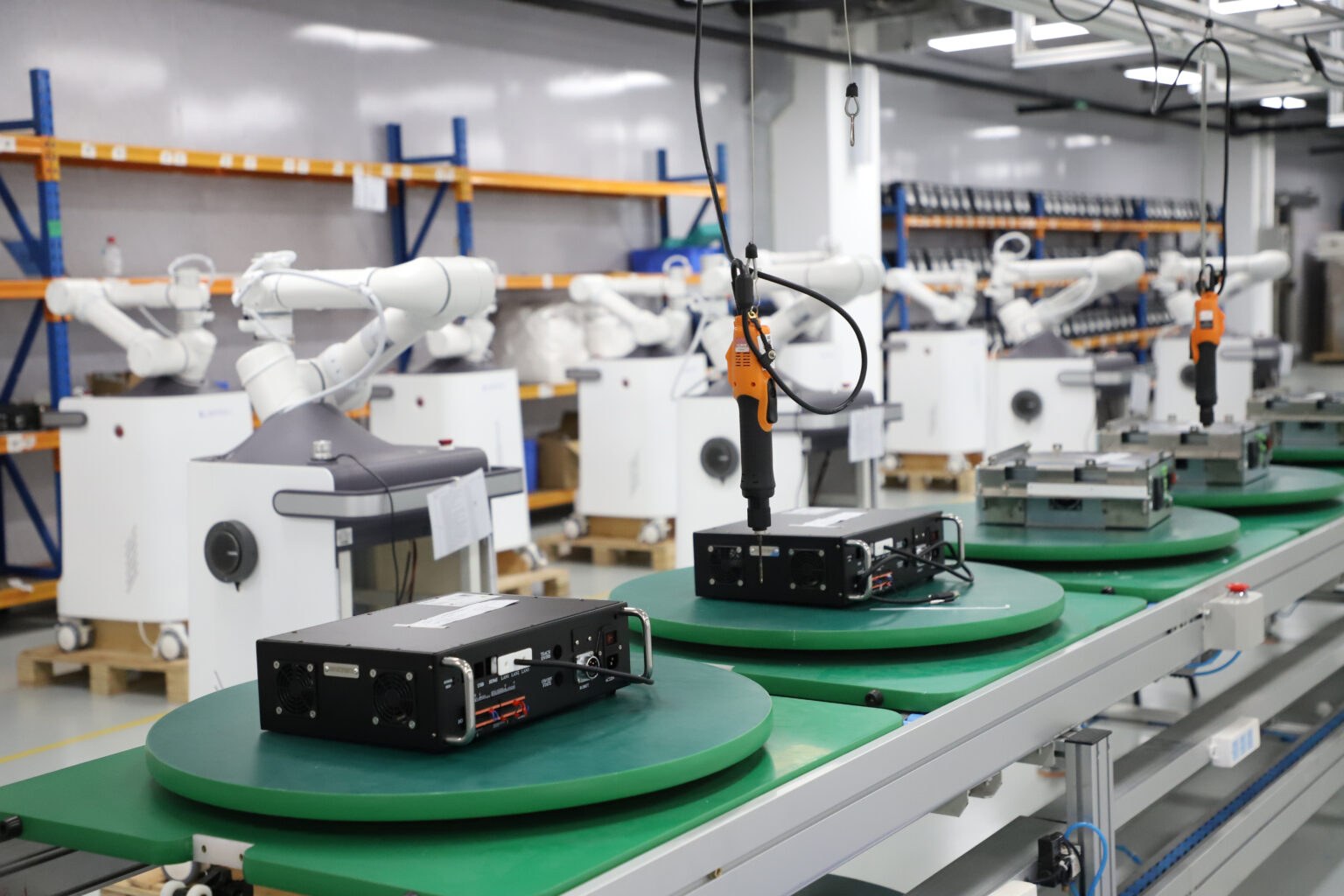
- Cover image: assembly line at an intelligent manufacturing base, photographed by Baitutai, released via Wikimedia Commons under the CC0 public-domain dedication