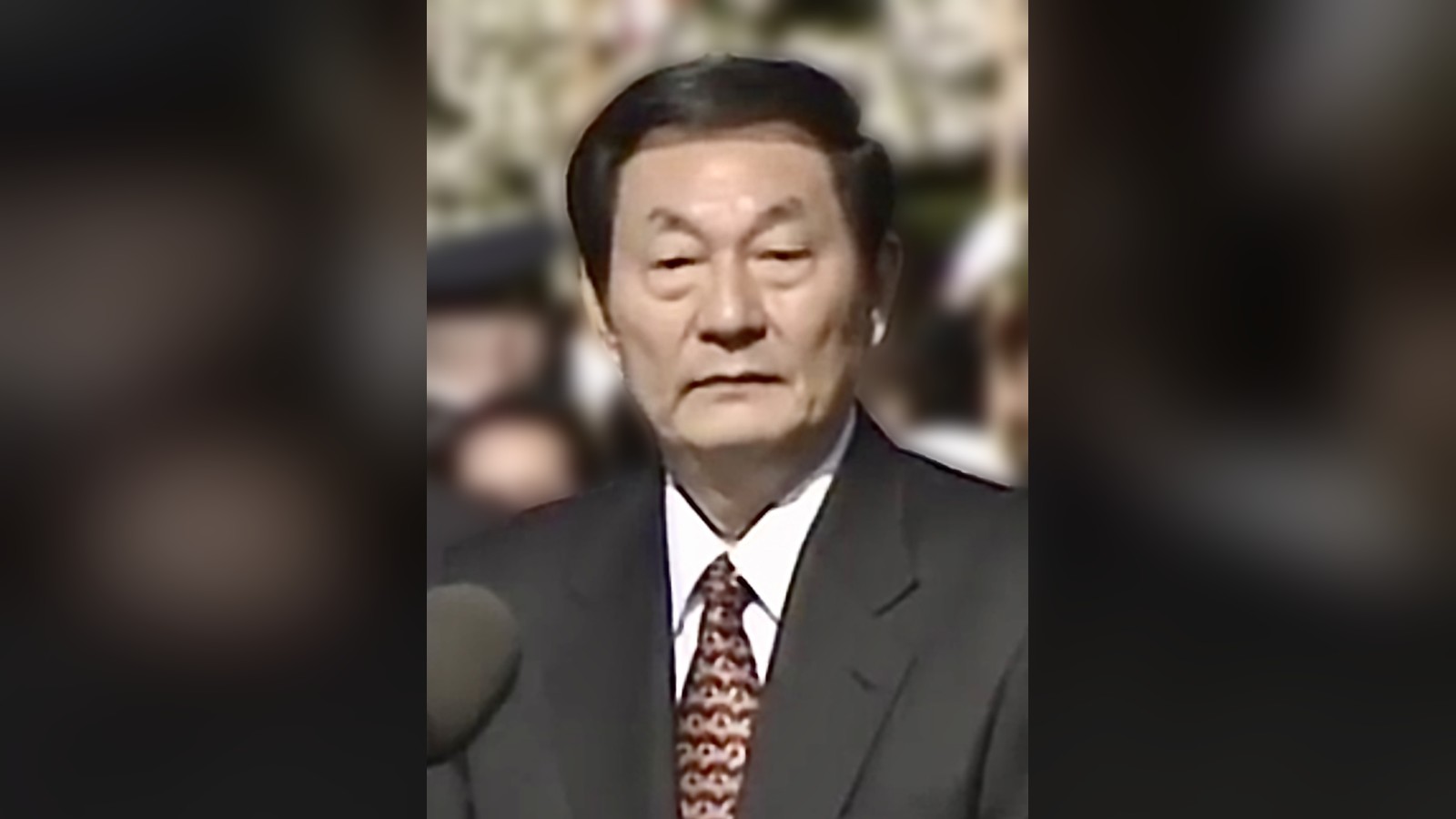

Prologue: August 12, 2026
At 11:06 a.m. on August 12, 2026, Zhu Rongji passed away in Beijing at the age of 98.
That afternoon, Xinhua News Agency was authorized to release the official obituary issued by the CPC Central Committee, the Standing Committee of the National People's Congress, the State Council, and the National Committee of the Chinese People's Political Consultative Conference. Its characterization of him read: an excellent member of the Communist Party of China, a long-tested and loyal communist fighter, an outstanding proletarian revolutionary and statesman, and an eminent leader of the Party and the state. The obituary said that his life was a life of revolution, a life of struggle, and a life of glory, and that his death was a great loss to the Party and the state. In reviewing his years presiding over the work of the State Council, the obituary mentioned the reform of the fiscal and taxation system, the reform of the financial system, and the decision to make state-owned enterprise reform the central link of economic structural reform—precisely the entries this essay will unfold.
As the news spread, tributes poured in from every direction. People's Daily Online, China News Service, and media outlets across the country republished the official obituary in full; figures from Hong Kong's political and business circles offered their condolences one after another; the obituaries in the international press, without prior agreement, all tied him to the market transformation of the Chinese economy—the Associated Press said he had "ignited China's explosive economic boom," while Bloomberg's headline called him "the Chinese premier who reshaped the economy." What flooded the Chinese internet, meanwhile, were the sentences he himself had left behind: the minefield, the incorruptible official, "Never falsify accounts."
The official obituary is short. It summarizes a statesman's life, but it does not have enough room to unfold one particular matter: the relationship between this statesman and Chinese manufacturing.
The Tianxia Gongchang Industry Research Institute has decided to do that work in one long essay. The reason is not complicated. Today, China is the country with the most complete range of industrial categories in the world, and its manufacturing value added accounts for nearly 30 percent of the global total; our platform catalogs 4.8 million real, existing factories, spread across the towns of the Yangtze River Delta, the villages of the Pearl River Delta, the county seats of North China, and the development zones of the west, taking orders, starting up machines, and shipping goods every day. The overwhelming majority of these 4.8 million factories came into being after Zhu Rongji left office in 2003. But the ground beneath their feet—the investment-attraction competition among local governments under the tax-sharing framework, a commercialized banking system, government-enterprise relations without a supervising ministry, and the ticket of admission to global markets that came with accession to the World Trade Organization—was largely poured in the sixteen years from 1987 to 2003.
In other words: these factories do not necessarily know him, but they use the institutions he left behind every day.
There is one further, methodological reason for a factory-data platform to write this essay. Industrial data is the sedimentary rock of institutions: a fiscal reform will not leave traces in the news for long, but it will leave strata in the geographic distribution of enterprise registrations over the following thirty years; a tariff adjustment will be forgotten, but the export structure it altered will settle into each year's customs declarations. The industries, regions, scales, and contact details of the 4.8 million factories we organize every day are, in essence, a survey of those strata. The man is gone; the strata remain—this is how a data institution commemorates an institutional designer: by drawing, faithfully, the landscape he changed.
Why insist on a "manufacturing perspective"? Because among the many narratives about Zhu Rongji—fiscal, financial, diplomatic, anti-corruption—manufacturing is precisely the thread that is least often examined on its own and yet strings all the other threads together. The fiscal and tax reforms landed on the factory's tax bill; the financial reforms landed on the factory's loans; the WTO negotiations landed on the factory's orders. Only by placing the factory at the center of the narrative do those sixteen years of reform reveal their full outline as a single engineering project.
Zhu Rongji was not an entrepreneur and never ran a factory; he was an official trained as an engineer, a graduate of Tsinghua's Department of Electrical Engineering who spent thirty years doing planning work inside the organs of the planned economy, and then spent the remainder of his career moving Chinese industry out of those organs. In Shanghai he drove the localization of a passenger car; in Beijing he cleared away the triangular debt that was crushing factories; he restructured the fiscal relationship between the center and the localities; he performed surgery on loss-making state-owned factories; he abolished an entire row of industrial ministries; and finally he brought Chinese manufacturing into the World Trade Organization. These undertakings were separated from one another by years and belonged to different fields—fiscal, financial, state enterprise, foreign trade—but viewed in retrospect from the perspective of industry, they are different passages of a single project: replacing the foundations beneath Chinese manufacturing.
This essay is a farewell stocktaking from an industrial perspective. The "farewell stocktaking" is a strict genre: it is not a eulogy—a eulogy does not need fifty thousand characters of data; nor is it a biography—the protagonist of a biography is a person, whereas the protagonists of this essay are institutions and factories, with the person as the thread that stitches them together. The essay is in seven parts: it begins with his formation, passes through the four years in Shanghai, the five years of taming disorder, the three years of breaking the deadlock, and the WTO negotiations, then takes stock of the institutional foundation he left behind, and finally returns to the ground of 2026—using today's industrial data to measure the load-bearing capacity of that sixteen-year project. The full text runs to roughly fifty thousand characters; appended at the end are three appendices—a chronology, notes on statistical definitions, and a verified compilation of quotations—which may be read selectively as needed.
For the youngest generation of factory owners on the industrial belts, Zhu Rongji belongs to their parents' evening news. By the time a "post-95" factory owner was born, the tax-sharing system was already in operation; by the time he entered primary school, China had already acceded to the WTO; by the time he took over the family business, the "supervising ministry" had long been a historical term. This generational distance gives this farewell a particular function: it is an opportunity to restore what is "taken for granted" to what was "hard won"—and this essay is intended to serve as the manual for that restoration.
First, a note on method. We have tried to exercise restraint, and to treat restraint as this essay's basic discipline: all data are sourced, with the National Bureau of Statistics' annual statistical communiqués, successive government work reports, and the original texts of official documents as the standard, and discrepancies of definition are itemized one by one in the appendix; quotations are drawn only from the three official compilations—Zhu Rongji Meets the Press, Zhu Rongji on the Record, and Zhu Rongji on the Record: The Shanghai Years—and from versions carried by authoritative media. The widely circulated line about "one hundred coffins," because it appears in no official documentation and its various versions contradict one another as to time and setting, is not cited as fact in this essay; and no judgment here goes beyond the characterization of the official obituary. For a departed man famed for his pragmatism, the most fitting commemoration is to set the facts in good order.
Part I: Formation (1928–1987)
Everything a man experiences before the age of sixty is preparation for the sixteen years after sixty. This part tells the story of his formation: an orphan from Hunan, an electrical engineering student at Tsinghua, a young planner at the State Planning Commission, a teacher and engineer through twenty years of vicissitudes, the director of technological transformation at the State Economic Commission. Only by understanding this path can one understand where the feel behind each of his later decisions came from.
1. Changsha, Tsinghua, Electrical Engineering
Zhu Rongji was born in October 1928 in Heping Village, Ansha Township, Changsha County, Hunan. He was a posthumous child—his father died before he was born, and his mother also died early. Many years later, in a personal account published in China Economic Weekly, a magazine of the People's Daily, he spoke of his origins this way: "I am an orphan. My parents died very early, and I never saw my father."
This beginning is not irrelevant to understanding his character. A child without the shelter of family, in Republican-era Hunan, made his way by study: entering school at seven, he attended Changsha's Chongde Primary School, Guangyi Middle School (today the High School Attached to Hunan Normal University), and Hunan Provincial Changsha No. 1 High School—one of the finest secondary schools of modern Hunan, from which large numbers of later scholars and builders emerged. For a poor student in a chaotic age there was only one narrow road: he had to win every examination at every level. In 1947 he graduated from Hunan Provincial No. 1 High School and was admitted to the Department of Electrical Engineering at Tsinghua University, majoring in electrical machinery manufacturing. In the winter of 1948, on the Tsinghua campus around the time of the siege of Beiping, he joined the China New Democratic Youth League—in an era when the White Terror had not yet lifted, a choice that required courage; in October 1949, the very month the People's Republic was founded, he joined the Communist Party of China. The official obituary dates the beginning of his revolutionary work to December 1948. For that generation of university students, the choice of personal future and the choice of national path were one and the same question: he handed in his answer at the age of twenty, and in the seventy-eight years that followed he never changed it.
His choice of major deserves a pause. In the China of 1947, civil war raged, inflation was devouring urban life, and industry had withered to the point where the word "system" scarcely applied. In such a year, a Hunan youth chose electrical machinery manufacturing—the study of saving the nation through industry, in the most literal sense. That generation of Tsinghua electrical engineering students studied from English-language textbooks while carrying Chinese questions in their heads: the country had almost no electrical machinery industry of its own—power generation, power transmission, motors, transformers, every one of them dependent on imports. Saving the nation through industry was the plainest conviction of that generation of engineering youth, and electrical engineering was then widely acknowledged as one of the "hardest to test into" and "most useful" majors. Only by understanding this starting point can one understand the almost obsessive stance on localization he would later take when facing the Santana, and facing the Three Gorges generating units—that was not a preference in industrial policy; it was the unfinished ambition of a generation.
When he graduated four years later, New China lay in ruins awaiting rebuilding, and the Northeast was the starting point of national industrialization. In 1951, at twenty-three, Zhu Rongji was assigned to the Northeast as deputy director of the production planning office of the planning department of the Northeast China Ministry of Industry—among the first generation of university graduates in New China assigned, under the plan, to posts in industrial management. The Northeast then concentrated the most complete heavy-industrial endowment in the country: Angang's steel, Fushun's coal, Shenyang's machine tools. On the spreadsheets of the production planning office, a young man fresh out of university saw for the first time what the word "industrialization" looked like in numbers.
From the first day, the base color of his career was the superimposition of two things: an engineer's training, plus a planner's position. The former kept him professionally sensitive all his life to technical detail, product quality, and cost figures; the latter allowed him, over the following thirty years, to see from the inside the full repertoire of methods by which the planned economy managed industry—and the full extent of those methods' limitations.
2. Twenty Years of Vicissitudes
In November 1952, Zhu Rongji was transferred to the State Planning Commission—by his own account, entering Beijing together with Ma Hong and An Zhiwen. There he served as a group head in the Commission's Fuel and Power Bureau and its Comprehensive Bureau, as deputy division chief in the office of the Commission's chairman and deputy chief of the comprehensive division of the Machinery Industry Planning Bureau, and as secretary to Zhang Xi, a vice chairman of the State Planning Commission. The State Planning Commission was the nerve center of the planned economy: in theory, the destination of every ton of steel, every kilowatt-hour of electricity, and every machine tool in the country had to pass through its spreadsheets. Working in his twenties at the uppermost reaches of those spreadsheets gave Zhu Rongji one thing: a sense of the whole of China's industrial endowment.
Then came setbacks that lasted twenty years. During the "Great Blooming and Contending" (daming dafang) of 1957, he spoke for a few minutes at a meeting in his work unit—by his own later account, he "spoke for only 3 minutes." In January 1958 he was wrongly labeled a "Rightist," removed from his post as deputy division chief, demoted two administrative grades, and expelled from the Party. The arrangements that followed are described in the official résumé with great calm: from 1958, teacher of mathematics, physics, and chemistry at the State Planning Commission's spare-time school for cadres; from 1962, engineer in the Commission's National Economy Comprehensive Bureau; from 1970, sent down for five years of labor at the Commission's "May 7th" cadre school; in 1975, back in Beijing as deputy office director and deputy chief engineer of the Electric Power and Communications Engineering Company under the Pipeline Bureau of the Ministry of Petroleum Industry.
Beneath the calm of those lines lie the full twenty years of a man's life from thirty to fifty. In those twenty years he taught classes, drew drawings, farmed the land at the cadre school, and managed electric power and communications projects at the pipeline engineering company. In his five years of labor at the cadre school, like countless intellectuals sent down across the country, he gave his best years to the fields; the difference is that in his own accounts he rarely dwelt on the bitterness of that experience—when foreign media asked about it at a press conference in 1998, he said only that he did not wish to recall that history, and immediately turned the conversation back to work. Putting the scars away in a drawer and keeping one's energy for the task at hand: this way of handling his personal history was of a piece with the way he handled the nation's books—look forward, and get to work first. Worth noting is the other side of this résumé: even at the lowest ebb, his posts never left industry—what he taught was mathematics, physics, and chemistry; what he worked as was an engineer; what he managed was pipelines and electric power. Planning center, grassroots enterprise, engineering site: these three perspectives completed, in him, a forced rotation.
His experience was not an isolated case. After 1957, hundreds of thousands of intellectuals across the country went through similar vicissitudes, among them large numbers of engineers, teachers, and technical managers; the rectification that followed 1978 invited many of them back to their posts. Among the technical backbones on every front in the early years of reform and opening up, these "returnees" could be seen everywhere—the twenty years they lost became, in another form, the most profound understanding of the old system. Zhu Rongji was the member of this group who went furthest.
In 1978 he was rehabilitated, his Party membership restored, and he was transferred to the Institute of Industrial Economics of the Chinese Academy of Social Sciences as head of a research office—he was fifty that year. The Institute of Industrial Economics was one of the few institutions in China then engaged in systematic reflection on the industrial management system; there, for the first time, he placed the problems he had seen over more than twenty years, inside and outside the system, into a research framework.
Later observers have often read his subsequent style of work out of these twenty years: unsparing, because he knew intimately the price of going through the motions; hating falsehood, because he had seen who pays the cost of lies. Such readings cannot be verified, and this essay will not pursue them. What can be confirmed is a plainer fact: when reform and opening up was launched in 1978 and the state once again needed people who understood industry, Zhu Rongji happened to be that rare combination—a man with complete engineering training, who had done overall dispatch at the planning center, spent time in grassroots enterprises, and systematically reflected on the planned economy in a research institute. Four kinds of experience—exactly the full set of knowledge required to dismantle the old system from within.
Here today's readers need an explanation of what "managing industry by plan" meant. Under that system, a factory's fate for the year was written on a few spreadsheets: the production plan was handed down by the ministry, raw materials were allocated by quota, products were delivered at planned prices to designated downstream users, profits were remitted in full, and losses were made up by the treasury; the factory director's task was not to face the market but to fulfill the numbers and fight for quotas. What the planning commission's cadres had to do was make these numbers mesh with one another across the country's hundreds of thousands of factories. Both the ingenuity and the absurdity of this system the young Zhu Rongji had witnessed at the front line of the spreadsheets—ingenious, in that it really could organize a destitute country into an industrial system; absurd, in that it had no mechanism whatsoever for answering the simplest of questions: does anyone actually want what this factory makes?
In March 1998, when as the newly installed Premier he was asked by foreign media about those "Rightist" years, his answer was a single sentence: he did not wish to recall that history. Yet in his 1988 acceptance speech in Shanghai, he had, unprompted, told the assembled people's congress deputies of his orphan origins and his twenty years of vicissitudes—choosing different degrees of candor for different occasions is itself a footnote to understanding him.
3. The State Economic Commission Years
After 1979, Zhu Rongji's official career made up its lost twenty years at a rare speed: division chief in the Fuel and Power Bureau and deputy director-general of the Comprehensive Bureau of the State Economic Commission; in 1982, director-general of the Technological Transformation Bureau and a member of the Commission; in 1983, Vice Chairman of the State Economic Commission and member of its Leading Party Group; in 1985, Deputy Secretary of the Leading Party Group and Executive Vice Chairman, at full ministerial rank. Six years from division chief to full ministerial rank: this speed in itself says two things—how hungry early-reform China was for cadres who understood the economy, and what reputation he left behind at every post.
The State Economic Commission managed the operation of the industrial economy and technological transformation—compared with the State Planning Commission, which managed long-term plans, the Economic Commission stood closer to the factories and closer to the products. The 1980s were precisely the early transition period of Chinese industry: the enterprise contracting system was being rolled out, dual-track prices ran in parallel, township and village enterprises (TVEs) were rising abruptly, and the old planning system and the new market forces interlocked like jagged teeth. From his seat at the Economic Commission, Zhu Rongji faced every day the concrete problems this interlocking produced—raw materials carried one price inside the plan and another outside it, so by which should a factory organize production? Once the contracted quota was fulfilled, who was responsible for renewing the equipment? These questions had no textbook answers, but the experience of handling them formed the experiential foundation of all his later judgments about reform. His work as director-general of the Technological Transformation Bureau was precisely one of the main themes of Chinese industry in the 1980s: using limited foreign exchange and funds to re-equip aging factories and raise their level. His later, almost obsessive emphasis on "technological transformation" when driving the Santana localization in Shanghai had its source in these years.
The Economic Commission years also contain a thread of work directly related to his later style: product quality. Chinese industry in the 1980s suffered from "quantity enough, quality wanting"; total quality management was being promoted in factories nationwide, and the Economic Commission was one of the main departments driving it. Quality, in his hands, was never a technical detail but the foundation of industrial credit—an understanding that ran through everything he later said and did at the Santana project, on the Jiujiang dike, and at the accounting institutes.
Two details from this period deserve the record.
First, from May 1984 he concurrently served as the founding dean of the School of Economics and Management at Tsinghua University, and he held that post for seventeen years thereafter, spanning his terms as Mayor of Shanghai, Vice Premier, and Premier. For a serving industrial-management official to go and found a management school was a novelty at the time; it reveals Zhu Rongji's judgment on one question—what Chinese industry lacked was not only equipment and foreign exchange, but the discipline of management itself. The goal he later set for the school was unequivocal: to become "the acknowledged first." Through seventeen years, however heavy his principal duties, he never laid down the dean's title; in his farewell address on stepping down he left the students two sentences—"In learning, be solid and thorough, and never fish for fame; in deeds, be just and clean, and leave no cursed name behind you"—which are now engraved in the memory of a generation of economics and management students. This judgment would run through all his later work, up to 2001, when he inscribed for the National Accounting Institute its famous motto.
Second, in the summer of 1987, as Vice Chairman of the State Economic Commission, he went to Shanghai to investigate a specific project: the localization of the Santana passenger car. In the course of that investigation he left a warning that would later be quoted again and again—Chapter 6 of this essay will return to that sentence. At this moment the project was still merely one item within his portfolio; a few months later, it would become his own battlefield. In December 1987, shortly after the close of the 13th Party Congress, Zhu Rongji was appointed Deputy Secretary of the CPC Shanghai Municipal Committee, in preparation for assuming the mayoralty of China's largest industrial city. When Yicai (China Business Network) later traced this history, it used a widely circulated phrase as its title: he was the leader Deng Xiaoping praised as one who "understands the economy."
He was fifty-nine that year. Measured by the normal rhythm of an official career, that is an age approaching the close; and every one of the publicly known great undertakings of his career had yet to begin.
Part II: Shanghai (1987–1991)
Shanghai was the proving ground for his entire method of governance. Over more than three years, he rehearsed in China's largest industrial city everything he would later scale up to the whole country: putting public finances in order, stabilizing people's livelihoods, compressing approvals, enforcing quality, building factor markets, and planning for opening up. This part unfolds along four cross-sections: a ledger, the embryos of institutions, a car, and a new district.
4. A Family Fortune of 15.3 Billion Yuan
On December 22, 1987, Zhu Rongji was appointed Deputy Secretary of the CPC Shanghai Municipal Committee; on February 6, 1988, he arrived in Shanghai to take up the post. According to an account by Yicai (China Business Network), on the afternoon of the day he arrived, the first thing he did was to go to the Shanghai Municipal Finance Bureau to hear a briefing.
This detail could almost serve as a preview of his working method over the sixteen years that followed: on taking over any portfolio, look at the books first.
The books did not look good. Shanghai's local fiscal revenue had slid steadily from 18.1 billion yuan in 1985, and the full-year figure for 1988 was projected at only about 15.3 billion yuan. Under the old fiscal system, roughly 11.9 billion of that 15.3 billion had to be remitted to the central government — a share approaching eighty percent. Shanghai was New China's most important industrial base and fiscal pillar: from 1950 to 1990, Shanghai's cumulative fiscal remittances accounted for roughly one-sixth of central fiscal revenue — a rounded figure carried by multiple sources; the precise accounting resides in the Shanghai Finance and Taxation Gazetteer, but the order of magnitude is not in dispute. Take 1983 as an example: Shanghai's fiscal revenue that year was 15.6 billion yuan, of which 13.1 billion was remitted. The problem was that after decades of high-intensity remittance, the city's own industrial equipment had aged, its infrastructure was deep in arrears, and workers' housing was dire — per capita living space stood at only 2 to 3 square meters. Unless the fiscal straitjacket was loosened, Shanghai could do nothing.
Around the time Zhu took office, a turning point arrived. On February 21, 1988, the State Council approved in principle a fiscal arrangement for Shanghai of "contracting on a fixed base, set for five years": with the 1987 actual revenue of 16.5 billion yuan as the base, Shanghai would remit a fixed 10.5 billion yuan to the center each year from 1988 to 1992; for the first three years, all revenue above the base would stay with Shanghai, and from 1991 onward any amount exceeding 16.5 billion would be split fifty-fifty with the center. At the time, Guangdong and Shanghai were the only provincial-level jurisdictions in the country under fiscal contracting. This contract gave Shanghai breathing room, and gave the new mayor capital to work with. The institutional backdrop is worth remembering: five years later, it was the 1994 tax-sharing reform, driven by Zhu Rongji himself, that terminated the entire fiscal-contracting system — this contract included. No one understood better than he did what contracting did for a locality, and no one understood better what it cost the center.
On April 25, 1988, Zhu Rongji was elected Mayor at the First Session of the Ninth Shanghai Municipal People's Congress. His policy address before the vote ran about one hundred minutes, delivered without a script, and in it he spoke — rarely, and of his own accord — about his orphaned childhood and the twenty years that followed his being labeled a Rightist. The core pledge of the speech: "If I am elected mayor, I am determined to make the next municipal government a clean, highly efficient government that serves the people wholeheartedly." He proposed to "start first with the small things," and vowed "to resolutely stamp out the culture of wining, dining, and gift-taking." The first executive meeting of the municipal government after he took office laid down rules requiring plain and frugal conduct of officials at bureau level and above; he announced, "It starts with me, and with the municipal government." For official meals on grassroots visits, "one dish and one soup must be adhered to, no matter what." He set himself the "five don'ts" — no newspaper coverage, no television appearances, no ribbon-cuttings, no calligraphic inscriptions, no gifts. He said he would keep the city's bureau-level officials in line — at first the formulation was managing the "506 bureau chiefs," later broadened to more than two thousand bureau-level officials. On the creeping culture of gifts and banquets, his written instruction pulled no punches: "This tendency must not be allowed to grow. If verified, 'execute' one to warn a hundred." In another written comment he left nine blunter characters: "Alas, Shanghai — without reform, it is finished."
Anchoring discipline in personnel, and speaking the sense of crisis out loud — as an opening act this was an anomaly in the officialdom of the day, yet it cleared the obstacles to execution for every reform that followed. Anyone can draft a reform plan; what carries a plan through the bureaucracy and onto the ground is always discipline and accountability.
Governance began in the most everyday of places. The new government made the city's non-staple food supply its breakthrough point, announcing in a televised address the construction of the "vegetable basket" program, which used integrated production–supply–marketing chains to stabilize the supply of vegetables, meat, poultry, eggs, milk, and fish. In an industrial city of over ten million people, the mayor's first hard battle was to keep residents' dinner tables stable — of a piece with his later work at the national level on grain circulation and on the "rice bag" and "vegetable basket": if the basic ground of people's livelihood cannot be held steady, no reform has any social space.
The significance of the "vegetable basket" must be read back into the price environment of 1988: that year, nationwide inflation hit its highest level since the start of reform and opening up, panic buying and hoarding spread through the major cities, and non-staple food prices were the thermometer residents felt most directly. Taking over Shanghai in such a year, stabilizing vegetable prices was not a decorative livelihood gesture but the precondition of the entire administration — residents' trust in the new mayor was accumulated in the vegetable markets, jin by jin, liang by liang.
The above-base retention won through fiscal contracting was indeed spent where it counted: the vegetable basket, housing, bridges, the metro — the arrears Shanghai had accumulated over decades began, in these years, to be worked off in batches. The five-year contract was like a two-way wager: the center bet that Shanghai could collect above the base; Shanghai bet that it dared to spend. The outcome was a win for both — Shanghai's fiscal revenue stopped falling and rebounded within the contract period, the city's face visibly changed, and the center received its stable quota of 10.5 billion. The very success of this contract, in turn, planted the seed of its own termination: contracting was too favorable to prosperous regions, and extending it nationwide could only accelerate the bleeding of central finances — a paradox that Zhu Rongji himself untied five years later with the tax-sharing system.
For manufacturing, the most important reform of this period came in foreign-investment approval. Previously, for a foreign investor to place a project in Shanghai required 126 seals and the rounds of dozens of commissions, offices, and bureaus, routinely taking a year or two. On June 10, 1988, the Shanghai Municipal Foreign Investment Commission was established, operating on the principle of "one agency, one window, one seal"; Zhu Rongji personally served concurrently as director of the commission, with Vice Mayor Huang Ju as deputy director. Compressing 126 seals into 1 was radical administrative reform in the China of 1988; the logic behind it — government process yielding to the investor's time — would be replicated again and again over the following three decades by development-zone administrative committees across the country, becoming a standard move in China's investment-promotion repertoire. The "one-stop service hall" of any county-level development zone today traces its lineage back to that single seal of 1988.
5. Embryos of the Factor Markets
In the breathing space bought by fiscal contracting, Shanghai began to grow a set of organs that no Chinese city had possessed before. In hindsight, nearly every one of the experiments conducted in Shanghai in those years became the embryo of a later nationwide institution.
Housing was the first. Facing a per capita living space of 2 to 3 square meters, Zhu Rongji publicly pledged to "basically solve the housing problem of the people of Shanghai within ten years." Where would the money come from? Shanghai was the first in the country to explore two methods: one was the housing provident fund — drawing on Singapore's experience, with employees and employers contributing jointly to funds earmarked exclusively for housing; the other was the issuance of housing-construction bonds. The provident fund, a Shanghai experiment, was adopted outright seven years later by the 1998 housing reform, and remains to this day one of the pillar institutions of Chinese housing finance.
The capital market was the second. On November 26, 1990, the Shanghai Stock Exchange was founded — the first stock exchange of New China. The stocks listed at its opening were few enough to count, later known among market veterans as the "Old Eight"; the trading floor was set up in the Pujiang Hotel, with red-vested clerks matching orders by hand. By today's standards it looks almost laboratory-crude, but a principle was established from that moment: enterprises could raise capital openly from society. In the thirty-odd years since, thousands of manufacturing enterprises have completed financing, restructuring, and expansion through this market — from textile mills to chip plants, the relationship between Chinese factories and the capital market begins in Shanghai, in the winter of 1990.
Infrastructure was the third. The Nanpu Bridge and Metro Line 1 were both launched in this period — the former the first bridge across the Huangpu River within the urban district, the latter Shanghai's first metro line. For an industrial city that had for decades "stressed production and slighted infrastructure," these projects were at once a repayment of arrears and a skeleton laid in advance for the development of Pudong.
Set these items side by side and a clear governing philosophy emerges: every move that solved an immediate problem was simultaneously building a long-term institution. The vegetable basket stabilized livelihoods while rehearsing a circulation system; the provident fund solved housing while creating housing finance; the stock exchange raised capital while establishing the capital market; the "one seal" attracted investment while reshaping government process. What Zhu Rongji's three-plus years in Shanghai left behind was less a list of achievements than a set of replicable institutional prototypes — the nationwide reforms that came later repeatedly drew directly on Shanghai's blueprints.
6. The Santana Localization Community
If one had to choose the purest "manufacturing event" in Zhu Rongji's career, it would be the localization of the Santana.
The background needs a few sentences. In 1982, the Chinese and German sides signed the agreement for trial production of the Santana sedan; in 1984, the joint-venture contract was signed; in 1985, Shanghai Volkswagen Automotive Co., Ltd. was formally established. The sedans were indeed being assembled, but the parts were almost entirely imported knock-down kits. By 1987, measured by the whole-vehicle localization rate, the Santana's localization stood at only 2.7% — the domestically made content amounted to four items: the tires, the horn, the antenna, and the badge. Even by the looser "horizontal supporting-industry" measure, it was only 12.7%. The two figures rest on different yardsticks, but they point to the same fact: China at the time could not build the body of a modern sedan — only its shoes and its voice.
Imported kits consumed foreign exchange, and foreign exchange was precisely the scarcest resource in 1980s China — the so-called domestic sedan was, in reality, precious foreign exchange being used to assemble German parts. This is the origin of the famous warning of 1987. That summer, Zhu Rongji, then Deputy Director of the State Economic Commission, traveled to Shanghai on an inspection visit; the words he left behind, as verified by Party-history research articles, were: "If the localization rate does not reach 40% within three years, Shanghai Volkswagen will be shut down and wound up." A few months later he was transferred to Shanghai, and the project passed from being part of his portfolio to being part of his jurisdiction.
On December 24, 1987 — just two days after his appointment as Deputy Secretary of the Shanghai Municipal Party Committee — he delivered a report titled "Push the Localization of the Santana Sedan Forward" at the Shanghai working conference on Santana localization (he formally arrived in Shanghai the following February; this report was his "opening gift" to the city). Zhu Rongji on the Record: The Shanghai Years, published in 2013, places this report first in the entire volume — the editors' intent self-evident. The report drew a quality red line: no makeshift substitutes ("guacaidai") — a word carried over from the memory of the years of hardship, when melons and vegetables stood in for grain; it meant that localization would never be allowed to pass off the inferior as acceptable, or to smuggle in Chinese standards in place of Volkswagen's German ones. He put it even more bluntly: "Every product in the Santana localization program must be 100% qualified; we will not accept even 1% less." And he publicly staked his own position on it: if the Santana was not localized within three years, he would take the blame before the central leadership.
Organizational innovation followed at once. At the end of 1987, on his initiative, the Santana Localization Community was founded — a consortium organizing parts supply on a national scale; beyond Shanghai's own enterprises, 121 units from Nanjing, Baoding, Wuxi, Guizhou, and elsewhere successively entered the Santana supply chain. The way the community operated was entirely new for its time: tasks were not apportioned by administrative subordination; instead, enterprises with real foundations were selected by parts category and certified against Volkswagen's original factory standards — and whoever failed certification, whatever their rank or backing, was kept off the supplier list. From 1988, a surcharge of 28,000 yuan on the price of each Santana funded a "localization fund," dedicated to subsidizing the technical upgrading of domestic parts makers (this figure follows the media's accounting). No slack on quality, real money on the table, and organizational barriers broken — a three-pronged approach.
For the factories that entered the community, this was a transformation from the bone outward. Supplying the Santana meant a first encounter with the full severity of German industrial standards: material batches had to be traceable, dimensional tolerances were measured in hundredths of a millimeter, and test reports had to withstand review by the German side. Many auto-parts enterprises that would later command the industry first learned how high the threshold of "modern manufacturing" stood when they faced the Santana certification list.
The results were clear. In 1991, the Santana's localization rate reached 70% (the precise figure in Party-history research articles is a "kit-reduction localization rate" of 70.37%); qualified suppliers grew from 1 in 1986 to 127 in 1991. Shanghai Volkswagen ranked for the following three decades among China's largest passenger-car makers, and its entire original endowment was this localization supply chain forced into existence. The Santana went on to be, for years, China's highest-volume sedan — on Chinese streets in the 1990s, among the taxis, official cars, and private cars, a considerable share of every ten wore the same face; the advertising line "Own a Santana, and fear no road under heaven" became the memory of a generation. And the parts enterprises that grew up around it formed the first-generation backbone of the Yangtze River Delta's automotive supply chain: from Jiading in Shanghai to Taicang in Jiangsu and Pinghu in Zhejiang, the first modern auto-parts factories settled along the Santana's supply radius, and the later localization drives of Volkswagen and GM — and later still the supply chains of the domestic brands and the new EV entrants — all grew layer upon layer on top of this base map.
From the standpoint of industrial history, the significance of the Santana Localization Community exceeds any single model of car. It was China's first organized, full-scale rehearsal of a playbook later proven extraordinarily effective:
- use a finished-product program as the tractor, forcing the upstream supplier system to grow;
- lay down hard quality red lines to set the rules — better to slow the schedule than to lower the standard;
- use cross-regional organizational coordination to break administrative compartmentalization, so that supplier enterprises organize along industrial logic rather than administrative subordination;
- use a price mechanism (the localization fund) to transfuse funds into suppliers' technical upgrading.
More than three decades later, the growth path of China's new-energy-vehicle industry chain — vehicle makers pulling along battery, motor, and electronic-control suppliers; suppliers clustering their plants around the anchor manufacturers — descends in a direct line from that playbook. Behind the harsh words of 1987 — "shut down and wound up" — lay a judgment verified again and again ever since: final assembly by itself does not constitute industrial capability; the supply chain does.
7. Pudong
The gestation of Pudong's development predates Zhu Rongji's tenure at the helm: in 1984, the State Council and the Shanghai municipal government had already put forward the concept of developing Pudong; in 1986, Shanghai produced a preliminary plan. In early 1990, Zhu Rongji, then Secretary of the Shanghai Municipal Party Committee, presented the strategic vision of developing Pudong to Deng Xiaoping in person, and won his attention and support. Deng's words, as recorded in Party-history materials, are widely known: "Taking hold of Shanghai is itself a major measure. Shanghai is our trump card; getting Shanghai going is a shortcut."
The tempo thereafter was fast. The State Council dispatched delegations under Yao Yilin and then Zou Jiahua to Shanghai for inspection and feasibility work — from March 29 to April 7, 1990, Zhu Rongji briefed Yao Yilin's delegation on the plan in successive sessions. On April 18, 1990, Premier Li Peng of the State Council attended the fifth-anniversary celebration of Shanghai Volkswagen Automotive Co., Ltd. and, on behalf of the Party Central Committee and the State Council, announced approval for Shanghai to accelerate the development of the Pudong area. That the announcement was staged in a joint-venture car factory reads, in retrospect, as richly meaningful: one of China's most consequential opening-up decisions was declared standing on a manufacturing shop floor.
The Pudong story that followed is familiar: Lujiazui grew from farmland and warehouses into the skyline of a financial city; Waigaoqiao became the country's first bonded zone; Zhangjiang raised clusters of chipmaking and biopharmaceuticals out of open fields. All of this happened after Zhu Rongji left Shanghai, but the positioning on the blueprint was settled with his participation while in office. Zhu's positioning of Pudong is found in Zhu Rongji on the Record: The Shanghai Years: "Developing Pudong is the hope of building a 'new Shanghai,'" with the goal of "making the city of Shanghai as a whole the nation's largest center of economy, trade, science and technology, finance, and information." Note the wording of this positioning — he did not describe Pudong as yet another industrial zone. In his conception, Shanghai was to be rewritten from a purely industrial city into a factor hub supplying finance, trade, and information services to the nation's industry. Over the following three decades, manufacturing's share of Shanghai's economy declined steadily while the total manufacturing output of the Yangtze Delta hinterland kept rising — two curves that together form a structure of division of labor: Shanghai runs the factor markets, the hinterland runs the factories. The outline of that structure was already drawn on the blueprint in 1990.
Pudong's place on the national map of opening up also needs a sentence of positioning: in the 1980s, the main stage of opening was in the south — the four special economic zones plus the fourteen open coastal cities. The launch of Pudong in 1990 moved the center of gravity of opening from experimental zones into the city carrying the greatest weight in China's economy, and the message it announced was unmistakable: opening up was no longer local piloting, but the national line. The entire hinterland of the Yangtze basin, from then on, had its own leading gateway to the sea.
Looking back on those three-plus years in Shanghai, there is a further layer of meaning in the personnel decision. Entrusting him with the hardest industrial city was itself a great examination: Shanghai was the place with the heaviest planned-economy burdens, the largest fiscal contribution, and the highest social expectations; only someone who could simultaneously hold steady the city's livelihoods, finances, and reform tempo there would be qualified to move the pieces on the national board. The answers he handed in — the fiscal decline reversed, vegetable prices stabilized, the Santana localized, Pudong launched — left the examination's verdict beyond doubt.
The export of the Shanghai experience did not travel north with him alone. The "one seal" was studied and adopted wholesale by development zones across the country; the provident fund was written into the nationwide housing-reform plan seven years later; the "vegetable basket" program became a national policy term; the playbook of the Santana community entered the toolbox of industrial policy — those three-plus years in Shanghai, in effect, prefabricated the components for the whole of China's reforms in the 1990s.
In April 1991, Zhu Rongji was transferred to the post of Vice Premier of the State Council, serving concurrently as Director and Party Secretary of the State Council Production Office, in charge of industrial production; the following year, the Production Office was expanded into the State Council Office of Economic and Trade, and he continued as its director. From Mayor of Shanghai to the Vice Premier overseeing the nation's industrial operations, every play he had drilled in Shanghai — reading the books, enforcing quality, breaking down compartmentalization, laying down rules — was about to be restaged on a stage thirty times larger. And at that very moment, the nation's industry lay mired in a web of debts owed back and forth among enterprises.
Part III: Taming the Chaos (1991–1996)
From 1991 to 1996, the Chinese economy passed through a complete cycle of disorder, discipline, and institution-building: triangular debt froze industry solid, overheating burned through the price level, then came the emergency braking of the Sixteen Measures — and finally 1994, the foundational year, when the tax-sharing reform, exchange-rate unification, and export tax rebates all took effect on the same day. This part has the highest institutional density of the entire essay: the fiscal and price foundations on which Chinese manufacturing runs today were almost entirely poured in these five years.
8. Triangular Debt: Unfreezing Industry
Chinese industry in 1991 was trapped in a web of mutual arrears. Factory A owed Factory B for goods; B owed C for materials; C in turn owed A for equipment — the chain looped back on itself, no one could collect, and no one paid. This was "triangular debt." By June 1991, the cumulative stock of triangular debt nationwide stood at roughly 300 billion yuan. For perspective, the country's entire fiscal revenue that year was itself only a little over 300 billion yuan — the debt frozen inside the industrial system was on the same order as a full year of state revenue.
For a factory, triangular debt meant something very concrete: goods shipped, payment never received; profit on the books, no cash in hand; raw materials bought on credit, wages paid with borrowed money. Enterprises whose accounting statements looked perfectly normal had long since suffered a ruptured cash flow. Picture the position of a mid-sized machinery plant in 1991: it had supplied equipment for a province's infrastructure project for a full year without receiving a single fen of the contract payment; it owed the steel mill for materials, and as the mill pressed for payment it could only buy on further credit; at month's end, wages were paid out of the bank's "stability and unity loans" — special loans banks issued in those years to keep enterprise payrolls stable, a name that announced their nature: not commercial credit, but an advance on social stability. Scenes like this were the common reality of the time, not extreme outliers. The circulation of blood through the entire industrial system had frozen, and the ice kept thickening — every enterprise that was owed money could only, in turn, default on someone else; arrears propagated link by link along the chain, reproducing themselves. Administrative fiat was completely powerless before this web: order whom to pay first? That firm was itself a creditor.
Zhu Rongji, who had taken office as Vice Premier in April 1991, inherited as his first nationwide campaign the clearing of triangular debt. From August 31 to September 3, 1991, the State Council convened a national work conference in Beijing on clearing triangular debt. In his speech on September 3, Zhu delivered his diagnosis of the root cause: the principal source of triangular debt was that ministries, localities, and enterprises, chasing output value and speed, had blindly launched construction projects; the funding gap in fixed-asset investment was severe, generating arrears owed to manufacturers for equipment and materials and to construction firms for project payments. The diagnosis dictated the method: not to snip at random in the middle of the debt web, but to "start from the source — arrears in fixed-asset investment — and unwind the debt chain link by link."
The method was piloted first in the Northeast. Zhu went in person to Liaoning to take command: in 26 days, 12.5 billion yuan of arrears were cleared. The pilot validated a critical leverage effect — banks injecting seed funds into the source projects, with payments then transferred down the debt chain in sequence. In his September speech that year he cited the pilot's measured results: "one yuan injected can clear three to five yuan," and the Northeast had already achieved one yuan clearing three. On the strength of the pilot, the State Council deployed the clearance nationwide: a planned injection of 23 billion yuan in bank loans, plus 11 billion yuan raised by localities.
The clearance then rolled out across the country. Over 1991 and 1992, a total of 55.5 billion yuan in clearance funds was injected nationwide (52 billion yuan in bank loans, 3.5 billion yuan raised by localities and enterprises), clearing a combined 219 billion yuan in fixed-asset investment and working-capital arrears — 136 billion yuan cleared in 1991 and 83 billion yuan in 1992 — a leverage ratio of roughly 1 to 4. By May 1992, 4,283 fixed-asset investment projects had been cleared nationwide.
Seen with today's eyes, this was a textbook resolution of a debt chain: find the source, inject liquidity, settle in chain order, and at the same time strictly control new project starts to prevent new arrears accumulating even as old ones were cleared. More than three decades later, when "overdue payments to enterprises" once again became a policy issue, the 1991 methodology was still being cited again and again. But its more lasting significance lay in exposing the lesion itself — so long as the systemic roots of the investment impulse remained, triangular debt would return after every clearing. Zhu harbored no illusions on this point; two years later, when overheating on a far larger scale arrived, what he operated on was no longer the debt chain but the three source institutions of money, fiscal revenue, and the exchange rate.
9. 1992: Legitimizing the Direction
In the middle of this narrative of taming chaos, the year 1992 must be inserted — without it, nothing that follows can be explained.
In early 1992, Deng Xiaoping toured Wuchang, Shenzhen, Zhuhai, Shanghai, and other cities, delivering his southern tour remarks and settling with one stroke the "socialist or capitalist" dispute that had haunted reform for more than a decade. In October of the same year, the 14th Party Congress (1992) formally established the socialist market economy as the goal of reform — the first time the words "market economy" were written into the goal formulation of a Party congress report. With the direction fixed, all the scattered local experiments that had come before now shared a common coordinate system. It was also at the First Plenum of the 14th Central Committee that Zhu Rongji was elected a member of the Politburo Standing Committee, entering the Party's highest decision-making body and taking charge of the State Council's day-to-day work — an "economics vice premier" seated on the Standing Committee. For the next decade, China's economic reforms would bear his touch.
For manufacturing, the legitimation of direction paid off immediately. Township and village enterprises (TVEs) and private factories no longer had to invent justifications for themselves in the crevice between "socialist" and "capitalist"; the workshops of southern Jiangsu, Wenzhou, and the Pearl River Delta ran at full throttle. Expansion plans shelved in prior years out of policy caution were released en masse in 1992. Foreign investors' doubts dissolved in step: from 1992 onward foreign capital poured in at multiplying rates, and joint-venture factories carpeted the coast — many of the foreign- and Taiwan-invested plants that would later form the backbone of China's electronics and light-industry exports were established between 1992 and 1995. Local governments threw themselves into investment promotion — and, of course, also let loose the overheating of the next chapter. The year also left behind a cohort of entrepreneurs later named for it: the "Class of '92" — after the southern tour remarks, a wave of government officials and intellectuals resigned their posts to start businesses, and more than a few later became leading entrepreneurs in their industries. The floodgate of talent between the state system and the market opened, for the first time in earnest, in 1992.
1992 was a watershed: before it, reform was "let's try and see"; after it, reform was "how do we do it." The whole of Zhu Rongji's work over the next five years — the Sixteen Measures, the tax-sharing reform, exchange-rate unification — was an answer to "how do we do it": a market economy is not laissez-faire; it needs a central bank, a unified tax system, a real exchange rate — an entire apparatus of macro institutions that China had never possessed.
Even as it established the market-economy goal, the report of the 14th Party Congress also pointed the way for state-owned enterprises: transform their operating mechanisms and build a modern enterprise system suited to the demands of a market economy. From 1994, over a hundred large and medium-sized state-owned enterprises began piloting the modern enterprise system, and the Company Law took effect the same year — "company," the word that would come to dominate Chinese commercial language, acquired its legal status in that year. This directional sentence of 1992 became a complete construction blueprint at the Fourth Plenum of the 15th CPC Central Committee (1999) — everything in Part IV of this essay traces its legal genealogy to this point.
Later historians grew accustomed to telling the directional decision of 1992 and the institutional foundation-laying of 1994 as one story: the former answered "should there be a market economy," the latter answered "what makes a market economy run." The direction was set collectively by the central leadership; on the institutional construction drawings, the signature that appears most often is Zhu Rongji's.
10. 1993: Overheating and the Sixteen Measures
After 1992, the Chinese economy heated up in a manner that slipped out of control. GDP grew 14.2% in 1992, with fixed-asset investment across society surging 44.4%; in 1993 GDP grew 13.4%, and fixed-asset investment reached 1,182.9 billion yuan, its growth rate climbing further to 50.6%. Money gushed out of the banking system through irregular interbank borrowing and unauthorized fund-raising, and it flowed to two destinations: development zones and real estate.
The numbers suffice to convey the frenzy. The count of development zones nationwide was 117 in 1991, became 1,951 in 1992, and reached more than 8,700 in 1993 (this series as compiled by Leju Finance) — a seventy-fold expansion in two years, the vast majority of them "development zones" that had enclosed land but could neither build roads nor attract a single factory. Investment in commercial housing construction nationwide reached 113.8 billion yuan in 1993, up 124.9% year on year. Land prices in Hainan were bid up from a few hundred thousand yuan per mu in 1991 to more than 6 million yuan by 1993; when the bubble burst it left behind more than 600 unfinished buildings and over 16 million square meters of idle construction — "Tianya, Haijiao, lanweilou" ("the ends of the earth, the corners of the sea, and the unfinished towers") became the memory of a generation. Prices rose in tandem: in 1993 retail prices climbed 13.0%, the cost of living for residents rose 14.7%, and in 35 large and medium-sized cities it reached 19.6%; by 1994, national CPI inflation hit 24.1%, the highest since the start of reform and opening.
For manufacturing, an overheated economy is a slow-acting poison. Raw-material prices rose in successive waves, capital was siphoned off into development zones and property, and factories in the real economy could find no loans; once inflation expectations harden, every long-horizon investment calculation is distorted. The more insidious damage lay on the distribution side: inflation is a hidden tax on savers and wage earners, and around 1993 waves of panic buying returned as social tempers stretched taut. Taming inflation was, in essence, a fight to win back capital and a workable price environment for the factories — and to preserve the social consensus behind reform itself.
The treatment came in two steps. First, tie off the sack: on April 28, 1993, the State Council issued a notice imposing strict approval and clean-up on development zones of every kind, pulling approval authority up to just two levels, the State Council and the provinces — the loophole of counties and townships approving their own development zones was sewn shut outright. Second, move on the whole board: on June 24, 1993, the CPC Central Committee and the State Council issued the Opinions on the Current Economic Situation and Strengthening Macro-Control — the famous Sixteen Measures. The list read almost item for item against the sources of the disorder:
- Strictly control currency issuance and stabilize the financial situation;
- Resolutely rectify irregular interbank borrowing and recall the funds within set deadlines;
- Apply the interest-rate lever flexibly to increase savings deposits;
- Resolutely stop unauthorized fund-raising in all its forms;
- Strictly control the aggregate scale of credit and strengthen the central bank's capacity for macro-control;
- Improve foreign-exchange administration and stabilize prices in the foreign-exchange market;
- Strengthen macro-management of the real-estate market, review and queue projects under construction, and strictly control new project starts.
Simultaneous with the Sixteen Measures came a highly unconventional personnel arrangement: in mid-1993, Zhu Rongji, while serving as Vice Premier, concurrently took the governorship of the People's Bank of China — seating himself directly at the controls of money issuance, and staying there for two years. From July to September 1993, the People's Bank mounted a concentrated rectification of illegal interbank borrowing, and the most chaotic segment of the funding chain was forced back into place. For a sitting Vice Premier to run the central bank in person was an arrangement of extreme rarity in the reform era; the message it sent was blunt — this time, in the fight against inflation, the center had handed the monetary sluice gate to the man least afraid of making enemies.
The Sixteen Measures were executed with dispatch: projects under construction were queued for review nationwide, halted where they should be halted, deferred where they should be deferred; irregularly borrowed funds were recalled on deadline, and a number of rule-breakers inside the financial system were disciplined; the openings for unauthorized fund-raising were sealed one by one. In the second half of 1993, China was a landscape of construction sites that had suddenly fallen silent.
The tightening hurt. Hainan's bubble burst, countless "development zones" went to weeds, and a raft of projects stacked on borrowed interbank money stopped dead. But from 1994 onward the pace of price increases fell year after year, paving the way for the soft landing three years later. More important, the rectification of 1993 cleared the operating table for a far deeper institutional surgery — if the Sixteen Measures treated the disorder, the tax-sharing reform that followed treated the disorder's root.
11. The Tax-Sharing Reform: Setting the Price of Local Investment Promotion for Thirty Years
If only one item on Zhu Rongji's reform list could be kept, the one with the deepest imprint on today's map of Chinese manufacturing would very likely be the 1994 tax-sharing reform.
Look first at the ledger before the reform. Under the fiscal contracting system of the 1980s, local economies grew fast, but the central government's purse deflated at a visible rate. Two curves fell together: fiscal revenue as a share of GDP dropped from 23% in 1984 to 13% in 1992; the central government's share of national fiscal revenue dropped from 41% in 1984 to 28% in 1992, and further to 22% in 1993. Of China's 30-odd provinces, autonomous regions, and municipalities, only a dozen or so were remitting money to the center under their contracts; the rest were asking the center for money. At the most humiliating point, the central treasury lived on overdrafts from the banking system — Zhu later disclosed that before 1993 the center drew roughly 20 billion yuan a year in uncompensated overdrafts from the banks to plug its deficit, and, to keep spending going, had even borrowed tens of billions of yuan from the banks in advance as a reserve for payments. A central government that had to borrow to meet its own payroll could not speak of any capacity for macro-control. On July 23, 1993, at the national fiscal work conference, Zhu Rongji explained the tax-sharing plan to the country for the first time and laid the problem bare: on the current course, the central treasury would soon be unable to carry on.
The skeleton of the plan was clear: divide taxes into central, local, and shared categories, with the largest tax, VAT, split between center and localities at 75:25; establish two separate collection systems, national and local, so that the center's money would be collected by the center's own apparatus and no longer pass through local hands — for which purpose a nationwide national-tax administration was assembled from scratch in remarkably little time, with hundreds of thousands of tax officials divided in two (the two systems ran in parallel for twenty-four years, until national and local tax administrations were re-merged in 2018 — by which time the fiscal architecture of tax-sharing had long since solidified, and merging collection was merely the ripened fruit); once the center had the money, it would return a verified base amount to each locality, guaranteeing that no locality's existing take would be diminished. "Base-figure rebates" were the political lubricant of the entire scheme — the reform confiscated no stock; it only redistributed the increment. The new tax system rolled out alongside tax-sharing established VAT as the mainstay of turnover taxation — and for manufacturing, the deeper meaning of this design lay here: VAT is levied on value added, with credits offsetting at every link, so it naturally rewards specialization and outsourcing and punishes the self-contained "big and complete" plant. Over the following three decades, as Chinese manufacturing evolved toward specialized division of labor and supply-chain collaboration, the tax system was quietly pushing in the same direction.
The plan was clear; the hard part was getting the wealthy provinces to accept it. From September 9 to November 21, 1993, Zhu Rongji led a delegation of more than 60 officials from the fiscal, tax, and system-reform agencies on a 10-stop tour of 17 provinces, autonomous regions, and municipalities, lasting over 70 days — settling accounts province by province, negotiating province by province. The journey had no precedent in China's fiscal history: a member of the Politburo Standing Committee, the vice premier in charge of the economy, carrying the Ministry of Finance's ledgers from province to province to "haggle."
The pivotal stop was Guangdong. Guangdong was the biggest beneficiary of fiscal contracting, and it feared that losing the contract system would drag down its goal of "catching up with the four Asian Tigers within 20 years." Xie Fei, then Party secretary of Guangdong, proposed that the base year for tax rebates be 1993 rather than the 1992 favored by the Ministry of Finance — 1993's revenue was higher, and the higher the base, the larger Guangdong's rebates ever after. Zhu weighed it and conceded on the spot. His words were: "I would rather yield to you on the question of taking 1993 as the base year, so that the localities agree to change the system; when the increment comes later, I will take the lion's share." The base could be conceded; the ratio could not — he insisted that the VAT split "must adhere to a single nationwide ratio," for otherwise "it would be no different from contracting." Those two sentences summarize the grammar of the entire negotiation: trade on the stock, concede nothing on the rules.
On January 1, 1994, the tax-sharing system took effect. The results were immediate: in its first month, the new tax system collected 50 billion yuan; over the full year 1994, central fiscal revenue grew 203% over the previous year; the central share of national fiscal revenue leapt from 22% in 1993 to 55.7% in 1994, and stayed above half for the long run thereafter. The central government had taken back the fiscal foundation of macro-control — every subsequent regional strategy, transfer payment, and major project has rested on that share as its premise. Without the tax-sharing reform there would have been no 660 billion yuan of treasury bonds for the proactive fiscal policy a few years later, no large-scale transfer payments to the central and western regions, and no possibility whatever of concentrating resources to accomplish big things. Every later instance of the Chinese economy moving "as one national chessboard" was played on the board laid down in this one year.
But what this essay cares about more is how the tax-sharing system shaped the geography of Chinese manufacturing over the following thirty years. Once fiscal authority moved up, the behavioral model of local government underwent a profound turn. The sociologist Zhou Feizhou's Profit as Profit: Fiscal Relations and Local Government Behavior, together with the empirical study by Sun Xiulin and Zhou Feizhou published in Social Sciences in China in 2013, summarize the turn as "generating revenue from land": after tax-sharing, local governments kept only 25% of VAT, but business tax, land-transfer income, and the assorted tax bases that follow investment stayed local — so local governments learned a two-handed play. With one hand they supplied industrial land at rock-bottom prices to attract investment, inviting factories in to enlarge the tax base and employment; with the other they restricted the supply of commercial and residential land, harvesting urban construction funds from land sales. Industrialization and urbanization fueled each other, and local governments became "corporations" managing their jurisdictions.
Set this mechanism in international comparison and its singularity becomes clearer. In most economies, local governments are neutral toward manufacturing investment or actively repelled by it — factories bring tax revenue, but also land use, environmental burdens, and NIMBY headaches. Only within China's tax-sharing structure, where the industrial tax base and employment constitute the twin hard needs of local finance and official performance, do local governments become manufacturing's most enthusiastic "partners." Economists have summarized this configuration as "local government competition" or the "promotion tournament," and generally list it among the core mechanisms explaining China's growth miracle — and the ignition key of this machine was the tax-sharing reform of 1994.
The industrial consequences of the mechanism are visible everywhere today: every county has its development zone, and every development zone is fighting for manufacturing projects; local governments will build roads for a supply chain, allocate land, fit out standard factory buildings, and construct dormitories on an enterprise's behalf; investment-promotion bureaus shuttle between the Yangtze and Pearl River deltas with quotas on their backs, calling on companies. For a factory looking to expand, China may be the only country in the world where "governments line up to invite you to build a plant" — and this solicitude is not culture; it is fiscal structure. Chinese manufacturing has enjoyed thirty years of the most proactive local-government service on earth, and the source of that price signal is the repricing of central-local finances in 1994.
How the center spent its larger share shaped industrial geography just as surely: the transfer-payment system was built alongside tax-sharing, and fiscal resources flowed through central redistribution toward the central and western regions and distressed areas — the east's taxes paying for the west's roads and schools. Without that redistribution, the receiving grounds of industrial gradient transfer would have lacked even minimal infrastructure and public services, and coordinated regional development would have remained a slogan.
On the enterprise side, tax-sharing had one more direct consequence: tax collection became serious. The contracting-era latitude for local governments to "keep the pond stocked" and shelter wealth inside enterprises was squeezed out by the two vertical collection systems; paying taxes according to law went from slogan to daily routine. In the short run this made the tax burden feel heavier to enterprises; in the long run it was intrinsic to a market economy — only when all enterprises face the same tax code can competition be called fair.
The tax-sharing reform was of course not designed for investment promotion — its purpose was the survival of the central treasury — but it inadvertently set the incentive structure for all the industrial relocation and cluster growth that followed. Only by understanding the tax-sharing system can one understand why industrial belts grow in China's county towns; only by understanding the incremental logic of "taking the lion's share" can one understand why every successive local administration burns to enlarge its industrial tax base. Deliberate institutional design and its undesigned consequences converge here into the underlying code of China's industrial geography.
12. 8.7: The Starting Price of Export Manufacturing
On January 1, 1994 — the same day as the tax-sharing reform — another reform took effect: the unification of the renminbi exchange rate. The official rate was adjusted in a single step from about 5.8 yuan to the dollar to 8.7, converging with the foreign-exchange swap market (the swap-market rate on December 31, 1993 was 8.72), and China began operating a managed floating exchange-rate regime, unified and based on market supply and demand. On April 4 of the same year, the China Foreign Exchange Trade System began operating; the retention-and-surrender system for foreign exchange was abolished, and domestic institutions moved to bank-based settlement and sale of foreign exchange.
The significance of this unification for Chinese manufacturing cannot be overstated. Before it, China ran a dual exchange rate: the official parity chronically overvalued the renminbi, exporters had to surrender their foreign-exchange earnings by retention quotas, and the cost of earning a dollar was severely inverted against the official rate — the more you exported, the more you lost on paper, and foreign trade lived on fiscal subsidies. Yet from 1991 the state had already abolished fiscal subsidies for exports, making foreign-trade enterprises fully responsible for their own profits and losses; the contradictions of the old exchange-rate system were stretched to the limit. Meanwhile, the wide spread between the swap-market rate and the official parity bred rent-seeking and arbitrage — whoever could obtain official-rate foreign-exchange quota could pocket the spread on the strength of a single approval document, and foreign-exchange quota became one of the most coveted "commodities" of the late 1980s. Unification amounted to accepting the price the market had set for the renminbi, and it annihilated that rent-seeking space at a stroke; the 8.7 rate, for the first time, wrote the cost advantage of Chinese factories onto the world market's quotation sheets at a true price. Before this, the world knew only vaguely that Chinese goods were cheap; afterward, every purchasing manager could calculate exactly how cheap.
Once the price was set right, the structure of exports began to speak for itself: in the mid-1990s, machinery and electronics products overtook textiles as China's largest category of exports — the export mainstay began climbing from labor-intensive light industry and textiles toward machinery and electronics with higher capital and technology content. That climb would continue for thirty years, all the way to today's electric vehicles, lithium batteries, and photovoltaic modules.
The supporting institutions took shape in the same year. The 1994 tax reform established a standardized system of export tax rebates — export goods carried a zero rate, with "whatever is levied, refunded," so that Chinese goods competed internationally at net prices stripped of domestic turnover taxes. On July 1, 1994, the Foreign Trade Law took effect, giving foreign-trade operations a statutory basis for the first time. The rebate system over-refunded 16.8 billion yuan that first year through "under-collection and over-refund"; in 1995–1996 the rebate rates were cut in two steps to a three-tier schedule of 9%, 6%, and 3%, then raised back step by step after the Asian financial crisis of 1998 — and this lever has remained one of China's standard instruments for regulating exports across the thirty years since.
The most direct measure of the effect is foreign-exchange reserves: at the end of 1993, China's reserves stood at only 21.2 billion US dollars; by the end of 1994 they had reached 51.6 billion, up about 143% in a single year; they broke 100 billion at the end of 1996, and stood at about 139.9 billion at the end of 1997. In four years China went from a country scraping for foreign exchange to a major reserve holder. On December 1, 1996, China formally accepted the obligations of Article VIII of the International Monetary Fund's Articles of Agreement, achieving current-account convertibility of the renminbi — under the trade account, renminbi could now be freely exchanged. From July 1996, foreign-invested enterprises were likewise brought fully into the bank-based settlement and sale system; the settlement channel between foreign buyers and Chinese factories was open end to end.
After unification, the renminbi confounded every skeptic: far from depreciating out of control, it held steady with a mild upward drift, and after 1997 it ran stable over the long term — the pledge of "no devaluation" during the Asian financial crisis was credible precisely because this exchange-rate formation mechanism had by then been running for four years and the reserves were no longer what they had been. The exchange rate, the export rebate, and bank-based settlement and sale of foreign exchange: the day this three-piece assembly was complete, the price infrastructure of China's export manufacturing was declared built. The later "world's factory" was erected on this price foundation.
13. The Soft Landing
The report card on taming inflation came due in 1996: GDP that year reached 6,779.5 billion yuan, up 9.7% over the previous year; retail price inflation fell back from 14.8% the year before to 6.1%, and consumer price inflation was 8.3%, down 8.8 percentage points from the previous year; by 1997, CPI inflation had fallen further to 2.5%. Growth did not stall, and prices returned to single digits — high growth and low inflation achieved together, in what officials and scholars alike came to call the "soft landing." The Xinhua official obituary rendered its verdict on this chapter of history: he "did a great deal of highly effective work to reverse economic overheating, curb inflation, and achieve a 'soft landing.'"
It deserves recording that this round of governance did not stop at administrative measures but completed, in parallel, a body of foundational legislation. The Budget Law, passed in March 1994 and effective January 1, 1995, placed government spending under budgetary legal constraint for the first time. The Law on the People's Bank of China, passed in March 1995, gave the central-bank system legal form for the first time, and the law expressly barred the central bank from extending overdrafts to government finance — the pre-1993 days of "the center borrowing from the bank to pay wages" were institutionally closed forever. The Commercial Bank Law, passed in May 1995 and effective July 1, made "commercial bank" a legal concept in China for the first time and wrote the 8% capital-adequacy requirement into statute. Together with the tax-sharing reform, exchange-rate unification, and export tax rebates, this package of reforms around 1994 was later regarded by the economics profession as the foundational engineering of China's market-economy institutions.
The aeronautical term "soft landing" entered the standard vocabulary of the Chinese economy from this point — an economy in high-speed flight brought down smoothly without stalling. Every previous campaign of retrenchment had ended in the price of a "hard landing"; 1993 to 1996 was the first exception. International observers rated the operation very highly: in a transition economy whose market mechanisms were still incomplete, to compress 24% inflation back into single digits within three years without stalling growth had no ready precedent in any textbook.
For manufacturing, the meaning of the soft landing was the meaning of environment: prices steadied, interest rates became calculable, the exchange rate became predictable, and the floodgate of reckless local project-building was shut. A macro environment in which one could run cost accounting five or ten years forward appeared, for the first time, around 1996. What factories need has never been stimulus, but certainty — this was the first legacy that Zhu Rongji's five years of taming chaos left to Chinese manufacturing.
In September 1997, the 15th Party Congress (1997) convened, and "grasping the large, letting go of the small" was written into its report; in March 1998, Zhu Rongji took office as Premier. The macro ammunition banked by the soft landing — receding prices, replenished reserves, laws set in place — was about to be committed, all of it, to the next and harder battle.
The second legacy would be paid out in a different way. The macro order was in place, but the micro-level lesion — tens of thousands of loss-making state-owned factories — could be carried no longer. In 1997, a financial storm sweeping across Asia canceled what remained of the grace period.
Part IV: Breaking the Deadlock (1997–2000)
This is the heaviest part of the entire account. With the Asian financial crisis bearing down and SOE losses at their nadir, a new premier publicly staked a three-year pledge. The twelve chapters that follow record every incision of that multi-front surgery: the textile mills' spindles, the banks' books, the ministries' seals, the army's businesses, the dikes of the great rivers, the grain in the state granaries, the housing stock itself — and the 25.5 million laid-off (xiagang) workers who paid the greatest price for it all.
14. The Asian Financial Crisis: The Cost and the Credibility of Not Devaluing
In July 1997, the Thai baht gave way, and a financial storm swept across Asia from Bangkok. The currencies of Thailand, Indonesia, and South Korea collapsed one after another; Malaysia and the Philippines were hit hard; in 1998 the storm reached Russia. The Indonesian rupiah lost more than 70% of its value within a year, and South Korea was forced to seek assistance from the International Monetary Fund. For China — which had just completed its soft landing and was preparing to operate on the chronic ills of its state-owned enterprises — the crisis raised the difficulty of every item on the agenda by a full notch.
As neighboring currencies raced one another downward, China faced a dilemma. Devaluing alongside them would preserve its export price advantage, but would drag the entire region into a new spiral of competitive devaluation, and the crisis would have no floor. Not devaluing meant bearing alone the cost of squeezed exports. In March 1998, at the press conference on assuming the premiership, Zhu Rongji gave an unambiguous commitment — the "one assurance": ensure economic growth of around 8% that year, keep inflation below 3%, and keep the renminbi from devaluing. Over the following five years, "the renminbi will not devalue" became the most frequently quoted sentence in China's external economic policy.
The cost was real. In 1998, China's total exports were US$183.8 billion, up only 0.5% — after a long stretch in which Chinese exports had grown at double-digit rates; total imports and exports were US$324.0 billion, down 0.4% from the previous year; actually utilized foreign investment was US$58.9 billion, down 7.9%. For Chinese factories that had only just built a price advantage on the 8.7 exchange rate, 1998 was the hardest year before WTO accession: while the currencies of nearby competitors had fallen by 30% or 50%, China's quotation sheets did not move an inch. Export factories making toys, shoes, and electronics assemblies watched their Southeast Asian counterparts snatch away orders with post-devaluation quotes; export enterprises in Guangdong and Fujian struggled to survive through those two years, holding on by grit — restored rebate rates, compressed costs, and newly opened markets. The policy side gave what support it could — export tax rebates were raised in batches from 1998 onward, and export credit was expanded — but the exchange-rate line never moved.
The essence of macro decision-making is choosing who bears the cost. Devaluation would have laid it on neighboring countries and on long-term credibility; not devaluing laid it on the country's own export sector in the short term. The choice of 1998 traded two years of export hardship for the stability of a region and the credibility of a nation. The factory owners working overtime on the shop floor to absorb costs may not have felt grateful at the time — but three years later, when the WTO dividend poured in, they were also the first to receive the world's orders.
What that commitment bought, however, kept paying interest for more than two decades afterward. To its East Asian neighbors, the renminbi's steadiness held the boundary of the crisis, and China appeared for the first time in the posture of a regional economic stabilizer. To Hong Kong, the central government publicly backed the linked exchange rate — according to a retrospective report in the South China Morning Post after Zhu Rongji's death, he had left Hong Kong's officials one resounding sentence: "I will be the first in line to buy your bonds." In August 1998, with the central government's support, the Hong Kong SAR government deployed the Exchange Fund to enter the market and confront head-on the international speculators shorting the Hong Kong dollar and Hong Kong stocks; the linked exchange rate held, and the defense of the Hang Seng Index became one of the turning points in the narrative of the Asian financial crisis. Hong Kong, barely a year after its return, had one thing confirmed by that battle: standing behind it was a central government with ample foreign exchange reserves whose word on the exchange rate could be taken to the bank. That credibility was still being invoked, again and again, in the tributes to Zhu Rongji from across Hong Kong in August 2026. To global buyers and investors, the crisis became a supremely persuasive stress test: here was a country that did not beggar its neighbors at the most difficult moment, and that kept its exchange-rate promises to the letter. When China acceded to the WTO three years later, part of the world's confidence in China's capacity to honor its commitments had been banked in 1998.
The crisis also left an intellectual legacy: financial security entered the standing agenda of China's top decision-makers from that point on. The collapse of its neighbors demonstrated the full consequences of hastily opened capital accounts, fragile banking systems, and runaway external debt. China's caution on capital-account liberalization over the following two decades, its attachment to foreign exchange reserves, its acute vigilance toward systemic financial risk — all of it traces back to the front-row observation of 1997 and 1998.
The crisis also forced into being everything in the chapters that follow. With the export engine stalling, domestic demand had to take over — hence the proactive fiscal policy and the housing reform. The fragility of the financial system was made visible in the neighbors' collapse — hence the bank recapitalization and the carve-out of non-performing assets. The losses of the state-owned enterprises could be carried no longer — hence the military pledge of the three-year SOE turnaround. China's economic policy of 1998 took shape almost entirely inside the storm. The crisis did not interrupt the reforms; it became their most powerful mobilization order — and this is a key to reading Zhu Rongji's style of governance: he used every crisis as a lever to advance institutional change.
15. "The Minefield": The Military Pledge
On March 19, 1998, as the First Session of the Ninth National People's Congress closed, Zhu Rongji held his first press conference as Premier of the State Council. A foreign journalist asked about the label "economic czar" and the hardships of the road ahead. His answer would be quoted countless times; it is reproduced here as recorded in Zhu Rongji Meets the Press: "No matter whether a minefield or an abyss lies ahead of me, I will press forward without hesitation, sparing nothing of myself until my dying day."
At the same press conference, he summarized his government's program as "one assurance, three completions, and five reforms." The "one assurance" was the macro commitment — growth, prices, and the exchange rate, three numbers locked in before the public. The list of the "five reforms" deserves to be quoted in full, because it is the table of contents for the remaining chapters of this Part: reform of the grain circulation system, of the investment and financing system, of the housing system, of the medical system, and of the fiscal and taxation system. A government publishing its entire five-year surgical schedule, supporting measures included, at its inaugural press conference — and then delivering item by item — was itself an institutional innovation in the practice of governing. Most directly relevant to manufacturing was the first of the "three completions": within roughly three years, to lift most large and medium-sized loss-making state-owned enterprises out of difficulty, and to strive, by the end of the century, for most large and medium-sized backbone SOEs to have initially established a modern enterprise system. The other two of the "three completions" were likewise three-year undertakings: financial system reform in place — the central bank strengthening supervision, the commercial banks operating autonomously; government institutional reform in place — the officials diverted from downsized organs each finding a proper landing. State enterprises, finance, government institutions: three operations sharing one three-year timetable. These goals had already been formally set by the 15th Party Congress (1997) and the First Plenum of its Central Committee; now the new premier reaffirmed them at a press conference broadcast live to the nation — tantamount to signing a military pledge in public. Setting explicit deadlines, committing publicly, checking results year by year — this "military-pledge style of governance" later became part of China's policy-execution culture, and its prototype is March 19, 1998.
The ledger behind the pledge was harrowing. In 1997, among the nation's independently accounted industrial enterprises, loss-making enterprises lost a combined 134.1 billion yuan, of which state-owned enterprises accounted for 74.4 billion; state-owned independently accounted industrial enterprises, netting profits against losses, realized profits of a mere 42.8 billion yuan — down 42% from 1987, ten years earlier — while the losses of the loss-makers had risen twelvefold from 1987. By the official statistical definition, 39.1% of state-owned and state-controlled large and medium-sized enterprises were loss-making in 1997; a broader estimate circulating in financial circles held that "one third were openly in the red, one third covertly in the red, and one third profitable" (a media formulation, not an official statistic). At the end of 1997, loss-making state-owned and state-controlled large and medium-sized industrial enterprises numbered 6,599 — the figure that became the monitoring baseline for the three-year SOE turnaround. A considerable share of enterprises could not pay wages or pensions.
What was the root of the disease? The Decision of the Fourth Plenum of the 15th CPC Central Committee (1999), adopted in September 1999, stated it plainly: "chiefly, severe redundant construction; enterprises built 'large and complete' or 'small and complete,' without specialized production, socialized collaboration, or economies of scale." For decades, every ministry ran its own factories and every locality ran its own factories; for one and the same product, hundreds of enterprises across the country each produced their own — none could eat its fill, and none could die — until the market economy drove prices down and all of them lost money together. Overcapacity, organizational fragmentation, and the fusion of government and enterprise: three lesions locking one another in place. The fusion of government and enterprise disabled the exit mechanism; the failure of exit meant the overcapacity could not clear; and the overcapacity, in turn, dragged down every enterprise. To unlock the deadlock, the knife had to fall in all three places at once — which is precisely why SOE reform, government institutional reform, and financial reform had to advance in step between 1998 and 2000.
The three-year SOE turnaround was, in essence, a general reckoning with this entire way of organizing industry. The surgery began with the most difficult sector.
16. The Cotton-Spindle Reduction Campaign: The First Incision
The first incision fell on textiles. The choice itself was telling. Textiles was China's oldest modern industry — more than a century old, counting from the official cotton mills of the late Qing; the "cotton mills" of Shanghai, Tianjin, Qingdao, and Wuhan had once been bywords for China's national industry. It was the merit industry of New China's export earnings — in the three decades before reform and opening, the foreign exchange earned by textile exports paid for half the country's imports of complete equipment sets; "Dacron" polyester ("dique liang") and "Shanghai goods" had been part of the everyday vocabulary of generations of Chinese. And precisely because its pedigree was the oldest, its burden was the heaviest: aging equipment, excess capacity, deep overstaffing, and industry-wide losses year after year through the 1990s. Operating first on the merit industry declared that no zone was exempt from reform.
In early 1998, the State Council issued the Circular on Issues Concerning Deepening Reform, Adjusting Structure, and Extricating the Textile Industry from Losses, with targets set in unambiguous terms: starting in 1998, within about 3 years, to cut and scrap 10 million obsolete cotton spindles, to divert and resettle 1.2 million laid-off workers, and to return the industry as a whole to profitability by 2000. The supporting policy was equally concrete: for every 10,000 obsolete cotton spindles cut and scrapped, a fiscal subsidy of 3 million yuan (borne half by the central government and half by local governments), plus 2 million yuan in interest-subsidized bank loans with repayment terms of 5 to 7 years. Spindle cutting was not an administrative order dispatched on paper; it was a capacity buyout at a posted price — a design that every subsequent capacity-reduction campaign would reuse.
The execution design contained one cruel but necessary detail: the scrapped spindles had to be destroyed in public — no resale, no transfer. What the subsidy bought out was the capacity itself, to prevent obsolete equipment from coming back to life somewhere else. Hence the ritual of smashing spindles. In January 1998, Shanghai struck the campaign's first hammer blow, destroying a first batch of 120,000 obsolete spindles. At Shanghai's Shenxin Mill No. 9 — its lineage traces back to the Rong family's Shenxin cotton mills; as late as 1990 it still had nearly 126,000 spindles and 7,053 employees — the workers who remained dismantled and smashed, with their own hands, 136 fine-spinning frames and 55,000 spindles, and more than 3,000 workers left the mill. The photographs of the smashing ran in the major newspapers: workers swinging sledgehammers at the machines they had operated for half a working lifetime. It is one of the heaviest images in China's industrial history. There is no need to avoid it, and no need to dramatize it — it is the true cost of that surgery. Shanghai's textile contraction had in fact begun earlier: in 1996, when Shanghai Cotton Mill No. 10 and Cotton Mill No. 28 merged to form the Shanghai Anda Cotton Textile Mill, 40,000 obsolete spindles had already been cut and more than 2,200 workers diverted and resettled; over the course of the 1990s, more than one million state-enterprise workers in Shanghai were laid off, with textiles among the largest single sources.
Other cities were cutting into their own flesh as well. Jinan State Cotton Mill No. 2 ended 32 years of textile production in 1998; Qingdao's nine "state cotton" mills faded away around the turn of the century through restructuring, reorganization, and bankruptcy. In 1998 alone, 537 textile enterprises nationwide were slated for merger, bankruptcy, or workforce reduction; 12.6 billion yuan in bad debts were written off — 31.5% of the national write-off total of 40 billion yuan that year, meaning nearly a third of the "ammunition" was fired for this one industry; and 35,000 workers at spindle-cutting enterprises took retirement that year.
It is worth explaining why the logic of spindle reduction held. China's cotton-spinning industry of the 1990s was trapped in a classic prisoner's dilemma: with industry-wide capacity severely in excess and cotton-yarn prices beaten below cost, everyone was losing money, yet no one dared cut output first — the first to cut would see its market share instantly devoured by the rest. The only exit from such a deadlock is for an external force to impose output-reduction constraints on the entire industry simultaneously, while offsetting the cost of exit with fiscal subsidies. The 10-million-spindle target was broken down to the provinces and assigned to the mills, with the subsidies following the spindles — the first time China executed "capacity clearance" in an organized, systematic way, nearly two decades before the capacity-reduction campaigns in steel and coal.
The results came faster than planned. By the end of 1999, 9.06 million spindles had been cut nationwide and 1.16 million workers diverted and resettled, and the textile industry as a whole had swung from net loss to a profit of 950 million yuan — achieving the turnaround target a year ahead of schedule. In 2000, the industry's profits rose substantially.
The true historical significance of the surgery, however, would only become visible after WTO accession. What the spindle cutting removed was the obsolete capacity of the state-owned textile system; the market space it vacated was quickly filled by private enterprises. The number of above-scale textile enterprises nationwide rose from 14,863 in 2003 to 33,133 in 2008 — more than doubling — while the industry's state-owned enterprises fell from 1,754 to 1,175 over the same period; the industry's average debt-to-asset ratio declined from 75.68% in 1998 all the way to 53.7% in 2014. A brokerage researcher doing fieldwork in Jiangsu and Zhejiang later recorded a thought-provoking observation: after the spindle reduction, "the textile industry seemed to have been forgotten by the state" — the ministry-level agency abolished, the subsidies withdrawn, the entire industry turned over to fully market-based operation. The "forgotten" industry turned out to live best of all: after global textile quotas were abolished in 2005, China's share of global textile and apparel exports peaked at roughly 38%. Today, the factories in textiles and apparel on the Tianxia Gongchang platform number in the hundreds of thousands, the overwhelming majority of them private enterprises. In the cities that once smashed their spindles, Shanghai's textile genes have been reborn as fashion and fabric trading, Qingdao has grown apparel brands and intelligent manufacturing — and the capacity itself migrated to the county towns of northern Jiangsu, Shandong, Henan, and Xinjiang. The death and rebirth of an industry was completed as a relay across the map. And the industry these factories belong to is one that was ransomed out of the old system in 1998 at the price of 9.06 million spindles.
17. "Grasping the Large, Letting Go of the Small": Advance and Retreat
The cotton-spindle reduction campaign was surgery on a single industry; "grasping the large, letting go of the small" was the strategic redeployment of the entire state-owned industrial sector.
In September 1997, the report to the 15th Party Congress (1997) stated the policy in its original words: "with a view to improving the state-owned economy as a whole, grasp the large well and enliven the small, carrying out a strategic reorganization of state-owned enterprises," and, for small SOEs, "accelerate their opening-up and revitalization through reorganization, association, merger, leasing, contract operation, joint-stock cooperatives, and sell-offs." The same report completed another, more fundamental upgrade of language: the non-public economy was elevated from a "beneficial supplement" to "an important component of China's socialist market economy"; in March 1999, this formulation was written into the Constitution. These two steps that legitimized private factories were the other face of the same coin as the contraction of the state-owned ones.
In September 1999, the Decision of the Fourth Plenum of the 15th CPC Central Committee (1999) drew the boundary of "retreat": the state-owned economy needed to control four types of domains — industries bearing on national security, natural monopolies, industries providing important public goods and services, and key backbone enterprises in pillar industries and high- and new-technology industries. The unstated corollary was equally clear: in ordinary competitive manufacturing, state capital was to "retreat."
The scale of "letting go of the small" was unprecedented. Between 1996 and 1998, the number of state-owned industrial enterprises fell from 113,800 to 65,000, a decline of about 42%; in 1997, in the 111 pilot cities for "optimizing the capital structure," 675 state-owned enterprises completed bankruptcy proceedings and 1,022 were merged. Over the following years, upwards of a million state-owned and collective small and medium-sized enterprises were restructured out of the public-ownership roster. County-run small machinery plants, small fertilizer plants, small textile mills were sold, leased, or restructured — and the first equipment and the first master craftsmen of a great many private factories on today's industrial belts came precisely from this restructuring. Industrial historians who later conducted oral-history interviews across the industrial belts of Jiangsu, Zhejiang, Shandong, and Guangdong kept encountering the same opening line of the founding story: "I used to be a technician / workshop director at such-and-such county factory; after the factory was restructured..." The dissolution of the old system released not only assets but also the craft and management experience accumulated over decades inside the state mills — and this cohort became one of the most important sources of the first generation of industrial-belt factory owners. The restructuring process was also attended by controversies over asset stripping and irregular procedures, on which there is an extensive scholarly literature; this account does not expand on them, and records only the outcome: the ownership structure of competitive manufacturing completed a fundamental reorganization at the turn of the century. Meanwhile, the forces outside the system had already grown formidable: in 1997, the value added of urban and rural individually owned industry reached 553.3 billion yuan, up 18.1%, and township and village enterprises (TVEs) employed roughly 130 million people. The assets and talent released by "letting go of the small" landed on soil that was already prepared. In the same period, large numbers of "red-hat" enterprises — private firms that in earlier years had registered under collective auspices for policy shelter — took off their hats and reverted to private status: the wave of property-rights clarification spread from the increment to the stock, and the ownership map of Chinese manufacturing changed its base color within a few years.
The aim of "grasping the large" was not merely to keep the large enterprises alive, but to make them live differently. The keyword of the Fourth Plenum's Decision was "establishing a modern enterprise system" — corporatization, corporate governance structures, an owner actually in place: state-owned enterprises were to turn from appendages of administrative organs into market entities in the sense of the Company Law. Large SOEs subsequently completed corporatization one after another, and a cohort of backbone enterprises restructured and listed; the later reform of the state-asset supervision system (the establishment of SASAC in 2003) followed this same line, from "managing enterprises" to "managing capital."
On the "grasping the large" side, two supporting projects started up simultaneously:
Debt-for-equity swaps. In July 1999, the State Economic and Trade Commission (SETC) and the People's Bank of China issued the Opinions on Several Issues Concerning the Implementation of Debt-for-Equity Swaps, under which the SETC recommended enterprises and the financial asset management companies conducted independent review. Agreements were ultimately signed with 580 enterprises (the SETC's batched recommendations totaled 601), for an agreed swap amount of 405.0 billion yuan; the list included backbone enterprises such as FAW, Baosteel, Ansteel, and WISCO (list per public reporting). Within a year of the swaps, enterprises' interest burden alone had fallen by nearly 20 billion yuan, and the average debt-to-asset ratio of the swap enterprises dropped by more than 20 percentage points. The heaviest stone pressing on the backbone enterprises — the debt accumulated under the plan-era conversion of state appropriations into loans — was lifted away. Debt-for-equity swaps were also contested at the time: critics worried that they rewarded default and invited the moral hazard of "fake bankruptcy, real debt evasion," and that the asset management companies would become the terminus of bad debts rather than their disposers. These worries were not idle, and later practice bore out some of them; but given the circumstances of the moment, letting backbone enterprises with market prospects climb out of the debt mire first was the lesser of two evils.
Treasury-bond technical upgrading. Over three years, 360 billion yuan in long-term construction bonds were issued, mobilizing 750 billion yuan in matching funds and bank loans; 880 projects entered the treasury-bond key technical-upgrading interest-subsidy program, and more than 300 high-technology industrialization projects received support besides. Capacity compression and technical upgrading ran in parallel — even as obsolete capacity exited, the equipment renewal of the backbone enterprises never stopped. This method of structural adjustment — subtraction and addition performed together — is essentially different from pure contraction and exit.
Industry-level clearance advanced in step: the sugar industry closed 150 mills and scrapped 2.73 million tons of capacity, returning to profitability; the coal industry closed pits and compressed output, sharply reducing its losses; the metallurgical industry practiced aggregate volume control, and its profits recovered markedly.
At the end of 2000, the report card was published: the three-year goals of SOE reform and turnaround had been basically achieved. In 2000, above-scale industrial enterprises realized profits of 426.2 billion yuan, up 86.2%; of this, state-owned and state-controlled enterprises realized profits of 239.2 billion yuan, 2.9 times the 1997 figure (this uses the state-owned and state-controlled industrial enterprise definition, which differs from the state-owned independently accounted industrial enterprise definition behind the 42.8-billion-yuan figure cited earlier; the two cannot simply be divided against each other). State-owned industry in all 31 provinces, autonomous regions, and municipalities either reversed its losses overall or increased its profits; of the 6,599 loss-making large and medium-sized state-owned industrial enterprises at the end of 1997, 4,799 had exited that status by 2000 — a turnaround rate of 72.7%. Among the 14 key monitored industries, a few distressed ones had still not reversed their losses as a whole — the report card was solid, but it was not a perfect score. That year, China's GDP reached 8,940.4 billion yuan, crossing US$1 trillion at the exchange rate for the first time.
18. Laid-Off Workers: The Price of Reform, and the Net Beneath Them
Sum the surgeries of the preceding chapters, and you arrive at the heaviest single number of this reform. According to the white paper Labor and Social Security in China, issued by the State Council Information Office in 2002: from 1998 to 2001, laid-off (xiagang) workers from state-owned enterprises nationwide totaled more than 25.5 million, of whom more than 16.8 million found re-employment.
For each individual family, this was the sky falling in. An "iron rice bowl" that had held steady for decades shattered; textile workers and machinists in their forties and fifties took a basic living allowance and went looking for work again — learning to drive taxis, setting up street stalls, cleaning, heading south to the factories. The shock fell with great unevenness across the map: layoffs concentrated in the distressed industries — coal, textiles, machinery, defense — and therefore in the cities where those industries clustered. The old industrial bases of the Northeast, the Third Front construction cities, and the inland textile cities bore the first brunt; families in which husband and wife were laid off together were not rare in those cities. Any industrial narrative of this period that detours around these 25.5 million people is dishonest. Literature and art returned to this memory again and again — the novels, the films, and the songs about the Northeast all carry the workshops and the family compounds of that era; public memory, in its own way, restored body heat to the statistics.
The policy framework of the time used the "two guarantees" and the "three-line safety net" to catch those who fell. The funding of laid-off workers' basic living allowances was shared on a "three-thirds" basis — public finance, the enterprise, and society (including the unemployment insurance fund) each bearing a share, with central fiscal transfers as the backstop for regions in fiscal difficulty. The "two guarantees": first, guarantee the basic livelihood of laid-off SOE workers; second, guarantee that retirees' basic pensions were paid on time and in full. The "three-line safety net" proceeded tier by tier: laid-off workers entered their enterprise's re-employment service centers, which for up to three years paid basic living allowances and made social insurance contributions on their behalf; those still without work when the three years expired moved onto unemployment insurance, drawable for up to two years; those still without work after that were brought into the urban residents' minimum living guarantee. In 1998, the CPC Central Committee and the State Council issued a dedicated document (Zhongfa [1998] No. 10) deploying this mechanism; state-owned enterprises with laid-off workers universally established re-employment service centers, and government employment-service agencies provided laid-off workers with regular career guidance, job information, and free vocational training.
The more far-reaching change was that China's social insurance system was erected precisely in this ebb tide. The founding legislation of the four basic institutions is tightly clustered in time:
- In July 1997, the State Council decided to establish a unified basic old-age insurance system for enterprise employees;
- In December 1998, the State Council decided to establish a basic medical insurance system for urban employees;
- In December 1998, the Unemployment Insurance Regulations were adopted, taking effect in January 1999;
- In 1999, the Regulations on the Minimum Living Guarantee for Urban Residents took effect; that year, minimum-living-guarantee systems were established in all cities and in all county seats with organic towns nationwide.
By the end of 2000, basic old-age insurance covered 104 million employees, unemployment insurance covered 104 million, basic medical insurance covered 43.32 million, and 7.01 million urban and rural residents were receiving minimum-living-guarantee relief. In other words: the births, old age, sickness, and death that the "work unit" had carried in the planned-economy era were, within three years, rewritten into the charge of socially pooled insurance systems. The apparatus was built at the time to catch laid-off workers; it later became the foundational employment institution for all enterprises — including every private factory. The five statutory social insurances into which factories enroll new hires today trace their origin to those three years, 1997 to 1999.
Those who bore this shock were the Republic's first and second generations of industrial workers — their fathers had built these factories, and they themselves had spent the whole of their prime inside them. For this generation, the "factory" was never merely an employer: it was household registration, housing, hospital, and the children's school — the vessel of an entire life. When the vessel cracked, what broke was not only income. This is also why the "two guarantees" placed retirees' pensions alongside laid-off workers' living allowances: the policy's designers understood that this surgery cut open the lives of two generations.
Where the re-employed went sketches a silent transformation of China's economic structure: of the more than 16.8 million laid-off workers who found new work, most did not return to state-owned factories, but entered individual proprietorships, private enterprises, and community services — the term "flexible employment" entered the policy vocabulary in precisely those years. The labor released by the state sector became the most important source of skilled workers for the private economy in its takeoff years; in that one subtraction and one addition, the ownership structure of Chinese industry completed its fundamental switch.
The price was not settled by 2000. At the end of 2000, laid-off SOE workers still numbered 6.57 million, with 3.61 million finding re-employment that year; in March 2001, an official report acknowledged that more than 6 million laid-off workers had yet to find re-employment. Industrial history must keep both entries on the books: this reform bought Chinese manufacturing the marketized foundation of the following two decades; and beneath that foundation lies the transition pain of a generation of industrial workers. In March 2002, Zhu Rongji said at a press conference a sentence that bears on this: "I never intimidate the common people; I only intimidate the corrupt officials." Historians may argue over every detail of the policy, but no one can say this surgery was carried out by evading its costs.
19. Operating on the Banks: RMB 270 Billion and RMB 1.4 Trillion
The sickness of the state-owned enterprises and the sickness of the banks were two faces of the same disease: a factory's losses, once parked on a bank's books, were called non-performing loans. For more than four decades, state money had flowed through the banks into state-owned factories; the factories could not repay, the banks carried the debts, and the treasury stood behind it all — and so long as that loop remained unbroken, the banks would forever be cashiers for the state treasury rather than commercial institutions in the business of managing risk. The Asian financial crisis tore away the last pretense: the chain collapse of neighboring countries' banking systems made plain to everyone that a hole in the financial system does not cease to exist merely because no one speaks of it.
A judgment then current in international financial circles held that, strictly calculated under international accounting standards, China's four big state-owned banks were technically insolvent. The judgment was harsh, but not unjust — bad debts accumulated over decades of policy lending were beyond the digestive capacity of any set of commercial standards. Only two choices lay before the decision-makers: pretend not to see, or operate. And the operation had to be performed without alarming depositors — virtually all of China's household savings sat in those four banks, and a run triggered by any misstep in the workout would have had unthinkable consequences. The entire design of the capital injection and the carve-out was executed under a single constraint: quietly. When the surgery was over, the great majority of depositors never even knew what their banks had been through.
The first step was to replenish capital. Under the Commercial Bank Law of 1995, a commercial bank's capital adequacy ratio was to reach 8 percent; at the time, the four big state banks stood at only around 5 percent. On February 28, 1998, the Standing Committee of the National People's Congress approved the Ministry of Finance's proposal to issue special treasury bonds to replenish the capital of the wholly state-owned commercial banks; on August 18, the Ministry of Finance issued RMB 270 billion of 30-year special treasury bonds placed directly with the four big banks — ICBC, ABC, BOC, and CCB — all of it devoted to capital replenishment: 85 billion for ICBC, 93.3 billion for ABC, 42.5 billion for BOC, and 49.2 billion for CCB. The funding of the subscription was ingeniously engineered: the central bank cut the statutory reserve requirement ratio by 5 percentage points, releasing roughly RMB 240 billion, which, together with some RMB 30 billion of excess reserves, the banks used to buy the bonds; the Ministry of Finance then injected the proceeds back into the banks as capital — a grand relocation of capital accomplished without spending a single extra yuan of base money.
The second step was to carve out the bad loans. On April 20, 1999, China Cinda Asset Management Corporation — the first company in China in the business of managing banks' non-performing assets — was founded in Beijing; in October of the same year, Huarong, Great Wall, and Orient followed, paired respectively with the Industrial and Commercial Bank of China, the Agricultural Bank of China, and the Bank of China, with Cinda paired with China Construction Bank (including part of the assets of China Development Bank). The four asset management companies (AMCs) purchased roughly RMB 1.4 trillion of the four banks' non-performing assets at book value — the Ministry of Finance injected RMB 10 billion into each AMC, the central bank extended RMB 570 billion in relending, and the AMCs issued RMB 820 billion in financial bonds to their paired banks. What does 1.4 trillion mean? China's GDP in 2000 was RMB 8,940.4 billion — the carved-out bad loans amounted to roughly one-sixth of GDP. The bill was ultimately footed by the whole nation, at enormous cost; but compared with letting the hole fester inside the banking system until a Chinese edition of the financial crisis arrived to settle all accounts at once, paying up front was the cheaper course.
The operation also had a sequel written into no document: it built the springboard for the far larger bank reform of a few years later. After 2003, the state banks went through the complete remaking of Huijin capital injections, financial restructuring, the introduction of strategic investors, and public listing; the four big banks came to market one after another and eventually ranked among the world's leaders in bank market capitalization and profits. Without the 270 billion of 1998 and the 1.4 trillion of 1999 to stanch the hole first, the later shareholding reform and listings would have been out of the question — the two generations of bank reform were two stages of a single operation.
Parallel to the injection and the carve-out ran reform of the mechanism itself. From January 1, 1998, the People's Bank of China abolished credit ceilings on the state-owned commercial banks in favor of asset-liability ratio management — lending shifted from "scale allocated by plan" to "decided autonomously under deposit and capital constraints," a key step in the marketization of credit. In May 1998, the Central Financial Work Commission was established, straightening out the management system of the financial sector; in his 2003 government work report, Zhu Rongji summed up the five years: the management system of the People's Bank of China had been reformed, and nationally centralized, unified regulatory systems for securities and insurance had been established. The earliest skeleton of today's financial regulatory architecture was erected in precisely those years.
The competitive landscape of banking loosened in the same period: joint-stock commercial banks were established and expanded through the 1990s, and urban credit cooperatives were reorganized into city commercial banks — for the first time, the four big banks faced organized, institutional competitors. For the private factories of the coast, the banks first willing to extend them credit were often precisely these small and mid-sized banks eager to break into the market.
For manufacturing, what the operation changed was the logic of where money flows. Before, a loan was a planned resource whose direction was determined by administrative rank and lines of subordination; afterward, a loan gradually became a commercial decision whose direction was determined by financial statements and collateral. For the state enterprises of the day this was a tightening hoop; for the private enterprises that came later, it was an admission ticket — complaints about the difficulty private factories face in obtaining finance have never ceased, but the fact that banks lend on commercial logic was itself a rule laid down by the operation of 1998. More directly, carving out the RMB 1.4 trillion of bad loans cleared the field for the banking system: the credit expansion of the Chinese economy after WTO accession was carried by a banking system whose balance sheet had just been scrubbed clean. Had it entered the high-growth period after 2001 dragging 1.4 trillion of old debts, Chinese banking could not have supported industrial credit on the scale that followed.
20. The 1998 Institutional Restructuring: Farewell to the Industrial Ministries
If the tax-sharing system redefined the relationship between the center and the localities, the State Council institutional restructuring of 1998 redefined the relationship between government and factory. For the administrative system governing Chinese manufacturing, it was the most thorough turn since 1949.
Consider first the landscape before the reform. In the planned-economy era, Chinese industry was administered vertically, sector by sector, one ministry per industry: the Ministry of Metallurgical Industry ran the steel mills, the Ministry of Machinery Industry the machine-tool works, the Ministry of Electronics Industry the radio factories, the Ministry of Chemical Industry the fertilizer plants, the Ministry of Textile Industry the spinning mills, the Ministry of Coal Industry the mines, the Ministry of Electric Power the power stations. The ministry issued plans to its factories, allocated materials, set prices, and appointed factory directors; a factory's superior was not the market but its "ministry." In the early stages of industrialization this system concentrated resources and accomplished great things, but by the 1990s it had become the organizational root of redundant construction and the "large-and-complete, small-and-complete" syndrome — every ministry wanted its own complete system, and every ministry protected its own enterprises. Personnel, finances, and projects entangled ministries and enterprises together, and market competition degenerated into bureaucratic contest.
On March 10, 1998, the First Session of the Ninth National People's Congress approved the Plan for the Institutional Restructuring of the State Council. The reform cut the State Council's constituent departments from 40 to 29. The roster of 15 ministries and commissions no longer retained reads almost like a roll call of the planned industrial system:
- The Ministry of Electric Power Industry, the Ministry of Coal Industry, the Ministry of Metallurgical Industry, the Ministry of Machinery Industry, the Ministry of Electronics Industry, and the Ministry of Chemical Industry — six specialized industrial ministries withdrew wholesale;
- The China National Council of Light Industry and the China National Textile Council — two councils converted from the former Ministry of Light Industry and Ministry of Textile Industry — were abolished along with them;
- The Ministry of Posts and Telecommunications was merged with the relevant functions of the Ministry of Electronics Industry to form the Ministry of Information Industry — a new department whose business was no longer "running factories" but industry-wide planning and regulation, and the predecessor of the Ministry of Industry and Information Technology created in 2008;
- The Ministry of Internal Trade, the Ministry of Labor, the Ministry of Geology and Mineral Resources, the Ministry of Forestry, the Ministry of Radio, Film and Television, the State Physical Culture and Sports Commission, and the State Commission for Restructuring the Economic System likewise left the sequence of constituent departments (the former Commission of Science, Technology and Industry for National Defense was also not retained, and was separately re-formed as a government department administering the defense science and technology industry).
The former ministerial-level economic departments for coal, metallurgy, machinery, light industry, textiles, internal trade, and petrochemicals were reorganized into state bureaus administered by the State Economic and Trade Commission (SETC) — the State Bureau of Coal Industry, the State Bureau of Machinery Industry, the State Bureau of Metallurgical Industry, the State Bureau of Light Industry, the State Bureau of Textile Industry... These "demoted" state bureaus survived less than three years: at the end of 2000 the central authorities decided to abolish them; in 2001 their administrative functions were folded into the SETC, with some functions transferred to industry associations. One step further: in the institutional restructuring of 2003, the SETC itself was abolished, its functions divided between the newly created Ministry of Commerce and the State-owned Assets Supervision and Administration Commission of the State Council. With that, the lineage of "industrial ministries" that had governed China's factories for half a century — ministry, council, state bureau, SETC, four descending steps exiting one after another — vanished completely from the roster of state institutions.
In step with the abolition of ministries came the severing of government from enterprise assets. After the Ministry of Electric Power Industry was dissolved, the State Power Corporation, founded in 1997, shifted to single-track operation, with industry-management functions handed over to the China Electricity Council; the government functions of the Ministry of Chemical Industry and the two big petroleum corporations were folded into the newly created State Bureau of Petroleum and Chemical Industry, and on July 27, 1998, the reorganized China National Petroleum Corporation and China Petrochemical Corporation were inaugurated on the same day, with more than RMB 850 billion of assets restructured — the two oil giants near the top of today's Fortune Global 500 carry that date on their birth certificates. The administrative establishment of the State Council organs was cut from 32,300 positions to 16,700, a reduction of 47.5 percent — the deepest cut of any institutional restructuring before or since, and the redeployment of the tens of thousands of ministry cadres took roughly three years to absorb.
International observers were no less astonished by this institutional reform than by the reform of the state enterprises: the central government of a large developing country voluntarily dismantling nearly half its institutions, cutting nearly half its establishment, and abolishing outright, as whole units, its own industrial administration departments — no precedent of equal magnitude can be found in the history of administrative reform in any country. Deng Xiaoping had said as early as 1982 that "streamlining the organs of government is a revolution" (see the essay of that title in the Selected Works of Deng Xiaoping); the reform of 1998 carried that sentence to its most thorough execution to date.
Why did this reform matter so much for manufacturing? Luo Gan, who presented the explanation of the plan, stated the principle: "In accordance with the requirements of developing the socialist market economy, we must transform government functions and achieve the separation of government from enterprise. Government functions must be genuinely shifted to macro-control, social administration, and public services, and the power over production and operation truly handed over to enterprises."
Translated into the language of the factory: from the 1950s onward, every state-run factory in China had a "mother-in-law" hovering over it. After 1998, the mother-in-law was gone. Factories had to face the market and find their own orders, and answer for their own balance sheets; sectoral administration gave way to sectoral self-regulation, and the supervising ministries became industry associations — today's China National Textile and Apparel Council and China Machinery Industry Federation are the direct descendants of those ministries. In Chinese manufacturing today, not a single factory has a "supervising ministry" — a thing that was heart-stopping at the time is now so taken for granted that no one mentions it anymore. The highest achievement of an institutional reform is that later generations cannot imagine it ever needed to happen.
Where did the tens of thousands of cadres of the abolished ministries go? The destinations are themselves a footnote to the era: some entered the newly formed state bureaus and the SETC, some moved into the industry associations converted from the ministries, some took early retirement, and a good many "plunged into the sea" of business — their intimate knowledge of their industries was repriced by the market. The human capital of the planned system did not disappear; it changed employers.
One more line is worth adding: the architect of this restructuring plan was Zhu Rongji's cabinet, and he himself had worked for eight years in the State Economic Commission — the nerve center of the industrial-ministry system. The man who abolished these ministries was precisely the man who knew them best. That is no coincidence: only someone who has seen through a system from the inside knows where the knife can fall without the patient bleeding out.
21. The Military Exits Business, and the Defense Industry Is Reorganized
1998 brought one more major decision bearing on market order. On July 13, at the national conference on combating smuggling, Jiang Zemin declared explicitly that the military, the armed police, and the political-legal organs must cease all commercial activities. In October of the same year, the central work conference adopted the Implementation Plan for the Military and Armed Police to Cease Commercial Activities; from 1999 onward, military expenditure was fully guaranteed by the state budget.
The connection between this and manufacturing runs deeper than it appears. Since the 1980s, military involvement in business had grown into a vast enterprise network, reaching into trade, transport, hotels, and areas rife with smuggling; market actors holding special powers of passage posed competition outside the rules to civilian industry — smuggled cars, smuggled refined oil, smuggled electronics, each directly battering the price system of the corresponding domestic industry. The 1998 anti-smuggling campaign and the military's withdrawal from business advanced in tandem; in essence, they pulled every market actor back under a single set of rules. In the dictionary of the market economy, the page before "fair competition" must read: no one may be referee and player at once.
The reorganization of the defense industry itself followed close behind. On July 1, 1999, the five administrative military-industry corporations were reorganized into ten defense industry groups — nuclear industry, nuclear engineering and construction, aerospace science and technology, aerospace science and industry, AVIC I, AVIC II, China State Shipbuilding, China Shipbuilding Industry, ordnance industry, and ordnance equipment — each sector split in two to introduce internal competition. Administrative corporations became competing groups; the defense system moved from "government offices running enterprises" to "groups running industries." The corporate map of Chinese defense and high-end equipment today — the builders of large aircraft, of aircraft carriers, of rockets — was essentially drawn in 1999; the results these groups have delivered in the two decades and more since — crewed spaceflight, domestically built aircraft carriers, large passenger aircraft, lunar and Mars exploration — have all been carried by the organizational architecture fixed in 1999; and the entry channel for the many private supplier firms along the military-civil fusion chain likewise rests on this reform as its premise.
22. The Jiujiang Dike: "Tofu-Dreg Projects"
In the summer of 1998, catastrophic floods struck the Yangtze basin while the Nen and Songhua rivers overflowed in the same season; the whole nation, soldiers and civilians alike, threw itself into the fight against the floods — the hundreds of thousands of PLA officers and soldiers on the dikes remain one of the deepest national memories of that summer. In August, the Jiujiang dike breached, and Zhu Rongji rushed to the scene. Confronting the corner-cutting construction that had failed, he erupted in fury on the spot — leaving behind two phrases that would enter everyday Chinese: "tofu-dreg projects" (豆腐渣工程) and "damnable projects" (王八蛋工程) (the outburst was captured on film; media transcriptions of the full passage differ slightly in wording, so only these two terms are quoted here).
That an on-site outburst could enter the language is because it struck a universal sore spot. The China of the 1990s was in an era of headlong construction; projects plagued by layer-upon-layer subcontracting, skimped work and materials, and supervision in name only were no isolated cases. And the years after 1998 were precisely the five years of heaviest treasury-bond investment in infrastructure — trillions of yuan of highways, power grids, and water works were about to roll out; if quality gave way, the proactive fiscal policy would amount to pouring money into sand. After the words "tofu-dreg," the engineering-quality responsibility system, the project legal-person responsibility system, and competitive bidding and tendering accelerated across the construction sector; the Regulation on Quality Management of Construction Projects, in force from 2000, turned "a project for the century — quality first" from a slogan into clauses under which liability could be pursued.
After the waters receded, water conservancy became one of the priority destinations of the long-term construction bonds in the following years; reinforcement of the Yangtze main dikes, construction of flood detention basins, and the return of farmland to forest rolled out in succession — the great flood of 1998 delivered, in the most painful way possible, a lesson in the stewardship of the national territory, and in the two decades and more since, the Yangtze has never again suffered a dike failure of that magnitude.
Set this scene into the lineage of this essay, and the consistency of Zhu Rongji's view of quality comes into focus: in 1987 he told the Santana program, "100 percent up to standard — we will not accept even 1 percent less"; in 1998, on the Jiujiang dike, he thundered "tofu-dreg"; in 2001, he inscribed "Never falsify accounts" for the accounting college — toward products, toward projects, toward account books, what he insisted on again and again was one and the same thing: the entire credit of a modern economy rests on the baseline that the goods are real and the numbers are real. Manufacturing understands this most deeply of all: a factory can do without a brand, but not without a pass rate; a supply chain can do without sentiment, but not without honest accounts.
23. Grain Reform: The Last Bastion of Planned Circulation
Between the salvos of industrial reform, 1998 also found room for a reform that looked unrelated to manufacturing: the reform of the grain circulation system. On May 19, 1998, the State Council issued the Decision on Further Deepening the Reform of the Grain Circulation System, whose core was "three policies and one reform" — open-ended purchase of farmers' surplus grain at protective prices, sale by state grain-purchasing enterprises at prices covering cost, closed-loop management of grain purchase funds, and accelerated reform of the state grain enterprises themselves; the guiding principle was "four separations and one improvement," and the first separation was separating government from enterprise.
There are two reasons for placing grain reform in this essay. First, grain circulation was the longest-surviving bastion of the planned economy — the prices of industrial goods had been largely freed by the early 1990s, while grain purchase and sale remained dominated by the state grain system up to this point; the reform of this final redoubt marked the full exit of the system of government pricing and unified state purchase and sale from the national economy. Second, the stability of grain prices and grain circulation was a hidden premise of low-cost industrialization — for the tens of millions of rural migrant workers entering the cities, the cost of factory canteens and the real purchasing power of workers' wages were all anchored to the price of grain. Only when the "rice bag" held steady could the labor costs of the world's factory hold steady. Zhu Rongji's attention to the grain question ran through his entire term — the "five reforms" put grain reform first, and not by accident. The real difficulties the reform met in execution (selling at cost-covering prices proved a hard slog in an oversupplied market) also furnished lessons for the further marketization that followed; the full liberalization of grain purchase and sale in 2004 was the natural extension of this line of reform.
24. Housing Reform: The Engine of Domestic Demand
On July 3, 1998, the State Council issued the Circular on Further Deepening the Reform of the Urban Housing System and Accelerating Housing Construction (State Council Document No. 23 of 1998), announcing that the in-kind allocation of housing would stop in the second half of 1998, to be replaced step by step by monetized housing allocation. The welfare housing-allocation system that had lasted more than four decades ended there, and "buying a home" entered the everyday vocabulary of Chinese families.
The immediate backdrop was the domestic-demand bind under the Asian financial crisis: with exports stalling, a sufficiently large engine of domestic demand had to be found. That housing was chosen is no surprise — housing was the largest unmet need of Chinese urban households, and housing is the consumer good with the longest industrial chain. Zhu Rongji had experimented with the housing provident fund and housing bonds during his Shanghai years; seven years later, that approach was scaled up to the whole country. Document No. 23 also designed a multi-tier supply system centered on affordable housing and required that the housing provident fund system be established nationwide. Alongside the housing reform, personal mortgage lending grew from nothing — for the first time, an ordinary family could borrow twenty years' worth of money from a bank to buy a home, and for the first time, commercial banks possessed a retail credit business of real scale, which for a banking system just beginning its commercial transformation was a remaking of another kind.
The market responded at once. In 1998, national sales of commodity housing reached 121.85 million square meters, up 35.23 percent year on year, with sales revenue of RMB 251.3 billion, up 39.65 percent; sales of commodity residential floor space climbed from 78.64 million square meters in 1997 to 237.02 million in 2002 — a twofold increase in five years; residential floor space under construction started at about 160 million square meters in 1998 and passed 200 million in 2000; in 2001, real estate investment grew by nearly 30 percent, the fastest since 1994. From 1997 to 2002, per capita housing floor space of urban residents rose from 17.8 square meters to nearly 22. In 2003, a State Council document formally designated real estate a pillar industry of the national economy.
For manufacturing, what housing reform ignited was an extraordinarily long industrial chain. Behind every commodity apartment stand steel, cement, glass, ceramics, aluminum profiles, wire and cable, coatings, and hardware; after handover come appliances, furniture, lighting, sanitary ware, and textiles. Over the following twenty years, China's output of cement, flat glass, and building ceramics rose one after another to first in the world; the ascent curves of a cohort of building-materials and home-furnishing industrial belts — Foshan's tiles, Linyi's board, Yongkang's hardware — track the curve of commodity-housing starts almost exactly. The post-1998 explosion of China's home-appliance industry, the swelling of its building-materials industry, and the expansion of its equipment manufacturing all tie directly to this engine of domestic demand (precise sector-by-sector pull-through figures lack a unified authoritative basis and are stated here qualitatively). The social meaning of housing reform ran just as deep: housing changed from a welfare benefit allocated by the work unit into an asset held by the family, and urban Chinese households came to possess major property for the first time — the principal form of household wealth for the following two decades and more was set there, together with all its benefits and costs. Shop-floor team leaders began to puzzle over down payments; the sales office replaced the housing-allocation committee as the stage of joys and sorrows — half of the Chinese life-story after 1998 has revolved around the home.
Looking back today, the merits and faults of real estate over the subsequent two decades are the subject of another essay; but in the context of 1998, housing reform, together with the proactive fiscal policy, did pull the Chinese economy out of the stall in external demand, and created for manufacturing a vast domestic market that had not existed before.
25. The Proactive Fiscal Policy: A Skeleton Built of Treasury Bonds
The other engine of domestic demand was fired directly by the treasury. In 1998, the central government issued an additional RMB 100 billion of ten-year long-term construction bonds earmarked for infrastructure, with further issues in each subsequent year — by the accounting Zeng Peiyan reported to the National People's Congress in 2001, RMB 360 billion of long-term construction bonds were issued over the first three years, drawing in RMB 750 billion of matching funds and bank loans; by the overall accounting in Zhu Rongji's 2003 government work report, RMB 660 billion were issued over five years, catalyzing an investment scale of RMB 3.28 trillion in bank loans and other social funds; another RMB 140 billion followed in 2003.
This money built the physical skeleton on which Chinese manufacturing would run for the next twenty years:
- Highways: Expressway mileage in service rose from 4,771 kilometers at the end of 1997 to 25,200 kilometers at the end of 2002, a more-than-fourfold increase in five years; by the end of 2001, at 19,000 kilometers, it already ranked second in the world. Total road mileage rose from 1.23 million to 1.76 million kilometers.
- Power: National installed generating capacity rose from 254 million kilowatts in 1997 to 353 million kilowatts in 2002; from June 1998, a nationwide program of rural power-grid construction and upgrading was launched, carrying out rural power-grid reform with urban-rural electricity price parity — upgrading rural grids, reforming rural power administration, and putting urban and rural users on the same grid at the same price.
- Railways: Operating mileage rose from 65,969 kilometers to 71,500 kilometers.
- Telecommunications: The national fiber-optic backbone took shape in the same period, with the "eight vertical, eight horizontal" trunk lines spanning the country from east to west and north to south — the competition unleashed by the telecom reform of the next chapter would run on the fiber laid down in these treasury-bond years.
For factories, these three things are written directly into the cost sheet. The expressway network set the logistics radius for raw materials and finished goods — electronic components from the Pearl River Delta could leave in the morning and reach assembly plants in the Yangtze River Delta by evening, giving the division of labor among industrial belts its physical precondition for the first time; rural grid upgrading and same-grid-same-price brought the electricity cost of running a factory in a county seat or a town level with the cities for the first time — the heavy presence of industrial-belt factories in county towns and organized townships today rests on the power lines first laid from 1998; and the expansion of railways and ports readied the channels for the container flood of post-WTO exports — the container terminals of Shanghai, Shenzhen, and Ningbo climbed into the world's top ranks by throughput over the following decade, the capacity of the seaports and the output of the hinterland making each other possible.
The spatial layout of the proactive fiscal policy carried its own intent as well: in 1999, the central authorities launched the Great Western Development strategy, tilting treasury-bond funds toward roads, power grids, and water projects in the central and western regions — even as the east took off first, the infrastructure network was extended inland. When industry began its gradient transfer toward the center and west two decades later, the roads and the power were already waiting in the receiving regions.
Infrastructure-first also carried a coincidence of timing that looks, in hindsight, almost precise: the roads built, the power added, and the grids upgraded between 1998 and 2002 entered service exactly in time for the export explosion that followed WTO accession in 2001. Without those five years of counter-cyclical construction, the order flood of the world's factory would have been stuck on the road. The proactive fiscal policy also demonstrated, at the time, a macro tool of counter-cyclical infrastructure investment that would be deployed again at great scale in the international financial crisis of 2008. Infrastructure first, industry filling in afterward — this playbook, so much discussed in later years, had its first complete rehearsal between 1998 and 2002.
Part V: Joining the WTO (1986–2001)
Fifteen years of negotiations, two near-collapses, one episode of bloodshed, and a six-day, six-night endgame. This part reconstructs the full process by which Chinese manufacturing won its ticket to the global market — and how, once through the gate, the fear that "the wolves are coming" turned into the reality of the world's factory.
26. The Fifteen-Year Marathon
Those fifteen years were also fifteen years of upheaval in the world trading system itself. When the talks began, the counterpart across the table was still the GATT — a provisional multilateral arrangement governing nothing more than tariffs on goods. By the time they ended, the counterpart was the World Trade Organization — a formal international organization covering goods, services and intellectual property, equipped with a dispute-settlement mechanism. China was chasing a bar that kept being raised: the resumption of China's GATT contracting-party status turned into WTO accession, and the examination paper was swapped mid-course for a harder one.
Rewind the timeline to 1986. On July 10 of that year, China formally submitted its application to the General Agreement on Tariffs and Trade (GATT), requesting the restoration of its contracting-party status — China had been one of the founding contracting parties when the GATT took effect in 1948, which is why in Chinese the negotiation was called fuguan, "resuming" rather than "joining." On October 22, 1987, the GATT Working Party on China held its first meeting. The talks then inched forward year by year: China had to answer thousands of questions posed by dozens of contracting parties, explaining its economic system item by item. At the end of 1994, the final sprint toward resumption fell short, and China failed to complete the process before the World Trade Organization came into being. On January 1, 1995, the WTO replaced the GATT; in November of that year, the talks on resumption of China's GATT contracting-party status were converted into negotiations for WTO accession.
For a Chinese factory, what did WTO rules mean? Three very concrete things. First, members grant one another most-favored-nation treatment: the tariffs Chinese goods faced in member markets were locked in once and for all, no longer subject to annual goodwill — until then, China's exports to the United States had to survive a yearly political cliffhanger over the renewal of most-favored-nation treatment (later renamed "normal trade relations"). Second, quotas and licenses were to be abolished on a fixed timetable, dismantling the ceiling on export volumes. Third, trade disputes would have rules to follow and a court to go to, shrinking the space for unilateral sanctions. Rules in place of favors, multilateralism in place of bilateralism — this was the most fundamental thing WTO accession gave Chinese manufacturing.
Why was the negotiation so hard? Because its substance was not tariff haggling but the alignment of institutions. In round after round, the other side asked the same family of questions: By what logic do your state-owned enterprises procure? By what logic do your banks lend? Who sets your prices? How is your exchange rate formed? In the late 1980s and early 1990s, the honest answers to those questions could not support a market-access commitment. Put differently, the progress bar of the accession talks was in reality the progress bar of domestic reform. The 1994 tax-sharing reform answered the fiscal question; exchange-rate unification answered the currency question; the Commercial Banking Law answered the finance question; SOE reform and institutional restructuring answered the question of the relationship between government and enterprise. Every one of the surgeries described in the preceding chapters was building up the confidence behind the answers given at the negotiating table. By the late 1990s, the Chinese delegation could at last point to the institutional reality at home and say: we are an economy in which the market is the principal allocator of resources.
This is also why this study places WTO accession after all the reforms: accession was not an isolated diplomatic achievement but the external acceptance inspection of more than a decade of domestic institutional engineering. Chief negotiator Long Yongtu later summed it up in public: "Fifteen years — we negotiated from black hair to white hair." Over those fifteen years, China's negotiating team turned over across generations, and so did the negotiators on the other side; the case files piled up mountain-high, each one corresponding to the progress of some reform at home. At the bilateral level, China had to conclude market-access agreements one by one with the 37 WTO members that had requested negotiations — from the United States and the European Union to Mexico, every bilateral round had to settle the fine print of market access down to the tariff-line level. The weightiest of them all was the United States.
27. April 1999: Washington
From April 6 to 14, 1999, at President Clinton's invitation, Zhu Rongji paid an official visit to the United States — the first visit to America by a Chinese premier in 15 years. The atmosphere beforehand was anything but friendly: the American press was hyping allegations of "Chinese espionage," sentiment toward China in Congress was taut, and many urged him to postpone the trip. Zhu left behind an opening line that has circulated widely ever since — according to media retrospectives, he said: "I have come to the United States this time to help the American people get over their anger." Behind the posture of meeting hardness with softness lay a clear strategic judgment: the China–US accession negotiations had reached their closing window, and a window missed might stay shut for years.
The negotiation itself was closing on the finish line. On April 10, the two sides signed the China–US Agricultural Cooperation Agreement and issued a joint statement on China's WTO accession. By numerous later accounts, the two sides were at that point close to agreement on the great majority of issues, but Clinton chose at the last moment not to sign — he feared the agreement would be opposed by a majority in Congress, and the political climate of the moment could not bear a trade agreement with China. What angered the Chinese side more was that on April 9 the US side unilaterally published, on an official website, a fact sheet on the status of China's WTO negotiations, laying out for the public the details of the concessions China had made — a document that survives in the Clinton administration's archives to this day. A published list of concessions with no signed agreement meant leaving China's negotiators to absorb the pressure at home alone. Domestic opinion erupted; accusations of "forfeiting sovereignty and humiliating the nation" rained down on the delegation. Years later, asked about his state of mind, Long Yongtu offered a single sentence: "I am neither a hero of the state nor a traitor to it."
The true measure of this "anger-defusing diplomacy" must be taken against the bilateral atmosphere of the moment: on one side, the hostility of Congress and a besieging press; on the other, a national interest that demanded a deal. Retreating in order to advance was not weakness but the composure of a man who had done the arithmetic — he knew American business wanted the Chinese market, knew the Clinton administration needed the agreement as an achievement, and knew that every item on China's concession list corresponded to a reform the country had already decided to undertake. The calmest person at the negotiating table is always the one who has thought through both his cards and his bottom lines.
On April 13, as Zhu Rongji was about to conclude his visit, Clinton called him and proposed resuming negotiations immediately; the talks then moved to Beijing. But a far greater shock followed. On the night of May 7, 1999 (May 8, Beijing time), NATO, led by the United States, brazenly bombed the Chinese Embassy in the Federal Republic of Yugoslavia. Xinhua News Agency reporter Shao Yunhuan, Guangming Daily reporter Xu Xinghu and his wife Zhu Ying were killed, and more than twenty people were injured. The central leadership decided to suspend the China–US accession negotiations. Amid nationwide fury, the negotiating table was not set up again until September of that year, after the US side had apologized and paid compensation for the embassy bombing.
Looking back, the first half of 1999 was the most perilous stretch of the entire accession process: an agreement within arm's reach was pushed away, then frozen outright by bloodshed. It could have ended there — history offers no shortage of negotiations that stumbled in the last mile. That it did not end owed to both sides' clear understanding of what the agreement was worth, and to the Chinese negotiators holding their course in the narrow passage between national sentiment and national interest.
28. November 15, 1999: The Endgame in Beijing
On the evening of November 9, 1999, US Trade Representative Charlene Barshefsky arrived in Beijing at the head of her delegation. From November 9 to 15, the two sides negotiated continuously inside the MOFTEC (Ministry of Foreign Trade and Economic Cooperation) building — a stretch the participants would later call "six days and six nights." The Chinese negotiators moved camp cots into the office building. Seven hard issues remained: telecommunications, insurance, automobiles, audiovisual products, foreign majority ownership, the anti-dumping clause, and the fertilizer distribution monopoly.
The talks came to the brink of collapse more than once. According to recollections from Shi Guangsheng's side, the table was pounded twice. Once, the deputy head of the US delegation declared, "On these terms you will never, never, never join the WTO," and Shi Guangsheng shot back: "The era when the Chinese people could be pushed around is gone forever." The other came in the small hours of the 13th, when Barshefsky spoke offensively and Shi Guangsheng admonished her: "You are on Chinese territory now. Kindly do not be so insolent in your speech." On the evening of the 14th, the US delegation briefly "vanished" — leaving the venue, unreachable; at 3:30 a.m. on the 15th they returned to the table and proposed collating the more than 500 pages of the agreement text item by item.
In those days the MOFTEC building was a city that never slept: translators checked the two legal texts against each other sentence by sentence, experts from every department stood watch beside the clauses of their respective industries, and camp cots and coffee pots were carried into the conference rooms — an agreement that would decide the livelihoods of hundreds of millions rested, at the end, on a few dozen people who had gone days without sleep.
During the day on the 15th, Zhu Rongji left the Central Economic Work Conference then in session and hurried to MOFTEC, stepping personally onto the front line of the talks. According to an account published in Global People magazine, he voiced his displeasure at the American side's "hide-and-seek" to their faces: "To vanish suddenly, and then leave without a word the next morning — that is very impolite!" "To this moment I am still baffled. This does not seem like a negotiation; it is a game of hide-and-seek."
What happened next comes from Long Yongtu's public recollection in 2018. The night before, Zhu Rongji had told him over the telephone: "Good — I trust your judgment. You must close this deal with the Americans. Do not let the Americans get away." On the morning of the 15th, the US side fired off its questions in succession, and to the first three Zhu Rongji answered "I agree" three times in a row. Long Yongtu, seated beside him, grew alarmed and kept passing notes to the Premier that read, "The State Council has not authorized this." Zhu slammed the table: "Long Yongtu, stop passing me notes." When the fourth question came, he said: "On the remaining four questions, it is your turn to concede. If you concede, we sign." About five minutes later, the American side conceded.
The final exchange ran roughly as follows: China accepted a clause retaining the surrogate-country (anti-dumping) methodology for 15 years and committed to importing 20 American films a year; the United States dropped its demand that foreign ownership in telecommunications and insurance be allowed to exceed 51%; China held the line against the demands on the fertilizer distribution monopoly and on controlling stakes in audiovisual publishing and distribution. At 4 p.m. that day, MOFTEC Minister Shi Guangsheng and Charlene Barshefsky signed the China–US bilateral agreement on China's accession to the World Trade Organization. By Shi Guangsheng's recollection, over the final 54 hours of negotiation he slept only twenty-odd hours in total.
News of the signing swept the country that evening; the media called the day a "historic breakthrough." The negotiating team knew better than anyone that the signature was only the penultimate bend of the marathon — the China–EU talks and the multilateral procedures still lay ahead. For a head of government to step personally onto the negotiating front line and make the call is exceedingly rare in the history of trade negotiations between major powers. Its significance lay not in the gesture but in the efficiency of decision: every item in that last-minute exchange exceeded the negotiators' mandate, and only with someone in the room able to shoulder political responsibility on the spot could the deal be closed before the window shut. Zhu Rongji staked his political capital as the final guarantee behind the agreement.
The process thereafter moved with momentum, yet the "final two kilometers" still took two years. On May 19, 2000, the China–EU bilateral agreement was signed in Beijing — the EU's demands were concentrated on telecom equity caps, insurance licenses and the like, and those talks likewise deadlocked repeatedly. China then completed its bilateral negotiations with the remaining members one after another, reaching agreement on September 13, 2001 with Mexico, the 37th and last member to have requested negotiations. On September 17, the 18th meeting of the WTO Working Party on China adopted the complete set of legal documents on China's accession — the multilateral procedure was finished, and fifteen years of files closed. On November 10, 2001, in Doha, Qatar, the Fourth WTO Ministerial Conference approved the decision admitting China to the World Trade Organization — by Long Yongtu's recollection, the chairman's gavel fell at 18:39 local time; the Chinese delegation rose to its feet applauding, many with tears standing in their eyes. On November 11, Shi Guangsheng signed China's Protocol of Accession to the WTO on behalf of the Chinese government; on December 11, China formally became the 143rd member of the World Trade Organization.
On the historical weight of accession, Zhu Rongji himself left a passage recorded in Zhu Rongji Meets the Press, spoken at the press conference of March 15, 2000: "President Clinton has said something to this effect: if it is not approved now (China's WTO accession), we may regret it for 20 years. Let me add one thing: not merely 20 years of regret — perhaps hundreds, even thousands of years from now, when the American people turn to this page of history, they too will regret that this mistake was ever made, and close the book with a long sigh."
29. The List of Commitments
Accession was not a blank admission ticket but a list of commitments specific down to the tariff line. Every line of that list was won at the negotiating table, and every line was carried out, item by item, in the years that followed. Seen from today, it was at once a register of risks and a register of opportunities — nearly every clause regarded at the time as a "concession" later became a whip driving the industry upward. The items that mattered most for manufacturing deserve to be recorded one by one:
- Tariffs. The overall level of import tariffs fell from 15.3% in 2001 to 9.9% in 2005 and 9.8% in 2010 (these figures are on the overall-tariff-level basis; within them, the average rate on industrial goods fell from 14.8% to about 9%, and on agricultural products from 23.2% to 15.2%). On January 1, 2010, China's tariff-reduction commitments were fulfilled in their entirety.
- Automobiles. Import tariffs on complete vehicles still ran as high as 110% to 150% in the mid-1990s; at accession in 2001 they stood at 70% (below 3.0 liters) and 80% (3.0 liters and above); on January 1, 2002 they fell to 43.8% and 50.7%, and were cut year by year thereafter, reaching a final 25% on July 1, 2006, with the average tariff on parts down to 10%. On January 1, 2005, the import quota-and-license regime for automobiles was abolished on schedule.
- Quotas and licenses. Under the protocol's timetable, import quotas, import licenses and other non-tariff measures covering products under 424 tariff lines were to be eliminated no later than January 1, 2005, spanning automobiles, machinery and electronic products, natural rubber and more.
- Equity caps. The floor limiting foreign equity in complete-vehicle joint ventures to no more than 50% was preserved in the negotiations — a rule laid down by the 1994 Automotive Industry Policy that held until it was phased out step by step between 2018 and 2022.
- Services. Of the 160 sub-sectors in the WTO's services classification, China committed to opening 100 — with phased opening timetables for banking, insurance, telecommunications and distribution all among them.
- Textiles. Under the Uruguay Round's Agreement on Textiles and Clothing, global textile quotas were abolished in full on January 1, 2005 — throwing open the gates for China's textile industry (the EU and the United States promptly reimposed transitional restrictions on China in 2005, which expired in 2007 and 2008 respectively — a later chapter of the story).
- Agricultural products. Wheat, corn and rice were placed under tariff-rate quota administration, with a high 65% tariff applying outside the quota, leaving agriculture a buffer zone; by the time the transition period essentially ended in 2005, China's agricultural tariffs had fallen to 15.35%, far below the then world average of roughly 62% for agricultural products — making China one of the most open economies in the world in its agricultural markets.
- Anti-dumping. The surrogate-country (anti-dumping) methodology was retained for 15 years, expiring on December 11, 2016 — the most enduring price China paid, and over the following fifteen years Chinese firms suffered bitterly in anti-dumping proceedings.
Commitments were not merely signed; they were subject to an annual physical: after accession China underwent the WTO's transitional review mechanism, with members examining its compliance year by year. The tariff commitments fulfilled in full by 2010, the services opening that went beyond what had been promised — this record of "doing what it said" became China's hardest currency of credibility in every international economic negotiation that followed.
The emotion this list stirred inside China in 2001 can be captured in a single phrase —
30. "The Wolves Are Coming"
On the eve of accession, anxiety hung over Chinese industry. It weighed heaviest on the automobile sector: with import-car tariffs sliding from three digits toward 25%, the industry widely expected imported cars to pour in like a flood of predators, and the prevailing view held that Chinese automaking was an "infant industry" unable to withstand the shock — that it might face outright annihilation. The pessimism in agriculture ran just as deep: Chinese farming was fragmented and little scaled, and many predicted it could not survive the impact of imported produce. Long Yongtu would recall that atmosphere many times in later years — the pressure the delegation bore at home was no lighter than the pressure at the table, and the charge that "opening up will wreck national industry" was one of the dominant notes in public opinion between 1999 and 2001.
Nor was the worry confined to cars and crops. The machinery industry feared quota-free imported equipment flooding in; the chemical industry feared being crushed by the scale of multinational giants; photographic film and beverages, sectors already penetrated by foreign brands, were invoked again and again as cautionary tales. The "how to cope with WTO entry" books published between 1999 and 2001 filled shelves beyond counting, and their keynote was mostly defensive. But the business world acted far more rationally than the commentary: coastal factories threw themselves into a rush for ISO quality-system certification; foreign-trade English and international business talent became scarce commodities overnight; export firms raced to build capacity ahead of the quota abolitions — fear was one thing, preparation another. Chinese factories cast their vote with their actions: they treated accession as an opportunity to be seized, not a disaster to be walled off.
The outcome, as everyone knows, was a reversal. Take automobiles. In 2002, the first year inside the WTO, China produced 3.251 million vehicles, up 38.8%, of which passenger cars accounted for 1.092 million, up 55.2% — a net gain of nearly 400,000 units in a single year over the roughly 700,000 of 2001, a year the media crowned as the inaugural year of the passenger-car "blowout." The market expansion driven by surging private car purchases overwhelmed the shock of imports; ten years later, China was the world's largest producer and consumer of automobiles. In agriculture, the assessments issued by officials and research institutes at the fifth and tenth anniversaries of accession reached the same conclusion: broadly stable — "the predictions of those days did not come true." Tariff-rate quotas held the line on staple grains, while labor-intensive products — vegetables, fruit, aquatic products — actually broke open export markets (a few products, soybeans above all, did take a genuine hit from imports, the real casualties of this opening, and they must be recorded honestly).
Long Yongtu later added an observation about the automobile industry: what accession truly changed was not the tariff but the posture — competitive pressure forced Chinese automakers, for the first time, to "think from the consumer's point of view." Prices fell, model ranges multiplied, service became respectable, and the market grew larger for it. An industry under protection keeps its eyes on the approving official; an industry in the open keeps its eyes on the person buying the car — and that single turn was worth more than any tariff rate.
Why did the prophecy of "the wolves are coming" fail? Explanations abound after the fact; from an industrial standpoint, the strongest is this: tariff protection was never the real moat of Chinese manufacturing. When competitive pressure actually arrived, three assets accumulated over the preceding decade and more began to tell — complete supply-chain support (from the Santana Localization Community to the industrial clusters spread across the country), an abundant supply of engineers and skilled technicians (amplified from 1999 onward by the university enrollment expansion), and white-hot competition among local governments for investment (the long tail of the 1994 tax-sharing reform). Protection cannot confer competitiveness; only environment can. Accession pushed China's factories into the global arena — and their legs had been trained by the reforms of the previous decade and more.
There is one further factor, often overlooked: the accession commitments themselves became an external locking device for reform. With the opening timetables written in black and white into an international treaty, no domestic agency could turn the clock back even if it wished to — locking in internal reform through external commitment was the deepest layer of intent in the accession's design. Zhu Rongji's determination in driving accession forward was less about export markets than about bolting onto twenty years of reform an insurance that could never be removed.
31. The Explosion: The First Decade of the World's Factory
The post-accession numbers still astonish today.
Exports. In 2001, China's total exports stood at 266.2 billion US dollars; in 2002 they rose to 325.6 billion, up 22.3%; by 2005 they reached 762 billion — nearly trebling in four years; in 2010, exports hit 1,577.8 billion US dollars, 10.4% of world merchandise exports, making China the world's largest exporter for the second consecutive year. The structure of who exported was rewritten in parallel: before accession, the right to conduct foreign trade was a licensed privilege granted by approval; after accession it was progressively opened to simple registration, and private enterprises moved from the margins of the foreign-trade stage to its center, ultimately becoming the largest single force in Chinese exports — "the factory doing its own foreign trade" went from exception to norm. China's share of world exports rose from 3.9% in 2000 to 10.4% in 2010. Its world ranking in total goods trade climbed from 6th in 2001 to 3rd in 2004, and finally to 1st.
Foreign investment. In 2002, China's actually utilized foreign direct investment reached 52.7 billion US dollars, surpassing the United States for the first time to make China the world's largest recipient of foreign investment. The great tide of global manufacturing capacity shifting toward China surged on for more than a decade — multinationals moved their factories in, and brought orders, standards, management and supply-chain knowledge along with them. The structure of employment was rewritten in turn: rural workers in the hundreds of millions entered the coastal factories, and the "migrant worker" became the protagonist of the largest labor migration in the history of world industry; their pay slips formed the hidden second storyline of the later expansion of China's domestic market.
Manufacturing in aggregate. By the estimate of IHS Global Insight, China's manufacturing output in 2010 accounted for 19.8% of the world total, edging past America's roughly 19.4% — the first time in more than a century that the United States yielded first place in world manufacturing; on the World Bank's measure, China's manufacturing value added surpassed that of the United States in 2010 and has held first place ever since. From 1.4% of the global total in 1980 to the top in 2010 took China's manufacturing thirty years — and the decisive acceleration came in the first decade after accession. The title "the world's factory" at first carried undertones of contract work and the low end, and Chinese opinion was for a time reluctant to accept it; the facts that followed revised its meaning — when a single economy is at once the world's largest producer of industrial goods, its largest trader of intermediate goods, and home to its most complete supply chains, the word "factory" no longer denotes an assembly line, but a system.
Industrial geography, too, took its lasting shape in the explosion. The Pearl River Delta, which had started from its first "sanlai yibu" processing-and-assembly factory in 1978 and accumulated twenty years of "shopfront in front, factory behind" experience, completed after accession its leap from a processing-and-assembly base to a world-class manufacturing cluster — "a traffic jam in Dongguan, and the world runs short of goods," went a saying that circulated widely in the 2000s. The Yangtze River Delta, with its more complete industrial base and deeper hinterland, took on the whole-chain relocation of electronics, equipment and automobiles. The basic map of China's industrial belts today — electronics and light industry in the Pearl River Delta, equipment and automobiles in the Yangtze River Delta, heavy and chemical industry around the Bohai Rim, and the successor tier in the central and western regions — was fixed in the first decade after accession.
Two representative sectors tell the story. Textiles and apparel — the industry that had 9.06 million spindles cut away in 1998 — exported roughly 53 billion US dollars in 2001, about 16% of global textile and apparel exports; by 2010 its exports exceeded 250 billion US dollars and its share had risen to about 33%; in 2014 it peaked at 306.95 billion US dollars, roughly 38% of the world. Home appliances — China now produces about 80% of the world's air conditioners; according to a survey by Nikkei, the top three global household air-conditioner brands by share in 2020 were Gree (20.1%), Midea (19.3%) and Haier (12.4%), with Chinese firms together holding more than half; by Euromonitor International's data, Haier has ranked first in the world in retail volume of major household appliance brands for sixteen to seventeen consecutive years. These two industries today — one that redeemed itself through the cotton-spindle reduction campaign, the other the consumer-goods sector where the fear of "the wolves are coming" ran deepest — form the two fitting footnotes to the accession narrative.
Behind the explosion lay a coincidence of global industrial history: the 2000s happened to be the decade in which the information-technology revolution was restructuring global supply chains, as multinationals unbundled "vertical integration" into "global outsourcing" and scoured the world for economies capable of taking on the manufacturing link — and China, with its freshly built highways, freshly cleansed banks, freshly liberalized property rights and freshly acceded tariff schedule, stepped into exactly the right place at exactly the right moment. The opportunity was the world's to give; the capacity to catch it was China's own accumulation.
Then consider the twenty-year ledger. From 2001 to 2020, China's GDP rose from 10.9 trillion yuan to 101.6 trillion yuan; total imports and exports grew from roughly 500 billion US dollars to 4.64 trillion; the average tariff level fell from 15.3% to 7.4% — this last figure lower than the accession commitment required, the result of China's autonomous tariff reductions. The official review at the 20th anniversary of accession records the changes in rank: total economic output from 6th in the world to 2nd, goods trade from 6th to 1st, services trade from 11th to 2nd.
The other side of the explosion should also be set down: trade friction grew in step with market share, anti-dumping investigations arrived in waves, and the price of the surrogate-country clause came due year after year; the profits of coastal factories sat pinned for years to the bottom of the smile curve, and the self-mocking line about "800 million shirts for one aircraft" circulated for a time. The first decade of the world's factory was glorious, and it was hard-won — the climb toward the upper reaches of the value chain was left to the next twenty years.
When Zhu Rongji left office in March 2003, this explosion had only just begun. He saw the first year of the blowout, but did not remain in office to see "the world's factory" crowned — yet on the roll of those who carried Chinese manufacturing to that starting line, he stands among the very first.
Part VI: The Bedrock (The Long Tail of Institutions)
Some decisions take twenty years to reveal their weight. The enrollment expansion gave manufacturing its engineers; the Three Gorges gave the equipment industry its method; breaking up telecom and breaking up power gave factories cheap inputs; "Never falsify accounts" gave the market a bottom line. This part takes stock of decisions that were not headlines at the time but later became the bedrock — and closes on the sight of his departing figure in the spring of 2003.
32. The Enrollment Expansion: The Starting Point of the Engineer Dividend
At that press conference of March 19, 1998 — the one remembered for the "minefield" — Zhu Rongji delivered another sentence of great weight: "Revitalizing the nation through science and education is the greatest task of this government." This was no ceremonial gesture. The strategy of revitalizing the nation through science and education had been formally put forward by the central leadership in 1995. In 1998, the State Council established the National Leading Group for Science, Technology and Education, with Zhu Rongji personally serving as its head; in June of that year, the State Council approved the Chinese Academy of Sciences to launch the Knowledge Innovation Program ahead of the field, as a pilot for the national innovation system; in December, the Ministry of Education drew up the Action Plan for Revitalizing Education in the 21st Century, out of which "Project 985" was born. The entire top-level architecture for science and education was erected within his first year as Premier.
That architecture rested on tracks laid in the mid-1990s: in 1995, the science-and-education strategy and "Project 211" were launched in succession, giving the construction of key universities its first dedicated national program; "Project 985" in 1998 raised it another level. From "211" to "985" to the enrollment expansion, higher education completed a double layout — "key construction plus aggregate expansion" — within four years.
The decision that truly changed the fate of tens of millions of families, and the talent structure of Chinese manufacturing, came in 1999: the university enrollment expansion. Its background had multiple threads. The expansion proposal submitted to the central leadership at the end of 1998 by the economist Tang Min is one of the most widely cited catalysts, its arguments including boosting domestic demand, easing employment pressure, and the universities' capacity to absorb more students; the deeper motive was written into the established strategy of "revitalizing the nation through science and education." In 1999, regular institutions of higher education nationwide admitted 1.5968 million students, an increase of 513,200 over 1998's 1.0836 million — a rise of 47.4%, the highest in history; over the following three years enrollment grew by 38.16%, 21.61%, and 19.46%, reaching 3.2 million admitted in 2002. The gross enrollment ratio in higher education rose from 9.8% in 1998 to 15% in 2002 — by the internationally accepted standard, Chinese higher education crossed from the elite stage into the mass stage within four years. The total number of students enrolled at regular institutions of higher education grew from roughly 3.6 million in 1998 to 16.59 million in 2005; the progression rate of upper-secondary graduates into higher education rose from 63.8% in 1998 to 76.3% in 2005. "Failing to get into university" went from being the common fate of a generation to the regret of a minority.
For tens of millions of Chinese families, the meaning of 1999 was embodied in an admission letter. Before it, university was a narrow gate through which only nine in a hundred passed, and "falling short at the exam" was an outcome most families had to accept in advance; afterward, putting a child through university turned from a low-probability stroke of luck into a goal that could be planned for, and "knowledge changes destiny" became, for the first time, a path an ordinary family could bet on. On the back walls of county-town high school classrooms, the numbers of the gaokao countdown carried a different weight from then on.
The speed of implementation is hard to imagine today: by the time the decision was finalized in the first half of 1999, only a few months remained before that year's college entrance examination, and universities added beds, hired teachers, and refitted canteens over a single summer vacation. In the years that followed, a nationwide wave of university-town construction rose up, private colleges and independent colleges appeared in batches, and the physical capacity of higher education was rebuilt within five years. The merits and faults of the expansion are still debated in educational circles — graduate employment pressure and the dilution of training quality are real problems. But seen from the vantage of manufacturing, the long-tail effect of this decision can hardly be overestimated. In 2003, the first post-expansion cohort of undergraduates finished their degrees: 2.12 million graduates from regular institutions of higher education nationwide. The armies of graduates that climbed year after year thereafter happened to move in step with Chinese manufacturing's climb from assembly toward R&D. Today China trains more than 5 million STEM (science, technology, engineering, mathematics) graduates a year, the most of any country; by Georgetown University's estimates, China's annual output of STEM PhDs would be roughly twice that of the United States by 2025; officially, the change is summed up as a shift from the "demographic dividend" to the "talent dividend." The curve of the gross enrollment ratio kept extending: it reached 51.6% in 2019, when Chinese higher education entered the universal stage, and 60.8% in 2024.
Running parallel to the undergraduate expansion was the expansion of vocational education — higher vocational colleges were established in batches over the same period, supplying factories with technical workers and line leaders in the tens of millions. Every tier of the educational pyramid was enlarging, and manufacturing was among the largest employers at every tier.
Down at the level of a single factory: in a mid-sized machinery plant, the process engineer drafting the drawings, the equipment engineer commissioning the line, and the quality supervisor running the QC system are, in all likelihood, university or junior-college graduates of the classes of 2003 and after. That Chinese manufacturing could climb from contract assembly toward "intelligent manufacturing" in the 2010s, and could commit R&D forces at scale in engineer-intensive industries such as new energy vehicles, photovoltaics, and lithium batteries, had as its human precondition the opening of that floodgate in 1999. The engineer dividend did not fall from the sky; it has a definite policy starting point.
33. The Three Gorges: A Coming-of-Age for Heavy Equipment
On April 3, 1992, the Fifth Session of the Seventh National People's Congress voted on the resolution to build the Three Gorges Project on the Yangtze: 1,767 in favor, 177 against, 664 abstentions, and 25 delegates not pressing the button — the yes votes came to 67% of those present, one of the lowest approval rates ever recorded for a major resolution in the history of the National People's Congress. The vote itself testifies to the scale of the controversy. On December 14, 1994, the Three Gorges Project formally broke ground at Sandouping, Yichang, Hubei. The State Council Three Gorges Project Construction Committee was the project's supreme decision-making body, its chairmanship held concurrently by the Premier of the State Council — and from 1998, Zhu Rongji took over as chairman of the Three Gorges Construction Committee.
The controversies over the Three Gorges were all-encompassing — flood-control benefits versus ecological impact, the resettlement of a million migrants, the long-term risks of sedimentation and geology; the arguments for and against were both written into the open debate of the day. This essay does not adjudicate those questions; it records only one key role the project played in the history of Chinese equipment manufacturing: the localization of the 700-megawatt hydro turbine generator unit.
Governance first. The Three Gorges Project Construction Committee was headed personally by the Premier, and major matters went straight to the highest level of decision-making — the schedule, the quality, and the resettlement problems of a super-project all acquired, within this mechanism, the authority of cross-ministerial coordination. The "Premier at the helm" model of project governance was later carried over to major undertakings such as the South-to-North Water Diversion.
The Three Gorges power station required 26 hydro turbine generator units of 700 MW unit capacity — 18,200 MW of total installed capacity, with a designed annual output of 84.7 billion kWh. At the time, 700 MW ranked among the largest hydropower units in the world, far beyond any scale Chinese enterprises had ever independently manufactured. When the 14 left-bank units went to international tender in 1997, Harbin Electric Machinery Works and Dongfang Electric Machinery lacked the qualifications to manufacture 700 MW units and could take part only as subcontractors.
The tender was therefore designed with singular ingenuity: "linking procurement with technology transfer." A consortium of France's Alstom and Switzerland's ABB won the contract for 8 units; the VGS consortium of Germany's Voith, Canada's GE, and Germany's Siemens won 6 — but the procurement contracts made it a hard requirement that the foreign parties transfer core technologies to Harbin Electric and Dongfang Electric, including turbine hydraulic design and analysis software, generator electromagnetic calculation programs, and a dozen other key technologies, for a technology-transfer fee of only US$16.35 million; the first 14 units had to be produced in cooperation with the Chinese enterprises. The world's largest hydropower order was traded for the world's most advanced hydropower technology — the bargaining chips of a buyer's market were pushed to their limit.
A signed contract is one thing; whether the lessons can be learned is another. Harbin Electric and Dongfang Electric threw their strongest design and process-engineering forces into digesting the transferred technology, working through every hurdle from hydraulic model testing to the machining of large castings and forgings — a technology transfer delivers drawings and programs, but whether they become one's own capability depends on whether the receiving enterprise has a sufficient engineering foundation. These two enterprises happened to be the accumulated patrimony of the state's sustained investment in power-generation equipment since the 1950s; the precondition of "introduction, digestion, absorption" is that someone is able to catch what is handed over.
Seven years later came the verdict. In the 2004 tender for the 12 right-bank units, Harbin Electric and Dongfang Electric competed as independent bidders alongside the international giants, each winning 4 units; of the 12 right-bank units, 8 were localized units with fully independent intellectual property. From subcontractor on the left bank to independent contractor on the right bank, Chinese hydropower equipment completed the full closed loop of "introduction, digestion, absorption and re-innovation" within a single project cycle — the left-bank units were about 50% localized, the last two domestically produced left-bank units reached 85%, and the right bank achieved full self-reliance. From then on, China's capability in hydropower unit manufacturing rose to the top of the world; the 1,000-MW units of the later Baihetan station are the natural extension of this line. The ultra-high-voltage and "West-to-East Power Transmission" projects built to carry Three Gorges output, in turn, delivered western hydropower into eastern factories — both threads of localization, generation equipment and transmission equipment, received their first impetus from the orders of this one super-project.
Set the Three Gorges units beside the Santana of seventeen years earlier and the methodological continuity is plain at a glance: both traded the market (procurement power) for technology; both set hard localization targets; both compelled the foreign partner to teach, through a "community" or cooperative production; and both took acceptance of the results in the next order cycle. The Santana drilled the consumer-goods supply chain; the Three Gorges drilled heavy equipment — and the two exercises were directed by the same man, or more precisely, by the same industrial method he used over and over again. The later path of "introduction, digestion, absorption and re-innovation" in high-speed rail equipment descends in a direct line from this method; the preconditions of its success — the buyer's position conferred by centralized procurement, hard transfer clauses, and state-owned backbone plants capable of receiving the technology — had all been demonstrated once through in the Three Gorges case.
34. Breaking Up Telecom, Breaking Up Power
In the final two years of Zhu Rongji's term, the knife of reform cut into the monopoly industries that had until then gone untouched.
Telecom was split first. In February 1999, the Ministry of Information Industry carried out the first breakup of China Telecom, spinning off the mobile, satellite, and paging businesses — China Mobile thereby became independent, and the paging business was folded into Unicom. On May 16, 2002, came the second breakup: China Telecom was divided along a north–south line, the ten northern provinces forming China Netcom and the twenty-one southern provinces retaining China Telecom, with the long-distance backbone network split 30–70 between north and south — producing the "5+1" competitive landscape of Telecom, Netcom, Mobile, Unicom, and Tietong (China Railcom), plus China Satcom.
Power followed. In 2002, the State Council issued the Power System Reform Plan (State Council Document No. 5 of 2002), laying down a sixteen-character policy: "separating power generation from the grid, separating core from auxiliary businesses, separating transmission from distribution, and competitive bidding for grid access." In December of that year, the State Power Corporation, which had operated for a little over five years, was dissolved — split into two grid companies, State Grid and China Southern Power Grid; five generation groups, Huaneng, Datang, Huadian, Guodian, and China Power Investment; and four auxiliary-business groups. In 2003, the State Electricity Regulatory Commission was established. The "government-and-enterprise-in-one" giant that had been preserved when the Ministry of Electric Power was abolished in 1998 was, in the end, also broken up into market entities.
These two breakups had a beneficiary no one foresaw at the time: the internet industry that rose a few years later. Portals, e-commerce, instant messaging — all of it ran on the tariffs and bandwidth squeezed out by telecom reform. Without competition pressing down the cost of communication, there would have been no internet that ordinary households and small factories could afford. China's internet economy, and the move of its manufacturing online, both owe a debt to the breakup of 2002.
For manufacturing, what both breakups broke up was cost. Communication tariffs fell sharply in the 2000s once competition was introduced — the long-distance call went from luxury to daily commodity, broadband entered the factory office — and the cost of communication between factories and their customers and suppliers dropped by orders of magnitude; without cheap communication, the later rise of e-commerce and the industrial belts' online customer acquisition would have been out of the question. The installed-capacity race among the five generation groups, meanwhile, stocked the power supply for the explosion of China's industrial electricity demand in the 2000s — industrial load growth after WTO accession outran everyone's expectations, and after 2002 China went through several years of "power famine," with provinces rationing electricity and factories staggering production shifts; it was precisely the generation groups' competitive expansion that filled the gap within a few years, and for the following two decades "blackout" essentially disappeared from the operating-risk list of Chinese factories (the brief curtailments of 2021 were a rare exception). Stable, cheap electricity is the most easily overlooked line item in the quotation sheet of "Made in China." Reform of monopoly industries is never thorough; the debates over the price-formation mechanism and the transmission-and-distribution segment continue to this day. But the framework of "separating power generation from the grid" set down in 2002 is the starting point of every subsequent market-oriented power reform.
One detail reveals the lineage of this round of reform: the telecom and power breakups were two segments of the same logical line as the 1998 abolition of the Ministry of Posts and Telecommunications and the Ministry of Electric Power — first take off the hat of "government," then break apart the monopoly of "enterprise." Separating government from enterprise was step one; introducing competition was step two. The steps were perhaps not fast enough; the direction never turned back.
35. "Never Falsify Accounts": The Accounting Foundation of the Market Economy
Even as he was dismantling monopolies, Zhu Rongji was shoring up a still more basic plank of the market economy: the credibility of the ledger.
On April 16, 2001, while inspecting the Shanghai National Accounting Institute, he wrote the most famous inscription of his life — a four-character school motto: "Never falsify accounts." On October 29 of the same year, he inscribed sixteen characters for the Beijing National Accounting Institute: "Integrity as the foundation, professional conduct above all; adhere to standards, never falsify accounts"; he later inscribed the same motto for the Xiamen National Accounting Institute. He explained in public why he had broken his own rule against inscriptions (according to 2002 media reports of his remarks while inspecting an accounting institute): "I rarely write inscriptions... but for the three national accounting institutes I wrote down four large characters — 'Never falsify accounts.'" He also said something more penetrating still: "I now feel acutely that in building a socialist market economy, without a culture of credit, this market economy cannot be built at all."
The backdrop to the inscriptions was 2001 — the year the capital market's credibility collapsed. That year, Caijing magazine lifted the lid on the Yinguangxia fraud: according to media reports of the CSRC's investigation findings at the time, this "blue-chip star" had fabricated 745 million yuan in profits through forged purchase-and-sale contracts, forged export customs declarations, and falsely issued VAT invoices. In April of that year, PT Narcissus (Shuixian) was delisted, becoming the first company ever removed from China's securities market; the Yi'an Technology share-manipulation case and the Zhongke Chuangye collapse were investigated and prosecuted in turn, and 2001 came to be known as the securities market's "year of regulation." A step further back: in June 1999, Auditor-General Li Jinhua delivered an audit report to the NPC Standing Committee that disclosed, naming names, that 43 of the 53 departments and directly subordinate units of the State Council had diverted or misappropriated 3.12 billion yuan in fiscal funds — a report that Standing Committee members called "the best audit report in many years," and from then on the annual public release of audit results gradually became the convention. For government departments' books to undergo a public audit that named names was unheard of at the time; it is the other face of the same coin as "Never falsify accounts" — the enterprise's books must be true, and the government's books no less so.
String these events together and a complete logical chain emerges: a market economy needs credible prices; credible prices need credible financial statements; credible statements need accountants who do not lie; and accountants who do not lie need a school that does not teach the falsifying of accounts — the three national accounting institutes and that four-character motto are the final link in the chain. The thread kept extending after he left office: in 2006, China issued a system of enterprise accounting standards converging with international norms, and for the first time the books of Chinese companies could speak to global investors in a common language — the modernization of accounting infrastructure belongs to the same unfinished project as the four characters he inscribed. Manufacturing is a heavy-asset, long-cycle business; a factory's financing, its mergers, its listing, all stand on the credibility of its books — as does the trust embedded in payment terms up and down the supply chain. The four characters of "Never falsify accounts" are a rule laid down on behalf of everyone doing honest work in industry. The frequency with which those four characters flooded the memorial essays of August 2026 shows that, twenty-five years on, people still believe the problem matters — and that it has still not been fully solved.
36. 2003: Stepping Down
From 1998 to 2002, the Premier's press conference held after the close of each year's National People's Congress became, on account of his bluntness and his memorable lines, a public moment the whole country watched; many of the direct quotations in this essay come from the transcripts of those five press conferences.
In March 2003, Zhu Rongji stepped down as Premier of the State Council. Earlier, on March 15, 2000, he had offered at a press conference the widely circulated statement of self-expectation, as recorded in Zhu Rongji Meets the Press: "The work I myself have done is limited. I only hope that after I leave office, the people of the whole country can say one sentence — that he was an honest official, not a corrupt one — and I will be quite satisfied. If they are a little more generous and say that Zhu Rongji did, after all, accomplish some real work, then I will thank heaven and earth."
After leaving office, Zhu Rongji kept an exceptionally low profile, his cardinal principle being "no talk of work" — no commentary on current affairs, no inscriptions, no ribbon-cuttings, most of his time spent reading behind closed doors. According to an account published by the Tsinghua University History Museum, he was "like a different man" before and after retirement: the sharp edge of his years in office entirely sheathed, treating non-interference in his successors' governance as the proper duty of the retired. That silence was itself a rare political virtue — the last image he left the public was not a statement but a departing figure. One of the few positions he retained had to do with the lectern: the School of Economics and Management at Tsinghua University, where he served as founding dean from the school's establishment in May 1984 until stepping down in June 2001 — seventeen years in all. In his farewell address of June 5, 2001, he distilled the Tsinghua spirit into "the pursuit of perfection," and his parting words to the students were: "In learning, be solid and thorough, and do not angle for fame; in deeds, be just and clean, and do not leave behind a name that is cursed."
The public traces of his later years consist chiefly of three books: Zhu Rongji Meets the Press (2009), the four-volume Zhu Rongji on the Record (2011, collecting 348 speeches, articles, and letters totaling about 1.23 million characters), and Zhu Rongji on the Record: The Shanghai Years (2013). The three share a single editorial trait: no memoir-style self-narration — only the original texts of the speeches, written instructions, and press answers of the time. He left the right to judge himself entirely to the texts and their readers. For researchers, the value of these records is irreplaceable: the live language of China's economic decision-making in the 1990s — the reckonings, the rulings, the criticism, the self-mockery — has been preserved exactly as it was; most of the direct quotations in this essay trace, in the end, to these books. The best relic a statesman can leave to history is original text that can be checked. According to the head of the publishing house, the manuscript of On the Record went through the General Office of the CPC Central Committee "without a single character changed." The market response to these titles was phenomenal by the standards of current-affairs publishing: Meets the Press sold about 1.5 million copies; On the Record broke one million sets within months of publication; cumulative sales across the several titles exceeded 8 million copies. He publicly declared that of the royalties he would "not take a single cent — all of it will be donated." In January 2013, with his personal donation of 20 million yuan as the founding endowment, the Shishi ("Real Work") Education Aid Foundation was established with the approval of the Ministry of Civil Affairs; its first funded projects landed in Xiangxi, Hunan — scholarships for students in hardship and improved nutritional meals for schools in mountain areas. By 2014, media reported that his donated royalties had approached 40 million yuan. The foundation's name was chosen plainly — "Shishi," real work — of a piece with the "doing real work" he had stressed all his life.
His public appearances could be counted on one hand: Tsinghua's centenary in 2011; a return to Tsinghua in 2015, honoring his promise to "come back to my alma mater once every four years"; and a meeting in October 2018 at Diaoyutai with the members of the advisory board of Tsinghua's School of Economics and Management. After that, he withdrew quietly from public view — until the official obituary of August 12, 2026.
From the handover in the spring of 2003 to the farewell in the summer of 2026, twenty-three years of silence covered precisely the most sweeping period of expansion in the history of Chinese manufacturing. He watched what was built upon the foundations he had helped to pour — and never once commented.
Part VII: The Legacy (2003—2026)
This final part does three things: it distills his methods into tools that can be handed down; it maps the twenty-three years of industrial curves after he left office back onto the institutions he laid down; and it brings the grand narrative back to the ground of the industrial belts and 4.8 million factories. And then, it says farewell.
37. The Methodology: Seven Tools
To take stock of the legacy, start with the method. Gather up the tactics he used again and again across the preceding thirty-six chapters and seven tools emerge. They lie scattered across different years and different domains, but assembled together they constitute a complete engineering discipline of reform. For anyone working in industry, management, or policy today, these seven tools remain usable.
First: read the ledgers before anything else. On February 6, 1988 — the afternoon of the very day he arrived in Shanghai — he went to the Finance Bureau; in 1993 he took a team of 60 through the provinces to work the accounts one by one; in 1998 he began deploying the SOE turnaround from a list of 6,599 loss-making enterprises. Whatever the problem, his first move was always to get the numbers straight. Judgment built on ledgers rather than on briefings — this was an engineer's instinct, and the source of all his hardness: only someone whose numbers are solid can afford to be merciless.
Second: pilot first, verify the leverage, then roll out nationwide. To clear triangular debt, he first ran a 26-day operation in the Northeast, measured a real-world leverage ratio of "one yuan injected clears three to five yuan," and only then scaled it to the whole country. The housing provident fund was first tried in Shanghai, entering the national housing reform program seven years later. The point of a pilot is not caution but calibration — measuring a policy's true multiplier at minimal cost before deciding how large a bet to place.
Third: binding pledges and hard deadlines. Santana localization: "if the rate does not reach 40% in three years, shut it down and be done with it"; the SOE turnaround: "about three years"; the cotton-spindle reduction campaign: "10 million spindles in three years"; the macro commitment of "one assurance" pinned to an exact percentage. Setting targets as verifiable numbers and announcing the deadlines to the entire country amounted to mortgaging his own political credibility to execution — this was the fulcrum with which he moved a vast bureaucracy.
Fourth: a bottom line of authenticity. For products: "100% qualified — we will not accept even a 1% reduction," and no makeshift substitutes ("guacaidai"). For construction: "tofu-dreg projects" (豆腐渣工程) were to be denounced in public. For the books: "Never falsify accounts." Across thirty years he repeated the same bottom line in three domains: the goods must be real, and the numbers must be real. The entire complex institutional apparatus of a market economy ultimately rests on this plain-spoken line.
Fifth: trade the market for technology; use orders to force growth. The Santana used a complete-vehicle project to pull along 121 supplier firms; the Three Gorges Project used the procurement rights to 14 generating units to obtain the transfer of core technology. Two operations a decade apart, structurally identical: turn the scale of the Chinese market into bargaining chips, write hard localization targets into contracts, forcibly arrange learning opportunities for domestic firms, and check the results in the next order cycle. The method was later carried on in high-speed rail and other fields, becoming one of the standard catch-up paths of China's equipment industry.
Sixth: concede on stocks, zero concessions on rules. In the tax-sharing negotiations, the base year could be conceded to Guangdong, but the 75-to-25 split was nationally uniform and not to be moved an inch. In the WTO accession endgame, "I agree" on the first three questions bought the other side's concessions on the core issues. His negotiating style was often described as tough; looked at closely, it was precise: he knew exactly which stock interests could be given away and which rules must never be broken — trading stocks for consensus, guarding rules for the long run.
Seventh: use crisis as leverage. The Asian financial crisis did not postpone reform; it became the general mobilization order for bank recapitalization, the 1998 housing reform, and the proactive fiscal policy. The "wolf is coming" dread of WTO accession he turned around and used as an external commitment that locked in domestic reform. Nearly every major operation of his tenure borrowed the anesthetic of a crisis — a society's tolerance for change is highest in a crisis, and he never wasted that window.
These seven tools share one underlying assumption: reform is a discipline of engineering, not a debate. Targets must be quantifiable, paths must be testable, costs must be auditable, responsibility must be traceable — translate political questions into engineering problems, then solve them with an engineer's discipline. This was the fullest expression of "engineers governing the state" in his person. It has boundaries, of course: not every social question can be translated into an engineering problem, and the distribution of costs is never merely a technical matter — the 25.5 million people recorded in Chapter 18 of this article are the boundary markers of this methodology.
Beyond the seven tools there was one thing that cannot be replicated: his willingness to stake himself on every undertaking. The binding pledge was collateral posted in credibility; the "minefield" was collateral posted in career; "taking the blame upon himself" was collateral posted in reputation. The tools anyone can learn; the collateral no one else will post — that is the last line of the methodology inventory, and the hardest.
38. The Second Half He Did Not See to the End
When Zhu Rongji left office in 2003, China's share of global manufacturing value added was under one-tenth. The curve that followed was a building raised on the institutional foundations laid during his tenure: in 2010, China's manufacturing value added surpassed that of the United States to rank first in the world; in 2022, its global share reached 30.2%; by the time of his death, the official phrasing was "about 30%, first in the world for many consecutive years." Stretch the time axis and the picture is clearer still: the figure was 1.4% in 1980, 5.9% in 1997, and roughly 7% at WTO accession in 2001 — the leap from 7% to 30% took place precisely within the quarter century after accession.
The second half of this curve saw changes his tenure could not have foreseen: the 2008 global financial crisis, the China–US trade frictions after 2018, the pandemic's shock to global supply chains, the rewriting of the industrial map by new energy and artificial intelligence. The institutional foundations were re-tested in every shock — the tax-sharing system again became the starting point of a new round of fiscal-reform debate around 2024; the multilateral trade framework established by WTO accession came under strain amid resurgent protectionism; the world's factory began evolving toward a composite role of "world's factory + world's market + world's laboratory." The foundations still bear the load, but the building above them has long since departed from the 2003 blueprint.
Checking item by item, every institution laid down between 1998 and 2003 finds its counterpart in the industrial reality of 2026:
- The long tail of the 1994 tax-sharing reform is today's thousands of development zones and industrial parks across the country, and county-level governments still building roads and supplying land for a single industrial chain — the engine of local investment-attraction competition runs to this day;
- The long tail of the State Council institutional restructuring is Chinese manufacturing's complete "no supervising ministry" condition — not a single factory needs to report its production plan to any "ministry"; sectoral governance relies on markets, industry associations, and macroeconomic agencies;
- The long tail of the banking surgery is the four big state-owned banks' journey from the edge of technical insolvency to the front ranks of global banking, underwriting more than two decades of industrial credit since;
- The long tail of the four social-security institutions is the "five insurances" line in every factory's labor-cost sheet today — the institutional passage through which industrial workers went from "work-unit persons" to "members of society";
- The long tail of WTO accession is the longest of all — the world's largest goods trade, the world's largest manufacturing value added, an industrial system complete in every category;
- The long tail of the university enrollment expansion is the more than 5 million STEM graduates each year — the talent pool that allowed engineer-intensive industries such as new energy, semiconductors, and equipment to expand at formation scale.
Six long tails, and all six are in the present progressive tense. The vitality of an institution lies not in the stir on the day of its promulgation but in its silent execution decades later — by that standard, the reforms of 1994 to 2003 have the highest survival rate of any batch in the economic history of the People's Republic.
The public reaction to his death was itself an inventory of the legacy. Domestic memorial articles quoted, over and over, the "minefield," "a clean official, not a corrupt one," and "Never falsify accounts" — Sing Tao Headlines ran the headline "Every word a gem; character shining through the lines." Hong Kong political and business figures sent condolences one after another; the South China Morning Post revisited his backing of Hong Kong during the 1997 financial storm, putting "I will be the first in line to buy your bonds" into its headline. International obituaries converged on the same judgment: the Associated Press wrote that he had forcefully driven the drastic transformation of state enterprises in the 1990s and led China into the WTO, igniting China's explosive economic boom; Bloomberg's headline called him the Chinese premier who reshaped the economy.
For readers of this article, the figure of 25.5 million and the figure of 30% must be read on the same page. The former is the cost, the latter the achievement; to smooth over the former with the latter is glib, and to negate the latter with the former is nihilism. A serious industrial history can only hold both numbers at once and say: this is what that generation paid, and what it bought. The "economic czar" nickname the foreign press had given him was precisely the premise of the foreign correspondent's question at that March 1998 press conference — and he answered with the "minefield," replacing a personal label with a statement of mission.
Set China's transition within the international comparison of its own era and the weight of this gradualist path becomes clearer. Starting equally from planned economies, Russia and parts of Eastern Europe chose "shock therapy" in the 1990s — prices freed overnight, state assets rapidly privatized — at the cost of deep contraction of their industrial systems and prolonged inflation; China chose a route of increments first, pilots then rollout, and coordinated gradualism, and its industrial system kept running continuously throughout its transformation. Economists have debated the merits of the two paths for thirty years; as far as the survival and growth of manufacturing is concerned, the conclusion is already written in the two curves. The gradualist route was the strategic choice of the central leadership; as for the art of execution that gave gradualism its efficiency and its force, Zhu Rongji was among its most important contributors.
One point deserves solemn elaboration. Every one of Zhu Rongji's reforms was a collective decision made under the leadership of the Party Central Committee: before him, Deng Xiaoping had set the direction of the socialist market economy; in the same period, Jiang Zemin presided over the whole — the roving tax-sharing negotiations, the top-level decisions on SOE reform, the final call on WTO accession all carried, at every major juncture, the political guarantee of the center's collective authority; after him, successive administrations carried the work forward. To credit — or to blame — any single individual for thirty years of industrial transformation is not a serious historical attitude. This article focuses on him because, in the window of densest institutional foundation-laying from 1991 to 2003, he was the principal executor on the front line of economic reform — the official obituary's phrasing is "an eminent leader of the Party and the state"; industrial history's phrasing can be more specific: he was one of the chief engineers of the market-economy foundations of Chinese manufacturing.
39. The Foundations of Three Industrial Belts
Institutional history, brought down to the ground, is the industrial belt. Take three representative industrial belts covered by Tianxia Gongchang platform data and match the institutional threads of the preceding chapters against them one by one — their stories differ, but the foundations are one and the same set.
Keqiao (Shaoxing): the textile capital after the spindles fell. What the 1998 cotton-spindle reduction campaign cut down was the state-owned textile system; in Shaoxing, Zhejiang, privately owned weaving factories that had grown out of the townships took over the market at precisely that moment. Today's Keqiao (Shaoxing) has formed, around China Textile City, a complete chain running from PTA and chemical fiber through weaving, printing and dyeing to fabric trading, and ranks among the world's largest textile distribution hubs. Its foundation inventory: the market space vacated by spindle cutting (Chapter 16); county-level governments' construction of parks and markets (Chapter 11, the tax-sharing reform); the foreign-trade price system delivered by export tax rebates and exchange-rate unification (Chapter 12); and the global market opened by the abolition of quotas in 2005 (Chapter 29). A county-level district became a coordinate that global textiles cannot route around — a standard specimen of "letting go of the small" compounded with opening up.
Shunde, Pearl River Delta: from "the wolf is coming" to the world's home-appliance capital. In the 1990s, Shunde's appliance factories were still worrying whether foreign brands would crush domestic products after WTO accession; more than two decades later, this is the densest home-appliance industrial cluster on earth, where — from compressors and motors to complete units and molds — every part of an air conditioner can be sourced within a radius of a few dozen kilometers. Its foundation inventory: the domestic demand ignited by the 1998 housing reform (Chapter 24); the global orders opened by WTO accession (Chapter 31); the property-rights vitality released by the restructuring of township and village enterprises (TVEs) (Chapter 17); and the local government's decades of unbroken industrial support (Chapter 11). The fear of "the wolf is coming" became the confidence of dancing with wolves — Shunde is the most persuasive site of all.
One further detail about Shunde is worth adding: it was also a pioneer of "letting go of the small" restructuring — in the 1990s Shunde led the country in the property-rights reform of TVEs and local SOEs, and today's appliance giants all passed through the tempering of that round. Entrepreneurship after clarified property rights, plus the global market after WTO accession — a two-stage rocket that lifted a county-level district's appliance industry to the summit of the world.
Kunshan, Suzhou: the development-zone model taken to its limit. Kunshan began as an agricultural county, bootstrapped itself on a self-funded development zone, received the transfer of Taiwan-funded electronics manufacturing, and grew into a major global production base for notebook computers and other electronics. Its foundation inventory: the "one seal" lineage of foreign-investment approval reform (Chapter 4); the inflow of foreign capital behind China's 2002 rank as the world's top recipient of foreign direct investment (Chapter 31); the logistics radius delivered by the expressway network (Chapter 25); and the engineer corps supplied by the university enrollment expansion (Chapter 32). The Kunshan model was later studied and imitated by hundreds of development zones across the country — one of the optimal solutions to the corporatized competition among local governments under tax-sharing incentives.
The methodology of industrial-belt research deserves a note as well. To study an industrial belt, we usually take data along three dimensions — the enterprise dimension (distributions of counts, registered capital, and founding years), the chain dimension (the local completeness of upstream and downstream segments), and the linkage dimension (supply and equity networks among firms). Overlay institutional history on these three dimensions, and you can see how policy is translated into industrial geography — this is the data framework behind the three cases in this chapter.
In the Tianxia Gongchang database, these three industrial belts each correspond to thousands of factory entries: Keqiao's weaving and dyeing mills, Shunde's complete-unit and component factories, Kunshan's electronics and mold factories. Page through the registration-date distributions of these entries and the same shape appears: the curve lifts after 1998 and accelerates upward after 2001 — the chapter breaks of institutional history are printed directly into the growth rings of enterprise-registration data.
Three industrial belts, three paths — endogenous Keqiao, transformed Shunde, externally seeded Kunshan — sharing a single institutional foundation. This is the judgment this article has stressed throughout: China's industrial belts did not grow naturally, nor were they drawn up by planners; they were selected by the institutional environment. The foundation was nationally uniform; what grew upon it depended on each locality's endowments and choices. The geographic distribution map of the 4.8 million factories on the Tianxia Gongchang platform is, in essence, a visualization of thirty years of selection by that institutional environment.
40. From Institutions to Factories: The Ground in 2026
In making this inventory, the Tianxia Gongchang Industry Research Institute must, in the end, return to the data we face every day.
Looking at the ground of Chinese manufacturing in 2026 through our data, three basic facts stand out. First, the geographic center of gravity of factories is at the county level (China): vast amounts of real production capacity sit not in the office towers of the municipalities and provincial capitals but in the workshops of county seats and incorporated towns. Second, factories are organized predominantly as small and medium-sized private enterprises: the giants are only the spire of the industry; the shaft and the base of the pagoda are millions of small and medium factories. Third, factory coverage spans the full industrial spectrum: from the most traditional casting and textiles to the most advanced robotics and photovoltaics, every industrial segment has a sizable cluster of enterprises in the database. These three facts correspond, respectively, to the tax-sharing reform, to "letting go of the small," and to the compounded result of the entire sixteen-year institutional project.
A word on data method first: Tianxia Gongchang's determination of what counts as a "factory" is not a simple copy of the business-registration caliber; an industrial data model verifies each enterprise's production attributes — whether there are real production premises, production equipment, and manufacturing operations — and only after pure traders and shell entities have been screened out does an enterprise enter the factory database. 4.8 million is the number that passed through that sieve.
The Tianxia Gongchang platform holds 4.8 million verified real factories in China. Geographically, they grow densely in the towns and counties of the Yangtze River Delta and the Pearl River Delta, and in the development zones of North, Central, and Southwest China; by industry, from fasteners to industrial robots, from textile fabrics to photovoltaic modules, they cover the complete spectrum of industrial categories. This data asset is itself the most direct acceptance report on the sixteen-year institutional project this article has described:
- Of the 4.8 million factories, the overwhelming majority are private enterprises — their birth certificates were issued by the 15th Party Congress's "important component" formulation and by "letting go of the small" restructuring;
- They are registered in large numbers in county seats and incorporated towns — the development zones that recruited them run on an engine installed by the 1994 tax-sharing reform, and the price logic of the electricity they use began with the 1998 rural power-grid reform with urban-rural electricity price parity;
- They have no "supervising ministry" of any kind — a default condition that did not exist before March 10, 1998;
- The five statutory social insurances they pay for their workers rest on an institutional framework built between 1997 and 1999;
- For those among them that trade abroad, the tariff rates on their customs declarations and the export tax rebates they enjoy trace back, respectively, to the 2001 WTO accession commitment schedule and to the 1994 tax reform;
- The engineers on their shop floors were, for the most part, trained after the 1999 enrollment expansion.
A young person taking over or opening a factory on an industrial belt in 2026 may never have seriously learned about Zhu Rongji. That is not forgetting; it is precisely the form that institutional success takes — good institutions become air, and only those starved of oxygen know the weight of air. One of the duties of industrial research is to issue a reminder every so often: the air has a history.
The cracks that remain in today's ground must be recorded honestly as well: the financing difficulties of private factories have never been fully resolved; the historical arrears of social security are still being digested; the real-estate engine ignited in 1998 now needs a difficult gear change more than two decades on; after anti-dumping came new trade barriers. Institutional foundations are not poured once and for all — every generation must keep pouring. This is also the most practical point of looking back on those sixteen years: only by knowing how the foundation was laid can you know how to mend its cracks.
A practitioner who has read this far might try a small exercise: take out your factory's business license, tax filings, employees' social-insurance statements, and export customs declarations, and ask of each one, "in what year was the institution behind this piece of paper established?" The answer will most likely fall between 1994 and 2001. Institutional history is not somewhere else; it sits in every factory's filing cabinet.
This inventory also leaves a topic list for the Institute's subsequent work: how the county-level investment-attraction model driven by tax sharing will evolve after the transition away from land finance; the migration routes of industrial belts in the new round of industrial relocation; where the equipment-localization methodology applies — and fails — on new battlefields such as semiconductors. Each is worth continued tracking with platform data, and we will take them up one by one in future research.
For our readers — factory operators, buyers and sellers along the supply chain, fellow researchers of industry — this history offers at least three judgments that still hold. First, the competitiveness of Chinese manufacturing has never been a matter of single-point technology, but the systemic combined force of institutions, infrastructure, talent, and supply chains; any assessment of an industrial trend should return to that system level. Second, industrial geography is the long-run product of fiscal arrangements and institutions; to understand an industrial belt, first understand the investment-attraction logic of the county it sits in — which is also why Tianxia Gongchang makes region and industry the two principal axes of its data. Third, the competitive pressure brought by opening up has been proven, time and again, to be a catalyst of Chinese factories' evolution rather than their destroyer — so it was with the Santana in 1987, so it was with "the wolf is coming" in 2001, and so it remains in every global competition debate today over new energy and high-end manufacturing. The Tianxia Gongchang Industry Research Institute will follow these three threads and continue to track the shifting map of Chinese industry with platform data.
41. Epilogue: The Departing Figure
On March 19, 1998, in the Great Hall of the People, the newly installed Premier told the cameras of the world that no matter whether a minefield or an abyss lay ahead of him, he would press forward without hesitation. Twenty-eight years later, at 11:06 on August 12, 2026, that road reached its end.
The official obituary says that Comrade Zhu Rongji's life was a life of revolution, a life of struggle, a life of glory. What industrial history can add are only the details: a Tsinghua graduate trained in electrical machinery manufacturing worked for thirty years amid the report forms of the planned economy, then spent sixteen years helping to dismantle that very system of forms, pouring the foundations for millions of factories he would never see. He left few inscriptions in his life; the most famous four characters read "Never falsify accounts." The wish he voiced was equally plain — that people might say of him, "he was a clean official, not a corrupt one," and, if they felt more generous, that he "still got a few real things done."
Measured against the scale of Chinese manufacturing today, the compound interest on that "few real things" is still accruing year after year.
This long article was written on the day after his death. At this moment, in the millions of workshops across the Yangtze and Pearl River Deltas, the machines run as usual, the containers leave port as usual, and young engineers tune the production lines as usual — for a man who staked his whole life on Chinese industry, the hum of machinery is a memorial more enduring than any eulogy.
This article is offered in tribute to an engineer who poured the foundations of Chinese manufacturing, and in memory of all the ordinary workers who paid the price of that transformation.
"Eternal glory to Comrade Zhu Rongji!"
Appendix I: A Chronology of Zhu Rongji and Chinese Manufacturing
- October 1928: Born in Heping Village, Ansha Township, Changsha County, Hunan; a posthumous child.
- 1947: Admitted to the Department of Electrical Engineering at Tsinghua University, majoring in electrical machinery manufacturing.
- October 1949: Joined the Communist Party of China.
- 1951: Upon graduation, assigned to the Northeast China Industrial Department as deputy head of the production planning office of its Planning Division.
- November 1952: Transferred to the State Planning Commission.
- January 1958: Wrongly labeled a "Rightist"; over the following two decades served successively as a teacher at the Planning Commission's spare-time school, an engineer in its General Bureau, at a "May 7th" cadre school, and at the Pipeline Bureau of the Ministry of Petroleum, among other posts.
- 1978: Rehabilitated; appointed head of a research office at the Institute of Industrial Economics, Chinese Academy of Social Sciences.
- 1979–1987: Served successively at the State Economic Commission as division chief in the Fuel and Power Bureau, director-general of the Technical Transformation Bureau, Vice Minister, and Executive Vice Minister (full ministerial rank).
- May 1984: Became founding dean of the School of Economics and Management at Tsinghua University, serving concurrently (until June 2001).
- December 1987: Appointed Deputy Secretary of the CPC Shanghai Municipal Committee; on December 24 delivered the report "Push Forward the Localization of the Santana Sedan," proposing the formation of the Santana Localization Community.
- April 25, 1988: Elected Mayor of Shanghai; subsequently rolled out an administration under fiscal contracting, the "vegetable basket" program, and the "one agency, one seal" reform of foreign-investment approval.
- April 18, 1990: The central authorities announced the development and opening of Pudong (Zhu Rongji was then Secretary of the CPC Shanghai Municipal Committee); on November 26 the Shanghai Stock Exchange was founded.
- April 1991: Appointed Vice Premier of the State Council; from August, led the nationwide clearing of triangular debt, clearing 219 billion yuan of arrears in two years.
- 1991: The Santana localization rate reached 70%; qualified suppliers grew from 1 to 127.
- Early 1992: Deng Xiaoping's southern tour remarks; in October, the 14th Party Congress (1992) established the goal of a socialist market economy, and Zhu Rongji was elected a member of the Politburo Standing Committee.
- June 1993: The central authorities issued the Sixteen Measures for macro-control; Zhu Rongji concurrently became Governor of the People's Bank of China (until June 1995).
- September–November 1993: Led the delegation to 17 provinces, autonomous regions, and municipalities to negotiate the tax-sharing system.
- January 1, 1994: The tax-sharing system and exchange-rate unification (at 8.7) took effect on the same day; the export tax rebate system of zero-rating exports was established.
- 1994–1995: The Budget Law, the Law on the People's Bank of China, and the Commercial Bank Law were passed in succession, forming the basic legislation of the market economy.
- 1996: The economy achieved its soft landing, with CPI down to 8.3%; in December the renminbi became convertible on the current account.
- 1997: The Asian financial crisis broke out; the 15th Party Congress (1997) put forward "grasping the large, letting go of the small"; international bidding was held for the Three Gorges left-bank generating units (linking procurement with technology transfer).
- March 1998: Took office as Premier of the State Council, put forward "one assurance, three completions, and five reforms," and delivered the famous "minefield" remark; the State Council institutional restructuring abolished a batch of industrial ministries, cutting departments from 40 to 29.
- June 1998: The State Leading Group for Science, Technology and Education was established with Zhu Rongji as its head; the Chinese Academy of Sciences' Knowledge Innovation Program was approved and launched.
- 1998: The cotton-spindle reduction campaign began (Shanghai smashed the first spindles in January); in July, State Council Document No. 23 of 1998 ended welfare housing allocation; in August, 270 billion yuan of special treasury bonds were issued to recapitalize the four big banks; in August, he furiously denounced "tofu-dreg projects" at the breached Jiujiang dike; the military and armed police ceased commercial operations; the grain-circulation reform of "three policies, one reform"; launch of the rural power-grid reform with urban-rural electricity price parity; an additional 100 billion yuan of long-term construction bonds issued.
- 1999: The four asset management companies (AMCs) were established, stripping off 1.4 trillion yuan of non-performing assets; debt-for-equity swaps covered 580 enterprises and 405 billion yuan; university enrollment expanded by 47.4%; the ten major military-industrial groups were formed; visited the United States in April; on November 15 China and the United States signed the bilateral WTO accession agreement.
- End of 2000: The three-year goals of SOE reform and turnaround were basically achieved, with a turnaround rate of 72.7%; the textile industry returned to industry-wide profit a year ahead of schedule.
- 2001: Inscribed the motto "Never falsify accounts"; the securities market's "year of regulation"; on December 11, China formally joined the World Trade Organization.
- 2002: The north–south breakup of telecoms; the power-sector reform of separating power generation from the grid, with the State Power Corporation dismantled at year-end; sedan output grew 55.2%, the first year of the auto "boom"; China surpassed the United States as the world's top recipient of foreign direct investment.
- November 2002: The 16th Party Congress convened; Zhu Rongji stepped down from the Politburo Standing Committee.
- March 2003: Left office as Premier of the State Council.
- 2009–2013: Zhu Rongji Meets the Press, Zhu Rongji on the Record, and Zhu Rongji on the Record: The Shanghai Years were published in succession, with all royalties donated to establish the Shishi (Practical Deeds) Education Aid Foundation.
- 2010: China's manufacturing value added surpassed that of the United States, ranking first in the world.
- August 12, 2026: Died in Beijing at the age of 98.
Appendix II: Notes on Statistical Calibers
This long article draws on statistics spanning four decades, and there are systematic differences among the calibers used by different eras and different agencies. To keep readers from misciting figures when quoting onward, the main caliber issues are set out here in one place; each entry corresponds to a statement in the main text and can be checked item by item:
- Santana localization rate in 1987: 2.7% on the complete-vehicle localization caliber, 12.7% on the horizontal component-supply caliber; this article states both side by side.
- SOE loss ratio in 1997: the statistical caliber is a 39.1% loss ratio among large and medium-sized state-owned and state-controlled enterprises; "two-thirds," and "one-third in open losses, one-third in hidden losses," are broad estimates circulating in financial circles, which this article flags as media calibers.
- Total number of laid-off (xiagang) workers: this article adopts the caliber of the State Council Information Office's 2002 white paper, "a cumulative total of more than 25.5 million from 1998 to 2001"; the 21 million and 28 million figures common in the media reflect different time windows and calibers.
- Number of debt-for-equity enterprises: 580 signed agreements; the State Economic and Trade Commission (SETC) recommended 601 in batches; both figures stand.
- Tariffs: "15.3% down to 9.8%" is the overall tariff-level caliber; the average rate on industrial goods fell from 14.8% to about 9% — the two must not be conflated.
- 1996 GDP growth: the statistical communiqué gives 9.7%; some literature cites 9.6%; this article follows the communiqué.
- Development-zone counts (1991–1993): the year-by-year series of 117, 1,951, and more than 8,700 comes from a compilation by Leju Finance; no complete series has been found in authoritative literature, and this article notes the nature of the source.
- Santana localization fund of 28,000 yuan per car: a media caliber; no archival original has been found.
- Date of the spindle smashing at Shenxin No. 9 Mill: January 1998; accounts give the specific day as either January 13 or January 23, so this article states only the month.
- The 203% growth of central fiscal revenue in 1994: this is the year-on-year increase on the caliber of direct central collection after the tax-sharing reform took effect; it was driven chiefly by the restructuring of collection channels, not by any sudden change in economic aggregates, and must be cited with this context.
- Mechanical and electrical products overtaking textiles as the largest export category: this occurred in the mid-1990s; the article treats it in general terms without pinning it to a specific year.
- Circulated sayings such as the "one hundred coffins": not found in official documents; this article never cites them as fact.
Appendix III: Verified Quotations
After Zhu Rongji's death, "quotations" of mixed authenticity circulated across platforms. Listed below are the versions of the principal remarks quoted in this article that have been verified against official compilations or authoritative media, with the occasion noted for each, for readers' reference when citing:
- "No matter whether a minefield or an abyss lies ahead of me, I will press forward without hesitation, sparing nothing of myself until my dying day." — March 19, 1998, the premier's press conference at the First Session of the Ninth National People's Congress (collected in Zhu Rongji Meets the Press; the circulated variant reading 勇往直前 is a corruption).
- "I only hope that after I leave office, the people of this country will say: he was a clean official, not a corrupt one — and I will be well satisfied. If they are a little more generous and say that Zhu Rongji still got a few real things done, I will thank heaven and earth." — press conference, March 15, 2000 (collected in Zhu Rongji Meets the Press).
- "Never falsify accounts." — motto inscribed for the Shanghai National Accounting Institute on April 16, 2001; in the same year he inscribed for the Beijing National Accounting Institute: "Take honesty as the foundation, hold professional integrity paramount, adhere to the standards, and never falsify accounts."
- "I now feel acutely that if we are to build a socialist market economy, then without a culture of credit, this market economy cannot be built at all." — during an inspection of the National Accounting Institute (published on the website of the Shanghai National Accounting Institute).
- "If I am elected mayor, I am determined to make the next municipal government one that serves the people wholeheartedly — clean, and highly efficient." — April 25, 1988, acceptance speech upon election at the First Session of the Ninth Shanghai Municipal People's Congress (collected in Zhu Rongji on the Record: The Shanghai Years).
- "Alas, Shanghai — without reform, it is finished." — written instruction during his Shanghai tenure (Zhu Rongji on the Record: The Shanghai Years, as related by Yicai).
- "Every product for Santana localization must be 100% qualified; we will not accept even a 1% reduction"; no makeshift substitutes ("guacaidai"). — report to the Shanghai Santana localization work conference, December 24, 1987 (the opening piece of Zhu Rongji on the Record: The Shanghai Years; as related by Shanghai Observer).
- "If the localization rate does not reach 40% within 3 years, Shanghai Volkswagen will be shut down and wound up." — during field research in Shanghai in the summer of 1987 (as verified by a 2022 article in CPC History Studies).
- "I am willing to yield to you a little on the question of taking 1993 as the base year... but whenever there is an increment thereafter, I take the larger share." — the Guangdong tax-sharing negotiation, autumn 1993 (as related by the China Economists 50 Forum).
- "Long Yongtu, stop passing me notes." "You make the concessions on the remaining 4 questions; if you concede, we sign." — the final session of the China–US WTO negotiations, November 15, 1999 (as recalled by Long Yongtu in a 2018 public speech).
- "Not merely twenty years of regret — I am afraid that hundreds, even thousands of years from now, when the American people turn to this page of history, they too will regret why they ever made this mistake, and close the book with a long sigh." — press conference, March 15, 2000, on China's WTO accession (collected in Zhu Rongji Meets the Press).
- "I have never frightened the common people; I only frighten corrupt officials." — press conference, March 15, 2002.
- "Revitalizing the nation through science and education is the greatest task of this government." — press conference, March 19, 1998.
- "Tofu-dreg projects," "damnable projects" (豆腐渣工程, 王八蛋工程) — his furious denunciation while inspecting the breached dike at Jiujiang in August 1998 (on-site footage exists; the full passage varies across retellings, and this article uses only these two terms).
- "In scholarship, be solid and rigorous, and do not fish for fame; in deeds, be just and clean, and do not leave a cursed name behind you." — farewell address at Tsinghua's School of Economics and Management, June 5, 2001.
- "Good. I trust your judgment. You must close the deal with the Americans — do not let the Americans get away." — telephone instruction to Long Yongtu on the night of November 14, 1999 (as recalled by Long Yongtu in a 2018 public speech).
- "I will be the first in line to buy your bonds." — his assurance to Hong Kong during the Asian financial crisis (per a South China Morning Post retrospective of August 2026).
The following widely circulated sayings, upon verification, are not recommended for citation as Zhu Rongji's words: "Prepare one hundred coffins — ninety-nine for corrupt officials" (not collected in official documents; the various versions contradict one another on time and occasion); "Though my face grows thin, the realm must grow fat" (吾貌虽瘦,必肥天下 — the original locus classicus is a remark of Emperor Xuanzong of Tang recorded in the New Book of Tang, 吾貌虽瘦,天下必肥, and no reliable record shows Zhu Rongji quoting it).
Data Sources and Key References
The facts and figures in this article have been cross-verified against multiple sources. Historical data follow the National Bureau of Statistics' annual statistical communiqués, successive Government Work Reports, and the original texts of official documents; quotations follow the three official compilations — Zhu Rongji Meets the Press, Zhu Rongji on the Record, and Zhu Rongji on the Record: The Shanghai Years — and versions published by authoritative media, and no circulated quotation of doubtful provenance has been used. The main sources are as follows:
- Tianxia Gongchang industry platform — China factory database and industry-chain data (identification of 4.8 million factories and industrial-belt distributions)
- Xinhua News Agency: official obituary issued by the CPC Central Committee, the NPC Standing Committee, the State Council, and the CPPCC National Committee (August 12, 2026)
- Zhu Rongji Meets the Press (People's Publishing House, 2009); Zhu Rongji on the Record (People's Publishing House, 2011); Zhu Rongji on the Record: The Shanghai Years (People's Publishing House and Shanghai People's Publishing House, 2013)
- National Bureau of Statistics: annual statistical communiqués on national economic and social development
- Gov.cn: successive Government Work Reports and State Council gazettes
- State Council Information Office: white paper "Labor and Social Security in China" (2002); white paper "China's Foreign Trade" (2011)
- China SCOPSR (State Commission Office for Public Sector Reform): materials on successive State Council institutional restructurings
- Institute of Party History and Literature of the CPC Central Committee; China Economists 50 Forum: the background and decision-making process of the 1994 fiscal and tax reform
- Ministry of Commerce: policy documents on relieving distress and reversing losses in the textile industry; Ministry of Finance: chronicle of the 1998 special treasury bonds
- Global People: the China–US WTO negotiations — the final six days and six nights; The Paper: Long Yongtu recalls the WTO accession negotiations
- The Paper / CPC History Studies: how the Santana achieved localization; Yicai: Zhu Rongji's Shanghai years
- Harbin Electric: the localization journey of the Three Gorges generating units; Shanghai National Accounting Institute: the "Never falsify accounts" inscription
Cover photograph: Zhu Rongji at the White House during his 1999 visit to the United States, from the audiovisual holdings of the Clinton Presidential Library — a work of the U.S. federal government in the public domain, obtained via Wikimedia Commons.