
1. Prologue: A Sourcing Shortlist Built Without Opening a Single Website
In the summer of 2026, a procurement lead in the cross-border home-goods business typed a sentence into the AI assistant she used every day: "Find me factories in Guangdong that make metal storage racks, with export experience and more than fifty employees. List ten, and include a way to reach the owner directly."
A dozen seconds later, the list appeared in the chat box: factory names, cities, main products, scale signals, export indicators — each entry followed by a contact path she could request further. She followed up with "compare the third and the seventh in detail," and the AI assistant pulled up both companies' full profiles, laying out years in operation, product mix, and operating status side by side. Throughout the whole process she never opened a single website, never registered an account, never paged through the ads and yellow-pages noise of a search engine — she simply asked a few more questions in the same AI chat box she used every day to write emails and organize spreadsheets.
What supported those few sentences was a pipeline she never saw: the AI assistant recognized her need, called the tool interfaces of the Tianxia Gongchang open platform, ran the search against a database of 4.8 million Chinese factories, retrieved the profiles, and settled the bill per call — a single search costs 0.2 yuan (about 3 US cents).
This scene is no longer a demo today; it is everyday reality already happening. The Tianxia Gongchang open platform has been built and opened for access, and the MCP service along with official adaptations for the various AI clients are being released one after another. What this article sets out to discuss is what this means for manufacturing: when a data foundation covering 4.8 million factories is thrown open to every AI assistant and every developer in the form of standard APIs and the MCP protocol, how will the ways we find factories, find customers, and run supply chains change — and which of those changes are overrated, and which underrated?
2. Two Terms: What Is an Open Platform, and What Is MCP
Among the readers of this article are factory owners, salespeople, and buyers, and not everyone will be familiar with these two technical terms. Two paragraphs will make them clear — and those two paragraphs are worth reading, because everything argued later in this article is built on them.
An open platform, in essence, means turning a company's core capabilities into standardized "sockets" that outside software can plug into directly. In the consumer internet world this has long been common sense: map companies turned positioning and navigation into APIs, so ride-hailing apps never had to survey the nation's roads themselves; payment companies turned collection into APIs, so the checkout system of any small shop could accept scan-to-pay. Once an industry's foundational capability is made into a public socket, an entire application ecosystem grows up around it — a script that has been validated again and again over the past twenty years.
MCP (Model Context Protocol) is a new standard born in the AI era: it defines how AI assistants discover and call external tools. Think of it as the universal interface standard of the AI world — just as USB lets any device plug into any computer, MCP lets any data service "plug into" any AI assistant that supports the protocol. Before MCP existed, getting your data into a particular AI product meant negotiating partnerships and doing custom development with each AI company one by one; after MCP, you publish your service once, to the standard, and every MCP-capable AI client on the market — from Claude and Codex to the various Chinese assistants — can, in principle, call it directly.
One more note on where MCP stands today: the protocol was only released at the end of 2024, yet its adoption has been unusually fast — mainstream AI clients added support within months, an official service registry and a range of marketplaces and tooling ecosystems took shape rapidly, and "giving AI tools" is moving from frontier experiment to industry default. The protocol wars are not settled, but the direction is clear: between AI and the outside world, there will be a standardized layer of tool interfaces.
Put the two terms together, and what this article discusses can be stated in one sentence: Tianxia Gongchang has turned its data capability covering 4.8 million Chinese factories into a standard socket, and plugged it into two worlds at once — the traditional software world (through standard REST APIs), and the exploding world of AI assistants (through MCP).
Why does this deserve a full-length article? Because at the two ends of the socket sit, on one side, the most complete ledger of factories Chinese manufacturing has assembled in decades, and on the other, an AI tool ecosystem that is evolving month by month. These two things had never before been connected.
3. Why Manufacturing Data Was Never Plugged In Before
In the consumer internet, the experience of "looking up a restaurant, comparing three hotels, booking a flight" was turned into APIs twenty years ago. Yet in the far larger world of manufacturing B2B, "looking up a factory, comparing three suppliers" still relies mainly on search engines, yellow-pages sites, and personal introductions to this day. Why?
The first reason is that the data itself long did not exist. Restaurants and hotels naturally want to be found; their information is self-disclosed. In the world of factories, by contrast, the most critical facts — does this factory really exist, is it still producing, what does it actually make, who is the owner, where is the plant — lie scattered across the workshops of millions of enterprises, and no one had ever systematically gathered, verified, and updated them into a ledger that machines could call. In our previous long-form research article on factory location we described in detail how that ledger was forged through five stages of work and years of unglamorous effort, so we will not repeat it here; the conclusion alone suffices: without a reliable data foundation, any API is just an empty socket.
The second reason is that the business model of B2B information services was a generation behind. The industry's dominant form used to be the "membership yellow pages": an annual fee of several thousand to tens of thousands of yuan bought you a query account. This form inherently shuts out two kinds of users — small buyers who need it only occasionally (buying an annual pass for a single inquiry makes no sense), and developers who want to embed the data in their own systems (an account cannot be written into a program). So vast amounts of real demand were locked outside the door, and the industry's data capability sat sealed behind one login box after another.
The third reason is also the newest: AI assistants have risen, but they cannot look up factories. Today's large models can chat about anything, yet they cannot reliably answer "which wire-mesh factories in Hebei are still operating, and what are their phone numbers" — because those facts are not in the training corpus; they live only in continuously updated industry databases. The more widespread AI assistants become, the more glaring this hole is: users have grown used to solving everything in the chat box, but with manufacturing's fact layer unplugged, the AI can only fabricate with a straight face. The industry calls this hallucination; to a user who is about to phone a factory and talk business, it is called unusable.
Three reasons, which map exactly onto the three things a breakthrough requires: a genuine data foundation, an open pay-per-call model, and a standard channel into the AI assistants. These are precisely what the Tianxia Gongchang open platform delivers, all at once.
4. How APIs Have Rewritten an Industry Before: Three Precedents
"Turn a capability into a socket and an ecosystem will grow around it" is not a visionary slogan; it is an industrial pattern validated repeatedly over the past twenty years. Before unpacking our own launch, it is worth looking at three precedents that have already run the full course — each corresponding to one piece of this article's argument.
The first precedent: maps. Twenty years ago, digital maps were the proprietary assets of a handful of giants; displaying a map or computing a route in your own software carried a barrier so high that only large companies could afford it. Once map capabilities were turned into APIs, what happened went far beyond what the map companies themselves imagined: ride-hailing, food delivery, run tracking, bike sharing, hotels and homestays — an entire generation of location-based services, all built on the premise that "the map is a ready-made building block." Not one of these applications was planned by the map companies themselves. The lesson of precedent one: once a foundational data capability is opened, the greatest incremental value comes from long-tail applications beyond the platform's imagination — which is exactly our expectation for the developer ecosystem (the later chapter on the "building-block layer" will expand on this).
The second precedent: payments. Before online payments were turned into APIs, collecting money was the exclusive capability of e-commerce giants; afterward, any street stall selling pancakes could take scan-to-pay. Note the pricing form of payment openness — a cut per transaction, not accounts sold by the year: the barrier was pressed to zero, and revenue followed real transactions. The lesson of precedent two: the pricing of infrastructure-type services should let the smallest user afford them, and align revenue with the value customers create — this is exactly where the open platform's pay-per-call pricing, at 0.2 yuan a call, comes from.
The third precedent: cloud computing. The essence of the cloud is turning heavy-asset capabilities like "compute and storage" into a public service consumed on demand. Its most profound impact was not saving big companies money, but changing the cost structure of starting up: a two-person team could, from day one, use infrastructure that only giants could once afford to maintain — and so a considerable share of the global explosion in software innovation over the past decade-plus should be credited to "making foundational capabilities public." The lesson of precedent three: when a critical capability shifts from "build it yourself or go without" to "plug and play," the biggest beneficiaries are not the giants who could already build it, but the small players who used to be shut out — and this maps onto our judgment about small and midsize enterprises and independent developers.
The three precedents share a common structure: some foundational capability previously locked inside a few institutions is made public in the form of standard APIs, an application ecosystem far exceeding expectations then grows on top of it, and the barrier to innovation across the whole industry drops by an order of magnitude. Maps were this to location services, payments to transactions, cloud to computing — and the entire argument of this article rests on one judgment: verified factory fact data is the foundational capability of equal standing in the manufacturing B2B world, and its being made public had never happened before.
Of course, precedents are not guarantees. Behind the three success stories lie many platforms that opened up yet never grew an ecosystem — data not solid enough, APIs not stable enough, pricing not honest enough, or simply bad timing. Openness is only the necessary condition; whether a forest grows depends on the soil. That is why this article will spend the next two chapters accounting for the quality of the soil — the data foundation and the pricing — rather than merely proclaiming "we are open."
5. What We Have Released: Five Capabilities, Two Access Methods
Let us lay out the product facts first, and discuss impact afterward. The Tianxia Gongchang open platform (documentation center at www.tianxiagongchang.com/open/docs, API domain open.tianxiagongchang.com) currently opens five capabilities:
- Factory search: search factories by keyword, province/city/district, industry category, and other conditions, returning a structured list. The foundation is 4.8 million factory profiles across 1,965 fine-grained industry categories.
- Company details: retrieve a single factory's complete profile — registration information, product mix, scale signals, operating status.
- Contact channels: obtain the contact channels of a factory's key people, covering over 3 million factories with direct lines to owners or decision-makers; the data is desensitized and delivered in tiers according to authorization.
- AI deep-dive report: run an AI deep analysis on a factory — aggregating public information into an interpretive report on its products, capabilities, and business characteristics.
- Conversational factory discovery: the natural-language factory-finding capability of the Tianxia Gongchang main site, opened up wholesale — describe your need in one plain sentence, and receive the parsed intent plus a factory list, drawn from the same source as the main site's AI search.
The five capabilities are delivered through two access methods, covering two entirely different kinds of users:
The standard REST API serves traditional software developers: the interfaces follow prevailing industry conventions, and the platform publishes a complete OpenAPI description file that any code generator, API debugging tool, or indeed AI coding assistant can read directly to auto-generate calling code. Teams that want to embed "factory lookup" into their own CRM, ERP, or mini-program take this route.
The MCP service serves the AI assistant ecosystem: published to the Model Context Protocol standard, so that an MCP-capable AI client, configured once, can call the five capabilities as native tools. The experience of the procurement lead in the prologue ran along exactly this route.
Behind both methods sit the same data, the same billing, the same permissions — developers and AI users see one and the same source of facts. Two further design choices are worth mentioning: the dictionary endpoints for administrative regions and industry categories are entirely free (they are the value basis for every filter parameter, and charging for them would only create pointless friction); and a free sandbox environment lets you run the whole flow end to end on sample data at zero cost, then top up and move to production once it works.
Ecosystem Moves Already Made
The MCP release is not an isolated act but a sequence: the service has been registered in the official MCP Registry (the Model Context Protocol's official service directory, from which MCP marketplaces worldwide sync their indexes); the official Agent Skill has been open-sourced on GitHub (china-factory-search) for Claude Code, Codex, and other mainstream AI coding and general-purpose assistants — install one skill pack and the AI assistant learns the complete method of "how to find factories in China": MCP-capable clients call the tools directly, and those without MCP can still take the standard REST route. The documentation center likewise maintains integration guides for seven mainstream AI clients, and publishes the full documentation in the AI-readable specification format (llms.txt) — even the "integration docs" themselves are prepared for AI readers.
The judgment behind this sequence of moves deserves to be stated plainly: we believe AI assistants are becoming a new — and possibly the most important — traffic entry point. The previous generation of open platforms plugged capabilities into websites and apps; this generation must also plug into the chat box. And the distribution logic of the chat-box world is completely different from the website world — there are no search rankings to buy there, only protocol standards to follow and the quality of being genuinely called by AI to compete on. Whoever plugs a reliable fact layer in first becomes the source of facts in AI's answers first.
6. 0.2 Yuan a Call: The Judgment Behind the Pricing
The open platform's pricing is public: factory search at 0.2 yuan per call, company details at 0.1 yuan per call, contact channels at 0.2 yuan per call, the AI deep-dive report at 0.25 yuan per call, and conversational factory discovery at 0.1 yuan per turn. Three further rules apply: failed calls are never charged; repeatedly fetching the same factory's contact channels is never charged twice; and sandbox calls are free forever.
Behind these numbers is a clear-cut business judgment: flip B2B data services from the "membership model" to a "utility model" — like water, electricity, and gas.
The logic of the membership model is customer filtering: only institutions with heavy usage and ample budget are worth serving. The logic of pay-per-call is barrier elimination: a small foreign-trade company that needs only twenty factory lookups a year can complete all twenty for four yuan; a developer who wants to validate a startup idea can get a prototype running on a ten-yuan top-up. Among the 100,000+ registered B2B salespeople on the Tianxia Gongchang main site, the overwhelming majority serve small and midsize enterprises — and the open platform's pricing extends the same stance: the right to use manufacturing data should not be allocated by company size.
The two rules — failed calls are never charged, and repeats are never charged — write "honesty in metering" into the contract: customers pay for results, not for attempts; a data service sells the information itself, and selling the same piece of information twice is a bad habit of the yellow-pages era that should not be carried into the API era.
There is also a less conspicuous detail worth recording: pay-per-call pricing has a natural fit with AI scenarios. AI assistants call tools on the user's behalf, and the number of calls is determined by task complexity — one or two for a simple question, a dozen or more for a complex comparison. Pay-per-call aligns cost precisely with task value, whereas a membership model, faced with such fluctuating usage, must either shortchange light users or subsidize heavy ones. Data services in the AI era will almost inevitably move to per-call pricing — we have simply taken that step early.
7. A Deeper Look at MCP: When the AI Assistant Becomes the Workbench
Earlier we compared MCP to the universal socket of the AI world; this section unpacks that metaphor — because what MCP means for manufacturing runs far deeper than "one more access method."
The Migration of the Entry Point
Over the past thirty years, the entry point for B2B customer acquisition and procurement has migrated three times: from trade shows and yellow pages, to search engines, to vertical platforms. Each migration reshuffled the deck: enterprises that adapted to the new entry point captured the increment, while those guarding the old one waited passively. And now the signs of a fourth migration are already quite clear: for more and more business queries, the first stop is no longer the search box but the chat box.
When a user asks an AI assistant "find me factories that make precision springs," the quality of the AI's answer depends on what tools it can call. Without tools, it can only recite a few well-known brands from its training corpus, plus a disclaimer; with MCP tools, it can search in real time, verify operating status, and produce a list with contact paths attached. For the user, this is the dividing line between "AI chat" and "AI getting things done"; for a data service provider, the dividing line between "being browsed" and "being called"; and for industries not yet covered by any tool, it is collective absence from the new entry point.
By plugging the five capabilities into MCP, we have in essence claimed a place at this new entry point on behalf of Chinese manufacturing: from now on, any MCP-capable AI assistant, given the user's authorization, can answer the class of questions that is "finding Chinese factories" — with answers drawn from a continuously verified database, not from the model's memory.
The Reordering of Workflows
Beyond the entry point, the second thing MCP changes is the shape of workflows.
In the traditional mode, a salesperson's customer-finding process spans four or five pieces of software: query a list on a data platform, export a spreadsheet, paste it into the CRM, then reach out one by one in a messaging tool, with manual hauling between every step. The combination of an AI assistant plus MCP tools lets this process, for the first time, run end to end inside a single conversation: have the AI circle target factories by criteria, ask follow-up questions, fetch contact channels, draft outreach scripts, update follow-up records — the tools are called one by one in the background, and the human is responsible only for judgment at the key junctures.
This is not the old process transplanted into a chat box; the process itself has been reordered: work once organized around "software" is being reorganized around "tasks." For toolmakers, this is a warning: the future competition is not in interfaces but in capabilities — if your capability cannot be called by AI, it will be excluded from the new workflows. This is exactly why we open-sourced the Agent Skill and made the documentation AI-readable: to push the friction of integration itself toward zero.
An Honest Qualification
Before overstating the case, a qualification must be made: the chat box will not swallow everything. Due diligence, factory audits, and negotiations for large-volume procurement will always require people on site; for complex supply-chain decisions, what AI provides is a candidate set and fact-checking, not the final call. What MCP brings is an order-of-magnitude speedup in the information-gathering stage — and information gathering is only the first link in the B2B transaction chain. Compressing that first link from three days to thirty seconds does not make the links after it disappear — they simply no longer have to wait for the first one.
8. An Integration Walkthrough: From Reading the Docs to the First Real Call
An abstract list of capabilities is worth less than one concrete walkthrough. This section follows the real path of a developer (or an ordinary business user who knows how to use an AI coding assistant) through the integration process — and it simultaneously answers a frequently asked question: "Sounds good, but how much work is integration?"
Step one: read the docs — or let AI read them for you. The documentation center puts capability descriptions, parameter definitions, error codes, and sample code on public pages, no login required. The even easier path is to feed the AI-readable version of the docs (the full documentation in llms.txt format) directly to your AI coding assistant and let it digest them for you — the docs were written to the standard of "readable by both humans and AI" in the first place. In practice, saying to an AI assistant "help me integrate the Tianxia Gongchang open platform's factory search" is enough for it to read the docs and generate the calling code.
Step two: run it through in the sandbox. After registering, enter the developer console and create an application to obtain an API key; the platform provides a public sandbox environment — sandbox calls return structurally complete sample data and consume no fees whatsoever. Run the full chain of "search, fetch details, request contact channels" through the sandbox, and confirm the response structures line up with your own system. The design goal of this step: the cost of validating an idea is zero.
Step three: top up a small amount and switch to production. Once the sandbox run succeeds, a top-up switches you to real data — pay-per-call means ten yuan buys fifty real searches, enough for the vast majority of prototype validation. Failed calls are never charged, so waste in the trial-and-error phase approaches zero.
Step four (optional): connect an AI client. If your use case is an AI assistant rather than self-built software, the path is even shorter: an MCP-capable client is configured once with the service address and API key per the docs; users of Claude Code and similar coding assistants can simply install the open-source official Agent Skill (china-factory-search) — one command, and the AI has learned the entire method of "finding factories in China."
Walking the whole path, a proficient developer's time is measured in minutes to half an hour, and a business user aided by an AI coding assistant can finish within an afternoon. We treat every point of friction along this path as a product problem — the public API description file lets code be auto-generated, the free dictionary endpoints mean no tollgate on parameter values, and the sandbox makes the first experience cost nothing — because, as stated earlier: the growth rate of an ecosystem is determined by the speed of the first successful experience.
One related question, answered in passing: "I can't write code — does any of this concern me?" It does, and the concern is growing. AI coding assistants have already lowered the barrier of "writing a few dozen lines of calling code" to "being able to describe what you need"; AI clients plus MCP lower it further, to "being able to type." The world of APIs used to belong only to developers; from this generation on, it belongs to everyone who can speak.
9. For B2B Salespeople: From "Using a Platform" to "Living Inside Your Workflow"
B2B salespeople who sell equipment, materials, software, and logistics services to factories were Tianxia Gongchang's earliest — and remain its largest — user group. What the open platform and MCP mean for this group can be summed up in one sentence: finding customers is shifting from "opening a platform" to "living inside your workflow."
Three layers of change will follow. The first is the entry point moving closer to you: salespeople no longer need to switch between the browser and a data platform — right inside their everyday AI assistant, they can shortlist prospects, pull up company files, and request contact channels. The tool follows the person, instead of the person accommodating the tool. The second layer is process automation: the routine parts — "every Monday, list the newly registered injection-molding-related factories in the Yangtze River Delta for me," "remove the ones on this list that have ceased operations" — can be handed to the AI to run on a schedule, with humans handling only the results. The third layer runs deepest: a sales organization's digital systems can be built directly on top of the data foundation. In the past, customer records in a CRM depended on manual entry by salespeople, and were outdated the moment they were entered; once connected to the standard REST API, customer files can stay in sync with a continuously verified database — when a company's operating status changes, when it relocates, when it switches categories, the system simply knows.
For an individual salesperson, this is efficiency; for a sales organization, it is a generational replacement of infrastructure. We expect the first teams to fully absorb this layer will be those already fighting with data — they will rewrite the entire "shortlist — rank — reach out — follow up" chain on top of the API, while their peers are still exporting spreadsheets by hand.
10. For Procurement and Supply Chains: Driving Down the Cost of "Finding a Supplier"
The mirror image is procurement. The scenario in the prologue already demonstrated the change at the experience layer; here we discuss the structural layer.
Procurement has long suffered a strange phenomenon: sourcing costs are so high that "comparing three suppliers" has become an empty phrase. Finding three qualified candidate suppliers traditionally meant flipping through yellow pages, working personal connections, and walking trade shows — a cumulative cost measured in days. So the practical choice for a great many small and mid-sized buyers has been "stick with the familiar" — knowing full well the current supplier may not be optimal, but the search cost of switching devours all the potential gains. Economics textbooks would call this a loss of market efficiency caused by search friction; factory owners put it more bluntly: good factories can't land new customers, while factories good at working the room never lack orders.
Driving the cost of sourcing from "measured in days" down to "measured per call — 0.2 yuan (about 3 US cents) a call" changes more than the buyer's daily experience; it changes the matching quality of the market: when the cost of comparing price, quality, and geography approaches zero, orders flow more often to the factories that genuinely fit, rather than to the factories that happen to be known. Every re-match in a supply chain is a release of efficiency — we already made the macro case for this when discussing misallocation costs in our previous long-form article on site selection, so here we add only one line: turning sourcing into an API extends that article's logic of "letting factories grow in the right places" into "letting orders flow to the right factories."
For enterprises with more mature supply chain management, the open platform offers one more use: turning supplier risk control into routine monitoring. The operating status and affiliation changes of core suppliers used to rely on annual due-diligence spot checks; connected to the API, they can be automatically re-checked weekly, with anomalies triggering alerts. Supply chain resilience is half about layout, and half about knowing early.
11. For Developers and the Software Industry: A Building-Block Layer for Manufacturing Vertical Applications
The third class of beneficiaries is people who build software — and here the room for imagination is actually the largest.
China has a vast landscape of software and services built around manufacturing: CRM, ERP, cross-border e-commerce tools, logistics systems, financial risk control, investment-promotion platforms. Their shared shortcoming has been a missing building block — the "factory fact layer": if you wanted to build "automatic verification of customer credentials," there was no data source; if you wanted "find suppliers by industrial belt," building your own database was beyond reach. So every company kept reinventing crude wheels inside its own small plot, or simply abandoned such features.
The open platform turns this building block into a public component. On top of the five capabilities, developers can assemble things we ourselves never thought of: supplier recommendations embedded in cross-border ERP, company due-diligence panels inside investment-promotion systems, entity verification for bank risk control, product-and-factory-matching mini programs for vertical industries — the site-selection and investment-promotion analytics discussed in our previous article can likewise be built by third parties directly on this set of APIs. The ceiling of a platform's imagination has never been the platform's own product list, but the long tail developers assemble from the building blocks. This is the common law of all open ecosystems; the consumer internet has already demonstrated it once, and on the manufacturing-data side, it is only just beginning.
To make "assembling the blocks" cheap enough, we have done everything that should be done: a public OpenAPI description, documentation that AI coding assistants can read directly, a free sandbox, sample code — a proficient developer should get from registration to a first successful call within half an hour. The growth rate of an ecosystem depends on the speed of the first successful experience.
12. For Factories Themselves: Being Seen by AI Is Becoming a New Kind of Competitiveness
The previous three sections were about "people who use the data"; this section is about the protagonists inside the data — the 4.8 million factories themselves.
One fact now taking shape: the path by which factories are discovered by customers is migrating, at accelerating speed, toward AI channels. When a buyer's first stop switches from the search box to the chat box, a factory's "digital storefront" is no longer just its website and online shop — it also includes its file in the data foundation: whether its products are described accurately, whether its categories are assigned correctly, whether its operating information is current, directly determines whether it appears in the lists AI produces, and in what light it appears.
This is new for factories, but it is not bad news. Competition in traditional customer-acquisition channels comes down to ad budgets and operational tricks, where big players hold a natural advantage; in the new channel of "being retrieved by AI," what decides the outcome is the truthfulness and completeness of the file — a thirty-person workshop, so long as its products are solid and its information is clear, stands on the same starting line as an industry giant in a search for "factories that make a certain kind of specialty fastener." AI does not look at ad placements; it looks at factual match.
For factory operators, the concrete advice is just one line: maintain your Tianxia Gongchang file as a second business license. Write product descriptions specifically ("metal products" is worse than "stainless steel kitchen shelving racks, two million units a year, primarily for export"), and update information promptly when it changes. In an era when traffic keeps getting more expensive, this may be the highest-ROI customer-acquisition investment available — because it is free, and its audience is every AI assistant in the middle of an explosion.
13. The Further Horizon: When the Buyer's AI Meets the Seller's AI
Stretch the timeline a little further, and allow a cautious outlook.
Today's form is "human + AI assistant + tools": the human gives instructions, the AI calls tools, the human decides. But what is happening across the AI industry — the rapid maturing of agent capabilities — points to a further form: task-level autonomous agents. The buyer's AI agent, carrying a requirements list and budget constraints, proactively executes the full "sourcing — screening — quoting — comparison" pipeline; the seller's AI agent, carrying capacity schedules and pricing strategy, responds to inquiries and arranges samples. The two agents converse over a standard protocol, and humans step in only at the key junctures before a deal closes.
How much of this picture will materialize, and when, no one can say for certain today — and we do not intend to pretend otherwise. But one judgment does hold: however agents end up talking to each other, they will need a shared fact layer — the buying agent must be able to verify that "this factory genuinely exists and is in operation," and the selling agent must be able to prove that "I am the factory I claim to be." Identity, status, capability, reputation — these facts must be supplied by neutral, continuously verified data infrastructure, or agent commerce becomes hallucination talking to hallucination.
This is precisely our long-term positioning for the open platform: not to be the agent that negotiates on anyone's behalf, but to be the ledger every agent must cite. The market can have a hundred kinds of agents, just as a road can carry a hundred kinds of vehicles — we build the road.
One final macro observation. If agent-based collaboration in manufacturing truly happens, it will most likely happen first in China — because three conditions coexist here: the world's most complete range of industrial sectors and its densest factory network (abundance on the supply side), the world's fiercest B2B customer-acquisition competition (momentum on the demand side), and a generation of businesspeople exceptionally receptive to new tools (fertile ground on the diffusion side). Infrastructure competition has always been competition for ecological niches: whoever gets their fact layer working first, and cited at scale first, leaves latecomers facing a double chase — "your data is less complete than theirs, and your verification history is shorter than theirs." We chose this moment to launch the open platform precisely because of this window.
14. Ten Questions About the Open Platform
Before and after drafting this article, we walked the plan through with friends of different backgrounds. The following ten questions came up repeatedly; we answer them here in one place.
Question 1: Where does the data come from? Is it reliable? We devoted a full chapter of "The Science of Site Selection" to how the data asset was built: files established factory by factory, addresses cleaned entry by entry, operating status rolling-verified against multiple signals, covering 4.8 million factories and 1,965 industry categories. What the open platform delivers is this very foundation — the 100,000+ registered B2B salespeople on our main site use it every day to make real phone calls, a quality test harder than any certification.
Question 2: How is this different from company data scraped off the web? Three words: plant address, verification, freshness. Most data on the market anchors to the registered business address and relies on static registration records; this foundation anchors to the actual production address, keeps operating status under continuous verification, and aligns product categories with how the industry's front line actually talks. The difference lives in every gap between "the number you dialed is not in service" and "the boss picked up."
Question 3: Why not an annual membership? Doesn't pay-per-call mean less revenue? Our judgment is that pay-per-call is the inevitable form of data services in the AI era (usage is determined by the task and fluctuates wildly), and it is also the only way to welcome small and mid-sized users in. The revenue logic switches from "locking in big customers" to "serving all genuine demand" — we are betting on total demand, and every time the barrier has dropped in history, the expansion of total demand has exceeded expectations.
Question 4: What if a call fails, or the data is wrong? Failed calls are never charged — that is a contractual commitment. On the data side, files carry time lags and edge cases (fully addressed in the boundaries chapter of "The Science of Site Selection"); for any single company, treat the file as a lead and the site visit as the ruler. Specific errors can be reported through the platform's feedback channel, and the verification pipeline will handle them.
Question 5: Which AI clients can use it? Any client that supports the MCP protocol can connect; the documentation center maintains integration guides for seven mainstream AI clients and keeps updating them as the ecosystem evolves. Scenarios without MCP support can use the standard REST API, with exactly the same capabilities.
Question 6: Could the contact channels be abused? Delivery is de-identified, access is tiered by authorization, calls are rate-constrained, and abusive behavior is intercepted by risk controls. Our stance is written into the boundaries chapter: this capability exists to enable valuable connections, not to serve as an ammunition depot for harassment.
Question 7: Is my call data safe? The API key system is isolated, and every call is fully audited. A developer's business data (what was queried, how it was used) belongs to the developer; we do not use it for any other purpose.
Question 8: How far can I get for free? The sandbox has no time limit and no charge, and returns structurally complete sample data — enough to finish all development and integration testing; the dictionary endpoints (administrative regions, industry categories) are permanently free in production as well. Payment happens only at the moment you draw real data.
Question 9: Will more capabilities be opened up? Yes. The direction is decided by two things: what else the data foundation can support (turning research capabilities such as site-selection analytics and cluster profiles into APIs is on the way), and what developers are actually building. Half of the open platform's roadmap is written in our plans; the other half is written in your call logs.
Question 10: What is the relationship with the Tianxia Gongchang main site? The same data, two outlets. The main site is the finished product (a complete product for salespeople and buyers); the open platform is the raw material and the building blocks (for developers and AI). Using the main site requires no knowledge of APIs; using the APIs requires no passage through the main site — each takes what it needs, and underneath sits the same continuously verified source of facts.
15. Boundaries and Honesty: What This Cannot Do
Per the Research Institute's custom, after the capabilities come the boundaries. Four of them, each one something you will actually encounter in real use.
The data has boundaries. What the open platform delivers is files and leads — whether a factory exists, whether it is in operation, what it makes, how to reach it. It cannot replace a factory audit: whether capacity is as claimed, whether quality is stable, whether payment terms are honored — these must be established by visiting in person and by working through orders. The API takes you to the right doorstep; the homework behind the door cannot be skipped.
AI hallucinates; tools are the medicine, but not a cure-all. An AI assistant connected to MCP is far more reliable on factual questions like "finding factories" than a bare model — because the answers come from a database, not from memory. But the AI's retelling, summarization, and recommendations of the results can still go wrong. Our advice is the same as ever: treat AI output as high-quality leads, not as inspection-exempt conclusions; before key decisions, use the company details capability to check against the original file.
Contact outreach has ethical boundaries. The contact channels capability exists to enable valuable business connections, not to serve as an ammunition depot for harassment. Data is delivered de-identified, access is tiered by authorization, and calls are rate-constrained — all of these designs convey the same stance: we want every call to the API to ultimately become a phone call that is valuable to both sides. Users who abuse outreach are not the customers we want to serve.
The ecosystem has only just begun — do not judge it by mature-stage expectations. The MCP protocol itself is still evolving rapidly, support varies across AI clients, and autonomous agent collaboration is earlier still. Of the picture described in this article, which parts become everyday reality within three years and which must wait ten — we are watching alongside everyone else. All that is certain is the direction, plus one thing within our control: keep the data foundation true enough and the API stable enough, so that when the ecosystem grows over, the groundwork is already there.
16. Conclusion: The Socket Is Installed
Recall this article's chain of argument: the fact-layer data of manufacturing has long been absent from the API world and the AI world; three precedents prove that once a basic capability becomes an API, an ecosystem beyond expectation grows out of it; we have turned the data capabilities of 4.8 million factories into five standard capabilities and two access methods, and completed a string of releases into the MCP ecosystem; pay-per-call pricing pushes the barrier to use down to 0.2 yuan a call; from there, the salesperson's workflow, the buyer's sourcing cost, the developer's box of building blocks, and the way factories get discovered will each change in turn; further out, industrial collaboration between agents will need a shared fact layer, and that is precisely our long-term positioning; meanwhile, factory audits cannot be replaced, hallucination cannot be eliminated, and the ecosystem cannot be rushed.
If all of this is compressed into a single image: the vast machine that is Chinese manufacturing has, for the first time, been fitted with a standard socket — from now on, any software, any AI, can plug in and read this machine's true state.
What grows out of the socket once it is installed is, in the end, not for us to decide — it is decided by those who plug in. That is also the original meaning of the word "open."
For readers who want to plug in, the path is short: the documentation center is at www.tianxiagongchang.com/open/docs, the sandbox is free, and the first call does not cost a cent. Finding factories, finding customers, building software, doing research — the socket does not pick its uses; it only recognizes genuine demand.
Data Sources and References
The information in this article on the Tianxia Gongchang open platform's capabilities, pricing, and data scale comes from the platform's public documentation and the data assets of the Tianxia Gongchang industry platform; statements about the MCP protocol reference its public specification. The main sources are as follows:
- Tianxia Gongchang industry platform — a database of Chinese factories and industry-chain data (files on 4.8 million factories, 1,965 industry categories, direct decision-maker connections at over 3 million companies)
- Tianxia Gongchang open platform documentation center (www.tianxiagongchang.com/open/docs) — capability descriptions, integration guides, and public pricing
- The Model Context Protocol specification and the official MCP Registry (modelcontextprotocol.io)
- Tianxia Gongchang Industry Research Institute, "The Science of Site Selection: When 3.45 Million Factory Coordinates Meet AI" (2026)
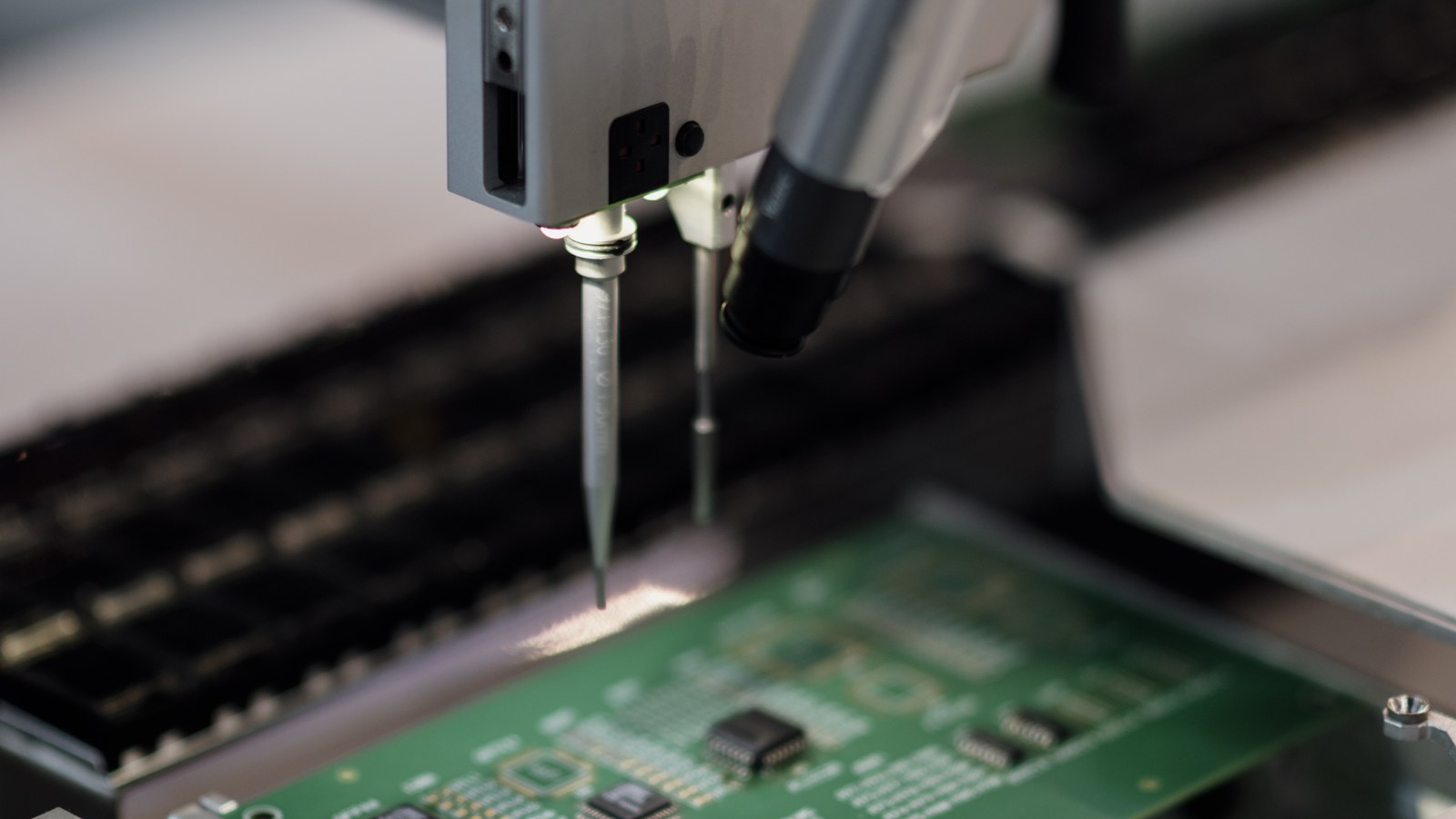
Cover photo: circuit-board placement equipment (photo by Nenad Stojković, Wikimedia Commons, CC BY 2.0).