
In the spring of 1997, before leaving Guizhou, Tan Zhonghua had some very practical matters to resolve: where his family would live in Xiamen, what work his wife would do, and where their child would go to school.
He was then working at State Factory No. 891. Located in Duyun, the factory would later become known as Zhenhua Qunying. A year earlier, a recruitment advertisement in Workers’ Daily had introduced him to Xiamen Hongfa. He went to visit, but did not immediately stay. Only after another visit in April 1997, when family arrangements and the recognition of his years of service after resignation had been addressed, did the move become a workable choice. China Industry News later recorded this episode. 2
This personal migration takes the story back thirty years: how had this Guizhou factory been established, and how did the people who later worked there find their way to different places?
In 1967, Hu Guanqun began his working life and joined Factory No. 891 in Guizhou. The factory was still under construction. He later became deputy chief engineer of Zhenhua Qunying. In a China Electronics feature, he recalled his choice as a young man with a simple phrase: “accepting the assigned placement.” In the same recollection, he spoke of young people from more than a dozen universities gathering at the factory, and of joining colleagues in developing the structure of a miniature hermetically sealed electromagnetic relay. 3
During the construction years, technology and people converged on the interior. Later, some factories and technical professionals moved to new places. Staying and leaving both formed part of the growth of China’s industrial capabilities. Establishing and reorganizing factories, and the movement of their people, repeatedly required families to rearrange their lives.
To understand what the Third Front construction program left behind, we need to follow these particular routes: from a factory in Duyun to a new site in Guiyang, and then to another production line in Xiamen; from a technician’s workbench to children’s classrooms, workers’ homes, and a dining hall for older residents. Only by placing these locations on the same map can we see how a factory became part of a city, and how it continued to shape people’s lives after moving away.
1. First, Make One Small Component
Two features of Factory No. 891 can easily disappear behind commemorative accounts.
First, it was an electronic component factory with a clearly defined specialty. Second, it took several years to build. To understand the weight of the word “construction,” we need to place the youth of many people within that process.
The corporate history disclosed by Zhenhua Science & Technology in 2013 records that Qunying Factory was approved for establishment on March 3, 1966. Designated Factory No. 891, it belonged to Base 083 and was built around Shabaobao in Duyun. On August 12, 1970, the entire factory was completed and passed national acceptance. The company’s own history also records the role of Factory No. 792 in Shaanxi in helping establish it. These records give the mountain factory an identifiable organizational origin, location, and production mission. 4, 5
The records show the support that the existing industrial system provided to a new factory. Experienced personnel had to translate technical requirements into a new workshop organization; young recruits had to learn through specific assignments. Where support came from, who ensured that processes were properly transferred, and how newcomers entered production were all conditions for turning an industrial location decision into an operating factory.
The tasks facing young engineers in such a factory were equally specific. Hu’s work on the structure of the TO-5 miniature hermetically sealed electromagnetic relay was one example. China Electronics’ retrospective connects the earlier dependence on imports with subsequent domestic development. In his recollection, the technology emerged through collective reasoning and repeated attempts, as young people turned what they had learned in college into actual products. 3
A relay may be small, but the industrial requirements surrounding it are substantial. It must switch circuits under specified conditions, requiring design, materials, parts, assembly, and inspection to work together. Once it enters a larger piece of equipment, users’ trust depends on whether it works as required, whether different batches are consistent, and whether problems can be traced.
The value of a component factory therefore lies, first, in an everyday capability: turning drawings into consistent products, individual judgment into transferable processes, and a successful attempt into sustained delivery.
The Third Front brought these expectations of industrial work to the interior as well.
In Duyun, young people from different places joined the same factory. Their knowledge had to come together around shared tasks. Being right in principle was only a beginning; a product had to pass through manufacturing and inspection before reaching a user. New graduates learned through that process, while experienced staff also confronted unfamiliar conditions on site. Only as individual knowledge became knowledge that an organization could repeatedly use did the factory develop its own professional capabilities.
In the working lives of Hu’s generation, joining the factory was a beginning. The work that followed turned their choices into products and capabilities, and gave the factory a basis on which others could build.
What remained could be very small: a requirement for machining a part, a welding method, a test fixture, or even a record that clearly documented an abnormal condition. Such things can outlast a factory building. They may change over time, but they provide a starting point for further improvement.
A single inauguration ceremony can hardly express this accumulation.
Completion has a date; maturity takes time. National acceptance marks an important stage in a factory’s development. A young engineer learning to judge a problem independently, a group of workers mastering a process consistently, or a technical department becoming able to organize a new development project represents another kind of progress. The first readily enters a chronology. The second is more often found in products, jobs, and people’s careers.
Following a continuous production identity allows us to see both the capabilities that traveled beyond an old site and the early work behind later achievements. A factory’s history thus includes two connected strands: how production matured, and how people lived there.
2. Beyond the Production Line, a Life Had to Be Built
On an industrial location map, a factory is often just a symbol. For those who came to it, that symbol had to expand into an entire way of living. Once the workplace had been decided, questions remained: would family members come too, who would care for the children, where would people receive medical treatment, and how would daily necessities be supplied? A construction project could begin before these conditions were ready. If they remained inadequate for too long, work and family life would both bear the strain.
Recollections from another organization in Duyun make this relationship particularly clear.
Research Institute No. 38 and Qunying Factory of Base 083 belonged to different organizational histories. Institute 38 was established in Guizhou in 1965. A China Electronics Technology Group Corporation retrospective records that nearly 1,000 personnel from Institute 14 subsequently moved there in three groups between December 1969 and August 1970. Wang Xiaomo was among them. New people and technical resources thus entered Duyun after the institute’s establishment. 6, 7
In an interview published in 2013, Wang recalled life in Daping, Duyun. The organization had to arrange housing, a hospital, and schooling for employees’ children; technical staff took turns teaching. He spoke about his son’s learning conditions and regretted that the child had not been able to attend university. The report recorded him choking up. 8
That moment deserves a place in accounts of the Third Front. A person can make a choice for himself, but cannot give his child the same experience of growing up. The parents’ work had clear objectives, while the gains and losses of the next generation could hardly be offset by a research achievement. Recognizing their contribution to national industrialization also means recognizing time that could never be recovered.
These family experiences show how wide the responsibilities of an industrial organization were at the time.
Where public services could not yet provide sufficient coverage, the work unit had to take on many matters beyond production. Schools and medical services directly affected whether people could work there over the long term. Housing and everyday arrangements determined whether families could reunite. They also affected whether young people wished to stay, and whether experienced technical professionals would continue to place their future there.
The resulting factory community had a clear dual character.
It brought people who had not previously shared a life into close relationships in one place. A colleague might also be the parent of a child’s classmate, or someone to turn to for help. Meeting difficulties together could create deep trust. Through such relationships, someone far from an original home made an unfamiliar place part of everyday life.
But a life heavily dependent on the work unit also concentrated risk. Changes in business conditions, finances, or staffing could affect work and family at the same time. Where the factory community had limited connections to the city around it, alternatives beyond a particular job could also be relatively restricted.
Both sides deserve attention. An account confined to mutual support can turn inadequate conditions into a way of life worth repeating. An account confined to inadequacy cannot explain why, decades later, some who left still wanted to return, or why some retirees continued to call the place home.
A more accurate understanding is that people built relationships capable of sustaining a shared life under limited conditions. Those relationships deserve to be valued, while the conditions that constrained their lives deserve improvement.
Industrial progress should include that improvement.
If an engineer can continue research without repeatedly worrying about a child’s schooling, if a young worker’s partner can find suitable work in the city, and if older people no longer depend entirely on the former factory for medical care, mobility, and meals, these changes also strengthen an industrial system’s ability to retain people.
Schools, hospitals, and community services are therefore connected to industrial development in specific ways. They affect whether people can remain in the workforce, whether skills can continue across generations, and whether a family is willing to make a life locally. Different organizations built these services in different ways. Wang’s recollection presents one identifiable path. It also reveals another side of research work: a generation of parents trying to sustain family lives whose needs they could not always fully meet.
3. What Capabilities Did a Factory Actually Leave Behind?
If a factory site had to organize production and daily life together, the capabilities it accumulated would also extend beyond any single product.
Qunying’s later technical records offer a relatively concrete way of examining this.
An asset valuation explanation published in 2013 describes earlier process development in electroplating, welding, the improvement of test fixtures, quality, and equipment applications. Its list of technologies also includes precision tooling, glass insulator sintering, cleaning and particle inspection, sealing, and testing. This is a record of the company’s technical capabilities at a particular time, not a current inventory. It nevertheless shows the coordination required inside a relay factory. 9
It shows the long chain of work behind a small component.
Engineers propose a product structure; manufacturing must turn it into qualified parts. Assembly requires suitable tooling, and inspection requires appropriate methods. When deviations occur, people must determine whether the cause lies in materials, machining, assembly, or testing. Responsibilities across jobs must connect, and changes must be communicated. Moving only one of these activities to a place may not establish a complete product capability.
This is where “industrial support” needs a closer explanation.
In discussions of Third Front factories, support has at least three meanings. The first is internal: the coordination of processes, equipment, testing, and people. The second is between organizations: supplies of materials and parts, and specialist services. The third connects production with the city: transport, utilities, and public services. Distinguishing these meanings helps identify whether a capability exists within one enterprise or has entered a local industrial network through actual collaboration.
Qunying’s internal professional capabilities have left a relatively clear, continuous record. Early product development, later process improvements, and business lines that remain identifiable today can be connected. The available material cannot, however, reconstruct the full supply network of Base 083. Geographical proximity between several enterprises and sustained supply, technical collaboration, or training relationships between them are different kinds of facts.
The supported conclusion is that organized industrial relocation established new specialist production organizations in the interior. How those organizations became further connected to surrounding economies still needs to be traced through actual transactions and relationships between people.
There remains a distance between one organization mastering a process and a city possessing that capability more widely.
Actual connections bridge that distance. A technical professional may leave a work unit but continue related work locally; one company may supply parts regularly to another; or a training arrangement may bring more young people into specialist jobs. Without such links, attributing a factory’s entire technical base to its host city omits the very process that needs explanation.
Training provides a more specific line of inquiry. A recollection published by China Science Daily in 2023 records that Wang Xiaomo recruited seven graduate students from the University of Science and Technology of China under a placement arrangement in 1985. After graduation, they joined Institute 38; Lu Jun was among them. This example belongs to a different organization, but reveals the same organizational requirement: existing professional capabilities must be able to absorb and train new people. 10
The knowledge brought by the first generation of builders would not automatically pass to the next through shared life alone. Someone had to arrange courses, research assignments, and job training. Experienced staff had to help newcomers resolve technical difficulties. As they matured, newcomers also needed opportunities to assume fuller responsibilities. If that succession broke down, capabilities could weaken even while equipment and buildings remained intact.
Technical continuity therefore has to be grounded in how particular people enter work and develop. It includes preserving experience and using new knowledge to revise older methods. A product made by an earlier generation can provide a starting point. The next generation must still learn to handle different materials, equipment, and applications. Enabling that renewal to continue is how an organization truly retains knowledge.
People in relocated enterprises trained and organized production in these places, while their families formed new social relationships. Later, some capabilities moved with the organization, some experience traveled with individuals, and some people stayed locally. Tracing these destinations separately makes it possible to understand the different results of an industrial location decision over time.
Corporate restructuring and reorganization add further changes to these paths.
Names, factory numbers, legal entities, products, and actual production locations may change at different times. A signboard can change while the professional team remains. An address can remain while production stops. An old site can cease production while a new operating entity continues its products. These clues must be considered together when judging continuity of industrial capabilities.
For Qunying, Factory No. 891 remains worth remembering because it can still be matched to later company names, products, and documents. It lets us follow construction, relocation, restructuring, and continued operation along one line, rather than recognize the history only through a commemorative plaque.
4. Leaving the Mountains: Different Choices for a Factory and a Family
The difference between moving into the mountains and moving out begins with a change in the questions people faced.
When factories were first established, national assignments set important directions for their location. Later, responding to new product demand, finding new opportunities for people, and reconsidering where production should take place became unavoidable issues.
These questions would not be answered in the same year or in the same way.
Institute 38 relocated as a whole to Hefei at the end of 1988. A Wang Xiaomo profile published by the State Administration of Science, Technology and Industry for National Defense describes his efforts to secure heating and hot water for the Hefei accommodation, and his attention to young researchers’ living conditions. The research organization had entered a new city, but the lives of its people remained among his concerns. 6, 11
In Guizhou, technical staff had shared responsibility for children’s education. In Hefei, living facilities still required an effort to secure. There is a clear connection between the two experiences: research assignments can be set down in documents, but enabling the people carrying them out to live without undue worry requires one practical arrangement after another.
There is also an easily overlooked change. Earlier migration required people to adapt to a location selected by an organization. Later organizational development increasingly required serious consideration of people’s choices about cities and life.
Both generations had to find arrangements between work and life, and both carried responsibilities in their jobs. Maintaining organizational capabilities required those arrangements to improve. An organization needed both to set objectives and to keep answering why people would want to stay.
Qunying’s adjustment took place over a longer period.
In 1987, it entered planning associated with China Zhenhua’s Guiyang “window” development. Documents in 1997 and 2000 subsequently included it in the Third Front relocation program. In 2002, its registered domicile changed from Duyun to Guiyang. The 2013 valuation material records completion of the factory’s overall relocation in 2004, a date also given in its official corporate history. 4, 9, 5
Planning, legal registration, and actual relocation did not share a single completion date. This history spanning several years shows that the procedures and production transitions involved were far more complex than replacing the city after a factory’s name.
For a factory, relocation requires continuity of production. Whether equipment can work to its previous requirements in a new location, whether the production environment is suitable, how people report to work, and how existing users continue to receive deliveries all help determine whether the move has truly been completed. Registration marks a change in legal status. Actual relocation also requires an entire set of production arrangements.
Families face different arrangements. A child’s schooling, a partner’s employment, or an older relative’s attachment to familiar surroundings may make it difficult for a household’s move to coincide precisely with the enterprise’s relocation. The weight of these matters varies between families. Tan’s recorded experience already shows how some of these conditions influence a decision.
Other technical professionals from Factory No. 891 also joined Hongfa before and after him. Their movements form an identifiable route along which experience was transferred. 2
This history can be viewed from two positions.
From the receiving enterprise, the arrival of technical professionals brought experience into a new organization. They knew products, understood processes, and had developed methods of judging problems through earlier work. Recruitment could shorten a company’s learning process and combine new personnel with its own equipment, markets, and management.
From the original factory, the departure of key staff meant reallocating assignments, filling positions, and training successors. An episode celebrated in one recruitment history could leave another organization with gaps to absorb.
Both can be true at the same time.
These movements show how the old factory had trained and gathered professional talent, while raising the question of how people could be encouraged to stay. To keep experience accumulating within an enterprise, the organization must offer conditions compatible with individual development. Retention after training also requires income, career opportunities, services, and organizational arrangements to work together.
The records identify people and their destinations, but do not quantify the effect on either company’s business. Many people contribute to an enterprise’s development; it cannot be reduced to a few individuals. Nor can all the difficulties a factory faces be traced to one episode of staff departures.
The case shows that experience developed through the Third Front did not remain permanently inside the walls of the original factory. It entered other enterprises with individuals and encountered new organizational arrangements. The movement of people thus became a concrete form of knowledge circulation within Chinese manufacturing, extending beyond a change in factory locations on a map.
This is also what makes the meaning of “left behind” so complex.
A capability may leave one city yet continue to serve the same country’s industrial development. Meanwhile, the original city still experiences the effects of changes in jobs and population. National and local scales cannot cancel each other out, just as industrial significance and family feelings cannot substitute for each other.
For Tan, what ultimately made the route workable included somewhere to live, a job for a family member, and continued education for a child. These conditions bring us closer than the phrase “talent mobility” to what a family actually faces when it crosses a threshold.
5. From a Mountain Factory to Today’s Production Organization
After a factory leaves the mountains, the next questions are whether it is still producing, and how its products connect with the past.
Qunying provides a line that can still be followed.
Zhenhua Science & Technology’s 2025 annual report continues to identify Guizhou Zhenhua Qunying Electric Co., Ltd. with “State Factory No. 891.” The company’s website lists electromagnetic relays, contactors, solid-state relays, and control assemblies, as well as gears and transmission mechanisms integrated later. Its operating entity, business, and production location remain verifiable. Its history did not end at the old Duyun site. 12, 13
This continuity nevertheless needs to be understood precisely.
Not every business now listed under the company existed in the 1960s. Its history records expansion, research partnerships, and later integration. Attributing all these changes to the original Third Front construction would obscure the decades of work that followed. Treating all later products as unrelated to the old factory would sever organizational and professional connections that can be verified.
Studying a Third Front factory requires examining change within continuity: how the original professional base was used, which processes retained value, which products needed renewal, which resources came from later investment, and which capabilities came from new partnerships and people.
This approach is also closer to reality than dividing a company into a “military products era” and a “civilian products era.” Different markets may impose different requirements for reliability, cost, delivery, and certification. Earlier experience provides a foundation, but cannot replace the work of adapting to new requirements. Success with one product does not automatically make another competitive. Turning technical foundations into new business capabilities requires continuing choices and investment.
Moving to the provincial capital did not immediately complete that work either.
In a named interview published by Guizhou’s GOG news website in 2023, Xiao Bin, who joined the company after graduating in 2004, recalled that analysis equipment was lacking when it first moved to Guiyang. Products had to be taken to a university, where they waited in line for testing. A later case of cracking after riveting could be investigated with the company’s own scanning electron microscope, and traced to quality control in the electroplating process. 14
The shift from waiting for external analysis to diagnosing problems internally makes support capability concrete in production. It did not change the basic requirements a product had to meet, but it changed the company’s ability to identify deviations and organize improvements.
Relocation provided new spatial conditions. Subsequent investment in equipment and the development of people gradually turned conditions into capabilities. Attributing all later development to the move would omit these continuing investments. Attributing it entirely to early technical foundations would fail to explain the need for new analytical tools.
The experiences of the two generations can thus illuminate each other. Hu recalled the early work of turning knowledge into products; Xiao described how product problems could later be understood more promptly. They served a factory with a continuous identity while facing the manufacturing requirements of different periods.
This is a more specific form of continuity than simply invoking a “spirit passed down”: earlier work established a professional starting point, and later work added new capabilities. The value left by predecessors gained new life as the next generation continued to ask questions and solve problems.
Zhenhua Science & Technology’s 2023 offering document lists a digital and intelligent production-line project for relays and control assemblies to be implemented by Zhenhua Qunying in Wudang, Guiyang. It covered factory buildings, process equipment, production lines, power distribution, and other supporting facilities. This represented another round of production reorganization. 15
It also matters that this construction did not proceed all the way to completion on its original timetable.
The 2025 annual report disclosed that, in April 2026, the board agreed to move the date on which the project was expected to be ready for use from December 31, 2026 to March 31, 2028. The stated considerations included operating conditions, market changes, and customer demand. The 2026 interim report continued to list this adjustment. The planned capacity therefore cannot be presented on this evidence as output already achieved. 12, 16
Operating data also belong in the same picture. One verifiable snapshot comes from the 2026 interim report: Zhenhua Qunying generated approximately RMB 222 million in revenue in the first half, with net profit of approximately negative RMB 25.4081 million. This result concerns the first half of 2026. It should not be omitted, but is insufficient on its own to assess the company’s long-term capabilities, much less to infer a consequence of the original location decision or a particular relocation. 16
These disclosures offer a more realistic picture of the factory today. It still has to assess demand, allocate funds, coordinate equipment and production conditions, and revise its pace as circumstances change. Its Third Front identity has not exempted it from present business constraints. Continuing to exist requires continuing to work.
To assess this continuity, we need to ask whether products are still being renewed, production activities remain reliably connected, technical professionals have room to develop, and new investment fits actual demand. History deserves respect; present operations must still be judged on present evidence.
Meanwhile, another path out of Factory No. 891 also has a traceable later point.
In 2023, a news release from TÜV Rheinland recorded a certification event for a Xiamen Hongfa safety relay. Tan Zhonghua attended as a Hongfa group vice president and chief engineer. His professional path can still be followed from his departure from Guizhou to this dated later record. 17
Placing this personal career alongside the factory’s corporate history reveals two forms of continuity.
One follows the original organization through relocation and reorganization as it continues producing. The other follows people into new organizations, where they participate in new products and standards. These forms need not compete for a single claim to “authentic” succession. Together, they show how industrial experience can change while organizational identity continues, and can also keep developing after an individual leaves.
Several generations of work separate Hu’s entry into Factory No. 891 during its construction, the later outward movement of technical personnel, and the production and technical activities that remain verifiable today.
If there is a source of pride here, it lies first in a fact achieved through considerable effort: specific connections in the accumulation of China’s industrial capabilities can now be identified across different periods, places, and organizations.
That pride should be grounded in work. It belongs to those who first turned drawings into products, and to those who later improved processes, organized testing, trained newcomers, and maintained equipment. New achievements still depend on doing many small tasks well. No generation’s work can be replaced by the honors earned by its predecessors.
6. Why Do Some Factories Move While Some Cities Keep Growing Around Them?
A limited comparison between Duyun’s electronics industry and Panzhihua further clarifies why there is no single answer to what a factory leaves behind.
Pangang was built around the vanadium-titanium magnetite resources of the Panxi region. Construction began in 1965; iron production started in 1970, followed by steelmaking and rolled steel products. Its public history connects resource utilization with the development of the production system. 18
Here, the location of resources directly constrains the location of production. Mining, smelting, and related facilities must be organized around a large physical flow of materials. The resulting connections to a city differ in an explicable way from an electronic component factory’s organization of production around specialist personnel, products, and users.
Resource-based industry also faces changing requirements for products, the environment, costs, and technology. Electronics enterprises may also choose to remain where they are because of existing teams, facilities, and collaborative relationships. Sector differences provide a starting point for understanding location; each enterprise’s later path still needs to be examined in its specific conditions.
The meaningful comparison concerns which local conditions a production activity depends on most, and whether those conditions subsequently change.
In 2021, the People’s Daily Overseas Edition recorded the recollections of Panzhihua builder Lei Yong. He had participated in early power construction, later became a boiler worker, and received the title of National Model Worker. His supporting work in electricity makes the formation of a large industrial city understandable through a more specific job. 19
Electricity is a condition for organizing continuous production. Restoring Lei’s job to its place within the industrial system reveals different trades working toward a shared result. Much of the work beyond the main factory building also determines whether an industrial system can function effectively.
This helps us understand Duyun’s story as well.
A place that retains a main factory still needs continuing improvements to support systems and products. A place that loses part of its production organization may retain communities, skills, and public facilities. Resources, organizations, markets, city services, and people’s choices interact to produce different outcomes.
Qunying’s move to Guiyang and Institute 38’s move to Hefei differed in destination, organization, and process. Panzhihua’s resources and steel production formed another kind of spatial connection. Keeping these paths distinct makes the search for new conditions for particular professional capabilities clearer. Estimating the overall impact on a city requires broader evidence and comparison.
These differences do not diminish the historical significance of the Third Front. They make it clearer: the program changed the industrial starting point of many places, while their subsequent development continued to depend on new work.
7. Beyond the Factory Gate, People Still Live Here
Factories can move, and production can stop, but life does not end on the same day.
Stepping away from the electronics story to the old Dongfang Machine Tool Factory neighborhood in Duyun reveals this other outcome. It belongs to a separate history of machinery-industry relocation, and preserves another kind of evidence of how industrial migration entered everyday life in the same city.
Dongfang Machine Tool Factory was established through the relocation of part of Jinan No. 2 Machine Tool Factory’s resources and personnel. A 2024 Guizhou Radio and Television report interviewed Li Shumian. When he came to Duyun in 1965, he left his wife and their two-month-old child behind. Only in the sixth year of separation from his child did he bring his wife and child to join him. The report also describes the factory’s eventual cessation of production and the aging facilities and inconvenience that affected the old neighborhood. 20
That separation occupies only a short line in an industrial history. In a child’s growth, it was time that could never be lived again.
Such family experiences give “industrial relocation” a scale different from an equipment inventory. A machine can have recorded departure and arrival dates. Human separation and reunion may remain suspended between such dates for a long time. After production assignments have been completed, these experiences remain within families, shaping how they understand work and home.
After a factory stops producing, older residents who stay still need to live their lives.
In the same 2024 report, He Dayun, formerly the head of the dough-making team in the factory canteen, became a volunteer at the community dining hall and helped its staff make Shandong-style steamed buns. The factory’s specialist production was not revived by this activity, but an older worker could still contribute familiar skills to public life today.
This continuity of everyday skills and community relationships has value in its own right. The dining hall provides meals, neighborhood improvements make life easier, and a museum preserves history that can be seen and understood. Together they respond to matters left behind when the factory withdrew from production. How former employment is to be replaced remains a separate question.
An old factory becoming a museum does not mean that its jobs have been replaced. Public consultation on a conservation plan does not mean that every project is complete, or that the local economy has revived. Duyun’s published conservation plan for the Longchang historic district sets out arrangements for protection and development. It must be distinguished from community improvements that have already taken place. 21
For people who remain here, respect for history and convenience in daily life should go together.
Preserving a building allows later generations to understand what happened here. Repairing the routes older people use every day and arranging accessible public services respond to the present needs of those who lived that history. One addresses the past; the other addresses lives that continue.
The care builders need extends beyond commemorative events. Once technicians, workers, teachers, and family members, they have grown into older people who need support. Those who gave their time to the industrial system should also have access to reliable support in urban life. Providing it is a practical expression of how a society treats its history of industrialization.
Memories of the Third Front likewise cannot be explained by a single emotion.
Paul Kendall’s 2025 study draws on extended observation and interviews in relevant Guizhou communities, directing attention to everyday life beyond commemorative narratives. Attachment to the past may include pride in shared work, neighborhood relationships, life when people were young, and losses associated with later changes. Such feelings need not be compressed into complete approval or rejection of one institutional arrangement. 22
Reading these real lives requires that patience.
People can take pride in contributing to national construction and regret what their families missed. They can cherish the factory community where they lived together while hoping their children will have more choices. They can miss close relationships while wishing that later generations will not have to repeat their difficulties.
These feelings do not cancel each other out. Their coexistence within a person is precisely what gives history its human depth.
8. The Place They Returned to Was More Than a Workplace
In August 2025, former Dongfang Machine Tool Factory workers and their families returned to Duyun.
The report describes Liu Shaoyong accompanying his father, Liu Guangyu, and mother, Gao Junfang, from Tai’an in Shandong. Both parents were 93 that year, and his father used a wheelchair. Four generations of the family gathered there to revisit the place where they had lived and worked. 23
Even at an age when a wheelchair was needed, they were willing to travel a long distance to a place they had come to when young. For a family, a factory site had grown beyond a workplace into the parents’ youth, the children’s childhood, and an origin that several generations could identify together.
Through such returns, earlier work and life become part of a family’s shared memory. At the time of decision, migration is a practical arrangement. Over many years, it also becomes part of how people understand their relatives and their own origins.
Returning to Qunying, the experiences of Hu Guanqun and Tan Zhonghua reveal another identifiable succession. The former began work while the factory was under construction; the latter passed through its jobs into another enterprise. After moving to Guiyang, Qunying continued operating and adapting under a corporate identity that can still be checked.
The three strands do not converge in one tidy ending.
Some organizations moved away; some professional experience kept circulating; some old factories stopped producing; some communities still housed the people who had lived there. Continuities that can be confirmed should be made clear, as should the breaks that occurred. The most reliable respect for this history comes from seeing it whole.
What Third Front factories left behind can therefore be understood at three scales.
At the scale of production, they left specific products, processes, and organizational experience. These require the work of later generations to continue becoming effective industrial capabilities.
At the scale of the city, they changed how people gathered and organized their lives, while leaving responsibilities for public services, neighborhood improvements, and future development choices.
At the scale of the family, they left migration, separation, and reunion. Some sacrifices found expression in later achievements; some regrets could never be compensated. Together, they form part of China’s industrialization.
Today, discussions of China’s manufacturing progress readily focus on the newest equipment and the largest projects. Yet how a small relay moved from a drawing into production, how a young person learned to work in the mountains, and how a family made a new life after migration also deserve serious attention.
These advances did not appear from nowhere. They passed through people’s hands and through their lives.
There is pride in being able, today, to follow these people’s paths, identify professional capabilities still at work, recognize changes in urban life, and provide later generations with choices that were once unavailable.
Commemorating that generation of builders should become more specific still.
Remember what they accomplished, and whom they waited for and worried about. Let factories still in production keep making good products; let the communities that remain become better places to live; let those who return in wheelchairs receive considerate care in familiar surroundings.
They once brought their youth here. What life the city can offer them decades later remains a part of this industrial history still being written.
Research Note
This article is based on public sources and does not include new interviews conducted by the author. Its core is the continuous identity of Qunying Factory / Factory No. 891 and the careers of Hu Guanqun and Tan Zhonghua. Institute 38 is used to examine another research organization’s migration and supporting living arrangements in the region. Dongfang Machine Tool Factory illustrates the continuity of families and communities. Panzhihua provides only a limited comparison of resources and production location. None of the latter three has been incorporated into the organizational history of Base 083 or Qunying.
Securities disclosures are used to verify entities, migration, operations, and construction status. Corporate histories and commemorative reports show organizations’ accounts of their own past. Named interviews convey personal memories. Different kinds of evidence are compared, but repeated reprints are not treated as independent confirmation. People’s ages refer to the years of the reports, without inferring their health, circumstances, or positions in 2026. The article does not estimate the net causal effect of the Third Front on local economies, treat planned capacity in investment documents as actual capacity, or describe conservation plans as completed projects.
Sources for the main facts are provided in the relevant paragraphs. Explanations of the relationships between production and cities are analyses based on the cases presented. Their scope is limited to this article; they do not represent a common trajectory for all Third Front enterprises.
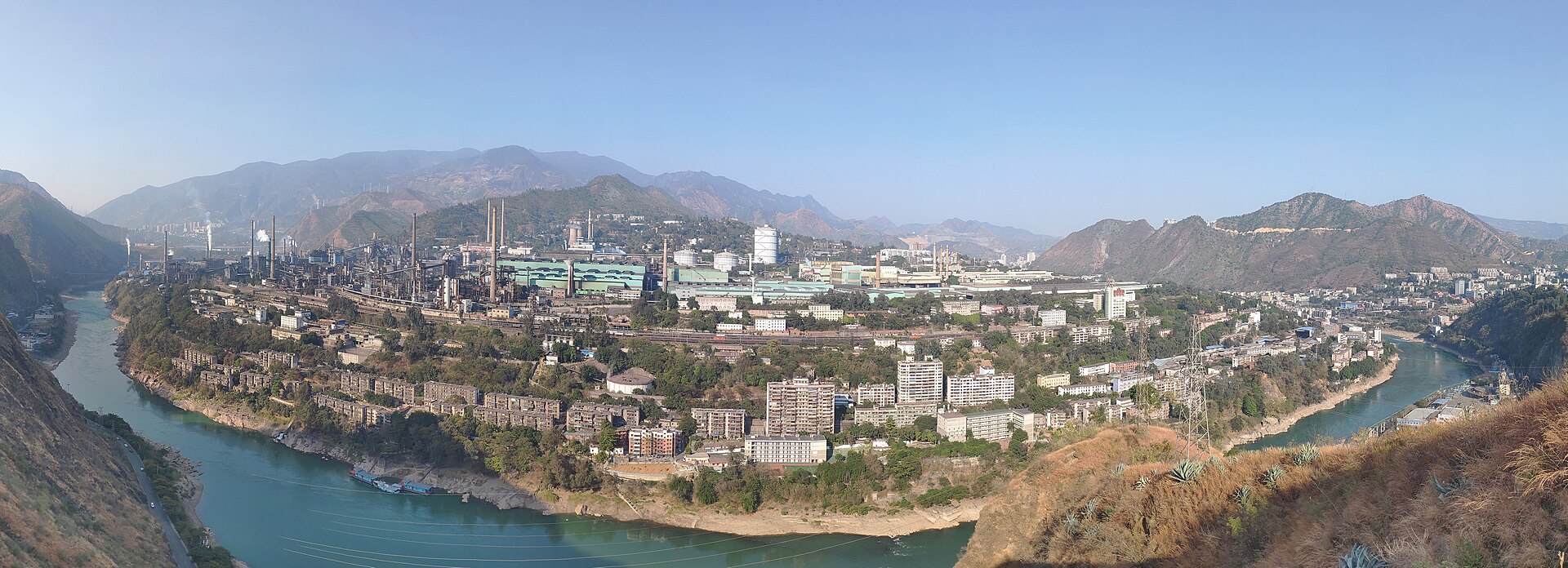
Cover photograph: Panzhihua Iron and Steel plant, illustrating Third Front industrial geography; not the Qunying factory. Zhangzj cet / Wikimedia Commons / CC BY-SA 4.0.
References
[1] 天下工厂制造业数据库 (Tianxia Gongchang Manufacturing Database).
[2] The Hongfa Journey, installment five.
[3] Reprint of the China Electronics feature.
[4] Zhenhua Science & Technology’s 2013 related-party transaction announcement, p. 30.
[5] Qunying’s corporate history.
[6] Institute 38 profile.
[7] China Electronics Technology Group Corporation retrospective.
[8] Wang Xiaomo: Dedicated to Early Warning Aircraft.
[9] Zhenhua Qunying asset valuation explanation, PDF p. 88, printed p. 85.
[10] China Science Daily, March 8, 2023, p. 3.
[11] Wang Xiaomo: A Life of Leadership.
[12] 2025 annual report, p. 5.
[13] Zhenhua Qunying company profile.
[14] GOG’s report on the factory’s high-performance relays, reprinted by Sina.
[15] 2023 offering document, PDF p. 65.
[16] 2026 interim report, p. 25.
[17] TÜV Rheinland news release, May 12, 2023.
[18] Pangang Group profile.
[19] People’s Daily Overseas Edition, January 4, 2021, p. 11.
[20] Guizhou Radio and Television’s report, reprinted on a government website.
[21] Longchang Historic District Conservation Plan, 2025–2035, public text.
[22] Kendall, 2025, Modern China.
[23] Report on the builders’ return to Duyun sixty years later.