
At 19:12 on September 20, 2024, Unit 1 at Tianjin Guoneng Panshan Power Plant reached full-load trial operation. In an announcement issued the following day, the equipment manufacturer recorded the moment down to the minute.[2]
When a large generating unit reaches full load, drawings, manufacturing and installation begin to deliver a shared result. At Panshan, that moment also connected with almost three decades of history.
The plant had been serving the Beijing–Tianjin–Tangshan grid for nearly thirty years. Its originally imported units had helped meet the urgent electricity needs of a rapidly developing region. Cities subsequently expanded, power consumption grew, equipment underwent maintenance and modification, and heating became part of the plant’s work. This time, engineers needed to replace the boiler, steam turbine and generator, installing a new generation of Chinese equipment within the existing buildings and parts of the auxiliary systems.
Some steel structures remained; some equipment left. New heating surfaces, blades, windings and control systems entered the buildings. The unit’s rated capacity stayed at 530 MW, while its technical operating conditions were rebuilt. Ten days later, on September 30, 2024, the upgraded Unit 1 entered service.[3] The old plant had begun a new operating chapter.
We often observe development through new high-rises, roads and production lines. Panshan offers another measure: how a plant that has served for years can regain the ability to work in the same place. This involves the remaining value of materials, experience accumulated through repeated maintenance, and people who must learn again, design again and take responsibility again.
An old plant can continue working only when each concrete element is reassessed. Which column can remain? Which pipe must be replaced? How can dismantling avoid disturbing the other unit, which is still operating? Can new equipment and old foundations withstand the new conditions together? Each question needs an engineering answer.
Those answers take time and concern specifics. They emerge through site surveys, take physical form in manufacturing shops, and face scrutiny in tests and operating records. The results for the city are ordinary: more capacity available to the grid, greater support for heating, and another shift of work inside the plant.
From aging Russian-made units to new Chinese main equipment, Panshan’s story reflects both the changing capabilities of China’s equipment industry and care for existing industrial assets. Technical progress moves in two directions here: forward, toward greater efficiency and operating capability; and back, to identify what decades of construction have left behind and carry the usable parts into the future.
Panshan’s story unfolds within these practical conditions. Behind the machinery turning again are an old plant’s renewed understanding of itself and China’s equipment manufacturers taking on the next task.
I. The Years It Helped Illuminate
Panshan’s original significance belongs to an era when electricity shortages still constrained urban life.
On June 7, 1996, People’s Daily published a Xinhua feature reviewing efforts in North China to resolve Beijing’s electricity shortages. The report noted supply problems affecting Panshan’s two imported units. Design, installation, commissioning and other teams converged on the site, completing an important commissioning task by the end of 1995. Alongside other power-generation and grid projects, Panshan helped improve electricity supply to the capital.[4]
The Panshan described in that report belonged to an era striving to expand supply. Adding a power plant required financing, waiting for large equipment, coordinating installation across disciplines and connecting with transmission and substation construction. The plant’s task extended beyond its boundaries: only when units could generate, the grid could deliver and equipment could operate reliably when demand required did construction truly enter everyday life.
Looking back, it is easy to reduce commissioning to a year. For the people building the plant, that year consisted of countless specific jobs: inspecting delivered equipment, checking foundation and installation dimensions, commissioning systems one by one, and addressing defects. The larger the power project, the more people were involved. Most of their names would never appear in later installed-capacity statistics.
Surviving reports show that Panshan was one site of these efforts. In 2014, China Energy News again linked Panshan with the “9511” project in its review of Beijing Electric Power Construction’s work in the Beijing–Tianjin–Hebei region. It placed the plant within a shared expansion of regional power supply, rather than attributing the outcome to a single machine.[5]
Once connected, electricity enters a common network. Together with other power sources, Panshan increased the system’s available supply capacity. Through that shared grid, many people’s labor became something that many others could take for granted in daily life.
Panshan was a large imported coal-fired power project built and commissioned in the 1990s, with original equipment drawn from the Soviet industrial technology system. It came to China in that era and began undertaking the work of that era.
The project’s publicly released environmental impact assessment identifies the manufacturers and models of the original boiler, turbine and generator. The two units were initially rated at 500 MW and were subsequently upgraded to 530 MW. Taken together, historical reporting and project documents place their successive entry into operation between late 1995 and 1996.[4][6]
A unit working for nearly thirty years undergoes many changes. Panshan had previously modified its turbine steam paths and converted to combined heat and power in 2013. It supplied heat as well as electricity. A 2026 tender announcement from the owner still listed those modifications in the company’s history.[3]
This history gives “old” a more precise meaning. Steel structures, main equipment, auxiliary systems, protection devices and personnel skills each follow different renewal cycles. An old plant is an industrial system under continuous maintenance. Over the decades, people have repeatedly corrected problems, replaced equipment and added functions. The later life-extension project encountered precisely this accumulated reality.
People had grown within it, too.
In 2020, CHN Energy documented the experience of Zhang Bin, head of Panshan’s relay-protection team. A unit overhaul was under way when he first joined the plant. During the day he learned alongside experienced workers on site; afterward he studied procedures and drawings. Faced with technical documents in English, he used translation tools to look up words and organize explanations, matching the equipment he had seen during the day with the principles on paper.[7]
The report also preserved a scene remembered by senior workers: the day’s maintenance had ended and others had finished work, but Zhang was still checking schematic drawings at the 500 kV line-protection modification site, tracing and marking circuits wire by wire. Later, as team leader, he organized protection-system upgrades and retained old panels removed during maintenance for practical training of younger employees.[7]
This account concerns earlier operation and maintenance work: a young person learning through drawings, equipment and experienced colleagues, then turning removed equipment into a tool for others to learn.
An old panel had lost its original installation position but could still teach someone how to understand a circuit. Equipment that had worked on site retained tangible wiring, components and functional relationships. Young trainees had to connect textbook principles with real circuits. The plant’s knowledge thus had both a physical carrier and another person to receive it.
This detail deserves a place in Panshan’s story. A plant’s accumulated wealth includes more than buildings and equipment. It also includes understanding developed through repeated work. How to investigate a fault, why wiring was changed during a particular modification, which drawings no longer match the site: generations of maintenance staff may continue identifying, recording and correcting these details.
Equipment can be purchased from a list; this understanding must accumulate through work. It supports an old plant’s long service and provides a starting point for understanding the original system before the next modification. Protection, operations, maintenance, design and construction staff occupy different roles, yet meet around the same question: how to keep this complex system working reliably.
Built to increase power supply, the plant gradually became an established regional facility. People grew accustomed to its presence, while its equipment approached the limits of its original life. Time had brought a question that another routine overhaul could no longer fully answer.
II. A New Decision at the Limit of Service Life
Aging in large equipment first appears as changes in technical condition.
In a named technical account published in 2024, engineering personnel from the manufacturer listed problems facing Panshan’s original main equipment: the boiler’s condition required close attention, parts of the turbine steam path had suffered erosion, the rotor had undergone corrective work, and generator structure and cooling presented issues requiring attention. The account also stated that the original units’ energy consumption and low-load flexibility had become inadequate for new requirements.[21]
These problems operated at different levels. Wear and material condition concerned safety; efficiency concerned fuel consumption; low-load capability concerned how the grid could dispatch the units. Fixing one fault could still leave other constraints. Engineering decisions therefore moved beyond local repairs toward reassessment of the entire system.
Service life also has different meanings. Design life provides a time basis for design and assessment, while actual condition also depends on materials, operating conditions, starts and stops, maintenance and accumulated damage. Reaching a certain age calls for examination of continued-use conditions; remaining below that age does not justify overlooking existing defects. Life extension begins with understanding specific equipment and systems.
Panshan’s options included retirement, reserve operation, replacement through another construction approach, and upgrading and extending life within the existing site. In a 2024 Tianjin Daily interview, Wang Jiuchong, then a deputy general manager at the plant, described these options and the process of examining proposals with main-equipment manufacturers, design institutes, universities and research organizations.[8]
Each path carried different costs.
Retirement required new arrangements for existing electricity and heat duties, personnel and assets. A replacement plant required investment, construction conditions and time. Keeping the original main equipment meant continuing pressure from efficiency, reliability and repairs. Upgrading and extending life could retain some existing conditions while bringing the complexity of connecting old and new systems into the engineering work.
Panshan’s choice therefore cannot be reduced to affection for old equipment. Safety condition, site constraints, regional demand, investment capacity and future operating modes all entered the decision. Attachment may explain reluctance to say goodbye to a plant; engineering analysis must explain how it can continue working and what that will require.
Keeping rated capacity at 530 MW is one of this project’s most significant boundaries. Progress was to come from supplying the existing capacity more efficiently, flexibly and safely, without increasing unit size. Main-equipment renewal and reuse of facilities had to succeed within the same project.
That boundary clarified the research questions: how large a new machine the original buildings could accommodate, which auxiliary systems could handle the new temperatures, pressures and flows, and how electrical, control and protection systems should be upgraded together. Equal capacity does not mean equipment can simply be replaced in the same position.
Design and manufacturing organizations entered the analysis early. Harbin Electric Group stated that it began participating in Panshan’s proposal studies in 2017 and signed the contract in September 2022. Harbin Electric International undertook overall contracting management, while the boiler, turbine and electric-machinery companies developed the corresponding main equipment and auxiliaries.[12]
From studies to contract signing and site execution, the time contained a succession of boundaries requiring coordination. The owner knew how the existing systems operated; manufacturers knew the new main equipment; the design institute had to calculate old–new interfaces; contractors had to turn proposals into executable site sequences. No participant alone possessed enough information to complete the entire transformation.
At the design stage, the environmental impact assessment specified that the project would be carried out within the existing plant without additional land, maintain rated capacity and modify the boiler, turbine, generator and auxiliary systems according to the proposal.[6]
Retaining the site meant existing roads, buildings, networks, equipment and operating arrangements would all influence the work. Usable facilities reduced the need for rebuilding but also constrained how new equipment could enter. Old foundation dimensions, existing structural capacity and internal building space became conditions the new design had to answer.
For people who had worked there for years, this was a particular kind of change. Familiar equipment would be removed while familiar buildings remained. Existing experience would be tested against new systems, and new operating and maintenance requirements would enter daily work. A familiar building had to accommodate new machines and the process of people learning again.
The engineering made that change clear: people first had to decide together what could stay, then connect new equipment, knowledge and responsibility to it.
On October 30, 2022, work formally began on Unit 1’s life-extension transformation. The date entered the records as the beginning of a main-equipment replacement project, and as the moment an old plant began preparing for its next period of operation.[3]
III. Learning the Familiar Plant All Over Again
Between Drawings and the Site
Designing a new unit normally requires knowing the space in which its equipment will be installed. Panshan’s difficulty was that this space had been used for years, and a gap had gradually opened between drawings and the site.
In a CCTV interview, Nie Hengkuan, then a deputy general manager at China Energy Engineering’s North China Power Engineering design institute, described missing original documentation and the use of three-dimensional scanning to reconstruct information about the buildings. Designers needed to use that information to recalculate existing facilities and determine which parts could remain in service.[11]
Scanning brought the buildings’ spatial relationships back into the design process. Pipes, platforms, beams, columns and equipment positions had to be understood within one coordinate system. In a continuously maintained plant, the site contains both the original design and the results of later modifications. Added supports, rerouted piping and access paths left by maintenance may together change the original conditions.
Recording them again was a careful reading of the old plant.
Engineers faced different kinds of objects. Measurable positions had to be checked against drawings; load-bearing structures required calculations combining their condition with new equipment requirements; relationships between equipment and foundations had to enter manufacturing and installation plans. The spatial model brought site conditions back onto the drawings, providing a starting point for subsequent calculations.
The resulting design work had a distinct relationship with time. The original plant had been built around the products, standards and duties of its day; the new equipment followed new requirements. Bringing both into one transformation required explaining differences, resolving interfaces and recording the results in documents that could be checked.
This work is often difficult to see. Reports can show a new turbine or a new control screen, while site surveys and calculations are dispersed across many drawings and records. Accurate installation depends on those records describing reality clearly enough. An existing plant also needs to be understood comprehensively again.
The boiler manufacturer’s March 2023 project account explained the difficulty further. The original Russian-made T-shaped boiler’s main steel structure was to remain while its components were renewed. The manufacturer first organized overall inspection and calculations, then designed reinforcement. Incomplete original documentation and the late arrival of external information compressed the time available for reinforcement design and supply; new site requirements prompted further adjustments.[9]
Documentation, calculations, production and site work therefore influenced one another. New equipment had an ideal arrangement, buildings had real boundaries, installation needed accessible routes, and operations and maintenance needed space. A local adjustment could affect another discipline’s interface. Engineers had to keep communicating until designs could enter manufacturing and construction.
Reuse itself thus involved technical investment. Determining how long an old structure could continue working, how it would carry new loads and where it required reinforcement all demanded professional capability. Each retained part became an industrial asset kept in use after a conditional assessment.
Dismantling While Power Continued to Flow
During Unit 1’s dismantling and transformation, Unit 2 remained in operation. Electricity and heating duties did not automatically disappear because construction had begun next door. In the CCTV report, both Nie Hengkuan and Deng Jinbo, then head of the plant’s engineering technology department, identified the overlap between operation and transformation as an engineering difficulty.[11]
This imposed two simultaneous requirements: systems scheduled for removal had to be taken out, while those still performing duties had to remain intact. Equipment in a power plant is linked by piping, cables, controls and auxiliary services. Construction boundaries had to be established physically on site and continually confirmed by operating and construction teams.
Separating one unit from the system required understanding its connections to the neighboring unit and shared systems. What would a component’s removal affect? What might construction activities touch? Through which areas would lifting and transport pass? These questions had to be resolved before work. As the scale increased, accurate distinctions became more valuable.
Dismantling under these conditions was a planned, sequenced engineering operation requiring protection. Structures and facilities intended for continued use had to survive removal work; space for new equipment had to be released progressively; operating areas still required reliable isolation and management. The weight of metal hauled away alone cannot explain these tasks.
Tianjin Electric Power Construction’s project account recorded 221 days for dismantling the entire Unit 1, with more than 20,000 tonnes of equipment and over 1,200 kilometers of cable removed. Project manager Liu Jiantao described constraints on dismantling and installation imposed by existing space, requiring construction sequences to be reorganized.[10]
Weight indicates scale; sequence indicates difficulty. Large equipment had to be broken down sufficiently for safe handling, while site access and existing lifting arrangements constrained transport and hoisting. What came out first and what remained until later affected both safety and subsequent installation. The old main equipment had occupied the buildings for years; the project had to create room for its successors in a new order.
Sometimes, the suitable manufacturing configuration of new equipment differs from the installation configuration an existing site can accept. A component that can be machined and assembled as a whole in a factory may need dismantling, transfer and reassembly inside an old building. Connection dimensions, installation accuracy and inspection requirements then cross different work interfaces. Factory manufacturing and site construction must jointly assure the final result.
The operating unit also changed the working environment. Tianjin Electric Power Construction reported high temperatures in some enclosed work areas during summer construction because of nearby operating equipment.[10] Heat, confined space and overlapping activities added practical constraints to each planned step. Site staff needed protection, work and rest arrangements; managers needed to organize resources while maintaining safe conditions.
Completing such a project includes enabling people to work safely and operating equipment to continue its duties. Identifying hazards in advance, implementing isolation and protection, and checking work before handing it to the next stage are all professional contributions by the builders.
People outside the plant would not know how far dismantling had progressed that day, or who was checking a cable. Continued electricity supply to the grid and arrangements for heating were precisely the outcomes the project needed to preserve. The more dependable a public service, the more easily the complex labor behind it disappears from view.
Panshan’s transformation makes that labor visible. It shows that when an old plant needs renewal, engineers must both change and maintain: prepare positions for new equipment while protecting operating systems, meet construction milestones while sustaining the city’s everyday energy use.
The Weight of an Old Column
After dismantling, the original buildings’ steel structures still had to meet new requirements.
The condition of existing structures, the loads of new equipment and current design requirements had to enter the same calculations. Boiler supports are linked with heating surfaces, piping, platforms and other facilities; local reinforcement also requires consideration of overall structural behavior. A retained-structure proposal must address strength, stability, connections and construction access together.
Tianjin Electric Power Construction’s account described approximately 1,600 tonnes of reinforcement to Unit 1’s boiler steel structure. Strengthening of the main columns extended through the boiler’s 0–82-meter height, while attached pipes, cables and platforms required relocation and reinstatement during construction.[10] Even a project committed to retaining the old frame required reinforcement on this scale. Keeping it involved substantial materials and construction work.
Installing reinforcement where needed within an already occupied building required sustained coordination between design and construction. Connections between new and old members, preparation of old surfaces, and arrangements for welding and inspection all depended on site conditions. Engineers were doing more than adding steel: they were rebuilding load-bearing relationships within an existing building.
Every retained column had to meet the new working conditions. It had supported old equipment and would now take on another duty. Its years of use deserved both respect and assessment. This careful judgment made care for old assets an executable engineering choice.
For an ordinary reader, the buildings’ outward appearance might change little. For designers and builders, equipment, loads and interfaces inside had been rearranged. The boundary between what remained and what was replaced was one of the project’s most important outcomes.
That boundary also had longer-term significance. Designers needed to understand existing assets, manufacturers needed to accommodate nonstandard conditions, construction staff needed to install equipment in complex spaces, and operating staff needed to accept new systems. Different disciplines had to develop a shared understanding of the same objects.
Industrial capability becomes complete through such cooperation. New-product performance matters, and the conditions of old buildings receive due attention. Factory requirements are implemented, while site operating needs feed back into manufacturing. What is ultimately delivered is a system whose parts can work together.
| Project element | Main scope of treatment | Task arising from that scope |
|---|---|---|
| Boiler, steam turbine and generator | Replacement of the three main machines; upgrading of parameters and equipment systems | New equipment must jointly meet design and operating conditions |
| Main buildings, boiler steel structure and foundations | Relevant parts inspected, calculated, reinforced and reused according to design | Existing structures carry new loads; construction protects retained facilities |
| Auxiliary facilities and control interfaces | Partial reuse, modification and connection according to the proposal | Old and new systems work together under actual conditions |
| Installed capacity and site | 530 MW per unit; construction within the existing site | Renewal delivers value through efficiency, flexibility and heating capability |
Table compiled from public design and engineering documents.[6][10][12]
IV. Chinese Equipment Enters the Old Buildings
The new boiler, turbine and generator respectively release heat from fuel, use steam to turn a shaft, and convert mechanical energy into electricity. They operate together through steam–water, mechanical, electrical and control relationships. Panshan’s generational upgrade required all three to match one another and the retained facilities.
Reorganizing Heat Within the Existing Space
The boiler connects coal and air at one end and must supply steam meeting the turbine’s requirements at the other. Raising steam parameters and expanding the load range simultaneously affect heating-surface arrangements, material selection, flow distribution and control methods.
Harbin Electric Group’s 2024 technical account summarized the boiler transformation around selection of a T-shaped furnace, optimization of heating surfaces and combustion, and steam-temperature regulation and deviation control. Retaining the original steel structure and some auxiliaries was a condition the design had to satisfy.[12]
This posed a concrete question for the manufacturer: how could the required thermal performance be achieved within a predetermined space? The new equipment could not simply grow in size, nor could it disregard existing supports, gas ducts and auxiliary systems. Design had to address performance and layout together.
The asymmetric heating-surface arrangement mentioned in technical documents can be understood in this context. Flue-gas flow, steam heating and spatial conditions had to be organized together. Gas had to move through available space, heating surfaces had to bring steam to the new requirements, and support and installation had to suit retained structures. Nonstandard design work lay within these simultaneous constraints.
Boiler temperatures and pressures also concern the working conditions of materials and joints. Higher-parameter operation requires appropriate materials, processing and inspection; an expanded low-load range requires attention to flow, combustion and pollutant control. Improving one indicator transmits requirements to multiple components and disciplines.
The manufacturing capability demonstrated at Panshan therefore forms a sequence. Designed heating surfaces must be manufactured in workshops. Finished components must be supplied in the sequence required on site. After installation, welds, system tightness and operating performance must undergo progressive verification. Only through these stages can engineering results become equipment a power plant can use.
A Harbin Boiler project account noted that Sui Guanfu, responsible for coordinating Panshan supplies, had to keep organizing technical communication, relay project changes promptly to the relevant departments and visit workshops to resolve supply difficulties.[13] Such work does not appear directly in the final unit-parameter table, yet connects design progress, production arrangements and site needs.
In a large plant, equipment arrival order affects installation order. Components delivered too early need storage and protection; late critical components may disrupt later work. When project changes enter manufacturing shops, someone must understand, communicate and coordinate them. The connection between manufacturers and operating sites takes shape through these specific tasks.
New Blades for the Steam to Pass Through
Changes in steam parameters became new design tasks inside the turbine.
Public documents give Panshan’s original turbine design parameters as 23.54 MPa, a main-steam temperature of 540°C and a reheat-steam temperature of 540°C. The new main equipment uses the 28 MPa, 600°C and 620°C class. These values describe changed technical conditions; manufacturer and project accounts also emphasize changes to the steam path, seals and regulation.[21]
Higher pressure and temperature allow steam to do work under new thermodynamic conditions. Turning that potential into actual efficiency also requires blades, casings, seals and regulation systems to work together. Materials must suit the environment, steam must follow its designed passages, and rotating and stationary parts must maintain appropriate relationships.
Unit efficiency is affected by multiple losses. Deviations from design flow, leakage, regulation and local throttling can consume otherwise usable energy. Design optimization must address those specific processes. Technologies disclosed by the manufacturer, including multistage reaction steam paths with small enthalpy drops and tangential volute steam admission, belong to this work.[12]
For industrial research, the task behind each technical name matters. Blades transfer steam energy to the shaft; seals reduce unwanted leakage; casings and supports maintain equipment relationships; regulation responds to load changes. Designing, machining and assembling these components for long service depends on an entire manufacturing and verification capability.
The old foundations imposed additional external constraints on the new turbine. Connections among the equipment, foundations, shaft line and generator required site confirmation. Equal unit capacity reduced some overall changes, but installation relationships still had to be checked again.
In May 2024, Harbin Electric announced completion of Unit 1’s low-pressure turbine casing closure and reviewed the earlier generator-rotor insertion.[14] Casing closure and rotor insertion are real assembly milestones. Shaft-line alignment, system checks and trial operation still follow; completing one milestone alone does not establish success for the whole unit.
In broad accounts of equipment manufacturing, assembly is often covered by a few verbs. The site actually deals with dimensions, clearances, centers and fits that measurement, records and inspection must confirm. Each operation turns design requirements into physical relationships that can work.
This transformation makes the progress of Chinese manufacturing observable: new thermal designs can be developed, corresponding equipment can be manufactured, and that equipment can then be installed to specification in old buildings. Capabilities support one another across several stages before appearing together in unit operation.
A Generator Must Still Be Reliable
Electricity passes from the generator into the electrical system. The new generator must work with the turbine and the relevant cooling, insulation and protection conditions.
Harbin Electric’s Panshan technical account described designs concerning stator-end fastening, rotor insulation, cooling and structure. Their purposes included managing vibration, insulation and reliability under flexible operation.[12] A generator’s value is thus described by more than its rated megawatts; it also depends on maintaining stability in actual service.
When a unit changes load, equipment undergoes corresponding thermal and mechanical changes. Design, manufacturing and installation quality all matter for rotating machinery, electromagnetic systems and insulation. Protection and monitoring must identify abnormalities promptly, while operation and maintenance must understand permissible operating ranges.
Bringing Chinese main equipment into Panshan did not remove these engineering principles. It placed responsibility for solving the problems within China’s design, manufacturing and service system. Products must continue receiving feedback from operating sites, while spares, maintenance and technical support must follow. Participating companies consequently take on responsibilities extending from delivery into use.
That responsibility gives domestic substitution concrete meaning. The design origin of the main equipment can be verified, manufacturers identified, performance tested and problems addressed when they arise. Continued operation ultimately still depends on whether these tasks meet requirements.
Panshan’s progress does not require belittling the contribution of the original equipment. It fulfilled the duties of its period, and maintenance staff kept it working for years. The new Chinese equipment has received a more complex task: renew within existing conditions, improve efficiency and flexibility, and continue regional electricity and heat duties. Respecting this continuous industrial history makes today’s advance visible.
V. What Remains Must Learn New Ways of Working
By the time a plant has renewed its main equipment, the grid’s requirements have also changed.
When Panshan was built, tight regional electricity supply gave additional generating capacity an immediate purpose. By this transformation, its units needed not only to supply electricity but also to adjust output to system needs while serving heat users. Reliable supply, lower energy consumption and flexible operation now appeared on the same task list.
These requirements influence one another. Efficiency at rated conditions cannot simply be assumed at every low-load condition. Changing heating-steam extraction also changes steam distribution and electrical output in the turbine. Starts and stops, load changes and sustained stable operation test different aspects of equipment and controls. Design must consider the range over which the unit will actually be dispatched.
That is also why Panshan did not stop at replacing three machines. Stable boiler combustion at lower loads, turbine accommodation of greater heating extraction, electrical protection suited to new equipment, and controls coordinating the various parts all determine how much the new main equipment can deliver.
Heating Capacity Connects with Winter Outside the Plant
Public project documents give combined heating capacity for the two units as increasing from 516 MW to 1,260 MW. On that common capacity basis, the new figure is approximately 2.44 times the original, an increase of about 144%. This is an improvement in equipment heating capacity; actual heat delivery must still match the heat network and user demand.[8][20]
In engineering language, these are changes in capacity. In urban life, heating means indoor temperatures maintained when severe cold arrives, and heat delivered when commercial and industrial users need it.
A combined heat and power plant must face both sides at once. Electricity demand changes with time, while heat demand also depends on weather and user conditions. Greater available heating capacity inside the plant becomes actual service only when the external network and users can accommodate it. This transformation provides the equipment conditions for future duties.
Panshan had already moved from electricity-only generation to combined heat and power. The owner’s 2026 announcement listed the 2013 heating modification as a point in the company’s history.[3] The current renewal builds on that foundation, showing that an old plant’s retained value includes established service relationships.
The buildings do not stand in isolation. Transmission lines, heating networks and roads connect them to surrounding areas. Taking a main machine out of service requires impacts to be managed within those relationships; benefits from renewing a unit are also realized through them. Part of an old plant’s established position lies in connections whose full extent is not readily visible.
Its second life therefore has a concrete public significance. Existing services can continue, new equipment may reduce the resources needed to provide equivalent service, and operators must demonstrate their professional capability again under new system conditions. Together, these efforts support ordinary people’s stable expectations of electricity and heat.
Those expectations are so ordinary that they are seldom mentioned. People enjoying warmth indoors rarely need to know how steam is extracted from a turbine, how a heat exchanger works or how a heating network delivers. Complex industrial work receding behind daily life shows that it has become something on which life can rely.
Turning Down and Responding to Change
Public technical documents for Panshan state that the upgraded units have deep load-reduction capability down to 20% THA, supported by arrangements including heat–power decoupling.[12][21] THA refers to the relevant turbine heat-rate acceptance reference condition. Use of this capability indicator still requires specific heating, cooling, coal-quality and environmental conditions to be met.
Low-load challenges begin with the thermal process. As fuel input decreases, stable combustion, heating-surface temperatures, steam parameters and pollutant control still have requirements of their own. The turbine must also remain in an appropriate state away from its rated design point. The whole system must change in coordination; one component’s capability does not guarantee the same operating range for the complete unit.
After turning down, speed of response, stability and the associated cost still matter. Low-load tests and long-term dispatch records will gradually turn this technical demonstration into operating experience that can be compared.
Another easily overlooked change concerns operators: new main equipment requires them to learn the permissible boundaries again. Familiar valve positions, temperature changes and operating rhythms cannot all be transferred unchanged to new systems. Equipment, procedures, protection settings and training must enter a new routine together.
Zhang Bin’s earlier work checking English drawings and later using old panels to train younger staff remains instructive in this sense. Learning inside a plant has never ended at commissioning. Transformation concentrates that learning: people bring existing experience with them while acknowledging what they do not yet know.
Chinese equipment creates new conditions for technical communication, but does not automatically remove the difficulty of learning. Fault symptoms still require judgment, test data still require understanding, and abnormal-condition response still requires training. Making a machine and enabling people to use it reliably over the long term are connected tasks.
After the Control System Was Energized
In April 2026, the distributed control system for Panshan Unit 2 was energized. CHN Energy’s newspaper recorded the milestone.[19] The control system began to meet the conditions for subsequent commissioning, as work progressed from equipment installation toward signal checks, logic verification and integrated system testing.
A value displayed on a power-plant control screen passes through field measurement, signal transmission, processing and display. An action entered on that screen must also reach the correct actuator and receive status feedback. Signals entering protection and interlock functions additionally determine whether equipment takes the required action under abnormal conditions.
Commissioning must confirm these relationships one by one: whether retained auxiliary facilities use compatible signal conventions, which measurements and protections the renewed main equipment needs, and whether field wiring matches the design and control configuration.
Energization matters because systematic verification can begin, testing relationships on paper against physical equipment and actions. Further work remains before the entire unit can perform its duties, but the project has entered a new stage.
Many critical tasks in large industrial projects carry such quiet names. Energization, inspection, interlock testing and defect correction are less visually striking than lifting a main machine, yet determine whether equipment works as people understand it should. The state of one contact and the condition in one piece of logic carry strict responsibilities in relation to machinery rated at hundreds of thousands of kilowatts.
Panshan retained part of the old plant’s physical body while rebuilding how equipment is sensed and directed. A unit’s second life requires progress in main-equipment manufacturing and these detailed tasks coming together again as a complete system.
VI. A New Life That Must Withstand Examination
Full-load trial operation in September 2024 marked an important stage in Panshan Unit 1’s new chapter. Reaching the required load showed that design, manufacturing, installation and commissioning had produced a working result. It did not yet answer every question about the project’s value.
Meeting design performance requires testing; continuing operation within legal and administrative arrangements requires the relevant procedures; performance over coming years requires time.
How to Read 276.3 Grams
On July 28, 2025, CHN Energy announced that Panshan had received a draft Unit 1 performance acceptance test report from Xi’an Thermal Power Research Institute on the 22nd of that month. The owner disclosed corrected results of 276.3 g/kWh for standard coal consumption per net kilowatt-hour supplied, 7241.3 kJ/kWh for turbine heat rate and 94.92% for boiler efficiency.[15]
Moving from design targets to acceptance testing added a new layer of verification. The figures cited here come from the owner’s disclosure of the draft report; the full report has not been obtained.
| Indicator | Published design value | Corrected test value disclosed by the owner | What the comparison supports |
|---|---|---|---|
| Standard coal consumption per net kilowatt-hour supplied | 277.7 g/kWh | 276.3 g/kWh | Disclosed test value is 1.4 g/kWh below design |
| Turbine heat rate | 7243 kJ/kWh | 7241.3 kJ/kWh | Disclosed test value is slightly below design |
| Boiler efficiency | 94.8% | 94.92% | Disclosed test value is 0.12 percentage points above design |
Source: the owner’s disclosure of the draft performance acceptance test report; results were corrected for operating conditions.[15]
Coal consumption per net kilowatt-hour links fuel consumption to electricity supplied. It is closer to the resource cost of supplying power than an isolated boiler or turbine parameter. It is related to turbine heat rate and boiler efficiency, while also being affected by plant auxiliary electricity consumption. Presenting the three indicators together helps assess whether the transformation met expectations at the system level.
Net-supply and gross-generation coal-consumption measures have different accounting boundaries, as do condensing and heating operation. Air temperature, cooling conditions, load and coal quality affect actual results. Test corrections compare observations under agreed conditions. The 276.3-gram figure is therefore a test value under specified conditions, not the consumption rate for every hour of the year.
Earlier project reporting used “not higher than 278 g/kWh,” comparing it with the original units’ 323 g/kWh to indicate a reduction of approximately 45 g/kWh.[21] The 2025 announcement disclosed a more specific corrected test result.
Subtracting the two published figures, 323 and 276.3, gives 46.7 g/kWh, or approximately 14.46% of the original value. That percentage describes the relative difference between two consumption figures. Full documentation is still needed to establish complete comparability between the original baseline and test corrections. It is neither a generation-efficiency gain nor an audited annual coal-saving rate.
Using less fuel has lasting value for a plant. A difference of only tens of grams per kilowatt-hour becomes substantial when accumulated across a sufficiently large volume of electricity supplied on the same accounting basis.
Thirty Years in a License and Thirty Years on a Calendar
On April 16, 2025, Panshan disclosed that Unit 1 had obtained its amended electricity business license the previous day, with its operating term recognized according to a 30-year safety-assessed service life.[16] An attachment to the corresponding announcement from the North China Energy Regulatory Bureau lists a change to Tianjin Guoneng Panshan Power Generation Co., Ltd.’s registration, allowing that administrative action to be checked against the company’s disclosure.[17]
The “30 years” establishes a new design and assessment period and helps explain why the transformation reached the level of main equipment and systems. Continued use over such a period requires equipment and structural condition, technical proposals and operating management to be considered together.
These 30 years belong to new design, assessment and licensing arrangements. Actual future operation still depends on maintenance, inspection, component renewal and continuing management.
It is the renewed and assessed generating system that has gained a new life. The three original main machines have undergone substantive replacement; retained buildings, foundations and auxiliary facilities have their own inspection and modification arrangements.
Administrative registration also has its own dates. The owner’s July 2025 announcement stated that the amended license recorded the unit’s commissioning date as January 27, 2025; the same announcement also stated that the unit had entered service on September 30, 2024.[15] These relate respectively to license registration and the engineering commissioning milestone.
From One Test to an Operating Record That Can Be Followed
The most valuable follow-up observations at Panshan will include energy consumption at different loads, coordination of heating and load adjustment, unplanned outages, the condition of major components, and maintenance and renewal costs. Year-by-year records are needed to establish how far design goals are realized in actual use.
The new main equipment in the old buildings has completed installation and trial operation. Unit 1 has entered service, with disclosed performance tests and an amended license among its stage results. Long-term operating records will continue to show how the proposal withstands time.
Panshan’s builders have delivered equipment that has begun to work and a responsibility that continues. Engineering reached a stage of completion on the commissioning date; for the plant, that date began a new daily routine.
VII. Bringing an Old Plant Back into the Future’s Accounts
Another practical reason for interest in Panshan is whether so much work within an existing site makes economic sense.
The answer first depends on the comparison. Maintaining the original units, retiring them, building replacements and undertaking comprehensive upgrades involve different investment, schedules, performance and service lives. Comparing new-equipment prices with one overhaul understates the scope of life extension; comparing transformation investment only with new main-equipment purchase prices omits other costs of a new plant.
Public Panshan documents describe investment as roughly half that for a new plant. Tianjin Daily used approximately 56% in 2024, while owner reports used approximately 50% in 2025.[8][15][23] These figures were released at different times, and public documents do not provide complete comparator projects, cost boundaries or final settlement schedules. They are insufficient to establish an independently verified saving percentage.
The environmental impact assessment lists total project investment of CNY 2,244.87 million, a design-stage estimate rather than the final settled cost.[6]
Less Rebuilding, More Integration
The value of reuse can first be understood physically.
The site, buildings, roads, some foundations and auxiliary systems already exist. Parts meeting the conditions for continued use reduce the scope of rebuilding. Bringing new main equipment into those conditions also adds survey, inspection, reinforcement, dismantling, interface-design and construction-protection costs.
Both happen simultaneously. What construction can be avoided depends on each existing facility’s condition; what additional modification is needed depends on the differences between new equipment and old systems. Greater building complexity and less complete site information can increase the importance of integration and construction organization.
Panshan’s three-dimensional scanning, original-drawing checks, steel reinforcement and isolation from the neighboring unit addressed precisely this complexity. They cannot be omitted from the economic accounts or dismissed as unproductive spending because they add no new capacity. They allow existing assets to keep working under new technical conditions.
That also explains why reuse percentage cannot be the sole target. Keeping more does not always mean lower cost or risk; more extensive replacement does not suit every old plant either. The relevant comparison is the cost of providing reliable electricity and heat capacity throughout the proposal’s intended service period.
Panshan’s experience has clear prerequisites: buildings, foundations, site and systems worth examining for reuse; continuing regional demand for the electricity and heat services; and participants capable of resolving nonstandard old–new interfaces. Plants without these conditions cannot simply copy its investment ratio or life-extension path.
Turning 46.7 Grams into a Reproducible Calculation
A clearly bounded scenario can illustrate the scale of the coal-consumption difference.
Take the 46.7 g/kWh difference between the two published figures, assume the same accounting basis for electricity supplied before and after transformation, and hold that difference constant across the electricity volume considered. Supplying 1 billion kWh corresponds to a difference of 46,700 tonnes of standard coal; 2 billion kWh corresponds to 93,400 tonnes; 3 billion kWh corresponds to 140,100 tonnes.
| Assumed annual electricity supplied on the same accounting basis | Assumed coal-consumption difference | Corresponding standard coal difference |
|---|---|---|
| 1 billion kWh | 46.7 g/kWh | 46,700 tonnes |
| 2 billion kWh | 46.7 g/kWh | 93,400 tonnes |
| 3 billion kWh | 46.7 g/kWh | 140,100 tonnes |
The formula is: standard coal difference (tonnes) = electricity supplied (kWh) × coal-consumption difference (g/kWh) ÷ 1,000,000. These electricity volumes are illustrative assumptions, not Panshan’s actual or forecast figures for any year. Because baseline-condition comparability and annual coal-consumption variation remain to be verified, the table shows only the quantitative relationship.
Only after obtaining a baseline under comparable conditions, annual net electricity supply and actual consumption by operating condition can these scenarios become an annual accounting exercise.
Standard coal is an energy-accounting measure; actual purchases are coal with specific heating values, prices and quality. Financial expenditure also depends on freight, inventory, heating revenue, dispatch arrangements and maintenance costs. Saving energy has value, but quantifying its cash effect requires more operating data.
Panshan has disclosed new performance test figures and demonstrated the physical scope of reuse and renewal. Actual operation and final settlement records will gradually complete the annual savings and life-cycle economics.
An Old Plant’s Accounts Also Include Time
Equipment comparisons often concentrate on purchase price and rated efficiency. Panshan reminds us that time also enters the accounts.
Dismantling requires an outage window, construction requires organization, and renewed equipment needs time for trial operation. Arrangements for electricity and heat during an outage, the neighboring unit’s ability to continue its duties and the effects of delay are all concrete project conditions. Organizing construction alongside an operating unit therefore has both economic and public-service significance.
Time after completion also has value. A life-extension arrangement provides a new period for operation, maintenance and technical service. Thirty years of design and assessment do not, however, lock in thirty years of generating hours, coal prices, electricity prices or earnings. Grid needs, heating demand and operating rules will continue to change.
Assessing whether the project is worthwhile therefore requires considering both current investment and future adaptability. Greater efficiency, a broader usable operating range and improved heating conditions help units take on changing duties. Their eventual earnings depend on actual operations and system demand.
Retained buildings and foundations do not thereby become free resources. Continued use entails inspection, maintenance and responsibility. Only by including that future work can the value of putting existing assets back to work be understood fully.
This is a more patient view of industry. Equipment’s age does not erase all its value, while past expenditure does not justify refusing replacement. Assess what can remain carefully, replace what must go decisively, then test the choice through new operating results.
Panshan has given that judgment physical form. Industrial conditions that might otherwise have been retired have entered future service plans again. The accounts record investment, energy consumption and years; beyond the accounts lies the fact that many people’s years of work have not been lightly erased.
VIII. From Knowing How to Use Equipment to Being Able to Redesign It
Panshan’s most consequential progress in domestic equipment should be viewed along a longer path of learning.
Initially, as large imported equipment entered China, construction and operating staff needed to study documentation and complete installation, commissioning and maintenance. Later, the plant undertook local technical modifications to solve operating problems and improve availability. This time, Chinese teams began with the unit as a whole: reselecting main-equipment parameters, developing the corresponding machines, designing old–new interfaces, replacing equipment on site and verifying performance.
Capabilities from different stages do not cancel one another out. Experience accumulated through years of using imported equipment helped people identify the original system’s constraints. Advances in Chinese design and manufacturing made comprehensive proposals that had once been difficult to achieve available for discussion, production and implementation.
Panshan therefore offers a recognizable line of progress: understanding equipment, improving it and then reorganizing it within existing industrial conditions. That path involves main-equipment design and manufacturing, years of plant operating experience, design-institute calculations and contractors’ ability to put equipment into the right position.
Industrial Capabilities Meet at the Interfaces
A boiler leaving a factory does not automatically establish that it will fit Panshan’s old frame. A turbine meeting its design-condition target does not establish that an old foundation and new shaft line will work together directly. A generator with a mature product base must still connect to a particular unit’s electrical, cooling and protection systems.
These interfaces connect participants’ capabilities. Manufacturers need to understand the site; the design institute needs equipment conditions; construction staff need to check drawings repeatedly against physical space; operators need to understand how the new system will ultimately work.
China’s equipment progress at Panshan occurs precisely at those meeting points. The boiler design suits existing space, the turbine and generator are renewed, foundations and structures are strengthened as needed, and controls and auxiliaries enter new operating conditions together. Through integration and verification, individual equipment performance becomes capability at the generating-unit level.
The hardest parts to replicate concern nonstandard conditions. Every old plant differs in modification history, equipment condition, documentation completeness and space. A completed proposal can offer methods; the next plant still needs its own surveys and calculations.
If Panshan’s experience travels further, what should travel includes methods for identifying reuse conditions, checking old drawings, setting construction boundaries alongside operating equipment, organizing tests of old and new systems, and feeding operating experience back into design and manufacturing.
These matters are less conspicuous than a large capacity figure, yet closer to the substance of engineering service. Manufacturers need to understand their products within site conditions. Transformation projects thereby extend responsibility for technical service beyond delivery.
Between Old Panels and New Generating Units
Let us return to the 2020 report about Zhang Bin.
He used tools to work through foreign-language drawings and later used removed panels to train younger people. This preceded the main-equipment life-extension project, yet preserved a real fragment of industrial development: knowledge moving from documentation into human judgment, then through operable physical equipment into the hands of the next learner.[7]
That knowledge does not belong exclusively to any equipment origin. How line protection acts, how circuits are checked and how field results match principles ultimately return to engineering. Only as learners develop judgment can they participate in changing equipment and systems.
Old equipment continues to offer a final part of its value here. Removed from its original role, it can still help newcomers understand real industrial systems. Components that have undergone years of operation and maintenance also turn paper knowledge into objects with dimensions, positions and wiring relationships.
Panshan’s second life thus contains two visible forms of continuity. One consists of buildings, foundations and facilities retained after assessment; the other consists of how people understand equipment, solve problems and train successors. The former needs technical conditions, the latter time and practice. Both deserve care.
These real tasks are already moving enough: young people once worked through others’ drawings line by line; today, Chinese teams can propose new main equipment and system designs for plants of this kind. The distance between those points has been filled by many people’s learning, manufacturing and repeated verification.
A country’s growing manufacturing capability is often summarized in a few technical terms. At Panshan, it takes a more human form: questions not yet understood, circuits needing clarification, drawings needing completion, and designs and equipment for which people can finally take responsibility themselves. Large advances must always pass through such concrete work.
There is firm ground for pride here. Chinese main equipment has entered the existing buildings, Unit 1 has completed renewal and entered service, and performance acceptance has produced traceable public disclosures. What people can undertake today is deeper and more complete than when the equipment first arrived. Real engineering is leaving a record of that capability.
IX. The Story Continues with the Next Unit
Panshan’s story is still unfinished.
After Unit 1 entered service, transformation of Unit 2 began on March 31, 2025.[22] Dismantling, installation and system connections had to be addressed again, with earlier experience applied to a new site situation. Completing the first unit provided one practical verification of the approach; the second still had to fulfill each of its own quality and safety responsibilities.
On October 26, 2026, Unit 2’s boiler passed its hydrostatic test at the first attempt. The owner reported that 41,206 welds subject to inspection had been completed, with a first-pass acceptance rate of 99.84%. These are installation-quality figures disclosed by the project participants, reflecting work at this stage.[18]
Each of those more than forty thousand welds occupies a real position in the piping system. Statistics show the scale of work; quality records must correspond to specific locations, processes and inspections. The integrity of the boiler pressure system is built from many such local connections.
Acid cleaning, ignition and steam blowing, and integrated startup remain after the hydrostatic test. Passing that test establishes that the relevant pressure system passed this stage of examination; a clear path of further work still separates it from whole-unit commissioning.[18]
The owner’s tender announcement published on November 9, 2026 stated that Unit 2 was scheduled to enter service in early 2027.[3] Part of Panshan’s second life has begun; part is still under construction.
Technical progress has exhilarating milestones, as well as long periods of construction, inspection and waiting between them. Quality responsibilities do not disappear because the first unit succeeded. The next must deliver its own results.
Looking back to late 1995 and 1996, Panshan was then adding electricity supply for a rapidly developing region. Imported equipment arrived, builders assembled it into working units, and operations and maintenance staff kept it serving for years. That completed work established the starting point for today’s transformation.
Thirty years later, new Chinese main equipment has entered the same plant. Some building outlines remain, while equipment and systems adapt to future duties. Core equipment once imported can now be designed, manufactured and integrated by Chinese teams. People who have learned and caught up are using their own capabilities to arrange a new future for old industrial facilities.
An old plant deserves remembrance because it worked, and because people continue to take seriously how it can still work. Equipment due for retirement is replaced; facilities retaining value are inspected and reinforced; new machines undergo tests; new operators continue learning. Respect for the past and responsibility for the future meet in these practical actions.
This progress will ultimately leave the headlines and return to ordinary life. Electricity enters the shared grid, heat travels through pipes to users, operators take their shifts, and maintenance workers keep checking equipment. Most people need not know which blades were replaced, or remember the date of a boiler hydrostatic test. Continuing to use electricity with confidence and receive heat in winter is the most ordinary destination of this complex project.
Panshan’s second life has not erased its first. The original equipment fulfilled its era’s duties, and years of operation and maintenance preserved industrial assets. Chinese manufacturing now enables those assets to continue serving under new technical conditions.
Time once brought the machinery close to retirement. Through redesign, manufacturing and verification, people have opened another period of service for the parts worth retaining.
It is moving that this plant can still go forward. It is a source of pride that today we can give a serious answer to how it will do so.
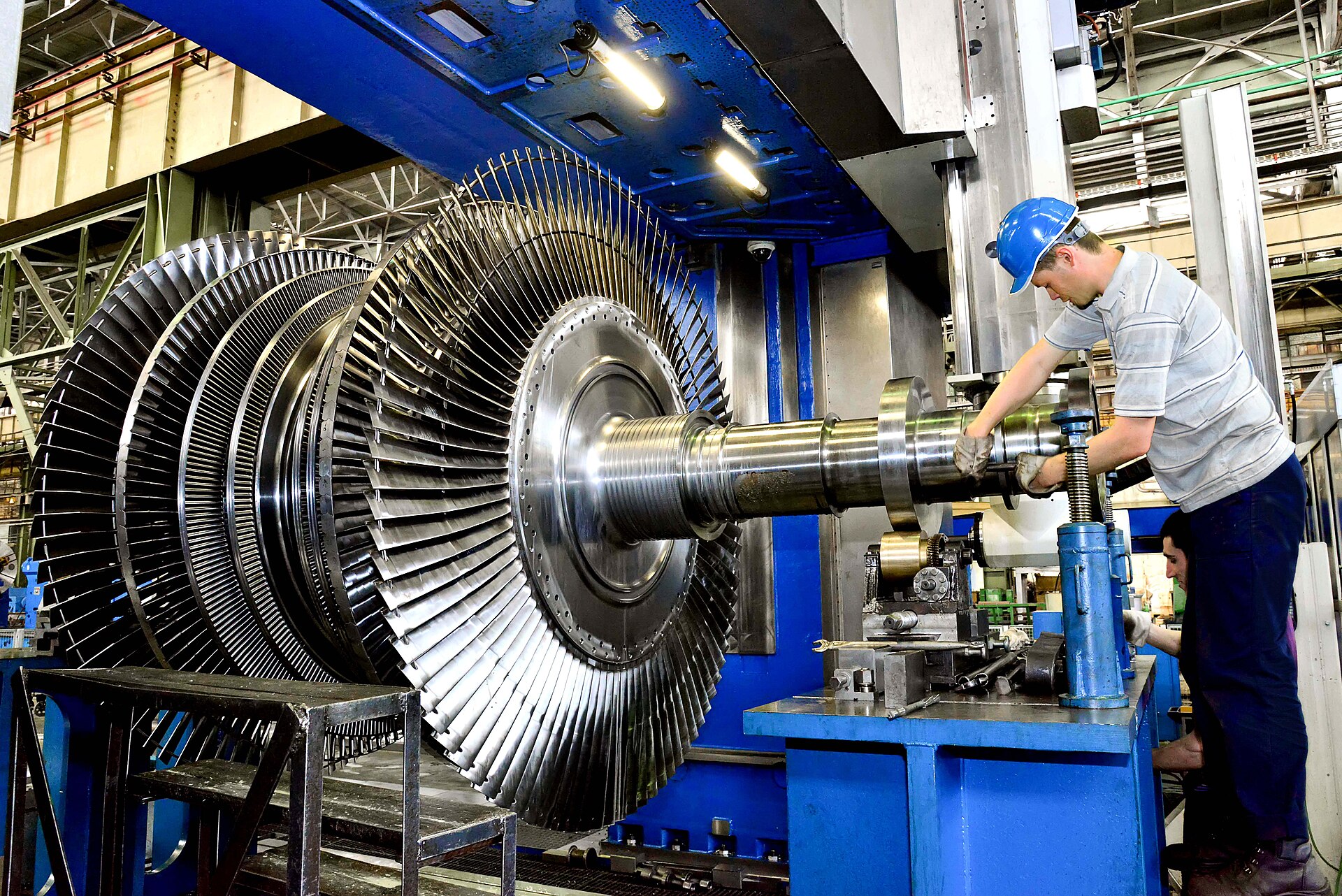
Cover photograph: Steam-turbine rotor illustration; not a Panshan generating unit. Elena Venediktova / Wikimedia Commons / CC BY-SA 2.0.
References
[1] 天下工厂制造业数据库 (Tianxia Gongchang Manufacturing Database).
[2] Harbin Electric Company Limited. China’s First Generating Unit with a Cross-Generation Parameter Upgrade Achieves Full-Load Trial Operation. 2024-09-21.
[3] CHN Energy, CEZB26A300512000. Public Tender for Outsourced Logistics Services at Tianjin Company’s Panshan Company, 2027–2029. 2026-11-09.
[4] Luo Haiyan, Xinhua; People’s Daily, June 7, 1996, page 2; digital mirror. An Excellent Answer to the Premier: How Beijing Ended Residential Electricity Rationing. 1996-06-07.
[5] China Energy News, Li Xinran and Zhang Jie. Beijing Electric Power Construction: Seizing New Opportunities in Beijing–Tianjin–Hebei. 2014-04-14.
[6] Original attachment released by the owner; design stage. Environmental Impact Assessment for Panshan Power Plant’s Innovative Upgrading and Life-Extension Project: Draft for Public Comment. 2021-12.
[7] CHN Energy, Gao Siyuan. Zhang Bin of Guohua Power’s Panshan Plant: Youth Shines at Work. 2020-05-15.
[8] Tianjin Daily, Wu Qiaojun. Cost Down 44%, Coal Consumption Down 14%, Service Life Extended 30 Years. 2024-12-09.
[9] Harbin Boiler. Harbin Boiler Efficiently Advances Guoneng Panshan’s Upgrade and Life-Extension Project. 2023-03-14.
[10] China Energy Engineering / Tianjin Electric Power Construction, He Yinlong. New Wine in Old Bottles, Old Friends Meet Again: An Account of China’s First Such Innovative Upgrading and Life-Extension Plant Project at Panshan in Jizhou, Tianjin. 2025-02-21.
[11] CCTV News, republished by Jimu News. New Heart and Lungs, a Stronger Body: New Approaches to Extending Aging Units’ Lives. 2024-11-20.
[12] Harbin Electric Group. Major Milestone: China’s First Generating Unit with a Cross-Generation Parameter Upgrade Achieves Full-Load Trial Operation. 2024-09-21.
[13] Harbin Boiler. Party-Building Project: Leading the Way to Advance Service Projects. 2023-09-19.
[14] Harbin Electric Group. Low-Pressure Turbine Casing Closure Completed for Unit 1 of Guodian Power’s Panshan Innovative Upgrade and Life-Extension Project. 2024-05-07.
[15] CHN Energy, Meng Boping. China’s First Life-Extension Transformation Unit Reports Major Performance Indicators Better Than Design. 2025-07-28.
[16] CHN Energy, Yang Li and Zang Xiulian. China’s First Life-Extension Transformation Unit Receives Recognition for a 30-Year Operating Term. 2025-04-16.
[17] National Energy Administration, North China Energy Regulatory Bureau. Administrative Licensing Announcement, Issue 12 of 2025. 2025-04.
[18] CHN Energy, Meng Boping and Wang Ming. Boiler Body Installation Completed for Unit 2 of the World’s First Russian-Made Supercritical Unit Life-Extension Transformation Project. 2026-10-28.
[19] CHN Energy News, Hou Huijie. Panshan Life-Extension Project’s Unit DCS Energized Successfully at the First Attempt. 2026-04-22.
[20] Tianjin Daily special supplement. The Rebirth of Aging Coal-Fired Generating Units. 2025-12-16.
[21] China Power News Network, Fan Lele and Wang Liqiang. Coal Consumption per Net Kilowatt-Hour Reduced by 45 Grams. 2024-12-30.
[22] CHN Energy, Wu Limeng and Wei Hua. Tianjin Company’s Panshan Plant Selected as an Outstanding Case of New Quality Productive Forces. 2025-10-15.
[23] CHN Energy News, contributed by the power division and Tianjin Company. CHN Energy Holds Seminar on the Panshan Model for Renewing Aging Coal-Fired Power Plants. 2025-03-12.