
Abstract: Focusing on the electro-optical hybrid underwater wet-mate connector developed by Guojun Wu’s team at the Xi’an Institute of Optics and Precision Mechanics, this article examines the interdependent requirements of dynamic sealing, mating force, and precise optical-fiber alignment. It traces verification from a failure in a high-pressure test apparatus and sea trials at approximately 1,600 meters in 2023 to 100 consecutive mating and demating cycles at more than 2,960 meters in 2025, and considers how long-term operation and manufacturing consistency determine the path to engineering applications.
In November 2023, in the South China Sea, a Chinese-developed connector completed two mating operations on a seafloor observation network approximately 1,600 meters below the surface. Optical and electrical connections were established, allowing power and information to pass through the interface. The Xi’an Institute of Optics and Precision Mechanics subsequently disclosed the trial. An acceptance announcement in January 2024 reported that the prototype had operated continuously without failure for more than 70 days.2 3
On land, making a connection rarely merits a news report. In the deep sea, it requires a complex set of technologies: moving parts must keep seawater out, a manipulator must be able to push the plug into place, and tiny optical channels must align accurately under pressure. All these conditions must hold together. Failure in any one can undermine the work that came before it.
The device has a name that seldom enters public view: an electro-optical hybrid underwater wet-mate connector. It was developed by Guojun Wu’s team at the Xi’an Institute of Optics and Precision Mechanics of the Chinese Academy of Sciences, working with several other institutions. Those first two mating operations were followed by another advance: in 2025, the team completed 100 consecutive mating and demating cycles at more than 2,960 meters in the South China Sea. A technical brief published in Acta Photonica Sinica in 2026 documented this progress.2 10
What deserves attention first is the work that preceded the connection.
A connector was damaged during a pressure test. Early prototypes repeatedly showed problems with electrical insulation, oil leakage, optical loss, and watertightness. The few lines of specifications in the success announcements came after faults that had to be explained and addressed one by one. Once signals were flowing on the seabed, the project leader did not end the story with a celebration. He emphasized that long-term reliability still required further examination.4 5
Here, the significance of Chinese manufacturing’s advance into the deep sea becomes tangible: people developed a device that could make a connection underwater, and they were prepared to remain responsible for the long period that followed.
1. Seafloor Engineering Needs Interfaces That Can Be Reconnected
To understand this development effort, first consider how a seafloor engineering project is built.
On shore, equipment can be brought into a workshop, assembled, and its wiring checked step by step. A seafloor observation network faces different scales and working conditions. Cables, nodes, and instruments must be manufactured and deployed separately, then connected. Adding equipment or replacing a failed instrument also requires an interface between the existing system and a new module. The connection method determines whether construction can proceed in sections and how much equipment must be recovered for maintenance.
A wet-mate connector provides the ability to connect and disconnect directly underwater. “Wet” describes the environment in which mating and demating take place. It does not mean seawater may freely enter the electrical contact region, nor does it automatically mean that energized mating is permitted. Whether a device can be operated while energized, and under what procedure, depends on the specific product’s design and operating requirements.
This distinction also separates it from another type of underwater connector. A dry-mate connector can be connected in a dry environment before the assembly is submerged. A wet-mate connector must also manage the transition between connection states. A product’s ability to withstand pressure for a long period is insufficient evidence that it can safely disconnect and reconnect under that same pressure.
Wu’s team faced an additional requirement: combining optical and electrical connections within one connector. Electrical channels carry energy, while optical channels carry information, placing different demands on the same structure. Electrical contacts require stable conduction and effective insulation; optical connections require controlled coupling losses. Both depend on a clean, stable internal environment, and both are affected by motion, seals, and manufacturing variation.
The institute’s product information published in 2024 lists four optical channels and two electrical channels. This describes a specific product configuration; it does not mean all underwater connectors use these channel counts.3
Seeing the connector merely as a small plug understates its role in the system. An observation node may contain advanced sensors and processors, but an unstable connection can prevent power from reaching them and data from returning reliably to shore. Advanced equipment and equipment that can remain part of a functioning network are related but distinct concerns.
The two mating operations in the sea trial therefore meant more than inserting a plug into a receptacle. They verified a longer chain of functions: the underwater actuator could complete the motion, internal contacts could be established, optical and electrical performance could be maintained, and the connected system could continue operating.
The development project began in August 2020 under a challenge-based research initiative. The lead institute worked with the Institute of Acoustics, the Changchun Institute of Applied Chemistry, the Shenyang Institute of Automation, and Laoshan Laboratory, among others. Their names need not become a series of institutional profiles, but they help explain the task: optical, materials, sealing, and underwater-operation problems were incorporated into one device.2
The team ultimately had to deliver a result in which all these elements worked together. Excellence in one technology could not substitute for the performance of the complete device at sea.
2. Keeping Seawater Out While Allowing Pressure In
Sealing is the first readily apparent difficulty. An intuitive approach is to build a sufficiently strong housing that keeps all external pressure outside. For a connection that must move repeatedly, however, this introduces another difficulty: the pressure difference between inside and outside can produce a large axial force, making mating and demating difficult.
A simple estimate illustrates the scale. Taking seawater density as 1,025 kilograms per cubic meter and gravitational acceleration as 9.81 meters per second squared, the water column at a depth of 1,620 meters produces approximately 16.3 megapascals of pressure. If a moving component experienced that full pressure difference over an effective area of one square centimeter, the corresponding force would be about 1,630 newtons—roughly the weight of a 166-kilogram mass on land.
This is only an illustration of the effect of differential pressure. It does not use the prototype’s actual effective area, is not its mating force, and does not account for pressure compensation in its structure. Deep-sea connector design must prevent that unfavorable pressure difference from acting in full on the moving parts.
In a 2024 interview, Yafeng Wu explained that the team used oil filling to balance the pressure of internal silicone oil with the external pressure, while protecting the optical fibers and electrical contact inserts from direct contact with seawater.4
Two points matter here. Pressure balancing does not mean keeping the interior at atmospheric pressure. And transmitting pressure does not mean admitting seawater. The basic function of oil-filled pressure compensation is to transmit external pressure to the internal medium through an appropriate structure, minimizing the pressure difference across critical seals. The separating structure must continue to keep seawater and the internal medium apart.
Published research on related technologies helps explain this mechanism. An electrical-connector paper by Wentao Song, Weicheng Cui, and colleagues describes elastic bladders that transmit pressure to internal insulating oil and analyzes the residual pressure difference after compensation. That work concerns a different team and a different electrical connector; it is neither a cross-sectional description nor a test record of Wu’s prototype. The shared principle it illustrates is that pressure compensation requires design and calculation. Filling a cavity with oil does not accomplish it automatically.6
In other words, the designer allows pressure to cross a boundary while preventing seawater from crossing it. Sealing thus becomes a coordinated problem involving materials, deformation, fluids, and motion.
As the device descends and external pressure rises, its internal medium and structure respond. During mating, moving parts change the available volume inside a cavity, and the compensation structure must accommodate that change. Inadequate compensation adds resistance; inadequate sealing can allow water and contaminants to threaten insulation and optical connections. The specific effects depend on the structure. Not every wet-mate connector uses the same oil-cavity arrangement, but the relationship among these constraints is clear.
This is why dynamic sealing is more difficult than remaining leak-free at rest. Surfaces that fit together when stationary must maintain the appropriate contact as they move. Seals must permit displacement while controlling leakage; components must return to position without friction or deformation leaving them in the wrong place.
The acceptance material for Wu’s project identifies deep-sea plunger dynamic sealing and synchronous actuation as one of its key advances. Behind that technical term lies a requirement for the sealing state to change in a controlled manner throughout the mating and demating process.2
Reliability assessment must therefore cover the entire motion: from separation to connection, and from connection back to separation. Every intermediate position is part of the product’s required operating state.
A photograph of a completed connection cannot answer all these questions. Nor can a theoretical curve for a seal. The device must actually move, with its performance measured throughout the motion. Development consequently advances from materials and structures into the test method itself.
3. A Tighter Seal Does Not Necessarily Make Success Easier
Seawater must stay out, while the plug must remain movable. The two requirements meet at the same contact surfaces.
Greater constraint at a sealing contact will generally help suppress leakage, but it may also increase friction or make a structure more sensitive to manufacturing variation. Reducing motion resistance must likewise preserve sealing and reliable return to position. Material deformation under pressure combines with dimensions, surface condition, the working medium, and assembly to determine performance. Optimizing a single metric can shift the problem elsewhere.
The institute’s account of the team describes a plunger assembly required to withstand high pressure while maintaining low friction. The drive rod also had to combine resistance to seawater corrosion, fatigue performance, strength, and dimensional precision. The team compared structures and materials and checked manufacturing processes.5
These demands resist a simple description such as “better.” Is a harder material still suitable for the sealing fit? Can a smaller clearance be reproduced consistently in manufacturing and assembly? Will a structure that moves smoothly at atmospheric pressure still do so under high pressure? Every choice must be examined in its actual operating conditions.
This makes the factory floor part of the development effort. Drawings define target geometry; processes turn that geometry into actual surfaces. From an engineering perspective, dimensional variation, surface condition, and assembly errors can all affect high-pressure motion and multichannel contact. Researchers must carry their design requirements into manufacturing.
For the sea-trial system, mating resistance must also match the actuator’s capability. An actuator cannot resolve every uncertainty simply by applying more force. Excessive force can damage precision components or turn a misalignment that guidance could have corrected into jamming and lateral loads.
Evaluating whether a connector “goes in” therefore requires checking whether the motion is completed within allowable force and displacement ranges, whether contacts reach their intended positions, and whether optical and electrical performance meet the requirements afterward. A successful mechanical motion and a successful complete connection remain different achievements.
The institute’s product page specifies a maximum insertion force of 320 newtons. Mechanical operating load has thus become an explicit product metric. This is a published specification; the page does not include complete test conditions or the original sea-trial curves.3
Likewise, the earlier illustrative force of approximately 1,630 newtons cannot be compared directly with 320 newtons as a measure of product quality. The former assumes a chosen area and full pressure difference; the latter is a specification for a particular device. Together they can explain why pressure compensation matters, but they are not results from tests conducted under identical conditions.
This also shows why pressure compensation, sealing, and actuation capability must be considered within a single design.
4. The Manipulator Delivers the Connector; the Optical Channels Still Need to Align
Beyond motion resistance, optical connection takes the problem to a smaller scale.
An electrical connection needs a conductive path that meets its requirements. An optical connection must also ensure that light leaving one channel enters another efficiently. Lateral position, angle, end-face condition, and the intervening medium all affect coupling. Joining the outer housings does not by itself establish a sound optical connection.
The China Science Daily interview states that the prototype’s optical-fiber core diameter was approximately nine micrometers. It also describes multistage guidance that achieves precise internal mating despite the manipulator’s limited operating precision.4
Nine micrometers is a physical core diameter. Manipulator positioning precision and internal connection precision belong to different levels of requirements. The underwater-operation problem is how to translate coarse external positioning into precise internal alignment.
Multistage guidance allocates these precision tasks appropriately. The external structure first accommodates a larger initial offset. As insertion proceeds, subsequent fits progressively constrain the position, leaving precision internal structures to manage the relative position of the optical channels. Each level handles a different scale, linking underwater operation to the internal optical requirements.
The functional sequence can be expressed as follows:
Accommodate some initial approach error → guide the outer components into place → control internal relative positions → establish protected optical and electrical connections.
This is a functional illustration derived from publicly described principles; in actual movement, the functions operate in coordination.
For a multichannel device, several optical paths must meet their requirements together. A good connection on one channel does not automatically qualify the others. Nor does low loss in one mating operation establish that the loss distribution remains stable after repeated cycles. Design must manage the assembly relationship among the channels, and manufacturing must reproduce it consistently.
Suspended particles in seawater introduce another variable. Contamination in an optical contact region can alter end-face condition and coupling. Sealing therefore serves both electrical insulation and a stable optical environment. The water-exclusion problem in the preceding sections and the precision problem here are embodied in the same structure.
Other approaches to underwater optical connections are also being explored. Qi Tan and colleagues published a study in Optics and Precision Engineering on another contact-based optical-fiber coupling method, examining in-situ connections in clean water and reporting experimental results. It offers a different approach to optical-path design, with a research object and verification scope distinct from the complete-device sea trial at the center of this article.7
Technological progress can come from a new structure or from combining established physical principles for conditions that were previously difficult to accommodate. Wu’s team had to make optics, electricity, sealing, and motion work together in a real deep-sea environment.
The institute’s product information specifies optical-fiber insertion loss below 0.36 decibels at wavelengths of 1,310/1,550 nanometers. Insertion loss describes the loss of optical power introduced by a connection; it cannot be converted directly into data transmission speed. Taking 0.36 decibels solely as an illustrative loss for a single connection corresponds to transmitted power of approximately 92% of the input. An actual communication system must also account for losses elsewhere in its components and lines.3
Behind a small loss figure lies considerable work that photographs cannot easily show. The public sees a plug approaching a receptacle; engineers need to know what happens to every channel along the way.
5. One Damaged Prototype Made the Test Apparatus Part of the Research
Technical problems can be explained separately, but a prototype presents them together.
The institute’s team account records electrical insulation failure, oil-pipe leakage, excessive optical insertion loss, and longitudinal watertightness failure during repeated tests of early prototypes.5
These faults span electricity, fluids, optics, and structural sealing, illustrating the distance between completing a drawing and producing a usable device. A failure in one area may appear in another measured variable, so diagnosis requires tracing the chain of causes. An abnormal optical signal may involve alignment, contamination, or damage; deteriorating insulation requires investigation along the possible paths of influence. The public material does not describe every diagnostic step, but the types of faults recorded already show that debugging was far more complex than the final result suggests.
What is clear is that the test method itself also had to evolve.
According to the 2024 interview, the team initially checked for leakage in shallow water. To test dynamic mating under high pressure, it subsequently designed a linear-guide apparatus that could fit inside a pressure vessel. During one test, a travel limit in the auxiliary apparatus failed. The connector moved beyond its intended travel and was damaged, followed by abnormal monitored signals. Guojun Wu explicitly attributed the immediate cause to the auxiliary equipment.4
This detail matters because it restores the real complexity of development. Failure may arise in the equipment used to evaluate a component, rather than in the component’s core function.
Putting a connector into a pressure vessel addresses only part of the pressure environment. Examining the dynamic process also requires dependable actuation, correct travel, stable mounting, interpretable measurements, and a correspondence between movement and monitoring. When a prototype behaves abnormally in an apparatus, researchers must examine both the prototype and whether the apparatus imposed the intended conditions.
A test system must provide more than a pressure reading; its movements must also be trustworthy. If a travel limit fails, a test intended to verify a product can apply a load beyond the designed travel. The resulting damage cannot simply be recorded as product failure under normal conditions. Nor should it disappear from the development record merely because the auxiliary apparatus caused it. It still exposes a weakness in the verification chain.
To demonstrate that a connector could move in the deep sea, the researchers first had to build an apparatus that could move reliably under high pressure. When that apparatus malfunctioned, they had to face the damaged hardware and re-examine the conditions used to judge the product.
The difficulty of research takes a definite form here: a prototype pushed beyond its travel, a set of abnormal signals, a test condition that needs reconsideration. It does not yield simply because the task is important, or lower its demands because the participants have invested considerable time.
For an engineering team, patience matters because it allows failure to be broken down into questions. Which part crossed a limit? Which condition was uncontrolled? Which measurements remain usable? Which results need to be obtained again? Resolving these questions one by one makes another step toward sea trials possible.
This is also what gives the story its emotional force. A major undertaking ultimately rests on specific human work: reading drawings, checking dimensions, assembling parts, applying pressure, recording results, and analyzing them. Each step is ordinary. Together they give a Chinese-developed device the chance to remain in the deep sea.
6. Real Seawater Extends the Verification
Tests in a pressure vessel allow conditions to be controlled, motions to be repeated, and causes to be investigated. Sea trials put the device into an actual operating system.
Both have their roles. Laboratory work helps isolate factors; sea trials examine the device, actuator, deployment procedures, and the system after connection. Passing a high-pressure simulation cannot replace a real sea trial, while one successful sea trial does not remove the need for continued laboratory investigation of weaknesses.
The institute’s July 2024 product description identifies the earlier trial as taking place in November 2023, on a seafloor observation network at approximately 1,600 meters associated with the Lingshui base. It records two mating operations, normal optical and electrical connections, and integration into the observation network for long-term testing.3
This supports a clear conclusion: the team demonstrated the connection function of this electro-optical hybrid wet-mate prototype under real deep-sea conditions. The design and high-pressure testing had advanced to operation within an actual environmental system.
Time then became another form of verification. In January 2024, the public record was still more than 70 days of continuous failure-free operation. In the technical brief published in 2026, the authors reported that the engineering prototype deployed in 2023 had operated continuously and stably without failure for more than two years. That new record gave the initial months of validation a longer foundation. It remains the state reported in the paper and cannot automatically be extended to any later date.2 10
A successful connection and sustained operation answer two successive questions. The former provides evidence for the technical approach in a real environment; the latter requires time to keep supplying answers.
Several easily confused numbers also need to be distinguished.
| Public information | What it establishes | What it does not directly prove |
|---|---|---|
| Approximately 1,600 meters and two mating operations in the 2023 sea trial | The depth and operations reported for that trial stage | Equivalent sea trials at every rated depth |
| More than 70 days of operation reported in January 2024; more than two years disclosed in the 2026 brief | Operating status at two reporting points | Failure-free operation through this article’s checking date, or a demonstrated 20-year life |
| Product-page depth range of 0–3,500 meters, with customization to 6,000 meters | The institution’s published product rating | A completed sea trial of that prototype at 6,000 meters |
| Product-page specification of at least 100 mating/demating cycles | A published repeated-cycle capability | 100 measured cycles on the seabed in 2023 |
| The 2026 brief records 100 consecutive cycles at more than 2,960 meters in 2025 | Repeated-cycle verification in a subsequent real sea trial | The same verification at all rated depths, in all conditions, and across production batches |
The early sea-trial information comes from the institute’s announcement, the 2024 specifications from its product-page performance table, and the subsequent trial and operation information from the 2026 brief.2 3 10
The project passed acceptance on January 17, 2024. The expert panel recommended accelerating commercialization. This was a substantive advance, and it presented the team with another question: how to turn a verified prototype into a product users would entrust with long-term service.2
Subsequent work extended verification. In their 2026 Acta Photonica Sinica brief, Long Zhao, Guojun Wu, Yafeng Wu, and colleagues describe tests based on API STD 17F and related company technical specifications. They included dynamic pressure-environment cycles, high- and low-temperature shock, mechanical vibration and shock, dielectric withstand, partial discharge, and oil-filled tail-cable dragging. The paper reports that these tests met the relevant requirements. As the brief does not provide all the original curves for each item, they are retained here as the authors’ reported conclusions.10
Repeated motion in deeper seawater required a new apparatus. The team developed an automatic mating test apparatus suitable for underwater pressure environments, enabling the connector to cycle automatically between mating and separation. The earlier linear-guide apparatus had brought dynamic testing into a pressure vessel. The new automatic apparatus brought repeatable cycling into real seawater. Their structures and settings differed, but they addressed the same continuing question: how to establish reliability more thoroughly.
In 2025, in an area of the South China Sea more than 2,960 meters deep, the team used the automatic mating apparatus and junction-box system to complete 100 consecutive mating and demating cycles. The brief reports normal optical and electrical coupling throughout the trial. A load camera received power through the connector, while the verification video it recorded returned in real time to the main control cabin through the connector’s optical-fiber path.10
This complete chain gives concrete meaning to “normal connection”: electrical energy crossed the interface to operate the camera, and images traveled back through the optical path for the trial personnel to examine. The device withstood real seawater pressure while repeatedly separating and reconnecting.
The advance from two operations to 100 was more than a higher count. A single connection asks whether a function can be achieved. Consecutive cycles further examine whether the motion can be repeated and whether sealing and optical and electrical contacts remain functional throughout. This did not exhaust every challenge of the deep sea, but it added new evidence to that first connection.
A prototype test once damaged by an auxiliary travel-limit failure and a test system capable of automatic cycling nearly 3,000 meters underwater provide a particularly meaningful connection between the earlier and later stages. Manufacturing capability grows through such advances: first developing the device, then making the means of testing it more thorough.
7. After Connection Comes the Test of Time
Looking back at the 2024 interview, Guojun Wu distinguished establishing the technical principle and achieving advanced-product levels on certain key metrics from proving long-term reliability. He noted that deep-sea pressure and corrosive saline conditions continually test materials and structures, and that long-term reliability needed further examination and improvement. The 20 years mentioned in the interview described the long service expectations of such engineering applications.4
The later disclosures of more than two years of operation and 100 deep-sea cycles accumulated evidence along precisely those lines. A 20-year service requirement remains far beyond the reported duration, but the team continued moving forward. Acknowledging the need for verification and undertaking more of it are connected here.
From connector principles, long-term validation involves at least three areas.
First, seals must retain their function over prolonged environmental exposure. Materials interact with working media, and sustained pressure, temperature changes, and repeated deformation can alter their properties. An acceptable initial condition does not ensure that every condition will remain unchanged over time. Material compatibility, sustained sealing performance, and repeatable testing therefore form part of long-term validation.
Second, optical and electrical performance must withstand both movement and immersion. A connector may remain mated for most of its time, or it may undergo disconnection, replacement, and reconnection. Cycle counts and immersion duration address different effects; one test cannot simply replace the other. Many cycles in a short period provide evidence about cycling, while a prolonged mated state examines another set of conditions.
Third, the connector must suit the maintenance practices of the actual project. Inspectability, recognition of a completed connection, and fault diagnosis and handling all affect use. Performance assessment should also match the task. Observation networks, oil and gas equipment, and underwater unmanned platforms differ in voltage, channels, maintenance windows, and mission requirements. A single set of striking specifications cannot judge every product.
The wet-mate connector review published in 2025 by Guojun Wu and colleagues likewise places reliability, service life, and verification costs among the field’s central development issues. It represents the team’s systematic understanding of these issues, rather than a new long-term operating report.8
This helps explain why experienced users care about service records. The consequences of a deep-sea failure often extend beyond the cost of replacing one component. A fault may affect a mission, require operating resources to be mobilized, or necessitate waiting for suitable maintenance conditions. Without project-specific vessel-time, support, and downtime data, this article does not estimate a cost per failure. It is nevertheless clear that procurement decisions must place the component within the complete engineering system.
The field experience accumulated by mature products is an engineering asset that deserves serious consideration. Chinese teams developing their own capabilities must likewise accumulate traceable records: product type, batch, environment, actions performed, metrics recorded, and the treatment of anomalies. More complete records give both subsequent design work and user decisions a stronger foundation.
Such records tend to attract less attention than an initial announcement, but they determine how far a technology can go.
The institute’s 2025 budget includes a dynamic high-pressure test-platform project for wet-mate connectors, with annual objectives to purchase or develop related equipment. The budget demonstrates that verification infrastructure was planned; it does not establish that the project was built or accepted as intended.9
Observing these underlying capabilities helps explain the later part of development. Products need continued testing, and testing capacity needs continued investment. A test platform makes more conditions controllable, more motions repeatable, and more results comparable. Like the prototype itself, it forms part of manufacturing capability’s growth.
8. From Making One Device to Making a Consistent Batch
Manufacturing consistency is another step between prototype and product.
A research team can devote extensive analysis and adjustment to one prototype. Users purchase products that meet agreed requirements and can be supplied and maintained consistently. The success of a carefully tuned device deserves recognition. A more stable delivery capability emerges when the production process can make every device meet its requirements.
This is especially concrete for an electro-optical hybrid wet-mate connector. Mechanical fits affect guidance and resistance; seal materials, processing, and assembly affect watertightness; and the relative positions of optical connection components affect loss. A manufacturing-process change must therefore be assessed for its effects on multiple performance measures, rather than checked only for a consistent appearance.
Commercialization consequently requires clear inspection conditions and recording methods. Specifications for insertion force, insulation resistance, insertion loss, and cycle count must correspond to executable test procedures. Part, assembly, and complete-device inspections also need to be traceable to one another. Subsequent production and delivery records must establish how complete these capabilities are.
The connector and cable termination should also be treated as an interacting system. Even if the mating interface meets its requirements, failures at a cable entry, rear seal, load-transfer point, or termination can affect the whole assembly. Focusing only on the plug and receptacle at the front can obscure the engineering behind them.
The oil-pipe leakage and longitudinal watertightness failure mentioned in the team’s account make this whole-system perspective necessary.5
These are also areas in which manufacturing companies can participate. Materials selection, precision machining, clean assembly, sealing processes, and performance testing must jointly support consistent results. Advances in critical components such as these place real and detailed demands on manufacturing.
Independent capability becomes more complete through the ability to propose designs and explain principles, master manufacturing, assembly, and inspection, and diagnose, correct, and revalidate problems when they arise.
The institute has presented this achievement as a product, and the 2026 brief provides further progress on operation and cycle testing. Commercial use still needs delivery records to support it. The primary sources obtained by this article’s checking date are insufficient to confirm actual delivery volumes or the scale of commercial orders.
The studies by different teams discussed above show that underwater connection technology continues to develop along multiple paths. An achievement’s value should be understood through the problems it actually solves and the verification it actually obtains.
The public record left by Wu’s team reveals technical constraints, real failures, and an engineering attitude together. It also shows how industrial capability grows within a specific component.
9. After the Signals Came Through
Let us return to the South China Sea in November 2023.
At approximately 1,600 meters, two mating operations established normal optical and electrical connections. The initial record later extended to more than two years of stable operation reported by the authors. In another sea trial, at more than 2,960 meters, the connector completed 100 consecutive mating and demating cycles.
The established facts are enough to give pause.
Behind a Chinese-developed device capable of making a connection in the deep sea lies sustained work on pressure, friction, seals, and tiny optical paths. Laboratory anomalies that needed repeated explanation, dimensions that could not be left ambiguous in drawings, and manufacturing requirements that had to be realized on the factory floor eventually converged in an apparently simple motion.
China’s industrial progress sometimes takes the form of a large vessel or machine heading offshore. It can also take the form of an interface between machines that can finally be developed and tested domestically. The former is easier to see; the latter deserves to be remembered as well. It provides a foundation on which more engineering choices can grow.
After the initial success, Guojun Wu continued to discuss long-term reliability. Subsequent work turned that responsibility into longer operating records and more deep-sea tests. Researchers understand that every day after connection remains part of the technology’s responsibility.
For deep-sea engineering, the value of a connection must ultimately be answered by the time that follows it. For manufacturing, the significance of a development effort likewise emerges through continued verification, improvement, and delivery.
Those two deep-sea mating operations carried work done on shore into real seawater. Later, 100 consecutive movements gave that work a further resonance. Longer periods, broader conditions, and production batches still need examination. But what has already been accomplished gives us reason to feel proud of China’s engineers. A single connection carries their patience: taking on a problem, and continuing to work through it one part at a time.
Sources and Methods
This article is an engineering and industry study based on public sources; no on-site interviews were conducted. Personal accounts and fault details are attributed to the original reporting or institutional material. Discussions of technical constraints and commercialization are research analysis; undisclosed structures are not inferred. Pressure, force, and optical-power conversions are illustrative calculations using a constant-density hydrostatic model and standard decibel conversion, not design calculations for the prototype.
Public accounts give different levels of precision for the first 2023 trial: approximately 1,600 meters in the early institutional announcement, 1,620 meters in the China Science Daily interview, and 1,625 meters in the 2026 brief. The narrative consistently uses approximately 1,600 meters; the illustrative pressure calculation retains the interview’s 1,620 meters. “3,000-meter class” in the 2026 brief’s title refers to a reported trial location at more than 2,960 meters; that trial occurred in 2025. The description of more than two years of operation is used as the status reported in the paper.
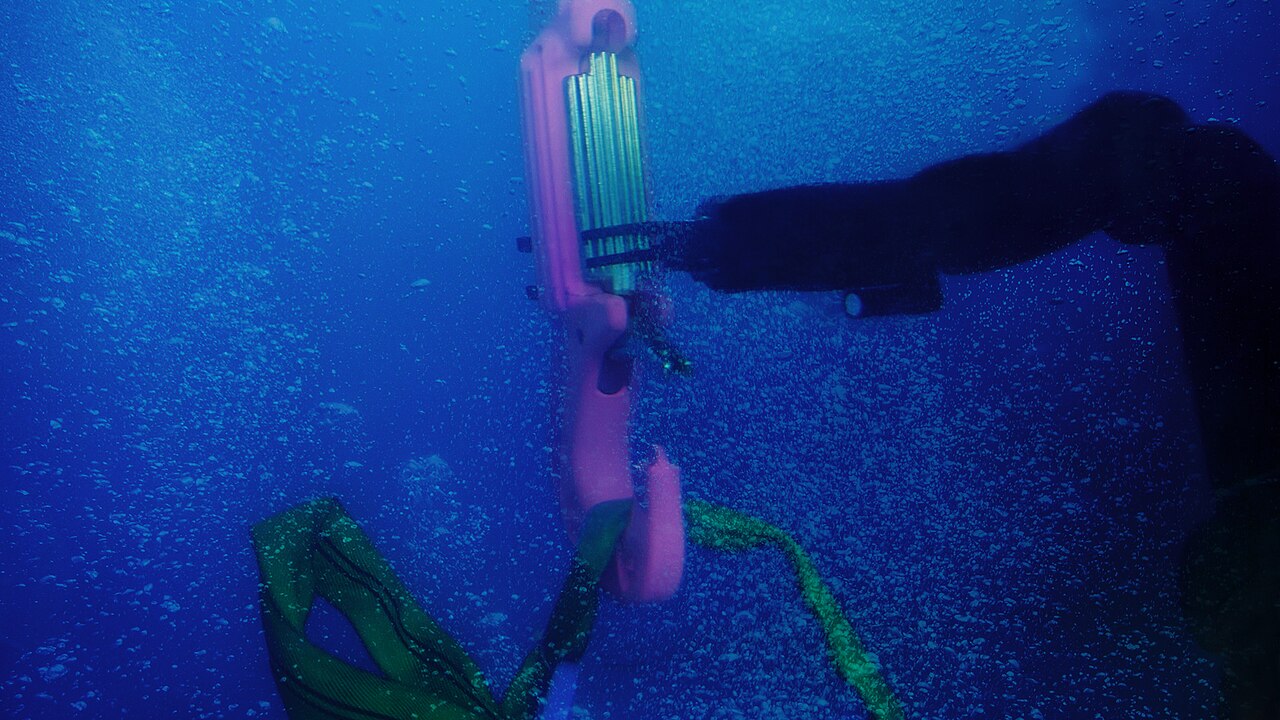
Cover photograph: Underwater manipulator illustration; not the Chinese connector prototype discussed here. BPLINFO / Blueprint Lab / Wikimedia Commons / CC BY-SA 4.0 / Blueprint Lab.
References
[1] 天下工厂制造业数据库 (Tianxia Gongchang Manufacturing Database).
[2] Xi’an Institute of Optics and Precision Mechanics, Chinese Academy of Sciences. Announcement of China’s first deep-sea underwater wet-mate connector of the reported category, January 19, 2024. Institutional announcement.
[3] Marine Optical Technology Research Division, Xi’an Institute of Optics and Precision Mechanics. Wet-Mate Electro-Optical Hybrid Connector, July 9, 2024, including the performance-specification image. Product page.
[4] Tao Yan and Xingyong Zhang. Report on the technology protecting deep-sea optical and electrical transmission from seawater. China Science Daily, January 30, 2024, page 1. Interview report.
[5] Xi’an Institute of Optics and Precision Mechanics. 2023 Pioneer Team: Deep-Sea Wet-Mate Connection Technology Development Team. The webpage displays June 9, 2026; the award year described is 2023. Team account.
[6] Song W, Yang C, Cui W, et al. An Underwater Wet-Mateable Electrical Connector with Dual-Bladder Pressure-Balanced Oil-Filled (PBOF) Technology. Journal of Marine Science and Engineering, 2023, 11(1):156. DOI: 10.3390/jmse11010156. Electrical-connector research by a different team, used only for comparison of principles.
[7] Tan Q, Meng H, Yin J, et al. Design and performance analysis of contact fiber-coupled of underwater wet-mateable connector. Optics and Precision Engineering, 2023, 31(3):313–321. DOI: 10.37188/OPE.20233103.0313. A different approach, used only to clarify the scope of technical alternatives.
[8] Zhao L, Wu G, Yan Z, Wang D, Hang D. Current status and trends of wet-mate connectors. Intelligent Marine Technology and Systems, 2025, 3:4. DOI: 10.1007/s44295-025-00053-8.
[9] Xi’an Institute of Optics and Precision Mechanics. 2025 Departmental Budget, performance-target table for the wet-mate connector dynamic high-pressure test-platform project, physical PDF page 27 / printed page 24. Budget PDF.
[10] Zhao L, Wu G, Wu Y, Wang D, Yan Z, Hang D. The Domestically Manufactured underwater Electro-optical Hybrid Wet-mate Connector has Successfully Completed the 100-cycle Mating and Demating Test at a Depth of 3,000 Meters in the Deep Sea Class. Acta Photonica Sinica, 2026, 55(3):0337001, technical brief. The Chinese Optical Journal Network lists online publication as May 13, 2026. Full text, publication information.