
Chapter 1 Industry Overview and CCL Definition
1. What Is a Copper Clad Laminate
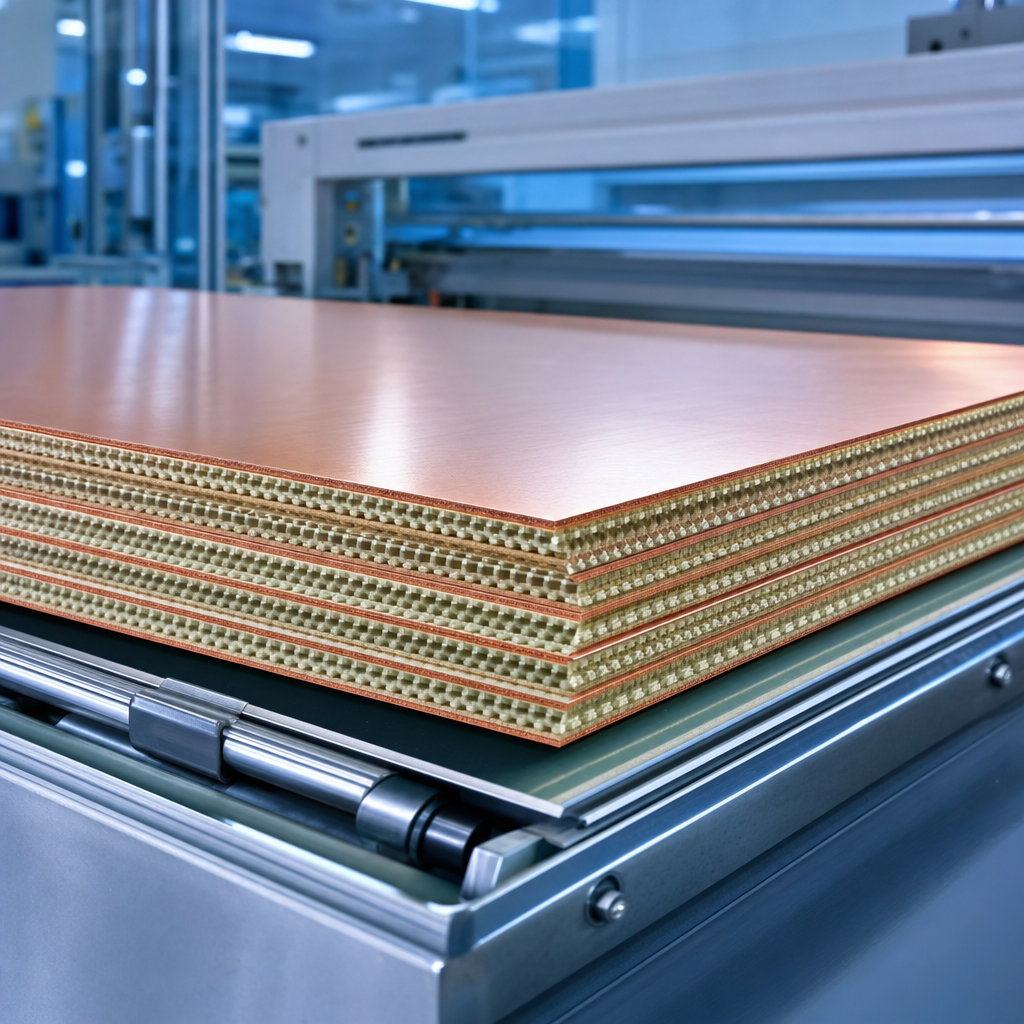
Copper Clad Laminate (CCL) is one of the most fundamental structural materials in modern electronics manufacturing. As its name implies, CCL is created by bonding electrolytic copper foil through high-temperature, high-pressure lamination to an insulating substrate — typically glass fiber fabric, polyimide film, ceramic composite, or metal core — on one or both sides, forming a composite sheet that combines a conductive layer with an insulating layer.
This seemingly simple physical structure carries seventy years of accumulated technical wisdom. From early phenolic resin paper-based CCL (XPC/FR-1, 1950s–1960s) to epoxy glass fabric CCL (FR-4, standardized in the 1970s–1980s), and on to today's high-speed and high-frequency CCL based on polyphenylene ether (PPE), cyanate ester, and PTFE resin systems, as well as polyimide-based flexible CCL (FCCL) and ultra-precision IC package substrate materials (ABF/BT resin), the CCL category has expanded from one or two types into a complete product matrix spanning multiple material systems and dozens of sub-segments.
Understanding CCL's strategic importance requires three dimensions of consideration:
Dimension 1: Unique Position in the Supply Chain. CCL sits between upstream bulk commodities (copper ore, glass sand) and downstream end products (smartphones, servers), as a critical intermediate material. Such materials are characterized by substantial volume, clear technology barriers, strong correlation with downstream demand, and significant exposure to upstream raw material price fluctuations.
Dimension 2: Decisive Influence on PCB Performance. The performance ceiling of a PCB is to a large extent determined by the CCL's material properties. In high-speed digital signal transmission and high-frequency microwave applications, the CCL's dielectric constant (Dk) and dissipation factor (Df) directly determine whether signals can propagate without distortion and at low loss — a direct material-to-system-performance mapping that cannot be fundamentally altered through process adjustments or design compensation alone.
Dimension 3: Strategic Value Leap in the AI Era. For thirty years, CCL was a relatively low-profile material category servicing stable consumer and industrial electronics demand with transparent pricing and limited margins. Since the generative AI explosion of 2022, however, AI servers and data centers have driven explosive demand for high-end PCBs, and the high-speed CCL (M7/M8/M9 grade) required for these PCBs is precisely the most supply-constrained, fastest-appreciating, and lowest-domestically-substituted sub-segment. A CCL company once regarded as an ordinary manufacturer (such as Shengyi Technology) has in two years become a core node in the AI computing supply chain, reflecting the profound logic of the industry's historic repositioning.
2. CCL's Position in the Supply Chain
The four-layer value chain from raw materials to end products: (1) Upstream Raw Materials — copper foil (30–40% of CCL cost), electronic-grade fiberglass cloth (20–30%), and resin systems (20%); (2) CCL and Prepreg Manufacturing — the core research object of this report; (3) PCB Manufacturing — dozens of precision processes turning CCL into printed circuit boards; and (4) System Assembly — PCBA and final electronics products. CCL at layer 2 is the pivotal link: its properties determine the PCB performance ceiling, while end-market application requirements determine the CCL specification needed.
3. Core Functional Attributes of CCL
CCL must simultaneously fulfill three functional attributes: (1) Electrical Conduction — the copper foil layer provides low-impedance current pathways; in high-frequency circuits, the copper surface roughness (Rz) must be minimized to reduce skin-effect conductor losses; (2) Electrical Insulation — the substrate provides high-quality insulation, with Dk determining signal propagation speed and Df determining signal attenuation per unit length; (3) Mechanical Support — the CCL backbone maintains dimensional stability under stress, vibration, and thermal shock, with key parameters including glass transition temperature (Tg), coefficient of thermal expansion (CTE), and copper peel strength.
4. Main CCL Product Categories
CCL has diversified into six major categories: General FR-4 (most widely used, ~60–70% of total CCL volume, ~95% domestically supplied in China); High-Speed CCL / Low-Loss CCL (M4–M9 grades, targeting 10 GHz+ digital signals, key for AI servers); High-Frequency CCL (PTFE-based, 1–100 GHz microwave applications, 5G base stations, automotive radar); IC Package Substrate CCL (ABF/BT, the most precision-demanding category, <5% domestically supplied); Flexible CCL / FCCL (PI-based, for FPC in foldable screens and wearables); and Metal Core CCL / MCCL (aluminum-based, for high-power LED and EV power modules).
5. Global Annual Market Value and Strategic Significance
The global CCL and prepreg market reached approximately $187.6 billion in 2025, expected to exceed $198.7 billion in 2026. High-speed CCL (M4 and above) accounts for 20–25% of the market and is growing at approximately 26% CAGR (2024–2026). A single AI server uses PCB content worth approximately RMB 19,500 — eight times that of a conventional server — making CCL one of the most indispensable foundational materials of the AI era.
Chapter 2 Global Landscape and China's Position
1. Global CCL Market Overview
The global CCL market is dominated by a few large players: Kingboard Laminates (HK, ~14–21% share, #1 in general FR-4 volume, 900 million sheets/month, 20+ factories); Shengyi Technology (China, ~14–18.5% share, top-3 rigid CCL globally, the key domestic high-end breakthrough company); EMC (Taiwan, ~13%); Nan Ya Plastics (Taiwan, ~8%); and Panasonic (Japan, dominant in high-speed CCL with the Megtron series). The top five together hold over 60% of global market share.
Other notable players include Resonac (Japan, BT resin and specialty CCL), Rogers (USA, global benchmark in high-frequency CCL), Isola (USA), ITEQ (Taiwan), and Doosan (Korea).
2. China's Dual Role in the Global CCL Landscape
China plays a uniquely dual role: the world's largest CCL consumer and biggest general-grade CCL producer, while simultaneously being the largest gap-filler in high-end segments. Domestication rates by tier: FR-4 ~95%; M4/M6 high-speed ~30–50%; M7/M8 ~15–25%; M9 <5% (Shengyi is the sole mainland certified entity); PTFE high-frequency CCL ~6–8%; ABF package substrate film <5%.
3. 2026: A Watershed Year
2026 is a watershed year for the global CCL industry driven by several structural factors: explosive AI computing demand (NVIDIA Rubin/GB300 server volumes at an historical peak, Megtron supply under allocation with 3–6 month lead times); copper prices surpassing $13,000/ton and NE-glass shortfall of 30–50%; and domestic substitution milestones (Shengyi M9 NVIDIA certification in December 2025, the RMB 5.2 billion Dongguan expansion announced in April 2026).
A historic price surge occurred in Q1 2026: Resonac raised prices 30%+; Kingboard raised prices 10% twice (December 2025 and March 2026); Nan Ya Plastics and Wuxi Hongren both raised 15%. Korea CCL import prices hit a record $20,728/ton in March 2026, up 74.5% year-on-year.
Chapter 3 Core Technologies
1. FR-4 General CCL Technology
FR-4 — named from NEMA flame retardant grade 4 — uses E-glass electronic fiberglass and epoxy resin cured with DICY, with bromine or phosphorus-based flame retardants. The two-stage manufacturing process (prepreg preparation followed by lamination at 170–200°C, 8–15 MPa) produces boards with Dk of 4.2–4.6 at 1 MHz, Df of 0.012–0.020, Tg of 130–180°C, and CTE of 55–65 ppm/°C in the Z-axis. China has fully domesticated this category, with Kingboard and Shengyi as the dominant global volume producers.
2. High-Speed CCL Technology (Low-Loss CCL)
For 10 GHz+ digital signals, high-speed CCL (M4–M9 grade) achieves low Df through three technical routes: Resin Upgrade (replacing epoxy with PPE, cyanate ester, or BMI — PPE from Asahi Kasei's Xyron brand is the primary low-polarity resin for M6 and above); Fiberglass Upgrade (E-glass → NE-glass → Q-glass, reducing Dk from ~6.6 to ~3.8); and Copper Foil Upgrade (standard ED copper Rz 6–10 μm → HVLP Rz <2 μm, primarily from Mitsui Mining and Furukawa Electric).
The Megtron grade hierarchy: M4 Df ~0.008–0.013; M6 Df ~0.004–0.006; M7 Df ~0.002–0.003; M8 Df ~0.0015–0.002; M9 Df <0.002. Shengyi's M9 breakthrough (December 2025, NVIDIA certification, 90% yield vs. industry average 70%, planned 12 million sqm/year capacity) is the most significant mainland domestic substitution milestone in the high-speed CCL space.
3. High-Frequency CCL Technology
PTFE (Dk ~2.1, Df ~0.0002–0.0005 at its intrinsic limit) overcomes its poor adhesion to copper foil through chemical etching, plasma treatment, or the "suspension method" patented by Zhongying Technology. Rogers dominates this segment: RO4350B (Dk 3.66, Df 0.0037 at 10 GHz) is the global reference for 5G antennas; RT/Duroid 5880 (Dk 2.20, Df 0.0009) is the millimeter-wave research standard. Domestic players Huazheng New Materials and Zhongying Technology have achieved Df of ~0.002 at 10 GHz, capturing ~6–8% of the domestic high-frequency market.
4. IC Package Substrate Materials
ABF (Ajinomoto Build-up Film): The premier advanced package substrate material, monopolized by Ajinomoto (>95% global share) through three moats — proprietary formulation know-how, equipment binding (dedicated vacuum laminators), and process binding (requalification takes 12–24 months). Goldman Sachs forecasts ABF supply gaps of 10% (2026H2), 21% (2027), and 42% (2028). BT Resin Substrates: Developed by MGC (Mitsubishi Gas Chemical), used for memory chips and RF packaging; Xingsen Technology and Shennan Circuits have achieved domestic production of up to 18-layer FC-BGA. Glass Substrates: Intel's 2030 target for glass-based IC packaging with <0.0001 Df and ultra-low CTE represents a long-term disruptive technology, not a near-term threat.
Chapter 4 Supply Chain: Upstream and Downstream
1. Upstream Raw Materials
Three core raw materials account for 90% of CCL production cost: copper foil (30–40%), electronic fiberglass (20–30%), and resin systems (20%). Three risk types: (1) Commodity price volatility — copper price directly impacts FR-4 margins; (2) Concentrated specialty material supply — PPE resin (Asahi Kasei), HVLP copper foil (Mitsui, Furukawa), NE-glass (Unitika, Nitto Boseki) are all highly concentrated in Japan; (3) Strategic material export control risk — PTFE (Chemours), Q-glass (JM, Nitto), HVLP copper foil all face potential US/Japan export control exposure.
2. Copper Foil: The Most Direct Cost Driver
HVLP copper foil (Rz <2 μm, required for M7/M8/M9) is primarily sourced from Mitsui Mining and Furukawa Electric. Domestic producers (Tongling Nonferrous/copper foil unit, Jiayuan Technology, Huachuang New Materials) are developing HVLP products but stable mass production with CCL vendor qualification will require another 2–3 years. HVLP foil domestication is the last critical missing piece for a fully domestic M8/M9 CCL supply chain.
3. Electronic Fiberglass: The Strategic Bottleneck with Slow Capacity Expansion
Glass tank furnace construction takes 12–24 months from groundbreaking to production, making fiberglass the least elastic supply in the CCL chain. NE-glass (Dk ~4.4, Df ~0.001) is in severe shortage in 2026 — NVIDIA and US server supply chain managers locked up 12-month forward capacity with prepayments, leaving Asian spot markets extremely tight. Q-glass (SiO₂ >99%, Dk ~3.8, Df ~0.0002) is almost entirely imported (JM in the US, Nitto Boseki in Japan).
4. Resin Systems and Downstream PCB Ecosystem
PPE (Xyron from Asahi Kasei, NORYL from SABIC) is the core resin for M6+ CCL, priced at RMB 35,000–50,000/ton (8–12× general epoxy). Major domestic PCB consumers include Shennan Circuits (FC-BGA and high-end PCB), Shengyi's M7/M8 materials buyer; Victory Giant Technology (5G backhaul); Kingboard PCB; and Xingsen Technology (IC substrate specialist). Pengding Holdings (world's largest FPC maker) is the key FCCL consumer. Long-term supply agreements (LTAs) between CCL makers and top PCB customers are proliferating, stabilizing pricing and supporting capex decisions.
Chapter 5 Downstream Applications
1. AI Servers and Data Centers: The Most Powerful Demand Engine in History
Single AI server (HGX H100, 8 GPU) PCB content: ~RMB 19,500, 8× conventional server. H100 uses M6/M7 CCL in the baseboard; Blackwell B200 upgrades to M7/M8; Rubin/GB300 requires M9. Four US hyperscalers (Microsoft, Google, Amazon AWS, Meta) collectively plan >$200 billion in 2026 capex, ~4× the 2022 level. China's three state telcos plus internet majors (Tencent, Alibaba, Baidu, ByteDance) plan >RMB 300 billion in AI data center investment in 2026.
2. 5G Base Stations and Millimeter Wave
China has deployed 4.3+ million 5G base stations (as of mid-2026). Each macro base station AAU uses 0.3–0.8 sqm of high-frequency CCL. Sub-6G antennas require Dk ~3.5–4.0, Df <0.005; mmWave (26/28 GHz) requires Df <0.002. 6G pre-research (IMT-2030) will eventually push material requirements to Df <0.0005 at THz frequencies.
3. Automotive Electronics: Multi-Category CCL Parallel Demand
77 GHz mmWave ADAS radar requires high-frequency CCL (Dk ~2.2–3.0, Df <0.002). Single-car radar count: from 1–2 units (2020) to 3–5 (2025) to projected 5–8 units in advanced L3 vehicles. Automotive MCCL (aluminum-based, thermal conductivity 2–8 W/m·K) serves EV power modules. Automotive CCL qualification (IATF 16949 + OEM-specific) takes 2–3 years, creating strong customer stickiness.
Chapter 6 Key Players
1. Shengyi Technology (600183.SH)
Founded 1985, listed 2000. 2025 revenues ~RMB 12.6 billion (30%+ YoY growth), net profit +90%+. AI server CCL (M6/M7/M8) accounts for ~35% of revenue. December 2025: M9 passes NVIDIA certification — the sole mainland China entity. M9 yield: 90% (vs. industry average 70%), planned capacity 12 million sqm/year, targeting NVIDIA Rubin/GB300 (GB300 SuperChip backplane). April 2026: RMB 5.2 billion Dongguan Songshan Lake Phase 2 approved, targeting M7/M8/M9 exclusively, Phase 1 groundbreaking Q4 2026, mass production 2028.
2. Kingboard Laminates (1888.HK)
General FR-4 global #1 by volume: 9 million sheets/month, 20+ factories in China and Southeast Asia. 2025 revenue: HK$20.71 billion (+10%), EBITDA HK$3.77 billion (+23%), net profit +71%. 2025 capex HK$4 billion targeting NE-glass and HVLP copper foil capacity — first steps toward mid-high speed CCL. Vertical integration in copper foil and epoxy resin provides unmatched cost isolation.
3. Nan Ya Plastics (Nan Ya, Taiwan Plastics Group)
Backed by Formosa Plastics' BPA and epoxy resin self-supply, one of Asia's largest FR-4 producers (~8% global share). Raised prices 15% in March 2026 as part of the industry-wide pricing reset.
4. Huazheng New Materials (603186.SH)
Focused on PTFE-based high-frequency CCL (Df as low as 0.002 at 10 GHz), targeting 5G sub-6G and 6G pre-research markets. Collaborating with Hongchang Electronics on "quasi-ABF" film R&D — a key strategic direction for breaking Ajinomoto's monopoly.
5. Jin'an Guoji (002636.SZ)
Major domestic FR-4 producer based in Huizhou, Guangdong. Expanding into HDI CCL and mid-speed high-speed CCL. Serves consumer electronics and industrial applications.
6. Zhongying Technology (ChiNext Listed)
Specializes in glass-fiber-reinforced PTFE CCL using the proprietary "suspension method" to solve the PTFE-copper foil adhesion challenge — the industry's long-standing engineering hurdle. Now entering 5G AAU antenna board supply chains. Funds raised via IPO directed at high-frequency CCL capacity expansion and 6G material R&D.
7. International Competitors
Panasonic: Megtron series defines the global high-speed CCL benchmark. Megtron 8 is the current production standard for AI server backplanes. March 2026: ¥7.5 billion investment in Guangzhou factory for new Megtron line; 5-year plan to double total Megtron capacity. Rogers (NYSE: RCI): High-frequency CCL global standard — RO4350B is the "default material" for 5G antenna engineers worldwide, with 3–5× price premium over domestic equivalents and extremely low customer substitution tendency. Resonac (Japan): High-end BT resin and specialty CCL; raised all CCL prices 30%+ in March 2026.
Chapter 7 Domestic Substitution Tiers and 天下工厂 Database Insights
1. The Substitution Gradient
Tier 1 (≥90% domestic): FR-4 general CCL (95% domestic), general MCCL for LED. Tier 2 (30–60% domestic): M4 CCL, M6 CCL, general FCCL, automotive MCCL. Tier 3 (5–30% domestic): M7 CCL (15–25%), M8/M9 CCL (<10%), BT mid-range substrates (30–40%), PTFE CCL for Sub-6G (~6–8%). Tier 4 (<5% domestic): ABF film (<5%), HVLP copper foil (in qualification), NE/Q-glass for M7+ CCL, high-frequency CCL for 77 GHz automotive radar.
2. 天下工厂 Database Insights
Based on the platform's data as of 2026-06-19, active factory counts by keyword reflect the supply chain structure: copper foil (519 factories), epoxy resin (1,072), electronic fiberglass (278), copper clad laminate (321), IC substrates (101), high-frequency CCL (12), flexible CCL (15). Geographic clusters: Guangdong (Dongguan, Shenzhen, Huizhou, Guangzhou) is the densest CCL-PCB integrated cluster; Jiangsu (Suzhou, Kunshan, Wuxi) is the second-largest cluster; Zhejiang (Hangzhou) for specialty CCL.
The database shows that mid-tier PCB factories (RMB 500M–2B revenue) switched to domestic M4/M6 CCL at accelerating pace in H2 2025, with domestic high-speed CCL penetration in this tier already 10–15 percentage points above official industry statistics — an "end-market acceleration" signal.
3. Core Constraints and Breakthrough Paths
Three substitution constraints: (1) Engineering lock-in — M7/M8 qualification takes 6–18 months and involves full signal integrity re-simulation, preventing rapid substitution even when technical performance matches; (2) Batch-to-batch consistency — high-speed CCL tolerates only ±10% Df variation between batches; (3) Upstream material dependency — HVLP foil and NE/Q-glass still import-dependent. Three breakthrough paths: (1) Tri-party joint certification (material + PCB + system maker) to compress qualification time; (2) Domestic AI chipset supply chains (Huawei Ascend, Cambricon) as independently validatable environments; (3) Co-design entry at new vehicle model inception to bypass Rogers' incumbency in automotive radar.
Chapter 8 Pricing Tiers and Business Models
1. Price Level Analysis by Category
General FR-4: RMB 15–30/sqm; M4 CCL: RMB 50–100/sqm (3–5× FR-4 premium); M6 CCL: RMB 200–450/sqm (domestic RMB 200–320, Megtron 6 RMB 350–450); M7 CCL: RMB 400–800/sqm; M8/M9 CCL: RMB 800–1,500+/sqm (M9 at 50–100× FR-4 premium); Rogers RO4350B: USD 300–600/sqm (~RMB 2,100–4,300/sqm, 80–200× FR-4 premium). ABF film: 15–25% price increase forecast for 2026 per Goldman Sachs.
2. Three Business Model Archetypes
Scale Model (Kingboard path): Maximum volume at minimum cost, vertical integration as cost shield, FR-4 market as the "price anchor." Premium Technology Model (Panasonic Megtron / Rogers path): Small volume at maximum price — pricing power from 30+ years of material R&D, engineering ecosystem binding, and exclusive upstream supply relationships. High-End Breakthrough Model (Shengyi path): FR-4 scale funds operations; M7/M8/M9 upgrades capture AI-era profit increment; continuous R&D closes the gap with Megtron. This dual-engine approach is showing the strongest financial results in the 2025–2026 market environment.
Chapter 9 Key Customer Case Studies
1. Shengyi → Shennan Circuits → Inspur AI Server: The Nascent Domestic Closed Loop
The "Shengyi M7/M8 CCL → Shennan Circuits high-layer PCB → Inspur/Huawei AI Server" supply chain is the most watched domestic substitution closed loop in the industry. Economic calculation: one AI server with 8× Huawei Ascend 910B GPUs uses 0.8–1.5 sqm of M7 CCL (RMB 4,000–7,500 at 2026 pricing). If M9 enters Huawei Ascend 920 (next generation), at >RMB 1,000/sqm, single-unit value exceeds RMB 10,000.
2. Xingsen Technology → Huawei Ascend 910B: FC-BGA Substrate Frontier
Xingsen completed 18-layer FC-BGA substrate qualification in 2025 with 85.7% yield for the Huawei Ascend 910B — the most significant domestic IC substrate milestone. However, ABF film is still 100% imported from Ajinomoto. Xingsen is collaborating with Huazheng and Hongchang to develop quasi-ABF film.
3. Zhongying Technology → 5G AAU Antenna Boards
Zhongying's PTFE CCL has entered domestic 5G base station AAU antenna board supply chains, primarily for sub-6G applications (3.5/4.9 GHz). The next challenge is qualifying for mmWave base stations (26/28 GHz), where Rogers RT/Duroid dominates.
4. Rogers → 77 GHz Automotive Radar: The Hardest Certification Fortress
Rogers RO4003C/RO4350B is built into existing automotive radar module design specs. The only viable domestic substitution path: co-design with Tier-1 suppliers in new vehicle programs to write domestic CCL specs into fresh design documents from the start — avoiding the impossible task of re-qualifying materials on existing production vehicle lines. Zhongying and Huazheng are pursuing this with select domestic Tier-1s (Huawei Intelligent Vehicle BU, Fortiss). Timeline: 2027–2028 for first new-model first-fit deployments.
5. Panasonic Megtron's Allocation System
Since 2025, Panasonic has rationed Megtron 6/7/8 into three customer tiers: A (strategic: TSMC CoWoS PCB partners, US fabricators — guaranteed supply); B (important: Shennan, SIFCO — baseline allocation, potential delays); C (general: smaller fab customers — 6+ month lead times). The irony: Panasonic's allocation policy is inadvertently accelerating domestic CCL adoption, as B/C-tier Chinese fabs turn to Shengyi M7/M8 to fill the gap.
Chapter 10 Investment and M&A
1. Recent Major Capital Events
Shengyi Technology RMB 5.2 billion Dongguan Songshan Lake project (April 2026): Largest single CCL capex event of 2026 globally. Phase 1 groundbreaking Q4 2026, mass production 2028, adding 48 million sqm/year of M7/M8/M9 substrate capacity plus 1 billion meters of adhesive film. Panasonic ¥7.5 billion Guangzhou investment (March 2026): New Megtron production line, plus 5-year plan to double global Megtron capacity from ~3M to ~6M sqm/year. Kingboard HK$4 billion capex (2025): Targeting NE-glass and HVLP copper foil capacity. Ajinomoto ABF expansion (2025–2026, ongoing): Still projected to be insufficient — Goldman Sachs 42% supply gap forecast for 2028.
2. Capital Market Dynamics
A-share CCL valuations re-rated from ~15–20× P/E (2022–2023, priced as cyclical materials) to 40–80× P/E (2025–2026, priced as AI infrastructure components). PE/VC funding of RMB 5+ billion cumulatively (2024–2026) flowed into upstream specialty materials (PPE resin domestication, HVLP copper foil R&D, NE-glass specialists). The substitution of "commodity cycle" valuation logic with "secular AI infrastructure growth" valuation logic is the defining capital market story of the CCL sector in this period.
3. Future M&A Outlook
Likely scenarios: (1) A domestic CCL leader (Shengyi or Kingboard) acquiring a HVLP copper foil company with growing technical capabilities; (2) A high-frequency CCL player (Zhongying, Huazheng) acquiring a domestic RF front-end design firm to offer integrated material+system solutions for automotive Tier-1s; (3) Consolidation among domestic ABF quasi-material developers (Huazheng, Hongchang, Keda New Materials) as technology differentiation emerges.
Chapter 11 Policy and Standards
1. New Productive Forces Framework and CCL
"New Productive Forces" (新质生产力) is China's central industrial policy theme in 2024–2026, explicitly encompassing advanced electronic materials. The Ministry of Industry and Information Technology (MIIT) has listed high-performance electronic materials (including high-speed CCL, high-frequency CCL, ABF substrate materials) in its "Key Foundational Materials and Critical Components R&D Special Program." Enterprises can apply for National Key R&D grants (up to hundreds of millions RMB per project) and Specialized/Sophisticated (SRPE) "Little Giant" status.
Regional policies: Guangdong prioritizes CCL/PCB chain upgrading in its "14th Five-Year" strategic industry plan; Jiangsu offers high-talent recruitment subsidies; Zhejiang supports green manufacturing with 15% preferential CIT rates for high-tech enterprises.
2. Computing Infrastructure and 5G/6G Policies
"East Data, West Computing" (东数西算) project drives AI data center deployment across eight national clusters, with procurement guidelines favoring domestic computing hardware (Huawei Ascend, Cambricon) — creating implicit pull for domestic PCB and CCL supply chains. MIIT's 2025 Computing Infrastructure Development Action Plan explicitly lists PCB/CCL as supply chain self-reliance targets. 5G rollout continues at ~700,000 new macro cells/year; 6G pre-research (IMT-2030) targets sub-THz frequencies, pushing Df requirements to <0.0005.
3. Standards and Certification
SAC/TC47 (China's PCB/CCL standardization committee) is progressively aligning with IPC and IEC international standards for high-speed CCL Dk/Df measurement methods. IATF 16949 + OEM-specific automotive qualifications (VW 80000, GM GMW14736) require 2–3 years and are the key entry barriers for automotive-grade CCL suppliers.
Chapter 12 Trends and 天下工厂 Research Team Judgments
1. Six Structural Mid-to-Long-Term Trends
Trend 1: High-Speed CCL Grade Continues Upward — M10 Level by 2027–2028. NVIDIA's Feynman/Blackwell 2.0 architectures (projected 2027–2028) will target 224–448 Gbps SerDes interfaces, likely requiring Df <0.0015. M10 is the next frontier for continuous high-speed CCL R&D investment.
Trend 2: ABF Substitution Battle Entering Critical Window (2026–2030). Goldman Sachs' predicted 42% gap in 2028 opens the commercialization window for quasi-ABF films. Mass production for mid-range packaging (smartphone AP, LPDDR5 memory) by 2027–2028; high-end ABF (GPU/AI chip) domestication likely 2029–2030.
Trend 3: High-Frequency CCL Boom as mmWave Radar Proliferates (2026–2028). L2+/L3 penetration in China new cars projected to exceed 50% by 2027. Automotive 77 GHz radar high-frequency CCL market could reach RMB 4–6 billion by 2030.
Trend 4: Glass Substrate vs ABF — A Decade-Long Material Transition. Intel's glass substrate target for 2030+ may compete with ABF for ultra-large AI processor packaging. Currently a neutral race — almost no domestic or international company has mass-production capability, making it a potential greenfield opportunity for new entrants.
Trend 5: CCL Supply Chain Security as National Strategy. Japan's 2023 advanced materials export review regime and potential US expansion of technology controls on electronic materials have placed CCL upstream inputs (ABF, HVLP foil, NE/Q-glass, PPE resin) on China's supply chain security risk register. National R&D programs are the primary policy response.
Trend 6: Green Low-Carbon Transformation. EU CBAM (formally applying to electronics materials from 2026) will require CCL companies to calculate and disclose product carbon footprints. High-energy CCL manufacturing (thermal lamination, electrolysis) faces carbon cost pressure; companies with higher renewable energy use will gain competitive advantage.
2. Research Institute Core Judgments
Judgment 1: 2026–2028 is the golden expansion window for domestic high-end CCL — missing it will cost multiples more later. Demand is highly certain (AI capex is structural), the competitive gap is at its most favorable (Megtron capacity growth lags demand by 15% vs. 30%+ demand CAGR), and policy support is fully aligned.
Judgment 2: ABF film is the biggest material "chokepoint" risk of the next 5 years, requiring national-level R&D intervention — beyond what commercial enterprise investment can accomplish within acceptable timelines.
Judgment 3: High-frequency CCL domestic substitution requires the "co-design, enter via new vehicle models" strategy rather than "same-performance direct replacement" — the Rogers moat in existing qualified vehicles is essentially unbreachable through normal channels.
Judgment 4: General FR-4 growth logic has shifted — structural upgrade, not volume expansion, is the future value driver for mid-tier domestic CCL producers.
Judgment 5: China's CCL industry is undergoing a historic transition from "world factory" (high volume, low cost, FR-4 dominated) to "high-end material supply chain node" — the Shengyi M9 NVIDIA certification and Xingsen Ascend 910B FC-BGA certification are the opening chapters of this transition narrative.
Chapter 13 Risks
1. AI Computing Capex Cyclical Risk
Base case: AI server demand +30–40%/year through 2027 → tight supply-demand for high-end CCL. Stress case: AI model scaling efficiency plateauing causes hyperscaler capex pullback (2027+), demand growth decelerates to 15–20% as expanded capacity from 2026 investments comes online — potential supply-demand inversion risk in 2028. Tail risk: Disruptive technology transition (photonic computing, quantum computing) significantly reduces traditional GPU cluster demand — assessed as low probability (<10%) within 10 years.
2. Ajinomoto ABF Monopoly System Risk
Two low-probability, high-impact scenarios: (1) Geopolitical trigger — Japan follows US in imposing export controls on ABF film, immediately crippling all Chinese IC packaging; (2) Production accident at Ajinomoto's Kanagawa plant — no alternative sourcing within months. Mitigation: 3–6 month strategic ABF inventory buffers at Xingsen and Shennan; accelerated quasi-ABF R&D programs.
3. Raw Material Price Volatility
Copper price forecast: $13,000–15,000/ton through 2026, potential $15,000–17,000/ton by 2027. Compresses FR-4 margins (cost vs. price, elasticity gap); high-end CCL (M7/M8/M9) can largely offset through larger product price increases. Mitigation: LME futures hedging, copper-price-linked pricing clauses in LTAs, and vertical integration (Kingboard, Shengyi both pursuing upstream copper foil self-production).
4. Technology Route Disruption
Photonic interconnects replacing copper SerDes: Accelerating migration (NVIDIA B200 NVL72 already uses hybrid optical-copper). If chip-to-chip photonic interconnects proliferate by 2030, PCB high-speed copper trace length per AI server may decrease significantly, reducing high-speed CCL demand per unit. Glass substrates replacing ABF: Intel's target for glass-based packaging by 2032 may partially overlap the ABF domestication investment timeline — a strategic scenario risk for companies investing heavily in quasi-ABF.
5. Geopolitical and Export Control Risk
Key vulnerability points: PTFE (Chemours/DuPont, US); PPE resin (Asahi Kasei, Japan); HVLP copper foil (Mitsui, Furukawa, Japan). The only systematic mitigation: accelerate upstream raw material domestication so that supply chain gaps are closed before export control risks materialize. Maintaining diversified sourcing across Japan, Taiwan, and domestic suppliers is the near-term hedge while domestication progresses.
Supply Chain Search Index
This report's featured materials and supply chain partners are searchable on B2B industrial platforms. Key search entries for procurement professionals and supply chain researchers:
CCL Categories: copper clad laminate | high-speed CCL | high-frequency CCL | FR-4 | FCCL | flexible CCL | IC substrates
Key Domestic Suppliers: Shengyi Technology | Chaohe Electronics (Ultrason) | Nan Ya Plastics | Kingboard Laminates | Jin'an Guoji | Zhongying Technology | Dingtai Tech
Upstream Materials: copper foil | epoxy resin | electronic fiberglass
Downstream Applications: AI servers | PCB substrate materials
Data Sources
All data and research judgments in this report are based on publicly available information. The data reference date is 2026-06-19. This report does not constitute investment advice.
Market Data: Mordor Intelligence, Research and Markets, Future Market Insights, Goldman Sachs ABF substrate supply-demand forecasts, Digitimes, Atlas PCB Korea CCL import price data, Business Research Insights.
Company Data: Shengyi Technology (600183.SH) 2025 Annual Report; Kingboard Holdings (0148.HK) 2025 Annual Results; Panasonic Industry March 2026 Guangzhou factory investment announcement; Zhongying Technology ChiNext IPO prospectus; Huazheng New Materials (603186.SH) announcements; Resonac March 2026 price increase announcement.
Industry Analysis and Media: Eastmoney, Sina Finance, Sohu, 21st Century Business Herald, Securities Times.
Industrial Data: B2B industrial platform data: active factory counts for copper clad laminate, copper foil, epoxy resin, electronic fiberglass, high-frequency CCL, IC substrates and related keywords (collected 2026-06-19, covering 4.8 million actively operating factory database).
This report was independently produced by the Industry Research Institute. Platform data used for research is for internal reference only and does not represent any form of commercial promotion. To search for verified manufacturers and suppliers of copper clad laminate, copper foil, electronic fiberglass, IC substrates, and related materials, visit 天下工厂 and search for "覆铜板" "高频覆铜板" "高速覆铜板" "铜箔" "电子玻璃布" "FCCL" "柔性覆铜板" "载板" "生益科技" "FR-4" "环氧树脂" "AI服务器" to access real-time supplier data from 4.8 million verified active factories.