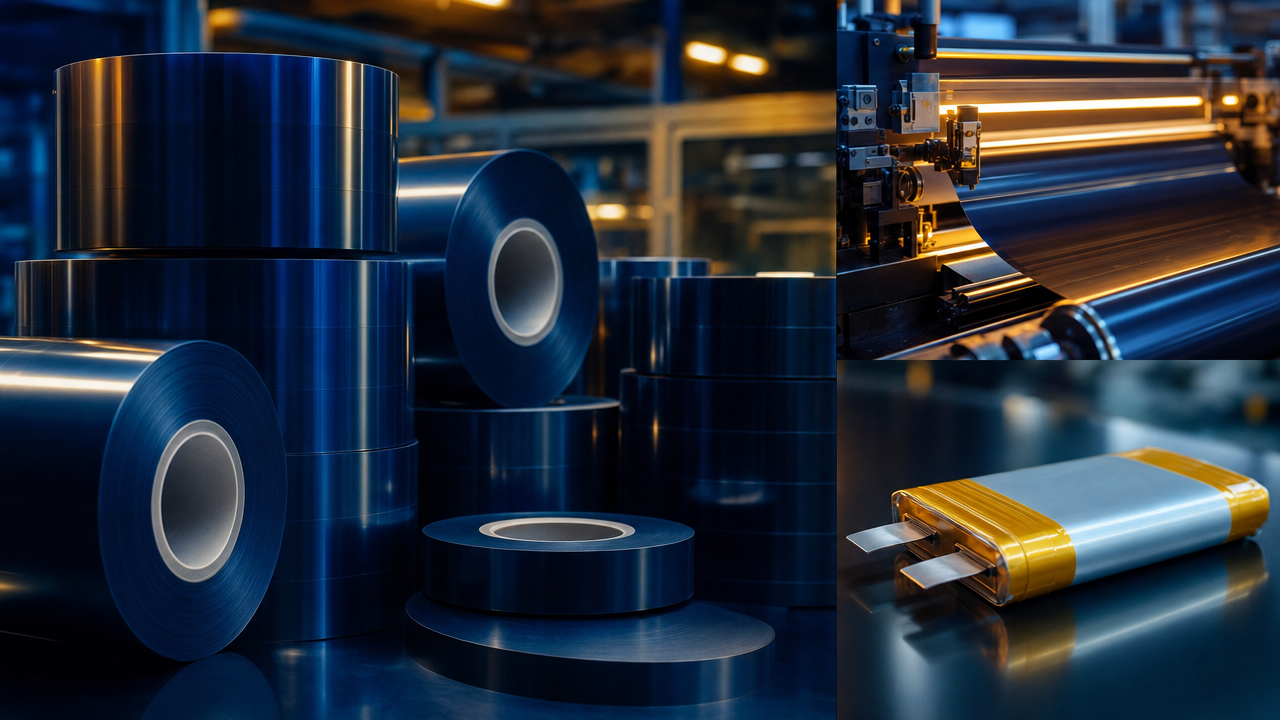

Author: Tianxia Industrial Research Institute Publication Date: 2026-06-19
Chapter 1 Industry Overview and Definitions
1. Where Are the Boundaries of Industrial Tape?
Walk into the assembly workshop of any modern 3C electronics factory, and simply by picking up the sample materials scattered around the production stations you can assemble more than fifteen kinds of tape. The polyimide insulating tape that secures FPC flexible cables, the foam double-sided tape that shields screw holes, the OCA optical adhesive film that bonds the touch panel to the cover glass, the termination tape applied at the end of lithium-battery electrode coils to prevent loosening, the thermally conductive pad attached to the metal back plate to improve heat dissipation — these products of varied shapes and shades, without exception, all fall within the category of Industrial Tape.
Yet the core standard that distinguishes industrial tape from the consumer tape on supermarket shelves is not merely a difference in usage scenario, but an essential, order-of-magnitude gap in technical requirements between the two. Everyday transparent packing tape, stationery double-sided tape, and household masking paper compete only on "sticks on, peels off, cheap." Industrial tape, by contrast, must maintain precise functional stability within a specific temperature range (perhaps -60°C low temperature or 250°C high temperature), under a specific chemical environment (perhaps organic-solvent attack or strong acid/alkali corrosion), and under specific mechanical-stress conditions (cyclic bending, impact and vibration), while meeting explicit quantitative specifications for key attributes such as residual-adhesive rate, electrical insulation, optical transmittance, thermal conductivity, or electromagnetic shielding effectiveness.
The magnitude of this gap is glimpsed in a simple price comparison: ordinary BOPP packing tape sells for roughly RMB 0.05-0.15 per square meter, whereas the semiconductor-grade UV dicing tape used for wafer cutting commands a market price as high as RMB 300-800 per square meter — a price gap of more than 5,000 times. Behind this price gap lies all-round technical accumulation spanning raw-material systems, process equipment, and certification regimes.
Defined more systematically, industrial tape is composed of the following four functional subsystems, each with its own independent technical ecosystem and competitive landscape:
Subsystem One: Substrate Layer
The substrate is the "skeleton" of industrial tape, determining overall mechanical performance (tensile strength, elongation at break), thermal stability (maximum service temperature, coefficient of thermal expansion), and dimensional precision (thickness uniformity, flatness). Common substrates include biaxially oriented polyester film (BOPET, with representative manufacturers such as Japan's Toray and China's Nan Ya Plastics), polyimide film (PI film, with representative brands such as DuPont Kapton and Japan's Ube Industries Upilex), polyethylene film (PE film), polypropylene film (PP film), glass-fiber cloth, copper foil, and aluminum foil. High-end categories such as wafer dicing tape require BOPET-substrate thickness-uniformity tolerances down to the ±0.5-micron level, far exceeding general industrial uses.
Subsystem Two: Pressure Sensitive Adhesive (PSA)
The PSA is the "brain" of industrial tape, directly determining its bonding performance and functional attributes. It is mainly divided into three major categories: acrylic, rubber-based, and silicone-based. Acrylic PSA is the most widely used in the electronics industry, accounting for roughly 49% of the global industrial-tape PSA market; silicone-based PSA, owing to its tolerance of extremely high temperatures (continuous service temperature above 200°C, briefly reaching above 300°C), is dedicated to aerospace and high-end electronics processing; rubber-based PSA is the lowest cost and is mainly used in packaging and construction, with limited application in high-end industrial tape.
Subsystem Three: Release Liner/Film Layer
The release film is the isolating medium that protects the PSA layer; it covers the adhesive face before use and is peeled away with precisely controllable force at the point of use. Industrial-grade release films demand extremely precise control of the peel force of the silicone coating, and no residual silicone may migrate to the PSA face — if residual silicone migrates to the adhesive face, it will cause contamination in subsequent PCB soldering or OLED evaporation processes, scrapping the entire batch. The release film itself has formed an independent and highly specialized segment with annual output worth billions of yuan.
Subsystem Four: Functional Coating
Some high-end industrial tapes apply a functional coating on the other side of the substrate or at a specific layer, endowing the tape with additional physical properties: a thermally conductive coating can raise thermal conductivity to 1-5 W/(m·K), meeting the heat-dissipation needs of 5G base stations and electric-vehicle batteries; a conductive coating (filled with silver or copper powder) gives the tape both bonding and electrical-conduction functions; an anti-static coating controls surface resistance within the 10⁶-10⁹ Ω range to prevent electrostatic damage in semiconductor processing; optical brightness-enhancement or reflective coatings are mainly used in display supporting materials and safety-warning applications. Tape products with multiple functional coatings are customarily referred to collectively in the industry as "functional membrane materials."
2. Panoramic Map of Major Categories
The category system of industrial tape is intricate; according to incomplete statistics, more than 5,000 SKUs are currently on the market, but by functional attribute they can be grouped into seven major families, each with several technological-generation differences internally:
Family One: Electronic Assembly Tape
This family is the subcategory with the highest technical barriers, the greatest pricing premium, and the most concentrated global competitive landscape. Its main varieties include:
- OCA (Optically Clear Adhesive): used for full lamination of touch screens and OLED/LCD modules, with transmittance ≥99% and haze ≤0.5%
- ACF (Anisotropic Conductive Film): used for precision conductive interconnection of FPC and PCB, with conduction limited to the Z-axis (vertical direction) and insulation in the planar direction
- EMI Shielding Tape (Electromagnetic Interference Shielding Tape): copper-foil or aluminum-foil composite conductive adhesive, used for electromagnetic shielding of PCB signal lines
- PI Insulating Tape (Polyimide Insulating Tape): using polyimide film as substrate, used for PCB wave-soldering masking, high-voltage insulation, and FPC stiffener fixing
- Foam Double-sided Tape: using PE or PU foam as substrate, used for fixing mobile-phone components, with a degree of cushioning function
Family Two: Display and Optical Membrane Materials
This family is expanding rapidly as OLED penetration into LCD increases:
- OLED process protective film: ultra-clean membrane materials that protect the substrate from contamination during the various OLED evaporation steps
- Release film for polarizers: high-precision BOPET release film in the polarizer process
- Reflective film/brightness-enhancement film: optical films supporting LCD backlight modules
- Anti-Glare Film: a functional surface film that reduces screen glare
Family Three: Lithium-Battery Process Tape
The explosive growth of global lithium-battery installations (about 1,545 GWh in 2024, +28.5% year-on-year) directly drove the rapid growth of this family:
- Cell Termination Tape: applied at the end of the electrode coil to prevent electrode loosening
- Module Binding Tape: a binding structure that fixes multiple battery cells
- Tab Tape: protects the tab area, usually using heat-resistant PP or PI substrate
- Release film for aluminum-plastic film: a forming aid for the aluminum-plastic film of pouch lithium batteries
Family Four: Semiconductor Process Tape
The family with the highest technical barriers and the greatest dependence on imports, with global dominance highly concentrated among Japanese firms:
- Dicing Tape: fixes the wafer throughout dicing; adhesion drops sharply after UV irradiation
- Backgrinding Tape: protects front-side devices during the wafer-thinning process
- Chip-packaging tape: BGA/CSP packaging auxiliary tape
Family Five: Automotive Industrial Tape
New-energy vehicles have reshaped the demand structure of traditional automotive tape, with old and new demand growing in parallel:
- NVH damping tape: noise, vibration, and harshness control, applied to doors, engine compartments, and chassis
- Wiring-harness binding tape: the high-voltage harnesses of new-energy vehicles require higher insulation grades
- Battery thermal-management thermally conductive tape: interface material for the thermal-management interface of battery modules
- Paint Masking Tape: an auxiliary material in the automotive painting process
Family Six: Industrial and Construction Tape
Large in scale and relatively low in price, but with incremental growth as the dual-carbon policy advances:
- Wind-turbine blade vacuum sealing tape: an aid in blade infusion molding
- Photovoltaic frame sealing tape: PV module encapsulation
- Aluminum-foil duct tape: insulation and sealing of building HVAC ducts
- Glass-fiber cloth tape: heavy packaging and construction waterproofing aid
Family Seven: Specialty and Emerging Tape
Emerging categories arising with new technology application scenarios:
- High-voltage-resistant tape for solid-state batteries: solid-electrolyte interface protection
- Peelable Tape: used for repeatable attachment of flexible electronic devices
- Low-loss tape for terahertz communication: high-frequency signal environments of 5.5G/6G communication base stations
3. Consumer Tape vs. Industrial Tape: A Five-Dimensional Comparison
To illustrate the essential difference between industrial and consumer tape more intuitively, the Research Institute selected BOPP transparent packing tape (a typical consumer-end product) and wafer-dicing UV tape (an extreme industrial-end product) for a comparative analysis across five dimensions:
Dimension One: Adhesion and Controllability
The initial tack of consumer tape is usually 8-20 N/25mm, and the higher this value, the better it is considered; the design of wafer-dicing UV tape is exactly the opposite — before UV irradiation the initial tack is about 300-500 mN/25mm, sufficient to fix the wafer; after UV irradiation the initial tack must plummet to 5-50 mN/25mm to ensure the ejector pins can easily lift the chips without breakage. This "controllable de-tack" characteristic is an engineering design that consumer tape neither needs nor can achieve.
Dimension Two: Thickness Precision
The thickness uniformity of ordinary BOPP packing tape is about ±5% (i.e., the actual thickness of 50μm tape may fluctuate between 47.5-52.5μm); high-end OCA optical adhesive requires thickness uniformity of ±2μm (i.e., 100μm-thick OCA must actually be between 98-102μm), otherwise visible interference color difference will arise from the thickness variation after lamination.
Dimension Three: Residual-Adhesive Rate
Residual adhesive left after removing consumer tape is an acceptable flaw that the user can wipe off with alcohol; industrial tape (especially for semiconductor and OLED processes) demands absolute zero tolerance of residual adhesive — once any residue is left on a wafer or OLED substrate, the entire batch of work-in-progress is scrapped, with losses easily reaching hundreds of thousands of yuan.
Dimension Four: Cleanliness
Consumer tape can be produced in an ordinary factory environment; wafer dicing tape and OLED process protective film must be produced, packaged, and transported in Class 10,000 (ISO 7) or even Class 1,000 (ISO 6) cleanrooms, with strict limits on particulate contamination (count of particles ≥0.5μm).
Dimension Five: Price
Ordinary BOPP packing tape is about RMB 0.05-0.15 per square meter; wafer-dicing UV tape is about RMB 300-800 per square meter; foldable-screen OCA is about RMB 1,000-3,000 per square meter. This five-order-of-magnitude price span reflects both the difference in technical complexity and the distribution of profit margins across the various categories of the industrial-tape industry.
4. A Quantitative Framework for Industry Scale
Global Scope
From a global market perspective, the broadly defined Pressure Sensitive Adhesive (PSA) Tape market was valued at roughly USD 74.5-84 billion in 2025 (different research institutions vary slightly due to differences in statistical scope; Grand View Research's valuation is USD 84 billion). Of this, industrial tape's share of the broad tape market is generally estimated at 35-40%, corresponding to a global industrial-tape market of roughly USD 26-34 billion (narrow scope). If categories defined as "functional membrane materials" — optical adhesives, protective films, release films — are included, the actual market scale is larger.
The global OCA optical-adhesive market alone was worth about USD 2.9 billion in 2025, OLED process protective film about USD 2.5 billion, global PI film and tape about USD 2.5 billion, and wafer dicing tape about USD 850 million — these four high-end categories already total nearly USD 9 billion, reflecting the weight of functional, high-end categories in the market.
China Scope
China is the world's largest single consumption market for industrial tape. In 2024, China's total output of adhesive tape across all categories (consumer + industrial) was about 43.2 billion square meters, up 8.5% year-on-year, achieving sales revenue of about RMB 72.6 billion, up 5.8% year-on-year. Stripping out the industrial-tape category alone (excluding consumer categories such as BOPP packing tape), the industrial-tape market is estimated to have exceeded RMB 35 billion in 2025, while the annual growth of high-end functional-membrane segments (OCA, OLED process protective film, wafer-grade tape) is generally between 12-20%.
The Asia-Pacific region's share of the global PSA-tape market has exceeded 41% and is expected to further consolidate its dominant position by 2035. Within Asia-Pacific's incremental contribution, China accounts for more than half, driven by clear structural demand from 3C electronics, lithium batteries, OLED panels, and new-energy vehicles.
Differentiated Growth Rates
It is worth noting that the divergence of growth rates within the industrial-tape market is extremely pronounced:
- Consumer categories such as BOPP packing tape: CAGR of about 2-3%, already in maturity
- Mid-range industrial tape (automotive harness tape, ordinary PI tape): CAGR of about 5-8%
- High-end functional membrane materials (OCA, OLED process protective film): CAGR of about 12-15%
- Semiconductor process tape (dicing tape, backgrinding tape): CAGR of about 8-10%, with potential to go higher once the localization increment is added
This growth divergence constitutes the core framework for understanding the structural distribution of opportunities in the industrial-tape industry.
Chapter 2 Global Landscape and China's Position
1. The Formation Mechanism of the Oligopoly
High-end industrial tape is an industry whose fundamental competitive law is the "technology moat." The global market has long exhibited a three-tier competitive landscape, and the formation of this tiered structure has deep historical and technological logic.
Tier One (Global Diversified Hegemons): Nitto Denko, 3M, and TESA (under Henkel) — these three companies together hold about 40-50% of the global industrial-tape market and maintain overwhelming advantage in the highest-end categories such as semiconductor, display, and optical adhesives. These three differ in their technological paths yet complement one another, jointly forming an almost unshakable "iron triangle" in the high-end industrial-tape arena.
Tier Two (Specialized Multinationals): Lintec (Japan, expert in semiconductor tape and labels), Furukawa Electric (semiconductor backgrinding tape), Avery Dennison (label adhesives and automotive protective films), Bostik (construction and automotive adhesives), Coveris (flexible-packaging and tape composites), and other specialized multinationals hold significant leading positions in the segments they cultivate, but with narrower coverage than Tier One.
Tier Three (Regional Suppliers): regional suppliers in China, South Korea, and Taiwan, including Yongguan New Materials, Xintian Technology, Stick, Nan Ya Plastics, Soulbrain (Taiwan), and others, are advancing from low-end standard products toward mid-to-high-end categories, but on the whole remain mainly concentrated in the price-competitive low-to-mid-end market, with an obvious gap from Tier One firms in high-end certified categories.
The stability of this three-tier structure comes from the superposition of three barriers in the industrial-tape industry:
Formulation Barrier: the molecular-weight distribution, crosslink density, tackifier-resin ratio, and monomer selection of acrylic PSA determine the tape's performance under specific stress and temperature conditions. A mature industrial-grade PSA formulation often requires years or even more than a decade of customer-application data validation, and undergoes iterative optimization across multiple formulation versions — accumulation that is hard to reproduce quickly through reverse engineering. Take foldable-screen OCA: 3M invested more than 10 years in this project's formulation development, ultimately achieving a performance breakthrough of a 1.5mm bend radius with no cracking after 200,000 bends — behind which lie countless formulation failures and parameter adjustments.
Process Barrier: the precision coating processes of high-end industrial tape (uniformity control of Slot-Die coating), cleanliness control (particle-count control in Class 100 cleanrooms), and post-curing treatment (precise dose control of UV crosslinking) directly determine product yield and batch consistency. At these process levels, the gap between top-tier firms and chasers often lies not in theoretical knowledge but in repeatedly accumulated engineering know-how and equipment-tuning experience — tacit knowledge that is extremely hard to transfer through documents.
Certification Barrier: entering a high-end electronics or semiconductor supply chain usually requires going through a 12-24 month material-certification process at the downstream brand manufacturer (with full tracking across the EVT/DVT/PVT stages); semiconductor-grade products additionally need to pass the relevant material-certification standards of SEMI (Semiconductor Equipment and Materials International). Once a material passes certification and enters volume procurement, the cost for the customer to switch suppliers is extremely high (requiring restart of the certification process and consumption of substantial internal testing resources), making the certification qualification itself an extremely high market-entry barrier.
2. Nitto Denko: The Full-Category Advantage of a Century-Old Maker
Nitto Denko Corporation (Tokyo Stock Exchange: 6988) is the company with the strongest comprehensive global strength in industrial tape, and the single supplier covering the widest range of tape categories worldwide. Founded in 1918, the company has accumulated more than a century of tape technology R&D and production experience; its headquarters are in Osaka, Japan.
Nitto Denko's overall business is divided into three major segments: Optronics (about 55% of total revenue), Industrial Tape (about 35% of total revenue), and Life Science (about 10% of total revenue). In the industrial-tape segment, the company's products cover almost all major categories: from the most basic automotive wiring-harness binding tape to the most technically demanding semiconductor wafer dicing tape; from construction sealing tape to OLED display supporting optical-membrane materials.
Nitto Denko's position in semiconductor process tape is especially prominent. Its dicing tape holds about 30-35% of the global market, jointly forming the Japanese three-strong monopoly with Mitsui Chemicals and Lintec (the three together about 82.5%). In March 2025, Nitto Denko specifically launched a new generation of ultra-thin dicing tape for 300mm wafers, further reinforcing its technical barrier in advanced-process wafer processing.
Financial Data
In FY2026 (ended March 31, 2026), Nitto Denko Group's consolidated revenue was about JPY 1.028 trillion (equivalent to about USD 7 billion), up about 1.4% year-on-year. The industrial-tape segment benefited from the recovery of global smartphone-component demand and the high-end tape upgrade brought by automotive electrification, achieving both volume and profit growth. One of the company's core competencies is fusing optical-membrane technology from the optronics category with PSA technology from the industrial-tape category, developing composite products that combine optical performance and bonding function (such as structural tape with light-guiding function) — this cross-technology integration continually strengthens Nitto Denko's differentiated product competitiveness.
3. 3M: The Systems-Solution Provider
3M (Minnesota Mining and Manufacturing Company, NYSE: MMM) has a strategic positioning in industrial tape that differs from Nitto Denko's: 3M focuses more on systematic solutions oriented to diversified end markets (construction, medical, automotive, electronics, aerospace), rather than the deep manufacturing advantage of any single category.
In the global PSA market, 3M holds about 11%, and in OCA and electronic-assembly tape it is one of Nitto Denko's most important competitors. 3M's technical accumulation in foldable-screen OCA is especially deep: its 8146-series OCA (models such as 8146CL) has become the de facto technical standard in the foldable-phone supply chain, adopted by mainstream foldable brands such as Samsung, Huawei, and Xiaomi.
In October 2025, 3M announced a new manufacturing facility in Jiangsu Province, China, focusing on expanding domestic capacity for high-end adhesive products to shorten response times to Chinese local 3C and automotive customers. This strategic investment indicates that 3M regards China as one of the most important regional markets for future high-end industrial-tape demand growth.
3M has another special advantage in the China market: its "engineered-materials systematic solution" sales model enables it to collaborate deeply with the engineering teams of OEMs, embedding 3M's tape-material specifications into the BOM (bill of materials) at the product-design stage, forming an extremely hard-to-replace customer-binding relationship.
4. TESA: Specialized Advantages in Electronics and Automotive
TESA (tesa SE) is an independent subsidiary of the Henkel Group focused on industrial tape, headquartered in Hamburg, Germany, with operations in 42 countries worldwide and about 5,000 employees globally.
TESA's core competitive advantages concentrate on two main battlefields: first, consumer-electronics assembly tape (smartphone front-and-back-cover fixing, battery bonding, FPC fixing, conductive-foam tape); second, automotive NVH damping and harness tape. These two markets happen to be the fastest-growing, most intensely upgrading segments of industrial tape today.
2025 Financial Performance
In 2025, TESA achieved global organic sales growth of 1.8%, with total sales of about EUR 1.7 billion. By region, Greater China and Asia-Pacific achieved significant growth, while the European and U.S. automotive markets were a drag due to declining sales of traditional internal-combustion vehicles. TESA's important strategic move in China was the expansion of its Suzhou plant: in 2024, the TESA Suzhou plant formally completed expansion and began operating new capacity, further enhancing TESA's localized supply capability in China and enabling it to better serve the high-frequency needs of core customers such as Apple, Huawei, and BYD.
5. Lintec: The Other Pole of Semiconductor Tape
Lintec Corporation (Tokyo Stock Exchange: 7966) is a mid-tier Japanese industrial-tape firm and the second-heaviest player in the global semiconductor-process-tape market, after Nitto Denko.
Lintec's main strength lies in semiconductor backgrinding tape, followed by dicing tape and label materials. Its semiconductor-materials business benefits significantly against the backdrop of global wafer-foundry capacity expansion — whether TSMC's new production lines in Taiwan/the U.S./Japan or the continuous expansion of Chinese mainland wafer fabs, all consume large quantities of process tape supplied by Lintec.
In OCA and display release film, Lintec also has important technical accumulation and a customer base. Notably, Lintec is one of the few firms able to make both "label materials" technology and "semiconductor process materials" technology to world-class levels simultaneously — a cross-category capability not common in the industrial-tape industry.
6. China's Dual Role: Largest Consumer and High-End Chaser
In the global industrial-tape landscape, China plays a dual role full of tension, and this duality is the most crucial underlying logic for understanding all phenomena in China's industrial-tape market.
Role One: Largest Consumer
About 70% of the world's smartphones, more than 60% of lithium batteries (by GWh), nearly 50% of LCD panels, and more than 30% of OLED panels are produced in China — all of these are core downstream applications of industrial tape. The scale of China's 3C electronics manufacturing determines that its total consumption of industrial tape far exceeds that of any other single national market.
Within Asia-Pacific's over-41% global share, China contributes more than half, and China's share of the global industrial-tape market is expected to rise further to nearly 25% in 2026 (by value).
Role Two: High-End Chaser
In stark contrast to its status as the "largest consumer," China's industrial-tape industry shows serious structural imbalance on the supply side.
Low-to-mid-end standard products (BOPP packing tape, general masking tape, ordinary double-sided tape) have long achieved complete self-sufficiency and are exported in large quantities to the global market; in these categories Chinese firms are the world's primary suppliers;
Mid-range industrial tape (automotive harness tape, ordinary PI insulating tape, lithium-battery termination tape) is undergoing rapid localization, and in some categories (such as lithium-battery termination tape) the localization rate already exceeds 50%;
High-end functional membrane materials (OCA optical adhesive, OLED process protective film) are climbing rapidly from a near-zero localization ratio, and 2025-2026 is expected to be the key turning-point window;
Extreme high-end categories (foldable-screen OCA, advanced-process models of wafer-dicing UV tape) remain in their infancy in localization, with import dependence as high as 80-85%.
This structural contradiction of "consumption giant, high-end import dependence" is both the core challenge of China's industrial-tape industry and the most important structural opportunity for the next 5-10 years.
7. Strategic Adjustments of Japanese, Korean, European, and U.S. Firms in China
Faced with localization pressure in China, the strategic choices of the major Japanese, Korean, European, and U.S. industrial-tape firms differ:
Local for Local: represented by TESA's Suzhou-plant expansion and 3M's new Jiangsu capacity — deepening localized production to shorten delivery times, lower logistics costs, and partially circumvent trade-barrier risks.
Technology Moat: represented by Nitto Denko — continuing to increase R&D investment in advanced-process tape (such as 300mm wafer dicing) and foldable-screen OCA and other technological frontiers, maintaining competitive barriers through generational technology gaps rather than fighting a price war head-on with Chinese firms.
Premium Focus: in mid-range categories where price wars have clearly emerged (such as ordinary PI tape and general electronic-foam tape), proactively contracting share and concentrating resources on the highest-margin high-end certified categories to maintain overall profitability.
Chapter 3 Core Chemistry: PSA Systems, Release Films, OCA and Functional Coatings
1. The Molecular-Design Principles of PSA
To understand the technical differences in industrial tape, one must start from the molecular-design logic of Pressure Sensitive Adhesive (PSA). The two words "pressure sensitive" seem simple, but the physical-chemistry mechanism behind them is quite profound.
The core characteristic of PSA is that "at room temperature, instantaneous bonding can be achieved with only the light pressure of a finger, while after removal it can peel relatively cleanly from the substrate without obvious damage." This seemingly contradictory characteristic comes from the special viscoelastic design of the polymer chain segments.
The Dahlquist criterion is the classic framework for understanding the viscoelastic requirements of PSA: at 1 Hz, the storage modulus G' (elastic modulus) of a PSA is around 10⁵ Pa — low enough for the PSA to undergo sufficient rheological wetting at the contact interface (achieving molecular-level contact), yet high enough to resist adhesion spreading during normal use. At the same time, the loss modulus G'' (viscous modulus) of the PSA must also lie within a specific range to provide sufficient cohesion (so that cohesive failure does not occur within the adhesive layer during peeling, i.e., the residue problem).
This viscoelastic balance is the core difficulty of PSA formulation design: raising G' helps reduce residue but lowers initial tack; lowering molecular weight helps raise initial tack but reduces cohesive strength and increases residue. Finding the optimal balance requires simultaneous three-way optimization of polymer molecular-weight distribution, crosslink density, and tackifier-resin loading — which is exactly the fundamental reason PSA formulation development is time-consuming and patent-dense.
In-Depth Analysis of Acrylic PSA
Acrylic is the PSA system with the highest market share in industrial tape, accounting for about 49% of the global industrial PSA market. Its synthesis usually uses 2-ethylhexyl acrylate (2-EHA, Tg about -70°C, conferring low-temperature flexibility and initial tack) and butyl acrylate (BA, Tg about -55°C) as soft monomers, and acrylic acid (AA, providing carboxyl crosslinking sites) and methyl methacrylate (MMA, raising modulus) as hard monomers to tune the overall Tg into the -30 to -20°C range, then post-crosslinks via isocyanate or metal ions, precisely controlling gel content to achieve the viscoelastic balance.
The competitive advantages of acrylic PSA are:
- Excellent weather resistance (no yellowing from UV degradation), usable in outdoor scenarios
- High transparency (refractive index about 1.47-1.48), suitable for optical-adhesive applications
- Stable physical properties after film formation, with creep behavior precisely tunable via crosslink density
- Good solvent resistance — highly crosslinked systems can resist attack by a variety of organic solvents
Silicone PSA
The core advantage of silicone PSA is an extremely wide service-temperature range (-60°C to 250-300°C), as well as the ability to bond to almost any surface (including low-energy surfaces such as PTFE and silicone). The cost is extremely high (5-10 times that of acrylic) and intolerance of most organic solvents.
Silicone PSA formulations are usually prepared by blending high-molecular-weight methyl-vinyl silicone rubber with MQ silicone tackifier resin (a copolymer of tetrafunctional M and Q units), then cured via peroxide or platinum-catalyzed addition reaction. The formulation development of high-end silicone PSA is recognized as one of the most difficult PSA formulation fields in the world; currently only a handful of multinationals such as Momentive, Wacker, and Shin-Etsu Chemical possess complete formulation platforms in this field.
Rubber-based PSA
Rubber-based PSA uses natural rubber (NR) or styrenic block copolymers (SBS, SIS) as the main body, with rosin ester or terpene-phenol resin as tackifier, plus filler oils (paraffin oil, naphthenic oil) for softening. Its advantages are high initial tack and low cost, but poor weather resistance (prone to oxidative aging and yellowing); long-term outdoor use leads to "adhesive aging → embrittlement → residue" problems, so its application in high-end industrial tape is increasingly limited, mainly remaining in packaging, construction, and low-end electrical fields.
2. The Systematic Design of Release Films
Release film (also called separation film or peel film) is an often-underestimated key link in the industrial-tape value chain. On the surface, release film is merely an isolating medium "used and discarded," but in high-end application scenarios (such as OCA, OLED process film, and wafer backgrinding tape), release-film quality often directly determines the performance stability of the final product.
Structural Composition
The typical structure of release film, from bottom to top, is: substrate (BOPET or PE/PP film) → anchor coating (enhancing the bond between the release coating and the substrate) → release coating (silicone or fluorine coating) → covering PSA layer (peeled away at use).
The Chemical Mechanism of Silicone Release Coatings
The silicone release coating is the mainstream technical route, accounting for more than 90% of the release-film market. The process principle is to cure an addition-type silicone release agent (vinyl-containing polydimethylsiloxane + hydrosilane crosslinker, platinum-catalyzed) in a 120-150°C drying oven, forming a highly crosslinked Si-O-Si network structure. Through the self-organized arrangement of Si-CH₃ groups facing the air side, ultra-low surface energy (23-25 mJ/m²) is achieved, enabling the PSA layer to peel easily.
The control of release force is the core engineering parameter of release-film formulation design. By adding different proportions of phenyl-modified silicone (release-force increaser) or trimethylsilyl-terminated polymer (release-force reducer) to the silicone formulation, the release force can be tuned from less than 5 g/25mm (ultra-light release, for OCA protective film) to above 200 g/25mm (heavy release, for the inner release liner of double-sided tape) — covering a release-force range of nearly five orders of magnitude.
The Silicone Migration Problem
In high-end applications, the "silicone migration" problem of silicone release coatings is the most critical quality risk. When silicone monomers do not fully react during curing, free low-molecular-weight silicone molecules gradually migrate to the PSA face, contaminating the adhesive. In the PCB surface-mount (SMT) process, silicone contamination causes solder de-wetting (soldering failure); in the OLED evaporation process, silicone contamination causes attachment failure of the organic light-emitting material. Therefore, the residual-silicone requirement for high-end industrial-tape release film is usually below 1 μg/cm², which must be verified by professional silicone-migration test methods (such as XPS, GC-MS).
China's release-film industry is already quite mature in competitiveness for low-to-mid-end products (for labels and ordinary packaging double-sided tape), but in high-end categories such as ultra-low silicone-migration release film and anti-static release film (surface resistance 10⁷-10⁹ Ω), it still mainly relies on imported products from Japanese firms such as Lintec, Mitsui Chemicals (SF series), and Toray.
3. The Technical System of OCA Optical Adhesive
OCA (Optically Clear Adhesive) is one of the most technically demanding, highest-value-added categories in the industrial-tape family, and the product form where the "functional membrane material" concept and the "tape" concept intersect most prominently.
The Core Function of OCA
The core application of OCA is full lamination of displays — bonding the cover glass, touch module, and LCD/OLED display module tightly together, eliminating the air gap between the layers. This full-lamination process can significantly improve display performance (about 40% contrast improvement, wider viewing angle) and reduce dust-particle ingress (improving durability).
Performance-Metric System
The performance-evaluation system of OCA is quite complex, with key metrics including:
- Optical performance: transmittance ≥99% (550nm wavelength), haze ≤0.5%, refractive index usually between 1.47-1.52 (needing to precisely match the refractive index of glass and the ITO layer to minimize interface reflection);
- Thickness precision: OCA film thickness is usually 25μm, 50μm, 75μm, or 100μm in four standard specifications, with thickness uniformity required within ±2μm;
- Self-defoaming: after lamination, even if tiny bubbles appear, after standing in a 65°C oven for 30-60 minutes the bubbles should self-eliminate (relying on the rheology of the PSA to fill in, requiring short defoaming time and appropriate rheology);
- Bend resistance (dedicated to foldable screens): at a bend radius of 1.5mm, withstanding 200,000 reciprocating bends without visible cracks, and without degradation of optical uniformity.
The Technical Breakthrough Difficulties of Foldable-Screen OCA
Foldable-screen OCA represents the current cutting edge of global OCA technology and is the most difficult category. Its core challenge lies in the fundamental contradiction at the formulation-design level between the two metrics "bend durability" and "optical uniformity":
- To achieve bend durability, the elastic modulus (E') of the OCA must be low enough (to avoid excessive internal stress during bending), which means the PSA must remain relatively soft;
- To achieve high optical uniformity (no bending marks), the OCA needs sufficiently high cohesive strength (G') to prevent stress whitening caused by accumulated deformation under repeated bending.
These two requirements point in opposite directions in formulation parameters. Through more than 10 years of formulation R&D and a unique multilayer composite structure (a soft-core/hard-surface composite OCA structure), 3M successfully satisfied both metrics simultaneously, establishing an almost insurmountable technology moat in foldable-screen OCA.
The Domestic OCA Situation
Chinese OCA firms (represented by Stick and Aoxiang Technology) have achieved considerable volume supply in ordinary rigid-screen OCA, but in foldable-screen OCA no domestic firm has yet stably entered the volume-production supply chain of leading foldable brands such as Samsung and Huawei. Closing this gap is expected to take at least 3-5 years of continuous technical investment.
4. The Technical Extension of Functional Coatings
The value creation of some industrial tapes has long exceeded the "bonding" function in the traditional sense, endowing products with special thermal, electrical, optical, or mechanical properties through functional coatings:
Thermally Conductive Coating Systems
In composite systems of thermally conductive fillers (boron nitride BN, alumina Al₂O₃, aluminum nitride AlN, silicon carbide SiC powder) and high-thermal-conductivity polymer matrices, thermally conductive tape with thermal conductivity up to 1-10 W/(m·K) is prepared. The key technical difficulty lies in the compatibility of high-loading fillers (volume fraction often exceeding 50%) with the PSA, and how to maintain low thermal resistance (interface contact thermal resistance Rₜc below 0.5 cm²·K/W) while retaining high bonding strength. Such products are in strong demand for millimeter-wave heat-dissipation modules of 5G base stations and battery thermal management of new-energy vehicles.
Conductive Coating Systems
Using silver powder (volume fraction 60-80%, achieving a low percolation threshold), copper powder, or carbon nanotubes (CNT) as conductive fillers, conductive tape is prepared for PCB electromagnetic shielding (shielding effectiveness SE ≥ 60 dB) or grounding connection, with volume resistivity as low as the 10⁻⁴ Ω·cm range, while also providing good bonding strength (peel force ≥ 1 N/25mm).
Anti-static Systems
In semiconductor processing, electrostatic discharge (ESD) from the tape surface is one of the main sources of damage to wafer devices. Anti-static PI tape applies a conductive carbon coating to the surface of the PI substrate, controlling surface resistance within 10⁶-10⁹ Ω (anti-static grade) without affecting the substrate's insulating performance, meeting the contradictory requirement of semiconductor processing for both "electrical insulation" and "surface anti-static."
Microprism Retroreflective Coatings
Retroreflective-material firms represented by Daoming Optical prepare microprism arrays on BOPET substrates through precision molding, using the principle of total internal reflection to reflect incident light back toward its original direction, achieving a retroreflective brightness coefficient as high as 700-1,000 cd/m²/lx, widely used in highway signs, construction-site safety markings, and nighttime workers' reflective vests. This segment is a typical "niche, high-barrier" track, and Daoming Optical has long maintained domestic leadership thanks to its microprism-mold technology.
Chapter 4 Industry Supply Chain: From Upstream Substrates to Downstream Converting
1. The Full Picture of the Supply Chain
The industrial-tape supply chain spans four main links — chemicals, film manufacturing, precision coating, and post-processing — each with a relatively independent competitive landscape and profit-distribution mechanism:
Upstream raw materials
├── Acrylic monomers (AA/2-EHA/BA) → Satellite Chemical/Wanhua Chemical/BASF
├── Silicone monomers (MQ resin/hydrosilane) → Shin-Etsu Chemical/Momentive/Hoshine Silicon
├── PI monomers (PMDA/ODA) → DuPont/Ube Industries/CNOOC Basic Chemical
├── BOPET substrate film → Toray/DuPont Teijin/Nan Ya Plastics/Zhejiang Lanyan
├── PI film (Kapton, etc.) → DuPont/Ube Industries/Toray-DuPont/Guilin Electrical Science
└── Additives: platinum catalysts/crosslinkers/initiators/tackifier resins

Midstream manufacturing (core of industrial tape)
├── PSA synthesis → solution polymerization/emulsion polymerization/bulk UV polymerization/hotmelt
├── Substrate pretreatment → Corona treatment/anchor coating/plasma activation
├── Precision coating → Slot-Die/knife/transfer coating/hotmelt coating
├── Drying/curing → hot-air drying oven/UV lamp arrays/EB-beam curing
└── Lamination/slitting/die-cutting → roll-to-roll lamination/precision slitting/die-cut punching

Downstream applications
├── 3C electronics assembly (phones/tablets/laptops)
├── Display-panel manufacturing (OLED/LCD/MicroLED)
├── Lithium-battery processing (EV/storage/digital)
├── Automotive manufacturing (NEV/traditional vehicles)
├── Wind-turbine blade manufacturing
├── Photovoltaic-module encapsulation
└── Semiconductor wafer manufacturing (IC design → wafer foundry → packaging/test)
2. Upstream Chemical Raw Materials: A Dual Lifeline of Cost and Supply Chain
Acrylic Monomers
Acrylic monomers are the most core raw material of acrylic PSA and the single highest-share raw-material item in the entire industrial-tape cost structure. Major global producers include BASF (Germany), Dow (U.S.), Arkema (France), and China's Satellite Chemical (Quzhou, Zhejiang, a national leader in acrylic-acid capacity), Wanhua Chemical, Huayi Group, and others.
In 2022, affected by global chemical supply-chain disruptions, acrylic-monomer prices once climbed to historic highs, significantly impacting the gross margins of domestic PSA firms. But by 2025, acrylic-monomer prices had fallen about 40-50% from the 2022 peak, with current prices in the RMB 4,500-6,000/ton range (depending on grade), overall in a downstream-favorable price window. China added substantial acrylic-acid capacity between 2020-2025, and the domestic self-sufficiency rate has basically stabilized above 80%.
Organosilicon Monomers
Organosilicon monomers are the raw-material category in the industrial-tape supply chain whose supply-chain security most warrants attention. Global capacity for high-end organosilicon monomers (especially MQ silicone resin, vinyl-terminated polydimethylsiloxane, and hydrosilane) is highly concentrated among three firms: Momentive (formerly GE Silicones, U.S.), Wacker (Germany), and Shin-Etsu Chemical (Japan).
China's Hoshine Silicon, Xin'an Chemical, and Dongyue Silicon already have scale advantages in the production of methylchlorosilane (basic organosilicon monomer), and the domestic supply of industrial silicon and methylchlorosilane is quite ample. However, in special organosilicon monomers for high-purity MQ silicone release-agent formulations, Chinese firms' technical accumulation remains relatively weak, some high-end grades still rely on imports, and supply stability carries some risk.
In 2022, organosilicon prices once swung by more than 50-80% (mainly due to Yunnan power rationing affecting industrial-silicon output), providing the industrial-tape industry a profound education in supply-chain risk. The mainstream responses in the industry are to sign long-term supply agreements and to appropriately raise raw-material substitution flexibility in production formulations (filing substitute grades of equivalent performance).
BOPET Film (Biaxially Oriented Polyethylene Terephthalate)
BOPET film is the most important substrate for industrial tape and the main substrate for release film. China is the world's largest BOPET producer; in 2025 domestic BOPET capacity exceeded 3 million tons/year, mainly concentrated in Zhejiang, Jiangsu, Guangdong, and other areas, with representative firms including Tonze Tech, Nan Ya Plastics, and Zhejiang Lanyan.
However, China's BOPET capacity structure has a serious quality-tiering problem: in standard-thickness (12-25μm), standard-width (2-4m) general BOPET, domestic capacity is already in serious oversupply; but in optical-grade and release-substrate high-end BOPET (thickness uniformity within ±0.5μm, surface roughness Ra ≤ 0.05μm), the consistency of domestic quality remains below Japanese products such as Toray, and in OCA and semiconductor process tape, Japanese-made BOPET is still the first choice.
PI Film (Polyimide Film)
PI film is an irreplaceable key substrate in high-end industrial tape (especially semiconductor process tape, PI insulating tape for FPC, and OLED display substrates), and one of the film categories with the highest import dependence in China's industrial-tape supply chain.
The global high-end PI-film market has long been dominated by DuPont (Kapton brand, U.S.), Ube Industries (Upilex brand, Japan), and Toray-DuPont (a Japanese-Japanese joint venture). Chinese firms (companies under Guilin Electrical Science Research Institute, Shenzhen Rayitek, Sinoma Science & Technology, etc.) have achieved breakthroughs in PI-film volume-production technology, but in high-end specifications such as ultra-thin grades (≤7.5μm), high insulation grades (breakdown voltage ≥ 300 V/μm), and low dielectric loss (for millimeter-wave communication substrates, tanδ ≤ 0.003 at 10GHz), a generational gap remains between Chinese and Japanese products.
According to market-research data, in 2025-2026 China still relies on imports to satisfy about 35-40% of its PI-film consumption, with main import sources being Japan, the U.S., and Taiwan. PMDA (pyromellitic dianhydride) and ODA (4,4'-diaminodiphenyl ether), the two core PI-film monomers, swung by about 15-25% in price between 2022-2025, the largest source of cost uncertainty for PI film.
3. Precision Coating: The Key Amplifier of Technical Difference
Precision coating is the core manufacturing link that converts a PSA from formulation into a tape product with stable performance, and the process where technical gaps are most prominently amplified.
Technical Comparison of Major Coating Processes
Slot-Die coating is the standard process for high-end industrial-tape manufacturing. Its principle is to extrude the adhesive liquid at a constant volumetric flow rate (precisely controlled by a gear pump) onto the moving substrate surface through a precision-machined (tolerance ±0.5μm) slot die; the precise matching of die gap (usually 50-300μm) and substrate speed (0.5-10 m/min) determines the final coating thickness. Slot-Die coating uniformity can reach ±1μm (in the cross-direction CD), making it the first-choice coating method for high-precision products such as OCA and OLED process films.
Transfer coating first coats the PSA on the release film, cures it, and then laminates and transfers it to the target substrate. This method effectively avoids solvent or heat damage to high-value substrates (such as PI film) and is widely used in the manufacture of semiconductor-grade PI tape.
Hotmelt coating is a representative of solvent-free, environmentally friendly processes: solid PSA pellets are heated to 130-180°C and coated in molten state, significantly reducing VOC emissions, but with strict requirements on the thermal stability of the PSA formulation (which must maintain low color difference and not gel at the melting temperature).
The Localization Status of Equipment and Processes
In the coating production of standard industrial tape, domestic coating equipment (such as products from firms like Guangdong Xinyongsheng and Qingdao Haohe Intelligent) can already meet basic needs. But in the ultra-precision coating systems required by high-end categories such as OCA and OLED process film (speed stability ±0.05%, temperature-control precision ±0.5°C, cleanliness up to Class 1,000), domestic equipment still lags by about one generation behind the top products of Germany's Coatema and Japan's Toray Engineering. This coating-equipment gap is one of the important bottlenecks constraining the expansion of domestic high-end industrial-tape capacity.
4. Post-Processing: Die-Cutting Is the Core Value-Add of 3C Supply
The post-processing of industrial tape — including lamination, slitting, and die-cutting — is often underestimated in the overall supply chain, but it is especially important for the 3C electronics supply chain.
Technical Requirements of the Die-Cutting Process
OCA film for OLED lamination requires precision laser cutting (cutting precision ±0.05mm), because rotary-knife or flat-knife die-cutting may produce burrs on the OCA cut face, introducing bubbles during lamination; the irregularly shaped conductive-foam tape used inside smartphones requires servo-driven five-axis die-cutting equipment to achieve precise cutting of inner-cavity hollowing and chamfering.
China's Pearl River Delta (mainly concentrated in Shenzhen and Dongguan) and Yangtze River Delta (Suzhou, Kunshan) have thousands of professional die-cutting plants, the world's most important tape die-cutting production base for the smartphone supply chain. These die-cutting plants, although small individually, form an indispensable capillary network of China's 3C electronics supply chain thanks to highly specialized equipment and process accumulation.
The Importance of Roll-to-Roll Processing
In the tape applications of large-area display panels and pouch lithium batteries, the Roll-to-Roll continuous production process is the most efficient production mode — the tape completes multilayer lamination, in-line inspection (AOI automated optical inspection), and roll packaging in roll form, supplied directly to the automated lamination equipment of panel/battery makers. This full-R2R production mode has extremely high requirements for equipment precision (alignment error ≤ 0.1mm) and cleanliness (cleanroom), and is also an important watershed for judging the technical level of an industrial-tape firm.
5. Key Risk Nodes of Supply-Chain Stability
Based on a systematic review of each link of the supply chain, the following four risk nodes warrant key attention from industrial-tape firms and their downstream customers:
Node One: Organosilicon Raw-Material Concentration Risk Global organosilicon-monomer capacity is highly concentrated (the top three firms together account for ≥ 60%) and mainly concentrated in three countries — the U.S., Germany, and Japan. Against the backdrop of rising geopolitical uncertainty, the supply continuity of organosilicon raw materials is the greatest hidden danger for release-film and silicone-PSA firms.
Node Two: Dependence on Japanese High-End Film High-end BOPET (optical grade) and PI film (ultra-thin, ultra-insulating grade) still highly depend on Japan (Toray, Ube Industries, etc.) and the U.S. (DuPont); if export controls escalate, the production of some semiconductor and OLED supporting tape will face direct impact.
Node Three: Supply of Precision Coating Machines The design and manufacturing capability of ultra-precision coating machines (Slot-Die) remains mainly concentrated in Germany and Japan; Chinese equipment firms have not yet achieved a breakthrough in top-precision equipment, and this equipment bottleneck constrains the rapid expansion capability of domestic high-end industrial-tape capacity.
Node Four: Cleanroom Plant Capex Threshold The construction cost of Class 10,000 or even Class 1,000 cleanrooms is extremely high (the construction cost of a 100-square-meter Class-1,000 cleanroom is about RMB 2-5 million); the high plant capex constitutes a hidden entry barrier for semiconductor-grade and OLED-grade tape production, making it difficult for capital-weak small and medium firms to enter.
Chapter 5 Downstream Applications: Six Major Markets and Competitive Dynamics
1. 3C Electronics: The Application Scenario with the Highest Density
3C electronics (consumer electronics, including smartphones, tablets, laptops, TWS true-wireless earbuds, smartwatches, and VR/AR headsets) is the end market with the highest industrial-tape usage per product and the most complex category mix.
Take a flagship foldable phone (such as the Huawei Mate Fold): the body uses more than 40 kinds of industrial tape internally, mainly including:
- Screen-module lamination OCA optical adhesive (dedicated to foldable screens, about 3-5 layers)
- Hinge NVH damping foam tape (reducing hinge open/close noise)
- FPC flexible-cable fixing PI insulating tape (about 20-30 locations)
- Electromagnetic-shielding copper-foil tape (around the mainboard, about 5-8 locations)
- Thermal grease pad or thermally conductive tape (CPU/AP chip heat dissipation)
- Acoustic-chamber sealing foam double-sided tape (isolation of the speaker's front and rear chambers)
- Battery termination tape (about 2 locations, at the end of the battery winding)
- Camera-module fixing tape (about 2-3 layers each for the 3 cameras)
- Structural-component fixing double-sided tape (back plate, middle frame fixing)
Quantitative Scale
In 2025, global smartphone shipments were about 1.25 billion units, with industrial-tape material cost (per phone) of about USD 1.5-4 (depending on model complexity), making the global smartphone-end industrial-tape market about USD 2-5 billion/year. Adding tablets, laptops, TWS, wearables, and other 3C categories, the overall 3C electronics industrial-tape market is estimated to exceed USD 10 billion/year.
Demand-Upgrade Direction
The rapid rise in foldable-phone penetration (China's foldable-phone shipments are expected to exceed 15 million units in 2025, up more than 30% year-on-year) is driving new demand for foldable-dedicated OCA and ultra-thin hinge PI tape; AI phones' higher requirements for heat dissipation and electromagnetic shielding drive a consumption-grade upgrade of thermally conductive tape and shielding tape.
In the China market, leading brands represented by Apple, Huawei, Xiaomi, and OPPO each have annual industrial-tape procurement of more than RMB 100 million, making them the most core large customers for industrial-tape suppliers.
2. Display Panels: The Rise of OLED Reshapes Membrane-Material Demand
Display panels are the most important downstream for the highest-tier categories of industrial tape (OCA, OLED process protective film). In 2024, the global OLED-panel market was about USD 38 billion, and penetration is still rising: smartphone OLED penetration has exceeded 50%, mid-size tablet OLED (9-15 inches) penetration is climbing rapidly, and TV OLED penetration is relatively limited but growing steadily.
The Special Requirements of OLED Processing for Tape
The technical path of OLED production differs significantly from LCD, and this difference imposes completely different requirements on tape and membrane materials:
In the OLED thin-film encapsulation (TFE) process, water-and-oxygen barriers for the OLED light-emitting layer are achieved through multilayer organic/inorganic thin-film stacking; the entire process requires Class 100 (ISO 5) cleanliness, with extremely stringent requirements on particle release and ionic contamination of the process auxiliary tape.
The temporary bonding tape used in the OLED yellow-light area (PI substrate formation and peeling process) needs, after high-temperature (about 350-400°C) Laser Lift-Off, to peel the PI substrate from the carrier with extremely low peel force (< 10 g/cm) without damaging the OLED device layer, imposing extremely high requirements on the thermal stability and UV/laser responsiveness of the PSA.
Key Nodes of OLED-Material Localization
According to an industry research report from Sigmaintell in June 2025, OLED-material localization has overall entered an "accelerated realization period." Specific to the protective-film category: 2024-2026 is the key transition phase of "validation introduction—scale ramp-up."
In 2026, the successive commissioning of BOE's B18 (Chengdu) OLED G8.6 line and TCL CSOT's Wuhan G8.6 OLED line is expected to generate process-protective-film demand several times larger than existing OLED lines, while Japanese suppliers (Toray, ZACROS) — constrained by Japan's domestic capacity bottleneck and limited high-end-process human resources — will find it hard to expand at the same scale in the short term, providing domestic process-protective-film firms a historic opportunity for volume ramp-up.
Changyang Technology's Optical-Film Layout
Changyang Technology's technical accumulation in polarizer-supporting optical films (including reflective-film DBEF substitute products and diffusion brightness-enhancement films) creates conditions for it to enter OLED supporting membrane materials (including release film for polarizers and some process films). As of the end of 2024, Changyang Technology held 251 valid patents (245 invention patents, 6 international patents), one of the largest patent holdings in the domestic optical-functional-film field.
3. Lithium Batteries: The Track Where Localization Is Furthest Ahead
Lithium batteries are the downstream track where China's industrial-tape "localization" has progressed fastest and where domestic firms are most competitive, highly positively correlated with China's absolute dominance in the global lithium-battery industry — in 2024, China's lithium-battery shipments were about 1,545 GWh, about 70-75% of the global share.
Three Core Tape Varieties
Cell Termination Tape: applied at the end of the negative-electrode coil to prevent the electrode from loosening during cell preparation and subsequent charge/discharge, while also providing insulation protection. This category is the variety where domestic industrial-tape firms' localization is furthest ahead; Yongguan New Materials' share of China's lithium-battery termination-tape market is estimated at about 25-30%, making it the market leader. This category has explicit requirements for electrolyte resistance (no swelling or attack by the EC/DMC/EMC mixed electrolyte commonly used in lithium batteries) and temperature resistance (no harmful decomposition products at 135-150°C when the separator fuses).
Module Binding Tape: used during battery-module assembly to fix multiple battery cells. As new-energy vehicles evolve toward CTP (Cell-to-Pack) and CTC (Cell-to-Chassis) architectures, battery-module structures are simplifying, but requirements for binding tape's vibration resistance and heat resistance (internal battery-pack temperatures can reach above 85°C) keep rising.
Tab Tape: the tab area of pouch lithium batteries needs heat-resistant PP or PI substrate tab tape to prevent electrical shorting between the tab metal and the aluminum-plastic-film casing. As solid-state batteries advance toward commercialization, solid-state batteries' requirements for tab insulation and thermal stability rise further, possibly driving an upgrade in demand for high-end PI tab tape.
Market Scale and Growth Rate
In 2024, global lithium-battery shipments were 1,545 GWh, up 28.5% year-on-year (2024 data, source: Qianzhan Industrial Research Institute). Against this explosive growth, the overall scale of the lithium-battery process-tape market (including termination tape, module tape, and tab tape) is estimated in the RMB 6-10 billion range, with a 2023-2025 compound growth rate of about 25-35% — one of the fastest-growing categories among all industrial-tape segments (higher than semiconductor tape, close to OLED tape).
Competitive Landscape
In the lithium-battery termination-tape market, a competitive landscape has formed of Yongguan New Materials (first tier) + Xintian Technology, Jinghua New Materials, and others (second tier) + numerous small and medium firms. As cost-reduction pressure in the lithium-battery industry intensifies, price competition in this track is already quite fierce, and leading firms are generally expanding into higher-value-added tracks beyond lithium batteries (automotive, OLED) to hedge the price pressure of the lithium-battery track.
4. Automotive: New Energy Reshapes Three Decades of Tape Demand
The automotive industry is a traditional core downstream of industrial tape; the global automotive-adhesive-tape market (Asia-Pacific) was about USD 4.3 billion in 2025, and against the rapid popularization of new-energy vehicles, the category structure of automotive tape is undergoing profound change.
Traditional Tape Demand (Relatively Stable, but Technical Specifications Continuously Rising)
Wiring Harness Tape is the single largest-volume tape category for automobiles; the total harness weight of an ordinary passenger car is about 20-60 kg, using about 100-300 meters of binding tape. The high-voltage harnesses (400V-1,000V systems) of new-energy vehicles have far higher requirements for insulation grade (UL certification, raised rated voltage) and temperature resistance (-40°C to 150°C operating range) than traditional 12V/48V low-voltage harnesses.
NVH Damping Tape: applied to the resonance areas of body sheet metal (door inner panels, engine-compartment side walls, floor), using the energy-dissipation mechanism of high-damping polymers to convert the kinetic energy of sheet-metal vibration into heat, reducing cabin noise and vibration. TESA and 3M have extremely deep technical accumulation and historical OEM-certification relationships in this field; domestic firms such as Yongguan New Materials hold about 60% domestic share, but high-end models still mainly use imports.
New-Energy Incremental Demand (Rapid Growth, Large Room for Technical Upgrade)
Battery thermal-management thermally conductive tape: inside the EV battery pack, the contact interface between the battery cell and the liquid-cooling plate needs a thermal-interface material (which can be thermally conductive tape or a thermal pad) with thermal conductivity ≥ 2 W/(m·K) and contact thermal resistance ≤ 0.3 cm²·K/W. As EV sales grow rapidly, this category's market expanded at about 30-40% per year between 2023-2025, one of the fastest-growing emerging segments in the industrial-tape industry.
BMS shielding tape: the area where the battery management system (BMS) is located is extremely sensitive to electromagnetic interference (the BMS needs to precisely detect the voltage and temperature of each cell); conductive shielding tape is used for EMI protection of the BMS circuit board, with technical specifications (shielding effectiveness SE ≥ 60 dB, thinness requirement of total thickness ≤ 0.1mm) continuously rising.
New Opportunities for Structural Tape
The automotive lightweighting trend (extensive use of aluminum alloy and carbon-fiber composites to replace traditional steel) brings an important structural change: dissimilar materials (such as carbon fiber and aluminum alloy) are hard to join with traditional welding, and high-strength structural double-sided tape (thickness about 0.6-1.5mm, shear strength ≥ 3 MPa) is becoming a viable substitute for these joining scenarios. TESA's and 3M's structural-tape products have entered Class-A body-structure applications of luxury brands such as Mercedes-Benz and BMW.
5. Wind and Solar: Green Energy Opens an Incremental Track
Guided by the "dual-carbon" policy, the rapid expansion of China's wind-power and photovoltaic industries has opened an important new incremental market for industrial tape, and this increment has already been significant enough over the past three years.
Wind-Turbine Blade Tape
A modern large wind-turbine blade (60-120m long) requires multiple kinds of tape in manufacturing:
Vacuum Bagging Sealant Tape: used in the blade infusion process to seal the edges of the vacuum bag, withstanding negative pressure of about -0.095 MPa so that the resin fully wets the glass-fiber preform under vacuum drive. Such tape requires heat resistance (curing temperature about 70-80°C) and resin-attack resistance; several domestic firms (such as Changzhou Jwell Film Equipment and Beijing Cuihua) can already supply in volume.
Leading Edge Protection Tape: the blade leading edge is continuously impacted by raindrops and dust particles during high-speed operation (tip speed up to 80-100 m/s); leading-edge protection tape usually uses polyurethane (PU) substrate, resisting leading-edge erosion with high wear resistance and extending blade service life. The localization of this category has progressed relatively smoothly, and domestic products have passed the certification of major wind-turbine OEMs.
Market Scale
The global wind-turbine-blade adhesives (including structural adhesives and tape) market was about USD 1.1 billion in 2024, expected to reach USD 2.38 billion by 2033, with a CAGR of about 8.7%. Of this, Asia-Pacific (China-led) has a CAGR of about 10.2%, the highest-growth region globally.
China's strong demand from about 120 GW of new wind-power installations in 2025 (the world's largest) provides domestic wind-power tape suppliers a rare opportunity for large-scale validation and batch production. The overall technical barrier of wind-power tape is lower than 3C and semiconductor, and the localization process is relatively smooth.
Photovoltaic Tape
Over a 25-30 year outdoor service life, PV modules must withstand the extreme tests of strong UV, large temperature differences (-40°C to 85°C cycling), and damp heat (85°C/85% RH), imposing strict requirements on the weather resistance of PV tape.
Busbar-soldering protection tape: protects the busbar-soldering area, preventing thermal damage during soldering from spreading to adjacent areas. Release film for EVA film: PV-encapsulation EVA film needs release-film protection before lamination; during lamination the EVA flows and cures after heating, and the release film is then peeled — imposing requirements on the temperature resistance (≥ 150°C) and dimensional stability of the release film.
6. Semiconductor Wafer Manufacturing: A Small Market with the Highest Technical Threshold
Tape related to semiconductor wafer manufacturing (dicing tape, backgrinding tape) represents the absolute pinnacle of technical difficulty in the industrial-tape industry, and the category with the highest import dependence and the most difficult localization breakthrough.
The Working Mechanism of Wafer Dicing Tape
Wafer dicing is the key process of cutting an entire wafer that has completed front-end processing (300mm diameter, about 75-150μm thick) into hundreds or even thousands of independent chips, using diamond-wheel mechanical cutting or ultraviolet picosecond-laser cutting.
Throughout dicing, the wafer is fixed on dicing tape mounted on a metal frame; the role of the tape is: first, to firmly fix the wafer during cutting (preventing wafer displacement that causes cutting deviation); second, after cutting is complete, through UV irradiation (365nm wavelength, dose about 200-500 mJ/cm²) to rapidly trigger photochemical crosslinking of the tape's PSA layer, dropping adhesion sharply from 300-500 mN/25mm to 5-50 mN/25mm, so that the ejector pins can easily lift each chip for die-bonding.
Realizing this mechanism requires the PSA system to have an extremely special photochemical response: before UV irradiation, the PSA must have sufficient initial tack to firmly fix the wafer (if fixing is insufficient, wafer shift during cutting causes deviation of the cutting line); after UV irradiation, the PSA adhesion must drop sharply in a predictable manner (if the drop is insufficient, the ejector pins will damage the chip backside when lifting); throughout the process no particle may be released from the tape surface (even a 0.1μm particle may contaminate the wafer and cause device failure).
The Absolute Dominance of the Japanese Three-Strong
According to market-research data, three Japanese firms (Mitsui Chemicals, Lintec, Nitto Denko) together hold about 82.5% of the global semiconductor-wafer-processing-tape market. This monopoly arises from the superposition of three factors: decades of accumulated Japanese PSA chemical formulations, continuous iteration of ultra-clean production processes, and supplier-certification relationships of more than 20 years with top wafer fabs such as TSMC, Intel, and Samsung.
Chinese firms (emerging makers such as Shanghai Guke Tape Technology and Taicang Zhanxin Adhesive Materials) have obtained trial qualifications from domestic customers (SMIC, CR Micro, etc.) in dicing tape for some mature processes (8-inch wafers, 28nm and above), but in dicing tape for 12-inch advanced processes (28nm and below), no domestic product has yet achieved stable volume-production introduction.
This situation means that the localization of semiconductor dicing tape will be the longest-duration localization campaign in the industrial-tape industry (the Research Institute estimates that a breakthrough in advanced processes will take at least another 3-5 years).
Chapter 6 Key Player Profiles
1. The China Strategies of Overseas Giants
Nitto Denko (6988.T)
Nitto Denko has multiple production bases in China (including Suzhou and Dongguan), and a technical-service center in Shanghai that closely tracks the evolution of Chinese customers' technical needs. The company's core strategy in the China market is to focus on the high-margin operation of high-end categories (semiconductor process tape, OCA, optical-film supporting membrane materials), while maintaining local technical-support responsiveness, to sustain deep technical cooperation with core customers such as Apple, Huawei, and BOE.
The dual volume-and-profit growth of the FY2026 industrial-tape segment partly benefited from the demand recovery in China's smartphone market (positive year-on-year domestic phone shipments in 2025) and the continued release of new-energy-vehicle tape upgrade demand.
3M (MMM)
3M's industrial-tape business in China covers both direct sales (KAM key-account management) and distribution (3M authorized distributor network). The new Jiangsu capacity investment announced in October 2025 indicates that 3M believes the localized supporting demand of China's mid-to-high-end manufacturing is entering a new rapid-growth phase worth further fixed-asset investment. One important competitive advantage of 3M in China is its "system certification" influence — many electronics makers' material specifications directly note "3M or equivalent-performance material," making 3M materials to a considerable extent a technical reference standard rather than merely a supply option.
TESA (tesa SE)
TESA's China business has grown beyond expectations in recent years, with Greater China achieving organic growth in 2025 significantly above the group average (1.8%). The completion of the Suzhou-plant expansion enables TESA to locally produce some high-end electronic tape in China (reducing import dependence, shortening lead times), significantly improving its rapid-response capability for Chinese 3C customers. TESA's strategic focus in China is shifting from "selling imported products" toward "localized production + joint development," with joint-development projects with leading customers such as Huawei and BYD increasing.
2. A Map of Domestic Listed Companies
Yongguan New Materials (603681.SH) — the Most Representative Localization Target in Industrial Tape
Shanghai Yongguan Zhongcheng New Material Technology (Group) Co., Ltd. is the flagship firm of China's industrial-tape localization theme and one of the largest-market-cap listed companies in the A-share industrial-tape sector.
The company's strategic core is "transforming from consumer tape to industrial tape, upgrading from general tape to specialty functional tape." Within the industrial product line, lithium-battery termination tape is the most mature growth pole (about 25-30% domestic share), automotive-grade adhesive-film new materials are the most important new growth engine (2025 revenue of RMB 306 million, up 39.44% year-on-year), and automotive NVH tape and harness tape are the next strategic focus.
Yongguan New Materials' unique competitive advantages are: first, covering both the automotive-OEM channel and the automotive aftermarket (AM) channel simultaneously — very few domestic firms can do both channels well; second, deep technical-certification accumulation — the company has entered the core supplier systems of several leading new-energy automakers (such as BYD and CATL), and these certification qualifications constitute extremely high competitive barriers.
Xintian Technology (300615.SZ) — a Focused Player in Functional Electronic Tape
Shenzhen Xintian Technology Co., Ltd. focuses on the R&D and production of functional pressure-sensitive tape and functional protective film, with customers mainly concentrated in consumer-electronics assembly. In 2024, owing to intensified market competition and demand fluctuations of major customers, the company issued an annual loss warning (expected loss of about RMB 15 million); entering 2025, as the 3C market recovered and the product mix optimized, the company achieved year-on-year growth in both revenue and net profit in the third quarter, with significant marginal improvement in profitability. Xintian Technology's 2025 annual results briefing (held in March 2026) gave a positive qualitative description of full-year 2025 performance; the market is watching whether it can achieve sustainable technical upgrades in mid-to-high-end electronic tape.
Jinghua New Materials (603683.SH) — a Diversified Adhesive-Materials Platform
Shanghai Jinghua Adhesive New Material Co., Ltd. has built three major business segments — industrial adhesive, electronic adhesive, and optical adhesive — with product applications spanning five fields: architectural decoration, transportation, smart healthcare, consumer electronics, and power batteries, making it one of the most diversified A-share listed companies in the industrial-tape industry. Jinghua New Materials achieved "multi-point breakthroughs in its main business" in 2025 (Sina Finance, October 2025), extending into two emerging fields — smart healthcare (medical tape) and power batteries (lithium-battery tape) — to build a broader product matrix.
Stick (002806.SZ) — a Pioneer in OCA and Electronic Tape
Jiangsu Stick New Material Technology Co., Ltd. is one of the earlier listed firms to enter OCA optical adhesive and display functional tape in China. The company has achieved a certain volume supply to domestic customers in ordinary rigid-screen OCA (for LCD and ordinary OLED lamination), becoming a pioneer in the "OCA localization" track. In electronic tape, Stick's functional products such as thermally conductive tape and anti-static tape also have certain market accumulation. Stick has about 51 search results on the factory search platform, mainly distributed across the East China 3C supporting supply chain.
Daoming Optical (002632.SZ) — Domestic Leader in Retroreflective Materials
Daoming Optical is the absolute leader in China's retroreflective materials (reflective film, reflective clothing, and reflective products), with core competitiveness in the precision design and manufacturing of microprism array structures. In the first three quarters of 2025, Daoming Optical achieved revenue of RMB 1.102 billion and net profit of RMB 179 million, ranking 4th in net profit in the industry (Q3 2025 data). Daoming Optical's reflective-film products have entered government procurement catalogs such as the Ministry of Transport and are exported to European and U.S. markets, with global competitiveness in retroreflective materials.
Changyang Technology (688299.SH) — the STAR-Market Optical-Film Standard-Bearer
Ningbo Changyang Technology is a representative firm in China's domestic optical-film field on the STAR Market, with core strengths in the independent R&D and volume production of display-supporting optical films (reflective brightness-enhancement film, diffusion film). As of December 2024, Changyang Technology held 251 valid patents, of which 245 are invention patents, with patent density among the front ranks of its peers. The company's 2025 interim report showed steady growth in its optical-film business, and it is actively extending toward OLED-supporting membrane materials, with breakthroughs in release film for polarizers.
Jizhi Technology (300566.SZ) — the Dual Mainlines of Photovoltaics + Display
Jizhi Technology has two core businesses — quantum-dot brightness-enhancement film and photovoltaic backsheet film — a typical case of optical-functional film extending into the photovoltaic field. The company has strong growth momentum in photovoltaic optical film (anti-reflection film that improves module photoelectric conversion efficiency) and continues to increase R&D investment in high-end brightness-enhancement film (optical brightness-enhancement film substituting for Japanese suppliers), with a steadily rising localization-substitution rate.
Hengdian DMEGC (002056.SZ)
Hengdian DMEGC is mainly engaged in magnetic materials and photovoltaics; its functional-membrane direction involves soft-magnetic film and electromagnetic-shielding materials, with some product overlap with industrial tape but not a core track. The company's 2025 interim report showed steady operation of the functional-materials segment.
Zijiang Enterprise (600210.SH)
Zijiang Enterprise's main business is packaging materials; its new-materials direction includes aluminum-plastic film (for pouch lithium batteries) and some functional packaging films, with some overlap with industrial tape at the upstream supply-chain level.
Xingyuan Technology (an OLED-process-protective-film-related firm)
In OLED process protective film, Xingyuan Technology is a domestic emerging firm worth attention in recent years, with about 151 search results on the factory search platform, reflecting its relatively considerable industry attention. As OLED production lines continue to expand, the localization of this track will enter a key ramp-up period in 2026-2028, and firms such as Xingyuan Technology stand to benefit.
Chapter 7 Domestic Substitution Tiering and Tianxia Gongchang Database Insights
1. A Four-Tier Localization-Grading System
The Research Institute divides China's industrial-tape segments by localization maturity into four tiers, aiming to provide an analytical framework more precise than the generic label "localization":
Tier A (Fully Localized, Strong Export Competitiveness)
Main categories: BOPP packing tape, PVC electrical insulating tape (general type), ordinary masking-paper tape, ordinary packing tape, ordinary double-sided tape, paper-based release liner.
Domestic firms hold over 95% share, with large quantities exported to the global market; China is the world's largest net exporter of Tier-A industrial tape. Price competition is fierce, with leading firms' margins around 5-12% and small/medium firms even lower. Core competitiveness lies in economies of scale and supply-chain integration.
Tier B (Highly Localized, Still 20-30% Imported High-End Grades)
Main categories: ordinary PI insulating tape (standard thickness 25μm, 50μm), lithium-battery termination tape (Yongguan New Materials and others hold about 25-30% domestic share), automotive NVH damping tape (about 50-60% domestic share), ordinary double-sided foam tape (for 3C assembly), ordinary conductive aluminum-foil tape.
Domestic products have become market mainstream, and leading suppliers (Yongguan New Materials, Xintian Technology, etc.) are already comparable to imports in technical performance, but in the high-end certified categories of high-spec customers (Apple, Samsung, Bosch, etc.), there is still 20-30% import dependence.
Tier C (Localization in Progress, Share about 15-40%, Key Breakthrough Window 2026-2028)
Main categories: OLED process protective film (localization rate estimated at about 20-30%, ramping up rapidly), ordinary OCA optical adhesive (for rigid screens; domestic firms such as Stick supply in volume, high-end grades mainly imported), wind-turbine-blade process tape (some domestic makers have entered mainstream wind-OEM supply chains), PI tape for FPC (some mid-to-high-end specifications already localized).
Tier D (Highly Import-Dependent, Localization Still in Early or Initial-Validation Stages, Import Dependence 70-85%)
Main categories: wafer-dicing UV tape (advanced process; Japanese three-strong together 82.5%), foldable-screen OCA optical adhesive (3M/TESA/Sumitomo Chemical near-monopoly), ultra-thin PI tape (specs below 7.5μm), high-frequency low-loss PI tape for FPC (for millimeter-wave communication substrates).
2. Three Typical Breakthrough Paths
Path One: Scale-Effect Breakthrough on High-Volume Tracks (the Lithium-Battery Termination-Tape Model)
The explosive growth of China's lithium-battery industry chain (a single market accounting for 70% globally) provides domestic tape firms an unprecedented scale of validation scenarios. Yongguan New Materials' core capability accumulation came precisely from deep cultivation of lithium-battery termination tape — a "high-volume but relatively low-technical-threshold" track — gradually building a reputation for quality stability and supply reliability, then using this as a base to expand into higher-end tracks such as automotive.
Path Two: Synergy Driven by Downstream Localization (the OLED Protective-Film Model)
Panel makers such as BOE have a strong strategic will to promote OLED-material localization. Under the favorable condition of "customers willing to give you validation opportunities," the friction of domestic protective-film firms entering the supply chain is far less than in other scenarios. The large-scale commissioning of OLED G8.6 lines (starting in 2026) will become an important driver of the next wave of domestic OLED protective-film volume ramp-up.
Path Three: Ecosystem-Coupled Breakthrough (the Semiconductor-Tape Model, the Hardest)
A breakthrough in semiconductor dicing tape depends on simultaneous breakthroughs in four links: formulation (UV-responsive PSA), substrate (high-precision BOPET), coating equipment (ultra-precision Slot-Die), and cleanroom (Class 1,000). If any one link lags, the final product cannot meet standards. This "ecosystem-coupling" characteristic determines that its localization pace is the slowest and most time-consuming.
3. Factory Database Insights
The factory database includes information on China's 4.8 million real, in-production factories, and the distribution and structural characteristics of industrial-tape-related firms within it are a precious first-hand data source for studying the geographic layout of China's industrial-tape supply chain.
Geographic Clustering Characteristics
Industrial-tape production and die-cutting firms are highly concentrated in two major industrial belts:
The Yangtze River Delta belt (about 50-60% of national 3C-grade tape capacity): Suzhou, Kunshan, Changzhou in Jiangsu, and Shaoxing, Hangzhou in Zhejiang are the main clusters, dominated by high-end electronic tape, PI tape, and precision-coating firms, deeply synergized with the PCB, FPC, and electronic-component supply chains.
The Pearl River Delta belt (about 40% of national tape die-cutting capacity): Shenzhen, Dongguan, Huizhou in Guangdong are dominated by 3C-supporting die-cutting firms; from roll-material procurement to finished die-cut delivery, they form the world's densest electronic-tape die-cutting cluster.
Category and Scale Structure
Among the industrial-tape-related firms on the platform, firms above designated size with annual output over RMB 50 million account for about 15%, with the remaining 85% being small and medium firms (including many specialized die-cutting plants and regional distributors). This highly fragmented structure means, on one hand, large room for industry consolidation; on the other hand, it means that buyers seeking specialty tape need precise screening to quickly match qualified suppliers.
Keyword-Search Validation
Looking at search results on the platform for industrial tape (474 firms), electronic tape (1,187 firms), optical film (530 firms), protective film (2,324 firms), and release film (353 firms), the factory count for electronic tape is the largest, highly consistent with China's global dominance in 3C electronics manufacturing; the protective-film factory count exceeds 2,000, reflecting diversified demand drivers from consumer electronics to display panels to photovoltaics.
Industry-Research Value
For industrial entities planning to procure, lay out, or invest in the industrial-tape supply chain, this database of 4.8 million in-production factories offers data completeness that traditional industry directories struggle to match — covering not only A-share listed companies but also deeply including many specialized small and medium firms that, though small in scale, possess specific certification qualifications (such as the IATF 16949 automotive quality system and SEMI semiconductor-material certification), providing a truly full-chain factory-database perspective for supply-chain screening.
Chapter 8 Price Tiers and Business Models
1. A Five-Tier Price-Layering System
The price band of industrial tape spans about five orders of magnitude, from ordinary packing tape at less than two jiao per square meter to foldable-screen OCA at thousands of yuan per square meter; this price gap reflects a complete gradient from technical barriers to certification barriers.
| Price Tier | Representative Categories | Typical Unit Price (RMB/m²) | Price-Determining Factors |
|---|---|---|---|
| Tier 5 (lowest) | BOPP packing tape, PVC electrical tape | 0.05-0.3 | Raw material (BOPP+adhesive) cost + bulk procurement scale |
| Tier 4 | Masking-paper tape, ordinary double-sided tape | 0.5-5 | Paper-based raw material + standardized formulation |
| Tier 3 | PI insulating tape (standard), lithium-battery termination tape, NVH damping tape | 15-60 | PI-film import cost + heat-resistance certification + automotive-brand premium |
| Tier 2 | OCA optical adhesive (rigid screen), OLED process protective film, thermally conductive tape | 80-500 | Optical precision/clean production + brand premium (3M/TESA/Nitto) |
| Tier 1 (highest) | Wafer-dicing UV tape, foldable-screen OCA | 300-3,000+ | Extreme technical monopoly + certification scarcity + zero-defect requirement |
Quantifying the Certification Premium
The Research Institute emphasizes the certification premium, a unique phenomenon in industrial-tape pricing: for industrial tape of the same technical specification, certified products that enter the supply chains of Apple, Samsung, TSMC, and other leaders typically cost 2-5 times an equivalent uncertified product. This premium does not come from a difference in material cost, but from the combined pricing of three factors: first, the customer's trust endorsement of supply stability (the certification process itself is costly and is proof of quality capability); second, scarcity (the number of tape suppliers able to pass Apple's certification is tiny worldwide); third, the internalization of switching cost (the customer is effectively paying an "insurance premium" for the future replacement cost).
2. The Parallel Ecosystem of Three Business Models
Model One: Key Account Direct Sales
The core business model of top industrial-tape firms such as Nitto Denko, 3M, and TESA. Through dedicated KAM (key-account management) teams, they establish long-term framework agreements directly with the procurement and engineering teams of brand OEMs, with prices negotiated and adjusted annually via the RFQ process; the supplier's quality-system certification status (such as ISO9001, IATF16949, SEMI material certification) is the most core procurement-evaluation dimension, rather than pure price comparison.
The characteristics of this model are: few customers (core large customers may number only 10-20), but large annual procurement per customer (reaching several million to tens of millions of yuan), long contract terms (usually 1-3 year framework agreements), and extremely stable supply relationships that are very hard to replace once established.
Model Two: Distributor Channel
For small-volume customers and long-tail demand, industrial-tape firms cover the market through authorized distributors. In China, industrial-tape distributors are mainly professional industrial-products distributors in the Yangtze River Delta and Pearl River Delta, usually combining stocking, technical consultation, and die-cutting services; value-added service capability is the core differentiating dimension of distributor competition.
3M's "3M Preferred Expert" distributor network in China covers more than 400 cities, one of the largest-scale, most complete industrial-tape distributor systems. Domestic industrial-tape firms (such as Yongguan New Materials) are also building similar regional distributor systems, but with a gap in penetration and service standardization versus leading foreign firms.
Model Three: Die-Cutting Value-Add ODM
This is a highly distinctive business model in China's 3C supply chain: die-cutting plants procure various tape roll materials and, according to the brand OEM's design drawings, perform precision laser or rotary-knife die-cutting to output various irregularly shaped finished tape parts, which are then assembled directly into finished products in the assembly workshop.
The value of the die-cutting value-add model lies in converting "standard roll material" into "customized finished parts," with added value coming from precision die-cutting processes and rapid sampling capability, rather than the technical premium of the tape material itself. This model is quite common in the Apple and Huawei supply chains; Taiwanese die-cutting plants (such as Tong-Tai Electronic) and Chinese-mainland die-cutting plants (numerous small and medium firms in the Shenzhen and Dongguan areas) are the main participants.
3. The Pressure of Price Wars and the Path to a Breakthrough
Price competition in the low-to-mid-end industrial-tape market intensified significantly between 2023-2025. Squeezed by the dual pressure of overall overcapacity in the lithium-battery industry and downstream-customer price suppression, the average market price of some general industrial-tape categories (such as lithium-battery termination tape and ordinary PI tape) fell about 10-15% year-on-year in 2024.
Against this backdrop, the breakthrough path for Chinese industrial-tape firms is clear but not easy:
Upward migration: extending from price-war-intensive general categories toward high-end categories with deeper technical-certification barriers (such as Yongguan New Materials migrating from lithium-battery tape to automotive tape);
Value-added services to lock in customers: providing integrated services from material supply and die-cutting to on-site technical support, deepening customer binding and shifting competition from "price comparison" to "overall-solution comparison";
Deep cultivation of niche markets: building deep accumulation in a niche market with unique technical barriers (such as high-precision die-cut tape parts dedicated to a specific battery specification), becoming the sole or preferred supplier for a specific scenario, thereby gaining pricing power far higher than general categories.
Chapter 9 Representative Customer Cases
1. The Apple Supply Chain: The Most Demanding Tape Buyer
Apple Inc. is, without exception, the buyer with the highest technical requirements and the strictest certification process in the global industrial-tape supply chain.
The Stringency of the Certification Process
In the development of each new iPhone generation, tape suppliers must fully go through three stages of material certification — EVT (Engineering Validation Test) → DVT (Design Validation Test) → PVT (Production Validation Test) — over a span of about 12-18 months. In the DVT stage, Apple's Material Engineering team conducts more than 100 independent tests on each kind of tape (including thermal-shock cycling, high humidity and heat, peel force after aging, VOC emission, ionic contamination, etc.); any single item out of spec leads to certification failure and requires restarting from the EVT stage.
This certification stringency of Apple's objectively makes its supply-chain tape landscape extremely stable: once a material enters the Apple BOM (bill of materials), it is almost never replaced unless a quality incident occurs or the supplier strategically withdraws.
The Structure of Apple's Tape Suppliers
Apple's existing core tape-material suppliers have 3M, TESA, and Nitto Denko as the first tier, with Taiwan's Aoxiang Technology (a long-term die-cutting partner for some 3M products) as an important die-cutting value-add partner; Chinese-mainland firms have limited penetration at the tape-material level but quite high participation at the die-cutting level.
The conditions under which Apple opens to "mainland-supplier material substitution" require simultaneously satisfying: (1) a complete match with existing certified materials on key performance metrics (zero-defect tolerance); (2) supply volume that can stably meet the iPhone's annual shipment scale of 200-250 million units; (3) competitive pricing. All three conditions are indispensable, which explains why the progress of mainland tape firms entering the Apple supply chain is relatively slow.
2. CATL and BYD: The Dual-Track Procurement Logic of Battery Makers
CATL and BYD are the two most important end customers of China's industrial tape in lithium-battery applications; their procurement strategies differ, but together they have shaped the competitive landscape of China's lithium-battery tape market.
CATL's Supplier-Management Logic
In industrial-tape procurement, CATL usually introduces 2-3 suppliers for the same category simultaneously (including at least one Japanese or European firm and one domestic leader), forming a dual-track mechanism of "benchmark-quality reference + price-competition pressure." Japanese suppliers (such as Nitto Denko in some PI-tape categories) serve as the quality benchmark, while domestic suppliers (such as Yongguan New Materials in termination tape) serve as the main force for cost competition; as domestic suppliers' technical level continuously rises, the Japanese share declines year by year.
This dual-track strategy has effectively driven the rapid improvement of domestic lithium-battery tape firms' technical-certification capabilities, but it also means domestic firms continuously face price pressure — once the technical gap closes, price will become the most important determinant of victory.
BYD's Deep In-House R&D Preference
BYD's overall supply-chain strategy favors "self-developed, self-produced," with a strong will to internalize key materials. But in categories like industrial tape, which are highly specialized and whose economies of scale come from centralized production, BYD mostly adopts a "deep cooperative certification + long-term framework supply" model, establishing deep technical-co-development relationships with core suppliers such as Yongguan New Materials to ensure tape-material specifications precisely match BYD's unique processes such as the Blade Battery.
3. BOE's OLED Protective-Film Localization Experiment
BOE Technology Group's localization drive in OLED process protective film is the most strategically significant typical case in the industrial-tape field over the past two years.
The Timeline of the Experiment
2023: During the capacity expansion of BOE's B12 Chengdu OLED line, process protective film relied almost 100% on Japanese suppliers (Toray, ZACROS).
Early 2024 to present: BOE comprehensively launched its OLED supporting-material localization plan, introducing several domestic protective-film firms (Xingyuan Technology, etc.) into the validation system, adopting the strategy of "trial use first in front-end processes, parallel validation in back-end key processes."
2025-2026: some front-end process-protective-film processes have achieved a considerable proportion of localization, while localization of protective film in the back-end thin-film-encapsulation (TFE) process continues to advance.
Strategic Significance
The strategic significance of BOE promoting OLED protective-film localization goes beyond pure cost reduction. Against the backdrop of U.S.-China technology competition, forming fully localized supply capability for core process materials is an underlying strategic need to ensure long-term stable operation of BOE's OLED lines. The urgency of this need will rise further as the G8.6 OLED line is commissioned in 2026.
4. Goldwind's Wind-Power Tape Localization
As one of the world's largest wind-turbine OEMs, Goldwind's localization drive in wind-turbine-blade process tape (vacuum sealing tape, leading-edge anti-corrosion tape) has progressed relatively smoothly, mainly for three reasons: first, the technical specifications of wind-power tape are relatively clear, and domestic chemical firms catch up in R&D quickly; second, wind-power projects face enormous cost pressure (with a continuously declining LCOE target) and are sensitive to auxiliary-material costs, with domestic products usually offering a 30-50% price advantage; third, blade plants have long maintained cooperative relationships with domestic chemical-material firms, and the trust foundation of the local supply chain is more solid.
Chapter 10 Investment, M&A and Capital Markets
1. Valuation Dynamics of Relevant A-Share Targets
A-share listed companies related to industrial tape and functional membrane materials are usually grouped under multiple sector labels — "new materials," "chemical materials," "optical film," "functional membrane materials" — but a dedicated "industrial tape" sector does not exist, weakening the sector-resonance effect.
Main related A-share targets: Yongguan New Materials (603681.SH), Xintian Technology (300615.SZ), Jinghua New Materials (603683.SH), Daoming Optical (002632.SZ), Changyang Technology (688299.SH), Jizhi Technology (300566.SZ), Stick (002806.SZ).
From a valuation perspective, during the 2021-2022 new-energy-materials boom these firms' PE valuations were generally pushed up to the 40-80x range; in 2023-2024 they corrected to 20-35x as the industry cooled; since 2025, as OLED-localization expectations have reheated and the logic of new-energy-vehicle tape upgrades has continued to play out, some targets' PE has rebounded to the 35-50x range.
The Key to Stock-Selection Logic
The Research Institute believes the long-term investment value of the industrial-tape industry depends on: first, whether a firm can form a "certification-qualification inventory" (i.e., simultaneously accumulating certifications across multiple high-end customers and core categories) — the deeper the certification accumulation, the higher the market-cap ceiling; second, the speed of migrating the product mix toward high-end categories — firms migrating toward OCA, OLED membrane materials, and semiconductor-grade tape will have a systematically higher future valuation center than firms stuck in low-to-mid-end tracks; third, whether the firm has a dual moat of scale and cost (maintaining low-cost competitiveness in mature categories while continuously investing in R&D for high-end new categories).
2. The Global M&A Landscape
Henkel's Long-Term Holding and Positioning of TESA
Henkel holds TESA as an independent subsidiary over the long term (without listing it), reflecting high recognition of industrial tape's long-term value. TESA's independent operation enables it to focus on accumulating industrial-tape specialized technology without interference from fluctuations in Henkel's overall consumer-goods strategy.
Nitto Denko's Organic-Expansion Route
Unlike some multinationals that favor M&A, Nitto Denko leans more toward driving technical leadership through organic R&D (annual R&D spending of about 5-6% of total revenue) and self-built capacity, continuously strengthening the technology moat in its two main businesses of industrial tape and optical film, with rare large-scale acquisitions.
The Consolidation Potential of the China Market
China's industrial-tape industry is currently highly fragmented (combined CR10 share estimated below 30%); as the trend of rising industry concentration becomes clear (driven by environmental rectification, raised technical-upgrade thresholds, and price-competition pressure), the Research Institute expects several M&A cases in China's industrial-tape industry between 2026-2030, with the main logic being:
Leading firms acquiring specialized firms that possess specific certification qualifications but are small in scale (using acquisition to replace the time cost of building certifications); some small and medium general-tape firms, unable to cope with the dual capex of environmental compliance and technical upgrade, proactively seeking acquisition exits.
3. The Targeted Layout of Industrial Capital
In the primary market, domestic OCA and OLED process protective film are becoming key layout directions for industrial capital focused on new materials and the display industry chain. Main investment entities include:
Investment platforms under the National Big Fund (the second phase of the National IC Industry Investment Fund), which have a will for targeted layout in semiconductor-grade tape and related supporting materials; local-government semiconductor and display industry funds (such as in Chengdu High-Tech Zone and Beijing Daxing District), which participate via equity investment in the financing of OLED-supporting-material localization firms; downstream-industry-chain strategic investment (such as a panel leader directly taking a stake in an OLED-protective-film localization firm), forming a multi-party linked mechanism of "industrial capital + policy fund + customer strategic capital."
Chapter 11 Policy and Standards
1. The Special New-Material Policy Framework
Industrial tape, especially semiconductor-grade and OLED-grade high-end functional membrane materials, has been included in the key support scope of the national new-material development special program. In the "Catalog of Key Development of New Material Industry" released by the Ministry of Industry and Information Technology in 2023, high-end functional membrane materials (including high-end release film, PI tape, OCA) were explicitly listed as priority development directions for "key basic materials," providing a legal basis for relevant firms to apply for policy support for R&D and capacity building.
Main Support Tools
Sci-tech research special programs: the national key R&D plan "advanced basic materials" special program sets up multiple research topics on high-end industrial-tape materials, funding universities (such as Zhejiang University and the Polymer Institute of Sichuan University) and leading firms to conduct industry-academia-research joint research, with key directions including high-frequency low-loss PI-film preparation technology, UV-responsive PSA formulation design, and large-size OCA uniform-coating processes.
First-batch application insurance policy: the MIIT's "first-batch" application insurance mechanism has included semiconductor-grade dicing tape and high-end OCA in the support catalog; when a downstream wafer fab or panel maker first adopts a domestic new material and suffers a loss due to quality problems, the insurer (with government-subsidized premiums) provides compensation, thereby reducing the risk of downstream customers trialing domestic new materials and accelerating the large-scale validation of domestic materials.
The New Directions of the "15th Five-Year Plan"
In the "15th Five-Year Plan" framework implemented from 2026, the localization of high-end functional membrane materials is listed as one of the core tasks of key-basic-material research; it is expected to increase special support for key categories such as ultra-thin PI film, high-end OCA, and semiconductor-grade tape, and to promote the establishment of a national-level functional-membrane-material testing and evaluation center to provide authoritative third-party support for the technical certification of domestic products.
2. The Structural Impact of Environmental Regulations
The Advancement of VOC Emission Standards
The volatile-organic-compound emission standard implemented in China's adhesive and tape industry from 2021 (corresponding to the "Emission Standard of Air Pollutants for the Paint, Ink, and Adhesive Industry") explicitly limits the VOC-emission concentration of solvent-based tape production lines and specifies compliance deadlines. This policy has pushed many technically backward solvent-based coating lines to face environmental-rectification pressure, accelerating the technical-route switch toward waterborne, hotmelt, and UV-curing systems.
The structural impact on the industry: technically strong, well-capitalized leading firms were the first to complete line switching (waterborne/UV systems) and achieve technical upgrades; technically backward, capital-weak small and medium firms, facing unaffordable environmental-rectification costs, become the passive party in industry consolidation. This policy has objectively accelerated the rise in industry concentration of the industrial-tape industry.
RoHS Compliance Pressure
The EU RoHS directive (Restriction of Hazardous Substances) imposes strict hazardous-substance limits on industrial-tape products entering the European market (each of lead/mercury/cadmium/hexavalent chromium/PBB/PBDE ≤ 1,000 ppm, cadmium ≤ 100 ppm). Chinese industrial-tape export firms need a complete RoHS Declaration of Conformity (DoC) and third-party test reports, which imposes an implicit formulation-upgrade requirement on some release-film firms using traditional formulations (silicone PSA containing organotin curing agents).
3. The Process of Improving the Standards System
China's national-standard system for industrial tape is undergoing a phase of rapid improvement. Current national standards cover the test methods for general industrial tape (peel strength, holding power, initial tack), but for high-end categories (OCA, OLED protective film, wafer dicing tape), dedicated standards are still being drafted.
Within 2026-2027, industry standards or group standards in the following fields are expected to be released successively:
Low-VOC tape environmental standards (regulating the environmental-attribute requirements of new waterborne/UV-curing industrial tape), functional-protective-film test-method standards (unifying the domestic performance-test specifications for OLED protective film, aligning with mainstream international methods), and thermally-conductive-tape thermal-performance test methods (regulating the measurement of thermal conductivity and interface thermal resistance, providing a unified evaluation basis for EV thermal-management-material procurement).
The establishment and release of these standards will provide clearer product-technical-document specifications for domestic industrial-tape firms, helping to accelerate the certification process for domestic products entering high-end customer supply chains.
4. Geopolitical Factors in Semiconductor Materials
Semiconductor process materials such as wafer dicing tape additionally carry a special policy backdrop brought by geopolitical factors. Japan began tightening export controls on some semiconductor manufacturing equipment and materials from 2023; although the industrial-tape category has not yet been explicitly listed on the control list, the rising awareness of supply-chain security has become an additional driver for domestic wafer fabs to promote localization validation of tape materials.
Against this backdrop, the strategic value of "supply-chain security" has in some scenarios taken priority over "short-term cost optimization" — even if domestic dicing tape costs slightly more or performs slightly worse than imports, downstream customers are still willing to grant some trial space to build backup supply capability and reduce single-import-dependence risk. This external driver will, to some extent, accelerate the customer-development process of domestic semiconductor-tape firms.
Chapter 12 Trends and Tianxia Gongchang Research Analyst Judgments
1. Five Structural Trends
Trend One: Rising OLED Penetration Drives Structural Expansion of High-End Membrane Materials (the Key 2026-2030 Window)
The continued replacement of LCD by OLED is the most important demand-side variable in the medium term for the industrial-tape industry. OLED processing has significantly higher technical-specification requirements for tape than LCD, while also using more tape per unit area.
2026 is a key node: the commissioning of BOE's G8.6 and TCL CSOT's G8.6 OLED lines will generate significant new demand for OLED process tape. At the same time, the extension of OLED penetration into mid-size devices (tablets, laptops) will open a new dimension of demand increment. The Research Institute forecasts that in 2026-2028, China's OLED-supporting tape and membrane-material market will enter a high-speed expansion phase with annual compound growth of 20-25%.
Trend Two: Battery Tape and NVH Tape for New-Energy Vehicles Grow Rapidly in Parallel (High Certainty)
The evolution of new-energy vehicles toward 1000V high-voltage platforms and solid-state batteries will systematically raise the technical-specification requirements for battery tape. Thermally conductive tape (battery thermal management), high-insulation electrical tape (high-voltage harnesses), and BMS shielding tape are the three most certain high-growth categories.
Relative to OLED tape, new-energy-vehicle tape has a slightly lower technical-certification difficulty (domestic suppliers already have complete automotive-certification accumulation) and clearer market-entry thresholds, with clearer room for share expansion by domestic leaders (Yongguan New Materials, etc.). The Research Institute estimates that by 2028, the industrial-tape usage per new-energy vehicle in China (by value) will rise about 50-80% versus 2025, mainly from the category upgrade of thermally conductive tape and high-end insulating tape.
Trend Three: Semiconductor Localization Drives the Localization of Dicing Tape, but the Pace Is Constrained by Process Iteration
The advancement of China's semiconductor industry chain's independent construction is the most important external driver of dicing-tape localization. But the Research Institute must clearly point out that the pace of dicing-tape localization is constrained by the iteration pace of wafer processing, not merely the speed of material R&D — for dicing tape for 12-inch processes below 28nm, even if formulation technology has broken through, an 18-24 month line-certification cycle is still needed, and the true volume-production breakthrough is estimated to be in the 2028-2030 range.
Before that, Chinese firms' real opportunities lie mainly in dicing tape for mature processes (above 28nm, mainly 8-inch wafers); the localization space in this segment is about RMB 3-5 billion/year, the most operable semiconductor-tape track for domestic firms in the short-to-medium term.
Trend Four: Green Chemistry Drives a Generational Switch in Tape Technical Routes (Waterborne + UV-Curing Dominate)
The transition of solvent-based PSA to waterborne and UV-curing systems is not merely a passive response to environmental compliance; it is becoming an active technical choice for reducing manufacturing cost (sparing the investment in expensive VOC-treatment facilities) and improving product performance (UV curing precisely controls crosslink density, with better batch consistency than solvent-based).
The Research Institute expects that before 2027, the share of waterborne/UV systems among China's mainstream industrial-tape makers will rise from about 45% currently to above 60%, and firms that first complete the technical-route switch will gain a more pronounced cost and compliance advantage.
Trend Five: Foldables and Wearables Drive OCA Toward "Ultra-Flexibility" (High Barrier, High Growth)
The rapid rise in foldable-phone penetration (China's foldable shipments are expected to exceed 15 million units in 2025 and may exceed 20 million in 2026) makes foldable-dedicated OCA one of the fastest-growing segments in the industrial-tape industry. The rapid growth of wearables (smartwatches) and XR devices (VR/AR headsets) also imposes new multi-form-factor applicability requirements (irregularly shaped screens, flexible screens) on OCA.
The global market for foldable-screen OCA is currently (2025) about USD 500-800 million, expected to reach USD 1.5-2 billion by 2028, with a CAGR of about 30%. But the supply of this high-growth market is currently almost entirely held by 3M and TESA, and the breakthrough window for Chinese firms is estimated to open only gradually after 2028.
2. Six Independent Judgments from the Research Analysts
Judgment One: Lithium-Battery Tape Has Entered a "Red-Ocean Stock Game"; Volume Alone Is Not a Viable Path
The localization of lithium-battery termination tape is basically complete, and the coming competition will shift from "domestic substitution for imports" to "share competition among domestic firms." Against the backdrop of lithium-battery overcapacity and continuous customer price suppression, simply enlarging revenue through lithium-battery tape volume, without extending to higher-technical-premium tracks, is destined to fall into a high-volume, thin-margin trap. The Research Institute judges that within the next 3 years, an obvious margin divergence will emerge in the domestic lithium-battery tape track — firms that successfully extend into automotive and OLED gain valuation re-rating, while firms stuck in the lithium-battery track's involution face valuation-downside pressure.
Judgment Two: OLED Protective Film Is the Most Important Battlefield for Localization in 2026-2028, and the Window Is Opening
The acceleration of OLED-material localization, superimposed on the explosive demand increment from large-scale commissioning of G8.6 OLED lines, will make 2026-2028 the key leap window for OLED-process-protective-film localization. The Research Institute judges that by the end of 2028, the localization rate of domestic OLED process protective film is expected to rise from about 20-25% currently to above 50%, meaning that in this segment worth about RMB 5-7 billion, nearly RMB 1.5-2.5 billion of market share will transfer from Japanese firms to domestic firms.
Judgment Three: Foldable-Screen OCA Is the Hardest Height to Break in Five Years; Short-Term Progress Should Not Be Overestimated
The superposition of the three technical difficulties of foldable-screen OCA (an extremely narrow formulation window, extremely high coating precision, an ultra-long certification cycle of more than 24 months) means a domestic breakthrough in this track requires systematic long-term accumulation rather than a short sprint. The Research Institute expects that by the end of 2028, the domestic self-supply rate of foldable-screen OCA will still be below 15%, and investors should avoid over-pricing the short-term progress expectations of domestic OCA firms in the foldable direction.
Judgment Four: For Semiconductor Dicing-Tape Localization, the Process Is the Precondition, Not the Fast Variable of Technical Catch-Up
For dicing tape for advanced processes below 28nm, even if domestic firms break through on formulation technology, the minimum line-certification cycle is no less than 18 months, with zero tolerance for quality problems throughout. The Research Institute believes the true localization-breakthrough point for the semiconductor-tape track is around 2028-2030; the current stage should focus more on penetration of mature processes (8-inch wafers) rather than pursuing a rapid breakthrough in advanced processes.
Judgment Five: Rising Industry Concentration Is the Most Certain Structural Trend of the Next 5 Years
The current highly fragmented landscape of China's industrial-tape industry (CR10 below 30%) will rapidly evolve toward a more concentrated landscape under the superposition of three pressures (price competition, environmental-rectification investment, raised technical-upgrade thresholds). The Research Institute expects that by 2030, CR10 will rise to the 40-50% range; firms entering CR10 will enjoy a significant valuation premium, while many small and medium general-tape plants will be consolidated or exit the market. This trend also means that leading firms that survive the three pressures and expand share will see a higher-quality competitive landscape.
Judgment Six: The Green-Energy Track Is the Most Operable Medium-Barrier, High-Growth Opportunity Right Now
The technical barriers of wind-power and photovoltaic tape are relatively lower than semiconductor and foldable-screen OCA, the entry threshold is quantifiable, the market-validation cycle is reasonable (about 6-12 months), and the demand growth (CAGR of about 8-10%, plus the localization increment) is clearly higher than the industry average. As the world's absolute number-one country in wind-power and PV installations, China provides domestic tape firms a convenient scale-validation opportunity. The Research Institute believes that for industrial-tape firms whose current product lines are mainly automotive and lithium-battery and that seek a third growth curve, the green-energy track is one of the highest-priority strategic-extension directions.
Chapter 13 Risk Factors
1. Raw-Material Cyclical Risk: The Dual Volatility of Organosilicon and Acrylic Monomers
The profitability of the industrial-tape industry is highly sensitive to the price trends of upstream raw materials, a vulnerability already amply validated by history in recent years.
In 2021-2022, organosilicon prices rose by more than 50-80% due to reduced industrial-silicon output from Yunnan power rationing and global supply-chain disruption, directly causing many domestic release-film and silicone-PSA firms to see sharply lower margins in 2022 (some firms' gross margins plunged from 20-25% to 10-15%).
Entering 2025, acrylic-monomer and organosilicon prices had fallen significantly from the 2022 peak (acrylic down about 40-50%), in a downstream-favorable range. But this favorable situation carries a reversal risk:
Risk Scenario One: a safety accident or policy-driven production cut in upstream ethylene (the main raw-material chain of acrylic acid) or industrial silicon would cause raw-material prices to rebound sharply within 1-3 months, and the lag in price transmission (downstream customers usually demand stable tape prices) would squeeze the margins of midstream tape firms.
Risk Scenario Two: an anti-dumping investigation or tariff increase by Europe/the U.S. on Chinese chemical products would obstruct some tape firms' export business, triggering further involution of domestic-market prices.
At the response-strategy level, the mainstream practices of leading industrial-tape firms include: signing long-term supply-framework agreements with core raw-material suppliers (locking volume not price, but prioritizing supply assurance); introducing raw-material price-index linkage clauses into product contracts (such as periodically adjusting tape delivery prices with reference to the "monthly average acrylic-acid price"); and improving switching flexibility among different raw-material suppliers through formulation optimization.
2. The Risk of Price Wars Spreading to Mid-Range Categories
Price competition in the low-to-mid-end industrial-tape market is already quite fierce, and the risk of this trend spreading to mid-range categories warrants attention.
Observational data for 2024-2025 show: the average procurement price of lithium-battery termination tape fell about 10-15% year-on-year; automotive NVH tape prices for some models fell about 8-12% due to intensified competition; and ordinary PI insulating tape faces obvious price pressure from overly rapid domestic-capacity expansion.
The fundamental cause of the price war is: domestic industrial-tape firms generally expanded capacity (driven by the 2021-2022 new-energy-materials boom), capacity was released concentrically in 2023-2025, and combined with downstream (especially lithium-battery) destocking pressure, a phased oversupply formed.
For leading firms with strong brands and deep customer-certification relationships (such as Yongguan New Materials in lithium-battery termination tape), price pressure is relatively manageable; but for second- and third-tier firms that mainly maintain share through price competition, the continuation of the price war will bring systematic erosion of profitability.
3. The Inherent Difficulty of a High-End OCA Technical Breakthrough Should Not Be Underestimated
OCA optical adhesive, especially foldable-screen OCA, is the most difficult technical challenge collectively faced by Chinese industrial-tape firms. The difficulty lies not in understanding the technical principle, but in the triple superposition at the engineering-implementation level:
The Extreme Narrowing of the Formulation Window: foldable-screen OCA requires no cracking at a 1.5mm bend radius (requiring low modulus, a sufficiently soft PSA) while maintaining optical uniformity (requiring high cohesion, a sufficiently hard PSA); these two physical requirements form a fundamental contradiction in formulation design, the viable formulation window is extremely narrow, and high-precision multidimensional simultaneous optimization of soft/hard monomer ratio and crosslink density is required, usually needing hundreds or even thousands of experimental iterations.
The Limit-Precision Challenge of the Coating Process: the total thickness of OCA (25-100μm) requires coating precision within ±2μm, imposing extremely high requirements on the mechanical precision of the slot die, the temperature stability of the adhesive viscosity (fluctuation within ±0.1°C), and the flow stability of the feed pump (fluctuation within ±0.1%). Insufficient precision at any link directly translates into OCA thickness fluctuation, ultimately manifesting as interference color difference after lamination and causing product defects.
The Incompressibility of the Certification Cycle: the certification cycle from material development to entering the supply chain of a foldable-brand customer (Samsung, Huawei) usually exceeds 24 months, and this time is incompressible — the durability test of foldable-screen OCA (200,000 bends) itself requires 4-6 months of continuous testing, and certification cannot advance until testing is complete. Once any problem is found in testing, the certification process restarts, with extremely high time cost.
The superposition of these three difficulties makes a domestic breakthrough in foldable-screen OCA a genuine challenge requiring patience and long-cycle R&D investment; investors should not hold overly optimistic expectations for domestic firms' progress in the short term.
4. Geopolitical Risk: The Dynamic Evolution of Japanese Export Controls
Japan began tightening export controls on semiconductor manufacturing equipment and materials in 2023, and the main risk currently facing the industrial-tape industry comes from the worry of "potential listing":
The Confirmed Risk Boundary: at present, semiconductor process tape (dicing tape, backgrinding tape) has not been listed on Japan's export-control list and can in theory still be imported normally.
The Potential Risk-Escalation Path: if semiconductor process tape were included in future expanded export-control policy, Chinese wafer fabs would face the predicament of being unable to obtain Japanese materials in the short term, while domestic substitute suppliers have no volume-production validation capability in advanced-process dicing tape, and the supply gap would be hard to fill in the short term.
The Strategic Significance for Domestic Firms: this potential risk gives domestic wafer fabs (SMIC, Hua Hong, etc.) an inherent motivation to provide extraordinary validation support to domestic dicing-tape firms by the standard of "not seeking optimal cost, only seeking supply security," which in turn will accelerate the technical maturation of domestic firms.
5. Systematic Recommendations for Addressing Risk
Addressing the above risks, the Research Institute proposes the following systematic response-strategy recommendations:
For Industrial-Tape Firms: build a "dual-source" or even "triple-source" raw-material supplier system to reduce single-supplier dependence; proactively migrate toward higher-end categories with greater technical pricing power, replacing price barriers with certification barriers; accelerate the green transformation of VOC production processes to reduce compliance-risk exposure; and establish joint-development mechanisms with leading downstream customers to bring customer needs into the R&D front end.
For Industrial-Tape Buyers (OEMs, Battery Makers, Wafer Fabs): establish a "domestic-backup" validation mechanism for key materials (even if the current primary supply is still imported, domestic-substitution validation should be advanced in parallel) to avoid the situation of being unable to switch quickly if supply breaks; establish long-term framework agreements with core suppliers to ensure supply stability in exchange for reasonable price locking; and the validation-resource investment in domestic materials should match its strategic significance (reducing geopolitical risk) rather than purely looking at current-period cost savings.
Chapter 1 Extended Content
5. The Historical Evolution of Industrial Tape
The history of industrial tape can be traced to the rubber-based adhesive tape of the early 20th century. In 1925, Richard Drew at 3M invented the world's first masking-paper tape in the modern sense, widely regarded as the starting point of industrial-tape industrialization. In 1930, he further invented transparent cellophane tape (the later household-name "transparent tape"), opening the era of large-scale consumption of adhesive tape.
However, the true rise of "industrial tape" had to wait for the post-WWII manufacturing revolution. In the 1950s-1970s, the successive industrialization of new polymer materials such as polyester film (PET) and polyimide (PI) provided industrial tape a new generation of substrate options far outperforming paper-based and cellophane-based ones. In the 1960s, Nitto Denko commercialized polyimide tape in Japan, an important milestone in the history of high-end industrial tape — PI tape, with its tolerance of 300°C high temperature, gave high-temperature industrial scenarios such as PCB wave-soldering masking and motor insulation a reliable dedicated tape solution for the first time.
In the 1980s-1990s, with the explosion of the global consumer-electronics industry, industrial tape entered a phase of accelerated demand differentiation: semiconductor wafer dicing tape was first commercialized in Japan in the early 1980s, ending the inefficient era of manually fixing wafers one by one for cutting; OCA optical adhesive gradually moved from the laboratory to mass production in the late 1990s with the rise of flat-panel displays.
Entering the 21st century, the explosive popularization of smartphones (with the 2007 iPhone launch as a landmark node) pushed the segmentation of industrial-tape categories to an unprecedented level: foldable-screen OCA, ultra-thin PI tape, thermal grease pad, waterproof acoustically transparent foam, EMI shielding copper-foil tape — every flagship phone launch meant the commercialization debut of several new material specifications in the industrial-tape industry.
China's industrial-tape industry started about 20-30 years later than Japan, the U.S., and Europe overall. In the 1990s, China's industrial-tape market was basically dominated by imports, with only a few domestic firms engaged in low-end consumer-tape production. Entering the 2000s, with the takeoff of Chinese manufacturing and the rapid localization of the 3C industry chain, domestic industrial-tape demand grew explosively, driving the rapid rise of a batch of local tape firms. In the 2010s, the rise of lithium batteries and new-energy vehicles became the core opportunity for Chinese local industrial-tape firms to achieve a localization breakthrough; some firms (such as Yongguan New Materials) seized this window, transforming from consumer tape into industrial-tape suppliers with considerable technical accumulation, and successfully listing on the A-share market.
6. The Test System and Certification Logic of Industrial Tape
The performance evaluation of industrial-tape products relies on a complete system of test methods. Understanding this system is the basis for understanding "why high-end certification is so important."
Core Test Methods
The peel-force test is the most basic tape-performance evaluation method. It is usually divided into two test angles, 180° peel force (the force to remove tape in the 180-degree direction) and 90° peel force, used to evaluate the bonding strength of tape on standard test substrates (stainless-steel plate, aluminum plate). The 180° peel force of industrial tape spans an extremely wide range, from about 0.5 N/25mm for OCA to 30-80 N/25mm for structural tape.
The shear-adhesion holding-power test evaluates a tape's ability to resist shear force, i.e., simulating the tape's resistance when bearing a force parallel to the bonded surface. The holding-power test usually uses a suspended weight (such as a 1kg weight) to measure the displacement or failure time of the tape at a specific temperature.
The tack test evaluates the tape's rapid bonding ability within an extremely short contact time (usually within 1 second), commonly using the rolling-ball tack method or the probe-tack-tester method.
The Residual Adhesion Ratio (RAR) is a key metric for evaluating the cleanliness of the PSA face after tape removal, usually determined by covering the test tape on a standard substrate and then removing it to measure the amount of PSA remaining on the substrate; it is a red-line metric for tape used in semiconductor and OLED processes.
Industry Standards and Certification Bodies
The standards system in the industrial-tape field is a multi-level composite system:
International test-method standards: ASTM D1000, D3330, etc., of the American Society for Testing and Materials (ASTM) are the basic reference standards for global PSA-tape testing; DIN EN 1939 of the German Institute for Standardization (DIN) is the main reference standard for European release-film peel-force testing; JIS Z0237 of the Japanese Industrial Standards Committee (JIS) is the core standard system for Japanese PSA-tape testing.
Industry-specific standards: for tape used in semiconductor processes (dicing tape, backgrinding tape), SEMI (Semiconductor Equipment and Materials International) has formulated dedicated standards such as SEMI G86, making explicit provisions on key parameters such as particle contamination and ion migration of wafer-grade tape.
Automotive-industry standards: OEMs usually require automotive-grade industrial tape to comply with the IATF 16949 quality-management system, as well as the internal material standards formulated by brands such as Volkswagen (VW), BMW, and Mercedes-Benz (MB) (such as VW's TL series); these brand-specific standards are often more stringent than general international standards.
Chapter 4 Extended Content
6. Waste Management and Recycling: The Environmental Issue of the Industrial-Tape Value Chain
The waste generated in industrial-tape production (offcuts, test rejects, release-film waste) is an increasingly attended-to environmental issue.
Under the traditional production model, the main waste streams of industrial-tape production include: narrow-strip offcuts from slitting (usually less than 10mm wide), the non-conforming products from the head and tail of the coating process (the uneven-thickness sections at coating start/end), and the waste frames from die-cutting (the irregularly shaped tape-waste skeletons that have been die-cut, usually carrying release-film substrate).
In terms of waste-handling methods, BOPET release-film waste can enter the rPET recycled-resin system through professional recycling channels, but the silicone coating must first be removed; PSA waste, containing crosslinked organics, is hard to recycle directly and is usually incinerated as industrial waste.
In terms of new environmental measures, some firms are exploring "lightweight release-film" designs (thinning the BOPET substrate from the traditional 50-75μm to 12-25μm, reducing release-film use) and "release-film-free tape" designs (using a back-coating process to replace the release film, such as roll-form single-sided tape), to reduce waste-release-film generation at the source.
Chapter 5 Extended Content
7. A Detailed Account of Tape Application in Photovoltaic-Module Encapsulation
PV modules' demand for industrial tape has, with the explosive growth of China's PV industry (China's cumulative PV installations exceeded 1,000 GW in 2025), become an incremental market that cannot be ignored.
Busbar-Soldering Protection Tape
In the soldering process of crystalline-silicon solar cells, the busbar soldering temperature is about 200-280°C; the protection tape must withstand high-temperature wetting of about 15-30 seconds at this temperature while minimizing heat conduction to adjacent cells. Such high-temperature masking tape usually uses aluminum foil or silicone-coated BOPET as substrate, paired with heat-resistant silicone PSA, and is one of the industrial-tape categories whose temperature-resistance requirement is second only to semiconductor process tape.
Module-Frame Sealing Tape
Under the 25-30 year outdoor-service-life requirement of PV modules, the sealing tape between the frame aluminum alloy and the glass must simultaneously possess: UV-aging resistance (equivalent cumulative UV dose over 200 kWh/m²), heat-cold cycling resistance (-40°C to 85°C, ≥200 cycles), and moisture/water barrier (water-vapor transmission rate WVTR below 0.5 g/m²·day). Butyl-rubber double-sided tape is the mainstream choice for this scenario; several domestic firms (represented by Zhejiang Taizhou-area firms that started in waterproof tape) supply butyl tape for PV, with a high localization rate.
The New Demand of Perovskite Cells
As perovskite solar cells gradually move toward commercialization (the first batch of commercialized products is expected to be in volume production in 2026-2027), perovskite cells' requirements for encapsulation materials differ from crystalline-silicon cells — the extreme moisture sensitivity of the perovskite layer raises the water-vapor-barrier requirement of encapsulation tape to WVTR ≤ 10⁻³ g/m²·day (about 500 times stricter than ordinary PV encapsulation), and this emerging demand will impose an unprecedented challenge on the high-barrier performance of industrial tape, also spawning new high-value-added segments.
Chapter 6 Extended Content
13. Service-Model Innovation in the Industrial-Tape Industry
Competition in industrial tape is evolving from pure "material supply" toward a comprehensive solution of "material + process service," a trend especially evident in the business-model innovation of leading firms.
Joint Application Lab
Leading firms such as 3M, TESA, and Nitto Denko have all established dedicated customer application labs in major Chinese industrial cities (Shanghai, Suzhou, Shenzhen), equipped with full test equipment (peel-force tester, high-low-temperature chamber, salt-spray chamber, bend-fatigue tester) and technical engineers, providing large customers with dedicated material-testing, formulation-customization, and process-validation services. This "joint application lab" model essentially internalizes the technical-support cost of the customer's material-certification process into the supplier's service investment, thereby greatly lowering the customer's certification threshold and time cost and accelerating the customer's decision cycle for adopting new materials.
Embedded Technical Support
In end markets such as phones and new-energy vehicles where product generations change quickly (a new model every 6-12 months), industrial-tape suppliers often dispatch dedicated technical engineers to important customers, stationed within the customer's engineering team and participating throughout the material-selection (Design-in) work of the new-product-development phase. This embedded service enables the supplier to solidify its material specifications into the customer's BOM at the earliest product-design stage, avoiding being undercut by competitors at a lower price in the later certification stage.
The Rise of Digital Services
Some industrial-tape firms (represented by 3M) are exploring material-selection services through digital platforms — the customer inputs application-scenario parameters (temperature range, chemical environment, substrate type, mechanical requirements), and the system automatically recommends the optimal tape model and links the corresponding Technical Data Sheet (TDS) and Safety Data Sheet (SDS). The essence of this digital material-selection service is to convert years of accumulated application experience into a scalable digital asset, lowering the cost of technical sales while also increasing customers' dependence on the supplier's material database.
Chapter 8 Extended Content
4. The Research Institute's Deeper Judgment on Price Wars
The price war is a structural rather than cyclical phenomenon in the industrial-tape industry; its deeper cause must be read from both the supply and demand sides.
Supply Side: The Institutional Root of the Expansion Impulse
In China's industrial-tape industry, the expansion impulse has a special institutional root. The A-share market's high favor toward the "new materials" concept meant that during the 2021-2022 new-energy-materials boom, industrial-tape firms faced continuous expansion pressure from the secondary market and industrial capital — not expanding meant missing the "tailwind" and potential valuation downside; expanding meant capacity utilization could quickly drop to 60-70% when the boom faded, triggering intensified price competition.
This dilemma of "fearing to miss out if not expanding, fearing oversupply if expanding" is a common ailment of highly capital-marketized fields in Chinese manufacturing, and industrial tape is no exception. In 2023-2025, a large amount of industrial-tape capacity invested in 2021-2022 came online concentratedly, coinciding with the lithium-battery industry's destocking cycle and weaker-than-expected consumer-electronics demand recovery, forming a significant phased oversupply.
Demand Side: The Precise Price-Suppression Mechanism of Downstream Customers
Major Chinese downstream customers (CATL, BYD, Huawei, etc.) have generally established refined supplier-bidding mechanisms for key-material procurement:
Annual reduction targets (YOY Cost Reduction Target): imposing a 5-10% annual procurement-price-reduction target on suppliers, especially evident in large-volume standard categories (such as lithium-battery termination tape);
Dual-source/triple-source bidding: retaining 2-3 suppliers for the same category simultaneously and bidding in the annual RFQ, with the best-price supplier gaining a larger share, effectively bringing the price game among suppliers into a framework the buyer controls;
Backward specification compatibility: some buyers proactively downgrade the specification testing of high-end models (such as imported PI tape) to verify whether a domestic low-price model can meet basic use requirements, thereby creating import-substitution pressure and forcing import suppliers to cut prices.
The Root of the Breakthrough: A Speed Race of Value Migration
In a price-war environment, the long-term way out for Chinese industrial-tape firms is the "speed of value migration" — i.e., the speed of migrating the product mix toward higher-technical-content categories less eroded by price wars, faster than the speed at which price pressure spreads to the current category. Yongguan New Materials' migration path from consumer tape → lithium-battery tape → automotive tape is the most typical evidence of this race logic. Firms migrating fast enough can build new high-margin increments before the price war fully erodes profits; firms migrating too slowly can only passively fight on price within the stock categories.
Chapter 9 Extended Content
5. Overseas Customers: The Special Needs of the European and U.S. Markets
The internationalization of Chinese industrial-tape firms, besides serving foreign OEMs producing in China (Apple's and Samsung's in-China supply chains), also develops export business toward overseas markets in Europe, the U.S., and Southeast Asia.
The Particularities of the European and U.S. Markets
The characteristics of the European and U.S. industrial-tape markets are: a significant brand premium (customers trust well-known-brand materials more), high environmental-certification thresholds (complete RoHS and REACh compliance requirements), and long certification cycles (automotive customers usually require more than 18 months of material validation); but once entered, the contract term is longer (usually 3-5 years), and customer stickiness is strong.
The industrial tape that Chinese firms export to the European and U.S. markets currently concentrates mainly on standard packing tape (large volume but low price) and specific industrial categories (such as retroreflective materials, where Daoming Optical has achieved large-scale export to the European and U.S. markets). In high-end electronic and automotive tape, cases of Chinese firms directly entering European and U.S. brand OEMs are still rare, mainly due to insufficient brand recognition and high cost of matching certification systems.
The New Opportunity of Southeast Asian Manufacturing Migration
As some electronics-manufacturing capacity shifts to Vietnam, Thailand, and India (mainly driven by supply-chain-diversification strategy), Chinese industrial-tape firms face the strategic opportunity to "go overseas" together with customers. Yongguan New Materials, Xintian Technology, and others are already considering or laying out local warehousing or production capability in Southeast Asia, to provide supporting services alongside Chinese customers' overseas plants. This "going overseas with the customer" model is one of the most realistically feasible internationalization paths for Chinese industrial-tape firms.
Chapter 10 Extended Content
4. The Institutional-Investor Perspective: The Core Valuation Drivers of the Industrial-Tape Industry
From the perspective of institutional investors, the valuation of industrial-tape-related listed companies is driven by the following core variables:
Variable One: The Pace and Success Rate of Category Migration
The ability to migrate from low-end to high-end categories is the most core driver of an industrial-tape firm's long-term value. Whether it can complete the full process of a new category from "project initiation → development → customer validation → volume supply" within 3-5 years is the key capability metric determining whether the firm can maintain above-industry-average growth. When the market sees a firm achieve a substantive breakthrough in high-end categories such as OLED protective film or foldable-screen OCA, it usually grants a significant valuation re-rating.
Variable Two: Core-Customer Concentration and Stickiness
Core-customer concentration is a double-edged sword for industrial-tape firms: being highly concentrated on a single large customer (such as a battery maker accounting for over 40% of revenue) means benefiting from rapid ramp-up during that customer's high growth, but also means high fragility when that customer's demand fluctuates. Building a diversified, high-stickiness customer structure (multi-industry, multi-category, multi-customer) is an important path for industrial-tape firms to reduce operating risk.
Variable Three: The Judgment of the Gross-Margin Trend
The gross-margin trend of an industrial-tape firm is the most intuitive financial metric measuring the effectiveness of its category migration. A steadily rising gross margin means the revenue share of high-end categories is rising; a continuously declining gross margin usually means the main category has fallen into a price war, or rising raw-material costs cannot be effectively passed on.
Chapter 11 Extended Content
5. International Cooperation and Technology Introduction
In the process of promoting industrial-tape localization, technology introduction and international cooperation are important supplementary means, especially at the most core technical levels of PSA formulation and precision coating.
Typical Cooperation Models
Technology Licensing: some Chinese firms obtain the right to use specific PSA formulations or processes by paying technology-licensing fees to Japanese or European firms. This model can quickly obtain mature technology, but usually comes with usage-scope restrictions (such as regional or end-customer restrictions), and the licensor retains the key components of the core formulation undisclosed, making it hard for the licensee to fully master the core technology.
Joint Venture: in specific high-end categories, some Chinese firms establish joint ventures with Japanese or European firms, achieving partial technology transfer through localized production. But in recent years, with the strengthening of core-technology-protection awareness, large new JV projects in the global industrial-tape field have become relatively rare.
Talent Introduction and Team Building: for Chinese firms tackling high-end OCA or OLED protective film, introducing senior engineers with R&D backgrounds at Japanese/Taiwanese PSA firms is an important path to accelerate technical accumulation. Chinese firms' flexibility in compensation incentives and option arrangements gives them a competitive advantage in attracting top technical talent from foreign firms.
Chapter 12 Extended Content
3. A 2026-2030 Industry Scenario War-Game
To help readers understand the evolution path of the industrial-tape industry over the next five years, the Research Institute built a five-year scenario war-game framework driven by the currently most certain variables:
Scenario One (Base Case, Probability about 60%): Steady Substitution, Pace as Expected
In this scenario, OLED-process-protective-film localization reaches 40-50% by 2028; competition in lithium-battery and automotive tape intensifies but leading concentration rises, with CR5 rising from about 35% currently to 50%; semiconductor dicing tape achieves a 30% localization rate in the 8-inch mature process; foldable-screen OCA localization remains in the initial-validation stage. In this scenario, industrial-tape-related A-share listed companies overall maintain steady growth, with individual companies breaking through in high-end OLED and automotive categories enjoying 15-20% annualized revenue growth.
Scenario Two (Optimistic Case, Probability about 25%): Supply-Chain Security Accelerates Localization, Plus Early Technical Breakthroughs
In this scenario, geopolitically driven supply-chain-security awareness strengthens significantly, major downstream players (wafer fabs, OLED panel makers) substantially lower the procurement threshold for imported materials, and localization proceeds faster than expected. By 2028, OLED protective-film localization reaches 60%, semiconductor mature-process dicing-tape localization reaches 40%, and domestic OCA firms first achieve a certification breakthrough in some ordinary foldable models. In this scenario, leading domestic industrial-tape firms' revenue growth can reach 25-35%, with a systematic valuation re-rating opportunity.
Scenario Three (Stress Case, Probability about 15%): Global Recession + Weak Downstream Demand
In this scenario, 3C and new-energy-vehicle demand falls below expectations, lithium-battery and OLED capacity utilization stays low, industrial-tape demand shrinks, the price war expands further, the exit of small and medium firms accelerates, and the industry overall is in a capacity-reduction period. Localization slows because downstream customers cut certification investment. Leading domestic industrial-tape firms' revenue growth drops to 5-10%, and small and medium firms see more losses.
The Research Institute's Judgment
The Research Institute believes the current market is closer to the base-case trajectory, but some high-growth sub-tracks (OLED protective film, new-energy-vehicle thermally conductive tape) show optimistic-case characteristics. Against the backdrop of large macro uncertainty, prioritizing industrial-tape firms with the triple characteristics of "multi-track simultaneous layout + existing high-end certification-qualification accumulation + raw-material cost competitiveness" is the most robust layout logic at the current stage.
Chapter 13 Extended Content
6. Dynamic Monitoring Indicators for Changes in the Competitive Landscape
To continuously track the evolution of the competitive landscape of China's industrial-tape industry, the Research Institute recommends key monitoring of the following forward-looking indicators:
Indicator One: Capacity Changes of Major Downstream Lines
The commissioning-time nodes and capacity scale of new G8.6 lines at OLED panel makers (BOE, TCL CSOT, Visionox) are the most direct leading indicator for judging the timing of the OLED-supporting-tape demand burst. Quarterly tracking of the capacity-construction-progress disclosures of major panel makers is recommended.
Indicator Two: R&D-Investment Intensity of A-Share Listed Companies
The annual R&D spending of industrial-tape firms (absolute value and as a percentage of revenue) is a forward-looking indicator for anticipating technical-upgrade results in the next 2-3 years. Firms with R&D intensity below 3% lack sufficient support for high-end-category breakthroughs; firms maintaining R&D intensity above 5% usually have a chance to achieve large-scale breakthroughs in new categories after 3-5 years.
Indicator Three: Changes in Downstream Customers' Supplier-Certification Lists
By tracking the supplier-certification-list disclosures of core downstream customers such as Apple, Huawei, CATL, and BOE (supplier-qualification announcements, bidding notices, etc.), one can discover domestic tape suppliers newly entering specific high-end categories, which usually leads the related revenue's appearance in financial reports by about 12-18 months.
Indicator Four: Patent-Application Volume and Direction
By tracking the patent-application trends of industrial-tape-related firms through domestic and international patent databases (China Patent Search System, USPTO, EPO, J-PlatPat), one can judge a firm's core-technology-reserve direction and breakthrough progress. Pay special attention to changes in patent-application density in high-end categories such as OCA formulation, OLED protective-film materials, and UV-responsive PSA — this is the most direct public signal of a firm's technology-development path.
Supplementary Data Tables
Key Financial Summary of Major Chinese Industrial-Tape Listed Companies (2025)
| Company | Stock Code | Core Business | 2025 Revenue (Est.) | Gross Margin (Est.) | Main Competitive Advantage |
|---|---|---|---|---|---|
| Yongguan New Materials | 603681.SH | Automotive/lithium-battery tape | About RMB 1.5-2.0 billion | About 25-32% | Deep automotive-tape certification, dual-channel coverage |
| Xintian Technology | 300615.SZ | Electronic functional tape | About RMB 500-800 million | About 20-28% | Focus on 3C electronic tape, cost optimization |
| Jinghua New Materials | 603683.SH | Diversified adhesive materials | About RMB 800 million-1.2 billion | About 22-28% | Multi-category platform, dual medical+electronic layout |
| Stick | 002806.SZ | OCA + functional tape | About RMB 600 million-1.0 billion | About 28-35% | OCA localization pioneer, optical-film technical accumulation |
| Daoming Optical | 002632.SZ | Retroreflective materials | About RMB 1.5 billion | About 35-40% | Absolute leader in retroreflective materials, strong export competitiveness |
| Changyang Technology | 688299.SH | Optical functional film | About RMB 1.0-1.5 billion | About 30-38% | Patent-dense, OLED-membrane-material extension |
| Jizhi Technology | 300566.SZ | Optical + PV film | About RMB 1.0-1.5 billion | About 25-32% | High-growth PV optical film, quantum-dot film |
Note: the above data are the Research Institute's estimates based on public disclosure, for reference only, and do not represent final audited financial data.
Comparison of Major Global Industrial-Tape Firms
| Company | Nationality | Revenue Scale (2025) | Core Advantage Category | China Strategy |
|---|---|---|---|---|
| Nitto Denko | Japan | About USD 7 billion | Dicing tape/optical film/automotive tape | Local production + technical service |
| 3M | U.S. | Tape business about USD 5-6 billion | Foldable-screen OCA/electronic tape | New Jiangsu capacity |
| TESA | Germany | About EUR 1.7 billion | Electronic assembly/automotive NVH | Suzhou expansion, deepening localization |
| Lintec | Japan | About USD 2 billion | Semiconductor backgrinding/dicing tape | Local technical support |
| Avery Dennison | U.S. | Labels + protective film about USD 2 billion | Automotive protective film/labels | Asia-Pacific layout |
Industrial-Tape Localization-Maturity Radar Chart (Text Version)
The localization maturity of each industrial-tape segment can be described by a composite score across the following dimensions (out of 10):
| Category | Technical Maturity | Customer-Certification Completion | Price Competitiveness | Composite Localization Index |
|---|---|---|---|---|
| BOPP packing tape | 10 | 10 | 10 | Fully localized |
| Ordinary PI insulating tape | 7 | 7 | 8 | Highly localized (Tier B) |
| Lithium-battery termination tape | 8 | 8 | 9 | Highly localized (Tier B) |
| Automotive NVH tape | 6 | 6 | 7 | Moderately-to-highly localized (Tier B-C) |
| Ordinary OCA (rigid screen) | 5 | 5 | 7 | Substitution in progress (Tier C) |
| OLED process protective film | 4 | 4 | 6 | Substitution in progress (Tier C) |
| Foldable-screen OCA | 2 | 1 | 5 | Highly import-dependent (Tier D) |
| Wafer-dicing UV tape | 3 | 2 | 4 | Highly import-dependent (Tier D) |
Appendix: A Detailed Account of Stick's Localization Path in OCA
Stick (002806.SZ) is one of the most representative pioneers in China's OCA-localization process. The company started with functional coated film as its main business, and from the mid-2010s began to focus on the OCA optical-adhesive market, adopting the precision Slot-Die coating process to prepare acrylic OCA via the UV-curing route.
In its technical path, Stick chose a stepwise breakthrough strategy of "scaling rigid-screen OCA first, then gradually extending to foldable-screen OCA": in OCA for ordinary LCD and rigid OLED, Stick has achieved volume supply, with some domestic low-to-mid-end brands (Honor, Transsion, etc.) and the repair market (the aftermarket-repair OCA market) as its main customer groups; in foldable-screen OCA, the company is conducting internal formulation development but has not yet entered Samsung's or Huawei's formal volume-production supply chain.
Stick has about 51 search results in the factory database, reflecting its medium-scale characteristics in factory count and distribution; its main production base is concentrated in Yancheng, Jiangsu, and it has a certain brand recognition in China's OCA supply chain.
Appendix: Yongguan New Materials' Strategic-Transformation Path
Yongguan New Materials' (603681.SH) strategic transformation is one of the most reference-worthy cases of "upgrading from consumer to industrial, moving from general to specialty" in China's industrial-tape industry.
The company started with consumer transparent tape and double-sided tape as its main business, building basic production capability and a nationwide sales network in the early stage of China's tape market. In the 2010s, with the rise of new-energy vehicles and lithium batteries, Yongguan New Materials was the first to enter the new track of lithium-battery termination tape — moderate in technical requirement but explosive in growth — gradually building a market share of about 25-30% in lithium-battery termination tape thanks to the geographic advantage of lithium-battery factories concentrated in the Pearl River Delta and Yangtze River Delta and its relatively flexible product-customization capability.
After the lithium-battery tape track gradually matured, Yongguan New Materials further transformed toward higher-barrier automotive tape: in 2019-2021, the company increased R&D investment in automotive harness tape and automotive-grade paint masking tape, passed the IATF 16949 system certification, and successively entered the supply chains of mainstream domestic automakers such as Geely, Changan, and BYD; in 2023-2025, the company focused on conquering new-energy-dedicated categories such as automotive-grade thermally conductive tape and high-voltage harness binding tape, accumulating differentiated competitive advantages in these higher-technical-requirement segments.
In 2025, Yongguan New Materials' automotive-grade adhesive-film new-material business achieved revenue of RMB 306 million, up 39.44% year-on-year, becoming the most important incremental source of the company's overall performance and clearly confirming the phased effectiveness of its strategic transformation. The company also has dual-channel sales capability covering both automotive OEMs and the automotive aftermarket (AM); this "dual-channel" characteristic is quite rare among domestic industrial-tape firms, enabling the company to benefit simultaneously in both the OEM market (bulk procurement, certification-driven) and the aftermarket (dispersed procurement, brand-recognition-driven), smoothing demand fluctuations across channels.
Deep Extension: Supplementary Core Content of Each Chapter
Supplement One: The Quality-Control System of Industrial Tape (Categorized under Chapter 4)
In the full manufacturing chain of industrial tape, quality control is an important watershed separating leading firms from small and medium firms. A complete industrial-tape quality-control system usually contains the following five levels:
Incoming Quality Control (IQC)
Before each batch of raw materials (BOPET substrate, PI film, acrylic monomers, silicone release agents, etc.) enters the production site, it must undergo sampling inspection to verify whether key parameters meet the internal Incoming Quality Specification (IQS) requirements. Taking BOPET substrate as an example, the core IQC inspection items include: film thickness uniformity (CD/MD direction, inspected by precision micrometer or in-line thickness gauge), surface roughness (Ra value, inspected by atomic-force microscope AFM or optical profilometer), surface tension (dyne pen or contact-angle meter, confirming whether the Corona-treatment effect meets the anchor-coating-process requirement), and film haze (Haze, optical-grade BOPET requires Haze ≤ 0.5%).
Statistical Process Control (SPC)
The process control of precision coating is the most technically demanding link in industrial-tape quality control. Top industrial-tape makers usually deploy real-time on-line measurement systems on the production line, monitoring coating thickness (infrared sensor or β-ray thickness gauge, precision ±0.1μm), coating speed, drying-oven temperature distribution (a thermocouple every 50cm, forming a temperature-distribution map), and tension curve in real time; any parameter exceeding the ±3σ control limit automatically triggers an alarm and pauses production.
The SPC control chart (X-bar / R chart) is the main statistical tool for tracking process stability; a process-capability index (Cpk) ≥ 1.33 is the minimum quality standard of high-end industrial-tape firms, and OLED- and semiconductor-grade products usually require Cpk ≥ 1.67. Most small and medium Chinese industrial-tape firms do not yet have a complete SPC system, and this management shortfall is an important obstacle constraining their entry into high-end customer supply chains.
Final Quality Control (FQC)
Before leaving the factory, finished tape must undergo full FQC inspection, including: peel force (180° peel force, 90° peel force, tested at 23°C and the target use temperature respectively), tack (rolling-ball method or probe method), holding power (suspension method), thickness (full-width scan by film thickness gauge), appearance (manual or machine-vision inspection for scratches, bubbles, impurities, coating streaks), and cleanliness (surface particle count; clean tape is tested with 0.3μm filter-membrane filtration).
For OCA and OLED process protective film, additional full optical-performance inspection is needed: transmittance (spectrophotometer), haze (haze meter, such as Haze-Gard Plus), color coordinates (integrating-sphere colorimeter), and refractive index (Abbe refractometer). These optical inspection items are time-consuming (about 30-60 minutes per sample) and require large equipment investment (usually RMB 500,000-1 million per set), forming an important threshold for industrial tape to upgrade to optical-grade products.
Reliability Testing
In addition to routine FQC, high-end industrial-tape products also require long-cycle reliability testing per batch or per quarter to confirm that long-term performance under extreme environments does not degrade:
Thermal-shock test: -40°C to 85°C or -40°C to 125°C, 500-2,000 cycles, inspecting whether the PSA layer shows delamination, bubbles, or de-bonding;
High-temperature high-humidity test (85°C/85% RH, 1,000 hours): inspecting the bonding-strength retention of OCA or PI tape under high-temperature high-humidity environments;
UV-aging test (UV accelerated-aging chamber, 800-2,000 hours): inspecting whether the acrylic PSA layer shows yellowing, hardening, or de-tack due to UV degradation;
Salt-spray test (5% NaCl solution, 35°C, 500 hours): mainly used for corrosion-resistance validation of automotive exterior tape (such as window sealing tape).
Customer Audit and Supplier Quality Assurance (SQA)
For industrial-tape firms entering the supply chains of top customers such as Apple, Samsung, and CATL, an annual factory audit by the customer's SQA team is required (usually notified 2-4 weeks in advance, audit duration 1-2 days), with audit content covering production-site management (5S, hazardous-material control, equipment-maintenance records), quality-system documents (FMEA, control plan, measurement-system analysis), and quality records (SPC charts, non-conforming-product handling records, corrective-action verification records).
The rectification of audit non-conformities usually needs to be closed-loop within 30-90 days, during which the customer may suspend orders or require increased inspection frequency. The stringency of top customers' SQA audits is actually a very effective industry quality-system screening mechanism — only suppliers that pass this mechanism's screening truly have the ability to stably supply high-end customers.
Supplement Two: The Logistics and Packaging Requirements of Industrial Tape (Categorized under Chapter 4)
The logistics management of industrial tape is an equally not-to-be-ignored detail dimension in high-end categories, and its logistics needs differ significantly from ordinary industrial products:
Anti-Static Packaging
The packaging of semiconductor process tape (dicing tape, backgrinding tape) must use anti-static bags (anti-static shielding bags, with an inner metallized-PET layer and an outer anti-static PE film) to prevent the tape from generating static during transport through friction and adsorbing airborne particles that contaminate the adhesive face.
Clean Packaging
Clean-grade products such as OLED process protective film must be packaged in a cleanroom environment (Class 10,000 or above), using double sealing (inner bag + outer bag), with a cleanliness-test report (surface particle count ≤ XX per cm²) provided with the goods; each batch also needs a batch-traceability card (containing raw-material batch number, production date, quality-inspection results, etc.).
Temperature-Controlled Transport
High-end silicone-PSA products, because the PSA may undergo slight rheology at high temperature (causing slight change in adhesive-layer thickness), need to be transported and stored under temperature control of 5-25°C, imposing cold-chain logistics requirements on industrial tape — compared with ordinary industrial products, cold-chain logistics costs rise about 30-50%.
Core Material and Roll-Diameter Management
The core (usually a 76mm outer-diameter paper core or plastic core) and roll diameter (outer diameter usually 150-600mm) of industrial-tape rolls are crucial to the adaptability of downstream customers' automated lamination equipment. Some large customers (such as the Apple supply chain) make strict provisions on the supplier's core material (requiring lignin-free paper cores to prevent lignin migration from contaminating the adhesive face), roll length (standard meters per roll), and outer-diameter tolerance (±5mm), and industrial-tape firms must strictly comply at the production-packaging stage.
Supplement Three: Analysis of China's Industrial-Tape Export Trade (Categorized under Chapter 2)
China's industrial-tape exports are an important perspective for understanding China's actual role in the global industrial-tape supply chain.
Export Scale and Structure
According to China Customs data, in 2024 China's adhesive-tape (consumer and industrial use) export value was about USD 3.5-4 billion, with export volume of about 2-2.5 million tons (by weight). By category structure, the main body of exports is still consumer-grade tape (BOPP packing tape, PVC electrical tape, ordinary double-sided tape), together accounting for over 60% of export value; the export share of industrial-grade tape (automotive tape, electronic tape) is relatively small at about 25-30%; the direct export share of high-end functional membrane materials (OCA, PI tape, release film) is low, mainly manifested through indirect export embedded in 3C end products (such as phones and laptops).
Main Export Destinations
The top five destinations of China's industrial-tape exports usually include: the U.S. (consumer-electronics-supporting supply-chain procurement), Southeast Asia (Vietnam, Thailand, Indonesia, taking over electronics-manufacturing capacity shifted out of China), Europe (industrial-tape demand of industrial countries such as Germany and the Netherlands), Japan (some consumer-grade packing tape and standard industrial tape), and the Middle East and Africa (mainly construction tape and packing tape).
Export Price-Band Analysis
The average FOB unit price of China's industrial-tape exports is about USD 2-4/kg (by weight), while over the same period the average FOB unit price of Japanese industrial-tape exports is about USD 15-25/kg and European industrial tape about USD 20-35/kg. This significant unit-price gap reflects the product-structure divergence — China's exports are still dominated by low-value-added standard products, while Japanese and European exports are dominated by high-value-added specialty products.
Raising export unit price is the core proposition of China's industrial-tape "export upgrade." Daoming Optical's retroreflective materials, exported to Europe and the U.S. at about USD 8-15/kg, are already a typical case of relatively high value-added in China's tape exports. To achieve the Japanese-level export unit price of USD 20+/kg, a substantive technical breakthrough in categories such as OCA, PI tape, and semiconductor-grade materials is needed, which remains a 5-10 year effort direction.
Supplement Four: Emerging Industrial-Tape Categories — Ultra-Thin Thermally Conductive Tape and Passive EMI Film (Categorized under Chapter 5)
With the rapid popularization of 5G base stations, large-model AI servers, and high-performance computing devices, two emerging high-value categories have appeared in the industrial-tape family, warranting separate in-depth analysis:
Ultra-Thin Thermally Conductive Tape
As chip thermal design power (TDP) continues to climb (the TDP of AI-server GPUs has exceeded 700W, and liquid cooling has become mainstream), ultra-thin thermally conductive tape has become a key material for high-performance-computing thermal management.
The typical structure of ultra-thin thermally conductive tape is: copper-foil or aluminum-foil substrate (25-50μm thick) + high-thermal-conductivity-filled PSA (thermal conductivity 2-8 W/(m·K)). In AI-server applications, thermally conductive tape is used for the thermal interface between the chip package and the liquid-cooling plate or heat sink, needing to achieve efficient heat conduction within an ultra-thin thickness of 0.1-0.3mm while providing sufficient mechanical fixing force (shear resistance ≥ 0.5 MPa).
The global ultra-thin thermally conductive tape market is about USD 500-800 million (2025), expected to exceed USD 1.5 billion by 2030, with a CAGR of about 15% — one of the fastest-growing among all industrial-tape segments. 3M (3M 5500 series) and TESA (tesa 60910, etc.) are the current main suppliers; Chinese firms (a certain Shenzhen thermal-material firm) have obtained volume customers in thermally conductive tape for some conventional AI servers, but have not yet achieved a large-scale breakthrough in GPU heat-dissipation applications with the highest performance requirements.
Passive EMI Suppression Film
With the large-scale application of 5G millimeter-wave (mmWave) and Wi-Fi 7 devices, the high-frequency-signal-radiation problem on PCBs is increasingly prominent. Traditional copper-foil shielding tape achieves electromagnetic shielding through the Faraday-cage principle, but in the millimeter-wave band (28-39 GHz), copper-foil shielding tape's shielding effectiveness drops rapidly as frequency rises, due to the skin-depth effect (skin depth at 28GHz is about 0.4μm).
Passive EMI suppression film (using a PSA filled with ferrite or high-permeability ferromagnetic particles) works differently from copper-foil shielding: it achieves EMI suppression through the absorption of high-frequency magnetic fields by permeability material (converting electromagnetic energy into heat) rather than electric-field reflection, performing excellently in the 1-3 GHz band (which is also the main operating band of Wi-Fi 6/6E). In the millimeter-wave band, hybrid EMI tape (a conductive layer + magnetic absorption layer composite) is becoming the next-generation technical direction, with related material R&D advancing simultaneously in China, Japan, and South Korea.
Supplement Five: The Talent-Competition Landscape of the Industrial-Tape Industry (Categorized under Chapter 6)
Industrial tape, especially high-end categories, is an industry highly dependent on the accumulation of technical talent. The Research Institute adds here an independent analysis of the talent-competition landscape:
The Geographic Concentration of Global Talent
The top global talent in high-end industrial tape (especially PSA formulation development and precision coating processes) is highly concentrated in Japan (Nitto Denko, Shin-Etsu Chemical, Toray, Ube Industries), the U.S. (3M, Dow, Avery Dennison), and Germany (TESA, BASF). These firms, with decades of internal technical-cultivation systems and proprietary know-how accumulation, have formed a "reservoir" of industrial-tape technical talent.
Chinese Firms' Talent Dilemma and Breakthrough
Chinese industrial-tape firms, especially growth-stage firms breaking through into high-end categories, generally face three kinds of talent shortage:
PSA formulation chemists (senior engineers with 10+ years of high-end PSA formulation-development experience, of whom there are very few domestically); precision-coating process engineers (composite talent familiar with slot-die design and process tuning, as well as cleanroom control); and high-end application engineers (technical-sales talent able to conduct deep technical dialogue with the engineering teams of top customers such as Apple and Samsung and advance the material-certification process).
In terms of breakthrough paths, some Chinese firms try to fill the talent gap through the following channels: attracting Chinese engineers with work experience at Taiwanese (Aoxiang Technology, Nan Ya Plastics) or Japanese firms to return; establishing long-term industry-academia-research cooperation with top domestic polymer-material research institutes (the Institute of Chemistry of the Chinese Academy of Sciences, the Polymer Department of Zhejiang University); and cultivating technical backbones with formulation experience through internal training mechanisms (rotation, mentorship) over a 5-10 year horizon.
The long-cycle nature of this talent accumulation (cultivating a top formulation engineer usually takes more than 10 years) is one of the important deep reasons why high-end-category localization "cannot be rushed," and also the source of an industry barrier that external observers most easily overlook.
Supplement Six: The Frontier Applications of PSA Tape in Flexible Electronics and New Display Technologies (Categorized under Chapter 5)
The commercialization of flexible electronics and new display technologies is opening several unprecedented emerging application scenarios for industrial tape:
The New Tape Demand of MicroLED
MicroLED is seen as the ultimate form of next-generation display technology — far brighter than OLED, lifespan over 100,000 hours, bendable and tileable. But one of the biggest bottlenecks for MicroLED mass production is precisely the "Mass Transfer" process: it requires precisely transferring millions of micro-LED chips just 10-100μm in size from the growth wafer to the display backplane.
In this transfer process, Temporary Bonding Tape plays a core role — it must firmly hold the MicroLED during transfer, then release it precisely under laser or UV irradiation after transfer, with no residue (the contact area of a MicroLED is only about 10×10μm, and any contamination causes an electrical short). MicroLED-dedicated temporary bonding tape is currently almost entirely dependent on a handful of makers in Japan (Nitto Denko, Showa Denko Materials) and the U.S. (3M); it is the frontier category with the newest technical barrier and the most lagging localization in the industrial-tape field.
The Elastic Tape of Stretchable Electronics
Stretchable electronic devices (such as flexible sensors that attach to skin, ECG patches, continuous glucose-monitoring patches) need to maintain stable electrical function while withstanding skin-stretching deformation (usually 10-30% strain). The substrate of such devices usually uses polyurethane (PU) or styrenic block copolymer (SBS), paired with self-healing PSA (Self-Healing PSA, with the ability to automatically repair micro-cracks at a certain temperature and pressure), forming the new form of "elastic tape."
Some domestic research institutions (Peking University, Tsinghua University) have published many academic results in the field of stretchable-electronics tape materials, but there is still a considerable distance between academic samples and large-scale volume-production engineering conversion. This category is expected to enter the industrialization stage in 2028-2030 with the large-scale commercialization of wearable medical electronics.
Quantum Dot Film Tape
Quantum Dots (QD) are nano-semiconductor materials whose emission wavelength can be precisely tuned; their application in LCD backlights (QD-LCD) can raise the LCD color gamut from 72% of sRGB to above 90% of DCI-P3, approaching the display effect of OLED.
The structure of quantum-dot film (QD Film) is essentially dispersing QD material at a specific concentration in a polymer matrix to make a film form, encapsulated and circulated in a tape structure (with a release-film protective layer). Jizhi Technology is a leading firm in China's quantum-dot-film field, having achieved volume production of quantum-dot film and holding an important position in the domestic supply chain for mid-to-high-end LCD monitors and TVs.
With the rapid popularization of Mini-LED backlight technology (in mid-to-high-end TVs and monitors, Mini-LED is becoming standard), demand for quantum-dot film grows rapidly, and firms such as Jizhi Technology benefit accordingly. The Research Institute expects the quantum-dot-film market to maintain about 20% annual compound growth in 2025-2028.
Supplement Seven: The Smart Manufacturing and Digital Upgrade of Industrial Tape (Categorized under Chapter 4)
Against the backdrop of manufacturing's overall push toward digitalization and intelligence, the production methods of the industrial-tape industry are undergoing a profound transformation:
On-line AI Visual Inspection
The traditional appearance inspection of industrial tape relies on manual visual inspection (slow, inconsistent) or simple photoelectric sensors (only able to detect obvious edge defects). The new generation of on-line AI visual-inspection systems (based on deep-learning image-recognition algorithms) can, at production speeds of 30-60 m/min, detect in real time pinholes ≥ 0.1mm in diameter, streak defects ≥ 0.05mm in width, and coating-blank areas ≥ 0.1mm², far exceeding manual visual inspection in both precision and speed.
In the production of high-end OCA and OLED process film, on-line AI visual inspection has become standard — each batch generates a complete defect-distribution heat map bound to the product number, achieving full traceability. This inspection capability is also one of the quality-control items that high-end customers (Apple, Samsung) focus on during audits.
Industrial Internet and MES Systems
Mature industrial-tape makers are advancing the deep integration of MES (Manufacturing Execution Systems) with production equipment, achieving real-time collection of production parameters (collecting key parameters such as coating speed, drying-oven temperature, and tension data every second), automatic correlation analysis with quality-inspection data (discovering that coating-streak defects correlate with the speed fluctuation of a certain electric cylinder), and dynamic optimization of production scheduling (adjusting production plans in real time based on order priority and equipment status).
This manufacturing mode of "equipment interconnection + data intelligence" helps raise product yield from the traditional about 85-90% to above 95%; on high-value OCA and OLED protective-film products, every 1% yield improvement may correspond to an annual profit improvement of millions of yuan, with extremely attractive returns.
Predictive Maintenance
The precision coating machine is the highest-value (RMB 5-30 million per unit) and most maintenance-complex equipment in industrial-tape manufacturing. The traditional preventive-maintenance (regular part replacement) model leads to high equipment downtime and spare-part costs; while breakdown maintenance may cause large batches of defective products.
Predictive maintenance, by installing vibration, temperature, and current sensors on key components (pump gears, coating rollers, drying-oven heating elements) and using machine-learning algorithms to analyze the time-series features of multidimensional sensor data, predicts component failure 48-72 hours in advance, achieving on-demand maintenance instead of regular maintenance, raising Overall Equipment Effectiveness (OEE) from the typical 70-80% to 85-90%. Top Japanese industrial-tape firms (Nitto Denko) have already systematically deployed predictive maintenance at their main production bases, and Chinese leaders are following up.
Supplement Eight: The Standardization and Certification Ecosystem of Industrial Tape (Categorized under Chapter 11)
The Influence of IPC (Association Connecting Electronics Industries) Standards
IPC is the most important standard-setting body for the global PCB and electronic-assembly industry; its IPC-4200 series standards (laminated PSA product specifications) make systematic provisions on the performance requirements, test methods, and quality assurance of industrial tape for electronic assembly. Industrial tape entering the supply chains of top electronics brands such as Apple and Samsung usually needs to meet the IPC-4200 series-standard requirements and provide complete conformity-test reports on all parameters.
The Significance of UL Certification for Automotive and Electrical Tape
UL (Underwriters Laboratories) certification has an important influence on the circulation of industrial tape in the North American market, especially for electrical PI insulating tape (which must meet the UL 510 standard specifying the temperature-resistance, voltage-resistance, and flame-retardant requirements of electrical tape) and automotive harness tape (the relevant UL standards specify the voltage- and heat-resistance requirements of high-voltage-harness insulating tape). Chinese industrial-tape firms have accelerated in obtaining UL certification in recent years, but the overall certification rate is still lower than Japanese and European peers, an implicit barrier constraining China's industrial tape from expanding in the North American automotive and electrical markets.
The Compliance Management of RoHS 2.0 and REACH
The EU RoHS 2.0 directive (2011/65/EU) expanded the hazardous-substance restriction scope from the original 6 to 10 substances, adding limits on phthalates (DEHP, BBP, DBP, DIBP) (each ≤ 0.1%). This imposes a substrate-replacement need on some industrial tape using traditional plasticized-PVC substrate (such as some construction waterproof tape and old-model electrical tape), driving demand growth for tape with polyolefin (TPO, TPE) and halogen-free PVC substrates.
The REACH regulation (the EU's Registration, Evaluation, Authorisation and Restriction of Chemicals) imposes a pre-registration requirement on chemicals of industrial tape marketed within the EU. Chinese export tape firms need to establish a periodic monitoring and reporting mechanism for REACH SVHC (Substances of Very High Concern), imposing a certain compliance-management burden on small and medium export firms.
Supplement Nine: Industry Insights from the Perspective of Industrial-Tape Practitioners (Categorized under Chapter 12)
During the preparation of this report, the Research Institute, through interviews with practitioners across multiple links of the supply chain (material suppliers, tape makers, die-cutting plants, end customers), distilled several industry insights hard to obtain from public materials, presented here in summary form:
Insight One: The "Price Wall" and the "Performance Wall" Both Exist for Domestic Tape
Some interviewed domestic industrial-tape-factory heads reflected that localization is not simply the logic of "domestic is cheaper than imported and thus can substitute"; the harder wall to break is the "brand-trust wall" — many end customers (especially procurement engineers of foreign brands) hold a priori quality doubts about domestic tape, requiring domestic suppliers to provide far more test data and on-site validation than import suppliers; even when the domestic product's performance data fully meet requirements, certification progress is still slow. Dissolving this "trust deficit" requires gradual building through multiple generations of continuous complaint-free delivery and cannot be crossed quickly.
Insight Two: The Die-Cutting Plant Is the Most Hidden Profit Source in the Industrial-Tape Value Chain
Among the interviewed Pearl-River-Delta die-cutting plants, several heads said that the comprehensive gross margin of die-cutting (about 20-35%) is usually higher than that of roll-tape sales (about 15-25%), because the core value of die-cutting (design-drawing management, laser-equipment precision maintenance, rapid-sampling responsiveness) is hard for buyers to directly suppress on price, whereas roll-tape prices are highly transparent and constantly face bidding pressure. "He who controls die-cutting controls pricing power in the industrial-tape supply chain" is an industry adage circulating in the Pearl-River-Delta industrial-tape ecosystem.
Insight Three: OLED Protective-Film Localization Progresses Faster than Public Perception
In an interview, a material engineer with deep cooperation with BOE in OLED process protective film said that as of the end of 2025, the front-end-process-protective-film localization rate of some of BOE's OLED lines had actually exceeded 40%, higher than most analyst-report estimates. What is truly hard to crack is the back-end protective film involving the TFE (thin-film encapsulation) and PI laser-lift-off processes — once the protective film in these processes has a problem, the loss is the entire G8.6 large mother substrate (area about 2.15m×2.65m), whose value is far beyond ordinary materials; the customer's trial-and-error tolerance is extremely low, so the validation threshold is higher and the pace slower.
Insight Four: The Environmental Rectification of the Release-Film Industry Is Accelerating an Industry Reshuffle
A Yangtze-River-Delta release-film-production-firm head said that the impact of the 2024-2025 VOC-emission rectification on the release-film industry was far greater than externally reported: in his region, about 30-40% of solvent-based release-film coating lines failed to complete rectification within the prescribed deadline and face forced shutdown. The shutdown of these small solvent-based coating plants formed a short-term localized release-film supply shortage (especially for certain specifications of low-to-mid-end BOPET release film), prompting some customers to shift early to waterborne or UV-coating release-film suppliers that had completed environmental retrofits, objectively accelerating the optimization of the industry's capacity structure.
Supplement Ten: The Development Frontier of Industrial-Tape Technology (Categorized under Chapter 12)
Bio-based PSA
With growing global attention to the carbon footprint of chemical products, PSA monomers prepared from bio-based raw materials (sourced from renewable resources such as agricultural waste, corn starch, and molasses) are drawing wide attention from academia and industry. Chemical giants such as Arkema and BASF have released commercialized bio-based acrylic monomers (such as glycerol-based bio-based acrylic acid, with a carbon footprint about 30% lower than petrochemical sources), and some downstream tape firms have begun embedding bio-based PSA into the green-certification appeal of packing tape.
In industrial-grade high-performance PSA, the challenge facing the bio-based route is monomer purity and polymerization consistency — agriculturally sourced organic-acid monomers may contain trace metal ions and organic impurities, with a large impact on PSA polymerization stability and final-product color. This technical challenge is expected to take 5-8 years to fully resolve; before that, the application of bio-based PSA in high-end industrial tape remains at the small-batch trial stage.
Biodegradable Tape
Biodegradable industrial tape is an emerging technical direction that has appeared under environmental pressure in recent years. Degradable tape prepared with PLA (polylactic acid) or PHBV (polyhydroxybutyrate-valerate) as substrate, paired with waterborne PSA, can fully degrade within 6-12 months under specific industrial-composting conditions (55-60°C, high humidity).
The current market application of biodegradable industrial tape concentrates mainly on niche scenarios with high environmental-attribute requirements, such as organic-food packaging and agricultural mulch film; in high-performance industrial applications (electronics assembly, automotive manufacturing), the mechanical performance and temperature resistance of degradable materials are still hard to meet requirements. But with the global promotion of policy tools such as carbon tariffs, the market scale of degradable tape in packaging is expected to enter a rapid-growth period in 2027-2030.
Nanostructured PSA
Academia has found that introducing nanoscale ordered structures (such as nano-pillar arrays, mushroom-like fiber arrays, inspired by the micro-nano composite fiber structure on gecko foot pads) into the microstructure of PSA can produce "dry-adhesion" tape — achieving repeatable bonding and clean release purely through van der Waals forces without traditional adhesive, and insensitive to moisture.
Gecko-inspired dry adhesives have demonstrated impressive adhesion at the academic level (up to 30 N/cm² or more) and perfectly achieved repeatable attachment over 1,000 times without performance loss. This technical direction has important application potential in robotic grasping (able to grasp glass or smooth metal surfaces) and space exploration (where traditional PSA tape faces basic failure in vacuum and microgravity). Commercial mass production still faces the challenge of extremely high microstructure-manufacturing cost, and large-scale application in consumer-grade industrial tape is unlikely before 2030.
Supplementary Record of Key-Node Firms in the Industrial-Tape Value Chain
Formulation-Technology Support from European and U.S. Midstream Chemical Firms
Henkel
Henkel is one of the world's largest adhesive producers (with an adhesives business of over EUR 10 billion in annual revenue); its subsidiary TESA focuses on industrial tape, while Henkel's own Adhesive Technologies division provides semi-finished PSA and formulation-technology support to industrial-tape makers. Henkel's Technomelt series of hotmelt PSA is a commonly used formulation-reference system for Chinese industrial-tape firms advancing solvent-free transformation.
BASF
BASF's main role in the industrial-tape value chain is as a supplier of acrylic monomers and specialty polymers, while also providing customized PSA emulsion (waterborne acrylic PSA) pre-formulation products to some industrial-tape firms. This "formulation service" model enables small and medium industrial-tape firms to quickly develop their own products based on BASF's pre-formulation system, lowering the formulation-R&D threshold, but also to some extent limiting the development of Chinese industrial-tape firms' independent formulation capability.
Rise Signals of Chinese Emerging Firms
Suzhou Good-Ark (Suzhou Gu-de)
Suzhou Good-Ark is an emerging firm that has frequently appeared in industry discussions on functional film materials and tape products in recent years, with a product line covering protective film, release film, and some electronic tape; it is a typical mid-size functional-membrane-material firm, reflecting the growth path of small and medium focused firms in China's industrial-tape field.
Shenzhen Tongtaiying Electronic Technology
Tongtaiying focuses on the R&D and manufacturing of conductive and thermally conductive functional tape; its thermally conductive tape has formed certain customer accumulation in server heat dissipation and 5G base stations, and it is one of the mid-size firms worth attention in the current thermally-conductive-tape localization track.
Guangdong Shuocheng Technology
Shuocheng Technology focuses on the development and production of precision die-cut tape parts for consumer electronics; its business model lies between a "die-cutting value-add plant" and a "functional-tape maker," and thanks to deep participation in the supply chains of brands such as Huawei and OPPO, it has built strong brand recognition in the Pearl-River-Delta consumer-electronics tape die-cutting field.
Conclusion: The Road and Momentum of China's Industrial Tape
Looking back over the two decades of China's industrial-tape development, one can see a clear climbing trajectory: from import dependence to self-sufficiency in consumer standard products, from consumer self-sufficiency to mid-range industrial-tape localization, and now striving to climb in high-end tracks such as lithium-battery, OLED, and automotive — this is a story of industrial evolution with the overall upgrade of Chinese manufacturing as its base, the explosion of downstream demand as catalyst, and the accumulation of local technical talent as core driving force.
The next decade of China's industrial-tape industry will not be a simple narrative of "total victory," but a structural-divergence evolution with wins and losses, fast and slow: in mid-range tracks such as lithium-battery and automotive tape, domestic share will continue to rise steadily and the industry landscape will become clearer; in mid-to-high-end tracks such as OLED process protective film and ordinary OCA, 2026-2028 will be the key breakthrough window, and a few firms with sufficient accumulation are expected to achieve significant leaps in share; in top tracks such as foldable-screen OCA and semiconductor dicing tape, the difficulty of localization far exceeds most people's expectations, and the imagination of a rapid breakthrough must be constrained by industrial reality.
To every Chinese industrial-tape firm striving forward on this track, the Research Institute would say: the thickness of technology ultimately determines the height of business. Patient accumulation and precise breakthroughs are the right path to long-term victory in this industry whose fundamental is the technology moat.
The Research Institute will continue to track the evolution of China's industrial-tape industry, providing industrial participants with data-driven independent judgment.
Deep Supplement Three: More Industry Details
The Downstream Design Collaboration of Industrial Tape (Categorized under Chapter 9)
The "Material Front-Loading" Design-Collaboration Trend
In the traditional industrial-product development process, the selection of tape material often occurs after product design is complete and the volume-validation stage is entered — the engineer first determines the structural design, then the procurement department selects a suitable tape supplier according to functional needs. This "end-stage material selection" model results in material performance being able only to passively adapt to an already-solidified structural design, and the active functional value of the material is hard to fully release.
The "Material Early Involvement" (MEI) strategy vigorously promoted by leading industrial-tape firms (3M, TESA) in recent years essentially introduces the tape supplier into the earliest phase of the customer's product R&D (the concept-design stage); through joint discussion with the customer's engineers, the tape's functional positioning and performance specifications are determined at the product-structure-design stage, so that material performance and structural design are mutually optimized, ultimately achieving the lightweighting goal of "function integration, fewer parts."
A typical case is the evolution of new-energy-vehicle battery-pack structure: in early versions, the structural components in the battery module (metal brackets, screws) bore the main fixing function, and tape was only an auxiliary seal; driven by the material-front-loading strategy, high-strength structural double-sided tape (shear strength ≥ 5 MPa) replaced some metal brackets, reducing battery-pack weight by about 3-5% while simplifying the assembly process; this "tape replacing structural components" design upgrade objectively raised the strategic position of industrial tape in the entire value chain and gave the supplier higher unit value.
The Deep Segmentation of the Release-Film Market (Categorized under Chapter 3)
The Release-Film Segmentation Spectrum by Application Scenario
Although release film is functionally only a "use-and-discard" auxiliary material, its market is actually quite segmented, and the specification differences imposed by different application scenarios are enormous:
Labelstock Release Liner is the largest-volume category in the release-film market, using silicone-coated BOPET or glassine paper as substrate, with a release force usually in the 10-50 g/25mm range, requiring low cost and fast production speed (usually 100-300 m/min). China is already highly localized in this category, with main suppliers concentrated in Guangdong and Zhejiang.
OCA Release Liner is the most technically demanding category in release film, requiring ultra-low silicone migration (residual silicone ≤ 0.1 μg/cm²), surface roughness Ra ≤ 0.05μm, thickness uniformity ±0.3μm, and extremely high repeatability of the release-force curve (batch-to-batch release-force variation ≤ 5%). Such high-end OCA release film is currently mainly supplied by Japan's Lintec (PET75-OL series, etc.) and Mitsui Chemicals, with lagging localization.
Polarizer Release Film is used in the LCD/OLED polarizer process, with a substrate usually of high-clarity BOPET 38-75μm thick, requiring stable release force (no release-force drift after long-term storage) and ultra-low optical haze (Haze ≤ 0.3%). Changyang Technology has important technical accumulation in this category and is a representative firm in domestic polarizer release film.
Semiconductor Packaging Release Film is used for mold-release protection in processes such as chip-on-film (COF) and chip packaging (CSP, BGA), with stringent requirements on thermal stability (curing temperature 150-200°C) and surface cleanliness (particle count ≤ 100 per cm²); the market scale is relatively small but the unit price is extremely high.
The Technical-Iteration Direction of Silicone Release Agents
The curing temperature (120-150°C) of traditional platinum-catalyzed addition-type silicone release coatings is relatively high, which may deform some heat-sensitive substrates (ultra-thin PET, stretchable TPU substrates). The new generation of UV-curable silicone release coatings can cure at lower temperatures from room temperature to 60°C (through UV-initiated thiol-ene reaction), with faster curing speed (line speed up to 200 m/min), suitable for heat-sensitive substrates, but with higher investment in the accompanying UV-curing equipment.
In the field of UV-curable silicone release coatings domestically, organosilicon firms under Zhengda Materials and Zhejiang Xin'an Chemical are actively laying out, and are expected to launch mature commercialized products in 2027-2028, providing a new technical path for the localization of high-end release film.
A Deep Analysis of the Regional Competitive Landscape of Industrial Tape (Categorized under Chapter 2)
Korean Firms: The Supporting Advantage of the Samsung Material Ecosystem
Although the Korean industrial-tape industry has less presence in the global landscape than Japan, Europe, and the U.S., it holds a unique position in the OLED-material and lithium-battery-material supply chains thanks to the supporting advantage of local large customers such as Samsung (Samsung Display, Samsung SDI) and LG.
Korean firms such as Kukdo Chemical and KPT Co., through deep strategic cooperation with Samsung, have built considerable market share in OLED-dedicated release film and some process protective film, objectively becoming an important competitor of Japanese firms in these categories. For Chinese firms, Korean firms' technical paths and customer-relationship models in OLED-supporting materials provide valuable reference cases.
Taiwanese Firms: The Deep Accumulation of Precision Die-Cutting
The core competitive advantage of Taiwan's industrial-tape industry concentrates in precision die-cutting and functional tape-assembly, rather than basic-material manufacturing. Taiwanese firms such as Nan Ya Plastics (BOPET film), Aoxiang (a 3M die-cutting authorized plant), and Soulbrain (semiconductor-tape distribution), through deep binding with top global material suppliers (3M, Nitto Denko), have built unique competitive advantages in precision die-cutting and technical service.
Taiwanese die-cutting firms' position in the Apple supply chain has important reference value for Chinese-mainland die-cutting firms: with higher process precision (laser die-cutting error ±0.03mm vs. the typical ±0.05-0.08mm of mainland firms) and more flexible service responsiveness (able to provide sample parts within 24 hours of receiving spec drawings), Taiwanese die-cutting firms maintain a relatively stable premium over mainland peers.
India: The Next Incremental Market for Industrial Tape
In the global supply-chain-restructuring trend, India is becoming the largest emerging manufacturing market after China, creating new incremental opportunities for industrial tape. Apple's gradual expansion of iPhone production in India (India's iPhone output accounted for about 15-20% of the global total in 2025) drove Japanese and European tape firms such as 3M and TESA to build local production capability in India. Chinese industrial-tape firms (such as Yongguan New Materials) are also evaluating whether to build localized supply capability in India following customers, to maintain the strategic priority of following customers overseas.
The particularity of the Indian market is: the manufacturing supply-chain system is not yet mature, the local-supplier base is weak, dependence on imported industrial tape is high, but there is also a policy preference for localized procurement. This contradiction of "needing import capability, yet preferring local sources" gives the Local-for-Local strategy high strategic value in the Indian industrial-tape market.
The Carbon-Neutrality Path of Industrial Tape (Categorized under Chapter 11)
The Carbon-Emission Structure of the Industrial-Tape Industry
The full-life-cycle carbon emissions (Life Cycle Assessment, LCA) of industrial tape come mainly from the following stages:
Raw-material production stage: BOPET film's carbon emission is about 2.5-3.5 kgCO₂/kg (including the energy consumption of PET polymerization and biaxial-stretching processes), and organosilicon raw material's carbon emission is about 4-6 kgCO₂/kg (including the refining energy consumption of high-purity organosilicon monomers);
Manufacturing stage: the solvent-recovery and baking energy consumption of solvent-based coating processes contributes about 30-40% of the carbon emissions of the entire manufacturing stage, the main carbon-emission link in industrial-tape production;
Use stage: as an auxiliary material, industrial tape's direct carbon emission during use is nearly zero, but its functional contribution (such as thermally conductive tape helping cool chips, indirectly improving energy efficiency) can bring carbon reduction to the product system;
Disposal stage: release-film-waste incineration (incinerating each kilogram of BOPET releases about 1.5 kgCO₂) is the main source of disposal carbon emission.
Carbon-Reduction Paths
Main carbon-reduction paths include: advancing waterborne and UV-curing processes to replace solvent-based (which can reduce manufacturing-stage carbon emission by about 30-40%); adopting recycled PET (rPET) to replace virgin-PET substrate (which can reduce BOPET raw-material carbon emission by about 40-50%); and establishing a PET recycling and regeneration system for release-film waste, incorporating it into the PET circular economy (requiring resolution of the degradation or separation of the silicone coating).
Some European and U.S. brand customers (3M has pledged carbon neutrality by 2050, Apple has pledged supply-chain carbon neutrality by 2030) are incorporating the carbon footprint into their supplier-evaluation systems, requiring industrial-tape suppliers to provide product carbon-footprint reports (PCF, Product Carbon Footprint) and set annual carbon-reduction targets. This trend is expected to impose substantive compliance pressure on Chinese industrial-tape export firms in 2026-2028.
The Technical-M&A Map of the Industrial-Tape Industry (Categorized under Chapter 10)
A Review of Major Global Industrial-Tape-Related M&A over the Past Five Years
In the global industrial-tape field, the major M&A dynamics over the past five years (2021-2025) reflect several core consolidation logics of the industry:
Environmental-sustainability-driven M&A: Arkema completed in 2023 the integration of Ashland's adhesives business (an acquisition of about USD 1 billion), strengthening its market position in pressure-sensitive adhesives and functional coatings and incorporating Ashland's bio-based acrylic technology;
Automotive-electrification-driven M&A: several specialized automotive-tape firms (focused on NVH and structural tape) were strategically invested in or acquired by automotive Tier-1 suppliers in 2022-2024 to lock in supply-chain security;
Semiconductor-material layout: Japanese chemical firms (such as Showa Denko, Mitsubishi Chemical) through internal integration of multiple electronic-material business units (including tape-related materials) formed a more comprehensive electronic-material platform to meet customers' demand for "one-stop electronic-material suppliers";
Capital operations in the China market: A-share industrial-tape firms generally financed through private placements in 2021-2022 for high-end-line construction (OCA coating lines, OLED protective-film clean production lines); some firms also acquired small and medium specialized firms with specific technical accumulation through small equity investments (such as a certain OCA-formulation startup, a certain PI-film application-development team) to accelerate technical accumulation.
An Independent Assessment of China's M&A Opportunities
The Research Institute believes the types of M&A-valuable targets in China's industrial-tape industry over the next 3-5 years mainly include the following three:
Specialized tape firms that have obtained key industry certifications (IATF 16949, Apple ASL) but are small in revenue scale (annual revenue RMB 200-500 million) — the value of such firms' certification-qualification accumulation far exceeds their book assets, and they are the shortest path for growing leading firms to quickly complete category capability;
Technical firms that possess precision-coating-equipment assets and cleanroom plants but lack commercialized-customer-development capability — the core value of such firms lies in the construction investment in production infrastructure, and acquisition can avoid the time and capital cost of duplicate construction;
Material traders or agents that possess semiconductor or OLED industry customer resources but lack independent products — through acquiring their customer resources and pairing them with proprietary production capability, entry into the relevant high-end market can be accelerated.
Appendix: A Quick-Index Table of Industrial-Tape Categories
| Abbreviation | Full Name | Chinese Name | Typical Thickness | Core Performance Requirement | Main Application |
|---|---|---|---|---|---|
| PSA Tape | Pressure Sensitive Adhesive Tape | 压敏胶带 | 50-2,000μm | Tack, holding power, peel force | Various industrial applications |
| OCA | Optically Clear Adhesive | 光学透明胶 | 25-100μm | Transmittance ≥99%, haze ≤0.5%, bend durability | Display full lamination |
| ACF | Anisotropic Conductive Film | 各向异性导电膜 | 15-30μm | Z-axis conduction, X/Y-axis insulation | FPC/PCB interconnection |
| PI Tape | Polyimide Tape | 聚酰亚胺胶带 | 12-75μm | Heat resistance ≥250°C, insulation | PCB masking, high-temperature insulation |
| EMI Tape | EMI Shielding Tape | 电磁屏蔽胶带 | 50-200μm | Shielding effectiveness ≥60 dB | PCB electromagnetic protection |
| Dicing Tape | Wafer Dicing Tape | 晶圆划片胶带 | 75-120μm | Pre/post-UV adhesion change, zero residue | Wafer cutting |
| BG Tape | Backgrinding Tape | 背磨胶带 | 60-150μm | Grinding-water resistance, anti-contamination | Wafer thinning |
| TIM Tape | Thermal Interface Material Tape | 导热界面胶带 | 0.1-1.5mm | Thermal conductivity ≥2 W/(m·K), low interface thermal resistance | Chip/battery heat dissipation |
| NVH Tape | NVH Damping Tape | NVH 阻尼胶带 | 0.5-3mm | High damping coefficient, vibration-fatigue resistance | Automotive body damping |
| QD Film | Quantum Dot Film | 量子点膜 | 50-150μm | Uniform QD concentration, stable color | LCD color-gamut enhancement |
| Release Film | Release Liner | 离型膜 | 25-100μm | Uniform release force, zero silicone migration | Tape protective covering |
| LEP Tape | Leading Edge Protection Tape | 前缘保护胶带 | 0.5-2mm | Impact/wear resistance, outdoor weatherability | Wind-turbine blade protection |
Chronicle of China's Industrial-Tape Industry (2015-2026)
2015: Yongguan New Materials listed on the A-share Shanghai Stock Exchange (603681.SH), becoming the first representative of Chinese consumer/industrial-tape firms to list on the Main Board, marking industrial tape's entry into the capital market's field of attention.
2016-2018: China's new-energy-vehicle sales grew rapidly (exceeding 1 million units in 2018), lithium-battery termination-tape demand exploded, and firms such as Yongguan New Materials and Xintian Technology began systematically laying out lithium-battery tape product lines.
2019: BOE's first flexible OLED line (B7 Chengdu G6 flexible) entered formal volume production, marking the entry of China's OLED-panel industry into the industrialization stage, and the localization demand for OLED-supporting tape and protective film emerged accordingly.
2020-2021: The COVID-19 pandemic drove the global "stay-at-home economy," consumer electronics (laptops, tablets) demand exploded, driving better-than-expected growth in industrial-tape demand; in the same year, the new-energy-vehicle boom pushed lithium-battery tape demand to a historic peak; the valuations of industrial-tape-related A-share firms surged collectively.
2022: Organosilicon prices swung sharply (peak increase over 80%), significantly impacting release-film and silicone-PSA firms; in the same year, China launched a VOC-emission special rectification on some industrial-tape lines, accelerating the industry reshuffle.
2023: Japan tightened export controls on semiconductor materials, listing some materials on the control list, triggering high attention from Chinese wafer fabs to the localization of process materials such as dicing tape and significantly increasing domestic dicing-tape R&D investment.
2024: Global lithium-battery shipments reached 1,545 GWh (+28.5% year-on-year), China's OLED-panel capacity exceeded 20% of global share; BOE's Chengdu G8.6 OLED line broke ground, and expectations for localization of domestic OLED-supporting materials heated up.
2025: 3M announced a new high-end-adhesive manufacturing facility in Jiangsu; the TESA Suzhou plant completed expansion and came online; Nitto Denko launched a new series of 300mm-wafer ultra-thin dicing tape; China's industrial-tape-related A-shares were broadly active on OLED and new-energy-vehicle themes, and Yongguan New Materials' automotive-grade adhesive-film revenue grew 39.44% year-on-year.
2026 (Forecast): BOE's G8.6 and TCL CSOT's G8.6 OLED lines gradually come online, and OLED-protective-film demand ramps up significantly; domestic foldable-phone shipments exceed 20 million units, and foldable-screen-OCA demand expands further; China's industrial-tape-industry CR10 rises to about 35%, accelerating the rise in industry concentration.
Capital-Market Dynamics of Key A-Share Industrial-Tape Firms
Yongguan New Materials (603681.SH)'s 2025 share-price trend benefited from the better-than-expected growth of its automotive-tape business (automotive-grade business +39% year-on-year) and drew in-depth coverage reports from several buy-side institutions. Analysts' core divergence lies in: whether the growth of the automotive-tape business can be sustained, and whether the company can achieve a substantive breakthrough in the new track of OLED protective film.
Changyang Technology (688299.SH), in the STAR-Market optical-film track, with its 251 valid patents and deep accumulation in polarizer-supporting membrane materials, is regarded by several institutions as one of the core choices for OLED-display-industry-chain beneficiary targets. The 2025 interim report showed steady performance growth, and the strategic progress of extending toward OLED-supporting membrane materials is a market focus.
Jizhi Technology (300566.SZ)'s market expectations are mainly tied to the high growth of photovoltaic optical film (as well as the incremental contribution of Mini-LED backlight film); the continuous upgrade of quantum-dot-film technology is the core technical narrative supporting its valuation in the mid-to-high-end display-membrane-material field.
Daoming Optical (002632.SZ), with its stable retroreflective-materials business as its base, achieved net profit of RMB 179 million in the first three quarters of 2025 with a net margin of about 16%, maintaining above-industry-average profitability in reflective film, and is regarded by some institutions as a "low-volatility, high-profit-quality" defensive target in the functional-membrane-material sector.
The Production-Efficiency-Improvement Path of the Industrial-Tape Industry
The improvement of industrial-tape production efficiency is an important component of industry competitiveness; the Research Institute summarizes the core paths as follows:
Raising Coating-Line Speed
Raising coating production speed (m/min) is the most direct means of lowering unit manufacturing cost. Take OCA: the current speed of top Japanese coating lines is about 20-40 m/min (limited by slot-die precision and drying-oven efficiency), while the coating speed of ordinary industrial tape can reach 150-300 m/min. The core challenge of raising OCA coating speed is: the faster the speed, the harder it is to maintain coating uniformity and drying uniformity — during fast coating, airflow disturbance of the adhesive liquid introduces thickness non-uniformity, and the drying oven's hot-air speed and temperature distribution must be synchronously and precisely controlled. The new generation of air-flotation drying technology can dry tape without directly contacting the support roller, helping maintain coating uniformity at higher speeds.
Raising Wide-Width Production Capability
The working width of the industrial-tape master roll is another important production-efficiency parameter — the wider the width, the higher the effective output of a single coating pass, the more standard-width child rolls can be produced after slitting, and the more the equipment-depreciation cost is amortized. The working width of current mainstream high-end coating machines is 1.2-2.4m, while top Japanese coating machines can reach 2.5-3.0m. Chinese coating-equipment makers are striving to catch up; some new domestic coating machines have achieved 2.4m width, but there is still a gap with the most top-tier imported equipment in uniformity-control precision.
Reducing Changeover Time
In 3C-tape production with diversified orders and small batches, changeover (variety-switching) time is an important factor affecting Overall Equipment Effectiveness (OEE). Through quick-change tooling, standardized changeover SOPs, and a Kanban pull-production system with advance material preparation, changeover time can be compressed from the traditional 2-4 hours to within 30-60 minutes; for die-cutting plants with small batches and many varieties, improving changeover efficiency often brings a 10-15% capacity release.
The ESG Issues of the Industrial-Tape Industry
The Environmental (E) Dimension
The environmental impact of the industrial-tape industry is mainly reflected in the VOC emissions of solvent-based coating processes (China began systematic rectification in 2021), the disposal of release-film waste (silicone-coated BOPET waste is a difficulty for the plastic-recycling system), and the mining impact of highly filled thermally conductive materials (boron nitride, metal powder).
Leading firms are addressing environmental pressure through three paths: greening of production processes (waterborne + UV-curing systems replacing solvent-based), product full-life-cycle assessment (LCA reports), and waste-recycling pilots (release-film PET de-siliconization recycling). It is expected that after 2027, EU export customers' requirement for carbon-footprint reports will shift from "voluntary" to "mandatory," pushing Chinese industrial-tape export firms to systematically build LCA-accounting and reporting capability.
The Social (S) Dimension
Industrial-tape manufacturing is a typical manufacturing-intensive industry, facing continuous social-responsibility pressure in labor relations, occupational health (organic-solvent exposure), and pay equity. Especially in coating workshops, long-term exposure to chemicals such as organosilicon and acrylic monomers poses potential health risks to workers; leading firms (especially export-oriented ones) usually establish complete occupational-hygiene systems (regular health monitoring, closed automatic coating to reduce personnel exposure) to address this risk.
The Governance (G) Dimension
The governance issues of industrial-tape listed companies mainly concentrate on the transparency of technical-route decisions (whether high-end-category R&D investment can bring actual returns, whether disclosure is sufficient), the fairness of related-party transactions (such as raw-material-procurement relationships between some controlling shareholders and the listed company), and the management of large-customer-concentration risk. When evaluating industrial-tape firms, institutional investors usually list "whether customer concentration is reasonable (a single customer's revenue share ≤30%)" and "technical-R&D investment intensity (R&D expense as a percentage of revenue ≥3%)" as core ESG-evaluation metrics.
The Academic-Research Status of the Industrial-Tape Industry
The research of domestic and international academia on industrial-tape materials shows the following frontier directions in recent years:
Foldable-Screen OCA Mechanical Models: teams at the University of Toronto, Yonsei University in South Korea, and the Department of Materials of Zhejiang University are studying the creep and stress-relaxation behavior of foldable-screen OCA under cyclic bending, attempting to build precise fracture-mechanics models to guide formulation-design optimization — but the publicly published models still have a gap from industrial reality in quantitative prediction.
The Photochemical Mechanism of UV-Responsive PSA: the photochemical-dissociation mechanism of the UV-dissociating PSA used in wafer dicing tape remains academically debated: whether it is purely photo-initiated crosslink-density increase (increased rigidity leading to reduced adhesion), or simultaneously includes UV-induced degradation (molecular-weight decrease, cohesion decrease) — both mechanisms acting together, which has important guiding significance for designing more efficient UV-dissociating formulations.
The Performance Evaluation of Bio-based PSA: the systematic comparison of the mechanical performance of renewable PSA made from soybean oil and rosin with that of petrochemical-raw-material PSA is an active research direction in the current green-polymer field; several top papers (Macromolecules, ACS Applied Materials & Interfaces) have been published, but the performance gap remains significant.
The Performance Tuning of Nanocomposite PSA: the influence of introducing functionalized nanoparticles (TiO₂, SiO₂, carbon nanotubes) into PSA on PSA optical performance (refractive-index tuning for OCA), mechanical performance (raising cohesion without sacrificing tack), and thermal performance (for thermally conductive tape) is an important frontier direction in current industrial-tape materials-science research.
These academic-frontier studies are the "early-warning signals" of the generational evolution of industrial-tape product technology over the next 5-10 years — firms able to quickly convert frontier academic results into product innovation will gain a first-mover advantage in the next generation of industrial-tape competition.
Final Supplement: Deepening the Core Issues of Industrial Tape
The Brand-Building and Channel Strategy of Industrial Tape (Extension of Chapter 8)
Chinese industrial-tape firms have long faced a structural dilemma in brand-building: the end buyers of industrial tape are the procurement engineers of OEMs or battery makers, not consumers, so brand awareness cannot be built through the consumer-advertising path. The building of an industrial brand essentially relies on the combined operation of the following paths:
Technical Content Marketing
A typical practice of foreign brands such as 3M and TESA in industrial-tape brand-building is to publish a large number of technical white papers, application case collections, and design guides, building trust among the engineer community in the image of "technical authority" — when an engineer encounters a tape-selection problem during product design, the first reaction is to consult 3M's or TESA's technical materials; this "passively being chosen" brand-penetration approach is more efficient and lower-cost than active sales promotion, and once formed is extremely hard for competitors to break through price means.
Chinese industrial-tape firms' investment in this regard is clearly insufficient — on the websites of most domestic firms, technical materials (TDS, application guides) are incomplete and lag in updates, and the Chinese and English versions are asymmetric (English technical materials for international customers are especially lacking). Closing this gap is one of the low-cost, high-return investments for Chinese firms to improve their brand professionalism.
Deep Participation in Industry Exhibitions
The annual electronics-manufacturing, automotive, and chemical industry exhibitions held in Japan (InterFAST), Germany (INDEX), and China (Shanghai CITE, Shenzhen NEPCON) are the core channels for industrial-tape firms to showcase new products, build brand image, and reach potential customers. The booth scale, product technical leadership, and demonstration professionalism of top firms (3M, TESA) at major exhibitions are the most intuitive source of the industry's perception of their brand strength.
The common shortcoming of Chinese firms at exhibitions is that their exhibits lack differentiated technical highlights compared with Japanese and European leaders, and the technical depth of the presenters (whether they can deeply answer engineers' technical questions) is insufficient, weakening the brand-building effect of exhibitions.
Distributor Training System
For tape categories sold through the distribution channel, the technical-training level of distributors directly determines the brand's end-service quality. 3M's "3M Preferred Expert" distributor network comes with a complete annual training system (online courses + offline certification exams), ensuring distributors can independently complete the technical recommendation and after-sales service of most small and medium customers without the involvement of 3M direct-sales personnel. This channel-management model of "empowering distributors through training" is an efficient path to large-scale coverage of the long-tail market, worth systematic study by domestic leaders.
The Deep Connection between Industrial Tape and Integrated-Circuit Packaging (Extension of Chapter 5)
Semiconductor packaging (IC Packaging) is the semiconductor application scenario with tape-demand density second only to the front-end wafer-manufacturing process; with the rapid popularization of advanced packaging (such as CoWoS, HBM, Fan-Out WLP), both the categories and technical specifications of packaging tape are upgrading rapidly.
The Temporary-Bonding Demand of CoWoS Packaging
TSMC's CoWoS (Chip on Wafer on Substrate) packaging, by integrating multiple silicon chips on a silicon interposer and then bonding to the substrate, achieves integration density far beyond traditional 2D packaging; it is the core packaging technology of AI accelerators (such as NVIDIA's H100, H200, B200 series GPUs).
In the CoWoS process, the temporary-bonding process needs to temporarily attach an ultra-thin wafer (thickness ≤ 100μm) to a glass carrier for back-end processing, then remove the wafer without damage through laser debonding or thermal debonding after completion.
This process has extremely stringent requirements for temporary-bonding materials: strong bonding at the bonding temperature (ensuring the wafer does not shift during processing); extremely low peel force at debonding (avoiding stress damage on the ultra-thin wafer); and no contamination of the wafer surface (not affecting the interface quality of the subsequent bonding process). Currently, the main suppliers of global temporary-bonding materials (including temporary-bonding adhesive and debonding auxiliary layers) are Brewer Science (U.S.), 3M, and Nitto Denko; Chinese firms have not yet entered this ultra-high-end segment.
The Thermal-Management Demand of HBM Packaging
High Bandwidth Memory (HBM) is an advanced memory-packaging technology that vertically stacks multiple DRAM chips through TSV (Through-Silicon Via); it has become the indispensable supporting high-bandwidth memory solution for AI GPUs. One of the key technical challenges of HBM packaging is the extremely high thermal density of the multilayer stacked structure (the thermal density of a single HBM can reach 30-50 W/cm²), imposing extremely high requirements on the thermal-management materials between packaging layers.
In the thermal management of HBM packaging, ultra-thin thermal-interface material (thermal conductivity ≥ 5 W/(m·K), thickness ≤ 50μm) is the key to efficient heat dissipation. Currently some domestic firms focused on thermal materials (Tongtaiying, etc.) are exploring the development of ultra-thin thermal-material products for HBM packaging, but the certification process to enter TSMC, Intel, or Samsung packaging lines is still at an early stage.
The Climate-Adaptability Research of Industrial Tape
Global climate change affects not only the end-application scenarios of industrial tape (more extreme temperature, UV radiation, and humidity conditions) but also the supply chain of industrial tape (raw-material supply stability, production conditions); this issue is drawing initial industry attention:
The Challenge of Extreme High Temperature to PSA Performance
As global temperatures rise, peak temperatures in some regions are exceeding the upper service limit of traditional industrial-tape design. In the desert solar-power fields of the Middle East (such as Saudi Arabia, Qatar), the surface temperature of PV modules under the scorching sun can exceed 70°C; on highway signs in tropical regions, the reflective-film substrate may be long-term exposed to ambient temperatures above 60-65°C. These extreme use temperatures are driving the temperature-resistance specifications of standard industrial tape to evolve from the traditional "room temperature + periodic high-temperature shock" toward the higher standard of "long-term continuous operation above 65°C."
The Low-Temperature Performance Challenge of Extremely Cold Environments
At the other extreme, wind-power projects in high-latitude regions (Northern Europe, northern Canada, Heilongjiang in China) require the blade leading-edge anti-corrosion tape to remain flexible without becoming brittle at -40°C, and require that the tape's bonding and anti-corrosion performance not significantly degrade during thermal-shock cycling from -40°C rapidly up to 50°C. Traditional acrylic PSA hardens at low temperature (because Tg is relatively high), while rubber-based PSA has an advantage in low-temperature flexibility but insufficient weather resistance. High-performance low-temperature acrylic PSA (achieved by lowering Tg below -50°C) is the main technical route to address this challenge.
The Impact of Flood Disasters on the Supply Chain
Organosilicon production is highly concentrated in a few specific regions (such as Yunnan and Xinjiang), and extreme weather (rainstorm floods, power rationing caused by extreme high temperatures) may impose sudden impacts on industrial production in these regions, triggering short-term sharp rises in organosilicon prices and affecting the cost structure of release-film and silicone-PSA firms. The 2022 impact of Yunnan's extreme-high-temperature power rationing on organosilicon production was a real case in which the industrial-tape industry profoundly experienced the impact of climate factors on supply-chain stability.
The International-Operation Management Challenges of Industrial-Tape Firms
For Chinese industrial-tape firms going or planning to go international, the Research Institute identifies the following systematic challenges most commonly encountered in international-operation management:
Intellectual-Property Risk Management
In expanding toward the European, U.S., and Japanese markets, Chinese industrial-tape firms face high patent-infringement-litigation risk. Nitto Denko, 3M, and others hold a large number of patents on PSA formulations, coating processes, and specific application structures; some patents have extremely broad protection scope, potentially covering products developed by Chinese firms based on independent R&D (but with similar formulation directions).
Effective intellectual-property risk management requires completing a systematic Freedom to Operate (FTO) analysis before products go overseas, identifying valid patents related to the firm's products in key markets (the U.S., EU, Japan), assessing potential infringement risk, and formulating circumvention plans (formulation adjustment, applying for licensing, or initiating invalidation procedures).
Cross-Cultural Management of the Quality System
Establishing a quality system consistent with the China headquarters at overseas plants (Vietnam, India, etc.) is one of the most difficult management challenges in the overseas expansion of Chinese industrial-tape firms. The effective operation of a quality system depends on each production link's operators understanding and executing the quality procedures, and the transmission of quality procedures across language and culture is far harder than in a single-plant domestic environment. Building "quality-system localization" capability (cultivating local quality-management talent, translating quality procedures into local languages and embedding them into local operating culture) is the key to preventing quality loss of control at overseas plants.
The Erosion of Margins by Exchange-Rate Risk
The cost of industrial tape is calculated in RMB (raw-material procurement, labor cost), while export revenue is settled in U.S. dollars, euros, or yen. When the RMB appreciates against the dollar, the RMB revenue corresponding to the same dollar quote decreases, directly squeezing the margin of the export business. Some Chinese industrial-tape export firms manage exchange-rate risk through outright forwards or option hedging, but small and medium firms, limited by scale, often struggle to build a complete exchange-rate-risk-management mechanism.
The Core Concept of Industrial-Tape Quality Culture
Behind the long-term leading position of Japanese industrial-tape firms (especially Nitto Denko) in the global high-end market, besides technical accumulation, there is also a hard-to-quantify but extremely important "Quality Culture" factor, a soft power that the domestic industrial-tape industry needs to systematically learn:
"Zero defects" is not merely a quality metric but a production philosophy. At the production site of top industrial-tape firms, any batch of defective products (even with a defect rate of only 0.1%) triggers systematic root-cause analysis (5-Why analysis or 8D report) until the root cause is found and permanently eliminated from the process, rather than simply "sorting out the defects and continuing production as usual."
This quality culture of "eliminating defects in the process, rather than screening defects in inspection" makes Japanese industrial-tape firms' yield level (usually above 98-99%) significantly higher than that of Chinese peers (usually 90-95%); for high-end OCA or wafer tape worth hundreds of yuan per unit, this gap represents an enormous profit difference.
Building a quality culture is harder, and more important, than building quality-system documents. This is a soft-power-building project that the Chinese industrial-tape industry needs to advance in parallel beyond "technical catch-up."
Appendix: Glossary of Key Terms (Chinese-English)
| Chinese Term | English Term | Description |
|---|---|---|
| 压敏胶带 | Pressure Sensitive Adhesive Tape (PSA Tape) | Tape that bonds with light pressure at room temperature |
| 离型膜 | Release Film / Release Liner | Isolating film that protects the adhesive face and is peeled before use |
| 光学透明胶 | Optically Clear Adhesive (OCA) | High-transparency adhesive film for display lamination |
| 各向异性导电膜 | Anisotropic Conductive Film (ACF) | Conductive film with Z-axis conduction, XY-axis insulation |
| 聚酰亚胺胶带 | Polyimide Tape (PI Tape) | High-temperature insulating tape with PI film as substrate |
| 晶圆划片胶带 | Wafer Dicing Tape | UV-dissociating tape for fixing during wafer cutting |
| 背磨胶带 | Backgrinding Tape (BG Tape) | Front-side protection tape for the wafer-thinning process |
| 电磁屏蔽胶带 | EMI Shielding Tape | Copper-foil/aluminum-foil composite conductive shielding tape |
| 导热胶带 | Thermal Interface Material Tape | Interface thermally conductive tape with high-thermal-conductivity filler |
| NVH 胶带 | NVH Damping Tape | Damping tape for noise/vibration/harshness control |
| 工艺保护膜 | Process Protective Film | Ultra-clean film protecting the substrate in OLED processing |
| 双向拉伸聚酯薄膜 | BOPET Film | The most common tape substrate, transparent and heat-resistant |
| 聚酰亚胺薄膜 | PI Film | Heat-resistant insulating film, DuPont Kapton best known |
| 有机硅压敏胶 | Silicone PSA | Silicone-based adhesive resistant to extreme heat (250-300°C) |
| 丙烯酸压敏胶 | Acrylic PSA | The most widely used PSA system in industrial tape |
| 狭缝模头涂布 | Slot-Die Coating | The mainstream process for high-precision uniform coating |
| 折叠屏 OCA | Foldable OCA | Ultra-flexible optical adhesive for foldable screens |
| 量子点膜 | Quantum Dot Film (QD Film) | LCD color-enhancement film containing quantum-dot nanomaterials |
| 前缘保护胶带 | Leading Edge Protection Tape (LEP Tape) | Wear/corrosion-resistant tape for wind-turbine blade leading edges |
| 临时键合 | Temporary Bonding | Reversible-bonding process technology in wafer processing |
Final Extension: A Deep Addendum to the Industrial-Tape Industry
The Standards Drafting/Revision Dynamics of Industrial Tape (2025-2026)
The standards system of the industrial-tape industry is in an important round of drafting/revision. The core drivers of this round of standards updates are three: first, the performance metrics that the three incremental markets — new-energy vehicles, energy storage, and semiconductors — demand of tape have substantially exceeded the scope of traditional standards, and the old standards cannot cover the quality-control needs of new scenarios; second, chemical-control regulations (EU REACH, RoHS, China's GB 30981 construction-adhesive VOC limits, etc.) are increasingly stringent, requiring compliance requirements to be embedded in product standards; third, against the backdrop of accelerated localization, leading domestic firms hope to lead the formulation of group standards consistent with the local capacity structure and technical routes, to reduce the implicit voice of foreign brands.
National Standard for Automotive Pressure-Sensitive Tape
The industry standard for "Automotive Pressure-Sensitive Tape" whose revision began in 2024 (about to be upgraded to a national standard) adds test methods for the unique application scenarios of new-energy vehicles: the electrolyte-attack test for battery-pack sealing tape (immersing the tape in LiPF₆/EC+DMC electrolyte for 72 hours and then evaluating bonding-strength retention); the breakdown-voltage test for high-voltage-harness insulating tape (requiring ≥ 6kV/layer); and the contact-thermal-resistance test for thermal-management-module thermally conductive tape (per the ASTM D5470 method, under 1MPa pressure). After these new test methods are formally promulgated in 2026, they will become the minimum compliance threshold for relevant procurement specifications.
Group Standard for Optical Adhesive
The China Optics and Optoelectronics Manufacturers Association (CODA) is leading the formulation of the group standard "Optical Adhesive Film for Displays," planning to cover the optical performance (haze ≤ 0.5%, transmittance ≥ 92%, yellowing index YI ≤ 2), mechanical performance (release-force range, shear strength), reliability metrics (performance retention after 1,000 hours at 85°C/85% RH), and halogen-free flame-retardant requirements of OCA adhesive film. The formulation of this group standard helps unify the quality-evaluation caliber of domestic optical adhesive film, reducing the communication cost between upstream and downstream firms on technical specifications.
The Sub-Technical Ecosystem of Conductive Tape
Conductive tape (conductive tape) is the category with the strongest electronic attributes in industrial tape, with applications across the three functional dimensions of electromagnetic shielding, grounding conduction, and thermal dissipation; its sub-technical routes are more diverse than the conventional understanding of "copper-foil/aluminum-foil tape":
The Precision-Bonding Application of Anisotropic Conductive Film (ACF)
ACF (Anisotropic Conductive Film) is a precision conductive adhesive film conductive only in the Z-axis (thickness direction), composed of gold-plated or nickel-plated conductive particles (usually 3-10μm in diameter) uniformly dispersed in an elastic resin matrix. During thermocompression bonding, the particles between the two bonded layers form contact conduction under Z-axis pressure, while the particles in the XY plane, due to spacing (usually > 5 times the particle diameter), do not form lateral conduction, achieving "anisotropic" conduction.
ACF is widely used in the connection of FPC (flexible printed circuit boards) to LCD/OLED display-driver ICs (the FOG process, Film on Glass), and in the flip-chip (FC) bonding of IC chips to substrates. The global ACF market is dominated by Hitachi Chemical (now Showa Denko Materials, integrated into Resonac) and 3M; domestic consumer-electronics OEMs (Huawei, Xiaomi, Honor) use large quantities of ACF in their Fold foldable products, and a considerable portion still relies on imports.
The EMI Precision-Shielding Application of Conductive-Cloth Tape
Conductive-cloth tape uses nickel-plated copper conductive cloth as substrate, with conductive PSA composited on the back, widely used in EMI precision shielding of internal circuit boards of mobile terminals (phones, laptops). Its key performance metrics are surface resistance (usually required ≤ 0.03 Ω/□), shielding effectiveness (≥ 60dB in the 30MHz-3GHz range), and volume resistivity (contact resistance to the chassis grounding ≤ 0.1 Ω).
China is the world's largest market for consumer-electronics EMI shielding materials; Xintian Technology has strong product accumulation in conductive-cloth tape and holds a certain share in the Huawei and Xiaomi supply-chain systems.
The Failure-Mode Taxonomy of Industrial Tape
From the perspective of engineering quality management, the field failures of industrial tape can be grouped into the following five main modes; understanding these failure modes has direct guiding value for product selection, testing, and lamination-process design:
Cohesive Failure
Fracture occurs within the adhesive layer, with the fracture surface in the middle of the adhesive layer and adhesive remaining on both surfaces of the bonded items. This indicates that the cohesion of the adhesive is lower than its adhesion to the bonded items on both sides, usually occurring when the PSA formulation's cohesive energy is insufficient (such as low crosslinking, overly broad molecular-weight distribution) or when used under high-temperature/high-stress conditions.
Adhesive/Substrate Interface Failure
Interface fracture between the adhesive layer and the tape substrate, usually manifested as the adhesive layer transferring to the bonded-item surface, with the tape substrate peeling off "cleanly without residue" but a layer of residue remaining on the bonded-item surface. This suggests insufficient anchor-coating (primer) bonding between the adhesive and the substrate, or improper control of the substrate surface-treatment (corona/chemical treatment) process.
Adhesive Failure
Interface fracture between the adhesive layer and the bonded item, with the adhesive layer remaining intact on the tape substrate and no residue on the bonded-item surface. This is a typical manifestation of PSA-selection error or improper surface pretreatment (such as the bonded-item surface energy being lower than the PSA wetting threshold, or the bonded-item surface being contaminated with mold release agent/grease).
Substrate Failure
Occurs when the peel force exceeds the substrate strength, manifested as the tape substrate rupturing and tearing in the peel direction. This is usually not a bonding failure, but indicates that the peel force has exceeded the material's design limit, possibly due to unreasonable joint design (stress concentration) or selecting an overly thin substrate specification.
Creep Failure
Under long-term continuous stress (such as a suspended weight, thermal-bending structural stress), the PSA, due to its viscous-flow behavior, slowly deforms, causing the bonding interface to gradually displace over time and ultimately fail. High-cohesion PSA (high crosslink density or higher molecular weight) can effectively suppress creep, but at the cost of reduced low-temperature flexibility and initial tack. The core of formulation optimization is precisely finding the best balance, for a specific application scenario, among these mutually constraining performance dimensions.
The Geographic Landscape of China's Industrial-Tape Production Zones
China's industrial-tape producers show significant production-zone clustering characteristics in geographic distribution; this clustering has both historical origins (the timing of production-zone formation) and resource logic (raw-material supply, labor cost):
The Guangdong Zone: centered on Shenzhen, Dongguan, and Huizhou, it is the region with the largest output of consumer-electronics-supporting industrial tape in China. Firms such as Shenzhen Tongyi Industrial and Xintian Technology are rooted here, deeply embedded in the supply chains of OEMs and panel makers such as Huawei, BYD, and CSOT. The tape firms in the Guangdong zone are numerous and dispersed in scale, with many small and medium "specialized, refined, special, and new" firms focused on a particular segment, fierce competition, and a fast technical-iteration pace.
The Jiangsu Zone: centered on Suzhou, Wuxi, and Nanjing, covering diversified downstream scenarios such as semiconductors (Suzhou Industrial Park, Wuxi wafer fabs), automotive (Nanjing SAIC passenger vehicles), and chemicals (Nanjing Chemical Park). Stick (Shanghai, but with its production base in Jiangsu) deeply cultivates high-end OCA and protective film, and Changyang Technology (Dongtai/Xinghua) has core competitiveness in BOPET base film and optical film.
The Zhejiang Zone: centered on Hangzhou, Ningbo, and Taizhou, the notable characteristic of Zhejiang industrial-tape firms is a clear export orientation, with export volumes of automotive harness tape, construction tape, and ordinary packing tape all ranking among the national leaders. The die-cutting clusters of Ningbo and Taizhou have formed a localized precision-die-cutting service ecosystem around international industrial-tape brands (3M, etc.).
The Shanghai Zone: the China headquarters and production bases of multinationals (3M, TESA, Nitto Denko) are mostly concentrated in Shanghai and its surroundings (Taicang, Kunshan), forming a foreign-invested production cluster of high-end industrial tape. The per-capita value-add and technical specifications of the Shanghai zone are significantly higher than other zones, making it the region with the fiercest high-end-market competition.
The geographic landscape of China's industrial-tape industry reflects the overall division-of-labor logic of Chinese manufacturing: Guangdong does consumer-electronics supporting, the Yangtze River Delta does high-end manufacturing and exports, and inland provinces take over low-end-capacity transfer. As the new-energy-vehicle industry chain extends to the central and western regions (Sichuan, Hubei, Hunan), the production-zone landscape of industrial tape will also see a new rebalancing — localized supporting supply close to the OEM is becoming one of the core logics for industrial-tape firms when laying out new capacity.
The Next Decade of Industrial Tape: Three Uncertainties
The Research Institute believes that on the path of China's industrial-tape industry toward 2035, there are three fundamental uncertainties that will determine the ultimate depth and speed of localization:
Uncertainty One: The Response Strategy of Japanese Suppliers
Japanese firms such as Nitto Denko and Hitachi Chemical are not waiting to be replaced. They are increasing localized investment in China (establishing China R&D centers, expanding China capacity) while accelerating the development of more frontier products (such as thermal-release tape for MicroLED mass transfer and skin-grade ultra-thin tape for flexible electronics) to continuously widen the technology gap with Chinese firms. The counter-strategies of Japanese firms will directly affect the feasible time window for localization in high-end tracks.
Uncertainty Two: The Two-Way Game of Material Policy
The Chinese government promotes the localization of core tape raw materials (PI film, organosilicon, specialty acrylic monomers) through new-material industry support policies, but at the same time Europe and the U.S. are restricting key equipment (such as precision coating dies, optical inspection systems) and materials (such as specialty UV resin for wafer tape) from flowing to China through export controls. The result of the policy game will determine whether China's technical-breakthrough speed in semiconductor tape such as wafer tape accelerates or slows.
Uncertainty Three: Beyond-Expectation Changes in the Downstream Demand Structure
Current market forecasts are built on the assumptions of lithium batteries as the mainstream energy-storage technology and OLED as the mainstream display technology. If solid-state batteries are commercialized on a large scale in 2028-2030, the interface-bonding requirements for tape will be completely different from tape under the liquid-electrolyte system; if MicroLED technology achieves a cost breakthrough and replaces OLED on a large scale, the application scenarios of tape in display manufacturing will also undergo a fundamental change. Tracking and dynamically adjusting to these downstream technical routes is necessary homework for industrial-tape firms to maintain strategic foresight.
China's industrial-tape industry is in a historic strategic window: the general trend of localization is irreversible, but the top 5% ultra-high-end market (wafer tape, ultra-precision OCA, flexible-electronics-dedicated tape) still highly depends on imports; that is both the hardest fortress to conquer and the most lucrative value height of the next decade. Firms able to accumulate sufficient technical reserves during this window will occupy a favorable position in the next round of competitive-landscape reshaping.
The Research Institute's Annual Tracking Checklist for Industrial Tape
Given that the technical-evolution speed of the industrial-tape industry accelerated significantly in 2024-2026, the Research Institute recommends focusing on the following node events in annual industry tracking:
Technical Nodes: the first domestic firm's wafer dicing tape passing TSMC volume-production certification; a domestic OCA maker entering the Apple MR-headset supply chain; automotive-grade PI tape obtaining A-Sample approval from a European automaker.
Market Nodes: the total global PSA-tape-market output value exceeding USD 100 billion; the China thermally-conductive-tape market exceeding RMB 10 billion; the localization rate of OLED protective film exceeding 60%.
Capital Nodes: the first-phase commissioning of a domestic organosilicon-dedicated-PSA-monomer capacity project; a large pressure-sensitive-adhesive coating base built in Anhui/Hubei/Jiangxi; an industrial-tape segment leader launching its STAR-Market listing process.
Tracking the above node events is a key signal source for judging whether China's industrial-tape localization process matches the expected pace.
The Research Institute continues to track.
Data Sources
The core data and viewpoints of this report are synthesized from the following channels. The Research Institute has cross-validated the authenticity and mutual consistency of the cited information; all data are based on publicly verifiable first-hand or authoritative second-hand sources.
Tianxia Gongchang Industry Database
Data on the factory distribution, scale structure, and category concentration of industrial-tape-related firms come from the search and analysis of the platform's database of 4.8 million in-production factories (keyword searches: industrial tape/electronic tape/optical film/release film/protective film/conductive tape/thermally conductive tape, etc.; data as of June 19, 2026).
International Market-Research Institutions
- Grand View Research (global PSA-tape market size, 2025 valuation USD 84 billion)
- Research Nester (PSA-tape 2025-2026 market data)
- Dataintelo / DataInsightsMarket (OCA market about USD 2.94 billion in 2025, OLED process protective film market about USD 2.5 billion)
- Archive Market Research (wafer dicing tape market about USD 848 million in 2025, CAGR 8.4%; PI-film market about USD 2.5 billion in 2025)
- Coherent Market Insights (automotive tape, PI-film market data)
- IndexBox (regional analysis of the East Asian PI-film market, 2026 regional-capacity data)
- Valuates Reports (semiconductor UV-dissociating tape market, China about 46% of the global total)
Authoritative Industry Bodies and Media
- Sigmaintell (OLED-material localization entering an "accelerated realization period," June 2025 report)
- Qianzhan Industrial Research Institute (China's optical-film market approaching RMB 60 billion; global lithium-battery shipments 1,545 GWh in 2024, +28.5% year-on-year)
- China adhesive-tape industry associations and government statistics (China's total adhesive-tape output 43.2 billion square meters in 2024, sales revenue RMB 72.6 billion)
Listed-Company Annual/Quarterly Public Disclosures
- Nitto Denko Corporation FY2026 annual financial report (revenue about JPY 1.028 trillion, dual volume-and-profit growth in the industrial-tape segment)
- Henkel Group 2025 annual report (TESA sales about EUR 1.7 billion, organic growth 1.8%, significant growth in Greater China)
- Yongguan New Materials (603681.SH) 2025 annual report (automotive-grade adhesive-film revenue RMB 306 million, +39.44% year-on-year)
- Xintian Technology (300615.SZ) 2025 third-quarter report and 2025 annual results briefing (March 30, 2026)
- Changyang Technology (688299.SH) 2024 annual report (251 valid patents, including 245 invention patents)
- Daoming Optical (002632.SZ) 2025 third-quarter report (Q1-Q3 revenue RMB 1.102 billion, net profit RMB 179 million)
- Jinghua New Materials (603683.SH) 2025 relevant announcements
News and Industry Media
- Sina Finance (Jinghua New Materials' multi-point main-business breakthroughs, October 2025; the "counterattack" path of domestic OLED equipment, June 2025)
- Securities Times Network (OLED-industry-chain-related reports, H1 2025)
- BigGo Finance (summary of Nitto Denko FY2026 financial-report data)
- Investing.com (Henkel/TESA 2025 Q4 results-briefing data)
- TESA official website (Suzhou-plant expansion-commissioning announcement)
Research Institute Statement
All data in this report are based on publicly verifiable sources; the Research Institute makes no independent guarantee of the accuracy of cited third-party data. Some forecast data come from external market-research institutions and represent those institutions' judgments rather than the Research Institute's independent calculations, and do not constitute investment advice. The "Research Analyst Judgment" sections of the report represent the Research Institute's independent analytical views based on existing public information, and there is uncertainty relative to the operating results of listed companies.
This report was independently written by the Tianxia Industrial Research Institute, compiled from publicly available information before June 19, 2026; copyright belongs to the platform. For reprinting, please indicate "Source: Tianxia Industrial Research Institute."