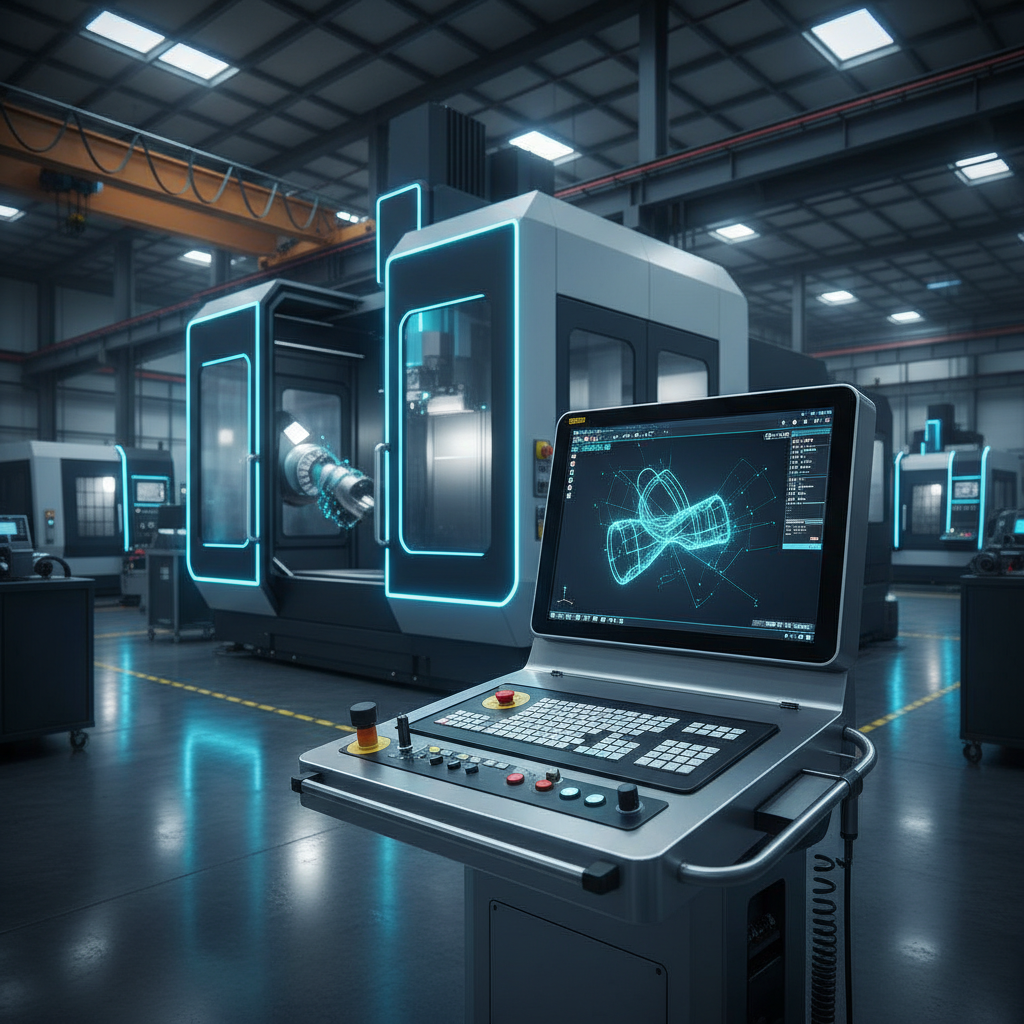

Chapter 1 Industry Overview and the Definition of CNC Controllers
I. The Master Machine of Industry: The Battle for Control Authority
In the taxonomy of advanced manufacturing, machine tools hold the title of "mother machine of industry" — the metalworking machinery that produces all other machinery. Turbine blades for jet engines, precision bearing raceways, intricate mold cavities for semiconductor packaging, and complex structural members of large civil aircraft all emerge from beneath the cutting tools of machine tools. And at the heart of every machine tool sits the CNC (Computer Numerical Control) system: the brain of the machine tool.
More precisely, if a machine tool is a skilled artisan whose hands never tire, then the CNC system is the artisan's cerebral cortex — the neural center that converts a machining drawing into a real-time command sequence, transforming design intent into a physical part with micrometer-level precision.
A CNC system accepts the machining program a process engineer has written, translates it into real-time position commands for each axis, drives the servo motors with sub-millisecond precision, and coordinates the tool's high-speed cutting trajectory with the flood of cooling lubricant — ensuring that every feed move holds the designed contour to within single-digit micrometers. Machining a compressor blade in titanium alloy means commanding five axes simultaneously, performing real-time interpolation at every half-millisecond interpolation cycle, feeding position commands to the servo drives with micron accuracy. There is no shortcut that bypasses the CNC system on this path.
The CNC system is therefore the irreplaceable technological lynchpin of the machine tool industry. A factory investing in machining centers — even the finest structural steel and the most precise spindle — achieves nothing without a capable CNC system. The binding relationship between a machine tool and its CNC system is far deeper than any ordinary component-to-machine relationship.
II. Anatomy of a CNC System: Five Modules That Must Work in Concert
A complete CNC system (Computer Numerical Control System) is not a single chip but an ecosystem of coordinated functional modules, each indispensable:
NC Core / NCK (Numerical Control Kernel): The computation center of the system. It parses G-code or CAM-generated tool paths, runs the Look-ahead algorithm to plan the velocity profile for multiple upcoming segments, and outputs interpolated position commands to the servo drives every interpolation cycle (typically 0.5–4 ms). The quality of the interpolation algorithm directly determines the machine tool's ability to achieve high-speed, high-precision machining with smooth surface finish. The NCK algorithm is the core intellectual property of every CNC brand, and the foundation of competitive differentiation.
HMI (Human-Machine Interface): The interaction layer for operators and programmers. It covers program editing, process parameter entry, coordinate system management, tool data management, alarm diagnostics, and maintenance guidance. Advanced HMI systems have built-in maintenance path real-time display, machining database integration, and remote monitoring. Siemens Sinumerik ONE's HMI runs on a PC-class architecture; its digital twin preview allows operators to verify the machining trajectory before the first cut, dramatically reducing costly scrap. Domestic CNC systems' HMI design has converged toward internationalization in terms of language richness and ergonomic friendliness, but still has a category gap against international leaders in the intelligence of maintenance guidance and workpiece knowledge library integration.
Servo Drive: Receives position and velocity commands from the NCK, drives the servo motors, and realizes the precise positioning of motion. The bandwidth, dynamic response, and closed-loop stability of the servo system directly and decisively determine machining accuracy. High-end servo systems typically run control loops at 125 µs cycles and require DSPs or FPGAs for real-time computation. Servo drives typically account for 30%–50% of the total CNC system hardware cost.
PLC and I/O Modules: Control the machine tool's peripheral actuators — tool changers, workpiece clamping, spindle lubrication, coolant management, and guard interlocks — typically via EtherCAT or PROFINET fieldbus for millisecond-level real-time communication. PLC logic can be customized by machine tool builders to implement complex automation sequences and special functions; the real-time performance of the communication bus (typically < 1 ms latency) directly affects the responsiveness of tool change and pallet swap cycles.
In addition, precision linear scales and encoders serve as the "sensory nervous system" of the CNC system — the direct feedback source for positional information. Linear scales provide direct linear position measurements; encoders provide rotary-to-linear position feedback for servo motors. Currently more than 90% of globally high-precision linear scales are supplied by German and British companies — Heidenhain and Renishaw. The domestic industry has multiple enterprises pursuing this segment, with best-performing domestic scales approaching 1 nm resolution in laboratory settings, but commercial-scale delivery reliability in harsh industrial environments still lags behind.
III. Product Tiers: From Economy to High-End, Three Distinct Markets
The entire CNC system product spectrum can be segmented into three tiers, each with distinctive technical requirements, competitive intensity, and price points:
Economy-grade CNC systems — typically for standard two-axis turning centers and three-axis milling machines, interpolation accuracy at the micrometer level, pricing approximately ¥3,000–15,000/set. China's national brands hold 90–95% of this tier. GSK 928/980 series is the landmark product. Primary customers are small CNC machining shops and CNC lathes manufacturers. Economy-grade CNC systems have already completed the nationalization transition and are now a mature domestic market.
Mid-range CNC systems — for precision three-to-four-axis machining centers and complex turning-milling centers, requiring superior velocity planning and Look-ahead capability of 100+ segments, excellent servo bandwidth, pricing approximately ¥15,000–100,000/set. This tier is the current main competitive battleground — domestic market share approximately 45%, contested by GSK, Huazhong (华中数控), KND (凯恩帝), and FANUC 0i series, Siemens 828D.
High-end CNC systems (five-axis and above) — for five-axis machining centers, complex turning-milling-grinding compound machines, ultra-high-speed precision machining. Must support RTCP five-axis transformation, NURBS interpolation, and sub-micron interpolation precision. Pricing approximately ¥100,000–¥2M+/set. This tier remains dominated by imported systems — FANUC 30i series, Siemens Sinumerik 840D/ONE, Heidenhain iTNC640/TNC7 — with domestic systems holding approximately 15% share, primarily in aerospace defense, with essentially zero penetration in civilian high-end machining.
IV. Market Size and Growth Logic
The global CNC system market (hardware only, excluding software licenses and services) was valued at approximately USD 19–23 billion in 2025, projected to exceed USD 30 billion by 2030 at a CAGR of 6–8%, driven by: automation of new-energy vehicle manufacturing lines, acceleration of industrial robots in electronics/3C production, and global defense manufacturing expansion. The Chinese domestic market, valued at approximately ¥45–55 billion annually, represents approximately 35–40% of global demand, making China the world's largest single-country CNC system market by both volume and value.
The growth logic of the CNC system market is fundamentally tied to fixed-asset investment cycles in manufacturing: when manufacturing enterprises expand capacity (new factory construction, production line upgrade), CNC machine tool procurement drives downstream CNC system demand. The 2024–2025 machine tool industry downcycle therefore suppressed CNC system shipment growth; but with China's new-energy vehicle and high-end equipment manufacturing sectors sustaining long-term investment cycles, the medium-term growth trajectory for CNC systems remains intact.
V. Why CNC Systems Are a National Strategic Technology
The strategic importance of CNC systems goes far beyond their direct market size. Three mechanisms amplify their macroeconomic significance:
Precision manufacturing capability multiplier. A CNC system with 20% higher positioning accuracy enables the machine tools it drives to achieve a 20%+ improvement in machining precision across all downstream products — aircraft engine parts, EV motor stators, medical implants, semiconductor equipment components. The precision of the CNC system sets an absolute ceiling on the precision of any product manufactured by machine tools equipped with it.
Industrial security supply chain risk. If a country's CNC system supply is controlled by foreign vendors who can restrict exports or remotely disable systems (not a hypothetical — 1994 Toshiba Machine incident and 2022 export controls have demonstrated this risk), the country's entire precision manufacturing sector is held hostage. The degree of self-sufficiency in CNC systems is a direct measure of the security resilience of a country's industrial base.
Technology spillover to adjacent fields. CNC system core algorithms (multi-axis interpolation, real-time trajectory optimization, digital servo control) are directly transferable to industrial robot controllers and high-precision motion control platforms. A CNC system R&D team simultaneously develops the foundational capabilities for the broader intelligent manufacturing ecosystem.
VI. The Economic Maturity Pyramid of CNC Systems
In evaluating a CNC system's overall capability, looking only at datasheet specifications is insufficient. The industry applies an "engineering maturity pyramid" framework — a dimension that often more faithfully reflects actual commercial value than any single technical metric:
Base layer: Fundamental Accuracy (measurable). Positioning accuracy, repeatability, and interpolation accuracy verifiable under standard test conditions. Through comparative testing at national machine tool testing centers, domestic high-end CNC systems (e.g., Kede GNC62) now approach 95%+ of the Siemens 840D benchmark on this layer.
Middle layer: Process Robustness (difficult to measure). Can lab-certified accuracy be maintained under real-world production conditions — tool wear, workpiece mass variation, cutting load fluctuation, ambient temperature swings? This validation requires data accumulation across thousands of real production hours. It is the hardest-to-quantify but highest-commercial-impact gap between domestic systems and FANUC/Siemens.
Top layer: Ecosystem Completeness (time-accumulated). Post-processors covering all common CAM platforms, cutting-parameter databases for major materials and processes, nationwide certified field engineer networks, rich macroprogramming example libraries — these accrue only through time and cannot be sprint-developed. This is the core of FANUC's multi-decade moat.
Understanding the three layers leads to an honest assessment: domestic systems are close on accuracy, accumulating on robustness, and furthest behind on ecosystem. The three layers carry roughly a 2:4:4 weighting in high-end user procurement decisions, meaning that even closing the accuracy gap yields limited incremental win probability — the middle and top layers are the decisive competitive battleground.
Chapter 2 Global Landscape and China's Position
I. The Three Global Oligarchs: FANUC, Siemens, Heidenhain
The global CNC system market exhibits a highly concentrated structure. Three companies dominate the landscape:
FANUC (Japan) commands approximately 40% of global CNC system market share, with particularly dominant positions in Asia: over 60% of Japanese machine tool production uses FANUC systems; in China, FANUC holds approximately 35–40% of the total CNC system market. FANUC's moat rests on four pillars: proprietary RISC processors optimized for CNC computation, the world's most extensive global service network (265 service centers in 108 countries), decades of accumulated cutting-process database knowledge embedded in its systems, and deep ecosystem lock-in through post-processor compatibility with virtually every major CAM software package.
Siemens Sinumerik (Germany) commands approximately 20–25% of global market share, with particular strength in Europe (approximately 50% European CNC market share) and in high-precision five-axis applications globally. Siemens' competitive differentiation lies in its platform strategy: Sinumerik is deeply integrated with NX CAD/CAM software, OPCENTER MES, and MindSphere IoT platform, positioning it as the centerpiece of a "Digital Enterprise" end-to-end solution rather than a standalone CNC controller. Sinumerik ONE (launched 2019, V6.20 in 2025) implements native digital twin capability — any machining program can be fully simulated and optimized in virtual space before physical execution.
Heidenhain (Germany) occupies a specialized but highly defensible niche: approximately 12–15% of global market share but over 80% share in specific high-precision segments including precision die-mold machining, medical device manufacturing, and aerospace surface finishing. Heidenhain's TNC 7 control system (2023) and the updated iTNC640 are the preferred controllers for HSC (High-Speed Cutting) machining of aerospace structural parts in the 10,000–30,000 rpm spindle range.
Mitsubishi Electric (Japan) holds approximately 8–12% global share with strongest presence in Japan and Southeast Asia, particularly in EDM (Electrical Discharge Machining) controls and high-speed laser cutting CNC systems, a segment where Mitsubishi's proprietary motion algorithms and laser power modulation integration give it distinct advantages.
II. China's Position in Global CNC: Largest Consumer, Growing Producer
China's position in global CNC systems can be characterized as: the world's largest consumer market, with growing production capability that has achieved competitive success in the economy and mid-range segments but has yet to decisively crack the high-end market.
In consumption terms, China accounts for approximately 35–40% of global CNC system demand by unit volume and approximately 30–35% by value. The value-share discount relative to unit-volume share reflects the structural tilt toward lower-to-mid-price CNC systems in China's manufacturing base.
In production terms, China's domestic CNC system manufacturers (Huazhong HNC, Kede GNC, GSK, KND) collectively supply approximately 50% of domestic CNC system units — but the value-share is significantly lower because the domestically produced units skew heavily toward economy and mid-range products, while high-end CNC systems are still predominantly imported from FANUC, Siemens, and Heidenhain.
This production-consumption gap — high unit volume, high import value — is the structural problem that China's "工业母机" (industrial mother machine) national strategy is designed to address.
III. Taiwan's Role: Between China and the West
Taiwan's CNC system manufacturers — NC Systems (formerly Lust) and Syntec Technology — occupy a distinctive position in the regional competitive landscape. Their products serve the Chinese mainland market as alternatives to Japanese and German systems but at closer-to-domestic price points. NC Systems' controllers have historically been popular among mid-size Guangdong and Zhejiang machine tool builders seeking better performance than GSK without the cost of FANUC. The cross-strait geopolitical uncertainty has increasingly prompted mainland machine tool manufacturers to evaluate domestic CNC brands as a supply chain security hedge.
IV. Japan's Strategic Position: FANUC's Fortress
Japan retains remarkable concentration in CNC systems through FANUC's global dominance. FANUC's success is not accidental — it reflects decades of deliberate focus: the company concentrates R&D almost entirely on manufacturing (automation, robots, CNC) and avoids diversification. Its "zero downtime" reliability standard (FANUC targets 99.99%+ uptime for its systems) has created a reliability reputation that commands premium pricing and deep customer loyalty.
FANUC's robustness stems partly from its vertically integrated supply chain: FANUC designs its own CNC processors, manufactures its own servo motors, and produces its own industrial robots in-house. This vertical integration allows FANUC to optimize across system boundaries — a capability that is extremely difficult to replicate through partnerships or outsourcing.
V. Germany's Dual Presence: Siemens and Heidenhain
Germany maintains a distinctive dual-brand presence in global CNC systems. Siemens dominates the "smart factory integration" end of the spectrum with its Digital Enterprise platform strategy, while Heidenhain defends the "ultimate precision" niche with metrology-grade position measurement hardware (Heidenhain's linear scale business is inseparably linked to its CNC controller business). This dual presence gives Germany a uniquely strong position in the high-value end of the global market and makes German CNC technology effectively irreplaceable in several ultra-precision applications.
The potential impact of Germany's export control decisions on China's CNC system supply chain is therefore significant. As of mid-2026, Germany has not aligned with the U.S. position on restricting CNC technology exports to China — a stance that continues to provide Chinese machine tool manufacturers with access to Siemens Sinumerik and Heidenhain linear scales for mid-to-high-end applications. Any change in Germany's stance would materially impact China's domestic CNC capability and further accelerate import substitution investment.
Chapter 3 Core Technologies
I. Five-Axis Interpolation and RTCP: The Technological Threshold
Five-axis simultaneous machining is the defining technical threshold that separates high-end CNC systems from mid-range ones. It requires the CNC to simultaneously control three linear axes (X/Y/Z) and two rotary axes (typically A/C or B/C), maintaining the precise orientation of the cutting tool relative to the workpiece surface throughout a complex machining path.
RTCP (Rotation around Tool Center Point): The fundamental algorithm that makes five-axis machining controllable. When the rotary axes move, the physical location of the tool tip in the machine coordinate system changes. Without RTCP, the tool tip would drift off the intended workpiece surface as the rotary axes rotate. RTCP calculates, in real-time, the compensatory linear axis displacements required to keep the tool tip stationary (in the workpiece coordinate frame) while the rotary axes rotate. This requires real-time evaluation of the machine's full kinematic chain — a mathematical problem involving 4×4 homogeneous transformation matrices computed every interpolation cycle.
TCPM (Tool Center Point Management): The Siemens equivalent nomenclature for RTCP functionality. The underlying mathematics is identical; Siemens uses TCPM as the command keyword in Sinumerik G-code while Heidenhain uses TCPM in iTNC language. FANUC implements the same function under the option name "3D Cutter Compensation."
The computation complexity of RTCP/TCPM is one reason why five-axis CNC systems require substantially more powerful processors than three-axis systems — the kinematic transformation math for every interpolation cycle adds hundreds of floating-point operations that simply do not exist in three-axis control.
II. Look-Ahead Algorithm: Maintaining Accuracy at High Feed Rates
At high feed rates (typically 8,000–30,000 mm/min for aerospace structural parts), the CNC system must plan velocity profiles for tool paths far in advance — it cannot wait until a corner is reached to begin decelerating. The Look-ahead algorithm solves this by continuously scanning a buffer of upcoming program segments (typically 100–500+ segments in high-end systems) and computing the maximum permissible feed rate through each segment based on:
- The geometric curvature of the path at each transition point (sharp corners require velocity reduction to avoid contour error)
- The machine's physical dynamics limits — maximum axis acceleration and jerk (rate of change of acceleration)
- The allowable chord error at each interpolation step
High-end CNC systems like FANUC's AI Contour Control (AI CC) and Siemens' Advanced Surface Technology can preview 500–1,000+ segments ahead and maintain commanded feed rates on complex sculptured surface paths that would have required dramatic feed rate reductions on earlier systems. Domestic systems like Huazhong HNC-848 have implemented competitive Look-ahead depth, but the tuning of Look-ahead parameters for specific workpiece materials and surface quality requirements is an area where Chinese engineers are still building the accumulated application knowledge that FANUC field support has available.
III. Real-Time Error Compensation: Geometric, Thermal, and Load Errors
Even the most precisely built machine tool accumulates geometric errors (straightness of linear guides, perpendicularity of axes, rotational axis radial runout), thermal errors (heat-induced structural expansion), and quasi-static load errors (deflection under cutting forces). CNC systems address these through compensation modules:
Geometric Error Compensation: Typically implemented via volumetric error compensation tables — measured using a laser interferometer and ball bar test, quantifying the 21 error parameters of a three-axis machine (6 per axis plus inter-axis squareness errors). These measurements are stored in the CNC as compensation tables that add correction values to position commands throughout the work volume.
Thermal Error Compensation: Multiple temperature sensors are placed at critical machine structure points (spindle bearing housing, ball-screw support bearing, machine base). A thermal error model — derived from characterization tests correlating temperature rise patterns to actual position drift — continuously computes and applies thermal displacement corrections to axis position commands.
Load-Dependent Deflection Compensation: Particularly relevant in heavy-duty five-axis machining, where spindle and B-axis head weight causes measurable structural deflection that varies with the axis angle. FANUC and Siemens high-end systems incorporate gravity compensation models that compute and apply position corrections based on the instantaneous rotary axis angles.
Huazhong's HNC-10 generation introduced AI-driven adaptive thermal compensation — using online machine learning to continuously update the thermal model as the machine's actual thermal behavior evolves over time. This is a genuinely novel approach that goes beyond the static thermal model approach used by FANUC and Siemens in their standard packages.
IV. NURBS Interpolation and Direct CAM Interface
Traditional NC programs convert smooth NURBS tool paths (as designed in CAM) into thousands of short linear (G1) segments. At high feed rates, these segment transitions create micro-velocity fluctuations that result in visible surface marks (faceting). NURBS interpolation eliminates this by accepting the spline control points directly and computing smooth interpolated positions from the mathematical curve — maintaining constant-curvature motion without segment-boundary effects.
FANUC's AI Nano Contouring and Siemens' Polynomial Interpolation (G06.2) both implement high-order spline interpolation. Kede Numerical Control (科德数控) GNC62 implements NURBS interpolation as a standard feature, and its surface quality results in aeronautical aluminum alloy pocket milling have matched those of FANUC 30i in comparative tests conducted at aerospace manufacturing facilities.
The complementary technology is direct DXF/3D CAD import in HMI — allowing simple mold features to be programmed directly at the machine without requiring a seat of CAM software. Siemens Sinumerik ShopMill and FANUC's Manual Guide i implement this; domestic HNC systems have comparable conversational programming for standard features but lag in the completeness of 3D solid-model direct import.
V. Fieldbus Integration: EtherCAT, PROFINET, and NCUC
The fieldbus protocol governing communication between the NC core and servo drives, I/O modules, and peripheral devices has a direct impact on system real-time performance, wiring complexity, and ecosystem interoperability:
EtherCAT (Ethernet for Control Automation Technology, developed by Beckhoff Automation): The fastest industrial Ethernet fieldbus, with cycle times of 31.25 µs achievable on standard Ethernet hardware. Siemens and many Chinese CNC manufacturers (including Huazhong) use EtherCAT-derived topologies for servo communication.
PROFINET IRT (Isochronous Real-Time): Siemens' preferred fieldbus for Sinumerik-to-Sinamics servo drives, achieving isochronous cycles of 125 µs with sub-microsecond jitter. Siemens' integrated portfolio (Sinumerik + Sinamics + Profinet) creates a tightly optimized system with pre-validated timing behavior.
NCUC (Numerical Control Universal Control) Bus: An open high-performance fieldbus standard developed by the China Numerical Control Standardization Working Group (in which Huazhong CNC plays a leading role). NCUC is designed as a Chinese-domestic alternative to EtherCAT, offering 31.25 µs cycle times and open specification for domestic servo and I/O manufacturers to implement. NCUC's growing adoption among Chinese CNC system and servo drive manufacturers — including Huichuan Technology (汇川技术) — is beginning to create a domestic fieldbus ecosystem that can serve as a supply-chain-secure alternative to European-designed fieldbus protocols.
VI. AI Integration in CNC: From Theoretical to Commercial
The integration of AI into CNC systems has accelerated dramatically in 2024–2026, evolving from experimental laboratory demonstrations to initial commercial deployments:
Huazhong HNC-10 (World's First AI Large-Model CNC System, April 2025): The HNC-10 embeds a manufacturing-domain fine-tuned AI large model directly in the CNC hardware, enabling natural language instruction (an operator can type "rough mill this pocket to ±0.1 mm tolerance" and the system generates the NC program) and real-time AI cutting parameter recommendation based on workpiece material recognition. Selected as one of the "2025 World Top-10 Intelligent Manufacturing Technology Advances."
Siemens Sinumerik ONE V6.20 (2025): Introduced AI-assisted process optimization — the digital twin collects historical machining performance data across a fleet of machines and uses supervised learning to recommend cutting parameter adjustments that reduce cycle time. An aerospace trial in 2025 documented 11% average cycle time reduction across a batch of structural aluminum wing rib components.
FANUC's AI Servo Monitor and AI Thermal Control: FANUC has incrementally embedded ML-based anomaly detection (AI Servo Monitor: predicts servo drive failure 2–4 weeks before occurrence by learning from vibration signatures) and AI thermal compensation (learning machine-specific thermal drift patterns) into its 31i and higher systems, positioning AI as an enhancement layer on its proven reliability rather than a paradigm shift.
VII. Digital Twin Architecture
The digital twin in CNC context means maintaining a real-time virtual model of the machine tool that tracks the actual machine's position, load, and thermal state synchronously with physical machining:
Siemens "My Virtual Machine" (integrated with Sinumerik ONE): The NC kernel software runs identically on real hardware and on a PC-based simulation environment — the same compiled machine data package controls both. This allows complete offline verification (including PLC logic, NC program, and machine kinematics) before committing to physical production.
Huazhong's "Dual Digital Thread" Architecture: HNC-10 implements a parallel data collection framework — one thread collecting command-domain data (NC program instructions, interpolated positions) and one thread collecting sensor-domain data (actual axis positions, motor currents, vibration, temperature). The parallel digital threads feed an AI analysis module that compares commanded versus actual behavior in real-time to detect emerging machining anomalies.
VIII. Mathematical Foundations of Five-Axis CNC
Five-axis CNC's mathematical core involves homogeneous transformation matrices (4×4 D-H matrices) cascaded to describe the kinematic chain from workpiece coordinate frame to tool frame. NURBS curve interpolation requires real-time evaluation of B-spline basis functions. Velocity optimization uses constrained nonlinear optimization to minimize cycle time subject to machine dynamic limits. Thermal error compensation employs multivariate regression and neural network models. The breadth and depth of applied mathematics embedded in a modern high-end CNC system is comparable to advanced embedded control software in the aerospace industry.
IX. Thermal Error Compensation in Engineering Practice
High-precision CNC machines are affected by thermal errors — positional drift accumulating over 2–4 hours of continuous spindle operation can reach 10–50 µm from heat generated by bearings, motors, and friction. Modern CNC systems address this by installing 8–16 temperature sensors at key machine locations, building a thermal error model that maps temperature distribution to positional error, and continuously applying real-time compensatory position offsets. AI-adaptive thermal models that update online represent the frontier of thermal compensation capability, with Huazhong HNC-10's adaptive model showing particular promise in 24-hour unmanned machining scenarios.
Chapter 4 Supply Chain
I. The Upstream Dependency Map: Where China Is Exposed
The CNC system supply chain has three distinct tiers of upstream vulnerability for Chinese manufacturers:
Tier 1 — Processing Electronics (FPGAs and High-Performance DSPs): Modern NCK cores run on FPGAs (Intel Xilinx/AMD, Intel/Altera) or high-performance DSPs. FPGAs are subject to U.S. Export Administration Regulations (EAR). China's domestic FPGA production (Pango Micro 紫光同创, Beijing Microelectronics Research Institute) has made progress at 28nm and 55nm nodes but lags in high-density logic count and I/O performance required for the most demanding CNC interpolation cores. This is an acknowledged strategic vulnerability.
Tier 2 — Precision Position Sensors (Linear Scales and High-Resolution Encoders): Linear scales with sub-100nm resolution and multi-turn encoders with 23-bit or higher absolute resolution are dominated by Heidenhain (Germany), Renishaw (UK), and Fagor (Spain). China's Yuheng Optics (禹衡光学, Harbin) produces linear scales up to approximately 1 µm resolution for mid-range applications but does not yet produce scales at the sub-50nm resolution needed for ultra-precision five-axis work. This is the supply chain segment where domestic substitution has furthest to go.
Tier 3 — Servo Motors and Drive Power Components: Domestic servo drives (Inovance/汇川, Delta/台达, Estun/埃斯顿) have achieved competitive mid-range (0.2–22 kW) performance. High-speed spindle motors (50,000+ rpm) and direct-drive torque motors for five-axis rotary tables remain areas where domestic supply is limited. The rare-earth NdFeB magnets in servo motors are a Chinese upstream strength (China controls ~90% of global NdFeB production), but precision motor winding and dynamic balancing for ultra-high-speed spindles are manufacturing capability gaps.
II. The NCUC Fieldbus Ecosystem
China's domestic NCUC fieldbus standard has created the foundation for a Chinese-domestic servo and I/O ecosystem. Inovance Technology, Huazhong CNC, and Weihong Numerical Control all produce NCUC-compatible servo drives, enabling a complete domestic CNC system to be assembled without any European or Japanese fieldbus-dependent components. The industrial adoption of NCUC is a supply chain security milestone — it represents the first viable Chinese alternative to the EtherCAT/PROFINET ecosystem for production CNC systems.
III. CAM Software Post-Processor Ecosystem
One of the least visible but most commercially important elements of the CNC ecosystem is CAM software post-processor compatibility. A machining program generated in Mastercam, Siemens NX, or Hypermill needs to be post-processed into the specific G-code dialect of the target CNC system. If the post-processor for a particular CNC brand is unavailable or unreliable, process engineers will simply specify a different CNC brand to avoid the compatibility risk. FANUC and Siemens have decades of accumulated post-processor libraries covering essentially every major CAM package. Domestic CNC systems have made significant progress in Mastercam and NX post-processor compatibility but still lag in covering the full range of niche CAM platforms (e.g., Vero VisiCAD, WorkNC, Tebis) that specialized industries rely on.
IV. Software Ecosystem Openness Trends
The CNC software ecosystem is gradually opening through three mechanisms: OPC UA/UMATI standardization for machine data interchange across brands; STEP-NC (ISO 14649) for transmitting CAM process intent (not just trajectory coordinates) to the CNC; and open CNC platforms (Beckhoff TwinCAT CNC, Codesys CNC) for non-standard automation. China's domestic CNC manufacturers have adopted OPC UA in their latest products (HNC-848/10, GSK5000), enabling integration with factory MES/ERP systems using vendor-neutral interfaces.
V. Servo Motor Rare Earth Dependence and Domestic Progress
High-performance servo motors depend on NdFeB (neodymium iron boron) rare-earth permanent magnets for power density and dynamic response. China controls approximately 85% of global rare earth reserves and approximately 90% of NdFeB magnet production — an upstream strategic strength. The challenge is the gap between magnetic material production and precision motor manufacturing: consistent inter-lot magnetic property uniformity for high-end servo motor grades, precision motor slot geometry and winding for < 0.5% torque ripple, and high-speed spindle rotor dynamic balancing to G0.4 grade all remain areas where domestic precision motor manufacturers are still closing the gap against FANUC and Siemens servo motor manufacturing quality.
Chapter 5 Downstream Applications
I. Aerospace: The Supreme Technical Validation Stage
Aerospace manufacturing is the most demanding application domain for CNC systems — and therefore the most credible commercial validation of high-end system capability. Titanium alloy structural parts (Ti-6Al-4V fuselage frames, landing gear components), nickel superalloy engine turbine discs, and carbon-fiber reinforced polymer (CFRP) wing skin panels all require five-axis simultaneous machining with positioning accuracy of ±2–5 µm and surface roughness Ra ≤ 0.4 µm.
China's C919 large commercial aircraft program and the COMAC C929 wide-body aircraft development have created specific demand signals for domestically produced high-end CNC systems in qualifying aerospace supply chains. Kede Numerical Control (科德数控) has achieved the most significant aerospace qualification success of any domestic high-end CNC company: its GNC62 five-axis system has been certified for production use in multiple AVIC-affiliated (Aviation Industry Corporation of China) machining centers, with aerospace orders representing approximately 63% of new orders in the first half of 2025.
II. Automotive: Volume Scale, Price Sensitivity, and Brand Lock-In
The automotive sector represents the highest-volume CNC system demand in China — cylinder block machining lines, transmission housing lines, camshaft grinding lines, and EV motor housing machining cells collectively represent millions of CNC system-years of operation. However, automotive is also the segment most characterized by brand loyalty and long supplier qualification cycles: a Tier-1 automotive supplier qualifying a CNC system for a production line typically runs 2–3 years of parallel operation before full changeover, making the switch from FANUC (dominant in Toyota/Honda/BMW partner supply chains) extremely expensive to justify on price alone.
The electric vehicle manufacturing revolution is gradually shifting this dynamic. BYD, CATL, and their tier-1 battery cell and e-drive suppliers are building new manufacturing lines without the accumulated FANUC-preference legacy of traditional ICE (internal combustion engine) automotive, and have shown greater willingness to evaluate domestic CNC systems for motor housing machining, battery tray aluminum milling, and gear grinding applications.
III. Mold and Die: Surface Quality Above All
The mold and die industry — plastic injection molds, metal stamping dies, forging dies — is the most quality-sensitive segment per part value. A precision injection mold for a smartphone housing (Class A surface) may cost ¥50,000–500,000 and require 5–8 days of machining time; a single surface defect from CNC control issues can scrap the entire mold. This extreme consequence of control failure makes mold makers among the most conservative CNC system adopters — they tend to stick with proven brands (Heidenhain TNC for HSC mold work, FANUC for standard three-axis milling) rather than risk a new brand on production work.
The barrier for domestic CNC systems in precision mold is not just technical — it is the risk calculus. Even if a domestic CNC system matches FANUC in specified accuracy, a mold maker with a ¥200,000 customer order will not accept an uncertain failure probability differential. Building trust in this segment requires sustained, well-documented performance records over multiple years.
IV. Medical Device: A Growing High-Precision Niche
Orthopedic implants (hip/knee prosthetics), dental restoration parts (full-ceramic crowns, zirconia bridges), and surgical instruments are emerging as a high-growth niche for CNC systems, with technical requirements that sometimes exceed aerospace. Orthopedic implant machining of medical-grade titanium requires surface roughness Ra ≤ 0.4 µm and geometric accuracy ±10 µm on complex anatomical surfaces. Dental milling machines operate at 50,000+ rpm spindle speeds on brittle ceramic materials. These requirements are driving demand for domestic mid-to-high-end CNC systems in the medical device manufacturing segment, where China's aging demographics are accelerating market growth.
V. New Energy Vehicle Manufacturing: Structural Growth Driver
NEV production in China exceeded 15 million units in 2025, creating large-scale demand for CNC machining of battery cell casings (precision aluminum extrusion), e-drive motor stator cores (precision stamping + laser welding), reducer housings (aluminum alloy milling), and structural battery tray frames (aluminum casting precision finishing). Each NEV corresponds to approximately 15–25 machine-tool-hours of CNC machining across the supply chain. This structural growth in NEV manufacturing is the most important near-term volume growth driver for mid-range domestic CNC systems, and is the commercial arena where GSK and Huazhong CNC are most actively displacing imported mid-range systems.
Chapter 6 Leading Players
I. FANUC: The Global Standard-Bearer
FANUC Corporation (Oshino, Japan, listed on Tokyo Stock Exchange, ticker 6954.T) is the undisputed global leader in CNC systems, generating approximately USD 5–6 billion in annual revenue from factory automation (CNC + Robots + Robomachine) in FY2025. FANUC's CNC business holds approximately 40% global market share and over 35% China market share. Its FANUC Series 30i-B Plus (five-axis, high-end), 0i-MF Plus (economy-to-mid-range), and the Series 31i/32i/35i family cover the complete product spectrum.
FANUC's deepest strategic moat is not any single technical feature but the combination of: absolute global reliability reputation (the industry benchmark for "six-nines" uptime), the world's most complete post-processor ecosystem, and decades of accumulated "cutting knowledge" embedded as application-optimized default parameters in its NCK firmware — parameters derived from millions of real-world machining hours across its global install base.
II. Siemens Sinumerik: The Digital Integration Champion
Siemens Digital Industries (Erlangen, Germany) offers Sinumerik CNC systems as part of its integrated "Digital Enterprise" manufacturing platform strategy. Sinumerik ONE (2019 launch, V6.20 in 2025) is the flagship product: an x86-platform CNC system that runs the NC kernel and HMI on virtualized hardware, enabling native digital twin execution — the same code runs in simulation and in production. The 2025 V6.20 update introduced AI-assisted process optimization that reduced cycle time by an average of 11% in aerospace trials.
Siemens' China revenue from digital industries exceeds USD 2 billion annually, with CNC systems as a core component alongside industrial automation. Its China strategy emphasizes "digital transformation" rather than hardware sales — selling MindSphere IoT connectivity, OPCENTER MES integration, and NX CAD/CAM software alongside Sinumerik hardware creates a bundled value proposition that is difficult for cost-only comparisons to undermine.
III. Huazhong CNC (华中数控): The Domestic High-End Flag-Bearer
Huazhong Numerical Control Co., Ltd. (stock code 300161, Wuhan, Hubei) is the most prominent domestically listed CNC system company and the technological flag-bearer of China's high-end CNC system nationalization effort. Founded in 1994 as a spin-off from Huazhong University of Science and Technology, Huazhong CNC has shipped over 300,000 units of CNC systems in its history.
FY2025 financials: Revenue ¥1.564 billion (−12.24% YoY, reflecting the 2024–2025 machine tool industry downcycle), net profit increased +129.48% driven by government R&D subsidies and a shift in mix toward higher-margin high-end products. Q1 2026: CNC product revenue +30% YoY, signaling the start of a market recovery.
HNC-848 Series (current flagship): Three-axis to five-axis systems covering mid-to-high-end machining centers. The 848M-V five-axis version implements full RTCP, 500-segment Look-ahead, and thermal error compensation as standard features.
HNC-10 (AI CNC, announced April 2025): The world's first CNC system embedding a manufacturing-domain AI large model. Natural language programming, AI cutting parameter recommendation, and adaptive thermal compensation are core innovations. Selected for "2025 World Top-10 Intelligent Manufacturing Technology Advances."
IV. Kede Numerical Control (科德数控): The Five-Axis Specialist
Kede Numerical Control Co., Ltd. (stock code 688305, Dalian, Liaoning) is the most credibly specialized domestic high-end five-axis CNC system company. Listed on Shanghai's STAR Market in 2022, Kede focuses exclusively on GNC-series five-axis CNC systems and the high-precision five-axis machining centers that use them.
H1 2025 financials: Revenue ¥295 million (+15.24% YoY), R&D expense at 33.34% of revenue (far above the industry average of 8–12%) — a signal that Kede is in investment mode, prioritizing technology over short-term profitability. Aerospace and defense orders represented approximately 63% of new orders in H1 2025.
GNC60/GNC62 flagship systems: Fully implemented RTCP, NURBS interpolation, dual digital thread data collection, and thermal compensation. Certified for production use in AVIC-affiliated aerospace machining facilities. In direct comparisons at aerospace machining centers, the GNC62 has matched FANUC 30i in surface quality on aluminum alloy structural parts.
Kede's moat: Unlike Huazhong CNC, which covers the full product spectrum from economy to high-end, Kede concentrates entirely on five-axis high-end and is vertically integrated — it also manufactures the high-precision five-axis machining centers (GMC series) that use its CNC systems. This allows Kede to optimize the CNC system and the machine tool structure together, a system-level optimization approach that is Kede's most defensible competitive differentiator.
V. GSK (广州数控): The Market Scale Champion
Guangzhou Numerical Control Equipment Co., Ltd. (广州数控设备有限公司, GSK) holds the largest domestic CNC system market share by unit volume — approximately 50% of all domestic brand units. With annual production approaching 100,000 CNC system sets, GSK's competitive formula is scale + service density: its regional agent network covers all major industrial cities, offering 4–8 hour on-site response times and local parts inventory.
GSK's core products — 928/980 series economy systems and 990/1000 series mid-range systems — are the volume backbone of China's mid-sized machine tool industry. The newer GSK 5000 series is GSK's attempt to penetrate the high-end market and compete with FANUC 0i-F Plus. Adoption has been moderate; GSK's established "economy/mid-range specialist" brand image creates a perception barrier for high-end sales that requires sustained investment to overcome.
VI. KND (凯恩帝): The Niche Mid-Range Specialist
KND (Beijing Kaen Di Technology Co., Ltd., 北京凯恩帝数控技术有限公司) operates in the mid-range CNC system space with particular strength in CNC lathe control and turning-milling centers. KND's K2000/K1000 series has established a loyal customer base among medium-complexity turning and milling operations. KND's market positioning is essentially "Chinese mid-range quality at Chinese pricing" — it does not attempt to compete with Kede or Huazhong in five-axis and explicitly positions its products as the value-optimized choice for the mid-volume machining market.
VII. The i5 System: A Strategic Case Study
Shenyang Machine Tool's i5 intelligent CNC system (2014–2019) represents an important case study in CNC system commercialization strategy. i5's vision — network-connected machine tools forming a sharing economy for machining capacity — was ahead of its time. Its execution failed because platform strategy was prioritized over product foundation maturity: the i5 system's basic control precision and reliability were not fully competitive when the networking platform was launched, and the envisioned "manufacturing sharing economy" value creation proved far harder to realize than anticipated, given manufacturing's deeply risk-averse nature. Shenyang Machine Tool's financial collapse in 2019 ended the i5 project's scaling ambitions. The i5 experience has informed the more technology-first approach taken by both Huazhong and Kede in their subsequent strategies.
VIII. International OEM Localization Strategies
FANUC (China) and Siemens Digital Industries (China) have both executed deep localization strategies — China-based sales, engineering, and service teams; local training centers; university lab partnerships. In the perception of Chinese machine tool manufacturers, FANUC and Siemens have long transcended "foreign brand" status and are seen as "industry standards deeply embedded in China for 30 years." Displacing this perception requires domestic CNC brands to compete not just on hardware specifications and price, but on service trust, application knowledge depth, and ecosystem coverage — a far higher bar than price parity alone.
Chapter 7 Domestic Substitution Tiered Map and Factory Database Insights
I. Economy-Grade Segment: Substitution Essentially Complete (90%+)
In the economy-grade CNC segment (pricing below ¥15,000/set, primarily for standard turning and milling), domestic brands have achieved what amounts to completed substitution. This is not merely a market share statistic; it represents a fundamental shift in the competitive reality: for machine tool builders in this segment, selecting an imported economy-grade CNC system (FANUC 0i-TD or Mitsubishi M70 at three times the price) would be commercially indefensible. GSK's 928/980 series, KND's K1000 economy line, and Huazhong's HNC-808 systems collectively own this market comprehensively.
Economy-grade substitution has also driven an important secondary effect: the concentration of China's mid-sized machine tool industry in specialized clusters (CNC lathes in Shenyang and Qingdao, machining centers in Taizhou and Ningbo) has built dense local ecosystems around domestic CNC brands, with trained technician pools, local spare parts distributors, and machine tool builders whose engineering teams are deeply familiar with domestic systems. This ecosystem density creates a self-reinforcing advantage for domestic brands in these clusters.
II. Mid-Range Segment: The Critical Competitive Zone (~45% Domestic)
The mid-range segment (¥15,000–100,000/set, primarily three-to-four-axis machining centers and complex turning centers) is the most strategically consequential battleground. Domestic market share is approximately 45%, with the remaining 55% going primarily to FANUC 0i-MF Plus and Siemens 828D.
Several dynamics are actively driving domestic share gains in this segment:
- New-energy vehicle supply chain: New machining lines for EV motor housing and battery tray components, built by Chinese Tier-1 suppliers with no legacy FANUC infrastructure, are evaluating domestic systems on a level playing field
- Government procurement preference: State-owned enterprise capital equipment procurement increasingly includes domestic CNC system preference requirements in RFPs
- Price pressure on machine tool builders: When final assembly machine tool prices compress due to competition, the ¥20,000–40,000 cost savings from choosing domestic over FANUC in the mid-range becomes a direct margin contribution
III. High-End Five-Axis Segment: Strategic Inroads, Long Road Ahead (~15% Domestic)
High-end five-axis CNC systems represent the most challenging frontier. Domestic market share is approximately 15%, almost entirely concentrated in aerospace and defense applications driven by policy mandates rather than open commercial competition. In non-policy-driven procurement (foreign joint-venture automotive, consumer electronics precision machining, precision medical devices), domestic five-axis CNC systems have essentially zero penetration.
The commercial validation milestones that Kede GNC62 has achieved in AVIC-affiliated aerospace machining are genuine and technically significant — they demonstrate that a domestically produced five-axis CNC system can meet the precision and reliability requirements of actual aerospace production. But achieving initial qualification in policy-driven aerospace accounts is a very different challenge from winning commercial five-axis business against FANUC 30i or Siemens 840D on a pure performance-and-cost basis.
The critical gap is ecosystem trust: aerospace machining centers that have used FANUC 30i for 15 years have accumulated verified post-processors, parameter libraries, and institutional knowledge about that system's behavior. Switching to a domestic system means rebuilding this knowledge base — a real cost that no datasheet comparison captures.
IV. Regional Differentiation in Domestic Substitution
Domestic CNC substitution progress varies significantly by geography:
Pearl River Delta (Guangdong): SME-dominated manufacturing with strong GSK presence (home turf advantage). Most price-sensitive market; highest domestic mid-range penetration among all regions.
Yangtze River Delta (Jiangsu, Zhejiang, Shanghai): The most complete manufacturing sector by product diversity. Both the strongest FANUC/Siemens market (for precision machining and JV automotive) and the most contested mid-range battleground for domestic penetration.
Central China (Hubei, Hunan): Huazhong CNC's home region, strongest domestic policy support. Heavy machine tool industry (Wuhan Heavy Machine) and automotive (Dongfeng) supply chain create demand aligned with Huazhong's product strength.
Northeast (Liaoning, Jilin): Kede's home base (Dalian), dense aerospace manufacturing concentration (AVIC units, aeroengine manufacturers). The region with highest domestic high-end CNC penetration in the country.
Southwest (Sichuan, Chongqing): Aerospace engine manufacturing (AVIC Chengdu, AECC) and rising NEV production (BYD). High strategic value for domestic high-end CNC penetration with historically low domestic share — most significant medium-term opportunity area.
V. Platform Data Insights: Demand-Side Quantification
The Tianxia Gongchang (天下工厂) factory database — covering 4.8 million verified manufacturing enterprises across China — provides a demand-side quantitative perspective on the CNC system market. Based on database analysis of buyer behavior in relevant categories:
- Search volume for "数控系统" (CNC systems) and "数控机床" (CNC machine tools): consistent growth trend, with accelerating inquiry velocity from 2024 Q4 through 2026 Q1 — aligning with the recovery signals from listed CNC companies' Q1 2026 financials
- Geographic concentration of search demand: Guangdong (Pearl River Delta machining cluster) and Jiangsu (Yangtze River Delta precision manufacturing) account for over 50% of CNC-related search volume
- Industry vertical distribution: 工业控制 (industrial control) and 加工中心 demand dominate, with the fastest-growing inquiry segment being 五轴联动 (five-axis simultaneous) — consistent with the structural narrative of China's manufacturing sector moving up the precision ladder
VI. Economy-Grade Systems: The Long-Tail Market
Economy-grade CNC systems (sub-¥15,000) serve a market of 40,000+ sets annually and represent the cash flow foundation for domestic CNC system manufacturers. The competitive dynamics in this segment are fully domesticized — no imported system can compete on the combination of price, local service, and supply speed. GSK and Huaxing Numerical Control (华兴数控) serve the deep long-tail: small machine shops, individual tooling workshops, and the vast number of CNC retrofit projects in the country's industrial heartland. This segment is structurally stable, generating reliable revenue that cross-subsidizes the R&D investment needed for the high-end challenges.
Chapter 8 Pricing and Business Models
I. The Three-Tier Pricing Landscape
Economy grade (¥3,000–15,000): Volume-driven, margin-thin, competitively intense among domestic brands. GSK's position is structurally entrenched through distribution scale. Profit comes from volume, parts supply, and basic maintenance contracts.
Mid-range (¥15,000–100,000): The most contested price band, where the ¥20,000–40,000 price advantage of domestic systems over FANUC 0i/Siemens 828D translates to meaningful machine tool builder margin impact. This is where domestic brands are gaining most rapidly.
High-end (¥100,000–¥2M+): Value-driven, service-intensive, dominated by FANUC 30i and Siemens 840D/ONE. Domestic systems (Kede GNC60/62) have entered this range but compete primarily in aerospace defense through policy-driven procurement rather than commercial market pricing competition.
II. Business Model: Hardware Sales, Functional Options, and After-Sales
The CNC system business model evolved from pure hardware sales to a combination of hardware + software licensing + after-sales services:
Hardware sales remain the primary revenue driver, but modern high-end systems layer paid functional options on top of base hardware. Siemens Sinumerik 828D base hardware: approximately ¥55,000; five-axis transformation package (CYCLE800): approximately ¥18,000 additional; High-Speed Cutting package: approximately ¥25,000 additional; CAD/CAM interface module: approximately ¥8,000 additional. A fully featured 828D with all common options can total ¥120,000+ — nearly double the base system price.
After-sales maintenance revenue is structurally important for FANUC and Siemens: with installed bases of hundreds of thousands of systems each in China alone, annual maintenance contracts (typically 8–15% of system purchase price per year) and spare parts revenue generate consistent high-margin recurring income. FANUC's service business generates approximately 15–20% of total revenue at margins substantially higher than hardware.
Software licensing and digital services represent the frontier of business model evolution. Siemens' MindSphere IoT connectivity subscription (annual per-machine fee), Kede's cloud-based machining analytics service, and Huazhong's AI cutting parameter recommendation service (subscription-based after initial trial period) are early-stage implementations of a software-as-a-service overlay on CNC hardware.
III. The Economics of Choosing Domestic vs. Imported (Mid-Range)
A concrete cost comparison for a typical mid-range three-axis vertical machining center:
Huazhong HNC-848M + domestic servo package (3 axes):
- HNC-848M control unit: ¥18,000–25,000
- Servo drives × 3 (domestic brand): ¥12,000–20,000
- Servo motors × 3 (domestic brand): ¥8,000–15,000
- Spindle inverter + operator panel + cables: ¥5,000–10,000
- Total CNC cost: approximately ¥43,000–70,000
FANUC 0i-MF Plus + FANUC servo package (3 axes):
- FANUC 0i-MF Plus main unit: ¥40,000–55,000
- FANUC servo drives + motors × 3: ¥28,000–40,000
- Operator panel + cables: ¥5,000–8,000
- Total CNC cost: approximately ¥73,000–103,000
The ¥30,000–40,000 cost difference represents 5%–15% of the total machining center sales price (¥250,000–500,000), a commercially meaningful margin impact that directly motivates domestic CNC selection in the mid-range machine tool segment.
IV. Service Network Economics
The economics of after-sales service networks are a critical competitive variable often underestimated in hardware-focused market analyses. FANUC maintains 265 service centers globally and approximately 80+ authorized service points in China, enabling 24–48 hour on-site response in major industrial cities. Building equivalent coverage requires substantial fixed investment in service center infrastructure and engineer training and certification — an investment that takes years to accumulate and creates a real competitive moat for incumbents.
Domestic CNC brands have built competitive service density in the Pearl River Delta, Yangtze River Delta, and Wuhan/Hubei regions but have sparser coverage in Northeastern China, Western China, and second-tier industrial cities. Closing this coverage gap is a multi-year capital investment priority for all domestic CNC system companies with growth ambitions.
Chapter 9 Representative Customer Cases
I. AVIC Xi'an Aircraft and Huazhong CNC: Large Structural Parts Machining
AVIC Xi'an Aircraft Industry (Group) — the manufacturer of the Y-20 military transport and domestic commercial aircraft structural components — has been a testing ground for domestic high-end CNC system adoption under the national "aerospace supply chain nationalization" program. Huazhong CNC HNC-848 five-axis systems have been deployed on large-structure aluminum alloy milling machines at several Xi'an facilities, machining wing ribs and fuselage frames for defense programs where import substitution was mandated rather than optional.
The experience at AVIC Xi'an has provided Huazhong with its most demanding process validation data — large aluminum aerospace structural parts (dimension tolerances ±0.05 mm over spans of 3+ meters) require the CNC system to maintain positioning accuracy over long continuous machining cycles while compensating for machine thermal drift. Huazhong's adaptive thermal compensation has been specifically validated in this context.
II. Kede at Shenyang AVIC Liming: Engine Component Five-Axis Validation
Shenyang AVIC Liming — the manufacturer of WS-15 jet engine components for the J-20 fifth-generation fighter — has been a key validation partner for Kede's GNC62 five-axis system in titanium alloy and nickel superalloy machining. The GNC62 systems deployed at Liming have machined titanium compressor discs and nickel alloy turbine seal rings to specification, establishing the system's credibility in the most precision-critical manufacturing context in China's defense industrial base.
These aerospace validation cases are commercially significant beyond their direct revenue — they provide the technical credibility that Kede uses in conversations with civilian aerospace supply chain manufacturers (who have similar but less stringent requirements than military aviation) and with the emerging commercial satellite manufacturing sector, where five-axis precision machining demand is growing rapidly.
III. BYD Battery Tray Lines and GSK Mid-Range CNC
BYD's internal machining capacity for battery structural components — aluminum alloy battery trays and cooling plates — represents one of the largest single-buyer deployments of mid-range CNC systems in China's NEV industry. GSK's mid-range CNC machining center systems have been deployed on high-volume aluminum milling lines, demonstrating competitive cycle time and reliability performance against FANUC benchmarks — and providing GSK with a reference that is directly relevant to the broader NEV supply chain buyer audience.
IV. An Optical Instrument SME: The Mid-Range Substitution Story
A small precision optical instrument manufacturer (annual revenue approximately ¥15 million) in Jiangsu province, previously running FANUC 0i systems on three-axis milling centers for optical mount machining (aluminum alloy, Ra ≤ 0.8 µm surface finish requirement), replaced two of six FANUC-controlled machines with Huazhong HNC-848 systems in 2024 as a trial. After six months of parallel operation, the company confirmed that surface finish quality on standard aluminum parts was indistinguishable between the two systems, and has committed to specifying Huazhong CNC for all future machine purchases.
This pattern — a pilot trial on non-critical production lines, followed by expanded adoption after positive performance validation — is the typical adoption pathway for domestic mid-range CNC in precision manufacturing SMEs, and is the unit story that aggregates into the ~45% market share figure in the mid-range segment.
V. The Academy Market: Building the Next Generation of Users
Huazhong CNC has established "Huazhong CNC Laboratories" at over 200 universities and vocational institutions, providing student-version HNC-8 simulation software licenses and technical training support. This educational ecosystem reach serves a dual purpose: developing institutional familiarity with domestic CNC systems among future manufacturing engineers, and creating a reference network of academic institutions that evaluate and validate domestic CNC system teaching performance.
The academy market's direct procurement scale (a few thousand teaching machines annually) is modest, but its strategic value in shaping the brand preferences of the next generation of CNC-using engineers and procurement managers is substantial — a lesson that FANUC demonstrated decades ago with its own university laboratory program that created lasting FANUC preference in Japanese and Chinese engineering education.
Chapter 10 Investment, Financing, and M&A
I. Listed CNC Companies: Market Capitalization and Valuations
China's CNC system sector has two publicly listed pure-play companies:
Huazhong CNC (300161.SZ): Listed on Shenzhen ChiNext, market capitalization approximately ¥6–8 billion (as of mid-2026), P/E approximately 40–60x based on FY2025 earnings (net profit significantly boosted by R&D subsidies and product mix improvement). Revenue base of ¥1.56 billion with a clear mid-range market leadership position but high-end market penetration still early.
Kede Numerical Control (688305.SH): Listed on Shanghai STAR Market (2022), market capitalization approximately ¥15–25 billion, P/E approximately 80–120x based on FY2025 numbers — a premium that reflects investor confidence in its long-term aerospace supply chain positioning rather than current earnings. R&D spending at 33%+ of revenue signals a company in investment mode rather than harvest mode.
Both companies receive substantial government R&D subsidies that inflate reported net profit relative to purely commercial income, a factor that investors need to account for in comparative valuation analysis.
II. Government Fund Investment: The National Manufacturing Upgrade Fund
The National Manufacturing Upgrade Fund (国家制造业转型升级基金), established under the 十四五 period with total capital of approximately ¥200 billion, has invested directly in CNC system and machine tool companies as LP positions and through project grants. Key investment channels include:
- Direct equity investment in specialist mid-range CNC system companies without a public listing pathway
- R&D project grants under the 工业母机 national technology major program (5–10 year grant cycles)
- Equipment first-trial subsidy programs (首台套补贴): subsidizing machine tool buyers who specify domestic CNC systems as a first commercial deployment
The government fund complex has effectively lowered the capital cost for domestic CNC system R&D and commercialization, enabling domestic companies to sustain R&D intensity (Kede's 33%+ R&D/revenue ratio would be commercially unsustainable without subsidy support) during the long technology maturation period.
III. M&A Activity: Consolidation in Progress
The CNC system sector is beginning to see consolidation as the investment cycle from 2021–2023 produces a cohort of venture-backed mid-size entrants that have not found paths to commercial scale. Expected M&A patterns:
Vertical integration acquisitions: Domestic servo drive companies (Inovance, Estun) may acquire CNC software capability to offer more integrated solutions; CNC system companies may acquire encoder or linear scale technology to reduce upstream supply chain vulnerability.
Geographic market access acquisitions: Chinese CNC system companies eyeing Southeast Asian or Middle Eastern export markets may acquire or partner with local machine tool distributors to accelerate go-to-market access in export markets.
Technology capability acquisitions: Specialized CNC companies with niche expertise in grinding machine control, gear grinding CNC, or EDM control that larger generalist CNC companies can add to round out their product portfolios.
IV. Private Equity and Venture Capital Dynamics
The private equity and VC investment cycle in CNC systems followed the pattern described in the strategy section: high enthusiasm from 2021–2023 (driven by policy tailwinds and Kede's STAR Market listing proving the exit path), rational recalibration from 2024–2025 as commercial progress across the cohort proved slower than projected, and early signs of renewed interest in 2026 as Q1 data from listed companies confirmed market recovery. Current investment evaluation focuses rigorously on: revenue quality (policy-driven vs. commercial), customer concentration (aerospace is policy-driven; automotive and mold are commercial signals), and software/service revenue as a proxy for genuine product competitive moat.
Chapter 11 Policy and Standards
I. 十五五 Plan: 工业母机 as a "Decisive Breakthrough" Priority
China's Fifteenth Five-Year Plan (2026–2030) explicitly designates machine tools and CNC systems (collectively referred to as 工业母机, "industrial mother machines") as a "decisive breakthrough" technology frontier — ranking alongside integrated circuits, quantum computing, and aerospace propulsion in the tier of technologies deemed essential for China's industrial sovereignty and national security.
The 工业母机 designation carries specific programmatic implications: it triggers a dedicated national technology major program (国家重大科技专项) with multi-year funding commitments; it mandates government procurement preference for domestic CNC systems in government-funded infrastructure and state-owned enterprise capital investment; and it directs the National Development and Reform Commission (NDRC) to monitor and report on domestic CNC system penetration rates as a macro-economic indicator.
II. Stability Measures for the Machinery Industry (2025–2026)
The Ministry of Industry and Information Technology (MIIT) issued "Machinery Industry Quality and Stability Measures (2025–2026)" specifically addressing the 2024 machine tool industry downcycle. Key provisions relevant to CNC systems:
- Equipment renewal subsidy programs with a specific carve-out for domestic CNC system replacement of imported systems (eligible for additional 10% subsidy beyond baseline equipment renewal support)
- First-commercial-deployment (首台套) protection for domestic high-end CNC systems in aerospace and ship manufacturing — allowing a full 24-month performance evaluation period before any penalties for performance shortfall
- Mandatory domestic CNC system specification in new production line investment projects funded by national strategic industries (aerospace, nuclear energy, advanced ship manufacturing)
III. Standards System: Transition to Technology-Neutral National Specifications
The technical standards governing CNC systems in China have been undergoing revision to remove legacy dependency on specific technology architectures and align with international standards (ISO, IEC) while preserving specific Chinese requirements for precision acceptance criteria and reliability testing protocols. Key standards relevant to CNC systems:
- National Standard 20957 (equivalent to ISO 230 series): Machine tool testing standards, including CNC axis positioning accuracy measurement protocols
- National Standard 16462 (metalcutting machine tools, CNC general technical requirements): The foundational specification that CNC machine tools must comply with for domestic market acceptance
- NCUC fieldbus specification (CNCUC-1.0/2.0): The domestically developed open fieldbus standard for CNC systems, maintained by the Chinese Numerical Control Standardization Technical Committee
IV. Cybersecurity Requirements for Industrial Control Systems
The "Industrial Control System Cybersecurity Guidelines" (工控系统信息安全) issued by MIIT impose specific cybersecurity requirements on CNC systems deployed in critical infrastructure and defense-adjacent manufacturing contexts:
- Network isolation requirements (air-gapping or strict firewall between CNC machine networks and enterprise IT networks)
- Authentication requirements for remote maintenance access (dual-factor authentication mandatory for overseas vendor remote service access)
- Data localization requirements for machine operational data in defense manufacturing contexts (prohibiting upload of machining program or machine performance data to overseas cloud servers)
These requirements create a structural barrier for imported CNC systems' IoT and remote monitoring features in defense contexts, effectively mandating domestically managed data infrastructure for these features — a requirement that domestic CNC system companies are better positioned to meet.
V. Local Government Policy Ecosystems
Provincial and municipal governments have implemented their own CNC system nationalization support programs:
Hubei Province (Huazhong CNC home base): Provincial industrial fund co-investment in Huazhong CNC R&D center expansion; "first purchase" subsidies for Hubei-based machine tool buyers specifying Huazhong systems; joint research projects with Huazhong University of Science and Technology funded at provincial level.
Liaoning Province (Kede home base): Dalian's "British Talent Engineering" for attracting overseas experienced CNC engineers; Liaoning Province aerospace industry fund supporting Kede-AVIC collaboration; provincial government co-investment in Kede's GNC series commercialization acceleration.
Guangdong Province (GSK home base): Single Champion Enterprise certification for GSK; Yellow Pu District manufacturing upgrade subsidies for GSK production line expansion; Pearl River Delta manufacturing upgrade subsidy programs with a domestic CNC preference carve-out.
VI. International Trade Policy and CNC System Flows
The intersection of export controls and CNC system trade creates a complex regulatory environment: U.S. EAR controls on high-performance FPGA chips used in CNC NCK cores; Wassenaar Arrangement review requirements for high-precision five-axis systems; Chinese rare-earth export controls as upstream leverage. Germany's non-alignment with US CNC export control tightening toward China remains a key swing variable for China's high-end CNC import continuity. The regulatory landscape is actively evolving, and any scenario involving German regulatory alignment with US policy would materially accelerate China's domestic high-end CNC investment pace and urgency.
Chapter 12 Trends and Research Analyst Judgments
I. AI Embedded CNC: From Feature to Platform
The most transformative trend in CNC systems over the 2025–2030 horizon is the shift of AI from a bolt-on feature to an architectural platform: the CNC system becomes not just a machining controller but an intelligent learning agent that continuously improves its understanding of the specific machine-workpiece-tool combination it controls.
The economic model implications are significant: an AI CNC platform that continuously learns from production data creates a subscription-based learning service whose value grows with usage — a fundamentally different commercial model from one-time hardware sales. For machine tool builders, the CNC system becomes a differentiated value driver rather than a cost line item.
II. Digital Twin as Standard Infrastructure
By 2028, digital twin capability will transition from a premium feature of top-tier CNC systems to standard infrastructure across the mid-range and above. The key driver is not technology availability (the technology exists now) but ecosystem maturity: as CAM software vendors (Siemens NX, Mastercam, Hypermill) complete native digital twin integration with major CNC brands, and as MES/ERP systems standardize OPC UA data ingestion from CNC twins, the marginal value of digital twin becomes sufficiently demonstrable to justify standard inclusion.
For domestic CNC manufacturers, this creates a two-track imperative: implement digital twin capability at the product level (Huazhong and Kede have started) and connect to the broader CAM/MES ecosystem at the data standard level (OPC UA/UMATI compliance is the necessary but not sufficient condition).
III. Supply Chain Self-Sufficiency: FPGA and Precision Sensors
The FPGA supply chain gap is the most structurally dangerous vulnerability in China's CNC system supply chain. Domestic FPGA progress (Pango Micro's 28nm production, planned 14nm development) provides a medium-term path to reducing dependency on Xilinx/Altera for mid-range CNC applications. High-end NCK cores that require Xilinx Ultrascale/Versal class devices remain dependent on U.S. supply chains without viable domestic alternatives in the near term. This gap will likely require a combination of: continued domestic FPGA development investment; architectural alternatives (high-performance ARM processors with hardware acceleration cores as NCK substrates); and strategic inventory management.
Linear scale domestic substitution (sub-50nm resolution for high-end five-axis) represents a longer-development-cycle challenge — the precision fabrication of diffraction gratings at 0.4 µm period with sub-nanometer uniformity is a capability that requires sustained specialized manufacturing investment.
IV. CNC and Digital Thread Integration
The CNC system's role in the manufacturing digital thread — from design (CAD) through process planning (CAM) through execution (CNC) through quality inspection (CMM) — is evolving from passive executor to active data producer. CNC systems that feed structured, actionable machining data (actual cutting forces, thermal compensation history, axis accuracy trend) back into the design and process planning system create a continuous improvement loop that is genuinely novel in manufacturing's technological history.
Siemens' "Digital Enterprise" vision explicitly positions Sinumerik ONE as the digital thread node in a Siemens-ecosystem manufacturing data architecture. The domestic equivalent — Huazhong's "dual digital thread" HNC-10 architecture — needs to demonstrate interoperability with non-Huazhong CAM and MES systems to achieve the same digital thread network effect.
V. 2030 Competitive Landscape Forecast
Forecast 1 — Mid-range domestic dominant: Domestic systems exceed 55–65% of mid-range market share by 2030, through combination of NEV supply chain adoption, government procurement preference execution, and accumulated service credibility.
Forecast 2 — High-end five-axis: parallel play (domestic + imported): Domestic five-axis CNC reaches 30–35% market share by 2030, driven by aerospace nationalization expansion and new civilian five-axis line adoption. FANUC 30i and Siemens 840D/ONE retain commercial dominance outside policy-driven procurement.
Forecast 3 — AI CNC as standard category: By 2030, "AI CNC" becomes a standard product category label rather than a differentiator — all major brands will include AI process optimization as standard. Competition shifts from "does it have AI" to "whose AI creates the most value" — a dimension where domestic brands' access to China's vast manufacturing data may confer advantage.
Forecast 4 — Upstream breakthrough: Domestic high-precision encoders (23+ bit) and servo drives (high-end) achieve meaningful share gains. Linear scale domestic substitution remains the hardest challenge, with domestic products competitive at mid-range precision by 2030 but still Heidenhain/Renishaw-dominated at ultra-precision high-end.
These four forecasts are grounded in demand-side evidence from the Tianxia Gongchang factory intelligence platform — search inquiry trends, geographic demand concentration, and category-level inquiry velocity all point to a structural upgrade cycle in Chinese precision manufacturing that will continue to drive domestic CNC system adoption across the 2026–2030 horizon.
Chapter 13 Risks
I. Technology Lock-In Risk: Ecosystem Inertia
The most persistent structural risk for domestic CNC system adoption is ecosystem inertia — the accumulated investment of Chinese machine tool builders and end users in FANUC and Siemens operational knowledge, post-processor libraries, training materials, and certified personnel. Each year of continued operation on imported systems deepens this institutional investment. The cost of switching is not the price difference between domestic and imported CNC hardware; it is the full cost of requalifying processes, retraining operators, rebuilding post-processors, and managing the performance risk during the transition period.
Domestic CNC system companies can address ecosystem inertia only through patient, sustained investment in the support infrastructure that reduces switching friction: free post-processor development for major CAM packages, training programs subsidized by government support, and customer success teams that actively manage customers through the transition learning curve.
II. Supply Chain Disruption Risk: FPGA and Precision Components
As discussed in Chapter 4, the FPGA dependency represents a genuine supply chain security risk for high-end domestic CNC systems. An escalation of U.S. export controls that cut off Xilinx/Altera chip supply to Chinese CNC system manufacturers would force an immediate pivot to alternative computing architectures — a technically feasible but commercially disruptive transition that could set back high-end domestic CNC commercialization by 2–3 years.
The linear scale dependency on Heidenhain and Renishaw represents a lower-risk but longer-term supply chain challenge: there is no current scenario in which Germany restricts Heidenhain scale supply to China (Germany would need to align with U.S. export control policy to do so), but long-term self-sufficiency in precision position measurement is a strategic imperative regardless.
III. Market Cycle Risk: Capital Equipment Demand Cyclicality
The 2024–2025 machine tool downcycle demonstrated that CNC system revenue is directly and immediately exposed to capital equipment demand cycles. When manufacturing enterprises defer investment — as many did in 2024 following the post-pandemic capex surge of 2021–2023 — CNC system unit volumes fall sharply. Huazhong CNC's revenue declined 12.24% in FY2025 despite its strong high-end product momentum. For smaller CNC system companies without the revenue diversification or balance sheet strength of listed companies, a prolonged downcycle can threaten commercial viability.
IV. Quality Credibility Risk: The First Large-Scale Failure
The single highest-impact risk for domestic high-end CNC adoption is a high-profile quality failure on a prominent national program — a domestically controlled five-axis CNC system causing a scrapped aerospace component, or a production line shutdown attributable to a domestic CNC system control failure. The consequences would extend far beyond the specific customer relationship; they would reset the market's risk assessment of domestic high-end CNC systems across the industry.
This risk is asymmetric in an important way: every successful aerospace machining result with a domestic CNC system marginally increases market confidence, while a single significant public failure can disproportionately damage confidence. Domestic CNC companies pursuing aerospace qualification must therefore manage their commercial expansion pace carefully — qualifying on lower-criticality parts first, building performance data, and expanding to higher-criticality applications only after robust reliability evidence has been established.
V. AI Over-Promise Risk
The current industry enthusiasm for AI-enabled CNC systems carries a risk of over-promise: if AI cutting parameter recommendation systems fail to deliver the efficiency improvements implied in marketing materials, or if digital twin accuracy falls significantly short of advertised prediction precision in commercial deployments, the resulting negative customer experiences could create backlash that slows the entire AI CNC adoption curve.
Managing AI promise against delivery requires domestic CNC companies to set honest, conservative performance claims in commercial materials and to invest heavily in the training data infrastructure required to make AI recommendation systems work reliably across the diverse range of materials, tool geometries, and machine configurations that production customers actually use.
VI. Technical Path Risk: AI Over-Commitment
Training data requirements for AI cutting parameter recommendation are substantial — a reliable model for any specific workpiece-material-machine-tool combination requires thousands of actual machining data points. For domestic high-end CNC systems with limited installed base, the cold-start data accumulation period may be longer than anticipated. Digital twin accuracy faces similar challenges: building a high-fidelity simulation model of a real machine's thermal and structural behavior is a deep engineering challenge that current commercial "digital twin" products frequently underperform against their specifications. Managing the gap between AI feature marketing and actual deployed performance is the central AI-strategy execution risk for domestic CNC system companies.
VII. Globalization Risk: Export Market Uncertainty
China's domestic CNC system companies face an increasingly complex export market environment. The global south (Southeast Asia, Middle East, Africa, Latin America) represents the most accessible export market — these markets lack strong CNC system brand preferences and are price-sensitive, where domestic Chinese brands have natural advantages. However, export market revenue monetization requires distribution network investment and localized technical support capability that extends well beyond the domestic China market infrastructure.
Geopolitical fragmentation of technology standards — if a U.S.-China technology standard divergence extends into CNC system programming languages, industrial ethernet protocols, or machine data formats — would constrain Chinese CNC system interoperability with the global manufacturing ecosystem, limiting export market potential. This is a medium-term risk that the NCUC fieldbus standardization initiative should be monitored against.
VIII. Industry Consolidation Risk and Price War
As the 2021–2023 VC investment cycle matures, the domestic CNC system sector faces consolidation pressure. Venture-backed entrants with limited installed base and commercial traction will face existential pressure, creating M&A opportunities for well-capitalized listed companies but also near-term pricing pressure as distressed companies compete for survival revenue. If price competition becomes severe in the mid-range segment, margin compression could reduce R&D investment capacity across the sector — creating a systemic risk to the sustained innovation that the 工业母机 nationalization strategy depends on.
Data Sources
All data and analysis in this report are derived from publicly available sources. This report is published by the Tianxia Gongchang (天下工厂) Industrial Research Institute. The database covers 4.8 million verified manufacturing enterprises across China (www.tianxiagongchang.com).
Primary Sources:
- FANUC Corporation Annual Report FY2025 (fiscal year ending March 2026), Investor Relations Section
- Siemens AG Annual Report FY2025, Digital Industries Division
- Huazhong CNC (300161.SZ) FY2025 Annual Report and 2026 Q1 Financial Report
- Kede Numerical Control (688305.SH) H1 2025 Report, 2025 Annual Report, and 2026 Q1 Report
- China Machine Tool & Tool Builders' Association (CMTBA) Industry Statistics Report 2025
- Ministry of Industry and Information Technology: "Machinery Industry Stable Growth Action Plan (2025–2026)"
- 十五五 National Planning Outline: Manufacturing Industry Directions (2026)
- National Machine Tool Quality Supervision and Inspection Center: Domestic and Imported CNC System Performance Comparative Test Report 2025
- Siemens Sinumerik ONE V6.20 Product Release Notes and Customer Case Studies (2025)
- Huazhong CNC HNC-10 Launch Press Release, April 2025
- Heidenhain TNC 7 Technical Documentation, English edition 2024
- FANUC Series 30i-B Plus Product Specifications, English edition 2025
- China Numerical Control Standardization Technical Committee: NCUC Fieldbus Specification V2.0
- Kede GNC60/GNC62 Product Technical Manuals (Chinese edition)
- National Bureau of Statistics: Fixed Asset Investment in Manufacturing, Q1 2026
Research Methodology Notes: Data freshness baseline: FY2025 corporate financials; 2026 Q1 interim reports; 2026 H1 policy updates. All company financial data cited from official annual reports or interim reports as publicly disclosed. Market share estimates are research analyst estimates based on disclosed revenue data, industry association statistics, and channel survey cross-validation. Export control regulatory status as of June 2026.