
# China High-End Connectors 2026 — Domestic Breakthrough Driven by AI Servers and EV Powertrains
Industrial Research Institute | 2026-06-22
Chapter 1: Industry Overview and High-End Connector Definitions
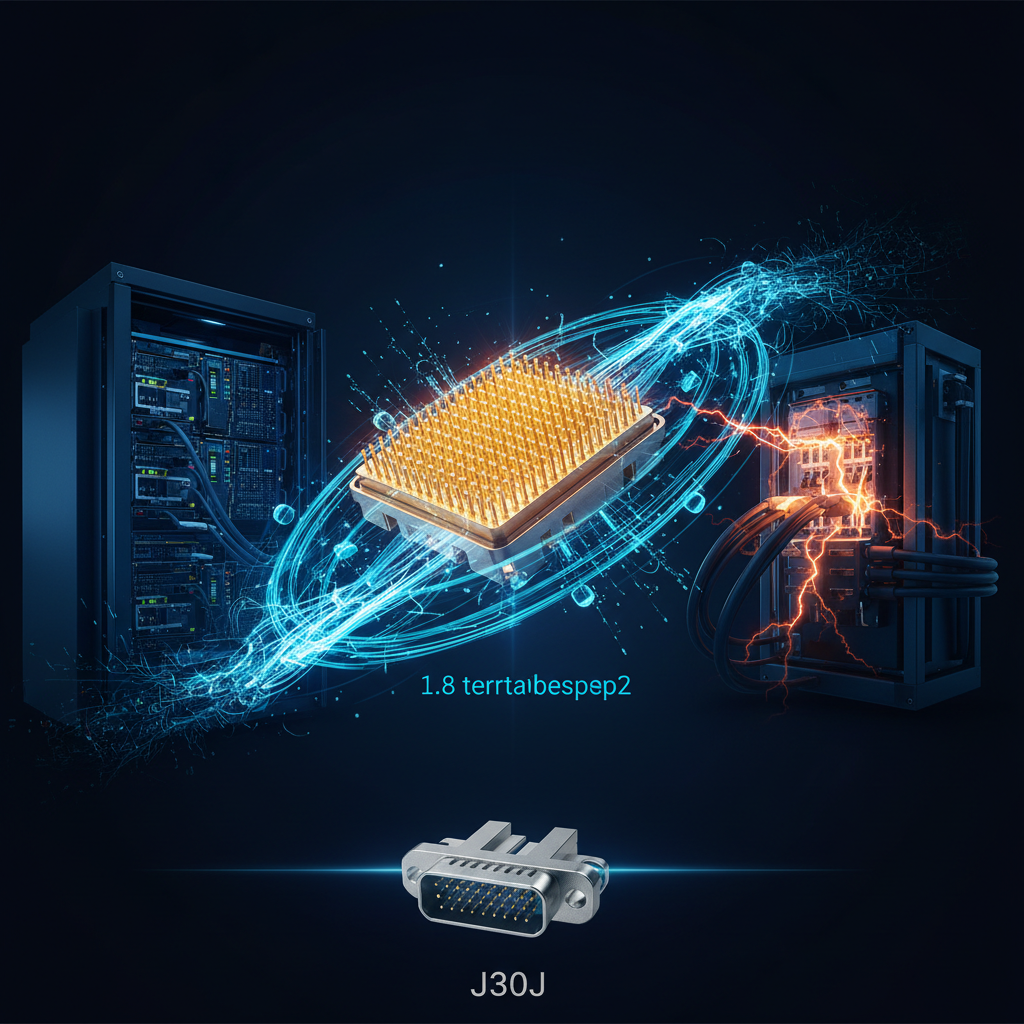
Connectors are among the most fundamental and irreplaceable components in electronic systems, responsible for physical transmission of electrical signals, optical signals, and power between circuit boards, modules, and subsystems. In an NVIDIA GB200 NVL72 AI server rack, over 5,000 NVLink copper cable interconnects carry 224 Gbps per channel, with total bidirectional bandwidth reaching 1.8 TB/s. An 800V-platform EV involves 30-40 high-voltage connectors, each rated for over 1,000V surge, full temperature range from -55 to +150 degrees Celsius, and vibration equivalent to 100,000 km of road use. Military J30J ultra-miniature rectangular connectors inside fighter aircraft must never fail.
China's high-end connector market reached approximately RMB 186.6 billion in 2024, forecast to reach RMB 247 billion in 2026. High-end connectors (AI server, automotive high-voltage, military/aerospace, industrial precision, medical) account for approximately 30-35% of this total.
Three macro forces converge in 2026: NVIDIA GB300 rack shipments doubling to 60,000+ units; China 800V EV platform penetration rising toward 10%; and defense procurement recovery from the 2023-2024 adjustment period.
Chapter 2: Global Competitive Landscape
TE Connectivity (annual revenue approximately USD 16.8 billion) is the world's largest connector company, holding approximately 20% global market share, with 60% of revenue from transportation applications — making it the world's largest automotive connector supplier. Its AdrenaLINE 224G connector portfolio targets AI server applications.
Amphenol (FY2025 revenue USD 16.2 billion) completed the USD 10.5 billion acquisition of CommScope's CCS division in January 2026, adding fiber data center connectivity to its electrical connector leadership. The Paladin HD 224G connector serves NVIDIA GB200 racks. Amphenol has completed 34 acquisitions historically, using M&A as its primary growth mechanism.
Molex (Koch Industries, approximately 6% global share) is developing the Inception genderless 224G backplane system. Japan's Hirose dominates ultra-miniature board-to-board connectors for mobile devices at 0.35-0.5mm pitch, with defect rates below 1 PPM — a manufacturing culture moat difficult to replicate quickly.
China's connector industry sits "strong at the base, emergent at the top": 95% domestic production in consumer electronics, 70% in telecom, 52% in automotive high-voltage, 30% in AI server high-speed, 95% in military (protected by GJB standards system).
Chapter 3: Core Technologies and Materials
Signal speed is the defining technical axis. The progression: 25G NRZ (standard 100G), 56G PAM4 (400G), 112G PAM4 (800G), 224G PAM4 (1.6T, NVIDIA GB200's NVLink), 448G (future). Each doubling requires a ground-up redesign — materials, shielding geometry, and contact physics all change fundamentally.
At 224G, the Nyquist frequency reaches 56 GHz. Conventional PA66 insulating material with dissipation factor (Df) 0.02-0.04 becomes unacceptably lossy; LCP (Liquid Crystal Polymer) with Df 0.002-0.005 is required — a full order of magnitude better. LCP supply remains approximately 70-80% import-dependent from Japanese producers (Sumitomo Chemical, Polyplastics/Toray), constituting a structural supply chain risk.
Signal integrity engineering at 224G requires: impedance control to milliohm precision, return loss below -20 dB, near-end crosstalk below -40 dB between adjacent differential pairs. Achieving these specs demands electromagnetic simulation tools (ANSYS HFSS) and high-frequency vector network analyzers (VNA, cost RMB 2-5 million) — capital investments that filter out commodity connector producers.
Co-Packaged Optics (CPO) represents the paradigm shift beyond pluggable optical modules: optical engines co-packaged with switch ASICs, with fiber array units (FAU) as the critical new connector interface replacing pluggable QSFP/OSFP cages. Tian Fu Communications supplies FAU and hermetic packaging for NVIDIA's Quantum X800 CPO switch — a position at the frontier of optical connectivity technology.
Chapter 4: Key Downstream Application Segments
AI server racks are the highest-value-density connector application. NVIDIA GB200 NVL72: 5,000+ NVLink connectors per rack, connector value RMB 1.4-2 million per rack. At 60,000 racks in 2026, NVIDIA alone implies RMB 90+ billion in AI server high-speed connector demand.
800V EV platform connectors: per-vehicle high-voltage connector content rises from RMB 800-1,200 (400V platform) to RMB 1,500-2,500 (800V platform). With 840,000 units sold in China in 2024 (+185% YoY) and forecast exceeding 1.5 million in 2025, the market grows rapidly. Domestic substitution: 52.3% in 2024, targeting 65%+ by 2026.
Military connectors operate in a GJB-protected domestic market. Foreign companies cannot obtain GJB certification; AVIC Jonhon and Aerospace Electronics collectively hold over 90% domestic military connector market share. Defense procurement cycle is recovering in 2025-2026 after 2023-2024 adjustment.
Industrial connectors (M8/M12 standard): 343 factories in the database; Harting and Phoenix Contact retain significant share in premium industrial connectors; Weifeng Electronics competes in mid-range M8/M12. Human-robot collaboration (cobots), AGV/AMR mobile robots, and industrial Ethernet (X-coded M12 for 10G) represent emerging domestic substitution opportunities.
Chapter 5: EV and Automotive High-Voltage Connectors
The 800V architecture transition does not merely double voltage — it cascades new requirements through every connector in the circuit. Contact materials must provide higher arc resistance (silver or gold plating preferred over tin). Insulating materials must achieve higher CTI (Comparative Tracking Index) ratings; PA46 and glass-reinforced PPS preferred over PA66. HVIL (High Voltage Interlock) connectors become more complex due to higher energy release during disconnection.
Liquid-cooled charging connectors integrate cooling channels within the connector assembly itself, allowing sustained 400-600A charging without excessive temperature rise. Huawei's liquid-cooled charging gun supports 1 MW peak power; Zeekr's liquid-cooled connector enables 1.2 MW peak. Ruike Da (瑞可达) is China's leading domestic liquid-cooled charging connector producer, with RMB 21.8 billion in EV connector revenue in 2024 (90.28% of total revenue).
China's domestic charging standard (national standard 20234 series for DC charging, separate from CCS/MCS/CHAdeMO) creates a natural tariff wall protecting domestic connector producers in the domestic market, while requiring additional product development for export to non-standard markets.
Chapter 6: Domestic Supplier Competitive Analysis
Luxshare Precision (立讯精密, 002475) is the most strategically significant Chinese connector company for the AI server narrative. 2024 revenue RMB 268.8 billion (total group); communications segment RMB 18.36 billion (+26.29%). The 224G CPC (Close-proximity Connector) reached small-batch shipment in early 2025, compatible with 1.6 Tb/s total bandwidth switch architectures. Target: 30% share of NVIDIA cabinet high-speed connectors in 2026, potentially 70% by 2027. Full vertical integration from copper alloy strip through cable assembly provides faster iteration cycles and tighter quality control.
AVIC Jonhon (中航光电, 002179): 2024 revenue RMB 20.69 billion; electric connector gross margin 39.37%; 5,900+ patents; 230,000+ product specifications. Liquid cooling segment RMB 1.63 billion (+14.44%). Serves defense, BYD, Li Auto, and data center liquid cooling applications from a single technical platform. Military market share exceeds 25%.
Tian Fu Communications (天孚通信, 300394): 2024 revenue RMB 3.25 billion (+67.74%); gross margin approximately 45%; net profit RMB 1.34 billion (+84.07%). NVIDIA CPO supply chain anchor. 200+ patents in silicon photonics coupling and FAU assembly. R&D intensity 7.1% of revenue — among the highest in the industry.
Ruike Da (瑞可达, 688800): 2024 revenue RMB 2.415 billion (+55.29%); EV connector revenue RMB 2.18 billion (90.28%). US factory operational. Gross margin 21.79% under raw material pressure. Specializes in liquid-cooled charging connectors and 800V high-voltage connectors.
Yihua (意华股份, 002897): 2024 full-year revenue approximately RMB 5.1 billion; QSFP56/QSFP-DD 200G/400G connectors in batch delivery. Key optical module interface connector supplier.
Aerospace Electronics (航天电器, 002025): 2024 revenue RMB 5.025 billion (-19.1%); net profit RMB 347 million (-53.8%) — reflecting defense procurement adjustment cycle. Gross margin on connectors 38.7%. J30J series ultra-miniature rectangular connector is the de facto standard in Chinese military avionics.
Chapter 7: Tianxia Gongchang Database: Factory Distribution Insights
The industrial research database covers 4.8 million verified manufacturing facilities across China. Keyword search results for connector categories reveal the structure of China's connector manufacturing base:
- General connector factories: 5,156
- Automotive connectors: 1,112
- RF connectors: 209
- Aviation/aerospace connectors: 123
- Industrial connectors: 343
- Charging connectors: 151
- High-voltage connectors: 79
- Optical module connectors: 40
- High-speed connectors: 66
- High-speed backplane: 6
- AI server components: 7
The contrast between the 5,156 general factory count and the 6-7 factories found for high-speed backplane and AI server applications illustrates precisely the chasm between China's vast low-end connector manufacturing base and the tiny cluster of technically capable high-end producers. Military connector producers (companies like AVIC Jonhon and Aerospace Electronics) do not appear prominently in commercial database searches due to the classified nature of their primary business.
Guangdong province accounts for the highest share of the 5,156 general connector factories, driven by the consumer electronics and EV supply chain concentration in Shenzhen, Dongguan, and Huizhou. Zhejiang (Wenzhou, Ruian) is China's industrial connector production heartland. Military connector production is geographically concentrated in Guizhou and Henan, reflecting the PLA's historical industrial base allocation patterns.
Chapter 8: Pricing, Economics, and Business Models
High-end connector gross margins span from 10-18% (consumer electronics) to 38-55% (military/aerospace), reflecting the value density and competitive structure of each segment.
The "three-phase margin lifecycle" of new technology connector products: (1) Introduction phase (years 1-3 after first shipment): 40-60% gross margin, supply-constrained, technology premium intact; (2) Growth phase (years 3-6): 25-40% gross margin as competitors enter; (3) Maturity phase (year 6+): 15-25% gross margin as specifications stabilize and price competition dominates. The 400G QSFP-DD connector is currently in maturity phase; 224G is in early introduction phase — the most attractive investment entry point.
Raw material cost dynamics: Copper (45-60% of connector material cost) follows LME copper prices, with pass-through mechanisms negotiated annually with major automotive OEMs (harder to pass through in consumer electronics). Gold plating costs rose significantly in 2024-2025 as gold prices increased from approximately USD 1,900 to over USD 3,000 per troy ounce — directly impacting military connector margins (Aerospace Electronics gross margin compressed from ~41% in 2022 to ~39% in 2024).
Certification economics: AI server high-speed connector qualification requires RMB 5-15 million investment and 18-30 months of engineering iteration before first revenue. Automotive OEM qualification: RMB 5-15 million and 2-4 years. Military GJB qualification: potentially 3-7 years. These certification economics are the primary reason why connector segments with high certification costs have "sticky" competitive moats — even technically-equivalent competitors must invest equivalent time and capital before displacing incumbents.
Chapter 9: Key Customers and Supply Chain Dynamics
Luxshare's NVIDIA supply chain integration represents the highest-profile domestic substitution success story in high-end connectors. The pathway: Apple consumer connector supplier → communications connector R&D investment → NVIDIA supply chain qualification → target 70% NVIDIA cabinet high-speed connector share by 2027. This trajectory, if realized, would mark the first time a Chinese company achieved dominant position in a tier-1 global AI infrastructure supply chain.
For Huawei Ascend-series AI servers, domestic connector adoption faces no political friction — the supply chain is explicitly designed to maximize domestic sourcing. This creates a large, technically demanding, but commercially accessible domestic validation platform for Chinese connector companies seeking to prove 224G and optical connector capability before approaching Western hyperscaler supply chains.
EV supply chain dynamics: BYD, SAIC-GM-Wuling, Li Auto, and NIO represent the largest domestic high-voltage connector demand sources. All four have explicit domestic supplier preference policies, creating the demand base that supports the growth of AVIC Jonhon, Ruike Da, and other domestic automotive connector producers.
Chapter 10: Investment, M&A, and Valuation Perspectives
Amphenol's 34-acquisition history is the defining case study in connector M&A. The CCS acquisition at USD 10.5 billion (completed January 2026) extends Amphenol's addressable market from electrical connectors into data center fiber connectivity — a segment growing rapidly due to AI-driven data center construction. Post-acquisition, Amphenol offers the most complete electrical + optical interconnect solution portfolio of any connector company.
Chinese connector companies are structurally constrained to organic growth: capital controls, CFIUS-equivalent scrutiny in Western jurisdictions (particularly for defense-adjacent targets), and valuation gaps all make outbound M&A practically unavailable. The implication is that Chinese connector companies build capability through R&D investment (AVIC Jonhon: RMB 2.25 billion in 2024), talent acquisition (hiring from Amphenol/TE/Molex China operations), and process iteration — slower but viable.
Valuation framework: Premium connector companies (Tian Fu: ~45% GM, CPO positioning) trade at significant premium to average connector companies (D-run: ~12% GM, consumer focus). The research institute views Tian Fu's current valuation as justified by CPO's growth potential, but notes that any CPO adoption timeline delays would create meaningful downside risk for a company with 45%+ gross margins that would compress if forced to compete in commodity optical components.
Chapter 11: Supply Chain, Standards, and Technology Barriers
LCP supply chain risk remains the most significant structural vulnerability in China's high-speed connector ambitions. Approximately 70-80% of LCP used in Chinese high-speed connectors is imported from Japan (Sumitomo Chemical, Polyplastics). Domestic LCP production (China's Shangfluoro, some emerging producers) has not yet achieved the purity and Df consistency required for the most demanding 224G connector applications.
Standards create durable competitive moats in military and automotive segments. GJB (military standard) qualification for Chinese defense connectors is a structurally protected domestic market. GB national standards for EV charging (national standard 20234 series) create domestic market protection for Chinese charging connector producers — though these same standards create barriers for Chinese EV charging equipment in foreign markets that use CCS or other standards.
In AI server high-speed connectors, international standards (IEEE, OIF-CEI for 224G electrical specifications; SFF-TA-1002 for OSFP form factor) are determined by organizations where Chinese companies participate but do not lead. Chinese connector companies therefore pursue a "standard-follower, fast-follower" strategy: rapidly qualify products to existing international standards rather than attempting to reshape standards.
Human robot collaboration, eVTOL (electric vertical take-off and landing), and AGV/AMR mobile robots represent emerging connector segments where standards are not yet fixed — creating an opportunity for Chinese connector companies to participate in standard-setting during the industry formation phase, rather than arriving after standards are locked.
Chapter 12: Tianxia Gongchang Research Institute's Assessment and Outlook
The research institute's five-year prediction framework (2026-2030):
Prediction 1: Luxshare Precision's communications connector segment will reach the global top 3 in value by 2030, with revenue exceeding RMB 60-70 billion (USD 8-10 billion) in communications connectors alone — enabled by AI server high-speed connector leadership.
Prediction 2: China's automotive high-voltage connector market will reach RMB 30+ billion by 2030 with domestic substitution exceeding 70-75%. AVIC Jonhon and Ruike Da combined could hold over 50% domestic market share.
Prediction 3: CPO adoption in new data center switch installations will reach a tipping point by 2028. Tian Fu Communications' CPO positioning is the most high-conviction differentiated call in the Chinese connector universe.
Prediction 4: Military connector demand recovery in 2025-2026 will drive AVIC Jonhon and Aerospace Electronics revenue back toward and above 2022 peak levels, supported additionally by commercial aerospace (satellite constellations) and eVTOL.
Prediction 5: Industrial connector domestic substitution will accelerate in human-robot collaboration and industrial Ethernet sub-segments where standards formation is still in progress.
Core risk: the technology transition from pluggable optical modules to CPO could create a period of demand uncertainty for companies with significant QSFP/OSFP connector revenue before CPO adoption is definitively confirmed. Yihua (400G/800G optical module interface connectors) faces this transition risk most directly.
Chapter 13: Risk Factors
Geopolitical risk: US export controls have not yet specifically targeted connector manufacturing equipment, but the regulatory environment warrants monitoring. Chinese connector companies' exposure to Western hyperscaler supply chains (as opposed to Chinese AI server and EV supply chains) is currently limited — which reduces geopolitical revenue concentration risk but also caps the addressable market for the near term.
Technology transition risk: The 224G copper cable era for AI server interconnects may be shorter than expected if CPO adoption accelerates beyond 2027 timelines. Any company whose connector business is concentrated in copper cable connectors (rather than optical components) for AI servers faces potential demand disruption within a 4-6 year window.
Material supply risk: LCP supply disruption from Japan could affect multiple high-speed connector producers simultaneously. An extended shortage scenario (triggered by geopolitical stress or capacity constraints) would disproportionately impact Chinese producers who are more import-dependent than their Japanese or American competitors.
Defense procurement cycle risk: Aerospace Electronics' 2024 revenue decline (-19.1%) illustrates the business risk concentration of pure-play military connector companies. AVIC Jonhon's diversification across military, EV, and data center provides better risk mitigation, but still faces a significant step-down in earnings if defense procurement remains at low levels beyond 2026.
Chapter 14: Appendix
Key Technical Glossary
224G PAM4: 4-level pulse amplitude modulation at 224 Gbps per channel; used in NVIDIA GB200 NVLink copper interconnects. Requires LCP insulators, precision shielding, and sub-milliohm impedance control.
CPO (Co-Packaged Optics): Optical engines co-packaged with switch ASICs; FAU connectors replace pluggable QSFP/OSFP; Tian Fu Communications is a Tier-1 FAU supplier for NVIDIA's Quantum X800 CPO switch.
FAU (Fiber Array Unit): High-precision component aligning optical fiber arrays to optical element arrays in CPO systems; Tian Fu's primary product for NVIDIA CPO supply chain.
J30J Series: Chinese military standard (equivalent to MIL-DTL-83513) ultra-miniature rectangular connector; produced by Aerospace Electronics; qualification for Chinese military avionics and weapons programs.
LCP (Liquid Crystal Polymer): Low dielectric loss thermoplastic (Df 0.002-0.005) required for 224G+ connector insulators; approximately 70-80% China import-dependent from Japan.
OSFP: Octal Small Form-factor Pluggable; 8-lane 100G optical transceiver form factor for 800G optical connections in AI servers.
GJB: Guojia Junyong Biaozhun (National Military Standard); China's military equipment standards system governing all PLA procurement; creates structural exclusion of foreign connector companies from Chinese military procurement.
Data Sources
Tianxia Gongchang industrial database (4.8 million verified factory records); company annual reports (Luxshare 2024, AVIC Jonhon 2024, Tian Fu 2024, Ruike Da 2024, Aerospace Electronics 2024); Amphenol FY2025 earnings materials; TE Connectivity investor presentations; SNS Insider, Fortune Business Insights, Precedence Research global connector market reports; OIF-CEI 224G electrical specifications; SFF-TA-1002 OSFP form factor standard documentation.