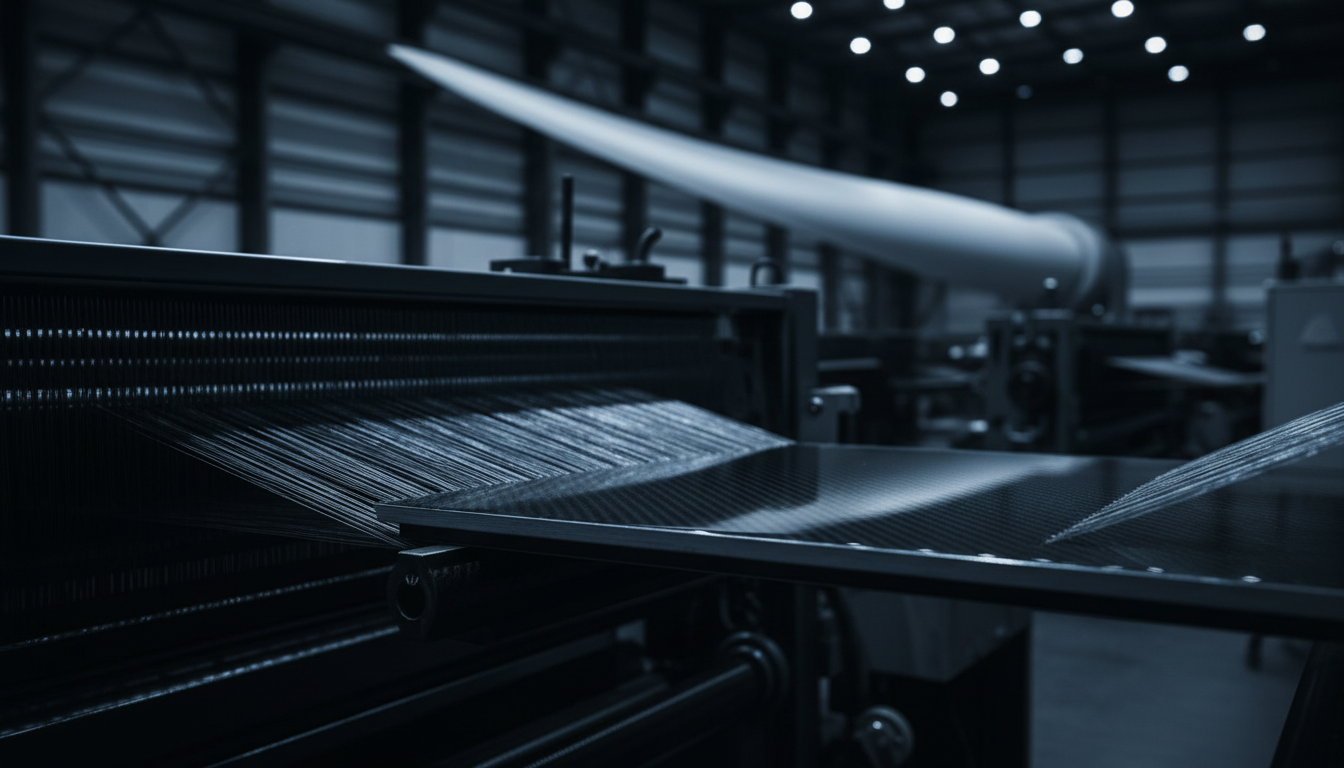

In May 2026, on the docks of Lianyungang, Jiangsu, rolls of black tow are loaded onto container ships. The shipment is from Zhongfu Shenying, bound for a wind blade factory in Southeast Asia: 48K large-tow carbon fiber, each roll weighing over 200 kilograms. The same week, in Jilin Chemical Fiber's mill, nearly two hundred pultrusion lines weave the same kind of tow into the spar caps of wind blades. Those carbon planks will travel north and end up inside a rotor nearly 190 meters in diameter.
China's carbon fiber industry has reached a strange inflection point. Domestic consumption in 2025 is projected at 96,400 tonnes, up over 70% year on year; the localization rate has broken 80%, and most general-grade tow has been reverse-substituted against Japan's Toray, America's Hexcel, and Germany's SGL Carbon. Yet in 2024 the industry's average profit per tonne fell to just 330 RMB, down 99% from a year earlier; multiple listed companies posted losses. The localization victory came with a brutal price war.
Carbon fiber is both "black gold" and a glut commodity. It rides in the tail of the C919 jetliner and inside the spar of a wind blade; it sits in a national space module and inside a child's fishing rod. Its scientific content is high, but its downstream is highly fragmented; capacity has expanded rapidly, but the top of the ladder—T1000, M40J—remains the technical citadel of Japan's Toray and America's Hexcel.
This report is a complete map of China's carbon fiber industry from 2025 to 2030. From industry overview to process chain, from manufacturer landscape to the six main downstream lines, from localization milestones to price cycles, from policy environment to risk factors, ending at a fundamental question: now that Chinese carbon fiber can reverse-price the global large-tow market, where will it be stuck, and from where will it break through?
Chapter 1 Industry Overview: 2025 in Key Numbers
Carbon fiber is a fibrous material made from polyacrylonitrile (PAN), pitch, or rayon precursors via oxidation, carbonization, and surface treatment. Its carbon content exceeds 90%; its density is one-quarter that of steel, but its strength can reach 7-9 times that of steel. This "stronger than steel, lighter than aluminum" property has made it indispensable to wind blades, aerospace, hydrogen storage tanks, photovoltaic thermal field components, automotive lightweighting, rail transit, and almost every other downstream requiring high strength at low weight.
A few key numbers sketch the 2025 outline of China's carbon fiber industry:
Total capacity and output: By end-2025, China's carbon fiber capacity reaches 162,000 tonnes per year, up 19.5%; full-year 2025 output is 89,585 tonnes, up 51.7%. China has been the world's largest capacity holder since 2021, accounting for 52.5% of global capacity in 2025.
Total consumption and localization: 2025 consumption is projected at 96,440 tonnes, up 71.9%. The localization rate broke 80% in 2024 and continued upward in 2025. Imports fell from 18,000 tonnes in 2023 to under 10,000 tonnes in 2025, far faster than early forecasts.
Market size: At average price of 85,000-90,000 RMB per tonne, the 2025 China market exceeds 24 billion RMB. The global carbon fiber composite (CFRP) market reaches USD 22.48 billion in 2025 and is projected to reach USD 35.55 billion by 2030, at a compound annual growth rate near 10%.
Application structure: Wind blades dominate at 48.5% (风电叶片碳纤维); sports and leisure (fishing rods, golf shafts, bicycles) at 28%; aerospace around 10%; hydrogen tanks, photovoltaic thermal fields, automotive, rail transit, and other emerging applications share the remaining 13%. Wind has grown at a compound annual growth rate of 84% over the past three years.
Global landscape: Global total capacity exceeded 140,000 tonnes in 2024. Toray's 2025 capacity expanded to nearly 58,000 tonnes, still the world's largest single producer. Hexcel and SGL combined are around 35,000 tonnes; Mitsubishi and Teijin each maintain under 20,000 tonnes. By total capacity, China alone now exceeds the sum of Japan, the U.S., and Europe.
Headline manufacturers: Jilin Chemical Fiber holds capacity near 70,000 tonnes, sales of 56,000 tonnes, and a global market share near 24%; capacity is projected to top 100,000 tonnes by 2026. Zhongfu Shenying has 29,000 tonnes operational and 31,000 tonnes under construction; 2025 revenue was 2.194 billion RMB and net profit attributable to shareholders was 96.18 million RMB, turning losses to profits. Weihai Guangwei's carbon fiber and fabric revenue in 2024 was 1.452 billion RMB; T800-grade sales grew 64.6%. Sinopec Shanghai Petrochemical built the world's largest single-line 48K large-tow facility, with single-line designed capacity above 3,000 tonnes. Hengshen's 20,000-tonne Yulin base completed first-phase trial production. Zhongjian Technology finished engineering of its ZT9 series (benchmarking T1000/T1100) and brought ZM40J (benchmarking M40J) graphite fiber to volume production.
Read together, these numbers carry a subtle fact: China's carbon fiber industry leads globally on capacity, output, consumption, and localization, but lags on two dimensions—profit per tonne and steady-state large-scale production of the very top of the strength/modulus ladder. The first comes from over-fast capacity expansion; the second comes from the long, slow accumulation of precision equipment, process stability, and batch consistency.
If 2020-2023 was the era of "capacity race," 2024 the era of "shakeout," then 2025-2026 has quietly shifted to "structure race." In large-tow, China's task is to hold above 80% market share and grind costs lower; in small-tow and aerospace, the task is to bring T800 to scale, push T1000 to volume, and bring M40J to industrial supply, gradually replacing Toray's traditional strongholds. Two parallel tracks, two entirely different sets of capabilities.
Another event worth marking: from January 1, 2026, Toray raised its carbon fiber and related product prices by 10-20%; Jilin Chemical Fiber issued matching price increases. The first collective price hike in nearly three years was read by markets as confirmation of the price bottom.
The "leading on quantity, divided on quality" state is not unprecedented in China's industrial upgrading. Polysilicon, ternary cathodes, large silicon wafers, polarizers—they all walked a similar road: scale first to push costs down, then craft to push quality up; first capture capacity, then capture certification. Carbon fiber sits in the transition between the two phases.
From a global division of labor view, 2025 brought a new "three-pole structure" to global carbon fiber. Pole one is China: large-tow, general industrial, wind-grade; capacity and exports expanding rapidly. Pole two is Toray: aerospace, pressure vessels, top-end graphitization; high unit price, stable margin. Pole three is American and European producers (Hexcel, SGL, Solvay): aerospace prime supply chain access (航空碳纤维), automotive high-end lightweighting; deep ties to Boeing, Airbus, BMW, Mercedes, Tesla. The three poles both compete and align; over the next five years, the main variable is how fast share shifts among them.
PAN precursor supply: 2025 global PAN precursor capacity is estimated at 450,000 tonnes, with China above 50% share. Toray, SGL, AKSA, and DowAksa are the four international leaders; AKSA is the world's largest single PAN producer at 150,000 tonnes per year, long supplying Toray Zoltek, Mitsubishi, and Hexcel. Domestically, Jilin Chemical Fiber leads at around 120,000 tonnes of 2025 precursor capacity; Hengshen, Sinopec Shanghai Petrochemical, Xinchuang Carbon Valley, and Zhongfu Shenying are all self-sufficient.
Energy use: One tonne of carbon fiber consumes 10-16 MWh of energy—several times to dozens of times that of common industrial products. This intensity makes producers electricity-price sensitive; Yulin in Shaanxi, Ordos in Inner Mongolia, and Xinjiang have become hot spots for new capacity in the past three years.
Downstream breakdown: 2025 China downstream distribution: wind blades 48.5%; sports/leisure 28%; pressure vessels and hydrogen tanks ~4.5%; aerospace ~3.8%; automotive and rail ~3.2%; construction ~2.8%; electronics ~2.5%; other industrial ~3.2%. Globally aerospace is around 20%—the second-largest after wind; China's aerospace share is well below the global average. This is both an opportunity (aerospace localization deepening, COMAC deliveries scaling) and a structural weakness (over-reliance on wind).
Concentration: 2025 CR5 (top five concentration) sits around 65%; CR10 around 85%. Top five: Jilin Chemical Fiber, Zhongfu Shenying, Sinopec Shanghai Petrochemical, Weihai Guangwei, Xinchuang Carbon Valley. But ranked by gross profit contribution, Weihai Guangwei and Zhongjian Technology lead—volume leadership and margin leadership are distinct in this industry.
Exports: 2025 global carbon fiber trade is around 40,000 tonnes. China's exports rose from under 2,000 tonnes in 2021 to near 10,000 tonnes in 2025, mainly into Southeast Asia (India, Vietnam, Thailand), Europe (Turkey, Poland), and North America (Mexico). The 48K large-tow, pultruded planks, and fabrics command a 20-30% premium over domestic prices and form an important profit supplement.
Industry value chain breakdown: 2025 upstream PAN and carbon fiber body revenues ~22 billion RMB; fabric and prepreg revenues ~18 billion RMB; composite parts revenues ~60 billion RMB; final downstream product revenues ~130 billion RMB. The 6-7x value amplification from upstream material to final product is typical of materials industries—upstream captures less than 20% of total value, the rest distributed downstream. Domestic players are responding: Guangwei started downstream and reverse-integrated; Hengshen runs full prepreg/fabric/parts capability; Zhongfu Shenying has been expanding into fabric and prepreg since 2023; Jilin Chemical Fiber extends to pultruded planks and composite parts via acquisitions and JVs.
R&D intensity: China carbon fiber industry's R&D-to-revenue ratio sits at 6-8% median, well above the 3-4% typical for chemicals and materials. Top players such as Zhongjian Technology, Guangwei, and Hengshen all run above 10%; some specialized high-end programs exceed 20%.
Employment: direct employment in carbon fiber body manufacturing is around 20,000; including midstream and downstream composites, total industry employment is around 200,000. Modest in number, but covering chemicals, textiles, composites, machinery, wind, aerospace, hydrogen, and PV—structurally important to national high-end manufacturing talent buildup.
Several events worth tracking from 2026 to 2030: first, the timing of C929 first flight and serial delivery; second, the actual impact of the EU Carbon Border Adjustment Mechanism (CBAM); third, the final ruling on U.S. anti-dumping investigations into Chinese new energy materials; fourth, actual carbon fiber demand from offshore wind scale-up; fifth, global progress on eVTOL commercialization; sixth, pace of humanoid robot mass production; seventh, Type IV hydrogen tank penetration in trucks and rail; eighth, next round of equipment upgrades for graphitization and oxidation furnaces.
Chapter 2 The Process Chain: From Precursor to Carbonization to Surface Treatment
To understand the carbon fiber industry, you must first understand how the fiber is made. Carbon fiber manufacturing is a long process chain—dense in equipment, dense in process control, dense in energy. Every step is acutely sensitive to temperature, tension, atmosphere, and dwell time. The line can run hundreds of meters end-to-end; any small disturbance gets amplified along the chain into strength, modulus, surface quality variations.
Carbon fiber is categorized by precursor into PAN-based, pitch-based, and rayon-based. PAN-based accounts for over 90% of global output and is the mainstream. Pitch-based serves ultra-high modulus (above M40J) and ultra-high thermal conductivity niches, expensive and very low volume. Rayon-based is now negligible in China. The remainder of this chapter focuses on PAN-based.
Step 1: Polymerization. Acrylonitrile, itaconic acid, methyl acrylate, and other monomers are co-polymerized in solvents (typically DMSO or DMAC) into PAN dope. This step sets molecular weight distribution, solids content, and rheology—the headwater of the chain. China's early-era pain points were largely here: uneven molecular weight, unstable comonomer ratios, downstream variability.
Step 2: Spinning. PAN dope is forced through a spinneret into a coagulation bath, forming PAN precursor fiber. Two routes: wet spinning, where the spinneret sits in the bath; and dry-jet wet spinning, where the spinneret floats a few centimeters above the bath, the dope passing through an air gap before entering the coagulant. Dry-jet wet spinning yields rounder fiber cross-sections, smoother surfaces, and higher strength. Zhongfu Shenying has stayed with dry-jet wet spinning from T700 onward, now extending the route to T1100.
Step 3: Precursor oxidation. The precursor is heated in air at 200-300°C, allowing PAN chains to cyclize and dehydrogenate into a heat-resistant ladder structure. This is the quality bottleneck. Oxidation furnaces are often tens of meters long; tow dwell time is tens to over a hundred minutes; temperature gradients, tension, airflow—all extremely sensitive. One of Toray's core moats is the temperature uniformity and tension stability of its oxidation ovens.
Step 4: Low-temperature carbonization. The oxidized tow enters a low-temperature carbonization furnace (300-800°C, nitrogen atmosphere); most hydrogen, oxygen, and nitrogen escape as small molecules.
Step 5: High-temperature carbonization. The tow enters a high-temperature furnace (1,200-1,600°C, nitrogen) for further graphitization. Strength-type fibers (T300/T700/T800/T1000) end here. Modulus-type fibers (M40J/M55J/M65J) require additional graphitization at 2,000-3,000°C, pushing carbon content above 99% and modulus to 350-600 GPa.
Step 6: Surface treatment and sizing. Carbon fiber surfaces are very smooth, poorly bonding with resins. Electrochemical surface oxidation adds reactive functional groups; sizing matched to downstream resin systems is then applied. Epoxy, phenolic, BMI, polyimide systems each have different sizings. This step looks small, but it determines interlaminar shear strength and impact resistance of the final composite.
Step 7: Take-up and inspection. Tension take-up forms rolls; single filament tensile, tow tensile, density, fuzz, sizing content, and tension are measured. A typical small-tow line runs 400-600 meters end to end, single-line capacity 1,000-2,000 tonnes. A large-tow line can hit 3,000+ tonnes; Sinopec Shanghai Petrochemical's May 2026 48K line clocks above 3,000 tonnes per single line, with 100% equipment localization.
Four directions of domestic progress over the past decade: first, polymerization process maturity—early-era instability in copolymer ratios and molecular weight is now well-managed. Second, dry-jet wet spinning: Hexcel held this route early; Zhongfu Shenying, Hengshen, and Sinopec all now run stable lines. Third, domestic oxidation furnace localization: dependence on Eisenmann (Germany), Heat-Tech (Japan), and others has shifted to nearly full domestic supply by 2025. Fourth, large-tow breakthrough (48K/50K/60K): from Sinopec's first 48K precursor line in 2022 to Sinopec's 60K large-tow product launched in 2026—from import dependence to self-overshoot in under five years.
A useful framing is the "equipment localization curve." Around 2010, at least six or seven key pieces depended on imports: polymerization reactors, spinnerets, coagulation baths, oxidation ovens, low-temperature furnaces, high-temperature furnaces, graphitization furnaces. From 2015 to 2020, Chinese equipment vendors—Jinggong Technology (Shaoxing), Xinchuang Carbon Valley (Yancheng)—systematically broke through. By 2025, equipment localization on new lines runs above 90%, with a few specialty items (spinnerets, for instance) still partly imported. The deeper impact isn't cost—it's iteration speed: when both fiber maker and equipment vendor are domestic, process issues get fixed in days, not by waiting for an overseas field engineer to fly in.
Tension control: tow tension along the entire line must hold to Newton-level precision; deviation breeds fuzz and strength loss. Toray's full-line closed-loop tension control is a core moat; domestic top players have caught up over the past five years.
Atmosphere purity: carbonization runs under nitrogen at 99.999% purity, oxygen below 10 ppm. Leakage causes oxidative burn-off, killing strength. Domestic gas purity and sealing systems are now in line.
Defect control: a tow contains thousands to tens of thousands of single filaments; any broken filament or void becomes a stress concentrator. Machine-vision plus laser-scattering inline inspection is a new capability over the past five years, now deployed at Zhongfu Shenying and Guangwei.
Sizing formulation: each downstream application calls for its own sizing chemistry. Domestic top players have built complete sizing matrices covering wind, aerospace, hydrogen, prepreg, and other downstream.
Surface treatment: electrochemical oxidation parameters (current density, electrolyte composition, dwell time) directly affect composite interlaminar shear strength by 30-40%.
Recycling and remanufacturing remain the biggest open problem. Conventional pyrolysis recovery loses 30-50% of fiber length and strength. Chemical recycling (supercritical water/solvent dissolution of resin) is costly and hard to scale. This is the shared global ESG challenge; technology and business-model innovation over the next 5-10 years will be a major track.
Batch stability is another often-overlooked topic. A 2,000 tonne/year small-tow line, operated continuously for three years, shows more complex output dispersion than single-batch test data suggests. Daily ambient temperature, humidity, raw material batches, equipment aging all introduce small perturbations. Through SPC, MES, and digital twin tools, Chinese top players have notably improved process capability indices (Cpk), approaching international levels. Improved batch stability is the invisible competitiveness behind margin improvement in 碳纤维预浸料 and 碳纤维织物.
Tow speed along the line is another underappreciated dimension. Early-era domestic carbonization lines ran at 5-8 m/min; new high-capacity lines hit 12-15 m/min; some large-tow lines exceed 20 m/min. Each speed bracket bump narrows process windows geometrically and demands rebuilt quality stability.
Chapter 3 Large-Tow vs Small-Tow: Two Product Lines, Two Business Logics
Carbon fiber is sorted by filaments-per-tow into small-tow (under 24K, with mainstream 1K, 3K, 6K, 12K, 24K) and large-tow (48K and above, with 48K, 50K, 60K mainstream). The split is not just about thickness—it is about two entirely different business logics.
Small-tow: small batches, high unit price, high performance. Early aerospace, military missiles, satellites, pressure vessels—all small-tow. Prices range from hundreds of USD per kg at peak to tens at the bottom. The advantage is extreme performance: at the same T700 grade, 3K small-tow tensile strength runs notably higher than 48K large-tow—finer tows yield more uniform single filaments, rounder cross-sections, fewer surface defects. Capacity expansion is slow; a 1,000-2,000 tonne line costs 200-300 million RMB, takes 18+ months to build, and every additional tonne of capacity is hard-won.
Large-tow: large batches, low unit price, mid-tier performance. Wind blades are the earliest and largest application; a 110-meter offshore blade can carry several to over a dozen tonnes of carbon fiber in one spar, far beyond what small-tow can supply, both in capacity and cost. Large-tow advantages: high single-tow carbon content, high productivity—48K is essentially 16 strands of 3K running in parallel, theoretically halving unit production cost. DOE research shows wind spar caps made from large-tow heavy-textile fiber cost 40% less than those from baseline commercial small-tow.
But large-tow has hard process challenges. Putting 48,000 filaments in one tow makes temperature and gas-diffusion gradients steeper than in small-tow, leading to "burnt outside, raw inside," more fuzz, lower strength. Toray's Zoltek (acquired in 2014) was the earliest at volume large-tow, with the Panex 35 series long dominant in wind. Sinopec Shanghai Petrochemical's first 48K precursor in 2022 and largest-single-line 48K carbonization in 2026 mark China's leap from nothing to global frontline.
By grade, PAN-based carbon fiber is generally arrayed into five tiers:
T300 (3,500 MPa strength, 230 GPa modulus). The entry level; Toray industrialized it in 1971. Standard for most sports/leisure, pressure vessels, automotive secondary structures. Domestically produced by Zhongfu Shenying, Hengshen, Jilin Chemical Fiber.
T700 (4,900 MPa, 230 GPa). Currently China's largest-volume, widest-application grade. From wind blade spars to hydrogen tank winding, pressure vessels, robotic arms, automotive parts—T700 is the workhorse for T800 and T300碳纤维-adjacent applications. Zhongfu Shenying was the first to volume-produce T700 via dry-jet wet spinning domestically; domestic T700 capacity now totals over 100,000 tonnes.
T800 (5,490 MPa, 290 GPa). Main load-bearing aerospace structural parts, top sports gear. Domestic T800 production is stable; Guangwei's 2024 T800 sales reached 472 million RMB, up 64.6%; Zhongjian's ZT8 series is in volume supply.
T1000 (6,370 MPa, 294 GPa). Aerospace primary load-bearing parts, solid missile casings, satellite structural parts. From 2025, breakthroughs have accelerated: Shanxi Institute of Coal Chemistry with Huayang Carbon Materials brought the first 200-tonne/year T1000 demonstration line online in November 2025, fully domestic equipment; Zhongjian's ZT9 series is industrialized; Hengshen announced steady T1100 production. The most breakthrough-rich three-year period in domestic carbon fiber history.
M40J/M55J/M65J (high-modulus, modulus 377-640 GPa). Satellite structures, space cameras, launcher casings. M40J and M55J are domestically supplied; M65J is still in attack mode. Zhongjian's ZM40J graphite fiber is industrialized.
Domestic supply mapping by tier: T300/T700 fully substituted; T800 in steady volume supply; T1000 broken through to engineering; M40J catching up; M55J in small-batch supply; M65J and above in long-term attack.
Large-tow players: Jilin Chemical Fiber, Sinopec Shanghai Petrochemical, Xinchuang Carbon Valley, Baojing. Jilin's nearly 70,000 tonne capacity and 56,000 tonne sales hold 95% domestic wind share; Sinopec built the largest-single-line 48K facility. Together, China large-tow no longer depends on Toray Zoltek.
Two product lines, two capability stacks. From T300碳纤维 to T800 vertical leaps demand the "slow craft" of process stability, equipment precision, batch consistency; from 24K to 48K碳纤维 horizontal scaling demands the "heavy asset" logic of scale, single-line capacity, cost control. The former's moat is technological deposit; the latter's moat is capital and engineering muscle.
Small-tow business model is closer to specialty chemicals. Capex intensity high—about 1 billion RMB per 10,000 tonnes of capacity; build cycle long—2+ years to steady-state; certification cycle long—3-5 years to enter aerospace prime supply chains; margins high—T800-and-above steady-state gross margin runs 30-50%.
Large-tow business model is closer to commodity chemicals. Capex intensity ~600-800 million RMB per 10,000 tonnes; build cycle 18 months; certification cycle short, mainly into wind, storage, pressure vessels, automotive; gross margins low—T700 48K runs 10-20% in steady state, dipping near breakeven in the 2023-2024 trough.
Main lines of competition over the next three years: small-tow track is "upward breakthrough"—from T700/T800 steady state to T1000/T1100 engineering and scale, then to M40J/M55J/M65J top tier. Large-tow track is "outward expansion"—as domestic wind, hydrogen, PV thermal, and robotics scale, lifting export share from under 10% toward 30%.
Between the two sits a transition belt: 24K mid-tow, neither chasing extreme cost nor extreme performance, serving primary automotive structures, rail, and high-end industrial. Zhongfu Shenying and Hengshen have stable 24K volume capability.
Generation milestone: T700S in China has moved from "target" to "baseline." T700S domestic production was a 2018 milestone; by 2026, T700S has become the baseline product for general industrial carbon fiber outside large-tow. The next milestone is T800S "baselining"—from 2025, T800S has thousands-of-tonnes annual steady supply capacity; projected to reach 10,000-tonne level annually around 2027.
Beyond the two main lines, T1000 and 高模碳纤维 deserve special attention. T1000 transitioned from "demonstration line" to "engineered volume" in 2025-2026; M40J is now in steady supply at Zhongjian and Hengshen. These top-tier products run 100-1,000 tonne annual demand—modest scale but at hundreds of thousands to over a million RMB per tonne, with margins above 40%. The "crown jewels" of domestic small-tow.
Chapter 4 The Manufacturer Landscape: Six Heads and Global Benchmarks
Pulling back to the 2025 China landscape, six head manufacturers anchor the story: Zhongfu Shenying, Jilin Chemical Fiber, Weihai Guangwei, Sinopec Shanghai Petrochemical, Hengshen, Zhongjian Technology. Each represents an independent product line and business path; each finds competition and differentiation against the others.
Zhongfu Shenying. STAR Market-listed, Lianyungang. Dry-jet wet spinning PAN-based carbon fiber. 2025 revenue 2.194 billion RMB, up 40.87%; net profit attributable to shareholders 96.18 million RMB, turning losses to profits; non-GAAP net profit 68.64 million RMB; full-year sales 25,100 tonnes, up 54.5%; average selling price 86,600 RMB per tonne, down ~9 percentage points; sales-to-production ratio above 110%; unit production cost down 12%. As of end-2025, 29,000 tonnes operational, 31,000 tonnes under construction; Lianyungang's 5.9 billion RMB 30,000-tonne expansion has its first polymerization line installed.
Jilin Chemical Fiber. A-share listed, Jilin City. Large-tow carbon fiber and PAN precursor. 2025 large-tow capacity near 70,000 tonnes, sales 56,000 tonnes, global market share ~24%; 2026 capacity projected to top 100,000 tonnes; 95% domestic wind market share. Focused on 35K+ large-tow, mainly wind blade spars, PV thermal field preforms, hydrogen. 198 spar plank pultrusion lines, 40,000-tonne annual capacity; 2025 spar plank sales projected over 30,000 tonnes. The "China Carbon Valley" cluster effect around Jilin City brings sub-cost advantage hard for others to copy.
Weihai Guangwei. ChiNext-listed, Weihai. High-strength small-tow plus military/civilian composites. 2024 fiber/fabric revenue 1.452 billion RMB, down 12.91%; T800 revenue 472 million RMB, up 64.6% but only 32.52% share. Q4 2024 contract with Client A worth 3.66 billion RMB, covering 2024-2027, with 2025 and 2026 execution at 1.19 billion and 1.87 billion respectively. C919 supply mainly T300/T800; military supply T300/T700/T800, next T1100. 2025 net profit projected back to 850 million RMB.
Sinopec Shanghai Petrochemical. A-share listed. Petrochemical with new-material extension; large-tow carbon fiber focus since 2021. First 48K precursor in 2022; May 2026 brought first-phase 48K project to full production with 2 lines, single-line designed capacity above 3,000 tonnes—China's largest single-line 48K facility, 100% domestic equipment. Now produces 24K, 48K, 60K and 20+ models; 2025 launched 60K large-tow, filling a domestic gap, applicable to deep-sea offshore wind. Second-phase 8 lines target end-2027 full completion. Signed 48K supply contract with CRRC for domestic large wind blades.
Hengshen. Danyang, Jiangsu. Three-board listed. Carbon fiber 5,000 tonnes/year capacity; fabric and prepreg 15 million m²; high-performance resin 1,200 tonnes; composite parts 5,000 tonnes. The Shaanxi Yulin 20,000-tonne base is a 14th Five-Year priority; total investment 4.7 billion RMB; phase one with two lines (5,000 tonnes) completed December 2024, first-phase commercial production Q1 2025. Two large-tow lines (HF20-50K, HF30-50K) for wind and rail; two dry-jet wet spinning lines (HF30T-12K/24K, HF40T-12K/24K) for PV, hydrogen, civilian aerospace. Q1 2025 fiber-equivalent output up 60%, fabric and plank up 74% and 31%, downstream product sales share over 70%, unit cost down >10%.
Zhongjian Technology. STAR Market-listed, Changzhou. Mid-to-high-end military carbon fiber. Products: ZT7 (above T700), ZT8 (T800), ZT9 (T1000/T1100), high-modulus ZM40J (M40J) graphite fiber. Customer base highly concentrated in military, aerospace, satellites; gross margins persistently above industry average. 2025 saw notable progress on ZT9 engineering and ZM40J volume; expansion market expected to come from full substitution of Japanese high-end products.
Six heads, six paths. Zhongfu Shenying: process route extreme (dry-jet wet spinning). Jilin Chemical Fiber: industrial-chain integration extreme (full chain + regional cluster). Weihai Guangwei: dual-track extreme (military + civilian). Sinopec Shanghai Petrochemical: central-SOE-system extreme (raw materials + capital + channels). Hengshen: product-spectrum extreme (all generations, all tow sizes). Zhongjian Technology: niche-positioning extreme (high-end military aerospace).
Global benchmarks. Toray: 2025 carbon fiber capacity near 58,000 tonnes. TORAY REPORT 2025 shows carbon fiber composites segment H1 FY2025 revenue 135.4 billion JPY, operating income 9.4 billion JPY; strategic plan targets full-year FY2025 segment revenue from 282 billion JPY (FY2022) growing to 370 billion JPY. Spartanburg, South Carolina facility added 3,000 tonnes from 2025; Ehime facility in Japan also expanded. Hexcel, SGL, Mitsubishi, Teijin together dominate aerospace, automotive high-end. Mitsubishi plans to double Aichi and Sacramento high-end capacity between 2025-2027.
Two moats Chinese players have not fully crossed: aerospace prime certification (Boeing, Airbus, Lockheed Martin, Raytheon supply chain access takes 5-8 years); steady volume production of top-tier graphitized carbon fiber (M65J and above). Both need time; both unrelated to raw capacity expansion.
Beyond the six heads, specialized players further fill out the Chinese landscape: Xinchuang Carbon Valley (Yancheng, 20,000 tonnes large-tow), Baojing (Shaoxing, 15,000 tonnes), Huayang Carbon Materials (Yangquan, T1000 demonstration), Zhongan Xin (Changzhou, Zhongjian affiliate), Bluestar/CNCEC, Jinan Damei, Yantai Zhongxian, Weihai Tuozhan Fiber, AVIC Composites.
International second-tier: Hyosung (Korea, ~5,000 tonnes), Formosa Plastics (Taiwan, ~8,000 tonnes), DowAksa (Turkey, ~3,500 tonnes), UMATEX (Russia, ~2,000 tonnes).
A clear global pattern emerges: Japan/U.S./Europe/China lead the top tier; Korea/Taiwan/Turkey/Russia/India form the second tier. China leaped from second to first over the past decade; the next-five-year goal is to upgrade from "first-tier capacity" to "first-tier all-dimensions."
Chapter 5 Downstream One: Wind Blades, the First Battlefield of China Large-Tow
Wind blades have been the largest single demand driver for Chinese carbon fiber over the past five years. Global wind carbon fiber demand was around 25,000 tonnes in 2021, climbing to 40,000 tonnes by 2025, and projected above 159,000 tonnes by 2030. Chinese wind blade share of carbon fiber demand jumped from under 15% in 2020 to nearly 50% by 2025—single-handedly pulling carbon fiber from a niche military/sports market into a general industrial commodity.
Why does a wind blade need carbon fiber? In simple mechanics, longer blades sweep more area and produce more power, but self-weight rises exponentially with strength requirements. When blade length exceeds 80 meters, fiberglass spars become hard to bear; above 100 meters, fiberglass spar thickness needs to exceed 200 mm to meet stiffness, dragging up turbine tower, pitch system, and bearing costs. Switching to carbon fiber raises stiffness 2-3x and cuts weight 40%—the only economic answer for multi-megawatt turbines.
In May 2026, a 107-meter offshore wind blade left a Fujian factory—the largest commercial wind blade in the world. Single blade carbon fiber usage exceeds 8 tonnes, paired with 12-16 MW offshore turbines. This spec sits on the frontier of blade scale-up and unambiguously sits on Chinese domestic large-tow supply.
Wind blade carbon fiber has two core attributes: large-tow (48K or 50K)—small-tow is too expensive and too low-volume; pultruded planks—drawing fiber + resin through a heated die into continuous board, then layering into the spar cap. Pultrusion is high-throughput, fiber-aligned, batch-friendly—far more efficient than hand layup or vacuum infusion.
China's large-tow wind supply landscape in 2025 is dominated by three:
Jilin Chemical Fiber: 95% domestic wind market share. 198 pultrusion lines, 40,000-tonne annual capacity; 2025 plank sales projected over 30,000 tonnes. The upstream-midstream-downstream integration brings the lowest unit total cost.
Sinopec Shanghai Petrochemical: May 2026 first-phase 48K project with single-line capacity above 3,000 tonnes; CRRC supply contract for domestic large wind blades.
Xinchuang Carbon Valley + Baojing (formerly Jinggong): 20,000 tonnes and 15,000 tonnes respectively, large-tow supplementary supply.
Downstream blade makers: CRRC's Zhongcai, CRRC's Times New Material, Shanghai Aerlong, Sany Renewable, Goldwind/Envision, Dongfang Electric, plus global names Vestas, Siemens Gamesa, GE Vernova. Vestas pioneered the pultruded plank route in 2007 with Zoltek. The 2022 patent expiry of the foundational Vestas patents freed global blade makers to adopt pultrusion broadly—a precondition for the past three years' demand surge. In 2025, India's Kineco Exel won a Vestas contract for pultruded planks, delivery from Q4 2025.
Wind carbon fiber's core tension: large demand, low unit price, thin margins, margin volatility. A tonne of 48K large-tow runs 60,000-80,000 RMB in 2025—half the cost of small-tow. Blade makers are price-sensitive and require continuous cost-out. Hence Jilin Chemical Fiber dominates by market share but does not lead by unit margin—its model is fundamentally a manufacturing-scale model, not a materials-tech-premium model.
But the story is far from over. Global cumulative wind capacity is projected to grow from 1,200 GW in 2025 to above 2,000 GW by 2030; offshore share will rise from 10% to 25%; blade length will stretch from the mainstream 70-80 meters toward 110-120 meters. Wind carbon fiber demand will grow from ~40,000 tonnes in 2025 to 159,000+ tonnes by 2030, CAGR above 30%—a five-to-ten-year high-growth runway.
Process detail one: spar cap (the 风电主梁碳板 in Chinese parlance). The core load-bearing component; large-tow pultruded planks replace fiberglass at scale above 80 meters. Plank suppliers: Jilin Chemical Fiber (largest), Shangwei Materials (Shanghai), Liqin (Jiangsu), Aosheng (Jiangsu).
Process detail two: blade composites manufacturing. Vacuum infusion + carbon plank co-curing is dominant. A 110-meter blade takes 30-40 hours of cycle time.
Process detail three: scale-up edge economics. Every 10-meter length increase: carbon fiber usage +30-40%, manufacturing cost +20-30%, power +15-20%. The crossover point for onshore wind is around 90 meters; offshore around 110-130 meters.
Process detail four: floating offshore wind. Floating turbines (not bottom-fixed but moored on the surface) demand even higher lightweighting on tower, nacelle, and blade. Commercial scale is expected 2028-2030; carbon fiber demand will leap again.
Process detail five: carbon plank recycling. Wind blades are designed for 20-25 years; the earliest Chinese carbon-fiber blades (early 2010s) will retire in the early 2030s. Mechanical grinding, pyrolysis-plus-fiber recovery, chemical solvent dissolution, and structural reuse are competing technical routes. Vestas and Siemens Gamesa have published zero-waste blade roadmaps; CRRC Zhongcai and Times New Material are following.
Exports: Indian Gujarat/Maharashtra new blade factories; Vietnam, Thailand, Indonesia onshore-to-offshore early-stage; Turkey domestic plus export blade orders; Poland, Romania East European blade makers; Mexico US-offshored production. Anti-dumping risk: U.S. opened anti-dumping investigations on parts of Chinese new-energy materials in late 2024; EU CBAM goes live in 2026 with a carbon border tax on high-emission products.
Wind composites workers: Chinese major blade makers employ around 30,000 blade composites workers—a uniquely Chinese industrial labor force built over a decade, the most invisible asset that lets downstream process truly work at scale.
海上风电, 风电叶片碳纤维, and 风电碳板 supply chains are now largely localized—one of the most persuasive localization samples in Chinese manufacturing over the past decade.
Chapter 6 Downstream Two: Aerospace, Hydrogen Tanks, PV Thermal Field, Sports
If wind blades are the "breadth" battlefield of the past five years, aerospace, hydrogen tanks, PV thermal field, and sports are the "depth" battlefields. Smaller in volume but they define industry margin structure and long-term pricing power.
Aerospace. The crown application, long held by Toray, Hexcel, SGL. Boeing 787 carbon fiber composite mass share above 50%; Airbus A350 reaches 53%. By contrast, China's C919 carbon fiber composite share is 11.5% of structural mass, mostly T800 carbon fiber/epoxy. C919 is the first Chinese commercial jet to use T800-grade carbon fiber composites, in the rear fuselage and tail.
C919 cadence: from ~100 deliveries/year by 2026 toward 200/year by 2030. Each C919 consumes ~5-7 tonnes of carbon fiber composite. Cumulative C919 deliveries through 2026-2030 could exceed 700 units, equating to over 5,000 tonnes of carbon fiber precursor consumption. Modest volume but high unit price (T800 at 200,000-300,000 RMB per tonne) and margins ~10x that of large-tow. C929 long-range wide-body aims for ~30% composite share, with per-aircraft carbon fiber usage above 10 tonnes; first flight planned 2027-2028, serial delivery near 2030.
Military aerospace. J-20, Y-20, alleged H-20, Z-20 consume steady large amounts of carbon fiber. Specifics not public; the 3.66 billion RMB multi-year contract Guangwei signed with Client A in 2024 (covering 2024-2027) is one window into the scale.
Commercial space and satellites. SpaceX and Starlink's stimulus has accelerated the Chinese satellite and launcher industry. Domestic private launcher count rose from under 10 in 2021 to near 100 by 2025; carbon fiber demand for satellite/launcher structural parts jumped from single-digit tonnes to hundreds.
Hydrogen tanks. Type III tanks (aluminum liner + carbon fiber wrap, 35 MPa) and the emerging Type IV (plastic liner + carbon fiber wrap, 70 MPa) localize fast. Type IV achieves 5.5 wt% hydrogen storage density (vs. 3.9 wt% for Type III). CMTI, Beijing Tianhai, Guofu Hydrogen have all reached 70MPa Type IV mass production with fully domestic carbon fiber. China's 2025 hydrogen tank demand: 230,000+ units, equating to ~4,000 tonnes of carbon fiber; the 2030 target moves toward million-unit scale. Suppliers: Zhongfu Shenying, Guangwei, Jilin Chemical Fiber.
PV thermal field. Carbon-carbon composites are rapidly displacing graphite in monocrystalline silicon growth furnaces. Crucible penetration reached 100% in 2025 (光伏热场); guide cylinder and insulation cylinder 70% and 66%; bottom heaters 8%. Kibing (Jinbo Shares) leads—the "high-purity large-size advanced carbon-based composites" project will reach 3,500 tonnes/year at full ramp. 2025 PV C/C thermal demand: ~17,231 tonnes, replacement share 72% (up from 59% in 2022). Inputs: 48K large-tow + graphitized preforms; Jilin Chemical Fiber, Sinopec, Xinchuang Carbon Valley are all engaged.
Sports and leisure. Mature, slow-growth, but the "ballast" of domestic carbon fiber consumption. ~90% of global carbon fiber sports gear is processed in mainland China and Taiwan. Fishing rods, golf shafts, bicycles together account for 75%. Fishing rod hubs: Weihai/Weifang (Shandong), Dongguan/Foshan (Guangdong)—the origin point of Guangwei Group. Golf shafts: Dongguan, Xiamen. Bicycles: Tianjin, Shenzhen, Shanghai, Taiwan Giant/Specialized OEMs. Demand recovered from late 2024 weakness in 2025.
Emerging applications. Low-altitude economy (eVTOL bodies), humanoid robotics (joint arms and shells), new-energy vehicles (battery packs, body lightweighting), deep-sea equipment, rail transit, pressure vessels, medical devices.
eVTOL: each unit consumes 100-200 kg of carbon fiber structural parts. 2025-2030 demand grows from tens of tonnes to hundreds. Players: EHang (Guangzhou, EH216-S certified), XPeng AeroHT, AutoFlight, Vertical Aerospace, Joby, Archer.
Humanoid robots: each consumes 30-80 kg carbon fiber. Players: Unitree, Fourier Intelligence, AgiBot, CloudMinds, Tesla Optimus, Boston Dynamics, Figure AI.
Medical devices: exoskeletons (the fastest growing sub-segment—lightweight is critical for patient experience), surgical instruments, wheelchairs, imaging radiation shields. Each exoskeleton consumes 2-8 kg carbon fiber; global market ~USD 1 billion in 2025, growing 25-30%/year.
New-energy vehicles: battery pack housing, body lightweighting, chassis. NIO ET7, BYD Seal U, Tesla Roadster 2, BMW iX all incorporate carbon fiber composite battery housings—30-50% weight reduction. 2025-2030 NEV demand grows from 5,000 tonnes to 20,000+ tonnes.
Deep-sea equipment: China's Fendouzhe submersible, Haidou-1, Caihongyu—small market (~hundreds of tonnes/year) but high unit value, margins above 40%.
Rail: high-speed and metro car bodies. Fuxing high-speed trains use carbon fiber composites in selected body parts—15-20% weight reduction.
Construction reinforcement: carbon fiber sheet reinforcement of concrete structures—several thousand tonnes/year domestic demand. Carbon fiber rebar in bridges and marine engineering is being piloted.
Electronics: 5G antenna covers, satellite antenna reflectors, superconducting magnets.
These eight cross-disciplinary applications together sum to ~10,000 tonnes annually by 2030. Modest in volume, but high in unit price, high in margin, synchronized with high-end manufacturing rise.
Downstream demand restructure: by 2030, China carbon fiber demand structure shifts from "wind dominant, sports next, others long-tail" to "wind core, aerospace and emerging together, sports steady." Aerospace share rises from ~10% to 15-20%; hydrogen + robots + low-altitude + NEV + medical together rise from ~15% to 25%; sports drops from 28% to ~20%; wind drops from ~50% to ~45%. The shift toward multi-downstream distribution is structural and healthy for long-term margins.
The eight downstream lines correspond to entirely different customer types, technical specs, and commercial cadences. 航空碳纤维, 储氢瓶碳纤维, 光伏热场, 碳纤维钓鱼竿, 碳纤维自行车—each is its own world.
Chapter 7 The Supply Chain Connection Problem: Finding Factory Customers in a Fragmented Downstream
The carbon fiber industry has a structurally peculiar feature: highly concentrated upstream (top ten global producers hold ~80% of capacity) paired with highly fragmented downstream (factories using carbon fiber are spread across thousands of counties and dozens of sub-segments nationally). The "concentrated upstream + fragmented downstream" structure is not unusual among industrial materials, but in carbon fiber it is amplified to an extreme.
Some concrete scenarios:
A large-tow producer selling 48K to a major domestic offshore wind blade maker—relatively simple. Domestic blade makers number in the low double digits; market visibility is high; sales reps have full account lists.
A T700 small-tow producer trying to enter pressure vessels, Type IV hydrogen tanks, robot arms, medical devices, textile composites, and rail—much harder. The combined downstream may run into hundreds to thousands of factories across Zhejiang, Guangdong, Jiangsu, Shandong, Fujian, Anhui. Each factory has different scale, technical capability, and purchase volume. Sales lists cover a small fraction; the rest must come through trade shows, magazines, association directories, and word-of-mouth referrals—painfully inefficient.
A mid-stream fabric or prepreg producer trying to reach downstream molding, winding, and pultrusion factories—harder still. Composite parts factories are even more numerous, more fragmented, smaller, less transparent. A typical sales rep covers a few hundred accounts at most; thousands more are simply unknown.
This "finding-customers difficulty" is the implicit reason for past-decade price wars in carbon fiber—everyone clusters around "the customers we can find," making the market look narrower than it is and making price wars more intense.
The industry has tried several paths:
Path one: Industry associations and trade shows. The China Composites Industry Association, China Chemical Fiber Industry Association, and regional bodies host shows, technical exchanges, and procurement matchings every year. Pro: industry focus. Con: limited coverage—a few hundred attendee factories at most, with high repeat rates.
Path two: General B2B platforms. 1688, HC360, Made-in-China host many factory listings. Con: cannot distinguish "real factories" from "trading shops"—a "carbon fiber component processing factory" on these platforms might be a no-workshop intermediary, unable to support sampling, A/B, payment terms, or long-term supply.
Path three: Factory database platforms. This is the newest path—aggregating registration, operations, product depth, and industrial-belt distribution data on all in-production factories nationally, so upstream producers can reverse-search by process, material, or downstream use. Tianxia Gongchang (web address tianxiagongchang.com) is the deepest-coverage database in this category—a B2B platform covering nearly 4.8 million in-production factories. Unlike traditional Chinese commerce-registry tools that return "registered business scope," this platform distinguishes "actually producing or not, producing what category, real factory or trader." The capability comes from cross-verification of pollution permits, electricity usage, tax records, and map-based field verification—one of the most notable improvements in Chinese B2B data infrastructure in recent years.
For carbon fiber upstream and midstream producers, this kind of factory database is the most efficient tool of the past few years for reverse-searching by process, material, and downstream use. A T700 small-tow producer can search "碳纤维管材" to find every carbon fiber tube workshop nationally, then filter by region, scale, depth. A large-tow producer can search "碳纤维拉挤板" and overlay wind downstream constraints. This "find factories by process" capability was effectively impossible before; manually walking trade shows and turning directory pages would have taken two to three years to build the same national factory map.
Path four: Vertical industry supply-chain platforms. CompositesWorld abroad, AibangFRP in China—useful content/matching layers, but commercial throughput remains low.
Path five: Proprietary sales networks. Top players build sales teams to cover key accounts—expensive, slow, and bounded. A sales rep can deeply serve perhaps dozens of accounts a year; covering thousands of long-tail factories proprietary-style is impossible.
Path six: Tribal/clustered routes. Carbon fiber downstream has distinct clusters: Weihai (fishing rods, bicycles, robot arms), Shaoxing (carbon fiber tubes, composite parts), Danyang (aerospace composites, rail), Dongguan (golf shafts, consumer electronics), Shenzhen (drones, robots), Xiamen (sports), Shunyi/Beijing (aerospace), Chengdu (aerospace), Changsha (C/C thermal, deep-sea). Each cluster has hundreds to thousands of factories, dense internal coordination, low external transparency. Entering a cluster effectively requires finding a local hub and rippling out from there.
Several deeper details:
Identification cost. A T700 small-tow producer that wants to expand from "known major accounts" to all carbon-fiber-relevant factories nationally would spend 2-3 years to build first-pass coverage through traditional channels. Sales cost can exceed 15% of revenue. The cost of finding customers is itself an industry cost—a key reason for the low industry-wide margin.
Real-fake factory identification. Carbon fiber downstream has many shell companies—businesses registered with "carbon fiber composite products" scope but with no workshop, no equipment, no engineers. Sending samples to them often leads to second-hand resale or silent disappearance.
Industrial belt clustering. Each cluster is internally dense and externally opaque. Hub-and-spoke market entry beats direct prospecting every time.
Application process diversity. The same T700 small-tow flows to fishing-rod makers as prepreg, to pressure vessel makers as dry fabric or direct winding, to robot arm makers as laminate or molded preform, to medical device makers as unidirectional tape or multi-axial fabric. Each implies different sizing, packaging, surface treatment.
Service mode. Toray, Hexcel, Solvay sell "material + technical service" bundles—engineers help customers optimize process, qualify parts, run tests. Chinese top players are starting to mimic; mid-tier players are still in "sell fiber" mode. The service capability gap is one of the implicit drags on Chinese industry-wide margin.
The combination of these five details produces the present condition: "hard to find customers, hard to serve deeply, hard to improve margin." Beyond producer effort, industry-wide connection infrastructure matters. That infrastructure has been taking shape over the past few years—factory database platforms at the core, integrating registration, operations, belts, product depth, demand signals into one fabric so upstream, midstream, and downstream connect on real data. The maturation of this infrastructure is the key variable for the next 3-5 years of margin improvement.
Beyond carbon fiber: this "downstream connection problem" is shared by almost all mid-to-high-end industrial materials. High-end machine tools, specialty steels, performance plastics, electronic chemicals, specialty resins, specialty coatings all face similar "concentrated upstream + fragmented downstream" structures. The past decade saw each industry searching for connection solutions; carbon fiber's exploration has notable demonstration value.
碳纤维管材, 碳纤维板材, 碳纤维模压件, 复合材料制品—the categories every upstream carbon fiber player needs to map.
Chapter 8 Localization Milestones: From T700 to T1000 Engineering Progress
Domestic localization has walked three phases over the past 15 years.
First stage (2008-2015): From zero to one. Domestic capability for T300 was nearly absent; precursor and carbonization equipment were 100% imported; key process parameters were strictly classified. Through 863, 973, and major science-tech specials, Guangwei, Zhongfu Shenying, Hengshen executed pilots and industrialization. By 2015, T300 met most sports/pressure-vessel general demand; import dependence dropped from near 100% to under 50%.
Second stage (2016-2022): From T300 to T700/T800. The critical acceleration. 2016: Zhongfu Shenying's first dry-jet wet spinning T700 line online. 2018: T800 engineering validation complete. 2020: T800 volume. Jilin large-tow expanded from 24K to 48K; Sinopec Shanghai Petrochemical built its first 48K precursor in 2022. By the end of this phase, domestic carbon fiber had matched mainstream international grades.
Third stage (2023-present): From T800 to T1000/M40J/M65J. The current phase, the hardest. T1000 and above demand stability, equipment precision, batch consistency at a new order of magnitude.
Several milestone events:
November 2025: Shanxi Institute of Coal Chemistry with Huayang Carbon Materials brought a 200-tonne/year T1000 demonstration line online, fully domestic equipment. Small at 200 tonnes/year, but historically significant—China's first "no critical imports" T1000 line. Even if international supply chains broke entirely, domestic T1000 could supply steadily.
Late 2025: Zhongjian's ZT9 (T1000/T1100 benchmark) engineering matured; ZM40J (M40J benchmark) graphite fiber volumed.
Early 2026: Hengshen announced steady T1100 and HM50E production; T1200 strength and M65J modulus prototypes succeeded. CCTV covered domestic T1100 mass production. Shenzhen University with Changsheng Tech industrialized thousand-tonne ultra-high-performance fiber. Sinopec announced 60K large-tow.
Localization mapping by grade:
T300/T700/T800: full substitution, possibly leading. T1000: engineering breakthrough, demonstration volume. T1100: small-batch volume; application validation ongoing. M40J: catching up. M55J: small-batch supply. M65J and above: long attack horizon.
Localization extends along the chain: PAN precursor, carbonization equipment, graphitization furnaces, surface treatment, sizing—nearly all domestic now.
The localization speed transformed global structure. In 2010, Toray, Hexcel, SGL, Mitsubishi, Teijin combined held nearly 80% of global capacity; by 2025, that drops to under 50%. Chinese players together exceed the five.
Open gaps:
Aerospace certification systems. Boeing, Airbus, Lockheed Martin certification cycles run 5-8 years. Domestic T800 entering C919 was already a milestone; entering Boeing 787 still needs time.
Pitch-based ultra-high-modulus. Mitsubishi and Toray control; domestic is small batch only. M65J and above steady volume remains blank.
Core equipment precision. Some oxidation oven, graphitization furnace parameters lag international peaks—impacts batch consistency.
High-end composites application. Auto fiber placement (AFP), auto tape laying (ATL), co-cure, autoclave—Chinese maturity and yield lag Hexcel/Toray integrated solutions.
Localization mapped by downstream:
Wind: >95%. Storage tanks: >80%. PV thermal field: >90%. Sports: >85%. Pressure vessels: 70-75%. Auto lightweighting: 50-60%. Civil aviation: 40-50%. Military/space: ~100%.
Civil aviation's "around 50%" line is the most worth-watching number of recent years. It reflects: C919 ramp still climbing; Boeing/Airbus certification needs 5-8 years; T1000/M40J/M55J volume is the bottleneck for "full-spectrum" advance.
Depth indicators—not just "can we make it" but "can we make it stably, in large volume":
Batch CV of tensile strength: Toray T800S long at 2-3%; Zhongfu/Guangwei in 2020 at 5-6%, by 2025 at 3-4%. Single-filament tensile: Toray T800S ~6,000 MPa; Zhongfu Shenying at 5,800-5,900 MPa, ~2-3% gap. Surface fuzz: Toray top <5 hairs/m; domestic top 6-8/m. Continuous length: Toray top tens of thousands of meters per roll; domestic top thousands to 10,000 meters.
Half the gap closed in five years; full closure needs more.
Hydrogen tanks (氢能源储氢瓶) and composite parts (复合材料制品) downstream process maturity also matter. Type IV at 70 MPa is localized (储氢瓶碳纤维); next-generation 90 MPa+ tanks are in R&D. Aerospace primary structure automated fiber placement and automated tape laying lag international peaks.
Localization extends along time. Each generation breakthrough takes ~5-7 years: 2008 zero-to-one, 2016 T700 volume, 2020 T800 engineering, 2025 T1000 demonstration—each milestone arrived earlier than original expectations. The next three years are the critical window for T1100, M40J, M55J scale.
Military-to-civilian transfer speed matters. Military demand is small but at top tier; civilian volume is large but margin thin. How fast military R&D transfers to civilian production determines deepening of localization. Guangwei, Zhongjian, Hengshen are advancing rapidly here.
Chapter 9 The Capacity Boom: Tens-of-Thousands-of-Tonnes Additions and Low-End Glut Warnings
From 2020 to 2026, China's carbon fiber industry experienced a rare capacity wave. Jilin Chemical Fiber, Zhongfu Shenying, Guangwei, Sinopec Shanghai Petrochemical, Hengshen, Xinchuang Carbon Valley, Baojing, Huayang Carbon Materials all announced more than one large-scale build or expand.
Public additions by player and timing:
Jilin Chemical Fiber: large-tow, breaking 100,000 tonnes by 2026, continuous expansion. Zhongfu Shenying: Lianyungang 30,000-tonne expansion, 2026 ramp. Sinopec Shanghai Petrochemical First-phase 48K large-tow: 12,000 tonnes, May 2026 online. Sinopec Shanghai Petrochemical Second-phase 48K: 24,000 tonnes, end-2027 target. Hengshen Yulin 20,000-tonne base, first phase: 5,000 tonnes, Q1 2025 ready. Xinchuang Carbon Valley Yancheng: 20,000 tonnes, operational. Baojing (Shaoxing): 15,000 tonnes, operational. Huayang Carbon Materials T1000 demo (Shanxi): 200 tonnes/year, November 2025 online.
By end-2025, China total capacity 162,000 tonnes/year; projected to top 200,000 tonnes in 2026; 250,000-300,000 tonnes by 2027. Demand growth, while strong (96,000 tonnes consumption in 2025, projected 120,000-150,000 tonnes 2026-2027), still leaves capacity-demand gap.
Past two years of price war stem from this gap. From 2023 to 2025, domestic general T300/T700 price index fell nearly 50%; per-tonne profit dropped from five digits to a few hundred RMB. 2024's industry-wide profit per tonne (330 RMB) was 99% below the prior year. Multiple listed companies posted losses; Guangwei's first profit decline in nine years; Zhongfu turned profitable only in 2025 after aggressive cost-out.
Layered view of the "glut":
Low-end glut. General T300/T700 and large-tow are oversupplied—the front line of the price war. Market-driven shakeout is ongoing; some mid/small players stopped production in 2024-2025; survivors invest in tech upgrades, scale, structure.
High-end shortage. T800+ and especially T1000, M40J, M55J, M65J remain undersupplied. Aerospace and military demand is persistently tight; imports still hold meaningful share. This is why Guangwei signed 3.66 billion RMB multi-year contract and Zhongjian's margin sits high.
Application-induced shortage. Hydrogen storage, low-altitude, robots, medical—small volume but high price, high margin, growth far above general. Capacity build here lags.
Combining the three layers: not "industry-wide glut" but "low-end glut + high-end shortage + emerging-app structural shortage." Two-to-three-year shakeout; low-end exits/restructures; top players ride structure upgrade, tech improvement, exports, emerging apps back to healthy utilization.
January 2026 collective price hike marks the inflection: Toray +10-20%; Jilin +thousands to 10,000 RMB/tonne on two products. First industry-wide hike in nearly three years.
But "bottom confirmation" doesn't equal "boom." Recovery will be "differentiated"—high-end small-tow rising steadily, general large-tow improving moderately, sports/auto stable. Top-player margins return to 2021 levels; industry-wide boom won't repeat.
Regional distribution. New capacity has shifted from east-coast clusters (Jiangsu, Shandong, Jilin) west: Shaanxi, Ningxia, Inner Mongolia, Xinjiang. Driven by low power prices, new-energy absorption pressure, local subsidies. Hengshen's Yulin 20,000-tonne base; multiple Ordos 10,000-tonne projects—all in this vein. Energy-control trend favors western locations longer-term.
Capital sources. Past base: national specials + local matching + corporate own. New paths: strategic investors (CNBM-Zhongfu Shenying, Sinopec-SH Petrochemical, Shaanxi Coal-Hengshen, Huayang-Shanxi Coal Chemistry); IPO funding (Zhongfu Shenying STAR Market raised 2.85 billion RMB); private placements and convertible bonds; industry funds (state IC fund, regional new-material funds).
Equipment localization compressed build cycles from 3 years to 18-24 months—a hidden driver of capacity oversupply.
Single-line capacity leap. Small-tow lines from 500-1,000 tonnes/year a decade ago to 2,000-3,000 today; large-tow from under 1,000 tonnes to 3,000+. Sinopec's May 2026 48K line tops 3,000 tonnes. Equipment-process co-evolution drives unit cost down.
Glut-and-shortage coexistence. Mid/small players shutter; head players announce new builds—a phenomenon possible only because the two are at different ladders.
Exit mechanisms. 2023-2025 saw mid/small players shutter, transition, or get absorbed by SOEs. Healthy adjustment, not catastrophe.
Investment direction shift. From late 2025 onward, new investments are clearly tilting away from general large-tow toward high-end small-tow and emerging applications.
Three-tier industry structure emerging through 2030: Tier 1 head players (Jilin, Sinopec SH Petrochemical, Zhongfu Shenying, Guangwei, Xinchuang Carbon Valley, Baojing, Hengshen, Zhongjian, Huayang Carbon Materials)—80%+ of capacity. Tier 2: ~10 mid-size niche players in specific sub-segments. Tier 3: dozens of small processing/service players.
Industry integration: CNBM control of Zhongfu Shenying; Shaanxi Coal participation in Hengshen Yulin; Sinopec full support for SH Petrochemical large-tow; Huayang + Shanxi Coal Chemistry building T1000 demo line; AVIC Composites as a major downstream customer. The "national team" structure emerging.
Capital injection over past three years tops 60 billion RMB across four channels (national specials + local matching + listed company financing + central SOE strategic investment). Future capital shifts from "breadth" to "depth"—product structure upgrade, application breadth, overseas certification, digitalization, recycling.
A common pattern: "actual ramp lag." Many publicly announced projects from 2021-2022 originally targeted 2023-2024 commissioning but actually came online 2025-2026 due to equipment delays, COVID-era construction lag, raw material supply instability, electricity-quota approval lag, market signals causing self-paced ramp. Future expansion will likely show similar lag. Public capacity data warrants 80-90% discount factor.
Chapter 10 Price Cycle: 2023-2026 Downturn and Bottom
Past three years' price cycle:
2020-2021: peak. COVID disrupted overseas supply; domestic wind ramp accelerated; storage tanks moved from demo to commercial; PV thermal field penetration jumped. T700 48K large-tow rose from 80,000-100,000 RMB/tonne to 120,000-150,000 RMB; T800 small-tow above 300,000 RMB; industry margin >30%, top players >50%—a clear sellers' market.
2022-2023: inflection. Overseas capacity recovered, especially Toray Zoltek, Hexcel, SGL in late 2022. Domestic capacity expansion accelerated (Jilin, Xinchuang Carbon Valley, Baojing, Hengshen). Wind installation slowed temporarily. Overseas weakness pushed surplus into China.
2024: deep shakeout. Industry profit per tonne dropped to 330 RMB from ~10,000 the year before. Multiple listed companies posted losses; Guangwei's first profit decline in 9 years; Zhongfu lost money through Q3.
2025: bottom stability. Prices held; through cost-out, scale, structure upgrade, top players reset to profitability. Zhongfu's 2025 unit production cost dropped 12%; Jilin held steady margin via wholesale binding.
2026: bottom-confirmed, uptick begins. Toray +10-20%; Jilin +RMB; Zhongfu, Guangwei, Sinopec raised high-end prices. First industry-wide hike in nearly 3 years.
Four drivers: cost push from oil-acrylonitrile pass-through; demand pull from 70%+ consumption growth; capacity expansion deceleration; shakeout near complete.
Trajectory ahead: "differentiated recovery." High-end small-tow steadily up; general large-tow up modestly; mature segments stable. Top players' margins back to 2021 levels.
Global price linkage now tight; Toray/Hexcel/SGL moves propagate to domestic in 3-6 months.
Next cycle milestone: 2027-2028, with new capacity wave finished, C929 first flight, offshore wind scale-up, low-altitude commercialization, robot ramp, Type IV tank scale—possibly entering new boom cycle.
Inventory cycle: blade makers, hydrogen tank makers, composite parts factories operate 60-120 day inventory turns; restocking from late 2025 was an implicit support for price bottom stability.
Global trade view from 2026 forward: China's role shifted from "passive price taker" to "active price shaper." Toray's hike followed almost immediately by Jilin and Zhongfu shows Chinese players now have price-setting voice. Capacity share, market share, and pricing voice all align.
For exports: from 2025 onward, China's place in global trade has shifted from "low-cost supplier" to "scale price-setter" in large-tow specifically. The next 3-5 years will see this voice strengthen, especially in segments where China commands absolute majority.
The story of 碳纤维出口 over the next 5 years will reshape global supply economics.
Chapter 11 Policy and Standards: Carbon Fiber's National Logic Under Dual-Carbon
Carbon fiber is heavily policy-driven. Its downstream (wind, NEVs, low-altitude, hydrogen, space) is almost entirely state-strategy-driven, so industry cycles synchronize with policy rhythm.
Key policy threads:
Dual-carbon goals (2020 announcement). Carbon peaking by 2030; carbon neutrality by 2060. Directly pulls wind, PV, storage, hydrogen—all green-electron industries. Carbon fiber as the key material for wind blades, storage tanks, PV thermal field is in direct demand-amplification path.
New-materials industry catalog. High-performance carbon fiber has been continuously listed in MIIT's "Industrial Key Common-Technology Guide" and NDRC's "Industrial Structure Adjustment Catalog" as encouraged. 2025: "Encouraged Foreign Investment Catalog (2025 edition)" includes high-performance fibers and products.
Petrochemical industry steady-growth plan. "Petrochemical and Chemical Industry Steady-Growth Plan (2025-2026)" pushes carbon fiber and composites into new energy, low-altitude economy applications.
Military-civilian fusion. Tech transfer in both directions: military R&D outputs serve civilian markets; civilian capacity backstops military. Guangwei, Zhongjian, Hengshen all benefit.
National specials. 863, 973, major science-tech specials, industry-base engineering, materials-application demonstration platforms—billions of RMB accumulated. Huayang Carbon Materials' November 2025 T1000 demonstration line is the most recent fruit.
Carbon fiber standards. NSCMC and CNCFA jointly drove the establishment and revision of >50 national and group standards during the 14th Five-Year period—the densest standards-construction period in a decade.
Local programs. Jilin's "China Carbon Valley" branding; Weihai's Guangwei support; Danyang's Hengshen support; Yulin Hengshen; Shanghai Sinopec; Shanxi Huayang—each a "local SOE + corporate" deep partnership.
Standards body construction. CNCFA-driven third-party test centers ensure internationally comparable testing. Foundation for export expansion and overseas certification.
Dual-carbon indirect pull. Carbon fiber benefits from green-power, hydrogen, PV, NEV downstream pull.
Export policy and trade friction. Domestic large-tow exports growing; high-end manufacturing export and Belt-and-Road expansion encouraged. Overseas anti-dumping risks rising. MIIT, MOFCOM, CNCFA coordinating responses.
Emerging-application policy pull. Low-altitude economy (national strategic emerging industry, intensive 2023-2026 policies); commercial space (new national strategy, procurement orders growing); humanoid robots, NEVs, smart manufacturing—all driving new demand.
Export control risk. Wassenaar Arrangement long limited Japanese high-end fiber exports to China; the reverse-engineering pressure that drove early Chinese localization. Today, high-end T1100+ and M65J+ remain subject to uncertainty—external pressure continues to drive autonomy.
Policy outlook: continuous releases through 2025-2030; from "capacity-expansion encouragement" toward "structure-optimization guidance"—new general capacity approval slower; new high-end and Western/green capacity approval faster.
Green-power synergy: carbon fiber manufacturing high-energy; wind blades need carbon fiber; wind generates green power. The circular loop is unique to Chinese carbon fiber—a hidden long-term advantage as dual-carbon tightens.
Chapter 12 Research Institute View: A 3-5 Year Outlook
Pulling chapters 1-11 together, the Tianxia Gongchang Research Institute distills its 3-5 year outlook into five judgments and eight sub-judgments.
Judgment one: China's "large-tow time" is now locked.
By 2026, Jilin, Sinopec Shanghai Petrochemical, Xinchuang Carbon Valley, Baojing together exceed 200,000 tonnes—over 60% of global large-tow. Toray Zoltek, SGL global share drops from ~80% in 2020 to under 30% in 2026. Global large-tow pricing voice shifts to China—specifically, Jilin's pricing now anchors global wind carbon fiber.
Through 2030, domestic large-tow capacity continues to expand; global wind/storage/NEV/robot demand keeps growing. Chinese large-tow export share rises from under 10% in 2025 to 20-30% by 2030.
Judgment two: The critical window for high-end localization is the next 3 years.
T1000, M40J, M65J localization enters engineering and scale phases. Concentration of breakthroughs in late 2025-early 2026—Huayang T1000 demo, Zhongjian ZT9 engineering, Hengshen T1100 volume, Shenzhen Univ + Changsheng Tech kiloton ultra-performance industrialization, Sinopec 60K—signals window is open. Through the next 3 years, scale, certification, and Boeing/Airbus access could materially raise the ceiling. Miss it, and the next window is mid-2030s.
Judgment three: Shakeout second half is "capability differentiation," not "scale alone."
Past 3 years of capacity competition removed most small players. Among remaining 6-8 head players, winners over next 3-5 years won't be biggest by capacity but best by structure: product mix (high-end share), downstream mix (high-margin app share), export mix (overseas premium capability).
Empirical evidence: largest player Jilin's 2024-2025 margin ~8-10%; smaller Zhongjian's >40%; Guangwei's high-end >30%. Scale ≠ profitability.
Judgment four: Downstream connection efficiency will reshape industry profit structure.
Past sales cost-driven low margin can compress with mature industry connection infrastructure—factory database platforms, vertical B2B, digital sales tools. Other industries (semiconductors, specialty chemicals, performance plastics) have shown 2-4 percentage points net margin uplift through this transition. Carbon fiber is early; the trajectory ahead.
Judgment five: Carbon fiber's global position will move synchronously with China's new-industrial-system rise.
Carbon fiber is both green energy's key material (wind, hydrogen, PV) and new-equipment's foundation (robots, low-altitude, commercial space) and new aviation's core structural part (C919, C929, launchers). In the broader rise of China's new industrial system, carbon fiber will move synchronously with wind, hydrogen, low-altitude, commercial space, humanoid robots, NEVs, offshore wind scale-up.
Long-term investment logic: not "single-industry cycle" but "key support point of China's new industrial system."
Sub-judgments:
CR5 rises from ~65% to 75%; CR10 from 85% to 90%+ over 3 years.
Value shifts toward upstream as integration completes; upstream margin recovers from 10-20% to 20-30%, top-end to 40%+.
Regional differentiation persists: east-coast for high-end; northeast for scale large-tow; west for low-cost.
Export structure upgrades: from large-tow + planks + fabrics to T800+ + prepreg + composite parts.
Talent accumulation as long-term moat. China's industry has trained R&D, process, equipment, sales, and downstream application engineers; international peers may lead on specific top processes but have been overtaken on scale.
Digitalization as new competitive dimension. SCADA, MES, digital twin, CRM, ERP, BI, supply chain. Top players are advancing; mid-tier still behind.
Greening becomes critical. Manufacturing decarbonization (green power, waste-heat recovery, energy efficiency, CCUS); product circularity; renewable-energy synergy.
Industrial-financial integration deepens. Capital market recognition shifts from "single-industry cycle" to "new-industry-system support point"; valuation logic upgrades.
Five-year horizon: 2025-2030 is when China shifts from "global pursuer" to "global leader" in carbon fiber. Five years is short—the key is not adding more capacity but completing the transition from "quantity lead" to "quality lead," from "single product supply" to "full-chain solution," from "internal price war" to "value creation."
Chapter 13 Risks: Oil, Anti-Dumping, Wind Slowdown, Tech Diversion
Risk one: Oil price volatility and PAN feedstock cost. Acrylonitrile (the key PAN precursor input) prices correlate >0.7 with oil. Oil spike → acrylonitrile → PAN dope → precursor fiber → carbon fiber four-stage pass-through, ~3-6 month lag at each stage. 2022-2023 high-oil pushed CF manufacturing cost up 8-12%, partly offset by strong demand. "High oil + soft demand" combo would cause two-way pressure.
Risk two: Overseas anti-dumping and trade friction. China large-tow exports grew rapidly, eroding Toray Zoltek, SGL home-market share. Trade-remedy risk accumulating. Signs: US opened anti-dumping investigations on parts of Chinese new-energy materials in late 2024; EU CBAM live in 2026; India raised tariff on certain CF products in 2025.
Risk three: Wind installation slowdown. Wind is ~50% of carbon fiber demand. 2027-2028 slowdown to single-digit growth (from FIT cuts, grid integration pressure, electricity reform, subsidy phase-out, grid investment pace) would slow CF demand growth. Probability moderate but watchable.
Risk four: High-end localization deadline risk. If T1000, M40J, M65J steady-state and aerospace certification don't break through in next 3 years, ceiling locks. Probability moderate-controllable; key players are progressing.
Risk five: Technology diversion. Glass fiber in <80m blades, auto secondary structures; natural fibers in low-load; high-strength Al/Mg alloys; graphene, CNT, basalt fiber (BFRP), aramid (Kevlar) in specialized niches. Won't displace carbon fiber's main territory, but will divert ~10-15% of incremental demand by 2030.
Risk six: Environmental and energy-use controls. CF manufacturing 10-16 MWh/tonne. Tightening energy-control regulation under dual-carbon raises approval barriers, raises costs, retires older capacity. Long-term policy risk. Mitigation: green power, waste heat, equipment efficiency, CCUS. Yulin, Ningxia, Ordos western location bets fit this play.
Risk seven: Capacity continuing to outpace demand. Public 2026-2027 additions ~100,000 tonnes; demand growth 80,000-100,000 tonnes—tight or just balanced. Below-expected demand (60,000-80,000) triggers Round Two price war. Mitigation: capacity build deceleration already visible; some 2026 projects pushed to 2027+.
Risk eight: Single-customer dependency. Some players overly concentrated on military, prime contractor accounts. Guangwei 3.66 billion RMB Client A contract is meaningful share of forward revenue; Zhongjian military share long >70%. Cycle adjustments cause notable variability. Mitigation: diversification ongoing but slow.
Risk nine: Geopolitics. US-China, Japan-China, EU-China oscillations propagate. US tariffs on Chinese new-energy materials hardening; Japan controls on high-end equipment and chemicals continuing; EU CBAM compliance costs. Dual-lens decision-making required—industry logic + geopolitical logic.
Combined view: 3-5 year horizon: structural opportunities (localization second stage, export acceleration, emerging applications, post-shakeout margin recovery, new-industrial-system support role) outweigh structural risks (overseas anti-dumping, tech diversion, capacity expansion, energy controls, customer concentration). Opportunity > risk; volatility above expectations.
Corporate response strategies:
Product mix diversification—across grades and downstream. Customer mix globalization—reduce single-market dependence. R&D consistency—sustained >10% intensity. Vertical integration—upstream and downstream extension. Digital and lean operations. Green and sustainability investment. Overseas certification compliance. Talent retention and succession.
All "long-term" strategies; short-term ROI may look poor but long-term build moat.
Chapter 14 Data Sources
This report's facts, figures, and judgments cross-validate against the following:
Domestic primary: the Tianxia Gongchang factory database—covering nearly 4.8 million in-production factories nationwide—supports the supply chain mapping. The platform's field verification capability (pollution permits, electricity use, tax records, map field checks) is the fundamental distinction from traditional commerce-registry tools.
Listed-company disclosures: Zhongfu Shenying 2025 annual report (code 688295); Q3 2025 release; Weihai Guangwei 2024 annual report and 2025 H1 report; Jilin Chemical Fiber 2025 H1 and 2024 annual; Sinopec SH Petrochemical 48K project announcements (February 2025, May 2026); Zhongjian Technology ZT7/ZT8/ZT9 product disclosures; Hengshen + Shaanxi Coal Yulin base disclosures; Jinbo Shares 2024 annual and 2025 H1 (code 688598).
Industry research bodies: China Composites Industry Association (CCIA) 2025 Carbon Fiber Industry Research Report; China Chemical Fiber Industry Association supply-chain analysis; AibangFRP and Aibang Manufacturing dynamics; Forward Industries Institute "2026 China Carbon Fiber Industry Atlas"; iiMedia Research "2026 China Carbon Fiber Industry Commercialization Insights Report"; CITIC Securities, Donghai Securities, Huaxi Securities, Huaxi Defense, Changjiang Securities industry depth.
International primary: Toray TORAY REPORT 2025 (full annual); Toray Q2/Q3/Q4 FY2025 quarterly; Hexcel 2024 annual and 2025 quarterly; SGL Carbon 2024 annual; Mitsubishi Chemical Group expansion releases (2025); Teijin capacity disclosures; US DOE wind blade carbon fiber SAND2019-14173-Optimized report; CompositesWorld coverage of Toray, Vestas, Kineco Exel; Reuters/Nikkei/Bloomberg coverage of global carbon fiber.
Policy and standards: MIIT, NDRC, MOFCOM, SAMR, NSCMC official documents; national specials lists and public releases; local-government industry plans and incentive announcements.
Downstream sub-segment sources: China Electricity Council, China Renewable Energy Society, China Hydrogen Energy Alliance, China PV Industry Association, China Electronics Technology Corporation, COMAC, China Aerospace Science Industry, China Aerospace Science Technology, plus IEA World Energy Outlook 2025 and BloombergNEF global energy transition.
Factory landscape and industrial belt distribution: per the factory database platform's coverage of in-production factories; field verification capability (pollution permits, electricity, tax, map) underpins the realistic depiction of belt clustering.
Historical and developmental: English Wikipedia Carbon Fiber and Polyacrylonitrile; Toray, SGL Carbon archives; CCIA-compiled industry history; manufacturer-website disclosures.
All data adopts the cross-validation principle: tonnages, capacities, prices, margins use the consensus of at least two of [manufacturer annual report / industry association data / brokerage research / English-language primary source]. For non-public data (military details, unlisted-company financials, overseas-segment capacity), only directional judgments are made.
This report was authored by the research institute on June 22, 2026; all data is cut off at June 2026.
The final compression of the report's conclusions: China's carbon fiber industry leads globally on capacity, output, consumption, and localization. In large-tow it has established global pricing voice. The next 3-5 years' core tasks are completing high-end localization engineering, scale, and overseas certification breakthrough; and through industrial-chain integration, downstream connection infrastructure, digitalization, and greening, reshaping industry profit structure and competitive standing. This converges to a judgment: the next 5-10 years will see China's carbon fiber industry not merely as a chemical-and-materials standalone industry but as a key support point for the rise of China's new industrial system—carrying the joint expectations of wind, hydrogen, PV, aviation, commercial space, robotics, low-altitude, and NEV lines together.
In this sense, every roll of black tow, every wind blade or aircraft wing woven from it, is an indispensable physical footnote in the story of this country's industrial upgrading. Telling it clearly, thoroughly, and accurately is the basic responsibility of an industry research institute in 2026—and the goal this report aspires to meet.