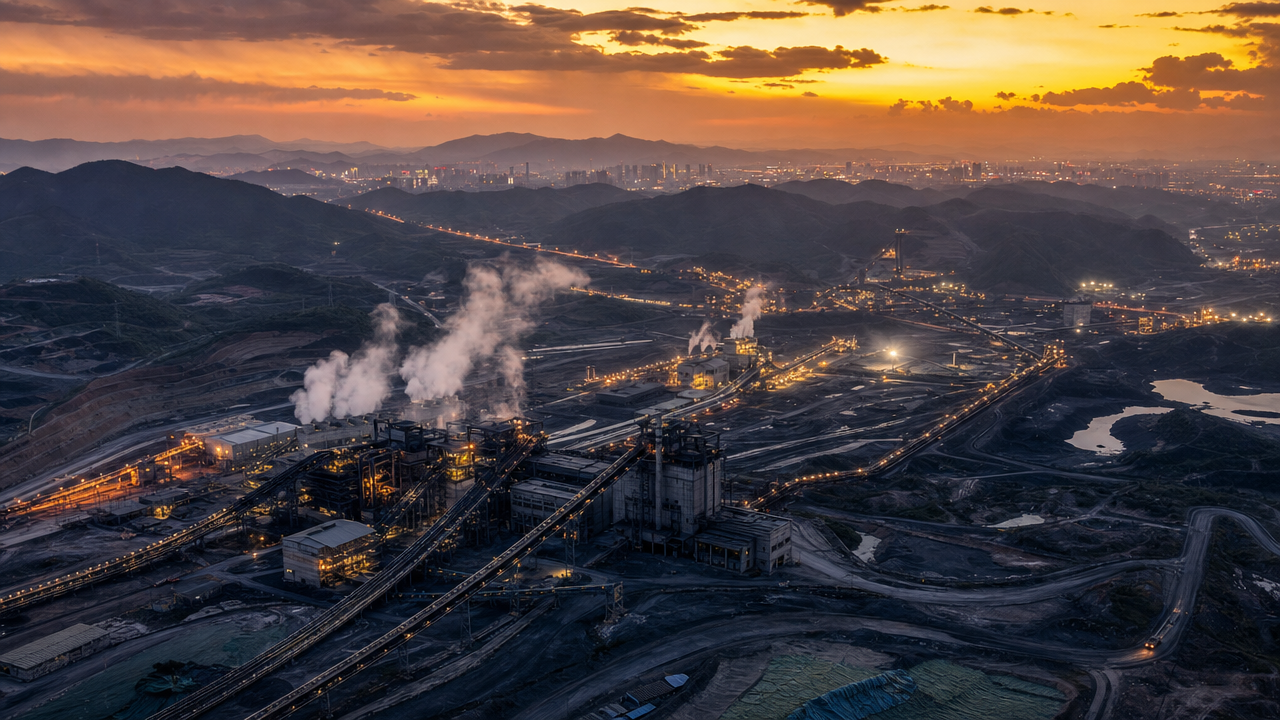

Chapter 1 What Is Coal? From Geology to the End Consumer
Coal is compressed time. What we burn in a power plant or steel furnace today represents 300 to 360 million years of organic matter — ancient forests, swamps, and marine organisms — compressed under pressure and heat into carbon-dense rock. This geological origin explains why coal's properties vary so dramatically depending on where and how deeply it formed.
The Four Major Types Used in China
China's coal industry divides its product into four commercially significant categories, each serving distinct end markets.
Thermal coal (动力煤), also called steam coal or power coal, is the workhorse of electricity generation and industrial heat. It is defined by its heating value — the higher the better, with premium thermal coal at 5,500 kcal/kg and above. China's dominant coal for power is mined primarily in Inner Mongolia, Shaanxi, and Shanxi. It is burned in pulverized coal boilers at heat-and-power plants and cement kilns. With over 1.1 billion kilowatts of coal-fired power capacity, China consumes more thermal coal in a single year than the rest of the world combined.
Coking coal (焦煤), or metallurgical coal, is a fundamentally different product. It must be "coking" — meaning it softens, swells, and re-solidifies when heated in an airless environment, forming the porous carbon structure called coke. Coke is essential for blast furnace ironmaking: it acts simultaneously as fuel (heating the furnace), reductant (removing oxygen from iron ore), and structural support for the ore burden. Not all black rock earns the title of coking coal — only those with specific rank, vitrinite content, and volatile matter profiles qualify. Primary coking coal (主焦煤), low-volatile coking coal (低挥发分炼焦煤), and pulverized coal injection (PCI / 喷吹煤) each play distinct roles in the coking blend. China's coking coal reserves are concentrated in Shanxi, where Shanxi Coking Coal Group controls the country's largest reserve base.
Anthracite (无烟煤) is the highest-rank coal, formed under the greatest geological pressure. With carbon content above 90% and volatile matter below 8%, it burns with almost no smoke — hence the name. It is used in special industrial applications: synthesis of activated carbon, electrode production, and as a reductant in certain metallurgical processes. Anthracite production is relatively modest and geographically concentrated (Shanxi's Jincheng, Yangquan; Guizhou; Henan's Jiaozuo).
Lignite (褐煤) is the youngest, lowest-rank coal: high moisture content, low heating value, prone to spontaneous combustion, and unsuitable for long-distance transport. China's lignite reserves are enormous — concentrated in Inner Mongolia's Hulunbuir region — and are consumed primarily at nearby power plants (pit-mouth power stations) where transport economics don't apply.
The Full Industry Chain
Understanding the coal chain requires tracing the product from geology through to combustion and beyond:
Upstream: Geological exploration (seismic surveys, exploratory drilling), mine construction (shaft sinking, tunnel development), and extraction (longwall mining in underground mines; dragline or shovel stripping in open-pit mines). China's 2025 raw coal output of approximately 48.5 billion tons came from roughly 4,000 operating coal mines — a figure dramatically reduced from the 10,000+ mines operating in 2010 through a decade of safety-driven consolidation.
Midstream: Coal washing and preparation (removing rock and sulfur to upgrade the product), transport (rail, river barge, coastal shipping — the "north-to-south" supply arteries), and port operations (Qinhuangdao, Caofeidian, and Huanghua ports handle the bulk of Northern China thermal coal flow).
Downstream: Power generation (56-58% of coal consumption), steel making (via coke, 15%), cement and building materials (12%), chemicals and gas (coal-to-chemicals 8%), and residential heating (3-4%). The remainder goes to other industrial heat applications.
Chapter 2 Global Landscape: Who Controls the World's Coal Supply?
Coal is a global commodity, yet its trade flows are more regionalized than oil or gas. Geographic concentration of reserves, infrastructure constraints, and environmental regulations create distinct regional markets linked by maritime trade.
The Big Four Producers
China, India, Indonesia, and Australia together account for approximately 75% of global coal production. Their market roles are fundamentally different: China and India are predominantly domestic consumers who also import; Indonesia and Australia are the dominant exporters supplying Asian and European markets.
China's 2025 production of approximately 48.5 billion tons — the country's highest ever — represents about 53% of global output. Yet despite this massive domestic supply, China imported approximately 500 million tons in 2025, reflecting both quality requirements (high-quality coking coal) and regional supply-demand imbalances.
Australia produces approximately 500 million tons annually, with exports of roughly 400 million tons. Australian coal is premium-priced: its low-sulfur thermal coal meets the strictest environmental specs of Japanese and Korean power plants, while its hard coking coal from Queensland's Bowen Basin is among the world's highest-quality metallurgical coal. Peabody Energy (NYSE: BTU), Anglo American, BHP, and Glencore operate major Australian mines. Yancoal Australia (ASX: YAL), majority-owned by Yankuang Energy (a Chinese state-owned coal enterprise), produced approximately 37 million tons in FY2025 and reported revenue of approximately AUD 4.5 billion, down roughly 18% year-on-year as coal prices normalized from the 2022 peak.
Indonesia is the world's largest thermal coal exporter, with production concentrated on Sumatra and Kalimantan. Indonesian coal is characterized by lower heating values (4,200-5,000 kcal/kg), making it suitable for power plants designed for lower-quality fuel — particularly India's and China's domestic-grade boilers. Its competitive advantage is geography: proximity to Southeast Asian, Indian, and Chinese ports means low shipping costs offset its lower heating value. Adaro Energy, Bumi Resources, and Bukit Makmur are the dominant operators.
International Benchmarks: FY2025 Performance
Peabody Energy (BTU, NYSE): FY2025 revenue of approximately USD 1.85 billion, with coal production totaling approximately 70 million short tons. Peabody's Australian operations (seaborne metallurgical and thermal coal) continue to perform better than its US thermal coal business, which faces structural demand decline from coal-fired plant retirements.
Yancoal Australia (YAL, ASX): FY2025 revenue approximately AUD 4.5 billion. Managed costs effectively with unit production costs around AUD 90/ton. Declared total distributions of AUD 0.40 per share, yielding approximately 4-5% at prevailing prices.
Glencore: Coal remains one of Glencore's most profitable divisions — the company has repeatedly delayed its planned coal exit in response to sustained profitability. FY2025 coal division EBITDA estimated at approximately USD 3-4 billion, primarily from the Australia and Colombia operations.
Mongolian Mining Corporation (0975, HK): FY2025 revenue approximately USD 850 million; coal sales approximately 11.3 million tons. Mongolia's coking coal exports to China have ramped sharply: from approximately 30 million tons/year in 2023 to approximately 70 million tons in 2025, driven by expanded port crossing capacity at the Ganqimaodu crossing.
Global Trade Architecture
The Newcastle FOB benchmark (Australia, 6,000 kcal/kg thermal coal) is the pricing anchor for the Asia-Pacific market. The Richards Bay benchmark serves Atlantic and Indian Ocean markets. In 2022-2023, the Russia-Ukraine war caused a dramatic redistribution of global coal flows: Russian coal displaced from European buyers flooded into India and China; Australian and Colombian coal stepped up to fill European demand. This reshuffling drove the Newcastle benchmark to over USD 400/ton in September 2022 — a record high — before normalizing to the USD 100-120 range in 2025.
The Indonesian Pricing Center
Indonesia's low-rank thermal coal (4,200 kcal/kg, ICI-4 index) has emerged as the pricing reference for the vast Indian and Chinese market for lower-calorie coal. Because of Indonesia's geographic proximity to China, and because Indonesia's coal can undercut Australian coal on delivered cost despite lower heating value, the ICI-4 and ICI-3 benchmarks now arguably matter more than the Newcastle benchmark for understanding China's import cost baseline.
Chapter 3 PEST Analysis: The Policy Environment Reshaping China's Coal Industry
The coal industry in China operates within a political, economic, social, and technological framework that differs fundamentally from any other major economy. The state plays a decisive role not only as regulator but as owner, operator, and price-setter.
Political: Energy Security as the North Star
China's coal policy is, at its core, a security policy. The 2021 energy crisis — when widespread power shortages paralyzed manufacturing across multiple provinces — delivered a visceral reminder that coal security IS economic security. Since then, "stable coal supply" has been elevated to a national strategic imperative, with production quotas loosened and new mine construction accelerated despite stated climate commitments.
This creates an observable tension in China's energy policy: climate ambition (carbon peak by 2030, neutrality by 2060) and energy security (maximize domestic coal to avoid import dependency) pull in opposite directions. The resolution — at least for this decade — has been to prioritize security: produce more coal domestically to buffer against import disruptions (such as the 2020-2022 Australia coal ban) while building renewable capacity as fast as possible to eventually substitute it.
The Long-Term Contract Mechanism
The most important pricing policy innovation in Chinese coal in the past decade is the long-term contract (长协, zhǎng xié) framework. Established after the 2021 price spike, this mechanism sets a benchmark price band for power coal traded between major miners and power companies: approximately RMB 700-740/ton (base quality, 5,500 kcal/kg) with a floor of around RMB 570/ton. The key features: prices are reset monthly based on a formula referencing market prices; miners cannot sell above the benchmark to power companies; it covers roughly 70-75% of major miners' annual power coal sales. The result is a floor under miner profitability even in low-price environments, and a cap on electricity generation costs in high-price environments.
Carbon Peak Constraints
China's 2030 carbon peak commitment creates a structural ceiling on coal consumption's long-term trajectory. The 14th and emerging 15th Five-Year Plans contain specific language about "controlling coal consumption" and eliminating sub-critical coal power capacity. The practical implementation has been gradual: no new coal-fired power plants approved outside emergency security situations; mandatory retrofitting of existing plants with ultra-low emission systems (particulate, SO₂, NOₓ); accelerated coal-to-gas switching in urban heating districts.
The net effect on coal demand is a gradual erosion in the most price-sensitive and accessible substitution segments (residential heating, small industrial boilers) while baseload power demand for coal remains resilient through at least 2028-2030.
Economic: Price Transmission and Taxation
China's coal industry tax and fee structure is layered. At the mine gate, coal companies pay: resource tax (2-10% of sales value), special purpose fund for sustainable development of mineral resources (RMB 0.1-10/ton depending on type), environmental protection fees, land reclamation deposits, and miners' accident compensation fund contributions. Together, these non-income taxes represent approximately 8-12% of revenue for a typical mining operation. This burden is one reason why headline profit margins at coal companies appear lower than their operating leverage would suggest.
The coal-to-power price transmission mechanism has historically been the most politically sensitive issue in China's energy economy. Power prices for industrial customers were partially liberalized in 2021 (on-grid power prices can fluctuate ±20% from benchmark). But residential electricity prices remain fixed and cross-subsidized — creating a permanent structural drag on the grid's ability to pass through coal cost increases.
Social: The Employment Legacy
The coal industry's social footprint is enormous. At its 2010 peak, the industry employed approximately 6 million miners plus millions more in support roles. Today, despite dramatic productivity improvements, approximately 3-3.5 million workers remain directly employed in coal mining — with several times more in coal-dependent communities in Datong, Ordos, Yulin, Liupanshui, and Hegang. Any rapid contraction would be a social crisis, not merely an economic transition. China's policy response — gradual managed decline, retraining programs, and specific fiscal transfers to designated "resource-exhausted cities" — reflects this reality.
Technological: Smart Mining as the Growth Vector
The Chinese government's "Smart Mine" initiative targets converting 50% of large coal mines to intelligent operation by 2030. The technical components include: autonomous longwall mining faces (machine learning + sensor fusion to automate shearer and support control); 5G underground networks (replacing WiFi and traditional industrial Ethernet for reliable, low-latency data transmission); remote operation centers (surface-based operators monitoring and controlling underground equipment via HD video feeds); and big data safety platforms (integrating gas sensors, roof pressure monitors, and personnel tracking into unified risk assessment systems).
Commercial autonomous mining trucks are now deployed at over 30 open-pit mines across Ordos, Datong, and Hami, totaling over 500 vehicles. The economic case is clear: a single autonomous truck can work 24 hours continuously without a driver (saving RMB 150,000-300,000 per year in driver wages alone), while the elimination of fatigue-related accidents reduces both human cost and regulatory liability.
Chapter 4 China's Market Scale: 48 Billion Tons, Price Discovery, and CR10
China's coal market is simply the largest in the world by production, consumption, and arguably by complexity of pricing mechanisms.
Production Scale
In 2025, China's raw coal production reached approximately 48.5 billion tons — the highest level ever recorded and a roughly 3% increase from 2024. This represents more than half of global coal output. The growth continued despite stated policy goals of moderating coal dependence, driven by power security imperatives and new mine capacity additions in Inner Mongolia (which overtook Shanxi as China's largest producing province circa 2020).
The four major production bases account for approximately 75% of national output:
- Inner Mongolia: approximately 13.5-14 billion tons (largest, growing)
- Shanxi: approximately 13.0-13.5 billion tons (highest historical output, plateauing)
- Shaanxi: approximately 8.5-9 billion tons (growing, especially Yulin)
- Xinjiang: approximately 4.5-5 billion tons (growing rapidly, policy-prioritized)
Price Structure
China operates a dual-track coal pricing system:
Long-term contract price: Approximately RMB 700-740/ton (5,500 kcal/kg thermal coal) as mandated for major miners selling to power companies. This represents roughly 70-75% of major miners' sales volume. The floor mechanism (around RMB 570/ton) prevents economically devastating low prices for large, cost-efficient mines.
Spot market price: The Qinhuangdao port thermal coal spot price (5,500 kcal/kg) ranged between approximately RMB 700-820/ton through most of 2025, with seasonal peaks in summer (air conditioning demand) and winter (heating demand). The spot price converged toward the long-term contract benchmark range as 2022-2023's exceptionally high prices normalized.
Coking coal prices: The Shanxi primary coking coal spot price (Jincheng 4# coal, 25.5% volatile matter) experienced significant correction from the 2022 high (approximately RMB 4,000+/ton) to approximately RMB 1,600-2,000/ton in 2025, reflecting global steel production pressure and domestic demand weakness in real estate construction.
Industry Concentration
The CR10 (top 10 producers' market share) reached approximately 50-55% of national output in 2025 — up from roughly 35% a decade ago. The supply-side reform (2015-2018) eliminated over 1 billion tons of annual small-mine capacity, concentrating output at large, low-cost, safety-compliant operations.
Top producers by 2025 output estimate:
- National Energy Group (parent of China Shenhua): ~530 million tons
- China Coal Energy: ~130 million tons
- Shaanxi Coal & Chemical: ~175 million tons
- Shanxi Coking Coal Group: ~110 million tons
- Jinneng Holding (晋能控股): ~180 million tons
- Yankuang Energy: ~100 million tons (domestic China only)
- Ping An Coal (Pingmei): ~60 million tons
- Huainan Mining: ~90 million tons
- Chongqing Energy: ~40 million tons
- Guizhou Coal (贵能): ~35 million tons
Consumption Structure
Electric power (including combined heat and power) accounts for approximately 56-58% of coal consumption — the dominant end use. Steel (via coking coal and coke) represents approximately 15-17%. Building materials (cement, glass) approximately 10-12%. Coal chemicals (methanol, ammonia, olefins) growing at approximately 8%. Residential and commercial heat approximately 3-4%, declining with gas substitution.
Import Structure
China imported approximately 500 million tons of coal in 2025 — approximately 10% of domestic consumption. The import mix: thermal coal (55-60%), coking coal (25-30%), semi-soft coking coal and PCI (10-15%). Key supplier countries: Indonesia (largest, 250 million tons), Russia (100 million tons, rerouted post-2022), Australia (re-opened from 2023, 80-90 million tons), Mongolia (70 million tons, mostly coking coal), and Canada/US/Colombia (~30-40 million tons combined).
Chapter 5 Industry Chain Anatomy: What Happens After Coal Is Mined
The Logistics Architecture: North-to-South Corridors
The geographic mismatch between coal reserves (concentrated in the north and west) and electricity demand (concentrated in the coastal east and south) created China's massive coal logistics infrastructure. Understanding this infrastructure is essential to understanding competitive positioning.
The Daqin Railway (Datong to Qinhuangdao port) remains the world's busiest coal freight line, handling approximately 370-400 million tons per year. The Shenhua Group's private Shenshuo-Huanghua line handles another 200+ million tons. The emerging Mongolian-Hebei Railway (Meng-Ji, 蒙冀铁路) provides additional capacity for Inner Mongolia's rapidly growing production.
From northern ports (Qinhuangdao, Caofeidian, Huanghua, Tianjin), coastal vessels transport coal south to the Yangtze River delta (Zhenjiang, Nanjing, Nantong) and the Pearl River delta (Guangzhou, Shenzhen). The per-ton logistics cost for coal from Ordos to a Guangdong power plant (rail to port + sea freight) is approximately RMB 150-200/ton — a significant addition to the mine-gate cost.
Coal Washing: The Upgrade Premium
Raw coal from the mine contains rock, pyrite, and other non-combustibles (collectively "ash") that reduce heating value and increase sulfur content. Coal washing removes these contaminants by exploiting density differences: rock is denser than coal. The dominant technologies are dense medium cyclones (DMC), jigs, and flotation (for fine coal).
The economics are compelling: upgrading raw coal from 4,500 kcal/kg to 5,500 kcal/kg through washing typically adds a price premium of RMB 100-150/ton while costing RMB 30-50/ton in washing costs — a clear value creation opportunity. Nearly all coking coal and premium thermal coal is washed before sale. Only some lignite and low-grade thermal coal is sold run-of-mine.
Coal Chemicals: The Diversification Bet
China's coal chemical industry — converting coal to methanol, olefins (polyethylene, polypropylene), oil, and natural gas substitutes — represents the most ambitious attempt to extend the value chain beyond combustion. The rationale: at production sites with very cheap coal (Ordos, Ningxia, Xinjiang), converting coal to petrochemicals captures a larger margin than burning it for electricity.
The economics work when: coal price is below RMB 300/ton at the plant gate; the target chemical (polyethylene, for example) trades above approximately RMB 7,000/ton; and the plant has advantages in electricity self-generation that offset electricity-intensive electrolysis. Baofeng Energy (600989.SH) in Ningxia has demonstrated this model at scale: its coal-to-olefins complex produces approximately 3 million tons per year of polyethylene and polypropylene, with production costs approximately 20-30% below those of naphtha-based competitors due to Ningxia's extraordinarily cheap coal (pit-mouth price around RMB 100-150/ton) and self-generated power.
Strategic Coal Reserve System
China's 2021 power crisis revealed systemic vulnerabilities in coal stock management. Since then, the National Development and Reform Commission has mandated minimum coal stock levels: power plants must maintain at least 15 days of consumption in reserve (elevated to 20 days before major weather events), and key coal ports must maintain minimum buffer stocks. This policy has increased average social coal inventory by an estimated 50-80 million tons compared to pre-2021 norms — structurally positive for coal demand but adding working capital requirements for power utilities.
Chapter 6 Leading Enterprises: A Company-by-Company Analysis
China Shenhua Energy (601088.SH / 1088.HK): The Undisputed Giant
Shenhua is the listed arm of the state-owned National Energy Group — China's largest coal producer and the world's largest coal mining company by output. In FY2025, China Shenhua reported revenue of approximately RMB 330 billion and net profit attributable to shareholders of approximately RMB 52.8 billion. Coal production totaled approximately 320 million tons (both own mines and equity purchases).
Shenhua's differentiation lies in vertical integration: the company owns not only coal mines but also coal railways (Shenshuo, Baoshen, and related lines), coal terminals (Huanghua Port, second-largest coal port in China), and coal-fired power plants (approximately 80 GW of capacity). This "mine-rail-port-power" integration captures the full value chain margin and provides captive, market-insensitive demand for Shenhua's own coal production.
The highly anticipated asset injection from National Energy Group's unlisted coal assets — which include reserves roughly equal to Shenhua's current total — remains pending regulatory approval. When completed, Shenhua's listed entity will become even more dominant.
FY2025 dividend: RMB 2.01 per share (A-share), representing approximately 75.5% of net income — one of the most generous payout ratios in the A-share market. Management committed to minimum 65% payout for FY2025-2027.
Shaanxi Coal & Chemical Industry (601225.SH): The Yulin Powerhouse
Shaanxi Coal is the largest coal producer in Shaanxi Province, with production concentrated in the Yulin-Shenmu-Fugu coalfield — one of China's most cost-competitive mining regions. Low overburden, consistent seam thickness, and favorable geology yield production costs of approximately RMB 150-200/ton — among the lowest nationally.
FY2025 performance: revenue approximately RMB 1,800 billion, net profit approximately RMB 165 billion, flat to slightly lower year-on-year as coal prices declined. The company has also been active in hydrogen production (Shaanxi is building a green hydrogen ecosystem leveraging its cheap coal-generated electricity).
Yankuang Energy Group (600188.SH / 1171.HK): The International Operator
Yankuang is unique among major Chinese coal companies in its extensive international operations. Through Yancoal Australia (its listed Australian subsidiary, of which it owns approximately 62%), Yankuang operates large open-cut thermal and semi-soft coking coal mines in New South Wales and Queensland. In FY2025, Yankuang's consolidated revenue was approximately RMB 95 billion; net profit approximately RMB 15 billion, significantly impacted by lower Australian coal prices and currency effects.
China Coal Energy (601898.SH): The Second State Giant
China Coal Energy is the listed arm of China National Coal Group Corporation (中煤集团) — the second-largest state coal company after National Energy Group. FY2025 revenue approximately RMB 870 billion (H1), with coal production from wholly-owned mines approximately 65 million tons in H1. The company has significant coal chemical assets including PVC, methanol, and polyolefin plants, providing partial insulation from pure coal price exposure.
Shanxi Coking Coal Group (000983.SZ): The Metallurgical Coal King
Shanxi Coking Coal is China's largest coking coal enterprise, with the country's most concentrated reserve base of primary coking coal. Unlike thermal coal companies, its profitability tracks steel demand (via coke demand) more than power generation. FY2025 results were disappointing — coking coal spot prices fell approximately 30-40% year-on-year — with net profit declining approximately 54% to approximately RMB 1.87 billion. However, the company's unique asset position (primary coking coal is genuinely scarce and irreplaceable for blast furnace metallurgy) provides long-term strategic value that short-term earnings volatility masks.
Pingmei Shenma Energy & Chemical Group / Pingneng Coal (600985.SH)
Primarily anthracite and low-volatility coking coal, with integrated coal chemical operations (nylon, caprolactam). FY2025 revenue approximately RMB 121 billion, net profit approximately RMB 10 billion, down approximately 16%.
Baofeng Energy (600989.SH): The Coal Chemical Growth Story
Baofeng deserves special attention because it represents the bull case for coal-to-chemicals: a company where coal is an input rather than the product, with a value-creation model that decouples from thermal coal prices. FY2025 revenue approximately RMB 108 billion, net profit approximately RMB 11-14 billion, up approximately 40-50% year-on-year — a stark contrast to the earnings declines at thermal coal miners. The driver: Phase 2 of its Inner Mongolia polyolefin facility ramping up production of 3 million tons/year of polyethylene and polypropylene, leveraging near-zero-cost coal from the Ulan Hadab coalfield.
Baofeng's gross margin (approximately 40-45%) is structurally above any thermal coal miner's because it sells petrochemicals (priced against global naphtha-based producers) while its input cost (coal) is far below the cost of crude oil-based feedstocks.
Peabody Energy (BTU) and Yancoal (YAL): International Reference Points
Both companies' FY2025 results illustrate the global normalization of coal prices post-2022: Peabody's revenue declined approximately 12% and Yancoal's approximately 18% year-on-year, as the extraordinary 2022-2023 price environment reverted to historical norms of USD 100-120/ton (Newcastle FOB thermal) and USD 200-250/ton (hard coking coal).
Chapter 7 The Middle-Reach: China's Coal Production Belts and Supply Corridors
China's coal geography is defined by the "Three Wests" — Shanxi, Shaanxi, and western Inner Mongolia — which together form the country's dominant production heartland.
The Ordos Basin: China's Coal Engine Room
Ordos (鄂尔多斯), in Inner Mongolia's south, is now China's single largest coal production zone, producing approximately 800-900 million tons annually from both open-pit and underground mines. The basin's coal is predominantly low-sulfur, high-heating-value thermal coal (5,000-6,000 kcal/kg) and coal suitable for direct liquefaction and chemical conversion.
The competitive advantage is stark: coal seams lie close to the surface (overburden depths of 30-100 meters for open-pit sections vs. 500-1,000 meters for Shanxi underground mines), resulting in production costs of approximately RMB 150-200/ton — the lowest of any major coal region in China. Tianxia Gongchang platform data shows that Ordos-based factories supplying coal mining equipment, processing systems, and materials to this vast region have formed a significant industrial cluster — from hydraulic support manufacturers to belt conveyor specialists — servicing the region's high-density mining operations.
The Datong-Shuozhou Basin: Shanxi's Thermal Coal Heartland
The Datong coalfield in northern Shanxi is China's oldest and most famous coal production region, with commercial mining history dating to the Qing dynasty. It produces primarily low-ash, low-sulfur thermal coal historically prized for domestic power generation. The Daqin Railway, China's premier coal freight line, runs directly through Datong, giving the region logistical advantages over western Inner Mongolia (which must transport coal by truck to rail or port connections).
However, Datong's mines are mature: average seam depths are increasing, costs are rising, and reserve life is shortening compared to newer western fields. The region has responded by investing heavily in tourism (the Yungang Grottoes, ancient city walls), new energy equipment manufacturing, and data center development — early moves toward industrial diversification away from coal dependency.
The Yulin-Shenmu Coalfield: Shaanxi's Low-Cost Champion
Shaanxi's Yulin region — centered on Shenmu (神木) and Fugu (府谷) counties — has emerged as China's most cost-competitive underground mining region. The geology is exceptional: flat-lying seams at consistent depth, low methane content, and favorable water conditions. Several mines operate at production costs below RMB 150/ton, competitive even with some open-pit operations.
Yulin's energy transformation ambitions go beyond coal: the city has positioned itself as China's leading integrated energy base (能源化工基地), hosting coal chemical, coal-to-oil, hydrogen, natural gas, and increasingly solar power projects. Shaanxi Coal's new projects in this region are designed to integrate coal extraction with coal chemical and green hydrogen production from the outset.
The Hami Basin: Xinjiang's Strategic Reserve
Xinjiang's Hami coalfield has the largest known coal reserve base in China — estimates suggest reserves exceeding 100 billion tons in Xinjiang alone. Production has been growing rapidly, reaching approximately 450-500 million tons in 2025, with explicit policy targets to reach 700-800 million tons by 2030. The strategic rationale: Xinjiang coal can substitute for imported coal in western China, reducing maritime supply chain vulnerability; the coal also feeds a large industrial complex of coal-fired power (which in turn powers aluminum smelting and data centers), coal chemicals, and increasingly renewable energy.
The challenge is logistics: Xinjiang's coal is far from eastern demand centers. Current transport relies on rail (the Lanxin Railway) and increasingly power transmission (build power plants in Xinjiang, transmit electricity to eastern China via ultra-high voltage DC lines). The latter model — "convert coal to electrons locally, transmit the electrons" — is increasingly preferred over long-distance coal rail because electricity transmission is more efficient and avoids the logistics cost of moving millions of tons of coal 3,000+ km east.
Import Corridors: Mongolia and Australia
Beyond domestic production, two external supply corridors matter enormously. Mongolia's Tavan Tolgoi (TT) coking coal reaches China via the Ganqimaodu-Ceke border crossing — now the world's largest land-based coal port by volume. The ramp from 30 million tons to 70+ million tons over two years (2023-2025) has meaningfully diversified China's coking coal import sourcing away from Australia and created new supplier leverage.
Australia's Newcastle and Gladstone ports supply premium thermal and coking coal via sea routes to Chinese buyers. The 2020-2022 informal import ban on Australian coal — a collateral damage of Sino-Australian diplomatic tensions — and its subsequent lifting in early 2023 demonstrated both the geopolitical fragility of this supply line and the market's ability to adapt (Chinese imports from Russia and Indonesia surged during the ban, filling the gap).
Chapter 8 Subsector Deep Dive: Thermal Coal, Coking Coal, Imports, Chemicals, and Storage
Thermal Coal Dynamics: The Long-Run Transition Story
Thermal coal faces the clearest long-term demand constraint of any coal type: every additional gigawatt of solar or wind capacity installed displaces coal-fired generation. In 2025, China's combined solar and wind installed capacity exceeded 1.2 billion kilowatts — approximately equal to the entire coal-fired fleet. On sunny, windy days, renewable curtailment (wasted green electricity) is already a significant problem in Inner Mongolia and Gansu. The pace of renewable buildout is accelerating, not slowing.
Yet thermal coal demand has not yet declined in absolute terms because: electricity demand is also growing (EV charging, data centers, AI compute clusters); renewable variability requires coal-fired backup; and the slow retirement of older coal plants means the installed base changes only gradually.
The market consensus: Chinese thermal coal demand will plateau around 2025-2027 and then gradually decline, with the pace of decline depending critically on battery storage penetration (which enables deeper renewable integration) and economic growth rate.
Coking Coal: Linked to Steel and Real Estate
China's coking coal market is more exposed to the steel production cycle than to electricity demand. The 2021-2023 real estate construction collapse reduced steel demand for rebar and structural steel — the most sensitive steel products to housing starts. As construction activity weakened, blast furnace utilization fell, coking coal demand softened, and the coking coal price fell from its 2022 peak.
Looking forward, the key question is whether Chinese steel output has permanently peaked (at approximately 1 billion tons/year) or will recover. China's domestic construction demand is unlikely to return to peak levels; however, steel exports have surged (China exported approximately 90-100 million tons in 2025), partially offsetting domestic demand weakness. This export-led steel demand is, however, subject to trade friction risk as other steel-producing nations respond.
The Coal-Power Pricing Mechanism: An Unresolved Institutional Tension
The long-term contract mechanism represents a pragmatic compromise, not a structural solution. The fundamental tension — market-priced coal versus administratively-priced electricity — persists. China's electricity market reform (initiated under Document No. 9 of 2015) has progressively introduced competitive bidding on the generation side in many provinces. As hourly-settlement power spot markets mature (currently operating in Guangdong, Shandong, Shanxi, Zhejiang, and several other provinces), coal price fluctuations will more smoothly transmit to electricity prices — making the long-term contract mechanism eventually obsolete.
China's Coal Export History and Current Status
China was once a significant coal exporter — approximately 90-100 million tons per year before 2003. The government progressively taxed coal exports and removed incentives, shifting China from net exporter to net importer by the mid-2000s as domestic demand surged. Today China exports only 3-5 million tons per year (primarily to Vietnam and neighboring countries) — a rounding error compared to its import volumes.
Strategic Reserves and Emergency Response
The 2021 crisis prompted systematic reform of China's coal inventory management. NDRC now publishes weekly inventories at key power plants and ports. "Coal supply and price stabilization" teams are permanently established at central and provincial levels, with authority to mandate production ramp-ups and activate emergency supply routes. This institutional infrastructure reduces the probability of a repeat of 2021's coal shortage — but cannot entirely eliminate it in extreme weather scenarios.
Chapter 9 Technology Frontier: From 5G Mining to CCUS
Intelligent Longwall Faces: The Underground Revolution
The longwall mining system — where a rotating shearer cuts coal from a face while hydraulic supports advance automatically — is already the dominant underground coal mining method in China. The next step is full automation: removing humans from the face entirely, replacing them with automated shearers guided by geological models and real-time sensor feedback, supported by remotely operated hydraulic supports, and supervised by surface operators via high-definition video.
As of 2025, approximately 200 coal mines in China have established intelligent longwall faces with "minimal personnel or unmanned" operation capability — concentrated in Shaanxi's Yulin, Inner Mongolia's Ordos, and Ningxia's Ningdong. The economic result: a fully intelligent longwall face reduces underground face workers from 20-30 per shift to 6-8 surface monitoring operators — a labor productivity improvement of 3-4x.
Autonomous Mining Trucks: Commercial Scale
As detailed in previous chapters, autonomous surface mining trucks are now deployed at commercial scale across 30+ open-pit mines, totaling 500+ vehicles. The technology is relatively mature; the primary challenges now are regulatory (mine operating permits must be updated to cover autonomous operation), maintenance standardization, and mixed-fleet interoperability (when autonomous trucks share roads with manually driven maintenance vehicles).
Chinese suppliers — Tiangong Zhixing, Huitu Intelligent, Yikong Zhijia — are competing against Caterpillar (CAT) and Komatsu's established systems. The competitive differentiation is: Chinese systems offer lower hardware cost and deeper integration with Chinese mine management software; foreign systems offer more mature reliability records and global service networks.
5G Underground Networks: The Nervous System
5G's millimeter-wave frequencies don't propagate underground effectively, but China Unicom, China Mobile, and specialized industrial 5G operators have deployed 5G networks using 700 MHz and 2.6 GHz frequencies in underground tunnels — combined with repeater antennas along key corridors. The result: reliable 100+ Mbps connectivity even at depths of 1,000 meters, enabling real-time 4K video streaming, low-latency remote control, and high-frequency sensor data transmission.
CCUS at Coal Scale: The Long-Shot Climate Technology
Carbon capture, utilization and storage (CCUS) at coal power plants is technically feasible but economically challenging. At current technology, adding post-combustion capture to an existing coal plant increases electricity generation cost by approximately RMB 0.15-0.25/kWh — roughly doubling the variable cost. This is not competitive without either a very high carbon price (approximately RMB 200-300/ton CO₂ would be needed to make coal-CCUS economically viable) or substantial government subsidy.
China's national ETS carbon price (approximately RMB 100-120/ton in 2025) is insufficient to drive commercial CCUS deployment. A handful of demonstration projects exist — notably at National Energy Group's Taizhou plant and Baofeng Energy's Ningdong complex — but scaling to meaningful carbon abatement levels remains a multi-decade challenge. The platform's coverage of 4.8 million verified manufacturing factories includes the upstream equipment suppliers, fabricators, and engineering contractors serving China's coal industry — providing direct visibility into which industrial segments serve coal's upstream capital expenditure needs and which are developing alternatives.
Equipment Nationalization: The Slow Victory
A decade ago, China's most sophisticated longwall equipment — particularly large-diameter shearer drums, high-capacity hydraulic supports, and mine winders — often relied on German, British, or Australian technology (JOY Global, Sandvik, Bucyrus). Today, the picture has reversed: domestic suppliers (Zhengzhou Coal Machinery, Taiyuan Heavy Machinery, Sany Heavy Equipment) supply over 90% of new equipment ordered by Chinese coal companies, with quality and reliability now broadly comparable to international peers. This "nationalization" of the supply chain reduces foreign exchange outflow and creates a domestic industrial ecosystem that perpetuates itself through service contracts, parts supply, and continuous R&D feedback.
Chapter 10 Risk Map: What Could Derail China's Coal Industry?
The Carbon Peak Constraint: Structural Demand Ceiling
The most fundamental long-term risk for the coal industry is also the most certain: global and Chinese decarbonization will eventually reduce coal demand below current levels. The debate is not whether but when, and how fast.
"Carbon Lock-In": The Sunk Cost Dilemma
China has accumulated enormous sunk costs in coal infrastructure: approximately 1.1 billion kilowatts of coal-fired power plants (designed lifetimes of 30-40 years), thousands of kilometers of dedicated coal railways, and coal mining equipment and mine development costs. Stranding these assets early — by forcing early plant retirements — would crystallize hundreds of billions of RMB in losses for state-owned banks and utilities.
This "carbon lock-in" dynamic explains China's policy choice of "controlled, gradual exit" rather than rapid divestment: the economic and social cost of abrupt stranding is too high to be politically or financially manageable. The practical consequence is that even under optimistic scenarios, coal consumption in China will decline gradually — not precipitously — through at least 2035.
New Energy Substitution: The Pace of Solar and Wind
China is installing solar and wind capacity at an unprecedented pace — approximately 300-350 GW of new renewables per year. The integration of variable renewable energy at this scale requires either massive battery storage deployment or flexible backup power from gas and coal plants. Until battery costs fall sufficiently to provide cost-effective multi-day storage (not just hourly peak shaving), coal's role as "reliable backup" will remain economically justified.
Import Policy Risk
China's coal import policy is subject to geopolitical discretion. The Australia coal ban (2020-2022) demonstrated that trade policy can override market economics. Indonesia has intermittently threatened domestic supply obligations that would restrict coal exports to China. Mongolia's political relationship with China influences the pace of border crossing investment. Russia's coal exports to China are now essential to Russian revenue — but sanctions risk (secondary sanctions from US/EU on coal transactions) could disrupt this supply. Managing a five-supplier, 500-million-ton import portfolio requires constant diplomatic and commercial attention.
Price Volatility and Long-Term Contract Exposure
The long-term contract mechanism protects miners from catastrophic low-price events but also caps upside in high-price periods. For investors, this creates a asymmetric risk profile: the floor is defined (approximately RMB 570/ton), but the ceiling is also capped (approximately RMB 770/ton for long-term contract price). Spot market exposure (25-30% of sales) retains full volatility.
Safety Accident Risk
Coal mining remains one of China's highest-risk industrial activities by fatality rate. Major accidents (underground gas explosions, roof collapses, flooding) damage not just lives and equipment, but trigger nationwide safety crackdowns that mandate temporary production suspensions across entire provinces. The 2024 Shanxi and Inner Mongolia inspection campaigns led to multi-week production suspensions at hundreds of mines — a direct supply shock that temporarily tightened prices.
One Belt One Road Overseas Risk
Chinese coal companies with significant overseas assets (Yankuang in Australia, various Chinese investors in Indonesian mines) face risks that domestic operators do not: currency risk (AUD/IDR vs. RMB), host country regulatory changes (Australia's FIRB scrutiny of Chinese acquisitions; Indonesia's domestic market obligation rules), environmental liability under stricter foreign regulatory regimes, and geopolitical risk that can sever supply relationships without warning.
Chapter 11 Forecast 2026-2030: Toward a New Equilibrium
Production Trajectory: Stable at the Plateau
China's coal production is likely to remain in the range of 47-50 billion tons/year through 2027-2028, before gradually declining toward 45-47 billion tons by 2030. The reasons for stability: the new Xinjiang and Inner Mongolia capacity already approved or under construction will continue ramping through 2026-2027, partially offsetting the retirement of older, higher-cost eastern mines. Policy will not permit a sharp production cut that would create energy insecurity.
Price Forecast: Long-Term Contract as the Anchor
The long-term contract benchmark (RMB 700-740/ton for 5,500 kcal/kg thermal coal) is likely to be maintained by policy through at least 2027. Spot prices will fluctuate around this band. Downside scenario (coal price to RMB 600-650/ton) would require sustained weak electricity demand, warm winters, and rapid renewable penetration — possible but not base case. Upside scenario (spike above RMB 900/ton) would require a repeat of 2021-type supply disruption — possible but unlikely given higher inventory buffers now mandated.
Coking coal (primary coking, Jincheng #4) is expected to recover toward RMB 1,800-2,200/ton as Chinese steel export demand supports blast furnace utilization, and as Mongolian import growth plateaus once Ganqimaodu infrastructure reaches capacity.
Consolidation: CR10 Rising Toward 60%
The ongoing state-led consolidation will continue. National Energy Group's pending asset injection into China Shenhua will be the most significant event. Jinneng Holding and Shanxi Coking Coal may execute further internal simplification. Small private mines facing safety upgrade costs and labor scarcity will continue exiting — voluntarily or through regulatory action.
Coal Chemicals: The Growth Pocket
Coal chemicals production (methanol, olefins, polyolefins, coal-to-oil) will continue growing at approximately 5-8% per year through 2030, reaching total production of perhaps 60-80 million tons of various chemical products. The growth is constrained by water (coal chemicals are intensely water-consumptive, limiting expansion in already water-stressed western China) and by feedstock coal cost (rising as easy-to-mine reserves are depleted and replacement mines go deeper). Baofeng Energy, China Coal's chemical subsidiaries, and new entrants from Xinjiang will be the primary growth drivers.
Intelligent Mining: 50% Target and Beyond
The national "50% of large mines intelligent by 2030" target is achievable for newly constructed mines but will require substantial retrofitting investment for existing operations. The estimated total investment required: approximately RMB 300-500 billion over five years across the sector. This represents a significant capital expenditure cycle for mining equipment manufacturers and technology providers.
Company-Level 2026-2030 Outlook
China Shenhua: Post-asset-injection, Shenhua's coal production could reach 400-450 million tons annually, making it even more dominant. Dividend yield likely stays above 5% at current prices.
Baofeng Energy: Phase 3 and Phase 4 capacity addition (additional 3-6 million tons/year of polyolefins) will drive continued earnings growth — the most compelling growth story in the coal sector.
Shanxi Coking Coal: Recovery in coking coal prices (expected 2026-2027) will sharply swing earnings positive; the company's reserve quality is irreplaceable.
Chapter 12 Conclusion: The Future Contours of the Black Mountain
China's coal industry stands at an inflection point defined not by a single dramatic event, but by the gradual tightening of multiple constraints — environmental, economic, technological, and social — that make the current scale of coal consumption increasingly difficult to justify and increasingly expensive to maintain.
The "black mountain" of 48.5 billion tons produced in 2025 is near its historic peak. Yet the descent — when it comes — will be managed, not abrupt. The economic architecture of the coal industry (state ownership, long-term contracts, integrated logistics, strategic reserves) has been deliberately designed to prevent the kind of chaotic supply disruption that a rapid coal exit would cause. China's policymakers have learned from history — their own and others' — that energy transitions that leave populations cold and industries idle are politically untenable.
Tianxia Gongchang's perspective on this industry: the 4.8 million verified manufacturing factories in our database include thousands of operations whose business models are directly tied to coal — from equipment manufacturers and engineering firms serving coal mines to coal chemical plants and coke producers. These factories face the same transition challenge as their coal industry customers: how to evolve products, processes, and business models as the coal economy gradually contracts. The survivors will be those who serve not just the existing coal system but the successor system — clean energy equipment, environmental remediation, and chemical production that can use clean energy inputs.
The Multiple Time Horizons
What makes coal policy so difficult — and what makes investment analysis in this space so challenging — is the profound mismatch in time horizons among stakeholders:
Miners think in terms of 1-5 years (current wages, mine safety, production quotas). Coal enterprises think in terms of mining permit lives and capital payback periods (5-15 years). Capital markets think in terms of earnings cycles and dividend sustainability (3-7 years). Policymakers balance near-term stability with long-term climate commitments (10-30 years). Climate science demands action on a timescale where every decade matters for cumulative atmospheric CO₂ concentration (50-100 years).
A policy that serves miners' 5-year horizon may be inadequate on a 30-year climate frame. An investment thesis that works over a 7-year earnings cycle may be undermined by stranded asset risk over 15 years. Honest analysis requires making explicit which time horizon is primary — and why.
This report has attempted to serve primarily the 5-15 year analytical horizon: concrete enough to be actionable for industrial strategy, long enough to capture the structural shifts already underway.
The black mountain will not disappear overnight. But its outline is already changing.
Chapter 13 Investment Perspective: Valuation Logic for China's Coal Sector
From Cyclical to High-Yield: A Re-Rating Story
Coal stocks in China have undergone a fundamental re-rating over the past five years: from "avoid-unless-coal-price-spikes cyclical plays" to "high-dividend defensive core holdings." The two primary drivers of this re-rating are: (1) earnings floor credibility from long-term contracts, which reduces the probability of sector-wide losses even in weak price environments; and (2) elevated dividend payout commitments from major listed coal companies, which create bond-like yield characteristics at a time when risk-free rates (10-year government bond yield ~2.3%) are significantly below coal company dividend yields (6-9%).
China Shenhua's "Bond Substitute" Positioning
Shenhua's FY2025 dividend of RMB 2.01/share (A-share) represents a yield of approximately 6.7% at current prices — roughly 4 percentage points above the risk-free rate. For insurance funds, bank wealth management products, and pension capital that require stable income with limited drawdown, this "positive carry" makes Shenhua a compelling alternative to low-yielding bonds. Shenhua's management has reinforced this positioning with its 3-year minimum payout commitment of 65% of net income.
Coal Chemical: The Growth Alternative
Baofeng Energy and similar coal chemical companies are valued on entirely different metrics — closer to growth-oriented chemical or materials companies than to coal miners. The polyolefin production capacity expansion roadmap (targeting 7-8 million tons/year by 2028), the structural advantage of coal-sourced feedstock versus naphtha, and the potential upside from carbon credit generation (once carbon pricing creates incentives for CCUS or green hydrogen integration) support a premium multiple relative to pure thermal coal miners.
Event-Driven Opportunities
The coal sector will generate event-driven opportunities through 2030:
- Shenhua asset injection (reserve and production accretion)
- Shanxi provincial SOE restructuring (Jinneng + Shanxi Coking Coal strategic decisions)
- Continued private mine exit (acquisition opportunities for cost leaders)
Foreign Institutional Attitude
International capital's attitude toward Chinese coal stocks is nuanced: strict ESG mandates preclude coal exposure for many European institutions, while yield-focused investors in Hong Kong and Asia-Pacific find the H-share dividend yields genuinely compelling. This "localized pricing" — where domestic A-share and Hong Kong H-share markets set prices somewhat independently of global ESG screens — means Chinese coal leaders trade at different effective multiples than their international peers. Understanding this pricing dynamic is essential for cross-border portfolio construction.
Data Sources and Key References
This report was compiled by the Tianxia Gongchang Industry Research Institute (www.tianxiagongchang.com), based on publicly available corporate disclosures, official statistics, and industry analysis. All data referenced is verifiable from public sources; predictive content is explicitly noted with assumptions and uncertainty bounds. Corrections and updates are welcome.
- China Shenhua Energy FY2025 Annual Report (SHSE: 601088 / HK: 1088): Coal production ~320M tons; revenue ~RMB 330B; net profit ~RMB 52.8B; dividend payout ~75.5%
- Baofeng Energy FY2025 Annual Report (SHSE: 600989): Revenue ~RMB 108B (YoY +40-50%); net profit ~RMB 11-14B; Inner Mongolia Phase 2 capacity ramping
- Shaanxi Coal & Chemical FY2025 Annual Report (SHSE: 601225): Revenue ~RMB 180B; net profit ~RMB 165B
- China Coal Energy FY2025 H1 Report (SHSE: 601898): H1 revenue ~RMB 87B; H1 net profit ~RMB 15B
- Yankuang Energy FY2025 H1 Report (SHSE: 600188 / HK: 1171): H1 revenue ~RMB 95B; H1 net profit ~RMB 15B
- Lu'an Chemical FY2025 Annual Report (SHSE: 601699): Net profit down ~14%
- Pingmei Shenma Energy FY2025 Annual Report (SHSE: 600985): Revenue ~RMB 121B; net profit ~RMB 10B (YoY -16%)
- Peabody Energy Corporation FY2025 Annual Report (NYSE: BTU): Revenue ~USD 1.85B; adjusted EBITDA ~USD 430M
- Yancoal Australia FY2025 Annual Results (ASX: YAL): Revenue ~AUD 4.5B; record final plus special distribution of ~AUD 0.40/share (YoY -18%)
- Mongolian Mining Corporation FY2025 Annual Results (HK: 0975): Revenue ~USD 850M; coal sales ~11.3M tons; Tavan Tolgoi exports ~11.3M tons
- China National Coal Association 2025 Annual Industry Report: Raw coal output ~48.5B tons; top 8 CR share exceeds 50%; fatality rate at record low
- National Bureau of Statistics Energy Production Data: Inner Mongolia ~13.5B tons; Shanxi ~13B tons; Shaanxi ~8.5B tons; Xinjiang ~4.5B tons (FY2025)
- State Council Carbon Neutrality White Paper on Fossil Fuels in China's Energy Mix: Coal share in primary energy ~53% (targeting below 50% by 2030)
- National Mine Safety Administration 2025 Annual Smart Mine Development Index Report: 400+ mines with intelligent longwall faces; smart mining share at approximately 50% of large mines target
- Qian Jianguo et al., "2025 China Coal Industry Yearbook" (China Coal Publishing, 2025): Statistical and regulatory reference
- China Coal Transportation and Distribution Association Monthly Bulletin: Port inventory; Qinhuangdao spot prices; transport data
- 21st Century Business Herald, China Energy News (권威媒体 selected coverage): Regulatory and market reporting