
Steel on the Sea: China's Shipbuilding Industry — 2026 Market Scale and Competitive Landscape
More than one in every two ships launched globally is built in China.
This is not a metaphor. It is a fact measured in deadweight tons with precision. In 2025, China's ship completions reached 53.69 million DWT, accounting for 56.1% of the global total; new orders stood at 107.82 million DWT, or 69% of the world's; and the order backlog hit 274.42 million DWT — 66.8% of the global total — setting a new all-time record. China's shipbuilding industry has held the top position in the world for sixteen consecutive years.
Yet the story of this industry is far more complex than the numbers suggest.
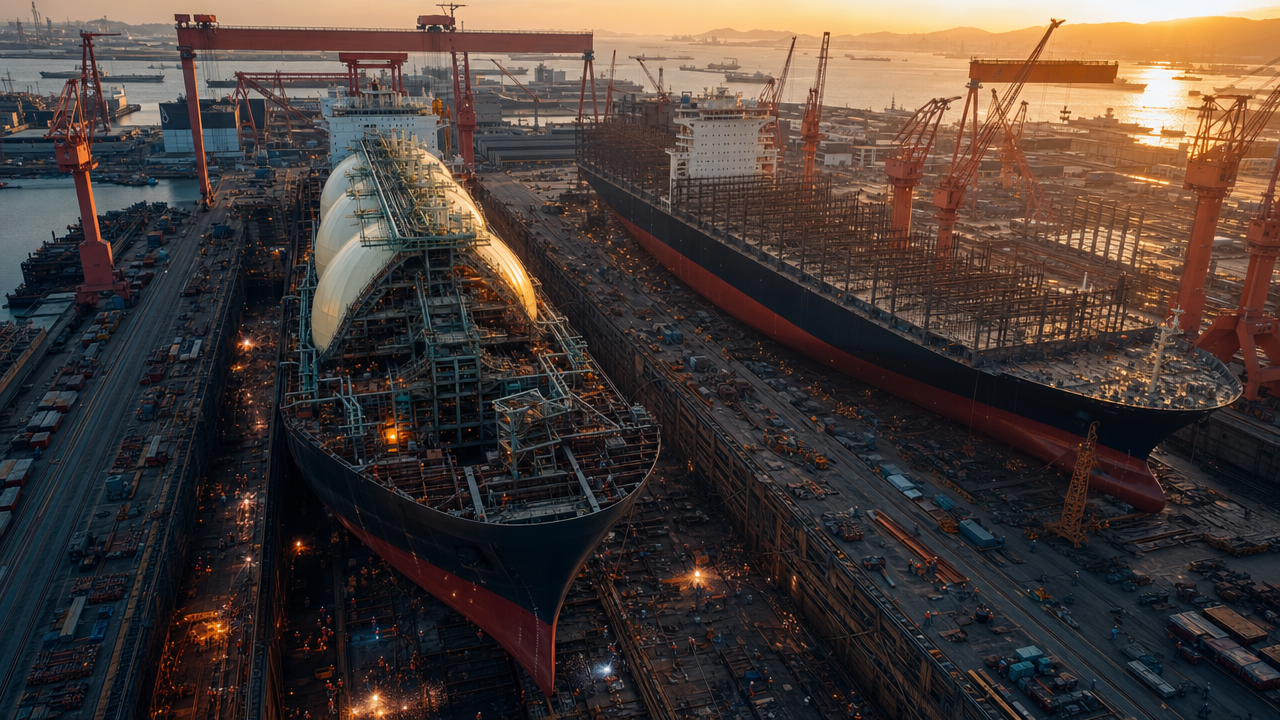
At the mouth of the Yangtze River, a 175,000-cubic-meter LNG carrier nears final outfitting at Jiangnan Shipyard — every square centimeter of its membrane cargo containment system is an exercise in metalworking at the edge of feasibility, with weld precision demands in the sub-millimeter range and Invar steel lining only 0.7mm thick. In Guangzhou, the steel skeleton of a 10,000-ton destroyer takes shape in a dry dock at CSSC's Huangpu Wenchong Shipyard. In Jiangsu's Nantong, Yangzijiang Shipbuilding — a private enterprise — is simultaneously constructing dozens of methanol dual-fuel container ships for European shipping giants, with delivery slots running into 2028.
These three parallel narratives define China's shipbuilding landscape in 2025–2026: a surge in commercial shipping, accelerating naval expansion, and breakthrough advances in green vessel technology.
Chapter 1 Definitions and Classification: Ten Types of Ships and One Supply Chain
The Five Families of Commercial Shipping
Bulk carriers are the most numerous single vessel type in the world fleet, carrying dry bulk commodities — iron ore, coal, grain, fertilizer, wood pellets — in large open holds. They range from Capesize (>100,000 DWT, too deep-drafted for the Panama or Suez Canals and forced to round Cape Horn or the Cape of Good Hope) through Panamax, Supramax, to Handysize. Capesize vessels are the primary carriers of iron ore imports to China from Australia and Brazil.
Oil tankers transport liquid petroleum products across the world's oceans. The VLCC (Very Large Crude Carrier, 200,000–320,000 DWT) is the workhorse of global crude trade; a single fully laden VLCC departing Brazil carries enough oil to supply a mid-sized city for roughly two weeks. Suezmax, Aframax, and MR (Medium Range) tankers round out the product tanker segment.
Container ships stack standardized boxes both below deck and above, measured in TEUs (Twenty-foot Equivalent Units). Modern ultra-large container ships (ULCS) now exceed 24,000 TEU capacity, stretching over 400 meters — four football fields end-to-end. The structural engineering challenge of managing bending moments across such a length is formidable.
LNG carriers are the highest-value commercial vessels afloat. Liquefied natural gas must be kept at −163°C at atmospheric pressure, demanding containment systems of extraordinary precision: the dominant membrane technology (licensed by France's GTT, with its Mark III FLEX and NO96 GW systems) uses Invar steel just 0.7mm thick with a thermal expansion coefficient near zero. A standard 174,000-cubic-meter LNG carrier is worth roughly $250–300 million, ten times the price of an equivalent-displacement bulk carrier.
PCTCs (Pure Car and Truck Carriers) feature multi-deck interiors through which vehicles drive aboard via stern ramps. As China's automobile exports exploded from 3.11 million units in 2022 to 5.5 million in 2024 — making China the world's largest auto exporter — global PCTC capacity became a critical bottleneck, triggering an order boom that Chinese yards have captured the majority of.
Offshore Equipment: Engineering from Surface to Seabed
FPSO (Floating Production Storage and Offloading) vessels are the backbone of deepwater oil field development — permanently moored processing platforms that separate, treat, store, and offload crude without ever returning to port. A large FPSO carries 10,000+ instrument control points and hundreds of kilometers of piping, representing the pinnacle of offshore systems integration. Unit costs typically run $1.5–3 billion.
Drilling rigs — jack-up (fixed leg, shallow water to ~150m) and semi-submersible (ballasted, deep water to 3,000m) — are the exploration frontier's mobile workhorses. Offshore support vessels (OSVs) sustain the entire ecosystem: platform supply vessels (PSV), anchor handling tugs (AHTS), and wind turbine installation vessels (WTIV) for the offshore wind sector.
Naval Vessels and the Ship Repair Industry
Military vessels share the same yards and base steel-working processes as commercial ships but are governed by entirely different engineering priorities — survivability, strike capability, and sustained combat readiness. China's naval surface fleet now includes the Type 055 destroyer (12,000-ton, 112-cell VLS, integrated electric propulsion) and the Fujian (CV-18), China's first electromagnetic catapult carrier, commissioned in November 2025.
Ship repair is the industry's quiet other half, centered on Zhoushan, Shanghai, Guangzhou, and Dalian. Zhoushan alone handles more than 2,500 vessels annually, serving one of the world's busiest shipping lane intersections.
Supply Chain Overview
Marine diesel engines are the highest-barrier component: MAN Energy Solutions and WinGD hold the core IP globally, with Chinese manufacturers building under license. Propellers, marine coatings, ship steel plate, marine electronics, and propulsion systems complete the upstream picture. Downstream: shipowners, freight markets (BDI, CCFI), and cargo owners form the demand chain.
Chapter 2 Global Landscape: Three-Way Competition and China's Ascent
Twenty Years of Tectonic Shift
Japan once commanded 40%+ of global completions. Korea overtook it in 2002 using scale and state-backed financing. China then overtook Korea in the late 2000s using still greater scale, lower costs, and abundant steel supply — and has expanded the lead ever since.
By 2025: China holds 56.1% of completions, 69% of new orders. Korea holds roughly 24–26% (by CGT) with a technology moat in LNG and premium container ships. Japan, at ~10–12%, continues to contract, focusing on chemical tankers, LPG carriers, and domestic use.
FY2025 Korean Financials
HD Hyundai Heavy Industries (329180.KS): revenue ~KRW 30 trillion, operating margin 7–8%, strategic focus on LNG carriers and ultra-large container ships. Samsung Heavy Industries (010140.KS): Q3 2025 operating profit turned positive after years of losses; backlog dominated by LNG and drilling rigs. Hanwha Ocean (042660.KS, formerly DSME): Q3 2025 operating profit approximately KRW 1 trillion, on course for full-year profitability. Japanese yards Kawasaki Heavy Industries and Mitsubishi Heavy Industries maintain modest, declining marine segments focused on specialized domestic tonnage.
Chapter 3 PEST Analysis: The Multi-Factor Structure Driving This Industry
Political & Regulatory
IMO's 2023 GHG Reduction Strategy targets net-zero shipping by or around 2050, binding EEDI (Energy Efficiency Design Index) tightening through Phase 3, and introducing the Carbon Intensity Indicator (CII) annual rating for existing ships. China's Ministry of Industry and Information Technology (MIIT) designates large civilian ships as strategic manufacturing industries with priority credit support. EU ETS integration since 2024 directly raises operating costs for high-carbon vessels calling European ports.
Economic
New-build prices rose roughly 60% from 2020 troughs to 2025 peaks, compressing the cost-price spread that historically squeezed yard margins. Steel plate costs — 25–35% of ship cost — rose ~20–30% over the same period, leaving a net margin expansion of ~30–35 percentage points for yards with favorable backlog timing. Exchange rate dynamics: hull prices are USD-denominated while major costs (steel, labor) are RMB — a stronger dollar benefits Chinese yards; CNY appreciation erodes competitiveness.
Social & Technological
China's engineering graduate pipeline outputs over 50,000 shipbuilding and ocean engineering graduates annually, sustaining the high-end human capital base. Yet skilled welders are aging out — average welder age at major yards is 40–50, with limited young entrants due to harsh working conditions and modest wages relative to electronics or automotive manufacturing. Digital twin platforms, robotic welding (15–30% penetration, targeting 50% by 2030), and AI-assisted hull form optimization are reshaping yard economics.
Environmental
Green propulsion technologies — LNG dual-fuel, methanol dual-fuel, ammonia (in trial), hydrogen fuel cell (niche) — are rapidly becoming the default specification for premium vessel orders. China delivered the majority of the world's methanol dual-fuel ships in 2025, a market position it intends to hold as the technology matures toward ammonia.
Chapter 4 China's Market Scale: Three Core Metrics in Historical Context
China's three headline metrics for 2025:
| Metric | Volume | Global Share |
|---|---|---|
| Completions | 53.69 million DWT | 56.1% |
| New orders | 107.82 million DWT | 69% |
| Backlog | 274.42 million DWT | 66.8% (record) |
The backlog figure is critical: at current delivery rates, it represents approximately 3–4 years of forward revenue visibility for Chinese yards, a historically elevated level that underpins cautious optimism about medium-term profitability.
By vessel type, bulk carriers and tankers dominate completions volume; container ships and LNG carriers dominate value. The CR3 (CSSC + Yangzijiang + CMG / China Merchants) commands roughly 55–60% of China's domestic order intake by CGT, with the balance distributed among mid-tier yards and regional specialists.
Chapter 5 Supply Chain: The Value Breakdown from Steel to Sea
The steel-to-ship transformation is a 2–4-year journey through a sophisticated supply chain. Rudder machines, anchor chains, valves, marine pumps, and thousands of smaller components support each hull.
China's overall domestic content rate is approximately 60–70% by procurement value. High localization (>80%): hull steel, anchor chains, valves, standard electrical equipment, coatings. Medium localization (40–80%): diesel engines (licensed IP, ~70–80% local manufacturing), fixed-pitch propellers, domestic navigation instruments. Low localization (<40%): azipod propulsion (ABB monopoly), GTT LNG containment IP, large cruise ship outfitting, certain specialty alloy steels. The GTT licensing fee alone — approximately €2–4 million per LNG ship — flows directly to France, a persistent gap in China's LNG ship supply chain independence.
Chapter 6 Key Enterprise Profiles: Operating Performance and Strategic Positioning
CSSC (China State Shipbuilding Corporation)
China's largest state shipbuilding group, created from the 2019 merger of CSSC and CSIC. Its listed vehicle China Shipbuilding (600150) reported 2025 revenue of approximately RMB 152 billion, with net profit improving to ~RMB 7–8 billion (net margin ~5%), driven by high ship prices unlocking in the backlog. Major subsidiaries include Jiangnan Shipyard (LNG specialists), Hudong-Zhonghua (LNG and specialist vessels), Waigaoqiao Shipbuilding (large tankers, FPSO), and Guangzhou Shipbuilding International.
Yangzijiang Shipbuilding (HK: 2317)
China's largest private yard, with 2025 revenue of ~RMB 28.5 billion and net profit ~RMB 8.6 billion — a net margin of approximately 30%, extraordinary for heavy manufacturing. The company has mastered the methanol dual-fuel container ship segment and maintains a multi-year clean backlog of premium vessels. Its financial quality (net cash position, high ROE) commands a premium valuation in the Hong Kong market.
CMHI / China Merchants Industry Holdings
Focused on offshore equipment (FPSO modules, jack-up rigs, OSVs) and defense-adjacent naval support vessels. Benefiting from the 2022+ offshore spending revival driven by sustained high oil prices.
CSSC Defense (600685)
The listed entity for naval and defense-oriented shipbuilding within CSSC. Limited public financial disclosure but benefits from consistent government defense appropriations. The vessel programs under its umbrella include destroyers, frigates, amphibious assault ships, and submarine construction.
Chapter 7 Industrial Geography: From the Yangtze Delta to the Northeast
China's shipbuilding capacity is geographically concentrated along its eastern coast, forming distinct industrial clusters each with specialized characteristics.
Yangtze River Delta (Jiangsu / Shanghai): The undisputed core. Nantong hosts Yangzijiang, COSCO and Sinopacific yards. Shanghai hosts CSSC's jewels — Jiangnan (LNG, container), Hudong-Zhonghua (LNG), Waigaoqiao (VLCC, FPSO). Jiangsu province as a whole accounts for roughly 40–45% of China's total tonnage output.
Pearl River Delta (Guangdong): Guangzhou hosts Huangpu Wenchong (naval + commercial) and Guangzhou Shipbuilding International. The region specializes in naval vessels, coastal shipping, and marine engineering support.
Bohai Rim (Dalian / Qingdao): Dalian (DSIC — Dalian Shipbuilding Industry Co.) builds VLCCs, bulk carriers, and some naval vessels; it is also historically significant as the yard where China's first domestically built carrier (Shandong) was constructed. Qingdao contributes naval auxiliary and OSV capacity in the northern tier.
The Tianxia Gongchang platform covers more than 4.8 million real in-production factories across China, including thousands of shipbuilding component suppliers — valve manufacturers, anchor chain producers, marine pump factories, and propeller casting works distributed across Jiangsu, Guangdong, Zhejiang, and Liaoning, providing researchers and procurement teams a direct window into the live industrial geography of China's shipbuilding supply chain.
Chapter 8 Segment Deep-Dives: Seven Structural Themes
LNG Carriers: Korea's GTT-licensed incumbency produces a 30-year trust advantage with European and Japanese owners. China's breakthrough moment: Hudong-Zhonghua signed its first offshore commercial LNG contracts with Norwegian owners in late 2025. By 2030, China's market share in large LNG carriers is forecast to reach 25–35% from below 10% today.
Container Ships: China and Korea are neck-and-neck in ultra-large container ships (>20,000 TEU). China's price advantage (~5–10% below Korean quotes) wins incremental share; green methanol variants are where Yangzijiang has built an early commanding position.
VLCCs: China dominates, capturing >75% of 2025 new VLCC orders. Korea has largely ceded this segment to focus on higher-margin LNG and specialized vessels.
PCTCs: The global PCTC order boom since 2023 has been almost entirely absorbed by Chinese yards, driven by China's surging automotive exports. This is the fastest-growing Chinese order category by unit count.
FPSO and Offshore: CNOOC Engineering (海油工程) and CMHI lead China's offshore engineering output. A high-oil-price environment sustains FPSO sanctioning, keeping order pipelines full through 2026–2028.
Green Vessels: China built more methanol dual-fuel ships in 2025 than any other country. Ammonia dual-fuel technology is in trials; commercial adoption expected 2027–2029 for early movers. Wind turbine installation vessels (WTIVs) are a fast-growing domestic demand category with large Chinese order intake.
Naval Vessels: China commissions more surface combatants annually than any other navy. The Type 055 destroyer, Type 075 LHA, and CV-18 Fujian represent three simultaneous capability tiers under construction or recently entered service.
Chapter 9 Technology Evolution: From IHOP to Artificial Intelligence
The IHOP (Integrated Hull Outfitting and Painting) construction philosophy — pioneered by Korean yards in the 1980s and adopted by Chinese yards in the 2000s — organizes the ship into large pre-outfitted block modules built in parallel across multiple indoor bays, then hoisted and welded together in a dry dock. Block sizes have grown from 100–200 tons to 800–1,200 tons, reducing in-dock time from years to months.
Key technology threads defining the 2026 frontier:
- Digital twin platforms: Real-time visualization of block assembly progress; defect detection before costly rework
- Robotic welding: Currently 15–30% penetration in leading yards; targeting 50% by 2030, addressing the welding workforce aging crisis
- AI hull optimization: Deep learning surrogate models replacing CFD runs, compressing design cycles from weeks to hours
- Green propulsion integration: LNG dual-fuel systems now routine; methanol dual-fuel achieving commercial scale; ammonia systems entering prototype testing
- IEP (Integrated Electric Propulsion): Proven on Type 055 destroyer; spilling into cruise ships and polar vessels
China's indigenous LNG containment research is advancing — Baosteel and Ansteel are developing alternatives to imported Invar steel for cryogenic applications, with pilot production underway. A domestic GTT-independent containment system remains a multi-year goal but progress is measurable.
Chapter 10 Risk Matrix: Six Structural Uncertainties
| Risk | Direction | Magnitude | Timeframe |
|---|---|---|---|
| South Korean LNG price war | Downside | High | 2026–2028 |
| Steel price surge | Downside | Medium | Rolling |
| CNY appreciation | Downside | Medium | 2026–2027 |
| Green infrastructure lag (ammonia/methanol bunkering) | Downside | Medium | 2027–2030 |
| Geopolitical trade diversion | Downside | Medium–High | 2026+ |
| EU ETS order boost | Upside | Medium | 2025–2027 |
The most consequential near-term risk is a coordinated Korean price offensive on LNG carriers, potentially backed by government-assisted financing from KEXIM (Korea's export credit agency), designed to recapture share China is encroaching on. A secondary risk is US Section 232 tariffs or port access restrictions on Chinese-built vessels, which could divert some US-bound shipping from Chinese-flagged or Chinese-built tonnage — though China has limited direct exposure to the US domestic shipping market.
Chapter 11 2026–2030 Forecast: Structural Transformation Across Five Dimensions
Total volume: China will maintain 55–70% of global completions, new orders, and backlog. No systemic challenge to this dominance is visible on a five-year horizon.
LNG share: China's LNG carrier market share projected to rise from <10% (2024) to 25–35% by 2030. This is the single most important structural shift in global shipbuilding competitive dynamics.
Green technology: Methanol dual-fuel propulsion will achieve full Chinese domestic technology sovereignty by 2030; ammonia dual-fuel commercial vessels will emerge by 2028–2029.
Naval expansion: Annual Chinese naval commissioning rates — in tonnage — will remain the highest in the world. The third carrier battle group, Type 076 amphibious assault ship (if approved), and continued Type 055/052D production all project forward.
Digital transformation: Yards achieving >40% robotic welding penetration will gain a structural cost advantage and quality premium by 2028, creating a widening internal gap between leading digital yards and laggards.
Price cycle: New-build prices will likely plateau or modestly correct in 2026–2027 as 2021–2023 order volume delivers and reduces the acute backlog pressure, before recovering as next-cycle environmental upgrade orders emerge in 2028+.
Chapter 12 Conclusion: China's Winning Position, the Unfinished Battles
China's shipbuilding dominance is a structural fact, not a cyclical coincidence. It rests on four reinforcing pillars: scale (the largest domestic steel supply, the largest yard infrastructure, the largest skilled workforce); cost discipline (lean manufacturing evolved through two brutal downturns, 2009–2016 and 2019–2021); supply chain density (the most complete upstream component ecosystem of any shipbuilding nation); and government alignment (steady policy support, export credit financing, and military-civil integration spillovers).
What remains unfinished is the technology premium — the ability to command the same per-CGT price as Korean yards for identical vessel types, and to serve the full spectrum from methanol tankers to luxury cruise ships to icebreaking LNG carriers with equal confidence. That gap is closing at a measurable pace. By 2030, only the very top of the premium market (bespoke cruise ships, ultra-complex offshore) will remain Korean-exclusive.
Tianxia Gongchang's Industrial Research Institute continues to track real factory dynamics across the shipbuilding and marine component supply chain. Its database of 4.8 million active in-production factories spans thousands of valve makers, anchor chain forges, marine pump factories, and propeller casting works distributed across Nantong, Shanghai, Guangzhou, Dalian, and Qingdao — making it the most direct real-time reference for supply chain researchers, industrial procurement teams, and investment analysts tracking China's shipbuilding ecosystem.
Appendix Capital Markets, Technology Sovereignty, and the Path to 2030
A-Share and Hong Kong Valuation Dynamics
China Shipbuilding (600150) surged from ~RMB 25 in 2020 to ~RMB 45–55 by 2025, tracking the new-build price recovery. Yangzijiang (HK:2317) at ~30% net margins and net-cash balance sheet commands 10–15x P/E — a clear premium for private-sector operational efficiency over the state-owned alternatives. Korean comparables (HD Hyundai HHI, Samsung HI) trade at similar absolute market caps, reflecting capital markets' convergent assessment of Chinese and Korean competitive positions.
Order backlog visibility and new-build price indices (Clarkson NB Price Index) are the primary valuation catalysts. ROE for leading Chinese yards at the 2025 cycle peak: Yangzijiang ~30%; China Shipbuilding ~8–10%. The ROE cycle in shipbuilding compresses sharply in downturns — the critical investment signal is whether the current cycle's high-price backlog will deliver before a price correction takes hold.
ESG, Green Finance, and Poseidon Principles
The Poseidon Principles — signed by 40+ banks covering $300+ billion in shipping credit — align loan portfolios with IMO's 2050 decarbonization pathway. This creates a structural financing premium for new green-fuel vessels and a mounting refinancing cost burden on high-carbon legacy fleets. Green bonds (Maersk, Odfjell) and sustainability-linked loans with CII covenants are restructuring the cost of capital for shipowners globally, in turn accelerating green new-build demand for Chinese yards.
Supply Chain Sovereignty Roadmap
Priority attack points for Chinese domestic substitution: GTT membrane containment (strategic, highest-value, multi-year effort); Azipod propulsion (cruise and polar vessels); high-power civil gas turbines (cruise ship IEP). Secondary targets: high-alloy cryogenic steels, high-frequency radars for advanced OSVs, precision variable-pitch propellers. Each breakthrough shifts more of the per-ship revenue into the Chinese supply chain rather than licensing or import payments to Europe.
The 2026–2030 Green Transition Investment Stack
Five technology S-curves are active simultaneously in the Chinese shipbuilding ecosystem:
- LNG dual-fuel: Mature, mainstream from 2020; dominates current order book for premium vessels
- Methanol dual-fuel: Commercial scale 2023–2026; Yangzijiang is the global volume leader
- Ammonia dual-fuel: Engine trials 2024–2026; first commercial vessels expected 2027–2028
- Hydrogen fuel cell (auxiliary): Ferries and short-sea vessels; commercial niche by 2026–2027
- Battery-electric (short-sea / inland): China's river ferries and coastal passenger vessels already deploying at scale
China's simultaneous positioning across all five curves — with the world's largest manufacturing capacity behind each — is unprecedented in the history of marine propulsion transitions, and represents a structural advantage that compounds over time as each technology matures.
Appendix Data Sources
All data and information cited in this report are from publicly available sources, systematically collated and independently analyzed by the Research Institute.
Authoritative Bodies and Industry Associations
- China Association of the National Shipbuilding Industry (CANSI): 2025 full-year and 2026 Q1 three-indicator data
- Ministry of Industry and Information Technology (MIIT): Monthly and quarterly shipbuilding sector reports
- Ministry of National Defense of the PRC: Official announcements regarding CV-18 Fujian commissioning
- International Maritime Organization (IMO): 2023 GHG Reduction Strategy revision
Listed Company Filings
- CSSC (600150): 2025 Annual Report and interim filings
- CSSC Defense (600685): 2025 Annual Report
- China Shipbuilding Power (600482): 2025 H1 report and performance guidance
- Yangzijiang Shipbuilding (HK:2317): 2025 Annual Results Announcement
- HD Hyundai Heavy Industries (329180.KS): Q4 2025 earnings call materials
- Samsung Heavy Industries (010140.KS): Q3 2025 earnings report
- Hanwha Ocean (042660.KS): Q3 2025 operating profit data
- Kawasaki Heavy Industries (7012.T): FY2024/25 Annual Report
Industry Trade Media
- Worldyards / eworldship.com: Vessel order and market data
- Xindemarinenews.com: Yard and order intelligence
- Hellenic Shipping News Worldwide: Korean shipbuilder English-language coverage
- The Maritime Executive: Global shipbuilding sector developments
- Clarkson Research: New-build price indices (reference benchmark)
Tianxia Gongchang Industrial Research Institute has aggregated the above public industry information for systematic collation and independent analysis. Data reference date: June 13, 2026. All financial figures cited derive from legally required corporate disclosure documents. Analysis and forecasts represent the Research Institute's independent judgment and do not constitute investment advice.