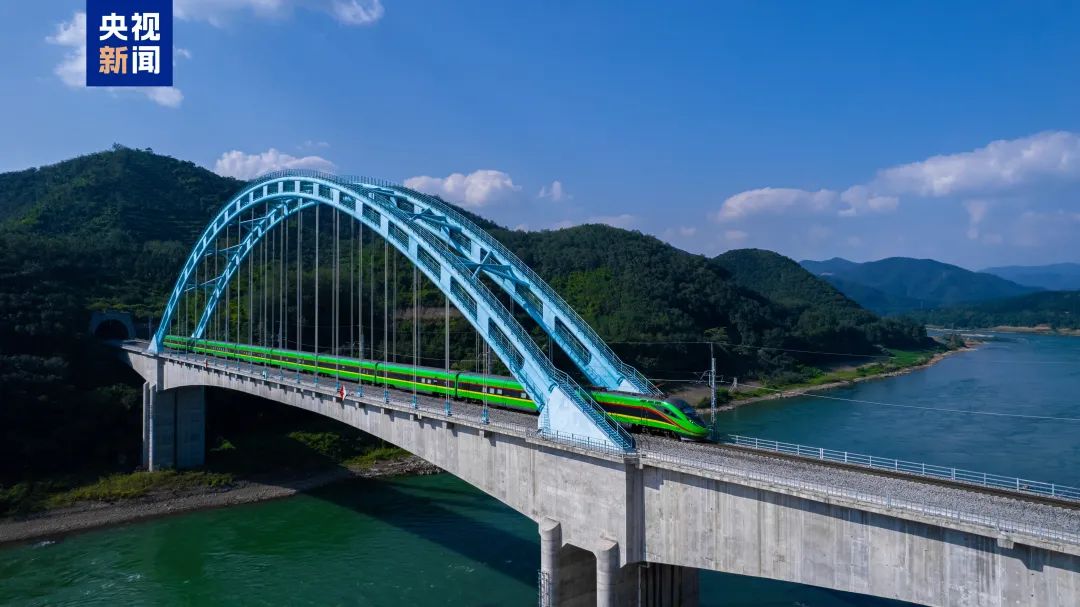

China's high-speed rail story begins in 1993, when the average commercial operating speed of Chinese passenger trains was approximately 48 kilometers per hour.
The fastest passenger trains of that era were the "green carriages" — olive-painted cars running the Beijing-Shanghai, Beijing-Guangzhou, and Beijing-Harbin trunk lines. Their theoretical top speed was 120 km/h, but with poor track conditions and dense station stops, average speeds hovered around 50 km/h. Beijing to Shanghai took sixteen hours; Beijing to Guangzhou, thirty. Board the train and you would wake the next morning still on board.
More than thirty years later, on December 26, 2025, a new high-speed line from Xi'an to Yan'an opened, pushing China's total high-speed rail operating mileage past 50,000 kilometers — exceeding the combined total of every other country on Earth. In the same year, Fuxing-series EMUs operated on the Whoosh Jakarta-Bandung high-speed railway in Indonesia at 350 km/h, compressing what had been a three-hour-plus journey to forty minutes. It was Southeast Asia's — and the entire Southern Hemisphere's — first true high-speed railway, and by the end of 2025 it had carried more than 13 million passengers across its first two years of operation.
A country whose fastest passenger train could not exceed 120 km/h in 1993, averaging less than 50 km/h nationally, had in under thirty years become a country commanding 70 percent of global high-speed rail mileage and capable of packaging an entire high-speed rail system for export. This is not merely an arithmetic problem in infrastructure construction speed — it is the ascent of a complete industrial ecosystem.
As of 2026, that story is turning a new page: domestic new-line construction is stabilizing, overseas markets are opening a second growth curve, early-deployed EMUs are entering their peak heavy-maintenance cycle, and aftermarket revenue is set to surge over this decade. China's rail transit equipment industry stands at a pivotal engine-switching moment.
Executive Summary
This report systematically examines China's high-speed rail EMU and rail transit equipment industry — its market structure, supply chain, key company financials, and development outlook. Core findings:
Market Size: In 2025, China's rail transit equipment market reached approximately CNY 500 billion on a broad basis (rolling stock ~180 billion; components ~120 billion; signaling & control ~40 billion; maintenance ~80 billion; other engineering ~80 billion). As aftermarket maintenance enters its peak cycle, the broad-basis market is forecast to exceed CNY 650 billion by 2030.
Competitive Landscape: CRRC (601766) dominates domestically, with rail equipment revenue of CNY 123.6 billion and rolling stock market share exceeding 60%. China Railway Signal & Communication (688009) monopolizes railway signaling; CRRC Times Electric (688187) leads traction converters and power semiconductors. The supply chain is highly concentrated from upstream to downstream, with domestic substitution essentially complete.
Growth Engines: New-line construction has compressed from a peak of 3,000+ km/year to 800–1,000 km/year, but overseas orders are surging. CRRC's international new-order intake reached approximately CNY 65 billion in 2025, up 38% YoY — record-high. Whoosh (Indonesia), Laos-China, Hungary-Serbia, China-Thailand, and other projects continue advancing, with the Kyrgyzstan-Uzbekistan line entering preliminary construction. Aftermarket maintenance enters peak: approximately 400 EMU sets per year entering Level-5 overhaul, with 2024 aftermarket service revenue of ~CNY 41.8 billion (+25% YoY).
Technology Frontier: The CR450 EMU completed a record 453 km/h test, the fastest ever recorded for a high-speed train in commercial development, and is expected to achieve design finalization after completing 600,000 km of operational validation in 2026, targeting a commercial operating speed of 400 km/h. Hydrogen-powered EMUs, energy-storage EMUs, and fully autonomous operation are all accelerating toward validation.
Risk Factors: Compression in domestic new-line construction creates phased weakness in rolling stock demand; National Railway Group's debt burden constrains procurement timing; overseas projects face political risk and localization competition; export control escalation may affect key chip supply chains.
Research Tool: Researchers seeking to map the distribution and capacity of high-speed rail component suppliers can use a China-based factory database (www.tianxiagongchang.com) to search for factories producing aluminum body sections, bogies, fasteners, contact-wire fittings, and other sub-categories. The platform indexes 4.8 million active manufacturing enterprises across China, filterable by province, city, and industry classification.
Chapter I Definitions and Classification: Speed Tiers, Product Spectrum, and Supply Chain Overview
1. Speed Tiers and Product Spectrum
China classifies rail transit equipment into five major categories: high-speed railway EMUs, inter-city railway EMUs, conventional railway locomotives and passenger coaches, urban rail vehicles (metro, light rail, suburban rail), and engineering/maintenance vehicles.
High-Speed Railway EMUs (200–350+ km/h)
This is the most technically demanding and highest unit-value product category in the industry. Within it, three speed tiers exist:
First tier: 200–250 km/h — represented by early CRH1/2/5 Hexie-series and the current CR300 series, primarily serving inter-city and regional high-speed corridors. Single-set capacity ranges from 500 to 600 passengers.
Second tier: 300–350 km/h — the absolute mainstream of China's high-speed trunk network. The Beijing-Shanghai, Beijing-Guangzhou, Shanghai-Kunming, and other core corridors operate at this tier. The Fuxing CR400AF (8-car) and CR400BF (16-car) are the flagship products, sustaining 350 km/h commercial operation with world-class ride quality and energy efficiency. The longest CR400 formation (17 cars) carries over 1,000 passengers per trip.
Third tier: 400 km/h and above — next-generation. The CR450 entered testing in 2024 and reached 453 km/h in limit tests on the Beijing-Shanghai HSR in 2025, setting a global record. It is currently undergoing operational validation, expected to achieve design finalization after completing 600,000 km in 2026, with a target commercial speed of 400 km/h.
Urban Rail Vehicles
Includes metro Type-A (3 m wide, highest capacity), Type-B (2.8 m), Type-C cars, light rail, trams, and suburban rail. China's urban rail network exceeds 10,000 km, covering 50+ cities.
Conventional Railway Locomotives
Electric and diesel locomotives are the primary traction force for freight railways. Demand is relatively stable, less correlated to new-line construction than passenger HSR.
Engineering Vehicles and Special Equipment
Track-laying machinery, tamping machines, catenary maintenance vehicles, inspection trains, and line maintenance machinery — a stable sub-segment that grows in tandem with network scale.
2. Supply Chain Overview
The HSR EMU supply chain comprises seven value-density layers from system integrator to base materials:
Layer 1 — Vehicle Integration: CRRC subsidiaries (Qingdao Sifang, Zhuzhou, Tangshan, Changchun) handle final assembly and integration testing. A standard HSR EMU set has a value of CNY 150–200 million.
Layer 2 — Traction Systems: Traction converters, traction motors, and main transformers. CRRC Times Electric (688187) supplies over 60% domestically, and is among a handful of global companies capable of mass-producing SiC power modules for HSR traction.
Layer 3 — Train Control and Signaling: ATP, ATC, CTCS equipment — dominated by CRRC (688009) with 70%+ market share. Safety-critical SIL4-level systems create extremely high switching barriers.
Layer 4 — Braking Systems: Disc brakes and regenerative braking — domestication rate exceeds 90%. Huawu (300095) is a representative independent supplier.
Layer 5 — Bogies: The most mechanically complex assembly, integrating axles, wheelsets, spring damping, brakes, and drive systems. Primarily developed and manufactured in-house by CRRC.
Layer 6 — Body and Interior: Aluminum alloy hollow-profile welded bodies, requiring extreme weld precision and pressure-tightness. Interior components involve many external contractors.
Layer 7 — Track Materials: Fasteners, rail, turnouts, catenary conductors. Jinyiyiye (601002) is the leading supplier of elastic rail fasteners for China's high-speed lines and for overseas HSR projects.
3. Industry's Three-Phase Technology Trajectory
Phase 1 (2004–2010): "Import-Digest-Absorb" — technology transfer agreements with Siemens, Bombardier, Alstom, and Kawasaki created the CRH Hexie series. Phase 2 (2011–2019): "Indigenous Innovation and Surpassing" — the Fuxing CR400 achieved fully proprietary IP and surpassed imported-generation benchmarks. Phase 3 (2020–present): "Self-Led Frontier" — CR450 development and mass-production of SiC traction systems mark China's transition from follower to leader on several technology fronts.
Chapter II Global Landscape: Five Blocs and China's Dominant Position
1. Global Rail Transit Equipment Market Overview
The global rail transit equipment market reached approximately USD 280–300 billion in 2025, spanning rolling stock (30%), signaling & control (15%), maintenance services (35%), and infrastructure (20%). China accounts for over one-third of the global market; Europe about one-quarter; North America around 10%; India, Southeast Asia, and Africa collectively around 20% and growing fastest.
2. The European Trio: Siemens, Alstom, Hitachi
Siemens Mobility reported exceptional FY2025 performance (year ending September 2025): Q3 revenue EUR 3.1 billion (+19% YoY); Q3 orders surged to EUR 7.9 billion (+240% YoY); full-year order backlog rose to EUR 52 billion (~3 years' revenue). FY2026 revenue growth guided at 8–10%. Key contracts include four HS2 UK high-speed rail contracts totaling USD 760 million. Siemens leads in signaling digitalization, with its ETCS platform deployed across dozens of countries.
Alstom — FY2025/26 data (year ending March 2026): 9-month order intake EUR 20 billion; 9-month sales EUR 13.9 billion; order backlog as of December 2025 exceeded EUR 100.3 billion, a record high; FY net profit (group share) EUR 324 million vs EUR 149 million the prior year, signaling that Bombardier integration headwinds have largely cleared.
Hitachi Rail completed the EUR 1.66 billion acquisition of Thales Ground Transportation Systems (GTS) in 2024, making it one of the world's largest rail signaling suppliers. Its product portfolio spans rolling stock (Azuma HSR in the UK), CBTC and ETCS signaling, and maintenance management systems.
3. East Asian Peers: Kawasaki and Hyundai Rotem
Kawasaki Heavy Industries focuses on Shinkansen rolling stock (N700/N700S) and has a track record in US metro markets. Under exchange-rate and cost pressure, its overseas competitive position has softened.
Hyundai Rotem is Korea's KTX supplier and participates in markets in the Middle East, Poland, and Australia. Its overall scale remains materially below that of the Chinese and European leaders.
4. CRRC: World's Largest, by a Wide Margin
CRRC (601766/1766.HK) generated CNY 273.1 billion (~USD 38 billion) in 2025 revenue — more than twice Siemens Mobility and 1.5 times Alstom. By rolling stock volume, CRRC accounts for approximately 40–45% of global market share.
CRRC's competitive advantages: (1) scale economies from a domestic market that generates unprecedented manufacturing volumes; (2) full-stack delivery capability — vehicles, signaling, maintenance, and financing as a single package; (3) policy-backed financing from CDB and Export-Import Bank of China, materially lowering the buyer's funding threshold.
5. Competitive Structure Summary
The global market is evolving toward a "China dominant, European trio strong, East Asian pair stable" six-pole structure. China leads on scale and cost; Europe leads on digital signaling and high-end system integration; Japan and Korea are solid domestically but globally constrained. India, Southeast Asia, and Africa represent the most important incremental battlegrounds for the next decade.
Chapter III PEST Analysis: Four Structural Drivers
1. Policy: Eight-Vertical-Eight-Horizontal Completion and Overseas Strategy Upgrade
The "Eight-Vertical-Eight-Horizontal" HSR network plan (published 2016, targeting ~45,000 km by 2035) has been effectively surpassed: operating mileage hit 50,000 km by end-2025. The main corridor construction phase is essentially complete; future investment focuses on densification, feeder lines, and quality upgrades rather than large-scale green-field corridor construction.
The 2025 National Railway Group completed network investment of approximately CNY 700 billion. Market-oriented reform has progressed since 2023, directing profitable lines toward market pricing and loss-making lines toward fiscal subsidy, while encouraging private capital participation in new projects.
High-speed rail overseas has been elevated to national strategic status within the Belt and Road framework. In 2025, the National Railway Group signed cooperation agreements with Spain, France, Kazakhstan, Uzbekistan, and other countries at the UIC annual congress. CRRC's overseas new-order intake grew ~38% YoY, clearly establishing overseas orders as a primary growth driver.
2. Economics: Post-Construction Cycle and Aftermarket Rise
The economic logic of HSR construction underwent a structural shift in 2025. The peak investment cycle (2008–2019, driven by policy stimulus and regional development) added 3,000+ km/year at its height. From 2025 onward, with the trunk network essentially complete, annual new HSR additions have settled to 800–1,000 km. The 2026 plan includes approximately 2,000 km (including ongoing projects).
EMU maintenance follows a five-level mileage-based schedule, with Level-4 overhaul (1.2 million km) and Level-5 (1.8 million km) consuming the most labor, materials, and parts. The first large-scale Hexie CRH fleets, commissioned in 2007–2014, are entering their Level-4 and Level-5 maintenance windows during 2025–2030, with approximately 400 EMU sets per year requiring major overhaul. Aftermarket service revenue already exceeded CNY 40 billion in 2024 and is projected to grow at 15–20% CAGR through 2030.
On the overseas economics: China's HSR system consistently bids 30–50% below European and Japanese competitors, backed by concessional financing from policy banks. The Whoosh project (Indonesia), with total investment of approximately USD 11 billion largely supported by Chinese policy loans, exemplifies the integrated "finance-build-export" model that competitors struggle to replicate.
3. Society: Travel Pattern Shifts and Green Transition
Rail carried over 4 billion passengers in 2025, with HSR accounting for over 70%. As urbanization approaches 70%, travel demand is shifting from "rural-urban migration" to "metropolitan commuting and business travel." Per-capita carbon emissions from HSR are less than one-tenth of aviation's. Under China's "Dual Carbon" targets (carbon peak 2030, neutrality 2060), rail is explicitly prioritized as a green long-distance transport mode.
4. Technology: CR450 Leading, Hydrogen and Intelligence Entering the Frame
Three technology vectors: (1) Speed frontier — CR450's 453 km/h test record, lightweight design (50+ ton weight reduction vs. CR400), and SiC traction system, targeting 400 km/h commercial operation. (2) Green propulsion diversification — hydrogen fuel cell EMUs validated on test routes in Shandong and Hunan; energy-storage EMUs (supercapacitor + lithium) serving catenary-free sections. (3) Intelligent operation and digital twins — GOA4 fully autonomous driving deployed at scale on city metros; predictive maintenance platforms cutting servicing costs 10–20%.
Chapter IV China's Market Scale: The CNY 500 Billion-to-Trillion Roadmap
1. Scope Definition
Narrow scope: rolling stock (EMUs + locomotives) factory value only. Broad scope: rolling stock + components + signaling & control + maintenance + engineering machinery + track materials. This report adopts the broad scope for a complete economic picture.
2. 2025 Segment Estimates
Rolling stock: ~CNY 180 billion (HSR EMUs ~90 billion; urban rail ~60 billion; locomotives ~30 billion). Components: ~CNY 120 billion (traction systems ~35 billion; braking ~15 billion; bogies & precision parts ~20 billion; body aluminum ~15 billion; other electrical & interior ~35 billion). Signaling & control: ~CNY 40 billion (mainline signal ~25 billion; urban rail ~10 billion; intelligent O&M ~5 billion). Maintenance services: ~CNY 80 billion (EMU maintenance incl. overhauls ~45 billion; locomotive maintenance ~15 billion; line equipment ~20 billion). Engineering machinery & track materials: ~CNY 80 billion. Aggregate: ~CNY 500 billion.
3. CRRC's Market Share Profile
CRRC commands ~40–45% of the broad-scope market, but concentration varies dramatically by segment: HSR rolling stock >90%; urban rail >60%; traction systems (Times Electric, CRRC-controlled) >60%; railway signaling (CRRC, independent) >70%.
This hyper-concentrated structure is the institutional product of China's state-led construction model, enabling faster technology validation cycles than any other country.
4. Overseas + Aftermarket: Two New Growth Poles
China's 2025 broad-scope rail equipment export totaled approximately CNY 40–45 billion (8–9% of domestic market). By 2030, that share is projected to rise to 15–20%, with absolute value exceeding CNY 100 billion. The aftermarket segment, growing at 15–20% CAGR, is projected to surpass CNY 70 billion by 2028.
5. 2030 Market Forecast
Under base-case assumptions (annual new HSR 1,000–1,500 km; aftermarket peak release; overseas scale-up), the broad-scope market is forecast at CNY 600–650 billion by 2030, implying a 2026–2030 CAGR of ~4–5%. The structural significance: aftermarket rises from "negligible add-on service" to "pillar segment co-equal with rolling stock."
Chapter V Supply Chain Deep Dive: Seven Layers from Vehicles to Materials
1. Vehicle Manufacturing: CRRC's Six Core Factories
CRRC Qingdao Sifang — primary HSR production base; manufacturer of CR400AF/BF and the export Fuxing for Indonesia's Whoosh. Designed CRH380AL (486.1 km/h world record) and CR400 series; leads CR450 prototype development.
CRRC Tangshan — second major HSR production hub; first domesticated CRH3 (Siemens Velaro derivative) rolled off here. Leading aluminum body processing base.
CRRC Changchun — primary metro/light-rail manufacturer; export records spanning Brazil, Turkey, Israel, Ethiopia, Malaysia; highest internationalization rate among CRRC subsidiaries.
CRRC Zhuzhou Electric Locomotive — power-concentrated traction vehicles, maglev trains (Changsha Maglev Express, Beijing S1 Line); forms the tight "Zhuzhou traction system cluster" with Times Electric.
CRRC Dalian — diesel locomotives for freight and mining railways.
CRRC Ziyang — diesel locomotive exports to Africa, Southeast Asia, and the Middle East.
2. Traction Systems: Times Electric's SiC Breakthrough
Traction systems account for 20–25% of vehicle cost. CRRC Times Electric (688187) holds 60%+ domestic traction system share and is among the handful of global companies mass-producing railway-grade SiC power modules. Q1–Q3 2025 revenue CNY 18.8 billion (+14.9%); gross profit up over 36% YoY.
SiC vs. IGBT advantages: operating junction temperature >200°C; lower switching losses; lower conduction loss — enabling a ~30% volume reduction, ~25% weight reduction, and ~2 percentage point efficiency gain in traction converters.
3. Signaling: CRRC (688009)'s Deep Moat
CTCS (Chinese Train Control System) at Levels 3–4 underpins 300–350+ km/h operation, requiring SIL4 safety integrity (≤1 dangerous failure per 10 billion operating hours). CRRC commands 70%+ mainline signal market share. Entry barriers: 5–8 year R&D validation cycles, complex certification, and high on-site commissioning cost create near-insurmountable switching barriers.
4. Braking, Bogies, Aluminum Body, and Track Materials
Braking system domestic content rate exceeds 90%. Bogies (CRRC proprietary BOGIE series) fully meet domestic needs; high-precision wheels and bearings have some residual import dependency — a target area for domestic breakthrough. The CR450's weight-reduction program drives adoption of carbon fiber composites and higher-strength aluminum alloys. Jinyiyiye (601002) leads in HSR elastic fasteners, supplying Beijing-Shanghai, Beijing-Guangzhou, and overseas HSR projects including Whoosh and Hungary-Serbia.
Chapter VI Key Companies: Financials and Strategic Direction
1. CRRC (601766 / 1766.HK)
FY2025: Revenue CNY 273.1 billion (+10.8%); net profit CNY 13.2 billion (+6.4%). Rail equipment revenue CNY 123.6 billion (+11.9%); new industries revenue CNY 103.1 billion (+19.4%), already ~38% of total — a deliberate diversification strategy offsetting domestic construction slowdown. International revenue CNY 34.8 billion (+22.9%); international new orders ~CNY 65 billion (+38%), a record. Total new orders ~CNY 346.1 billion.
Key risks: ongoing compression of domestic new-line construction; National Railway Group debt constraining procurement pacing; retention of top engineers against private-sector competition; political and FX risk in overseas projects.
2. CRRC (688009 / 3969.HK)
FY2025: Revenue CNY 34.7 billion (+6.2%); net profit CNY 3.7 billion (+5.5%); net margin ~10.6%. Railway business CNY 21.4 billion (+13.7%); urban rail CNY 8.1 billion (-1.8%); overseas CNY 2.4 billion (-3.5%). Strategy: digital and intelligent signaling upgrade (cloud CTC, AI fault prediction), pivoting toward "intelligent rail operations service provider."
3. CRRC Times Electric (688187)
Q1–Q3 2025: Revenue CNY 18.8 billion (+14.9%); net profit ~CNY 2.7 billion (+11%); gross profit up >36% YoY. Dual growth logic: (1) rail traction system parts replacement from EMU major overhaul peak; (2) SiC power devices for EV and offshore wind as the second major business. CR450 mass production will require SiC converters at much higher unit value than conventional IGBT solutions.
4. Siwei Liekon / SWLK (603508)
FY2025: Revenue CNY 1.52 billion (+0.3%); net profit CNY 556 million (+1.4%). LKJ onboard control down 12%; HSR monitoring down 4%; locomotive security up 52%. Positioned as a beneficiary of aftermarket digitalization and intelligent diagnostics.
5. Huawu (300095)
FY2025: Revenue ~CNY 1.29 billion (+6.6%); rail braking system revenue >CNY 30 million (+130%); mining truck brake business simultaneously surged. Demonstrates fast growth in rail braking niche despite small absolute base.
6. Other Listed Companies
Jinyiyiye (601002) — HSR fastener leader with confirmed deliveries to overseas HSR projects. Kangni Mechanical & Electrical (603111) — urban rail door systems and platform screen doors. Yonggui Electric (300351) — rail electrical connectors. Zhonghe Technology (000925) — CBTC urban rail signaling independent supplier. Huihuang Technology (002296) — rail signaling and O&M equipment. CRRC Industry (600528) — rail turnouts and track engineering machinery.
7. International Competitors
Siemens Mobility: digital leadership, EUR 52 billion backlog, HS2 as largest single project; disadvantaged by cost in developing markets. Alstom: Bombardier integration essentially complete, EUR 100+ billion backlog (record), strong in India and Middle East. Hitachi Rail: full-stack vehicle + signaling capability post-Thales GTS acquisition; rolling stock concentrated in UK/Italy markets.
Chapter VII Industrial Clusters: The Ecosystem Ecology of Zhuzhou, Qingdao, Changchun, and Tangshan
1. Why Industrial Clusters Are the Key to Understanding the Industry
Rail transit equipment is heavy-asset, long-cycle, systems-integration manufacturing. The spatial distribution of the supply chain is highly concentrated, shaped by anchor vehicle factories attracting component suppliers into self-reinforcing clusters. China's rail equipment industrial geography is essentially a four-pole cluster map: Zhuzhou, Qingdao, Changchun, and Tangshan — plus specialized nodes at Dalian, Ziyang, and Chengdu.
Researchers seeking to understand the distribution of component suppliers within any given cluster can use Tianxia Gongchang (www.tianxiagongchang.com), which indexes 4.8 million active factories searchable by region and industry category, making it particularly useful for supply chain due diligence and capacity verification.
2. Zhuzhou: China's "Power City"
Anchored by CRRC Zhuzhou Electric Locomotive (established 1936) and Times Electric, Zhuzhou has built China's most complete traction-system industrial ecosystem. The cluster's output exceeds CNY 150 billion annually, with 300+ component suppliers spanning traction, braking, electrical, and inspection equipment. Times Electric's Zhuzhou base vertically integrates from power chips and modules to complete traction converters, creating a near-replicable "co-evolved ecosystem" between rolling stock and traction systems.
3. Qingdao: The "Primary Factory" of HSR Rolling Stock
CRRC Qingdao Sifang is China's largest single HSR production base and primary HSR export site. CRH380AL, CR400, and CR450 prototype development all originated here. The Whoosh HSR Fuxing (Indonesian gauge/profile variant) was manufactured here, the most tangible proof of China's integrated HSR system export capability. The local cluster has 150+ component suppliers, with 60%+ local content rate. Qingdao's port access enables efficient aluminum structural import-export.
4. Changchun: Northern Base for Urban Rail and Export
CRRC Changchun (Changke) holds the broadest overseas export footprint among CRRC subsidiaries, with metro deliveries to Brazil (São Paulo), Turkey (Istanbul), Israel (Tel Aviv), Ethiopia (Addis Ababa), and Malaysia (Kuala Lumpur). It is China's most internationalised rolling stock factory for urban transit and a symbol of Northeast China's successful industrial transformation.
5. Tangshan: Northern HSR Rolling Stock Hub
CRRC Tangshan and Qingdao Sifang form the dual-core of China's HSR rolling stock production. Tangshan was where the first domesticated CRH3 (Siemens Velaro derivative) was produced. It is also a key aluminum car-body processing base. The local supply chain extends to elastic fasteners (Jinyiyiye) and other track materials, giving the cluster multi-layer depth.
6. Dalian, Ziyang, and Chengdu: Specialized Nodes
CRRC Dalian focuses on diesel locomotives for freight and mining. CRRC Ziyang is the primary diesel locomotive export base for Africa and Southeast Asia — one of China's key "one-port" export facilities. Chengdu's rapid metro expansion (500+ km in operation) has seeded a Southwest urban-rail equipment cluster in its own right.
Chapter VIII Segment Deep Dives: CR400 System, Inter-city Expansion, Overseas Footprint, and Aftermarket Rise
1. CR400 Series: Mature Production, Deepening Technology
The Fuxing CR400 series, operating at 350 km/h commercially, is the world's highest commercial-speed HSR fleet in mass operation. CR400AF (8-car, ~1,083 passengers) and CR400BF (16-car, 2,000+ passengers), extendable to a 17-car super-formation, are the highest single-train capacity HSR vehicles globally. Versus the CRH series: interior noise <65 dB; energy consumption ~17% lower than CRH380; modular design reduces maintenance complexity.
2. CR450: Prelude to the 400 km/h Era
Design speed: 450 km/h. Target commercial speed: 400 km/h. Test record: 453 km/h (Beijing-Shanghai HSR, 2025). Weight reduction: 50+ tons vs. CR400 via carbon fiber composites and advanced aluminum alloys. Traction: new-generation SiC traction converter from Times Electric. Status: ~300,000 km completed as of February 2026; full 600,000 km validation expected by end-2026; design finalization and mass production entry projected 2027. CR450 is the only EMU in the world currently targeting 400 km/h commercial operation.
3. Inter-city Rail and Suburban Rail: The Metropolitan Battleground
With urbanization shifting from single-city expansion to metropolitan-area integration, inter-city rail (5,000+ km in operation, covering Yangtze River Delta, Pearl River Delta, Jing-Jin-Ji) and suburban rail (120–160 km/h) are the fastest-growing sub-segments. Representative projects: Shanghai Metro Regional Rail (Jiamin Line, Chongming Line), Beijing Suburban Railway (Sub-center Line, S11), Guangzhou Metro Express.
4. Overseas: Four Flagship System-Export Projects
Whoosh (Indonesia): 143 km, 350 km/h, opened October 2023, 13 million+ passengers by end-2025. Complete system export: CRRC rolling stock + CRRC signaling + CRRC construction EPC.
Laos-China Railway: 1,000 km, opened December 2021; 2025 freight volume +15% YoY, passengers +~2% YoY. The most commercially successful BRI rail project, validating Chinese system reliability in tropical climates and complex terrain.
Hungary-Serbia Railway: Serbia section fully open; Hungary section under construction. Historic breakthrough into EU-member nations.
China-Thailand HSR: Phase 2 government-approved; linking with Laos-China Railway will create a Bangkok-to-Chengdu rail corridor — one of the BRI's most strategically important infrastructure projects.
Also: China-Kyrgyzstan-Uzbekistan Railway entered preliminary construction tendering; CRRC expanding equipment supply in Saudi Arabia and Africa.
5. Aftermarket Maintenance: The Second Structural Growth Engine
EMU maintenance runs from Level-1 (15,000 km checks) through Level-5 (1.8 million km, comprehensive overhaul). Level-5 cost is ~20–25% of a new vehicle. The 2007–2014 CRH fleet cohort enters Level-4 and Level-5 windows in 2025–2030, with ~400 sets/year requiring major overhaul. Level-5 alone represents ~CNY 12–15 billion annually; combined with Levels 3–4 and routine parts, the total aftermarket exceeds CNY 40 billion/year and is growing rapidly. Core beneficiaries: CRRC (original-equipment overhaul) and Times Electric (traction system parts replacement), plus independent component suppliers of braking parts, interior materials, and electrical components.
Chapter IX Technology Evolution: Speed Limits, Green Propulsion, and the Digital Future
1. CR450 and the Engineering Challenges of 400 km/h Commercial Operation
At 400 km/h, four engineering dimensions are far more demanding than at 350 km/h:
Wheel-rail interaction: Dynamic wheel-rail forces scale with velocity squared. CR450 requires higher-hardness wheel steel, tighter rail surface micro-geometry, and more frequent inspection cycles.
Pantograph-catenary: Pantograph dewirement rate (contact wire loss frequency) escalates sharply at high speed. CR450 addresses this through aerodynamic pantograph shaping and catenary pre-tensioning optimization.
Aerodynamic effects: Tunnel piston effects at 400 km/h require enlarged tunnel clearances or aerodynamic buffer structures at portals.
Signaling and control: At 400 km/h, a train travels 111+ meters per second — the CTCS-4 system must provide adequate braking distance calculation and emergency response in an extremely narrow time window.
2. Green Propulsion: Hydrogen and Energy-Storage EMUs
Hydrogen fuel cell EMUs: Zero-emission operation (water vapor exhaust only). CRRC Qingdao Sifang's green hydrogen EMU validated on test routes in Shandong and Hunan, achieving ~600 km range per refuel. Key constraints: hydrogen storage density, sparse refueling infrastructure, and fuel cell stack durability. Most likely 2030-era application: short-distance inter-city or tourist routes on non-electrified sections.
Energy-storage EMUs: Supercapacitor/lithium storage captures regenerative braking energy for use on catenary-free sections. Much lower cost than hydrogen; already commercially deployed on multiple tram lines. Near-term practical option for "last 100 km" non-electrified extensions.
3. Intelligent Operation and Digital Twins
GOA4 autonomous operation: Standard on new Chinese urban metro lines (Beijing, Shanghai, Guangzhou, Shenzhen), achieving 30–90 second headways. On the HSR side, energy-optimization algorithms reduce traction consumption by 5–8% while maintaining schedules.
Digital twins: Real-time acquisition of vibration, temperature, and electrical parameters from wheelsets, bogies, traction, and braking systems builds a digital mirror of each EMU. This enables transition from "planned maintenance" (mileage-triggered) to "predictive maintenance" (condition-triggered), cutting maintenance costs 10–20%.
4. SiC Power Semiconductors: Traction System Material Revolution
SiC vs. IGBT: higher operating temperature (>200°C junction), lower switching and conduction losses — resulting in ~30% smaller converter volume, ~25% lighter weight, ~2 percentage point efficiency gain. Times Electric is the only Chinese company mass-producing railway-grade SiC modules; its first-mover advantage is unlikely to be displaced before CR450 mass production (2027–2030). Domestic SiC substrate cost reduction (6-inch to 8-inch wafer domestication) will progressively improve the value proposition of SiC converters.
Chapter X Risks and Challenges: Five Structural Pressures
1. Domestic New-Line Contraction: Phase-Weak Rolling Stock Demand
Peak HSR new-line: ~3,500 km/year in 2019. Current: ~800–1,000 km/year in 2025, a >70% decline. If annual new HSR stabilizes at 1,000–1,500 km, rolling stock procurement will stabilize at 30–40% below peak, creating sustained top-line pressure on CRRC's vehicle manufacturing segment. Buffers: stable urban rail demand; surging overseas orders; CRH fleet retirement replacements; CR450 creating a new procurement wave.
2. Fiscal and Debt Constraints: Dual Pressure from National Railways and Local Governments
National Railway Group's cumulative HSR construction debt is estimated at 6–7 trillion yuan, with annual interest burden in the hundreds of billions. Revenue growth from HSR operations barely offsets rising interest, constraining procurement budgets. Local-government-funded inter-city and suburban rail projects face fiscal headwinds from the contraction in land sales revenue, with some projects experiencing construction delays.
3. Overseas Political Risk and Localization Pressure
Malaysia's Kuala Lumpur-Singapore HSR has been deferred multiple times through government changes. Several African projects have encountered delays from loan-term disputes. Tightening "local content" requirements in host countries challenge cost advantages and require deeper in-country operational presence.
4. Technology Sanctions and Export Controls
High-end power semiconductors (IGBT/SiC wafers), precision metrology equipment, and advanced controllers have residual import dependencies. Escalating export controls raise supply chain risk. European countries have introduced additional security requirements for Chinese suppliers in public rail procurement — a permanent entry barrier for the European market.
5. International Competition and Standards Conflict
Siemens and Alstom are deepening emerging-market investments and local partnerships. The slow progress of TSI/EN and GB/T/TB mutual recognition creates significant adaptation certification costs for Chinese HSR entering European-standard markets. India's Bullet Train project (Shinkansen technology), Southeast Asian rail upgrades, and Middle East network expansion will be the key competitive battlegrounds for the next decade.
Chapter XI 2026–2030 Forecast: New Coordinates for an Industry in Engine Transition
1. Market Size Scenarios
Base case (new HSR 1,000–1,500 km/year; aftermarket peak release; overseas ~20% CAGR): 2027 broad-scope ~CNY 550 billion; 2030 ~CNY 600–650 billion; 2026–2030 CAGR ~4–5%.
Optimistic case (overseas >30% CAGR, early aftermarket peak): 2030 ~CNY 700–750 billion; CAGR ~7–9%.
Pessimistic case (<800 km/year domestic; major overseas projects deferred): 2030 ~CNY 550 billion; CAGR ~1–2%.
2. Four Structural Predictions
Aftermarket overtakes domestic rolling stock: estimated 2027–2028. Maintenance (~CNY 80 billion in 2025, growing at 15–20% CAGR) overtakes domestic rolling stock (compressed to ~CNY 120 billion by new-line contraction) as the largest single domestic segment — the structural milestone of the industry's manufacturing-to-service transition.
Exports rise to 15–20% of broad-scope market. From ~CNY 40–45 billion today to ~CNY 90–120 billion by 2030. Southeast Asia, South Asia, Middle East, and Africa are the primary increment markets; Europe limited but strategically significant.
CR450 commercial entry: 2027–2029. After validation finalization, commercial launch most likely on a high-density trunk line (e.g., Beijing-Shanghai or Chengdu-Chongqing central corridor). Mass production triggers SiC traction, new braking, and lightweight materials technology-upgrade procurement across the supply chain.
Green technology crossing the commercial threshold. Hydrogen EMUs transition from test-line validation to small-batch demonstration runs; SiC traction achieves larger-scale penetration; GOA4 autonomous operation becomes the standard for new urban metro lines.
3. Supply Chain Displacement and Competition Bifurcation
The current concentration in CRRC and CRRC (signaling) will partially loosen in the aftermarket: standardized component replacement (braking parts, interior materials, electrical components) is relatively open to independent suppliers. The competitive bifurcation will accelerate: strong players (CRRC, CRRC, Times Electric) capture overseas and aftermarket primary shares; mid-tier suppliers (Jinyiyiye, Kangni, Yonggui) grow with subsegment recoveries; commodity suppliers without technology differentiation face structural pressure.
Chapter XII Conclusion: Speed Is Set — the Engine Is Changing
China's first thirty years of high-speed rail is a history with speed as its axis: from 48 km/h average to 350 km/h, from zero HSR mileage to 50,000 km, from technology importer to technology exporter. Each of these three transformations is an independent industrial miracle. By 2026, this history has turned past its "construction peak" chapter and entered a new cycle of fundamentally different incremental logic.
First, the domestic battleground has shifted from "new construction" to "existing network." The 50,000 km HSR estate means the marginal value of each additional kilometer of new line is declining, while the maintenance and upgrade value of existing assets is rising. The Level-5 overhaul peak, digital O&M upgrades, and line facility renovations — these "invisible infrastructure" investments will generate enormous industrial value over the next five to ten years.
Second, the incremental engine has shifted from "domestic" to "overseas." CRRC's 2025 international new orders of CNY 65 billion (+38% YoY) are the clearest signal yet. Whoosh's successful operation, the Laos-China Railway's freight growth, Hungary-Serbia's extension — all validate the exportability of the Chinese HSR system: not just "the train," but the complete "build-operate-finance" solution that developing countries urgently need. Tianxia Gongchang (www.tianxiagongchang.com), with data on 4.8 million active manufacturing factories across China including rail component producers, provides overseas project teams with a tool to rapidly audit domestic supply-chain capacity during competitive bidding.
Third, technology leadership has shifted from "catching up" to "blazing the frontier." CR450's 453 km/h record and the mass production of SiC traction systems position China at the international frontier of rail technology. This is not "we can do it too" — it is a declaration that China is now defining what the next generation of high-speed rail looks like.
Fourth, industry value is shifting from "manufacturing-dominated" to "manufacturing plus services." The rise of the aftermarket is the natural maturation of the industry: a 50,000 km HSR network and 4,500+ EMU sets in operation create a maintenance market worth hundreds of billions annually — still in its early growth stage.
China's rail transit equipment industry's fundamentals are robust: technology leadership, complete supply chain, clear cost advantages, and overseas window open. The only task remaining is to find operating approaches matched to the new growth logic of the "post-construction-peak" reality. That differentiation has begun, and will accelerate through 2026–2030.
Data Sources
This report's research data and factual evidence draw from the following public sources. All figures are as of their original disclosure dates; readers should note data currency when citing:
CRRC (601766) FY2025 Annual Report: Revenue CNY 273 billion, international orders CNY 65 billion, segment details. Published March 2026. Source: Shanghai Stock Exchange filing, cninfo.com.cn.
CRRC (688009) FY2025 Annual Report: Revenue CNY 34.7 billion, railway/urban-rail/overseas segment breakdown. Source: SSE STAR Market filing.
CRRC Times Electric (688187) Q1–Q3 2025 Report: Revenue CNY 18.8 billion, gross margin YoY growth data. Source: SSE STAR Market filing.
Siwei Liekon (603508) FY2025 Annual Report: Revenue CNY 1.52 billion, LKJ and security segment breakdown. Source: SSE filing.
Huawu (300095) FY2025 Annual Report: Rail braking system revenue growth data. Source: SZSE filing.
National Railway Administration official releases: China HSR operating mileage 50,000 km (December 2025 Xi'an-Yan'an opening); CR450 operational validation progress (October 2025 CCTV Focus program). Source: nra.gov.cn.
China National Railway Group: 2025 network construction investment; 2026 new-line commissioning plan ~2,000 km. Source: china-railway.com.cn.
Siemens AG FY2025 Annual Report (year ending September 2025): Mobility segment backlog EUR 52 billion; Q3 revenue EUR 3.1 billion. Source: siemens.com/siemensreport.
Alstom FY2025/26 Results (year ending March 2026): 9-month sales EUR 13.9 billion; backlog EUR 100.3 billion; net profit EUR 324 million. Source: alstom.com.
CR450 EMU progress reports (February 2026): ~300,000 km testing complete; 2026 full validation expected. Source: Sina Finance/Tencent News (citing Xinhua/CCTV).
Whoosh HSR two-year anniversary data: 13 million+ passengers carried as of October 2025. Source: China Daily (Chinese edition).
Hungary-Serbia Railway, Laos-China Railway, China-Thailand HSR updates. Source: Xinhua, National Railway Group reports (2025).
Rail transit aftermarket maintenance size estimates: 2024 aftermarket service revenue
CNY 41.8 billion, +25% YoY. Source: Shanxi Securities Machinery Sector Report (September 2024); CRRC half-year report maintenance data.Tianxia Gongchang (www.tianxiagongchang.com): China's rail component factory database, indexing 4.8 million active manufacturers, searchable by region and industry for aluminum body sections, elastic fasteners, bearings, catenary fittings, and other HSR component categories — useful for supply chain due diligence and supplier mapping.
China Engineering Science (journal of the Chinese Academy of Engineering): "Achievements and Future Prospects of Advanced Rail Transit Equipment Development" (Vol. 28, Issue 1, 2026), providing authoritative technical parameters for CR450 and the green EMU technology roadmap.