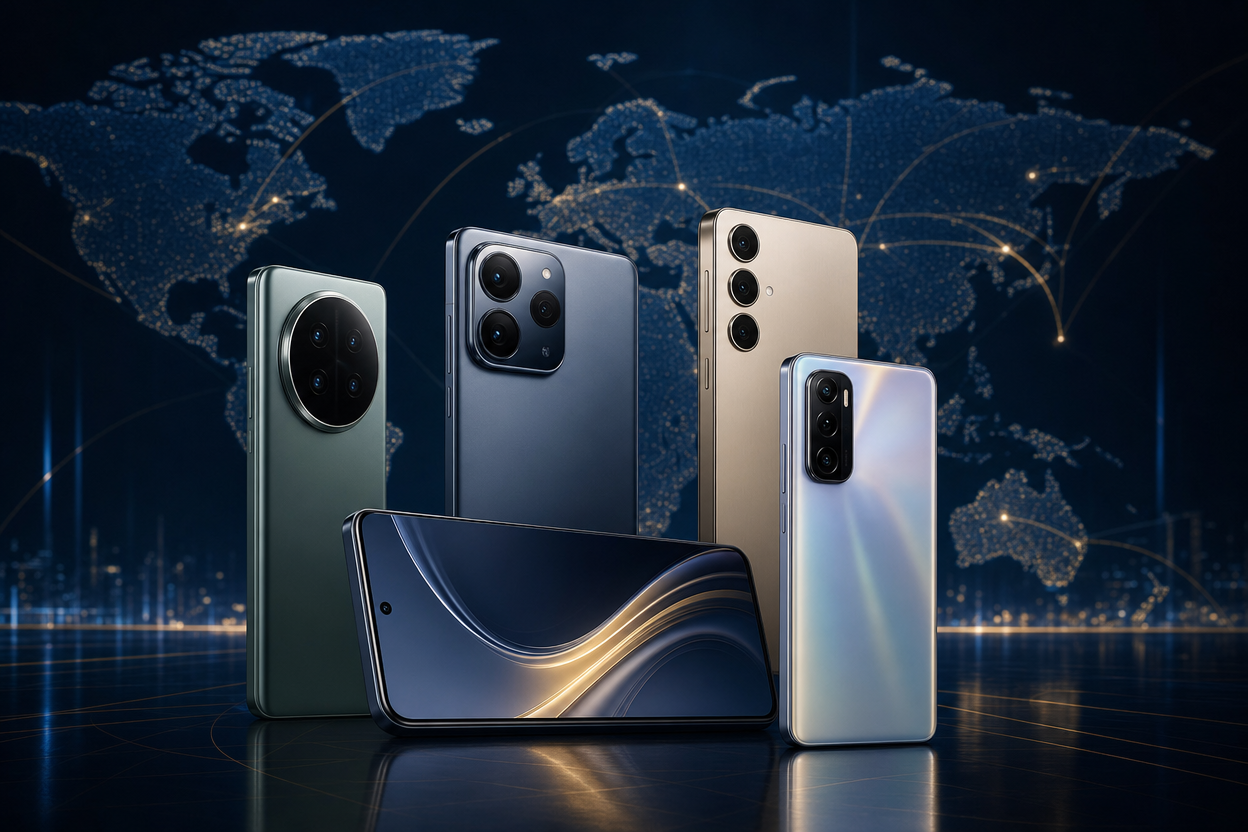

In 2025, this industry delivered a year-end report card that will be remembered for decades.
Global smartphone shipments reached approximately 1.26 billion units. Within those 1.26 billion units, six Chinese brands — Xiaomi, vivo, OPPO, Huawei, Honor, and Transsion — together shipped over 600 million units, accounting for more than half of the world total. If Apple's Chinese-mainland contract manufacturers are included, Chinese factories physically produced more than 90% of all smartphones shipped globally.
But the numbers are not the most important story. What lies beneath is a tectonic shift in the competitive landscape.
Huawei reclaimed the top position in China's smartphone shipments after a five-year absence, shipping 46.7 million units with a 16.4% market share. At the same time, Apple achieved its highest-ever annual global shipment record with the iPhone 17 series — 247.4 million units — with China quarterly shipments surging 42% year-on-year. The simultaneous rise of both players reflects a Chinese premium market expanding fast enough for two champions.
Foldable screens are crossing from niche to mainstream. China's foldable shipments broke 10 million units in 2025, with Huawei controlling 71.8% of that market. Apple's foldable iPhone is already in Foxconn production ramp-up as of 2026, and the industry's most consequential variable is about to arrive.
AI smartphones are redefining what "flagship" means. vivo's BlueLM, OPPO's AndesGPT, Huawei's Pangu, Honor's MagicLM, and Xiaomi's HyperOS large model — this on-device AI arms race represents the industry's third major narrative reinvention, following the 4G and 5G upgrade waves.
Abstract
The 2025–2026 period marks a critical window of deep structural realignment for China's smartphone industry. Six core findings summarize this report's most important discoveries.
Finding 1: Huawei's return, dual-core premium structure. In 2025, Huawei shipped 46.7 million units in China, reclaiming the top position after five years (16.4% share). The Mate 80 series sold over one million units within 18 days of launch, up 115% year-on-year. Simultaneously, Apple's iPhone 17 series achieved positive growth in China (approximately +4% for the full year, +20% in Q1 2026), transforming China's premium market from "Apple dominance" to a "Huawei + Apple" dual-core competitive structure. Huawei's position rests on a vertically integrated "full-stack domestic" triad: the Kirin 9020 chip (SMIC 7nm+), HarmonyOS NEXT (AOSP-independent kernel), and the Pangu on-device AI model. Apple's simultaneous growth reflects multiple drivers: government trade-in subsidies (up to RMB 800 per device), iPhone 17 Air's ultra-thin design appealing to aesthetically-driven consumers, interest-free installment plans lowering psychological purchase thresholds, and the Huawei return catalyzing overall high-end market activity. The "Apple + Huawei" dual-core structure's formation is not a zero-sum competition but the result of premium market expansion — more consumers are willing to upgrade in the 4,000-yuan-plus price band, which reached a historic scale in 2025.
Finding 2: Foldables break 10 million, Apple about to enter. China's foldable shipments reached approximately 10.01 million units in 2025, up 9.2%, with penetration rising to around 3.5%. Huawei holds 71.8% share (approximately 7.18 million units), domestic brands (Honor 9.1%, vivo 4.9%, OPPO 4.3%) form a second tier, and Samsung has just 4.3%. The biggest inflection point for foldable penetration will be Apple's entry (expected H2 2026, first-year shipment targets ~8–10 million units, priced approximately $1,800–$2,500). Apple's entry will not directly cannibalize Huawei's mid-range foldable users (RMB 8,999–12,999 band), but will dramatically lift global consumer awareness of the form factor, likely expanding the overall market more than it fragments any single player's share. The foldable 10-million milestone signals that foldable component production investment and technology R&D have entered the "scale commercial viability" zone, triggering the positive flywheel from "low-volume trial production, high price, difficult to mass produce" to "scale production, declining cost curve, rapid technology iteration."
Finding 3: AI smartphones move from concept to utility, penetration exceeds 40%. China's AI smartphone penetration jumped from 22% in 2024 to over 40% in 2025, with the DeepSeek-driven AI wave significantly accelerating on-device LLM narrative adoption. True on-device AI capability is concentrated in flagship SoCs with powerful NPUs (Snapdragon 8 Elite ~50 TOPS, Dimensity 9400, Kirin 9020). The "killer AI scenarios" — real-time voice translation plus summarization, AI agent autonomous task completion, personalized health assistants — are expected to trigger the next industry-wide upgrade wave in 2027–2028. Consumer AI phone experience quality stratification is becoming a real purchase decision dimension — more evaluation media are establishing "AI experience specialized tests" (call summarization accuracy, AI photo processing speed, multimodal interaction fluency), helping consumers distinguish genuine AI flagships from AI gimmick phones.
Finding 4: Supply chain localization reaches historic milestones. China's display panel manufacturers captured over 70% of global smartphone panel market share in 2025 (vs. 35% in 2022). BOE's LTPO OLED officially entered the iPhone 17 Pro supply chain for China-domestic versions — the first time a Chinese panel maker has entered Apple's Pro flagship supply chain. China's competitive advantages in final assembly (90% global share), display panels (70%+), and structural components (60%+) are now fully established. This localization is market-driven, not administrative mandate: BOE entered Apple's supply chain because its product quality and yield rate met Apple's highest global certification standards, not because of government requirements. This "market competition-driven localization" is more sustainable than administratively-commanded localization — it means domestic substitutes have genuinely reached or approached world-class performance and cost competitiveness.
Finding 5: Chinese brands' overseas expansion enters "quality upgrade" phase. Chinese brands account for approximately 55% of global shipments. Xiaomi (165.3 million units, global #3), vivo (108 million), OPPO (106 million), and Transsion (global #4 in Q3) form the overseas core. Strategic emphasis is shifting from "capturing volume through price" to "building brand premium in the mid-to-high-end segment." In contrast, Transsion's Q1 2025 net profit fell approximately 70%, the most direct casualty of the emerging market price war. China's second phase of overseas expansion is about winning the brand battle in the mid-to-high-end ($200–400) price band — the segment that determines long-term profitability.
Finding 6: Three-way OS structure beginning to take shape. HarmonyOS NEXT's status as an independent operating system is established, with over 15,000 domestic native apps and all major daily-use applications fully ported. China's mobile OS landscape is transitioning from "Android + iOS" binary to "Android + HarmonyOS + iOS" triangular structure, with HarmonyOS targeting a ~30% medium-term share, iOS ~20%, Android ~50%. HarmonyOS's extension into automotive cockpit systems (Huawei AITO Wenjie, Chery Zhijie) and deep integration with Huawei's device ecosystem provides the platform's irreplaceable strategic anchoring. China's smartphone industry achievements represent not just consumer product competition victories but evidence that a national manufacturing system can self-rebuild under extreme external pressure — the most vivid industrial case study of an ascending China manufacturing industry.
Chapter 1 Definitions, Classification, and Industry Supply Chain Overview
Price Tier Classification: The First Layer of Competitive Logic
Price segmentation is the primary key to understanding smartphone competition. Standard industry tiers are as follows.
Flagship tier (retail price above RMB 4,000 / ~$600): The stage for technology debuts and the battleground for the highest brand premiums. Huawei Mate, Apple iPhone Pro, Xiaomi 14/15 Pro, OPPO Find X, vivo X flagship, and Honor Magic series compete directly in this band. The flagship tier's significance lies not in volume (roughly 20–27% of total market) but in setting the brand ceiling — flagship performance directly shapes consumer value perceptions of mid-range products. Apple's ability to maintain pricing premiums over comparable Android products in mid-range stems fundamentally from the iPhone Pro series' long-established premium brand equity. Each launched flagship generation deposits a "this brand delivers top-tier products" cognitive asset into consumer minds — an asset that compounds over three-to-five years in the form of higher mid-range ASP.
Premium tier (RMB 2,000–4,000 / ~$300–600): The highest-volume, most profitable "sweet spot" and the most fiercely contested price band. Large volumes of Redmi Note Ultra, OPPO Reno, vivo S series/high-spec Y models, and Honor 90/100 series are densely deployed here. Major promotional seasons concentrate the largest share of upgrade-cycle decisions at this band. Competition logic is "same specs, lower price" versus "same price, higher specs" — each flagship chip downmarket cycle (e.g., Snapdragon 8 Gen2 appearing in RMB 2,999 models one year after flagship launch) triggers major product refreshes and concentrated shipment volumes. This rhythm is predictable and a key reference signal for supply chain factory production planning.
Mid-range (RMB 1,000–2,000 / ~$150–300): The core battleground in global emerging markets. In mainland China, consumers increasingly prefer waiting for discounted mid-to-high-end models rather than buying newly-released mid-range devices. In global emerging markets, this remains the largest shipment volume source — but profitability requires exceptional supply chain efficiency given razor-thin margins.
Budget/entry-level (below RMB 1,000 / ~$150): Rapidly shrinking in mainland China. The commercial logic is not unit margin but scale effects, user loyalty establishment, and ecosystem entry-point positioning. Transsion's itel brand is the global leader at this tier in Africa, where sub-$100 handsets account for over 40% of shipments. Among various price tiers, the inverse relationship between volume share and profit share is striking: flagships hold the least volume but highest margins; entry-level holds the most volume but lowest margins. Apple's extreme validation of this rule — approximately 20% global shipments but ~70–80% of global industry profits — is the fundamental commercial motivation for all Chinese brand premiumization strategies.
Form Factor Classification: Candybar Dominance, Foldables Breaking Out
Traditional candybar/slab: Over 95% of global smartphone shipments and the absolute mainstream. Evolution has concentrated on bezel reduction (notch → punch-hole → true full-screen), thinner profiles, and screen curvature adjustments. The next candybar form factor revolution awaits mature under-display camera technology (currently still experiencing meaningful image quality compromises), expected to arrive in 2027–2028.
Foldable: Two primary sub-categories. "Book-fold" — fully unfolded display approaches 8-inch tablet dimensions, represented by Huawei Mate X7, Samsung Galaxy Z Fold7, OPPO Find N5, Honor Magic V5. Core value proposition: "one device, two modes." Current pain points include weight (typically 255–295g, significantly heavier than candybar flagships) and price (RMB 8,999–14,000). Weight reduction through titanium alloy frames plus UTG glass collaboration, and price reduction through scale-driven component cost curve decline, are the primary paths to mainstream foldable adoption — expected to drop to the RMB 4,000–6,000 mainstream price band around 2028–2029. "Flip-fold" — compact when folded, standard candybar size when open, targeting fashion-conscious and differentiation-seeking consumers. Huawei Pura X shipped over 1.5 million units in 2025, establishing Chinese brands' independent narrative in the vertical-fold category.
Global foldable penetration in 2025: ~1.5–2% globally, ~3.5% in mainland China. The penetration rate curve is the most important forward-looking indicator to track in the next phase of smartphone industry evolution.
OS Classification: Android, HarmonyOS, iOS — The Three-Way Evolution
HarmonyOS NEXT: Huawei's proprietary OS, no longer dependent on AOSP at the kernel level since late 2024. By 2025, over 15,000 independent native apps are available; all major daily-use applications have completed HarmonyOS native adaptation. HarmonyOS now exceeds iOS in daily active users in mainland China. The three-stage ecosystem expansion roadmap: Stage 1 (complete) — mainstream app native adaptation; Stage 2 (2025–2026, ongoing) — long-tail app nativization; Stage 3 (2027–2028, planned) — HarmonyOS native apps "surpassing Android version experience," the critical milestone for attracting users to actively migrate to HarmonyOS.
Android: Still the absolute dominant global smartphone OS, running customized AOSP forks — Xiaomi HyperOS, OPPO ColorOS 15, vivo OriginOS 5, Honor MagicOS 9.0. Chinese domestic versions remove Google Mobile Services, replaced by brand-proprietary app stores, push services, and account systems.
iOS: Apple's fully closed system. Apple Intelligence (WWDC 2024) has not yet launched in mainland China due to data compliance issues — the most significant structural user experience disadvantage for Apple in the Chinese AI smartphone market, and the single most important disruptive variable for Chinese AI phone competition if and when it launches. Negotiations with Baidu (AI integration) and Tencent (WeChat deep integration) are ongoing; the key obstacle remains China's data compliance regulatory requirements.
Industry Chain Overview: Five Layers Behind a Single Smartphone
A flagship handset contains over 1,000 components; each component represents a complete supply chain system. Five layers from upstream to downstream:
Layer 1 — Core semiconductors: Qualcomm Snapdragon 8 Elite (TSMC 3nm, Oryon CPU, ~50 TOPS Hexagon NPU supporting ~13B parameter on-device LLM inference) is the most widely deployed 2025 Android flagship SoC. MediaTek Dimensity 9400 (TSMC 3nm all-big-core, 3.62GHz peak, first to surpass Snapdragon 8 Elite in AnTuTu benchmark) broke Qualcomm's de facto Android flagship SoC monopoly. Apple A18 Pro/A19 Pro (TSMC 3nm/2nm) maintains absolute single-core CPU performance leadership through custom microarchitecture. Kirin 9020 (SMIC 7nm+ N+2, 12-core, self-developed Maleoon 920 GPU) embodies the "sufficient philosophy": ~30–40% CPU gap versus leading-edge peers, but deep HarmonyOS co-optimization delivers smooth premium experience in real-world usage.
Layer 2 — Display panels: Samsung Display E7/E8 OLED remains the industry benchmark (>3,000 nits peak brightness, excellent LTPO technology maturity). BOE's LTPO OLED (85% yield rate, 1–120Hz adaptive refresh, >2,000 nits, Delta E <2) entered iPhone 17 Pro China supply chain in 2025 — a historic first. China mainland display makers' global smartphone panel market share surpassed 70% in 2025, up from less than 35% three years earlier.
Layer 3 — Camera modules: Sony IMX-series sensors dominate flagship main cameras (1-inch IMX989 base size provides maximum photon collection in low light). Optical brand collaborations (Leica×Huawei/Xiaomi, Hasselblad×OPPO/OnePlus, Zeiss×vivo) involve genuine color science engineering, certified coating processes, and camera system validation — not just logo placement.
Layer 4 — Battery, structural components, and charging: China's charging speed leadership — vivo X200 Ultra 120W wired (0–100% in 20 minutes) versus Apple iPhone 17's 27W wired (90–100 minutes) — represents a four-to-five-year technology gap and the most quantifiable "China leads" dimension in the entire spec comparison. Titanium alloy midframe proliferation (iPhone 15/16/17 Pro, Huawei Mate series, Xiaomi 14/15 Pro) drives demand for five-axis CNC machining center capacity among precision structural component factories.
Layer 5 — Contract assembly: Foxconn (Zhengzhou, peak ~300,000 workers, >150M iPhone annual capacity) is the world's single largest-volume electronics manufacturing site. Foxconn's Sriperumbudur (India) and Tata Electronics operations assembled approximately 18–20% of global iPhone volume in 2025, targeting 25%+ by 2027. This India capacity expansion is the most significant geographic supply chain diversification in progress.
Chapter 2 Global Landscape: How Chinese Brands Are Rewriting the Rankings
Full-Year 2025 Global Shipment Overview
Global smartphone shipments in 2025 reached approximately 1.26 billion units, up roughly 1.9% year-on-year (IDC) — a significant deceleration from 2024's 6.4% growth, reflecting the market's return from strong recovery to stable growth rhythm.
| Rank | Brand | Shipments (M units) | Global Share | YoY |
|---|---|---|---|---|
| 1 | Apple | 247.4 | 19.7% | +6.1% |
| 2 | Samsung | 241.2 | 19.1% | +7.9% |
| 3 | Xiaomi | 165.3 | 13.1% | ~+1-2% |
| 4 | vivo | ~108 | ~8.6% | Flat |
| 5 | OPPO (incl. OnePlus/Realme) | ~106 | ~8.4% | Flat |
Apple and Samsung's combined share reached 38.8%, expanding approximately two percentage points from 2024. Apple grew through iPhone 17 Air's ultra-thin design and the global (ex-China) debut of Apple Intelligence; Samsung grew through Snapdragon 8 Elite-equipped Galaxy S25 series and foldable product line. Chinese brands collectively (Xiaomi + vivo + OPPO + Huawei + Honor + Transsion) shipped over 600 million units — approximately 50–55% of global total — a dominant position that continues to strengthen.
Apple's +4% full-year China growth made it the only top-five brand recording positive China growth. iPhone 17 series cumulative China sales through Q1 2026 surpassed 27.2 million units, a historic record. Apple FY2026 Q1 Greater China revenue: $25.526 billion, +38% YoY — Apple's best-ever quarterly iPhone performance in Greater China.
Samsung maintained 241.2 million global shipments (+7.9% YoY, fastest among top-five). However, in mainland China, Samsung's share has long been reduced to 1–2%, foldable market share just 4.3% — the most classic case of "global #2, domestic Others" in smartphone history. Samsung's rational China strategy: no price war, maintain Galaxy Z Fold7's RMB 13,999 premium pricing for brand image preservation, concentrate strategic resources on Europe, North America, India, and Southeast Asia.
Beyond individual brand performance, Samsung's role as a technology supplier (Samsung Display OLED panels to Apple and Chinese brands; Samsung NAND/DRAM storage to the entire industry; Samsung LSI chips for Samsung handsets) means Samsung's full ecosystem revenue from smartphones may exceed that of any single pure phone brand — the most comprehensive single-company participant in the global smartphone ecosystem.
China Market Spotlight
Apple's China growth story defied expectations that Huawei's return would directly cannibalize Apple's share. Instead, both grew simultaneously — reflecting China's high-end market expansion rather than zero-sum competition. Key drivers: government trade-in subsidies; iPhone 17 Air ultra-thin design; proliferation of interest-free installment plans; and paradoxically, Huawei's return activating comparison discussions that raised overall premium market attention and engagement.
The quarterly distribution of 2025 global shipments showed clear seasonal patterns: Q1 ~+1.5%, Q2 ~+1.0% (weakest, subdued China consumer sentiment), Q3 ~+2.6% (iPhone 17 launch in September driving supply chain stocking), Q4 ~+2.3% (Apple contributing approximately 40% of its full-year shipments in this single quarter — the most pronounced quarterly concentration of any major brand).
From the perspective of "second-tier" global brands, Motorola (Lenovo-owned, North America and Latin America), Nokia (HMD Global, Africa and developing markets), and Sony Xperia (Japanese premium, cinema-ratio enthusiasts) collectively form a ~150–200 million unit annual secondary tier, representing approximately 12–16% of global volume. These brands maintain loyal niche user bases but operate at the periphery of the intense competition characterizing the top five.
Chapter 3 PEST Analysis: Six Major External Variables Shaping Industry Structure
Political/Regulatory: Sanctions, Subsidies, and the Multi-Front Regulatory Contest
US sanctions on Huawei: Entity list restrictions since 2019, initially expected to crush Huawei's handset business, instead inadvertently accelerated China's semiconductor supply chain transformation. Huawei and SMIC's collaborative Kirin 9000S and 9020 chips at 7nm+ (N+2) process proved viable high-end chips can be produced domestically under sanctions. The ongoing effect: Huawei handsets cannot preinstall Google Mobile Services in overseas markets, limiting overseas expansion — even if Kirin process nodes catch up to TSMC, GMS absence remains the fundamental barrier to Huawei's global share recovery unless sanctions policy fundamentally changes.
India's complex policy environment: Tax and foreign exchange investigations (Xiaomi India ~INR 55 billion in frozen assets), combined with Make in India PLI requirements forcing Chinese brands to build local assembly factories, create a structural "carrot and stick" dilemma. More local investment means weaker regulatory negotiating leverage; insufficient investment risks market access under PLI requirements.
EU regulatory developments: USB-C mandate (forcing Apple Lightning→USB-C transition); Digital Markets Act potentially creating institutional space for HarmonyOS AppGallery's legal European distribution; GDPR data protection requirements adding compliance costs for Chinese brands' European cloud AI features.
China's trade-in subsidy policy: Government appliance trade-in subsidies (15% of device price, maximum RMB 500–800) served as meaningful premium handset demand catalysts. Policy continuation uncertainty into 2026–2027 means any subsidy withdrawal may produce temporary demand pullback (estimated "demand borrowing" effect of 50–70 units pulled forward per 100 units subsidized during the policy period).
Data sovereignty and compliance: Rising regulatory complexity across jurisdictions — China's PIPL, EU's GDPR, and various national cybersecurity standards — creates new compliance costs for phone OS ecosystems. Huawei's "sensitive data on-device processing, never cloud-uploaded" strategy partially addresses both domestic government data security concerns and overseas consumer trust concerns about Chinese-server data transmission.
Economic: ASP Escalation and the Price War Dual Track
Global smartphone ASP reached approximately $375–380 in 2025 (~RMB 2,700), up roughly 30% from five years earlier — driven by both absolute flagship price increases and consumer mix shift toward mid-to-high-end purchasing. Replacement cycles have stretched from 18–24 months to 30–40 months. In mainland China, government trade-in subsidies created a "demand borrowing" effect worth tracking carefully as a 2026–2027 demand headwind risk when policies potentially phase out.
Transsion's Q1 2025 net profit -70% YoY exemplifies the price war casualty in emerging markets. Xiaomi's premiumization strategy — deliberately contracting low-end and budget models — produced a 35% Q1 2026 shipment decline, trading short-term volume for medium-term brand premium improvement and margin structural enhancement. This "sell fewer but better" strategic transformation is correct but painful, and its success validation will require at least the 2027 H2 new flagship cycle results.
Consumer credit tools — especially e-commerce platform interest-free installment payments — have significantly influenced China's premium upgrade pace. When a RMB 5,999 flagship can be purchased in 12 interest-free installments (~RMB 500/month), the effective psychological purchase threshold approaches mid-range single-purchase pricing. This "deferred payment" consumer finance proliferation is a meaningful accelerant for China's premiumization trend.
Social and Technology Dimensions
Gen Z consumer rise and purchasing behavior: Gen Z (born 1997–2012) prioritizes appearance/personalization, camera quality, and AI feature acceptance. Purchase decisions increasingly influenced by Xiaomi/Bilibili/Douyin review content rather than traditional retail store experiences. Honor and Xiaomi have relatively stronger Gen Z penetration; vivo has deeper penetration among female consumers aged 25–35 through consistent beauty/lifestyle brand positioning.
AI smartphone cognitive upgrading and consumer fatigue risk: By 2025, "AI smartphone" has moved from marketing concept to actual purchase decision influence. Most buyers' perception is "this phone's AI features are more useful" rather than technical LLM architecture understanding. Brands' AI marketing must focus on "how AI changed your experience in specific scenarios" — a lesson from 5G smartphone era's "killer app absence" problem is cautionary: when AI features remain at 90% "available but rarely used," the upgrade catalyst logic fails and "AI fatigue" risk materializes.
5G-A and materials science: Global 5G-A commercial deployment began in 2025; consumer-perceptible daily experience improvement remains limited in 2025–2026 but provides network infrastructure for future "spatial computing + immersive content" heavy AI scenarios. Titanium alloy midframe proliferation drives precision CNC machining center demand across structural component factories — a cross-industry linkage connecting smartphone materials upgrading to China's domestic precision machine tool advancement. ESG considerations are also becoming a competitive dimension for European market premiumization: European mid-to-high-end consumers, when faced with similar price and features, tend to prefer brands with better ESG profiles, creating a growing compliance and brand-building dimension for Chinese brands' European expansion.
Chapter 4 Chinese Market Scale and Competitive Landscape
Total Market: The ~285 Million Unit Replacement Battle
China's mainland smartphone market shipped approximately 285 million units in full-year 2025, down 0.6% YoY. This is an essential market characteristic: China's smartphone market transitioned long ago from an "incremental market" to a "replacement cycle market." Total smartphone holdings approximately 800–900 million units generates annual replacement demand of 285+ million units. The government trade-in subsidy "demand borrowing" effect — accelerating some replacement decisions forward, potentially creating corresponding 2026–2027 demand gaps — is a key variable for near-term market trajectory analysis.
Market structural evolution trends: virtually no new first-time buyers (urban penetration near saturation); premiumization continuous with flagship/mid-premium share increasing year-on-year; foldables and AI phones emerging as genuine upgrade catalysts. In a replacement market, brand stickiness, upgrade word-of-mouth, and product differentiation matter far more than distribution breadth or absolute price advantage. The "replacement market competition" means each "breakout flagship" launch is primarily a battle to capture competitor users rather than acquire new market entrants.
The macro economic lens on 2025's -0.6%: China consumers showed cautious spending psychology — real estate market adjustments suppressing some consumption intentions — but premiumization's structural forces continued. Despite slight volume decline, total market GMV (in value terms) actually achieved positive growth due to the continued shift toward higher-priced devices. This "declining volume, growing value" dynamic explains why brands accept short-term shipment decline in exchange for ASP improvement: market total dollar size may grow even as unit counts decline.
Brand Landscape: Huawei's Return, Five-Way Parity
| Brand | 2025 Full-Year China Shipments (M) | Market Share | YoY |
|---|---|---|---|
| Huawei | 46.7 | 16.4% | Returned to #1 |
| Apple | 46.2 | 16.2% | +4% |
| vivo | 46.1 | 16.2% | Flat |
| Xiaomi | 43.8 | 15.4% | Positive |
| OPPO | 43.4 | 15.2% | Flat |
The most striking aspect is the extreme parity: #1 to #5 gap is only 3.3 million units, less than 7% of any single brand's share. This means any single quarter's product misstep or marketing misjudgment risks a ranking swap. Including Honor (13% China share), CR6 totals approximately 94% — leaving less than 6% for all other brands combined.
Huawei's return is a "system rebuild victory" — built on Kirin 9020 mass production return, HarmonyOS ecosystem maturation, and Mate 70/80 series genuine product capability, not price promotions or subsidies. The strategic context: Huawei in early 2020 once held over 40% China market share; US sanctions and supply cutoffs caused rapid market share collapse, at one point falling out of China's top five. The 2025 return required rebuilding the entire technology capability stack — chip design, OS development, app ecosystem construction — simultaneously.
Premiumization, Foldables, and Q1 2026 Data Points
The 4,000-yuan-plus tier reached approximately 27% of 2025 shipments, up from ~18% three years earlier. Huawei held ~33% of China's 600-dollar-plus high-end market in Q3 2024, its highest since 2022 — and this share growth came not entirely from Apple losses but also from consumers previously in "wait and see" mode shifting to "domestic flagships are now good enough to buy."
China's foldable market's 10.01 million units (+9.2%) with Huawei at 71.8% demonstrates full-category coverage dominance. Samsung's 4.3% foldable share in China mirrors its overall China smartphone predicament — Galaxy Z Fold7 at RMB 13,999 versus OPPO Find N5 and Honor Magic V5 both at RMB 8,999, with only a marginal narrowing product experience gap, leaves RMB 5,000+ price difference as an insurmountable purchase barrier for most consumers.
Q1 2026 brand performance: Huawei 20% share (#1), Apple +20% (#2), OPPO leading Android ASP (~$372), vivo the only Android brand with positive YoY shipment growth. Xiaomi -35% YoY — a deliberate premiumization-driven contraction combined with SU7 automotive capital diversion effects and pre-new-cycle vacuum. Channel structure understanding is also essential: China smartphone sales split roughly 40–45% e-commerce (JD.com, Tmall, Douyin commerce), 15–20% brand-owned retail, 35–40% offline distributors — with brand-owned retail particularly important for foldables and AI phones requiring hands-on experience.
Chapter 5 Supply Chain Anatomy: Chips, Screens, Cameras, Batteries, and Assembly
Chips: Competitive Landscape Restructuring Under Global Concentration
Qualcomm Snapdragon 8 Elite (TSMC 3nm, Oryon CPU architecture, Adreno 830 GPU, ~50 TOPS Hexagon NPU): most widely deployed 2025 Android flagship SoC, used in Samsung S25 series, Xiaomi 15, OPPO Find X8/X9, and multiple vivo X200 models. MediaTek Dimensity 9400 (TSMC 3nm all-big-core design, 3.62GHz, first to exceed Snapdragon 8 Elite AnTuTu benchmarks): shatters the long-held "MediaTek only for mid-to-low end" perception, appearing in vivo X200 Ultra (Dimensity version) and OPPO Find X9 Pro as dual-platform flagship variants. MediaTek's global Q1 2025 smartphone chip market share reached 36% vs. Qualcomm's 28%.
Apple A18 Pro/A19 Pro (TSMC 3nm/2nm): 35 TOPS Neural Engine, absolute single-core CPU performance leadership. Apple's "chip self-design + OS self-design + content ecosystem self-design" vertical integration model is its highest-moat competitive foundation — the reason iPhones maintain the highest global smartphone ASP. Kirin 9020 (SMIC 7nm+ N+2, 12-core, Maleoon 920 self-developed GPU): approximately 30–40% CPU performance behind leading-edge peers, but "sufficient philosophy" plus deep HarmonyOS co-optimization delivers smooth high-end experience. Kirin chip's strategic significance extends beyond phones: it represents China's preservation of mobile SoC "full-stack design capability" — a capability that can accelerate rapidly if fabrication process constraints ease. Storage localization: YMTC (Yangtze Memory Technologies) is expanding supply to Chinese brand phones — China's next major smartphone supply chain localization battleground after displays.
Screens: China's Historic Display Breakthrough
BOE entering iPhone 17 Pro China supply chain is one of the most significant Chinese manufacturing structural changes of 2023–2025. BOE's LTPO OLED upgrade path exemplifies China manufacturing's "from usable to adequate to good" classic progression: iPhone 13/14 standard-version supply (2021–2022) → progressive iPhone mid-range share increase (2022–2024) → iPhone 17 Pro China-domestic version entry (2025). China mainland display makers' global smartphone panel share: 68.8% in 2024, surpassing 70% in 2025, from less than 35% three years earlier. TCL CSOT's world-first 8.6-gen inkjet-print OLED production line in Guangzhou (t8 project, RMB 29.5B investment, planned Q4 2026 mass production) targets tablet and laptop OLED expansion — proactive attack on broader value chain. UTG (Ultra-Thin Glass, 30–50 micrometer, ≥200,000 fold durability) for foldables: Samsung SDI and AGC primary suppliers; domestic enterprises pursuing development but not yet at scale substitution capability.
Cameras, Charging, and Contract Assembly
Sony IMX989 (1-inch base, 50MP) maximum photon collection in low light enables unmatched noise/dynamic range performance. vivo X200 Ultra's 1/1.4-inch periscope telephoto with APO apochromatic optics achieves entry-DSLR-approaching image quality at 200–300mm equivalent — the imaging frontier. Optical brand collaborations (Leica×Huawei/Xiaomi, Hasselblad×OPPO/OnePlus, Zeiss×vivo) involve genuine color science engineering: color temperature/tone curve calibration, certified coating processes, camera system validation — not just logo placement. These partnerships carry significant brand credibility with European consumers who deeply recognize these optical heritage brands.
vivo X200 Ultra 120W wired charging (0-100% in 20 minutes) versus iPhone 17's 27W (90-100 minutes): a four-to-five-year technology gap, and the most easily quantifiable "China leads" dimension. Wireless charging: Chinese brands (50–80W wireless) vs. Apple MagSafe (15W) and Samsung (15W) — another "performance parameter China leads" typical dimension.
Foxconn's Zhengzhou factory: >150M iPhone annual capacity, 300,000 peak workers, world's largest single-location electronics manufacturing facility. India's growing share (18-20% of iPhone production in 2025, targeting 25%+ by 2027) is the most significant supply chain geographic diversification in progress. Samsung's Vietnam facilities handle ~40% of Samsung's global smartphone volume with 160,000+ workers — Samsung's "Vietnam first" strategy's definitive success case.
The smartphone accessories market — protection cases (>2 billion units globally), chargers, TWS earphones (~500 million units annually), power banks, phone stands — forms a hundred-billion-RMB-scale adjacent market where Chinese manufacturers dominate. Anker (深圳-headquartered, listed company) has established significant brand premium in global charging accessories and power bank markets — a benchmark for Chinese accessories brand "overseas premiumization."
Chapter 6 Key Enterprise Deep Analysis
Huawei: The Full-Stack Domestic Premium Comeback
Understanding Huawei's 2025 requires grasping a core proposition: this is not merely a smartphone company's performance review but a systemic validation of "how a sanctioned Chinese tech company rebuilds core capabilities." Huawei's China shipments: ~46.7M, 16.4% share, reclaiming #1 after five years — through genuine product capability recovery and "full-stack domestic" narrative resonance, not price wars.
Mate 70 series (from RMB 5,499, Kirin 9020 + HarmonyOS 5.0): projected lifecycle shipments 13–14 million units. Mate 70 Air (RMB 4,199): extends flagship reach to the 4,000-yuan band. Mate 80 series (launched late 2025, HarmonyOS 5.x): 1M units in 18 launch days, +115% YoY — strongest data point validating Huawei brand premium recovery. Full foldable coverage: Pura X (flip-fold, ~4,999–6,999 RMB, >1.5M units); Mate X7 (book-fold, from RMB 8,999); Mate XTs (tri-fold, ~RMB 19,999 — world's first mass-produced tri-fold, enormous brand altitude contribution).
HarmonyOS NEXT: >15,000 native apps, all major daily-use apps natively adapted, daily active users exceeding iOS in mainland China. Pangu on-device AI's deep HarmonyOS system-level integration — calendar/email/file linkage, on-device sensitive data processing, BeiDou satellite service AI enhancement — constitutes a differentiation triangle that third-party OS users cannot replicate. Huawei's To-B/To-C synergy: telecom equipment business (5G base stations, routers) provided stable profit that sustained Huawei through handset volume trough periods; government and SOE procurement channels give Huawei uniquely irreplaceable B2B defense in data-security-sensitive institutional markets. The 1+8+N multi-device ecosystem (phone + 8 core companion devices + N IoT devices through HarmonyOS) is China's most complete domestic multi-terminal strategy.
Risks: Kirin process capped at SMIC 7nm+; GMS absence remains fundamental overseas recovery barrier; entity list uncertainty persists; HarmonyOS long-tail app richness gap versus Android ecosystem.
Xiaomi, OPPO, vivo, Honor, and Transsion
Xiaomi: 2025 global shipments 165.3M, global #3 for two consecutive years. Premiumization transition: deliberately contracting low-end/budget model output, concentrating on flagship and mid-to-high-end to trade short-term shipment volume for ASP and margin improvement. Xiaomi 14/15 (Snapdragon 8 Elite, Leica cameras, RMB 3,999–5,999) and Xiaomi 15 Ultra (RMB 6,499, 1-inch main sensor) are premium breakthrough cores. HyperOS connects phones, automobiles (SU7/YU7 >100,000 units delivered), smart home, and wearables — making Xiaomi's "technology lifestyle brand" narrative operational and differentiated. Key challenge: overcoming the "Xiaomi = cheap" consumer perception that requires at least three to five years of sustained premium brand investment to change, regardless of current product capability.
OPPO: 106M global shipments, #5 globally. Three-brand architecture (OPPO premium flagships → OnePlus global premium → Realme mid-low emerging markets) enables effective price and geographic segmentation. Find X9 Pro (RMB 6,999, Dimensity 9400 + Snapdragon 8 Elite dual-platform, Hasselblad certified cameras) targets iPhone 17 Pro Max and Huawei Mate 80. Find N5 (8.93mm closed, 5,600mAh, Hasselblad, from RMB 8,999) is among the industry's thinnest mass-produced book-fold. Q1 2026 ~$372 Android ASP leadership is the most direct quantitative validation of OPPO premiumization. OnePlus's European premium positioning (OnePlus 12/13 at ~€700–900 with stable Android enthusiast reputation) is a critical overseas premium window brand for the OPPO group.
vivo: Most stable Android major brand in 2026, only Android major achieving positive YoY shipment growth in Q1. X-series imaging flagship sequence (X100 Ultra → X200 Ultra → X300 Ultra): "each generation must achieve a quantifiably improved specific imaging dimension" logic provides clear media evaluation anchors. iQOO (gaming performance) + vivo main brand (imaging flagship) dual-brand structure enables independent recognition across two tracks. BlueLM on-device AI (1B for high-frequency local, 7B for complex multimodal, 175B cloud) with practical-first emphasis. vivo's "long-termism brand strategy" — seven to eight years of sustained imaging investment with Zeiss deepening to genuine engineering collaboration — is its core competitive advantage: competitors can match vivo's imaging in any single generation, but cannot quickly replicate "vivo = imaging flagship" deeply established consumer cognition. vivo India success (Q1 2025 +20.7% YoY, #1 in India growth) relies heavily on deep offline distribution networks in tier-2/3 cities — a channel advantage competitors cannot replicate quickly.
Honor: ~28.9M global shipments in 2025, +47.3% YoY (highest growth among mainstream brands). IPO filed with Shenzhen CSRC (CITIC Securities lead, three-stage guidance June 2025–March 2026, estimated ~RMB 200B valuation). MagicOS + MagicLM (7B on-device LLM) powering Magic Portal; >RMB 10B cumulative AI R&D investment establishing independent-from-Huawei AI system. Magic V5 book-fold (from RMB 8,999) holds 9.1% China foldable market. Honor's European expansion (UK, Netherlands, Spain momentum) works to shed the "former Huawei sub-brand" label and establish "Honor is an independent advanced brand" positioning.
Transsion (688036.SH): Core model: "low-price deep localization" across Africa, South Asia, Southeast Asia, Latin America (dark-skin tone photography optimization, local language input, ultra-long standby, multi-SIM support). Q1 2025: revenue -25%, net profit -70% YoY — primary victim of emerging market price war intensification (Xiaomi Africa +34%, Honor Africa +158%). Q3 recovery: ~29.2M global shipments (+13.6% YoY), regaining global #4; Africa Q3 share 51%, demonstrating core territory defensive resilience. Filed for Hong Kong Stock Exchange secondary listing. Accelerating upmarket push (Tecno Phantom flagships >$400 in Africa) to build "Africa's premium first choice" positioning. Core structural challenge: as Xiaomi and Honor enter Africa with stronger brand recognition, better cameras, and AI features at near-Transsion prices, Transsion's "local depth" advantage must translate to genuine product capability advantage to continue resisting competition.
Chapter 7 Industrial Belt: The Geographic Map of China's Smartphone Manufacturing
China's ability to become the absolute global smartphone shipment center rests not only on brands but on the extraordinarily deep factory manufacturing network behind those brands. The consistent observation from tracking China's manufacturing industry: a sector's competitive advantage does not reside in its brightest brand but in how many factories are behind that brand, collaboratively supplying it. In the smartphone industry, this observation is validated most thoroughly. Tianxia Gongchang covers 4.8 million active Chinese factories — the data foundation for understanding the real scale of China's smartphone manufacturing ecosystem, serving the many businesses that need precise factory sourcing within this supply chain.
The key perspective: China's smartphone manufacturing geographic map accumulated over 30 years from mid-to-low-end electronics OEM (1990s), to handset ODM rise (2000s), to full supply chain upgrading (2010s), to automation transformation and premiumization (2020s). Each decade built qualitatively on the previous — creating accumulated depth that cannot be replicated in a few years by policy-driven investment alone. The Shenzhen-Dongguan industrial belt advantage is not the result of government planning; it is the natural product of market competitive pressure and industrial cluster effects over three decades of consistent building.
Shenzhen: R&D Hub and Supply Chain Heart
Shenzhen is the world's highest-density smartphone industrial city. Huawei headquarters (Nanshan District, Bantian campus ~1.2 million m², >50,000 R&D staff — where Kirin chip design, HarmonyOS development, and Mate flagship industrial design happen), BYD Electronics (Longgang), Foxconn (Longhua), and tens of thousands of SME supply chain factories constitute the ecosystem. Shenzhen's Bao'an, Longhua, and Guangming areas host the main cluster for phone precision structural components, FPC flexible circuit boards, touch screen module lamination, and camera module assembly. Over 30,000 smartphone components-related certified factories in Shenzhen alone — approximately 40% of China's national total — means at least one in every three smartphones globally has had a key component processed or assembled by a Shenzhen factory. Shenzhen's core advantage: extreme speed and flexibility — two weeks from brand design change request to sample validation, a systematic speed that Detroit, Bangalore, and Tokyo cannot replicate.
Shenzhen's ecosystem also has an often-overlooked "incubator function": many SME factories that later became segment-global-leading enterprises started as Shenzhen supply chain subcontractors. A factory originally making metal parts for Foxconn later became OPPO's foldable hinge core supplier through mastering precision hinge components. A camera module lamination startup later upgraded into a vertically integrated camera module maker with proprietary design capability. This "bottom-up capability upgrading" pattern is not policy-planned but the natural evolution catalyzed by market competitive pressure and industrial cluster effects — the reason "the Shenzhen model" is globally difficult to replicate: its essence is the culture and mechanism where "each factory knows its next upgrade step, and the entire ecosystem continuously evolves upward under competitive pressure." Factory distribution can be explored at www.tianxiagongchang.com/search?q=Shenzhen+precision+structural+parts.
Dongguan, Guangzhou, and Inland Manufacturing Rise
Dongguan: OPPO headquarters (Chang'an Town, ~650,000 m², highly automated assembly, >100M units annual capacity) and vivo headquarters (Houjie Town) form the smartphone assembly "dual core." Foxconn Longhua is one of the world's largest iPhone assembly bases. Luxshare Precision (Songshan Lake) is a primary AirPods and some iPhone model contractor expanding into iPad/MacBook. Dongguan also concentrates acoustic components, precision connectors, and PCB SMT processing for phone motherboards. Guangzhou concentrates smartphone PCB, acoustic components, power management IC factories, and TCL CSOT's new OLED production lines. Foxconn Zhengzhou (Henan): >150M iPhone annual capacity, ~300,000 workers — world's largest single-location electronics manufacturing facility. Chengdu concentrates phone module, PCB, and chip packaging/testing factories; Xi'an hosts Samsung's important NAND Flash base and Xiaomi R&D center. India supply chains: Foxconn Sriperumbudur and Tata Electronics Hosur/Sriperumbudur assembled ~18-20% of Apple's global iPhone volume in 2025; all major Chinese brands (Xiaomi, OPPO, vivo) operate India local assembly facilities under PLI policy requirements.
Supply chain digital and automation transformation: OPPO Dongguan Intelligent Manufacturing Center has automated rate >85% for key assembly processes — exemplifying China smartphone manufacturing's "labor-intensive to technology-intensive" transformation. As automation increases, the "China costs more than Southeast Asia" cost disadvantage will be partially offset; China manufacturing's advantage evolves from "cheap labor" to "technically skilled engineering workforce + mature automated production lines + complete ecosystem support" — a higher-level, harder-to-replicate competitive advantage form.
Chapter 8 Segment Spotlights: Premium, Foldables, AI Phones, Imaging, Gaming, and Global Expansion
Premium Flagship: Structural Market Realignment Above RMB 6,000
China's 2025 premium market ($600+) underwent historic structural realignment: Apple's dominance genuinely broken by Huawei. iPhone Pro series previously held over 60% of China's $600-plus segment (2022–2023). Huawei Mate 70/80 return compressed Apple's share to approximately 40%, Huawei reclaiming ~33%, with remaining ~27% distributed across Xiaomi 15 Ultra, vivo X-series super flagships, and OPPO Find X flagships.
The structural significance: Chinese premium consumers now have "equivalent experience, no domestic ecosystem compromise" flagship options. For government officials, state enterprise procurement, and data-security-sensitive professionals, Huawei Mate's appeal is uniquely irreplaceable — a market segment Apple can never fully contest regardless of product quality. Premium market channel effects also matter: Huawei's premium tier sales provide brand equity halo effects that improve consumer willingness to pay for mid-range Huawei products — the premium "brand asset interest" generating returns across the full product line.
Foldables: The Competitive "Fold Race" and Apple's Imminent Entry
Apple foldable iPhone strategic preview (analyst consensus, incl. Ming-Chi Kuo): first-year targets ~8–10M units, $1,800–$2,500, book-fold form. Apple's entry will compete directly in the super-premium foldable segment (>RMB 10,000 / >$1,400) against Huawei Mate X series and Samsung Galaxy Z Fold7, without directly cannibalizings Huawei's RMB 8,999–12,999 mid-range foldable core. "The world's largest phone brand also makes foldables" narrative will systemically lift global consumer trust in the form factor — likely expanding the overall foldable market more than fragmenting existing players' shares. Related component supply chains can be explored at www.tianxiagongchang.com/search?q=foldable+screen+components.
Chinese brand foldable product matrix (late 2025 to H1 2026): Huawei (Pura X flip / Mate X7 book from RMB 8,999 / Mate XTs tri-fold premium); Honor (Magic V5, from RMB 8,999); OPPO (Find N5, from RMB 8,999, 8.93mm — industry-thinnest mass-produced book-fold); vivo (X Fold5, ~RMB 8,999); Samsung (Galaxy Z Fold7, RMB 13,999; Galaxy Z Flip7 flip); Xiaomi (MIX Fold4, ~RMB 9,999). The RMB 8,999–10,000 domestic brand band is well-competed — a healthy sign for foldable market development overall.
AI Phones, Imaging, Gaming, and Global Expansion
AI phones: Effective high-frequency use on-device AI features: real-time call transcription/summarization, AI photo enhancement (low-light real-time improvement, real-time object removal), cross-app context-aware navigation (Honor Magic Portal), real-time foreign language subtitles. "True killer scenarios" expected to drive upgrade demand in 2027–2028: real-time voice translation + text summarization (business travel value), camera AI object identification + knowledge augmentation, health management AI assistant. AI brand feature overview: vivo BlueLM (1B/7B/175B), OPPO AndesGPT (7B/180B), Huawei Pangu (HarmonyOS deep integration), Honor MagicLM (7B), Xiaomi HyperOS large model. The DeepSeek wave significantly raised consumer AI expectations — long-term favorable for AI flagship upgrade demand concentration.
Imaging: Real imaging competition extends well beyond DxOMark scores. Key battlegrounds: low-light performance, periscope telephoto extremes (vivo X200 Ultra's 1/1.4-inch periscope telephoto with APO optics approaching entry-DSLR at 200–300mm), video capability (iPhone 17 Pro Max ProRes 4K 120fps, vivo X300 Ultra 4K 120fps, OPPO Find X9 Pro Dolby Vision), and AI computational photography (Apple's Photonic Engine delivering competitive results from smaller sensor size through deep AI signal processing). Camera-oriented high-end brand positioning (vivo X series) with sustained investment and specific quantifiable improvement per generation is a proven strategy for building durable imaging brand recognition. Chinese brands' overseas high-end imaging positioning ("Eastern product capability + Western brand endorsement" of Zeiss/Leica/Hasselblad) is the smartest positioning approach for European premiumization.
Gaming phones (ROG Phone, Red Magic series): global annual ~6–8M units, 1.5–2x regular flagship per-unit margin. 165Hz+ AMOLED, active cooling (internal fan), dedicated triggers, large fast-charging battery. A "small but profitable" niche — the smartphone sector's best "small + high premium" commercial model case.
Global expansion four regions: India (160–170M annual, Apple PLI-driven pricing optimization + fastest growing premium market globally), Southeast Asia (100–110M, Samsung strongest regional brand, Chinese brands strong online), Europe (~160–170M, Xiaomi leads Chinese brands, Honor building momentum), Africa/Latin America (Transsion dominant with 40–50%+ in sub-Saharan Africa, Xiaomi Africa Q3 +34%, Honor Africa Q3 +158% representing the most real competitive pressure on Transsion). Chinese brands' "technology accompaniment" — optical brand partnerships, sports IP sponsorships (Xiaomi F1, vivo FIFA World Cup), local celebrity endorsements — are transforming overseas brand building from "performance spec push" to "aspiration brand building" in high-end segments.
Chapter 9 Technology Evolution: Seven Directions Defining Next-Generation Smartphones
On-Device AI: Paradigm Reconstruction, Not Feature Upgrade
On-device LLMs redefine the smartphone product "ceiling." Past iterations (faster processors, more megapixels, higher refresh rates) linearly extended "tool performance." On-device AI LLM is a paradigm shift: "tool to cognitive companion." The phone can now read emails and summarize key points, understand photo scenes and provide relevant information, simultaneously translate and summarize conversations, and proactively remind based on itinerary patterns.
Three enabling layers: (1) NPU compute density — Snapdragon 8 Elite's Hexagon NPU at ~50 TOPS completes 7B parameter single-turn inference in 1–2 seconds; by 2027, flagship SoCs should run 130B+ parameter quantized models smoothly; (2) Quantization/compression — INT4 quantization compresses 7B FP16 model from ~14GB to ~3.5GB for on-device deployment, at the cost of some inference quality loss; (3) System-level integration depth — on-device AI becoming "experience" not "feature" requires deep integration with OS perception, application, and privacy layers; Huawei Pangu's HarmonyOS integration depth is its core AI advantage since full proprietary OS control enables this level of integration.
On-device AI's intrinsic competition medium-term (2027–2029) will focus on "inference efficiency" rather than "parameter scale" — who can complete equivalent quality inference with less compute power wins in on-device AI hardware cost and battery life dimensions. This is the NPU architecture innovation core direction (Apple Neural Engine, Huawei Ascend mobile-derivative, Qualcomm Hexagon NPU) and the critical technical node determining whether on-device AI can genuinely diffuse below flagship price tiers.
Foldable Mechanics, Satellite, Camera Extremes, and Materials
Foldable hinge and UTG: Hinge mechanism challenges (flat when open, gap-free when closed, appropriate damping, 100,000–200,000 cycle precision stability, ±5–10 micrometer machining accuracy) are precision CNC machine tool application frontiers. Huawei "water-drop hinge" (4th gen): variable-width gear profiles simulate water-drop cross-section during folding, reducing tensile stress and minimizing crease depth. Samsung "Flexion hinge": ultra-thin priority (Z Fold7 closed ~12mm). OPPO Find N5 hinge: minimal unfolded thickness (8.93mm). UTG (30–50 micrometer, ≥200,000 fold cycles, chemical strengthening): Samsung SDI and AGC primary suppliers; Chinese domestic enterprises pursuing this capability but not yet at scale substitution.
Satellite communications: Apple Emergency SOS via satellite (GlobalStar, North America/Europe/Australia) from iPhone 14. Huawei Mate 70 BeiDou two-way satellite voice calling — world's unique capability for true voice calls in no-signal areas. Starlink/AST SpaceMobile direct-to-cell (D2C) connectivity (commercial maturity expected 2027–2029) will fundamentally change mobile communication "coverage boundary" concepts.
Camera technology extremes: 2025–2028 core breakthrough shifts from "bigger sensor" to "AI computational photography" — on-device AI deep processing of light field data (denoising, super-resolution reconstruction, dynamic range extension) compensating for optical system physical limits. Video capability maturation (iPhone 17 Pro Max ProRes 4K 120fps, vivo X300 Ultra 4K 120fps, OPPO Find X9 Pro Dolby Vision) is reshaping flagship user demographics as content creators become a major buyer segment. Health monitoring integration: Huawei Watch atrial fibrillation detection (NMPA Class-II certified in China). Future CGM/lipid monitoring migration to wearables will make "phone + watch" health monitoring ecosystem a major upgrade driver among high-income 40–60-year-old consumers.
HarmonyOS ecosystem: Global unique "non-AOSP-dependent non-iOS" mobile OS. Automotive cockpit extension (AITO Wenjie, Chery Zhijie) makes HarmonyOS increasingly foundational — not just a phone OS but a multi-terminal smart life OS spanning phone + car + home + wearables. Android fragmentation (Xiaomi HyperOS, OPPO ColorOS, vivo OriginOS, Honor MagicOS as AOSP forks) remains a long-term structural challenge that inter-brand "interconnection" initiatives (all-scenario interconnection standards) can only partially address, not fundamentally resolve.
Materials and wireless communications: Titanium alloy mainstream entry in 5,000-yuan-plus flagships expected to diffuse to 3,000-yuan-plus mid-high-end in 2027–2028 as precision CNC machining capabilities improve and costs decline. VC vapor chamber heat dissipation expanding in area (from 3,500mm² to 5,000mm+), graphene thermal films, and liquid metal thermal interface materials progressively applied in high-end models. Wi-Fi 7 (802.11be, theoretical >40Gbps, multi-link operation MLO) and Bluetooth 5.4 (LE Audio, multi-stream distribution) progressively proliferate in 2025–2026 flagship models. UWB (Ultra-Wideband, ~10cm indoor positioning accuracy) is expanding from iPhone Find My and AirDrop directional sensing toward "phone-as-car-key" and "phone-as-access-key" broader applications.
Chapter 10 Risk Analysis: Six Major Uncertainties in Industry Structure
Risk 1: Apple AI in China — Largest Single-Point Disruption Risk
Apple Intelligence not yet in mainland China is Apple's most significant structural user experience disadvantage in China's AI phone market. If Apple gains approval for localized Chinese Apple Intelligence: systemic impact on Chinese AI phone competition; Apple's high stickiness among content creators, designers, students, and business professionals — precisely the most AI-premium-willing consumers — would be unleashed. The trigger timeline is uncertain but constitutes the single most important disruptive variable for 2026–2027. Not "will it happen" but "when" and "in what form" — impact depth depends on localization completeness. Ongoing negotiations with Baidu (AI integration) and Tencent (WeChat deep integration) face the key obstacle of China's data compliance regulatory requirements.
Risk 2: Innovation Bottleneck and "AI Bubble" Risk
The "AI phone" narrative requires that users can perceive AI value. If 90% of AI features are "available but rarely used," the upgrade catalyst logic fails. The risk is the psychological market correction of expectation-vs-experience gap — similar to 5G's "killer app absence" pattern dampening upgrade momentum below initial expectations. Over-marketing may trigger premature "concept fatigue." The 3D TV historical parallel (spectacular early marketing, poor usage frequency, rapid decline from core selling point) is cautionary — though on-device AI has broader general-purpose applicability and is less likely to be pure bubble. Mitigation depends on: true "killer scenario" emergence (AI agent autonomous task completion), user habit cultivation (AI features require time to enter "daily muscle memory"), and brand marketing's shift to "demonstrating real specific scenario improvement" rather than "parameter stacking."
Risks 3–6: Trade Friction, Sanctions, Emerging Market Policy, and Component Supply
US tariff policy entered new turbulence in 2025; EU anti-China-EV precedent risks extension to consumer electronics; US sanctions escalation vectors include EDA tool restrictions, AI chip export controls possibly affecting mobile AI supply relationships, and DUV equipment supply chain indirect restrictions on SMIC. India regulatory uncertainty continues; similar policy volatility risks in Indonesia, Pakistan, and Brazil. Component supply concentration risks: Sony >50% camera sensor share, Samsung SDC strong OLED pricing power, TSMC 2026 capacity allocation tension (Apple A19 + Snapdragon 8 Gen5 + Dimensity 9500 simultaneous 3nm/2nm demand). Domestic alternatives (BOE OLED, YMTC storage, OmniVision sensors) are medium-to-long-term offsets but not yet fully mature for top flagship specs. The deepest risk tail: if TSMC faced management controls similar to Huawei (requiring denial of service to Chinese brand SoC suppliers) — currently low probability but requiring supply chain "dual-source strategy" contingency planning.
The industry has inherent resilience: smartphones are near-necessities of modern digital life, with no viable substitutes foreseeable in the coming decade. Regardless of macroeconomic volatility or geopolitical dynamics, global annual upgrade demand will persist — this is the industry's foundational floor. The competitive landscape will evolve, technology will iterate, geopolitics will exert influence, but the industry's existence is not in doubt.
Chapter 11 2026–2030 Forecasts: Shipments, Premiumization, Foldables, and AI Penetration
Global Shipments: Post-Decline Structural Reorganization
2025's ~1.26 billion global shipments face near-term downside. IDC 2026 forecast: approximately 10–13% decline to ~1.1 billion, driven by US trade policy global consumer confidence impacts. This decline is expected cyclical, not structural. From 2027–2029, as AI smartphone upgrade drivers materialize, global shipments should recover to 1.3+ billion, potentially surpassing 1.4 billion around 2030 (emerging market continued growth + AI upgrade cycle shortening dual drivers). This "fall then rise" trajectory mirrors 4G and 5G upgrade wave patterns, with key difference being the AI wave's "activation threshold" not yet reached.
Brand-level 2026 decline impact will be highly differentiated: leading brands with deeper moats will see relatively smaller declines vs. industry average; price-competition-dependent brands face greater compression pressure. Medium-term (2028–2030) recovery to 1.3–1.4 billion provides supply chain investment baseline — avoid making capacity investment decisions based on short-term volume fluctuations.
Foldable Penetration Five-Year Forecast
| Year | China | Global |
|---|---|---|
| 2025 (actual) | ~3.5% | ~1.7% |
| 2026 | ~5–6% | ~2.5–3% |
| 2027 | ~8% | ~4% |
| 2028 | ~10–12% | ~5–6% |
| 2030 | ~15–18% | ~8–10% |
Key acceleration: foldable mainstream price band falling to RMB 4,000–6,000 (expected 2028–2029). Apple foldable entry (H2 2026) is the global consumer awareness milestone. The foldable's 10-million unit milestone already signals that component investment has entered "scale commercial viability" — the positive flywheel of scale production, declining cost curve, and rapid technology iteration is now active. Supply chains for related components can be explored at www.tianxiagongchang.com/search?q=foldable+OLED+module.
AI Phone Penetration: From Flagship Standard to All-Price-Band Diffusion
| Year | AI Phone Penetration |
|---|---|
| 2025 (actual) | Flagship ~100%, ~40% overall |
| 2026 | ~50% overall |
| 2027 | ~65% (Dimensity 8050/8300 downmarket push) |
| 2029 | ~85% (all RMB 1,000+ with meaningful capability) |
| 2030 | ~100% mainstream |
AI smartphone "upgrade trigger" expected 2027–2028: most consumers holding phones purchased 2024–2025 (lacking on-device AI) while new phone AI capabilities have genuinely entered real daily use scenarios. Three co-determining factors: AI Agent technology maturity, carrier + internet platform coordination (5G-A + AI service scenarios), consumer trust in on-device AI privacy. Scenario analysis: Bull case (Apple AI launches in China + AI Agent breakthrough) — AI phone penetration accelerates to 60–70% by 2026–2027, replacement cycles compress to 22–25 months, global shipments recover to 1.3B+ by 2027. Bear case (AI bubble correction + deepened trade friction) — penetration stalls at 50–55% by 2028, replacement cycles remain at 35–40 months.
China's structural "declining volume, improving quality" trend: flagship share rising from ~27% (2025) to ~35–38% (2030); foldable from 3.5% to 15–18%; AI from "nice to have" to "non-negotiable." Total market GMV may continue growing even as unit counts decline — the "sell fewer but better" dynamic that validates premiumization brand investment.
Chinese Brands' Profit Share Upgrading, OS Structure, and Phone-Car Convergence
Chinese brands' ~55% global shipment share will remain relatively stable; the more important structural change is profit share improvement. If Chinese brands increase their share of global "300-dollar-plus" from ~15% to 25%+ by 2030, that represents meaningful global smartphone profit distribution migration. China mainland 2030 OS forecast: Android (customized) ~45–50%, HarmonyOS NEXT ~28–35%, iOS ~18–22%. HarmonyOS's long-tail app gap versus Android ecosystem is the core 2026–2028 attack direction.
New emerging markets: India (~160–170M shipments, fastest growing major market, potentially surpassing China as the world's largest by unit count around 2030); sub-Saharan Africa (smartphone penetration still ~45–55%, significant expansion potential over the next 5–10 years as 4G/5G infrastructure improves). Phone-car convergence: "phone → car → home" three-terminal coordination deepens; as China's NEV penetration exceeds 55% (2025), buying a car increasingly "defaults" to a phone ecosystem — a loyalty lock-in mechanism operating across both the phone and automotive industries simultaneously.
Chapter 12 Conclusions: When a Smartphone Becomes a Mirror of a Nation's Industrial Capability
Understanding what drives smartphone competition requires looking beyond brand rankings and chip roadmaps to a deeper contest: who better understands human needs. Every iteration hides a simple but fundamental question: what do users actually need? Foldables, because users want bigger screens without sacrificing portability. AI phones, because users want smarter assistants, not just faster processors. Fast charging, because users refuse to accept battery anxiety. Imaging flagships, because users want to record their lives with phones without carrying dedicated cameras. Every product innovation is a response to a real user need.
In 2025's China market, a consumer purchasing a Huawei Mate 80 encounters: Kirin 9020 (SMIC-fabricated, HiSilicon-designed); HarmonyOS 5.0 (Huawei-developed, fully proprietary); Pangu AI model (Huawei AI Lab, on-device inference); BeiDou satellite communications (China's autonomous satellite system); Maleoon GPU (Huawei self-designed); BOE domestic OLED screen. In this single handset, the depth of "full domestic origin" is unique globally among any smartphone brand. This is not marketing language but a genuine cross-section of China's manufacturing system depth — the most vivid annotation of an industrial system self-rebuilding under the coercion of sanctions.
Simultaneously, a consumer purchasing an iPhone 17 receives a device designed by Apple in the United States, A18 Pro chip fabricated by TSMC in Taiwan, OLED screens produced by Samsung/LG/BOE in Korea and mainland China, assembled by Foxconn in Shenzhen and Zhengzhou plus an increasingly large share from Indian factories. The extreme global supply chain division of labor finds its most complete expression in a single smartphone.
Two completely different supply chain philosophies coexist, compete, and are mutually dependent. Huawei: "full-stack domestic sovereignty — survive and counterattack under sanctions." Apple: "global optimal specialization — integrate the world's best suppliers with brand premium." Both can succeed; they differ in strategic logic and risk dimensions.
This industry's competitive intensity may be the highest in all of global manufacturing: 1.26 billion annual shipments, hundreds of billions of dollars annual revenue, six major Chinese brands sharing almost equal sub-25% portions in the home market, each at constant risk of dropping out of the top five. This intensity is merciless in supply chain demands — quality, speed, cost must simultaneously satisfy, with no margin for slack.
The industry's real depth lies not in its brightest flagship products but in the factories behind those products, collaboratively supplying them. Workers and engineers in camera modules, precision structural components, flexible circuit boards, acoustic components, batteries, thermal management systems, and precision hinges — each refining capabilities to global technology frontiers — are the true foundation of this contest. Businesses seeking supply chain factory resources can explore Tianxia Gongchang's platform at www.tianxiagongchang.com/search?q=smartphone+supply+chain+factory, www.tianxiagongchang.com/search?q=OLED+screen+supplier, www.tianxiagongchang.com/search?q=foldable+hinge+factory, and www.tianxiagongchang.com/search?q=smartphone+camera+module for precise supply chain access.
This is not "China manufacturing is rising" — that rise largely completed around 2012–2016 for smartphones. This is "how China manufacturing continues climbing higher after having already risen": from contract assembly, to module supply, to chip autonomy, to software ecosystems, to AI engines, to operating systems — every step is a new ascent. And that ascending path moved meaningfully forward the moment Kirin 9020 and HarmonyOS 5.0 appeared simultaneously in the same handset.
Over the next five years, foldables' large-scale proliferation, on-device AI's upgrade catalyst, Apple's foldable iPhone market activation, and China's OS three-way equilibrium will only intensify the smartphone industry's competitive pressure. In this contest, no brand can rest on its laurels — every flagship generation is a moment of repositioning. This global contest for the smartphone will continue for many years. Determining this contest's ultimate trajectory is not any single brand's strategic declaration, but the engineers and workers in those 4.8 million factories, patiently refining the precision of the next generation of components — their effort and creativity are the deepest source of China manufacturing's competitive strength in this long-running global contest.
Data Sources
This report's data and judgments are grounded in publicly available authoritative industry data sources. Readers seeking smartphone supply chain factory resources can access Tianxia Gongchang's platform (www.tianxiagongchang.com), which covers 4.8 million active Chinese factories across smartphone supply chain-related categories.
- IDC "Worldwide Smartphone Quarterly Tracker" (full-year 2025, published March/April 2026); China market -0.6% YoY, 284–285M units
- Counterpoint Research "China Smartphone Market Quarterly Report" (full-year 2025); Q4 2025 China -1.6% YoY
- Canalys "Worldwide Smartphone Market Analysis" (full-year 2025); "Huawei reclaims China #1 in Q2 2025"; "H1 2025 global foldable: Huawei 48%, Samsung 20%"
- Apple Inc. (AAPL) FY2026 Q1 earnings call (February 2026): Greater China revenue $25.526B, +38% YoY — best-ever iPhone quarter in Greater China
- Xiaomi Group (1810.HK) FY2025 annual report, Q1 2026 results: global shipments 165.3M units, global #3
- Transsion Holdings (688036.SH) FY2025 annual report, H1 2025 report: Q1 net profit -70% YoY; Q3 global 29.2M, +13.6% YoY
- Honor: Shenzhen CSRC IPO guidance filing (June 2025, CITIC Securities, guidance to March 2026)
- Ming-Chi Kuo (TF International Securities): Apple foldable iPhone H2 2026 launch and shipment forecasts
- Pacific Securities: "Foldable Smartphone Industry Chain Deep Research" (March 2025)
- IDC China: "Q1 2026 China Smartphone Market Analysis" (April 2026)
- Sina Finance/IT之家/36Kr/21st Century Business Herald: Brand quarterly shipment, activation, and AI feature launch reporting
- CNNIC: "Statistical Report on China's Internet Development" (2025)
- MIIT: "2025 Electronic Information Manufacturing Industry Development Report"
- MediaTek Q1 2025 chip market share: MediaTek 36%, Qualcomm 28%, Apple 17% (C114, July 2025)
- IDC 2025 Global Smartphone Shipment Report (March 2026)
- Canalys 2025 Global Foldable Market Report (Huawei H1 2025 global 48%, Samsung 20%)
- CAICT: "China Mobile Phone Market Operation Data Report" (full-year 2025 and Q1 2026)
- BOE (BOE Technology Group) 2025 annual report (iPhone 17 Pro China supply chain participation)
Data timeliness: Core data baseline is FY2025 (full-year 2025) and Q1 2026. All predictive content represents analytical judgment based on current information and does not constitute investment advice. Any major technology breakthrough, geopolitical event, or leading brand strategic pivot could materially deviate prediction paths from actual outcomes.