
Executive Summary
Industrial robots carry a simple definition: machines that can repeatedly execute programmed movements. In the context of manufacturing, however, their significance reaches far beyond that — they are the benchmark of factory automation density and a display of a nation's advanced manufacturing capability. A six-axis robot's wrist can complete automotive welding, 3C assembly, or lithium-battery handling around the clock at a repeatability of ±0.02 mm; the precision it can achieve, the speed it can run, and the number of units it can coordinate in a networked operation define that factory's automation ceiling. In 2024, China added 29.5 ten-thousand newly installed industrial robots, accounting for 54% of global installations, while domestic brands captured a 57% domestic market share for the first time — a milestone structural inflection point. On one side, the Big Four (Fanuc, ABB, KUKA, Yaskawa) still hold the high-end segment with their precision reducer and control-system moats; on the other, Estun and Inovance are pushing domestic share from 30% in 2020 to 57% in 2024 through a twin engine of price competition and synchronized domestic-component breakthroughs. Humanoid robots represent the largest upside scenario in this landscape — and the greatest uncertainty.
This report, produced by the TianxiaGongchang Industrial Research Institute, uses 2026 as its observation vantage point to systematically survey China's industrial robot industry: market scale, supply-chain structure, competitive landscape, sub-markets, technology evolution, risks, and the trajectory over the next five years.
Core conclusions:
- The 57% domestic share is an inflection point, not an endpoint. Within automotive OEM plants, foreign brands (Fanuc, Yaskawa) still hold approximately 65–70%; the "57%" was largely accumulated in mid-to-low-end and non-OEM scenarios. The real share battle will unfold in the critical validation window of 2025–2028, when domestic brands attempt to break into OEM welding lines.
- The three core components are both a moat and a bottleneck. Precision RV reducers are only approximately 20–25% locally sourced, with Nabtesco and Sumitomo dominant; servo motors show the most visible domestic breakthrough (Inovance at 27.6%); controller localization is lowest. The speed of breakthrough in these three items will determine whether domestic brands can close the gross margin gap from the current ~25% to the foreign brands' 40–50%.
- Humanoid robots are the largest elasticity variable. Unitree, Zhiyuan, and UBTech have made the leap from prototype to small-batch production, but commercialization costs (~RMB 1–3 million/unit) and reliability remain 3–5 years away from industrial-scale deployment; whether global annual shipments can surpass 200,000 units by 2030 is the key assumption embedded in current valuations.
- Collaborative robots are the fastest domestic-brand growth lane. Jaka, Han's Robot, and Dobot are rapidly penetrating 3C, food, and medical scenarios with fast-changeover capability and price points under RMB 100,000; cobots already account for approximately 15% of China's new installations in 2024, projected to rise to approximately 22–25% by 2030.
Key data at a glance:
- 2024 global industrial robot installations: approximately 590,000 units; China: 295,000 units (54% of global), 12th consecutive year as the world's largest market.
- China's industrial robot production in 2024: 556,400 units (+14.2% YoY), the world's single largest producing nation.
- China's installed base: 2.027 million units; robot density: 470 units/10,000 workers (4th globally; Korea ~1,012 leads).
- Domestic share rose from approximately 30% in 2020 to approximately 57% in 2024, a gain of 27 percentage points in four years.
- Precision reducers account for approximately 35% of robot unit cost; servo motors ~20%; controllers ~15%.
- Inovance Technology (300124) servo domestic market share: 27.6% (2024, domestic #1).
- Landi Renzo Harmonic (688017) harmonic reducer domestic market share: approximately 30–35% (domestic leader).
- Big Four global CR4: approximately 30%; Fanuc FY2024 revenue approximately JPY 730 billion (~USD 5.0 billion).
- China industrial robot unit (body) market 2024: approximately RMB 20–23 billion; 2030E approximately RMB 37–48 billion (CAGR approximately 10–14%).
- China robot industrial belt: Yangtze River Delta (Jiangsu, Shanghai), Pearl River Delta (Guangdong), Northeast (Shenyang, Liaoning), and Beijing-Tianjin-Hebei as the main clusters; more than 3,000 robot unit-manufacturing and key-component enterprises nationwide, more than 3,000 system integrators.
- Humanoid robot 2030 global annual shipment scenarios: conservative <50,000 units; base case 100,000–200,000 units; optimistic >500,000 units; Chinese brands (Unitree, Zhiyuan, UBTech 9880.HK) and Tesla Optimus are the two pivotal forces in this China–US race.
- Cobots account for approximately 15% of China's 2024 new installations, with a domestic localization rate of approximately 65%; Jaka, Han's Robot, and Dobot are the three most active domestic cobot brands, and also the fastest in overseas expansion.
- China's industrial robot production in 2024 accounts for approximately 55–60% of global output (estimate); China has become the world's largest industrial robot manufacturing nation, holding both the "largest buyer" and "largest maker" identities simultaneously — a position unlikely to change fundamentally over the next 5–10 years. Future overseas competition, humanoid robot mass-production validation, and domestic three-core-component breakthroughs are the three main lines that will define the next decade's landscape.
Chapter 1 Definitions, Classification, and the Full Supply-Chain Picture
1.1 The ISO Definition and Core Meaning
Industrial robots carry a concise definition: machines that can repeatedly execute programmed movements. ISO 8373:2021 defines them as: automatically controlled, reprogrammable, multipurpose manipulators with three or more programmable axes, fixed or movable, for use in automation applications. This definition marks industrial robots clearly — not CNC machine tools, not special-purpose robots, but automated actuators characterized by programmability, multi-axis linkage, and repetitive execution.
In 2024, China added 29.5 ten-thousand newly installed industrial robots, capturing 54% of global installations, with domestic brands holding 57% domestic share for the first time — a milestone structural inflection. Understanding the supply-chain logic behind these numbers requires a clear view of classification and the industry map.
1.2 Classification by Application: Four Major Categories
By application, industrial robots are typically segmented into handling, welding, assembly, painting, and inspection robots. Each imposes distinct requirements on kinematic properties, end-effectors, and control precision.
Handling robots are the highest-volume segment, broadly used for automotive press-part transfer, warehousing palletizing, and logistics sorting. Key metrics are rated payload (3–800 kg) and repeatability (±0.02–0.1 mm). Handling robots prioritize speed and cycle time over precision; but in lithium-cell module handling, cleanliness and force-control requirements are rising rapidly.
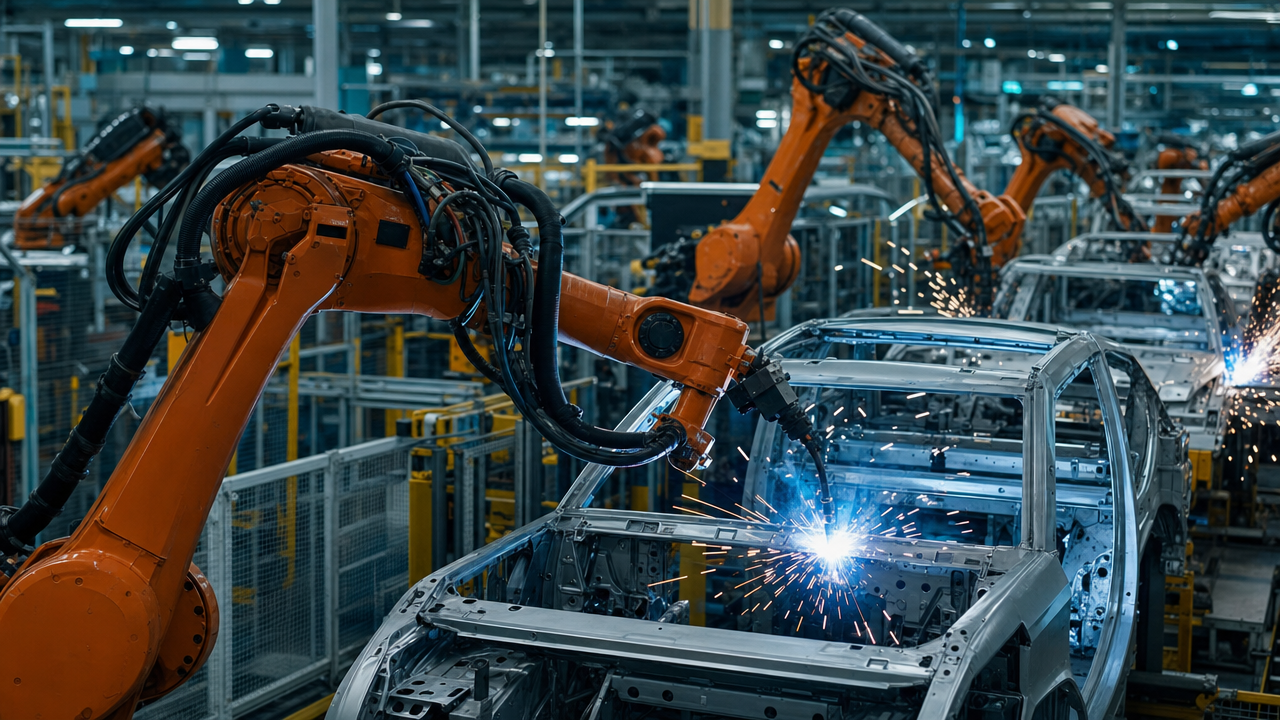
Welding robots are the most deeply penetrated segment, accounting for over 40% of China's installed industrial robot base. They divide into arc-welding (MIG/MAG/TIG) and spot-welding sub-categories: arc-welding robots require exceptional path accuracy (within ±0.1 mm) and are used for white-body seam welding and structural-part welding in construction machinery; spot-welding robots carry high payloads (over 100 kg) and run at fast cycle rates, primarily used on automotive final-assembly lines.
Assembly robots are used in 3C precision assembly and automotive drivetrain component assembly. These scenarios demand the highest repeatability (±0.01–0.02 mm) and typically require integration with vision systems and force-control sensors to achieve "compliant assembly." SCARA robots, with their high-speed planar pick-and-place characteristics, dominate 3C assembly.
Painting robots operate in toxic coating environments and must be explosion-proof; path planning must ensure uniform paint-film thickness. Automotive coating lines typically deploy 20–40 painting robots per line, where Fanuc and ABB hold dominant positions.
1.3 Classification by Structure: Six-Axis Articulated, SCARA, Delta, Cobots
Six-axis articulated robots are the most widely deployed configuration, accounting for over 60% of total installed base. Six rotational axes give the end-effector full six-degree-of-freedom positioning, suitable for the spatial complexity of welding, handling, and assembly. Typical payload range: 3–800 kg; repeatability: ±0.02–0.1 mm. The Big Four's flagship products all center on six-axis articulated robots.
SCARA robots (Selective Compliance Assembly Robot Arm) use two horizontal rotation axes plus one vertical linear axis; their horizontal rigidity and vertical compliance make them ideal for high-speed horizontal pick-and-place. Typical cycle rates: 60–120 picks/min; payload: 1–20 kg; repeatability: ±0.01 mm. Primary use: PCB assembly, smartphone-screen lamination, and other high-speed 3C operations.
Delta robots (parallel robots) suspend the end-effector downward from a fixed platform via three linkages, with an inverted-cone workspace. Their greatest advantage is extreme speed (over 150 picks/min), though payload is limited (typically 1–15 kg). Primarily used for high-speed sorting and case-packing in food/beverage and pharmaceutical packaging. ABB's IRB 360 (FlexPicker) is the archetypal Delta robot product.
Collaborative robots (cobots) are the fastest-growing sub-segment. Unlike traditional industrial robots, cobots incorporate safety collision-detection capability — via torque sensors or current feedback — enabling shared-workspace operation without safety fencing. Payload typically 3–25 kg; repeatability ±0.02–0.05 mm; price range approximately RMB 80,000–300,000. Universal Robots (UR) pioneered the cobot market; domestic Jaka, Han's Robot, and Luoshi are prominent players with fast overseas expansion.
1.4 Supply-Chain Overview: Upstream Three Core Components → Midstream Units → Downstream Applications
The industrial robot supply chain has three layers: from high-value-added components to unit manufacturing to system integration.
1.4.1 Upstream: Core Precision Components — Highest Value Concentration, Lowest Localization
Upstream core components consist of precision reducers, servo motors and drives, and controllers — together accounting for approximately 70% of robot unit cost, the most value-concentrated segment in the entire chain.
Precision reducers represent approximately 35% of unit cost, the highest single-item share. The global RV reducer market is dominated by Japan's Nabtesco and Sumitomo (~75%+ combined); the harmonic reducer market is dominated by Japan's Harmonic Drive (Nidec group, ~60–70%). Domestically, Landi Renzo Harmonic (688017) has broken through, holding approximately 30–35% of the domestic harmonic reducer market; RV reducer domestic progress lags, with Zhongjing Transmission and Zhuhai Feima Transmission among the leading domestic challengers.
Servo motors and drives account for approximately 20% of unit cost. High-end servos are dominated by Japanese brands (Yaskawa, Panasonic, Mitsubishi) and Siemens. Domestically, Inovance Technology holds a 27.6% share of the Chinese servo market (2024, domestic #1) — the most significant domestic breakthrough among the three core components.
Controllers (hardware + motion-control software) account for approximately 15% of unit cost and are the "brain" of the robot, governing motion-path planning, joint coordination, and sensor fusion. The Big Four all self-develop and self-supply controllers, treating core algorithms as their most critical competitive asset. Domestic controller localization is the lowest of the three components; Estun, Inovance, and Siasun are investing continuously in self-developed controllers.
1.4.2 Midstream: Unit Manufacturing — Core Battleground for Integrators and Brands
Midstream unit manufacturers assemble the three core components and structural parts into complete robots under their own brand, with value defined by technical-integration capability (reducer + servo + controller coordination tuning) and brand premium plus customer service networks.
China's robot unit market is approximately RMB 20–23 billion (2024), with moderate concentration. The Big Four dominate the high end; domestic brands led by Estun (002747), Inovance, Siasun, and Topstar are penetrating mid-to-low-end markets through price advantages and local service, and gradually breaking into automotive OEM supply chains.
1.4.3 Downstream: System Integration and End Applications — Most Fragmented, Highest Domestic Share
System integrators combine robot units with tooling, welding guns, vision systems, positioners, and conveyors into complete workstations or production lines, providing turnkey solutions to end clients. This layer has the largest number of enterprises (estimated 3,000+ integrators in China) and the most fragmented competitive landscape. End users are dominated by automotive (45%), 3C consumer electronics (20%), lithium-battery/solar (fast-growing), logistics warehousing (~5–8%), and other industries.
The value distribution along the robot supply chain follows a "smile curve": upstream core components and downstream brands/services earn the highest margins; midstream unit manufacturers earn relatively thin margins; system integrators typically achieve gross margins of 15–25%.
1.5 Historical Coordinates of China's Industrial Robot Industry
China's industrial robot industry started approximately 20 years behind Europe, the US, and Japan. The 1985 "Seventh Five-Year Plan" first listed industrial robots as a key science-and-technology project; China became the world's largest annual robot installation market in 2013; annual production first exceeded 300,000 units in 2021; domestic market share historically broke above 50% in 2024.
1.6a Robot Density International Comparison and China's Catch-Up Path
Robot density — industrial robots per 10,000 manufacturing workers — is the most important macro comparison metric in the industrial robot field. The international comparison directly reveals China's incremental headroom. In 2024: Korea ~1,012 units/10,000 workers (global #1); Singapore ~770; Germany ~429; Japan ~419; US ~295; China ~470 (global #4, surpassing Germany and Japan for the first time). China's robot density nearly doubled in four years (from ~246 in 2020 to ~470 in 2024) — the fastest growth of any major economy.
Within China, density is highly uneven. Eastern coastal provinces (Shanghai 620, Shenzhen ~500–600) approach Germany's level; central provinces (Henan, Hunan ~150–250) are in early catch-up; western provinces (50–100) remain at very low density. This internal imbalance means that incremental robot demand will increasingly come from central and western regions as manufacturing relocates inland.
1.6 Industrial Robots vs. Special-Purpose Robots vs. Service Robots: Boundary Definitions
This report follows ISO 8373:2021 and IFR classification standards, defining "industrial robots" as automated multi-axis manipulators for industrial automation applications (manufacturing, logistics), not including special-purpose robots (IFR counts separately) or service robots (separate IFR report). Humanoid robots are discussed as an "emerging industrial robot form" in Chapter 8, since their primary applications are industrial.
1.7 Cost Structure and Business Model
A typical six-axis industrial robot (20 kg rated payload, domestic brand) cost breakdown: precision reducers (35%), servo motors + drives (20%), controller (15%), structural parts (cast iron base + aluminum alloy arms, ~15%), end-effector + sensors (15%). Revenue models: unit sales (one-time, gross margin 25–45%), system integration services (project-based, gross margin 15–25%), and after-sales maintenance and spare parts (recurring, gross margin 40–60%). As the installed base scales, maintenance revenue's share is rising — a key driver of improving profit quality.
Chapter 2 Global Competitive Landscape and the Big Four
2.1 Global Industrial Robot Market Overview
Per IFR data, 2024 global industrial robot annual new installations were approximately 590,000 units, up approximately 5–7% YoY. China installed 295,000 units, accounting for 54% of global totals — its 12th consecutive year as the world's largest single market. Asia overall (China + Japan + Korea + Southeast Asia) accounts for approximately 73% of global installations; Europe ~15%; Americas ~12%.
The global industrial robot market was approximately USD 20–22 billion in 2024 (IFR body-sale scope), projected to reach approximately USD 35–40 billion by 2030 (CAGR ~8–9%). Drivers include: new EV production-line automation demand, consumer electronics flexible-manufacturing needs, lithium-battery and solar large-scale capacity expansion, and labor-cost increases in Southeast Asia.
At end-2024, global industrial robot accumulated installed base was approximately 4.7 million units, of which China's approximately 2.027 million units (~43% of global total). China's rapid installed-base growth means replacement cycles (8–10 year useful life) will generate an additional 30,000–50,000 units/year from 2026–2028 as the 2016–2018 cohort ages out.
2.2 The Big Four: Fanuc, ABB, KUKA, Yaskawa
The four firms' global CR4 is approximately 30%. In the high-end segment (automotive welding lines, precision assembly, coating), the Big Four hold over 60% combined share. Three competitive moats underpin their positions: motion-control algorithm databases (decades of production-line tuning data); deep binding with OEM engineering teams (in-plant technicians certified on specific foreign brands); and OEM procurement inertia ("default to Fanuc" in certain automakers). These soft moats do not erode simply because domestic products achieve comparable performance.
Fanuc (6954.T): Global industrial robot's largest single brand; FY2024 revenue approximately JPY 730 billion (~USD 5.0 billion); robot business ~25–30% of revenue; net margin consistently above 20%. Core moat: self-developed CNC and servo systems deeply integrated with robot controllers, accumulating decades of production-line validation data. China strategy: focus on automotive welding and machine-tool loading/unloading; avoid mid/low-end price wars.
ABB (ABBN.SW): Robotics & Discrete Automation division FY2024 revenue approximately USD 3.4 billion. Pioneer in cobots (YuMi dual-arm, GoFa). China strategy: heavy local R&D investment at Shanghai center; focus on food/beverage, electronics, automotive. Faces pressure from rising domestic cobot brands.
KUKA: HQ Augsburg, Germany; acquired by Midea Group (002759) in 2016 for approximately RMB 29.2 billion (~94.5% stake), delisted from Frankfurt in 2022. FY2024 revenue approximately EUR 3.9 billion (+3%). Local production in Shunde, Guangdong. The acquisition remains contested: Western automotive OEM procurement compliance scrutiny creates friction; but domestic Chinese OEM acceptance is improving.
Yaskawa (6506.T): FY2024 revenue approximately JPY 530 billion (~USD 3.6 billion); robot business ~30%. Unique moat: deep integration of servo systems (Sigma series, ~12–15% global servo share) with robot units. China strategy: capacity expansion at Suzhou plant; faster service-engineer coverage to counter domestic pricing competition.
2.3 Structural Pressure on the Big Four
From 2020 to 2024, the Big Four's combined China market share fell from approximately 70% to approximately 43%. Price gap (domestic units 30–50% cheaper than equivalent foreign models), service response speed advantage, and narrowing product differentiation are the three core pressures. The Big Four responded with selective price cuts of 15–25% on certain product lines in 2023–2024 — signaling willingness to sacrifice some margin for share. The key battleground is whether domestic brands can enter OEM-level welding lines within 2025–2028.
2.4 Global Regional Competitive Landscape Rebalancing
Japan (Fanuc, Yaskawa, EPSON, Kawasaki), Germany (KUKA ecosystem), and Switzerland (ABB) are the three traditional innovation centers; China (Estun, Inovance, Siasun), Korea (Hyundai Robotics), and Taiwan (TM Robot) are rising challengers. Chinese robot exports are growing significantly: Estun's Cloos acquisition in Germany, Jaka's Middle East and European penetration, and others. China's overseas brand-building capability will determine whether the global CR5/CR10 reshuffles in China's favor.
2.5 Humanoid Robots: The Next Global Competitive Dimension
In 2024, humanoid robots moved from R&D prototypes to small-batch trial production. Tesla's Optimus ran in an internal factory; Boston Dynamics' Atlas launched an electric-drive version; Figure AI and Agility Robotics obtained trial orders from BMW and Amazon respectively. In China, Unitree (H1/G1), Zhiyuan (Yuanzheng A1), and UBTech (9880.HK, Walker X/S) are the main players. The current relationship between humanoid robots and traditional industrial robots is "parallel tracks rather than direct substitution" — humanoid robots aim to handle unstructured tasks that fixed-arm robots cannot, not to replace highly optimized automotive welding lines.
2.6 Global Industrial Robot M&A History and Future Outlook
The Big Four's current positions were shaped by decades of M&A and consolidation. ABB formed through the ASEA–BBC merger; KUKA went through multiple ownership changes culminating in Midea's acquisition; Harmonic Drive was acquired by Nidec in 2022 — the most significant precision component M&A transaction in the industry.
Future M&A directions: Chinese enterprises continuing to acquire European brand/channel/technology assets (mid-sized specialist European cobots); humanoid robot industry consolidation as capital-intensive startups face commercialization tests in 2027–2028; and upstream component integration (RV reducer breakthroughs attracting strategic investment from integrators like Inovance and Estun).
Chapter 3 PEST Environmental Analysis
3.1 Political: From Planning Support to Humanoid Robot Initiatives
China's industrial robot sector is among the most consistently and forcefully supported advanced manufacturing segments in national policy. The policy role extends beyond fiscal subsidies to encompass top-level planning, key-product breakthrough catalogs, industrial park construction, and demand-side incentive design.
The "14th Five-Year Plan for Robotics Industry Development" (2021) set 2025 targets: substantially increased domestic robot market share; robot density doubled vs. 2020; breakthroughs in key core components; 3–5 global-leading enterprises cultivated. By 2024's results, the 57% domestic share has largely delivered on "substantial improvement"; the density (~470/10,000 workers) nearly doubled from 2020's ~246 — closely on target.
The "Guiding Opinions on Innovative Development of Humanoid Robots" (MIIT, 2023) set two key milestones: 2025 — key technology breakthroughs achieved, small-batch production capability formed; 2027 — scale production capability formed, batch deployment in industrial, service, and special scenarios. This policy document has strongly stimulated capital-market investment in humanoid robot directions.
"Machine Substitution" policies at the provincial/municipal level directly stimulate robot installations: Guangdong, Zhejiang, and Shanghai subsidize purchase at 10–30% of equipment cost, effectively lowering the payback threshold for SME automation.
Export controls and technology restrictions are the counter-variable: US and EU export restrictions on China related to high-end robot control systems and high-precision reducer processing equipment continue to tighten, accelerating domestic substitution urgency while maintaining some near-term dependency on Nabtesco RV reducers.
3.2 Economic: EV Electrification, 3C Replacement, Lithium-Battery/Solar Stacking
Automotive (45% of installations): EV electrification is a double-edged variable — battery module assembly, motor winding, and connector assembly generate substantial new robot demand; but removing 300–500 traditional machined components (engine, transmission) reduces some welding/machining demand. Net impact: stable growth at ~5–8% through 2026. **3C consumer electronics (20%):** iPhone 16 and Huawei foldables drove second-half 2024 recovery; AI glasses and AR/VR headsets add new incremental demand from 2026 onward. Lithium-battery/solar (cyclical): Peak expansion in 2022–2023 drove >30% YoY robot demand; 2024 saw demand pullback as overcapacity hit; recovery expected with storage capacity utilization improvement post-2026. Labor cost escalation: Manufacturing worker wages rose from RMB 21,000/year in 2010 to ~RMB 75,000/year in 2024 (8% annually), far outpacing robot price declines (~5–10%). Payback periods for collaborative robots compressed from ~4–5 years in 2015 to ~1.5–2 years in 2024 — the fundamental economic case for SME automation.
3.3 Social: Engineer Dividend, Aging Pressure, Workforce Skill Transition
China's approximately 5 million annual engineering graduates (world's most) provide abundant R&D talent for robot enterprises at a fraction of Japanese or German cost — the hidden competitive advantage enabling continuous domestic control-system iteration. Manufacturing workforce aging accelerates: 60+ population reached ~21% in 2024; frontline worker recruitment in electronics assembly and welding grows increasingly difficult, expanding demand for cobots and automated production lines. Workforce skill transition: robot deployment displaces simple repetitive work while generating robot-operator, maintenance-engineer, and vision-annotation roles. "Robot Application Engineer" is becoming a popular vocational-college major.
3.4 Technology: AI+Vision+Force-Control+Humanoid — Four Dimensions
AI vision integration is the most prominent technical trend since 2022: 2D→3D point-cloud recognition enables "bin picking" (random-heap workpiece grasping). Force-control technology is expanding from cobots to industrial robots, enabling compliant assembly. EtherCAT and OPC UA standardization is driving digitally integrated production lines. Digital twins and simulation (ABB RobotStudio, Fanuc ROBOGUIDE) compress line commissioning from 2–6 months to 2–4 weeks. Humanoid robot technology sits in six dimensions: dexterous hands, bipedal balance control, edge-inference chips (NVIDIA Orin), high-power-density motors, multi-sensor fusion, and embodied intelligence (VLA models).
3.5 Policy Details: Tax Incentives and Localization Requirements
Three forms of fiscal incentive for domestic robot purchases: (1) equipment-purchase subsidies (8–30% of purchase price at provincial level); (2) R&D expense super-deduction (100% add-back for eligible SMEs); (3) high-tech enterprise preferential tax rate (15% vs. standard 25%). Subsidy-cliff effects appear after subsidy phase-out (as seen in lithium/solar equipment in 2023–2024); R&D deduction and HTE preferential rates provide more durable policy tailwinds. State-sensitive sectors (nuclear, defense) explicitly require domestic-brand robots.
3.6 Technical Standards and Certification Competition
IEC/ISO robot safety standards (ISO 10218 series) and cobot technical specifications (ISO TS 15066) are internationally recognized. China is progressively aligning GB standards with ISO/IEC, reducing the incremental cost of CE certification for export-oriented domestic brands. China's influence in standards-setting — from participant to contributor — follows its growing role as the world's largest robot market and manufacturer.
3.7 Macro Cycle Characteristics
Industrial robots are more sensitive to manufacturing capex cycles than consumer goods or software. Three notable slowdowns in China's robot sector in the last decade: 2015–2016 (3C cycle), 2018–2019 (US-China trade friction, auto weakness), 2022–2023 (lithium/solar peak). Post-downturn recovery typically takes 1–2 years. PMI transitions from contraction to early expansion, plus auto/3C unit-sales data turning positive on a sequential basis, are the most reliable leading indicators for robot sector timing.
3.8 Digitalization Synergy
MIIT's "Smart Manufacturing Demonstration Factory" program has made robot deployment rate, production-line connectivity, and digital-twin adoption core evaluation metrics, directly pushing large/mid-sized manufacturers to upgrade from single robots to networked automation nodes. This trend raises per-robot sale value (integrated OPC UA interfaces, offline simulation licenses, maintenance contracts) and customer stickiness — a key reason gross margins have held up relatively well despite intensifying price competition.
Chapter 4 China Market Scale and Operations
4.1 2024: Three Historic Milestones
2024 was a defining year for China's industrial robot sector, marked by three milestones.
First: China's industrial robot production reached 556,400 units, up +14.2% YoY — the all-time peak for any single country in a single year. Second: China's new robot installations were approximately 295,000 units, accounting for 54% of global total — the 12th consecutive year as the world's single largest market. Third: domestic-brand market share reached approximately 57% for the first time — the first time in recorded history that domestic brands commanded a majority of China's robot market. From 30% in 2020 to 57% in 2024 in four years; from 24% in 2013 to 57% in 2024 — a structurally transformative trajectory.
4.2 Production Structure: 556,400 Units Broken Down
By product type: six-axis articulated 60–65%; SCARA ~15–18%; cobots ~10–15%; Delta and others ~5–8%. Cobot production growth (25–30%) outpaces the overall market. By entity: domestic-capital enterprises 60%; foreign-funded in-China plants (Fanuc Shanghai, ABB China, KUKA Shunde, Yaskawa Suzhou) ~40%. Foreign in-China production counted in China's output statistics but still branded as foreign — pure volume metrics overstate actual domestic technological competitiveness. By price tier: below RMB 100K (35% of units); RMB 100–250K (45%); above RMB 250K (20%). The concentration in mid/low-end price bands reflects the market's prevailing competitive dynamic.
4.3 Installation Distribution by Downstream Industry
- Automotive (~45%, ~133,000 units): new-energy vehicle line new installations account for approximately 30% of the automotive total and are growing faster than conventional vehicles. A line producing 200,000 EVs/year typically requires 400–600 industrial robots.
- 3C consumer electronics (~20%, ~59,000 units): iPhone 16 and Huawei foldable-display launches drove visible H2 2024 SCARA order recovery.
- Lithium-battery/solar (
10%, ~30,000 units): 2024 YoY decline vs. 2023 peak (40,000 units) as lithium industry de-capacitizes. - Metal fabrication/welding (~8%, ~24,000 units): arc-welding robots; clients include construction machinery, shipbuilding, and steel structures.
- Food/pharma/chemical/logistics (~8–10%): fastest-growth segment; cobots and AGV/AMR penetrating rapidly.
- Other (~7–9%): semiconductor, medtech, aerospace — small volume but highest per-unit value.
4.4 The 57% Domestic Share: Structural Nuance
The 57% aggregate domestic share is a volume figure masking structural stratification. Within automotive OEM plants: foreign brands (Fanuc, Yaskawa) still hold ~65–70%; within automotive Tier1/Tier2: domestic brands at ~40–50% and rising fastest; in 3C, metal fabrication, and logistics: domestic brands above 60%, some above 75%. The 57% was largely accumulated in non-OEM and non-automotive-core scenarios. Measured by sales value rather than unit count, foreign brands still account for ~50–55% of the market — domestic brands need to close the value-per-unit gap.
4.5 Installed Base: 2.027 Million Units and Robot Density
At year-end 2024, China's accumulated installed base was approximately 2.027 million units (43% of the global 4.7-million-unit total). Robot density: approximately 470 units/10,000 manufacturing workers, surpassing Germany and Japan for the first time (global #4). The gap to Korea (1,012) signals substantial remaining room for growth; central/western province density (<200) represents the largest medium-term incremental opportunity.
4.6 Pricing Trend and Profit Structure
Six-axis general-purpose robots (20 kg payload): domestic brand ASP approximately RMB 100,000–150,000; foreign brands approximately RMB 200,000–350,000. Cobots: domestic ~RMB 80,000–150,000; UR ~RMB 200,000–300,000. Price declines are driven by scale efficiencies, domestic component cost reduction (Landi Renzo Harmonic, Inovance servo pricing), and market-share competition. Domestic listed robot companies' gross margins compressed from ~30–35% in 2021 to ~22–28% in 2024, below foreign brands' ~40–50%. Estun's vertical-integration strategy, Inovance's multi-product synergy, Siasun's premium custom positioning, and Topstar's regional depth represent four distinct margin-improvement paths.
4.7 Market-Scale Definition and Scope
Unit (body-only) scope: approximately RMB 20–23 billion (2024). Systems-integration scope: approximately RMB 40–45 billion. Full supply-chain scope (components + units + integration + services): approximately RMB 56–60 billion. This report cites the unit scope unless otherwise stated, consistent with IFR global methodology. Cross-report discrepancies of RMB 20 billion to RMB 60 billion for "China's robot market" typically reflect different scope definitions rather than data disputes.
4.8a Trade: Approaching Net-Export Balance
2024: China exported approximately 150,000–180,000 robots (mainly cobots and SCARA); imported approximately 100,000–130,000 (mainly high-end foreign branded units). Export destinations: Southeast Asia (30–35%), Middle East (12–15%), Europe (10%). Import origins: Japan (55–60%), Germany (15%), Switzerland (10%). The emergence of net exports in some categories mirrors China's trajectories in lithium batteries, solar panels, and now robots — first becoming the world's largest market, then the world's largest manufacturer, and then building export competitiveness.
4.8 Industry Concentration and Competitive Structure
China's industrial robot unit market CR5 is approximately 55–60%, CR10 approximately 70–75% — moderately concentrated. From 2020 to 2024, foreign brands' CR5 representation dropped from four seats to three (Fanuc, ABB, Yaskawa maintained top positions; KUKA slipped modestly); Estun entered the top five domestically, and Inovance's robot segment entered the top ten. By 2030, industry CR5 is projected to rise to 65–70% as the competitive consolidation phase progresses.
Chapter 5 Supply-Chain Deep Dive: The Three Core Components
5.1 Precision Reducers: Highest Value, Steepest Barrier
Precision reducers account for approximately 35% of robot unit cost — the highest single-item share. Robot-grade reducers must achieve: high reduction ratios (1:50–1:160), near-zero backlash (arc-second level), high input speeds (3,000–6,000 rpm), and service life exceeding 10,000 hours in continuous operation — a combinatorial precision challenge that places reducer manufacturing among the highest-barrier activities in the global precision machinery industry.
5.1.1 RV Reducers: Nabtesco's Moat and Domestic Pursuit
RV reducers dominate the large-joint applications (waist, upper arm). Nabtesco + Sumitomo command approximately 75%+ of global share. Domestically: Zhongjing Transmission, Zhuhai Feima Transmission, and Shuanghuan Transmission (002472) are the main challengers. Current domestic RV reducers are technically viable (~85–90% of mid-tier Nabtesco performance) but face a 12–18 month OEM validation cycle before qualifying on automotive lines. Domestic RV reducer market share in China is approximately 20–25%, primarily serving domestic mid-to-low-end robot lines. The path to broader penetration runs through "domestic robot volume scale → workload data accumulation → reliability validation."
5.1.2 Harmonic Reducers: Landi Renzo's Breakthrough
Harmonic reducers dominate small-joint, lightweight applications (wrist, forearm). Globally, Harmonic Drive AG (Nidec) holds approximately 60–70% market share. Domestically, Landi Renzo Harmonic (688017) is the standout case: founded in 2011, IPO on STAR Market in 2020, 2024 revenue approximately RMB 80–100 million, domestic market share approximately 30–35%. Price advantage: approximately 40–60% below Harmonic Drive equivalents. The next challenge: developing high-precision versions for collaborative robots (lower backlash, smaller dimensions) where Harmonic Drive still leads.
5.1.3 Domestic Reducer Commercialization Challenges
Three hurdles: (1) precision machining equipment (five-axis gear grinders, precision grinding machines) largely imported; (2) validation cycle length (OEM lines require 1–2 years durability testing); (3) batch consistency control. These constraints make domestic reducer breakthrough a 5–10 year continuous-accumulation process, not a one-time engineering event.
5.2 Servo Motors and Drives: Inovance's Domestic Breakthrough
Servo systems represent approximately 20% of robot unit cost — and the segment with the clearest domestic breakthrough. The global servo market is dominated by Japanese brands (Yaskawa Sigma, Panasonic A6, Mitsubishi MR-J5) and Siemens (~45–50% combined). Inovance Technology (300124) holds 27.6% of China's industrial servo market (2024, domestic #1) — the only domestic brand to surpass any single Japanese brand. Inovance's path: entered from low-voltage VFDs (2003) → servo (2010s) → robot units (2020s), leveraging 100,000+ manufacturing-client network and cross-product bundling. Risk: robot hardware remains a relatively small share of Inovance's total revenue; maintaining growth in a price-competitive mid-to-low-end market requires discipline.
5.3 Controllers: Lowest Domestic Localization, Thickest Barrier
Controllers (hardware + motion control software) represent approximately 15% of unit cost — the lowest-localized component, with the thickest barriers. The Big Four all self-develop and self-supply controllers; core algorithms — decades of kinematic/dynamic optimization plus production-line tuning libraries — are non-licensable black-box assets. Domestic controller leaders: Estun (100% self-developed, tightest supply-chain integration), Inovance (leveraging VFD/servo motion control expertise), and Siasun (CAS Shenyang Automation Institute technical lineage). The fundamental challenge: controller algorithm reliability is built from production-line data, not R&D investment alone. Domestic brands need to run more lines, accumulate more data, and iterate more cycles — an unavoidably time-dependent process.
5.4 Sensors: Vision and Force-Control Ecosystem
Machine vision (Hikrobot MVS, Dahua, Basler for cameras; Mech-Mind, OPT for 3D guidance) is the robot's "eyes." Force/torque sensors (ATI globally; Yuli Instruments domestically) are essential for force-control cobots. Cobot market growth is driving sensor demand and price declines (six-axis F/T sensors fell from ~RMB 20,000–30,000/set in 2019 to ~RMB 8,000–15,000/set in 2024). Domestic localization projections to 2027: servo motors 35%→50%; harmonic reducers 35%→50%; RV reducers 22%→35%; controllers 30%→45%.
5.5 Three-Component Supply Chain: Strategic Competition
Foreign supplier defense: tiered pricing (strategic customers get preferential pricing and priority supply); technology generational leapfrogging (Nabtesco continuously launches higher-precision, lighter next-generation RVs); and deep OEM binding via long-term supply agreements and joint-development programs. Domestic supplier attack: price leadership (40–60% below foreign equivalents); scale validation (accumulating reliability data through volume); strategic co-development with domestic integrators (Landi Renzo + Estun model). The pivot variable: whether top-tier OEM integrators proactively introduce domestic second-source suppliers. In 2024, some foreign integrators (ABB, Yaskawa) began small-batch testing of domestic harmonic reducers — the most important industry signal to monitor.
5.6 New Components: Motor-Drive Integration and Dexterous-Hand Joint Modules
The collaborative robot and humanoid robot boom is driving "joint module integration" — combining motor, reducer, driver, encoder, and temperature sensor in a single compact module with standardized EtherCAT output. This modular paradigm has lower barriers for new entrants and represents the fastest-evolving area of robot supply-chain domestication. Unitree self-develops high-power-density joint modules; Zhiyuan self-develops dexterous-hand modules; Dazhe Electric Motor is entering the drive-integration motor space. Joint module integration may redefine the robot supply-chain landscape by 2028–2030, with impact extending far beyond the traditional three-component boundaries.
5.7 Financial Characteristics by Supply-Chain Layer
Harmonic reducers (Landi Renzo): gross margin ~50–60%; R&D intensity ~8–12%; capital-intensive (precision gear grinding equipment); ROE ~15–20% — highest among robot supply-chain layers, consistent with the "smile curve" premium for high-barrier core components. Servo motors (Inovance servo segment): gross margin ~35–45%; strong scale economies (doubling production cuts cost by ~20–30%); total company ROE ~20–25% — among the best in industrial automation globally, driven by asset-light + brand premium + network effect. Robot units (Estun): gross margin ~28–35%; R&D ~8–10%; ROE ~8–12% — lower than components, reflecting intense competition and higher capex relative to revenue. System integrators (North China Engineering): gross margin ~18–25%; highly cyclical with automotive capex; net margin ~5–8%; ROE ~8–12%; long receivables cycles (OEM payment terms 6–9 months). Ranking by profit quality: harmonic reducers > servo motors > robot units > system integrators — fully consistent with the supply-chain "smile curve."
Chapter 6 Competitive Landscape and Key Companies
6.1 Domestic Tier: Estun-Led Multi-Strong Structure
6.1.1 Estun (002747): Full-Chain Self-Development Leader
Founded 1993, HQ Nanjing; one of the few domestic enterprises achieving full self-development of reducers + servos + controllers; highest domestic-brand market share in six-axis robot units (~10–12%). Business: robot units + motion-control systems (servo drives) + welding-robot systems (including acquired German Cloos). Key advantage: self-developed servo drives provide ~15–20% cost advantage vs. domestic peers sourcing foreign three-components. 2024 revenue approximately RMB 28–30 billion (robot segment dominant); gross margin ~28–32%; R&D rate ~8–10%.
6.1.2 Inovance Technology (300124): Servo-Driven Robot Expansion
HQ Suzhou; largest market cap/revenue industrial automation company in China; core strength in servo motors and VFDs. Servo domestic market share 27.6% (2024, domestic #1). Robot business revenue 2024 approximately RMB 15–20 billion, covering six-axis (3–50 kg), SCARA, and cobots (Jite series). Key advantage: 100,000+ manufacturing-client cross-sell leverage and internal servo cost synergy. Main risk: robot business still a relatively small share of total revenue; must maintain growth pace in a hyper-competitive market.
6.1.3 Siasun (300024): State-Backed Premium Custom
CAS Shenyang Automation Institute spinout; state-enterprise background providing irreplaceable credibility in policy-sensitive markets (nuclear, defense) and automotive OEMs (FAW, Dongfeng). Product matrix: industrial robots (six-axis, cobots) + AGV/AMR + cleanroom robots (semiconductor, pharma). AGV/AMR segment is Siasun's strongest: domestic market share ~12–15%, most stable revenue. 2024 revenue approximately RMB 16–18 billion; semiconductor cleanroom robots (CSMG, SMIC) are the key margin-improvement lever.
6.1.4 Topstar (300607): South China 3C System Integrator
HQ Guangzhou; automation integrator covering robot units + injection-molding automation + CNC automation. 2024 revenue approximately RMB 50–55 billion; robot unit business ~20–25% of revenue. Core clientele: South China 3C (Foxconn supply chain, plastics parts manufacturers) and automotive Tier1/Tier2.
6.1.5 HCNC (300161), JASIC (002444), North China Engineering (688218), Landi Renzo Harmonic (688017)
Huazhong CNC: motion-control algorithm expertise (9th-generation AI CNC) transferable to robot controllers; robot revenue ~RMB 2–3 billion. JASIC: acquired Swiss Kassow Robots (2021), 7-axis cobot; robot business ~RMB 2–3 billion. North China Engineering (688218): welding-robot system integrator, not unit maker; 2024 revenue ~RMB 9–11 billion; gross margin ~20–25%; automotive OEM/Tier1 deep binding. Landi Renzo Harmonic (688017): harmonic reducer pure play; 2024 revenue ~RMB 80–100 million; domestic market share ~30–35%.
6.2 Noteworthy Unlisted Companies
Jaka Robotics: domestic cobot leader; 3–30 kg payload range; Middle East and Europe overseas penetration most active; valuation ~RMB 5 billion; closest to IPO among unlisted cobots. Unitree Robotics: four-legged robot pioneer scaling to humanoid (H1/G1); G1 priced at ~RMB 99,000 (the industry's lowest entry price); strategy — use four-legged supply-chain cost discipline to build humanoid price leadership. Han's Robot (Han's Laser 002008 subsidiary): deep 3C consumer-electronics channel access. Dobot: cobot and SCARA specialist with aggressive pricing and active Southeast Asia/Middle East overseas expansion.
6.3 Foreign Brands in China: Defending the High End
Fanuc China: focus on automotive welding and machine-tool tending; no price war in mid/low end; 2024 China revenue ~15–20% of Fanuc global. ABB China: localized R&D at Shanghai; cobots + food/beverage + automotive; 2024 growth slowed but high-end manufacturing customers stable. KUKA Shunde: local factory providing ~10–15% cost advantage vs. Germany-imported; China-brand OEM (BYD, GAC, Geely) acceptance improving. Yaskawa Suzhou: capacity expansion for faster delivery; local service-engineer coverage to close response-speed gap.
6.4 Key Competitive Metrics: Domestic vs. Foreign Quantified
Repeatability: Fanuc LR Mate/Yaskawa GP: ±0.01–0.02 mm; domestic Estun ER/Inovance IR: ±0.02–0.04 mm — a gap meaningful in precision assembly but not in welding or palletizing. MTBF: foreign ~70,000–100,000 hours (empirically validated); domestic ~30,000–50,000 hours (specification, accumulating validation). Max payload: foreign (ABB M-2000, Fanuc M-900, KUKA QUANTEC) up to 800–2,300 kg; domestic mainly 3–300 kg — heavy-load (>300 kg) domestic localization rate <5%. Software ecosystem: foreign brands' dedicated programming languages (FANUC KAREL, Yaskawa Inform, ABB RAPID, KUKA KRL) + rich application packages (welding, painting, assembly packages); domestic software completeness still developing.
6.5 Competitive-Landscape Upstream Feedback Effects
As domestic brands rose from 30% to 57% share, upstream domestic component suppliers (Landi Renzo Harmonic, Inovance servo) benefited enormously — Landi Renzo's revenue grew from ~RMB 40 million in 2020 to ~RMB 80–100 million in 2024, tracking domestic robot share gains closely. This positive loop (domestic integrator growth → domestic component volume → domestic component cost reduction → domestic integrator price competitiveness) has structural durability but will face a ceiling effect as domestic share approaches 65–70%. More importantly: foreign robot OEMs are beginning to evaluate domestic second-source suppliers for supply-chain diversification. "Foreign OEM + domestic components" is the most exciting incremental scenario for upstream component suppliers and would drive domestic localization beyond what domestic integrator growth alone can deliver.
Chapter 7 Industrial Belt Geography and Factory-Identification Landscape
7.1 Overview of China's Industrial Robot Industrial Belts
China's industrial robot unit manufacturing and system integration clusters concentrate in: East China (Yangtze River Delta — Jiangsu, Shanghai), South China (Guangdong), North China (Beijing, Tianjin), and Northeast China (Shenyang, Liaoning). Nationwide, over 3,000 robot unit and key-component enterprises, plus over 3,000 system integrators — total supply-chain participants approximately 6,000–8,000.
7.2 Shenyang (Northeast): Siasun + CAS Ecosystem Origin
Shenyang is China's historical industrial robot industry origin. CAS Shenyang Automation Institute (founded 1958) — China's first robot research institution — incubated Siasun (founded 2000), China's "first commercial industrial robot brand." The Shenyang cluster's unique feature: a "research institution + system integrators + application factories" ecosystem, with special strengths in automotive welding and semiconductor cleanroom robots. The Shenyang Robot and Intelligent Manufacturing Innovation Demonstration Zone continues expanding, cultivating specialized/innovative SMEs in AGV/AMR and cobot local-application ecosystems.
7.3 Shanghai: Foreign-Brand Production Center
Fanuc Shanghai (JV with SAIC, Fanuc 60% stake) is Fanuc's primary China local-production node; ABB's China Robotics HQ is in Shanghai; KUKA (Shanghai) and 500+ system integrators cluster in Songjiang and Jiading districts. The Shanghai cluster is characterized by "foreign-brand domination + local system integrator support." Adjacent Suzhou/Kunshan electronics and automotive downstream base drives sustained high-quality robot demand.
7.4 Guangdong (Pearl River Delta): Cobots + System Integration Cluster
Guangdong is one of China's highest robot-density provinces. Topstar (Guangzhou), Dobot (Shenzhen), Han's Robot (Shenzhen), and Jaka (deep Guangdong presence) represent domestic unit and cobot leaders. KUKA's Shunde factory is the cluster's landmark foreign-brand localization project. Key demand drivers: South China 3C consumer electronics (global largest contract manufacturing cluster) and automotive (GAC, BYD Guangdong plants). Cobot penetration is fastest here: 3C line changeover cycles of 12–18 months give cobots a decisive flexible-manufacturing advantage.
7.5 Jiangsu (Nanjing + Suzhou): The Domestic "Three-Party Triangle"
Jiangsu is the strongest integrated domestic robot industrial belt. Nanjing center: Estun (unit manufacturing) + Landi Renzo Harmonic (harmonic reducers) + Nanjing GAEA (ballscrews/guideways). Suzhou center: Inovance Technology (servo systems) + Yaskawa Suzhou (robot production) + Yiweis CNC (precision components). The Jiangsu belt's distinctive feature: "upstream three components + midstream units + downstream auto/3C" full-chain in-situ coordination. Estun's cost competitiveness is significantly enabled by this local-cluster synergy.
7.6 Factory Identification Challenge: Who Is Actually Using Robots
Industrial robot industry's "who is actually producing" is a surprisingly difficult question to answer. Unit makers, component suppliers, and system integrators often register under nearly identical business names ("technology/automation/machinery limited"). More critically for robot sales teams: the downstream application factories — automotive welding plants, 3C assembly factories, lithium-battery warehousing lines, solar-panel factories — are the industry's most important potential customers, but they don't self-identify their robot count, expansion plans, or upgrade needs. For robot OEM sales teams, finding factories that are "actually in production, of meaningful scale, and automation-ready for upgrading" is the first hurdle in downstream customer development.
TianxiaGongchang covers approximately 480 million verified active factories and uses multi-dimensional factory identification mechanisms (business registration, production-activity signals, product-category tagging) to screen out automotive welding plants, 3C assembly factories, lithium-battery warehousing lines, and solar-panel factories — enabling robot sales teams to avoid high-volume ineffective outreach from day one. For core component suppliers (reducer, servo, vision-sensor companies), finding small/medium system integrators that are actively using domestic brands and have re-purchase or expansion needs is equally a data-driven exercise.
7.7 Geographic Evolution Trends
Western/central industrial belt fill-in: manufacturing cost-driven relocation to Chongqing, Sichuan, Hubei, and Hunan is pulling robot application demand inland. Chengdu (Smart Robot Industrial Park), Wuhan (HCNC + Dongfeng auto supply chain), and Changsha are emerging system-integration clusters. Overseas supply-chain establishment: Estun (Cloos channel in Europe), Jaka (Middle East/Southeast Asia), Landi Renzo Harmonic (export to Japan/Europe) are exploring global extension of China's production capability. Vietnam Samsung factories are piloting domestic SCARA robots; India automotive (Suzuki, Tata) has Estun trial installations.
7.8 System Integrators: Most Numerous, Most Fragmented
System integrators bridge robot units and end-application scenarios, providing end-effector design, sensor integration, safety-system design, line commissioning, and personnel training. Their value often equals or exceeds the robot unit itself. 3,000+ integrators in China; industry CR10 ~15–20%. Future consolidation: standardized modules (unit + standard end-effector + standard vision guidance) are commoditizing low-value "assembly-style" integrators; specialists with deep process knowledge and long-term customer binding will grow through M&A. Listed integrators — North China Engineering (688218), Reison Technology (688090), and Yuanda Intelligence — are consolidation beneficiaries.
7.9 Robot Density by Industrial Belt
Long River Delta (Jiangsu 550, Shanghai ~620, Zhejiang ~480 units/10,000 workers): highest density, driven by automotive (SAIC, GM Shanghai), 3C (Kunshan electronics cluster), and semiconductor (SMIC, HHG). Pearl River Delta (Guangdong ~400–450): largest single-province robot market (22% of national total), with the fastest cobot penetration. Northeast/Shenyang (250–300): below national average but strong in automotive (FAW Northeast) and semiconductor cleanroom. Beijing-Tianjin-Hebei (200–280): automotive (BBAC, Beijing Hyundai) and aerospace; highest-density foreign-brand share. Central-Western (Chongqing, Chengdu, Wuhan ~150–220): fastest-growing density catch-up; most certain medium-term incremental growth opportunity.
Chapter 8 Sub-Market Profiles
8.1 Automotive: Largest Downstream; Welding + Handling + Assembly Three-Track
Automotive is industrial robots' single largest downstream, approximately 45% of China's new installations. Key demand segments: welding (55% of auto robots): spot-welding (100–400 kg payload, Fanuc/Yaskawa dominant) and arc-welding (±0.1 mm path accuracy, Estun/Cloos/Inovance breakthrough territory); handling (25%): stamping-part inter-station transfer (100–600 kg, 30–60 robots per stamping-welding line); assembly (~20%): engine/transmission precision assembly (Fanuc/Yaskawa dominant, but EV motor winding/connector assembly opening domestic entry points).
EV electrification is a structural resetter: each EV production line eliminates 300–500 machined parts but adds battery-module assembly, motor-winding, and high-voltage connector assembly. A 200,000-unit/year EV line typically needs 400–600 industrial robots — comparable to an equivalent conventional-vehicle line. Gigacasting (6,000–9,000-ton presses at Tesla, NIO, etc.) reduces some spot-welding need (40–50 spot joints/vehicle eliminated) but adds de-flashing robots and large-part handling robots.
OEM vs. Tier1/Tier2 comparison: OEM plants (single-plant 300–800 units, decision cycle 12–24 months, MTBF requirements extreme, Fanuc/Yaskawa/ABB dominant) vs. Tier1/Tier2 (single-plant 20–200 units, decision cycle 3–6 months, domestic share already >50%, price+service the key decision factor).
8.2 3C Consumer Electronics: SCARA Main Stage, Cobots Accelerating
3C (~20% of installations): SCARA dominant (80–120 picks/min, ±0.01 mm repeatability) for PCB placement, screen lamination, connector insertion. Delta robots for high-speed sorting (TWS earbuds, small component sorting). Cobots rapidly penetrating: 3C product changeover cycles of 12–18 months favor drag-teaching and fast-retool cobots over traditional fixed-arm robots; domestic cobots (Jaka, Han's Robot, Dobot) have been the single largest 3C incremental growth driver since 2022.
8.3 Lithium-Battery and Solar: Expansion Cycle and De-Capacity Double Wave
A 10-GWh lithium-battery line uses approximately 300–500 industrial robots + 100–200 AGVs. 2022–2023 expansion peak drove >30% YoY robot demand; 2024 demand declined with lithium overcapacity and new-line reduction. Solar demand follows a similar cyclical pattern. Long-term direction remains positive (global storage targets), but requires discipline on customer concentration and capacity flexibility.
8.4 Logistics Warehousing: AGV/AMR Fast Penetration
Logistics warehousing: approximately 5–8% of installations, growing ~25–30% YoY — the fastest sub-segment growth rate. AMR (SLAM-based autonomous path planning) replacing AGV (fixed-path). JD Logistics, SF Express, Cainiao large-scale AMR deployments are the defining use cases of 2020–2024. Siasun (AGV/AMR domestic #1), Hikrobot (Hikvision subsidiary, vision advantage), and Quicktron (e-commerce AMR focus) lead domestically. Domestic brands hold approximately 75–80% domestic market share in AGV/AMR — above the overall robot market average — due to stronger local software-scheduling and service-response advantages.
8.5 Humanoid Robots: Largest Upside, Largest Uncertainty
Tesla Optimus running in internal Tesla factory; Boston Dynamics Atlas (electric version); Figure AI and Agility Robotics with BMW/Amazon trial orders. China: Unitree (H1/G1, valuation ~RMB 10 billion), Zhiyuan (Yuanzheng A1), UBTech (9880.HK, Walker X/S, revenue ~HKD 1.0–1.2 billion, loss-making).
Three commercialization barriers: cost (current ~RMB 1–3 million/unit vs. six-axis robot ~RMB 150,000–400,000 — a 5–20x gap); reliability (industrial lines require MTBF >5,000–8,000 hours; humanoid robots well below that today); task generality (VLA models improving but still failing frequently on industrial-environment variability).
2030 reasonable scenario: pre-2028, primarily pilot deployments (factory material handling, warehouse picking, limited assembly) — global annual volumes ~10,000–50,000 units; 2028–2030, if cost compresses to RMB 300,000–500,000 (optimistic), scale substitution begins in structured industrial scenarios.
8.5.2 Humanoid Robot Supply Chain: Highest Domestic Localization Among New Sub-Segments
Unlike traditional industrial robots (three core components heavily foreign-dependent), humanoid robot supply chains have unusually high domestic localization — not because domestic firms are more capable, but because the primary suppliers (high-power-density motors, dexterous hands, edge-inference chips) are new industries without established foreign monopolies. China's scale in motor manufacturing and the rapid progress of domestic chip design give it a structural upstream advantage in humanoid robot supply chains. This means humanoid robot unit cost reduction will be faster than traditional industrial robots (which are constrained by foreign reducer pricing) — the commercialization inflection may arrive earlier than consensus expects.
8.6 Sub-Market Comparison Table
| Sub-Segment | 2024 Share | Main Robots | Domestic Share | 2024 Growth |
|---|---|---|---|---|
| Automotive (incl. NEV) | ~45% | Six-axis heavy | ~40% OEM / 55% Tier1+2 | ~8% |
| 3C Consumer Electronics | ~20% | SCARA / Six-axis light | ~55% | ~12% |
| Lithium-battery / Solar | ~10% | Six-axis / AGV | ~70% | ~-10% (de-cap) |
| Metal Fab / Welding | ~8% | Six-axis arc-weld | ~60% | ~5% |
| Logistics Warehousing (AGV/AMR) | ~7% | AMR / AGV | ~75% | ~28% |
| Food / Pharma / Chemical | ~5% | Cobot / Delta | ~50% | ~15% |
| Semiconductor / Medical / Aerospace | ~5% | Cleanroom / Cobot | ~35% | ~20% |
| Humanoid (pilot) | <1% | Humanoid | — | N/A |
8.7 Semiconductor and Medical: High-Precision, Low-Volume Special Segments
Semiconductor and medical together ~5% of installations in 2024 but average unit value of RMB 400,000–800,000 (far above the RMB 100,000–250,000 general-robot average). Semiconductor cleanroom robots (EFEM, vacuum transfer arms, pick-and-place): cleanroom Class 10 requirement, anti-static, ±0.01 mm repeatability, MTBF >100,000 hours. Domestic localization ~15–20%; Kawasaki, Yaskawa, Brooks Automation dominate; Siasun is one of the few domestic brands with semiconductor-line credentials. Medical device manufacturing robots (injector assembly, endoscope assembly, catheter welding): domestic localization ~30–40%, cobots dominant. The significance: these segments represent industrial robots' highest "precision premium" — domestic breakthrough here signals a shift from "volume" share to "value" share.
Chapter 9 Technology Evolution Trends
9.1 Collaborative Robots: From "Safe Coexistence" to "Active Force-Control Perception"
Cobots have undergone three technology generations: Gen1 (2010–2016): current-feedback collision detection (20–100ms response); Gen2 (2016–2021): joint torque sensors at each axis (5–10ms, force resolution 0.1N), UR e-Series/ABB GoFa/Fanuc CRX; Gen3 (2021–present): joint torque + tip six-DOF F/T sensor + AI prediction model enabling "pre-collision detection" (human-body detection before contact) and compliant assembly. Domestic cobots (Jaka, Han's Robot, Luoshi) have largely closed the Gen2 gap; key remaining difference is Gen3 AI prediction-model generalization — requiring large-scale real-workload data, where foreign brands have a meaningful first-mover advantage.
9.2 AI Vision: From 2D Recognition to 3D Unstructured Bin Picking
2D vision guidance (2010–2020 mainstream): 2D industrial cameras for feature detection (±0.5–1 mm precision), defect inspection. Mature, commoditized. 3D vision guidance (2018–2024 rapid expansion): structured light, stereo, laser-profile 3D point-cloud for "bin picking" (random-heap workpiece grasping). Cost fell from ~RMB 150,000–200,000/set in 2018 to ~RMB 30,000–50,000/set in 2024 — a price-inflection point accelerating penetration. Mech-Mind (China) and Photoneo (Slovakia) lead; Fanuc and ABB have integrated 3D vision modules. VLA (Vision-Language-Action) models (Google DeepMind RT-2, Physical Intelligence π0): currently lab- and early-pilot stage; 3–5 year verification window before industrial-scale landing.
9.3 Force Control and Compliant Assembly
Traditional robots: position-control only, failing on assembly tasks when dimensional tolerances or fixturing offsets occur. Force-control robots sense end-effector contact force and adjust path in real-time ("compliant assembly"). Key component: six-DOF F/T sensor (0.1–0.5N accuracy), mounted at the robot's end flange. Force-control applications: automotive engine assembly (crankshaft bearing caps, connecting-rod hole fitting, force-control lifts yield rate from ~85% to ~99%); 3C precision assembly (vibration motor insertion, Type-C connector positioning, ±0.05 mm tolerance). Cobots inherently support force control via joint torque sensors.
9.4 Six Key Humanoid Robot Technology Nodes
Dexterous hands: 4–5 fingers, 12–20 DOF; tendon-driven (more human-like, costly) vs. linkage-driven (rigid, cheaper); Unitree and Inspire Robots (Yin'ge) have achieved <10 kg grasping. Bipedal balance control: MPC + reinforcement learning; 1–5 kHz state estimation and joint-command update; stable on flat surfaces, limited on unstructured terrain; wheeled-legged hybrids (Xiaomi, Agility Robotics Digit) are pragmatic compromises. Edge-inference chips: NVIDIA Orin (275 TOPS) mainstream; future Orin successor (2000+ TOPS); domestic Horizon Journey 6 Pro and Rockchip RK3588 entering light humanoids. High-power-density motors: Tesla self-developed "hollow-cup + planetary" integrated joint actuators; Unitree self-developed joints with >360 N·m peak joint torque; domestic high-power-density motors have the highest domestic localization among humanoid robot components. Multi-sensor fusion: binocular cameras + IMU + millimeter-wave radar + joint F/T + tactile skin; state-estimation update at 10–30 ms cycles. Embodied intelligence (VLA): training on large-scale robot-operation datasets (Google RT-X, Open-X-Embodiment); 2024 demonstrations from DeepMind, Physical Intelligence; Zhiyuan and Unitree building their own embodied AI data pipelines. The "data flywheel" problem — needing large real-operation datasets to train generalizable models — is the highest-cost challenge.
9.5 EtherCAT and OPC UA: Industrial Communication Standardization
EtherCAT (device-layer real-time bus, 100-μs synchronization) and OPC UA (factory-layer semantic interoperability) are the two converging standards. Both are supported by the Big Four and major domestic brands. Full compliance allows robots, PLCs, vision systems, and sensors to interconnect cross-brand within a single line, lowering system-integration barriers for domestic brands entering foreign-OEM digital factories.
9.6 Digital Twin and Simulation Accelerating Line Commissioning
Digital twin (ABB RobotStudio, Fanuc ROBOGUIDE, Siemens Process Simulate, ROS2 open-source) compresses on-site commissioning from 2–6 months to 2–4 weeks by virtualizing 90%+ of line debug work. Digital twin + AI optimization (motion-path optimization, cycle-time simulation) will become standard capability for high-end system integrators by 2026–2028.
9.7 Technology Evolution: Opportunities and Threats for Domestic Brands
Opportunities: new-technology directions (AI vision, cobots, embodied intelligence) have no historical moats — domestic brands can compete on equal footing or even lead. China's AI-talent depth, low-cost training-data access (world's highest-volume factory operation data), and end-to-end deployment speed are structural advantages, especially for VLA-model iterations on Chinese factory scenarios.
Threats: if the Big Four embed AI deeply into controllers and motion-control algorithms (Fanuc FIELD system + AI tuning, ABB RobotStudio AI path optimization), AI could reinforce rather than erode foreign barriers. Foreign OEM production-line workload data (automotive welding process parameter libraries) are proprietary assets that domestic brands cannot replicate quickly. The growing "Loco-manipulation Robot" convergence (six-axis arm + AMR base) may disrupt fixed-arm robots in certain warehouse/factory segments.
9.8 Domestic Brand Technology-Path Comparison
Three distinct paths: Path 1 (vertical integration, Estun model): VFD→servo→reducers→units; best cost structure, but each layer requires independent long-term R&D investment. Path 2 (horizontal extension from core components, Inovance model): VFD→servo→units; strongest client-resource synergy and cross-product bundling, but shallower unit-technology depth. Path 3 (system-integration-first reverse integration, Topstar/North China Engineering model): integration→units; deepest downstream-process knowledge, but weakest three-component self-development. Divergence: vertically-integrated companies (Estun, Inovance) will maintain cost and self-sufficiency leadership through 2030; integration-first companies face the steepest high-end market challenges but maintain valuable sector-specific depth.
9.9 Robot Safety Standards Technology Evolution
Safety technology is transitioning from "physical isolation" to "intelligent perceptive safety." Traditional (1970s–2010s): total physical isolation via safety fencing, light curtains, safety PLCs — zero-injury guarantee but zero flexibility. Collaborative safety (2010s–present): ISO TS 15066 — Power and Force Limiting (PFL), Speed and Separation Monitoring (SSM), Hand Guiding (HG) — enabling no-fence shared-workspace operation. Intelligent safety (2023–onward): 3D vision + AI human-body detection and behavioral prediction for proactive pre-collision speed reduction; SICK, Cognex, Hikrobot are key beneficiaries. Expanding robot applicability into multi-SKU SME production lines, blurring the boundary between cobots and traditional industrial robots.
Chapter 10 Risks and Challenges
10.1 Automotive and 3C Capex Cycle Volatility
Automotive capex risk: German OEM China plants (VW, BMW, Mercedes) facing EV competitive pressure; some planned line expansions delayed. If a capex trough materializes in 2025–2026, automotive robot installations would be directly constrained. 3C cycle: Apple supply-chain migration (partial to India, Vietnam) creates medium-term headwinds; AI phones and AI glasses new-category upgrades are the key offset factor. Lithium-battery overcapacity: capacity utilization at ~55–65% in 2024; new-line construction sharply reduced; recovery awaits storage-demand-side absorption, expected to begin 2026+.
10.2 Price War Eroding Gross Margins
Six-axis general robots (20 kg payload): domestic brand ASP fell from ~RMB 180,000 in 2020 to ~RMB 100,000–120,000 in 2024 — over 30% decline. Cobots: from ~RMB 150,000 in 2021 to ~RMB 80,000–100,000 in 2024. Domestic robot business gross margins compressed from ~30–35% in 2021 to ~22–28% in 2024. When margins approach marginal R&D/service costs, sustained R&D investment becomes constrained — a dangerous dynamic in a technology-accumulation-dependent industry. Firms with lowest external-component dependency (Estun via vertical integration) and strongest cross-product synergies (Inovance) are best positioned to survive the price war.
10.3 Big Four Price-Cut Counter-Offensive and High-End Moat Durability
The Big Four cut prices 15–25% on selected mid/low-end product lines in 2023–2024, partially restoring their price competitiveness in 3C and Tier1/Tier2 auto scenarios. The more fundamental challenge: OEM-level soft moats (焊接工艺参数库, certification-qualifying standards, procurement-committee inertia) won't erode through product specification parity alone — domestic brands need 3–5 years of production-line reliability data and deep OEM-engineering co-development.
10.4 RV Reducer Import Dependency
Nabtesco RV reducers have no viable domestic substitute for high-end six-axis robots (>50 kg payload) at this time. If Japan implements export controls (analogous to ASML restrictions on Dutch lithography equipment) or supply disruptions occur, mid/high-end robot production would be directly constrained. US and Japan have already intensified export-control scrutiny on certain precision robotics components in 2024. Domestic enterprises (Zhongjing Transmission, Zhuhai Feima) are accelerating R&D, but OEM-level qualification requires 3–5 years.
10.5 Humanoid Robot Mass-Production Underperforming Expectations
Current valuations embed optimistic assumptions: rapid bipedal reliability achievement, fast dexterous-hand cost reduction, rapid VLA model generalization improvement, strong industrial-customer purchase intent. If any assumption fails — e.g., outdoor bipedal reliability cannot meet industrial MTBF standards by 2027, or unit cost remains above RMB 500,000 in 2028 — current high valuations face compression, with supply-chain spillover effects (motors, reducers, sensors).
10.6a Automotive Structural Change Long-Term Impact
EV electrification on industrial robots: new EV process needs (battery-module assembly, motor winding, EV connectors) generate genuine robot demand increases; but removing 300–500 machined parts reduces certain welding/machining robot demand. Software-defined vehicles (SDV) shift demand toward semiconductor, sensor, and wiring-harness manufacturing robots — different sub-types vs. traditional powertrain machining. Net effect 2024–2027: broadly neutral (new demand offsets reduction). From 2028 onward, if humanoid robots achieve in-plant reliability validation, automotive robot total installed base gains an additional humanoid-robot layer.
10.6 Overseas Competition and Compliance Challenges
CE (EU) and ANSI/RIA (US) certification: 6–12 months duration, RMB 300,000–1,000,000 cost per model — meaningful barrier for smaller domestic brands. Brand credibility deficit: "China-made industrial robot" has not yet established Fanuc/ABB-equivalent trust in Europe/Japan; client validation cycles 12–24 months. Geopolitical uncertainty: US-China trade tensions may cause some US-based companies to adopt more conservative China-sourcing policies; EU high-tech equipment oversight discussions have intensified in 2024. IP risk: patent compliance scrutiny intensifies in overseas markets; need preemptive defensive IP positioning.
10.7 Industry Consolidation and Tail-End Enterprise Exit
2020–2024 capital/policy wave drove 200+ robot unit makers, 3,000+ integrators, and 50+ cobot firms into the market — too many for a RMB 20–23 billion unit market to sustain. Expected 2025–2027 consolidation: technically weak, financially thin, customer-concentrated SMEs (e.g., single-customer lithium-battery dependency) will exit; Estun and Inovance will expand via M&A; foreign brands will hold high-end with selective price cuts. Investors must separate "industry growth" from "enterprise growth" — market expansion does not mean every participant prospers.
10.8 Standardization and Interoperability Risk
Each major brand has its own programming language (Fanuc KAREL, Yaskawa Inform, ABB RAPID, KUKA KRL) — cross-brand incompatibility increases integration cost and switching friction (a moat for incumbents, but a systemic inefficiency). ROS2 Industrial (hardware abstraction layer) and OPC UA/MQTT (factory-level data exchange) are reducing fragmentation but remain incomplete before 2026. Domestic brands that preemptively support open standards (EtherCAT + OPC UA + ROS-Industrial) will build stronger system-integrator affinity.
Chapter 11 2026–2030 Forecast
11.1 China Industrial Robot Market Scale Projection
| Year | China New Installations (10K units) | China Unit Market (RMB B) | Global Installations (10K units) |
|---|---|---|---|
| 2024 (actual) | 29.5 | 20–23 | 59 |
| 2025E | 32–34 | 22–26 | 63–66 |
| 2026E | 34–37 | 24–28 | 68–72 |
| 2027E | 37–41 | 27–32 | 74–80 |
| 2028E | 40–45 | 30–36 | 80–88 |
| 2029E | 44–50 | 33–42 | 88–98 |
| 2030E | 48–56 | 37–48 | 95–110 |
Base scenario (mid-range): automotive capex mild recovery + 3C steady growth + lithium/solar modest 2026 restart; installation CAGR ~10–11%. Optimistic scenario (upper bound): humanoid robots adding 20,000–50,000 units/year globally from 2028; China overseas exports driving incremental demand; CAGR ~13–14%. Unit-only scope; full supply-chain (incl. integration + services) 2030E approximately RMB 120–150 billion.
11.2 Domestic Share: 57% to 65–70% Roadmap
2026E ~60–62%: domestic RV reducers penetrating mid/low-end (22%→28–30%); cobot domestic share 65%→75%. 2028E ~63–67%: conditional on Tier1 automotive penetration progress. 2030E ~65–70%: conditional on at least 1–2 domestic brands qualifying on a major OEM welding line (BYD, GAC, or FAW system). A breakthrough of this kind would generate a demonstration effect, accelerating further OEM share shifts. The ceiling effect beyond 65%: remaining incremental share requires penetrating technology-moat-thick scenarios — a harder-per-percentage-point ascent.
11.3 Three-Component Localization Rate Five-Year Roadmap
Harmonic reducers: 2026E ~38–42%; 2030E ~50–55% (approaching structural parity with Harmonic Drive). RV reducers: 2026E ~25–28%; 2030E ~32–38% (Tier1 qualification assumed to start 2026–2027). Servo motors: 2026E ~42–45%; 2030E ~50–55% (high-spec automotive servo the key frontier). Controllers: 2026E ~35–40%; 2030E ~45–52% (software/algorithm-driven; production-line data the key unlock at 2027–2028 inflection).
11.4 Humanoid Robot Scenario Analysis
Conservative: cost >RMB 500K/unit and MTBF <3,000 hours through 2030; global annual volume <50,000 units; negligible impact on overall robot market. Base case: Tesla Optimus + 1–2 Chinese brands achieve batch commercialization by 2027–2028 (10,000–30,000 units/year); cost down to RMB 300,000–500,000/unit; 2030 global volume ~100,000–200,000 units, contributing ~5–8% of robot market. Optimistic: VLA generalization breakthrough enables batch deployment at Toyota/Amazon/JD Logistics from 2027; cost reaches ~RMB 150,000–200,000/unit; 2030 global volume >500,000 units — a valuation re-rating event for the entire sector.
11.5 Overseas Expansion
Southeast Asia (Vietnam, Thailand, Indonesia, Malaysia): machine density extremely low (Vietnam ~70/10,000), market early-stage, domestic Chinese brands have price + supply-chain synergy advantages; 2030E Southeast Asia annual installations ~80,000–120,000 units, Chinese brands targeting 30–40% share. Middle East (Saudi Arabia, UAE): "Vision 2030" and "Industrial Strategy" driving manufacturing and smart-logistics investments; low brand-sensitivity vs. Europe; Jaka and Siasun have 2024 landed projects. Europe: highest barrier market (CE certification, brand trust, 3–5 year entry timeline); Estun's Cloos brand the best current beachhead; cobot niche (Germany/Italy SME metal fabrication) has pricing-gap opportunities.
11.6 Investment Logic by Technology-Maturity Layer
Highest certainty (validated, ongoing): domestic servo (Inovance 300124) and harmonic reducers (Landi Renzo 688017) — clearest localization logic, most mature commercialization, benefiting from both volume expansion and price-driven demand growth. High growth but competitive: six-axis robot units (Estun 002747, Inovance robot segment) — domestic-share upside confirmed, but margin pressure requires attention to vertical-integration degree as the key differentiator. Highest elasticity, lowest certainty: humanoid robots (UBTech 9880.HK) and AGV/AMR (Siasun 300024) — high growth assumptions embedded in valuations; require dynamic tracking of commercialization progress, not static valuation frameworks. System integrators (North China Engineering 688218): automotive-capex-cycle tracking; optimal entry timing is early in automotive capex up-cycle, signaled by leading indicators (new model planning disclosures, procurement tender activity).
11.7 China's Strategic Position in the Global Robot Supply Chain
China's industrial robot story is expanding from "domestic market share gain" to "core node in the global automation supply chain." Three reinforcing forces: (1) "Largest buyer + largest maker" dual status: China's manufacturing-base scale gives domestic robot suppliers the world's densest and most diverse factory-scenario verification opportunities — a competitive advantage Japanese or German firms cannot replicate, enabling faster product iteration. (2) China manufacturing going global: China auto exports surpassed Japan at ~5.85 million units in 2024 (global #1 for the first time); as China's manufacturing capacity migrates to Southeast Asia, Middle East, and North Africa, Chinese robot brands will follow as natural "companion suppliers" — unlocking a "manufacturing outbound + robot outbound" linkage effect that should significantly amplify overseas robot revenue by 2026–2028. (3) Humanoid robot supply-chain upstream advantage: if humanoid robots achieve industrial-scale production by 2028–2030, China will be the world's largest humanoid-robot component supplier (high-power-density motors, dexterous hands, edge AI chips, structural parts). This mirrors lithium batteries and solar panels: first becoming the largest market, then the largest supplier, ultimately commanding pricing power. The global overseas incremental market share for Chinese robot brands — beyond domestic 57%→70% — is the variable most undervalued by current consensus.
Chapter 12 Conclusions and Research Institute Judgment
The whole report can be distilled to a single sentence: in the dual-track structure of foreign brands defending the high end while domestic brands attack the mid-range, the speed of domestic three-component breakthrough and the humanoid robot mass-production timeline will together determine how far this industry can travel over the next decade.
The 57% domestic market share in 2024 is a historic milestone — but it conceals a deeper structural gap. Within automotive OEM plants, foreign brands (Fanuc, Yaskawa) still hold 65–70%, underpinned by decades of welding-parameter accumulation and deep-binding with OEM engineering teams. The aggregate 57% was built up piece by piece in mid/low-end and non-OEM scenarios. The real competitive distance to "full-spectrum competition" is still significant — and the remaining stretch is precisely where the technology barriers are thickest.
The three core components are the most direct gauge of whether domestic brands can cross that barrier. Harmonic reducers: Landi Renzo Harmonic (688017) has achieved 30–35% domestic share — the most successful commercialization case among the three. Servo motors: Inovance Technology (300124) at 27.6% domestic #1, extending toward robot-dedicated high-end servos. RV reducers: Nabtesco's wall has not yet been cracked by a replicable domestic path — the single weakest link in China's entire robot supply chain, and the battle that will require the most patience and long-cycle investment. Controller localization's challenge is more software than hardware: foreign controller algorithm reliability is fed by production-line data accumulated over decades; domestic brands can only narrow the gap through the "higher installations → faster data accumulation → higher algorithm reliability" flywheel — a time-dependent process without shortcut.
Regarding the future five years: cobots are the most certain domestic-brand growth vector in 2026–2028 — three mutually reinforcing forces: cobot costs fast declining (2030E average price potentially reaching RMB 50,000–80,000, approaching "consumer product" threshold) + SME "machine substitution" demand continuously releasing + AI vision lowering cobot usage barriers (teach-in time from hours to minutes). RV reducers are the supply-chain's most important "validation node" to track: when Zhongjing Transmission or Zhuhai Feima first qualifies on a BYD or FAW automotive welding line, it will be the single strongest signal of complete domestic three-component breakthrough — potentially appearing in the 2026–2028 window. For humanoid robots: rather than tracking "when will they mass-produce," the right question is "which company has shipped >1,000 genuine industrial orders before end-2027" — a standard simultaneously non-trivial and realistically discriminating between genuine commercial progress and prototype demonstrations.
TianxiaGongchang covers approximately 480 million verified active factories, using multi-dimensional factory identification to screen true active-production factories from the universe of registered business entities, enabling "understand the factory first, then do business" without relying on mass manual outreach. In an industry where robot sales itself faces intense competition and customer development efficiency directly impacts acquisition cost, accurate market intelligence and factory data are a genuinely valuable starting point.
The industrial robot story is a cross-section of China's manufacturing sector advancing toward automation and higher value. Global #1 in installations and production are already established facts; structural domestic share gains have begun; three-component breakthrough is ongoing; humanoid robot possibility space has opened. Every barrier has known difficulty and unknown breakthrough windows; every passage forward will raise the automation density of China's factories and the precision ceiling of Chinese manufacturing one notch higher. This path is still being walked — and from the 2024 vantage point looking forward, it is being walked faster than most observers expect.
One detail captures the industry's true velocity: in 2013, China became the world's largest annual robot installation market, with domestic share at only ~24%; in 2024, China maintained its 12th consecutive year as the world's largest market, with domestic share at 57%. In eleven years, "China as largest market" and "China as largest maker" have each completed their respective leaps — not through a short-term policy sprint, but through a community of engineers, a supply chain, and a network of industrial belts accumulating their results one robot, one reducer, and one algorithm at a time. That accumulation does not reverse on the next cycle downturn.
Data Sources and Key References
This report was produced by the TianxiaGongchang Industrial Research Institute based on its factory and supply-chain data platform, combined with publicly available data, official information, and authoritative institution research. Primary sources include:
- TianxiaGongchang China factory database and industrial-belt data (www.tianxiagongchang.com)
- IFR (International Federation of Robotics) annual World Robotics reports
- China Robot Industry Alliance (CRIA) annual statistics and operational analysis reports
- MIIT monthly/annual industrial robot production and industry operational data
- "14th Five-Year Plan for Robotics Industry Development" (MIIT, December 2021)
- "Guiding Opinions on Innovative Development of Humanoid Robots" (MIIT, October 2023)
- Fanuc (6954.T) FY2024 Annual Report and investor relations materials
- ABB Group FY2024 Annual Report (Robotics & Discrete Automation segment)
- KUKA FY2024 revenue and operating reports (disclosed under Midea Group 002759)
- Yaskawa Electric (6506.T) FY2024 Annual Report
- Estun (002747), Inovance Technology (300124), Siasun (300024), Topstar (300607), Landi Renzo Harmonic (688017), North China Engineering (688218), HCNC (300161) annual reports and disclosures
- Nabtesco Corporation product and technology white papers
- Harmonic Drive AG (Nidec) public product documentation
- Unitree Robotics, Zhiyuan Robotics, UBTech (9880.HK) public funding and product announcement information
- Xinhua News Agency, China Economic Information Daily, The Paper, 36Kr, Robot Master Lectures, and other authoritative media reports
- CIROS (China International Robot Show) and WRC (World Robot Conference) public materials