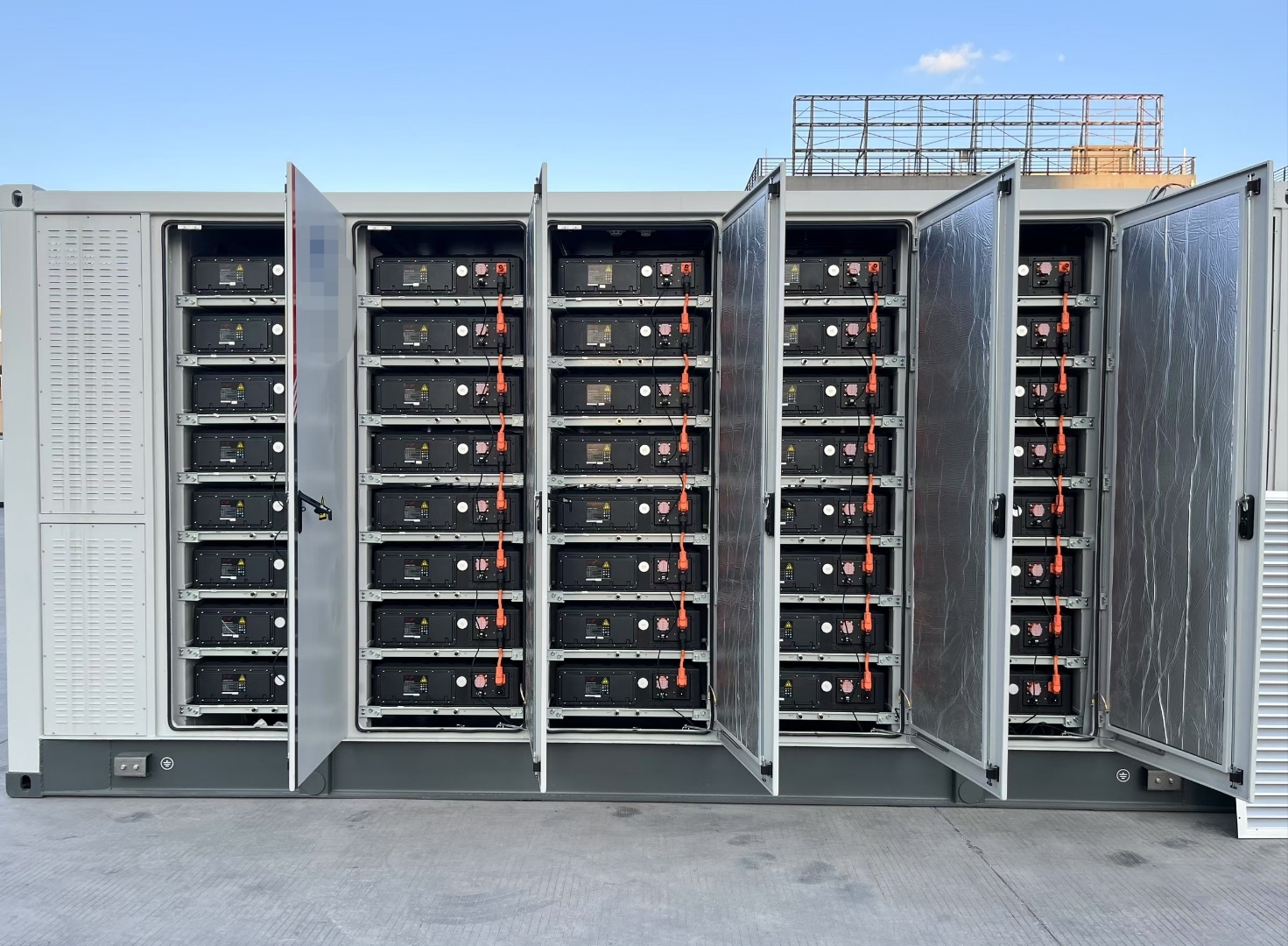

Abstract
Energy storage is the "regulator" of the new power system. It neither generates nor consumes electricity — it simply stores surplus wind and solar power and releases it when demand exceeds supply. In a grid where installed solar capacity has already surpassed 1.1 billion kW and the share of renewables keeps rising, energy storage is no longer optional; it is a structural necessity.
In 2025, China's new-type energy storage (excluding pumped hydro) delivered results that exceeded even the record-breaking 2024 performance. According to data officially released by the China Energy Storage Alliance (CNESA) on January 22, 2026, newly commissioned new-type storage reached 66.43 GW / 189.48 GWh, up roughly 52%/73% year-on-year. By end-2025, cumulative installed new-type storage reached 144.7 GW — a year-on-year increase of 85% — breaching the 100 GW milestone ahead of schedule. Meanwhile, energy storage systems continued to cheapen: the full-year average bid price for 4-hour utility-scale systems fell to roughly 0.48 CNY/Wh in 2025 (down ~20% from the 2024 average of ~0.60 CNY/Wh), with the lowest bids touching 0.37–0.42 CNY/Wh. Record installations on one side, brutal price war on the other — that was the defining reality of China's storage market in 2025.
This report takes 2026 as its observation point and systematically reviews China's energy storage industry across market size, supply-chain structure, competitive landscape, sub-segments, technology evolution, risks, and the five-year outlook, arriving at five core judgments:
- High installation growth has structural support. The dual-carbon target, continued renewables expansion, and electricity-market reform jointly underpin long-term, rigid storage demand regardless of whether the price war has ended; by 2030, China's cumulative storage capacity is expected to reach roughly 300–380 GW / 800–1,000 GWh (upgraded from the previous estimate based on 2025's outperformance).
- The price war is approaching its cash-cost floor, and industry consolidation is accelerating. The cell-industry average cost floor is approximately 0.28 CNY/Wh; 2025–2026 is the pivotal consolidation window, with smaller integrators under mounting cash-flow pressure.
- CATL retains the top cell position while BYD's storage-system shipments vault to global #1. CATL shipped 121 GWh of storage cells in 2025 (~37% global share); EVE Energy rose to global #2 at 71 GWh; BYD's storage system shipments exceeded 60 GWh, topping the global system-integration ranking.
- Sungrow's storage business delivered a double win on volume and profitability. Sungrow shipped 43 GWh of storage systems (+54%), with storage revenue of CNY 37.3 bn (41.8% of company total) and storage gross margin of 36.49%; high-margin overseas markets remain the key buffer against domestic price compression.
- Overseas expansion is the dominant growth narrative of 2025–2026. Chinese storage companies signed ~366 GWh of overseas contracts in 2025 (+144% YoY), covering 60+ countries; trade barriers (US tariffs rising to ~55%, FEOC rules taking effect) are forcing localized manufacturing, which will define the competitive landscape post-2026.
Key Data at a Glance (updated through 2025 full year / 2026 Q1)
- China 2025 new additions: 189.48 GWh (+73% YoY); cumulative: 144.7 GW (CNESA, Jan 2026).
- 2026 Q1 new additions: ~35.89 GWh (grid-side independent storage +294% YoY).
- System price: utility-scale 4h 2025 average ~0.48 CNY/Wh; lowest bids ~0.37–0.42 CNY/Wh.
- CATL storage cell shipments 121 GWh, global share ~37%; Sungrow storage shipments 43 GWh, revenue CNY 37.3 bn, gross margin 36.49%.
- Hithium 2025 revenue CNY 11.61 bn (+40%); net profit CNY 951 mn — a clear contrast to South Storage Power's continued losses, illustrating deepening sectoral bifurcation.
- China 2030E cumulative capacity: ~300–380 GW (base scenario, revised up from prior estimate).
This report comprises 12 main chapters covering storage definitions and the supply-chain overview, the global landscape and leading overseas players, the PEST macro environment, China market size, supply-chain deep dive, competitive landscape and company profiles, industrial clusters and factory identification, sub-segment reviews (utility/C&I/residential/overseas), technology trends, risks, the 2026–2030 forecast, and the Research Institute's summary judgments. Readers may read chapters selectively; for quick access to core conclusions, jump directly to the Abstract, Chapter 6, Chapter 11, and Chapter 12.
A central observation of this report is that energy storage is not an isolated sector — it is the "downstream of the downstream" of the solar supply chain. Solar's internal competition directly accelerated storage's cost decline and capacity additions; solar's overcapacity indirectly redirected vast manufacturing capability into storage; and the history of the solar price war is the most important reference frame for forecasting storage's future trajectory. Understanding this structural linkage between solar and storage explains why 2024–2025 simultaneously produced "highest-ever installations" and "lowest-ever prices" — not by accident, but as one more iteration of how China's industrial cycles play out.
The research methodology underpins each judgment with verifiable, source-attributed data drawn from CNESA, BNEF, IEA, and the publicly disclosed annual reports of CATL, Sungrow, Hithium, and other listed companies (data updated through full-year 2025).
Chapter 1 Definitions, Classifications, and Supply-Chain Overview
1.1 Energy Storage: The "Regulator" of the Power System
Energy storage converts electrical energy into other forms for later reconversion; in China's current power context it is the indispensable buffer between volatile renewable generation and stable grid demand. As solar PV surpasses 700 million kW and wind exceeds 480 million kW in China, storage is the mechanism that converts temporal mismatches in supply and demand into balance.
New-type energy storage — excluding pumped hydro — refers primarily to electrochemical storage (lithium-ion batteries), which is the principal focus of this report.
1.2 Classification by Duration
- Short-duration (0.5–2 h): Frequency regulation and voltage support; lithium-ion and flywheel. 2-hour storage systems are the domestic default.
- Medium-duration (2–4 h): Peak shaving; 4-hour systems are the 2024 utility-scale standard, with a tender average price of around 0.6 yuan/Wh.
- Long-duration (>4 h, typically 8–100 h): Seasonal balancing; flow batteries, compressed air, and pumped hydro are the main candidates; costs remain high.
1.3 Classification by Application Scenario
- Generation-side large storage: Co-located with renewable plants; was the dominant form under mandatory co-location policy (2021–2023); partly compressed since the 2025 "Document 136" policy change.
- Grid-side standalone storage: Built by grid companies or independent operators at substation level; first exceeded co-located storage in 2024, reaching 54% of new-addition share.
- Commercial and industrial (C&I) storage: Peak-valley arbitrage for factories and commercial buildings; requires ≥0.7 yuan/kWh peak-valley spread for economic viability.
- Residential storage: Near-zero domestic market; primarily an export product targeting Europe, Australia, and Japan.
1.4 Classification by Technology
- Lithium-ion (LFP-dominant): ~96.4% of domestic new-type storage; LFP (lithium iron phosphate) with >6,000 cycles, falling costs, and established safety profile.
- Sodium-ion batteries: 200 Ah+ cells, >5,000 cycles; first 10 MWh demonstration station commissioned in Guangxi in 2024; mass production timeline being refined.
- Flow batteries: All-vanadium and iron-chromium variants; >20,000 cycles; suited for 4–12 h; cost still above lithium-ion.
- Flywheel storage: Millisecond response for frequency regulation; low energy density.
- Compressed air energy storage (CAES): 300 MW-class projects operational; GWh-scale long-duration.
- Pumped hydro: Excluded from "new-type storage" definition; China has >50 GW installed.
1.5 Supply-Chain Overview
The value chain spans eight layers: lithium ore → cathode materials (LFP; Dynanonic, Yuneng Technology, BTR) → anode materials (artificial graphite) → electrolyte (Tianci Material) → separator (Yunnan Energy New Material) → cell manufacturing → PACK + BMS → PCS (Sungrow, Huawei, Sineng, Kelong, Shenghong) → EMS → thermal management (Envicool) + fire suppression → containerized system → system integration → downstream operations. Cells account for approximately 60% of system cost; PCS 10%–15%.
Chapter 2 Global Energy Storage Landscape and Leading Overseas Players
2.1 Global Market Scale
Global electrochemical storage new additions in 2024 were approximately 169 GWh (BNEF), a record high. At a market-value basis, the global storage market was estimated at approximately USD 57 billion in 2024, with projections exceeding USD 150 billion by 2030 at a CAGR of 15%–18%.
2.2 Regional Landscape
- China: ~65%+ of global new-addition GWh in 2024; world's largest market by far.
- United States: ~47 GWh in 2024, driven by the IRA's 30% standalone ITC. Texas and California lead.
- Europe: REPowerEU targets 600 GW by 2030; UK, Germany are the largest markets.
- Australia: One of the highest per-capita storage densities; residential and utility-scale both active.
- Middle East: Saudi Arabia, UAE large-scale projects growing rapidly, a key Chinese export destination.
2.3 Tesla Megapack: Global Brand Leader
Tesla Energy's FY2023 storage revenue was approximately USD 6 billion (14.7 GWh installed, +125% YoY); FY2024 continued to grow strongly. BNEF estimated Tesla's 2024 global system market share at approximately 19% by GWh. The Megapack uses 4680 cylindrical cells and offers a highly integrated, rapid-deployment solution.
2.4 Fluence Energy
Fluence (Siemens + AES joint venture) is the world's largest independent third-party storage integrator. FY2024 revenue approximately USD 2.7 billion (+22% YoY); backlog USD 4.5 billion. Fluence procures cells from Samsung SDI and LG ES, and has strong presence in the UK, US, Australia, and Middle East.
2.5 LG Energy Solution ESS
LG ESS is the storage division of LG Energy Solution, a leading global NMC cell supplier. Its global ranking among storage cell providers has been slipping as Chinese manufacturers gain share; LG is pivoting toward LFP chemistry to compete.
2.6 Global Cell Supply: China's Dominance
In 2024, Chinese companies accounted for over 90% of global storage cell shipments. The top 10 storage cell suppliers by GWh are almost entirely Chinese, with CATL leading at ~37%, followed by EVE Energy and BYD.
2.7 Global Value-Chain Geography
China's supply chain integrates the entire storage value chain from raw materials to system integration. Chinese-made storage systems are priced 50%–70% below US or European equivalents on a comparable-spec basis, which is the root cause of China's rapid export growth. Chinese manufacturing has no short-term peer in scale, cost, or iteration speed.
2.8 Overseas Manufacturing: China's Global Expansion
Major Chinese storage enterprises are building overseas production capacity to navigate tariff barriers:
- Hungary: CATL's 100 GWh-scale cell factory for European markets.
- Malaysia / Vietnam: Assembly lines to access US IRA compliance pathways.
- Saudi Arabia / UAE: Joint ventures or local service bases as part of Middle East mega-project participation.
2.9 Global Supply-Chain Resilience and Risks
Lithium resources are geographically concentrated — Australia ~50%, Chile ~26%, China ~15%. LFP cathode production is almost entirely in China, creating a single-point vulnerability for global supply if exports were restricted. Separators and electrolytes are more geographically distributed.
2.10 Emerging Markets
- India: Ambitious 500 GW renewable target by 2030; large storage demand; but restrictive policies for Chinese suppliers necessitate local manufacturing strategies.
- Southeast Asia: Vietnam, Indonesia, Malaysia — both growing markets and potential manufacturing hubs.
- Africa: Energy-access microgrids for off-grid regions.
2.11 Global Standards and Certification Competition
Key standards: IEC 62619 (international safety), UL 9540 (US), EU Battery Regulation (carbon footprint from 2027). Chinese companies — CATL, Sungrow, CNESA — are actively participating in IEC technical committees to shape standards around Chinese technology (LFP chemistry, large-format cell specifications).
2.12 Global Capital Flows
Government funding (US DOE LPO, EU Horizon, China policy banks), private equity/VC ($50–80 billion in 2024 globally), infrastructure funds (Macquarie, Blackstone), and corporate strategic capital are all flowing into storage — a convergence that signals an industry at liftoff, not at its peak.
Chapter 3 PEST Analysis
3.1 Policy: From Mandatory Co-location to Market-Driven Standalone Storage
Dual-carbon goals and new power system: China's 2030 carbon peak / 2060 carbon neutrality commitments require renewable penetration to climb toward 80%+ by 2060; storage is a structural necessity for this transition.
Mandatory co-location (2021–2024): Provinces required new renewable projects to co-locate 10%–20% storage. This drove explosive growth but also created "zombie storage" — low-utilization assets installed for compliance, not revenue.
Document 136 (2025): Eliminated mandatory co-location as a precondition for new-energy grid connection; shifted toward market-based standalone storage driven by capacity pricing and spot-market arbitrage. This marks a transition from administrative to economic logic.
Capacity pricing: Independent storage receives fixed annual compensation per kW; Ningxia 100 yuan/kW·year in 2025 rising to 165 yuan/kW·year in 2026. The mechanism provides a revenue floor analogous to a regulated utility tariff.
Overseas: IRA + REPowerEU: US IRA provides 30% standalone ITC for BESS from 2023; EU REPowerEU targets 600 GW storage by 2030. These are the two largest overseas demand catalysts.
56 National Demonstration Projects (Jan 2024): National Energy Administration published a list spanning 17 lithium-ion, 11 CAES, 8 flow battery, and other projects.
3.2 Economy: PV Overcapacity Spillover and Power Market Reform
China's solar PV price war in 2023–2024 accelerated a spillover of manufacturing capacity and investment into storage. Power market liberalization (spot market expansion) is widening the peak-valley spread in key provinces, improving C&I storage economics. Overseas markets with stable pricing serve as the profit "pressure valve" for leading Chinese companies.
3.3 Society: Peak-Valley Gap Widening, Energy Security
China's electrification of transportation and industry is widening daily peak-valley gaps, increasing demand for flexible resources. Energy security considerations reinforce policy support for storage — reducing dependence on fossil-fuel peaking capacity and imported energy. Safety incidents (2021 Dahongmen, multiple 2024 events) have tightened fire-suppression standards, increasing system costs but improving industry quality.
3.4 Technology: Cost Decline and Multi-Path Commercialization
Large-format cells (500 Ah), liquid cooling as standard, AI EMS optimization, and multi-technology commercialization (sodium-ion, flow, CAES) are the four main technology levers providing continued cost reduction and differentiation opportunities.
3.5 Policy Timeline: 2021–2025
The regulatory progression — from 2021 policy documents to 2024 demonstration projects to 2025 Document 136 and the 2025–2027 action plan — reflects a deliberate evolution from administrative mandate to market mechanism, deepening the industry's foundations for sustainable long-term growth.
3.6 PEST Summary Assessment
Policy: highly positive long-term, short-term execution uncertainty. Economy: macro headwinds temper C&I capex appetite; falling prices lower barriers. Society: widening peak-valley spread is the most reliable structural demand driver. Technology: clear cost-reduction roadmap; multi-technology options reduce single-path risk.
3.7 ESG and Storage's Revaluation
ESG frameworks are reshaping storage asset valuation — carbon-footprint certification, lifecycle assessment, and green bond eligibility are becoming structural features of storage project finance in Europe and increasingly elsewhere.
3.8 International Cooperation and Competition
China's structural cost advantage in storage manufacturing positions it as a global energy-transition enabler; at the same time, US IRA domestic-content rules and EU Battery Regulation carbon-footprint requirements are raising the bar for Chinese exporters. Market-entry strategies differ by region: brand credibility and LCA certification for Europe; local assembly compliance for North America; price-to-performance for the Middle East and Southeast Asia.
3.9 Policy Divergence and Enterprise Strategy
Document 136 requires Chinese enterprises to pivot from compliance-driven to return-driven project screening. IRA demands local content for North American projects. EU Battery Regulation mandates carbon-footprint declarations by 2027 — companies building LCA capability early will have a meaningful compliance advantage.
3.10 International Policy Convergence
Carbon-footprint monitoring and supply-chain security scrutiny are both tightening globally. Chinese storage manufacturers need proactive LCA systems, green energy procurement, and "trusted supply-chain" credentials to stay ahead of regulatory requirements in key export markets.
Chapter 4 China Market Size and Dynamics
4.1 Installation Scale: 2025 Breaks All Records Again
In 2025, China's new-type storage (excluding pumped hydro) extended 2024's explosive momentum and surpassed it in scale.
Per CNESA DataLink data officially released on January 22, 2026:
- Full-year new-addition of grid-connected new-type storage: 66.43 GW / 189.48 GWh, up ~52%/73% YoY.
- Cumulative installed new-type storage at year-end 2025: 144.7 GW, up 85% YoY; the 100 GW milestone was passed ahead of schedule.
- Including storage battery shipments (domestic + exports), estimated full-year 2025 shipments exceeded 350 GWh.
Compared with the ~6 GWh of additions in 2021 when the 14th Five-Year Plan began, four years produced roughly a 30× increase. Western provinces led the country: Inner Mongolia ranked first in both GWh and GW additions, surpassing California to become the world's single largest provincial/state storage market.
Into 2026, momentum continued: 35.89 GWh of new-type storage was added in Q1 2026, with grid-side independent/shared storage accounting for 26.59 GWh — up ~294% YoY (energy basis) — confirming the continued dominance of utility-scale independent storage.
Electrochemical storage technology remains highly concentrated: lithium-ion batteries account for ~96%+ of all new-type storage, with LFP as the dominant chemistry. Sodium-ion, flow batteries, and compressed air each remain in low single digits but are making demonstration-project inroads.
4.2 Three-Segment Landscape: Utility-Scale Leads, C&I Surges
Utility-Scale (Generation-Side + Grid-Side)
Utility-scale storage is the dominant segment, accounting for ~72% of new 2025 additions (GWh basis). Grid-side independent storage remained the leading sub-segment for the second consecutive year, surpassing generation-side co-located storage.
Independent storage's revenue logic has matured into a "triple-income stacking" model: spot-market peak-valley arbitrage, ancillary-service income, and capacity-payment tariffs. Ningxia's capacity tariff rose from CNY 100/kW·year in 2025 to CNY 165/kW·year in 2026, and multiple provinces have followed with capacity compensation mechanisms, providing a firmer investment floor.
The "Document 136" (2025) removed mandatory co-location requirements, leading to a contraction in new generation-side co-located storage additions. GWh-scale independent storage stations have become the new standard; individual project sizes are now evolving toward 1–2 GWh.
Commercial & Industrial (C&I) Storage
C&I storage remained one of the fastest-growing sub-segments in 2025, driven by widening peak-valley price spreads and further system-price reductions. C&I storage's share of total new additions remained ~20%–25%.
System prices dropped from ~CNY 0.7/Wh in 2024 to ~CNY 0.5–0.6/Wh in 2025. Payback periods in high-spread provinces have shortened to ~4–5 years.
Residential Storage
China's domestic residential market remains negligible (constrained by flat residential tariffs and installation regulations). Chinese residential storage manufacturers are almost entirely export-oriented, primarily targeting Europe, Australia, and Japan. Following 2024's inventory destocking pressure (Germany subsidy fade-out), the European residential market began recovering in 2025 as inventory normalized.
4.3 Price Trends: From 0.6 CNY/Wh to Near Cash-Cost Floor
The 2025 utility-scale system price continued its descent, albeit at a slower pace than 2024:
- 2023 start: average 2-hour system bid price ~1.3 CNY/Wh
- 2023 end: ~0.79 CNY/Wh (−40%)
- 2024 full-year average: 2h ~0.69 CNY/Wh; 4h ~0.60 CNY/Wh
- 2025 full-year average: 2h ~0.554 CNY/Wh; 4h ~0.479 CNY/Wh
- 2025 lowest bid (4h): ~0.37–0.42 CNY/Wh
- 2026 latest bids: BYD's Inner Mongolia bid ~0.42 CNY/Wh
- Industry cost floor: cell average cost ~0.28 CNY/Wh; all-in system cost floor ~0.35–0.40 CNY/Wh
Cumulative price decline from peak: >70% over two years, pushing most participants to the break-even margin.
Three structural drivers remain:
- Lithium carbonate at historical lows (~CNY 70,000–100,000/t in 2025), keeping cell costs depressed.
- Massive overcapacity: planned cell capacity exceeds 2 TWh vs. ~190 GWh actual 2025 installations.
- Second-tier competition: EVE Energy, Hithium, CALB, and Gotion pursue price-for-share strategies, continuously dragging down the industry average.
4.4 Profitability Structure: Pronounced Margin Stratification
- CATL storage cells: 2025 storage battery gross margin ~26.71%, above its EV battery segment — scale and technology leadership combine.
- Sungrow storage systems: 2025 gross margin ~36.49%, best-in-class; sustained by PCS+system+EMS vertical integration and overseas pricing power.
- Hithium: 2025 net margin ~8.2% (net profit CNY 951 mn); domestic utility-scale gross margin ~15%–20%, overseas ~40%+.
- EVE Energy storage: gross margin ~11% — a deliberate volume-for-margin trade-off to capture global rank.
- Upstream cathode materials: margins remain at historical lows given lithium carbonate prices; major producers' gross margins compressed to single digits.
4.5 Overseas Expansion: The Pressure-Release Valve, Amplified
In 2025, Chinese storage exports became the sector's most important growth highlight:
- Chinese storage companies signed overseas contracts of ~366 GWh (+144% YoY), covering 60+ countries and regions, with 70+ Chinese companies actively building overseas presence.
- Europe remains the largest export destination (UK, Germany, Spain, Poland most active).
- The US market saw narrowing Chinese direct-export volumes amid tariff and FEOC headwinds, but IRA safe-harbour projects (must be commissioned by end-2028) continued to underpin demand.
- BYD delivered the world's largest grid-side storage project: 12.5 GWh in Saudi Arabia (2025).
- Sungrow announced in February 2026 a EUR 230 mn European manufacturing investment — 12.5 GWh/year storage system capacity — marking the shift from product exports to factory exports.
High overseas margins (significantly above domestic levels) remain the structural rationale for this push.
4.6 Market Concentration: Accelerating Bifurcation
- Cell side: CATL CR1
37%; EVE Energy has risen to global #2 (15%); BYD storage system shipments rank #1 globally. - System-integration side: Sungrow, CATL Storage, Hithium, and BYD Storage continue to gain share; smaller integrators face persistent margin pressure.
- Distress signal: South Storage Power's 2024 loss of CNY 1.2–1.56 bn, and continued strain in 2025, illustrates that rapid sector growth does not protect weaker players.
4.7 Installation Map: Regional Distribution
2025 additions were highly concentrated in resource-rich western and industrial eastern provinces.
Northwest/North: Inner Mongolia (GWh/GW double-#1), Xinjiang (20.9% of national capacity), Ningxia (#3) — the three West corridor provinces together account for roughly 40% of new 2025 additions.
East: Jiangsu and Zhejiang lead in C&I storage; Shandong remains the largest North-China utility market.
Central: Hunan and Hubei, with large peak-valley spreads, have seen consistently strong co-location demand.
South: Guangdong is the #1 provincial C&I market, anchored by the Pearl River Delta's dense manufacturing base.
4.8 Business Models: Three Mainstream Paths
Model 1 — Equipment Sales: Integrators deliver turnkey projects to state-owned power generators; system gross margins compressed from 20%+ in 2022 to 5%–15% in 2025.
Model 2 — Independent Storage Operations: Asset owners hold storage station assets and earn returns through spot-market arbitrage, ancillary services, and capacity-payment tariffs. Project IRRs are gradually improving to 6%–9% as capacity mechanisms spread.
Model 3 — C&I Energy-Service (EPC+EMC): Integrators or operators deploy storage at zero upfront cost to commercial users, sharing electricity-bill savings. This model expanded in Guangdong and Zhejiang in 2025 but remains early stage.
4.9 China-vs.-Global Price Gap: Competitiveness Map
| Region | 2025–2026 4h Utility-Scale System Price (approx.) | Multiple vs. China |
|---|---|---|
| China | Baseline | |
| Japan | ~$230–280/kWh | ~3.5–4.3× |
| USA | ~$200–280/kWh (incl. tariffs) | ~3.1–4.3× |
| Europe | ~$170–220/kWh | ~2.6–3.4× |
| Australia | ~$140–190/kWh | ~2.2–2.9× |
China's all-in cost advantage versus Europe/US (1/3 to 1/4 of their prices) remains the bedrock of China's global export competitiveness.
4.10 2025 Benchmark Events: Evidence of Industry Deepening
BYD Storage Systems Rise to Global #1: Shipping 60+ GWh, BYD vaulted above Sungrow in system-integration volume — a landmark assertion of Chinese dominance across both cell and system layers.
Inner Mongolia Becomes World's Largest Single-Province Storage Market: Surpassing California, Inner Mongolia's additions reflect the maturation of China's western renewable energy base.
China Overseas Storage Contracts Reach 366 GWh: Single-year overseas signing volume equals ~60× China's entire 2021 installations, elevating overseas expansion from "incremental supplement" to "second main front."
Sungrow Announces European Manufacturing: The EUR 230 mn factory investment signals the industry's shift from exporting products to exporting manufacturing — a competitive form that will become standard post-2026.
4.11 Capital Markets: Valuation Logic
In 2025, Sungrow (300274) hit an all-time market-cap high of CNY 413.5 bn, with capital markets assigning the highest certainty premium to the "overseas high-margin + volume growth" storage model. Hithium (688411) demonstrated steady profit growth, cementing its status as the independent storage operations specialist.
Three valuation shifts are now well-established:
- Overseas revenue share is the #1 valuation factor: companies with clearly disclosed overseas storage margins command the highest certainty premium.
- Vertical integration premium: CATL's 26.71% storage cell margin — above its EV battery segment — quantifies the value of fully integrated supply chains.
- Software/operations optionality: companies with EMS platforms and storage-asset operation capability (Hithium) receive valuations above pure manufacturing peers, reflecting market expectation of the "light-asset + tech-service" business model.
Chapter 5 Supply-Chain Deep Dive
5.1 Cell Cost Structure: Cathode as Value Origin
Typical 4h utility system cost breakdown: cells 55%–65%; PCS 10%–15%; container structure 5%–8%; thermal management 5%–7%; BMS + EMS 3%–5%; fire suppression 2%–3%; EPC balance 5%–10%.
5.2 Lithium Carbonate and the Cathode Roller Coaster
Lithium carbonate peaked at ~600,000 yuan/t in late 2022; by 2024 it had settled to ~70,000–100,000 yuan/t. This ~83% decline drove the system price halving. LFP cathode production is >95% domestic; leading suppliers: Dynanonic (liquid-phase), Yuneng Technology (solid-phase), BTR New Material.
5.3 Anode, Electrolyte, Separator, Foils
Anode: artificial graphite-dominant; BTR, Putailai, ShanShan. Electrolyte: Tianci Material, Xinzhoubang; differentiated by functional additive formulations. Separator: Yunnan Energy New Material (Enjie) #1. All four layers are >85% locally sourced.
5.4 PCS Semiconductor: SiC / IGBT Localization
IGBT (key PCS power device): domestic share ~30%–40%; BYD Semiconductor, SiDA Semiconductor, CRRC Times Electric. SiC MOSFET (next-gen, higher efficiency): domestic share ~10%–15%; Basic Semiconductor, Tianyue Advanced, San'an Integrated. High-end SiC (1200 V / 200 A+) remains the primary import-dependence node in the storage supply chain.
5.5 Container, Thermal, and Fire Systems
Liquid-cooling thermal management (Envicool, Goaland, Shenling) is the 3 MWh+ system standard, controlling cell temperature differential to ≤3°C. Perfluorohexanone-based fire suppression is replacing HFC-227ea for lithium-specific thermal-runaway suppression.
5.6 EMS: The Hidden High-Margin Layer
EMS software — market dispatch, SOC optimization, AI scheduling — is the highest-margin element of the storage value chain (gross margins 50%–70%). Sungrow, Huawei, and HiEnergy are all deploying proprietary AI EMS platforms. Same hardware with better EMS algorithms can improve annualized arbitrage revenue by 15%–25%.
5.7 Localization Rate Assessment
Domestic value content of a typical 2024 4h utility system is estimated at 88%–92%, with SiC/IGBT devices being the primary import dependency. This compares favorably to almost any other advanced manufacturing sector in China.
5.8 LFP Cathode Competition: Liquid Phase vs. Solid Phase
Liquid-phase LFP synthesis (Dynanonic) offers better particle uniformity and rate performance; solid-phase (Yuneng) is lower cost. As large-cell systems demand higher rate capability, liquid-phase share is expanding.
5.9 Electrolyte Additives: The Invisible Differentiator
Functional additives (film-forming agents like FEC, flame retardants, overcharge protectors) are the proprietary "secret sauce" of each cell maker's electrolyte formulation. Tianci Material and Xinzhoubang's moat lies in additive R&D and deep customer co-development relationships.
5.10 "Hidden Champions": Critical Components Below the Radar
High-voltage storage relays and contactors, aluminum alloy structural parts, burst-membrane safety valves, and BMS communication ICs are components with high technical requirements but low public visibility; numerous specialist manufacturers supply these to Tier 1 integrators.
5.11 Localization Rate by Component Table
| Component | Cost Share | Domestic Supply % | Notes |
|---|---|---|---|
| LFP cathode | 20%–25% | >95% | Fully localized |
| Anode | 5%–7% | >90% | Mostly local |
| Electrolyte | 5%–7% | >90% | Mostly local |
| Separator | 3%–5% | >85% | Mostly local |
| Cell manufacturing | 15%–20% (processing) | ~100% | Fully local |
| PCS (incl. IGBT/SiC) | 10%–15% | Device ~35% | Device imports remain |
| BMS | 2%–3% | >85% | Mostly local |
| Thermal management | 5%–7% | >80% | Mostly local |
| Fire suppression | 2%–3% | >85% | Mostly local |
| Container | 5%–8% | ~100% | Fully local |
5.12 Cost Curve to 2030
2024 full system (4h, incl. EPC): ~0.70–0.80 yuan/Wh → 2026E ~0.55–0.65 → 2028E ~0.40–0.50 → 2030E ~0.30–0.40. At this price level, storage becomes the world's lowest-cost peaking resource.
Chapter 6 Competitive Landscape and Key Companies
6.1 Three-Layer Competition: Cells, PCS, and Integration
China's storage industry competition stratifies into three layers with distinctly different concentration and profitability characteristics:
- Cell layer: Highly concentrated. CR3 (CATL + EVE Energy + BYD) ~60%–65%; CATL leads, EVE Energy has risen to global #2, landscape still evolving; competition centers on cost curves, large-cell R&D, and shipment scale.
- PCS layer: Relatively concentrated. Sungrow + Huawei Digital Energy dominate; Sineng Electric, Kstar, and Shengong each defend niches. Competition centers on SiC/IGBT device selection, efficiency specs, and integration capability.
- Integration layer: Fragmented. Low entry barriers; many SMEs compete on price. Leading integrators (Sungrow, Huawei, Hithium, CATL Storage, BYD Storage) maintain share via brand, channels, and vertical integration, but price wars have spread to high-end projects.
6.2 Cell-Layer Key Companies
CATL (300750)
CATL is the undisputed global storage cell leader. 2025 storage cell shipments: 121 GWh (+29.1% YoY), global share ~37.1%, world #1 for five consecutive years (SNE Research). Storage system revenue reached CNY 72.85 bn (+45.2%, 17.5% of CATL's total revenue); storage cell gross margin 26.71% — higher than its EV battery segment.
CATL's full-year 2025 net profit was CNY 72 bn, with dividends exceeding CNY 36 bn (CNY 200 mn/day), demonstrating the formidable profitability of the storage + EV dual-engine model. Storage system integration shipments surged 160%+ YoY in 2025, accelerating the shift from cell supplier to system integrator.
Competitive advantages: unmatched cost scale; leading 280/300/500 Ah large cells; Tianxing storage systems (5 MWh+) integrating liquid cooling and fire suppression; 10,000+ cycle life; vertical integration into upstream cathode materials; growing global footprint.
BYD (002594)
BYD Storage achieved a landmark in 2025: storage system shipments exceeded 60 GWh, overtaking Sungrow to rank #1 globally in storage system integration, covering 110+ countries. BYD delivered the world's largest grid-side storage project — 12.5 GWh in Saudi Arabia — and launched a new-generation system with 2,710 Ah ultra-large blade cells.
BYD's 2025 total revenue was CNY 803.96 bn (+3.5%); net profit CNY 32.62 bn (−19%, primarily from EV competitive pressure). Storage contributed ~15% of 2025 interim revenue and is positioned as BYD's second growth curve; 2026 storage shipments are expected to double.
EVE Energy (300014)
EVE Energy is the fastest-growing storage cell manufacturer. 2025 storage cell shipments: 71.05 GWh (+40.8% YoY), vaulting to global #2. Storage cell revenue: CNY 24.44 bn (~40% of company total); total company revenue CNY 61.4 bn; net profit growth only 1.4%, reflecting the volume-for-margin strategy. Storage gross margin ~11%.
EVE's core approach: large-cell technology (560 Ah ultra-large prismatic cells) combined with anchor-customer relationships, scaling production at Jingmen and Chengdu manufacturing bases.
Haichen Storage (CALB Group subsidiary)
From launch to global TOP 5 in ~three years, Haichen represents this cycle's most impressive new entrant. Products: 300 Ah+ LFP large prismatic cells with 10,000+ cycle life. Already in Europe and Middle East markets; IPO process underway.
Ruipu Lanjun (0666.HK)
Backed by Tsingshan Holdings' nickel/cobalt supply-chain advantages. Wendingtop storage systems have entered multiple SOE projects.
Penghui Energy (300438)
Transitioned from cylindrical to prismatic LFP storage cells; running at full capacity in 2025 with strong order intake, focused on C&I storage and residential storage exports.
6.3 PCS-Layer Key Companies
Sungrow (300274)
In 2025, Sungrow's storage business delivered a double win. Storage system shipments: 43 GWh (+53.5% YoY). Storage revenue: CNY 37.29 bn (+49.4%), accounting for 41.81% of total company revenue (CNY 89.18 bn, +14.6%). Storage gross margin: 36.49%. The company announced a EUR 230 mn European manufacturing investment in February 2026 (12.5 GWh/year capacity), firing the first shot in overseas localized production.
Competitive edge: self-developed PCS; full-stack integration (PCS + system + EMS + liquid cooling + AI scheduling); high-margin overseas market as domestic price-war buffer.
Huawei Digital Energy
Huawei Digital Energy (unlisted) offers an end-to-end smart-energy solution (PCS + EMS + thermal management + intelligent monitoring), sold primarily to major state-owned power operators. Its modular C&I products and cloud-based EMS are core differentiators. Sanctions limit its US and some European exposure, but the Middle East, Southeast Asia, and domestic C&I segments remain strong.
Sineng Electric (300827), Kstar (002335), Shengong (300693)
These three each guard specific niches (utility-scale PCS, data-center UPS + storage, and C&I PCS respectively) and are experiencing margin pressure from the domestic price war.
6.4 System-Integration Key Companies
Hithium (688411)
Hithium is China's most representative independent storage system integrator. 2025 full-year revenue: CNY 11.61 bn (+40.4%); net profit: CNY 951 mn (+46.8%). Q3 2025 single-quarter revenue CNY 3.39 bn (+124%), Q3 net profit CNY 307 mn (+872%) — showing powerful acceleration.
Overseas gross margin ~40%+ vs. domestic ~15%–20%. Strategy: build scale domestically, generate profits overseas. Currently expanding into independent storage operation and data-center "compute-power + storage" high-value scenarios.
South Storage Power (300068)
A legacy integrator combining lead-acid and lithium storage, South Storage posted a loss of CNY 1.2–1.56 bn in 2024, and continued to face headwinds in 2025. Its trajectory is the sector's textbook example of bifurcation: an industry that is growing fast can still inflict heavy losses on those without adequate cost competitiveness.
Envision (unlisted) is a comprehensive renewables solutions provider; storage is a strategic extension of its wind-turbine core. In 2025, Envision won the Inner Mongolia 200 MW/800 MWh bid at 0.459 CNY/Wh, demonstrating strong system-level competitiveness.
6.5 Foreign Firms in China: Strategic Retreat and Localization Dilemma
Foreign storage brands continue to lose ground in China. The combination of rapidly declining domestic prices and Chinese manufacturers' catch-up on brand and technology specs has left foreign players in a bind: their cost structures are too high for large-scale project bidding, while their niche differentiation in ultra-high-reliability or specialty channels is limited to edge cases (data-center UPS, nuclear plant backup).
6.6 Competitive Evolution: Three-Stage Forecast
Stage 1 (2025–2026) — Shakeout: Price war near its cash-cost floor; weaker players squeezed; leaders lock in long-term supply contracts at low prices. Shakeout signals will become more visible by end-2026.
Stage 2 (2027–2028) — Consolidation: Capacity utilization recovers as demand expands; cell CR5 from 75% → 80%+; integration leaders solidify; sodium-ion/flow technology differentiation emerges; overseas localized manufacturing becomes a new threshold.
Stage 3 (2029–2030) — Value Creation: Hardware prices stabilize; software operations, AI EMS, and battery health management become the incremental profit sources; financial institutions and insurers enter storage asset allocation; Chinese brands dominate global landmark projects.
6.7 Key-Company Financial Comparison (FY2025)
| Company | FY2025 Revenue (CNY bn) | Storage Revenue (CNY bn) | Storage Gross Margin | Net Profit (CNY bn) | Notes |
|---|---|---|---|---|---|
| Sungrow (300274) | 89.18 | 37.29 | 36.49% | — | 43 GWh shipped; +53.5% |
| CATL (300750) | — | 72.85 (systems) | 26.71% (cells) | ~72 | 121 GWh cells; global #1 |
| EVE Energy (300014) | 61.4 | 24.44 | ~11% | — | 71 GWh; global #2 |
| Hithium (688411) | 11.61 | ~11.5 (est.) | ~18% | 0.951 | +40% YoY; Q3 NP +872% |
| South Storage (300068) | — | — | — | Loss | Ongoing distress case |
Sungrow's 36.49% storage gross margin versus South Storage's ongoing losses crystallizes the sector's core competitive reality: vertical integration capability, overseas market share, and technology premiums are the decisive variables separating winners from losers.
6.8 M&A: The Next Phase of Consolidation
Three M&A vectors are forming:
- Upstream integration: Large cell manufacturers moving into cathode/anode; CATL and EVE pursuing strategic upstream partnerships or equity stakes.
- Integrator consolidation: Distressed second-tier integrators being acquired by large integrators or SOE generators; SOEs building proprietary storage operation teams.
- Overseas M&A: Chinese leaders potentially acquiring European or US local integrators and battery recyclers; Sungrow's European factory is the leading indicator of this trend.
6.9 Competitive Radar: Multi-Dimensional Assessment (FY2025)
| Dimension | Sungrow | CATL Storage | Hithium | Huawei Digital Energy |
|---|---|---|---|---|
| Cost competitiveness | Strong | Strongest | Moderate | Strong |
| Technology leadership | Strong (PCS+EMS) | Strong (large cell) | Moderate | Strong (AI EMS) |
| Brand recognition | High (global) | High (global) | Moderate | High (global) |
| Overseas market share | Highest (EU factory) | Fast-growing | Accelerating | Moderate |
| Profitability quality | Excellent (36%+ margin) | Excellent (cell 27%) | Good (NP CNY 951 mn) | Not disclosed |
6.10 Huawei Digital Energy: The Special Case
Huawei Digital Energy (unlisted) remains the most distinctive competitor in China's storage landscape. Its ICT heritage underpins EMS and AI scheduling platforms that other storage companies cannot replicate; its global enterprise-customer network enables large-project bundling; and its exposure to US sanctions — while real — is partially offset by strong domestic C&I and Middle East/Southeast Asia positioning. Its existence forces Sungrow to continuously raise its brand, technology, and service game — which, paradoxically, accelerates the entire industry's innovation pace.
6.11 State-Owned Power Groups' Storage Build-Out
The Five Major Power Groups (Huaneng, Datang, Huadian, SPIC, CGN-Energy) and the Six Minor Groups (Three Gorges, CGN, etc.) are simultaneously the largest buyers and emerging operators of storage assets. SPIC (State Power Investment Corp.) has built the most advanced proprietary storage system integration and EMS capability among SOEs, via subsidiaries including Guoneng Rixin and Lüdian Storage. Three Gorges has strategic interests in long-duration storage (compressed air, flow batteries) given its deep expertise in hydropower asset lifecycle management.
SOE storage build-out will materially reshape the competitive landscape over the next 3–5 years: SOE internal sourcing may divert some third-party integrator orders, while SOE credit ratings and long-term contract profiles provide the anchor assets needed for storage REITs and project-finance structures.
Chapter 7 Industrial Clusters and "Factory Identification"
7.1 Five Core Storage Industrial Clusters
Fujian Ningde: CATL headquarters; world's largest LFP cell manufacturing base; >200 supporting suppliers in a 100 km radius. "Single-core radiating" cluster model — supply chain destiny tightly linked to CATL's production schedule.
Guangdong Shenzhen / Huizhou: PCS and C&I storage system hub; Huawei Digital Energy HQ in Shenzhen; BYD Energy Storage, Sunwoda, Clou, Shenghong, ANKER SOLIX residential storage all present. PCB, connectors, IGBT sourcing depth makes system assembly highly efficient.
Jiangsu Changzhou / Suzhou: "New Energy Capital" — EVE Energy's Jintan base, CALB Liyang, Svolt Jintan; complete EV + storage ecosystem. Sineng Electric and other PCS makers in Suzhou.
Anhui Hefei: Sungrow headquarters and primary storage R&D + manufacturing; Gotion High-tech Hefei/Lujiang. Aligned with Hefei's pro-EV/storage industrial attraction policy.
Fujian Xiamen: Hithium Energy Storage headquarters; Zhangzhou, Quanzhou attracting supporting supply; Xiamen Port for European export logistics.
7.2 Mid-Tier Supporting Factories: The Invisible Backbone
Liquid-cooling thermal components, fire-suppression modules, BMS modules, high-voltage wiring harnesses, copper busbars, and containerized structure fabricators form a dense ecosystem of specialist suppliers. These are often multi-industry (HVAC, automotive) companies for whom storage is one vertical among several, making them invisible to keyword-based databases.
7.3 Factory Identification Challenge: The "Invisible Supply Chain"
Tianxia Gongchang's coverage of approximately 480 million verified active factories reveals a fundamental identification challenge: most storage supply-chain factories are not registered or named as "storage" companies. A thermal management supplier may be categorized as "industrial HVAC"; a BMS manufacturer as "electronic control"; a high-voltage relay maker as "low-voltage apparatus." Conventional search and business registry tools miss this supply chain depth entirely. Tianxia Gongchang's cross-verified factory database, which identifies factories by production capability rather than registered name, provides uniquely accurate coverage of this dispersed but critical supplier network.
7.4 New Frontiers: Western and Northern China
Xinjiang, Inner Mongolia, Ningxia, Qinghai are the fastest-growing deployment markets; local manufacturing infrastructure is sparse, with systems trucked from coastal clusters. Ningxia's early capacity-pricing implementation attracts independent storage project investment.
7.5 Cluster and Port Logistics
Ningde → Xiamen Port; Shenzhen → Yantian/Huizhou Port; Changzhou → Shanghai/Ningbo Port; Hefei → Shanghai/Ningbo Port. Port logistics efficiency supports export competitiveness.
7.6 China vs. Global Clusters
China's five major storage clusters collectively dwarf global competitors — Korea's Chungcheong/Gyeonggi (LG, Samsung SDI) and Europe's nascent clusters (Northvolt Sweden, CATL Hungary) are 10x+ smaller in cell output and lack China's full-chain ecosystem. No alternative cluster can match China's manufacturing depth on a 5-year horizon.
7.7 Cluster Evolution: From Single-Point to Network
Three stages: (1) single-anchor (2010–2018) — CATL, Sungrow as individual anchors; (2) supply-chain extension (2019–2022) — upstream suppliers cluster around anchors; (3) networked specialization (2023–present) — clear inter-cluster division of labor, Ningde cells → Shenzhen PCS → Hefei system → national deployment.
7.8 Factory Density and Cluster Vitality
Cluster vitality is not measured by the number of factories, but by the density of differentiating capability. Price-driven homogeneous integrators in Shenzhen are structurally vulnerable; technology-differentiated suppliers — even small ones — are the real foundation of competitive cluster advantage.
7.9 Government Policy Competition for Storage Investment
Changzhou "New Energy Capital" branding, Ningxia's capacity-pricing leadership, Hefei's pro-storage industrial policy — government rivalry for storage investment is real and active. Risk: "build-first, support-later" policies that attract anchors before local supply-chain depth develops, creating logistics cost overruns in inland locations.
Chapter 8 Sub-Segment Specialist Review
8.1 Utility-Scale Grid-Side: China's Largest Single Storage Segment
Grid-side independent storage is China's largest and fastest-growing storage sub-segment. It remained the largest category in 2025 for the second consecutive year; in 2026 Q1, grid-side independent/shared storage added 26.59 GWh (+294% YoY capacity basis).
The "triple-income stack" model has matured:
- Spot-market arbitrage: In provinces with open electricity spot markets (Shanxi, Guangdong, Gansu, Ningxia), independent storage earns peak-valley spread; >300 discharge cycles/year required to break even.
- Ancillary services: Primary frequency regulation, AGC services, billed by response volume.
- Capacity tariffs: Ningxia's capacity tariff rose from CNY 100/kW·year (2025) to CNY 165/kW·year (2026); other provinces are following, providing a baseline return floor.
Stacking all three can lift independent storage IRR to 8%–12% with a 7–9 year payback. As spot-market coverage expands, economics are steadily improving.
Generation-side co-located storage is contracting following the 2025 "Document 136" removal of mandatory co-location requirements. Inventory-heavy "zombie storage" projects (low actual utilization) remain a legacy challenge.
8.2 Utility-Scale Generation-Side: Buffer Layer for Large Energy Bases
Large desert solar bases (e.g., Gansu Kubuqi, Mengxi green corridor) and offshore wind + storage configurations use storage as a "buffer layer" — smoothing output profiles, reducing curtailment, and improving competitive power in spot markets.
Characteristics: single-site 500 MWh–2 GWh; highly competitive SOE procurement; strict BMS/EMS/thermal requirements; long SOE receivables cycles.
8.3 Commercial & Industrial Storage: The Peak-Valley Arbitrage "Arithmetic"
C&I storage economics hinge on:
- Peak-valley spread: ≥CNY 0.7/kWh for strong economics (Guangdong, Zhejiang, Shanghai); some areas exceed CNY 1.0/kWh.
- Electricity volume: Higher users benefit more from storage discharge windows.
- Demand-charge management: Reducing peak-demand fees can contribute 20%–30% of total project returns.
In 2025, C&I storage new additions reached an estimated 20–30 GWh (continued high-growth pace). System prices fell from ~CNY 0.7/Wh (2024) to ~CNY 0.5–0.6/Wh (2025); payback in high-spread provinces shortened to 4–5 years.
The competitive landscape: Huawei Digital Energy's modular products, Sungrow's C&I solutions, and Shengong's C&I PCS lead among branded players; but a large fragmented second tier continues to compete on price and flexible installation services.
8.4 Residential Storage: Negligible at Home, Export Recovery Underway
Domestic residential storage remains negligible (flat residential tariffs, installation restrictions). Chinese residential storage manufacturers are almost entirely export-oriented:
- Germany: Europe's largest residential market; 2025 sees recovery after 2024's subsidy-related destocking.
- UK: Rapid penetration, bundled with solar.
- Italy: Government subsidies support solar+storage combinations.
- Australia: Highest global solar penetration; persistent co-installation demand.
- Japan: Disaster-preparedness driven; premiums for higher-safety products.
Key exporters: Huabao New Energy, GoodWe (688390), Kstar (002518), iSolar (688218), Deye (605117), Anker (300866) SOLIX brand.
2025 saw European residential inventory normalize and orders start recovering. 2026 growth is expected to continue as new European subsidy programs are implemented.
8.5 Overseas Sub-Segment Deep Dive: Four Key Destinations
United States
The US is the world's #2 storage market, but 2025–2026 brought important policy shifts:
- IRA Continuity: The "One Big Beautiful Bill" (signed July 4, 2025) extended the Investment Tax Credit (ITC) for storage projects through 2033, with phase-out in 2034–2035 — far more durable than many expected, sustaining safe-harbour project demand (must commission by end-2028).
- FEOC Restrictions Take Effect: From 2026, storage projects claiming ITC must comply with foreign entity of concern (FEOC) rules; battery components with >55% ties to Chinese entities will be excluded from incentives (threshold rises to 75% after 2029).
- Tariff Escalation: From January 1, 2026, comprehensive tariff rates on Chinese storage batteries and BESS rose from ~37.5% to ~55%, further eroding the competitiveness of direct Chinese exports.
- Response Strategies: Chinese companies route through Southeast Asian (Malaysia, Indonesia) or Mexican assembly to circumvent direct-import restrictions, and accelerate UL 9540/9540A certification for large-project eligibility.
2024 US additions: ~47 GWh; 2026 projected: 70–75 GWh (IRA safe-harbour pipeline).
Europe
Europe is the most important Chinese storage export destination, backed by multiple tailwinds:
- REPowerEU continues; EU 2030 storage target is 60 GW; 2025 European additions ~15 GWh; 2026 projected ~30 GWh.
- EU Electricity Market Design (EMD) Reform: Requires member states to establish capacity mechanisms, creating new stable revenue streams for both grid-scale and C&I storage; business-model certainty increases.
- UK, Germany are the largest markets; Poland, Spain, Italy growing fast. Sungrow leads in European utility-scale share.
- EU discussions on CBAM carbon-footprint requirements and supply-chain security reviews continue but have not crystallized into formal trade barriers; Sungrow's European factory is a pre-emptive localization move.
Australia
Globally leading solar penetration, dense large BESS project pipeline (Hornsdale SA, Victoria Big Battery). Chinese companies (Sungrow, CATL) are rapidly growing share. Both utility-scale and residential segments are active.
Middle East
The Middle East is the most closely watched emerging destination in 2025–2026. Saudi Arabia and UAE large renewable + storage projects are GWh-scale:
- BYD delivered the world's largest grid-side storage project: 12.5 GWh in Saudi Arabia.
- UAE, Qatar, Morocco, and additional GCC countries have large-scale signings.
- The region is dominated by government-led mega-projects, typically with high contract values and long tenures — an important high-quality profit pool for Chinese leaders.
8.6 Sub-Segment Comparison Summary
| Segment | Typical System Size | Primary Revenue Model | China Top 3 | Key Metric |
|---|---|---|---|---|
| Grid-side utility | 500 MWh–2 GWh | Capacity tariff + spot arbitrage + ancillary | Sungrow, CATL, BYD | IRR 6%–10%; payback 7–9 yr |
| Generation-side utility | 100–500 MWh | Co-location compliance + output smoothing | CATL, BYD, EVE | Utilization 200–300 cycles/yr |
| C&I storage | 0.5–10 MWh | Peak-valley arbitrage + demand-charge mgmt | Huawei, Sungrow, Shengong | Payback 4–8 yr; need spread ≥0.7 CNY |
| Residential | 5–20 kWh | Self-consumption (export) | GoodWe, Kstar, iSolar | Europe/Australia primary markets |
| Microgrid | 100 kWh–5 MWh | Off-grid + diesel hybrid | Fragmented | High unit price, low volume |
8.7 C&I Storage Regional Bifurcation
Guangdong — the #1 provincial C&I market in both 2024 and 2025; dense manufacturing in Shenzhen, Dongguan, Foshan; best subsidy infrastructure (Huizhou, Dongguan programs).
Zhejiang — highest peak-valley spreads (avg ~CNY 0.9/kWh); fastest payback; Yiwu, Ningbo, Wenzhou SMEs rapidly adopting storage.
Shanghai — data centers and manufacturing parks as key customers; relatively streamlined fire-safety approval process.
Jiangsu — Suzhou, Wuxi, Nanjing manufacturing clusters; peak-valley spreads CNY 0.7–0.9/kWh.
By contrast, western provinces (Sichuan, Yunnan) with abundant cheap hydro and narrow peak-valley spreads remain C&I storage dead zones.
8.8 Data Centers: Storage's Special Application Scenario
With AI compute demand exploding, large data centers have become an important storage application where "compute power + storage" (算电协同) is emerging as a new theme:
- UPS: Lithium displacing lead-acid for data-center backup; stable demand, price-insensitive, high-margin.
- Demand-charge management: Cutting peak-demand fees is highly cost-effective for hyper-scale data centers.
- Microgrid + solar + storage: Large campus data centers building integrated energy self-sufficiency.
Hithium is actively targeting "independent storage + compute-power synergy" as a premium scenario. Kstar and Huawei Digital Energy lead in data-center UPS storage. As domestic large-model training and inference workloads grow, data-center storage demand is expected to scale materially in 2025–2027.
8.9 C&I Storage Meets Demand Response
Combining C&I storage with demand-response (DR) programs — where system operators compensate users for reducing load on demand — adds a third revenue layer on top of arbitrage and demand-charge savings.
In provinces with established DR markets (Guangdong, Shanghai, Zhejiang), a typical 2 MWh factory installation can earn an additional ~10%–15% of total project returns through DR compensation (approximately CNY 5–10/kWh during peak-stress events). As DR market rules mature and compensation mechanisms become more transparent, C&I storage economics will evolve from "single arbitrage" to "multi-value aggregation."
8.10 Overseas Certification: The Hidden Market Threshold
UL 9540 / UL 9540A (USA): The core safety standard for US storage systems; full certification takes 12–24 months. From 2026, UL certification plus FEOC-compliant sourcing documentation form a two-layer entry barrier for US large-project procurement.
CE (EU): Covers EMC, LVD, ATEX modules; some EU member states require local supplements (German VDE, British BS EN).
IEC 62619: The international standard for stationary storage safety; widely adopted in Europe, Middle East, Australia. Easier for Chinese companies to obtain than UL but requires ongoing maintenance.
Certification barriers reinforce leader concentration: top firms (Sungrow, CATL, Hithium) with established certification experience can enter new markets faster, objectively amplifying the overseas-tier head-count effect.
8.11 EVs and V2G: The Mobile Storage Dimension
With China's NEV fleet exceeding 30 million vehicles in 2025 (assuming ~50 kWh average battery), theoretical dispatchable storage capacity is ~1.5 TWh — far exceeding current total fixed-storage installations. V2G's commercial potential is enormous but faces layered barriers:
- Technology: Bidirectional charger (OBC / V2G charging-pile) upgrade costs at scale remain high; CATL, BYD, and NIO are all exploring V2G solutions.
- Commercial: Frequent V2G cycling accelerates EV battery degradation; user-participation incentives need to exceed degradation costs. Some provinces have started including EVs in DR dispatch, but compensation frameworks remain exploratory.
- Policy: V2G market participation qualifications, settlement mechanisms, and metering standards are not yet fully defined.
Full V2G commercialization in China is projected no earlier than 2027–2028, after which the combined V2G + fixed-storage "dual-track" architecture will fundamentally reshape storage market scale logic.
Chapter 9 Technology Trends
9.1 Large-Format Cells: The 280 → 300 → 500 Ah Journey
280 Ah era (2021–2023): Standardized LFP prismatic cell; 4,000–6,000 cycle life; the basis for initial large-scale deployment.
300 Ah+ transition (2023–2024): ~7% capacity increase per cell; ~5%–8% system BOS cost reduction.
500 Ah era (2024–2025): CATL "Tianxing" 5 MWh system; EVE 560 Ah; ~44% fewer cells vs. 280 Ah at equal system capacity. Thermal management challenge increases with cell size; leading manufacturers have demonstrated solutions.
9.2 Large Systems: From 1 MWh to 5 MWh+ Containers
Single-container capacity progression: 500 kWh → 1 MWh → 2 MWh → 5 MWh+ (2024 commercial). Benefits: fewer containers per GWh, simpler EMS/PCS topology, reduced footprint, lower civil and installation cost.
9.3 Liquid Cooling: Standard for ≥3 MWh Systems
Liquid cooling reduces cell temperature differential to ≤3°C vs. 8–10°C for air cooling; each 1°C reduction estimated to extend cycle life 3%–5%. Cold-plate liquid cooling is the dominant implementation. Full-immersion cooling is next-generation but in validation stage.
9.4 AI EMS: From Rule-Based to Adaptive Intelligence
AI EMS leverages machine learning for spot-price forecasting, SOH-adaptive charging, multi-site VPP coordination, and ancillary-service response optimization. Estimated annualized revenue improvement: 10%–20% per 100 MWh installation. Sungrow, Huawei, HiEnergy have deployed commercial AI EMS; independent EMS providers (State Power New Energy Data, Mulian Energy) are competitive in C&I.
9.5 Alternative Technologies: Sodium-Ion, Flow, CAES
Sodium-ion batteries: 200 Ah+ cells, >5,000 cycles, -40°C operability; first 10 MWh storage station in Guangxi operational. Cost currently 15%–25% above LFP; cost parity possible 2026–2028 at scale.
Flow batteries: 20,000+ cycle life; iron-chromium flow reaching 500 kW stack modules; competitive in 8–12 h applications at scale. 2030E LCOE could approach lithium-ion large-scale.
Compressed air: 300 MW-class projects commissioned; GWh-scale, 30-year design life. Geography constraints limit deployable sites.
Solid-state batteries: Commercial impact on storage sector not expected before 2028–2032.
9.6 SiC Devices: Efficiency Gains and Localization
SiC MOSFET raises PCS switching frequency (>100 kHz), reduces losses 1%–2%, and shrinks volume 20%–30%. Wolfspeed (US), STMicroelectronics, Infineon dominate supply; domestic: Basic Semiconductor, Tianyue Advanced, San'an Integrated. High-end SiC localization from ~10%–15% today toward 30%–40% by 2027.
9.7 Battery Cascade Use: Extending the Value Chain
Post-retirement storage cells (capacity <80%) can serve low-power-density applications: light EV, telecom backup, low-rate C&I storage. Accurate SOH assessment is the technical gate; Greenmobility, BTR Eco, Huayou Cobalt active in this segment.
9.8 Battery Recycling: Closing the Loop
2020–2022 deployed storage batteries will begin retiring around 2025–2030. Wet-chemistry recovery of LFP (lithium and iron-phosphate extraction) and urban mining of NMC (nickel, cobalt, manganese) are the main paths. Greenmobility (002340), Huayou Cobalt (603799) are the leading recyclers. Building domestic secondary lithium supply is the long-term strategic antidote to raw material import dependency.
9.9 Virtual Power Plants: Value Aggregation
VPP aggregates dispersed storage assets (C&I, residential, V2G) for unified market participation. Pilot programs in Shanghai, Guangdong, Jiangsu. VPP revenue contribution for C&I storage systems expected to grow materially post-2026 as spot market coverage expands.
9.10 Next-Generation System Integration
Solar + Storage DC coupling: 3%–5% efficiency improvement; Sungrow and Huawei have commercial DC-coupled systems.
Charge + Storage fusion: Fast-charging stations with co-located storage for demand management; Pulan New Energy, TELD active.
Modular prefabrication: Factory-assembled 90%+ complete units; field commissioning compressed from 3–6 months to 4–6 weeks. CATL Tianxing, Sungrow PowerTitan are leading commercial products.
AI safety early-warning: ML-based thermal-runaway prediction (voltage anomaly, temperature gradient, gas sensor correlation) provides 10–30 minute lead time before thermal runaway; CATL BMS and Huawei systems deploy this capability.
Chapter 10 Risks and Challenges
10.1 Price War: The Bottomless Competition
4h utility-scale system prices fell ~72% over two years (1.3 → 0.37–0.42 yuan/Wh). Capacity utilization at ~10% (>2 TWh capacity vs. ~200 GWh demand) means marginal-cost pricing persists. NanDu Power's 2024 loss is the clearest signal of the structural damage from this competition.
10.2 Safety Incidents: The Sword of Damocles
Lithium-ion thermal runaway events (Korea 30+ fires 2017–2020, China Dahongmen 2021, multiple 2024 incidents globally) raise regulatory risk and siting resistance. Liquid cooling + perfluorohexanone fire suppression + multi-sensor early warning are the current best-practice stack; full elimination of thermal-runaway risk remains out of reach.
10.3 Overseas Tariffs and Supply-Chain Security Scrutiny
US: IRA domestic-content requirements; FERC/DoD security reviews tighten. EU: CBAM battery extension under discussion; supply-chain due-diligence regulation. Chinese companies' primary response: Southeast Asian and Mexican assembly capacity to satisfy local-content requirements.
10.4 Overcapacity and Cash Flow Squeeze
Upstream accounts receivable (60–180 day terms from SOE buyers), reduced upfront payments, and limited SME financing options compound the cash flow stress of the price war. Medium-term casualties among undercapitalized integrators are expected.
10.5 Technology-Path Switching Risk
If sodium-ion achieves LFP cost parity by 2026–2028, existing LFP cell capacity faces value impairment. Solid-state batteries post-2030 are a longer-horizon risk to all current liquid-electrolyte investment.
10.6 Policy Uncertainty: Capacity Pricing Variability
Capacity pricing standards vary by province and may be adjusted as the power market matures. If rates fall or ancillary service revenue per kWh declines (due to storage market crowding), standalone storage IRR projections are revised downward.
10.7 Lithium Resource Import Dependency
China imports ~50%–60% of its carbonate lithium; Chile's 2023 nationalization announcement and Australia's potential resource nationalism create supply disruption risk. Battery recycling (urban mining) and domestic brine/hard-rock development are the structural mitigants.
10.8 Immature Power Market Profitability
Only ~10 provinces have active spot markets. In provinces without spot markets, storage revenue depends on fixed ancillary-service compensation that may not cover full costs. "Right province selection" is currently more important than "right technology selection" in storage project viability.
10.9 Quality and After-Sales Risk
Premature capacity degradation (from under-investment in cell screening, BMS algorithms, or thermal management) will manifest in projects installed 2021–2024 as the 3–5 year quality window arrives. Performance guarantees and lifecycle insurance are becoming procurement requirements for sophisticated buyers.
10.10 Risk Matrix
| Risk | Probability | Impact | Combined | Mitigation |
|---|---|---|---|---|
| Price war continuation | High | High | Extreme | Overseas + vertical integration |
| Safety incidents | Medium | High | High | Liquid cooling + fire-suppression upgrade |
| Overseas tariff escalation | Medium | Med-High | Med-High | Overseas manufacturing |
| Lithium price volatility | Medium | Med-High | Med-High | Long-term offtake + recycling |
| Overcapacity cash flow | High | Medium | Med-High | Cost control + cash management |
| Technology path shift | Low | High | Medium | Multi-path R&D |
| Policy adjustment | Medium | Medium | Medium | Multi-province diversification |
10.11 Survival Paths for SMEs
Sub-segment focus, vertical component supply, regional service depth, or technical specialization in emerging niches (sodium-ion BMS, flow battery EMS, AI fire detection). Prerequisite for all four: positive cash flow through the price war's most intense phase.
10.12 Geopolitical Scenario Analysis
Base case (~55%): US IRA rules require local content but no comprehensive ban; EU finalizes carbon-footprint rules; Chinese companies expand via SE Asian / Mexican assembly. Export growth continues at a reduced pace.
Pressure case (~35%): US anti-dumping duties on Chinese storage; EU follows with tariffs. Chinese market share shifts toward Middle East, SE Asia, Africa; top-line impact material for leading exporters.
Decoupling (~10%): Full-scale Chinese storage export ban across major Western markets. Short-term shock; medium-term acceleration of BRI-market and domestic expansion.
10.13 Competitive Defense Strategies
Scale advantage (CATL), full-value-chain integration (Sungrow), focused domestic integration + overseas high-margin (HiEnergy), technology differentiation (Hithium, EVE 560 Ah cells) — each is a valid risk mitigation framework for different enterprise types.
Chapter 11 2026–2030 Forecast
11.1 China Market: Sustained High-Growth Installation Trajectory
The Research Institute synthesizes CNESA, BNEF, and multiple broker reports, incorporating the 2025 outperformance (189.48 GWh actual, +70% YoY) and 2026 Q1 continuation (35.89 GWh), to produce the following China storage 2026–2030 forecast:
New-Addition Forecast (Revised Upward Based on 2025 Actuals)
| Year | China New Additions (GWh, est.) | YoY Growth | Cumulative (GWh) |
|---|---|---|---|
| 2024 (actual) | ~111.6 | +115% | ~168 |
| 2025 (actual) | ~189.5 | +70% | ~357 (cum.) |
| 2026E | ~230–280 | +20%–40% | ~590–640 |
| 2027E | ~280–350 | +15%–30% | ~870–990 |
| 2028E | ~340–430 | +15%–25% | ~1,210–1,420 |
| 2029E | ~390–510 | +15%–20% | ~1,600–1,930 |
| 2030E | ~440–580 | +10%–20% | ~2,040–2,510 |
CNESA's 2030 cumulative target ranges from 221 GW (conservative) to ~313 GW (optimistic) in power terms. More recent institutional updates have shifted the base case up toward 370 GW (1,100 GWh) reflecting 2025's outperformance. This report's base scenario: 300–380 GW / 800–1,000 GWh by 2030.
Three Certainties Driving Growth:
- Dual-Carbon structural demand: Renewables continue rapid expansion; storage demand is long-run structural, not cyclical.
- Electricity-market deepening: More provinces open spot markets; capacity-payment coverage expands; large financial institutions and insurance capital begin allocating to storage assets.
- Continued cost reduction: Large cells, standard liquid cooling, AI EMS push LCOE down further; C&I storage economic viability threshold lowers, accelerating penetration.
Potential Dampeners:
- Price war forcing SME exits, temporarily reducing supply quality;
- Capacity-tariff policy disappointing → slower utility-scale investment pace;
- Lithium-supply disruption temporarily reverting cost curve.
11.2 Global Market: Massive Incremental Volume Outside China
2030 Global Storage Forecast (Updated for 2025 Actuals)
- Global new annual additions 2030E: ~700–1,000 GWh (China ~440–580 GWh; rest of world ~260–420 GWh).
- USA: IRA safe-harbour deadline (end-2028) will concentrate installations in 2026–2028; ITC through 2033 backstops longer-term demand; FEOC and tariffs reduce Chinese direct exports but do not close the market; 2030 US annual new additions ~120–180 GWh.
- Europe: REPowerEU + EU EMD capacity-mechanism reform; 2030 annual new additions ~100–150 GWh; more policy-stable than the US.
- Middle East: Saudi mega-projects (BYD 12.5 GWh already landed); 2030 annual ~30–60 GWh; government-led large projects dominate.
- Australia: High renewables penetration; strong ongoing demand for both utility-scale and residential; 2030 annual ~20–35 GWh.
From the perspective of Chinese companies: 2026–2030 overseas strategy will pivot from "product exports" to "localized operations" — establishing local service networks, assembly capacity, and partner ecosystems in the US, Europe, and Middle East to navigate trade barriers and build local brand equity. Sungrow's European factory is the leading signal.
11.3 Price Trends: The Bottom Zone and a Shift in Value Center
Price Forecast (Updated for 2025 Actuals)
- 2025 (actual): 4h utility-scale average ~0.48 CNY/Wh; lowest bids ~0.37–0.42 CNY/Wh.
- 2026E: ~0.35–0.45 CNY/Wh — the bottom zone; leading companies approaching or touching cash cost.
- 2027E onwards: As laggard capacity exits and concentration rises, prices stabilize; premium products (liquid-cooled, 500 Ah+ cells, AI EMS) earn a differentiation premium.
- 2030E: System average ~0.30–0.38 CNY/Wh — far more competitive than any other peaking resource.
Value Center Shift
As hardware prices bottom out, the industry's value center will migrate from hardware sales toward software + operations:
- EMS & digitalization: Operating platforms, AI dispatch, VPP aggregation → 50%–70% gross margins.
- Storage asset operations: Storage-station assets become institutional/insurance-company allocations; REITs enhance asset liquidity.
- Battery Health Management (BHM): SOH monitoring, cascade-use assessment, residual-value management → standalone service market.
11.4 Technology Roadmap Penetration Forecast
| Technology | 2025 Share | 2026E Share | 2030E Share |
|---|---|---|---|
| LFP lithium-ion | ~96% | ~87%–92% | ~68%–78% |
| Sodium-ion | ~0.5% | ~3%–6% | ~12%–18% |
| Flow batteries | ~1% | ~2%–3% | ~5%–8% |
| Compressed air | ~1% | ~2% | ~3%–5% |
| Other | ~1.5% | ~1%–3% | ~2%–5% |
LFP dominates through 2030, but sodium-ion penetration will accelerate as 2026–2027 non-demonstration commercial deployment begins. Flow batteries expand in long-duration niches.
11.5 Investment Logic: Where Is the Alpha?
α Opportunities (Structural Outperformance Above Sector Beta)
- AI EMS and storage software: 50%–70% gross margins; minimal price-war exposure; still early-growth stage.
- Domestic SiC devices: Supply-chain security rationale; 2024–2027 SiC domestic substitution rate rising from ~10%–15% to ~30%–40%.
- Sodium-ion batteries at scale: If sodium reaches LFP parity in 2026–2028, early movers reap disproportionate gains.
- Overseas full-stack services: FEOC compliance consulting + local installation + BHM; European localized manufacturing pioneers (Sungrow) earn competitive moat advantages.
β Opportunities (Riding the Sector Beta)
- Large independent storage operators (future storage REITs or operating-platform IPOs);
- Leading cell makers' scale-economy dividends (CATL, EVE Energy long-term share growth);
- Thermal management and fire-suppression suppliers benefiting from steady utility-scale shipment growth.
Risk Reminder: Price war not yet over; capex-exit cycle uncertain; overseas trade barriers (FEOC + 55% tariffs) add volatility — all three structural risks must enter any storage-related valuation framework.
11.6 Supply-Chain Structural Forecasts
Cell layer: Capacity utilization pressure should force third/fourth-tier exits in 2025–2026. By 2027, cell CR5 is expected to rise from ~75% to 80%+; CATL/EVE/BYD will become more entrenched, with Haichen and CALB carving differentiated positions. Competition axis shifts from price to large-cell technology + cycle-life certification + global service.
PCS layer: SiC MOSFET domestic substitution rate rises from ~10%–15% to ~30%–40% by 2027. Sungrow and Huawei will maintain premium PCS dominance; SiC device suppliers (SICC, Tianyue Advanced) will capture a larger share of device-level economics. PCS hardware margins compress; software (EMS + dispatch) is the profit protector.
Integration layer: By 2028, leaders with global channels + self-developed EMS + vertical integration (Sungrow, Huawei, Hithium, BYD Storage) will further consolidate share; pure low-cost integrators will exit; differentiated mid-size integrators (C&I specialists) will survive on niche differentiation.
Upstream materials: LFP cathode margins remain compressed. Sodium-ion cathode materials (Prussian-blue, layered oxide) form a new supply-chain ecosystem; 2026–2028 will see the first batch of sodium-ion cathode material scale-leaders emerge.
11.7 China's Strategic Position in Global Storage: Evolution Path
2026–2030: China evolves from "world's largest manufacturer" to "world's largest manufacturer + meaningful operator + technology-standard participant."
- Manufacturing: China's global cell-manufacturing dominance is nearly irreversible; by 2030, ~85%+ of global storage cell shipments will originate from Chinese factories.
- Technical standards: China's dominance in LFP cell formats (280/500 Ah), containerized storage interface standards, and BMS communication protocols is turning into de facto global standards through sheer shipment volume. Chinese participation in IEC, ISO storage standardization is increasing.
- Operations: China's independent storage model (capacity-payment + spot-market arbitrage) will become a reference template for developing markets; "Chinese storage solutions" will evolve from product exports to full-solution exports.
11.8 Long-Duration Storage: 2027–2030 Commercialization Window
Long-duration storage (>4 hours, typically 8–100 hours) is the sector's "blue ocean" — no economically viable large-scale projects yet, but demand is building as renewables penetration rises.
At >60%–70% renewable penetration, 4-hour storage can no longer bridge multi-day weather-driven output gaps. China's 2025 renewables penetration is ~40%; "15th Five-Year Plan" penetration targets will bring long-duration storage's economic value into the light during 2026–2030.
Market-scale forecast by 2030:
- Vanadium flow batteries (8–12h): 2030E China cumulative ~15–25 GWh; market ~CNY 30–60 bn.
- Compressed air (10–100h): 2030E ~5–10 GW installed; ~3–5 large-scale projects at the 10 bn-CNY level.
- Hydrogen (long-cycle): Very limited commercial scale before 2030.
Key players: Dalian Rongke, China Power Universal Energy (Beijing), Shanghai Electric-Guangshen (vanadium flow); SPIC Research Institute, Xi'an Saipurei (iron-chromium flow); Zhongshu Guoneng, Qingneng Era (compressed air).
11.9 Green Finance and the Financialization of Storage Assets
Financialization of storage assets is a major 2026–2030 industry theme and a key driver of the sector's next development phase.
Green bonds and carbon-neutral bonds: Storage projects can access green-bond financing at 30–80 bps below conventional bonds; China's carbon-neutral bond market has grown rapidly in 2023–2025.
Storage REITs: Following the US precedent (Hannon Armstrong), China's public REIT market is extending to new-energy infrastructure. Storage power stations qualify as "infrastructure" under existing frameworks; 2026–2028 domestic storage REIT products are a plausible outcome.
Project Finance: Large independent storage projects (500 MWh+) — with capacity-tariff contracts and growing spot-market transaction track records — increasingly qualify for bank/insurance project-loan financing; the market is expected to scale materially in 2025–2027.
Carbon-market linkage: Storage projects enhancing renewable curtailment recovery may earn quantifiable credits; if China's carbon price exceeds CNY 100/tonne by 2030, carbon revenue becomes a material positive IRR variable.
11.10 Policy Roadmap: 2026–2030 Key Milestones
2026
- More provinces implement capacity-tariff mechanisms; Ningxia's 2026 rate of CNY 165/kW·year sets a benchmark for others.
- Spot-market coverage expands further; independent storage arbitrage opportunities multiply.
- Storage safety standards evolve; liquid-cooling and active fire-suppression become de facto mandatory.
- US FEOC restrictions officially in force; Chinese companies accelerate Southeast Asian / Mexican manufacturing buildout.
2027–2028
- National unified electricity market construction reaches milestone; cross-provincial storage dispatch mechanisms may be established.
- Sodium-ion storage projects likely entering non-demonstration commercial deployment.
- Long-duration storage (8h+) may receive dedicated policy support ("long-duration storage guidance" document).
- Storage REIT pilot may launch, providing an exit channel for existing storage assets.
2029–2030
- China's new-type storage total installed capacity exceeds 250 GW (power), becoming the world's largest new-type storage market.
- Market-based electricity price signals cover the majority of storage assets; policy-subsidy reliance declines.
- V2G commercialization may begin at small scale in highest-liquidity spot-market provinces.
- Carbon-emission standards and lifecycle ESG assessment frameworks for storage may begin development, linking to international carbon markets.
11.11 Key Assumption Sensitivity Analysis
| Assumption | Base Case | Upside | Downside | Impact on Forecast |
|---|---|---|---|---|
| Electricity market reform pace | Moderate advance | Accelerated | Stalled | ±20% installations |
| Lithium carbonate price | CNY 70–120k/t range | Continues falling | Rebounds to 200k+ | ±15% system cost |
| Dual-carbon policy enforcement | Resolute | Exceeds expectations | Weakens | ±25% demand |
| Overseas trade barriers | Partial escalation (FEOC + ~55% tariff) | Status quo | Full embargo | ±30% exports |
| Technology switch speed | Sodium-ion volume 2026–2027 | 2026 early ramp | 2029 delayed | ±10% cell landscape |
Policy variables (electricity market reform + dual-carbon enforcement) are the most sensitive levers for storage installation demand. Overseas trade barriers (FEOC + tariff at ~55%) materially affect leading companies' profitability quality but will not derail China's domestic market growth trajectory. The Research Institute's view: storage's long-run growth certainty is extremely high; near-term price swings and policy adjustments will not alter the bedrock logic — "renewables require storage, and storage will become standard equipment."
Chapter 12 Conclusions and Research Institute Judgment
12.1 The Underlying Logic of the Storm
In one sentence: record-high installations, record-low margins — simultaneously in 2024. This is not a contradiction; it is the same coin's two faces. The surge in installations attracted a wave of capacity that far exceeded demand, triggering the most severe price war in the sector's history. The dynamics mirror solar PV's 2012–2016 shakeout period.
Storage's structural demand drivers — dual-carbon commitment, the inexorable expansion of variable renewables, power market liberalization — are policy-independent and enduring. Price wars do not negate these drivers; they are the mechanism by which capital-intensive industries rationalize capacity toward their natural long-run cost curve.
12.2 Three Key Judgments
First: Large storage will shift from "deployment war" to "operations war." As system hardware prices reach 0.3–0.4 yuan/Wh, hardware margins approach zero and profit migrates to the "operations side" — AI EMS dispatch optimization, ancillary service participation, VPP aggregation, and full-lifecycle battery health management. Companies with software-first, operations-capable business models will build durable competitive moats.
Second: Overseas is the "second lifeline" for leading enterprises. Domestic project net margins have compressed below 5%; European, US, and Middle Eastern markets price at 2–3x the domestic level. Companies that build "system delivery + local service + cloud EMS" capabilities in key markets will be disproportionately rewarded in the global share competition.
Third: Multi-technology commercialization will reshape the landscape. Sodium-ion, flow, and compressed-air storage pilot programs in 2024 are real commercial starts, not symbolic displays. By 2028–2030, if sodium-ion achieves LFP cost parity, the cell-maker rankings face major disruption; flow batteries in the 8h+ segment will unlock a market that today is essentially non-existent. These "slow variables" are accelerating.
12.3 Tianxia Gongchang Research Institute's Industry Assessment
The factory data platforms platform's coverage of approximately 480 million verified active Chinese factories provides a perspective on the storage industry's depth that aggregate statistics cannot. The supply chains of CATL, Sungrow, and HiEnergy run through thousands of factories across Ningde, Shenzhen, Hefei, and Changzhou — from cathode material plants to liquid-cooling component manufacturers to containerized structure fabricators to BMS module shops. These factories, largely invisible in market rankings but essential to system delivery, are the foundation of China's irreplaceable manufacturing advantage in global storage competition. No competitor can buy or replicate this network on a five-year horizon.
12.4 The Historical Parallel with Solar PV
Solar PV's brutal 2012–2016 shakeout eliminated hundreds of manufacturers and left LONGi, JinkoSolar, and a handful of others with the global scale and cost to define the next decade of solar deployment. Storage is following the same arc — the shakeout is underway, and the survivors will emerge with deeper moats than any policy period could have built.
12.5 Five Long-Term Strategic Judgments
- Storage's long-run demand is among the most certain of any industrial investment.
- The price war is a transitional phase, not a permanent state.
- China's manufacturing advantage is structural and short-term-proof.
- Software and operations will capture storage's next value increment.
- Overseas expansion is the largest single incremental opportunity for the next five years.
12.6 Manufacturing Sector Revaluation in the Storage Era
China's traditional manufacturing competitive advantages — scale, cost, and supply-chain depth — struggled against quality and technology headwinds in sectors like machine tools and semiconductors. Storage is the industrial sector where all three traditional advantages not only apply but have been augmented by decade-long technology investment. The result: global cost leadership by a margin of 2–3x, full supply-chain localization at 88%–92%, and technology iteration speed that rivals any global peer.
12.7 A Closing Note
Storage in 2024 crossed the most important threshold of all: the point at which economic logic, not policy mandate, becomes the primary growth driver. When standalone storage exceeds 54% of new additions; when Sungrow's storage unit earns 11 billion yuan net profit; when GWh projects become routine tender specifications — these are the signals that storage has "grown up." The price war's pain is real. But the industry that emerges on the other side will be structurally stronger, economically self-sustaining, and globally dominant in ways that the policy-driven growth phase never guaranteed.
From the historical vantage of industry development: 2020 and before — demonstration projects and subsidies; 2021–2023 — mandatory co-location explosion with rising quality concerns; 2024 — market logic overrides policy logic for the first time. The price shakeout is storage's "coming of age." What follows will be built on genuine economic competitiveness — and that, uniquely, is durable.
Data Sources
This report was prepared by the Tianxia Gongchang Industrial Research Institute using the Tianxia Gongchang platform's factory and supply-chain data, supplemented by public records, official information, and authoritative media reporting. Primary data sources include:
- factory data platforms's China factory database and industrial cluster data (www.tianxiagongchang.com)
- China Energy Storage Alliance (CNESA) annual energy storage market statistics and white papers
- National Energy Administration, China New-Type Energy Storage Development Report (2025)
- BloombergNEF (BNEF) global energy storage market tracker (2024)
- China Electricity Council (CEC) power-sector statistical data
- CATL, BYD, Sungrow, EVE Energy, HiEnergy Technology, NanDu Power public annual reports
- NDRC and NEA energy storage policy documents
- Xinhua, Economic Information Daily, Caixin, The Paper, and other authoritative media reporting