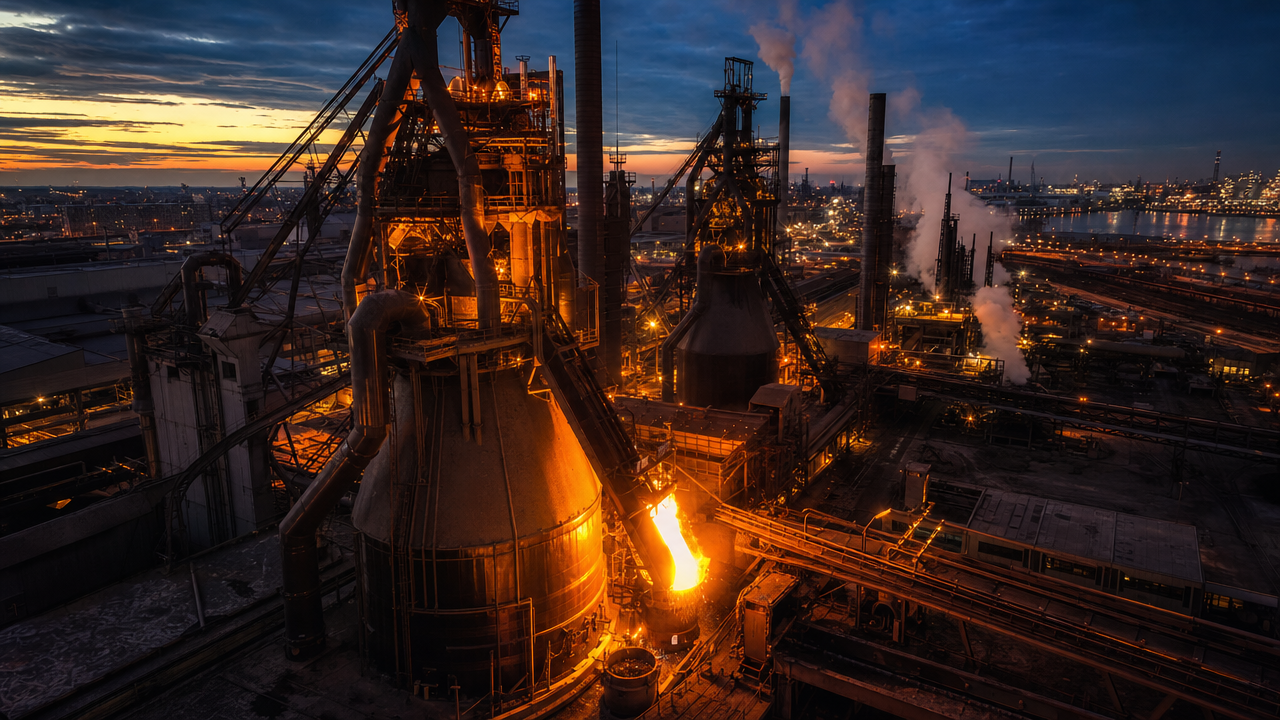

China Steel Industry 2026: Market Scale, Competitive Landscape & Deep Research Report
Preamble An Evidence-Based Report on Chinese Steel
Research Framework & Core Narrative
Steel is a mirror. It reflects China's spectacular industrial journey while also reflecting the contradictions of capacity glut, trade frictions, and carbon emissions that define our era.
In 2024, China's crude steel output reached 1.005 billion tonnes — more than 53% of global production — for the ninth consecutive year at this scale. Yet industry-wide profits fell nearly 90% from the 2021 peak. Steel prices languished near multi-year lows. Baosteel's 7.362 billion yuan net profit led a sector where many peers bled red ink.
Three structural forces define the era: overcapacity clearing, painful export re-routing, and short-process low-carbon transformation. Together they constitute the master narrative of Chinese steel from 2026 to 2030.
Six Key Numbers
1.005 billion tonnes — China's 2024 crude steel output, 53% of the world total, the ninth straight year at this scale.
863 million tonnes — Domestic steel consumption in 2024, down 4.4% year-on-year. The ~100 million tonne gap between output and consumption was bridged entirely by exports.
110.72 million tonnes — Steel exports in 2024, up 22.4%, the second-highest volume on record. Record exports are a symptom of domestic overcapacity, not a triumph of competitiveness.
10.5% — Electric arc furnace (EAF) share of crude steel output in 2024. The global average is 28%; the U.S. runs at 70%. Closing this gap is China's most important structural investment theme for the next decade.
+73.62 vs. −71.22 billion yuan — Net profits of Baosteel Co. vs. net losses of Ansteel — two mega state-owned steel groups separated by 15 billion yuan in financial performance in the same market environment.
80% — China's iron ore import dependency. The Big Four miners (Vale, Rio Tinto, BHP, Fortescue) control ~70% of global seaborne iron ore supply. This is the strategic Achilles heel of China's steelmaking supply chain.
One Definition & Classification: The Skeletal System of Industrial Civilization
1.1 Process Dimension: Blast Furnace Route vs. Electric Arc Furnace Route
1.1.1 Integrated Route (BF-BOF)
The integrated blast furnace–basic oxygen furnace (BF-BOF) route accounts for approximately 89–90% of China's crude steel production. It begins with coking coal converted into metallurgical coke, which is then charged into a blast furnace together with iron ore sintered pellets. At temperatures exceeding 1,500°C, the iron oxides are reduced to liquid pig iron (hot metal). The hot metal flows to a converter (BOF), where a top-blown oxygen lance removes excess carbon in approximately 25–35 minutes per heat. The resulting molten steel passes through secondary metallurgy (ladle furnace, vacuum degassing) for compositional fine-tuning, then into the continuous caster to solidify into slabs, billets or blooms. Hot rolling and cold rolling complete the transformation from liquid steel to finished products.
The integrated route's advantage: large-scale throughput, high metal purity, and the ability to accommodate diverse iron ore grades. Its disadvantage: high energy consumption (560 kg standard coal per tonne of crude steel), high carbon emissions (1.8–2.0 t CO₂ per tonne), enormous capital investment, and near-zero flexibility in shutting down once a blast furnace is lit.
1.1.2 Short-Process Route (EAF)
The electric arc furnace (EAF) route melts scrap steel or direct reduced iron (DRI) using electrical energy discharged through graphite electrodes. Carbon emissions per tonne of crude steel fall to ~0.4–0.6 t CO₂ when using scrap — just one-quarter of the integrated route.
China's EAF penetration of 10.5% in 2024 lags far behind the global average (28%), the United States (70%), and Europe (~43%). The structural reasons are well-known: limited scrap accumulation historically, relatively high industrial electricity prices, and quality constraints (copper tramp element contamination in scrap hampering production of certain high-end flat-rolled products).
Policy targets: 15% EAF share by end-2025; 20%+ by 2030. With China's annual scrap generation set to grow from ~270 million tonnes in 2024 toward ~350 million by 2030, and with renewable energy lowering electricity costs in coastal regions, EAF expansion will accelerate.
1.2 Product Dimension: Five Main Product Categories
Long products (construction) — Rebar (HRB400/500E), wire rod, structural sections (H-beams, channels), rails. The dominant volume category historically. Rebar alone once exceeded 250 million tonnes per year at the housing construction peak. Structurally oversupplied as real estate investment contracts.
Flat products (manufacturing) — Hot-rolled coil (HRC), cold-rolled coil (CRC), medium/heavy plate, coated products (galvanized, aluminized, color-coated), electrical steel (silicon steel). Higher-value, increasingly important as Chinese manufacturing upgrades.
Pipe and tube — Seamless pipe (OCTG, high-pressure boiler, precision mechanical) and welded pipe (ERW, spiral). China is the world's largest producer and exporter of steel pipe.
Special steel — Bearing steel, gear steel, spring steel, tool steel, die steel, high-speed steel — produced with strict compositional and cleanliness controls. Price premiums of 3–5× versus commodity steel. China's special steel champion CITIC Pacific Special Steel (Xingcheng Special Steel) is the world's largest bearing steel producer.
Stainless steel — Austenitic 300-series (304, 316L; chromium-nickel), ferritic 400-series (chromium only, no nickel), martensitic. China produces ~2.8 billion tonnes+ in 2024 across all stainless grades, accounting for over 55% of global output.
1.3 Downstream Applications
Construction (~53%) — Rebar in reinforced concrete; structural steel in steel-frame buildings, bridges. Peaked at ~9.5 billion m² new housing starts in 2019; 2024 starts ~7.5 billion m², down 61% from peak.
Automotive (~8%) — Cold-rolled high-strength steel, hot-dip galvanized sheet. ~700–900 kg per vehicle. China's 2024 NEV output 10.87 million units demands increasing volumes of ultra-high-strength steel (UHSS) for lightweighting and high-grade non-oriented electrical steel for drive motors.
Home appliances (~5%) — Cold-rolled sheet, galvanized sheet for white goods exteriors.
Machinery & shipbuilding (~18%) — Medium/heavy plate, sections. China's shipbuilding completions hit a global record in 2024 (55%+ share), consuming ~25–30 million tonnes of steel.
Energy (~5%) — Line pipe (X65–X80 grade), wind turbine monopiles (ultra-heavy plate), solar mounting sections.
Two Global Landscape: Baowu Leads, Global Giants Hold Their Ground
2.1 Global Production Share: China's Structural Dominance
China's 53% share of global crude steel is not a transient aberration — it is the crystallized outcome of 30 years of accelerating industrialization. In 1990, China produced 66 million tonnes; in 2000, 127 million; in 2010, 627 million; in 2024, 1,005 million. Each leap corresponded to a wave of urbanization, infrastructure construction, and manufacturing expansion that absorbed every tonne produced.
The pivot is now underway. China's peak consumption likely occurred in 2020–2021 at approximately 950 million tonnes. The structural decline in housing construction, combined with demographic headwinds (China's population entered negative growth in 2022), means that recovery to those demand levels is improbable. The gap between production and domestic consumption will narrow only through output reductions, not demand recovery.
2.2 Top-10 Global Steel Producers (2024)
China Baowu Steel Group — 130.1 million tonnes, global No. 1 for the fifth consecutive year. Nearly double the output of ArcelorMittal. Baosteel Co. (the listed flagship) earned 7.362 billion yuan net profit, the highest among Chinese listed steel companies.
ArcelorMittal — 57.9 million tonnes, revenues $62.4 billion, EBITDA ~$5.9 billion (+41% YoY). Headquarters Luxembourg; operations spanning 20+ countries. Strategic joint venture partner in China's VAMA (Hualing AM Automotive Steel).
Ansteel Group — ~56–58 million tonnes (including Bengang Steel). Listed subsidiary Ansteel Co. posted a net loss of 7.122 billion yuan — the largest loss among Chinese listed steel companies.
Nippon Steel (Japan) — ~43.6 million tonnes. World's largest steel producer outside China. The abortive $14.1 billion acquisition of U.S. Steel (blocked by the Biden administration on national security grounds) highlighted the geopolitical dimension of cross-border M&A in the steel sector.
POSCO Holdings (South Korea) — ~37.8 million tonnes, down 1.7% YoY. Pioneer in ultra-high-strength automotive steel and HyREX hydrogen-based steelmaking technology.
JFE Steel (Japan) — ~25–27 million tonnes. Offshore structural steel, ultra-high-strength automotive sheet, large-diameter seamless OCTG.
Tata Steel (India/UK) — ~30 million tonnes (India + Europe). European operations remain loss-making; Port Talbot blast furnace closure sparked political controversy. India domestic operations are the growth engine.
Nucor (USA) — ~20 million tonnes. The global benchmark for profitable EAF mini-mill steelmaking. ~70% of Nucor's output is EAF-based. Its capital efficiency and ROE consistently outperform integrated steelmakers.
JSW Steel (India) — ~24–25 million tonnes. India's fastest-growing private steel group. AM/NS India (former Essar Steel) is the most modern integrated complex in India.
2.3 Three Structural Contradictions
Contradiction 1: China's supply glut vs. incremental global demand. Demand growth in India, Southeast Asia, and Africa cannot absorb China's surplus production. The ~100 million tonne annual export "overflow" from China creates competitive damage to steel industries in importing countries, generating an unprecedented wave of trade remedy actions.
Contradiction 2: Carbon neutrality path vs. long-lived fixed assets. Every major steel company has announced net-zero targets, yet blast furnaces have 20–30 year design lives. Premature retirement carries enormous asset write-down costs. Bridging strategy is the core strategic tension.
Contradiction 3: Trade liberalization vs. "strategic industry" protectionism. Steel is uniquely susceptible to trade barriers because governments perceive it as critical to defense and industrial sovereignty. The Trump administration's escalating Section 232 tariffs and the EU's CBAM carbon border levy are two expressions of this same protectionist impulse.
2.4 India: The Rising Third Pole
India's 2024 crude steel output of ~143 million tonnes placed it firmly as the world's second-largest producer. Per-capita consumption of ~100 kg compares to China's ~640 kg, leaving enormous room for growth. The National Steel Policy targets 300 million tonnes of capacity by 2030. JSW, Tata, AMNS India, and JSPL are all expanding aggressively. India will become the defining demand growth story in global steel for the next 10–15 years.
Three Policy & Macro Environment: Output Curbs, Carbon Tariffs & the Trade War Trilemma
3.1 China's Steel Policy Framework
China's steel policy has evolved through four distinct phases:
- 1990s: Unrestricted capacity expansion to support industrialization.
- 2006–2015: First recognition of overcapacity; limited policy traction.
- 2016–2020: Supply-side structural reform — 150+ million tonnes of "zombie" capacity eliminated.
- 2021–present: "Control total volume + decarbonize + upgrade product mix" — the current tri-pillar framework.
The crude steel output control mechanism mandates that annual production must not significantly exceed the prior year. Results: −2.3% in 2023, −1.7% in 2024. The "capacity replacement" loophole, however, allows new large efficient blast furnaces to replace small inefficient ones, meaning effective capacity continues to creep upward even as headline output edges down.
3.2 Carbon Policy Architecture
The steel sector's decarbonization policy framework consists of:
- Ultra-low emission transformation (ULER): Mandatory scrubber upgrades across sintering, coking, blast furnace, and rolling mill stacks. As of 2024, 230+ enterprises covering ~650 million tonnes of capacity have completed or are implementing ULER.
- Carbon dual-control targets: By 2025, 80%+ of steel capacity must complete ULER; energy intensity must fall 2%+; carbon peak must be assured by 2030.
- National ETS inclusion: China's national carbon market (launched 2021) currently covers only the power sector. Steel's inclusion — expected 2025–2026 — will add a direct carbon price signal, estimated at 50–80 yuan/tonne CO₂, raising integrated steelmakers' costs by 90–160 yuan/tonne crude steel.
3.3 The CBAM Threat
The EU Carbon Border Adjustment Mechanism entered its transitional reporting phase in October 2023 and will impose actual carbon costs from January 2026. Steel is among the six initial sectors covered.
The financial impact on Chinese steel exports to the EU:
- China's average carbon intensity: ~1.8–2.0 t CO₂/t crude steel, far above the EU average
- EU carbon price 2026 estimate: ~60–80 €/t CO₂
- CBAM cost per tonne of Chinese steel exported to the EU:
100–160 €/t (760–1,200 RMB/t) - Chinese steelmakers' average net profit per tonne in 2024: approximately −10 to +20 RMB/t
The arithmetic is damning: CBAM costs will exceed total net profits by 50–100×, making Chinese long-process steel exports to Europe structurally uneconomic unless:
- The Chinese carbon market develops an internationally credible, verifiable price; or
- Chinese EAF-based "green steel" products (with verifiable low-carbon certification) claim a genuine cost advantage.
3.4 U.S. Section 232 Tariffs
Since 2018, all Chinese steel exports to the U.S. face a 25% tariff under Section 232. The Trump administration's 2025 expansion of tariffs to 50%+ on multiple categories has made direct Chinese steel imports to the U.S. negligible. Anti-circumvention investigations targeting Chinese steel transshipped through Vietnam, Mexico, and other third countries have further closed this workaround.
3.5 The Anti-Dumping Cascade
China's 2024 record exports triggered 30–40 new anti-dumping, countervailing duty, and safeguard investigations globally, including:
- India's 12% provisional safeguard duty on hot-rolled coil (August 2024)
- Vietnam's anti-dumping investigation on rebar and billet
- EU maintenance of steel safeguard quota limits
- Turkey, Thailand, Brazil initiating or renewing investigations
The wave reflects a fundamental asymmetry: China's overcapacity is a domestic problem, but the solution (mass exporting) is everyone else's problem.
Four China Market Scale: 1.005 Billion, 863 Million, 110 Million Tonnes
4.1 Output: The 1-Billion-Tonne Plateau
China's crude steel output trajectory in four stages:
- 1978–2000 (Reform era foundation): 31.8 → 127 million tonnes
- 2000–2015 (Urbanization boom): 127 → 804 million tonnes (+677 million tonnes in 15 years)
- 2015–2020 (Supply reform and breakthrough): 804 → 1,053 million tonnes
- 2020–present (Plateau + gradual contraction): 1,005–1,053 million tonnes, with first consecutive annual declines in 2023 (−2.3%) and 2024 (−1.7%)
Regional concentration: Hebei (18.7%), Jiangsu (11%), Shandong (6.7%), Liaoning (6.4%), Shanxi (5.6%). Tangshan city alone produces ~124 million tonnes — more than Japan's entire national output.
4.2 Consumption: 863 Million Tonnes and Structural Rebalancing
China's 2024 apparent steel consumption of approximately 863 million tonnes was down 4.4% year-on-year. The composition:
| Sector | 2024 Volume | YoY Change |
|---|---|---|
| Construction | ~458 Mt | −8.6% |
| Machinery/Engineering | ~140 Mt | +3% |
| Automotive | ~65 Mt | +5% |
| Energy/pipeline | ~40 Mt | +8% |
| Home appliances | ~35 Mt | +1% |
| Shipbuilding | ~30 Mt | +15% |
Construction alone fell 43 million tonnes — nearly offsetting combined growth from all other sectors. The structural rebalancing from construction toward manufacturing is underway, but the volume gap is enormous.
4.3 Exports: Record Volume, Falling Value
China's 2024 steel exports of 110.7 million tonnes (+22.4% YoY) masked a 2.2% decline in export revenue — the painful arithmetic of quantity-over-quality export strategy:
- Hot-rolled coil export price: ~$470–510/t (vs. ~$850–900/t at the 2022 peak)
- Net profit per tonne of exported steel: approximately −10 to +30 RMB/t
- Folded crude steel equivalent: ~121 million tonnes — an all-time record
Primary export destinations: Southeast Asia (Vietnam, Philippines, Thailand, Malaysia — 35–40 Mt), Middle East (Saudi Arabia, UAE, Egypt — ~15–20 Mt), South Asia (10–15 Mt), Africa (8–10 Mt), Europe (4 Mt).
4.4 Price Cycle: From Peak to Trough
The price journey from 2021 peak to 2024 trough:
- Rebar: 6,000 RMB/t (2021 peak) → 3,400–3,500 RMB/t (2024)
- Hot-rolled coil: 6,500 RMB/t (2021) → 3,600–3,700 RMB/t (2024)
- Industry net profit per tonne: +800 RMB (2021) → −10 to +20 RMB (2024)
- Sector total net profit: ~300 billion RMB (2021) → ~20 billion RMB (2024); −93%
The equilibrium rebar price at current cost curves is approximately 3,500–3,600 RMB/t. The 2024 market is operating at or below the median-cost producer's breakeven — a structural condition that, historically, precedes accelerated capacity exit.
Five Supply Chain Anatomy: From the Big Four Miners to Downstream Steel Rolls
5.1 Upstream: Iron Ore — The Critical Dependency
Iron ore accounts for 55–65% of BF-BOF hot metal costs. China's import dependency is acute:
- 2024 iron ore imports: 1.237 billion tonnes (+4.9% YoY) — an all-time high
- China's share of global seaborne iron ore demand: ~72%
- Big Four miners' combined market share of seaborne supply: ~70–75%
- Cost advantage: Big Four cash costs ~$20–40/t vs. Chinese domestic iron ore costs ~$80–90/t
Vale (Brazil), Rio Tinto (Australia/UK), BHP (Australia/UK), and Fortescue (Australia) effectively operate as an oligopoly with unmatched pricing power over China's steelmaking input costs. China's attempts to establish a unified procurement entity and to increase the influence of the Dalian iron ore futures contract have achieved limited success in altering this structural asymmetry.
5.2 Coking Coal: The Second Upstream Vulnerability
Metallurgical coke (consumed at ~380–420 kg per tonne of hot metal) derives from coking coal. China's domestic coking coal is concentrated in Shanxi, Inner Mongolia, and Shaanxi — geographically distant from the main steel production centers in Hebei and Jiangsu, creating internal logistics cost friction.
Australia was historically China's largest coking coal source until a trade dispute effectively cut off Australian coking coal imports from 2020–2022. The forced diversification to Mongolia, Russia, the U.S., and Canada has increased source diversity but also average cost. Australian coking coal imports have since partially resumed.
5.3 Scrap Steel: The Low-Carbon Raw Material of the Future
China generated approximately 270 million tonnes of scrap steel in 2024. Of this, ~230 million tonnes was usable for steelmaking (the rest went to foundries and other uses). EAF steelmakers consumed ~100–120 million tonnes; the remainder was charged into BOF converters as a coolant/diluent.
The key structural dynamic: China's cumulative steel stock (all steel ever produced that hasn't yet returned as scrap) is approximately 11–12 billion tonnes. As the enormous volumes of steel installed in buildings, infrastructure, and vehicles from the 1990s through 2010s approach end-of-life, annual scrap generation will increase from ~270 million tonnes today to an estimated 350 million tonnes by 2030 and 400+ million tonnes by 2035. This expanding scrap supply is the most important enabler of China's EAF expansion target.
5.4 Profit Distribution: Miners Extract, Steelmakers Survive
The steel supply chain's profit distribution is severely skewed:
- Big Four miners' EBITDA margins: 50–65% (cost ~$20–40/t, price ~$90–110/t)
- China's integrated steelmakers' net margins: 0–0.5% in 2024
- Steel traders/service centers: 0.5–1.5%
Some analysts characterize this as miners capturing 90%+ of the value chain's economics. While perhaps an overstatement, the structural imbalance is real and persistent. The path to rebalancing runs through two levers: (1) EAF-ification, which reduces iron ore dependency per tonne of steel produced; and (2) product premiumization, which lifts the value at which steel is sold to end users, expanding the "gap" between steel price and iron ore cost.
5.5 The Coke/Coking Coal Ecosystem
The coking industry (producing ~490 million tonnes of coke in 2024) is itself a major industrial ecosystem, heavily capital-intensive and pollution-intensive. Ultra-low emission standards for coke ovens are among the most technically challenging to implement. Coking coal's role in the supply chain creates direct interdependence with steel industry carbon targets: as EAF penetration rises, coke demand falls, and the massive coking industry faces its own structural overcapacity problem.
Six Key Enterprise Profiles: 2024 Financial Full Scan of Eight Leaders
6.1 Baosteel Co. (600019.SH) — Industry Profit Leader
Baosteel Co., the listed flagship of China Baowu, achieved revenue of 321.1 billion RMB (−6.5% YoY) and net profit of 7.362 billion RMB (−38.4% YoY) — still the highest net profit among all listed Chinese steel companies. The company shipped 51.59 million tonnes at a 5.5% gross margin.
The competitive moat: superior product mix (automotive sheet, electrical steel, pipeline steel), the world-class Zhanjiang Steel base providing raw material cost advantages, an asset-light financial structure (debt-to-assets ratio: 39.7%), and exceptional R&D intensity (7.77% of revenue — 25 billion RMB equivalent annually, with 12 global first-to-market product launches in 2024).
6.2 HBIS Group / HBIS Steel Co. (000709.SZ) — Scale Without Returns
HBIS Group ranked 249th on the Fortune Global 500 in 2024 with revenues of ~$56.7 billion. Listed subsidiary HBIS Steel Co. reported revenue of 121.6 billion RMB (−0.9%) and net profit of 707 million RMB (−34.7%). Challenges: inland Hebei location increasing iron ore logistics costs; product mix still includes significant volumes of commodity rebar; high financial leverage.
Notable international dimension: HBIS acquired Serbia's Smederevo steel plant (2016) — the largest Chinese steel acquisition in Europe — providing EU market access but also creating CBAM exposure on European products.
6.3 Shagang Group — Private Sector Champion
Shagang produced approximately 40 million tonnes of crude steel in 2024, ranking 4th nationally and 1st among private enterprises. Founded by Shen Wenrong from a small electric furnace shop in Zhangjiagang, Jiangsu, Shagang's trajectory — small EAF → capacity import (1700mm hot rolling mill from Germany in 1988) → mass expansion → M&A consolidation — is the defining narrative of China's private steel rise.
Group revenue ~157 billion RMB (2023 estimate). Listed subsidiary Jiangsu Shagang Co. reported revenue of 14.4 billion RMB (−7.7%).
6.4 Ansteel Co. (000898.SH) — The "Republic's Elder Son" Struggling
Net loss of 7.122 billion RMB in 2024, expanding from −3.255 billion in 2023. Revenue: 105.1 billion RMB (−9.1%). Root causes: Anshan iron ore grade of only ~28–30% Fe, imposing a ~2× cost premium on iron ore processing vs. imported ore; aging equipment; high fixed costs from post-merger integration of Bengang Steel.
6.5 Hualing Steel (000932.SZ) — Automotive Strategy Validated
Revenue: 144.7 billion RMB (−12.0%); net profit: 2.032 billion RMB (−60.0%); steel output: 25.15 million tonnes (−3.1%). The VAMA joint venture (Hualing × ArcelorMittal) reached full capacity on Phase 2 high-end automotive sheet in 2024. VAMA's hot-dip galvanized automotive products now serve all major domestic OEMs. The "manufacturing base + automotive premium" dual-rail structure is Hualing's long-term differentiator.
6.6 CITIC Pacific Special Steel (000708.SZ) — Special Steel's Fortress
Revenue: 109.2 billion RMB (−4.2%); net profit: 5.126 billion RMB (−10.4%); steel shipments: 18.89 million tonnes including 2.20 million tonnes of exports. Net margin well above all large-cap Chinese steel companies. The key driver: Xingcheng Special Steel's bearing steel franchise — the world's No. 1 bearing steel producer, supplying SKF, Schaeffler, NSK. Once certified into a top-tier bearing manufacturer's supply chain, replacement risk is very low.
6.7 Fangda Special Steel (600507.SH) — Spring Steel & Structural Cyclicality
Revenue: 21.56 billion RMB (−18.7%); net profit: 248 million RMB (−64.0%); steel output: 4.23 million tonnes. Fangda dominates China's spring flat steel market (automotive leaf springs). Exposure to commodity rebar drags performance during steel price downturns.
6.8 Yongxing Materials (002756.SZ) — Special Steel + Lithium Battery Dual Business
Stainless steel bar/wire accounts for 70.1% of revenue; lithium battery energy materials (lithium carbonate) 29.9%. The collapse in lithium carbonate prices (peak ~500k RMB/t → ~80–100k RMB/t by 2024) severely impaired the battery materials segment, while the special steel (gas valve steel, precipitation-hardened stainless steel for high-temperature applications) remained resilient.
Seven Industrial Belts: From Tangshan to Zhanjiang, China's Steel Geography
7.1 North China: Tangshan's Dominance
Tangshan produced approximately 124 million tonnes of crude steel in 2024, representing ~60% of Hebei province and ~12% of the national total. By comparison, Japan's entire steel industry produces ~86 million tonnes per year.
Tangshan's advantages: proximity to Qianan iron ore (a high-quality domestic source), deep-water port access at Caofeidian (capable of handling 400,000 DWT ore carriers), and a densely integrated supply chain (coking, refractory, logistics, trading). Disadvantages: extreme production density creating severe air quality pressure; product mix heavily weighted toward commodity rebar; thousands of SME steel shops with high financial leverage.
7.2 East China: Jiangsu and Shanghai's Precision Flat Products Belt
Jiangsu produced approximately 110 million tonnes in 2024. Shagang's Zhangjiagang base (±40 million tonnes) is the anchor. The Yangtze River corridor provides ore logistics close to coastal efficiency; proximity to Shanghai's automotive and appliance manufacturing base creates ready demand for flat products.
Baosteel's Baoshan base in Shanghai — while not coastal — remains China's most technically advanced automotive and electrical steel production complex. Its 30+ years of relationship-building with Chinese and international automakers (including Tesla Shanghai) constitutes a defensible franchise.
7.3 South China: Baowu's Zhanjiang Beachhead
Baosteel Zhanjiang (湛江), commissioned from 2019, with capacity expanding to ~12–15 million tonnes. Zhanjiang Port's deep-water berths accept Valemax and Capesize ore carriers directly. Proximity to Pearl River Delta automotive/electronics OEMs creates an advantageous demand corridor. Zhanjiang is the model for what "competitive coastal integrated steelmaking" looks like in China's next decade.
7.4 Northeast China: Ansteel and the Old Industrial Base Dilemma
Liaoning's 64 million tonnes production (2024) centers on Ansteel (Anshan) and Bengang (Benxi). High domestic ore processing costs ($80–90/t vs. $20–40/t for imported ore) create a structural cost disadvantage. Products transitioning toward automotive steel, rails, and specialty products — but under severe financial pressure.
7.5 Northwest & Southwest: Resource-Anchored Niches
Baotou Steel (Inner Mongolia): China's largest vanadium-bearing iron ore processor. Vanadium steel rebar, rare-earth-modified engineering steels, high-quality railway wheel steel are its differentiated products.
Panzhihua Steel (Sichuan, Baowu affiliate): Vanadium-titanium magnetite ore (Panzhihua holds ~60% of China's vanadium reserves). Rail steel quality is internationally recognized; exports to South Asian railways. One of the few Chinese steel companies with genuine geological specialty moats.
7.6 China Tianxia Factory's Perspective: Identifying Mid- and Downstream Processing Factories
Beyond the iconic blast furnace complexes, China's steel industry encompasses tens of thousands of mid- and downstream steel processing factories: structural steel fabricators, steel pipe processing centers, cold-formed section mills, steel grating manufacturers, rebar processing depots, stainless steel service centers, precision laser cutting shops.
China Tianxia Factory (天下工厂) — the 4.8-million-factory B2B industrial database — provides comprehensive, continuously updated coverage of this processing layer. Unlike conventional company registries, Tianxia Factory tracks each plant's actual operating status, production capacity, and product scope, enabling upstream steel suppliers to identify live customers and downstream manufacturing buyers to find qualified specialty processors. For the steel mid-stream, where factory turnover rates are high and market intelligence is sparse, this kind of factory-level data infrastructure fills a critical gap.
Eight Segment Deep-Dives: Rebar, Auto Sheet, Appliance, Special Steel, Stainless, Exports
8.1 Rebar & Long Products: Oversupply's Deepest Wound
Rebar accounts for the largest single volume of China's steel consumption (200+ million tonnes), but faces the most profound structural demand contraction. New housing starts in 2024 (7.5 billion m²) were down 61% from the 2019 peak. No credible scenario restores starts to anywhere near peak levels: demographic aging, population decline, and household debt overhang all constrain recovery.
Rebar prices in 2024 (~3,400–3,500 RMB/t) hovered at or below the median cost of production. Structural exit of high-cost capacity — likely 50–100 million tonnes of rebar-focused capacity over 2025–2028 — is necessary for any durable price recovery.
8.2 Automotive Sheet: Quality Upgrade Cycle in Progress
China's 34.06 million vehicle production in 2024 (including 10.87 million NEVs) generated demand for approximately 65 million tonnes of flat-rolled steel. The automotive sheet market is concentrated: Baosteel Co. (market share ~50%), Hualing VAMA, Magang (Baowu affiliate, No. 1 in wheel steel), and Ansteel.
Automotive sheet demand is structurally growing: the increasing ultra-high-strength steel (UHSS, 800–1,500 MPa) content per vehicle — driven by NEV lightweighting needs — means the value per tonne of automotive sheet is rising even as total volume per vehicle stabilizes. Certification barriers are formidable: 18–36 months from first sample to volume production qualification, creating strong customer stickiness once achieved.
8.3 Electrical Steel (Silicon Steel): The Hidden NEV Winner
China's electrical steel output (both oriented and non-oriented grades combined) is led by Baosteel (Baowu) with ~600–700 million tonnes per year (all grades), about 25–30% of global output. Non-oriented electrical steel for NEV traction motors is the fastest-growing segment: one NEV requires 30–50 kg of high-grade NO electrical steel, and with 10.87 million NEV units produced in 2024, annual demand for high-grade NOS approached 400,000–550,000 tonnes per year.
Baosteel is one of a handful of companies globally that can reliably produce the highest-grade NOS (e.g., 20HX1200, 25H1350) required for high-efficiency PMSM motors in NEVs. This creates a genuine scarcity premium: NEV customers have been known to pay 30–50% premiums for the highest grades during tight supply periods.
8.4 Special Steel: The Premium Island
CITIC Pacific Special Steel achieved 5.126 billion RMB net profit in 2024 — among the highest in the industry — on the back of bearing steel's defensible margins. Bearing steel customers (global precision bearing manufacturers) prioritize cleanliness and consistency over price; once qualified, switching costs are extremely high.
The domestic special steel consumption market (~150–180 million tonnes of all special steel grades combined) continues to grow as Chinese machinery, automotive, aerospace, and defense manufacturing upgrade quality requirements. Import substitution in aviation-grade steels (300M, D6AC, ultra-high-purity stainless) remains incomplete — a medium-term opportunity for Baowu's specialty steel research centers.
8.5 Stainless Steel: China's 55% Global Dominance
China's 300-series stainless production: ~19.8 million tonnes (+8.8% YoY). Top three producers: Qingshan Group, Taigang (Taiyuan, Baowu affiliate), and Jiangsu Delong.
Qingshan's stainless steel production exceeds 10 million tonnes per year — the world's single largest — underpinned by its massive Indonesian nickel pig iron (RKEF) smelting base on Sulawesi island. The 2022 LME nickel short squeeze (nickel briefly topped $100,000/tonne) involved Qingshan's reported short position, briefly making the low-profile Wenzhou group globally notorious. The episode illustrated both the power and the systemic risk concentration of China's private stainless/nickel complex.
Taigang Stainless (Taiyuan Iron & Steel): 2024 output 6.20 million tonnes of stainless, 13.98 million tonnes total steel. Its ultra-thin NOS strip ("hand-tearable stainless") at 0.02mm thickness is a marquee technical achievement.
8.6 Export Structure: Destination & Product Shifts
The export tsunami of 2024 (110.7 Mt) will reshape the geographic footprint:
- Southeast Asia (35–40 Mt): Existing dominant destination, but rising domestic capacity in Vietnam (Hoa Phat), Thailand, and Indonesia will compress China's share over time.
- Middle East (15–20 Mt): NEOM, Saudi Vision 2030 infrastructure pipeline sustains robust demand. Lower anti-dumping risk than Asia.
- Africa (8–10 Mt): Infrastructure gap is enormous; Chinese engineering project exports bundle steel procurement. Africa is China's most important incremental export market for the 2030s.
- Europe (4 Mt): CBAM post-2026 will raise the effective cost of standard BF-BOF steel exports. "Green steel" (EAF + green power certified) opens a differentiated premium opportunity.
- Americas (3–5 Mt, non-US): Brazil, Chile, Mexico offer alternatives as U.S. tariffs have made direct North American exports negligible.
Nine Technology Evolution: From EAF to Hydrogen Metallurgy's Low-Carbon Revolution
9.1 EAF Expansion: The Near-Term Priority
China's path from 10.5% to 20%+ EAF share by 2030 rests on:
- Scrap availability: Annual supply growing from 270 Mt (2024) toward 350 Mt (2030)
- Green electricity cost decline: Industrial green power rates in coastal regions falling to 0.30–0.40 RMB/kWh, improving EAF economics
- Policy mandates: 15% EAF target by end-2025; 20% by 2030
- CBAM incentive: EAF steel's carbon intensity (0.4–0.6 t CO₂/t) vs. BF-BOF (~1.8–2.0 t CO₂/t) creates a ~100+ €/t CBAM cost advantage in EU export markets by 2026
The manufacturing economics: at today's Chinese industrial electricity price (~0.60 RMB/kWh), EAF electricity cost is ~210–240 RMB/tonne of crude steel, which is competitive with BF-BOF energy cost only when iron ore prices are elevated. At renewable power rates of 0.30 RMB/kWh, EAF electricity falls to ~105–120 RMB/t — decisively competitive.
9.2 Hydrogen Metallurgy: The Long-Term Pathway
Hydrogen-based direct reduction (H₂-DR) eliminates the carbon reduction reaction by substituting H₂ for C/CO as the reductant: Fe₂O₃ + 3H₂ → 2Fe + 3H₂O. The only by-product is water vapor. At zero carbon emissions per tonne of hot metal (assuming green hydrogen), this represents a ~90% reduction in steelmaking carbon intensity vs. BF-BOF.
Baowu's hydrogen metallurgy program is China's most ambitious: A pilot-scale hydrogen shaft furnace at Zhanjiang was commissioned for industrial validation in 2023–2024, using coke oven gas (55% H₂) as transitional reducing gas. Target: full-scale commercial H₂-DRI module operational by ~2028–2030.
Global benchmark: Sweden's SSAB HYBRIT project delivered the world's first H₂-DRI-EAF steel commercially in 2021 (first shipment to Volvo). SSAB has committed to full commercial-scale green steel by 2030. ArcelorMittal, Thyssenkrupp, and Voestalpine in Europe are all at various stages of H₂ injection trials or dedicated H₂-DRI pilot plants.
The green hydrogen cost barrier: Green hydrogen currently costs ~25–35 RMB/kg in China, against a steelmaking need of ~55–60 kg per tonne of DRI — implying green hydrogen adds ~1,500–2,100 RMB/t DRI. Target is to reach 10 RMB/kg by 2030 through renewable electricity scale-up, which would reduce the premium to ~550–600 RMB/t DRI — narrowing but not yet eliminating the cost gap vs. BF-BOF.
9.3 Digital Steel: AI-Enhanced Operations
Baowu's industrial internet platform (Ouyeel Cloud) connects 2+ million real-time sensor points across its mills. Applications:
- AI blast furnace diagnostics: Predict silicon content in hot metal 30–60 minutes ahead with AI, optimizing pulverized coal injection, reducing energy use by 1–3%
- Continuous caster level control: Reduce mold level fluctuation from ±5mm to ±2mm, cutting surface defect rates
- Hot mill shape control: AI roll gap adjustment eliminates ~2–5% of shape rejections
9.4 Carbon Capture (CCUS): The Backstop
Carbon capture, utilization, and storage costs for steelmaking flue gas are currently 300–500 RMB/t CO₂. Baowu, Ansteel, and others have small-scale pilot programs underway. CCUS will likely play a residual role (10–15% of total decarbonization) for legacy blast furnace fleets that cannot be retired before 2050.
Ten Risk Matrix: Real Estate, Overcapacity, Anti-Dumping, Ore Prices & Steel Prices
10.1 Real Estate Contraction: Structural, Long-Duration
New housing starts have fallen 61% from the 2019 peak. The structural drivers — population plateau, household debt, consumer confidence damage from unfinished housing — will not reverse on a 2–3 year cyclical timeline. The base case scenario for construction steel demand: stabilization near 430–450 million tonnes per year through 2030, vs. ~550 million tonnes at peak. The high-end rebar capacity base of ~200+ million tonnes remains 30–40% oversized for this demand level.
Policy mitigants: affordable housing construction (200–300k new units/year), urban renewal projects, industrial park development. These provide demand support at the margin but cannot restore the scale of commercial real estate's steel appetite.
10.2 Structural Overcapacity: The Prisoners' Dilemma
China's nominal crude steel capacity (1.2–1.3 billion tonnes) vs. 2024 production (1.005 billion tonnes) implies a ~20% utilization gap. The "capacity replacement" policy perpetuates this: old small furnaces are replaced by new large efficient ones, maintaining or growing effective capacity.
The game-theoretic trap: if all producers reduce output simultaneously, prices recover and all benefit. But the individually rational strategy is to maintain output and hope others blink first — the prisoner's dilemma prevents cooperative solution. Local government employment and fiscal interests reinforce individual firms' reluctance to reduce capacity. Resolution comes only through market-forced exit (prolonged losses exhausting weaker players) or policy-enforced consolidation.
10.3 The Anti-Dumping Cascade
2024's 30–40 anti-dumping/safeguard/CVD cases against Chinese steel are not an aberration — they represent the new normal as China's 110 million tonne annual export level competes with and undercuts domestic producers in over 50 destination markets. Key new features in 2025: anti-circumvention investigations against Vietnamese and Mexican re-exporters of Chinese-origin coils; EU CBAM adding a carbon cost dimension that further disadvantages Chinese high-carbon steel in premium markets.
10.4 Iron Ore Price Risk
The Big Four miners' consolidated dominance (Vale, Rio Tinto, BHP, Fortescue) means China effectively has limited ability to influence the $90–110/t price range for 62% Fe fines. Any demand surge in India, Brazil's steel expansion, or supply disruption could rapidly push prices back to $150–200+/t — immediately destroying the thin per-tonne margins at integrated producers. China's EAF expansion (reducing iron ore demand per tonne of steel) is the only credible structural hedge.
10.5 Steel Price Volatility
The 2021–2024 price cycle was one of the steepest boom-bust cycles in the industry's history: rebar from 6,000 to 3,400 RMB/t in 36 months. The structural causes of high price volatility — capacity that cannot quickly be curtailed (blast furnace inertia), volatile speculative trading on SHFE steel futures, and demand from a highly cyclical real estate sector — are not going away. Managing through cycles requires financial conservatism (low leverage, strong cash reserves), product mix that is less cycle-exposed (special steel, automotive sheet), and operational flexibility to shift product grades quickly.
Eleven 2026–2030 Outlook: Output Peak, EAF Rise, Export Reorientation
11.1 Production Trajectory
Base case projections:
- 2025: ~975–1,000 Mt (slight decline from 2024)
- 2026: ~940–975 Mt (trend decline confirmed)
- 2027–2028: ~900–950 Mt (high-cost exits accelerate)
- 2030: ~850–940 Mt (wide range reflecting policy execution uncertainty)
The long-term constraint is domestic demand, not production capacity. Any demand stabilization or recovery would allow output to maintain its current level; however, the base case assumes no full recovery in construction steel demand, with manufacturing growth insufficient to fill the gap.
11.2 EAF Share: 10% → 20%+
The 2030 target of 20%+ EAF share implies roughly doubling EAF production from ~100 million tonnes to ~200+ million tonnes. The investment requirement is substantial: a new 3-million-tonne EAF melt shop costs approximately 2–3 billion RMB. With 60–80 million tonnes of new EAF capacity needed, total investment is ~40–80 billion RMB — feasible within the industry's capital budget but requiring a permissive regulatory environment and competitive economics (green power cost + scrap availability).
Carbon implications: Each percentage point shift from BF-BOF to EAF reduces annual CO₂ emissions by approximately 20 million tonnes (assuming 1.8 t CO₂/t BF-BOF vs. 0.5 t CO₂/t EAF). The 10% → 20% shift implies ~200 million tonnes of CO₂ reduction per year — a material contribution toward the steel sector's 2030 carbon peak commitment.
11.3 Export Reorientation
From 110 Mt in 2024 to ~80–90 Mt by 2030 (base case), as anti-dumping barriers expand and target-country domestic capacity grows. The volume contraction will be more than offset by a structural quality shift: declining share of commodity rebar/HRC and growing share of special steel, automotive sheet, green-certified steel, and project-embedded steel (shipped as part of infrastructure EPC contracts).
11.4 The India Factor
India's trajectory to 200+ million tonnes by 2030 means:
- Incremental demand in construction and manufacturing absorbed domestically, limiting Chinese export opportunity in India itself
- Potential new demand from India for China's high-end flat products (automotive, electrical steel) that Indian mills cannot yet produce competitively
- India as a future competitor in regional steel markets (Southeast Asia, Africa), competing directly with China on commodity grades
11.5 Competitive Landscape in 2030
- Baowu: 150–180 Mt, 15–18% national share (up from 13%)
- CR10: ~45–50% (up from 38%)
- Commodity rebar producers: significant consolidation/exits
- EAF-based players: growing share, primarily in coastal regions
- Special steel segment: high concentration remains (CITIC Special Steel maintaining leading position)
Twelve Conclusion: Overcapacity Clearing, Export Pains & Low-Carbon Transformation
12.1 Three Structural Forces, One Decade
The next decade in Chinese steel will be defined by three forces operating simultaneously:
Force 1: Overcapacity clearing — Market discipline (losses driving exits) plus policy pressure (output controls, carbon constraints, consolidation incentives) will reduce effective capacity by 100–200 million tonnes over 2025–2030, restoring some semblance of supply-demand balance.
Force 2: Export realignment — The record 110 million tonnes of 2024 is not a new normal; it is a cyclical extreme driven by domestic oversupply. Structural export volume will decline toward 80–90 Mt as trade barriers rise and target markets build domestic capacity. The survivors will be those who pivot from commodity-grade volume exports to specialty/certified steel and EPC-embedded exports.
Force 3: EAF and decarbonization — The 2030 milestone of 20%+ EAF share represents a major structural shift: ~100 million tonnes moving from BF-BOF to EAF, saving ~200 million tonnes of CO₂ annually. This is not just a regulatory compliance exercise — it is the foundation of China's long-term competitiveness in carbon-regulated markets (especially Europe post-CBAM).
12.2 China Tianxia Factory: Mapping the Steel Processing Layer
The steel story is not only about blast furnaces and rolling mills. There are tens of thousands of mid- and downstream steel processing factories that transform raw coil, plate, and section into the shapes and specifications that end-users actually need. China Tianxia Factory — with its database of 4.8 million verified operating factories — provides the industry-level granularity that enables:
- Raw material suppliers to identify and connect with downstream processors
- Engineering buyers to source specialty fabricators
- Market analysts to track regional production capacity in processing niches
In an industry where factory-level intelligence matters as much as macro statistics, this kind of verified, continuously updated factory intelligence is a distinctive competitive resource.
12.3 The Civilizational Stakes
Steel decarbonization is not merely an industry challenge — it is one of humanity's most important decarbonization priorities. Chinese steel alone emits ~1.5 billion tonnes of CO₂ per year. Getting this number to near-zero by 2060 while maintaining sufficient productive capacity to meet societal needs is one of the most complex industrial transition challenges in history.
The companies that navigate this transition successfully — through EAF investment, green hydrogen readiness, product premiumization, and financial resilience — will be the defining industrial enterprises of China's next chapter. Their success will matter not just commercially, but civilizationally.
Data Sources & Principal References
This report was prepared by the Tianxia Factory Industrial Research Institute, drawing on factory and supply chain data from the Tianxia Factory industrial platform (www.tianxiagongchang.com), combined with public information from the following principal sources:
- National Bureau of Statistics of China: 2024 steel industry production statistics
- China Iron and Steel Association (CISA): Annual industry operating report, import-export statistics
- General Administration of Customs, PRC: Steel and iron ore trade statistics
- Ministry of Industry and Information Technology (MIIT): Ultra-low emission transformation policy documents; capacity reduction targets
- Company Annual Reports 2024: Baosteel Co. (600019), HBIS Steel Co. (000709), Ansteel Co. (000898), Hualing Steel (000932), CITIC Pacific Special Steel (000708), Fangda Special Steel (600507), Yongxing Materials (002756)
- China Baowu Steel Group: 2024 audited financial statements
- World Steel Association (worldsteel.org): Global crude steel production statistics 2024
- ArcelorMittal: Q4 & FY 2024 financial results presentation
- Nippon Steel, POSCO Holdings: Annual report summaries
- Lange Steel Network, Mysteel, China Steel News Network: Industry pricing and market data
- NDRC, Ministry of Ecology and Environment: Steel industry carbon peak implementation plan documents
- McKinsey Greater China: "China Accelerating Toward Carbon Neutrality — Steel Sector" report
- Dalian Commodity Exchange (DCE): Iron ore futures historical price data
- Citic Securities, China Merchants Securities, Industrial Securities: Steel sector deep-dive research reports