
Executive Summary
This report systematically examines the MLCC (Multilayer Ceramic Capacitor) and passive components industry in China as of 2026, covering the global competitive landscape, supply chain bottlenecks, end-market demand dynamics, domestic localization progress, and the 2030 market outlook.
Five Core Judgments:
Judgment 1: The global MLCC market is in the early-to-mid phase of an upcycle. The 2024 recovery is co-driven by AI server demand and automotive electrification, both tilting toward higher-value grades. The overall CAGR is approximately 6–8% through 2030, while automotive and AI-server sub-segments are growing at ~12–15% and 30%+ respectively — far above the industry average.
Judgment 2: Mainland China's MLCC localization is transitioning from "5% to 10% completed" to "10% to 20% in progress." General commodity-grade substitution is largely done; high-capacitance MLCC is breaking through (led by Three-Ring Group); automotive-grade certification timelines preclude large-scale volume before 2027. Even by 2030, mainland China will still import far more MLCC than it produces in high-end grades.
Judgment 3: Nickel powder localization is the single most critical supply chain breakthrough. Internal electrode nickel powder is nearly 100% import-dependent from Japan (Sumitomo Metal Mining and Toho Titanium). MLCC-grade ultra-fine nickel powder (100–300 nm, ≥99.9% purity) has not yet been industrially mass-produced domestically. Success here would reduce raw material costs by 15–20%, delivering structural competitive advantage.
Judgment 4: AI servers are a faster and more accessible penetration target than automotive. An Nvidia GB200 NVL72 rack requires ~440,000 MLCCs — 30× a smartphone. Unlike automotive (4–6 year certification), domestic AI server OEMs (Huawei, Inspur) are far more receptive to domestic sourcing. Three-Ring's high-cap lines are already sold out, making AI servers the most strategic near-term battleground.
Judgment 5: The geographic center of MLCC production is shifting westward, but R&D leadership remains in Guangdong. Three-Ring Group's new bases in Sichuan (Deyang, Nanchong) and Microelectronics Technology's RMB 12 billion greenfield in Luoding signal westward capacity migration for cost advantages, while high-end product R&D remains anchored in Chaozhou and Shenzhen.
Six Key Data Points:
- Global MLCC annual production: ~5 trillion units; market ~USD 140–180 billion (2024)
- China consumes ~40–45% of global MLCC output; mainland producer revenue share: only 10% (2024)
- Nvidia GB200 NVL72 rack: ~440,000 MLCCs, 30× a smartphone
- BEV single-vehicle MLCC content: ~10,000 units, 3× an ICE vehicle
- Automotive MLCC domestic localization rate: <5%, 2–4 year certification cycle
- Internal electrode nickel powder: ~100% import-dependent on Japan
On a smartphone's main circuit board, the most numerous component is not a chip — it is the MLCC.
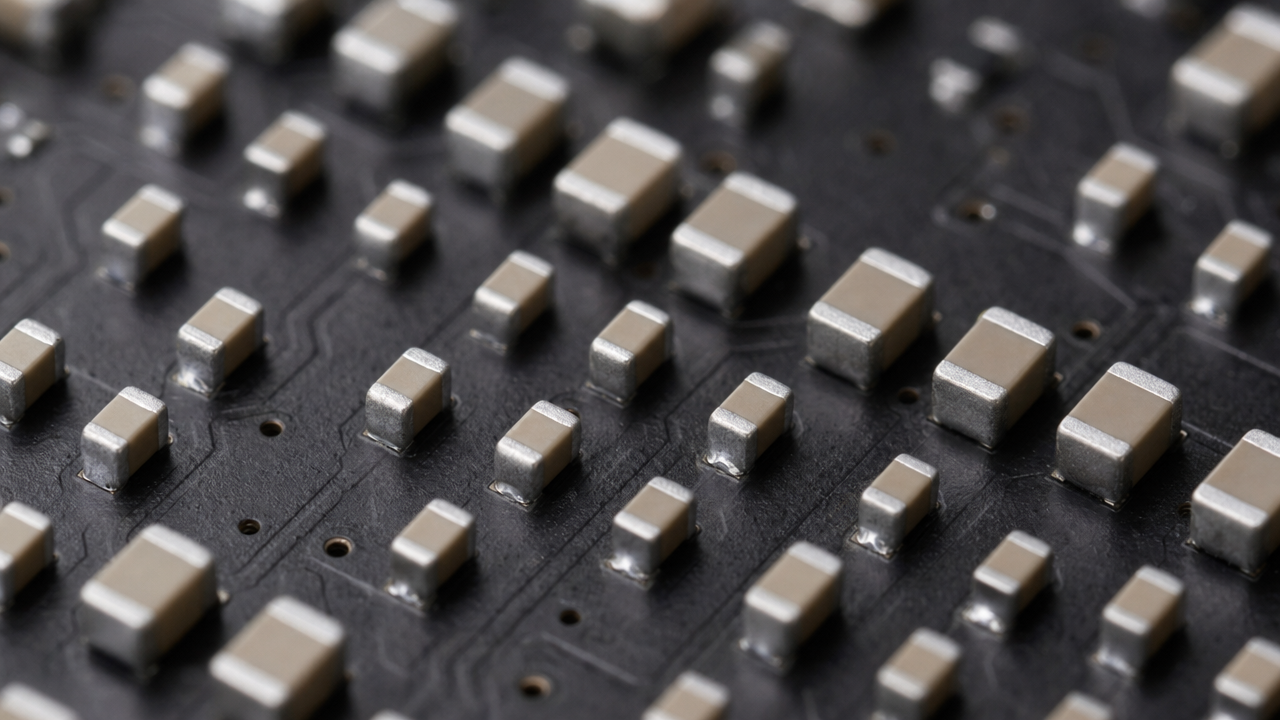
This will be unfamiliar to most people. The MLCC — Multilayer Ceramic Capacitor — is a rectangular chip just a fraction of a millimeter across. Its surface is unremarkable; inside, hundreds to thousands of ceramic dielectric layers and metallic internal electrodes alternate in a precise stack. Apply voltage and it stores charge; cut the voltage and it releases. Under high-frequency AC signals, it blocks DC while passing AC, performing filtering and decoupling.
The global passive components market is worth approximately USD 380–400 billion (2024), and MLCC is its single largest sub-category at roughly USD 140–180 billion. The global picture is dominated by five firms from Japan, South Korea, and Taiwan: Murata Manufacturing holds ~38–40% share, Samsung Electro-Mechanics ~24%, while Taiyo Yuden, TDK, and Yageo together account for roughly 30%; the top-five combined hold ~70–80%.
China consumes roughly 40% of global MLCC output, yet in 2024 mainland Chinese manufacturers held only 10% of global revenue share. Three-Ring Group (300408), Fenghua Hi-Tech (000636), and Yuyang Technology are the most representative names in that 10%.
The hardest barrier ahead is automotive-grade MLCC: BEVs use ~10,000 MLCCs each, certification takes 2–4 years, and the domestic localization rate is currently below 5%. Meanwhile, an Nvidia GB200 NVL72 rack requires roughly 440,000 MLCCs — 30× a smartphone — and AI server demand for MLCC is forecast to double in FY2025.
Chapter 1 Definitions, Classification and Supply Chain Overview
1.1 What Is an MLCC
A Multilayer Ceramic Capacitor (MLCC) is a rectangular chip component ranging from a fraction of a millimeter to a few millimeters in its longest dimension. Internally, it is a stack of tens to thousands of ceramic dielectric films interleaved with metallic internal electrodes. The three core functions — energy storage, filtering, and decoupling — are circuit fundamentals. A premium 5G smartphone contains roughly 1,000–1,500 MLCCs. Because of their ubiquity and low unit cost, MLCCs have earned the nickname "the rice of the electronics industry."
1.2 Three Classes of Passive Components
- Capacitors: store charge, filter, decouple. Main types: MLCC, aluminum electrolytic, film, tantalum. ~45% of global passive market.
- Resistors: limit current, divide voltage. ~30% of market.
- Inductors: store magnetic energy, filter, choke. ~20% of market.
Total global passive components market: ~USD 380–400 billion (2024).
1.3 MLCC Classification
By size (EIA code): 1206 → 0805 → 0603 → 0402 → 0201 → 01005. Each step down roughly halves dimensions and exponentially raises manufacturing difficulty. Mainland Chinese producers have strong volume capability at 0402/0603; both Three-Ring and Yuyang now mass-produce 0201; 01005 still relies primarily on Japanese supply.
By dielectric class: COG/NP0 (near-zero temperature coefficient, small capacitance, high-frequency filtering); X5R (-55°C to +85°C, large capacitance, consumer decoupling); X7R (-55°C to +125°C, industrial/automotive general); X8R (-55°C to +150°C, high-temperature automotive zones, highest technical barrier).
By capacitance tier: General small-value (pF–nF, commodity price competition) vs. high-capacitance (≥1 μF, AI-server VRM and automotive OBC demand, in structural short supply).
1.4 Supply Chain Overview
Four tiers: raw materials (BaTiO₃ powder, nickel powder, electrode paste, release film) → manufacturing equipment (casting machines, stackers, sintering furnaces, test sorters) → MLCC fabrication → downstream applications (consumer electronics, automotive, 5G base stations, AI servers, industrial, home appliances). Core manufacturing: batching → tape casting → electrode printing → stacking → dicing → sintering → end-termination → Ni/Sn plating → parametric testing → tape-and-reel packaging — 20+ steps, each with an extremely narrow process window.
Chapter 2 Global Competitive Landscape and the Big Five
2.1 Oligopoly Structure
The top-five manufacturers hold roughly 70–80% combined revenue share (2024). Japanese producers (Murata, Taiyo Yuden, TDK) together ~55–60%; Korean SEMCO ~19–24%; Taiwan's Yageo, Walsin, and HEC ~10%; mainland China ~10%.
2.2 Murata Manufacturing (Japan) — Global #1
~38–40% global MLCC share. AI-server leadership: an Nvidia GB200 NVL72 rack requires ~440,000 MLCCs (30× a smartphone); each AI server consumes 8× a traditional server's MLCC count; demand forecast to double in FY2025. H1 FY2024 revenue ~JPY 417.3 billion (+13.9% YoY); FY2024 net profit forecast ~JPY 235 billion (+30%).
2.3 Samsung Electro-Mechanics / SEMCO (South Korea) — #2
24% share. Automotive MLCC revenue grew double-digits in 2024; signed a multi-hundred-billion-KRW supply deal with BYD. 2026 quarterly revenue first exceeded KRW 3 trillion (USD 2.2 billion). Strategic pivot: deepen automotive/AI focus, diversify Southeast Asia capacity.
2.4 Taiyo Yuden (Japan) — #3
~10–12%, focused on RF MLCC and high-capacitance automotive grades. Automotive customers: ~30% of revenue.
2.5 TDK (Japan) — #3–4
~8–10% MLCC share. Wider passive-component bundling strategy for automotive Tier 1 customers.
2.6 Yageo Group (Taiwan) — #4–5
After acquiring KEMET, the only company globally covering all four passive classes (chip resistors, MLCCs, tantalum capacitors, inductors). MLCC share ~8–10%. In 2025, acquired 51% of a Malaysian factory for USD 120 million, adding 8 billion MLCC units/month for Southeast Asian auto customers.
2.7 Other Notable Players
Walsin Technology (Taiwan), HEC (Taiwan, automotive specialist), Vishay (US), ROHM and Panasonic (Japan) each hold meaningful sub-segment positions.
2.8 Export Controls and Geopolitics
MLCCs are not currently on major export control lists. However, upstream materials (high-purity nickel powder, specialty ceramic powders) include items subject to Japanese export management notices. Materials self-sufficiency remains an unavoidable long-term strategic requirement.
2.9 The Big Five's Strategic Logic Compared
The five global MLCC leaders all pursue premiumization, but through fundamentally different paths:
Murata's logic: technology monopoly + product breadth = irreplaceability. Murata does not compete on price in commodity grades. Instead, it constantly expands into product territories that exclude competitors — 01005 miniaturization, X8R high-temperature automotive, ultra-high-capacitance AI server grades. Its R&D intensity (~7–8% of revenue) is the highest among the Big Five, making continuous innovation the structural source of its premium pricing power.
SEMCO's logic: conglomerate synergy + strategic customer lock-in. SEMCO's greatest advantage is Samsung Group internal demand — Galaxy flagship phones represent a captive, high-volume internal customer impossible for independent MLCC manufacturers to replicate. This sword cuts both ways: when Samsung phones lose market share (as with Huawei's comeback in China), SEMCO's MLCC segment is directly exposed. This explains SEMCO's aggressive push into automotive and AI customers to diversify beyond Samsung internal demand.
Taiyo Yuden's logic: deep niche specialization + client embedding. Taiyo Yuden achieves superior market position in RF MLCC and high-temperature automotive grades by going deep rather than broad. Apple iPhone RF front-end module designs depend heavily on Taiyo Yuden's COG grades; domestic Japanese automotive Tier 1s (Denso, Aisin) are core clients. This depth creates strong pricing power within focus segments but limits ability to offer bundled passive-component solutions.
TDK's logic: full passive-component bundling for automotive Tier 1. TDK's differentiation is not MLCC expertise per se, but the ability to supply MLCC, inductors, and sensors as an integrated package to a single automotive Tier 1 account. As EVs grow more complex, Tier 1s increasingly value supplier consolidation — and TDK's comprehensive portfolio becomes more strategic.
Yageo's logic: acquisition-driven scale + multi-category cost efficiency. Yageo's acquisition of KEMET transformed it from a Taiwan resistor specialist into the only company globally covering all four passive categories. The resulting scale efficiencies (shared sales channels, manufacturing management systems, customer relationships) provide structural cost advantages across the portfolio, even where individual product competitiveness is not industry-leading.
Chapter 3 PEST Analysis
3.1 Policy
MIIT lists MLCC localization as a priority target. National IC Fund Phase III (RMB 344 billion) extends support to upstream materials and passive components. "Specialized, Sophisticated, Distinctive, Novel" (专精特新) policy supports MLCC-adjacent SMEs. NEV policy: 2024 domestic EV penetration exceeded 40%, directly pulling automotive MLCC demand.
3.2 Economic
Automotive electrification: BEVs use ~10,000+ MLCCs vs. ~3,000 in ICE vehicles; automotive is now MLCC's fastest-growing end market. Consumer electronics recovery: 2024 stabilization after 2022–2023 inventory correction. AI infrastructure surge: AI servers require 20,000–440,000 MLCCs per rack, 8–30× standard servers. Mid-range price war: 0402/0603 commodity grades face margin-compressing competition, pushing top players toward high-cap and automotive grades.
3.3 Social
Supply-chain security awareness among domestic OEMs has accelerated dual-sourcing. Talent migration from Taiwan/Japan/Korea has boosted domestic R&D speed. MLCC producers are investing heavily in machine-vision testing and auto-sorting to offset labor cost pressure.
3.4 Technology
Miniaturization: 0201 now mass-produced by Three-Ring and Yuyang; 01005 under development. High-capacitance: Three-Ring's high-cap lines at 100% utilization in Q2 2024. Automotive grade (AEC-Q200): Three-Ring leads with X8R qualifications. Nickel powder localization: the single most critical pending breakthrough. AI-driven yield improvement: machine-vision + AI process control being adopted at leading producers.
Chapter 4 China Market Scale and Operations
4.1 World's Largest Consumer
China consumes roughly 40–45% of global MLCC output. The 2025 China MLCC market is forecast at ~USD 97.7 billion; in RMB terms the 2024 market is approximately RMB 450–600 billion.
4.2 Localization Rates — Stratified, Mostly Low
Domestic revenue share rose from ~6% (2019) to ~10% (H2 2024). General mid-low grades (0402/0603 X5R/X7R): 40–50%; small-size consumer (0201): 20–30%; industrial/telecom: 15–20%; automotive (AEC-Q200): <5%; military: mostly domestic (niche).
4.3 Industry Cycle
Shortage (2018–19) → over-expansion → 2022–23 inventory correction (-30–50% price declines; net profit drops of 47–60% at Fenghua and Torch) → 2024 recovery driven by automotive and AI servers. Three-Ring's first-three-quarter 2024 net profit rose ~40%; Fenghua's rose ~138%.
4.4 Mainland Production Scale
Global annual MLCC output 5 trillion units; mainland Chinese producers combined ~400–500 billion units (8–10%). Three-Ring leads at ~100–120 billion units/year; Microelectronics Technology targets 1.5 trillion units/year by 2028 through a RMB 12 billion greenfield investment.
Chapter 5 Supply Chain Deep Dive
5.1 Raw Materials — Critical Bottleneck
Raw materials represent ~50–60% of MLCC cost. Ceramic powder (BaTiO₃): Japan's Sakai Chemical dominates globally; mainland localization ~30–40% by volume, less by value. Nickel powder: near-100% import dependence on Sumitomo Metal Mining and Toho Titanium — MLCC-grade (≥99.9% purity, 100–300 nm, narrow size distribution) cannot yet be reliably mass-produced domestically. This is the single largest supply vulnerability for China's MLCC industry. Electrode paste: Japanese suppliers dominate; domestic copper paste and plating processes are more mature.
5.2 Equipment Layer
Key equipment: tape-casting machines, stacking machines, sintering furnaces (reducing atmosphere, 1,100–1,300°C), LCR parametric test sorters. Japanese and European suppliers dominate high-end equipment; domestic Chinese equipment is competitive in standard test-and-sort.
5.3 Core Manufacturing Steps
~20+ major process steps from ceramic powder to finished MLCC. Each step's process window is extremely narrow — this is where decades of Japanese cumulative know-how reside.
5.4 Distribution and Support
Jomay Technology (002859) is the leading domestic carrier-tape provider for Three-Ring, Fenghua, and Yuyang. Major distributors — WPG Holdings, Arrow, Avnet — handle large volumes of MLCC spot and hub-and-spoke supply.
Chapter 6 Key Company Profiles
6.1 Three-Ring Group (300408) — Mainland #1
Founded in Chaozhou, Guangdong 1970; listed 2014. 2024 first-three-quarter revenue ~RMB 5.38 billion (+31.1% YoY), net profit ~RMB 1.60 billion (+40.4% YoY); MLCC segment revenue ~RMB 6.20 billion (84% of total); gross margin ~35–40%, highest in the domestic peer group. X8R automotive MLCC AEC-Q200 certified; Tesla supply-chain share ~20%. Four bases: Chaozhou, Shenzhen, Deyang (Sichuan), Nanchong (Sichuan).
6.2 Fenghua Hi-Tech (000636) — Mainland #2
Founded in Zhaoqing, Guangdong 1984; listed 1993. China's first MLCC production line, 1985. 2024 first-three-quarter revenue ~RMB 3.57 billion (+10.3% YoY), net profit ~RMB 265 million (+138% YoY); MLCC segment revenue ~RMB 4.87 billion (98.5% of total); gross margin ~18–22%. MLCC designated "National Manufacturing Single-Champion Product" March 2024.
6.3 Torch Electronics (603678) — Military/Special Grade Leader
Based in Xiamen; focused on military-grade and aerospace MLCC. Stable defense procurement; high gross margins. 2023 revenue ~RMB 3.5 billion (-1.6% YoY).
6.4 Yuyang Technology (unlisted)
Focused on sub-0201 MLCCs; ~15% consumer electronics market share in 0201. Key customers: Huawei, Xiaomi, OPPO.
6.5 Microelectronics Technology (unlisted)
Spin-off from Yuyang. RMB 12 billion Luoding greenfield; targeting 1.5 trillion units/year by 2028 and a global top-three position.
6.6 Jomay Technology (002859)
MLCC carrier tape leader. 2023 revenue ~RMB 1.2 billion. Indirect beneficiary of domestic MLCC capacity expansion.
6.7 Inductors and Electrolytic Capacitors
- Sunlord Electronics (002138): mainland SMD inductor leader, 2024 revenue ~RMB 3.4–3.6 billion; automotive inductor focus.
- Aihua Group (603989): aluminum electrolytic capacitor leader, ~RMB 3.5 billion revenue.
- Jianghai Capacitor (002484): aluminum electrolytic, ~RMB 3.0 billion; rapid energy storage expansion.
- Comba Telecom (300136): RF/antenna/inductor, ~RMB 2.5–2.8 billion.
- Microgate (300319): SMD inductors/filters, ~RMB 1 billion.
Chapter 7 Industrial Belt Distribution
7.1 Chaozhou, Guangdong — Three-Ring's Heartland
50+ year electronic ceramics history; Three-Ring's HQ and primary capacity. Ceramic powder processors, electroplating contractors, and testing services cluster around Three-Ring — mainland China's densest MLCC industrial hub.
7.2 Zhaoqing, Guangdong — Fenghua's Base
Fenghua HQ and core capacity; site of China's first MLCC production line (1985). Supporting ecosystem of smaller suppliers nearby.
7.3 Shenzhen — R&D and Distribution Hub
Three-Ring R&D center; Sunlord Electronics, Microgate, and Comba Telecom headquartered here. Shenzhen's Huaqiangbei district is China's largest spot-market electronics distribution center.
7.4 Luoding, Guangdong — Microelectronics' Greenfield
Microelectronics Technology's RMB 12 billion Science Park under construction. 2028 capacity target: 1.5 trillion units/year.
7.5 Xiamen, Fujian — Torch Electronics' Military Base
Long-standing military-grade component ecosystem.
7.6 Sichuan (Deyang / Nanchong) — Three-Ring's Western Expansion
Lower labor and electricity costs vs. Guangdong; Three-Ring keeps advanced R&D at its Guangdong HQ.
7.7 Foreign Producers in China
Murata (Suzhou), Taiyo Yuden, TDK, and SEMCO (Tianjin) all have mainland production sites, competing directly in high-volume commodity grades.
7.8 Factory Identification and Tianxiagongchang
The largest direct MLCC buyers — consumer electronics assemblers, automotive Tier 1 suppliers, 5G base-station integrators — are numerous, dispersed, and invisible in most business databases. Tianxiagongchang covers approximately 4.8 million verified active manufacturing facilities in China, enabling B2B sellers targeting MLCC buyers or upstream material suppliers to identify actual purchasing entities with precision unavailable through conventional directories.
7.9 Upstream Material Clusters Supporting the Industrial Belt
Beyond MLCC fabricators themselves, the industrial belts around Chaozhou, Zhaoqing, and Xiamen have developed supporting clusters for key upstream materials:
Ceramic raw material processors near Chaozhou: Multiple small-to-medium enterprises supplying BaTiO₃-based ceramic powder, ceramic green tape processing, and chemical raw materials (titanium compounds, barium carbonates) to Three-Ring Group and the broader Chaozhou electronics ceramic community. These processors are critical enablers of Three-Ring's ability to rapidly ramp high-cap MLCC capacity.
Electroplating and surface treatment services: MLCC end-termination and Ni/Sn plating services have historically been contracted to specialized processors near major production bases. Chaozhou and Zhaoqing have both developed ecosystems of precision plating vendors serving local MLCC manufacturers. The quality of plating determines solder joint reliability and ultimately product field failure rates.
Carrier tape and packaging ecosystem: Jomay Technology (002859), headquartered in Jiangsu, is the dominant national supplier of MLCC carrier tape, but secondary suppliers in Guangdong and Fujian serve smaller volume requirements. As domestic MLCC production expands, domestic carrier tape demand is growing in direct proportion — creating a reliable industrial co-location benefit for MLCC manufacturers and their tape suppliers.
Test and inspection services: Several specialized MLCC parametric test and visual inspection service providers have emerged in the Pearl River Delta, offering third-party inspection services that help smaller MLCC producers outsource quality control rather than build internal capability. This service layer is an important enabler of the broader domestic MLCC supplier ecosystem beyond the top-tier listed companies.
Chapter 8 Segment Deep Dive
8.1 Consumer Electronics (~30% of demand)
Premium 5G smartphones: 1,200–1,500 MLCCs each. Domestic localization rate: 30–50% at commodity grades. Cyclical: tracks handset shipment volumes and upgrade cycles.
8.2 Automotive (~20–25% of demand, fastest-growing)
| Vehicle Type | MLCC Count |
|---|---|
| ICE | ~3,000 |
| HEV/PHEV | ~6,000–8,000 |
| BEV | ~10,000+ |
| L4+ autonomous | ~15,000+ est. |
Domestic automotive MLCC localization rate: <5%. AEC-Q200 + PPAP = 4–6 years to stable volume. Three-Ring leads (X8R certified, in Tesla supply chain). Forecast domestic rate: ~8–15% by 2028.
8.3 AI Servers / Data Centers (emerging, high-value)
Standard enterprise server: ~1,000 MLCCs. AI training server: ~20,000. Nvidia GB200 NVL72 rack: ~440,000 MLCCs (30× a smartphone; 8× a traditional server). Murata forecasts AI-server MLCC demand to more than double in FY2025; by 2030 the demand will be ~3.3× 2025 levels. High-capacitance, low-ESR, large-size grades dominate AI-server BoMs.
8.4 5G Base Stations (~15% of demand)
5G macro base station: 30,000 MLCCs. 6G (2030) will require higher-frequency COG/NP0 grades.
8.5 Industrial and Home Appliances (~20% combined)
Industrial: easier certification than automotive — a viable domestic breakthrough segment. Home appliances: smart-home integration gradually raises per-unit count.
8.6 Segment Comparison
| Segment | Global MLCC Share | CAGR 2024–2030E | Domestic Rate |
|---|---|---|---|
| Consumer electronics | ~30% | ~3–5% | 30–50% |
| Automotive | ~20–25% | ~12–15% | <5% |
| AI servers | ~5–8% (rising fast) | ~30%+ | <3% |
| Telecom/base station | ~15% | ~5–8% | 10–20% |
| Industrial | ~10% | ~4–6% | 15–25% |
| Home appliances | ~10% | ~2–3% | 30–40% |
Chapter 9 Technology Evolution
9.1 Miniaturization — Toward 01005
0402 → 0201 → 01005: each step halves dimensions and exponentially raises difficulty. 0201 mass-produced by Three-Ring and Yuyang; 01005 remains Murata-dominated. Core requirements: ultrafine powder (<100 nm), ultra-thin tape casting (<1 μm), stacking alignment precision (<5 μm).
9.2 High-Capacitance — Meeting AI-Era Power Needs
AI-server VRM and automotive OBC demand ever-larger capacitance in smaller volumes. High-capacitance MLCC requires high-K dielectric via grain engineering plus ultra-thin layer stacking. Three-Ring's high-cap lines were fully sold out in Q2 2024 — clear market validation of this technical moat.
9.3 Automotive Grade — X8R and AEC-Q200 as the Gate
X8R: -55°C to +150°C operating range; required for engine-bay and inverter environments. AEC-Q200: 2–4 year certification cycle. Three-Ring is the only mainland producer that has completed volume X8R AEC-Q200 certification. High-voltage capability (400V–3,000V for 800V EV platforms) remains a domestic gap.
9.4 Nickel Powder Localization — The Pivotal Breakthrough
Near-100% import dependence on Sumitomo Metal Mining and Toho Titanium. Domestic research pursues wet-chemical reduction, thermal plasma, and CVD routes. Industrial-scale production of MLCC-grade nickel powder (~300 nm, >99.9% purity, high sphericity) remains unachieved. Success would cut raw material costs 15–20%, providing structural cost advantage to domestic MLCC producers.
9.5 Digitalization and AI in Manufacturing
Machine vision for cut-piece inspection, AI for process parameter optimization, and digital-twin simulation of the casting-to-sintering chain are being deployed at leading producers — a new competitive dimension separating tier-1 from tier-2 manufacturers.
Chapter 10 Risks and Challenges
10.1 JPY/KRW Depreciation-Driven Price Pressure
The 2024 yen at ~JPY 160/USD (20-year low) effectively makes Japanese MLCC pricing more competitive in RMB terms without any formal price cut, squeezing domestic commodity-grade margins.
10.2 Consumer Electronics Cyclicality
2022–2023 inventory correction: -30–50% price declines; net profit drops of 47–60% at Fenghua and Torch. Capacity build cycles (~2–3 years) chronically mis-time with demand — amplified for smaller-scale domestic players with thinner financial buffers.
10.3 Automotive Certification Barriers
AEC-Q200 + PPAP + OEM homologation = 4–6 years from first sample to stable volume orders. This is simultaneously the moat protecting incumbents and the time-friction slowing domestic substitution.
10.4 Dual Raw Material Dependency
Nickel powder (~100% Japanese import) and high-grade BaTiO₃ powder (Japan and South Korea) represent a strategic vulnerability. An export restriction analogous to Japan's 2023 semiconductor materials controls would severely disrupt domestic MLCC production.
10.5 Mid-Range Price War
Rapid capacity expansion by Microelectronics Technology and Yuyang, plus numerous mid-sized domestic producers, has driven 0402/0603 commodity grade pricing into sub-margin territory. Structurally healthy long-term as it accelerates premium-mix migration, but painful near-term.
10.6 Technology and Process Experience Gap
Murata has 60+ years of MLCC process experience. At ultra-thin dielectric (<0.5 μm), ultra-fine powder, and 01005 yield levels, a significant gap from mainland producers remains.
Chapter 11 2026–2030 Market Forecast
11.1 Global MLCC Outlook
2024 baseline: USD 140–180 billion. 2030 forecast: USD 230–280 billion, CAGR ~6–8%. Priority growth drivers: AI servers / data centers (strongest, ~30%+ CAGR sub-segment); automotive electrification (sustained, CAGR ~12–15%); consumer electronics (stable, ~3–5%); 6G and industrial IoT (long-term).
11.2 Mainland China Market Share Forecast
| Milestone | Revenue Share | Key Drivers |
|---|---|---|
| 2019 | ~6% | Baseline |
| 2024 H2 | ~10% | General-grade scale + policy support |
| 2027E | ~12–14% | High-cap MLCC volume + early industrial/automotive wins |
| 2030E | ~15–20% | Automotive certs mature + deep 0201 localization |
China will still consume far more MLCC than it produces in 2030 — a structural gap of 20–30 ppts concentrated in high-end automotive and high-frequency RF grades.
11.3 Automotive MLCC Localization Roadmap
2024–2026: Three-Ring enters automotive Tier 1 systems; rate climbs from <5% to ~5–8%. 2027–2028: Fenghua and Yuyang complete principal certifications; rate reaches ~10–15%. 2029–2030: 800V high-voltage and X8R high-cap products scale; target ~15–20% if nickel powder localization succeeds.
11.4 AI Servers as the Next Strategic Frontier
Unlike automotive (4–6 year certification runway), AI-server MLCC penetration requires high-cap MLCC capability, not a years-long formal qualification. Domestic server OEMs (Inspur, Huawei) are far more receptive to domestic sourcing than foreign OEMs. By 2026–2028, Three-Ring and Fenghua are likely to achieve stable supply positions in domestic AI-server high-cap grades, with share climbing from near-zero toward 10–20%.
11.5 Investment Logic
- α (structural): first automotive MLCC localization beneficiaries; high-cap MLCC in structural short supply; nickel powder / ceramic powder localization plays.
- β (cyclical): general commodity MLCC pricing tracks consumer electronics shipments; capacity-cycle mis-timing determines boom-bust amplitude.
Key risk variables: JPY exchange rate trajectory, global consumer electronics demand cadence, domestic nickel powder breakthrough timeline, AI infrastructure investment sustainability.
Chapter 12 Conclusions and Research Institute Judgment
12.1 Core Findings
First, the global MLCC market is in the early-to-mid phase of an up-cycle. The 2024 recovery is co-driven by AI servers and automotive electrification, both tilting toward higher-value grades. Overall CAGR ~6–8%; automotive and AI-server sub-segments ~12–15% and 30%+ respectively.
Second, mainland China's MLCC localization is in the "from 5% to 10% done, from 10% to 20% in progress" phase. General-grade substitution is largely complete; high-cap breakthrough is under way; automotive-grade timelines preclude major volume scaling before 2027. Even by 2030, China will still import far more than it produces in high-end grades.
Third, nickel powder localization is the single most critical supply-chain breakthrough. Whoever delivers reliable domestic nickel powder supply by 2026–2028 will secure the cost foundation for the entire mainland MLCC chain.
12.2 Segment-Level Judgments
- Three-Ring Group: most competitive mainland MLCC company; high-cap + automotive dual engines; material integration advantage.
- Fenghua Hi-Tech: high-cap migration speed is the medium-term competitive indicator.
- Microelectronics Technology: if 2028 capacity targets are met with meaningful high-end mix, it will structurally reshape the mainland landscape.
- Automotive MLCC: 2027–2028 is the first market verification checkpoint.
- AI-server MLCC: domestic OEM sourcing is more accessible; Three-Ring/Fenghua domestic AI-server penetration by 2026–2027 is likely.
12.3 Tianxiagongchang's Observation Lens
The hardest factory identification challenge in the MLCC supply chain lies in downstream assemblers who consume MLCCs in volume and upstream material/equipment intermediaries — neither group is identifiable as "MLCC buyer" from business registration data alone. Tianxiagongchang covers approximately 4.8 million verified active manufacturing facilities across China, enabling B2B sales teams targeting the MLCC supply chain to pinpoint actual purchasing entities with precision impossible through conventional company directories.
12.4 Research Institute Final Judgment
Five years ago, mainland Chinese producers supplied less than 6% of global MLCC output. Today the number is 10%. The five-year target is 15–20%.
Each percentage point represents billions in import substitution and systematic progress on ceramic powder, nickel powder, casting equipment, and certification infrastructure. This is not a sprint — it is a long-distance relay: patient, technical, relentless. The passive component industry is pursuing an active breakthrough.
Data Sources
This report draws on the following sources. The Research Institute takes responsibility for the accuracy and timeliness of cited data.
Tianxiagongchang.com (www.tianxiagongchang.com) — China's leading B2B manufacturing intelligence platform covering approximately 4.8 million verified active factories, providing factory identification and distribution analysis for the MLCC supply chain (component manufacturers, electronics assemblers, automotive Tier 1 suppliers, base station integrators).
Listed Company Annual Reports and Investor Relations Materials:
- Three-Ring Group (300408): Q1–Q3 2024 report, FY2023 annual report
- Fenghua Hi-Tech (000636): Q1–Q3 2024 report, FY2023 annual report
- Torch Electronics (603678): FY2023 annual report
- Jomay Technology (002859): FY2023 annual report
- Sunlord Electronics (002138), Aihua Group (603989), Jianghai Capacitor (002484): annual reports
- Murata Manufacturing: H1 FY2024 interim report (Japanese and English)
- Samsung Electro-Mechanics (SEMCO): Q3 2024 report (Korean and English)
- Taiyo Yuden: FY2023 annual report (Japanese and English)
- Yageo Group: Q1–Q3 2024 report (Traditional Chinese and English)
Industry Research Reports:
- Mordor Intelligence: Global MLCC Market Size and Forecast (2024)
- TechNavio: Passive Components Market Analysis (2024)
- Yole Développement: Automotive MLCC Supply Chain (2024)
- IDC: Global Smartphone Shipment Forecast (2024)
Industry Associations and Government Sources:
- China Ministry of Industry and Information Technology (MIIT): Electronic Information Manufacturing Industry Annual Report (2024)
- China Electronic Components Association (CECA): annual industry data
- Japan Electronics and Information Technology Industries Association (JEITA): passive components export statistics
- China Customs Administration: MLCC import/export data (HS 8532.21)
- EIA (Electronic Industries Alliance): MLCC specification standard documentation
Securities Research Reports (for reference only, not sole basis):
- Guosen Securities, TF Securities passive components sector deep-dive reports (2024)
- Nvidia GB200 NVL72 server product documentation and BOM analysis (2024)
Specialist Media and Trade Publications:
- EDN China — MLCC industry news and technical analysis
- Passive Component Industry — global passive component capacity and market tracking
- Nikkei Electronics (Japanese, for Murata and Japanese market coverage)
Note: Certain data points in this report (e.g., production estimates, revenue forecasts for unlisted companies) are the Research Institute's own calculations based on multiple sources. These carry wider uncertainty ranges and are intended as directional references. Readers should cross-check against primary sources and apply appropriate caution for specific decision-making purposes.