
2026 China Passenger Vehicle Industry In-Depth Research Report
Author: factory data platforms Industrial Research Institute Published: May 2026 Disclaimer: Data in this report are sourced from public materials, listed-company annual reports, and industry association statistics. It is for professional reference only and does not constitute investment advice.
Executive Summary
The automobile is the ultimate test of an industrial system's maturity. Steel strength, battery energy density, chip computing power, and software intelligence — all ultimately converge in a vehicle and face the market's verdict. In 2025, China's auto production and sales both exceeded 34 million units, with production of 34.531 million units (+10.4% YoY) and sales of 34.4 million units (+9.4% YoY), setting a new record for the 17th consecutive year as the world's largest single auto market (CAAM). New energy vehicle (NEV) production and sales both exceeded 16 million units (production: 16.626 million units, +29%; sales: 16.49 million units, +28.2%), with full-year retail passenger car NEV penetration averaging approximately 53–54% and breaching 60% in December. China exported 7.098 million vehicles (+21.1%), retaining the top spot globally for the second consecutive year. Behind these numbers lies a decade-long industrial revolution approaching its climax: domestic brand passenger car market share (including exports) reached approximately 70%, joint-venture brands continued their decline, and combustion-engine vehicles became the minority in the passenger car retail market.
Electrification in deep water, the year of mass intelligent driving adoption, and a new overseas battleground — these define 2025 in China's automotive industry. BYD (002594) delivered 4.6024 million units (+7.73%), retaining its position as China's and the world's top NEV maker; revenue reached RMB 803.96 billion (+3.46%), net profit RMB 32.62 billion; overseas sales surpassed 1.05 million units (covering 119 countries). Geely delivered 3.0246 million units (+39%), exceeding its 300,000-unit annual target. Among new-force brands, Leapmotor (9863.HK) topped the new-force annual rankings with approximately 600,000 units and achieved its first-ever full-year profitability; Xiaomi Automotive delivered 411,000 units with a 2026 target of 550,000; Li Auto declined to approximately 406,300 units (-18.81%) amid product restructuring; SAIC Group completed a historic turnaround with 4.507 million units and net profit up +506%. The EU confirmed a "price undertaking" framework to replace the high anti-subsidy tariffs, while US cumulative tariffs on Chinese vehicles reached 137.5%, creating a divergent overseas policy environment.
This report uses FY2025 full-year actuals as its baseline and systematically presents the full picture of China's passenger vehicle industry, with professional projections for 2026–2030.
Five Core Conclusions:
The historic dominance of domestic brands is irreversibly established. The 65% (including exports) / 55%+ (domestic) market share of domestic brands in 2024 reflects not a single policy driver but the convergence of three structural factors: first-mover advantage in electrification, leadership in intelligentization configurations, and systematic price-competitive pressure. Joint-venture brands' room for recovery is extremely limited; non-BEV/PHEV JV product lines can no longer compete head-on with domestic brands in China's core price segments.
The 50% NEV penetration breakthrough is qualitative, not quantitative. Five consecutive months above 50% in the second half means ICE vehicles have formally become the minority in the passenger car market. REEV/PHEV have served as a crucial bridge eliminating "range anxiety" for many consumers, while 800V ultra-fast charging commercialization from 2026-2027 will finally close the refueling convenience gap.
Exporting is China's new historic automotive challenge, with risks and opportunities in equal measure. Exporting 6.41 million units to lead globally represents a product competitiveness victory, but EU tariffs (+17%-35.3%), US blockade (100% tariffs), and Turkey/Brazil surcharges mean the pure-export model faces structural challenges. The core proposition of 2026-2030 is "overseas factory building + brand localization," requiring capital, management, and legal compliance capabilities — a cycle of at least 5-10 years.
Intelligentization has become the essential competitive dimension for vehicles under RMB 300,000. The 2024 mass deployment of city NOA, Qualcomm Snapdragon 8295 cockpit chips, and LLM-based voice assistants in vehicles priced above RMB 200,000 shows that intelligent competition has moved from flagship models into the mass market. Advanced ADAS becoming standard in the RMB 150,000-200,000 price band will be the next mass adoption milestone.
Price wars and overcapacity will drive a market shakeout in 2026-2028. Approximately 10 million units of excess capacity and 227 price-cut models foreshadow a consolidation wave similar to China's appliance/LCD panel sectors of 2000-2010. The outcome is not industry decline but rising concentration: the BYD/Geely/Chery/Changan leading structure will be further reinforced.
Key Data at a Glance (FY2025):
- China auto production/sales 2025: 34.531M units (+10.4%), 34.4M units (+9.4%) (CAAM)
- NEV sales: 16.49M units (+28.2%), 47.9% of total auto sales (incl. commercial vehicles); retail passenger car penetration ~53–54% full-year avg, breached 60% in December (CPCA)
- BEV: ~58–60% of NEV; PHEV/REEV: ~40–42% (double-digit growth maintained)
- Domestic brand passenger car share: ~70% (incl. exports, CAAM), new record
- Vehicle exports: 7.098M units, +21.1%, global No. 1 (2nd consecutive year)
- BYD: revenue RMB 803.96B (+3.46%), net profit RMB 32.62B (-18.97%, R&D RMB 63.4B), sales 4.602M units (+7.73%), overseas 1.05M units (119 countries)
- Geely: 3.025M units (+39%); Changan 2.913M units (+8.5%); Chery 2.806M units (+7.8%); GWM 1.324M units (+7.33%)
- SAIC Group 4.507M units (+12.3%), net profit RMB 10.106B (+506%); GAC 1.722M units (under pressure)
- New forces: Leapmotor ~600K units (first full-year profit); Xiaomi 411K units; Li Auto 406K units (-18.81%); NIO 326K units (+49%); Xpeng 429K units (+126%); AITO ~420K units
- EU "price undertaking" framework confirmed (early 2026), replacing high anti-subsidy tariffs; US cumulative tariff on Chinese vehicles reached 137.5%
- High-end NOA (urban) penetration: ~15–20% (2025, roughly doubled vs. 2024)
- Tesla Optimus V3: mass production launch 2026 mid-year, target annual capacity 50,000 units by end-2026
- 2030E forecast: NEV penetration 70–76%, exports 1,000M+ units, ~70% of new cars with advanced assisted driving.
Chapter 1 Definitions, Classification and Industrial Chain Overview
1.1 The Automobile: Definition of the Mother of Manufacturing
The automobile is typically defined as a non-rail vehicle powered by an engine and driven on roads or surfaces, carrying up to 9 passengers (passenger car), 10 or more passengers (bus), or goods (truck). A mass-produced sedan contains approximately 30,000 components, spanning metallurgy, chemicals, rubber, glass, electronics, software, and textiles. The VDA (German Association of the Automotive Industry) found that every job in the auto sector supports 7-9 related jobs upstream and downstream. This extreme supply chain breadth explains why the automobile is called the "mother of manufacturing."
The rise of NEVs has expanded this definition further: in addition to traditional mechanical components, the traction battery (energy storage), the drive motor (energy conversion), and the power electronics control system (energy management) have been added — transforming the automobile from a mechanical product into an electro-mechanical-digital product, with Software Defined Vehicle (SDV) becoming the dominant industry narrative.
1.2 Classification by Powertrain
Battery Electric Vehicle (BEV): Pure electric drive, no ICE. Approximately 60% of 2024 NEV sales. Representative models: BYD Seagull/Seal, Tesla Model 3/Y, Xpeng G9, NIO ET5, Xiaomi SU7.
Plug-in Hybrid Electric Vehicle (PHEV): Both ICE and drive motor, externally chargeable, approximately 60-150 km pure-electric range. Representative: BYD DM series, Geely Leishen hybrid, Changan Deepal.
Range-Extended EV (REEV): Motor drives wheels; ICE acts solely as generator. No range anxiety. Representative: Li Auto L6/L7/L8/L9, AITO M5/M7/M9 range-extended, Leapmotor C11/C16 range-extended.
HEV: Not externally chargeable; not counted in China NEV statistics. Toyota (Corolla/Camry Dual Engine), Honda e:HEV are representatives. HEV's competitive advantage is being rapidly eroded by PHEV.
ICE Vehicle: Share in China's passenger car retail fell to approximately 52.4% in 2024 (CPCA), with multiple months below 50% in 2025.
Fuel Cell EV (FCEV): Hydrogen-powered, primary application in commercial vehicles; passenger FCEV remains small-scale domestically.
1.3 Classification by Brand Affiliation
China's auto market divides into four camps, with historic structural shifts in 2024:
Domestic brands (new EV startups + traditional domestic): BYD, Li Auto, NIO, Xpeng, Leapmotor, AITO (Seres+Huawei), Xiaomi; traditional domestic: Geely, Changan, Great Wall, Chery, GAC Trumpchi/AION, SAIC Roewe/MG/IM, BAIC ARCFOX, Dongfeng Voyah.
Joint-venture brands: SAIC-VW, SAIC-GM (Buick/Chevrolet/Cadillac), FAW-VW (VW/Audi), GAC Toyota, FAW Toyota, GAC Honda, Dongfeng Nissan, BAIC Hyundai. JV brand share fell below 35% in 2024 for the first time — a precipitous drop from its 60%+ peak.
Foreign wholly-owned brands: Tesla's Shanghai Gigafactory (100% wholly owned); BMW seeking to raise its JV stake to 75%.
Exited or shrinking brands: FCA China JV has exited; Suzuki left in 2018; Renault reduced to commercial vehicles; Mitsubishi announced exit in 2023; Ford and Nissan severely contracted.
1.4 Classification by Vehicle Segment
- Passenger Vehicle (PV): Sedan, SUV, MPV, Sports Car. SUVs now account for approximately 55% of passenger car sales.
- Commercial Vehicle (CV): Buses, trucks (including pickup trucks), mini-vans. Electrification progresses more slowly; battery-swapping heavy trucks are the current breakthrough.
1.5 Industrial Chain Overview: From Raw Materials to Users
Upstream raw materials and key components:
- Steel (55-65% of vehicle weight): BAOWU, ANSTEEL for high-strength automotive steel
- Aluminum alloy (BEV uses 1.5-2x more than ICE): Wencan (603348), Xusheng (603305) for aluminum die-casting
- Rubber (tires/sealing): Linglong (601966), Sailun (601058), Zhongce (000040) domestically
- Glass: Fuyao Glass (600660) — global No. 2, ~28% global share
- Modified plastics: ~15% of vehicle weight; Kingfa Science (600143), Pret (002324)
- Electronics/chips: Qualcomm cockpit chip, NVIDIA ADAS chip, Horizon Robotics (domestic ADAS), Renesas ECU
- Traction battery (NEV-specific, ~30-40% of BOM cost): CATL (300750) ~37% global share; BYD FinDreams ~15%; China combined ~63-65% globally
- Drive motor (NEV-specific): BYD (in-house), Inovance (300124), Founder Motor (002196)
- Power electronics (NEV-specific): SiC MOSFET for 800V platforms; Infineon/onsemi dominant globally; BYD Semiconductor/Starpower (603290) domestically
Midstream OEM assembly: ~100+ OEMs in China, sales concentrated among top 20; domestic brands hold ~65% share (2024, including exports).
Downstream distribution and services: Dealerships (4S stores / direct-sales); auto finance; aftersales; charging/battery-swapping infrastructure (~3.4 million public charging points in 2024, ~45,000 battery-swap stations).
1.6 Core Manufacturing Processes
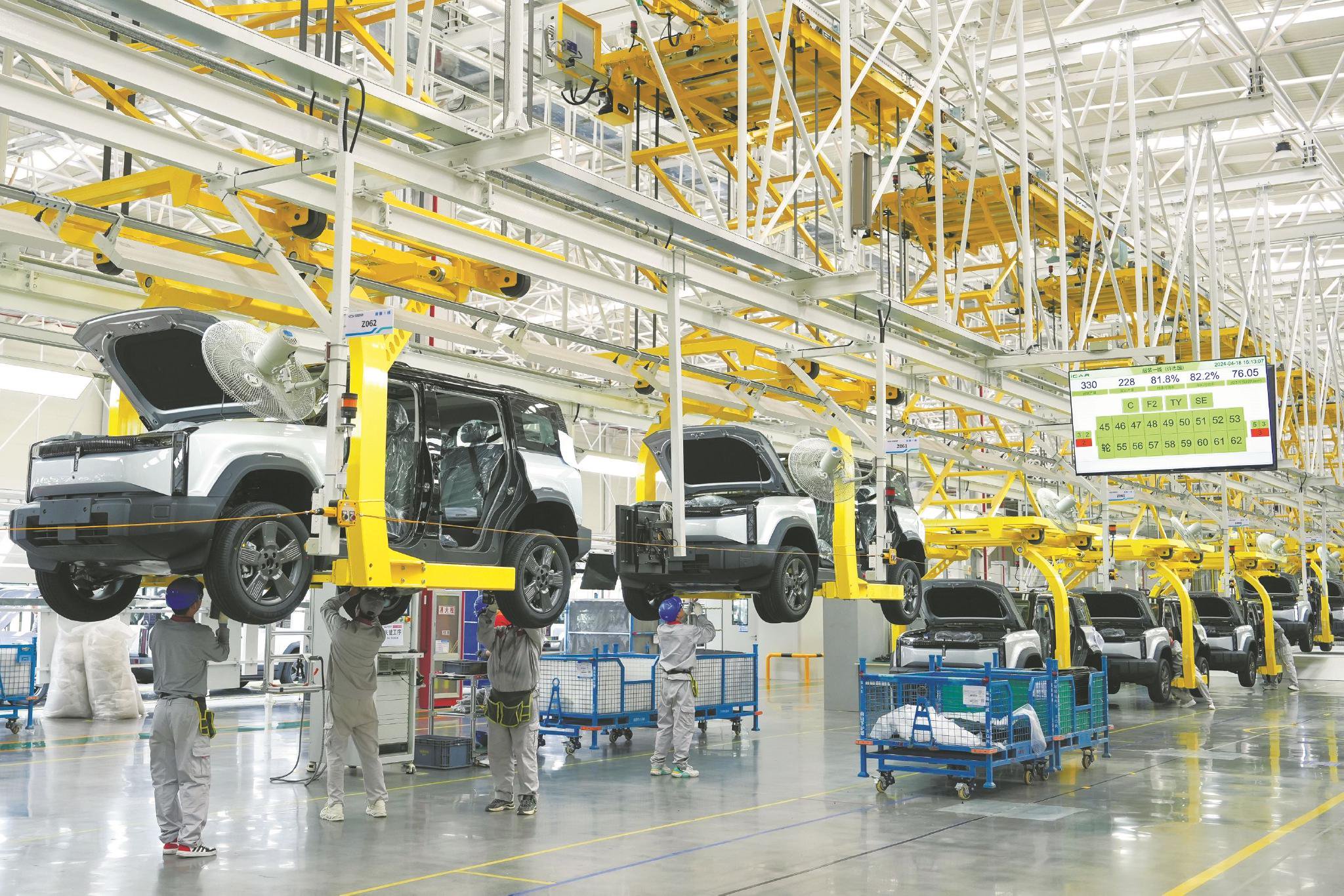
Four core processes: Stamping → Welding → Painting → Final Assembly. Gigacasting is progressively replacing stamping + welding for large body sections. Tesla's Shanghai factory deploys 9,000-ton mega casting machines for rear body structures. Welding robot density exceeds 95% at leading Chinese OEMs.
1.7 Links to the Research Series: The Auto Industry as Ultimate Downstream
The auto industry is the largest downstream for nearly all industrial products in this research series:
- Machine tools: auto parts machining accounts for ~35-40% of China's machine tool consumption
- Reducers: EV drive motor integrated reducers; factory welding robot joint reducers
- Laser equipment: body welding (laser welding), battery tab cutting (ultrafast laser)
- PCB/power semiconductors: ECU/BMS/motor controller/ADAS domain controllers
- Modified plastics: instrument panels/bumpers/door inner panels — third-largest material source
1.8 Business Model Evolution
Traditional: "vehicle sale + aftersales service." NEV era is reshaping this into "software + services + ecosystem" subscription models:
- Tesla FSD subscription: ~RMB 1,500/month; hardware pre-installed, software-activated
- NIO BaaS (Battery as a Service): car purchased without battery, monthly battery rental RMB 980-1,480
- Li Auto AD Max feature subscription
- AITO HiCar intelligent driving feature subscription
1.9 Employment and Social Impact
Direct employment in auto manufacturing: ~3-4 million; full industry chain (sales/repair/finance/logistics/charging): estimated over 30 million. NEV shifts employment structure: manufacturing headcount per 10,000 units is ~20-30% lower for BEV factories than traditional ICE; software/R&D roles surged 3-5x at major OEMs from 2020 to 2024.
1.10 China Auto Ownership and Saturation Analysis
China's vehicle ownership reached approximately 340 million in 2024, or roughly 230 vehicles per 1,000 people — far below the US (850) or Germany (580). Saturation is likely to occur around 400-500 per 1,000 people (comparable to Japan/Korea) rather than chasing the US level, meaning incremental demand increasingly comes from replacement purchases of the ~140 million vehicles over 10 years old.
1.11 Policy History
- 1984-2001 (JV import era): Foreign OEMs entered via 50% max JV structure. SAIC-VW (1985), FAW-VW (1991) established.
- 2001-2018 (scale expansion era): WTO accession opened markets; production rose from ~2.3M to ~28M units.
- 2018-2022 (foreign stake cap removed): NEV JV cap lifted in 2019 (Tesla Shanghai 100% wholly owned first); ICE cap removed from 2022.
- 2020-2024 (NEV policy deepening): Dual-credit policy tightened; trade-in subsidies; fast-charging infrastructure build-out drove NEV penetration from 5% (2020) to 47.6% (2024).
1.12 China Auto Regulatory Framework
Key regulatory bodies: MIIT (vehicle announcement, NEV admission, dual-credit), MPS (registration/licensing), MEE (emission standards National 6A/B), SAMR (recall management), MOC (used-car trade), MOT (road transport licenses).
1.13 Compliance Framework for Vehicle Exports
China OEM exports require destination-country type approval: EU WVTA (~18-36 months), US FMVSS (effectively blocked by 100% tariff), UN ECE/WP.29 (Middle East/Southeast Asia/Central Asia — relatively accessible), and country-specific standards (Russia EASC, India CMVR, Brazil DENATRAN, Australia ADR). Chery leads in accumulated international type approvals among Chinese brands.
Chapter 2 Global Auto Landscape and International Leaders
2.1 Global Auto Market Volume
2024 global vehicle sales: approximately 88-90 million units. Key regional breakdown:
- China: 31.28M production, 31.44M sales, ~35% of global total
- Europe (EU + UK): ~10-11M units; German premium brands dominant
- US: ~15.8M units (light vehicles); GM/Ford/Stellantis/Tesla/Toyota lead
- Japan: ~4.8M domestic; ~4.2M exports (well below 2023's 4.87M)
- India: ~4.2M units (passenger cars), surpassing Japan to become world's No. 3 market
- Southeast Asia (ASEAN): ~3M units; Thailand/Indonesia as core; Chinese brands making strong inroads
- Middle East/Africa/Latin America: ~6-7M units combined; China's high-growth export regions
2.2 Global OEM Sales Rankings (2024)
| Rank | Group | HQ | 2024 Sales | YoY |
|---|---|---|---|---|
| 1 | Toyota | Japan | ~10.8M units | -4% |
| 2 | Volkswagen Group | Germany | ~9.03M units | -2.3% |
| 3 | Hyundai Kia | Korea | ~7.23M units | ~0% |
| 4 | Stellantis | Netherlands/US | ~6.5M units | -15% |
| 5 | BYD | China | 4.27M units | +41% |
| 6 | GM | US | ~6.0M units | ~0% |
| 7 | Ford | US | ~4.47M units | +2% |
| 8 | Honda | Japan | ~3.81M units | +4% |
| 9 | Nissan | Japan | ~3.35M units | -7% |
| 10 | Geely Holdings | China | ~3.33M units | +22% |
Tesla delivered approximately 1.789 million units globally (-1.1%). Chery (unlisted) approximately 2.6M units. For the first time, two Chinese OEMs (BYD and Geely Holdings) entered the global top 10, both showing strong positive growth while traditional Western/Japanese OEMs broadly stagnated.
2.3 International Leader Analysis
2.3.1 Toyota
Toyota retained global No. 1 at 10.8M units but growth turned negative (-4%). Its HEV strategy (Corolla/Camry Dual Engine popular in China) is its core competence, but BEV strategy lags the market — global BEV sales approximately 377,000 units (3.5% of total). Toyota's response: all-solid-state battery (planned 2027-28 mass production), technology-sharing matrix with Suzuki/Subaru/Mazda, deeper NEV localization in China with GAC Toyota and FAW Toyota. China combined sales ~1.54M units — down ~20% from the 2022 peak of ~1.94M.
2.3.2 Volkswagen Group
Volkswagen: ~9.03M globally (-2.3%), brands include VW, Audi, Porsche, Škoda, SEAT/CUPRA, Bentley, Bugatti, Lamborghini, and Traton (trucks). VW faces a dual crisis: in China, combined JV sales fell to ~2.55M units (vs. ~3.8M peak); in Europe, overcapacity pressure raised the prospect of closing German domestic factories for the first time. VW's EV response: ID. series underperforming in China; platform partnership with Xpeng (Volkswagen invested USD 700M); Audi partnering SAIC on ADP EV platform.
2.3.3 Hyundai Kia
Hyundai Kia: ~7.23M units, most aggressive in emerging markets (India/Southeast Asia). Genesis BEV penetration ~12% — ahead of Toyota/VW. In China, BAIC Hyundai fell to ~200,000 units from a 2016 peak of 1.8M — a near 90% collapse exemplifying the systemic retreat of Korean brands from China.
2.3.4 Stellantis
Stellantis: ~6.5M units (-15%), global No. 4. Formed from Fiat/Chrysler (FCA) + PSA. 14 brands including Jeep, Chrysler, Dodge, Fiat, Alfa Romeo, Maserati, Peugeot, Citroën. China: Jeep JV exited in 2022; DS exited; Peugeot-Citroën JV semi-dormant. 2024 was Stellantis's most difficult year among major Western OEMs: market slowdown in both Europe and the US, CEO departure, sharply declining profit.
2.3.5 General Motors
GM: ~6.0M globally; in the US relies on SUVs and pickup trucks (GMC/Chevrolet/Cadillac) for high margins, but BEV strategy repeatedly revised (target for 400,000 BEVs in 2025 reduced to ~200,000 amid weak demand; Cruise autonomous unit suspended after 2023 incident). In China (SAIC-GM): only ~435,000 units (-56.54%), the largest decline among mainstream JV brands. Buick/Chevrolet/Cadillac all fell sharply; factory closures in China announced.
2.3.6 Ford
Ford: ~4.47M units (+2%); in the US the F-150 pickup (world's best-selling single model) supports profits; EV unit (Ford Model e) lost ~USD 5B in 2024. China: Changan Ford maintained ~200,000-250,000 units, a major contraction from its peak.
2.3.7 Honda
Honda: ~3.81M units (+4%); in China (GAC Honda + Dongfeng Honda combined ~700,000 units, down sharply from a peak of ~1.5M). Honda and Nissan announced merger talks in 2024; if successful, the combined group would be global No. 3.
2.3.8 Nissan
Nissan: ~3.35M units (-7%); China (Dongfeng Nissan) fell to ~600,000-700,000 units from a 2017 peak of 1.54M. The Honda-Nissan merger talks are the biggest strategic story for both companies.
2.3.9 BMW Group
BMW: ~2.4M units globally (including Rolls-Royce/MINI); China ~720,000-750,000 units (including BMW Brilliance/MINI). Among luxury brands, BMW is the most aggressive on electrification: iX3/i4/i5/i7/iX series in mass production in China; target: 50% BEV by 2030. BMW Brilliance in Shenyang committed RMB 15B in new capacity expansion — a landmark case of foreign OEM expanding in China.
2.3.10 Mercedes-Benz
Mercedes-Benz: ~2.3M units; focused on premium/ultra-luxury (EQS/EQE/Maybach/AMG); China ~650,000-700,000 units (including imports). Mercedes revised its strategy in 2024, delaying full electrification (original 100% BEV by 2030 target adjusted to retain ICE models until market demand is clear).
2.4 Global Electrification Landscape
| Market | NEV Penetration | Leading OEMs | Note |
|---|---|---|---|
| Norway | >90% | VW/Tesla/BMW | Policy-leading, rural geography |
| Netherlands/Iceland | 70%+ | — | EU policy-driven |
| China | 47.6% (passenger retail) | BYD + Li Auto/AITO + Tesla | World's largest BEV+PHEV market |
| UK | ~25% | Tesla/BMW/VW | ZEV regulation driven |
| Germany | ~18% | VW/BMW/Mercedes-Benz | Decelerated after subsidy withdrawal |
| US | ~9% | Tesla dominant, ~50% EV share | IRA subsidy driven |
| Japan | ~4% | Toyota PHEV mainly | HEV mainstream, BEV very low |
| India | ~2-3% | Tata Motors leading | Infrastructure limited |
| Southeast Asia | ~3-6% | BYD/SAIC/Neta | Chinese brands aggressive |
Global battery landscape: China holds ~63-65% of global installed capacity (CATL ~37%, BYD ~15%); Korea holds ~20% (LG ~11%, Samsung SDI ~4-5%, SK On ~4-5%); Japan ~7% (Panasonic).
2.5 Structural Reasons for Foreign OEM Retreat in China
- Electrification timing lag: Most JV core products remain ICE models with limited BEV/PHEV lineups far narrower than domestic brands, and priced higher than comparable domestic alternatives.
- Missing intelligentization capability: Qualcomm 8295/Huawei HarmonyOS cockpit/Huawei ADS appear almost exclusively in domestic-brand vehicles; foreign cockpit systems (iDrive/MMI/MBUX) lack deep local integration.
- Eroding brand premium: Young Chinese consumers' perception of JV quality halos has weakened while domestic brands now surpass JVs in interior luxury and tech configurations.
- Price war pressure: BYD's ultra-low-cost strategy ("EV cheaper than ICE") puts a price bayonet at JV brands that have limited room to discount without destroying their brand positioning.
- Policy tailwinds to domestic brands: Rising dual-credit NEV requirements force JVs to purchase credits or accelerate electrification — a transition pace they cannot match.
This trend is irreversible. Post-2024, further fragmentation of JV brands in China can be expected: factory closures (already underway), consolidations (Honda + Nissan + Mitsubishi logic), and repositioning from "largest market" to "important regional market."
2.6 Global M&A Wave
- Honda-Nissan merger talks: Announced 2024; if successful, ~7.2M combined sales — global No. 3. Mitsubishi confirmed joining the merged group. Both companies' failure to keep pace in electrification and China makes independent operation unsustainable.
- Stellantis internal restructuring: New CEO focus after 2024 leadership change; deepening EV collaboration with Dongfeng commercial vehicles.
- VW stakes Chery: VW and Chery signed technology cooperation agreement; Chery receives VW brand IP licensing for new Anhui factory — a role reversal as VW leverages Chinese R&D capability.
- Tesla and CATL: Tesla's 2024 balancing act among CATL/Panasonic/LG reflects supply chain diversification; Cybercab launch (2026 production) signals strategic pivot toward Robotaxi.
Underlying logic: a single mainstream BEV platform costs USD 5-10B to develop; combined with software investment and China market competition eroding profits, OEMs with insufficient scale must merge (Honda+Nissan) or partner (VW+Chery) to spread fixed costs.
2.7 Global Supply Chain Restructuring
"China-centric" trend: NEV core components (battery/motor/control/ADAS chip) increasingly concentrate on Chinese suppliers (CATL/Huawei/Horizon Robotics/Wencan/Xusheng). Any supply disruption from Chinese suppliers now affects Western OEM production capacity. This has triggered "supply chain security" debates in the West; US IRA's Chinese-supplier restrictions and EU Critical Raw Materials Act localization requirements are political hedges against China supply-chain dependency.
Regionalization trend: Tesla builds North American supply chain in Texas/Nevada; VW deepens European localization; Chinese OEMs (BYD/Geely/Chery) establish regional manufacturing bases in Southeast Asia/Europe. By 2030, the global auto supply chain will look more like a "three-pillar structure" (North America / Europe / Asia each in regional loops) than the China-centric global single chain of pre-2015.
2.8 Hydrogen Vehicles: The Parallel Track
Toyota remains the most committed FCEV proponent (Mirai: cumulative ~25,000 units — minuscule scale); Hyundai pushes NEXO and hydrogen heavy trucks (Xcient). China's FCEV applications center on commercial vehicles (buses/heavy trucks/forklifts): ~20,000 FCEV commercial vehicles by 2024. Analysts broadly see hydrogen as more viable for heavy trucks/shipping/aviation than passenger cars, where BEV economics will dominate through 2030.
2.9 North American Market Structure
The US (~15.8M light vehicles annually) is structurally different from China: pickups/full-size SUVs account for ~65-70% of sales (F-150 annual sales ~700,000-800,000 units). Tesla holds ~50-55% of US BEV market share (down from ~70% in 2022). IRA's requirements for North American battery/components production effectively systemically disadvantage Chinese-content vehicles from competing in the US BEV market.
2.10 India: The Next Large-Volume Opportunity
India (~4.2M units in 2024) is both the world's third-largest and fastest-growing major auto market. Chinese brands face severe entry obstacles post-2020 India-China border tensions; India scrutinizes Chinese investment closely. Tata Motors leads India's BEV market with ~60% share. NEV penetration is ~2-3% — extremely early-stage. Long-term potential is immense (1.4B population, only ~25 vehicles per 1,000 people) but geopolitical barriers require 5-10 years of diplomatic normalization.
Chapter 3 PEST Environment Analysis
3.1 Political and Policy (Political)
3.1.1 Dual-Carbon Targets as Strategic Constraint
China's 2020 pledge of "peak carbon by 2030, carbon neutral by 2060" designates transportation electrification as a critical pathway. By 2035, 100% of public sector new vehicles are to be electric; NEV share to rise sharply by 2030. This makes the "abandoning ICE" direction policy-irreversible.
3.1.2 Dual-Credit Policy
MIIT's parallel CAFC (Corporate Average Fuel Consumption) and NEV credit system, in place since 2017 and continuously tightened. In 2024 NEV credit requirement reached 28% of annual production; 38% in 2025. This structurally pressures JV brands to either buy NEV credits (at rising cost) or accelerate electrification. Domestic brands with abundant NEV production are net credit sellers — an indirect subsidy mechanism redistributing from JVs to domestic brands.
3.1.3 Trade-In Subsidies Stimulating Consumption
The 2024 national "vehicle trade-in" subsidy provided up to RMB 30,000/vehicle for NEV purchases. December saw NEV sales grow 37.5% YoY — the highest monthly growth of the year. Synergy with "rural subsidy" programs pushed NEV penetration into Tier-3/4 cities and rural markets.
3.1.4 Export Qualifications and International Certification
MIIT maintains an "approved import/export model catalogue"; exports require destination-country type approval. EU WVTA typically takes 2-3 years. Chery has the broadest international type certification reserves among Chinese brands.
3.1.5 Belt and Road Initiative and Automotive Diplomacy
BRI infrastructure (roads/ports/logistics) directly lowers the logistics cost and customs barriers for Chinese vehicles entering BRI countries. China signed auto trade facilitation agreements with multiple Southeast Asian, Central Asian, African, and Middle Eastern countries; Saudi Arabia, Vietnam, and Ethiopia grant preferential tariffs on Chinese NEVs.
3.1.6 EU Anti-Subsidy Tariffs: Trade Friction Escalating
On October 30, 2024, the EU formally imposed countervailing duties: BYD +17%, Geely +18.8%, SAIC +35.3%, Tesla (China-made) +7.8%. This marks the institutionalization of EU-China automotive trade friction. China challenges the investigation procedures and WTO conformity; both sides remain in negotiations over a "price undertaking" to replace the tariff regime.
3.1.7 US 100% Tariff Blockade
In 2024, the US raised EV tariffs on Chinese vehicles to 100% — effectively barring Chinese-made passenger cars from the US market. Chinese OEM responses: Mexico factory route (now under US anti-circumvention scrutiny) and components-export instead of finished vehicle export.
3.2 Economic Environment (Economic)
3.2.1 China Macro and Auto Consumption
China GDP growth ~5% in 2024; household disposable income growth slowing; consumer confidence cautious. But auto sales maintained positive growth (+4.5%) driven by policy subsidies. Real estate market depression weighed on consumer sentiment, but NEV demand showed resilience through the structural shift from ICE to NEV.
Average transaction price declined year-on-year due to the price war: from ~RMB 180,000 in 2023 to ~RMB 160,000-170,000 in 2024 (estimated). The sub-RMB-200,000 domestic-brand EV segment boomed.
3.2.2 NEV as Economic Growth Engine
NEV total industry chain output value in 2024 exceeded RMB 1.4 trillion (including battery/motor/control/charging infrastructure). BYD alone paid RMB 51B in taxes — among the largest single corporate taxpayers in China.
3.2.3 Price War and Industry Profit Compression
227 model price cuts in 2024 (+53% YoY); average market discount ~20.4%. The price war first victimizes JV brands, and also compresses margins for domestic brands and new EV startups. Li Auto had the highest gross margin among major startups (20%); BYD vehicle gross margin ~22-25%; most new EV startups: 10-15%.
BYD demanded 10% cost reductions from suppliers in 2024 — a typical case of price war transmission upstream to the entire supply chain.
3.2.4 Charging/Battery-Swap Infrastructure Investment
Public charging points reached ~3.4 million by end-2024 (up ~60% YoY); ~45,000 battery-swap stations. Rapid infrastructure buildout is a prerequisite for NEV penetration exceeding 50%, creating a trillion-RMB investment track.
3.3 Social Environment (Social)
3.3.1 Consumer Preference Shift: Intelligentization as Core Purchase Motivation
Surveys (J.D. Power / CPCA) show that in 2024, ~65% of respondents listed "intelligent cockpit / in-car system" as a top-3 purchase factor; over 50% rated "whether advanced ADAS covers my city" as important. This preference shift is highly unfavorable to foreign brands whose cockpit systems lack deep Chinese local integration.
3.3.2 NEV Penetration into Lower-Tier Markets
BYD Seagull (from RMB 79,800), Wuling Bingo, Chery QQ Ice Cream — sub-RMB-100,000 EVs became the lower-tier market workhorses. "Rural charging network" infrastructure and trade-in rural subsidy programs co-drove NEV adoption in Tier-3/4/5 cities and rural markets.
3.3.3 Diversifying Mobility Patterns
Ride-hailing (Didi/Caocao/T3) and Robotaxi penetration reduce "need to own a vehicle" sentiment in Tier-1 cities. However, EVs' dramatically lower running costs (electricity vs. fuel) actually strengthen vehicle purchase rationale, especially in Tier-3/4 cities (weaker public transit, commute-dependent) where trade-in behavior accelerates.
3.3.4 Generational Shift in Auto Culture
Three purchasing cohorts: 1970s generation favored Japanese (quality/fuel economy); 1980s preferred German (brand/safety); 1990s/2000s generations choose domestic EVs (tech/value for money/national identity). This generational switch, accelerating in 2021-2024, is the socio-cultural driver of domestic brand share rising from ~40% to 65%.
3.4 Technology Environment (Technology)
3.4.1 Electrification Technology Generational Leap
Competition has shifted from "how far can it go" (range anxiety) to "how fast can it charge/perform" (performance anxiety) and "next-generation battery":
- LFP cost-performance advantage: CATL CTP 3.0 Kirin Battery LFP pack energy density ~160 Wh/kg; BYD Blade ~140-150 Wh/kg — approaching NMC.
- NMC still preferred in high-performance BEV (300+ km/h performance cars).
- All-solid-state batteries: R&D to production transition phase; Toyota/Samsung SDI/CATL plan 2027-2030 mass production.
3.4.2 Intelligentization and Software-Defined Vehicle
- Domain controllers: Transition from distributed ECUs to centralized domains; Huawei/NVIDIA Orin/Horizon Journey 6 are mainstream ADAS domain control solutions in China.
- Cockpit: Qualcomm Snapdragon 8295 (SA8295P) held ~67% H1 2024 market share; MediaTek CT-X1 is its main rival.
- OTA: Software updates now standard for all NEVs; Tesla/NIO/Li Auto/Xpeng update far more frequently than JVs.
- Data flywheel: Driving data → AI model training → perception iteration; early movers (Tesla/Huawei ADS/Xpeng XNGP) have clear data advantages.
3.4.3 Gigacasting Manufacturing Revolution
Tesla pioneered gigacasting (2020); Chinese OEMs fully adopted by 2024: Xpeng X9 used a 12,000-ton mega-casting machine. Benefits: reduced part count, ~30% weight reduction, ~40% manufacturing cost reduction (Tesla data). Growing controversy over high repair costs after even minor collisions.
3.4.4 High-Voltage Fast Charging and Energy Network Competition
800V platform penetration rose from ~2.8% to 15.4% in 2024. Representative models (Xpeng G6/G9, BYD Yangwang U8, Zeekr 001 FR) can charge 200-300 km in 5-10 minutes. Huawei's 600kW ultra-fast charger achieves "1 minute for 60 km."
3.5 Digital Transformation in Auto (Technology Supplement)
3.5.1 SDV Industry Impact
"Software Defined Vehicle" means vehicle functions (ADAS/cockpit/energy management/chassis tuning) are increasingly determined by software, not fixed hardware parameters:
- Traditional Tier-1s face "hardwarization" risk as domain controller + OS layers migrate to OEM self-development (BYD/Huawei/NIO) or new tech suppliers.
- Software engineering capability becomes core OEM competency: BYD has ~100,000 engineers; Li Auto/NIO/Xpeng software teams exceed 3,000 each.
- "Chip + OS + ecosystem" bundled competition: Qualcomm QNX-based SA8295, NVIDIA DRIVE OS, Huawei AOS/MDC each try to become the automotive industry's "Android/iOS."
3.5.2 AI Large Models Deeply Integrated into Automotive
LLMs deployed in vehicles in 2023-2024:
- In-car voice: AITO "Xiao Yi" (Huawei AI) / Li Auto "Li Xiang Tong Xue" evolved to LLM-driven, handling complex semantic requests.
- Autonomous driving: Tesla FSD V12 replaced rule-based code with end-to-end neural networks; Li Auto/Xpeng/NIO launched self-developed end-to-end autonomous driving models in 2024.
- AI-assisted design: GM/BMW use generative AI for interior design concepts, cutting concept design phase ~30%.
- AI quality inspection: FAW/SAIC deployed computer vision for assembly-line inspection, replacing manual visual checks.
3.6 Social Supplement: Auto Culture and Running Cost Changes
BEV total running cost advantage over ICE: annual energy cost ~RMB 1,400 for BEV vs ~RMB 10,500 for ICE (20,000 km/year), a ~7-8x difference. Maintenance cost: ~RMB 1,500-2,000/year for BEV vs ~RMB 3,000-4,000 for ICE (no engine oil/transmission fluid/spark plug changes). However, NEV insurance premiums are 20-40% higher than comparable ICE vehicles due to higher repair costs from gigacast body sections and battery complexity.
3.7 Political Supplement: Belt and Road and the Geopolitics of Export
BRI infrastructure improvements directly lower logistics costs for Chinese vehicles in partner countries. People's RMB settlement share in Chinese auto export transactions rose to ~25-30% in 2024 (up sharply from 2020). Geopolitical double edge: the Russia-Ukraine conflict opened the Russian market (as Western brands exited) but creates secondary sanctions risk; Taiwan Strait/South China Sea tensions could, if they escalate, affect market access for Chinese OEMs in Europe/US.
3.8 Technical Policy Environment: Standards as Strategic Leverage
Domestic standards (CAFC Stage 6, GB 18384 NEV safety series, intelligent connected vehicle standards) form China's technical baseline. China's C-V2X standard competes with Europe's DSRC (802.11p). The MIIT CAFC Stage 6 (~4.6L/100km by 2025) further tightens the institutional pressure on ICE vehicle development.
Chapter 4 China's Auto Market Size and Operations
4.1 Overall Volume and Growth
2024 marked China's 16th consecutive year as the world's largest single auto market:
- Production: 31.282 million units, +3.7% (CAAM)
- Sales: 31.436 million units, +4.5% (CAAM)
- Retail passenger cars: approximately 22.9 million units (CPCA); +5.5%
The 2024 figure of 31.44M sales surpasses the 2017 historical peak (~28.88M) by ~9%, but the structure is radically different: in 2017 virtually all were ICE; in 2024 NEV accounted for ~40.9% of all vehicle sales (CAAM) and 47.6% of passenger car retail (CPCA).
4.2 NEV Scale and Structure
4.2.1 Volume
- NEV production: 12.888 million units, +34.4%
- NEV sales: 12.866 million units, +35.5%
This is the first year global NEV annual sales exceeded 12 million units, with China contributing ~60% of the global total.
4.2.2 BEV vs PHEV/REEV Divergence
- BEV: ~60% of NEV sales; ~22% growth — below overall NEV growth, reflecting natural diffusion.
- PHEV/REEV: ~40% of NEV sales; ~80% growth. The REEV/PHEV boom (AITO M5/M7/M9 range-extended, Li Auto L series, Deepal SL03 REEV) reflects consumers choosing the compromise between full BEV commitment and range anxiety.
The rapid rise of PHEV/REEV is the most important structural signal of 2024: electrification penetration is not a linear "ICE-to-BEV" switch but involves a prolonged transition where REEV/PHEV acts as a "buffer zone."
4.2.3 Dual-Measure Penetration
- CAAM (full market including commercial vehicles): NEV share ~40.9%, +9.3pp YoY.
- CPCA (passenger car retail): NEV penetration 47.6%; second half had 5 months above 50%; December ~53%.
The gap between the two measures (40.9% vs 47.6%) reflects slower electrification in commercial vehicles.
4.3 Domestic Brand Historic Reversal
4.3.1 Market Share Leap
Domestic brand passenger car market share (including exports): 65% (Jan-Nov, CAAM) — an all-time high. Domestic-only share ~55%+; October single-month reached 70.1%.
Historical milestones:
- 2015: ~41% (near historic low)
- 2020: ~38% (COVID/trade war low)
- 2022: exceeded 50% for first time
- 2024: ~65% — approaching the domestic-brand dominance level of major Western economies
4.3.2 JV Brand Collapse
JV brand total 2024: ~9.592 million units — first time below 10 million — share approximately 34.8% (vs. historical peak 60%+). Mainstream JV passenger car retail share ~27.6% — lowest on record.
| Brand/JV | 2024 Sales | YoY |
|---|---|---|
| FAW-VW | ~1.4M units | slight decline |
| SAIC-VW | 1.1489M units | -5.51% |
| GAC Toyota | 738,000 units | -22.32% |
| FAW Toyota | 800,200 units | +0.02% (rare positive) |
| GAC Honda | ~420,000 units | -30%+ |
| SAIC-GM | 435,000 units | -56.54% (largest decline) |
| Dongfeng Nissan | ~600,000 units | -10%+ |
| BAIC Hyundai | ~200,000 units | -20%+ |
SAIC-GM's -56.54% — from ~1M units in 2022 to 435,000 in just two years — is a systemic warning to GM's China strategy.
4.4 Vehicle Exports: Historic No. 1
4.4.1 Export Volume
2024 exports: ~6.41 million units, +23%, surpassing Japan (4.22M) as the world's largest auto exporter. Export value: ~USD 117.4 billion (3.3% of China's total exports).
Historical path: 1.08M (2020) → 2.01M (2021) → 3.11M (2022) → 5.22M (2023) → 6.41M (2024) — nearly 6x growth in four years.
Export composition: domestic brands 80% (5M units); foreign-brand China factories ~20% (Tesla Shanghai ~350,000-400,000 units to Europe/Australia).
4.4.2 Export by Region
| Destination | YoY Growth | Key Characteristics |
|---|---|---|
| Russia/FSU | +25% | Chinese brands ~56% share; filling Western exit vacuum |
| Southeast Asia | +8% | Thailand/Indonesia/Vietnam/Philippines; NEV penetration rising fast |
| Latin America | +181% | Brazil/Mexico/Chile; highest growth rate |
| Middle East | +40% | Saudi/UAE; BYD/Chery dominant |
| Africa | +187% | Low base; South Africa/Egypt/Kenya |
| Japan/Korea | +63% | Partly electric buses/commercial vehicles |
| Europe | -10% | Anti-subsidy tariffs (from Oct 30) caused contraction |
Russia is the most emblematic "window of opportunity": following Western sanctions in 2022, Chery/Haval/Geely/BYD/Changan rapidly filled the gap; Chinese brands now hold ~56% of Russia's passenger car market.
4.4.3 Export Quality Upgrading
2021-2022 exports were mainly low-end ICE (USD 10,000-20,000 average); by 2024: NEVs accounted for ~25-30% of total exports (1.7-2M units); average export price rose to ~USD 18,300; BYD overseas sales 407,700 units (+71%), mainly mid-to-high-end models (Atto 3/Seal/Han).
4.5 Market Profitability Structure
Price war compressed overall profitability. Rough tiering: BYD net margin ~5.2%; Li Auto ~5.6%; Geely (0175.HK) ~6.9%; Great Wall ~6.3%; NIO ~-34%; Xpeng ~-14% (improving sharply). JV profit data shows through parent company (SAIC/GAC/Dongfeng) equity-method investment income — declining sharply as JV volume shrinks.
4.6 Price Band Structure
| Price Band | Sales Share (est.) | Representative Models |
|---|---|---|
| Below RMB 100,000 | ~25% | Wuling Hongguang / BYD Seagull / Chery mini EV |
| RMB 100,000-200,000 | ~38% (largest band) | BYD Han/Song/Seal / Xpeng G6 / Lynk & Co 08 / Great Wall Haval H6 |
| RMB 200,000-300,000 | ~22% | Li Auto L6 / AITO M5 / Tesla Model Y / Zeekr 007 / Xiaomi SU7 |
| Above RMB 300,000 | ~15% | Li Auto L9 / AITO M9 / NIO ES8 / Mercedes-Benz E-class / BMW 5 Series |
The RMB 100,000-200,000 band is the most fiercely contested: BYD Qin PLUS Honor Edition (RMB 79,800) demolished the compact ICE pricing floor, forcing JV brands into desperate discounting that undermined their brand positioning fundamentals.
4.7 Market Concentration
Top-5 OEMs (BYD/Geely/Chery/Changan/GAC) hold ~60% of the passenger car market; CR10 estimated above 80%. Yet over 50 OEMs compete for the remaining share — making China still the world's most intensely competitive auto market. BYD's 4.27M NEV sales are 7-10x the next largest BEV brand (Tesla ~650,000/Li Auto ~500,000/AITO ~427,000) — making "BYD vs. non-BYD" the defining competitive structure.
4.8 Commercial Vehicle Market Overview
Commercial vehicle (bus/truck/pickup) total ~5M units in 2024. Battery-electric heavy truck is the standout: ~120,000-140,000 units (+80%+), with battery-swap mode (CATL/Geely Viridi/Sany Heavy Industry) commercially deployed in mines/ports/urban logistics. City bus electrification rate exceeded 70% nationally. Yutong (600066)/BYD commercial/Zhongtong (000957) dominate.
4.9 Charging/Battery-Swap Infrastructure
~3.4 million public charging points (2024), of which DC fast-charge ~1.4M and AC slow-charge ~2M. Vehicle-to-charger ratio ~1:2.6 (improved from 1:3.1 in 2020). Battery-swap stations ~45,000 total (NIO Power ~2,400+, CATL Choco-SEB ~1,200+). The gap in rural/lower-tier city charging density remains the biggest practical obstacle to BEV adoption in those markets — which is why REEV sales surge fastest where home charging is impractical.
4.10 Used-Car Market Structural Change
2024 used-car transactions: 18-20M units; growing share is NEV. NEV residual value rate is structurally lower (30-35% two-year depreciation vs. ~20-25% for ICE) due to rapid technology iteration, battery health uncertainty, and continuous new-car price cuts. Battery health detection (BMS data disclosure/third-party certification) will be a major new aftermarket vertical in 2025-2030.
4.11 Consumer Behavior Shifts
- Shorter decision cycle: Average time from "considering purchase" to "transaction" fell from ~90 days (2020) to ~45 days (2024) via online configuration/direct-sales models.
- OTA as loyalty tool: Regular OTA pushes (ADAS features/cockpit upgrades/energy efficiency) mean satisfaction with owned vehicles increases over time — the opposite of traditional ICE ownership experience, creating powerful word-of-mouth.
- Youth and feminization: Female share among sub-RMB-100,000 BEV buyers ~40%; 25-35 year-olds now the core buyer group for RMB 150,000-250,000 vehicles.
4.12 Auto Finance and Leasing
Auto finance penetration: ~50% in China (vs. ~85% in the US). Key products: traditional secured loans, lease-to-own (monthly ~RMB 3,000-5,000 for 3 years), NIO BaaS (monthly RMB 980-1,480 battery rental). Risk: lower NEV residual values create potential residual-value estimation losses for lease-to-own products.
4.13 Charging as a Service (CaaS) and Energy Ecosystem
Charging operators: TELD (002728)/Star Charging/State Grid/Southern Grid/NIO Power. Average public charging station utilization 8-12% (low). Operators earn on electricity service fee spread (RMB 0.1-0.3/kWh). V2G (vehicle-to-grid) trials underway at multiple pilot cities; expected commercial scale in 2026-2028 under time-of-use electricity pricing.
4.14 Spatial Mismatch Between Production and Consumption
Production is highly concentrated (Guangdong/Shanghai/Hubei/Chongqing/Jilin); consumption is dispersed nationally. This creates a massive finished-vehicle logistics market (tens of millions of units transported annually by rail/road/inland waterway/maritime RoRo). BYD addresses this by manufacturing near demand centers (Xi'an/Shenzhen/Hefei/Zhengzhou/Changzhou etc.), minimizing cross-regional transport.
4.15 Market Cyclicality and Counter-Cyclicality
China's auto market shows "counter-cyclical" characteristics: in macro downturns, trade-in/subsidy policies sustain positive sales growth (2024 +4.5% despite cautious consumer sentiment). Post-subsidy "policy cliff effects" (as seen after 2019 NEV subsidy cuts) pose a short-term downside risk for 2025-2026 if natural demand cannot sustain the subsidy-boosted level.
Long-cycle drivers: urbanization (still ~100M rural-to-urban potential), replacement demand (140M+ vehicles over 10 years old), and NEV penetration rising from 50% to 70% (existing ICE fleet replacement). These three curves, combined, will sustain ~3-5% moderate positive growth in China's passenger car market through 2026-2030.
Chapter 5 Industrial Chain Analysis
5.1 The Uniqueness of the Auto Supply Chain: Where All Industrial Goods Converge
Among all manufacturing sectors, the automotive supply chain's length and breadth is unparalleled. A mass-produced sedan contains ~30,000 components, covering virtually every industrial category: metallurgy, chemicals, rubber, electronics, textiles, optics. The NEV transition adds an entirely new "energy-electronics" supply chain (traction battery/motor/power electronics/charging) on top of the existing mechanical chain — making today's auto supply chain more complex than ever.
The analytical framework has three layers: upstream (raw materials and key components), midstream (OEM final assembly), downstream (distribution and aftermarket services).
5.2 Traditional Upstream: Raw Materials and Basic Components
5.2.1 Steel
Steel accounts for ~55-65% of vehicle weight. High-strength steel (AHSS/UHSS, ≥1,000 MPa) is used in A/B-pillars, sill beams, and anti-intrusion beams; hot-press-formed steel (PHS, 1,500-2,000 MPa) for B-pillars and front/rear side members. BAOWU (Baosteel) and ANSTEEL (Anshan Iron & Steel) are core domestic suppliers of high-strength automotive steel. Electrical silicon steel (motor lamination steel) for NEV drive-motor stator/rotor cores is a high-value-added NEV-specific category; BAOWU/Wuhan Steel/Shougang have achieved domestic breakthroughs in high-grade products.
5.2.2 Aluminum Alloy
BEV aluminum content (~250-350 kg per vehicle) is 1.5-2x that of an ICE vehicle. Key segments: aluminum die-castings (motor/gearbox housings, suspension arms) and gigacasting (10s of stamped/welded pieces merged into 1-2 large castings). Domestic leaders: Wencan (603348, gigacasting pioneer), Xusheng (603305, NEV aluminum parts), iKD (600933, automotive aluminum die-casting Tier-1). Primary aluminum from Chinalco, Nanshan Aluminum (000402), Shenghuo (000933).
5.2.3 Rubber
Tires (~40 kg rubber per passenger car) are the largest rubber application. Michelin/Bridgestone/Goodyear hold the global top three; Chinese domestic Zhongce (000040)/Linglong (601966)/Sailun (601058) compete in mid-to-low-end and OEM supply. NEV battery pack sealing (IP67/IP68 waterproofing) creates new demand for specialty elastomers and buffering foams.
5.2.4 Glass
Fuyao Glass (600660) is the world's No. 2 automotive glass maker, ~65% domestic share and ~28% global share, serving virtually all major OEMs with gross margin ~30%+. Panoramic glass roofs have become a key NEV differentiator (Li Auto/NIO/AITO all feature oversized rooftop glass), significantly increasing glass content per vehicle. HUD laminated glass (with embedded transparent film) adds further value.
5.2.5 Modified Plastics
Modified plastics account for 15% (150-250 kg) of vehicle weight: instrument panels/door panels/bumpers/fenders/tailgates/lamp housings. Key resins: PP/PA/ABS/PC/POM/PBT, customized for heat/weather/mechanical requirements. Major domestic suppliers: Kingfa Science (600143), Pret (002324), Dawning (002838) — detailed financial data cross-referenced with the Modified Plastics report in this series.
5.3 NEV-Specific Supply Chain: Three-Electric System
The three-electric system (traction battery + drive motor + power electronics) accounts for ~40-50% of NEV BOM cost and represents the highest technology barriers in the entire NEV chain.
5.3.1 Traction Battery
Value: ~30-40% of BEV total cost.
Technology routes:
- LFP (Lithium Iron Phosphate): Pack energy density
140-160 Wh/kg; excellent thermal stability, long cycle life (3,000-4,000 cycles), lower cost. BYD Blade Battery and CATL CTP 3.0 Kirin (LFP) represent this route. LFP accounts for ~65%+ of China NEV installed capacity. - NMC (Nickel Manganese Cobalt): Cell energy density ~200-280 Wh/kg; higher performance but lower thermal stability and higher cost. Used in premium BEVs.
- All-solid-state: R&D/pre-production phase; 2027-2030 mass production expected; target 300-500 Wh/kg, inherently safe.
Market structure: CATL (300750) global No. 1 with ~37% share; BYD FinDreams ~15% (mainly in-house); LG Energy Solution ~11%; Samsung SDI/SK On ~4-5% each; Chinese Tier-2 (EVE/Sunwoda/Gotion/Farasis) combined ~10%.
Upstream bottlenecks: lithium carbonate (price collapsed from RMB 600,000/ton in 2022 to RMB 70,000-100,000/ton in 2024); cobalt (Congo DRC sourced, Luoyang Moly 603993); cathode materials (Ronbay 688005/Easpring 300073); anode (BTR 835185/Putailai 603659); separator (Enjie 002812 ~50%+ domestic share); electrolyte (Tinci Materials 002709/Capchem 300037).
5.3.2 Drive Motor
Converts electrical energy to mechanical energy. Key types: PMSM (Permanent Magnet Synchronous Motor) — mainstream in China's NEVs, ~97% efficiency, relies on NdFeB permanent magnets (China is the world's largest NdFeB producer; North Rare Earth 600111/Zhenghai Magnetics 300224). Major motor suppliers: BYD (fully self-developed), Inovance (300124), Founder Motor (002196), Dayang Motor (002249); foreign Dana/Bosch/Continental also have China capacity.
5.3.3 Power Electronics
- Motor Control Unit (MCU): SiC MOSFET (vs. IGBT) cuts losses ~50% and supports 800V platforms. Domestic: BYD Semiconductor, Starpower (603290), CRRC Times Electric (688187); foreign: Infineon/onsemi/STMicroelectronics dominant in premium SiC.
- Vehicle Control Unit (VCU): Coordinates three-electric systems; most major OEMs self-develop VCU.
- Battery Management System (BMS): Monitors SOC/temperature/balancing/protection; CATL/BYD self-develop; Joyson Electronics (600699) is a key external supplier.
5.4 Automotive Electronics and Semiconductors
Automotive electronics accounted for ~35-40% of BEV BOM cost (vs. ~25% for ICE) in 2024.
- Cockpit SoC: Qualcomm SA8295P held ~67% H1 2024 installed share; MediaTek CT-X1 is its main rival; Huawei Kirin supplies internally (Huawei AITO).
- ADAS chip: NVIDIA Orin (254 TOPS) is mainstream; Thor (2,000 TOPS) in high-end flagships; Horizon Journey 6 (up to 560 TOPS) and Black Sesame A2000 represent domestic alternatives. Domestic share rising in self-branded OEMs.
- Vehicle MCU: NXP/Renesas/Microchip lead globally; domestic share ~10-15%.
5.5 Traditional Powertrain and Chassis Components
ICE powertrain (engine + transmission) was the strongest JV competitive moat historically. In the NEV era it is being displaced by three-electric, but still relevant for the ~52% ICE passenger car market:
- AT gearboxes (declining segment): Bosch DCT/ZF/Aisin; domestic share small.
- Braking: Bosch (ESP/ABS)/Continental/TRW lead globally; Brembo/TICA (603596) domestically.
- Steering: EPS replaced hydraulic; JTEKT/Nexteer/Bosch lead; steer-by-wire (SBW) is the future direction.
- Suspension: Mahle/Sachs (ZF)/ThyssenKrupp; domestic Zhongding (000887)/Tuopu (601689)/Sanhua Intelligent (002050) competitive globally.
5.6 Value Distribution in the Supply Chain
| Segment | % of BEV BOM (est.) | Leading Players |
|---|---|---|
| Traction battery | 30-40% | CATL/BYD/LG |
| Chips (cockpit+ADAS+MCU) | 8-12% | Qualcomm/NVIDIA/NXP |
| Motor and power electronics | 5-8% | BYD/Inovance/Infineon |
| Aluminum castings/steel stampings | 8-12% | Wencan/Xusheng/BAOWU/ANSTEEL |
| Chassis/suspension/braking/steering | 6-10% | Bosch/ZF/Tuopu/Brembo |
| Interior/exterior/glass/rubber | 6-8% | Fuyao/Yanfeng/Kingfa |
| Software/OS/maps/OTA | ~5% (rising fast) | Huawei/iFlytek/Gaode/Tencent |
| Assembly labor + manufacturing overhead | ~10-15% | OEM |
In the BEV era, the battery is the single largest cost item, and OEM pricing leverage depends heavily on battery supply control (BYD self-supplied; Tesla balances CATL/Panasonic).
5.7 Wiring Harness and Connectors: Low-Profile, High-Complexity
An automotive wiring harness in a traditional ICE vehicle totals 3-5 km in length, ~30-50 kg, and is one of the hardest components to automate (highly manual assembly). BEVs have even more electrical interfaces (4-6 km), but architecture is evolving toward high-speed Ethernet replacing low-speed CAN, eventually targeting ~1-2 km harness length under central-compute + zonal-controller architectures.
Market leaders: Yazaki (Japan)/Sumitomo Electric (Japan)/Aptiv (US, spun from Delphi) combined ~50% global share. Domestic Joyson Electronics (600699)/SUMEC/Shenzhen Walco have partial share. High-end harnesses (luxury brands) remain heavily dependent on Japanese suppliers.
Connector leaders: Aptiv/TE Connectivity/Molex/Yazaki. China-specific vehicle connectors for standard applications have domestic supply; high-reliability (high-voltage/high-frequency/IP67+) still largely imported.
5.8 Tire Industry: From OEM to Aftermarket
Global automotive tire market ~USD 200B annually (OEM + replacement). Replacement market ~70% of revenue — the profit center. Global top 3: Michelin/Bridgestone/Goodyear ~45% combined. Chinese: Linglong (601966)/Sailun (601058)/Zhengxin are competitive in mid-to-low-end and commercial tires, increasingly building overseas factories (Vietnam/Cambodia/Thailand) to avoid anti-dumping tariffs.
NEV-specific tire requirements: ~20-30% faster wear due to greater weight (400-700 kg battery) and instant torque; lower rolling resistance and lower noise needed. "NEV dedicated tires" are an important product line: Michelin e.Primacy, Bridgestone Enliten, Linglong EU01.
5.9 Green Manufacturing Transition
Production-phase carbon footprint: ~5-10 tonnes CO₂ per vehicle (ICE), with painting contributing ~60-70%. Green directions:
- Waterborne paint: Replaces solvent paints; VOC emissions -80%; standard at VW/BMW/Tesla.
- Closed-loop water recycling: 90%+ water recovery in advanced factories.
- Renewable energy procurement: Tesla Shanghai targeting net-zero in production by 2030; BYD rooftop solar at factories.
- Battery recycling: CATL (Brunp Recycling)/GEM (002340) for battery cascade utilization and Li/Co/Ni/Mn recovery.
EU CBAM (Carbon Border Adjustment Mechanism) may expand to automotive products by 2026-2030, making production-phase carbon footprint a hard cost factor for exports — a challenge for Chinese factories with high manufacturing-phase emissions.
5.10 Automotive Sensor Ecosystem: "Eyes" of ADAS
A city-NOA-capable vehicle typically carries:
- Cameras (~8-11 units): Front-view mono/multi, surround-view, DMS; CMOS sensors from onsemi/OmniVision/Sony; lenses from Sunny Optical/Lianchuang.
- Millimeter-wave radar: 77 GHz front medium/long-range radar, 24/77 GHz corner radars; Continental/Bosch/Veoneer (acquired by Qualcomm) dominant; domestic HuaWei/Gasgoo/Calterah gaining share.
- LiDAR: High-accuracy 3D point-cloud sensing; Hesai (HSAI)/Innovusion/RoboSense are China's top-3; combined monthly shipments exceeded 100,000 units in 2024.
- Ultrasonic sensors: Parking/low-speed proximity, standard equipment, ~RMB 5-15/unit; Valeo/Murata lead.
Domestic content rate: cameras/ultrasonic ~50-70%; mmWave radar ~30% (Bosch/Continental dominant in premium); LiDAR ~60-70% (Hesai/RoboSense lead in high-end solutions).
5.11 Interior Components: From Functional to "Third Living Space"
- Large/multi-screen layouts: Li Auto L9's 5-screen layout; AITO M9's 4K central display; screen sizes from 8-inch single-screen to 15-24-inch widescreen.
- Ambient lighting: 64/128-color LED now standard above RMB 150,000.
- Nappa leather/ergonomic seats: Zero-gravity seat (Li Auto/AITO "boss seat") wide in 250,000+ RMB vehicles.
- Fragrance/NVH engineering: BYD Yangwang U8 with Dynaudio sound; Li Auto L9 with Dolby Atmos; NIO ET9 with active noise cancellation + spatial audio.
Interior supplier landscape: Yanfeng Automotive Interiors (SAIC affiliate, one of world's largest), Fuyao Glass (panoramic/HUD), Joyson Electronics (steering wheel/airbag), Ningbo Jifeng (headrest/armrest/seat adjuster). Domestic content ~70-80%.
Chapter 6 Competitive Landscape and Key Companies
6.1 Overall Competitive Landscape
China's 2024 competitive landscape: leading domestic brands (BYD/Geely/Chery/Changan) significantly strengthened; new EV startups polarizing (Li Auto/Seres profitable or near-breakeven, NIO deeply loss-making); traditional JV brands broadly contracting; foreign brand exit wave continuing.
Market concentration: top-5 OEMs (BYD/Geely/Chery/Changan/GAC) ~60% of passenger car sales; CR10 >80%. Competitive moat has fundamentally shifted: from "brand accumulation + ICE powertrain technology" to "three-electric R&D self-sufficiency + intelligent software capability + vertical integration depth + extreme cost control."
6.2 Leading Domestic Brands
6.2.1 BYD (002594 / 1211.HK)
Sales: 4.2721 million units (+41.26%) — China No. 1, global NEV No. 1, global overall No. 5.
Financials: Revenue RMB 777.102B (+29%) — first to surpass Tesla (~RMB 750B equivalent) as world's highest-revenue NEV company; net profit RMB 40.254B (+34%); R&D RMB 54.2B (+36%); taxes paid RMB 51B (one of China's largest single corporate taxpayers); cash RMB 154.9B.
Technical moat: Deep vertical integration — battery (FinDreams Battery), motor (FinDreams Motor), power electronics (FinDreams Technology), semiconductor (BYD Semiconductor), cockpit (DiLink), even vehicle sales network all in-house. Blade Battery (LFP CTP) is now a global safety benchmark. DM 5.0 super hybrid (4.7L/100km depleted-battery fuel consumption — a record) leads PHEV iteration.
Brand matrix: Dynasty series (Qin/Han/Tang/Song/Yuan/Seal, RMB 79,800-250,000); Ocean series (Dolphin/Seagull/Seal/Frigate); Yangwang (above RMB 300,000 high-end off-road, U8/U9); Fang Cheng Bao (outdoor off-road niche); Denza (JV with Mercedes-Benz, BYD-operated, RMB 300,000-500,000 MPV/SUV); Overseas: Atto 3/Seal/Han in Southeast Asia/Europe/Australia/Latin America, 407,700 units overseas (+71%).
Risks: Intelligent driving software capability relatively weaker than Li Auto/Huawei ecosystem (DiPilot approximately industry L2 benchmark); supply chain management and quality stability pressure grows with scale; ultra-low-price strategy difficult to sustain long-term unit profit growth.
6.2.2 Geely Auto (0175.HK, including Zeekr/Lynk & Co)
2024 sales 2.1766 million units (+32%); revenue first exceeded RMB 240B (+34%); net profit RMB 16.632B (+213%) — most improved performance among major OEMs.
Brand matrix (Geely Holdings system): Galaxy (RMB 100,000-200,000 NEV main line, 494,400 units +80%+); Zeekr (2024 US IPO then merged with Lynk & Co, RMB 200,000-500,000 premium BEV, 222,100 units +87%); Lynk & Co (RMB 100,000-300,000, 176,200 units +57%); Geely main brand (transitioning from ICE); Geometry (merging into Galaxy); Volvo/Polestar/Lotus (premium/luxury brands — separate financials, not in 0175.HK).
Strategy: "multi-brand full coverage" — from RMB 70,000 entry-level to RMB 500,000+ luxury. Zeekr-Lynk & Co merger (announced Q3 2024) will yield synergies from 2025. Overseas: 414,500 units (+57%+, including Volvo/Polestar).
6.2.3 Chery Group (unlisted)
2.6M units in 2024 — domestic brand No. 2 (behind BYD only); exports 1.144M units — No. 1 Chinese brand exporter for 22 consecutive years. Competitive moat: earliest overseas expansion, broadest international certifications (80+ countries); brand matrix (Chery/Chery PLUS/Exeed/Jetour/iCAR) from RMB 70,000 to 250,000; in Russia ~350,000-400,000 units; VW acquired a stake in Chery and is co-developing a new BEV platform in Anhui.
6.2.4 Changan Auto (000625)
~2.68M units, 5 consecutive years of positive growth. Revenue RMB 159.7B; net profit RMB 7.321B (-35.37%) after losses from Deepal/Avatr NEV brands combined >RMB 5.5B. Dual identity: "traditional state-owned reformer + NEV explorer":
- Changan main brand (CS35/75/Evita/Qiyuan): RMB 100,000-200,000
- Deepal (SL03/S7/G318): RMB 100,000-200,000 NEV, approaching profitability
- Avatr (with Huawei deep cooperation): RMB 250,000-500,000 premium NEV, still in investment phase
- Changan Ford (JV): ~200,000-250,000 units, significantly contracted
6.2.5 Great Wall Motors (601633)
1.2345M units — the only major domestic brand under 1.5M units — but among the highest unit profitability: net profit RMB 12.692B (+80.76%); net profit per unit ~RMB 10,300 (BYD ~RMB 9,400/unit). "Less but premium" brand logic:
- Haval: RMB 100,000-200,000 SUVs; Haval H6 — China's best-selling SUV for many consecutive years
- WEY: RMB 200,000-300,000 premium; Blue Mountain DHT-PHEV with Huawei NOH partnership
- Tank: RMB 300,000+ off-road SUVs; Tank 300/400 launches generated strong market enthusiasm
- ORA: sub-RMB-100,000 female-oriented small EV; facing price-war pressure
- Pickup truck (Great Wall Cannon): China's No. 1 pickup brand
Overseas: 454,100 units (+44.61%, 36.8% of total sales); Thailand and Brazil factories already in production.
6.3 New EV Startup Cohort
6.3.1 Li Auto (2015.HK) — Only Profitable New EV Startup
Sales: 500,000 units, +~33%. Financials: Revenue RMB 144.5B (+16.6%); net profit RMB 8.045B (-31.9% due to increased R&D and MEGA disappointment); gross margin ~20% (best among new EV startups). Products: L6/L7/L8/L9 REEV SUVs (RMB 250,000-460,000); MEGA pure-EV MPV (RMB 550,000, 2024 launch underwhelmed). Core logic: REEV precisely addresses family buyer pain points (no long-trip anxiety, daily pure-EV commuting); "family SUV" positioning deeply locks in the family-buyer cohort (30-45 year-old males). Challenges: Product line balance between REEV and BEV (MEGA underperformance is a warning); Huawei-ecosystem competitors (AITO M9) directly compete in the RMB 400,000+ segment.
6.3.2 Seres/AITO (601127, deep Huawei cooperation)
Sales: 426,850 units (+182.84%) — highest growth rate among major OEMs in 2024. AITO M9 (RMB 469,800+) maintained monthly deliveries stably above 20,000 units — consistently No. 1 in the luxury segment above RMB 500,000.
AITO's success stems from "Huawei ecosystem" brand endorsement: HarmonyOS cockpit/ADS 3.0 intelligent driving/Huawei ultra-fast charging network form a powerful user magnet. Seres handles manufacturing; Huawei handles R&D/sales/brand — the most successful "OEM + tech company deep collaboration" case in China's automotive industry.
Risk: Seres has thin proprietary R&D depth and deep Huawei dependency; if Huawei adjusts strategy (e.g., launching its own brand), Seres's strategic value could be impacted.
6.3.3 NIO (9866.HK)
Sales: ~220,000 units (+38%); Revenue RMB 65.73B (+18.2%); net loss RMB 22.4B (widening +8.1%).
NIO's strategy: "premium full-lifecycle service ecosystem" (NIO Power battery-swap + NIO Life user operations + BaaS) + premium brand (ET9/ES8/ET7 all RMB 300,000+). But burning user operations costs combined with intensifying competition in the premium segment (Huawei ecosystem/Mercedes-Benz/BMW all at RMB 300,000+) makes loss control difficult.
Sub-brands Onvo (RMB 150,000-250,000 mass market) and Firefly (Class A small car) are the new volume drivers for 2024/2025, but their ability to turn around group-level losses remains to be seen.
6.3.4 Xpeng (9868.HK)
Sales: ~190,000 units (+34%, strong rebound vs. 2023); Revenue RMB 40.87B (+33.2%); net loss RMB 5.79B (narrowed 44% — the sharpest loss reduction among new EV startups).
Xpeng's inflection points: X9 large MPV unexpectedly strong (monthly ~4,000-5,000 units at RMB 300,000+ price) proves upward brand breakthrough; VW strategic investment (USD 700M + joint development of two BEV models) provides a technology monetization path.
Xpeng leads the industry in ADAS technology (XNGP city NOA covering 243 cities — widest among peers). It has built intelligent driving into its most systematically developed core competitive barrier among new EV startups.
6.3.5 Leapmotor (9863.HK)
Sales: ~290,000 units (+95%); Revenue RMB 32.16B; net loss narrowed to RMB 2.82B; Q4 net profit ~RMB 80M (approaching profitability inflection). Core differentiation: "full-domain self-development" (chip/power electronics/motor/cockpit all self-developed) + ultra-high value-for-money (C10/C11/C16 main price range RMB 100,000-200,000). Stellantis acquired ~20% stake (EUR 1.43B) and formed "Leapmotor International" for Europe exports — one of the most important Sino-foreign NEV export partnerships.
6.3.6 Xiaomi Auto (under Xiaomi Group 1810.HK)
Xiaomi SU7 began large-scale deliveries in March 2024; full-year deliveries 135,000 units — the fastest new startup model to exceed 100,000 annual sales. Success factors: Xiaomi brand trust (100M+ Xiaomi device ecosystem users), Xiaomi HyperOS cockpit integration, and "performance flagship + rational pricing" (SU7 Max RMB 299,900 — outsold Porsche Taycan). 2025 target: 300,000 units; sustained profitability remains to be verified.
6.4 Major JV Brands (2024 Operations)
6.4.1 SAIC-VW
2024 sales: 1.1489M units (-5.51%). Product line: VW (Polo/Lavida/Tiguan/ID. series) and Škoda (Rapid/Karoq, decided to exit China market in 2025). ID. series sales recovered somewhat after price cuts, but remains less competitive than same-price domestic BEVs. SAIC-VW and SAIC also developing a new "SAIC-VW ADP" platform, targeting 2026-2027 launch of new pure-EV models with Huawei technology.
6.4.2 SAIC-GM
2024 sales: only 435,000 units (-56.54%) — the largest decline among mainstream JV brands; all three brands (Buick/Chevrolet/Cadillac) under pressure. GM has announced closure of some China factories and is evaluating further strategic adjustments, marking the definitive end of an era when GM sold ~4M units/year in China (2015 historical peak).
6.4.3 GAC Toyota
2024 sales: 738,000 units (-22.32%) — largest decline among mainstream Japanese JV brands. Camry/Highlander/RAV4/bZ4X are core products; HEV/PHEV remains a competitively viable direction (Camry Dual Engine has clear fuel economy advantage in RMB 150,000-200,000). GAC Toyota is pushing "bZ" pure-EV local R&D, though progress is relatively slow.
6.4.4 FAW Toyota
2024 sales: 800,200 units (+0.02%) — a rare positive-growth JV brand in 2024. Products centered on Corolla (Dual Engine) / Frontlander / RAV4. Positive growth reflects HEV's genuine competitiveness in RMB 100,000-150,000 — consumers trust "Toyota hybrid fuel economy" brand reputation, giving FAW-T some price-war resilience.
6.5 Exited or Severely Contracted Foreign Brands
- FCA (GAC-FCA): GAC-FCA declared bankruptcy in 2022; Jeep/Fiat/Chrysler exited China JV manufacturing.
- Mitsubishi: GAC-Mitsubishi officially ceased production and sales in 2023.
- Suzuki: Exited China in 2018; no China vehicle production remaining.
- Renault: Passenger-car JV exited; retains Dongfeng Renault commercial vehicle cooperation.
- Nissan: Dongfeng Nissan 2024 ~600,000 units (halved from 2021's ~1.19M); factory closures; Honda merger talks are the key variable.
- Ford: Changan Ford ~200,000-250,000 units (from ~950,000 at 2016 peak); Chongqing factory closure; Lincoln brand (import + domestic) surviving in a niche.
6.6 Competitive Capability Comparison
| Company | Volume (2024) | Profitability | NEV Tech | Intelligentization | Globalization | Rating |
|---|---|---|---|---|---|---|
| BYD | ★★★★★ 4.27M | ★★★★ RMB 40.3B | ★★★★★ Blade/DM 5.0 | ★★★ ADAS relatively weak | ★★★★ Global layout | A+ |
| Li Auto | ★★★ 500K | ★★★★ Only profitable startup | ★★★★ REEV leading | ★★★★ AD Max city NOA | ★★ Overseas early stage | A |
| AITO/Seres | ★★★ 427K | ★★★ Near profitable | ★★★★ REEV/HEV | ★★★★★ Huawei ADS | ★★ Limited overseas | A- |
| Geely | ★★★★ 2.18M | ★★★★ RMB 16.6B | ★★★★ Leishen hybrid/Zeekr BEV | ★★★ Moderate | ★★★★ Zeekr Europe | A- |
| Chery | ★★★★ 2.6M | ★★★ (est. profitable) | ★★★ Exeed/iCAR | ★★★ Moderate | ★★★★★ Export No. 1 | A- |
| Xpeng | ★★ 190K | ★★ RMB -5.8B loss | ★★★★ BEV pure-electric | ★★★★★ City NOA widest | ★★★ Europe/Middle East | B+ |
| NIO | ★★ 220K | ★ RMB -22.4B loss | ★★★ Premium BEV/swap | ★★★★ NOP+ city | ★★★ Europe direct | B |
| Changan | ★★★★ 2.68M | ★★★ Profitable but declining | ★★★ Deepal/Avatr | ★★★ Huawei cooperation (Avatr) | ★★★ 530K exports | B+ |
| Great Wall | ★★★ 1.23M | ★★★★ RMB 12.7B | ★★★ Haval PHEV/Tank | ★★★ WEY+Huawei NOH | ★★★★ 454K overseas | B+ |
| GAC | ★★★ 2.0M | ★★★ Profitable but pressured | ★★★ AION BEV | ★★★ Moderate | ★★ 120K exports | B |
6.7 HiPhi and Neta: Early Cases of Industry Consolidation
HiPhi (Kaichai): In February 2024 suddenly suspended production and operations; ~4,000 employees faced layoffs. HiPhi previously targeted RMB 300,000-800,000 premium luxury, but monthly sales of only ~400-600 units meant the model could never achieve scale to amortize high brand operating costs. Clear lesson: premium positioning must be backed by sales volume; without scale, high brand operating costs cannot be spread.
Neta Auto: 2024 signs of financial stress — delayed employee salaries and overdue supplier payments emerged. Neta previously built some scale (~170,000 units in 2023) in sub-RMB-200,000 BEVs, but BYD's price pressure dried up growth momentum. Stellantis's planned investment fell into doubt. Neta's predicament reflects another new EV startup dilemma: low-end value-pricing has no moat against BYD.
These two cases foreshadow more small-to-mid new EV startups facing similar crises in 2025-2027; industry concentration will rise through an elimination race rather than pure market-share competition.
6.8 Huawei's "No Car-Building" Strategy and Auto Ecosystem Layout
Huawei is China's most controversial "non-OEM" participant. Huawei explicitly states it does not build vehicles, but deeply embeds in the value chain through three modes:
Mode 1: Smart Selection (Huawei deep involvement): Deep partnership with Seres (AITO); Huawei defines product, channels, brand, and provides full suite (HarmonyOS cockpit + ADS intelligent driving + Huawei Cloud BMS). In 2024 Huawei spun out "Yinwang" (Seres AI) as an independent intelligent-vehicle business platform, allowing Changan/GAC/Chery/BAIC to invest, opening up the intelligent car solution ecosystem.
Mode 2: Huawei Inside (HI): Huawei provides full intelligent driving system (perception/algorithm/actuation) but brand remains OEM's own (Avatr 11/12 are examples); OEM retains more product control than in Mode 1, but accepts Huawei's technology architecture constraints.
Mode 3: Component supply: Huawei LiDAR/cockpit domain controller (MDC Cockpit)/intelligent driving computing platform (MDC/Ascend)/Huawei DriveONE three-in-one electric drivetrain supplied as standard components without deep partnership requirement.
Huawei's ultimate strategic intent is to become "the Bosch of smart automotive" — earning Tier-1 profits by providing systematic intelligent automotive components/solutions, without bearing OEM manufacturing risk. Huawei auto BU revenue ~RMB 10-15B in 2024 — still a small portion of Huawei's total, but growing rapidly and viewed as one of Huawei's most important incremental businesses over the next decade.
6.9 GAC Group's NEV Transition Difficulties
GAC (601238) is among the most pressured large state-owned OEMs in 2024. Combined revenue reached RMB 401.6B, but consolidated revenue (excluding JVs) ~RMB 107.7B, and pre-warned losses of RMB 8-9B for Q1 2025, reflecting accelerating JV profit drain.
- GAC Toyota: 738,000 units (-22%), down ~30% from 2022 peak of ~1.05M; GAC Toyota closing its Panyu factory (annual capacity ~200,000 units) — the first publicized proactive capacity reduction by a Tier-1 multinational auto JV in China.
- GAC AION: ~375,000 units in 2024 (slight YoY growth) but still operating at a loss; IPO plans shelved due to investor doubts about NEV profitability.
- GAC Trumpchi: ~415,000 units (NEV models +129.8%) — the most relatively stable domestic brand within GAC.
GAC's contested strategic question: whether to bring in strategic investors (Xiaomi/Tencent/Didi) to strengthen intelligentization — the biggest internal debate.
6.10 Dongfeng's Multi-Brand Strategy
Dongfeng Auto Group (600006) — one of China's four central-government auto SOEs (FAW/Dongfeng/Changan/BAIC). JV brands: Dongfeng Nissan/Dongfeng Honda/Stellantis-Dongfeng (PSA brands)/Dongfeng Renault (commercial). Self-owned brands: Voyah/Mengshi/Fengxing/Fengsheng.
2024 core challenge: all JV brands contracting — Dongfeng Nissan ~600,000 units (from 1.2M peak); Dongfeng Honda also declined sharply; factory production lines closed in Wuhan. Dongfeng is stepping up strategic investment in Voyah (Voyah Dream/Free/Zhiguang series, RMB 200,000-400,000 premium NEV) with Huawei HI cooperation and multiple government procurement orders (official vehicle electrification).
6.11 BAIC Group: ARCFOX Difficulties
BAIC Group (including BAIC BluePark 600733 as listed vehicle) faces the toughest NEV transition among traditional state-owned OEMs:
- BAIC Hyundai: ~200,000 units (from 2016 peak 1.8M — down ~90%)
- BAIC BluePark (ARCFOX brand): continuing losses; ARCFOX Alpha S/Alpha T competing in RMB 300,000-400,000 vs. Li Auto/NIO/Avatr but with inferior intelligentization, monthly sales ~1,000-3,000 units
- Beijing Mercedes-Benz (BAIC + Mercedes JV): BAIC Group's largest profit source (~90%+), but Mercedes China sales also contracting
BAIC Group's biggest strategic risk: if Beijing Mercedes-Benz shrinks further, overall group financial health will be severely tested, potentially forcing SASAC to restructure (merge/spin-off) BAIC Group.
Chapter 7 Midstream Industrial Belts and the "Factory Identification" Landscape
7.1 Geographic Layout of Six Major Auto Industrial Clusters
China's automotive manufacturing geography is the combined result of historical accumulation and NEV-era competitive reshaping, forming six major industrial clusters:
7.1.1 Yangtze River Delta Cluster: Shanghai / Hefei / Suzhou / Ningbo
The Yangtze River Delta is China's most complete and R&D-intensive automotive industrial region.
Shanghai: Tesla Shanghai Gigafactory — one of China's largest single automotive factories, annual capacity over 1M units (Model 3/Model Y), Tesla's most important global export base (Europe/Australia/Southeast Asia). SAIC Group (SAIC Motor/Roewe/MG/IM) headquarters. Auto R&D (Tongji University/SAIC Technical Center), auto finance, and import/export (Yangshan Port) highly concentrated.
Hefei: Known as "NEV Capital" — NIO (global HQ)/Volkswagen China (new pure-EV factory)/BYD Hefei base (capacity >800,000 units)/Changan Deepal/CATL Hefei battery factory. 2024 Hefei NEV output exceeded 1.35M units (+81%); government strategic equity investment (government fund invested in NIO during its 2020 crisis) has become the "Hefei Model" of industrial policy nationwide.
Suzhou/Kunshan: Key auto components hub (electronics/precision machining/molds); Bosch/ZF/Continental Asia-Pacific factories concentrated, forming a 50-100 km supply circle serving Shanghai OEMs.
Ningbo: Joyson Electronics (airbags/steering), Xusheng Group (aluminum die-castings) and other Tier-1s clustered; Ningbo port is a key finished-vehicle export port, forming a "manufacturing + export" dual-engine dynamic.
7.1.2 Pearl River Delta Cluster: Guangzhou / Shenzhen / Foshan
The Pearl River Delta, anchored by GAC Group (Trumpchi/AION) and BYD (Shenzhen/Huizhou/Foshan), is one of China's most dense NEV production regions.
Guangzhou: GAC Group HQ; GAC Toyota/GAC Honda/GAC AION multiple production lines. Xpeng Auto Guangzhou factory (Zhaoqing/Guangzhou Panyu).
Shenzhen: BYD global HQ (Pingshan); BYD semiconductor/FinDreams Motor/FinDreams Technology clustered in the Pingshan campus — BYD's "urban industrial complex" model. Huawei Vehicle BU HQ (Bantian) — all Huawei automotive intelligent technology (ADAS/HarmonyOS/LiDAR) developed here.
7.1.3 Northeast Cluster: Changchun / Shenyang
The Northeast is China's historical automotive birthplace, experiencing profound transition pain.
Changchun ("China's Auto City"): FAW (First Auto Works) HQ — FAW-VW (capacity >1.5M units)/FAW Audi/FAW Hongqi/FAW Toyota all based in or near Changchun. Hongqi brand NEV transformation is a state-owned OEM flagship, but volume remains relatively modest (~200,000-300,000 units).
Shenyang: BMW Brilliance Automotive is Shenyang's most important automotive investor; BMW recently committed ~RMB 15B to expand Shenyang factory (adding pure-EV BMW iX3/i3 capacity) — a landmark case of foreign OEM counter-cyclically expanding in China. Brilliance self-owned brand (Brilliance Zhonghua) is in operational difficulties; Brilliance Group in restructuring.
7.1.4 Central China Cluster: Wuhan / Hefei (overlapping with YRD)
Wuhan: Dongfeng Auto Group HQ; Dongfeng Nissan/Dongfeng Honda/Voyah Auto all have capacity in Wuhan. Dongfeng is advancing Voyah and other self-owned NEV brand transformations. Wuhan is China's second automotive pillar city but JV brand (Nissan/Honda) contraction in China has weighed on Wuhan's automotive industry.
7.1.5 Southwest Cluster: Chongqing / Xi'an
Chongqing: Changan Auto HQ; 2024 total auto output ~2.54M units (+NEV +90.5%); Seres (601127) manufacturing base (Liangjiang New Area) — all AITO models produced in Chongqing; Lifan/Xiaokang (Seres predecessor) + Zongshen/Loncin motorcycle parts suppliers transitioning to auto parts, forming Chongqing's unique parts ecosystem.
Xi'an: BYD Xi'an base is BYD's largest single capacity base nationally — annual capacity ~1.2-1.5M units (main production of Qin PLUS / Song PLUS DM); BYD's "auto city" model (closed campus integrating procurement/R&D/production/sales). Shaanxi Auto (heavy trucks) / Geely Xi'an factory also located here.
7.1.6 North China Cluster: Beijing / Tianjin
Beijing: BAIC Group HQ (Beijing Mercedes-Benz/BAIC Hyundai — severely contracted/ARCFOX); Li Auto (2015.HK) has a Beijing factory producing L9/L8; BAIC BluePark (600733) is BAIC's NEV listed entity, continuing losses. Beijing has unique political capital characteristics: autonomous driving (Robotaxi/driverless) policy pilot leader (Baidu Apollo Go Yizhuang, Didi autonomous driving), and liberal NEV license plate policy (direct issuance without lottery vs. strict ICE lottery) serve as national demonstration.
Tianjin: FAW Toyota Tianjin factory / FAW-VW Tianjin factory / Great Wall Motors Tianjin factory all located here.
7.2 Parts Supplier Industrial Belt Ecosystem
Behind every OEM are hundreds of Tier-1 suppliers and thousands of Tier-2/Tier-3 small parts factories. The components of a single mainstream BEV may originate from 20+ provinces: battery cells from CATL (Fujian Ningde/Guangdong Zhaoqing factories), aluminum die-castings from Ningbo, lamp housings from Jiaxing, seats from Yanfeng (SAIC Tier-1, nationwide). Each component represents a hidden supply chain.
The factory identification challenge: Given total auto parts supply of hundreds of billions of units annually, the number of producing factories is enormous. Generic parts (stampings/plastic injection moldings/rubber parts/electronics/wiring harness) have potentially thousands of producers scattered in industrial parks across the Yangtze River Delta/Pearl River Delta/Chengdu-Chongqing/Wuhan belts.
Even harder to identify: Tier-2/Tier-3 factories — typically 10-200 employees, producing a specific stamped part / coil spring / rubber seal / aluminum profile for a Tier-1. In commercial databases, their industry classification may be "general equipment manufacturing" or "metal product processing" — making it very difficult to directly identify "automotive supply factory" status from industry labels alone.
Tianxia Gongchang covers ~4.8 million verified operating factories, and its identification capability lies precisely here: while business registration platforms (Qichacha/Tianyancha) can only infer from registration data, Tianxia Gongchang uses multi-dimensional data (production scene identification/industry keywords/site verification/platform behavioral data) to distinguish "truly operating automotive aluminum die-casting factories" from "trading companies/shell companies/suspended businesses." In the post-trade-in-subsidy environment where parts procurement demand can cool rapidly, knowing which factories are truly operating and what their capacity levels are is a critical variable for both B2B buyers and sellers.
7.3 Old vs. New Industrial Belt Dynamics
The 2024 industrial belt geography vividly illustrates the geographic logic of China's automotive transition:
- Northeast (Changchun/Shenyang) decline: FAW-VW/FAW Audi/BMW Brilliance — large JV factories slow on NEV transition, declining output.
- Hefei/Xi'an explosion: Hefei is the new "NEV capital" — government industrial fund model (attracting BYD/NIO/VW NEV factories + building supply chain) is being replicated nationally. Xi'an BYD base is proof: one factory generating hundreds of supply partners within a 50 km radius.
- Yangtze River Delta (Shanghai/Ningbo/Suzhou) consolidation: Tesla Gigafactory keeps Shanghai the world's largest single-city auto production center; Ningbo's Tier-1 parts cluster (aluminum die-castings/safety components) pivoted to NEV rapidly.
- Pearl River Delta NEV new map: BYD Shenzhen HQ + Huizhou/Foshan production bases + GAC AION gives the PRD a core competitive position in pure-EV BEV manufacturing.
7.4 Major Industrial Clusters Summary
| Cluster | Core Cities | Representative OEMs | Representative Tier-1 Parts |
|---|---|---|---|
| Yangtze River Delta | Shanghai/Hefei/Suzhou/Ningbo | Tesla/SAIC/NIO/VW | Joyson/Xusheng/Wencan/Bosch/ZF/Yanfeng |
| Pearl River Delta | Guangzhou/Shenzhen/Foshan | BYD/GAC/Xpeng/Huawei BU | FinDreams Battery/BYD Semi/Minsheng/Xinyu Lights |
| Northeast | Changchun/Shenyang | FAW/BMW Brilliance | FAWER Auto/FAW Jiefang parts/BMW Brilliance parts |
| Central China | Wuhan/Hefei | Dongfeng/Voyah/NIO | Wuhan Grohmann/Shenlong Auto parts |
| Southwest | Chongqing/Xi'an | Changan/Seres/BYD Xi'an | Chongqing Bosch/Vitesco/Nexteer/Star Group |
| North China | Beijing/Tianjin | BAIC/Li Auto/FAW Toyota Tianjin | BAIC parts/Bosch North China/ZF Tianjin |
Secondary parts cluster hubs: Zhejiang Taizhou (auto/moto parts); Zhejiang Jiaxing (auto lamps); Jiangsu Wuxi/Changzhou (motors/wiring harness); Hubei Shiyan (Second Auto/Dongfeng commercial vehicle legacy zone); Guangdong Dongguan/Foshan (auto electronics/molds).
7.5 Specialized Automotive Parts Industrial Belts
Beyond the six OEM clusters, China also has highly specialized auto parts belts:
Zhejiang Taizhou: China's largest auto/moto parts industrial belt; started with motorcycle parts, shifted strongly to auto parts (steering/braking/engine components) in the 2010s. Over 10,000 parts companies, output value ~RMB 60-80B.
Zhejiang Jiaxing/Haiyan: Auto lamp industrial belt; Xingyu (601799)/Stanley Electric (Japan)/Minsheng Group (00425.HK) clustered; Jiaxing is one of China's largest single-city auto lamp production hubs.
Jiangsu Wuxi/Changzhou: Auto motor (drive motor/starter motor) and wiring harness industrial belt, output value ~RMB 40-60B, rapidly pivoting to NEV electric drivetrain supply.
Hubei Shiyan: Second Auto (Dongfeng) legacy supply cluster; historically engine/gearbox/axle manufacturing center; facing transition pressure as ICE declines; local government actively attracting NEV supply chain.
Guangdong Dongguan/Foshan: Auto electronics (in-car displays/car PC motherboards/auto lamps) and mold industrial belt, synergizing with Pearl River Delta OEMs.
Anhui Wuhu: Chery Auto's home base; ~400 auto supply companies clustered, the core node of the Yangtze River (Wan-jiang) auto industrial belt.
Chongqing Hechuan/Yongchuan/Bишань: Changan Auto supply cluster; Bosch Chongqing/Vitesco/Joyson Safety Systems/Star Group Tier-1s located here; Chongqing auto parts companies total over 5,000.
7.6 The "Hefei Model": New EV Industrial Belt Effect
The Hefei Model is the signature case of 2020s Chinese automotive industrial policy — government-led, using industrial fund equity investment to rapidly attract OEM anchors and catalyze supply-chain clustering.
Pathway:
- 2020: Hefei government invested RMB 7B to subscribe to NIO's B-round, rescuing NIO from a capital crisis, with the condition that NIO relocate China HQ to Hefei.
- Subsequently: BYD (Hefei Changfeng base), VW (Hefei pure-EV factory, >RMB 15B investment), and JAC (local OEM) formed Hefei's OEM matrix.
- Using OEM anchors, Hefei attracted upstream: power battery (CATL Hefei factory)/motor/parts factories, forming a full NEV industrial chain.
- 2024 Hefei NEV output exceeded 1.35M units (+81%) — the fastest-growing automotive industrial belt nationally.
Replicability: Xi'an (BYD)/Zhengzhou (BYD/Nissan)/Changzhou (Li Auto/energy storage) followed similar logic. But success requires strategic timing (Hefei invested in NIO at its lowest point in 2020 — the key to the bet paying off) and existing manufacturing foundation (Hefei already had JAC/Ankai buses as manufacturing base — not greenfield).
7.7 Auto Export Port Infrastructure
China's rapid export growth has made RoRo (Roll-on/Roll-off) terminals a critical logistics infrastructure bottleneck.
Major export ports:
- Guangzhou Nansha Port (BYD/GAC main export channel)
- Ningbo-Zhoushan Port (Geely/SAIC MG main export channel; world's No. 1 cargo throughput port)
- Tianjin Port (northern export channel for North China/Northeast OEMs)
- Shanghai Yangshan Port (Tesla Shanghai factory primary export channel)
- Qingdao Port (northern export; BAIC/FAW channel)
China's 6.41M vehicle exports in 2024 required ~32M GT of RoRo shipping. China's own RoRo fleet (COSCO/COSCOL/CMPort) is rapidly expanding, but compared to Japan's mature dedicated RoRo fleet (Toyota/Nissan proprietary ships), China's self-owned shipping capability still has a gap. BYD purchased ~8 RoRo vessels in 2024 — a pioneer in building self-owned export logistics capability.
7.8 Auto Parts Domestic Substitution: From Follower to Leader
Domestic substitution of auto parts accelerated notably in 2024, particularly in NEV-related categories:
Brake-by-wire: Brembo/TICA (603596) WCBS (Wire-Controlled Brake System) is already deployed in Li Auto/Xpeng new EV startup flagship vehicles — a landmark domestic brake-by-wire product.
Thermal management: NEV thermal management (battery thermal management/cabin HVAC/motor cooling three-in-one integration) is a wholly new demand. Sanhua Intelligent (002050)/Yinlun (002126)/Songzhi (002454) are domestic thermal management Tier-1 representatives. Sanhua's NEV thermal management revenue grew >30% in 2024.
Seating: Yanfeng Automotive Interiors (SAIC affiliate, one of world's largest seat/interior Tier-1s)/Lear (US)/Brose (Germany) are global seat market leaders. Chinese OEMs (BYD/Geely/Xpeng) in the NEV era are increasingly self-developing seats and adding domestic seat makers as supplementary suppliers.
Automotive electronics: Joyson Electronics (600699) is China's largest listed auto electronics/safety Tier-1, building a global system through acquisitions (Key Safety Systems etc.) and deepening NEV BMS software/cockpit/steering sensor offerings in 2024.
Exterior parts/bumpers: Overall high domestic content; Minsheng Group (00425.HK)/Ningbo Huaxiang (002048) lead in aluminum exterior/bumper segments, supplying VW/BMW/Tesla.
7.9 Factory Logistics and Supply-Chain Digitalization
JIT (Just-In-Time) and JIS (Just-In-Sequence): OEM delivery timing to Tier-1 suppliers accurate to the minute (Toyota JIT is the global standard). BYD/NIO have introduced digital kanban systems (direct interface with Tier-1 systems) for real-time visibility of inventory/production planning/transportation.
VMI (Vendor-Managed Inventory): Suppliers maintain safety stock near OEM factories; BYD's supplier campus model (Tier-1 build factories right next to the OEM) is the extreme version — minimizing transport time and supply-chain friction.
Blockchain traceability: SAIC/BMW pilots blockchain for full supply-chain lifecycle tracking of key components (battery/airbag/seatbelt), providing immutable records for recall liability determination.
7.10 New Development Model for Auto Industrial Parks
The most representative cases in 2024 are BYD Xi'an Industrial Park and Hefei NEV Industrial Base, both evolving from "traditional industrial zone" to "vertically integrated auto city":
BYD Xi'an Park: ~3M square meters in Xi'an Hi-Tech Zone; integrates ~1.2-1.5M unit/year OEM (mainly Qin PLUS/Song PLUS DM), FinDreams Battery Pack factory, FinDreams Motor and electronics factory, and energy storage system factory. Internal part-to-assembly logistics distance: under 3 km. Complete vertical integration eliminates large transportation costs and supply-chain coordination friction.
Hefei NEV Town: Government-designed ecosystem with OEM anchors (NIO/VW NEV/BYD) combined with traction battery (CATL), autonomous driving (iFlytek/Huawei AI Research Center), and industrial internet (Alibaba Cloud/China Mobile) — not just manufacturing concentration but R&D/talent/data integrated highland.
Changzhou Li Auto Industrial Park: Li Auto Changzhou factory (annual capacity ~500,000 units) anchors a Changzhou smart-manufacturing ecosystem (chip testing/aluminum die-casting/intelligent sensors/precision machining). Changzhou has earned a place in China's NEV "New Four Cities" (Shanghai/Hefei/Chongqing/Changzhou).
Chapter 8 Segment-Specific Analysis
8.1 By Powertrain Segment
8.1.1 BEV (Battery Electric Vehicle)
BEV accounts for 60% of China NEV sales in 2024 (7.7M units). Natural advantages:
- Sub-RMB-100,000 urban commuters: BYD Seagull/Yuan UP/Qin L, Wuling Bingo; 150-300 km range, home-charging dependent.
- RMB 200,000-300,000 premium sedan/SUV: Tesla Model 3/Model Y, Xpeng G6/G9, NIO ET5/ES6, Zeekr 001/007; tech specs (range/charging speed/intelligentization) are core competitive factors.
- Above RMB 300,000 performance/luxury: BYD Yangwang U8/U9, NIO ET9/ES8, Xiaomi SU7 Ultra, Zeekr 007 Performance.
Main BEV challenge: range anxiety (especially winter range reduction ~30-40% in northern China) and charging wait time. 800V ultra-fast charging becoming standard in sub-RMB-300,000 vehicles (expected 2026-2027) will be the key milestone resolving this pain point.
8.1.2 PHEV and REEV
The fastest-growing NEV segment in 2024 (~80% growth, share rising to ~40% of NEV).
PHEV (BYD DM series): BYD DM 5.0 depleted-battery fuel consumption down to 4.7L/100km (Qin L DM) — a record. In RMB 100,000-200,000 competing directly against ICE core users. 2024 BYD DM vehicles (Qin/Song/Han/Tang DM) combined ~2M units — absolute PHEV segment leader.
REEV: Li Auto's REEV positions as "no range anxiety" — suited for 25-45 range family large SUVs/MPVs; AITO M7/M9 REEV with Huawei ecosystem penetrates RMB 300,000-550,000 luxury; Leapmotor/Deepal/Voyah/Neta all launched REEV versions.
PHEV/REEV rise fundamentally challenges the "electrification = single-path BEV" narrative: in the large segment of consumers without home-charging capability (old residential complexes/renters), REEV provides "long trips without anxiety, daily urban pure-electric commuting" — a powerful transitional compromise.
8.1.3 HEV (Hybrid Electric Vehicle)
Not counted in China NEV statistics, but still substantial in volume. Toyota (FAW/GAC) HEV maintains real market share in RMB 100,000-200,000 due to fuel economy — combined ~700,000-800,000 Toyota HEV units in China. Honda SPORT e:HEV is also a key weapon for GAC Honda/Dongfeng Honda in resisting volume declines.
Long-term: HEV competitive advantage is being rapidly eroded by PHEV as consumers increasingly prefer "pay RMB 20,000-30,000 more for PHEV with external charging + 100 km pure-electric range" over "buy HEV at lower price relying on self-charging."
8.1.4 ICE Vehicles
ICE accounted for ~52-53% of 2024 passenger car retail (CPCA), but with five consecutive years of declining trend. The "remaining" ICE market is concentrated in: commercial vehicles (heavy/light trucks, slower electrification); sub-RMB-100,000 entry-level market (ICE and micro-EV coexisting); rural/township markets (home-charging challenging); and some premium brands (Mercedes-Benz/BMW/Audi premium ICE models in RMB 300,000+ segment still have loyal users).
8.2 By Price Band Segment
8.2.1 Below RMB 100,000: Entry EV and Lower-Tier Markets
Reactivated in 2024: BYD Seagull (RMB 79,800)/Yuan UP (RMB 112,800 borderline)/Chery mini EV/Wuling Bingo (~RMB 60,000-80,000). Policy stimulus (trade-in + rural subsidy) significantly boosted replacement purchases: rural residents with national subsidy of RMB 15,000-20,000 on a RMB 80,000 small EV face effective monthly payments under RMB 2,000 — strong competition for ICE runabouts. Growth pressure may rise after 2025 subsidy exit.
8.2.2 RMB 100,000-200,000: Most Fiercely Contested Core Band
~38% of China passenger car market and the most brutal price-war battleground:
- BYD Qin PLUS DM (from RMB 109,800)/Song PLUS DM (from RMB 152,800)/Han DM (~170,000-230,000)
- Geely Galaxy L7/L6 (~RMB 130,000-180,000)
- Changan Deepal SL03/S7 (~RMB 140,000-190,000)
- Tesla Model 3 standard (~RMB 220,000 — slightly above band but continuously cutting price)
- Japanese JV (Toyota Corolla Dual Engine ~130,000-160,000; Honda Civic/Accord ~130,000-180,000)
- German JV (VW Bora ~RMB 100,000-130,000; Lavida ~RMB 110,000-150,000)
In this band, "EV cheaper than ICE" (RMB 79,800 Qin PLUS) caught ICE competitors off guard; JVs forced to deeply discount (Lavida transaction prices at times below RMB 100,000), fundamentally undermining brand-pricing logic.
8.2.3 RMB 200,000-300,000: Smart + Premium Intersection
The starting price point where consumers "are willing to pay a premium for intelligentization": Li Auto L6 (from RMB 249,800), AITO M5 (from RMB 259,800), Xpeng G9 (from RMB 249,900), Tesla Model Y (~RMB 240,000-290,000), Zeekr 007 (from RMB 209,900), Xiaomi SU7 standard (from RMB 215,900).
Competition logic shifts from "value for money" to "tech flagship": ADAS (NOA city coverage/feature completeness) and cockpit experience (HUD/big screen/audio/OTA frequency) are key decision factors. Traditional JVs in this range (Audi A4L/BMW 3 Series entry ~RMB 300,000) face structural misalignment between "brand premium or tech premium" — younger consumers increasingly favor the tech option.
8.2.4 Above RMB 300,000: Premium Luxury Market China Battle
2024 was a "historic brand landscape reconstruction" in China's luxury market (300,000+):
- AITO M9 (from RMB 469,800): Huawei ecosystem flagship; 2024 monthly deliveries ~15,000-25,000 units; consistently No. 1 in luxury above RMB 500,000, directly challenging Mercedes-Benz GLE/BMW X5/Audi Q7.
- Li Auto L9 (from RMB 459,800): family flagship SUV, monthly ~15,000 units.
- BYD Yangwang U8 (RMB 1,098,000): off-road + luxury, monthly ~1,000-2,000 units.
- NIO ET9 (RMB 799,000): all-aluminum body/super electric drivetrain/self-developed chip, flagship tech showcase.
- Xiaomi SU7 Ultra (RMB 814,900): track-performance flagship, first-month pre-orders exceeded 3,600 units.
JV luxury brands (Mercedes-Benz/BMW/Audi) retain substantial share in 300,000+ in 2024 (BMW ~720,000 units, Mercedes-Benz ~650,000-700,000 units). But Chinese consumers' mindset that "luxury doesn't have to mean JV" is forming rapidly.
8.3 By Export Destination Segment
8.3.1 Russia/FSU
Chinese auto brand share in Russia reached ~56% in 2024 — the single-market largest influence zone for Chinese exports. Chery/Haval/Geely/BYD/Changan are the main export brands. Russia's Western-sanctions environment eliminates WVTA requirements; Chinese vehicles can enter quickly. Ruble exchange volatility/financial settlement difficulties/aftersales parts supply are ongoing challenges.
8.3.2 Southeast Asia
Southeast Asia is the highest-strategic-value region for Chinese auto global expansion: 670M population/rapidly growing middle class/relatively low vehicle penetration (Thailand ~229 per 1,000, Vietnam ~30 per 1,000) — one of the fastest-growing auto consumption regions for the next 5-10 years.
- Thailand: Chinese NEV market explosion: 2024 Thailand EV market share ~10-15%; BYD (Atto 3/Seal)/Neta/Great Wall ORA are major brands; BYD Thailand local factory (Map Ta Phut) already in production, capacity ~150,000 units/year — Southeast Asia's first Chinese NEV brand local production base.
- Indonesia: Traditional market still dominated by Japanese brands (Toyota Avanza/Honda Brio MPVs); Chinese BEV penetration
2-3%; SAIC-GM Wuling Air EV is Indonesia's best-selling BEV (2,000-3,000 units/month). - Vietnam: VinFast (local brand) leads BEV; Chinese brands accelerating penetration.
8.3.3 Europe
Europe is China's highest-quality, highest-barrier export market. After anti-subsidy tariffs (October 30, 2024), Chinese BEV exports to Europe fell ~10% (1-10 month pure-EV exports ~506,800 units, ~10% below prior year).
Coping strategies:
- European factories: BYD Hungary factory (production from 2025); SAIC evaluating European factory sites.
- Through existing European partners: Stellantis + Leapmotor partnership "Leapmotor International" sells in Europe (Leapmotor T03/C10 via Stellantis network, avoiding tariffs).
- Price negotiation: Ongoing EU Commission negotiations on minimum-price undertaking as alternative to tariff regime.
SAIC MG4 EV/MG5 (Geely-affiliated MG brand) is the best-selling Chinese brand BEV in UK/Norway/Germany.
8.3.4 Latin America/Middle East/Africa
- Latin America (Brazil/Mexico/Chile): +~181%; Chery/Geely/BYD leading; Brazil is the largest market; BYD building 150,000-unit annual factory in Camaçari, Brazil.
- Middle East (Saudi Arabia/UAE): High-end NEV (AITO/NIO/BYD Yangwang) entering as new pilots; Saudi Public Investment Fund in cooperation talks with BYD/Chery.
- Africa: Very low base, +~187%; mainly affordable ICE vehicles and pickups; BYD/Haima building dealer networks.
8.4 Three-Dimensional Competition: New EV Startups vs. Traditional Domestic vs. JV
| Dimension | New EV Startups | Traditional Domestic | JV/Foreign |
|---|---|---|---|
| Volume scale | Li Auto 500K/Seres 427K/NIO 220K/Xpeng 190K/Leapmotor 290K (10K units) | BYD 4.27M/Geely 2.18M/Chery 2.6M/Changan 2.68M | FAW-VW 1.4M/SAIC-VW 1.15M/GAC Toyota 738K |
| Profitability | Only Li Auto profitable; NIO RMB -22.4B | BYD/Geely/Great Wall solidly profitable | Still profitable but sharply declining |
| Technology positioning | Intelligentization/software leading (esp. Huawei ecosystem/Xpeng) | Scale/cost/full NEV coverage | Brand history/some HEV technology |
| Product iteration speed | Fastest (OTA monthly updates/annual model refresh) | Fast (BYD adds dozens of SKUs/year) | Slow (3-5 year product cycle) |
| Global expansion | NIO/Leapmotor European layout; Xiaomi no plans yet | Chery/Geely/BYD global layout | Still mainly traditional markets |
The most notable structural tension: new EV startups exceed traditional domestic brands on intelligentization but lag on financial health; traditional domestic brands (especially BYD) dominate all competitors on scale and cost but still have room to improve ADAS software. By 2026-2027, whoever first achieves "scale + profitability + intelligentization" simultaneously will likely be the next phase's No. 1 competitor.
8.5 Pickup Truck and Specialty Vehicle Markets
Pickup trucks (~600,000-650,000 units in 2024, +5-8%) have gradually benefited from liberalized city-entry policies. Great Wall Motors (Great Wall Cannon): ~30% domestic share; NEV pickup launched in 2024. New energy pickups: BYD (Shield)/Dongfeng (Fengye/EV pickup) — but pickup users' (construction/outdoor/off-road) charging dependency requirements differ significantly from passenger car scenarios; REEV pickup may be the most sensible transition solution.
8.6 MPV Market: Value Reconstruction of Large Family Vehicles
The traditional "business reception" era (Buick GL8 as MPV king for ~20 years) is being replaced by a "premium family MPV" new era.
Legacy business MPV: Buick GL8 (SAIC-GM) ~100,000-120,000 units in 2024, still the benchmark but growth stagnant; Toyota Alphard (imported) retains deep loyalty in RMB 400,000-500,000 luxury MPV.
New energy family MPV rise:
- Denza D9 DM (RMB 280,000-460,000, BYD-operated/Mercedes-Benz JV brand): monthly ~6,000-8,000 units — landmark domestic brand MPV success.
- Voyah Dreamer: RMB 280,000-380,000; Dongfeng premium NEV.
- Toyota Sienna (FAW Toyota HEV): RMB 200,000-310,000; Japanese MPV NEV choice.
- Xpeng X9 BEV MPV (RMB 879,900-899,900): monthly ~5,000 units — validates premium pure-EV MPV market acceptance.
- Li Auto MEGA (RMB 550,000 pure-EV MPV): monthly ~2,000-3,000 units — underperformed expectations after initial controversy.
8.7 Specialty Electrification: Mines, Ports, Airport Ground Support
Mine electrification: Electric large mining trucks (300-ton class pure-EV mining trucks from Sany Heavy/Caterpillar/XCMG). Fixed routes, specialized charging infrastructure, massive fuel cost savings.
Port electrification: Container cranes/forklifts/yard bridges/AGVs — one of the fastest-advancing commercial electrification scenarios. CATL/BYD/ZOOMLION all active; Yangshan/Tianjin/Ningbo ports have significant electric port equipment deployed in 2024.
Airport ground support electrification: Baggage tractors/jetways/ground support vehicles — steadily advancing at major airports (Beijing Capital/Daxing/Shanghai Pudong/Guangzhou Baiyun). ~RMB 10-20B annual market; domestic suppliers have competitive advantage.
8.8 Auto Aftermarket: From Repair to Digital Service
China auto aftermarket: RMB 1.3-1.5 trillion annually (2024). Main components: maintenance (40%), insurance (25%), auto finance (15%), used cars (15%), modification/cosmetics (5%).
NEV impact on aftermarket is bidirectional:
- Positive: Rapidly growing NEV fleet → maintenance/insurance/used-car assessment demand increasing.
- Negative: Fewer NEV maintenance items than ICE (no engine oil/transmission fluid) → lower per-visit revenue; three-electric system repair requires high specialization → independent shops can't service, 4S advantage enhanced (but 4S cost is high).
Digital transformation is core: OTA remote diagnostics (60% of new EV startup vehicle issues solvable remotely); automated vehicle health reports; predictive maintenance scheduling are shifting aftermarket from "reactive repair" to "proactive pre-maintenance," fundamentally changing 4S store service logic and staffing needs.
8.9 ADAS Level Segmentation: L0-L4 Market Penetration
| ADAS Level | Features | 2024 New Vehicle Share (est.) | Representative Config |
|---|---|---|---|
| L0 (no assist) | Fully manual | ~8% | Old models/entry below RMB 100K |
| L1 (driver assist) | ACC/lane departure warning | ~20% | RMB 100K-150K standard |
| L2 (partial automation) | ACC + Lane Centering (LCC) | ~55% | Most new mid-range vehicles |
| L2+ (advanced assist) | Highway NOA/City NOA | ~15% | RMB 200K+ high-spec / new EV startups |
| L3+ (conditional auto) | No monitoring needed in specific scenarios | ~2% | Very few certified pilot models |
L2 to L2+ is the biggest 2026-2028 market opportunity: L2 is now commoditized (cost-war stage); city NOA (L2+) remains a differentiator, currently mainly in RMB 200,000+ vehicles, expected to penetrate the RMB 150,000 band around 2026, pushing L2+ share from ~15% toward 30%+.
8.10 Brand Loyalty Comparison by Segment
Traditionally high loyalty: Toyota HEV users (~65% repurchase rate, "never regretted" perception); BMW (strong luxury brand recognition and owner stickiness).
New EV startup high loyalty: Li Auto (family large SUV positioning is precise; user repurchase/recommendation rate ~60%+, industry-highest NPS); NIO (battery-swap ecosystem + NIO Life user operations create emotional stickiness, ~55% repurchase rate — though high-burn model sustainability questioned).
Low loyalty/high churn risk: Early entry pure-EV minor new EV startups (Neta/WM Motor); and brands that primarily competed on price cuts (consumers chose on price, not brand identity, leaving no premium space).
In RMB 100,000-150,000 mainstream price band, brand loyalty is generally low (<30%); purchasing logic closer to "compare specs and pick the best." In RMB 300,000+, brand identity (buying AITO/Li Auto out of values alignment, not just price) is more prominent — the prerequisite for high-end new EV startups maintaining higher per-unit gross margins.
8.11 Regional Market Differentiated Needs
Eastern coast (Shanghai/Guangdong/Zhejiang/Jiangsu): Highest NEV penetration (~55-65%, some cities >70%); highest share of premium BEV (RMB 250,000+). Most advanced region for NEV adoption: developed economy, easy home-charging installation, strong policy support.
North China (Beijing/Tianjin): Beijing's liberal NEV plate policy (direct issuance, no lottery; ICE lottery probability only 0.1-0.2%) makes Beijing the first Chinese megacity to reach >60% NEV natural penetration (not subsidy-driven).
Southwest (Sichuan/Chongqing): Major auto province; Changan/BYD Xi'an production radiates here; 2024 NEV penetration 40-50%. Mountainous terrain creates range requirements; REEV (Li Auto/AITO) popular locally. Abundant Sichuan hydropower keeps electricity prices low (RMB 0.3-0.4/kWh), further strengthening BEV economics.
Northeast (Liaoning/Jilin/Heilongjiang): Relatively lower NEV penetration (~30-35%); winter temperatures (-20°C to -30°C) cause ~35-45% pure-EV range reduction, driving consumer preference for PHEV/REEV or retained ICE; Northeast economic relative stagnation means lower average vehicle prices.
Rural/lower-tier markets: Wuling Hongguang MINI EV's market collapse (from 40,000/month peak in 2022 to under 10,000/month in 2024, mainly from poor product quality and negative publicity) reminds the industry that lower-tier markets are not "push cheap EVs and succeed." BYD Seagull's success (RMB 79,800, relatively stable quality, nationwide sales/service network) demonstrates the correct path: high value + reliable quality control.
Chapter 9 Technology Evolution Trends
9.1 Electrification Technology Generational Leap
9.1.1 Traction Battery: From "Energy Density Race" to "All-Dimensional Optimization"
Competition dimensions expanded from "energy density only" to "energy density + charging speed + safety + low-temperature performance + cost + cycle life" by 2023-2024.
LFP cost-performance dominance: CATL CTP 3.0 Kirin Battery (LFP) pack energy density 160 Wh/kg; BYD Blade ~140-150 Wh/kg — approaching NMC (Cell-level 200-250 Wh/kg). LFP cycle life ~3,000-4,000 cycles (600,000-800,000 km); cost ~RMB 550-650/kWh (2024 est.) — ~15-20% below NMC. For all vehicles except the highest-performance BEVs, LFP is now the overwhelming choice in the RMB 100,000-300,000 segment.
Fast-charging adoption pathway:
- Gen 1: AC slow charge (home charging, 7 kW, ~8 hr full charge)
- Gen 2: DC fast charge (60-150 kW, ~30-60 min to 80%)
- Gen 3: Ultra-fast charge (350-480 kW, with 800V architecture, ~10 min for 200-400 km); Huawei 600kW achieves "1 minute for 60 km"
800V platform penetration rose from ~2.8% to 15.4% in 2024, mainly in vehicles above RMB 200,000. Expected to penetrate RMB 150,000-200,000 by 2026.
Sodium-ion batteries (Na-ion): CATL is the most aggressive commercializer, planning mass production in sub-RMB-100,000 small vehicles by 2024-2025; energy density ~120 Wh/kg, better low-temperature performance than LFP, strong cost potential.
All-solid-state batteries: Universally viewed as the next-generation "ultimate" battery — theoretical energy density 500+ Wh/kg, no liquid electrolyte (inherently no thermal runaway/fire), wide temperature operation. Toyota (2027-28 production), Samsung SDI (2027), CATL (2028-30), BYD (2030+) are the main candidates. Solid-state battery commercialization is the biggest suspense in the 2026-2030 battery competition.
9.1.2 Motor Technology: Efficiency and Integration
Evolution direction: "high power density + system integration":
- High-speed motors: max RPM from ~16,000 to 22,000-25,000 rpm (BYD DM 5.0 front drive motor) via higher RPM for greater power density.
- Integrated electric drivetrain: motor + reducer (planetary/fixed-ratio) + power electronics in one package ("three-in-one electric drive"); smaller, lighter. BYD/Huawei/Viridi (Bosch subsidiary)/ZF all have products.
- SiC power devices: SiC MOSFET replacing Si IGBT raises inverter efficiency from ~96-97% to 98-98.5% and supports 800V platforms.
9.1.3 Charging/Battery-Swap Infrastructure Technology
Competition shifted from "quantity" to "experience":
- Liquid-cooled ultra-chargers: Built-in liquid-cooled power modules for thermal management at high power — mandatory for 350kW+ fast charge.
- Battery-swap: NIO Power (3-5 min full swap), CATL's Choco-SEB standard trying to extend swap to multi-brand shared stations; OEM design constraints limit broader rollout.
- V2G (Vehicle-to-Grid): BEV not only consumes grid power but can reverse-discharge in peak hours; China issued V2G standards in 2024, expected to scale in 2026-2028 in specific scenarios.
9.2 Full-Scale Intelligentization Breakout
9.2.1 Intelligent Driving: L2+ Entering Mass Adoption, L3/L4 Penetrating Pilots
L2+ (advanced driver assistance, NOA without manual handover): 2024 was the mass-deployment year for city NOA:
- Xpeng XNGP (city NGP, 243 cities without HD maps): widest domestic city NOA coverage.
- Huawei ADS 2.0/3.0: in AITO M9/Avatr/Chery Luxeed; LiDAR + camera + mmWave multi-sensor fusion; industry-leading city NOA performance.
- NIO NOP+ (606 cities): widest geographic coverage but function depth trails Xpeng/Huawei.
- Tesla FSD (V12): Camera-only end-to-end neural network in the US; faces regulatory data-export hurdles in China, local deployment lagging.
- Li Auto AD Max (2x NVIDIA Orin X, 508 TOPS): city NOA standard in L9/L8/L7 high-spec trims.
- Horizon Journey 6P (128 TOPS): mass deployed across Li Auto/VW/GAC — largest domestic ADAS chip deployment case.
L3: 2024 China "Intelligent Connected Vehicle Pilot Admission Regulations" allow certified models on specific road sections. Mercedes-Benz/BMW are fastest to pursue China L3 certification after European approval — a potential leapfrog window for foreign brands.
L4/Robotaxi: Baidu Apollo Go in Wuhan operating fully driverless commercially — monthly orders exceeded 1M in 2024; DiDi Autonomous/WeRide/Pony.ai also operating Robotaxi in multiple cities. Expected to scale in 50+ cities by 2026.
9.2.2 Intelligent Cockpit: From Infotainment to "Third Living Space"
- High-performance cockpit chips: Qualcomm SA8295P (4nm, 30 TOPS AI) held ~67% H1 2024 installed share; Li Auto/NIO/Xpeng/Huawei ecosystem widely deployed.
- In-car LLMs: AITO (Huawei PanGu model)/Li Auto (Li Auto LLM)/Xpeng (Xpeng LLM) launched LLM-based voice assistants; "help me check driving time to Peking University today and stop at a coffee shop on the way" — complex semantic handling now functional.
- Cross-device connectivity: Huawei HarmonyOS car system (ArkUI/distributed task scheduling) enables seamless handoff between phone/tablet/car display; Xiaomi HyperOS connects home appliances/wearables/car cockpit through Xiaomi ecosystem.
- AR-HUD: Navigation/speed/driving prompts overlaid on windshield; widely deployed in RMB 200,000+ vehicles; wide-field AR-HUD (FOV >15°) gaining traction.
- DMS (Driver Monitoring System): Accelerating adoption due to EU GSR2 mandate (all new EU vehicles required DMS from 2024) and domestic liability recognition needs for autonomous driving incidents.
9.2.3 Vehicle Electrical Architecture: From Distributed ECUs to Centralized Computing
- Distributed ECU (traditional ICE): Dozens to ~100 ECUs; costly to maintain; long harness; slow iteration.
- Domain controller architecture (current mainstream BEV): ADAS domain + Cockpit domain + Body domain + Chassis domain controllers; reduced ECU count; harness ~2-3 km; Tesla pioneered three-domain architecture.
- Central compute + zonal controller architecture (next generation): One high-performance central computer + zone-distributed controllers; harness target <1 km; full-vehicle OTA like a phone OS upgrade; Li Auto/NIO/Xpeng are evolving toward this in new models.
9.3 Gigacasting: Manufacturing Revolution's Deeper Penetration
9.3.1 Technology Principles and Advantages
Gigacasting (Mega/Giga Casting) uses super-large die-casting machines to form body sections (rear body/front motor bay/center channel/floor), originally comprising 70-100 stamped/welded pieces, as 1-2 large aluminum castings.
Core advantages: component count reduction; ~30% weight reduction (aluminum vs. steel); ~40% manufacturing cost reduction (Tesla); ~30% torsional stiffness improvement.
9.3.2 Supply Chain Impact
- Super-large die-casting machines (6,000-12,000 ton): L.K. Technology (01586.HK, China) and Idra (Italy, L.K.-owned); Haitian International (1882.HK) also developing. Xpeng used a world-record 12,000-ton machine for X9.
- Specialized aluminum alloy: New heat-treatable aluminum alloys (A356 / Alumobility / Novelis variants) needed for large one-piece castings — materials science challenge.
- Post-cast machining (5-axis CNC): Super-large castings require 5-axis machining centers for precision milling of mounting faces/bores — directly linking to "machine tools / auto as largest downstream" thesis.
- Inspection: X-ray CT/ultrasound inspection to ensure internal defect-free castings; full vs. sampling inspection is a production cost tradeoff.
9.3.3 Controversy: Repair Difficulty and Insurance Cost
Small collision accidents (rear-end impacts) may crack the cast section; replacing an entire rear-body casting costs tens of thousands of RMB. This generated consumer discussion in 2024 and prompted insurance companies to reassess premiums for affected models — a real barrier to gigacasting's broader rollout.
9.4 Brake-by-Wire and Intelligent Chassis
By-wire systems (electronic signals + actuators replacing mechanical linkages):
- Brake-by-wire (BBW): NIO/BYD/Li Auto self-developed systems (BYD DiSus Yunjian, Brembo/TICA WCBS); mandatory for L3+ autonomous driving.
- Steer-by-wire (SBW): Pilot mass production in Zeekr/Xpeng new models; enables physical decoupling of front wheels from steering wheel, supporting "zero-turning-radius" modes.
- Active suspension: BYD Yunjian system (adjustable air spring + magnetorheological damper) on Yangwang/Denza with 5-wheel independent dynamic control; Xiaomi SU7 Ultra front/rear active dual-wishbone full-active suspension.
- Skateboard platform: Battery + three-electric + by-wire chassis standardized as a "chassis platform" with interchangeable upper bodies (sedan/SUV/MPV); dramatically shortens new model development cycle (3-4 years to 1-2 years).
9.5 V2X and Vehicle Connectivity
V2X (Vehicle-to-Everything):
- V2V: Real-time sharing of position/speed/intent between vehicles; reduces accidents at intersections/emergency braking.
- V2I: Vehicle-to-infrastructure (traffic signals/road sensors); "green wave" intersection traversal; priority for special vehicles.
- V2P: Vehicle-to-pedestrian detection via mobile V2X signals.
- V2N: Vehicle-to-network for real-time data upload/download/OTA.
China's C-V2X standard (cellular V2X, based on 4G LTE-V2X/5G NR-V2X) is the domestic direction, competing with Europe's DSRC (802.11p). China has deployed C-V2X infrastructure at 1,000+ intersections (2024) in Xiongan/Shanghai/Beijing pilot zones.
By 2030, with China's ~3.5M 5G base stations further densifying, V2X coverage on urban main roads is projected to exceed 80%, enabling cooperative driving from pilot to mass-vehicle standard.
Connected vehicle big data: Each connected NEV generates ~4-20 GB/day × ~30M NEV fleet = ~10-60 PB/day nationally — catalyzing new business models (insurance actuarial/urban traffic planning/crowdsourced HD map updates/driving risk assessment).
9.6 Solid-State Batteries: Next-Generation Energy Storage Revolution
All-solid-state batteries (SSB) are the most important battery technology transformation in 2026-2030 and the key bet by traditional OEMs (Toyota/BMW/VW) to rebuild technology advantages in EV competition.
Advantages: energy density 300-500 Wh/kg (vs. liquid ~200-280 Wh/kg); no thermal runaway (no liquid electrolyte); cycle life >5,000 (vs. liquid 1,000-4,000); excellent low-temperature performance.
Manufacturing challenges: Solid electrolyte preparation (oxide/sulfide/polymer — each route has tradeoffs); solid-solid interface resistance; specialized equipment (incompatible with existing liquid battery lines); high cost (~RMB 3,000-5,000/kWh in 2024 vs. liquid ~RMB 500-700/kWh, expected to reach ~RMB 800-1,000/kWh by 2030).
Mass-production timelines: Toyota (2027-28, 1,200 km+ range BEV if achieved will be transformative), Samsung SDI (2027), CATL (2027-28 condensed state semi-solid as bridge, full solid 2030), BYD (2030+), QuantumScape/VW (2025-26 pilot), Solid Power/BMW-Ford (2026-27).
9.7 Auto Manufacturing Industry 4.0 and Digital Factories
Flexible manufacturing: New-generation flexible factories (Tesla/BYD/NIO) can mixed-line produce multiple models on the same line with 1-3 day changeover (vs. months traditionally), dramatically improving capacity utilization and response speed.
Digital twin: Every production line and equipment has a complete digital mirror in virtual space; BMW's new Debrecen factory (Hungary) was 100% designed in digital twin — construction cycle ~30% shorter than traditional.
Industrial robot density: China's auto sector robot density rose from ~392 units per 10,000 employees (2020) to ~500+ units (2024); top factories (Tesla Shanghai/BYD Xi'an) exceed 95% welding automation.
AGV/AMR: Replacing manual material carts for automated warehouse-to-line delivery; NIO Hefei factory has over 1,000 AGV units — among China's highest AGV densities in any auto factory.
MES and quality traceability: Every component on every vehicle (VIN-bound) has quality data recorded from production start; any process anomaly triggers automatic line stop/alert for full-lifecycle traceability (critical for recall management).
9.8 Automotive-Grade Chip Domestic Substitution Roadmap
| Chip Category | Domestic Rate (2024 est.) | Key Domestic Suppliers | Key Foreign Competitors |
|---|---|---|---|
| Cockpit SoC | ~3% (Qualcomm-bound) | Huawei Kirin (internal) | Qualcomm SA8295, MediaTek CT-X1 |
| ADAS chip | ~15-20% | Horizon Journey 6, Black Sesame A2000 | NVIDIA Orin/Thor, Mobileye EyeQ |
| Vehicle MCU | ~10-15% | Xinwang Micro, Jifa Tech | NXP, Renesas |
| Power semiconductor (IGBT) | ~35-40% | BYD Semi, Starpower (603290), CRRC Times Electric | Infineon, onsemi |
| SiC MOSFET | ~15-20% | BYD Semi, Sanan Semi | Infineon, STMicro, onsemi |
| LiDAR chip | ~30-40% | RoboSense self-developed VCSEL/APD | Luminar, Innoviz |
| Automotive Ethernet chip | ~5-10% | Realteam (Yutai Micro) | Broadcom, TI |
ADAS chips and cockpit SoCs have the lowest domestic content but Horizon Journey 6 entering Li Auto (a volume OEM) is a significant signal. Substitution logic: not requiring 100% domestic replacement in all categories, but ensuring domestic backup for safety-critical chips (MCU/functional-safety/chassis control) and at least one domestic competitor in high-value categories (cockpit/ADAS SoC) to guard against supply cutoff risk.
9.9 Auto Industry Carbon Footprint and Green Certification
EU CBAM may expand to automotive products in 2026-2030, making production-phase carbon footprint a hard cost variable for Chinese exports to Europe. A vehicle's lifecycle carbon (LCA) covers material production/manufacturing/use/end-of-life. Chinese BEV manufacturing-phase carbon remains high (steel/aluminum/cathode materials). EU Battery Regulation (effective 2024) requires carbon footprint disclosure for batteries and will prohibit sales above Carbon Footprint Thresholds from 2027+. BYD/CATL are building European factories and procuring European green energy to address carbon compliance directly.
Chapter 10 Risks and Challenges
10.1 Price War: Profit Erosion and Industry Health
2024 price war became an industry-wide persistent condition, not just individual competitive tactics. ~227 model price cuts (+53% YoY); average market discount ~20%+. Trigger: BYD Qin PLUS Honor Edition at RMB 79,800 ("EV cheaper than ICE") in February 2024 shattered the compact ICE core pricing; all competitors (JV/domestic/new EV startups) were forced to follow.
Systemic impacts:
- JV profit collapse: brand-premium pricing logic destroyed as JV models forced to deeply discount below domestic BEV peers.
- New EV startup losses widened: NIO RMB -22.4B, Xpeng RMB -5.8B — price war further compresses profitability path.
- Upstream supply chain squeezed: BYD demanded 10% supplier cost cuts — cascading through entire supply chain.
- Consumer "wait for lower prices" psychology defers purchases temporarily — suppresses near-term demand.
- Accelerates market shakeout: eliminates weaker brands/OEMs, potentially leading to healthier medium-term market structure.
Key variable: can the price war persist? BYD's Blade Battery/vertical integration cost advantage means BYD still earns positive unit margins at current price points; competitors can't sustainably match BYD on price and maintain financial health.
10.2 Overcapacity: 1.7x Utilization Crisis
- Total capacity: ~48.7M units (passenger + commercial, all factory nominal capacity)
- Actual sales: passenger ~22.9M + commercial ~5M = ~27.9M units
- Overall utilization: ~59% (industry healthy threshold typically 80%+, below 70% is overcapacity warning zone)
- Domestic brand utilization: ~84% (BYD/Geely near capacity, relatively healthy)
- JV/foreign brand utilization: ~56%, with estimated ~10M units of excess capacity needing to be eliminated (factory closures/production cuts/repurposing)
Structural roots: 2020-2023 municipal government mass-recruitment of NEV OEM projects (approving capacity without market validation); new EV startup optimistic expansion during funding boom; JV factories unable to quickly close (JV partner decision friction, local government employment preservation pressure).
Capacity exit paths: foreign brands accelerating exit (closing JV factories/contracting lines), new EV startup mergers/acquisitions (small startups as acquisition targets), some factories converting to NEV-dedicated or non-automotive use.
10.3 JV Exit Irreversibility
The JV model has transformed from "win-win" to "one-sided hemorrhage." Core contradictions:
- Foreign technology contribution (ICE engine/transmission) has deeply depreciated in NEV era; Chinese side no longer needs imported ICE technology.
- Foreign brands can't rapidly provide competitive BEV/PHEV products in China (intelligentization/digitalization far below domestic brands).
- JV decision mechanisms (50/50 requiring consensus) are inherently agile barriers.
- China NEV policy (dual-credit/purchase restrictions exempt for NEV) favors domestic brands, further eroding JV brands' policy protection.
Expected path: 2025-2030 more JV brands will downsize (close factories/reduce employee count) or fully exit China passenger car manufacturing; some foreign OEMs may pivot to "technology licensor" or "China brand manufacturing partner" roles (VW investment in Chery + technology cooperation logic), rather than independent brand operators.
10.4 Overseas Anti-Dumping: Institutionalized Trade Friction
EU anti-dumping tariffs (2024-10-30, +17%-35.3%, valid for 5 years) are just the tip of global trade friction:
- US: 100% tariff — effectively complete blockade.
- EU: Formal additional tariffs in effect; minimum-price undertaking negotiations ongoing.
- Turkey: +40% tariff in 2024.
- Brazil: Removed import tariff waiver for Chinese EVs in 2024, reverting to ~35% tariff.
- Thailand/Indonesia: Requiring local production ratio; setting barriers for pure imports.
This cascade of trade barriers forces Chinese OEMs to shift from "finished vehicle exports" to "local factories + localized supply chains" — dramatically raising cost, capital, and management requirements. Building factories in Europe (BYD Hungary/Chery Spain Ebro-EV) takes 3-5 years to ramp, faces labor unions/local procurement/EU domestic content requirements — far from smooth.
10.5 New EV Startup Profitability Path Risk
Only Li Auto (net profit RMB 8.045B) profitable among major new EV startups in 2024. NIO (-22.4B)/Xpeng (-5.8B)/Leapmotor (-2.8B) all in losses. NIO's loss magnitude is approaching sustainability limits.
NIO's special dilemma: battery-swap network capital expenditure (cumulative >RMB 20B invested), high-end user service system (NIO House/NIO Life) ongoing costs, and head-on competition with Mercedes-Benz/BMW in the RMB 300,000+ luxury market make profitability impossible in the foreseeable future without sub-brand (Onvo/Firefly) scaling.
Systemic new EV startup risk: Any major startup's capital crisis/funding failure (in a tightening funding market) could rapidly evolve into an operational crisis, triggering a "user confidence collapse → sales decline → deeper losses" negative feedback loop. WM Motor/HiPhi's bankruptcies in 2024 are cautionary tales.
10.6 Intelligent Driving Safety Accident Risk
Rapid L2+/NOA deployment has increased safety incident risk. Multiple high-profile NOA/FSD-related accidents entered public attention in 2024 (involving Tesla FSD, NIO NOP+, Li Auto AD). Each incident triggers regulatory scrutiny (MIIT/MPS/MOT) and public pressure, potentially accelerating stricter L3 certification standards or imposing usage constraints on existing L2+ features.
Additionally, data security and personal privacy (vehicle camera/sensor-collected data) is a growing regulatory risk: EU investigated Tesla and other OEMs on data transfer practices; China further tightened auto data security regulations in 2024 (MIIT "Regulations on Automotive Data Security Management").
10.7 Supply Chain Concentration and Bottleneck Risk
Key bottlenecks in NEV supply chain:
- High-end SiC chips: Infineon/onsemi/ST dominant; domestic (Starpower/Sanan/BYD Semi) have low-end SiC breakthroughs but 60%+ dependency on imports for premium automotive SiC.
- Key LiDAR optical components: Emitter/receiver chips (Luminar/Innoviz) still partly imported; domestic substitution ongoing.
- Vehicle MCU/ASIL-D functional safety chips: NXP/Renesas dominant; domestic ~10-15% penetration.
- High-end bearings/precision bearings: SKF/FAG (Schaeffler)/NSK; domestic still catching up.
- Platinum group metals (Pt/Pd): Used in ICE three-way catalysts; highly concentrated sourcing (South Africa/Russia); NEV electrification is the fundamental solution (BEV/PHEV don't need them).
Overall: NEV supply chain domestic content is high for most main components; true bottlenecks are concentrated in chips/precision components/advanced materials — narrow but strategically significant.
10.8 Supplier Concentration Risk
CATL monopoly dependency: ~37% global battery market share; some OEMs (Tesla/BMW/NIO/Li Auto) exceed 50% single-supplier dependency. Tesla/BMW/GM accelerated multi-sourcing (LG/Samsung SDI/BYD FinDreams diversification) in 2024, but CATL's technology and cost advantage is difficult to replace short-term.
Qualcomm cockpit chip ecosystem lock-in: 67% SA8295 share means supply disruption would strand large volumes of in-production vehicle cockpit systems. MediaTek CT-X1/Huawei Kirin vehicle-grade series are in evaluation at multiple OEMs but rapid switching is difficult near-term.
Rare earth/lithium carbonate resource-end constraints: Permanent magnets depend on NdFeB (rare earth); China holds ~60% of global rare earth production but export controls could affect non-Chinese OEMs' material access. Li carbonate/Co/Ni/Mn global resource concentration (Chile/DRC) has historically spiked battery costs (2021-2022 price surge).
10.9 ADAS Accidents and Legal Gray Zone
Current legal framework (Road Traffic Safety Law/Tort Liability Law) assumes "driver always in effective vehicle monitoring." Under L2 ADAS, the driver remains the legal responsible party. But in practice, consumers blur "driver assistance" and "autonomous driving" — many accidents result from users over-trusting the system and failing to monitor.
OEM legal risk: if design defect (wrong perception/judgment) is proven, OEM bears product liability; if user clearly violated monitoring requirements (fell asleep/not watching), OEM liability is limited. Actual liability determination requires professional analysis of vehicle log data (EDR/DAS) — a new challenge for judicial institutions.
MIIT is advancing legislation on "Interim Measures for Intelligent Connected Vehicle Driving Safety Responsibility Determination," expected to be formally issued in 2025-2026, providing legal basis for ADAS accident liability while setting clear compliance requirements on functional safety standards.
10.10 FX and Settlement Risk in Auto Exports
- Ruble/RMB volatility ~±20% in 2024; profit erosion on Russia sales.
- Turkish lira large devaluation (~-20% vs. USD in 2024); impacting Turkey market RMB-equivalent revenue.
- Some emerging market currencies (Latin America/Africa) weakening vs. USD/RMB; reduces export average price purchasing power.
Multi-currency settlement diversification (CIPS system/RMB cross-border payment) mitigates USD exposure; Russia exports shifted to RMB/alternative settlement paths (implying longer payment cycles and higher bad debt risk).
10.11 Global Trade Relationship Systemic Risk
Southeast Asia localization requirements: Thailand requires a minimum local content rate (≥40%) for preferential tariff treatment by 2025-2027; Indonesia requires TKDN (domestic procurement rate) ≥40% by 2030 for foreign OEMs. Localization requirements add on-the-ground investment and supply chain construction costs but are "entry fees" for these markets.
Mexico/USMCA risk: Chinese OEMs attempted to enter US market via Mexico factories using USMCA zero-tariff rules. The US has started scrutinizing Chinese-capital-involved Mexican auto factories for USMCA origin compliance; both Biden and Trump administrations are tough on this issue. The Mexico route is largely blocked (2024 US anti-circumvention measures).
Third-party sanctions spillover: Chinese OEMs exporting to Russia (especially those with Western-origin components) face US/EU secondary sanctions investigation risk. Chery/Changan received regulatory inquiries from Western authorities in 2024; some OEMs adjusted Russia export policies (reducing models with Western semiconductors).
10.12 Data Security and Cybersecurity Regulatory Trends
Modern vehicles are mobile data collection terminals; cameras/mmWave radar/GPS/mobile connectivity generate massive data every second, including sensitive driving personal data and road infrastructure information.
China's regulatory framework: MIIT 2021 "Regulations on Automotive Data Security Management" stipulates: in-vehicle data generally cannot be cross-bordered; must disclose data collection scope and obtain user consent; images near military/government/critical infrastructure require special protection.
European regulatory trends: EU GDPR applies to all OEMs operating in Europe; the European Data Protection Board (EDPB) began investigating Chinese brand vehicle data processing compliance in Europe in 2024 — a new compliance challenge for Chinese brands' European expansion.
As ADAS proliferates (rapidly increasing camera count), automotive data security has evolved from "compliance topic" to a key variable affecting global expansion strategy, product design (data anonymization vs. raw data), and partner selection.
10.13 Recalls and Quality: Risk Accumulation During Rapid Expansion
China auto recall volume 12-15M units (2024 announcements), of which NEV recalls ~15-20% (1.8-3M units), mainly: battery/three-electric system defects (most serious, safety-related); vehicle software/OTA push errors (intelligentization fast-iteration-caused); chassis/braking system issues.
New EV startup quality system maturity is a structural risk: Xpeng/NIO/Li Auto models scaled from tens of thousands to hundreds of thousands/year, but quality management systems (supplier qualification/process control/vehicle endurance testing) take time to accumulate. 2024 AITO M7 rear-end accident attracted social attention, raising public expectations for both intelligent driving and safety component quality.
Traditional JV brands' quality systems are more mature after decades of accumulation, but on new BEV platforms they face similar challenges — VW ID.3's early large-scale software recall in China shows even veteran OEMs face equivalent new-energy-platform quality challenges.
Chapter 11 2026–2030 Forecasts
11.1 China Auto Total Volume Forecast
China's passenger car retail 22.9M units in 2024 is approaching a mature market scale ceiling. Vehicle ownership (230 per 1,000 people) is far below the US/Europe but already high vs. Southeast Asia/Latin America; growth naturally decelerates.
Volume forecast:
- 2026E: Passenger car retail ~24-25M units (CAGR ~3-4%)
- 2028E: ~25-27M units
- 2030E: ~27-30M units (including some output driven by export volume growth)
Incremental demand mainly from replacement purchases (the massive fleet of 140M+ vehicles over 10 years old) rather than first-time buyers (youth vehicle ownership costs stabilizing first-purchase rates). Commercial vehicle NEV electrification is an important 2026-2030 growth category but doesn't change the passenger-car-dominated industry structure.
11.2 NEV Penetration Forecast
2024 retail passenger car NEV penetration: 47.6% (CPCA); H2 had 5 months above 50%. Extrapolating current trend plus policy targets:
| Year | NEV Passenger Car Penetration (est. median) | Estimated Annual NEV Sales |
|---|---|---|
| 2025E | ~55-58% | ~14-15M units |
| 2026E | ~60-63% | ~15.5-16.5M units |
| 2028E | ~65-68% | ~17-18.5M units |
| 2030E | ~70-75% | ~19-22M units |
Former MIIT Vice Minister Su Bo (2024 public forecast): NEV to exceed 70% of new car sales by 2030. BloombergNEF/S&P Global/IEA forecast range: 65-75% for 2030 China NEV penetration.
Marginal incremental penetration will increasingly rely on: lower-tier markets (Tier 3/4/5 + rural) BEV/REEV penetration; and replacement purchase timing (~100M ICE vehicles over 10 years old entering replacement cycle by 2030).
11.3 BEV vs. PHEV/REEV Structural Evolution
2024's PHEV/REEV boom (80% growth, share rising to 40%) raises the question: is this a transitory "bridge" or a sustained structural share?
Research Institute judgment: PHEV/REEV will continue fast growth in 2025-2027 (especially REEV in RMB 200,000-400,000 family SUV not yet saturated). But from 2028, as:
- BEV range improves (700-900 km mainstream by 2027)
- Ultra-fast charging infrastructure matures (800V 30-minute 400 km becomes mainstream)
- BEV prices decline further (all-solid-state battery commercialization accelerates cost curve)
BEV will regain share advantage over PHEV/REEV, returning to ~65-70% of NEV total by 2030, with PHEV/REEV stabilizing at 30-35%.
11.4 Exports: From Product Globalization to Brand Globalization
11.4.1 Export Volume Forecast
2024 exports ~6.41M units; 2026-2030 path will be shaped by trade barriers (EU/US/Turkey) and local manufacturing ramp:
| Year | Exported Vehicle Volume Forecast | Key Growth Sources |
|---|---|---|
| 2026E | ~7-7.5M units | Russia/Middle East/Latin America continue growing; European local factory partially offsets export decline |
| 2028E | ~8-9M units | Southeast Asia/Africa expansion; European factory volume ramp |
| 2030E | ~10-11M units (incl. ~2-3M overseas factory output) | Brand globalization matured; global landscape reshaped |
Including "Chinese brand overseas factory output," 2030 Chinese brand global deliveries (domestic + overseas manufacturing) could exceed 25-30M units — comparable to Toyota/VW scale — a true globalization milestone in China's automotive century.
11.4.2 Brand Globalization: Rebuilding Value from Low-End to High-End
2020-2024: China auto exports dominated by "value substitution" mode — 30-50% cheaper than JV brands for comparable or better configurations (especially intelligentization), rapidly capturing share in Russia/Southeast Asia/Latin America.
2026-2030 key variable: can "brand globalization" succeed?
- BYD: Targeting high-quality brand image in Europe/Australia/Southeast Asia with Atto 3/Seal; goal is competing head-to-head with VW/Toyota in mainstream markets by 2030.
- Geely (Zeekr/Lynk & Co): Through premium sub-brands (Zeekr positioned vs. Audi/BMW, Lynk & Co vs. VW/Volvo) — whether European consumers accept the premium pricing remains the biggest uncertainty.
- Chery: 20 years of export cultivation in Middle East/Africa/Latin America gives it the highest brand recognition in emerging markets among Chinese brands.
- Great Wall (Tank/Haval): In Australia/Southeast Asia/South Africa has established relatively strong off-road SUV brand image — one of the strongest "brand stickiness in target markets" among domestic brands.
Brand globalization core requirements: overseas dealer/direct-sales network, aftersales service infrastructure, and ultimately "brand cultural export." These three elements take 5-10 years of sustained investment — the biggest strategic challenge for Chinese OEMs in 2026-2030.
11.5 Intelligent Driving Penetration Forecast
| Milestone | L2+ (Advanced ADAS) | L3 (Conditional Automation) | L4+ (High/Full Automation) |
|---|---|---|---|
| 2025E | ~30-35% new cars with highway NOA standard | A few OEMs approved for specific road sections | Robotaxi operating in major cities |
| 2026E | ~45% new cars with city NOA | 5-10% new cars with L3 certification | Expanded to 50+ cities |
| 2028E | ~60% new cars L2+ city NOA | 15-20% | Uncrewed delivery/commercial Robotaxi at scale |
| 2030E | ~70% new cars advanced ADAS | ~20-30% (L3 widespread) | ~20% approaching full autonomy |
Forecast basis (IEA 2025/Automobility): by 2030 approximately one-fifth of new Chinese vehicles will approach full autonomous driving, with ~70% carrying advanced driver assistance (L2+/L3).
11.6 Concentration Rise: Market Shakeout Forecast
Combined overcapacity + price war + new EV startup losses will drive market shakeout in 2026-2030:
- ~5-8 second-tier new EV startups will face capital crises in 2026-2028 (WM Motor/HiPhi precedents); some acquired by leaders (BYD/Geely systems as potential acquirers), some will go bankrupt.
- ~5-8 JV joint ventures will close or severely contract (SAIC-GM/Dongfeng Renault/BAIC Hyundai already in contraction).
- Total OEM count falls from ~100 (2024) to ~40-60 (2030 passenger car); market concentration (CR10) may rise from ~80% to 85-90%.
- Leading domestic brands (BYD/Geely/Chery/Changan) will further consolidate market share.
11.7 Investment Logic and Industry Positioning
Alpha sources (structural outperformance directions):
- Three-electric technology breakthroughs (CATL solid-state battery/BYD DM 6.0/SiC domestic substitution) creating cost/performance differentials.
- Intelligent driving software and chips (Horizon Robotics/Black Sesame domestic ADAS chip share gains; Huawei ADS licensing to more OEMs).
- Overseas localization successes (factories in Southeast Asia/Middle East/Europe; brand premium establishment) earning significant P/E re-rating.
- Gigacasting + lightweight materials (super-large die-casting machines/specialized aluminum alloys) demand growth.
Beta directions (industry-wide beneficiaries):
- Charging/battery-swap infrastructure investment (~RMB 150-200B/year scale, continuing growth).
- Auto Tier-1 parts domestic substitution (vehicle MCU/SiC/automotive glass/interior components).
- Auto aftermarket (growing NEV fleet driving maintenance/replacement/modification market restructuring).
Avoid (structural decline):
- ICE powertrain components (engine/AT gearbox): continuing contraction; 2030 market scale will shrink substantially.
- JV-dependent OEM stocks: sustained profitability pressure, valuation recovery difficult.
- Parts companies overly dependent on EU/US exports: tariff + localization double pressure.
11.8 Battery Cost Curve and NEV Price Parity Timeline
Traction battery is the core variable in BEV pricing (~30-40% of BOM). Lithium carbonate fell from a 2022 peak of ~RMB 600,000/ton to ~RMB 70,000-100,000/ton in 2024, driving battery unit price down to ~RMB 500-700/kWh (BEV pack-level) — about 60% of 2020's ~RMB 900-1,000/kWh.
2026-2030 battery cost forecast:
- 2026E: ~RMB 400-500/kWh (pre-solid-state); scale effects + raw material supply looseness
- 2028E: ~RMB 350-400/kWh (approaching solid-state commercialization threshold)
- 2030E: ~RMB 250-350/kWh (with solid-state mass production)
BEV-ICE cost parity: For a RMB 150,000 Class A sedan, BEV (58 kWh battery) currently costs ~RMB 20,000-30,000 more than comparable ICE (battery ~RMB 30,000, motor/electronics save ~RMB 10,000 vs. ICE powertrain). At RMB 350/kWh (2028), the same 58 kWh battery costs ~RMB 20,000; BEV-ICE cost gap essentially eliminated, enabling genuine parity competition without subsidies. This milestone's significance for global automotive history is comparable to solar panel grid parity in 2012-2015 — after which scale expansion follows internal economic logic, not policy subsidy dependence.
11.9 2030 Global Competitive Landscape Reshaping
Chinese brands' global share will rise from ~30% (2024) to ~35-40%:
- Further consolidated dominance in China (domestic NEV share ~75-80%).
- Transition from "price competition" to "brand competition" in global emerging markets (Southeast Asia/Middle East/Africa/Latin America).
- Some Chinese brands shifting from "tariff-paying exports" to "local manufacturing" in Europe, using Hungary/Spain factories as beachheads.
Toyota and VW will maintain global No. 1 and No. 2, but under pressure: Toyota may retain top positions with solid-state battery commercialization (if 2027 achieved) + HEV US/Southeast Asia advantage. VW's European domestic share relatively stable but China business contraction irreversible.
Tesla's positioning will bifurcate: Tesla maintains premium BEV brand premium in US/Europe; in China is squeezed below the RMB 300,000+ price band by BYD/Xpeng/Xiaomi. Cybercab (Robotaxi, 2026 production) commercialization success will determine whether Tesla can transcend from "auto company" to "mobile travel platform company."
Hyundai Kia relatively stable in mid-market (India/Southeast Asia/Korean domestic): most resilient mid-market multinational auto group in two-front competition (EV: Ioniq 6/EV6 well-regarded; traditional ICE: India market).
11.10 Lower-Tier Markets and Rural Electrification
2026-2030 marginal NEV penetration from 60% to 70% heavily depends on deepening electrification in Tier 3/4/5 cities and rural markets.
Core growth drivers:
- Price down: RMB 79,800 BYD Seagull already penetrates ICE's most crowded price band; RMB 60,000-70,000 sodium-ion small vehicles expected by 2026-2027 to further break through rural markets.
- Home charging: Rural residents with private courtyards/parking actually have better home charging installation conditions than urban old-apartment residents.
- Use patterns: Rural commuting (daily 30-80 km) perfectly matches BEV range; night charging feasible.
- Policy subsidies: Trade-in rural programs expected to continue into 2025-2026.
Constraints: rural public charging station coverage still low; winter range reduction in Northeast/North China rural areas most severe; used BEV quality flowing into rural markets is variable — may generate safety concerns and negative word-of-mouth.
Overall judgment: 2030 rural/sub-Tier-3 NEV penetration could rise from 2024's ~25-30% to ~50-55%, contributing ~5-8 percentage points to the national overall penetration rate — a critical piece of the "70% penetration target" puzzle for 2030.
11.11 Global Auto Supply Chain Rebalancing
China's secure leadership positions: Traction battery (CATL/BYD), motor and controller (Inovance/BYD), intelligent cockpit chips (Qualcomm SA8295 as mainstay, Huawei/MediaTek as supplements), OEM manufacturing efficiency (BYD/Tesla Shanghai — globally lowest manufacturing cost), rare earth/permanent magnets (dominant global position).
China making breakthroughs: ADAS chips (Horizon Robotics/Black Sesame from 10% to 20-30% domestic share), vehicle MCU (slow incremental improvement), high-end SiC (BYD Semi/Starpower breaking into low-end from below).
China still import-dependent: Premium automotive SiC (Infineon/onsemi); advanced-node chips fabricated by EUV/ArF lithography (TSMC/Samsung); some high-precision bearings (SKF/FAG); ultra-high-strength hot-formed steel top grades (JFE/ThyssenKrupp).
Global division of labor evolution: North America (IRA-driven) building "North America closed-loop supply chain" from mining to battery (Northvolt/Panasonic/LG in North America); Europe (CBAM + Critical Raw Materials Act) pushing European domestic supply chain, but foundation weak and full de-China-ization before 2030 extremely difficult; Southeast Asia/Middle East/Africa highly dependent on Chinese supply chains and will remain the priority zone for Chinese exports/capacity relocation. "Chinese automotive supply chain dominance won't reverse, but non-China regional supply chain loops are also rapidly establishing" — dual-track parallel is the 2030 global auto supply chain fundamental structure.
11.12 Capital Market Outlook
Category 1: High-certainty growth:
- CATL (300750): Global battery leader; continued technology iteration leadership; solid-state battery timeline clear.
- BYD (002594): Global NEV OEM scale No. 1; vertical integration advantage more prominent in cost-down cycle.
- Fuyao Glass (600660): World's No. 2 auto glass; panoramic glass/HUD value uplift; strong customer stickiness.
- Tuopu Group (601689): Auto Tier-1 comprehensive platform; gigacasting aluminum/brake-by-wire/thermal management — three high-growth curves.
Category 2: Distress reversal (higher risk):
- NIO (9866.HK): If Onvo/Firefly achieve monthly sales of 20,000+ units in 2025-2026, group losses will narrow sharply — but time window is limited.
- Xpeng (9868.HK): ADAS technology leadership + VW strategic investment provide clearer profitability roadmap; profitability possible in 2026-2027.
Category 3: Structural decline (cautious avoid):
- ICE transmission/powertrain Tier-1 suppliers (Bosch auto transmission/ZF AT business): revenue base continuously shrinking with NEV penetration rise.
- JV-heavy auto group stocks (SAIC Group 600104): JV profit loss cannot be fully offset by domestic brand incremental gains; overall profitability under sustained pressure.
11.13 Auto and Energy System Deep Fusion
V2G at scale: By 2028-2030, China's NEV fleet is projected to reach ~150-200M units; if 20-30% participate in V2G grid balancing, virtual installed capacity ~300-600 GW — equivalent to ~1,000 large coal power plants' peak-shaving capacity. State Grid has incorporated V2G into "new-type power system" construction planning; V2G electricity incentive policies expected post-2026 to give vehicle owners real economic returns from reverse-discharge.
Auto and energy storage synergy: CATL simultaneously operates power battery and energy storage battery businesses, creating a complete energy battery ecosystem: "factory/commercial building storage + automotive battery cascade utilization + large-scale generation-side storage."
Smart energy management: Home Energy Management System (HEMS) + vehicle charge/discharge management integration — rooftop solar → home storage → vehicle charging → V2G discharge closed-loop already in pilot in Guangdong/Zhejiang. BYD's "BYD Home Energy" package (integrated home storage + vehicle charging) is the earliest commercial case.
This "vehicle-grid-storage" deep fusion means the auto industry post-2030 will have unprecedented blurred boundaries with the energy industry — whoever builds the "mobility × energy" complete ecosystem first will hold a strategic advantage in the next competitive era.
11.14 Autonomous Driving Commercialization Multi-Scenario
Robotaxi: Baidu Apollo Go's driverless commercial operations in Wuhan at scale (monthly orders ~1M+ in 2024); expanding to Beijing/Shanghai/Shenzhen/Guangzhou by 2026-2027; target 100 Chinese cities and sustained profitability before 2030.
Highway logistics autonomous driving (L4 long-haul heavy trucks): TuSimple/PlusAI/Inceptio/Pony.ai heavy truck division piloting on Chinese highways; fixed routes/fewer obstacles/strong scale economics — the clearest commercial path for truck autonomous driving.
Port/mine unmanned operations: Already commercially deployed; see Section 8.7.
Last-mile delivery (L4 autonomous vehicles): Meituan/JD.com/Alibaba piloting unmanned delivery vehicles in select cities (low-speed, ~20-40 km/h); technology mature but regulations are the main bottleneck.
Driverless bus (Autobus): Specific routes in Shenzhen/Beijing have L3/L4 driverless bus pilots; Yutong/BYD commercial vehicle arms have product deployments.
11.15 China's Rising International Voice in Auto Industry
- WP.29 (UN Global Vehicle Regulations Forum): China as signatory pushing more Chinese NEV technology standards (C-V2X/battery-swap interface/battery management) into WP.29 international standards; if successful, substantially reduces compliance cost for Chinese OEM exports.
- IEC/ISO international standards: BYD/CATL as observer/member participants in battery safety/recycling/testing international standards formulation.
- "Belt and Road" mutual recognition: Advancing mutual recognition agreements on auto technical standards in Southeast Asia/Central Asia, lowering type-approval costs for Chinese brands.
- Global FCEV standards (hydrogen): China — though FCEV passenger car is limited — has extensive data on commercial vehicle hydrogen (heavy trucks/buses) and actively participates in hydrogen fuel cell safety/storage/refueling station standards formulation.
China's automotive industry transitioning from "standards follower" to "standards co-shaper" is one of the most historically significant structural changes in the 2026-2030 cycle.
Chapter 12 Conclusions and Research Institute Judgments
12.1 A Historic Revolution Still Unfinished
China's automotive industry has traversed three distinct eras. Era 1 (1984-2001): the JV import era — Santana/Audi 100/Xiali/Peugeot 505, China traded market for technology, establishing basic industrial foundations. Era 2 (2001-2020): the scale expansion era — WTO opening boosted production from 2M to 28M units; JV brands at peak occupied ~60% of passenger car market; domestic brands survived in a difficult niche in the low end. Era 3 (2020-present): the electrification + intelligentization + globalization era — BYD, Li Auto, and AITO as domestic brand exemplars leveraged the NEV "lane-change overtaking" to push domestic brand passenger car share to a 65% historical high in 2024 for the first time.
The revolution's essence: the century-old traditional technology barriers of ICE era (engine/transmission/NVH/brand goodwill) were rapidly diluted by the electrification wave, while China's systematic deployment across the full NEV industry chain (battery/motor/power electronics/charging infrastructure/intelligent cockpit/intelligent driving) created unprecedented comprehensive competitiveness for domestic brands. This trend has not ended — as further technology gaps (solid-state battery/full autonomous driving) mature sequentially in 2027-2030, China's automotive industry's position in the global competitive landscape will be further strengthened.
12.2 Five Structural Judgments
First: The JV model's golden age is irreversibly over. JV brand market share ~34.8% in 2024; SAIC-GM -56.54% is the tip of the iceberg behind the entire JV system's systematic inferiority in intelligentization capability, product iteration speed, and cost competitiveness. Over the next five years, some JV brands will close factories/reduce brand footprint/pivot to technology licensing models; China JV count will shrink from ~50 to fewer than 20.
Second: China has become the core definer of global NEV technology. 12.866M annual NEV sales (~60% of global total) means global battery/motor/power electronics/ADAS chip technology roadmaps are effectively determined by Chinese market scale demands. CATL, BYD FinDreams, Huawei, Horizon Robotics are the most cost-competitive options in the global supply chain — this dynamic will not be fundamentally shaken before 2030.
Third: Export structure upgrading is a more important long-term narrative than export volume. From 1.08M low-end ICE vehicles in 2020 to 6.41M (including ~2M NEVs) in 2024, China's export value content has fundamentally changed. The key for 2026-2030 is not whether exports can reach 10M units but whether Chinese brands can build "brand trust" and "localized service infrastructure" in strategic markets (Europe/Southeast Asia/Middle East) — barriers harder to replicate than engines, and the historic challenge Chinese OEMs must systematically overcome.
Fourth: Intelligentization will be the most important competitive dimension in 2026-2028. Electrification differentials are narrowing (most OEMs have usable BEV/PHEV product lines); intelligentization differentials are still widening — whoever first achieves standard city NOA in the RMB 150,000-200,000 price band, who has the most fluid intelligent cockpit experience, who pushes OTA updates most frequently, will be the core variables determining consumer choice in this phase.
Fifth: Automotive is the largest downstream in this research series and the key coordinate for understanding all prior reports' value. Machine tools (~35-40% consumption for auto parts machining); reducers (EV drive motor integrated reducers); laser equipment (body welding/battery tab cutting); PCBs/power semiconductors (three-electric system core); modified plastics (interior/exterior components) — all previous reports in this series find their ultimate demand validation in China's 31M annual vehicle production. Automotive is the "mother of manufacturing" both in its supply-chain breadth and in its role as the ultimate test bench for every industrial product.
12.3 Tianxia Gongchang's Positioning: Identification Capability for 4.8 Million Factories
In this industrial structure, factory data platforms's identification capability covering approximately 4.8 million verified operating factories has specific, real application value in the automotive supply chain context.
Behind a single vehicle, Tier-1 suppliers number ~100-200; Tier-2/Tier-3 combined can reach thousands — parts factories scattered in industrial parks nationwide, with highly variable quality, ranging from 10-person small casting shops to 5,000-person precision stamping factories. For auto industry B2B buyers and sellers, the biggest challenge is not "can't find a supplier" but "is the factory I found actually operating?" — business registration platforms (Qichacha/Tianyancha) can tell you registered capital and legal representative, but cannot distinguish "normally operating automotive aluminum die-casting factory" from "registered but three-year-idle shell entity." factory data platforms, through multi-dimensional factory attribute verification — covering production scene identification, in-operation status determination, and precise industry classification — identifies approximately 4.8 million verified operating factories from massive commercial data, providing B2B participants in the automotive supply chain with a "trustworthy factory" decision foundation. In niche segments like gigacasting/high-pressure casting/precision forging/wiring harness assembly/plastic injection molding, being able to precisely find "the supplier that is truly producing this category, truly has capacity, and truly is a factory not a middleman" is the core gap in supply-chain efficiency.
12.4 The Research Institute's Closing Remarks
From JV-dominated ICE era to domestic brand dominance in the NEV era, China's automotive industry has accomplished a stunning historic pivot in under a decade. This pivot was not driven by any single policy subsidy, but is layered by the full domestic industrial ecosystem — from ore to chip, from battery to finished vehicle, from software to service.
But history's deeper meaning often hides in the cracks of victory narratives. The persistent price war will erode the entire industry's profit health; new EV startups' massive losses are burning capital rather than creating value; the systemic escalation of overseas trade barriers will transform the export model from "quantity expansion" to "quality competition." China's automotive industry's next chapter will not merely refresh production/sales numbers, but will require building genuine, lasting brand recognition in the minds of global consumers — a journey measured not in months, but in generations.
This is also why we continue to follow this sector: where the numbers end, the story has only just begun.
12.5 Full Industrial Linkages: Auto Industry and Preceding Reports
This research series covers machine tools, reducers, laser equipment, PCBs, modified plastics, traction batteries, and other industrial sub-sectors — and the auto OEM is the single largest downstream customer for all of them. Final systematic linkage:
Machine tools → Automotive: Auto parts machining (crankshafts/camshafts/transmission gears/wheel hubs/motor housings/die-cast post-processing) accounts for ~35-40% of China's machine tool consumption. NEV gigacasting post-processing (super-large 5-axis machining centers) is becoming a new premium machine tool demand increment.
Reducers → Automotive: NEV drive motor integrated reducers (planetary/fixed-ratio); factory automation welding robot joint reducers (harmonic/RV) are also downstream demand.
Laser equipment → Automotive: Body welding (laser welding replaces resistance welding — faster and more precise) is laser processing's largest downstream; battery tab cutting (ultrafast laser, picosecond/femtosecond pulses) is the core process in battery factories; lamp cutting/drilling is also a key application.
PCB/power semiconductors → Automotive: A BEV contains ~1-2 square meters of PCBs (ADAS domain controllers/BMS/motor controllers/cockpit displays) — driving fast-growth demand for automotive-grade PCBs; SiC power semiconductors for motor controllers (supporting 800V ultra-fast charging) is an emerging blue ocean for power semiconductor industry.
Modified plastics → Automotive: 15% (150-250 kg/vehicle) of vehicle material; NEV battery pack housings/charging ports/high-voltage cable insulation demand heat-resistant/flame-retardant/corrosion-resistant specialty plastics — a new incremental direction for modified plastics.
Traction battery → Automotive: The most direct linkage — battery accounts for ~30-40% of BEV BOM cost, the fastest-growing and highest value-uplifted single segment in the automotive supply chain.
From a supply-chain linkage perspective: every supply-side variable discussed in prior reports — machine tool capacity/reducer technology advancement/laser power improvement/chip domestic substitution/modified plastics formulation upgrade/battery energy density improvement — transmits through supply-chain relationships to automotive finished-vehicle cost, performance, and competitive landscape. The "automobile as mother of manufacturing" thesis finds its most concrete validation here: it is both the "demand convergence point" of all prior industrial products and the ultimate "productization" test bench.
12.6 The Research Institute's Continuing Focus Areas
After completing this automotive OEM in-depth report, factory data platforms Industrial Research Institute will continue tracking:
- BYD DM 6.0 technology launch timeline (expected H2 2025): If depleted-battery fuel consumption breaks below 4L/100km, PHEV competitors lose all performance comparison meaning.
- CATL condensed-state/all-solid-state battery mass production milestone (expected 2027-2028): Next inflection point for the industry cost curve.
- EU NEV tariff negotiation final outcome (expected resolution within 2025): Will determine whether Chinese brands' Europe strategy needs major adjustment.
- Honda + Nissan merger process: If successful, will reshape the global top-3 structure and have profound impact on China JV systems.
- NIO/Neta/AITO and other new EV startup funding and profitability paths: 2026 is the critical life-or-death window; will determine whether industry enters large-scale consolidation.
- Chinese OEM overseas factory construction progress (BYD Hungary/Chery Spain/SAIC Europe): Whether to complete production ramp before EU 2026 full tariff enforcement.
China's automotive industry story is a long narrative without a final chapter. At 31 million vehicles per year on the world's largest single market, it writes — vehicle by vehicle — the most profound proof of China's manufacturing transformation.
12.7 To Suppliers: Research Institute Judgment on Factory Identification as the Precondition for Genuine Decision-Making
This report has systematically outlined China's automotive OEM industry from macro to micro. But for B2B participants in automotive supply chains, beyond the macro numbers lies a more immediate question: is my customer/supplier genuinely operating?
In the automotive Tier-2/Tier-3 supply chain, the answer to this question is far more complex than imagined. A factory with "automotive components" in its name could be:
- A genuinely operating precision stamping manufacturer (with equipment, workers, orders)
- A trading company (no self-owned production capability, acting as agent intermediary)
- Already shutdown but not deregistered (commercial database still shows "normal operations")
- In transformation (previously making ICE parts, now attempting NEV battery pack brackets — but yield rates unstable)
Qichacha/Tianyancha can tell you registered capital and legal representative; they cannot tell you whether the factory is truly open for business today, what its capacity level is, or whether it can handle NEV new-category demands. This information gap creates daily decision inefficiencies in auto industry parts procurement and sales decisions.
factory data platforms — through multi-dimensional factory attribute verification covering production scene identification, in-operation status determination, and precise industry classification — identifies approximately 4.8 million verified operating factories from the vast ocean of commercial data, providing B2B participants in the automotive supply chain with the "trustworthy factory" decision foundation. The ability to precisely find "factories truly producing this category, truly with capacity, and truly factories not intermediaries" in segments like gigacasting/high-pressure casting/precision forging/wiring harness assembly/plastic injection molding is precisely where supply-chain efficiency gaps manifest.
12.8 Three Historic Questions Facing the Future
Standing at 2026, China's automotive industry faces three historic questions without certain answers, which will profoundly shape this industry's trajectory from 2030-2040:
Question 1: Can Chinese automotive brands truly become global?
From product globalization to brand globalization, the gap lies in "whether consumers are willing to pay a premium for Chinese brands." Korean brands (Hyundai/Kia) took 20 years to complete the brand upgrade from "cheap cars" to "quality alternative"; Japanese brands (Toyota/Honda) took 30-40 years. Can Chinese brands leverage intelligentization/electrification technology differentiation to complete similar brand elevation in shorter time? This is the most watch-worthy proposition for 2026-2030.
Question 2: To what extent will all-solid-state batteries reshape the industry?
If Toyota achieves all-solid-state battery mass production in 2027 — a Toyota BEV with 1,200 km range at RMB 300,000-350,000 pricing — it would directly challenge Chinese brands' advantages in the RMB 250,000-400,000 range. Whether Chinese companies (CATL/BYD) are sufficiently technically prepared on solid-state batteries will determine whether this technology generation gap can be absorbed or amplified.
Question 3: After market shakeout, who is China's automotive industry's final form?
When 100 OEMs contract to 40; when JV brands' exit leaves the market to BYD/Geely/Chery/Changan four leaders occupying ~70%; when new EV startups shrink from 30 to 5-8... how similar will this "post-shakeout industry form" be to China's appliance sector (Midea/Gree/Haier three-way balance) or China's internet (Alibaba/Tencent/ByteDance oligopolistic competition)?
The Research Institute's judgment: automotive's technology complexity and asset weight far exceed appliances — it won't trend toward "three-firm monopoly" extremes — but CR5 rising from the current ~60% toward 75%+ is a clear trend. Moreover, given the rapid evolution of the intelligentization dimension, automotive will feature a multi-layered competitive structure: "hardware giants (BYD) + intelligent ecosystem platforms (Huawei/Xiaomi) + regional specialty brands (Tank off-road/Li Auto family)" rather than single-dimensional price/scale competition.
History never evolves in straight lines, but looking back at every curve, one can always see the foresight of those who positioned early.
factory data platforms Industrial Research Institute — continuing to track and record.
Data Sources
Data in this report are sourced from the following authoritative institutions and public materials:
- China Association of Automobile Manufacturers (CAAM): 2024 auto production and sales data
- China Passenger Car Association (CPCA): Passenger car retail penetration, price band analysis
- Listed company 2024 annual reports: BYD, Geely Auto, Changan Auto, Great Wall Motors, GAC Group, SAIC Group, Seres, Li Auto, NIO, Xpeng, Leapmotor, CATL
- Tianxia Gongchang (www.tianxiagongchang.com): 4.8 million verified operating factory database
- International Energy Agency (IEA): Global EV Outlook 2025
- BloombergNEF: China NEV market forecast report
- S&P Global Mobility: Global auto market volume data
- Automobility: State of China's Auto Market report
- Oxford Institute for Energy Studies (OIES): OIES Energy Comment, March 2026
- AutoCango, AutoNews, DigitTimes, Gasgoo: Export and overseas market data
- Rhodium Group: China auto export research
- J.D. Power China: 2026 China NEV-APEAL Study
- McKinsey & Company: China Automotive Industry Analysis
- Marklines Global Automotive Intelligence Platform: Brand-level sales statistics