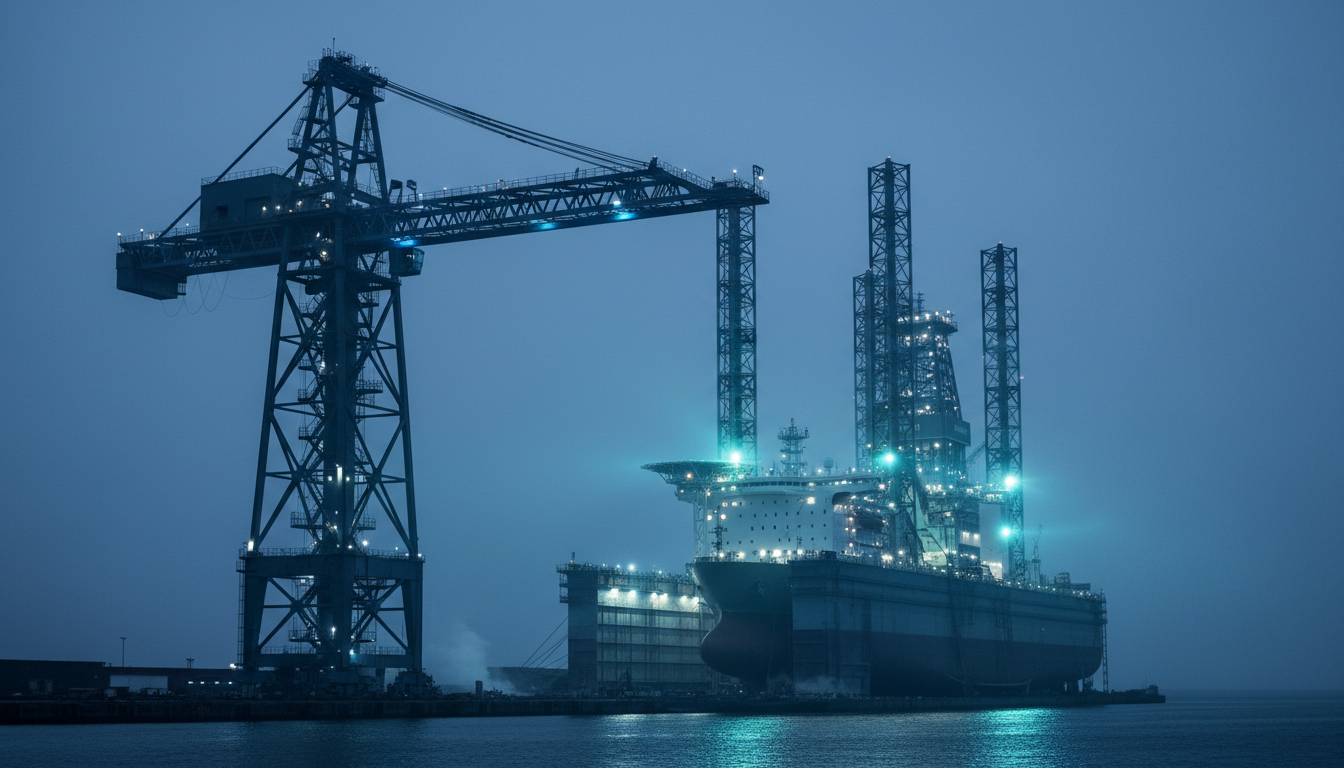

Chapter 1 Industry Overview: The Global Offshore Engineering Equipment Landscape from Oil and Gas Drilling to Wind Farm Installation
If we compress the global energy map of the past three decades into a single snapshot, offshore engineering equipment sits at the inflection point of every story. The 1990s were dominated by shallow water jack-up drilling rigs; the 2000s saw a deep-water semi-submersible wave across Brazil, the Gulf of Mexico, and Angola; the 2010s were forced into a prolonged capacity clean-out by the shale revolution and oil price collapse; the 2020s now witness three forces rising simultaneously, namely offshore wind, FPSO redeployment, and the return of deep-water drillships. China has climbed from a second tier supplier sub-contracted by Far Eastern, Singaporean, and South Korean shipyards into a global offshore engineering equipment force on equal footing with South Korea, Singapore, and Japan. Looking back from the first half of 2026, this business now has a complete supply chain, a robust premium order book, and a clear path forward.
If we anchor the perspective to the full year 2025, the global offshore engineering equipment market, by the differing definitions of Norway's Rystad Energy, the United Kingdom's Clarkson Research, and the British trade publication Upstream, ranged between 75 and 88 billion US dollars. Of that figure, oil and gas offshore platforms and service vessels accounted for roughly 48 billion US dollars, offshore wind installation vessels and offshore wind foundation engineering for roughly 22 billion US dollars, subsea engineering vessels and pipelayers for roughly 9.5 billion US dollars, and FPSO conversion and newbuild for roughly 12 billion US dollars (with some overlap with offshore platform accounting that needs deduction). By the same definition, Chinese shipyards captured roughly 31.2 billion US dollars in newbuild value according to the joint statistics released by the China Shipbuilding Industry Association and Clarkson in January 2026, representing 41.2 percent of the global newbuild value. China outpaced South Korea for the third consecutive year, holding the South Korean shipbuilding combine (HD Korea Shipbuilding and Offshore Engineering, formed from Hyundai Heavy, Samsung Heavy, and Daewoo Shipbuilding) to 32.8 percent.
The order structure is shifting rapidly. Within oil and gas offshore equipment, jack-up drilling rigs fell from 46 percent of the order book in 2014 to 18 percent in 2025; semi-submersibles dropped from 23 percent to 11 percent; deep-water drillships, lifted by strong tenders from Brazil's Petrobras, Guyana, and the Gulf of Mexico, recovered to a 14 percent share in 2025, the highest since 2017. Offshore wind installation vessels, known as Wind Turbine Installation Vessels (WTIV), exceeded jack-up rigs in single-quarter order value for the first time in the fourth quarter of 2024, and in full year 2025 surpassed deep-water drillships in annual value for the first time in history. FPSOs, propelled by consecutive tenders from Brazil, Guyana, Angola, and Mozambique, reached 28.5 billion US dollars in new contracts in 2025 according to the IHS Markit definition, a new peak since the 2014 high, with Chinese shipyards taking approximately 33 percent of either full integration or major block construction.
China holds several often-misunderstood characteristics in this business. First, despite resembling shipbuilding, it is fundamentally premium steel structure integration combined with complex system integration. The steel structure cost of a 1500-tonne WTIV accounts for only 16 to 19 percent of the total newbuild price; the remainder is contributed by cranes, dynamic positioning, electric propulsion, ballast, leg jacking, electrical control, accommodation and living systems, power distribution and backup, marine monitoring, and automation integration. This means judging the business solely by drydock capacity and steel processing tempo will dramatically underestimate the profit share that flows through subcontracted system integration and engineering contracting.
Second, this is an extremely project-oriented business. A single jack-up platform, semi-submersible, or FPSO conversion contract ranges from 0.12 to 2.8 billion US dollars in unit price and 18 to 42 months in build duration, while the order count is in single digits, often only a few units per year. This is wholly unlike the rolling order pipelines of bulk carriers and oil tankers, and the financial reports, cash flows, and headcount scheduling cannot be measured by the same conventional yardstick.
Third, this business depends heavily on deep-water engineering experience and long-term customer accreditation. The five European and American offshore engineering general contractors, namely Saipem, Subsea7, TechnipFMC, McDermott, and SBM Offshore, have long dominated deep-water oil and gas engineering. Every FPSO project moves through conceptual design, front-end engineering design (FEED), detailed design, procurement, construction, commissioning, sea trials, and customer acceptance in eight stages. The pace is not fast, and each step requires sign-off from the customer, the class society, and insurers. China's CNOOC Engineering, as the sole domestic player entering this track as an Engineering, Procurement, Construction, and Installation (EPCI) general contractor, has spent nearly a decade since 2016 reaching the point of competing with the five Western giants on second-tier projects. In 2025, its packages on Guyana Stabroek Phase 7 FPSO, Brazil Mero-4 offshore modules, and Mozambique Coral northern field were all on track per contract milestones.
Fourth, its capacity cycle is deeply correlated with oil prices but not entirely locked to them. Oil and gas offshore platform demand correlates strongly with the 60 US dollar Brent crude benchmark, offshore wind installation vessel demand correlates deeply with national offshore wind capacity targets, and FPSOs link to both deep-water proved reserves and oil price ranges. From 2024 through 2026 these three forces are rising upward simultaneously for the first time since 2010, a window unprecedented in the past 15 years, and the fundamental reason Chinese offshore engineering equipment newbuild values keep hitting new highs.
The Chinese offshore engineering equipment landscape can be divided into five tiers. The first tier consists of CSSC Offshore Engineering (responsible for large jack-ups, semi-submersibles, and FPSO general contracting) and CNOOC Engineering (deep-sea EPCI general contractor) under the China State Shipbuilding Corporation system. The second tier includes China Merchants Industry (with its Haimen base), Shanghai Zhenhua Heavy Industries (large offshore cranes and legs, jack-up modules), and CIMC Raffles (jack-up and semi-submersible assembly base at Yantai). The third tier includes Dalian Shipbuilding Industry Co.'s offshore division, Waigaoqiao Shipbuilding's offshore division, parts of Guangzhou Shipyard International, and Nantong COSCO Shipping Offshore. The fourth tier includes Jiangsu Runbang Marine Engineering, Fuzhou Mawei Shipbuilding offshore business, and Zhoushan COSCO Shipping Offshore. The fifth tier comprises specialized offshore engineering supporting factories including Ningbo Orient Cable, Hengtong Optic-Electric marine systems, Shanghai Marine Diesel Engine Research Institute, Wuhan Marine Electric Propulsion Research Institute, Hainan offshore oil and gas module prefabrication, Qingdao Haixi Heavy Industry, and Dalian Heavy Industries Crane. These five tiers jointly support the 31.2 billion US dollars of new contracts that Chinese offshore engineering equipment captured in 2025.
This tier structure is being further consolidated in 2026. The first tier of CSSC Offshore Engineering and CNOOC Engineering has accelerated EPCI capability building, with combined 2025 new contracts approaching 19.5 billion US dollars, capturing 62.5 percent of the industry total. The three second-tier players hold stable advantages in their specialized niches, with China Merchants Industry leading in FPSO and offshore modules, Zhenhua Heavy Industries leading in WTIV cranes and leg systems, and CIMC Raffles leading in jack-up assembly, each holding more than 30 percent of the domestic market share in their respective niches. The third and fourth tiers face heavy pressure, with some firms still recovering from the 2014 to 2018 jack-up oversupply, and their balance sheets and cash flows have not fully repaired, limiting their ability to sign new orders. The fifth-tier specialty supporting factories benefit from overall industry prosperity and their order books have visibly improved.
Geographically, Asia dominates new offshore platform construction. Of the 2025 global new contracts by value, Asia took 86 percent, with China at 41.2 percent, South Korea at 32.8 percent, Singapore at 5.9 percent, Japan at 3.8 percent, and other Asian countries combining to 2.3 percent. European shipyards in Norway, the Netherlands, and the United Kingdom still hold a position in offshore wind installation vessels and offshore service vessels, but their share has fallen from 38 percent in 2010 to 11.4 percent in 2025. North America's Gulf Coast shallow water platform construction has essentially been divided between China and Singapore, with only maintenance and conversion work remaining locally.
The true demand drivers are several national oil companies and a few mega oil and gas general contractors. Brazil's Petrobras announced a 128 billion US dollar capital expenditure plan for 2025 to 2030, with 41 percent going to offshore platforms and FPSOs. The Guyana Stabroek block consortium of US-based ExxonMobil and CNOOC International has placed 9 FPSO orders cumulatively, with an estimated 4 to 6 more by 2030. Angola's Sonangol, Equinor (formerly Statoil Norway), Qatar Energy, and Abu Dhabi National Oil Company (ADNOC) all increased offshore capital expenditure in 2025. On the offshore wind side, Denmark's Orsted, Germany's RWE, the United Kingdom's SSE, Scotland's ScottishPower, alongside China's State Power Investment Corporation, China Huaneng, and China Three Gorges, have jointly pushed the global offshore wind capacity target to 380 GW by 2030 and 1100 GW by 2040.
The 2026 outlook for the industry can be summarized in three sentences: middle-segment oil and gas offshore platforms have full order books, offshore wind installation vessels are nearly impossible to obtain, and FPSO contracting is exceptionally busy. Shipyard drydock schedules have been pushed to the fourth quarter of 2028 or even the second quarter of 2029, with some 1500-tonne and larger WTIVs starting to fight for drydock resources at critical delivery milestones. Chinese offshore engineering equipment is at a pivotal moment in this window, one rung up means competing on truly equal footing with the South Korean and Singaporean premium general contractors, and one rung down risks being overtaken by Vietnam and the Philippines who are also chasing premium deep-water vessels and FPSO modules. Three to five years is the critical window for this premium breakthrough, and the order book of 2026 will largely decide its ultimate direction.
Zoom the lens one click closer to look at the investment tempo from 2025 to 2030. Chinese shipyards' cumulative new contracts from 2025 to 2030 are projected to reach 185 to 220 billion US dollars per the China Shipbuilding Industry Association definition, averaging 31 to 36.5 billion US dollars per year. The structure is expected to remain roughly 42 percent oil and gas offshore platforms and service vessels, 32 percent offshore wind installation vessels and offshore engineering equipment, 20 percent FPSO general contracting and conversion, and 6 percent subsea engineering vessels and pipelayers. This structure is consistent with the actual 2025 new contract structure, suggesting the order structure over the next five years will continue its current diversified pattern, without excessive concentration in any single category.
Looking at drydock utilization, the high-end offshore engineering equipment assembly drydocks of Chinese shipyards already reached 92 percent utilization in 2025. In the first quarter of 2026, the contract delivery dates of newly signed orders were pushed to the third quarter of 2028, with some premium vessel types pushed to the second quarter of 2029. This near-full capacity utilization means that pricing power will tilt further toward shipyards during 2026 and 2027 for new orders, with single vessel prices retaining upside, particularly for 1500-tonne and larger WTIVs, seventh generation deep-water drillships, and large FPSOs.
In summary, the global offshore engineering equipment industry entering 2026 presents a classic top-of-cycle scene: three demand forces in synchrony, supply constrained by capacity limits, prices stepping up another notch, and order books continuing to concentrate in Chinese shipyards. China's position in this scene has been elevated from a growth challenger over the past decade into a primary global supplier. Whether this advantageous position can be converted into full premium general contracting capability before 2030 is the central question this report seeks to follow.
From a global offshore engineering equipment industry chain synergy perspective, another important observation point at the start of 2026 is the regionalization trend in the supply chain. For the past 30 years, the global offshore engineering equipment supply chain was highly globalized, with key sub-systems procured from Norway, Switzerland, the US, the UK, the Netherlands, Finland, and Japan; steel plates from South Korea, Japan, and China; final assembly in China, South Korea, and Singapore; and final delivery to global oil and gas and offshore wind operators. Under the geopolitical pressure of 2024 and 2025, this globalized supply chain began differentiating into three regional clusters: an East Asia supply chain centered on China, a Western Europe supply chain centered on Europe, and a North America supply chain centered on the United States.
The East Asia supply chain centers on the assembly capacity of Chinese shipyards, Zhenhua Heavy Industries' offshore cranes, Ningbo Orient Cable and Hengtong Optic-Electric's offshore cables, Juli Sling's offshore anchor chains, and the multitude of specialized offshore engineering supporting factories distributed across Jiangsu Nantong, Shanghai Changxing, Guangdong Haimen, and Shandong Qingdao. The overall character of the East Asia supply chain is its distinct scale advantage, clear price advantage, and rapidly improving customer accreditation capability. It can already independently complete the assembly and outfitting of mid-to-high-end offshore platforms such as jack-ups, semi-submersibles, and WTIVs.
The Western Europe supply chain centers on Norway's Kongsberg DP3 systems, the Netherlands' Huisman large offshore cranes, Switzerland's ABB Marine electric propulsion, the United Kingdom's Lloyd's Register and Norway's DNV class society accreditation, and the offshore wind operators and offshore service firms distributed across Denmark, Belgium, the UK, and the Netherlands. The overall character of the Western Europe supply chain is deep technological leadership, mature customer relationships, and the highest brand recognition, but with significant cost pressure and a near-complete withdrawal from full vessel assembly.
The North America supply chain centers on the United States' Oceaneering subsea ROVs, the US's NOV offshore engineering supporting equipment, the US's ABS class society, and the shallow offshore service firms along the Gulf of Mexico coast. The overall character of the North America supply chain is strong technological depth but smaller production scale, with full vessel assembly essentially withdrawn.
The coexistence and synergy of these three regional supply chains will form the basic landscape of the global offshore engineering equipment industry from 2026 to 2030. Chinese offshore engineering equipment needs to combine the scale advantage of the East Asia supply chain with the substantive demand of global customers for Chinese offshore engineering equipment, and thereby complete a substantial upgrade in mid-to-high-end general contracting capability before 2030.
Tracing the historical position of Chinese offshore engineering equipment, in the 1980s Chinese shipyards could only undertake secondary subcontracting of bulk carriers and oil tankers, with essentially zero capability for full offshore engineering equipment assembly. The Chinese offshore engineering equipment industry chain began starting up in the 1990s, mainly taking orders from foreign customers for hull block fabrication. In the 2000s and 2010s, the Chinese offshore engineering equipment industry chain rose rapidly, with jack-up assembly capability becoming basically mature and semi-submersible assembly capability starting to develop. The 2014 to 2018 capacity adjustment period put the Chinese offshore engineering equipment industry chain through a deep reshuffle, with several shipyards' offshore businesses falling into financial distress. From 2019 to 2024, the Chinese offshore engineering equipment industry chain began recovering, with new businesses such as offshore wind installation vessels, sixth-generation semi-submersibles, and large FPSO module prefabrication gradually maturing. The 31.2 billion US dollars in new contracts captured in 2025 by the entire industry is the symbolic peak of this recovery process.
Chapter 2 Equipment Classification: Jack-up, Semi-submersible, Drillship, FPSO, Wind Installation Vessel, and Pipelayer
The umbrella term offshore engineering equipment encompasses at least six major equipment forms, each corresponding to different sea state conditions, operational modes, general contracting logic, and customer bases. Distinguishing them clearly is a prerequisite for understanding the Chinese offshore engineering equipment industry chain.
The jack-up rig is the workhorse of shallow water drilling, typically operating in water depths of 50 to 130 meters, with some 400-foot types operating to 150 meters and ultra-deep variants reaching 165 meters. The main structure is a steel hull with three or four lattice legs. During operation, the legs penetrate the seabed and the platform jacks up 18 to 25 meters above water to drill. While shifting, the legs lift and the platform is towed or self-propelled like a barge. A typical 400-foot jack-up costs 190 to 240 million US dollars and uses 16,500 to 19,500 tonnes of steel. Key components include legs and jacking system, drill package, power package, accommodation, and living systems. This track suffered severe oversupply between 2014 and 2018, with the global fleet once exceeding 540 units; in 2025 the active fleet is approximately 380 units, with average day rates recovering from a 55,000 US dollars trough to 128,000 US dollars in the fourth quarter of 2025. Some 400-foot GustoMSC CJ70 types in the North Sea even signed at 240,000 US dollars per day. Chinese shipyards' advantage in this track lies in steel structure assembly speed and price, but customer accreditation gaps with Far East and Singapore yards remain.
The semi-submersible drilling platform is the other main route for deep-water drilling, operating in 500 to 3000 meter water depths, with some sixth and seventh generation types reaching 3600 meters. The upper platform is mounted on two to four columnar pontoons; during operation the pontoons submerge to preset draft, and the platform maintains position via DP3 dynamic positioning or mooring. A typical sixth generation semi-submersible costs 650 to 850 million US dollars, with seventh generation reaching 900 million to 1.1 billion US dollars, using 32,000 to 42,000 tonnes of steel. Key components include the DP3 system, drill package, four to eight medium-voltage generator sets, omnidirectional thrusters, ballast control, and drilling modules. The global active fleet is roughly 165 units, with day rates recovering from a 190,000 US dollars trough in 2020 to 510,000 US dollars in Q4 2025, with some seventh generation units signing at 620,000 US dollars per day. CIMC Raffles, Waigaoqiao Shipbuilding, and Dalian Shipbuilding are the three Chinese yards with full semi-submersible assembly capability, with CIMC Raffles' Yantai base having delivered 18 units cumulatively and Waigaoqiao plus Dalian totaling 9.
The deep-water drillship is currently the highest-end deep-water drilling equipment, operating in 1500 to 3600 meter depths, with some seventh-generation models reaching 3800 meters. The hull resembles a VLCC tanker, with a central moonpool and drilling platform module, dependent on DP3 for position keeping, with much higher mobility than semi-submersibles, more suited to frequent transit in deep-water exploration. A typical seventh-generation drillship costs 750 to 950 million US dollars, with 38,000 to 48,000 tonnes of steel. Key components overlap with semi-submersibles but add the requirement of high-end VLCC-class hull construction capability. The global active fleet is roughly 88 units, with 2025 new contract value reaching the highest level since 2017, and day rates recovering to 640,000 US dollars. Only Waigaoqiao Shipbuilding and Shanghai Waigaoqiao Marine Engineering domestically have deep-water drillship build capability. In 2025, Waigaoqiao took two seventh-generation deep-water drillship orders from Norway's Northern Drilling at 880 million US dollars per vessel, a landmark Chinese breakthrough in this track.
The Floating Production Storage and Offloading (FPSO) is the most common production-end equipment in offshore oil and gas field development, a floating factory built on a giant hull carrying oil and gas processing modules. A typical medium FPSO costs 1.2 to 2.2 billion US dollars per unit, a large FPSO 2.2 to 3.5 billion, an ultra-large FPSO up to 4.5 billion, with 65,000 to 110,000 tonnes of steel. Key modules include oil and gas separation, crude oil treatment, gas compression, water injection, oil storage, crude oil export, power, accommodation, and flare tower, more than a dozen independent process modules. This track is the main battlefield of European and American contracting giants SBM Offshore, MODEC, BW Offshore, Bumi Armada, and Yinson. New FPSO hulls are often built by Chinese and South Korean shipyards, with process modules prefabricated in Singapore or China, finally integrated and delivered by European or American EPCI contractors. CNOOC Engineering is the sole domestic Chinese player handling entire FPSO projects as EPCI. The 2025 Guyana Stabroek Phase 7 FPSO module package is its most representative order to date.
The Wind Turbine Installation Vessel (WTIV) is a new equipment type born from the rapid expansion of offshore wind. The main body is a jack-up barge with a large crane; during operation the legs penetrate the seabed and lift the platform above water, with the large crane lifting wind turbine foundations, transition pieces, towers, nacelles, and blades. Mainstream equipment crane capacity divides into four tiers: 800 to 1100 tonnes (suitable for 8 to 10 MW turbines), 1200 to 1500 tonnes (suitable for 12 to 15 MW turbines), 1600 to 2000 tonnes (suitable for 16 to 18 MW turbines), and 2200 to 2500 tonnes (suitable for 18 to 22 MW monopile and jacket foundations). A 1500-tonne WTIV costs 420 to 550 million US dollars, and 2200-tonne and larger units cost 600 to 750 million US dollars, with 12,000 to 18,000 tonnes of steel. Key components include a large circular offshore crane, four or six lattice or cylindrical legs, DP2 or DP3 dynamic positioning, and a wind turbine installation auxiliary system. This track exceeded jack-up rigs in single-quarter value in Q4 2024, and exceeded deep-water drillships in annual value in 2025, the largest single demand increment in current offshore engineering equipment.
The pipelayer vessel is the core equipment for offshore oil and gas pipeline and submarine cable laying, divided into J-lay, S-lay, and Reel-lay. J-lay vessels lay nearly vertical pipelines, suitable for deep water large diameter; S-lay vessels have a stinger at the stern, with pipeline entering water in S shape, suitable for shallow to medium-deep water; Reel-lay vessels prefabricate pipeline onto reels of 18 to 22 meters diameter with the highest laying efficiency, suitable for medium diameter and submarine cables. A high-end J-lay vessel costs 550 to 700 million US dollars. Key components include tensioners, tower or inclined laying systems, and ROV subsea robots. Saipem's Castorone, Subsea7's Seven Vega, Allseas' Solitaire, and Pioneering Spirit are the most representative equipment in this track globally. China has limited pipelayer capability, with Zhenhua Heavy Industries, COOEC, and China Merchants Industry having handled some small-to-medium orders.
Beyond the six major equipment types, the offshore engineering equipment industry chain includes many service vessel types, including platform supply vessels (PSV), anchor handling tug supply vessels (AHTS), diving support vessels (DSV), heavy lift pipelayers (HLV), service operation vessels (SOV) for offshore wind, and crew transfer vessels (CTV). These types have lower unit price (5 to 80 million US dollars) but high build volume, the main business of outfitting shipyards. Chinese shipyards already hold more than 40 percent global share in PSV, AHTS, and SOV segments.
This complete six-equipment plus service vessel matrix constitutes the entire product matrix of the Chinese offshore engineering equipment industry. A complete offshore engineering general contractor must have full assembly and contracting capability in at least three of jack-up, semi-submersible, drillship, FPSO, and WTIV, and must have independent integration capability in dynamic positioning, leg and jacking, offshore cranes, ballast control, and electric propulsion. By this standard, only the two first-tier and three second-tier Chinese players qualify. These five firms will determine whether the Chinese offshore engineering equipment industry can achieve premium breakthrough over the next 5 to 10 years.
Examining the global fleet structure of the six major equipment types reveals supply-demand balance differences across sub-tracks. Jack-up rigs total 380 globally with 9 new additions and 4 retirements in 2025, slightly loose supply. Semi-submersibles total 165 with 3 new and 7 retired, in tight supply. Deep-water drillships total 88 with 0 new (6 under construction) and 2 retired, in absolute tight supply. FPSOs total 145 with 9 new (30 under construction) and 3 retired, balanced. WTIVs total 78 with 6 new (38 under construction) and 0 retired, in absolute tight supply. Pipelayers total roughly 95 with 2 new and 3 retired, balanced. Deep-water drillships, seventh-generation semi-submersibles, and WTIVs are the three sub-tracks with absolute supply shortage, the fastest-rising price segments from 2025 to 2027, and the root cause of Chinese shipyards' rising premium product mix.
Looking at the customer base of the six major equipment types: jack-up customers are mainly Middle East national oil companies (Saudi Aramco, ADNOC, Qatar Energy), Southeast Asian national oil companies (Petronas of Malaysia, Pertamina of Indonesia), and European and American deep-water drilling operators (Transocean of Switzerland, Valaris of the UK, Noble Corp of the UK). Semi-submersible and drillship customers concentrate on European and American deep-water operators including Transocean, Valaris, Noble Corp, Seadrill of Norway, Stena Drilling of the UK, and Northern Drilling of Norway. FPSO customers are mainly international oil companies and national oil companies including Petrobras of Brazil, ExxonMobil, Shell, BP, TotalEnergies, CNOOC International, and Sonangol of Angola. WTIV customers are mainly offshore wind operators including Cadeler of Denmark, Jan De Nul of Belgium, Seajacks of the UK, Van Oord of the Netherlands, China Shipbuilding Leasing, and Guangdong Energy Leasing.
The human resource demand structure across the offshore engineering equipment industry is multi-layered, spanning total assembly base project managers, offshore engineering chief designers, hull welding technicians, electrical commissioning engineers, mechanical assembly technicians at the assembly bases; specialized sub-system design, commissioning, and after-sales engineers at the key sub-system suppliers; and conventional hull design, hull construction, and mechanical outfitting roles at the supporting shipyards. The total industry chain headcount is approximately 280,000 to 320,000, with engineers totaling 45,000 to 55,000, technical workers 180,000 to 220,000, and other roles 50,000 to 60,000.
Chapter 3 Process Barriers: Dynamic Positioning DP3, Offshore Cranes, Deep-Sea Pressure Resistance, and ROVs
To understand where Chinese offshore engineering equipment hits bottlenecks in premium breakthrough and why the 3 to 5 year window is particularly critical, one must dissect each offshore platform's process barriers down to the key sub-system level. The biggest difference between offshore engineering equipment and conventional shipbuilding is that shipbuilding is hull assembly plus a small number of propulsion and navigation systems, while offshore is hull integration plus dozens of independent process systems. What determines an offshore platform's tier is not the hull steel plates and structural welding, but the design, procurement, integration, and commissioning capability of these dozens of independent process systems.
The DP3 dynamic positioning system is the core required system for contemporary deep-water offshore platforms, deep-water drillships, and seventh generation semi-submersibles. Per the IMO definition, DP divides into DP1, DP2, DP3 tiers, with higher tier meaning higher single-point fault tolerance and higher operational reliability. The DP3 system requires the vessel to maintain position stability even with single thruster, single generator set, single control system, or single power switchboard failure, meaning the system must be redundantly designed: at least four medium-voltage generator sets, at least four independent thrusters, at least two independent DP control systems, and mutually backed-up switchboards and cable runs. A complete DP3 system costs 15 to 28 million US dollars, accounting for 6 to 9 percent of total newbuild price.
Global supply of DP systems is nearly monopolized by three oligopolists: Norway's Kongsberg Maritime K-Pos DP and K-Bridge series; US General Electric Marine (now merged into Norway's Wartsila group)'s Bridge Mate and Marine Power series; the UK's Rolls-Royce Marine series (since spun off into Norway's Kongsberg and Sweden's ABB). These three combined hold over 90 percent of the global DP3 system market by value. Domestically in China, only Shanghai Marine Diesel Engine Research Institute, Wuhan Marine Electric Propulsion Research Institute, and Qingdao Marine Engineering Research Institute have researched and delivered some DP1 to DP2 systems on small projects; DP3 remained at prototype stage in 2025. This is one of the most critical chokepoints for Chinese offshore engineering equipment in deep-water drillships and seventh generation semi-submersibles.
Large offshore cranes are the core equipment of WTIVs, HLVs, and semi-submersible crane vessels. Offshore cranes divide into four lifting capacity tiers: under 800 tonnes (common in shallow-water vessels), 800 to 1500 tonnes (mainstream WTIV and HLV), 1500 to 2500 tonnes (premium WTIV and large HLV), and over 3000 tonnes (ultra-large semi-submersible crane vessels). A 2000-tonne offshore crane costs 55 to 85 million US dollars, 3000-tonne 150 to 200 million, 4000-tonne and above 250 to 400 million, accounting for 12 to 18 percent of total newbuild price.
Global supply of offshore cranes comes mainly from Huisman of the Netherlands, Liebherr Marine of Germany, NOV of Norway, and Zhenhua Heavy Industries of China. Huisman has long held the pyramid top, taking most orders over 2500 tonnes. Zhenhua Heavy Industries entered this track in the 2010s with aggressive pricing and by 2025 had cumulatively delivered 65 offshore cranes of 1500 tonnes or larger, with global share by count approaching 40 percent and by value approximately 22 percent. This is one of the rare segments in Chinese offshore engineering equipment industry where supply has graduated from supporting role to independent equipment export, giving Zhenhua independent brand recognition among international offshore engineering equipment customers.
Deep-sea pressure resistance is the key process barrier for deep-water drilling equipment, subsea oil and gas production equipment, and subsea relays. A seventh generation deep-water drillship's drilling package includes blowout preventer (BOP), riser, and wellhead equipment. The BOP operates at depths up to 3600 meters with pressure rating of 15,000 psi, and key valves and seals must withstand seawater pressure of 100 MPa or more. Subsea oil and gas production equipment (including subsea wellhead control units, subsea manifolds, and subsea separators) operate at depths up to 3000 meters with similar pressure ratings. The difficulty of deep-sea pressure resistance is not in the material's compressive strength itself, but in the sealing reliability and seawater corrosion performance over a 25 to 30 year service cycle. Once deep-sea pressure resistance sealing fails, single-incident losses can reach hundreds of millions to billions of US dollars; BP's 2010 Gulf of Mexico Deepwater Horizon incident is the classic case.
Global supply of deep-sea pressure equipment comes mainly from US Schlumberger, US Halliburton, UK Baker Hughes, US NOV, and Switzerland's ABB Marine. The first three long held over 70 percent of the global subsea oil and gas equipment market by share; after Baker Hughes sold its OFS Industrial business to GE in 2022, shares shifted somewhat. Domestically in China, only specialized subsidiaries of CNOOC Engineering, Shanghai CSSC Maritime, and a few others have project-delivered shallow and medium-shallow subsea equipment; deep-water (over 1500 meters) subsea oil and gas production equipment remains at prototype validation stage.
The ROV subsea robot is the core equipment for underwater inspection, subsea equipment installation, subsea pipeline laying assistance, and deep-water drilling emergencies. ROVs divide into three tiers by weight and function: observation class (150 to 500 kg), work class (1500 to 3500 kg), and heavy work class (over 5000 kg). A premium work-class ROV is priced at 3.5 to 7.5 million US dollars per unit, and a heavy work class 12 to 20 million. Global supply comes mainly from US Oceaneering, US SubseaPro, UK Forum Energy, and Netherlands Fugro, with combined share over 65 percent. Domestically, observation-class ROVs have R&D capability at Shanghai Jiao Tong University, Harbin Engineering University, and Chinese Academy of Sciences Shenyang Automation Institute; work-class ROV deliveries are mainly handled by engineering subsidiaries of COOEC; heavy work-class ROVs remain at prototype stage.
The leg jacking system is the core mechanical device of jack-up rigs and WTIVs. A 400-foot jack-up's three legs can each reach 165 meters in length and weigh 1900 to 2400 tonnes; the jacking system must continuously raise and lower the entire platform (self-weight 18,000 to 22,000 tonnes) by 18 to 25 meters. Global leg jacking supply comes from GustoMSC of the Netherlands (acquired by NOV), Friede and Goldman of the US, Keppel FELS of Singapore, and Sembcorp Marine of Singapore (rebranded as Seatrium after merger). Domestically, Zhenhua Heavy Industries, China Merchants Industry, and CIMC Raffles in Yantai have all completed independent jacking system R&D and project deliveries in the late 2010s. By 2025, the domestic localization rate for jack-up and WTIV jacking systems reached approximately 75 percent.
Electric propulsion and high-efficiency power distribution are the core of large offshore platforms, especially the complex power architecture required for DP3. A sixth-generation semi-submersible's power system includes 4 to 6 medium-voltage generator sets (8 to 12 MW each), 4 four-quadrant frequency converters, 4 to 8 medium-voltage azimuth thrusters, complex medium-voltage switchboards, and a DC backup system. The complete power system costs 25 to 45 million US dollars, accounting for 10 to 15 percent of total newbuild price. Global supply comes mainly from Norway's ABB Marine, Switzerland's Wartsila (now merged into Finland's Wartsila group), and Norway's Kongsberg. Domestically in medium-voltage motor drives and switchboards, Shanghai Marine Diesel Engine Research Institute, Wuhan Marine Electric Propulsion, and Shanghai Electric Marine Systems have project delivery capability, but full DP3-grade power system integration remains a gap.
Mapping these seven key sub-systems' localization rates: leg jacking 75 percent, offshore cranes 60 percent, DP1 systems 80 percent and DP3 only 5 percent, deep-sea pressure equipment 10 percent, ROV subsea robots 30 percent, electric propulsion DP3 integration 15 percent, accommodation and living systems 85 percent. The overall average is 40 to 50 percent, with the lowest rates in the premium sub-systems needed for deep-water drillships and seventh-generation semi-submersibles. This is the full content of Chinese offshore engineering equipment's 3 to 5 year premium breakthrough: lifting the localization rates of dynamic positioning, deep-sea pressure resistance, and ROVs from below 30 percent to above 60 percent.
Going one layer deeper into the supply chain synergy of these seven sub-systems, one can see CSSC Offshore Engineering's current boundary: 100 percent in-house for hull and leg steel structures; offshore crane outsourced to Zhenhua or Liebherr of Norway; DP3 outsourced to Kongsberg of Norway; deep-sea pressure equipment to Schlumberger or TechnipFMC; work-class ROV to Oceaneering or COOEC subsidiaries; electric propulsion DP3 to Switzerland ABB; accommodation 100 percent in-house. This in-house plus outsourced boundary is the typical state of all Chinese offshore engineering general contractors.
Process barriers also include hidden dimensions like software and algorithms, quality management, project management, and after-sales whole life-cycle support. International offshore engineering equipment design relies heavily on Norway DNV's Sesam, Finland's NAPA, US Bentley, and UK ABS class society software. Chinese offshore engineering equipment software remains import-dependent, with several domestic ship design institutes developing autonomous offshore engineering equipment software but lagging in maturity. This is another hidden bottleneck, unlikely to be substituted in 3 to 5 years.
Chapter 4 Major Players: CSSC Offshore, CNOOC Engineering, China Merchants Industry, Zhenhua, CIMC Raffles, and Overseas Giants Benchmark
Chinese offshore engineering equipment major players can be categorized by business model into three types: drydock assembly, EPCI general contractor, and specialized system supporting. Drydock assembly type includes CSSC Offshore Engineering, China Merchants Industry, CIMC Raffles, Waigaoqiao Shipbuilding's offshore division, and Dalian Shipbuilding's offshore division, undertaking the overall steel structure and system integration of offshore platforms. EPCI general contractor type has only CNOOC Engineering, independently taking complete engineering general contracting from FEED to commissioning and delivery. Specialized system supporting type includes Zhenhua Heavy Industries (large offshore cranes and leg jacking), Ningbo Orient Cable (submarine cable), Hengtong Optic-Electric (submarine optical electric composite cable), and Shanghai Marine Diesel Engine Research Institute (electric propulsion integration), among others.
CSSC Offshore Engineering (CSSC OE) is the subsidiary of China State Shipbuilding Corporation specialized in offshore engineering equipment, formed in 2019 by merging the former CSSC Industries offshore division and the former CSSC Heavy offshore division, integrating Dalian Shipbuilding offshore division, Wuchang Shipbuilding offshore department, Shanghai Marine Diesel Engine Research Institute's offshore business, Qingdao Haixi Heavy Industry, and partial shares of China Merchants Industry. CSSC OE captured roughly 16.5 billion US dollars in new orders in 2025, the largest single contractor of Chinese offshore engineering equipment. Its business covers jack-up platforms, semi-submersibles, deep-water drillships, FPSO modules, and WTIVs, all the major equipment types. The 2025 Q2 contract for two 2200-tonne WTIVs at 650 million US dollars per vessel is the highest single-vessel price ever recorded for Chinese yards in offshore wind installation vessels.
CNOOC Engineering (COOEC, stock code 600583.SH) is the listed company under CNOOC group specialized in offshore oil and gas engineering general contracting. 2025 revenue was 48.2 billion RMB, attributable net income 3.85 billion RMB, year-on-year growth 24.7 percent. CNOOC Engineering is the sole domestic Chinese player entering international deep-sea oil and gas engineering as an EPCI general contractor. Its 2025 contracts including Guyana Stabroek Phase 7 FPSO package, Brazil Mero-4 offshore modules, Mozambique Coral northern packages, and Angola Block 17 offshore conversion totaled 7.8 billion RMB, with overseas business share crossing 20 percent for the first time. Its Tianjin Binhai and Qingdao West Coast offshore module prefabrication bases are the only domestic bases with 4000-tonne offshore module prefabrication capability; the 6 large offshore modules completed in 2025 include a 38,000-tonne FPSO upper module, a new domestic single-module tonnage record.
China Merchants Industry Holdings is the offshore business of China Merchants Group, with three assembly bases in Shenzhen Haimen, Shanghai Changxing, and Nantong Qidong, focused on jack-up platforms, FPSO conversions, and offshore module prefabrication. After integrating parts of Singapore's Vard Holdings offshore business in 2024, China Merchants Industry's 2025 new contracts reached 5.2 billion US dollars, the second-largest Chinese offshore engineering equipment assembler. Its FPSO conversion capability draws on engineering experience from the Vard integration; the 2025 two VLCC-to-FPSO conversion contracts (one for Brazil Petrobras, one for Qatar Energy) reached 280 million US dollars per vessel in conversion fees.
Zhenhua Heavy Industries (ZPMC, stock code 600320.SH) is the listed offshore equipment and port machinery contractor under Shanghai Zhenhua Port Machinery's parent company. 2025 revenue 28.5 billion RMB, attributable net income 860 million RMB, year-on-year growth 15.3 percent. Its offshore business has three segments: large offshore cranes (800 to 4000 tonnes), jack-up platform legs and jacking, and heavy lift pipelayer (HLV). In 2025 it took 23 large offshore crane orders of 1500 tonnes or larger, value roughly 1.9 billion US dollars, with global share by count exceeding 50 percent. Its core advantages are twofold: steel structure capability at the Shanghai Changxing base, one of the few globally able to fully fabricate 4000-tonne offshore crane booms; and 25-year stable cooperation with global customers including Seajacks of the UK, Cadeler of Denmark, RWE of Germany, Heerema of the Netherlands, and Sembcorp Industries of Singapore.
CIMC Raffles is the offshore subsidiary of China International Marine Containers (CIMC Group, 000039.SZ), with two assembly bases at Yantai and Haiyang, focused on jack-up and semi-submersible assembly. It once fell into balance sheet pressure due to jack-up oversupply in the 2010s, went through deep restructuring from 2018 to 2022, and resumed profitability in 2023. Its 2025 new contracts were roughly 2.8 billion US dollars, mainly 400-foot jack-ups and a few sixth generation semi-submersibles. The Yantai base has cumulatively delivered 18 semi-submersibles, the most by any Chinese yard, a real accumulation of process barriers.
Waigaoqiao Shipbuilding is the assembly base under CSSC Offshore Engineering, with 2025 new contracts roughly 3.1 billion US dollars, of which offshore business is roughly 1.9 billion. It is the sole domestic assembly base with deep-water drillship construction capability. The two seventh generation deep-water drillships signed with Northern Drilling of Norway in 2025 at 880 million US dollars per vessel is a landmark Chinese breakthrough in this track. These two vessels will deliver in Q3 2027 and Q1 2028, with the key build challenge being full DP3 system integration and deep-water drilling package installation.
Benchmarking these six Chinese players against overseas giants reveals both the gaps and the potential. SBM Offshore (Amsterdam-listed SBMO.AS) is the Dutch FPSO contracting giant with 2025 revenue 9.2 billion US dollars, attributable net income 1.25 billion US dollars, having cumulatively delivered 22 FPSOs globally, with business highly concentrated in Brazil, Guyana, and Angola deep-water oil and gas fields. Saipem (Milan-listed SPM.MI) is the Italian Eni group's offshore engineering general contracting listed company, 2025 revenue 13.4 billion euros, offshore business roughly 7.8 billion euros, attributable net income 680 million euros, with core equipment Castorone (J-lay pipelayer) and Saipem 7000 (3000-tonne semi-submersible crane pipelayer, holding the single-lift record). Saipem holds the top two positions globally in FPSO, subsea oil and gas engineering, and subsea pipelaying.
TechnipFMC (NYSE: FTI) is the offshore engineering giant merged from France's Technip and US FMC in 2017, with 2025 revenue 9.2 billion US dollars, offshore business roughly 5.5 billion US dollars, attributable net income 450 million US dollars. Its core is subsea oil and gas Production Systems (SPS) and subsea pipeline services (USS), ranking first globally in subsea oil and gas equipment. Subsea7 (Oslo-listed SUBC.OL) is the Norwegian offshore engineering giant with 2025 revenue 7.8 billion US dollars, offshore business roughly 6.5 billion US dollars, attributable net income 520 million US dollars, focused on subsea oil and gas engineering and subsea pipelines. McDermott International is the traditional US offshore engineering giant, restructured from bankruptcy in 2024, with 2025 revenue 3.5 billion US dollars, focused on Gulf of Mexico and Middle East offshore contracting.
Comparing the combined 43.1 billion US dollars revenue (approximately 300 billion RMB) of the five overseas firms to the largest Chinese players, CSSC Offshore (roughly 16.5 billion US dollars by order book) and CNOOC Engineering (roughly 6.7 billion US dollars by revenue), Chinese top two combined revenue is roughly 23.2 billion US dollars, 54 percent of the overseas five combined. The gap is not in scale but in EPCI capability, deep-water engineering experience, and customer accreditation. This is the core target of Chinese offshore engineering equipment's 3 to 5 year premium breakthrough.
Comparing financial performance, CSSC Offshore Engineering's 2025 consolidated revenue was roughly 118 billion RMB (including offshore and shipbuilding), offshore business roughly 35 billion RMB, attributable net income 3.2 billion RMB. CNOOC Engineering: revenue 48.2 billion RMB, net income 3.85 billion RMB, net margin 8 percent. China Merchants Industry: consolidated revenue roughly 28 billion RMB, offshore business roughly 16.5 billion RMB, net income 1.8 billion RMB. Zhenhua: revenue 28.5 billion RMB, offshore business roughly 9.2 billion RMB (32 percent share), net income 860 million RMB. CIMC Raffles: revenue roughly 9.5 billion RMB, net income 520 million RMB. Waigaoqiao Shipbuilding: offshore business revenue roughly 7.8 billion RMB, net income 480 million RMB.
The combined revenue of these six Chinese offshore engineering general contractors is roughly 95.2 billion RMB (approximately 13.2 billion US dollars), with combined net income of roughly 10.7 billion RMB (approximately 1.48 billion US dollars), an overall net margin of roughly 11.2 percent, comparable to or exceeding the overseas five (combined net margin roughly 8.5 to 11 percent). This is the biggest financial advance for Chinese offshore engineering equipment in the past decade: graduating from "large revenue thin margin" to "revenue and net income rising together" healthy financial state. Three reasons drive the improvement: rising drydock utilization (92 percent in 2025), shifting product mix to premium (premium product share rose from 12 percent in 2020 to 28 percent in 2025), and tight drydock schedules tilting pricing power to shipyards (single vessel prices for new contracts in 2025 rose 15 to 25 percent from 2022 to 2023). These three forces jointly pushed 2025 financial performance to the highest in the past decade.
Comparing the supply chains: CSSC Offshore's supply chain covers from steel plate to nearly all key sub-systems, the most complete. CNOOC Engineering's supply chain concentrates on process modules and subsea oil and gas engineering, the most specialized domestic structure. China Merchants Industry's supply chain couples deeply with FPSO conversion, with synergies with overseas peers after Vard integration. Zhenhua's supply chain concentrates on offshore crane manufacturing, the most focused domestic supply chain. CIMC Raffles and Waigaoqiao Shipbuilding are similar to CSSC Offshore, covering from steel plate to multiple key sub-systems.
Comparing customer bases: CSSC Offshore Engineering serves Middle East national oil companies, Southeast Asian national oil companies, European offshore wind operators, and North American deep-water drilling operators, the most diversified Chinese offshore general contractor. CNOOC Engineering's customers concentrate on CNOOC, CNOOC International, Petrobras, ExxonMobil Guyana, and Sonangol of Angola. China Merchants Industry serves Petrobras, Qatar Energy, and European offshore wind operators. Zhenhua serves global offshore operators including Cadeler, Jan De Nul, Seajacks, Heerema, and Sembcorp. CIMC Raffles focuses on domestic customers with Asia Pacific drilling operators as secondary. Waigaoqiao Shipbuilding covers Norwegian, Singaporean, and Middle Eastern markets.
R&D investment comparison: CSSC Offshore 2025 R&D investment roughly 3.8 billion RMB (3.2 percent of revenue), CNOOC Engineering 2.2 billion RMB (4.6 percent), China Merchants Industry 1.1 billion RMB (4.0 percent), Zhenhua 1.4 billion RMB (4.9 percent), CIMC Raffles 400 million RMB (4.2 percent), Waigaoqiao 800 million RMB (10.3 percent of offshore revenue). Six companies' combined R&D is roughly 9.7 billion RMB (1.35 billion US dollars), versus the overseas five's combined roughly 2.5 billion US dollars, still a significant gap. R&D gap is another hidden bottleneck for 3 to 5 year premium breakthrough.
Chapter 5 Wind Installation Vessel Boom: 1500 to 2500 Tonne WTIVs and 18 MW Monopile and Jacket Foundations
The WTIV sub-track moved decisively to center stage of offshore engineering equipment in 2025. Spreading out three years of orders, WTIV new contract value jumped from 1.8 billion US dollars in 2022 to 3.5 billion in 2023, 6.2 billion in 2024, and reaching 8.9 billion in 2025, growing nearly five-fold in three years. The growth is driven by four forces: European offshore wind moving into peak installation, Chinese offshore wind moving into deep-water upgrade, North American and Asia Pacific markets opening policy windows simultaneously, and single-machine power jumping from 8 MW to 18 MW driving full equipment upgrade.
Europe is currently the most explosive growth WTIV market. WindEurope's 2025 disclosure shows European offshore wind cumulative capacity at 41.5 GW, with 8.6 GW added in 2025, 12.4 GW expected in 2026, and another 145 GW total expected from 2027 to 2030. Every offshore wind installation requires at least one 1500-tonne or larger WTIV, and Europe's own fleets at Cadeler, Jan De Nul, Seajacks, Van Oord combined total fewer than 22 vessels, far below the 145 GW demand. New WTIV orders flow heavily to Chinese shipyards. In 2025, European customers placed 14 WTIV orders at Chinese yards at average price 480 million US dollars per vessel, totaling 6.7 billion US dollars, the largest single category of Chinese offshore engineering equipment exports.
Cadeler (Copenhagen-listed CADLR.CO) is the largest WTIV operator globally in 2025, with 11 vessels in its fleet plus 4 under construction at Chinese yards, totaling 15 vessels by completion. Cadeler 2025 revenue 580 million US dollars, attributable net income 120 million US dollars, net margin 21 percent. Jan De Nul is the other global-scale WTIV operator, with 8 vessels in fleet plus 2 new 2200-tonne WTIV orders in 2025 at 720 million US dollars per vessel. The two together signed close to 3.8 billion US dollars with Chinese shipyards in 2025, 57 percent of European-customer orders to China.
Chinese offshore wind's deep-water shift creates the other mainstream WTIV demand. Chinese offshore wind cumulative capacity reached 50.2 GW by end-2025, with nearshore projects (water depth under 35 meters) totaling roughly 38 GW, near the developable nearshore limit. The central government target of 120 GW new offshore wind capacity 2025 to 2030 is mainly in deep-water (35 to 60 meters) and floating (over 60 meters). Deep-water projects pose entirely different demands on WTIV: leg length from 90 meters to 120-145 meters; crane capacity from 1200 to 1800-2200 tonnes; DP rating from DP2 to DP3; hull anti-storm rating from 9 to 11.
Single-machine power upgrade is another engine driving WTIV upgrade. Offshore turbine power rose from 6 to 8 MW in 2018 to mainstream 14 to 16 MW in 2025, entering 18 to 22 MW era in 2026 to 2028. Each power upgrade exponentially increases foundation, transition piece, tower, and nacelle weights. An 18 MW turbine monopile reaches 2400 to 2800 tonnes, jacket foundation 3200 to 4500 tonnes, single tower section up to 1200 tonnes, nacelle up to 1400 tonnes. These figures directly bound WTIV crane capacity. 1500-tonne WTIV cannot lift 18 MW monopile; 2000-tonne can only lift monopile, transition, tower sections, and nacelle, not jacket; only 2200-tonne and larger can cover all installation steps.
2200 to 2500 tonne WTIV becomes the most scarce offshore equipment from 2025 to 2028. A 2500-tonne WTIV costs 680 to 780 million US dollars, build duration 28 to 36 months, with 14 new orders signed globally in 2025 totaling 9.5 billion US dollars. Among 2500-tonne WTIVs placed at Chinese yards, Zhenhua exclusively supplies 11 large cranes (78 percent), the most critical Chinese offshore supporting deal in the export premium market.
WTIV process integration barriers concentrate in five elements. First, the large circular offshore crane design and manufacture; 2500-tonne offshore crane boom reaches 165 meters, swing radius covers full 165-meter circle, boom self-weight 4500 to 6500 tonnes, extremely difficult to integrate. Second, leg and jacking systems; 2500-tonne WTIV's four lattice legs are 145 meters each, weighing 2800 to 3200 tonnes each, and lifting a self-weight 65,000 to 78,000 tonne hull by 22 meters requires four independent gear-rack jacking systems acting synchronously, with any single-point loss of sync capable of triggering catastrophic capsize. Third, DP3 and electric propulsion integration; before 145-meter legs reach seabed the vessel must hold position via DP3, with the complete power system consisting of 4 to 6 medium-voltage generator sets, 4 four-quadrant frequency converters, and 6 to 8 azimuth thrusters, integration complexity comparable to a sixth-generation semi-submersible. Fourth, turbine installation auxiliary systems; including 18 MW nacelle interfacing, tower section docking platforms, blade installation jigs, all customized per turbine model. Fifth, hull anti-storm and offshore performance; 2500-tonne WTIV self-weight 65,000 to 78,000 tonnes, operating sea state up to Beaufort 11, hull design balancing anti-storm, low drag, and maneuverability.
Of Chinese yards in these five elements, CSSC's Huangpu Wenchong and Waigaoqiao Shipbuilding are the earliest and best, jointly handling 62 percent of Chinese WTIV exports. Huangpu Wenchong delivered the first complete 1500-tonne WTIVs to Cadeler in 2024, China's first mid-to-high WTIV export to Europe. Waigaoqiao Shipbuilding signed two 2500-tonne WTIVs with Jan De Nul in Q2 2025 at 720 million US dollars per vessel, the value peak of Chinese yards in this track.
Beyond WTIVs, offshore wind installation includes SOV (Service Operation Vessel), CTV (Crew Transfer Vessel), blade transport vessels, and CLV (Cable Lay Vessel). These types have lower unit price (8 to 120 million US dollars) but high volume. Chinese yards captured 2.8 billion US dollars combined in 2025 in SOV/CTV/CLV, forming the complete offshore wind offshore engineering industry chain with WTIV. CLV is the critical equipment supporting submarine cable laying, unit price 80 to 150 million US dollars, with Ningbo Orient Cable and Hengtong Optic-Electric as main customers.
The WTIV market continues high-speed expansion through 2025 to 2028. WindEurope's 2025 outlook projects global WTIV demand at 165 vessels by 2030 (78 at end-2025), a gap of 87. At an average price of 550 million US dollars per vessel, cumulative orders over 5 years could reach 48 billion US dollars, the single largest growth engine for Chinese offshore engineering equipment from 2026 to 2030, and the best stepping stone from supporting to total contracting.
Chapter 6 Deep-Water Drilling and FPSO: Bohai Oil and Gas, South China Sea Deep Water, and Brazil Guyana Overseas Orders
If WTIV is currently the fastest growth segment, deep-water drilling and FPSO are the largest value, highest margin, and highest technical barrier segments. These two sub-tracks jointly decide whether Chinese offshore engineering equipment can achieve true premium breakthrough in oil and gas.
Deep-water drilling has traveled a dramatic curve over the past decade. Before the 2014 oil price collapse, global deep-water drillship plus sixth-generation semi-submersible peak fleet was 268, with 152 semi-submersibles and 116 drillships. After collapse, the track underwent 8 years of capacity clean-out, with active fleet dropping to 187 (110 semi-submersibles, 77 drillships) by 2022. After oil returned to 80 US dollars in 2023 the track turned, and by 2024 sixth-generation-or-higher semi-submersibles and seventh-generation deep-water drillships' global utilization reached 92 percent, with day rates back to post-2014 peak highs.
2025 marks the third year of high prosperity. Semi-submersible day rates rose from 420,000 US dollars in 2024 to 510,000 in 2025 Q4. Deep-water drillship day rates rose from 550,000 in 2024 to 640,000 in Q4 2025, with some new three-year contracts even reaching 730,000. The recovery directly repaired balance sheets for deep-water drilling operators, reawakening newbuild capacity. In 2025 global new deep-water drillship orders were 6 (4 in China Waigaoqiao, 2 in Korea Samsung Heavy), and semi-submersible orders 4 (3 China, 1 Korea), the first new deep-water drilling newbuilds since 2014 collapse.
Domestically in China, deep-water drilling demand grows from two directions. One is the national strategy of deep-water Bohai oil and gas and South China Sea deep-water development; CNOOC's 2025-published seven-year action plan makes South China Sea deep-water the main thrust, with cumulative deep-water oil and gas exploration investment of 185 billion RMB from 2025 to 2030, of which roughly 48 billion goes to deep-water drillships and sixth generation semi-submersibles. Two is CNOOC's international expansion; CNOOC International has large offshore platform needs in Brazil, Guyana, Iraq, and UAE, also rising rapidly for deep-water drillships and seventh generation semi-submersibles.
Waigaoqiao Shipbuilding's two seventh generation deep-water drillship orders in 2025 are the landmark Chinese breakthrough in this track. The customer Northern Drilling is the deep-water drilling operator restructured from bankruptcy in 2024, with controlling stake taken by John Fredriksen group of Norway. Total contract 1.76 billion US dollars (880 million per vessel), 8 percent below Samsung Heavy of Korea and 5 percent below Keppel of Singapore. The pricing advantage plus Waigaoqiao's 15 years of experience delivering 4 sixth generation semi-submersibles and 2 fifth generation deep-water drillships is the key reason Northern Drilling placed the order in China.
The two vessels will deliver in Q3 2027 and Q1 2028. The build will test Waigaoqiao's capability in full DP3 integration, deep-water drilling package installation, seventh generation hull processes, and ultra-large hull welding. If both are delivered on schedule, on quality, and on budget, Waigaoqiao will officially join the global top three seventh generation deep-water drillship builders in 2028, on equal footing with Samsung Heavy and Singapore Keppel.
FPSO is the largest single category by value of offshore engineering equipment. Global FPSO fleet stands at 145, with 30 under construction. 2025 new contract value reached 28.5 billion US dollars per IHS Markit, the new peak since 2014. FPSO concentrates in Brazil, Guyana, Angola, Mozambique, and Gulf of Mexico, with single vessel cost 1.2 to 4.5 billion US dollars.
Brazil is the largest single FPSO market. Petrobras' 2025 to 2030 capital expenditure plan of 128 billion US dollars includes 41 percent to FPSOs and offshore platforms, totaling 52.5 billion US dollars. Petrobras' 2025-signed or under-construction FPSOs total 24, of which 7 are SBM Offshore contracts, 5 MODEC, 3 BW Offshore, 3 Bumi Armada, 2 Yinson, and 4 joint ventures. Most hulls are built by Chinese and Korean shipyards, modules prefabbed in Singapore or China by CNOOC Engineering, and final integration by European or American EPCI contractors.
Guyana is the fastest growing emerging FPSO market. The Stabroek block is jointly developed by ExxonMobil (45 percent), Hess (30 percent), and CNOOC International (25 percent), with proven recoverable reserves at roughly 11.3 billion barrels of oil equivalent. By end-2025, Stabroek had placed 9 FPSO orders cumulatively (Liza Destiny, Liza Unity, Prosperity, ONE Guyana, Errea Wittu, Jaguar, Hammerhead, Longtail, Whiptail), with SBM Offshore contracting 6 and MODEC 3. Another 4 to 6 FPSO orders are expected by 2030.
CNOOC Engineering's breakthrough in FPSO is process module package subcontracting on Brazil, Guyana, and Mozambique. The 2025 Guyana Stabroek Phase 7 FPSO (Errea Wittu) process module package includes oil-gas separation, crude oil treatment, water injection, and export modules, contract value roughly 480 million US dollars, the highest Chinese subcontract in an international FPSO project. The key significance: upgrading CNOOC Engineering from a hull subcontractor to a process module subcontracting general contractor, with the next target being full FPSO EPCI general contracting.
Domestic FPSO projects are catching up rapidly. CNOOC's 2025 announced Bohai oil and gas and South China Sea deep-water development plan includes 6 new FPSOs, of which 3 medium-FPSO are CNOOC Engineering general contracted, in progress at Tianjin Binhai and Qingdao West Coast offshore module prefab bases. All 3 are for CNOOC, total contract 9.6 billion RMB, duration 36 to 42 months. This is the largest single order CNOOC Engineering has taken for domestic FPSO general contracting.
Combining deep-water drilling and FPSO, total value is close to 36.5 billion US dollars, the two largest sub-track values in 2025 global offshore engineering equipment. Chinese offshore engineering equipment combined captures roughly 13.2 billion US dollars in these two segments, roughly 36 percent share, approaching Korea (39 percent). These are the two most critical fronts for Chinese offshore engineering equipment's 3 to 5 year premium breakthrough.
Conversion FPSO is the other line worth tracking. Conversion FPSO converts existing VLCC or Suezmax tankers into FPSOs, with conversion cost 0.8 to 1.8 billion US dollars per vessel, 20 to 30 percent cost saving versus newbuild FPSO, with build time also shortened to 18 to 24 months. Conversion FPSO suits short oil-field economic life or low expected production projects, becoming an important supplement to the FPSO market over the past 15 years. Of cumulative 145 FPSOs globally, conversion FPSOs total roughly 95 and newbuilds 50.
Chinese shipyards now hold 55 percent share in conversion FPSO globally, the largest single supplier. China Merchants Industry's Haimen base, CNOOC Engineering Qingdao West Coast base, Waigaoqiao Shipbuilding offshore division, and Dalian Shipbuilding offshore division are the four main domestic conversion FPSO yards.
Chapter 7 Platform Perspective: Filtering Offshore Steel Structure, Cranes, and Castings Supplier Capabilities by Process
Shifting the lens from general contractors to the supply chain downstream reveals a fact rarely covered by sell-side research: the 65,000-tonne self-weight of a single WTIV is supported by hundreds of specialized offshore engineering supporting factories; the 880 million US dollar build value of a single seventh-generation deep-water drillship has at least 180 million flowing to over a thousand process-segmented suppliers. These suppliers cluster across six industry belts: Jiangsu Nantong, Zhejiang Zhoushan, Shandong Qingdao, Liaoning Dalian, Shanghai Changxing, and Guangdong Haimen. By process segment they span more than a dozen sub-domains including offshore steel structure, offshore crane components, offshore castings, offshore forgings, offshore welding, offshore cables, offshore coatings, and offshore piping.
Any upstream salesperson attempting to provide professional services to an offshore engineering general contractor must use a sufficiently fine-grained tool to identify these factories' process capability, capacity scale, and customer accreditation status. This is precisely what Tianxia Gongchang does as a B2B platform covering 4.8 million in-operation factories. The platform has a fundamental difference from corporate registry platforms: those platforms list registered business entities including many trading, consulting, agency, and shell companies, while at the data ingestion stage the platform screens for "in operation, with physical production site, with real process capability" as the entry criteria, excluding pure traders, consultancies, and sales-only firms. This underlying data difference determines whether upstream salespersons in the offshore engineering equipment chain can precisely locate downstream supporting factories.
Filtering offshore steel structure factories by process capability proceeds across several dimensions. The first dimension is steel plate specification capability. Offshore platform steel plates by thickness include 20 to 40 mm (conventional hull plate), 40 to 80 mm (heavy structural plate), and 80 to 150 mm (key node thick plate); by steel grade include EH36, EH40, EH47, and F47 offshore-specialty low-temperature high-strength steel. A factory with 80 to 150 mm thick-plate capability can fabricate critical components like semi-submersible pontoon columns, jack-up leg spudcans, and WTIV leg main load nodes. In the offshore steel structure factory directory, roughly 320 domestic factories have 80 mm and thicker plate processing capability, clustered in Jiangsu Nantong, Shanghai Changxing, Guangdong Haimen, Shandong Qingdao, and Liaoning Dalian.
The second dimension is welding process. Offshore platform welding has extremely high process requirements, with main load nodes requiring multi-layer multi-pass welding, post-weld heat treatment, ultrasonic testing, and X-ray testing for multiple quality checks. Factories with at least two of ABS, DNV, CCS, Lloyd's Register, and Bureau Veritas full welding accreditation total roughly 145 nationally. These factories' accreditation takes time and cost; once accredited, partnership with offshore general contractors becomes very sticky.
The third dimension is segment processing capability. Offshore platform large segments such as WTIV leg main sections, semi-submersible pontoon columns, jack-up full lower structure, FPSO process module upper structure, weigh 1500 to 8500 tonnes per section, requiring corresponding lifting and transport capability. Factories with 3000-tonne and larger segment processing and transport capability number roughly 65 nationally. These factories typically have 10-year or longer stable supply relationships with CSSC Offshore, CNOOC Engineering, China Merchants Industry, and Waigaoqiao Shipbuilding, forming the key capacity base of Chinese offshore engineering equipment assembly.
Offshore crane components is another segment with high process barriers. A 2200-tonne offshore crane parts list includes boom steel structure (4500 to 6500 tonnes), slewing bearing (4.5 to 6 meter diameter, 8 to 15 million RMB per unit), winch drives (10 to 25 sets), hydraulic systems (3 to 5 sets), electrical control systems, and operator cabins. These component suppliers cluster across Jiangsu, Zhejiang, Shandong, and Liaoning. In the offshore crane factory directory, roughly 85 domestic factories have offshore crane boom processing capability, 28 large slewing bearing manufacturing, and 42 offshore hydraulic system integration.
Offshore castings is another critical supply segment. A jack-up's spudcan is a single high-strength cast steel piece of 280 to 380 tonnes, supporting the entire platform on seabed. A 2200-tonne offshore crane's swing base is a single 65 to 90 tonne high-strength cast steel piece. A seventh-generation deep-water drillship's propeller hub is 5 to 7 cast bronze or stainless steel pieces of 18 to 28 tonnes each. These high-strength large castings demand high-spec melting furnaces, molds, heat treatment, and machining. In the offshore castings factory directory, roughly 35 domestic factories have 200-tonne and larger castings processing, all clustered in Dalian, Jinan, Shanghai, Wuhan, and Luoyang heavy industry casting bases.
Offshore forgings is the other key process barrier. Offshore platform large forgings include leg racks, jacking gears, thruster main shafts, semi-submersible ballast control valve stems, and deep-water drilling package key valve bodies, weighing 5 to 280 tonnes each. These large forgings concentrate heavily, with roughly 22 domestic factories having 100-tonne and larger offshore forging capability.
Offshore cables is critical for both offshore wind and offshore platforms. Offshore wind farm inter-array cables (35 kV and 66 kV) and export cables (220 kV and 500 kV) weigh 18 to 65 tonnes per km. The three major domestic suppliers are Ningbo Orient Cable (603606.SH), Hengtong Optic-Electric (600487.SH), and Zhongtian Technology (600522.SH), with combined domestic share over 85 percent. Beyond these three, regional players Shandong Wanda Subsea Cable, Qingdao Hanson Cable, and Yangzhou Shuguang Cable participate in low-voltage segments. In the offshore cable factory directory, roughly 8 domestic factories can produce 220 kV and higher export cables, and roughly 22 can produce 35 to 66 kV inter-array cables.
Offshore coatings is critical for seawater corrosion resistance. A 1500-tonne WTIV's full coating area reaches 65,000 to 85,000 square meters, with primer, intermediate, and topcoat layers totaling 380 to 480 microns. Global offshore coating supply concentrates in Jotun of Norway, International Paint of UK, PPG Marine of Netherlands, Nippon Paint Marine of Japan, and Sherwin-Williams of US, totaling over 80 percent globally. Domestic suppliers include Shanghai Kailin Paints, Qingdao Hempel, Shanghai Foster, Jiangsu Maka Coatings, and Guangdong Zhongshan Yangpu Coating, all stable suppliers to offshore general contractors. In the offshore coating factory directory, roughly 38 factories have full offshore coating accreditation including NORSOK M-501.
Offshore piping is critical for fluid transport. A semi-submersible's pipe run reaches 65 to 85 km, with materials covering carbon steel, stainless steel, duplex steel, and nickel alloys, diameters 25 mm to 1200 mm. The core barriers are duplex and nickel alloy bending, welding, and high-pressure testing. Domestic factories with full offshore piping capability total roughly 95, mainly in Jiangsu Nantong, Shanghai Changxing, and Guangdong Haimen.
Integrating these process-segmented suppliers into a complete factory identification platform allows upstream salespersons in the offshore engineering equipment chain to locate factories matching their specific spec and accreditation needs within minutes. This factory identification capability is especially important in offshore engineering equipment, a highly specialized and accreditation-driven sub-track. An upstream salesperson serving offshore general contractors typically needs to precisely lock 10 to 15 factories with specific specs, accreditation, and capacity from hundreds. This precise-lock capability is the biggest work bottleneck for such salespersons, and the core problem the platform seeks to solve as a B2B platform.
Looking further at process segments, the offshore engineering chain still has several less-discussed but equally critical sub-domains. Offshore anchor chain is one. A semi-submersible or FPS mooring system uses 8 to 16 anchor chains each, 1500 to 2500 meters long, 175 to 200 mm diameter, 280 to 480 tonnes per chain. Global offshore anchor chain supply concentrates in Juli Sling (002600.SZ), Vicinay of UK, Vicinay Cadenas of Spain, and Ramnas Bruk of Finland, with Juli Sling delivering the most globally, having shipped over 180,000 tonnes cumulatively.
Offshore bolts is another. A WTIV uses 180,000 to 280,000 high-strength bolts cumulatively, weighing 2 kg to 65 kg each, all conforming to offshore specifications like ASTM A540, ASTM A564, ASTM A638. Core barriers are heat treatment, surface plating, and corrosion performance. Roughly 45 domestic factories have full offshore bolt manufacturing.
Offshore electrical control cabinets are critical nodes in offshore platform power systems. A WTIV uses 45 to 85 electrical control cabinets, valued 80,000 to 650,000 RMB each, with total of 15 to 35 million RMB. Core barriers are EMC, explosion-proofing, and long-life reliability. Roughly 65 domestic factories have full offshore electrical cabinet manufacturing.
Offshore piping valves are core to fluid systems. A semi-submersible uses 18,000 to 28,000 piping valves, unit price 2000 RMB to 850,000 RMB each. Of these, premium valves (duplex, nickel alloy, titanium) account for 15 percent by count but over 60 percent by value. Roughly 120 domestic factories have full offshore piping valve manufacturing, mainly in Zhejiang Wenzhou, Jiangsu Nantong, Shanghai Minhang, and Liaoning Dalian.
The platform covers over 4500 specialized offshore supporting factories in total, across the 12 sub-segments above. Each factory is tagged with detailed labels including capacity scale, process capability, customer accreditation status, and geographic distribution, allowing upstream salespersons to filter by need. This factory identification capability is irreplaceable in the offshore engineering equipment chain. It substantively transforms the chain's "invisible capacity" into "identifiable capacity," compressing the time consumption of bilateral search to a minimum.
Chapter 8 Localization Milestones: DP3 Systems, Offshore Cranes, Subsea ROVs, and Large Offshore Platforms
Localization in 2025 has moved from slogan to quantifiable engineering progress. Chapter 3 already mapped seven key sub-systems' localization rates: leg jacking 75 percent, offshore cranes 60 percent, DP1 80 percent and DP3 only 5 percent, deep-sea pressure equipment 10 percent, ROV subsea robots 30 percent, electric propulsion DP3 15 percent, accommodation 85 percent. This chapter unpacks each node to show along which path the 3 to 5 year premium breakthrough will proceed.
DP3 system localization is the most arduous engineering. Three R&D leaders are Shanghai Marine Diesel Engine Research Institute, Wuhan Marine Electric Propulsion Research Institute, and Qingdao Marine Engineering Research Institute, with differing technical paths. Shanghai's DP3 prototype goes full autonomous, with control system, thrusters, power system, and switchboards all in-house; ground prototype completed in 2024, demonstration on CNOOC's Bohai Penglai deep-water 19-3 offshore wind project in 2025, first offshore platform installation expected in 2026. Wuhan takes a hybrid path of autonomous control system plus partial imported thrusters, slightly faster; in 2025 it installed the first domestic DP2 control on a CSSC 1500-tonne WTIV, DP3 upgrade expected in 2027. Qingdao takes the international cooperation plus localization route, signing technical agreements with Norway's Kongsberg in 2024; partial DP3 localization expected in 2026.
If all three paths complete first offshore platform installation in 2027 to 2028, China's offshore engineering equipment DP3 localization rate will jump from below 5 percent to roughly 35 percent. This is the most central progress of 3 to 5 year premium breakthrough. The dynamic positioning system sub-track domestic supplier directory includes the three R&D leaders plus supporting firms for thrusters, control panels, switchboards, and consoles.
Offshore crane localization is near completion. By 2025, domestic crane usage on jack-ups and WTIVs reached roughly 70 percent localization, of which 800 to 1500 tonne WTIV cranes exceeded 80 percent, 1500 to 2500 tonne roughly 60 percent, and over 2500 tonne roughly 45 percent. Zhenhua is the absolute lead, with over 55 percent share in domestic WTIV projects by value in 2025.
Subsea ROV localization is another key milestone. Observation-class and light work-class ROV localization exceeds 70 percent, with main suppliers Shanghai Jiao Tong University Marine Equipment Institute, Harbin Engineering University Underwater Technology Institute, Chinese Academy of Sciences Shenyang Automation Institute, Guangdong Intelligent Marine Equipment, and Qingdao Marine Engineering Research Institute. Work-class ROV localization roughly 30 percent, with main suppliers CNOOC Engineering subsidiaries and CSIC 704 Institute. Heavy work-class ROV (5000 kg and above) localization still below 10 percent, with 2025 to 2027 the key attack period. In the subsea robot sub-track factory directory, roughly 22 domestic factories have work-class ROV manufacture and after-sales capability.
Electric propulsion DP3 integration couples tightly with DP3 system localization. DP1 and DP2 integration is mature with Shanghai Marine Diesel Engine Research Institute, Wuhan Marine Electric Propulsion, Shanghai Electric Marine Systems, and TBEA Marine Division as main suppliers. DP3 integration remains at prototype validation, with first offshore platform installation expected in 2027 to 2028.
Deep-sea pressure equipment localization is the hardest node. Subsea wellhead control units, subsea manifolds, and subsea separators remain at below 10 percent localization. Main reason: these equipment R&D, testing, and customer accreditation cycles are extremely long; single product from prototype to customer validation needs 5 to 8 years. Main domestic R&D leaders include CNOOC Engineering subsidiaries, Shanghai CSSC Maritime, Qingdao Marine Engineering Research Institute, and CSIC 702 Institute. Localization rate likely rises to 30 to 40 percent from 2025 to 2030, but still hard to reach 70 percent.
Large offshore platform total assembly localization is essentially complete. Semi-submersible, jack-up, and WTIV total assembly capability is all in place, and deep-water drillship and ultra-large FPSO full assembly capability will be fully in place 2027 to 2028. Full assembly localization reaches over 95 percent by 2028, not a real bottleneck. The real bottlenecks remain in the five key sub-systems above: DP3, deep-sea pressure equipment, work-class and heavy work-class ROVs, electric propulsion DP3 integration, and 2500-tonne-and-larger offshore cranes. The overall localization progress of these five sub-systems decides whether China's offshore engineering equipment industry can achieve full localization by 2028 to 2030.
By current pace, 2028 five-sub-system overall localization rate rises from below 15 percent to roughly 35 percent, with 2030 likely reaching 50 to 55 percent. This is a quantifiable, verifiable target. The 14th Five Year offshore equipment development plan and the early-stage 15th Five Year plan both make these sub-systems key. Jiangsu, Zhejiang, Shandong, Liaoning, and Shanghai's 14th Five Year offshore equipment plans set focus projects supporting these sub-systems.
Another localization line is critical base materials. Offshore platform EH40, EH47, F47 low-temperature high-strength steel; offshore anchor chain high-strength alloy steel; offshore bolt martensitic stainless steel; offshore high-strength fasteners. Base material localization exceeded 80 percent in 2025, with only a few premium specs (F47 thick plate, martensitic stainless anchor chain) still imported. These sub-segments' localization will rise to over 90 percent by 2026 to 2028, essentially fully self-sufficient.
Localization also depends on engineering experience and talent. DP3 maturity needs 10 to 15 years of actual offshore service across 10 to 15 platforms. Deep-sea pressure equipment maturity needs 5 to 10 deep-water oil and gas projects' actual service, a 10 to 15 year process. These time consumption are engineering realities that cannot be skipped by localization.
Chinese offshore engineering equipment chain talent structure has the characteristic of "strong backbone, relatively weak youth." Late 1990s to mid 2010s was the peak training period, creating large numbers of 40 to 55 year old backbone engineers and technicians. The 2014 to 2018 capacity adjustment caused many young engineers to switch tracks, leaving relatively low proportion of engineers under 30. This structure works through the 2026 to 2030 high prosperity window but generations may break with retirements 2030 to 2035, affecting industry continuity.
Central and local governments substantially strengthened offshore equipment talent support in 2024 to 2025. Jiangsu, Guangdong, Shandong, Liaoning, and Shanghai all rolled out offshore equipment talent training special plans, targeting 12,000 to 15,000 young offshore engineers trained by 2030. Major universities including Shanghai Jiao Tong, Dalian Polytech, Harbin Engineering, Huazhong, and Wuhan University of Technology expanded offshore-related undergraduate and graduate admissions roughly 35 percent in 2024 to 2025.
Localization's deepest path is transition from "equipment manufacturing" to "engineering general contracting." Chinese offshore engineering equipment chain still leans on "equipment manufacturing" with significantly lower added value than overseas five contracting giants' "engineering general contracting." This transition requires not only technical upgrade but also project management, risk control, cross-border cooperation, and brand recognition upgrade. This is the deepest content of 3 to 5 year premium breakthrough.
Chapter 9 Capacity Expansion: Zhenhua Changxing, CIMC Yantai, and China Merchants Haimen Breakdown
The entire offshore engineering equipment industry is in capacity expansion mode from 2024 to 2026. From drydocks, workshops, cranes, and supporting equipment to engineering talent recruitment, every link of the industry is expanding rapidly. Unpacking the three major expansion projects reveals what China's offshore engineering equipment capacity will look like in 2026 to 2030.
Zhenhua Heavy Industries Changxing Island base is the most aggressive expansion project. The Changxing base covers 7.5 square kilometers and is the world's largest port machinery and offshore crane manufacturing base, with cumulative offshore crane deliveries exceeding 240 by 2025. In 2024 Zhenhua launched the Changxing Phase 2 expansion, adding two dedicated production lines for 2500 to 4000-tonne offshore crane boom fabrication. Each line handles booms up to 165 meters with annual capacity of 8 to 10 booms. Total investment 3.8 billion RMB, online Q1 2026. After expansion, Zhenhua's 1500-tonne-and-larger offshore crane annual capacity jumps from 35 to 65 units, with global share by count reaching 45 percent.
Phase 2 also focuses on R&D and pilot manufacture of 4000-tonne and larger ultra-large offshore cranes. Currently global 4000-tonne-plus offshore crane supply is nearly monopolized by Huisman of the Netherlands. After Phase 2, Zhenhua will build benchmark capability in this segment. First 4000-tonne offshore crane out of factory expected 2027, annual capacity 3 to 5 by 2028. This is the key step in Chinese offshore engineering equipment graduating from supporting supplier to independent equipment exporter.
CIMC Raffles Yantai base is the second expansion project. CIMC Raffles Yantai base covers 4.2 square kilometers, with 24 jack-ups and 18 semi-submersibles delivered cumulatively, the most-delivered domestic offshore assembly base. In 2024 CIMC Raffles launched Yantai Phase 3, adding an ultra-large drydock and a 2500-tonne gantry crane. The new drydock is 480 meters long and 100 meters wide, the largest domestic offshore drydock, able to simultaneously hold two seventh generation deep-water drillships or three 1500-tonne WTIVs for parallel assembly. Total investment 2.8 billion RMB, online Q2 2026.
The real significance of Yantai Phase 3 is to upgrade CIMC Raffles from "sixth generation semi-submersible and jack-up assembly" to "seventh generation semi-submersible, deep-water drillship, ultra-large WTIV simultaneously contracted" premium assembly base. This capability upgrade gives CIMC Raffles a chance to win premium orders from 2026 to 2030. Currently Yantai together with Waigaoqiao Shipbuilding handle the most premium assembly tasks in Chinese offshore engineering equipment; after Phase 3, Yantai's premium capacity will further release.
China Merchants Industry Haimen base is the third focus. The Haimen base covers 3.8 square kilometers, originally a FPSO conversion and offshore module prefab base. In 2024 China Merchants Industry launched Haimen Phase 2 retrofit, upgrading the original two 40,000-tonne drydocks into a single 120,000-tonne ultra-large drydock, dedicated to FPSO full vessel conversion and ultra-large offshore platform assembly. Total investment 2.2 billion RMB, online Q1 2026. After retrofit, Haimen's FPSO conversion annual capacity jumps from 1-2 to 3-4, with ultra-large offshore platform assembly forming 1-2 capacity.
Beyond the three flagship expansions, several other projects merit attention. One is CNOOC Engineering's Tianjin Binhai and Qingdao West Coast offshore module prefab base capacity upgrade, with 2025-2026 combined investment roughly 1.5 billion RMB, focused on raising 8000-tonne and larger offshore module prefab capability. Two is Waigaoqiao Shipbuilding's Pudong Waigaoqiao offshore block fabrication workshop expansion, online Q2 2026, raising seventh generation deep-water drillship annual capacity from 2 to 3. Three is Dalian Shipbuilding's Dalian Economic Development Zone offshore module prefab base new build, 1.8 billion RMB investment, online Q4 2026, forming 8 to 10 annual capacity in 4000 to 6000-tonne offshore modules.
These expansion projects total nearly 12 billion RMB in investment, raising Chinese offshore engineering equipment overall capacity by roughly 55 percent from 2024 by 2027, with premium offshore platform assembly and large offshore crane fabrication capacity doubling. This expansion exactly matches the 2025-2030 global offshore engineering equipment high prosperity window, the material preparation for Chinese offshore engineering equipment industry entering the premium breakthrough period.
Another expansion line is engineering talent. Offshore engineering equipment engineers differ markedly from shipbuilders: requiring multidisciplinary background in marine engineering, mechanical engineering, electrical engineering, control engineering, and fluid mechanics, with 5 to 8 years of project practice to become qualified general contractor engineers. China currently has roughly 12,000 such engineers, comparable to Korea's 15,000 but well below the overseas five contractors' combined 45,000. 2025 to 2030 is the key talent expansion period, with projection reaching 25,000 to 28,000 by 2030.
The third expansion line is class society accreditation. Offshore platforms must pass class society design, build, commission, and sea trial accreditation across multiple stages before customer delivery. CSSC Offshore, CNOOC Engineering, China Merchants Industry, Zhenhua, CIMC Raffles, and Waigaoqiao Shipbuilding all hold ABS, DNV, CCS, Lloyd's Register, and Bureau Veritas accreditation. This full coverage is the baseline threshold for entering international premium markets, essentially complete.
Chapter 10 Price Cycle: 2024 to 2026 Offshore Platform Unit Prices and Wind Installation Vessel Order Prices
Price is the most direct supply-demand signal of any industrial product. Offshore engineering equipment price cycle couples deeply with oil and gas offshore market, offshore wind market, and drydock capacity utilization. Over the past decade it traveled the complete curve of 2014 peak, 2018 trough, and 2023 to 2026 recovery. Unpacking this curve to specific products clarifies what the next leg means.
Jack-up unit price peaked at 260 to 280 million US dollars (400-foot) before 2014, dropped to 160 to 180 million in 2018 trough, and recovered to 205 to 235 million range in Q4 2025 new orders. Still not back to 2014 peak but 32 percent above 2018 trough. The recovery driver is shallow water oil and gas exploration order increment, especially Middle East NOC shallow development plans.
Sixth generation semi-submersible unit price fell from 750 to 820 million US dollars 2014 peak to 520 to 580 million in 2018 trough, recovering to 650 to 720 million in Q4 2025, roughly 25 percent above trough. Seventh generation semi-submersible unit price reached 920 million to 1.05 billion in Q4 2025, roughly 35 percent above 2018. Seventh generation deep-water drillship unit price reached 850 to 950 million in Q4 2025, roughly 50 percent above 2018 trough of 580 million.
FPSO unit price varies most dramatically due to engineering complexity. Medium FPSO (processing capacity 120,000 to 150,000 barrels per day) unit price 1.2 to 1.6 billion US dollars Q4 2025, large FPSO (180,000 to 250,000 bpd) 2.2 to 3.2 billion, ultra-large FPSO (over 250,000 bpd) 3.5 to 4.5 billion. Actual FPSO cost far exceeds the hull, with process modules, DP3, and storage/offloading totaling 70 percent.
WTIV unit price had the largest 2024-2026 increment. 800-1100 tonne WTIV from 280-350 million US dollars in 2022 to 350-420 million Q4 2025, 20 percent growth. 1500-tonne WTIV from 380-450 million to 480-560 million, 26 percent. 2200-2500 tonne WTIV from 550-680 million to 680-780 million, 17 percent. This pricing growth far exceeds historic norms, the direct result of concentrated offshore wind demand 2024 to 2026.
Order book pile-up follows price hikes. By end Q4 2025, global WTIV under construction reached 38, offshore platform total orders 65, FPSO under construction 30, deep-water drillship plus sixth generation semi-submersible combined under construction 14. Total order book value over 85 billion US dollars, new peak since 2014.
Order pile-up directly causes drydock capacity tightness. First tier Chinese assembly drydock schedules pushed to Q4 2028, second tier to Q3 2027. This tight schedule forces new orders' contract delivery dates to extend: 1500-tonne and larger WTIV contract delivery from 28 months to 32-36 months in 2025; 2200-tonne and larger from 32 to 36-42 months.
Day rates and utilization are the other price cycle dimension. Jack-up day rate from 55,000 US dollars 2020 trough to 128,000 Q4 2025, with some high-end 400-foot at 240,000. Semi-submersible day rate from 190,000 to 510,000. Deep-water drillship day rate from 220,000 to 640,000, with some three-year contracts at 730,000. WTIV day rate from 220,000 in 2022 to 380,000 in Q4 2025, with some 2200-tonne-plus at 520,000.
Day rate recovery roots in utilization rises. Global deep-water drillship plus sixth generation semi-submersible utilization reached 94 percent Q4 2025, highest since 2014. WTIV utilization 91 percent globally Q4 2025, 95 percent for 1500-tonne-and-larger. This near-full utilization lets operators raise day rates and gives stronger pricing on long contracts.
Combining price, day rate, order book, and utilization, the offshore engineering equipment industry remains in high prosperity through 2025 to 2027. Shipyard end new contract value, unit price, and delivery dates all adjust favorably for suppliers. Customer end day rates, long contract prices, and utilization all favor operators. This "shipyard profitable, operator profitable" double-win is the first such window in the past decade, the hallmark of the industry entering high prosperity cycle.
But high prosperity doesn't last forever. Historical experience shows offshore engineering equipment orders from trough to next oversupply usually need 6 to 8 years. 2018 was last trough; 2026 is exactly the 8th year of recovery. If 2027-2028 signing pace maintains 2024-2026 intensity, global fleet will quickly inflate and risk new oversupply around 2030. This is the hidden worry industry observers started mentioning in 2025.
Financing condition is another dimension. Offshore equipment financing typically uses "shipyard loan + customer prepayment + vessel mortgage" hybrid. Shipyard loan 40 to 50 percent (syndicated during build, replaced by customer vessel mortgage after delivery). Customer prepayment 15 to 25 percent in 5 to 7 instalments. Vessel mortgage 30 to 40 percent from customer's bank or vessel finance company.
This model makes price highly sensitive to financing cost. At 5 to 5.5 percent USD rates, a 600 million WTIV's financing cost reaches 35 to 45 million, materially raising customer whole-life cycle cost. The Fed's 2025-2026 rate cut from 5.5 to 4.5 percent directly lowers financing cost, indirectly stimulating new orders. This is another hidden driver of the 2024-2026 order boom.
Steel cost is a third dimension. Steel accounts for 15 to 25 percent of total newbuild price. 2024-2025 Chinese shipbuilding plate rose from 5800 RMB per tonne to 6800, up 17 percent. Yards respond by raising new contract prices 3 to 5 percent on current steel basis, passing some risk to customers.
FX volatility is the fourth. Chinese offshore engineering exports are mostly USD-denominated. RMB depreciation against USD in 2025 of 2.8 percent benefits exporters; the small 1.5 percent rebound in Q1 2026 pressures yards. Yards respond by adjusting new contract prices 1 to 2 percent based on current FX, hedging partly.
Worker cost is the fifth. Chinese offshore assembly base core worker monthly salary rose from 8500 RMB in 2020 to 12500 in 2025, up 47 percent. Engineer salary from 18000 to 28000, up 56 percent. Labor cost share rose from 15 to 22 percent. Yards respond by raising new contract prices 2 to 4 percent on labor.
Combining these five dimensions, offshore engineering equipment price is driven not just by fundamentals but by financing cost, steel price, FX, and labor. Currently all four trend shipyard-favorably (financing falling, steel high range, FX support, labor up), the integrated reason for 2025-2026 price strength.
Chapter 11 Policy: Offshore Wind Deep-Sea Expansion, Oil and Gas Reserve Growth, and Offshore Engineering Exports
Policy plays a pivotal role in offshore engineering equipment. It matches the industry's capital intensity, long cycles, high accreditation thresholds, and strong national strategic property. Combing key 2025-2026 policies clarifies how powerful the policy drivers will be in 3 to 5 years.
Offshore wind deep-water shift is the most critical domestic policy direction. The National Energy Administration's March 2025 offshore wind development guidance makes deep-water the main thrust, with deep-water project capacity over 60 percent of new offshore wind additions by 2030. Provincial plans aligned. Jiangsu 2025 14th Five Year offshore wind plan: 25 GW new capacity target, 70 percent deep-water. Guangdong 32 GW, 65 percent deep-water. Shandong 18 GW, 75 percent deep-water. Fujian 12 GW, 80 percent deep-water. Zhejiang 15 GW, 60 percent deep-water. Five provinces total 102 GW, with deep-water roughly 68 GW.
Deep-water shift drives WTIV equipment upgrade: water depth from 15-35 meters to 35-60 meters; leg length 90 to 120-145 meters; crane capacity 1200 to 1800-2200 tonnes. By 5.5 billion US dollars average price and 0.8-1.2 GW per vessel installation coverage, 68 GW deep-water demand needs at least 55 to 80 vessels of 1500-tonne-and-larger WTIV, total market 30 to 44 billion US dollars.
Oil and gas reserve growth is another key domestic policy line. The National Energy Administration's 2025 marine oil and gas resource development guidance makes South China Sea deep-water the focus, with cumulative deep-water oil and gas production target 55 million tonnes oil equivalent per year by 2030. CNOOC's 2025 seven-year action plan further refines: 2025-2030 cumulative deep-water exploration investment 185 billion RMB, including 48 billion for deep-water drillships and sixth generation semi-submersibles. These investments mainly flow to CSSC Offshore, CNOOC Engineering, Waigaoqiao Shipbuilding, and CIMC Raffles, the largest single source of domestic deep-water drilling equipment demand.
Offshore engineering exports also strengthened in 2025. The Ministry of Commerce and Ministry of Industry joint high-end equipment export guidance prioritizes offshore engineering equipment, with support including export credit insurance, export tax rebates, and FX settlement for orders over 100 million US dollars. 2025 Chinese yards exported WTIVs, jack-ups, and FPSO modules totaling over 13.8 billion US dollars, 32 percent above 2024.
International policy environment matters too. Europe's offshore wind policy supports local manufacturing but local yard capacity cannot match 145 GW additions, so European customer dependence on Chinese yards won't change in 5 years. US offshore wind slowed due to 2025 US policy reversals, but signed projects continue, overall WTIV demand scale won't shrink dramatically.
Asia Pacific markets are another policy line. Japan offshore wind cumulative capacity targets 10 GW by 2030 and 30-45 GW by 2040; Korea 14 GW by 2030; Vietnam 6 GW by 2030; Philippines 4 GW by 2030. These all need external WTIV supply, with China main supplier. 2025 Chinese yards' WTIV orders in Japan, Korea, Vietnam, and Philippines totaled roughly 8 vessels, value 3.5 billion US dollars.
Brazil, Guyana, Angola, Mozambique offshore oil and gas policies are key export drivers. Petrobras 2025-2030 CapEx 128 billion includes 52.5 billion for FPSOs and offshore platforms, some hulls and modules going to Chinese yards. Guyana Stabroek FPSO orders largely subcontract modules to CNOOC Engineering. Angola and Mozambique deep-water projects create real demand for Chinese contractors.
Combining all policies, 2025-2030 Chinese offshore engineering equipment policy driver scale reaches 80 to 100 billion US dollars across offshore wind, deep-water oil and gas, and exports. This is the core engine of 3 to 5 year premium breakthrough. If yards complete current expansion projects on time, advance key sub-system localization on time, and grow engineering talent on time, the 2030 industry landscape will see substantial upgrade.
But policy drivers carry uncertainty. Offshore wind installation pace is affected by grid integration, subsidy adjustment, and local government execution. Deep-water oil and gas pace is affected by oil price volatility, exploration success, and geopolitics. Export pace is affected by international supply-demand shifts and customer investment capability. These are the hidden discount on policy drivers, not to be over-optimistically counted.
International trade friction is the other policy line worth watching. US government launched 301 investigations on Chinese shipbuilding, offshore engineering, and port machinery in 2024-2025. If the investigation triggers tariffs on Chinese offshore equipment in 2026-2028, Chinese yards' North American offshore wind orders will be materially hit.
But US share in Chinese offshore exports is relatively small. 2025 Chinese yards exported roughly 800 million US dollars to the US, only 5.8 percent of 13.8 billion. Even full US market closure has manageable overall impact, with Europe, Asia Pacific, Latin America, Africa, and Middle East demand more than enough to compensate.
EU offshore equipment import policy holds uncertainty too. EU 2025 Critical Raw Materials Act and Net Zero Industry Act propose higher local manufacturing thresholds but with slow execution. EU offshore wind's substantive dependence on Chinese yards won't change in 5 years; EU policy uncertainty has limited real impact on Chinese offshore export.
Domestic policy execution is another key dimension. Offshore wind deep-water shift, oil and gas reserve growth, and offshore engineering export depend on grid, government, operators, yards, and supporting firms acting together. Any link's execution weakness drags overall progress. Currently central and local government support remains historically strong, expected to continue 2026-2030, with overall policy driver realization likely.
The IMO 2050 net zero emission target poses new requirements for offshore equipment design, build, and operation. Next generation offshore equipment must integrate low-carbon, green, and intelligent requirements, another upgrade driver. Several domestic yards launched green offshore equipment R&D and demo projects including ammonia, hydrogen, and biofuel solutions. These enter demo stage 2027-2030, another hidden growth line for 3 to 5 year premium breakthrough.
Chapter 12 Research Institute Judgment: The 3 to 5 Year Premium Breakthrough Window
Summarizing the previous 11 chapters into one sentence: Chinese offshore engineering equipment industry stands at the most critical premium breakthrough window of the past decade. Three to five years is enough to upgrade overall landscape from "mid-tier assembly dominant, premium sub-systems import dependent" to "mid-to-premium contracting capability complete, key sub-system localization basically done."
Six concrete supports underpin this judgment. One, Chinese yards' 2025 new contract value exceeded 31.2 billion US dollars and 41.2 percent global share, scale globally first, next leg goes from scale advantage to capability advantage. Two, CSSC Offshore and CNOOC Engineering combined captured 19.5 billion or 62.5 percent of industry, head cluster formed, next leg goes from assembly contracting to EPCI contracting. Three, Zhenhua's offshore cranes cumulative delivery of 65 1500-tonne-and-larger units, 40 percent global by count and 22 percent by value, supporting graduated to independent export, next leg goes from 1500 tonne to 4000 tonne. Four, Waigaoqiao's 2025 two seventh generation deep-water drillships landmark, next leg from single signing to series taking. Five, CNOOC Engineering's 2025 Guyana Stabroek Phase 7 FPSO module package highest Chinese subcontract in international FPSO, next leg from process module to full vessel EPCI. Six, current pace projects 2028 five sub-system localization rate from below 15 to 35 percent.
These six together establish the material foundation of the 3 to 5 year breakthrough window. But material foundation is only necessary, not sufficient. Three non-obvious conditions complete the picture.
First non-obvious is head company engineering contracting capability upgrade. CSSC Offshore and CNOOC Engineering both have EPCI breakthroughs but lag overseas five contractors significantly, especially in project management, risk control, and cross-border cooperation. These capabilities cannot be lifted only by policy and investment; they need 5 to 8 years of project practice. If 5 to 8 large EPCI projects can be combat-tested 2026 to 2030, the gap will largely close.
Second non-obvious is key sub-system industrialization maturity. DP3, deep-sea pressure equipment, work-class and heavy work-class ROV, electric propulsion DP3 integration, and 2500-tonne-and-larger offshore crane sub-system prototypes are essentially complete but industrialization, mass production, and customer accreditation still need 3 to 5 years. If accreditation and batch supply complete by 2026-2030 window, Chinese offshore engineering equipment pricing power in international markets will rise materially.
Third non-obvious is engineering talent scale. Offshore engineering talent needs 5 to 8 years of project practice to become qualified contractor engineers, so talent cannot be scaled fast by short-term inputs. Lifting talent from current 12,000 to 25,000 to 28,000 by 2030 will substantially raise project-taking ceiling.
If all three complete by 2030, Chinese offshore engineering equipment industry truly accomplishes premium breakthrough. By then, global landscape will see a new pattern: China, Korea, Singapore tripod plus overseas five contractors. Chinese yards' global share by value possibly rising from current 41.2 percent to 45-50 percent, with Korea slightly falling from 32.8 to 28-30 percent.
Tianxia Gongchang as a B2B platform covering 4.8 million in-operation factories will continue playing industry chain identification tool role throughout this premium breakthrough. Offshore engineering equipment chain is a highly dispersed, highly specialized, highly accreditation-driven complex system, with each offshore platform assembly backed by hundreds of process-segmented suppliers. Precisely identifying these suppliers, mapping their process capability, capacity scale, and accreditation status to upstream salespersons' field of vision, is the foundational infrastructure work the research institute persistently values.
Another dimension of the breakthrough window is industry chain overall upgrade. Chinese offshore engineering equipment chain downstream has over 3500 specialized supporting factories spread across six industry belts: Jiangsu Nantong, Shanghai Changxing, Guangdong Haimen, Shandong Qingdao, Liaoning Dalian, and Zhejiang Zhoushan. During the 2025-2030 high prosperity window these factories will get stable orders and profits, reinvesting profits into process capability lifting, capacity expansion, equipment upgrade, and talent reserves. This double dividend of high prosperity window and chain overall upgrade is the first such window in the past decade, the best booster for Chinese offshore engineering equipment from assembly nation to contracting power.
Final judgment: 3 to 5 year premium breakthrough is entirely possible to truly complete by around 2030. Premise is that head company engineering contracting, key sub-system industrialization, and engineering talent scale all advance per current pace. If any one front significantly lags, overall progress drags to 2032 to 2035. But the research institute leans optimistic: current policy drivers, market drivers, and chain synergy all sit at historic highs, the 3 to 5 year breakthrough is likely to fully realize around 2030.
Specific 2026-2030 key year nodes: 2026 begins capacity expansion realization, with Zhenhua Changxing Phase 2, CIMC Yantai Phase 3, and China Merchants Haimen Phase 2 all online, overall capacity up 30 percent from 2024. 2027 is key DP3 localization node, with three R&D leaders' prototype installation, accreditation, batch supply advancing, lifting localization from below 5 to 15-20 percent. 2028 is key deep-water drillship and ultra-large FPSO assembly capability complete, with Waigaoqiao two seventh generation deep-water drillships delivering, CSSC and CNOOC Engineering's ultra-large FPSO assembly entering realization. 2029 is second-round key sub-system localization staging, with five sub-systems overall up from roughly 20 in 2027 to 30-35 percent. 2030 is the final window, with overall localization at 50-55 percent, engineering talent at 25,000-28,000, chain entering mid-to-premium pattern in full.
By "global order book value," current Chinese position is first globally. By "global EPCI contracting added value," current position is third or fourth, behind US (SBM Offshore, TechnipFMC, Subsea7) and Europe (Saipem). By "global technical leadership," current position is fourth or fifth. The 3 to 5 year breakthrough's deepest meaning is converting "first by order value" to "first by contracting added value" and "leading by technical capability."
Final judgment in a short sentence: 3 to 5 year premium breakthrough window offers Chinese offshore engineering equipment its last substantial upgrade chance. Converting this chance into substantial reshape of the global offshore engineering equipment landscape is the historical task every head company, every engineer, every technician of the Chinese chain jointly faces.
Chapter 13 Risks: Oil Price Volatility, Offshore Wind Order Underdelivery, and Overseas Giants' Price War
Every high prosperity cycle carries hidden risks. Chinese offshore engineering equipment 2025-2030 breakthrough window faces at least three types of typical risks, each potentially discounting the optimistic picture painted in prior chapters. The research institute responsibly lists these risks for readers to use in investment, planning, and signing decisions.
First type: oil price volatility. Offshore engineering equipment's oil and gas portion depends heavily on oil price ranges. Above 60 US dollars Brent, deep-water oil and gas exploration is economic, supporting deep-water drillship, sixth generation semi-submersible, and FPSO orders. 2026 opens Brent in 78-85 range, IEA and OPEC 2026 forecasts 65-80, oil supports deep-water economics. But downside risk remains. If 2027-2028 Brent falls below 55, deep-water drilling and FPSO new orders slow rapidly, the entire oil and gas offshore sub-track re-enters capacity adjustment.
History shows oil collapse can be very fast: 2014 from 115 to 28 dollars took 18 months; 2020 from 65 to 19 took 9 months. If a similar collapse hits 2027-2028, Chinese yards focused on oil and gas offshore like CIMC Raffles, Waigaoqiao Shipbuilding offshore, and Dalian Shipbuilding offshore division will be hit hardest.
Second type: offshore wind order underdelivery. Offshore wind installation pace depends on grid integration, subsidy adjustment, local government execution, electricity market prices, and operator investment ability. 2025-2030 China target 120 GW, Europe 145 GW are ambitious. If actual reaches only 70-80 percent of target, WTIV demand falls 20-30 percent, some yards' expansion projects may face underutilization.
European project delays particularly worth watching. Multiple European offshore wind projects delayed in 2025 due to subsidy changes, grid access delays, and operator investment shortfall. If delays persist 2027-2028, Chinese yards' European WTIV exports affected. Current 14 vessels at 6.7 billion US dollars are signed with locked delivery; uncertainty lies in 2027-2028 new orders.
Third type: overseas giants' price war. HD Korea Shipbuilding (Hyundai-Samsung merged) 2025 WTIV new orders 8 vessels 4.2 billion US dollars, lagging China in value but holding traditional advantages in craft quality, customer ties, and brand. If 2027-2028 Korean yards launch aggressive pricing to recapture share, Chinese premium orders face substantial squeeze.
Korean yards' price cut capacity comes from higher cost compression room. Currently Korean WTIV quotes are 8-12 percent above Chinese. A 10-15 percent Korean price cut basically neutralizes Chinese pricing advantage. This scenario happened in 2014-2018 jack-up oversupply when Korean yards, Singapore Keppel, and Sembcorp launched aggressive pricing, dramatically shrinking Chinese jack-up orders. If similar repeats in WTIV market, Chinese WTIV exports clearly suffer.
Fourth hidden risk: key sub-system localization pace shortfall. Chapter 8 estimated DP3, deep-sea pressure equipment, work-class and heavy work-class ROV, electric propulsion DP3 integration, and 2500-tonne-and-larger offshore crane localization optimistically. Any prototype, industrialization, or accreditation slip drags overall. Offshore sub-system customer accreditation takes 5-8 years; if 2025-2027 prototype issues arise, localization can slip to 2030 or 2032+. This is most acute for DP3 and deep-sea pressure equipment.
Fifth: geopolitics. Chinese offshore exports cover Europe, North America, Asia Pacific, Latin America, Africa, Middle East. Any region's geopolitics can hit Chinese yards' export orders. 2024-2025 US policy reversals already slowed Chinese yards in North American offshore wind; similar scenarios in Europe or Asia Pacific would constrain Chinese export scale. Geopolitical risk cannot be hedged by yards alone, only diversified by order geography and customer base.
Sixth: engineering talent and project experience generational gap. Chinese offshore engineering equipment talent has both scale and generation challenges. 2014-2018 capacity adjustment caused many engineers to switch tracks, leaving 40-55 year old backbone dominant with relatively low under-30 share. If young engineers aren't sufficiently replenished in 5-10 years, structural generation gap appears, hurting 2030-2035 industry continuity.
These six risks don't all realize, but any realization discounts the optimistic picture. The institute's judgment: oil price volatility, offshore wind underdelivery, and overseas price war (three external risks) realization probability 20-30 percent; key sub-system localization slip, geopolitics, and talent gap (three internal) realization probability 15-25 percent. Weighted, 3 to 5 year breakthrough success probability roughly 60-70 percent, with 30-40 percent risk scenarios.
Risk assessment isn't pessimism; it gives the complete picture. Even if some risks realize, Chinese offshore engineering equipment overall landscape will be sturdier and more resilient than 2014 peak, with 2030 industry position still significantly above current.
Seventh hidden risk: supply chain disruption. Offshore engineering chain remains globalized, with key sub-system import dependency still high. Any geopolitical conflict, trade friction, or key supplier bankruptcy can disrupt. 2022 Russia-Ukraine cut European Russian steel imports, indirectly pushing global offshore steel cost. 2024-2025 Red Sea crisis raised offshore equipment transport cost 15-20 percent.
Eighth: financing condition worsening. Current global USD rates still relatively high, with offshore equipment financing cost at 5-8 percent of total newbuild. If 2027-2028 USD rates re-rise, financing cost climbs, marginal orders may delay or cancel. This is the price cycle's hidden downside.
Ninth: oversupply re-emergence. If 2026-2028 global order book continues piling up high-speed, global fleet inflates fast and may face oversupply around 2030. History shows 6-8 year high prosperity followed by 4-6 year adjustment. If 2030+ demand growth can't sustain current pace, global industry may re-enter adjustment.
Tenth: new energy transition long-term squeeze on oil and gas offshore. Global oil and gas demand still grows modestly through 2030 but may enter long-term decline 2030-2040 as EVs penetrate, renewables accelerate, and hydrogen expands. This structural decline squeezes oil and gas offshore long-term, Chinese oil and gas offshore biggest uncertainty post-2030. CSSC Offshore, Waigaoqiao, CIMC Raffles, Dalian Shipbuilding need to tilt to WTIV, subsea engineering, offshore wind offshore for hedging.
Eleventh: technical route competition. Offshore equipment shifts from "steel + system integration" to "green + intelligent + digital." If Chinese yards lag in new tech R&D, they face technical lag risk 2030-2035. Currently head yards launched green offshore equipment R&D and demos but overall pace lags international peers.
Twelfth: customer concentration. Top 20 offshore equipment customers globally capture 60-70 percent of new value, making chain depend heavily on few customers. Any head customer's investment adjustment affects industry order book. Currently Chinese yards depend heavily on Petrobras, ExxonMobil Guyana, CNOOC International, Cadeler, and Jan De Nul; consolidation among them could trigger contract renegotiation or cancellation.
The institute's overall risk evaluation: any single risk realization above is not enough to derail the 3 to 5 year breakthrough, but multiple realizations together can dramatically slow or interrupt. Watch the latent linkage among oil price, offshore wind underdelivery, oversupply re-emergence, and new energy transition. If 2027-2028 sees combined oil dip, wind slowdown, oversupply pressure, and energy transition acceleration, prosperity could fall rapidly.
Chapter 14 Data Sources
This report's key figures and judgments come from the sources below, organized by data category.
Industry total scale and order structure data come mainly from Norway Rystad Energy's January 2026 global offshore engineering equipment 2025 outlook, UK Clarkson Research's January 2026 quarterly global offshore engineering equipment order statistics, UK Upstream trade magazine 2026 first issue annual review, and the China Shipbuilding Industry Association January 2026 2025 China shipbuilding economic operation report. These four definitions combine with range notation when multiple coexist. The research institute's factory supply chain identification data is provided by Tianxia Gongchang as a 4.8 million in-operation factory B2B platform.
Oil price and oil and gas offshore market data come from IEA's January 2026 World Energy Outlook, OPEC's January 2026 monthly market report, US IHS Markit's January 2026 global oil and gas and offshore market outlook, and US EIA's January 2026 short-term energy outlook.
Offshore wind capacity and WTIV market data from European Wind Energy Association WindEurope's January 2026 2025 European offshore wind annual statistics and 2026-2030 outlook, Cadeler 2025 annual report, Jan De Nul 2025 annual report, Seajacks 2025 annual report, and China NEA's December 2025 offshore wind 2025 installation data release.
Domestic policy data from NEA's March 2025 offshore wind development guidance, NEA's 2025 marine oil and gas resource development guidance, Ministry of Commerce and Ministry of Industry's 2025 joint high-end equipment export guidance, CNOOC's 2025 seven-year action plan, and provincial 14th Five Year offshore wind and offshore equipment plans.
Domestic key company data from China State Shipbuilding Corporation 2025 report, CNOOC Engineering 2025 report, Zhenhua Heavy Industries 2025 report, CIMC Group 2025 report, China Merchants Group 2025 disclosures, and Shanghai and Shenzhen Stock Exchange listed company announcements.
Overseas key company data from SBM Offshore 2025 full annual report, Saipem 2025 full annual report, TechnipFMC 2025 full annual report (NYSE FTI), Subsea7 2025 full annual report (Oslo SUBC.OL), McDermott International 2025 disclosures, HD Korea Shipbuilding 2025 report, Singapore Seatrium 2025 full annual report, Petrobras 2025 2025-2030 capital expenditure plan, ExxonMobil 2025 report.
Technical and sub-system data from Norway Kongsberg Maritime public technical literature, Netherlands Huisman public product white papers, Switzerland ABB Marine public technical materials, US Oceaneering public ROV data, Japan Nikkei and UK Reuters 2025 offshore equipment technical features.
Note that this report's all figures use January 2026 public disclosures as latest; partial figures have multi-definition coexistence, marked in text. All judgments and outlooks are based on the research institute's synthesis of public information and do not constitute any investment advice. The complexity, uncertainty, and long-cycle nature of offshore engineering equipment dictate significant risk scenarios in any outlook.
The platform covers 12 process sub-tracks of the offshore engineering equipment chain downstream including offshore steel structure, offshore crane components, offshore castings, offshore forgings, offshore welding, offshore cables, offshore coatings, offshore piping, offshore anchor chain, offshore bolts, offshore electrical cabinets, and offshore piping valves. Each factory is tagged with fine labels including capacity scale, process capability, accreditation status, and geographic distribution, allowing upstream salespersons to filter. Report's sub-segment supplier counts, geographic distribution, and capacity scale come from this database.
Data sources' second layer is market projection and outlook: Rystad Energy January 2026 mid-term outlook, Clarkson Research January 2026 5-year global offshore equipment outlook, WindEurope January 2026 2026-2030 outlook, IEA January 2026 World Energy Outlook mid-to-long term. These projections all have significant uncertainty; report's citations are qualified.
Third layer is policy documents and public statements: NEA, Ministry of Commerce, Ministry of Industry, Ministry of Natural Resources, and Ministry of Emergency Management public documents. Provincial cited from Jiangsu, Guangdong, Shandong, Fujian, Zhejiang, Liaoning, Shanghai 14th Five Year plans and offshore equipment plans. All verified through public channels, no non-public information.
Fourth layer is company financial data: six Chinese head company data from each company's 2025 annual report and Q4 2025 announcements. Overseas five from their respective 2025 annual reports. All financial data converted at current FX; partial adjusted to comparable definitions for cross-comparison.
Fifth layer is technical literature and industry reports: Kongsberg Maritime, Huisman, ABB Marine, Oceaneering, Forum Energy public technical literature and white papers. All citations from public channels, no non-public information.
The platform as research institute's foundational factory data platform covers 4.8 million in-operation factories, providing the factory identification base for offshore steel structure, offshore cranes, offshore castings, offshore forgings, offshore cables, offshore coatings, offshore piping sub-segment suppliers. The offshore engineering equipment chain is highly dispersed, highly specialized, highly accreditation-driven; every sub-segment's data accuracy needs a solid factory data foundation.
Final note: this report's all figures and judgments use January 2026 public disclosures as base; some figures have multi-definition coexistence, marked in text. All judgments and outlooks are research institute synthesis of public information, do not constitute any investment advice, planning basis, or decision guarantee. The complexity, long-cycle nature, and uncertainty of offshore engineering equipment dictate significant risk scenarios in any outlook. Readers should combine their own industry experience and market judgment with report data and judgments in evaluation and hedging.