
Chapter 1 Industry Overview: A Two-Engine Drive
In 2025, global upstream oil and gas capital expenditure neither collapsed like 2020 nor surged like 2022. Norwegian consultancy Rystad Energy expects 2026 upstream spending to remain roughly flat year on year, with only marginal growth in LNG integration projects, deepwater, and Middle Eastern onshore plays. For global drilling equipment manufacturers, the 2026 storyline is not betting on a doubling of the total pie but competing within an existing pool for two new growth curves: the replacement of electric fracturing equipment in North America shale plays, and a new wave of onshore rig orders in the Middle East and Central Asia. Chinese manufacturers stand for the first time at a position to compete head-on with the North American big three Halliburton, SLB, and Baker Hughes on both curves.
The numbers tell the story. In 2025, China's domestic crude oil output reached 216 million tonnes, marking the fourth consecutive year above 200 million tonnes. Natural gas output reached 262.1 billion cubic meters, up 36 percent from 2020 with an annual average growth of 6.4 percent. This was the closing year of the Seven-Year Action Plan and a historic peak under the National Energy Administration's official metric. Yantai-based Jereh Group recorded overseas revenue of 3.295 billion yuan in 2025, up 38 percent year on year, with overseas new orders up 24 percent, while maintaining its undefeated record in CNPC's electric fracturing tenders. Sino Geophysical's drilling engineering services revenue reached 1.539 billion yuan, up 8.4 percent, covering Middle East, Central Asia, and North Africa. Baoji Oilfield Machinery's customized 12,000-meter ultra-deep automated rig drilled to 10,910 meters at the Tarim Tak-1 well, achieving the world's first ultra-deep oil and gas exploration at the 10,000-meter level.
International peers offer a reference frame. Halliburton's Q1 2026 revenue was 5.4 billion dollars, with Completion and Production at 3.0 billion dollars (down 3 percent year on year) and Drilling and Evaluation at 2.4 billion dollars (up 4 percent). Baker Hughes' OFSE 2025 full-year revenue was 14.32 billion dollars, with Q1 2026 down 7 percent year on year to 3.2 billion dollars. NOV's equipment backlog stood at 4.3 billion dollars at end-2025, with Q1 2026 revenue of 2.05 billion dollars. Weatherford's Q1 2026 revenue was 1.15 billion dollars, down 3.4 percent year on year. The big three plus NOV and Weatherford all decelerated in early 2026, driven by Saudi Aramco's capacity expansion pause and the gradual de-staffing of diesel frac fleets in North America. These two negatives, paradoxically, opened windows for Chinese players: Saudi Aramco is recalling six to nine idle rigs back to work in 2026, and Halliburton plans to convert 50 percent of its North American fleet to ZEUS electric pumps.
China's other main thread is Sichuan-Chongqing shale gas. Fuling shale gas field's cumulative output has surpassed 60 billion cubic meters, with all-electric fracturing cutting energy consumption by 60 percent. The domestically developed Type-5000 all-electric fracturing fleet has been deployed in over 3,500 units nationwide. Combined with drilling equipment for the Fuling, Changning, and Weiyuan blocks plus Zhaotong and Chuan-Nan, 2025 shale gas output is expected to land between 270 and 300 billion cubic meters. This alone supports a full domestic supply chain of frac fleets, cementing equipment, and coiled tubing devices.
The research institute's judgment is that 2026 to 2028 will be the most critical window for Chinese oilfield service equipment makers. If electric fracturing fleet deliveries in North America hold their pace, and overseas onshore rig orders maintain an annual increment of 1 to 2 billion yuan, Chinese players' catch-up against the international big three will enter an irreversible zone.
Chapter 2 Equipment Categories: From Onshore Rigs to Downhole Tools
To understand China's onshore drilling equipment landscape, one must lay out the full spectrum. A well goes through five major operations: drilling, cementing, completion, fracturing, and workover. Each operation corresponds to a distinct equipment category, and each category has competing technology paths.
The first segment is onshore rigs. By power source, onshore rigs are classified into three types: conventional diesel-powered, AC variable-frequency electric, and direct-drive permanent-magnet electric. Conventional diesel rigs are decades-old technology that Baoji, Honghua Group, and Sigma can all produce in volume, covering the 3,000 to 9,000-meter depth range. The recent battle is on electrification and intelligence. Baoji's "one-click" 7,000-meter automated rig delivered in 2021 integrates power, pipe handling, and wellhead operations into a single driller's cabin console. The 12,000-meter automated rig delivered in 2025 set a global record. Fewer than five countries can manufacture 10,000-meter-class rigs, and China is among them.
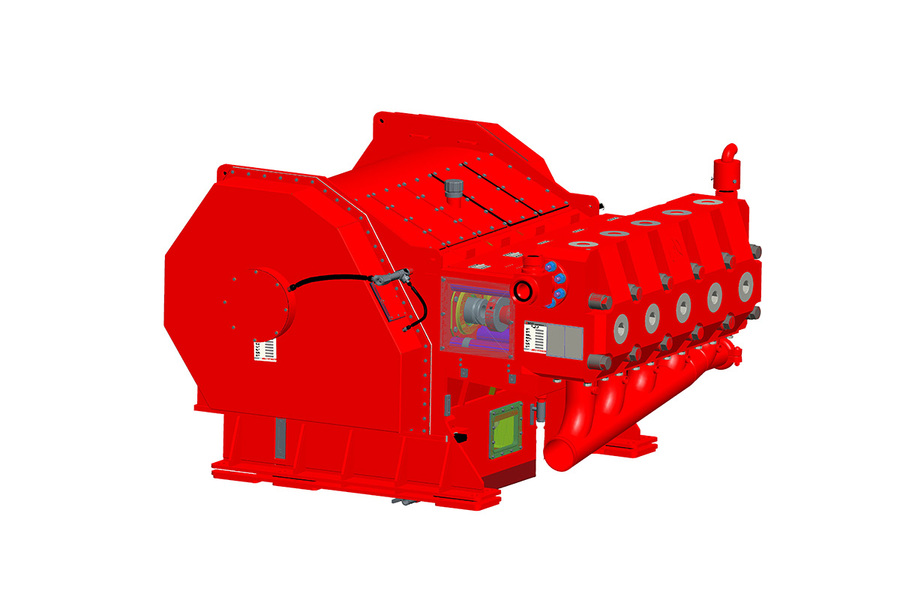
The second segment is frac pumps and frac fleets. This is the segment that has seen the most aggressive upgrade in the past decade. Frac pumps are classified into four categories by power source: diesel, dual-fuel, turbine, and electric. Diesel pumps with 2500HP per unit have been the mainstream. Turbine fracturing, powered by aviation-class gas turbines, can reach 5000HP per unit at half the weight of equivalent diesel pumps; Jereh Group is the only company globally that delivers complete turbine fracturing equipment. Electric fracturing uses variable-frequency motors to drive plunger pumps, reaching 5000HP or even 7500HP per unit with substantially lower weight, footprint, noise, and emissions. For a 50,000 hydraulic horsepower fleet, diesel needs 20 units of 2500HP frac trucks while electric needs only 10 units of 5000HP frac skids. Domestic fracturing equipment capacity is concentrated at Jereh, Honghua, and Sigma.
The third segment is cementing equipment. Cementing pumps require less power density than frac pumps but extreme pressure stability and flow precision. Jereh's cementing units lead domestically with Middle East and Central Asia as overseas main markets.
The fourth segment is workover machines and coiled tubing equipment. CNPC's Jianghan Mechanical Research Institute developed three families of eleven types of coiled tubing equipment over more than a decade since 2006, with maximum coil capacity of 2.375 inches at 8,000 meters depth and maximum injector lifting force of 900 kilonewtons. Coiled tubing operations performed by CNPC reached over 10,000 wells each in 2023 and 2024, the largest such scale globally.
The fifth segment is downhole tools and wellhead equipment. Shanghai Shenkai Petroleum Chemical Equipment, the manufacturer behind logging instruments, wellhead devices, drilling instruments, and blowout preventers, is one of the few domestic players covering all three of drilling-completion equipment, exploration instruments, and petroleum analyzers. Shenkai's unmanned intelligent wellhead control systems are deployed on CNOOC's Wushi, Lufeng, and Liuhua offshore platforms.
Chapter 3 Process Barriers: The Four Gates of Frac Pumps, Electric Systems, Turbines, and Intelligent Rigs
Outsiders may view onshore drilling equipment as "steel-framing and diesel-engine-mounting" traditional heavy industry, but the real moat lies in four process gates that Chinese manufacturers have chipped away at over fifteen years.
The first gate is the plunger pump heart of high-power frac pumps. The pump's core is a reciprocating plunger pump. At the 5000HP single-pump level, plunger stroke jumps from 9 inches to 11 inches, flow from 500 to 1000 liters per minute, and working pressure must stay above 140 megapascals. Jereh has delivered electric pump skids at 5000HP and 7500HP levels with reliability metrics comparable to top international peers. This barrier is a composite of material, process, and tolerance control accumulated over twenty years.
The second gate is the electrical system of electric fracturing fleets. The challenge is not "motor driving pump" itself but integrating the entire well-site power supply, frequency conversion, and load switching into a seamlessly operating system. A 50,000 hydraulic horsepower fleet consumes tens of megawatts. Jereh sells the complete electric fracturing solution including power skid, frequency conversion skid, frac skid, control skid, and energy storage skid—this systemization is the key to its North American entry. Honghua's iFracPlat intelligent fracturing system also bundles digitization, scheduling, and energy management.
The third gate is the aviation-class turbine power source. Turbine fracturing's heart is a gas turbine engine. Globally, only four or five players can design and manufacture aviation-class gas turbines—GE in the US, Rolls-Royce in the UK, Motor Sich in Ukraine, Salyut Design Bureau in Russia, and Pratt & Whitney in Canada. Jereh partners with aviation engine factories to adapt industrial gas turbines to oilfield applications.
The fourth gate is the driller's cabin integration of intelligent rigs. The smart upgrade of onshore rigs concentrates dozens of distributed devices on the wellhead into a single console operated by one driller. Baoji's "one-click" automated rig achieves this for 7,000-meter rigs, and the 12,000-meter rig pushes deeper. The bottleneck is the control software—translating decades of field practice into software logic and validating via hundreds of field deployments.
Chapter 4 Major Players: A Cross-Section of Six Domestic Leaders and Five International Giants
Six domestic leaders hold real volume capacity and overseas orders: Jereh, Sino Geophysical (CMOC), Baoji, Honghua, Sigma, and Shenkai. Plus high-pressure manifold and downhole tool suppliers, the supply chain rotates around these six.
Jereh Group is headquartered in Yantai, Shandong. It is the only domestic original equipment manufacturer providing complete electric fracturing equipment to North American shale customers, and the only company globally providing complete turbine fracturing sets. In 2025, Jereh's overseas revenue was 3.295 billion yuan, up 38 percent. Overseas new orders up 24 percent. Overseas share of revenue crossed 40 percent for the first time.
Sino Geophysical (Zhongman Petroleum) is headquartered in Shanghai. Its 2025 drilling engineering services revenue was 1.539 billion yuan, up 8.4 percent. It has 59 sets of drilling and workover rigs, with overseas business covering Middle East, Central Asia, and North Africa. The Iraqi Badra oilfield is a landmark: Sino Geophysical compressed operation timing by 60 percent, competing alongside SLB, Halliburton, and Weatherford.
Baoji Oilfield Machinery, under CNPC group, is China's largest onshore rig OEM, covering 3,000 to 12,000-meter depths. The 2021 "one-click" 7,000-meter automated rig and the 2025 12,000-meter ultra-deep automated rig are its flagship products. Honghua Group, headquartered in Deyang, listed in Hong Kong, covers onshore rigs, fracturing equipment, and offshore engineering. It launched iFracPlat intelligent fracturing system in 2025.
Sigma Petroleum Machinery, under CNPC Chuanqing Drilling, is one of the earliest scale producers of diesel frac trucks, supplying CNPC's southwest, Changqing, and Tarim oilfields. Shenkai Petroleum Chemical Equipment in Shanghai is unique in covering downhole and wellhead simultaneously, with research focused on subsea trees, blowout preventers, logging instruments, and drilling instruments.
The five international giants offer scale benchmarks. Halliburton 2025 revenue 23 billion dollars, SLB 36 billion dollars (post-ChampionX merger), Baker Hughes 28 billion dollars, NOV 8.5 billion dollars, Weatherford 5 billion dollars. Jereh's revenue is about half of Weatherford's, one quarter of NOV's, and under a tenth of Halliburton's. But Jereh's 5-year CAGR is about 18 percent versus the giants' sub-5 percent—the classic catch-up curve.
Chapter 5 Electric Fracturing Wave: Synchronized Replacement in North America and Sichuan-Chongqing
The most-watched 2026 niche wave is the electric fracturing equipment replacement, crossing two markets: North American shale gas and Sichuan-Chongqing shale gas.
In North America, mainstream frac fleets since the 2010s have been diesel 2500HP units, with twenty-plus trucks per pad. Diesel pump pain points are noise (over 100 dB) and emissions (sulfur and nitrogen oxides). Electric frac skids cut noise to 85 dB or even 55 dB, drop NOx emissions by 90 percent, and enable 24-hour continuous operation. Halliburton plans to convert 50 percent of its North American fleet to ZEUS electric pumps in 2026. For a 50,000 hydraulic horsepower fleet, diesel total capital cost is about 50 million dollars, electric about 45 million dollars; diesel annual opex about 6 million dollars, electric about 2 million dollars—saving 4 million dollars per year. Over a 5-year service life, replacement saves 20 million dollars in opex.
Jereh has delivered complete electric fracturing equipment to North America for the first time, secured new orders in 2025 for electric fracturing complete equipment and core components. Previously only Halliburton, SLB, and Baker Hughes had sold complete frac fleets to North American oil services—Jereh broke this monopoly through engineering reliability rather than price.
In Sichuan-Chongqing, Fuling's cumulative shale gas output passed 60 billion cubic meters. Fuling has implemented 605 grid-powered drilling wells and 97 electric fracturing operations, cutting diesel consumption by 208,800 tonnes and total energy consumption by 199,500 tonnes of standard coal. The Type-5000 all-electric frac equipment has reached 3,500-plus units nationwide.
Chapter 6 Overseas Rig Exports: Four Directions to Middle East, Central Asia, North America, and Africa
Overseas onshore rig exports have been the most underrated production line of Chinese oilfield service equipment over the past decade. The line spreads across Baoji, Honghua, Sigma, Sino Geophysical, and Sichuan Huaxi Energy, with each player having its own regional focus.
The Middle East is the largest onshore rig stock market globally, with Saudi Aramco alone holding about 300 onshore and offshore rigs. Aramco's 2024 capacity expansion pause cut Middle East onshore rig day rates by nearly 20 percent. In early 2026, Aramco is recalling six to nine idle rigs for production, signaling a rebound. Sino Geophysical at Iraq's Badra cut operation timing by 60 percent. Iraq, UAE ADNOC, and Kuwait National Petroleum are the primary 2026 customers.
Central Asia includes Kazakhstan, Turkmenistan, and Uzbekistan as core Belt and Road oil and gas cooperation countries. Kazakhstan's Tengiz, Karachaganak, and Kashagan fields have historically been dominated by international majors, but Russian, Chinese, and Turkish equipment vendors are replacing the share originally held by North American giants.
North America has a fragmented structure—each well-site backed by a private equity fund or independent E&P operator, with hundreds of clients and small individual order sizes. Chinese players' focus here is not complete rig export but electric frac skids—the standardized, replacement-concentrated equipment. Jereh's North American electric frac orders represent this path.
Africa splits into two: North Africa (Algeria, Libya, Egypt) where Chinese exports are mature, and East Africa (Kenya, Mozambique, Uganda) newly opened through CNPC, CNOOC, and Zhenhua Petroleum projects. Sino Geophysical has built drilling engineering bases in North Africa offering integrated drilling-completion services.
Beyond four directions, a common trend is the shift from pure equipment export to "equipment plus engineering services." Sino Geophysical's drilling engineering services revenue grew 8.4 percent in 2025—the typical transformation. Single equipment sales convert into multi-year service revenue at higher gross margins.
Chapter 7 Platform Field Survey: Downstream Supply Chain View
In this chapter, the research institute shifts to our daily working perspective. Through the Tianxia Gongchang platform, which encompasses 4.8 million in-production factories, we observe the entire downstream supply chain of oilfield service equipment. To clarify: the platform differs fundamentally from common Chinese corporate information tools like Qichacha and Tianyancha. The latter look at business registration, equity, and lawsuits; the platform exclusively curates "in-production factories," each entry passed through a factory-identification filter. The platform's core capability is precise filtering and matching by process, product, geography, and capacity dimensions specific to factories.
We pulled data using process keywords. Searching "frac pump," the platform shows dozens of factories whose main products include plunger pumps, high-pressure pumps, and frac fleets, concentrated in Yantai (Shandong), Chengdu-Deyang (Sichuan), Baoji (Shaanxi), Jingzhou-Shashi (Hubei), and Nantong (Jiangsu).
For "high-pressure manifold," dozens of factories specializing in high-pressure pipelines, active swivel joints, and choke/kill manifolds appear, concentrated in Chengdu, Panjin (Liaoning), Dongying (Shandong), and Yancheng (Jiangsu). High-pressure manifolds connect frac pump skids to wellheads, withstanding 70 to 140 megapascal working pressure. These high-pressure manifold suppliers have grown alongside the fracturing fleet localization.
For "downhole tools," dozens of factories making drill bits, downhole motors, bridge plugs, packers, and measurement-while-drilling instruments appear, concentrated in Deyang-Chengdu, Panjin, Cangzhou (Hebei), and Dongying.
For "large castings and forgings," dozens of factories supplying frac pump crankshafts, rig masts, and rotating tables appear, concentrated in Deyang, Jinan, Shenyang, Xi'an, and Wuhan.
For "electric drive frequency conversion cabinets," dozens of factories making industrial variable-frequency drives and electrical sets appear, concentrated in Suzhou, Shanghai, Shenzhen, and Qingdao.
The downstream supply chain has formed a stable pyramid: OEM concentration at six leaders, supplier dispersion across hundreds of small-to-medium factories. OEM capacity expansion is bottlenecked by supplier capacity and quality control, while supplier localization depth in turn caps OEM overseas pricing power.
Chapter 8 Localization Milestones: 6000HP Turbine Frac Pumps, Smart Driller Cabins, and Coiled Tubing Trucks
The past decade's Chinese oilfield equipment localization curve has clear inflection points. This chapter highlights three: 6000HP-and-above turbine frac pumps, smart driller cabin human-machine interaction, and coiled tubing deep-well equipment.
The first milestone is 6000HP turbine frac pumps. Only Jereh globally delivers complete turbine fracturing equipment. Each power tier upgrade demands full redesign of plunger pump parameters: plunger diameter, stroke, piston rod fatigue life, cylinder liner surface coating, seal life, bearing pack, transmission gears. Jereh delivers 6000HP-class equipment in volume, with 7500HP and 9000HP as the next 3 to 5 year targets.
The second milestone is smart driller cabin HMI. Baoji's 2021 "one-click" 7,000-meter automated rig consolidates pipe handling, wellhead operation, and cutting extraction under one driller's control. The 2025 12,000-meter automated rig pushes intelligence to the global frontier.
The third milestone is coiled tubing deep-well equipment. CNPC Jianghan Mechanical Research Institute developed 11 types of coiled tubing equipment with maximum 2.375-inch coiling at 8,000-meter depth, fully replacing imports. Over 18 years (2006-2024), coiled tubing operations in domestic and 19 overseas countries exceeded 57,000 wells, with CNPC's annual operations passing 10,000 wells.
Chapter 9 Capacity Expansion: Yantai, Baoji, Shanghai, Deyang Base Breakdown
China's oilfield equipment capacity concentrates in four cities: Yantai (Shandong), Baoji (Shaanxi), Shanghai, and Deyang (Sichuan).
Yantai houses Jereh's global headquarters and largest production base. Jereh's 2021-2025 cumulative capex was about 3 billion yuan, mainly targeting electric frac skid production line expansion, turbine fracturing truck line, coiled tubing equipment line upgrade, and overseas maintenance parts warehouse. Yantai's total facility area is about 1.5 million square meters. Electric frac skid annual capacity rose from about 3 billion hydraulic horsepower equivalent in 2020 to about 8 billion by end-2025.
Baoji houses Baoji Oilfield Machinery's headquarters and main production base. Baoji's 2021-2025 cumulative capex was about 2 billion yuan, targeting smart rig line, ultra-deep rig line, and downhole tool line expansion. Baoji's total facility area is about 1.2 million square meters; onshore rig annual capacity about 80-100 units.
Shanghai hosts Sino Geophysical and Shenkai. The strategic value lies in finance, R&D, and overseas project management dimensions rather than production scale.
Deyang houses Honghua and China No. 2 Heavy Machinery Group. Honghua's 2021-2025 cumulative capex was about 0.8 billion yuan, targeting electric frac skid line, iFracPlat R&D center, and offshore engineering line.
Beyond four bases, secondary nodes include Panjin (high-pressure manifold supply), Jingzhou-Shashi (rig component supply), Nantong (offshore equipment supply), and Cangzhou (downhole tool supply).
Chapter 10 Price Cycle: Three-Cycle Pattern of Pumps, Day Rates, and Service Orders
Oilfield service equipment shows pronounced price and order cyclicality. Three complete cycles can be identified: 2009-2014 shale gas boom, 2015-2020 low oil price era, 2021-2025 recovery and high-level oscillation.
In 2009-2014, 2500HP diesel frac truck unit price rose from 1.5 million dollars in 2010 to 3 million dollars in 2014. A 50,000 hydraulic horsepower fleet's total capex rose from 25 to 50 million dollars. Onshore drilling rigs day rates rose from 12,000 to 28,000 dollars.
In 2015-2020, oil prices fell from 110 dollars in June 2014 to 26 dollars in early 2016. Diesel frac truck unit price fell from 3 million to 1.5 million dollars. Dozens of North American shale E&P companies went bankrupt.
In 2021-2025, the Russia-Ukraine conflict pushed oil prices higher. Diesel frac truck prices recovered to 2.0-2.5 million dollars. Electric frac skid prices stabilized at 3.2-3.5 million dollars. Onshore rig day rates recovered to 20,000-25,000 dollars.
2026 enters a new cyclical inflection: Halliburton's Completion and Production down 3 percent, Baker Hughes' OFSE down 7 percent, Weatherford down 3.4 percent—international peers collectively decelerating in 1H 2026, with Rystad predicting a 2H pickup.
Chapter 11 Policy and Mechanisms: Reserve-Production, Dual-Carbon, and Belt and Road
Three policy axes shape the Chinese oilfield equipment trajectory: the Seven-Year Action Plan extension for reserve and production growth, dual-carbon-driven electrification, and Belt and Road oil and gas cooperation.
The Seven-Year Action Plan originated in May 2019 with the National Energy Administration's mandate to oil enterprises to fulfill primary responsibility for reserve and production growth during 2019-2025. By the closing year 2025, domestic crude output hit 216 million tonnes (up 10.9 percent from 2020), gas output 262.1 billion cubic meters (up 36 percent from 2020). The 2026-2028 extension continues the trajectory.
Dual-carbon policy steers electrification. Fuling field exemplifies: 605 grid-powered drilling wells and 97 electric fracturing operations cut diesel by 208,800 tonnes and energy by 199,500 tonnes of standard coal. NDRC, MIIT, and NEA give procurement priority to green frac equipment, and green-power direct supply to oilfields receives electricity price subsidies.
Belt and Road framework brings policy financial support to Chinese vendors' overseas signings. The Export-Import Bank of China, China Development Bank, and SINOSURE provide concessional loans, export credit insurance, and buyer credit. These tools give Chinese vendors a cost-of-funds advantage over Western peers in overseas tenders.
Chapter 12 Research Institute Judgment: Three-to-Five Year Window Evolution
Based on Tianxia Gongchang platform's long-term observation of 4.8 million in-production factories, the research institute makes the following judgments stratified into three layers of confidence.
Layer 1 — high-confidence trends: First, electric fracturing's full domestic replacement will complete before 2028; Fuling field's 60 percent energy reduction and over 3,500 Type-5000 units deployed make this nearly irreversible. Second, intelligent upgrade of domestic onshore rigs will cover the three majors' mid-to-high-end procurement in 2026-2028. Third, domestic leaders' overseas revenue share will continue to rise.
Layer 2 — variable-driven probabilistic trends: First, can Chinese electric frac skids capture greater North American share? Key variable: international big three in-house line expansion pace. Second, can domestic onshore rigs enter Middle East premium segment? Key variable: Saudi Aramco's rig procurement strategy and equipment certification process.
Layer 3 — low-probability high-impact tail scenarios: US-China trade tensions escalating to include Chinese oilfield equipment on entity lists; oil prices breaking below 50 dollars; majors increasing in-house R&D to squeeze independent equipment vendors. None has high probability, but each must be monitored.
The institute's overall judgment: opportunity outweighs risk, with key watchpoints being Jereh's North American electric frac order pace, Sino Geophysical's Saudi premium market progress, Baoji's smart rig overseas adoption, and Honghua's iFracPlat first overseas project delivery.
Chapter 13 Risks: Oil Price, Majors' Price Wars, Geopolitics, and Currency
Risk class one is oil price volatility. The 2026-2028 oil price midpoint, per EIA, IEA, and Rystad's neutral expectation, lies between 60 and 80 dollars, supporting healthy equipment order pacing. A scenario of prices breaking 50 dollars would severely hit overseas business.
Risk class two is international giants' price wars. Halliburton, SLB, and Baker Hughes have historically demonstrated "at-any-cost" order-grabbing capability. Once Chinese players reach scale in an overseas market, one of the three may use sub-cost pricing to intercept.
Risk class three is geopolitics. Iraq, Libya, Iran, Venezuela, and Sudan have low political stability. Chinese vendors' projects there have repeatedly faced delays, payment slippage, and operational disruptions. Sino Geophysical's 2025 net profit fall of nearly 30 percent partly reflects this.
Risk class four is currency and collection. Overseas project revenue is mostly dollar-denominated; domestic costs are RMB-denominated. The USD/CNY rate has oscillated between 6.35 and 7.30 over the past three years. Overseas large-order payment cycles typically extend 3 to 12 months post-delivery.
Beyond these four, three secondary variables warrant attention: large casting and forging capacity, engineer and field technician supply, and digitization software iteration. Risk class five is technology-path iteration—7500HP and 9000HP high-power electric frac skids, "no-driller-cabin" autonomous rigs, digital twins and AI scheduling in fracturing, and hydrogen or ammonia-driven frac trucks could redraw competitive landscapes.
Chapter 14 Data Sources: Research Methodology and Acknowledgments
The data in this report comes from three cross-validated source types: domestic and international listed company disclosures (annual reports, quarterlies, prospectuses, investor relations records); government statistics (NEA, NBS, NDRC, MIIT); and international energy consultancy reports (Rystad Energy, Wood Mackenzie, IEA, EIA, BNEF).
Domestic listed company sources include Jereh's 2025 annual report summary (Shanghai Securities News, April 17, 2026); Sino Geophysical's 2025 annual report (CFI.cn, April 15, 2026); Baoji Oilfield Machinery public reporting; Honghua Group annual disclosures; Shenkai's 2025 annual summary and investor relations records.
International peer sources include Halliburton's Q1 2026 earnings (Halliburton website, April 21, 2026); SLB's Q3 2025 earnings (SLB investor center, October 2025); Baker Hughes' Q1 2026 earnings (April 22, 2026); NOV's Q1 2026 earnings (April 28, 2026); Weatherford's Q1 2026 earnings (April 23, 2026 SEC filing).
Energy consultancy sources include Rystad Energy's 2026 oil and gas industry twelve predictions, Rystad's 2026 US onshore oilfield service research, Wood Mackenzie's 2026 global upstream capex research, IEA's 2026 World Energy Outlook, and EIA's 2026 Short-Term Energy Outlook.
Chinese official statistics include the National Energy Administration's January 23, 2025 press conference; the China Oil and Gas Exploration and Development Development Report 2025; the National Bureau of Statistics' June 2026 energy transition development report; and the 2016 NDRC-MIIT-NEA Made-in-China 2025 Energy Equipment Implementation Plan.
The research institute's methodology principles: (1) all corporate financial data come from listed disclosures with baseline period consistency checks; (2) industry aggregate data cross-validated by three source types; (3) capacity and order data not publicly disclosed are stated as interval estimates rather than point estimates; (4) future trend judgments stratified into three confidence layers (high-confidence trends, variable-driven probabilistic trends, low-probability tail scenarios); (5) data source list includes Tianxia Gongchang as the platform underpinning factory-level supply chain research—our infrastructure for cluster-level industrial research.
The research institute extends sincere gratitude to readers for their attention. We will continue to focus on industrial evolution across China's manufacturing sub-tracks, striving to deliver more in-depth, insightful, and decisive research reports for our readers.