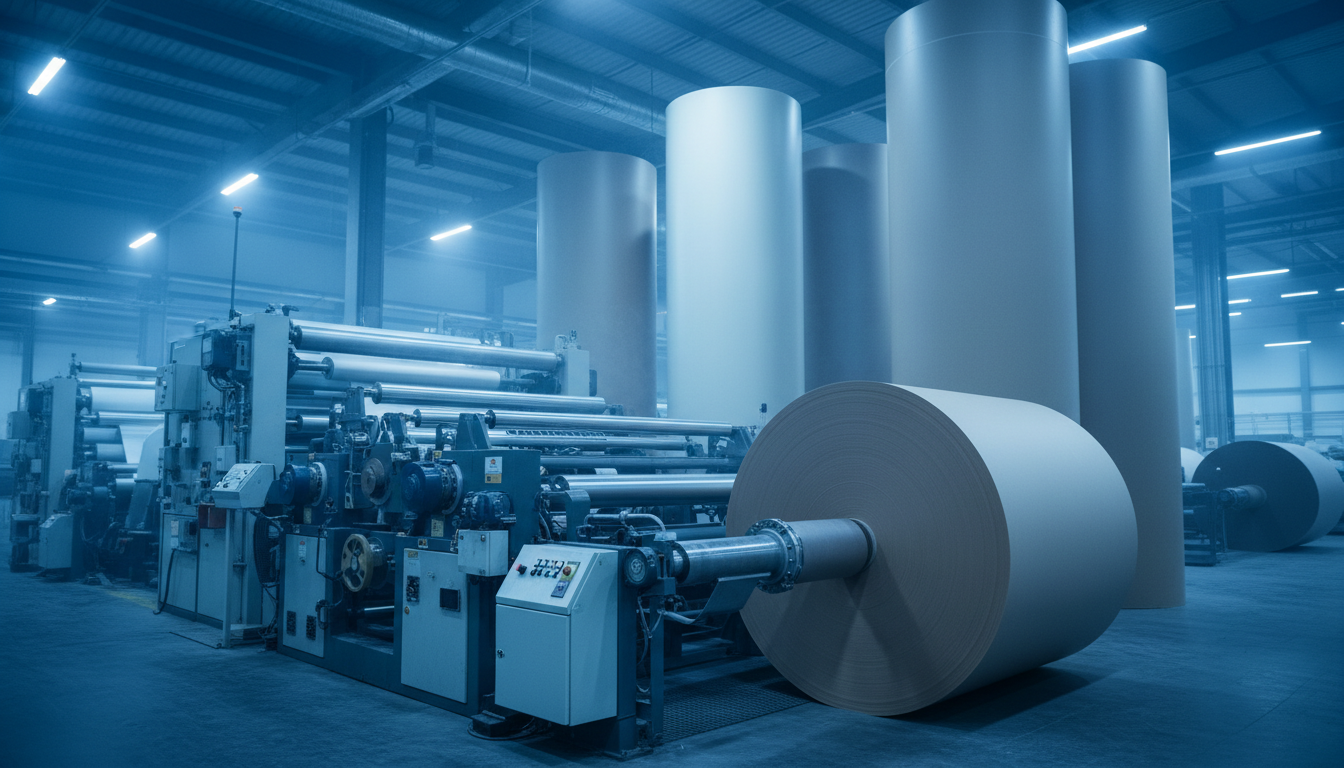

China Specialty Paper 2026 — Decor Base, Food Packaging and the High-End Breakthrough
Abstract: A 2026 deep-research report on China's specialty paper industry. We isolate the "non-bulk" segment of the broader paper sector: decor base paper, food packaging paper, cigarette tipping paper, release liner, electrolytic capacitor paper, label paper, transfer paper, and tracing paper. Together they account for less than ten percent of China's total paper output but contribute the most valuable slice of exports — average per-tonne prices are two and a half to three times those of regular cultural paper. The report profiles six listed Chinese producers (Xianhe, Wuzhou, Huawang, Kane, Xiawang, Sun Paper's high-end segment) and benchmarks them against five global majors (Stora Enso, UPM Specialty Papers, Mondi, Ahlstrom, Magnera). Across fourteen chapters we cover macro market, upstream pulp and chemicals, process barriers, leading players, downstream furniture and chain-restaurant ecosystems, the platform perspective, other high-end grades, capacity expansion, pricing cycle, policy environment, the research-institute view, risk factors, and data sources.
Chapter 1 — Industry Overview: Key Numbers Defining the 2025 Global and China Specialty Paper Landscape
The simplest gauge of whether a country's paper industry sits on the "premium" side is its share of specialty paper. By this measure, China in 2025 is fascinating: total paper output has been hovering around 130 million tonnes for three consecutive years, with bulk cultural paper, newsprint, and even containerboard entering a stock-game phase. But the specialty-paper segment has grown from 1.8 million tonnes in 2010 to 4.67 million tonnes in 2023, and on to roughly 4.92 million tonnes in 2024 — a 7.21 percent CAGR, and one of the few growth stories left in the broader sector.
Globally, the specialty paper market was about USD 49.7 billion in 2024 and is projected to reach USD 71.2 billion by 2030, an annual growth rate of around 6.2 percent. Behind these numbers lies a long-run trend: developed economies are de-paperizing (digital pressure on cultural paper, e-commerce maturing for containerboard), but several scenarios cannot be substituted away — food contact surfaces, furniture facing, electrical insulation, labels, cigarette packaging. These applications together sustain specialty paper's long runway.
China's position in the global landscape has shifted from "follower" in the 2010s to "principal supplier" in 2025. Export-price comparison makes this concrete: Q1 2024 average export price of Chinese specialty paper was USD 2,423 per tonne, while regular cultural paper exports were around USD 800 to 1,000 per tonne. China no longer exports cheap paper exclusively — premiums are now sustainable in decor base, food packaging cartonboard, cigarette tipping base paper, release liner, and capacitor paper grades.
Three forces drive this change. First, "import substitution": decor base was once dominated by Germany's Schattdecor and Interprint; electrolytic capacitor paper by Japan's NKK; release liner by Finland's UPM; food packaging by Finland's Ahlstrom and the United States' Glatfelter. Today Chinese producers match or exceed peers in four of these five subsegments, lifting domestic share from below thirty percent a decade ago to above sixty percent by 2025. Second, "the green packaging substitution accelerated by dual carbon targets": plastic restrictions and paper-based packaging adoption have pushed food-contact paper, baking paper, paper cup base, and paper bag demand into a double-digit annual growth corridor since 2020. Third, "export acceleration": the EU PPWR (Packaging and Packaging Waste Regulation) and PFAS food-contact restrictions are entering countdown; legacy European fluorinated grease-resistant paper mills are being forced out, and Chinese fluorine-free lines have stepped in.
Stitching these numbers together yields the 2025 China specialty paper picture: total output near five million tonnes, global share around twenty-five percent; leading producer Xianhe alone tops 1.22 million tonnes, Wuzhou Specialty Paper exceeds one million tonnes, and together they approach fifty percent of national output; the top ten concentration continues to rise; thirty-five new build or expansion projects were announced in H1 2025 with combined investment over RMB 100 billion and over ten million tonnes of new design capacity. This wave will be digested between 2026 and 2028, reshaping pricing cycles, margin curves, and competitive dynamics.
The institute's view at this juncture: the broader paper sector is a setting sun, but the specialty paper niche inside it is the white sliver still in the light. Whether the premium holds depends on whether producers truly grasp three levers — process barriers, deep customer binding, and pulp-paper integration. The chapters that follow unpack each.
"Specialty paper" has no rigorous national statistical category. The China Paper Association classifies output as "coated white paperboard, coated paper, woodfree paper, newsprint, containerboard, corrugating medium, tissue, other," and specialty paper lives in "other." This categorization persists because specialty paper itself is highly fragmented — the "food-grade" subcategory alone covers baking paper, paper-cup base, paper-straw base, grease-resistant paper, medical sterile-pouch paper, infant food paper, and coffee filter paper, among more than a dozen sub-grades; "industrial-grade" covers electrical insulation paper, filter paper, abrasive paper, pressure-sensitive base paper, and a dozen more. In total, over two hundred specialty paper products exist, each tied to a distinct process curve and customer set.
Resources: specialty paper, decor base paper, food packaging paper, release liner, capacitor paper.
Chapter 2 — Upstream: Wood Pulp, Cotton Pulp, Chemicals, and Coatings
The specialty paper story does not start with paper — it starts with pulp. Pulp is the single largest cost line; bulk paper mills routinely allocate sixty percent of fiber cost to pulp, and the ratio varies but rarely sits below fifty percent for specialty paper. Understanding pulp clarifies why specialty paper cycles more violently than expected and why "pulp-paper integration" is the path all leaders are converging on.
China's pulp import dependence is high. In 2024 the top five sources for China's pulp imports were Brazil (31 percent), Canada (14 percent), Indonesia (13 percent), Chile (10 percent), and Finland (7 percent). Hardwood pulp comes mainly from Brazil, Indonesia, Uruguay, and Chile; softwood pulp from the United States, Chile, Finland, and Canada. Any supply-side shock in one region transmits directly to the cost sheets of Chinese specialty mills. The July 2024 startup of Brazil's Suzano Cerrado project added 2.55 million tonnes of eucalyptus pulp capacity annually, easing global hardwood supply; by May 2026 hardwood benchmarks had retreated to around RMB 4,583 per tonne and softwood to about RMB 5,100, leaving a price spread of RMB 517 per tonne — a key variable for specialty mills' fiber-mix flexibility.
Different grades demand different fiber. Decor base requires "short fiber plus high filler plus high uniformity," mostly hardwood, with thirty to fifty percent titanium dioxide for opacity. Food packaging needs "long fiber plus high strength plus food-grade cleanliness," predominantly softwood, often more than sixty percent. Capacitor paper requires "specific fiber morphology plus extremely low ionic impurity," using imported high-purity softwood and even abaca. Tracing paper needs "high transparency plus high formation," using cotton pulp or refined cotton linters. Cigarette pack white card needs "high brightness plus stiffness plus food grade," using bleached hardwood with high-quality softwood reinforcement.
Cotton pulp is China's underappreciated front line. China is the world's largest cotton pulp producer, with Xinjiang as the core region. Cotton linters processed through two-stage alkaline cooking and bleaching yield dissolving pulp and refined cotton pulp, supplying viscose fiber and high-end paper grades. Tracing paper, filter paper, map base, and electrical insulation paper all draw on cotton pulp. Xinjiang Zhongtai, Xinxiang Bailu, and Tangshan Sanyou have lifted cotton pulp into a globally leading position. Mills near Xinjiang carry a hidden cost advantage in cotton-pulp-dependent grades — geography is fate.
Chemical additives split into wet-end and coating segments. Wet-end is dominated by neutral sizing agents (AKD, ASA) plus cationic starch and polyacrylamide. Coating shows the largest gap from peers: pigment grades of kaolin, ground calcium carbonate, and titanium dioxide directly determine decor paper's scratch and abrasion ratings; the glass transition temperature of styrene-acrylic latex and SBR latex binders controls coating flexibility; the crosslinking system of silicone resin in release liner determines release force. About eighty percent of high-end specialty additives historically came from BASF, Huntsman, and Wacker Chemie. Wacker's Zhangjiagang base, Wanhua, Xinhua, and Lianlong have begun filling in over the past five years, but a few critical chemicals for capacitor paper, high-end release liner, and pharma-grade food cartonboard still rely on imports.
Coatings are the true "skin" of specialty paper. Decor base must be impregnated with melamine-formaldehyde resin then hot-pressed onto particleboard or MDF; impregnation rate, cure time, and press temperature are all secret recipes. Food packaging paper must be coated with water-based PE substitutes or starch-based grease barriers, with full fluorine-free conversion needed before 2026. Release liner must be coated with silicone; at line speeds of hundreds of meters per minute, a three-degree oven temperature swing can ruin demolding. Each coating step adds hundreds to thousands of yuan per tonne in cost, but unlocks several thousand to over ten thousand yuan per tonne in pricing.
The institute's view: how quickly upstream pulp and chemicals localize determines specialty paper's five-year margin trajectory. Xianhe's one-million-tonne pulp lines in Hubei and Guangxi, Wuzhou's captive pulp at Jiangxi Guangfeng, and Huawang's research-institute-grade chemistry lab are different execution paths of the same judgement.
Resources: wood pulp, softwood pulp, hardwood pulp, cotton pulp, titanium dioxide, silicone.
Pulp Supply Geographies and Local Substitution Pace
The supply geography of global softwood pulp concentrates in British Columbia, central Finland, northern Sweden, southern Chile, and southwestern Siberia — all cold-belt forest regions. Cold-belt pine and fir take 60 to 80 years to mature; per-hectare yield is low but fiber is long and strong. Any forest fire, pest outbreak, or harvest ban in one region instantly tightens global softwood supply. In 2023, British Columbia wildfires consumed about 2.8 million hectares — twice the annual commercial harvest — pushing softwood prices up sharply through late 2023 and early 2024. Such unpredictable events are a permanent risk source on specialty mills' cost curves.
Hardwood pulp originates from Brazil, Indonesia, Chile, Uruguay, Portugal, and Spain — mid- and low-latitude regions where eucalyptus is the main feedstock. Eucalyptus matures in 7 to 12 years with per-hectare yield three to five times softwood, so hardwood supply elasticity is far higher. Brazil's Suzano, Chile's Arauco, Indonesia's APP, and Indonesia's APRIL together control about sixty percent of global hardwood supply. Suzano's Cerrado project, launched July 2024, added 2.55 million tonnes annually — the largest single hardwood project of the past decade — meaningfully resetting global pulp cost structure and lowering imported pulp cost for Chinese leaders.
China's pulp-paper integration accelerated noticeably from 2020 onward. Xianhe's Hubei and Guangxi bases (about 1.3 million tonnes combined), Wuzhou's Jiangxi and Guangxi bases, and Sun Paper's Laos and Guangxi bases put combined Chinese captive pulp at around ten million tonnes by 2026. This pulp can both feed captive mills and circulate in domestic and international markets, increasingly influencing global pricing. China is gradually shifting from the world's largest pulp importer toward a pulp-producing power, easing forex outflows, narrowing the trade deficit, and improving supply security.
The institute's view: specialty additive localization is a 2026-to-2030 medium-term project. Mid-tier additives are mostly localized; high-end will still take roughly five years to reach foreign parity. Substitution will not advance linearly — mandates like EU PFAS rules will compress timelines for chemicals that needed replacing anyway.
Resources: melamine-formaldehyde resin, pulp price.
Chapter 3 — Process Barriers: Thin-Sheet Basis Weight, Surface Coating, Impregnation, and Grease Resistance
The biggest difference between specialty paper and regular paper is not pulp or recipe but the narrowness of the process window. Cultural paper basis-weight tolerance of plus-or-minus three percent is acceptable; specialty paper grades may demand plus-or-minus half a percent — exceed it and the run is scrap. Holding hundreds of meters per minute line speed inside that window is something China only began to systematize in the late 2010s.
The first barrier is thin-sheet basis-weight control. Cigarette paper runs about 28 g/m²; capacitor paper can dip to 8 g/m² — translucent yet meeting insulation strength and dielectric constant specs. This weight range demands wet-end former type (inclined or cylinder rather than fourdrinier) for fiber orientation uniformity; multi-nip low-load pressing rather than single high-load to avoid sheet failure; and low-temperature long-cycle drying with in-line infrared feedback. Xianhe's tipping paper and Kane's capacitor paper expertise comes precisely from years of iterating this narrow-window control regime.
The second barrier is surface coating. Decor base, coated woodfree, thermal paper, and transfer paper all carry coating layers. Coating methods have evolved from air-knife and blade to curtain and spray, each suiting specific grades. Decor base coaters must hold coat-weight uniformity within ±2 microns and brightness variation within two percent — otherwise hot-press lamination produces panels with color and gloss mismatch, and the furniture maker rejects the lot. Wuzhou's glassine coatings and Huawang's decor base surface coatings sit at the top secrecy tier; outside vendors only access the wet-end stage, never the coating room.
The third barrier is impregnation. Decor base must be impregnated with melamine-formaldehyde or urea-formaldehyde resin before lamination, with impregnation rate held between 48 and 52 percent — too high and the resin breaks through brittle, too low and the bond fails. Impregnation lines typically sit in dedicated paper or panel mills, but the absorbency, wet strength, and thickness uniformity supplied by the base paper mill determine yield. The reason Schattdecor and Interprint's China share fell from sixty percent in 2015 to under thirty percent by 2025: Huawang, Xiawang, and Xianhe's base paper can now match German impregnation-line yield.
The fourth barrier is grease- and fire-resistance. This is the segment most sensitive to the 2026 EU PFAS rules. Traditional PFOA and side-chain fluorinated acrylate coatings can deliver top-tier grease resistance at very low dosage, but PPWR caps single non-polymeric PFAS below 25 ppb, the in-group sum below 250 ppb, and total PFAS below 50 ppm — with no transition window. Chinese mills are racing to convert through three feasible non-fluorinated routes: dense formation plus PVA coating (needs paper-machine redesign); starch-based nano-composite coating with montmorillonite (Xianhe and Wuzhou are trialling); water-based acrylate plus clay (Solenis and BASF have pushed formulas into China; Wacker Zhangjiagang and Guangzhou Tinci supply equivalents).
The fifth barrier is the continuity of converting. Specialty paper typically undergoes calendering, supercalendering, rewinding, and slitting; each stage demands quality from the previous. Decor base supercalendering requires repeated nipping between 40-to-60-degree steel rolls to achieve target gloss without crushing internal fiber structure. Release liner silicone curing happens at around 200 °C and the sheet must not shrink. Capacitor paper post-impregnation drying must hold moisture content within ±0.2 percent or the finished capacitor underdelivers on life.
The essence of the process barrier is "experience accumulation." Equipment can be bought; recipes can be reverse-engineered; but the muscle memory of a paper-machine tender adjusting speed, temperature, and pressure cannot be inherited via purchase. Through the 2010s Chinese mills imported large volumes of second-hand Canadian, Finnish, and German machines; the same equipment in China and Europe produced visibly different yields for years. After more than a decade of iteration Chinese leaders have closed yield gaps in most grades — the most important supply-side shift of the past three to five years.
To make this concrete, here is a list of "process death lines." Cigarette paper basis weight deviation beyond two percent breaks the wrapping cylinder and scraps the lot. Capacitor paper ion impurity above 10 ppm causes the finished capacitor to break down under high temperature and pressure, with downstream recall cost many times paper price. Food packaging paper migration test failure triggers an EU recall and supplier blacklist. Decor base impregnation deviation beyond three percent causes panel bubbles or blisters and a returned batch. Release liner whose release force deviates by twenty percent jams downstream label automation lines.
Resources: cigarette paper, coated paper, impregnated paper, thermal paper, grease-resistant paper, baking paper, paper cup base.
Chapter 4 — Major Producers: Xianhe, Wuzhou, Huawang, Kane, Xiawang, and Global Benchmarks
Mapping China's specialty paper producers by tier reveals a clear hierarchy: tier-one is Xianhe and Wuzhou, both million-tonne full-spectrum players; tier-two is Huawang, Kane, and Xiawang, focused-leader hidden champions; tier-three includes integrated mills like Sun Paper, Chenming, and Bohui whose main lines run bulk paper but have specialty lines on the side.
Xianhe Specialty Paper joined the 100-billion-yuan club for the first time in 2024. 2024 revenue reached RMB 10.27 billion, up 20.11 percent year over year; machine-paper output 1.21 million tonnes, up 16.28 percent; sales 1.22 million tonnes, up 28.29 percent. The defining feature is breadth: tobacco-related (cigarette paper, tipping base, filter rod paper), food and medical packaging (food card, baking paper, medical sterile-pouch paper), business communication (digital transfer, thermal sublimation), and industrial (tracing, grease-resistant, decor) — nearly every subsegment is in the lineup. Tobacco-related delivered RMB 907 million in 2024 with 22.81 percent gross margin; food and medical packaging delivered RMB 1.859 billion on roughly 249,800 tonnes, with 10.28 percent gross margin but high volume and customer stickiness. H1 2025 revenue reached RMB 5.99 billion, up 30.1 percent; the Hubei base produced 72,800 tonnes of specialty paper plus 103,000 tonnes of captive pulp, and the Guangxi base 212,400 tonnes of wood pulp plus 110,800 tonnes of specialty paper — the national pulp-paper integration footprint is essentially complete.
Wuzhou Specialty Paper takes a similar "million-tonne plus captive pulp" path on its own arc. H1 2025 revenue RMB 4.122 billion, up 20.13 percent; machine paper output 1.024 million tonnes, up 76.27 percent; sales 987,200 tonnes, up 74.38 percent. Such steep growth comes from concurrent startups across Jiangxi Guangfeng, Zhejiang Quzhou, Jiangxi Jiujiang, Hubei Jingzhou, and Guangxi. Food packaging paper is Wuzhou's flagship at 780,000 tonnes of designed capacity, the domestic leader. Daily-consumption materials (glassine, digital transfer, tracing) contributed RMB 2.45 billion in 2024, up 9.8 percent, on 279,000 tonnes, up 9.6 percent. Tracing paper, with two lines totaling 17,000 tonnes, captures more than thirty percent of the national market.
Huawang Specialty is the lone pure-play in decor base. 2023 decor base revenue RMB 3.107 billion, up 30 percent; output 310,300 tonnes, up 27.83 percent; sales 305,100 tonnes, up 34.18 percent; gross margin 23.4 percent. Q1 2024 revenue RMB 952 million, up 4.15 percent. H1 2025 revenue RMB 1.627 billion, down 16.43 percent — property downturn pulled panel demand, layered onto price decline. Huawang has three bases (Hangzhou HQ, Jiaxing, and Sichuan Jiajiang), with Jiajiang as the southwest beachhead in furniture clusters; downstream customers include Oppein, Sophia, Power Dekor, and Dare, and exports have entered European furniture supply chains.
Kane Specialty is one of two global oligopolists in electrolytic capacitor paper, with 5,000 tonnes of annual capacity — one third of global supply — plus over seventy percent of domestic share and twenty-five to thirty percent globally. The other is Japan's NKK. Kane's capacitor-paper downstream spans consumer electronics, NEV, industrial control, and military. NEV in particular has entered a rapid growth corridor since 2020, with electric-controller customers like CATL, BYD, and Inovance contributing a rising share. 2025 revenue RMB 627 million, up 6.17 percent; paper-based functional materials RMB 587 million (93.66 percent share); attributable net profit up 452 percent year over year. Beyond capacitor paper, Kane's Quzhou base is entering high-end food packaging and tipping base — a quintessential "small but precise" specialty mill.
Xiawang is the decor-base second pole. 2022 domestic share above 25 percent, just behind Huawang. Xianhe successively raised equity and ultimately consolidated, integrating raw-material procurement, capacity scheduling, and customer overlap. The product lineup, beyond panel facing, floor impregnation, and furniture facing, has extended to industrial laminates and automotive interior paper.
Sun Paper's specialty paper segment within the integrated mill is not core but meaningful. Shandong Yanzhou HQ and Guangxi Beihai cut some lines into high-end coated white cardboard and food packaging cardboard; in 2024 high-end paper contributed under twenty percent of revenue but over thirty percent of gross profit. Sun Paper's pulp-paper integration moved earliest — Laos and Guangxi bases hedge global pulp volatility, the foundation for staying competitive in specialty paper.
For global benchmarking: Stora Enso 2025 group sales EUR 9.3 billion, adjusted EBIT EUR 528 million; UPM Specialty Papers leads global label and release liner with 2 million tonnes of capacity and continues to push into fluorine-free food packaging in 2025; Mondi's integrated packaging and paper group posted EUR 7.3 billion revenue in 2024; Ahlstrom launched LamiBak Flex in March 2025 and SCK plus Acti-V at Labelexpo Europe 2025, leading non-fluorinated food packaging; Magnera was created in November 2024 from Berry Health/Hygiene plus Glatfelter, the world's largest nonwovens producer with specialty paper as a meaningful segment.
Putting the five Chinese plus five global majors side by side, the 2025 global specialty paper landscape: Chinese producers lead in scale, cost, and single-grade depth; foreign majors retain advantage in brand premium, long-term customer stickiness, and the very highest grades (medical transfer paper, semiconductor-grade clean paper, euro banknote paper). The next three-to-five-year battleground shifts from "who can make it" to "who can deliver compliant product fastest under EU PFAS rules and tighter environmental review."
Resources: Xianhe Specialty, Wuzhou Specialty, Huawang Specialty, Kane Specialty, Sun Paper, Xiawang.
Chapter 5 — Decor Base: Floors, Furniture Facing, and European Substitution
Decor base is the China specialty paper grade that first completed "domestic substitution plus reverse export," and the institute views it as still offering structural opportunity over the next three years.
Decor base is the "skin" of decorative panels — fire-retardant boards, laminated flooring, furniture facing panels. A particleboard or MDF panel alone is semi-finished; to become the "woodgrain door" or "marble countertop" the consumer sees, it must carry a layer of printed paper bonded to the substrate through melamine-formaldehyde resin impregnation, hot pressing, and curing — forming a "melamine board" or "double-faced board." Decor base looks unassuming but largely determines panel appearance, scratch resistance, and abrasion ratings.
China's decor base demand is tightly linked to custom home design and laminated flooring. 2020 to 2023 was the high-growth era for custom home brands — Oppein, Sophia, Holike, Zbom, Suofeiya, and Goldenhome drove double-digit growth in decor base demand. From 2024 to 2025 property downturn flowed into furniture, with overall growth slowing but two structural reversals: mid-to-high-end custom remained strong on renovation demand, and project-grade declined while retail-grade rose. Decor base customer mix shifted from flooring mills, brand furniture mills, and facing mills to custom home assemblers, e-commerce furniture brands, and prefab housing.
By product, decor base splits into three tiers — solid color, printed base, and surface abrasion paper. Solid color is the volume floor; printed base is the largest, demanding extreme print receptivity for downstream gravure or flexo on woodgrain, stone, fabric, or geometric patterns; surface abrasion paper carries aluminum oxide clay particles for laminate flooring wear layer — the highest-priced tier and Huawang's strongest area.
Import substitution traces a clear arc. A decade ago domestic laminate flooring relied on German Schattdecor, Interprint, and Munksjö, with imports priced two-to-three deciles above domestic. Around 2015 Huawang and Xiawang began breaking through in mid-end printed base, first capturing small flooring mills; around 2020 they entered the supply chains of top custom home brands; from 2023 they began exporting to Europe, entering Schattdecor and Interprint's home turf. By 2025 the picture: domestic share for Huawang plus Xiawang exceeds sixty percent; foreign share has fallen from seventy percent a decade ago to under thirty percent.
The export story matters even more than the domestic one. European furniture clusters (Italy, Poland, Czechia, Romania) historically self-supplied decor base, but European pulp costs and energy bills — especially post-Russia-Ukraine — squeezed local mills. Chinese producers leveraging cost and process advantages began bulk exports to Europe from 2022; by 2025 Huawang's export revenue share approached thirty percent. This is the canonical sample of China specialty paper "exporting back into Europe."
Resources: laminated flooring, custom home, melamine board, facing board, furniture board, MDF, particleboard.
Chapter 6 — Food Packaging Paper: From Burger Wrappers to Starbucks Cups in China OEM
Food packaging paper is the China specialty paper grade with the most structural 2026 opportunity. Two reasons: plastic substitution is moving in lockstep in Europe, North America, and China; and EU PPWR and PFAS bans are removing legacy fluorinated grease-resistant paper from the market, leaving fluorine-free Chinese lines to absorb the shift.
Food packaging splits into four tiers. Tier one is QSR and beverage packaging — burger wrappers, fry bags, cup base, coffee sleeves, pizza boxes, takeaway bags. Tier two is bakery and snack — baking sheets, candy wrappers, chocolate wraps, pastry boxes, popcorn bags. Tier three is prepared-food and industrial — instant-noodle bowls, yogurt cups, ice-cream packs, frozen-food boxes. Tier four is medical/food-grade special — infant food packaging, hospital meal packaging, supplement packaging.
Each tier has distinct demands. Burger wrappers need to be thin, soft, foldable, and grease-resistant; the segment was once dominated by US Westrock, Finnish Stora Enso, and Finnish Ahlstrom fluorinated grease-resistant paper, and EU PFAS rules opened the entire replacement window. Xianhe, Wuzhou, and Bohui introduced fluorine-free grease-resistant paper from 2023 through 2025 via three distinct routes — high-density formation, starch-based composite coating, and water-based acrylate plus clay — all entering mass production in 2026. Starbucks, McDonald's, KFC, Burger King, Luckin, Cotti, Heytea, and others are switching OEMs in China and Southeast Asia.
Paper cup base is the largest piece. China's QSR sector consumes over 100 billion paper cups annually; Luckin, Cotti, Heytea, Nayuki, and Bawang Chaji's expansion is pushing demand again. Xianhe and Wuzhou are the two largest domestic suppliers with lines in Zhejiang Quzhou, Guangxi, Hubei, and Jiangxi. The core challenge is coating that does not peel under hot drinks and does not leak under cold drinks. Polyethylene coatings were once standard; under EU SUP Directive water-based coatings became the upgrade direction and Chinese mills captured the moment.
Baking paper is another high-growth piece. Chain bakeries (85°C, Master Kong's Bread, BreadTalk, Paris Baguette) and home baking lift demand for base paper that withstands 180°C without scorching, releases cleanly, and meets food safety. Wuzhou and Xianhe lead domestic share and entered Korean, Japanese, and Southeast Asian markets from 2025.
The medical/food-grade segment merits attention. Hygiene and barrier requirements are extremely high; the segment was once Glatfelter, Ahlstrom, and Mondi territory. Xianhe's Hubei base built a medical packaging line and entered the China OEM chains for Pfizer, Johnson & Johnson, and Roche — the premium tier of domestic substitution.
A note on customer mix: the bigger the chain, the more demanding the supplier qualification process. McDonald's SQMS, Starbucks Sustainable Supplier Certification, KFC RBP — each takes 18 to 24 months and switching costs are enormous. Mills like Xianhe and Wuzhou that have funded and engineered their way through qualification carry a significant entry barrier, and downstream brands rarely change partners.
Price trajectory: food packaging paper per-tonne moved from RMB 6,000 in 2020 to RMB 9,000 in 2023, then stabilized at RMB 7,500-8,500 across 2024-2025 as pulp prices fell, and is expected to rebound modestly in 2026 with PFAS substitution.
Resources: paper cup base, paper cup, baking packaging, food-grade packaging, grease-resistant packaging, medical packaging, paper straw.
Chapter 7 — The Platform Perspective: Surgical Targeting of Downstream Mills Within 4.8 Million Factories
Specialty paper salespeople share a common feeling: customers are highly fragmented and process-specific. A cigarette-paper mill never goes after a decor-base mill, and a food cartonboard mill never targets a capacitor-paper mill. Each subsegment maps to its own factory set, and the sets barely overlap. Under such fragmentation, "finding the right downstream mill, completely and accurately, classified by process" is the salesperson's daily work.
Tianxia Gongchang is a B2B platform of 4.8 million producing factories whose differentiation from data providers like Tianyancha or Qichacha is decisive: it isolates the factory entity specifically — not by name keywords, not by registered business scope, but through emission permits, electricity data, primary-product validation, and on-site process identification. For a specialty paper salesperson this matters. Search "manufacturing in business scope" inside an industry-and-commerce tool and tens of thousands of companies surface, but only about ten percent actually produce; the rest are shuttered, trading-only shells, or renamed defunct entities. Filter out the noise and what remains is a sellable customer pool.
By specialty paper subsegment, here is how to navigate the platform:
Decor base downstream is custom home assemblers, flooring mills, and facing mills. Filter "custom home" with a province on the platform; Guangdong, Sichuan, Henan, Shandong, and Zhejiang furniture clusters surface. Layer revenue or capacity, and remaining results are real targets. For flooring, filter "laminated flooring" or "engineered wood flooring"; Zhejiang Nanxun, Jiangsu Changzhou, and Hubei Xiangyang are core.
Food packaging downstream splits two: chain-restaurant China OEM factories (reverse-find by "food packaging" plus a brand name like Burger King or McDonald's) and packaging converters (filter "packaging" or "food-grade packaging" plus region). Jiangsu Suzhou, Shanghai, Guangdong Dongguan, and Zhejiang Wenzhou are core.
Tobacco card and tipping paper downstream are the 18 provincial China Tobacco companies and their cigarette mills. Filter "cigarette" or "tobacco" plus province; Yunnan, Hunan, Shanghai, and Guangdong dominate.
Release liner downstream is label printers, electronic tape factories, automotive tape factories, photovoltaic backsheet mills, and copper-foil interleaf-paper mills. Filter "pressure-sensitive label," "photovoltaic backsheet," or "lithium battery" plus province.
Capacitor paper downstream is aluminum electrolytic capacitor mills, concentrated in Xinjiang (Jianghai), Hunan (Aihua), Guangdong (Aihua, Fenghua), and Shanghai (Yingfeng, Difar). Filter "aluminum electrolytic capacitor" or "capacitor" plus province.
Label paper downstream is pressure-sensitive label converters, thermal label converters, and trademark printers. Filter "label printing" or "pressure-sensitive" plus province.
Transfer paper and digital print paper downstream is textile dyeing and digital printing mills. Filter "digital printing" or "thermal sublimation printing" plus province; Guangdong Dongguan, Fujian Jinjiang, and Zhejiang Shaoxing are core.
A more advanced pattern combines the platform's industrial-chain structure. Decor base — custom home — property fitting — home e-commerce; each step yields a factory set, and combining them yields a complete lead map. For a junior salesperson this visualization is an order of magnitude more efficient than business cards or phone directories.
Think more deeply about "factory identification" itself. The Chinese industry-and-commerce database registers about three million manufacturing companies, but how many are truly producing? How many have relocated or shut down? How many have manufacturing in scope but trade only? How many have registered addresses hundreds of kilometers from actual factory sites? Traditional industry-and-commerce tools cannot answer; they only deliver registration date, capital, legal representative, and business scope.
The platform's approach is multi-source cross-validation. Source one is emission permits — all genuinely producing factories in China must hold permits (wastewater containing nitrogen and phosphorus, dust emissions, VOCs, etc.); the Ministry of Ecology and Environment's permit disclosure system tracks roughly 15 million permits nationally. Source two is electricity data — industrial load curves correlate with production. Source three is product validation — the platform maintains a dictionary covering 500,000 industrial product categories. Source four is on-site process identification — for selected industries (food packaging, paper, electronics) the platform partners with associations and third-party laboratories.
After cross-validation, the platform identifies about 4.8 million "real factories." This is roughly 1.8 million more than the three million manufacturing companies registered with the industry-and-commerce system — the surplus covers small workshops, individually owned plants, and rural-area producers that are not always in the formal registry but are genuinely producing.
Resources: home building materials, cigarette mill, pressure-sensitive label, photovoltaic backsheet, aluminum electrolytic capacitor, digital printing, packaging printing.
Chapter 8 — Other High-End Grades: Tobacco Card, Release Liner, Label, Transfer, Tracing Paper
Beyond decor base and food packaging, several "small but beautiful" subsegments deserve individual treatment. Volumes are modest but per-unit value is high, and they sit at the heart of leading producers' profit structure.
Tobacco card (cigarette tipping base plus pack white cardboard) is China specialty paper's most stable subsegment. Under tobacco monopoly the 18 provincial China Tobacco companies are the only buyers, with extreme concentration. Demand tracks national cigarette output, stable at around 3 million tonnes per year. Tobacco tipping base connects the cigarette body and filter, with strict requirements on stiffness, brightness, print receptivity, and food safety; pack white card is the high-grade outer cardboard of the cigarette pack, demanding tight basis-weight uniformity and excellent print performance. Xianhe and Kane's Quzhou bases dominate supply, with margins sustained above twenty percent — cash cow business. Domestic substitution for tobacco card is essentially complete; Stora Enso and Japan's Oji imports compressed to under ten percent.
Release liner has been the fastest-growing subsegment of the past five years, driven by pressure-sensitive labels, consumer-electronics tape, automotive tape, photovoltaic backsheet, and lithium-battery copper-foil interleaf paper. Photovoltaic backsheet and copper-foil interleaf are newly created by the new-energy wave — photovoltaic modules use release liner as temporary support layer during EVA encapsulation; copper foil uses it as anti-stick interleaf during slitting and winding. China holds eighty percent of global PV module capacity and seventy percent of copper-foil capacity, propelling release-liner demand by double digits annually. Kane's 210,000 tonnes of glassine capacity is the domestic leader; Wuzhou's Jiangxi Guangfeng glassine expansion continues, and together they hold over sixty percent of share by 2025.
Label paper subdivides into pressure-sensitive label and thermal label. Pressure-sensitive face stocks include coated, holographic, synthetic, and thermal; downstream covers logistics waybills, product labels, QR code stickers, and price tags. Thermal label exploded with logistics waybills and e-commerce labels — between 2020 and 2025 China thermal-paper output doubled. Xianhe, Wuzhou, and Hengfeng lead supply, with Xianhe's high-end thermal paper entering Ratiopharm, Walmart, and 7-Eleven's global supply chains.
Transfer paper and digital print paper serve digital printing and sublimation transfer. China is the world's largest textile dyeing base; digital printing has been replacing traditional rotary-screen printing at scale since 2017. Digital printing workflow: print pattern onto transfer paper, then heat-press the transfer paper with greige fabric so ink sublimes onto cloth. The key consumable is transfer paper, demanding ink absorption speed, dye compatibility, and dimensional stability. Wuzhou's digital transfer paper leads domestically, serving Zhejiang, Guangdong, and Fujian textile clusters. Digital printing reached fifteen percent of China's printing market by 2025, implying transfer-paper demand over 400,000 tonnes per year.
Tracing paper is a small but rich subsegment. Traditional engineering drawing and architectural plot use cases shrank rapidly in the digital era, but new use cases revived demand — clothing tags, luxury packaging, art gifts, and book frontispiece pages. Wuzhou's two tracing-paper lines, totaling 17,000 tonnes, capture over thirty percent of national share. Tracing paper carries a high unit price, a fragmented and order-batch-small customer base, and margins sustained above thirty percent — a textbook "small but precise" subsegment.
Electrical insulation paper is the most professional industrial-paper subsegment, covering transformer, cable, and motor insulation, with extreme requirements for dielectric strength, thermal stability, and chemical stability. Domestic producers include Teneng and Shuangxing, with modest volume but high barriers.
Security paper (banknote, tax stamp, certificate) is the highest-barrier specialty grade, supplied through restricted-channel state-owned mills; private producers cannot enter.
These "small but precise" subsegments together account for half of China's specialty paper output but possibly sixty percent of profits. The institute's view: specialty paper competition over the next three to five years pivots not on scale capacity for commodity grades but on technical upgrades and market expansion of these small grades.
Resources: cigarette tipping base paper, glassine, thermal paper, label paper, transfer paper, digital transfer paper, insulation paper.
Chapter 9 — Capacity Expansion: Xianhe Quzhou, Wuzhou Ningbo, Huawang Jiajiang, Kane Quzhou
2025 was the peak year of China specialty paper capacity expansion. The 35 H1 projects with over RMB 100 billion in cumulative investment, mapped by producer, reveal the pace and direction of capacity injection.
Xianhe's expansion spans four locations. Quzhou HQ keeps incremental upgrades. Hubei Xianhe, online progressively from 2023 to 2025, plans 800,000 tonnes of machine paper plus 500,000 tonnes of captive pulp. Guangxi Xianhe is the joint-venture pulp-paper integration project, planning 800,000 tonnes of wood pulp plus 400,000 tonnes of specialty paper. Zhejiang Xiawang integrated after the 2018-2023 acquisition. Xianhe's three-year total capacity will approach 2 million tonnes — China's first "ultra-large integrated specialty mill."
Wuzhou is equally aggressive. Jiangxi Guangfeng HQ keeps upgrading; Zhejiang Quzhou base launched 2022; Jiangxi Jiujiang base (Zhonglu Pulp & Paper) launched 2022-2024; Hubei Jingzhou base launched 2023; Guangxi base is the pulp-paper integration play. Wuzhou's H1 2025 76 percent machine-paper-output growth comes mainly from these concurrent startups. Three-year target heads toward 1.5 million tonnes.
Huawang expands more conservatively. Hangzhou HQ runs steady on high-end printed and abrasion paper; Jiaxing handles mid-end; Sichuan Jiajiang serves the Sichuan-Chongqing furniture cluster. Huawang stays near 500,000 tonnes total but concentrates the mix toward premium, stabilizing margins.
Kane's expansion is targeted. Quzhou HQ keeps expanding capacitor paper, consolidating the global oligopoly; the new base enters food packaging and tipping base, the company's move from "single-grade leader" to "multi-grade premium."
Sun Paper as integrated mill carves out specialty lines at Shandong Yanzhou HQ and Guangxi Beihai for premium coated white cardboard and food packaging cardboard. Sun's strategy is "premium specialty as profit augmenter on top of bulk paper," with Laos and Guangxi pulp bases providing fiber security.
Summing the projects, 2022-2028 cumulative net capacity addition is around 15 million tonnes — food packaging paper around 6 million, decor base around 2 million, thermal plus release liner around 3 million, other around 4 million. Capacity rollout is staggered: decor base mainly 2025-2026 with prices already under pressure; food packaging mainly 2026-2027 (PFAS substitution offsetting some pressure); tobacco card steady, capacitor paper still rationed, premium release liner buoyed by demand.
The funding sources are worth analyzing. Xianhe raised over RMB 10 billion across IPO, convertible bonds, private placements, and bank loans over five years, mostly for Hubei and Guangxi. Debt-to-asset ratio sits around 55 percent — relatively low. Wuzhou raised over RMB 8 billion; debt ratio about 65 percent — manageable, with the rolling "build-produce-repay" model. Huawang relies on IPO and operating cash, with debt ratio about 35 percent — the lowest in the group. Kane is even more conservative on debt, with ratio about 30 percent.
The institute's framework: "startup timing plus ramp curve plus customer-qualification cycle" together determine the real pressure on supply. A new line takes 12-24 months from mechanical completion to full output. Customer qualification adds another 2-3 years from first shipment to stable large orders. Capacity announced for 2026 may not pressure the market materially until 2027-2028.
Resources: paper mill, papermaking, pulp, pulp-paper integration, Quzhou papermaking, Guangxi papermaking, Hubei papermaking.
Chapter 10 — Pricing Cycle: 2024-2026 Per-Tonne Prices, Pulp Cost Transmission, and FX
Specialty paper's pricing cycle has its own rhythm. It cannot be modeled as a simple lag on pulp prices because: subsegment elasticity differs dramatically (tobacco card barely moves while decor base swings over twenty percent per year); pulp-to-paper transmission lags three to six months; and FX matters heavily for export-heavy producers.
Across 2024-2026: H1 2024 pulp was high (softwood near RMB 6,800, hardwood near RMB 5,800), with margins squeezed. H2 2024 pulp eased on Suzano Cerrado supply. H1 2025 hardwood returned to RMB 4,500 and softwood to RMB 5,100, with margins recovering, though paper prices did not rise in lockstep due to capacity addition. Huawang's revenue declined while Xianhe's rose — Huawang relies on single-grade decor base, hurt by both price and volume, while Xianhe's broad mix could offset.
Decor base mid-end printed: H1 2024 around RMB 11,000, H2 2024 RMB 9,800, H1 2025 RMB 8,500, H1 2026 RMB 8,000 — textbook property weakness plus capacity expansion. Food cartonboard: H1 2024 RMB 8,500, H2 2024 RMB 8,200, H1 2025 RMB 7,800, H1 2026 RMB 7,600 — relatively stable thanks to plastic substitution and customer stickiness. Paper cup base: stable RMB 7,200-8,000. Tobacco tipping base: stable RMB 12,000-13,000. Glassine release liner: RMB 10,000-11,000, rising modestly with PV demand. Capacitor paper: stable RMB 18,000-20,000. Thermal paper: RMB 8,500-9,500, rising slightly on e-commerce waybill demand.
FX shows differential impact. Xianhe and Wuzhou's overseas revenue is 10-20 percent; RMB depreciation lifts export margin. Huawang's overseas share approaches 30 percent and benefits more from depreciation, though order price cuts partially offset. Foreign majors (UPM, Stora Enso, Ahlstrom) saw EUR appreciation against RMB in 2025, raising the cost of importing into China — opening pricing space for Chinese export expansion.
The 2026 outlook: pulp low and volatile; capacity addition continues; downstream demand is structurally divergent (home weak, food strong, tobacco flat, electric controllers strong); EU PFAS countdown; net: decor base prices and margins remain pressured, food packaging stable to slightly up, tobacco card and capacitor and premium release liner stable at high margin.
For leaders, 2026-2027 is no longer pure "price war" but a contest of "cost structure and grade mix." Producers who keep pressing cost (captive pulp, captive cogeneration, logistics) and keep tilting mix upward (premium share, export share) will separate from the pack.
Historical cycle perspective: China specialty paper prices roughly tracked three major waves over the past decade. 2016-2018 up: average from RMB 6,000 to RMB 10,000. 2018-2020 down: back to RMB 7,000. 2020-2023 up: peak around RMB 11,000. 2023-2026 down to oscillation: average sliding to around RMB 8,500. Each wave runs three to four years with 30-40 percent amplitude — an inherent feature of the pulp-paper industry.
Resources: paper price, pulp price, paper export, specialty paper export, white cardboard, food cartonboard, coated white cardboard.
Chapter 11 — Policy Environment: Dual Carbon, Green Packaging, EU PPWR and PFAS
Specialty paper policy enters a critical window in 2026. Domestic drivers are dual carbon and plastic governance; overseas drivers are EU PPWR and PFAS.
Domestic plastic governance traces to the January 2020 NDRC and MEE "Opinions on Further Strengthening Plastic Pollution Governance," with five years of deepening: catering takeaway gradually switched to biodegradable or paper; express packaging plastic-reduction phased in; supermarket plastic-bag bans expanded. 2023-2024 follow-on rules accelerated food-contact paper substitution. These directly pull demand for food packaging paper, paper cup base, baking paper, and paper-straw base.
Domestic standards on food-contact paper and cardboard are tightening. GB 4806 series for food-contact paper continues to update, with stricter migration limits, sensory metrics, and microbial requirements. Premium-grade producers benefit; low-end producers get squeezed out.
Domestic decor-base formaldehyde requirements are stepping up from E1 (1.5 mg/L cap) toward E0 (0.5 mg/L cap), pushing producers to MUF or isocyanate resin alternatives — formaldehyde-free becomes a five-year technical key direction.
EU PPWR (Regulation EU 2025/40) is the headline. Adopted January 2025, parts effective August 12, 2026, full implementation by 2030. PPWR replaces the 1994 Packaging and Packaging Waste Directive, lifting from a directive to a regulation — directly applicable without national transposition.
PPWR's core mechanisms: packaging-volume reduction targets (5 percent per capita by 2030, 15 percent by 2040); mandatory recycled content (plastic packaging at 30 percent by 2030); reuse rates for specific packaging types; design-for-recycling; PFAS limits in food-contact packaging — the most direct hit on specialty paper.
The PFAS detection method is LC-MS/MS, requiring specialized instruments and experienced labs. Chinese producers exporting to the EU can partner with SGS, Intertek, Eurofins, or TÜV Rheinland; or build in-house labs at higher capex; or commission universities.
The maturity of PFAS substitution determines whether Chinese producers keep EU share post-implementation. Three main routes (PVA, starch-based, water-based acrylate) cover most cases. Two newer directions: double-coating (starch dense layer underneath, tiny acrylate top layer); and physical calendering (super-densification of surface to physically block grease, with light wax or silicone assist).
Resources: eco-friendly packaging, biodegradable, food contact, fluorine-free, green packaging, plastic substitution, low carbon.
Chapter 12 — The Tianxia Gongchang Research Institute View: A 3-to-5-Year Outlook
Aggregating the prior eleven chapters, the institute's outlook for China specialty paper over the next three to five years:
First, total output reaches around 7 million tonnes by 2028, sustaining a 6-7 percent CAGR — one of the very few growth stories left in paper. But growth is uneven, with structural divergence pronounced.
Second, concentration tightens. Xianhe plus Wuzhou rise from under 40 percent in 2024 to nearly 60 percent by 2028; top five from 45 percent to around 70 percent. Mid- and small-mill survival space compresses to two cracks: regional and niche.
Third, grade divergence. Decor base enters "red ocean consolidation" with margins squeezed; pulp-paper integration and reverse export sustain leader ROE. Food packaging enters "domestic substitution plus fluorine-free" double tailwind — the most-watched high-growth area. Tobacco card stable, capacitor paper barrier high, premium release liner buoyant — profit core. Emerging niches (medical transfer paper, semiconductor clean paper, automotive interior paper) host new hidden champions.
Fourth, pulp-paper integration becomes standard. Xianhe Hubei plus Guangxi, Wuzhou Jiangxi plus Guangxi, Sun Paper Laos plus Guangxi hedge pulp volatility. Producers without captive pulp can't hold through up-cycles; accelerated exit follows. Foreign majors completed this years ago; Chinese leaders are catching up; parity around 2028.
Fifth, overseas markets are pivotal. EU PFAS + PPWR full execution removes legacy European mills; Chinese plus North American producers split the remainder. Chinese share in Europe rises from under 10 percent in 2024 to around 25 percent by 2028. Export-revenue share lift materially improves leader margin and cash flow.
Sixth, new energy and electronics demand sustains. PV backsheet, copper-foil interleaf, capacitor paper, and insulation paper outpace industry average; producers in these grades sustain superior profitability.
Seventh, environmental tightening is double-edged. PFAS bans plus formaldehyde-free push out low-end capacity, benefiting leaders. Compliance cost erodes some margin and must be offset by scale plus tech.
Eighth, foreign share inflects. Schattdecor and Interprint's decor-base share dropped from 60 percent a decade ago to under 30 percent by 2025 and continues down. Ahlstrom and Magnera's food-packaging share erodes. Only the highest tiers (medical transfer paper, semiconductor clean paper, euro banknote paper) preserve foreign advantage.
Ninth, capital markets re-rate from "growth plus cycle" to "growth plus quality." Xianhe and Wuzhou's 15-20x PE could move to 20-25x with sustained margin and export expansion. Huawang's PE could re-rate from around 10x to 15x if cycle low is passed.
Tenth, M&A may accelerate. Foreign majors completed several rounds (Berry + Glatfelter = Magnera; Bain bought Ahlstrom-Munksjö). Chinese leaders starting overseas acquisitions in the next three to five years would reshape global competition.
Resources: specialty pulp, functional paper, premium paper, export paper, medical paper, semiconductor clean paper, automotive interior paper.
Chapter 13 — Risk Factors: Property, Pulp, Foreign Price Cuts, and Regulation
Any analysis demands a risk dissection. Major risks for China specialty paper over the next three to five years:
Property downturn risk on decor base demand. Decor base demand is roughly seventy percent linked to home panels; home panels follow renovation activity. New-home sales in China fell from 1.7 billion m² in 2021 to about 900 million m² by 2024, a halving. Renovation demand has cushioned but not closed the gap. If 2026-2028 brings another leg down, decor base may enter negative growth. Hedges include accelerating overseas, mix shifts toward retail-grade, deeper binding with top brands, and downstream vertical integration into panel facing.
Pulp price volatility. H2 2024 to H1 2026 sat at cyclical lows on Suzano Cerrado supply. The 2028-2030 next up-cycle could begin on Chile and Finland mill retirements, Russia-Ukraine energy effects, or Canadian wildfires affecting softwood. Producers without captive pulp face elimination; the captive advantage amplifies.
Foreign price-cut retaliation risk. As Chinese share rises in Europe and foreign share falls in China, foreign majors could cut aggressively for nine to eighteen months. Hedges: keep total cost 15-20 percent below foreign peers, lock long-term contracts, build sales offices and small processing/distribution centers in Europe, partner with distributors.
EU PFAS execution uncertainty. Limits could tighten further (e.g., from 25 ppb to 10 ppb) or scope could expand. Hedges include early multi-route prep — Chinese leaders ran PVA, starch, and acrylate in parallel through 2022-2024 to avoid betting on one route.
New material substitution. Bioplastics, biodegradable plastics, and nanocellulose film could push back. If bioplastic cost drops to parity in select applications, paper's window narrows. A long-term watchpoint.
Geopolitical risk. US-China trade frictions could yield tariffs on Chinese specialty paper; EU could launch anti-dumping. Mitigations include market diversification and overseas manufacturing footprint.
FX risk. Sustained RMB appreciation would erode export competitiveness; depreciation brings short-term tailwind but raises imported pulp cost. Hedges blend natural matching plus financial instruments.
Upstream chemical dependence. High-end silicone, specialty titanium dioxide, and nano-clay still partly imported; geopolitical disruption could affect supply.
Labor cost escalation. Chinese manufacturing wages keep rising; widening gap with Vietnam/Indonesia could erode cost edge, though paper is capital- and process-intensive and labor is a small share.
Capacity overhang risk. 15 million tonnes added 2026-2028; if demand growth lags, price wars intensify in decor base and food packaging. Leaders should survive on cost and mix; smaller mills accelerate exits.
Resources: paper mill transformation, environmental retrofit, anti-dumping, pulp import, specialty chemicals, export certification, paper mill M&A.
Chapter 14 — Data Sources and Institute Note
The core data and analysis in this report come from Tianxia Gongchang Research Institute's 2025-2026 tracking of leading specialty paper producers, combined with public-source integration. Below is a non-exhaustive list for cross-validation.
Factory database: the platform's 4.8-million-factory base is the identification layer for this study. The key differentiation from data providers like Tianyancha or Qichacha is multi-source validation (emission permits, electricity, primary-product validation, on-site process identification) rather than business-license registration. Readers can use the keywords throughout this report (such as specialty paper, decor base paper, food packaging, custom home, laminated flooring, cigarette mill, PV backsheet) to query downstream factory distributions on the platform.
Company disclosures: Xianhe (603733) 2024 annual report, 2025 interim report, credit rating reports; Wuzhou Specialty (605007) 2024 annual report, 2025 interim, investor relations records; Huawang Specialty (605377) 2025 interim report, Soochow Securities deep research; Kane (002012) 2024 annual report, 2025 Q3 report; Sun Paper (002078) 2024 annual report, 2025 interim. These are the primary references for producer analysis.
Foreign filings: Stora Enso 2025 annual report (issued February 2026); UPM 2025 disclosures; Mondi 2024 annual report and 2025 interim; Ahlstrom 2025 product announcements; Magnera Corp FY2025 10-K. These benchmark global comparisons.
Industry research: China Paper Association annual reports; Qianzhan Industry Research specialty paper coverage; China Light Industry Federation statistics; FOEX pulp price index; Fastmarkets RISI weekly pulp/paper reports; Yantai Cloud Mall industry news; Paper Insight, China Paper Online, China Paper magazine analyses.
International press: Nikkei coverage of Asian papermakers; Reuters reporting on global paper M&A and pricing; Bloomberg pulp futures data; Pulp & Paper International magazine; TAPPI annual statistics.
Policy sources: State Council, NDRC, MEE plastic-pollution-governance documents; SAMR food-contact material standards; EU PPWR (Regulation EU 2025/40) full text; RASFF; US FDA food-contact substance database.
Institute note: this report was authored independently by our research institute; none of its content constitutes investment advice. Predictions and views rely on public information and the institute's framework and carry uncertainty. Readers citing data should cross-validate with original sources.
This is one report in the institute's "China Manufacturing Deep Research" series, which already covers papermaking, flexible packaging, automotive, semiconductor, new energy, and pharmaceutical sub-segments. Follow-on coverage will continue on the platform.
The institute will track China specialty paper continuously, with key variables: EU PFAS execution effectiveness; Chinese leader overseas share growth pace; new pulp-paper integration ramp curves; new-material reverse-substitution against paper-based packaging. We will publish a full annual update each year.
Resources: specialty paper mill, papermaking equipment, food packaging factory, home manufacturing, tobacco manufacturing, new energy materials, electronic materials.