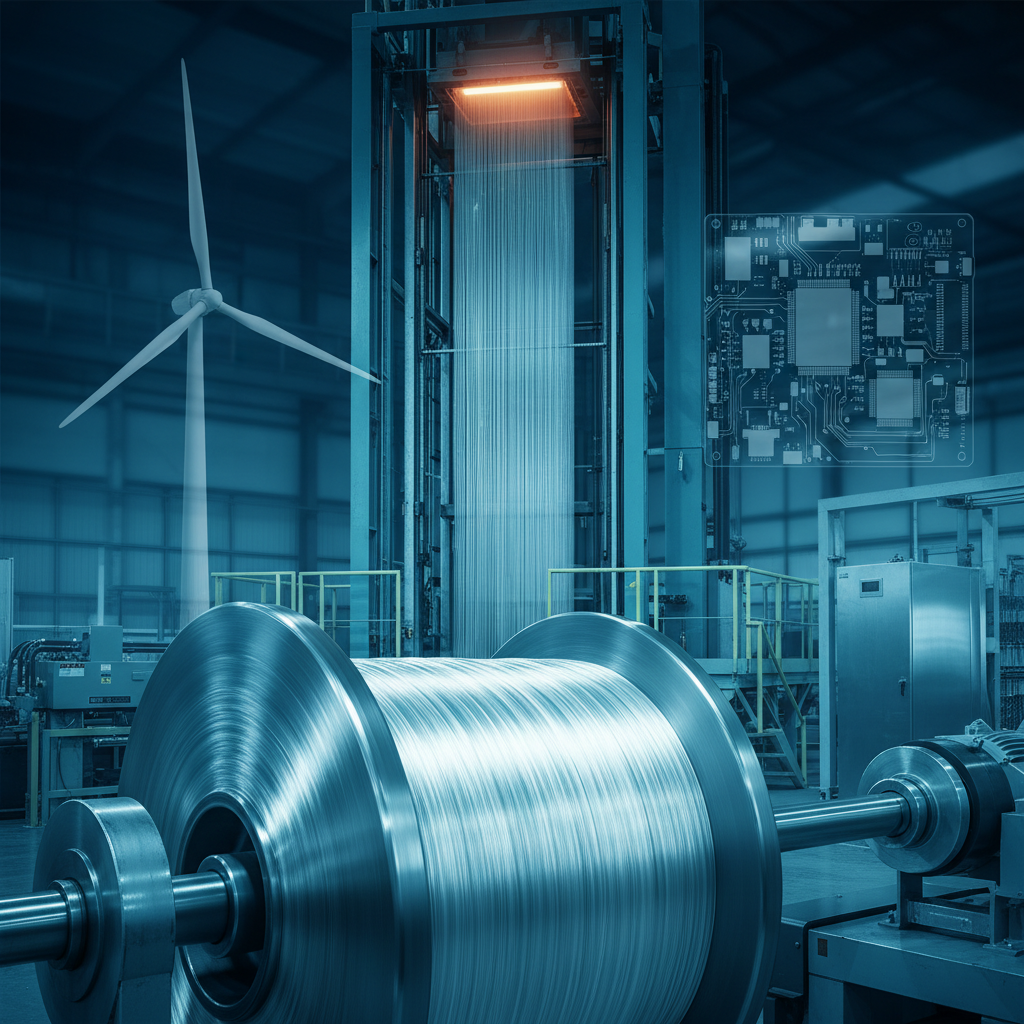

In May 2026, at a factory complex in Tongxiang, Zhejiang, a freshly cold-repaired furnace was reignited. Molten glass at 1,400 degrees Celsius flowed through thousands of holes in a platinum-rhodium bushing plate and was drawn at high speed into continuous filaments less than ten microns in diameter. The line's annual design capacity had been raised from 120,000 tons to 200,000 tons — one of several cold-repair upgrades China Jushi completed before the end of 2025. That same month, in Huai'an, Jiangsu, a so-called "zero-carbon smart" electronic-grade glass fiber plant celebrated its ignition ceremony, with a planned capacity of 100,000 tons of electronic yarn and 390 million meters of electronic cloth annually. Eight hundred kilometers to the south, in Jiujiang, Jiangxi, Jushi's second 200,000-ton coarse yarn line had come online earlier in the year. These three moments, stacked together, capture the most concentrated picture of China's glass fiber industry over the past twelve months.
China's glass fiber industry has reached a delicate moment of dual-front offensive. One front is wind-power yarn, as offshore wind units march toward the 18 MW and 20 MW class, blades stretch from 100 meters to 120 meters, and the mechanical demands on glass-fiber spar caps approach material limits. The other front is electronic yarn, as AI compute server demand explodes and T-glass cloth and low-dielectric electronic cloth enter the tightest decade-long shortage on record, with prices launching a second round of monthly price increases in early 2026. Both fronts share one common feature: traditional E-glass is no longer enough. The industry is being pushed toward higher generations — large-tow high-modulus wind yarn, Low-Dk low-dielectric electronic cloth, Q-glass quartz cloth.
The key numbers of 2025 outline this dual-front offensive. China's total glass fiber yarn output reached 8.43 million tons, up 11.5 percent year-on-year. Total capacity stood at roughly 8.7 million tons, still the world's largest at around 70 percent of global share. Electronic yarn output reached 886,000 tons, up 9.6 percent year-on-year, and sales of high-value-added products such as wind-power yarn and thermoplastic yarn grew rapidly. But at the same time, industry-wide per-ton profits remain in the historical mid-to-low range. The 2023-to-2024 price war pushed per-ton gross margins on many mid-tier coarse yarn products down to just a few hundred yuan, and the slow recovery in 2025 came only as electronic-yarn tightness and the gradual repricing of coarse yarn took hold.
More intriguing still is the global landscape. In February 2025, Owens Corning of the United States signed an agreement to sell its entire global Glass Reinforcements business for approximately USD 474 million, with closing expected in early 2026. That business had generated around USD 1.1 billion in annual revenues and was one of the company's main pillars and one of the three veteran global players in glass fiber. This divestiture means that the "China-US-Europe" three-pole structure of the global glass fiber industry is contracting to a "China-Japan dominant, others supplementary" two-pole structure. The global market share of Chinese glass fiber producers, for the first time, decisively passes 70 percent.
This report is a complete jigsaw of China's glass fiber industry from 2025 through 2030. From the industry overview to the process chain, from product generations to the corporate map, from offshore wind blade scaling to AI-driven electronic cloth demand, from the milestones of domestic substitution to the price cycle, from the policy environment to the risk factors — finally circling back to a fundamental question: now that Chinese glass fiber is already setting global prices in capacity and exports, where will it be blocked? And from where will it break through?
Chapter 1: Industry Overview — Starting with Several Key 2025 Numbers
Glass fiber is a continuous inorganic fiber drawn at 1,400 to 1,600 degrees Celsius from a molten mixture of pyrophyllite, kaolin, limestone, quartz sand, boron-calcium ore, and other minerals, with sodium carbonate, boric acid, and other auxiliary chemicals, through a platinum-rhodium bushing plate. Fiber diameters typically range from five to twenty microns, density about 2.55 grams per cubic centimeter, tensile strength exceeding 3,000 MPa, and modulus between 75 and 110 GPa. It is neither a niche high-end aerospace material like carbon fiber or aramid, nor a cheap commodity like the glass-fiber mesh sold for a few yuan per meter at roadside building supply shops. It is a foundational industrial material, produced at tens of millions of tons annually, penetrating from wind blades, automotive bodies, electronic circuit boards, tanks and pipes, appliance shells, all the way to building insulation, filtration and separation, and fire protection — covering essentially every node in the modern industrial system that requires "lightweight, high-strength, electrical insulation, and corrosion resistance" simultaneously.
The 2025 outline of China's glass fiber industry is captured by several key figures.
Total capacity and output. As of mid-2025, China's total glass fiber yarn capacity reached about 8.7 million tons per year. Full-year 2025 output was 8.43 million tons, up 11.5 percent year-on-year, of which coarse yarn was about 7.55 million tons and electronic yarn 886,000 tons. China's capacity has led the world since 2018 and by 2025 accounted for about 70 percent of global capacity, more than the second-place United States (led by Owens Corning) and third-place Japan (NEG, Nittobo, Sumitomo Mitsui) combined and then some.
Total consumption and exports. In 2025, China's exports of glass fiber and products reached approximately 1.8 million tons, flowing mainly to Europe, Southeast Asia, and North America for composite fabrication, wind blade plants, and PCB makers. Domestic consumption was around 6.6 million tons, distributed across wind power, thermoplastic reinforcement, electronic grade, building materials, tanks and insulation, automotive, and other sectors.
Market size. Using the recovered average price of late 2025, the industry's coarse yarn and product revenue was around RMB 110 to 120 billion. Including downstream GFRP composites, total domestic chain revenue exceeded RMB 300 billion.
Application mix. Building materials accounted for roughly 30 percent; electronics and PCB 17.5 percent; transportation (autos, rail) 15.2 percent; wind blades 11.8 percent; industrial tanks and equipment 10.4 percent; appliances and consumer goods 6.1 percent; others (filtration, fire protection, anticorrosion, marine engineering, leisure sports) 9.2 percent. Wind power and electronics are the two highest-growth segments, the twin engines lifting industry sentiment from 2024 to 2026.
Global landscape. Total global glass fiber capacity was about 12 million tons in 2025, with China taking 70 percent. Of the remaining 30 percent, European and U.S. makers (Owens Corning, Saint-Gobain Adfors, Johns Manville, Jushi USA joint venture) accounted for about 15 percent, Japanese players (NEG, Nittobo, AGC) about 6 percent, and Southeast Asian, Indian, Turkish, and Russian makers the remainder. By single-company measure, the top three Chinese producers — China Jushi, Taishan Fiberglass (under Sinoma Science & Technology), and Chongqing Polycomp International (CPIC) — together held roughly 45 to 50 percent global share, while Owens Corning at about 10 percent was the nominal global fourth.
Leading companies. China Jushi posted 2025 revenue of RMB 18.881 billion and net profit attributable to parent of RMB 3.285 billion. Coarse yarn and product sales reached 3.2026 million tons, and electronic cloth sales reached 1.062 billion meters. Taishan Fiberglass, under Sinoma Science & Technology, reported 2025 sales of 1.37 million tons of glass fiber products, revenue of RMB 8.9 billion, and net profit attributable to parent of RMB 1.05 billion; following Taiyuan base line one and two coming online, total capacity jumped to more than 1.7 million tons per year. CPIC posted 2025 revenue of RMB 8.658 billion, up 17.60 percent year-on-year, with glass yarn capacity exceeding 1.2 million tons. Changhai Stock posted 2025 revenue of RMB 3.139 billion, of which glass fiber business was RMB 2.497 billion, up 24 percent year-on-year; chopped strand mat held over 50 percent global share and wet-laid veil ranked first domestically. Shandong Fiberglass, Xingtai Jinniu, and Zhenshi New Materials are the second tier.
Reading these numbers together reveals a subtle fact: China's glass fiber industry leads the world in five dimensions — capacity, output, consumption, domestic substitution rate, and exports — yet still trails in two: the steady-state mass production of high-end electronic cloth (T-glass, high-end Low-Dk electronic cloth, Q-glass quartz cloth) and the process consistency of high-end aerospace composite glass fibers. The former reflects that AI-era electronic-yarn generation transitions have only just begun and the domestic substitution window is open. The latter reflects that aerospace glass fiber has long been monopolized by Western producers and the certification cycle into airframe supply chains is long.
This "lead in quantity, attack on the high end" pattern echoes earlier waves of Chinese material upgrades — polysilicon, ternary cathode materials, large-diameter silicon wafers, polarizing films — all of which followed similar trajectories: first achieve scale to drive down cost, then polish process for high-end. The earlier phase races for capacity, the later phase races for quality and certification. Glass fiber currently sits between these two phases. But unlike carbon fiber, glass fiber's volume is larger, its applications broader, and its downstream more fragmented — so the transition rhythm is also more complex.
From a global division-of-labor perspective, 2025 reveals a "two-pole structure" sharper than five years ago. The first pole is China, dominating coarse yarn, thermoplastic yarn, wind yarn, and mid-tier electronic yarn, with rapidly expanding capacity and exports and 70 percent global share. The second pole is Japan, dominating high-end electronic yarn (T-glass, Low-Dk) and specialty glass fiber (optical fiber, glass-fiber paper), with prices far above coarse yarn and stable margins. Within this pole, Nittobo alone holds about 90 percent of the global T-glass market. The former "third pole" of Western producers is contracting — Owens Corning divests GR, Johns Manville continues to focus on insulation and nonwovens, Saint-Gobain Adfors specializes in glass-fiber wallpaper and reinforcing mesh, and PPG exited long-fiber glass more than a decade ago. The global glass fiber battlefield has shifted, within a few years, from a four-cornered contest among China, the United States, Europe, and Japan to "China-Japan two-pole plus others supplementary."
A specific data point worth unpacking: the trajectory of per-ton profit. In 2021, industry-wide average per-ton net profit was nearly RMB 2,000, the high of the past fifteen years. It fell to around RMB 1,000 in 2022, to a few hundred yuan in 2023 (with several producers reporting quarterly losses), and to a low of RMB 200 to 300 for many mid-tier coarse yarn varieties in 2024. By 2025, with electronic-yarn tightness, wind-yarn repricing, and post-clearing capacity-utilization improvements, per-ton gross margin climbed back above RMB 1,000, and Jushi's glass-fiber gross margin rebounded from the low 20-percent range in 2024 to 32.22 percent in 2025. Behind this trajectory are several forces in combination: domestic capacity expansion peaked in 2022 to 2023 with several million tons of new furnace capacity coming online at once, far outpacing downstream demand growth; export markets faced sequential antidumping investigations from India, the EU, Brazil, Turkey, and the United States from 2022 onward, pressuring prices; real-estate downturn dragged building-material glass-fiber demand; and only by 2025 did AI compute pulling electronic yarn and cloth and accelerating offshore wind pulling wind yarn lift the industry from the trough.
Another worth-unpacking number is the "domestic substitution rate." This must be read in layers.
For ordinary E-glass coarse yarn, domestic substitution is near 100 percent — imports remain only for residual brand preference and legacy contracts. For mid-tier electronic yarn (G75, E225, 5.5-micron), domestic substitution is around 90 percent, with the remaining imports coming from NEG, Nittobo, and AGC. For wind yarn (high-modulus, high-strength, thermoplastic-compatible types), domestic substitution exceeds 95 percent, with Jushi, Taishan, and CPIC together supplying more than 70 percent of global wind-yarn output. For high-end Low-Dk electronic cloth, domestic substitution leapt from 20 percent in 2024 to 40-50 percent by 2026, the fastest-paced segment of the past twelve months. For T-glass (used in AI server CCLs), domestic substitution is below 10 percent — Nittobo alone holds about 90 percent globally, while Jushi, Honghe Tech, Feilihua, and Huasheng are in the sampling and small-batch validation stage. For Q-glass (quartz cloth, for the most premium AI and satellite communications use), production remains in laboratory and pilot phases.
Layering this segmentation onto the 8.43-million-ton output figure produces a more precise industry picture: in coarse yarn, thermoplastic yarn, mid-tier electronic yarn, and wind yarn, Chinese producers have overtaken the world; in high-end Low-Dk electronic yarn they are breaking through rapidly; in T-glass, Q-glass, and aerospace high-end glass fiber they have just begun. These four states coexist within the same industry, the most complex and dramatic structural story of China's glass fiber sector over the past three years.
The theme of China's glass fiber industry from 2020 to 2023 was "race for capacity." In 2024 it was "race for clearing." In 2025 to 2026 it has quietly shifted to "race for structure." In coarse, wind, and thermoplastic yarn, the task is to defend more than 70 percent global share and continue pushing down per-ton costs. In high-end Low-Dk electronic yarn and T-glass, the task is to complete the generation jump, overcome Nittobo's premium barrier, and lift per-ton net profit from a few thousand yuan to tens of thousands. These two paths run in parallel but demand entirely different corporate capabilities — the former requires scale and cost discipline, the latter requires process consistency and certification patience.
Several events of the past nine months deserve a place in the industry record. First, beginning in October 2025, electronic cloth opened its first round of price hikes for the year, with ordinary 7628 thick cloth ex-factory prices climbing from about RMB 3.5 per meter to above RMB 4 per meter; further hikes followed in December 2025 and in January and February 2026, with cumulative increases of RMB 1.0 to 1.2 per meter — unprecedented in the past five years. Second, from February 2026, mainstream producers announced a second round of monthly price increases, each round at 10 to 15 percent. Third, in April 2026, Owens Corning formally completed the GR divestiture, and the global glass fiber landscape formally entered the "China-Japan two-pole" era. Fourth, in March 2026, Nvidia's Rubin platform opened supplier testing for the new M10 CCL material, requiring electronic cloth and copper foil to maintain stability at higher frequencies with lower losses — pushing the industry toward a new material generation. Fifth, in Q1 2026, China added 15.77 GW of new grid-connected wind capacity, up 22.4 percent year-on-year, of which onshore was 15.55 GW and offshore 0.21 GW (offshore was seasonally low; full-year plan exceeds 15 GW).
Beyond these headline numbers, several finer pictures merit attention.
On upstream raw material supply, the core mineral inputs are pyrophyllite (China accounts for about 89 percent of global output), kaolin, limestone, quartz sand, boron-calcium ore, boron-magnesium ore, and dolomite. Mineral materials are largely self-sufficient in China. Boron is a bottleneck point — although China has nontrivial boron reserves, most are low-grade, and high-grade boron ore (over 70 percent B2O3) depends on imports, mostly from Turkey. Boron accounts for about 5 to 8 percent of E-glass formulation, and boric acid price swings transmit directly to per-ton glass fiber cost.
On energy intensity, the glass-fiber furnace is high-energy, long-cycle, heavy-asset equipment. A new 200,000-ton furnace costs RMB 1.2 to 1.6 billion to build. Once lit, a furnace must run continuously for five to eight years before cold repair; each cold repair costs RMB 100 to 200 million and takes six to nine months. Per-ton comprehensive energy use is about 1.5 to 2.0 tons of standard coal, costing RMB 400 to 600 — the second-largest cost item after minerals. This energy intensity makes producers highly sensitive to natural-gas and electricity prices. Jushi, Taishan, and CPIC have therefore tilted new capacity toward western provinces with cheaper gas and looser carbon constraints (Chengdu, Huai'an, Jiujiang, Tongxiang).
A fuller breakdown of 2025 downstream distribution: building materials (mesh, wall reinforcement, insulation, wallpaper, flooring) 29.8 percent; electronics and electrical (CCL, PCB electronic yarn, electronic cloth) 17.5 percent; transportation (autos, rail, marine thermoplastic structural parts, tire cord) 15.2 percent; wind blades 11.8 percent; industrial tanks and equipment 10.4 percent; appliances and consumer products 6.1 percent; others (filtration, fire protection, anticorrosion, marine engineering, leisure sports) 9.2 percent. Compared with global distribution, China's building-materials share is higher than the global 25-percent average, electronics share is lower than the global 25 percent (as US-Japan CCL makers concentrate in offshore Asia), and wind share is similar.
On concentration: the top-three concentration (Jushi, Taishan, CPIC) was about 45 percent in 2025; top-six concentration was about 65 percent. But if ranked by gross-margin contribution, Jushi, Taishan, and Changhai take the top three — Changhai, while not in the top five by volume, holds a gross margin in the 25-to-30 percent range thanks to chopped strand mat, wet-laid veil, and electronic mat. This contrast between volume concentration and margin distribution means the next three years of competition will be fought in product extension and high-end electronic cloth, not coarse-yarn tonnage.
Putting the timeline of 2020 to 2025 together, the leap is striking: 2020 total Chinese glass fiber capacity was 5.4 million tons, about 55 percent of global; 2025 total capacity 8.7 million tons, about 70 percent. Domestic consumption grew from around 4 million tons to about 6.6 million; exports from around 1.5 million to about 1.8 million. Three-axis simultaneous expansion of this scale has few parallels in Chinese industrial history — polysilicon, EV batteries, and ternary cathode materials are perhaps the only comparable cases.
On the value chain, 2025 numbers stack roughly as follows: yarn and coarse-yarn body, around RMB 65 billion; woven and intermediate products (chopped strand mat, wet-laid veil, electronic cloth, mats and fabrics, mesh), around RMB 50 billion; composite fabricated parts (blades, tanks and pipes, automotive structural parts, appliance shells), around RMB 150 billion; final downstream products (wind turbines, electronics CCL, auto vehicles, building-material end uses), around RMB 300 to 400 billion. The amplification factor from upstream to downstream — about five to six times — is typical for materials industries.
The leading Chinese producers have all responded to this value-chain logic. Changhai started from downstream chopped strand mat and extended backward to upstream furnaces. Jushi has extended from coarse yarn downward to electronic cloth and wind-blade-specific fabrics. Taishan, leveraging the Sinoma Science & Technology group, extends to wind turbine assemblies and specialty wind yarn. CPIC has built a complete "yarn-fabric-product" chain at its Chongqing base. This downstream extension is both a margin-recovery tactic and a cyclicality hedge.
R&D investment intensity for the Chinese industry runs at 3 to 5 percent of revenue, with leading producers at 4 to 6 percent — lower than carbon fiber but far above commodity construction-materials industries. Research focuses on three directions: furnace scale-up and energy savings, specialty glass formulations (Low-Dk, T-glass, E-CR, high modulus), and automation and intelligence (lights-out drawing, AI vision inspection, automatic winding). This research intensity has driven the past decade's shift from "price substitution" to "performance substitution."
Direct employment in glass-fiber body production is around 60,000 people. Including midstream fabrics and products and downstream composite fabrication, the full chain supports about 800,000 jobs. The number sounds modest, but the chain spans construction materials, chemicals, composites, mechanical processing, wind power, electronic circuits, tanks, and autos — its talent footprint matters structurally to Chinese high-end manufacturing.
Looking ahead from 2026 to 2030, several events deserve close tracking: first, how the eventual acquirer (likely Quanex or a private-equity consortium) handles Owens Corning's GR assets; second, the impact on global CCL supply chains once Nittobo triples T-glass capacity by 2028; third, further evolution of antidumping and countervailing duty rates from the EU, India, Brazil, and the United States; fourth, the actual pace of Chinese offshore wind moving from 10 MW toward 18 to 20 MW units; fifth, how AI compute server demand shifts from Nvidia's H/B series to Rubin and Vera Rubin generations and pulls electronic-cloth generation transitions; sixth, when domestic Low-Dk low-dielectric electronic cloth substitution crosses 60 percent; seventh, the breakthrough pace for domestic Q-glass and quartz cloth; eighth, the next milestone in glass-fiber furnace scale-up (250,000-ton, 300,000-ton single lines).
Finally, glass fiber as a foundational industrial material is tightly synchronized with the rhythm of global new energy, new equipment, and new aviation. The new-energy wave that began around 2020 — the EU Green Deal, the U.S. Inflation Reduction Act, China's dual-carbon target — pulled wind, hydrogen storage, and EVs sharply higher and gave the glass fiber sector a clear "dividend window" from 2021 to 2025. Over the next five to ten years, this wave will shift from "high-speed growth" to "quality upgrade." Demand growth will be less explosive but structural upgrading, application broadening, and process deepening will remain rich. The healthy development of China's glass fiber industry is and will remain bound to this global macro rhythm.
Chapter 2: The Process Chain — From Minerals to Furnace Drawing to Surface Treatment
To understand the glass fiber industry, one must first understand how glass fiber is made. Like carbon fiber, it is a process-intensive, equipment-intensive, energy-intensive long chain. But the critical bottleneck is different — for carbon fiber it is the oxidation and high-temperature carbonization furnaces; for glass fiber it is furnace scale-up and the platinum-rhodium bushing plate. The three elements of "temperature plus tension plus flow rate" unfold along a multi-meter molten-glass flow path at 1,400 degrees Celsius. Any micro-perturbation amplifies through the line into deviations in strength, modulus, surface, and glass-transition temperature of the final fiber.
Glass fiber is classified by manufacturing process into two routes: direct-melt (furnace drawing) and marble-melt (crucible drawing). The direct-melt route dominates modern industry, accounting for more than 95 percent of global glass fiber output: minerals enter a large melting tank directly, flow through the bushing plate, and are drawn and wound. The marble-melt route is used only for small-batch specialty products. The following discussion refers to direct-melt.
Step one: raw-material batching and mixing. Pyrophyllite, kaolin, limestone, quartz sand, boron-calcium ore, dolomite, and other minerals are mixed in precise proportions according to E-glass, E-CR, S-glass, D-glass formulations, with sodium carbonate, boric acid, and Glauber's salt added as auxiliaries. E-glass typically contains over 52 percent silica, 12-16 percent alumina, 16-25 percent calcium oxide, 5-10 percent boron oxide, and less than 1 percent sodium oxide. The recipe determines electrical, mechanical, and chemical resistance properties — it is the most jealously guarded craft secret. Jushi has developed E6, E7, E8, and E9 formulations over the past decade; E9 is the current high-strength, high-modulus wind-yarn flagship, benchmarked against Nittobo's high-modulus E-glass.
Step two: melting and refining. Mixed raw material enters the furnace's charging end. The melt zone is held at 1,500 to 1,600 degrees Celsius; the tank is tens of meters long, several meters wide, and one to two meters deep. The raw material undergoes melting, chemical reactions, and bubble release, finally forming a uniform, bubble-free, stone-free, temperature-homogenized glass melt. This is the core step. Thermal efficiency, burner layout, air-gas ratios, and melt convection design all determine the furnace's energy use and lifetime. China's current 200,000-ton furnaces achieve per-ton comprehensive energy use of about 1.8 to 2.0 tons standard coal, well below the 2.5+ tons of 60,000- to 80,000-ton furnaces of 2010.
Step three: forehearth and bushing. The refined melt flows from the tank into the forehearth, a continuous channel with a descending temperature gradient — from above 1,400 degrees down to about 1,200 degrees. At the end sits the most critical equipment: the platinum-rhodium bushing plate. Each plate has thousands to tens of thousands of fine holes (tips); molten glass flows through them and is drawn by high-speed winding machines at tens of meters per second, instantly cooled into continuous filaments five to twenty microns in diameter. Bushings are the most expensive and critical equipment in glass fiber production — each contains tens to over a hundred kilograms of platinum-rhodium alloy, worth several million to tens of millions of yuan at 2025 prices. A large furnace line carries dozens to hundreds of bushings, with the total noble-metal value running from RMB 500 million to RMB 2 billion. Hole count, hole geometry, hole diameter, and temperature distribution determine drawing speed, fiber diameter, and product specification. Japan's Tanaka Kikinzoku, Britain's Johnson Matthey, and China's Sino-Platinum are the main suppliers of bushing alloys.
Step four: sizing application. Freshly drawn glass filaments are smooth, hydrophilic, and brittle, with poor interfacial bonding to downstream resin, cement, or concrete. A thin sizing layer must be applied — a coating of coupling agents, film formers, lubricants, antistatic agents, emulsifiers, and water, matched to the downstream resin system. Epoxy, unsaturated polyester, phenolic, polypropylene thermoplastic, and CCL-grade electronic sizings all have different formulations. Sizing comprises only 0.5 to 2 percent of fiber mass yet determines interfacial shear strength, hygrothermal resistance, and fatigue performance in the final composite. The sizing formulation library is one of the deepest moats — Jushi reportedly maintains more than 2,000 formulations, matching virtually every major downstream resin system.
Step five: winding. After sizing, the fiber bundle (containing hundreds to thousands of filaments) is wound onto a paper or metal core under tight tension control, forming a cake or roving. Winding speeds range from several meters per second up to fifty. Tension control precision is extreme — any tension perturbation introduces broken filaments, breakage, or coil-shape defects.
Step six: drying and post-processing. Freshly wound cakes have high moisture content; they pass through drying ovens at 60 to 120 degrees Celsius for 10 to 20 hours so that sizing water evaporates, film formers cure, and a stable bond forms between glass surface and sizing. Dried roving may ship directly or proceed to fabric weaving, chopped strand, chopped strand mat, wet-laid veil, electronic cloth, or non-crimp fabric.
Step seven: inspection and grading. Tensile testers, density meters, sizing meters, moisture meters, and broken-filament meters check tensile strength, modulus, density, sizing content, moisture, and broken filaments. A typical 200,000-ton furnace drawing line runs 200 to 400 meters from charging end to outbound. The decade-long leap in single-line capacity — from 10,000-ton to 200,000-ton — has been the single most visible craft advance of the Chinese glass fiber industry.
Four directions characterize the past fifteen years of Chinese glass-fiber craft progress.
First, furnace scale-up. From 60,000-80,000-ton in 2008 to 120,000-ton in 2015, to 160,000-ton in 2020, and to 200,000-ton single lines today at Jushi, CPIC, and Taishan. The direct benefit is scale economy — at the same process level, a 200,000-ton furnace's per-ton comprehensive cost is 20-30 percent lower than an 80,000-ton furnace. But scale-up introduces challenges in temperature uniformity, bushing tension consistency, and downstream coordination of sizing, drying, weaving, and winding. The 2025 Tongxiang 200,000-ton retrofit, Jiujiang 200,000-ton commissioning, and Huai'an 100,000-ton electronic-grade construction are the latest milestones.
Second, glass formulation iteration. E-glass is the oldest and most general formulation but has ceilings on electrical performance, modulus, and corrosion resistance. Over the past fifteen years, Chinese producers have developed E-CR (boron-free, fluorine-free, corrosion-resistant — for wind and tanks), high-modulus E-glass (modulus from 75 GPa to above 85 GPa — for large blades), Low-Dk low-dielectric glass (dielectric constant from 6.6 down to below 4.8 — for AI high-speed PCBs), and Jushi's proprietary TLD-glass low-dielectric formulation now in batch supply to leading domestic PCB makers. Each iteration combines chemical, melting, refining, and bushing modifications. Nittobo's twenty-plus-year T-glass monopoly is, in essence, a complete formulation-plus-process-plus-bushing-plus-sizing system; Chinese producers are following that path systematically.
Third, the sizing formulation library. This is the area where Chinese producers have most rapidly closed the gap with international peers. Jushi, Taishan, and CPIC all maintain over 2,000 sizing formulations covering thermoset resins (epoxy, unsaturated polyester, vinyl ester, phenolic, BMI, polyimide), thermoplastic resins (PP, PA, PBT, PC, PPS, PEEK), cement and concrete, rubber-tire cords, electronic-grade CCL, and specialty environments (marine, oil and gas, fire protection). Sizing barriers look modest but run deep — a new formulation typically requires two to three years from R&D to downstream qualification.
Fourth, automation and intelligence. Including automatic winding, AI vision broken-filament detection, intelligent drawing-speed regulation, furnace temperature-field real-time feedback, lights-out bushing inspection, automatic cake transfer, and electronic-cloth automatic inspection. Jushi and Taishan have established demonstration "zero-carbon smart" plants, with single-line headcount dropping from twenty per 10,000 tons a decade ago to five to eight today.
From a craft perspective, the gap between Chinese and Japanese-European high-end glass fiber is concentrated in two details: first, the stability, batch consistency, and bushing lifetime for Low-Dk low-dielectric formulations; second, the mass-production craft and device-level consistency of Q-glass and S-glass. Breaking these takes more than five years of accumulated experience. Jushi, Honghe Tech, Feilihua, and Huasheng are the most likely candidates, but 2026-2028 remains a critical attack window.
By craft difficulty, the product ladder runs roughly: coarse E-glass (easiest) → wind-yarn high-modulus E → chopped strand and mat → mid-tier electronic yarn G75 → wet-laid veil → high-end electronic yarn 5.5-micron → Low-Dk low-dielectric → S-glass high-strength → T-glass ultra-low-dielectric → Q-glass quartz cloth (hardest). Crossing each tier multiplies per-ton cost two to fivefold, per-ton price three to tenfold, and gross margin by 10 to 20 percentage points. This craft-difficulty ladder is the most important product-generation map for the industry.
Finally, the platinum-rhodium bushing's noble-metal recycling loop deserves mention. Bushings gradually wear over three to five years from platinum and rhodium evaporation and abrasion at high temperatures, then must be replaced. Spent bushings are sent to Tanaka, Johnson Matthey, or Sino-Platinum for refining, casting, and remachining. This loop is the single most important asset-management item — a furnace line's bushing noble-metal inventory often runs over RMB 1 billion — and is also a sector entry barrier. Without a stable noble-metal recycling supply chain and the working capital to pre-fund inventory, new entrants cannot start a 200,000-ton furnace. Jushi, Sinoma, and CPIC began strategic partnerships with Sino-Platinum and Tanaka in 2018, building closed-loop recycling systems. This system is itself one source of the Chinese industry's overall resilience.
Chapter 3: Product Generations — E-Glass, E-CR, High-Modulus, Low-Dk, T-Glass, Q-Glass
Glass fiber is not a product but a "formulation family." Within the family, products are organized by generation, downstream, and performance — with both inheritance relations and jump transitions. Understanding the generational map is a prerequisite for understanding the industry's next five years.
The oldest and most basic formulation is E-glass — the "E" for Electrical. Developed in the 1930s by Owens-Illinois and Corning to replace mica as electrical insulation, E-glass typically contains 52-56 percent silica, 12-16 percent alumina, 16-25 percent calcium oxide, 0-5 percent magnesia, 5-10 percent boron oxide, and less than 1 percent combined sodium and potassium oxides. Its strengths are balanced performance, cheap raw materials, and mature processing; its weaknesses are relatively high dielectric constant (6.6), modest corrosion resistance, and modulus of 72-76 GPa. E-glass covers more than 80 percent of global glass fiber demand — the basis of coarse yarn, wind yarn, thermoplastic yarn, mid-tier electronic yarn, building reinforcement, and automotive thermoplastic parts.
The first major derivative is E-CR glass — "CR" for Corrosion Resistant. E-CR removes boron, lowers sodium, and adds more calcium and magnesium. Its acid-corrosion lifespan is five to ten times longer than E-glass, making it the mainstream wind-blade material of the past decade.
The second is high-modulus E-glass, drawn out by blade scale-up over the past five years. By raising magnesia, alumina, and calcia, modulus is lifted from E-glass's 72-76 GPa to 82-90 GPa — a 15-20 percent improvement. Higher modulus means stiffer blades at the same length, lower deflection, better vibration tolerance.
The third is S-glass — "S" for Strength. Silica content rises above 65 percent, boron and calcia are dropped, and more magnesia is added. S-glass has the highest mechanical performance — tensile strength up to 4.6 GPa (versus E-glass's 3.4 GPa) and modulus 86-96 GPa. Used in military, aerospace, premium leisure, and high-end composites. Craft difficulty far exceeds E-glass — higher melting temperatures, more demanding bushing high-temperature endurance, slower drawing speeds. Global output is only tens of thousands of tons. Leading producers are AGY (U.S., Owens Corning and Saint-Gobain JV) and Nittobo (Japan); Chinese producers Jushi and Feilihua are attacking industrialization.
The fourth is D-glass — "D" for Dielectric. With higher silica and higher boron, D-glass's dielectric constant drops from E-glass's 6.6 to about 4.8. Used in high-frequency-circuit PCBs, radomes, and space applications. Early industrialization was led by Corning and Nittobo; D-glass became the craft starting point for Low-Dk low-dielectric electronic cloth.
The fifth derivative is Low-Dk low-dielectric electronic glass — pushed into industry spotlight in the past three years by the AI compute server boom. Built on D-glass, it further lowers Dk to 4.2-4.6 and Df from E-glass's 0.005 down to 0.002-0.003, keeping CCL signal integrity at 30-76 GHz frequency bands. Target downstreams include AI compute server CCLs, 5G base station PCBs, millimeter-wave radar, and phased-array antennas. Global Low-Dk electronic cloth demand was around 100 million meters in 2024, grew to 150 million meters in 2025, and Huatai Securities estimates 240 million meters in 2026, with market value expanding from RMB 3.9 billion to RMB 29.2 billion. Jushi's 2025 Low-Dk capacity was under 100 million meters; this doubles with the Huai'an base ignition in 2026.
The sixth is T-glass — the "T" originally for Toray. Pushed forward and monopolized by Nittobo, T-glass has ultra-low Dk (3.8-4.0), ultra-low loss (Df below 0.001), and very low CTE — used in AI servers' most premium M9-plus CCLs (Nvidia Rubin, AWS Graviton5, etc.). Nittobo holds about 90 percent of the global T-glass market; 2025 capacity is a few thousand tons, and new capacity comes online no earlier than mid-2027. Jushi, Honghe, Feilihua, and Huasheng are at the sampling and small-batch validation stage with domestic CCL makers (Shengyi, Nan Ya New Materials, Tairiwn).
The seventh is Q-glass — "Q" for Quartz. With silica above 99 percent, Q-glass is near-pure quartz fiber, Dk around 3.5, Df below 0.0005, and CTE extremely low — the crown jewel of glass-fiber generations. Industrialization barriers are extreme — melting requires above 1,700 degrees Celsius, demanding extreme bushing high-temperature endurance, with extremely slow drawing speeds, and quartz hardness damages PCB drilling tools. Q-glass is currently dominated by Heraeus (Germany), Saint-Gobain Quartz (U.S.), and Asahi Glass (Japan). Global annual output is only a few hundred tons. Chinese producers Feilihua, Honghe Tech, and Huasheng have small-batch capability; mass-production craft and PCB-processing compatibility remain to be solved.
Mapping all seven generations into a vertical chart yields a clear product-generation map.
By downstream, glass fiber products fall along several main lines. Wind yarn uses E-CR and high-modulus E-glass primarily, typically 1,200-2,400 tex coarse yarn for blade spar caps, skins, roots, and shear webs. Electronic yarn uses E-glass and low-sodium glass, in finer specifications from G75 (coarse) through E225 (medium) to 5.5-micron fine and 3-micron ultrafine. Thermoplastic yarn (LFT/SFT) uses E-glass plus specialty sizing in 270-4,800 tex coarse or chopped strand form for PP, PA, PBT, PPS thermoplastic composites — primarily automotive structural parts, appliance shells, battery trays, and thermoplastic pipes. Chopped strand uses E-glass primarily in 1.5-13 millimeter lengths for thermoplastic injection reinforcement, SMC/BMC sheet molding, and concrete reinforcement. Mats use E and E-CR, including chopped strand mat, continuous mat, wet-laid veil, stitched mat, and surface veil; Changhai's chopped strand mat holds over 50 percent global share. Electronic cloth uses E-glass and low-dielectric glass in thin (106, 1080, 2116, 3313), medium (7628, 2113, 1652), and thick (3070, 3784) specifications by warp-weft density — the core reinforcement of CCL, with 2025 Chinese output around 3 billion meters. Specialty fabrics include non-crimp fabric, unidirectional tape, three-dimensional weave, mostly for blades, tanks, marine engineering, and aerospace.
Mapping these generations, lines, and specifications onto a product matrix reveals the depth of the Chinese industry's portfolio. Jushi covers seven of eight major lines — the most complete all-product player. Taishan and CPIC follow. Changhai, Zhenshi, Honghe, and Feilihua each have prominence in specific lines or generations. The generation coverage of the Chinese industry now exceeds any single country outside Japan, but the steady-state mass production of top generations (T-glass, Q-glass) remains the three-to-five-year attack focus.
By generation transition speed: 2020-2023 was the E-CR and high-modulus wind-yarn ramp; 2022-2025 the mid-tier electronic-yarn domestic substitution phase; 2024-2027 the Low-Dk low-dielectric domestic-substitution attack phase; 2026-2028 the T-glass localization breakthrough phase; 2028-2030 the start of Q-glass industrialization. This generational timetable is the single most important industry map for the next five-to-ten years, and the core dimension for judging each producer's competitiveness.
Chapter 4: The Corporate Map — Jushi, Taishan, CPIC, Changhai, Benchmarked Against Owens Corning and NEG
China's glass fiber industry is far more concentrated than carbon fiber. The top three coarse-yarn makers together hold nearly 50 percent share, and the top six nearly 70 percent. But once one moves downstream to value-added products and the high-end generations, the picture grows more complex. The following maps each leading producer's 2025 position and strategy, with international comparators.
China Jushi (600176.SH).
2025 revenue RMB 18.881 billion (up 19 percent YoY); net profit attributable to parent RMB 3.285 billion (up 34 percent); glass-fiber product gross margin 32.22 percent (up 7.87 percentage points). Coarse-yarn and product sales 3.2026 million tons; electronic-cloth sales 1.062 billion meters. Glass fiber and products revenue RMB 18.345 billion (99 percent of main business).
On capacity, the Tongxiang cold-repaired line raised from 120,000 to 200,000 tons in Q2 2025; the Jiujiang 200,000-ton line began production in early 2025; electronic yarn and cloth capacity were 270,000 tons and 960 million meters per year respectively. Major in-construction projects: Huai'an annual 100,000-ton electronic glass fiber plus 390 million meter electronic cloth zero-carbon smart line (ignition mid-2026); a new 320 million meter electronic cloth expansion line at RMB 4.431 billion investment (18-month build); planned Chengdu 200,000-ton coarse-yarn line; continued Tongxiang upgrades.
On products, Jushi covers coarse yarn, wind yarn, thermoplastic yarn, electronic yarn, chopped strand, and electronic cloth — the only "all-generation, all-mainline" domestic player. Premium attack directions include TLD-glass (proprietary Low-Dk now in batch supply), T-glass (sampling phase), and ultra-fine electronic yarn (2 and 3 micron in mass production).
Strategic position: China's global champion. By 2025, Jushi's global market share exceeded 25 percent — surpassing Owens Corning and NEG combined. Core moats: furnace scale-up capability, 2,000-plus sizing formulation library, full-generation product coverage, and downstream integration (in-house electronic cloth and wind-blade fabrics).
International benchmark: historically Owens Corning, but after Owens Corning's February 2025 announcement to divest GR for about USD 474 million, Jushi's international benchmark is effectively disappearing. The remaining international peers of comparable scale are Nittobo (electronic-yarn focused, coarse yarn far below Jushi), NEG (combined scale about half of Jushi), and Saint-Gobain Adfors (wallpaper and reinforcing mesh, not large coarse yarn). From 2026 forward, Jushi will be the unambiguous "single first tier" of the global glass fiber industry.
Sinoma Science & Technology / Taishan Fiberglass (002080.SZ).
2025 net profit at Sinoma overall more than doubled; the "AI materials new engine" launched. Taishan Fiberglass: 2025 glass-fiber product sales 1.37 million tons, revenue RMB 8.9 billion, net profit attributable to parent RMB 1.05 billion. Average selling price up 14 percent YoY; gross margin up 9 percentage points YoY. Taiyuan base lines one and two commissioned within 2025, lifting total capacity to over 1.7 million tons per year.
On products, Taishan's portfolio is somewhat narrower than Jushi but has deeper differentiation in wind yarn, thermoplastic chopped strand, LFT yarn, and specialty wind yarn — LFT yarn maintains the global number-one market share. H1 2025 wind-related product sales up 44 percent YoY. In electronic cloth, the Zoucheng 35-million-meter specialty cloth, Zoucheng 35-million-meter low-dielectric cloth, and Taishan 24-million-meter ultra-low-loss low-dielectric cloth projects were at year-end 2025 progress of 45.25, 19.01, and 0.04 percent respectively.
Strategic position: number two and wind-yarn specialist. Backed by the Sinoma Science & Technology group (Sinoma, under China National Building Material Group), Taishan and Jushi long-term form competition-plus-complementarity. International benchmark: NEG of Japan — NEG's wind-yarn, thermoplastic-yarn, and LFT-yarn strategies closely parallel Taishan's, though NEG capacity is far below Taishan's.
CPIC (301526.SZ, "International Composites").
2025 revenue RMB 8.658 billion, up 17.60 percent YoY. End-of-2025 glass yarn capacity over 1.2 million tons (global top three); glass fabric capacity 200 million meters (global top three); premium electronic cloth (LDK/T cloth) about 30 million meters per year, planned to expand to 60-70 million meters in 2026.
CPIC listed on Shenzhen's ChiNext in December 2023, raising funds primarily for an "annual 150,000-ton ECT glass fiber intelligent manufacturing line" and an "F10B annual 150,000-ton high-performance fiber line cold-repair upgrade." Chongqing Dadukou, Changshou, and Brazilian bases form a multi-base layout.
On products, CPIC's specialty is ECT (its proprietary E-Corrosion Resistant-Thermoplastic) and TM high-strength high-modulus glass — a "multi-formulation, multi-base" representative.
Strategic position: number three and globalization pioneer. CPIC is the earliest among Chinese producers to build overseas furnace capacity (Brazil, Bahrain). Overseas capacity and revenue share are far above peers — a representative sample of how Chinese producers respond to antidumping pressure.
Changhai Stock (300196.SZ).
2025 revenue RMB 3.139 billion (up 18 percent YoY); glass fiber business RMB 2.497 billion (up 24 percent YoY) — the core driver. Changhai's identifying path is "products first, then upstream" — starting from chopped strand mat in the 1990s and gradually extending backward into furnaces.
Capacity: three furnaces (combined 130,000 tons). Downstream products: over 50 percent global chopped strand mat share, number-one wet-laid veil domestically, number-one electronic mat globally.
Products: chopped strand mat, wet-laid veil, glass fabric, composite separators (AGM for lead-acid batteries), mesh. AGM separators are a relatively unique differentiator — Changhai is the only Chinese producer combining AGM separators with upstream glass-fiber integration.
Strategic position: niche champion and integration model. Changhai does not compete on coarse yarn volume against Jushi or Taishan; it focuses on high-margin products. Gross margin holds at 25-30 percent, well above industry average. International benchmark: Johns Manville (under Berkshire Hathaway), though Johns Manville's glass fiber business is insulation- and nonwoven-focused, not AGM separators.
Shandong Fiberglass, Xingtai Jinniu, Zhenshi New Materials, Honghe Tech, Feilihua, Huasheng each have differentiation. Shandong is the North China leader; 2025 industry-wide profits at RMB 11 billion (up 78 percent) reflect the strength of post-clearing margin recovery. Xingtai Jinniu has 90,000-ton annual capacity, with Jizhong New Materials' two 200,000-ton lines fully ramped and a third 120,000-ton line under construction. Zhenshi New Materials filed for Sci-Tech Innovation Board IPO in 2025, specializing in high-end electronic cloth and wind yarn. Honghe Tech is a leading domestic electronic-cloth maker, with 2025 market cap surging to RMB 20 billion on revenue of just RMB 800 million — pure AI-electronic-cloth expectation pricing. Feilihua and Huasheng are leading domestic players in quartz glass and high-end Q-glass and T-glass.
Putting the major Chinese producers in one table:
Company             FG Revenue   FG Capacity   Global Share   Gross Margin   Premium Layout
China Jushi          ~RMB 18.3B   ~2.8M tons    ~25%           32.22%         All gen + T-glass sample
Taishan Fiberglass   ~RMB 8.9B    ~1.7M tons    ~15%           ~30%           Wind + LFT + Low-Dk
CPIC                 ~RMB 8.7B    ~1.2M tons    ~10%           ~25%           ECT + multi-base + Brazil
Changhai Stock       ~RMB 2.5B    ~130K tons    ~3%            ~28%           Chopped mat global #1
Shandong Fiberglass  ~RMB 2.5B    ~500K tons    ~4%            ~22%           North-China regional
Honghe Tech          ~RMB 0.8B    cloth-focused —              ~30%           Premium electronic cloth
Feilihua             ~RMB 1.5B    quartz-focused —             ~40%           Q-glass + quartz cloth
International benchmark snapshot (FY2024):
Company                              FG Revenue        FG Capacity         Specialty
Owens Corning (GR, divested 2026)    ~USD 1.1B         ~1.0M tons          Wind + building reinforcement
Nippon Electric Glass (NEG)          ~USD 2.5B FG seg  ~800K tons          Thermoplastic + electronic + specialty
Nittobo                              ~USD 0.9B         ~100K tons (e-grade) T-glass monopoly
Saint-Gobain Adfors                  ~EUR 1.0B         Wallpaper + mesh    European building reinforcement
Johns Manville (Berkshire)           ~USD 1.3B         Insulation-focused  North American insulation
3B Fibreglass (Norsk)                ~EUR 0.3B         ~300K tons          European coarse yarn
A clear judgement emerges: the combined capacity and revenue of the top three Chinese producers (Jushi, Taishan, CPIC) already exceed the combined totals of Owens Corning, NEG, Nittobo, Saint-Gobain, and Johns Manville. This shift in global glass-fiber dominance is the largest industry-pattern change in fifteen years, and the formal arrival of the "China-dominant, Japan-specialty, others contracting" two-pole structure with Owens Corning's 2026 GR divestiture closing.
Five differentiation paths over the next three years:
Jushi: "all-generation plus integration" — defend coarse-yarn scale while breaking through Low-Dk and T-glass upstream, and extend downstream into electronic cloth and wind-blade fabric.
Taishan: "wind plus thermoplastic plus group synergy" — anchored to Sinoma's wind OEM coordination and auto thermoplastic customer-binding; gradual Low-Dk penetration in electronic cloth.
CPIC: "global layout plus antidumping evasion" — Brazilian and Bahrain capacity as core defensive assets against trade-remedy actions; overseas sales share well above peers.
Changhai: "high-margin product focus" — avoids coarse-yarn volume competition; focuses on chopped strand mat, wet-laid veil, electronic mat, AGM separators.
Honghe, Feilihua, Huasheng: "high-end generation breakthrough" — electronic cloth, quartz glass, Q-glass entry points; skip coarse yarn, fight for the highest generation directly.
These five paths run in parallel but each implies different capex intensity, R&D cycles, and certification rhythms.
Chapter 5: Downstream One — Wind Blades, Offshore Scale-Up and the Glass-Fiber Spar-Cap Inflection
Wind power has been the most important "incremental demand engine" of the past decade for Chinese glass fiber, and the most certain high-prosperity downstream of the next five years. Understanding wind blade glass-fiber demand starts from blade scale-up.
Wind turbine rated power has gone from 1.5-2 MW in 2010, to 5-6 MW in 2020, to 10-12 MW in 2025, to 20 MW installed at sea in early 2026 — a 10x-plus rise in fifteen years. The physical basis is rotor diameter expansion. Single blade length has gone from about 40 meters in 2010, to 100-110 meters in mainstream offshore units of 2025, to over 120 meters in the latest 20 MW machines of 2026.
Every doubling of blade length scales mass, materials, and glass-fiber consumption by 2.5 to 3x. A 110-meter offshore blade weighs 40-50 tons, with glass-fiber consumption of 30-35 tons. Three blades total 90-100 tons of glass fiber. A 12 MW unit's annual generation of 30 million-plus kWh comes from a turbine consuming over 100 tons of glass fiber. At industry scale, China's 2025 new wind capacity of around 100 GW (onshore ~80 GW, offshore ~15 GW) corresponded to glass-fiber consumption above 700,000 tons.
This "third-power scaling" of demand from blade lengthening is the largest structural variable for the Chinese glass fiber industry over the past decade. More importantly, blade scale-up demands not just "more material" but "generation upgrade." Blades over 100 meters — with large rotation radii, heavy self-weight, complex wind loads, enormous root bending moments, and 20-plus-year service life — push glass-fiber modulus, tensile strength, fatigue life, glass-transition temperature, and resin interface bonding far past traditional E-glass. This is the root of why high-modulus E-glass, E-CR glass, and thermoplastic-compatible glass fiber have surged over five years.
Key 2025 and Q1 2026 data: China added 15.77 GW of new grid-connected wind (15.55 GW onshore, 0.21 GW offshore, with offshore seasonally low and full-year plan at 15 GW+). By end-March 2026, cumulative wind grid-connected capacity reached 655 GW, up 22.4 percent YoY. The 15th Five-Year Plan period sets annual new wind capacity above 120 GW, with offshore above 15 GW per year. By 2035, wind and solar combined target 3.6 TW, 6x the 2020 base.
European reference: 2025 new wind capacity 19.1 GW, cumulative 304 GW (onshore 265 GW, offshore 39 GW). But European offshore added only 2 GW in 2025 — the low since 2016, on UK, German, and French project delays. WindEurope projects 2026 additions of 25 GW (19 GW onshore, 6 GW offshore), 2026-2030 cumulative reaching 439 GW (offshore growing from 39 GW to 73 GW).
Wind-blade glass-fiber product forms include spar-cap yarn (high-modulus E-glass UD fabric, increasingly hybridized with carbon-fiber pultruded plates in 100m-plus offshore blades), skin yarn (E-CR primary, NCF or biaxial woven), root yarn (high-modulus E-glass UD plus stitched fabric, 3-5 tons per blade), shear-web yarn (thermoplastic yarn or E-glass chopped mat composite), and root bolt-bushing reinforcement yarn (extremely high fatigue requirement). Jushi, Taishan, and CPIC's edge is the ability to supply all five forms simultaneously and partner closely with blade plants (MingYang, Sinoma Wind Blade, Sinomatech, Aerodyn, Shanghai Glass Steel Institute).
Three opportunity dimensions: per-unit consumption scaling (110m blade uses 5-6x the glass fiber of a 60m blade); generational upgrades (each generation increases per-ton net profit 20-50 percent); composite-fabrication coordination (integrated solutions extending margins from yarn to fabric to total solution, lifting gross margins from 20s to 30s percent).
Global competitive landscape for wind-blade glass fiber: 2025 demand about 1.2 million tons. Chinese suppliers about 900,000 tons (75 percent globally). Remainder split among NEG, Owens Corning (taken over by acquirer from 2026), Saint-Gobain Adfors, Johns Manville, 3B Fibreglass. Post-Owens-Corning divestiture, Chinese share rises further.
Five forward-looking variables: offshore scale-up pace, carbon-fiber spar-cap substitution (large-tow carbon vs. high-modulus glass currently at 12-15x price; long-term glass keeps 80-percent blade volume share), EU antidumping policy evolution, onshore aging-unit replacement (cumulative onshore wind over 500 GW with aging 1.5-3 MW units approaching retirement), and emerging overseas wind markets (India, Brazil, Turkey, Saudi Arabia, UAE — biggest export uncertainty also concentrated here).
A unique long-tail opportunity: end-of-life blade recycling. Each blade's glass-fiber-plus-resin mass is 50-60 tons. Cumulative retired blades worldwide exceed 2 million tons by 2030. Recycled glass-fiber composites can be re-crushed for cement kiln co-processing, thermoplastic reinforcement, concrete reinforcement, or SMC/BMC. A potential growth area over the next five-to-ten years; Vestas and LM Wind Power lead European pilots; Sinoma and MingYang advance domestic equivalents.
Chapter 6: Downstream Two — Electronic Yarn and Cloth, Invisible Material Champion of the AI Compute Era
If wind has been the past decade's largest growth engine, then electronic yarn and cloth have been the most violent eighteen-month "price storm" for the industry. The logic begins with AI compute server demand for CCL.
CCL — Copper Clad Laminate — is the raw sheet for every PCB. A modern AI server compute board stacks 26-36 CCL layers, each layer's glass cloth directly affecting signal stability, loss, and interference resistance.
AI compute servers' CCL requirements differ fundamentally from traditional comm servers. Traditional servers run at a few to tens of GHz where regular E-glass cloth (7628, 2116, 1080) suffices; but AI servers (Nvidia H100/H200/B100/B200/GB200, AMD MI300, AWS Graviton4) have GPU-to-GPU, GPU-to-HBM, and NVLink high-speed serial links pushed to 30/64/112 GHz — Df, CTE, and signal-integrity demands jump. E-glass loses too much signal at these bands and must be replaced by Low-Dk, NE-glass (Saint-Gobain US), T-glass (Nittobo-monopolized), and Q-glass (quartz cloth).
In March 2026, Nvidia's Rubin platform formally opened M10 new-CCL supplier testing, demanding signal loss 30-40 percent lower than traditional FR-4 (E-glass-based standard CCL). From H2 2026 onward, global AI-server CCL enters the critical generation-jump node — E-glass → Low-Dk → NE-glass → T-glass → Q-glass migration accelerates broadly.
Electronic cloth shortage status: from H2 2025, global electronic cloth entered the tightest shortage of the decade. Ordinary 7628 cloth ex-factory price rose from about RMB 3.5 per meter in September 2025 to near RMB 6 in May 2026 — a roughly 70-percent cumulative increase. Thin cloths (1080, 2116) rose more, some over 100 percent. Low-Dk cloth even more dramatic — May 2026 prices reached RMB 30-40 per meter (6-8x ordinary 7628). T-glass cloth effective offers exceeded RMB 100 per meter, supply Nittobo-monopolized, scheduled through late 2027.
Industrial logic: AI compute demand surge; long electronic-cloth capacity build cycle (18-24 months from groundbreaking to stable supply); high-end process barriers; and upstream electronic-yarn tightness propagating to cloth.
Major producers' electronic-cloth capacity and expansion plans:
Jushi. 2025 capacity 960 million meters per year. Huai'an zero-carbon smart base ignition mid-2026. Additional 320-million-meter expansion at RMB 4.431 billion (18-month build). 2027 capacity expected to exceed 1.6 billion meters per year — about 30 percent global share.
CPIC. 2025 premium electronic cloth (LDK/T cloth) about 30 million meters per year; planned expansion to 60-70 million meters in 2026. Among earliest in T-glass and Q-glass R&D layout.
Sinoma / Taishan. Multiple projects at varying year-end 2025 progress; full commissioning by 2027 builds ~100 million meter premium-cloth capacity.
Honghe Tech. Pure A-share electronic-cloth pick — 2025 market cap surged from RMB 7-8 billion to RMB 20 billion on RMB 0.8 billion revenue. Pure expectation pricing.
International players. Nittobo T-glass global monopoly, 3x capacity expansion by 2028. NEG electronic-cloth segment >1 billion meters per year. Tairiwn announced end-2025 cessation of E-glass electronic cloth in favor of full Low-Dk transition.
Generation-transition pace for domestic substitution: 2024 mid-tier Low-Dk substitution ~20 percent; 2025 over 30 percent; 2026 (projected) 40-50 percent for mid-tier and >20 percent for premium Low-Dk; 2027 (projected) T-glass localization breakthrough; 2028-2030 (projected) Q-glass localization.
The downstream certification chain is critical. A new electronic cloth needs 12-24 months from sample to CCL-plant certification (Shengyi, Nan Ya, Kingboard, ITEQ, Tairiwn, KB Materials), then re-certification at PCB plants (Shennan Circuits, Wus Printed Circuit, Shengyi Electronics, Tripod, Yiteng, Unimicron), then again at server OEMs (Wiwynn, Foxconn, Quanta, Inventec). This chain explains why electronic-cloth domestic substitution lags coarse yarn significantly — even when process is solved, certification still requires 1-2 years.
Chapter 7: The Platform View — Fragmented Downstream Means Factory Recognition Beats Brand Directories
The glass fiber industry has one distinct industrial trait differing fundamentally from carbon fiber, semiconductors, or EV batteries — its downstream is extraordinarily fragmented. The endpoints of coarse yarn, thermoplastic yarn, chopped strand, electronic yarn, wind yarn, and specialty yarn — from a wind turbine to an AI server, from an EV to an air-conditioner, from a buried PVC pipe to a roll of wall reinforcement mesh, from an oil tank to a fire-protection panel — cover essentially every node in modern industry needing "lightweight, high-strength, electrical-insulation, corrosion-resistance" simultaneously.
This fragmentation creates a unique problem in industry research, sales leads, and supply-chain management: finding downstream customers via traditional brand directories and phone lists is high-cost and low-coverage. A glass-fiber producer seeking to reach "every SMC plant nationwide using E-CR glass" or "every battery-tray plant using LFT thermoplastic yarn" might scan tens of thousands of small factories, manually filter for months, and still hit less than one-tenth.
This is precisely the product value of Tianxia Gongchang in industry research and sales-lead workflows — it is a B2B sales-oriented factory lead platform covering 4.8 million in-production factories. The difference from general business-information platforms (Qichacha, Tianyancha, Qixinbao) is that those are "all-enterprise pools" (covering large numbers of trading firms, shells, dormant entities, and individual businesses), whereas this platform focuses on real in-production factories — identified through cross-source signals (pollution permits, energy certificates, social-security headcount, electricity-usage curves, business-registration changes) verifying actual production status, then enriched with semantic structuring of process, equipment, products, and supply-chain relations to characterize each factory's capabilities. For glass fiber, wind, electronics, autos, and appliances — industries with highly fragmented downstreams — this factory-grade granular identification offers efficiency gains an order of magnitude beyond plain enterprise directories.
Several practical scenarios:
Scenario one: a Low-Dk low-dielectric electronic-cloth maker wishing to reach every domestic CCL plant and PCB plant running 5G millimeter-wave PCB or AI-compute-CCL production. Traditional method: scan hundreds of CPCA-association members, then manually verify which already supply AI server CCL. Factory-grade method: filter on "CCL plus multilayer plus high-frequency-high-speed plus 2025 electricity-usage growth plus core customer list" and obtain a focused list in half an hour — tens of times faster.
Scenario two: a wind-yarn maker wishing to reach every domestic blade plant running large blades (70m+) and every composite plant producing wind spar-cap pultruded plates. Traditional method: rely on China Renewable Energy Society wind committee membership list. Factory-grade method: filter on "wind blade plus composite plus carbon-fiber pultrusion plus ECR-glass plus province" multi-dimensionally — high precision, full coverage.
Scenario three: an LFT thermoplastic-yarn maker wishing to reach every modified-plastic plant producing EV battery trays, instrument-panel skeletons, bumpers, underbody protection, and roof crossmembers. Traditional method: door-to-door visits and trade-show business cards. Factory-grade method: filter on "auto injection plus EV match plus PP/PA modification plus thermoplastic reinforcement" — building a national precise customer base in hours.
Scenario four: an E-CR corrosion-resistant fiber maker wishing to reach every domestic tank and composite-fabricated-parts plant producing pressure pipes and flue-gas desulfurization towers. This is a highly fragmented, regional downstream (concentrated in Shandong, Hebei, Jiangsu, Henan, Guangdong) — traditional coverage extremely hard. Factory-grade method: filter "FRP plus tank plus desulfurization plus corrosion-resistant plus province" for precise lock-on.
Common features across scenarios: extremely fragmented downstream plus factory identification as the core problem plus traditionally low efficiency. This is the root pain point of glass fiber in the sales-lead workflow, distinct from carbon fiber, semiconductors, and EV batteries where downstream is concentrated. A factory-grade data infrastructure providing precise identification, detailed capability characterization, and multi-dimensional filtering offers value to glass fiber industry research and sales management far exceeding other industries.
Zooming out, the broader Chinese manufacturing transition from "broad-net sales" to "precision-touch sales" runs along two main lines: digital-marketing tool penetration (enterprise WeChat, SCRM, sales cloud) digitizing process; factory-grade data infrastructure maturity converging sales targets from "all-enterprise pools" to "real-in-production factory pools." These two lines fused rapidly through 2020-2025, with industry-level standard cases emerging from late 2025. Glass fiber, with its extreme downstream fragmentation, is one of the most benefited industries.
From an industry-research standpoint, factory recognition has another implicit value — pushing research granularity down from industry-level to factory-level. Traditional glass-fiber research reports could write at most "wind-blade glass-fiber demand up 20 percent" or "SMC demand concentrated in East-Central China." On factory-grade data infrastructure, this can sink to "Jiangsu Yancheng Funing X blade plant added Y tons of glass-fiber purchase in 2025" or "Zhejiang Shaoxing X modified-plastic plant added Z tons of LFT thermoplastic yarn in 2025." This granularity shift gives industry research bottom-up and top-down cross-validation for the first time.
Finally, from China's manufacturing-international-competitiveness perspective, downstream fragmentation is itself a unique advantage of the Chinese industry. China has 4.8 million in-production factories covering virtually every glass-fiber downstream — the underlying logic supporting 70-percent global capacity share. How to enable this vast, fragmented downstream to be precisely identified and finely served will be the core agenda for glass fiber industry research and sales management over the next five years.
Chapter 8: Domestic Substitution — From Coarse Yarn to Mid-Tier Electronic Yarn to the Low-Dk Attack
Domestic substitution is the most important industrial narrative for China's glass fiber over the past decade, but unlike carbon fiber, semiconductors, and EV batteries (which run on "generation jumps"), glass fiber's substitution path is "low to high, coarse to fine, commodity to specialty" — a layered penetration. Understanding this layered penetration is essential for forecasting the next five years.
Layer one: coarse E-glass yarn. Substitution essentially complete by early 2010s. Jushi, Taishan, CPIC, Changhai, Shandong Fiberglass, Xingtai Jinniu and dozens of others raised localization from ~50 percent to ~100 percent over a decade. Core driver: furnace scale-up and per-ton cost reduction.
Layer two: wind yarn and thermoplastic yarn (E-CR, high-modulus E, LFT). Substitution completed 2015-2020. Jushi E7/E8/E9, Taishan TG-E series, CPIC TM-E series form a tripod covering essentially all domestic blade-scale-up needs. LFT thermoplastic — Taishan's global #1 share is the most visible result of this layer.
Layer three: mid-tier electronic yarn (G75, E225, 5.5-micron). Most completed 2020-2024. Slower than coarse and wind due to finer diameter (5.5-9 micron), tighter bushing-precision and sizing-stability demands, and longer CCL/PCB certification chains. By 2024 mid-tier electronic-yarn localization passed 90 percent.
Layer four: Low-Dk low-dielectric electronic cloth. Accelerating now — the hottest segment of the past twelve months. Jushi's TLD-glass in batch supply; Taishan's low-dielectric cloth advancing; CPIC's premium LDK expanding to 60-70 million meters in 2026. End-2026 mid-tier Low-Dk localization expected to jump from 20 percent (2024) to 40-50 percent.
Layer five: T-glass. Just starting. Nittobo ~90 percent global share; new capacity only mid-2027. Jushi, Honghe, Feilihua, Huasheng sampling and validating with Shengyi, Nan Ya, Tairiwn. 2027 expected breakthrough at perhaps 10-percent share.
Layer six: Q-glass (quartz cloth). Lab/pilot still. SiO2 over 99 percent, melting above 1,700 degrees. Currently Heraeus, Saint-Gobain Quartz, Asahi. Domestic Feilihua/Honghe/Huasheng have small-batch capability but mass production and PCB-processing fit unresolved. 2028-2030 key window.
Layer seven: aerospace high-end S-glass and specialty. Long-term attack. Global only tens of thousands of tons; AGY and Nittobo dominate; Jushi, Feilihua, AVIC Composites doing small-batch. Scale breakthrough probably ~2030.
By tonnage, China's overall localization rate exceeds 95 percent in 2025; by revenue around 90 percent; by premium-product revenue still around 60 percent; by top-end (T-glass, Q-glass, aerospace) under 20 percent. This "low-end vs. high-end localization gap" is the most important structural feature of the next five years.
Drivers: per-ton cost advantage (30-percent below Western producers), downstream coordination depth, policy support, R&D-intensity gap (3-5 percent of revenue, well above Western peers' under 2 percent), and customer-stickiness moats.
Remaining challenges: premium process consistency (Nittobo's twenty-year T-glass craft requires five-plus years to truly close), CCL/PCB certification chains, noble-metal supply chain (bushing Pt/Rh), IP and patent walls (extensive Nittobo, Owens Corning, Saint-Gobain, NEG patents on formulation, bushing design, sizing), and aerospace OEM supply-chain entry (long airframe certification cycles).
The Chinese industry's substitution main battlefield from 2026-2030 has shifted from coarse, wind, thermoplastic, and mid-tier electronic yarn to Low-Dk, T-glass, Q-glass, and S-glass — the topmost generations. This top-layer substitution will decide whether Chinese glass fiber truly enters the "global premium tier" — not merely the "global largest."
Chapter 9: Capacity Expansion — From 2022 Overheat to 2026 Tight Balance
Chinese glass-fiber capacity over the past five years shows a clear three-phase pattern: overheat, clearance, structural re-expansion.
Phase one (2020-2022): overheat. From 5.4 million tons (2020) to over 7.5 million tons (end-2022) — over 2 million tons added in two years, ~20 percent CAGR. Drivers: wind "rush installation" (pre-onshore-subsidy expiry), EV thermoplastic boom, dual-carbon material pull. Jushi, Taishan, CPIC, Shandong, Zhenshi, Xingtai Jinniu all expanded aggressively. New capacity concentrated in 200,000-ton new furnaces and 120,000-ton cold-repair upgrades.
Phase two (2023-2024): clearance. Capacity passed 8 million tons in 2023; downstream growth slowed (post-onshore-rush weakness, real-estate downturn, antidumping abroad). Imbalance drove prices sharply down; industry-wide per-ton net profit fell from RMB 2,000 high (2021) to ~RMB 200-300 (2024); many small producers exited or saw cash-chain breaks. 2024 was the toughest year.
Phase three (2025+): structural re-expansion. End-2025 capacity ~8.7 million tons — small growth from 2023 high. But new capacity structure changed fundamentally — Jushi Huai'an 100,000-ton electronic, Jiujiang 200,000-ton coarse, Tongxiang cold-repair 200,000-ton — shifting from coarse to premium electronic and premium coarse; from central to eastern coast and gas-rich west; from pure-volume to "volume plus smart plus low-carbon." Substantively a generation upgrade, not pure stacking.
Three-year forward capacity plans: Jushi Huai'an mid-2026, expansion line 2026-2027, Chengdu 200,000-ton planned, Tongxiang ongoing — total Jushi to reach 3.2 million tons by end-2027. Sinoma/Taishan Taiyuan commissioned, Zoucheng specialty advancing. CPIC ECT 150,000-ton intelligent line and premium LDK expansion. Shandong, Xingtai Jinniu, Zhenshi second-tier expansions. Honghe, Feilihua, Huasheng premium-cloth and quartz-fiber expansions.
By end-2027, China's total glass fiber capacity is expected to reach over 10 million tons — about 60 percent coarse, 18 percent electronic, 15 percent wind, 7 percent other specialty. Structure clearly more premium-loaded than current.
New-capacity features: eastern coast and gas-rich west priority; electronic-glass expansion much faster than coarse; smart and green as standard; overseas capacity acceleration; obsolete capacity progressive elimination.
Supply-demand balance: 2026-2028 expected as structural tight balance. Demand to ~12-13 million tons by 2027 (6-8 percent CAGR — wind, AI electronic cloth, EV thermoplastic, exports). Supply to ~12 million tons (4-5 percent CAGR). Coarse maintains tight balance with modest upside; wind yarn persistent shortage with 15-20 percent price upside; electronic yarn and cloth severe shortage with price doubling possible; other segments balanced. Structural tight balance is the most important industry fundamental for the next three years.
But this hinges on disciplined capacity-investment cadence. Overshoot triggers another round of price war.
Chapter 10: Price Cycle — From 2023-2025 Downtrend to 2026 Repricing
Glass fiber is a textbook price-cycle industry. Reviewing the past three years' downtrend and 2026's repricing launch is the foundation for next three years' earnings trajectory.
2021 high: industry-wide per-ton net profit near RMB 2,000; premium varieties (electronic, wind yarn) above RMB 3,000. Drivers: wind rush, thermoplastic boom, dual-carbon launch.
2022 retreat: net profit to ~RMB 1,000; lagged release of 2021 capacity plus slowing demand. Still profitable.
2023 downturn: net profit to a few hundred yuan; quarterly losses for many; real-estate downturn, antidumping abroad, weak overseas demand redirecting imports into China. Coarse E-glass ex-factory fell ~50 percent from 2021 high.
2024 trough: historical low; mid-tier coarse per-ton gross margin RMB 200-300. Sinoma Taishan net profit YoY -63.3 percent; many producers in "cash-flow maintenance" mode. The toughest year.
2025 recovery: clearance complete, AI electronic-cloth demand surge, wind repricing, exports rebound. Jushi gross margin from 20+ percent (2024) to 32.22 percent (2025); Taishan ASP +14 percent and gross margin +9 ppts YoY; CPIC net profit strong recovery.
Early 2026 repricing launch: September 2025 first round of electronic cloth hikes — 7628 from RMB 3.5 per meter to above RMB 4. December 2025 second hike. January-February 2026 continued — cumulative RMB 1.0-1.2 per meter. From February 2026, mainstream producers announce monthly hikes (10-15 percent per round); if sustained, price doubling by end-2026 plausible.
This repricing's features: electronic cloth leads, coarse yarn follows (reverse of past cycles); monthly continuous hikes (not single jumps); premium upside far above mid-tier (Low-Dk multiples vs. 7628 modest); global synchronization (Nittobo, NEG, Saint-Gobain, Owens Corning all hiked H2 2025 onward).
2026-2028 price-trajectory judgements: coarse E-glass recovers modestly (up 15-20 percent from 2024 low); wind yarn faster (per-ton net profit RMB 1,500 → above RMB 2,000); electronic yarn and mid-tier electronic cloth substantial (7628 to back near 2021 high RMB 8/m+); premium Low-Dk and T-glass most uncertain but most upside (per-ton net profit from low thousands to tens of thousands); Q-glass and quartz cloth high but small total contribution.
Key variables: new-capacity cadence, overseas trade remedies, downstream demand growth, raw-material prices, noble-metal Pt/Rh prices.
Overall judgement: 2026-2028 trajectory "recovery plus uptrend" — but pace differs across segments. Electronic-cloth and premium-generation upside far exceeds coarse; the core driver of industry sentiment recovery the next three years.
Chapter 11: Policy Environment — Dual Carbon, AI Compute New Infra, Wind Plans, Export Trade Remedies
Glass fiber's policy environment has been one of the most stable and persistent industry tailwinds of the past decade. Understanding the next five years' policy framework is critical to industry sentiment.
Layer one: dual-carbon and renewables targets. China's dual-carbon goal (peak by 2030, neutrality by 2060) anchors all new-energy materials. October 2025's "Wind Energy Beijing Declaration 2.0" sets 15FYP annual new wind capacity above 120 GW, offshore above 15 GW; 2035 wind+solar target 3.6 TW (6x 2020). Wind yarn's stable demand baseline.
Layer two: AI compute new infrastructure. From 2023, AI compute treated as core "new infrastructure." East-to-West Compute, national hubs, AI model training/inference cluster construction directly pull AI servers and thus Low-Dk and T-glass. Q1 2026 saw national data-center rack additions over 400,000 (AI rack share above 60 percent). The most violent demand puller.
Layer three: NEV and lightweighting. NEV-support policies drive sales. Per-vehicle glass-fiber use about 136 kg higher than ICE peer (NEVs +181 kg, ICEs +71 kg). 2025 ~12 million NEVs sold → thermoplastic yarn incremental demand above 200,000 tons.
Layer four: building energy efficiency and urban renewal. Slower than wind/AI/NEV, especially given real-estate downturn through 2022-2025. From 2026, urban renewal and "two-new-one-major" may modestly recover building-grade demand, though slower than pre-2020.
Layer five: new-materials industrial policy. 14FYP and 15FYP plans include premium electronic glass fiber, specialty, Low-Dk, T-glass, Q-glass on bottleneck attack lists. Local-government supports (Zhejiang, Jiangsu, Shanghai, Chongqing, Sichuan, Shandong, Henan, Hubei) for industry funds, tax breaks, land terms, talent subsidies.
Layer six: export trade remedies. The biggest external pressure of the past three years. India: March 2026 antidumping sunset review affirmative final ruling (Owens Corning Guangzhou USD 14.60/ton, others USD 400.23/ton). EU: April 2025 sunset review on cloth; July 2025 sunset review on long-filament — duties 0-19.9 percent maintained. US: August 2025 countervailing initial ruling on door panels — duties 59.17-921.42 percent. Brazil: August 2025 antidumping investigation. Turkey: ongoing.
Layer seven: CBAM. EU carbon-border mechanism formal-implementation from 2026 covers steel, aluminum, cement, fertilizer, electricity, hydrogen — not directly glass fiber. But industry expects extension within five years. Chinese producers pre-position via zero-carbon smart-manufacturing bases, green-electricity sourcing, carbon-footprint accounting.
Layer eight: local industrial policy. Zhejiang, Jiangsu, Sichuan, Shandong, Henan, Chongqing, Hubei — primary glass-fiber provinces — support producers through industry funds, tax breaks, land subsidies, talent grants, green-power matching.
Overall, the next five years' policy environment is mildly positive — dual-carbon, AI compute, NEV, new-materials policies pull demand; local support continues capacity expansion; building energy efficiency recovers slowly. The only negative is export-end antidumping and CBAM pressure — managed via overseas-capacity layout, trade-remedy defense, and green transition.
Chapter 12: Research Institute Judgements — Three-to-Five-Year Outlook for the Chinese Glass Fiber Industry
Lifting from previous chapters to an industry-level vantage, this research institute offers core judgements on the next three-to-five years. Before judgement-by-judgement detail, an overall framing: glass fiber is not an industry defined by any single technology node or domestic-substitution wave. It is more like a long-cycle industry built on the layered compounding of furnace scale-up, generation-jump craft, and customer base — a long-cycle industry where trend judgements matter more than short-term price prediction.
Judgement one: the global industry enters a "China-dominant, Japan-specialty" two-pole era. After Owens Corning's 2026 GR closing, the prior China-US-Europe-Japan four-corner contest formally transitions to "China-Japan two-pole plus others supplementary." Chinese top three (Jushi, Taishan, CPIC) hold 55+ percent global capacity, 65+ percent output, 75+ percent exports; Japanese (NEG, Nittobo) about 20 percent industry revenue (mostly premium electronic and specialty); Western (Owens Corning successor, Saint-Gobain Adfors, Johns Manville, 3B) about 20 percent global output. The largest industry-pattern shift in fifteen years.
Judgement two: electronic yarn and cloth are the next three years' most violent value-rerating segment. AI compute server demand for Low-Dk and T-glass has launched the most violent price cycle in a decade. 2026 monthly continuous hikes — value-chain shifting toward upstream electronic glass. By 2027, electronic-cloth segment per-ton net profit jumps from RMB 5,000-8,000 to RMB 15,000-20,000; premium varieties above RMB 50,000.
Judgement three: wind yarn is the next five years' most stable demand base. 15FYP 120 GW/year new wind, 15 GW/year offshore; European 2026-2030 cumulative 439 GW. By 2027 global wind glass-fiber demand grows from 1.2 million to 1.5 million tons (15 percent CAGR); high-modulus E-glass faster (20+ percent).
Judgement four: coarse yarn enters "cost competition plus overseas layout" duality. Domestic substitution near 100 percent; competition shifts to per-ton cost and downstream depth. Top-three per-ton cost already 20+ percent below tier two — share concentrates further toward top. Overseas — CPIC Brazil/Bahrain, Jushi Egypt JV — defensive against antidumping; overseas-capacity share to grow from under 10 percent to over 20 percent by 2030.
Judgement five: industry-wide gross margin continues recovering but divergence intensifies. 2025 ~25 percent (from ~15 percent 2024); 2026-2027 to over 30 percent. But divergence widens — electronic-cloth-heavy producers (Jushi, Honghe) potentially over 40 percent; specialty-products focus (Changhai) ~30 percent; coarse-heavy ~25 percent; tier two ~20 percent. Pyramid divergence will define resource and integration cadence.
Judgement six: industry integration shifts from capacity to product-portfolio. Past decade's integration was capacity-level — small producers acquired or cleared; top producers expanded single-line scale via cold-repair upgrades. Next five years' integration is product-portfolio — top producers extend from coarse to electronic cloth, wind fabrics, thermoplastic parts, composite fabrication, building "all-generation, all-mainline, integrated" portfolios.
Judgement seven: overseas capacity shifts from antidumping evasion to active global market expansion. The strategic significance shifts from "defensive" to "offensive" — proximate customer service, faster delivery, local subsidies. Top-three to accelerate overseas capacity build over the next five years.
Judgement eight: premium-generation breakthrough window 2026-2028. Low-Dk substitution mostly done 2026-2027; T-glass industrialization 2027-2028; Q-glass localization 2028-2030; S-glass industrialization circa 2030. This timetable is the most important industry map for the next five years.
Judgement nine: Pt/Rh noble-metal supply chain rises strategically. Bushing noble-metal inventory and recycling are infrastructure thresholds for premium electronic yarn and Q-glass mass production. Industry inventory to grow from hundreds of billions to over RMB 1 trillion over five years. Sino-Platinum and Tanaka (in-China) are key suppliers.
Judgement ten: smart and low-carbon become standard for new capacity. "Zero-carbon smart manufacturing" and "digital workshops" are the new-capacity sales hooks. Jushi Huai'an demonstration leads; Taishan and CPIC follow. Smart-plus-low-carbon aligns with policy and translates to capacity competitiveness (lower energy, higher productivity).
Judgement eleven: downstream fragmentation lifts the strategic value of factory-grade lead platforms. Glass fiber's fragmentation makes factory-recognition's strategic value far higher than for other materials. Tianxia Gongchang as a B2B factory-lead platform covering 4.8 million in-production factories — its precision focus on "real in-production factories" (vs. Qichacha-style general databases) creates increasing infrastructure value as the industry extends to premium generations and broader downstreams.
Judgement twelve: risk warning — capacity-investment cadence and external siege. Biggest internal risk for 2026-2028 is overly fast capacity-investment causing supply-demand imbalance — Jushi, Taishan, CPIC concentrating 2 million-plus tons of new capacity over 2025-2027 — could trigger another price war if downstream growth disappoints. Biggest external risk is persistent escalation of overseas antidumping and countervailing actions.
Combined: the Chinese industry enters "global-dominance plus generation-jump plus margin-recovery plus integration-acceleration" — a new golden phase. Global position lifts from "capacity #1" to "value-chain-premium #1"; top-producer profitability continues recovering; industry structure shifts from "capacity wins" to "product-portfolio wins."
A long-term structural note: glass fiber's success is a microcosm of Chinese manufacturing's overall rise. It is not isolated — it depends on upstream mineral resources (China 89 percent global pyrophyllite), equipment manufacturing (domestic bushing and furnace maturity), energy (stable gas and power), downstream coordination (full chain across wind, AI servers, NEV, appliances, building materials), policy environment (dual carbon, new materials, new infra), R&D investment (top-producer intensity above Western peers), talent buildup (800,000 industry-wide), overseas layout (CPIC Brazil, Jushi Egypt), trade-remedy defense capability. This "systemic industrial capability" — broader than any single firm's product advantage — is glass fiber's deepest moat and the hardest to displace.
If the Chinese industry continues along this systemic-capability path over the next three-to-five years — breaking premium generations, navigating export sieges, accelerating overseas layout — by 2030 the global glass-fiber pattern reaches "China 65+ percent share + Japan 20 percent premium specialty + others minimal" as the end-state. The longest-term judgement.
Chapter 13: Risk Factors — Capacity Overshoot Recurrence, Antidumping Escalation, Shipping and Raw Materials
Every industry report must list risks alongside opportunities. The Chinese industry's core risks for the next three-to-five years cluster across the following dimensions.
Risk one: capacity-overshoot recurrence. Biggest internal risk. The 2022-2023 overheat into 2023-2024 clearance is the most recent capacity-price-war cycle. 2026-2028 Jushi/Taishan/CPIC concentrating ~2 million tons of new capacity (Jushi Huai'an, Jiujiang, Chengdu; Taishan Taiyuan, Zoucheng; CPIC Chongqing, Brazil, Bahrain) — if downstream growth slows from 10 percent CAGR to 6-8 percent, supply-demand could re-tip and trigger price war. Self-discipline and market-cadence regulation are the key variables.
Risk two: export antidumping and countervailing escalation. Biggest external risk. India March 2026 sunset review reaffirmation; EU April-July 2025 sunset reviews; US August 2025 countervailing; Brazil August 2025 antidumping; Turkey ongoing; Indonesia and Mexico ongoing or new. Cumulative effect — past three years' biggest export pressure. Further rate hikes or coverage expansion compress overseas margins and shrink overseas share.
Risk three: EU CBAM coverage expansion. Currently not glass fiber; expected coverage within five years. Per-ton CBAM tax at current EUR 90/tCO2 with ~5 tCO2 per ton glass fiber → ~EUR 450/ton, ~20+ percent of price. Would significantly compress EU-export profitability.
Risk four: shipping and freight costs. China's exports primarily by sea. 2021-2022's freight surge pressured margins; 2023-2024 normalized; H2 2025 Red Sea and Panama Canal issues again drove up rates. Geopolitical escalation could re-pressure exports.
Risk five: raw-material price swings. Pyrophyllite (China 89-percent global, self-sufficient, stable); boric acid (China lower-grade reserves, premium imports from Turkey — Turkey export-policy changes affect cost); natural gas (2021-2022 Russia-Ukraine spikes, 2024-2025 stable); Pt/Rh (recyclable but capex/depreciation impacts).
Risk six: technology substitution. Long-term gradual: blade — carbon-fiber pultruded plate substituting glass spar; current carbon/glass 12-15x price ratio — if large-tow carbon cost drops further, substitution accelerates. Electronic cloth — paper CCL, thermoplastic CCL, direct Q-glass — embryonic. Building — magnesium-oxide board, basalt fiber — partial substitution risk. None will dramatically displace glass fiber in three-to-five years but require persistent R&D attention.
Risk seven: downstream-concentration pricing power. Concentrated downstream OEMs (wind top-5 ~80 percent share, AI servers Nvidia-dominated, NEVs CR5 ~70 percent) lift bargaining power against glass-fiber suppliers. Excessive concentration plus integrated-solution outsourcing may compress glass-fiber margins to retain orders. Top producers must watch this "value-chain compression."
Risk eight: high-generation process-consistency barrier. T-glass, Q-glass, S-glass, premium Low-Dk process consistency remains hard. Nittobo's 20+ year T-glass craft can't be matched in three-to-five by capex and R&D alone. Process slips delay CCL certification 1-2 years, slowing localization rhythm.
Risk nine: talent and R&D sustainability. Top-producer R&D intensity 4-6 percent; industry 3-5 percent. But total researchers, output efficiency, and craft-talent reserves still trail Western and Japanese peers' decades of accumulation. Sustained multi-year investment required.
Risk ten: macro economy and downstream-growth pace. Glass fiber demand depends heavily on macro and downstream-industry sentiment. Macro downturn, NEV slowdown, AI capex retreat, wind slowdown — any combination pressures multiple demand legs simultaneously.
Composite risk assessment: the next three-to-five years face four risk categories — internal capacity overshoot, external trade-remedy siege, long-term technology substitution, macro downturn. The first two are high-probability but manageable (via discipline and overseas layout); the latter two are low-probability but harder to control (require strategic and R&D investment). Opportunities outweigh risks overall, but require disciplined strategy choices at each key node.
Risk-mitigation suggestions by producer type:
For top three (Jushi, Taishan, CPIC): restrain 2026-2028 capacity cadence; intensify overseas capacity; deepen Low-Dk and T-glass R&D; actively defend trade-remedy actions.
For specialty product focus (Changhai): keep chopped strand mat, wet-laid veil, electronic mat differentiated; avoid coarse-yarn head-on with top three; expand into electronic cloth and wind-fabric.
For premium-generation focus (Honghe, Feilihua, Huasheng): accelerate Low-Dk, T-glass, Q-glass industrialization; build deep CCL-plant qualification relationships; watch capital-market AI-expectation realization cadence.
For tier two (Shandong, Xingtai Jinniu, Zhenshi): find niches in mid-tier coarse and differentiated products; avoid head-on with top three on commodity.
For all producers: continue zero-carbon-smart manufacturing and digital workshops in anticipation of CBAM coverage and tighter domestic dual-carbon enforcement; deepen integrated-solution coordination with downstream OEMs, upgrading from "yarn supplier" to "composite solution supplier."
Chapter 14: Data Sources and Methodology
The data underlying this report come from the following publicly available channels, listed by category for transparency and reproducibility.
Category 1: listed-company annual reports and disclosures.
China Jushi Co., Ltd. 2025 Annual Report. Reporting period January 1, 2025 to December 31, 2025, disclosed on the Shanghai Stock Exchange. Explicitly disclosed: 2025 revenue RMB 18.881 billion, up 19 percent YoY; net profit attributable to parent RMB 3.285 billion, up 34 percent; coarse-yarn and product sales 3.2026 million tons; electronic-cloth sales 1.062 billion meters; glass-fiber gross margin 32.22 percent, up 7.87 ppts; Tongxiang cold-repair line commissioned Q2 2025 (12 → 20 K tons); Jiujiang 200K-ton line commissioned early 2025; electronic-yarn and electronic-cloth capacity 270K tons/year and 960M meters/year respectively; Huai'an 100K-ton electronic-glass zero-carbon smart line construction launched; 320M-meter electronic-cloth expansion line at RMB 4.431 billion planned; Chengdu 200K-ton coarse-yarn line planned.
Sinoma Science & Technology 2025 Annual Report. Reporting period January 1, 2025 to December 31, 2025. Disclosed: Taishan Fiberglass segment 2025 glass-fiber sales 1.37 million tons (historical high); revenue RMB 8.9 billion (up 15 percent); net profit attributable to parent RMB 1.05 billion; Taiyuan lines one/two commissioned within 2025, total capacity >170M tons/year; H1 2025 wind product sales up 44 percent; ASP up 14 percent and gross margin up 9 ppts YoY; Zoucheng 35M-meter specialty cloth, Zoucheng 35M-meter low-dielectric cloth, Taishan 24M-meter ultra-low-loss low-dielectric cloth at year-end 2025 progress 45.25%, 19.01%, 0.04%.
Chongqing Polycomp International Corporation 2025 Annual Report. Disclosed: 2025 revenue RMB 8.658 billion (up 17.60 percent); glass-yarn capacity >120M tons/year; glass-fabric capacity 200M meters/year; premium electronic cloth (LDK/T cloth) ~30M meters/year, planned expansion to 60-70M meters in 2026.
Jiangsu Changhai Composite Materials Co., Ltd. 2025 Annual Report. Disclosed: 2025 revenue RMB 3.139 billion (up 18 percent); glass-fiber business RMB 2.497 billion (up 24 percent); chemicals RMB 642 million; chopped strand mat global >50 percent share; wet-laid veil domestic #1; electronic mat global #1.
Shandong Fiberglass Group Co., Ltd. 2025 Annual Report.
Owens Corning Form 10-K FY2025. Disclosed: February 13, 2025 agreement to sell global GR business for ~USD 436M (net of costs); year-end 2025 estimated purchase price USD 474M; closing expected early 2026; 2024 GR revenue ~USD 1.1B.
Nippon Electric Glass FY2025 financial disclosures.
Category 2: industry-association data.
China Fiberglass Industry Association 2025 industry operations report. Disclosed: 2025 China yarn output 8.43 million tons (up 11.5 percent); mid-2025 capacity ~8.7 million tons; 12-million-ton-plus furnace technology developed.
China Electronic Fiberglass Industry Association 2025 electronic-yarn and cloth operations report. Disclosed: 2025 electronic yarn output 886K tons (up 9.6 percent).
WindEurope 2025 European wind statistics and 2026-2030 outlook. Disclosed: end-2025 cumulative 304 GW (onshore 265, offshore 39); 2025 new additions 19.1 GW; 2025 offshore additions 2 GW; 2026 projection 25 GW (onshore 19, offshore 6); 2026-2030 cumulative 439 GW (onshore 366, offshore 73).
National Energy Administration Q1 2026 renewable grid-connection report. Disclosed: Q1 2026 new wind 15.77 GW (onshore 15.55, offshore 0.21); end-March 2026 cumulative 655 GW (up 22.4 percent); Q1 2026 renewables new capacity 58.93 GW (70 percent of new).
National Energy Administration 2025 disclosures on China's offshore-wind cumulative global lead.
Category 3: foreign authoritative media and English-language sources.
Nikkei Asia coverage of Nittobo and NEG. Disclosed: Nittobo plans capacity expansion from end-2026, triple by 2028 vs 2025; ~90 percent global T-glass share.
Reuters coverage of Owens Corning GR divestiture.
TrendForce on AI-server CCL and glass-cloth shortage. Disclosed: modern AI-server boards stack 26-36 CCL layers; March 2026 Nvidia Rubin M10 new-CCL supplier testing; T-glass Nittobo-monopolized; new T-glass capacity from mid-2027.
OffshoreWIND.biz on 2025 European offshore only adding 2 GW.
Category 4: Chinese financial media.
Sina Finance, East Money, Securities Times, Shanghai Securities News, Caizhongshe, Huibo, Aibang Composites, Zhihu research, Qianzhan Industry Research, Zhiyan Consulting, Baogaodating, Zhuochuang, Baichuan.
Category 5: research institutions and brokerage reports.
Huatai Securities "Construction Materials 8: AI-Driven Electronic-Yarn Industry Upgrade" (February 14, 2025).
Huibo "Glass Fiber Industry Deep Dive: Applications, Market Space, Competitive Landscape, Chain and Companies."
Huibo "Electronic Cloth Industry Deep Dive: Upgrade Trends, Competitive Landscape, Market Space, Chain and Companies."
Open Source Securities "Wind Industry 2026 Investment Strategy: Riding the Wind."
Qianzhan Industry Research "2025 China Glass Fiber Industry Panoramic Map."
Category 6: this institute's data infrastructure.
Tianxia Gongchang as a B2B factory-lead platform covers 4.8 million in-production factories. The key difference from Qichacha-style general business-info platforms is its focus on "real in-production factories" — identified via pollution permits, energy certificates, social-security headcount, electricity-usage curves, business-registration changes for production verification, plus semantic structuring of process, equipment, products, and supply-chain relations. All factory-level observations in this report on glass-fiber downstream fragmentation, factory recognition, and sales-touch scenarios are based on this platform's data infrastructure.
Category 7: English-language company filings and industry primary materials.
Owens Corning Form 10-K filings (FY2024 February 24, 2025; FY2025 early 2026 disclosing GR divestiture USD 474M).
Nippon Electric Glass press release December 2, 2025.
Saint-Gobain 2024 Annual Report and CSR Limited acquisition press release.
WindEurope "Latest wind energy data for Europe — Autumn 2025."
WindEurope "2025 Statistics and the outlook for 2026-2030."
Nikkei Asia on Nittobo's T-glass premium niche strategy.
Reuters on Owens Corning Glass Reinforcements divestiture.
TrendForce "What Is Glass Fiber Fabric and Why Is T-Glass Critical for AI Servers?" published November 24, 2025.
Lighthouse Canton "CCLs - The Invisible Bottleneck" 2026 thematic.
OffshoreWIND.biz "WindEurope Expects 'Catch-Up Effect' in Offshore Wind" February 26, 2026.
Category 8: trade-remedy and policy announcements.
India Ministry of Commerce and Industry March 11, 2026 antidumping sunset review affirmative on glass-fiber rovings.
European Commission April 3, 2025 sunset review on China and Egypt origin glass-fiber fabrics.
European Commission July 14, 2025 sunset review final ruling on China-origin glass-fiber long-filament.
US Department of Commerce August 19, 2025 countervailing preliminary on China-origin glass-fiber door panels.
Brazil External Trade Secretariat August 6, 2025 antidumping initiation on China and Egypt-origin glass fiber.
China National Development and Reform Commission and National Energy Administration "Wind Energy Beijing Declaration 2.0" (October 2025).
"China's NDC2035 Climate Target" (September 2025).
Methodology principles.
Principle 1: Data freshness first. All company data use 2025 annual reports; all industry data use 2025 full-year plus H1 2026; all policy events traced to disclosures within June 2026.
Principle 2: Cross-validation. Each data point requires at least two independent sources (annual reports, association data, English-language media, brokerage reports).
Principle 3: Chinese-foreign cross-reference. Critical data points cross-verified with English sources (SEC filings, WindEurope statistics, Reuters/Nikkei/TrendForce reports, overseas company reports).
Principle 4: Quantification first. All judgements supported by quantitative data where possible.
Principle 5: Factory-grade granularity. Where judgements can sink to factory level, validated against this platform's factory-grade data.
Principle 6: Institute restraint. Three-to-five-year judgements are given as "baseline plus scenario," not preset conclusions.
Principle 7: Risk paired. Each opportunity judgement is paired with a corresponding risk to avoid one-sided optimism or pessimism.
Principle 8: Long-term view. The report's base outlook horizon is 2026-2030, with select major events extended to 2035.
This report does not constitute investment advice. Specific investment decisions on Chinese glass fiber must integrate individual risk tolerance, portfolio allocation, and industry expertise. All data and judgements herein are for industry research, corporate strategy, and sales-management professional reference.
For further factory-level data — composite-fabricated parts directories, CCL plant directories, wind-blade plant directories, modified-plastic plant directories — readers may visit the platform's factory search system for multi-dimensional cross-filtering. The factory-grade data infrastructure updates daily via pollution permits, energy certificates, social-security headcount, electricity-usage curves, and business-registration changes — providing precision capabilities for glass-fiber industry research and sales management.