
Abstract
In October 1938, Japanese troops occupied the Daye Iron Mine in Hubei, and the mine was promptly handed over to Nippon Steel to operate. Four years later, its annual output had been pushed to 1.45 million tons. During those same years, the Japanese cabinet adopted a decision to ship Chinese laborers, forcibly abducted, in batches to the mines and construction sites of the Japanese home islands; after Japan's defeat, the Japanese Ministry of Foreign Affairs compiled its own investigative report and counted them — 38,935 people, distributed across 135 work sites belonging to 35 companies, of whom 6,830 died in Japan.
These two sets of figures belong to the same machine. At one end, ore and coal; at the other, human beings. They moved along the rosters of the same group of companies, and congealed at last into the steel, coal, explosives and aircraft required by a war of aggression. What this article traces is precisely these two chains — the resource chain and the forced labor chain — as they converge upon a set of specific companies, and how those companies, after 1945, have handled their relationship to that history.
A third thread lies in the postwar period. From the 1990s onward, Chinese victims successively brought suit in Japanese courts; in 2000, 2009 and 2016, Kajima Corporation, Nishimatsu Construction and Mitsubishi Materials each reached a settlement with the victims' side. Across the documents of all three settlements runs one shared silence: an apology may be written, payment may be made, legal responsibility may not be admitted. And on these companies' official corporate-history pages today, the period before 1945 is, in most cases, simply a blank.
A fourth thread lies in the present. In 2021 the Japanese cabinet, by way of a written answer, ruled the term "forcible abduction" inappropriate — that was said of labourers from the Korean peninsula; whereas on the question of Chinese labourers the same cabinet had, one month earlier, avoided the word "requisition," and the official characterization to this day remains the "semi-coerced manner" of 2003, while its own formal texts continue to call the matter the so-called issue of the forcible abduction of Chinese. Within a year of those written answers, seven textbook companies made alterations in forty-one places. In the official statements, "invasion" and "colonial rule" have over twenty years retreated from being things our country did to general phenomena the world ought to leave behind. And each year at the spring and autumn festivals and on 15 August, the offerings go to Yasukuni Shrine as usual. This article sets that layer beside the blank on the corporate history pages, because what the two delete is the same passage — a sustained set of attempts to whitewash the history of aggression, and the first intellectual preparation that the revival of militarism requires.
This article rests principally on several kinds of text that can be checked word for word: an ore-supply contract, an investigative report compiled by the Japanese government itself, several courts' settlement terms, the corporate chronologies these companies post on their own websites, and today's cabinet written answers and official statements. Industrial history need not lean on adjectives; ledgers, name rosters, judgments, corporate chronologies and written answers are quite sufficient on their own.
A word first about what this article includes and excludes. Wherever numbers of victims, numbers of deaths, settlement amounts and judicial holdings are concerned, only figures traceable to an original document are used; where none could be traced, the point is left unwritten rather than repeated from common circulation. Passages touching on atrocities give only what is necessary and do not elaborate — this is industrial history, and its center of gravity is the chain and the firms, not the scene. All Japanese corporate and institutional names cited here, such as the South Manchuria Railway Company and the Manchuria Industrial Development Company, are historical proper names; they were instruments through which Japan carried out invasion and colonial expansion. Northeast China is Northeast China, and is not renamed here on account of what the invaders once called it.
Chapter 1 One Mine, Two Sets of Books
To understand what fed the military-industrial system of the old Japanese Empire, the best place to begin is neither a shipyard nor an arsenal, but an iron mine on the south bank of the middle Yangtze.
The Daye Iron Mine lies within present-day Huangshi, Hubei. It is an extremely old mine. Chinese records of mining and smelting here reach back to the Eastern Wu of the Three Kingdoms period, that is, the early third century, when furnaces were built on this spot to cast weapons; over the thousand-odd years that followed, every dynasty came here for iron. What turned it into a modern mine was the group of Self-Strengthening officials of the late nineteenth century. In 1874, Li Hongzhang commissioned Sheng Xuanhuai to survey coal and iron across the country; in 1877, a British mining engineer engaged for the purpose submitted a report estimating recoverable ore here at more than five million tons, with an iron content between 60 and 66 percent — world-class rich ore runs at about 70 percent, so Daye came close. In 1889, Zhang Zhidong, Viceroy of Huguang, resolved to establish an ironworks at Hanyang, and the matching ore source chosen was Daye. Mechanized extraction, a railway to carry the ore to the riverside, then shipment up the Yangtze into the Hanyang blast furnaces — this was China's first large open-pit iron mine worked by machine.
A word more is warranted here on the relationship between mine and works. Iron ore cannot walk. The Daye ore lay on a hillside; the Hanyang blast furnaces stood on the riverbank three hundred kilometers away; between them there had to be a conveyance. So an ore railway and wharf were built from the mining district to Shihuiyao on the Yangtze: the ore came down the hill by rail, then went upriver by steamer. A modern mine is never an isolated pithead; it is a whole assembly of orebody, railway, wharf, stockyard and dressing plant. Whoever holds that whole assembly is the one who truly holds the mine — a sentence that would be borne out forty years later in the plainest possible way.
Up to this point the story is that of a late-developing country building heavy industry on its own. The turn came a few years later, and it came not on a battlefield but on a contract.
In 1896, the Hanyang Ironworks was converted from state operation to official supervision with merchant management, and Sheng Xuanhuai took it over. Along with the works and mine, what Sheng took over was a heavy funding gap. The Hanyang furnaces ate money, extraction and transport at Daye ate money, and after the defeat of 1895 the Qing government had none to give. The works itself had also taken wrong turns: in its early years the ore did not match the steelmaking process, and coke had to be bought from far away, so it ran at a loss for a long time. For an enterprise that had been plugging holes since the day it started up, what was scarcest was not technology but money that would keep coming in. It was at this point that the Japanese side appeared.
Japan's first move was not, in fact, to buy ore; it was to lend. On 14 March 1899, the Japanese Foreign Minister and Minister of Agriculture and Commerce instructed the head of the Imperial Steel Works and the Consul-General in Shanghai to put a loan proposal to Sheng Xuanhuai: two million taels, at five percent, for twenty years, secured on the entire land, machinery and buildings of the Hanyang Iron Administration Bureau, plus the whole of the Daye iron mountain; with management rights to be held by a representative of a syndicate of Japanese capitalists. That negotiation failed. (A note on a common misattribution of cause: many accounts present Sheng's later borrowing from a German firm as the reason Japan was compelled to lend. The research by Sato Shoichiro on which this article relies specifically refutes that chain, noting that it follows the house history of the Industrial Bank of Japan and places Japan throughout in a merely passive position. This article does not adopt it.)
A little over three weeks later, the second move landed. On 7 April 1899, the two sides signed the Contract for the Purchase of Daye Iron Ore. Its principal clauses were:
- The Japanese steel works would purchase 50,000 tons of Daye iron ore annually
- Ore to be delivered at Shihuiyao
- A term of fifteen years
- Daye was to supply the Japanese steel works on a priority basis, and was forbidden to sell to foreign-capital steel works established within China
The price was not among the principal clauses but set out in a separate stipulation: ore of the standard iron content of 65 percent at 2 silver dollars 40 cents per ton (equivalent to 2 yen 40 sen), with an increase or decrease of 10 cents per ton for each percentage point above or below standard. Two things need to be clear here. First, the currency — the original archive records silver dollars, and the yen equivalence is only a conversion; the other yen figures cited in this article are not the same unit. Second, this price and that fifteen-year term were set out separately, and should not be read as "2.40 a ton locked in for fifteen years"; the originals of the successive later price revisions could not be verified for this article, so only the level agreed in 1899 is given.
The first four are ordinary terms of sale. The fifth is not. It concerns neither price nor quantity; it governs whether the seller may sell to anyone else. When an exclusivity clause is written into an ore-supply contract, it means the buyer wants not merely this consignment, but this seller.
The Japanese side's own assessment of the contract survives in a diplomatic cable. In August 1899 the Consul-General in Shanghai wired the Foreign Minister that in the negotiations the present situation should be exploited so as to have Sheng Xuanhuai alone bear the responsibility for concluding the transaction; and that even were the purchase price raised, the steel works would still not come off badly. The sentence states the nature of the deal plainly enough — price was secondary, locking in the relationship was the main thing.
The following year, 1900, Daye ore began to be shipped to Japan.
An ore-supply contract shows nothing untoward commercially. The mine owner sells ore, the buyer buys ore, price and term in black and white. Its danger lies not in the clauses but in the balance of power behind them — one party urgently needs cash, the other has both cash and patience. By 1904, Japan came back to demand an increase in the volume supplied to Japan and an extension of the term from fifteen years to thirty. What does thirty years mean? It means that thirty years of this mine's output was spoken for before it was ever dug. The ore was still underground in China; the entry had already been made in someone else's ledger.
An arrangement of this kind — the long-term ore-supply contract — is still common in today's commodity trade, where it is called an offtake agreement. It is not in itself a bad thing: the mine locks in a buyer, the buyer locks in supply, and both reduce risk. But it has preconditions — roughly equal bargaining power, prices that move with the market, and the ability of either side to exit within the term. The documents of 1899 to 1904 removed all three preconditions one by one. The ore price was fixed at a very low level, the term was stretched to thirty years, and the seller signed because without signing there was no money to operate. Later, the motive for renewing was no longer to sell ore but to borrow money: each additional loan had to be exchanged for a longer term and a larger volume. Ore was no longer a commodity; it had become interest.
After the contract, the loans followed one upon another. In January 1904, the Japanese government, through the Industrial Bank of Japan, advanced three million yen to the Hanyang Ironworks. That money holds a particular place in Japanese financial history: it was the first foreign loan made by the Japanese government. (The exact date is commonly given as 15 January, but that day appears only in reference-work accounts; the loan table compiled by Sato Shoichiro from Ministry of Finance archives records only the month, so this article writes January 1904.)
Its character was written into the terms: nominally an "advance against the price of ore," repayable over thirty years, to be settled each year against the price of at least 70,000 tons of ore, secured on the Daye iron mountain. That is to say, from the very first loan, the means of repayment was already not money. Mitsui, Okura and the Yokohama Specie Bank joined in turn, and in December 1913 came a further large loan of fifteen million yen.
In 1908, the Hanyang Ironworks, the Daye Iron Mine and the Pingxiang coal mine in Jiangxi merged to form the Hanyeping Coal and Iron Company Limited. This was the largest heavy-industrial combine in China at the time, and on paper a Chinese company. Yet of its nominal capital of twenty million yuan, two thirds was in fact borrowed.
Loans require collateral, and the only collateral available was ore and future output. So contracts were renewed one after another, each supplying more and running longer.
The total of this chain of loans can be calculated. From January 1904 to January 1927, loans to Hanyeping numbered sixteen, totaling roughly 40 million yen and 2.62 million taels; by March 1929 the outstanding principal still stood at about 38.7 million yen and 2.5 million taels — the great bulk of it never repaid.
Non-repayment did not mean the creditor lost out, because repayment was never in cash to begin with; it was in ore. And to what level was the price of that ore driven down under the loan agreements? According to Japan's own encyclopedia: the price at which Hanyeping sold to Japan was forced down to one quarter to one fifth of the market price, so that the company could not obtain the profit it was due.
This constituted a self-sustaining cycle: selling ore cheap produced losses, losses required further borrowing, and borrowing demanded still more ore, still cheaper, for still longer. The debt could never be cleared on the books, while the ore was physically carried away shipload by shipload. Japanese reference works later gave the arrangement a collective name — the "Daye loans," or the "Hanyeping loans" — noting that the same method was also used to lock up the Taochong iron mine in China and the Johor iron mine in British Malaya. It was a method that had been summarized, and replicated.
On 25 May 1915, Japan and China exchanged notes on the Hanyeping question. Among the Twenty-One Demands presented earlier, Group Three dealt specifically with Hanyeping: it required that the company be converted to joint Sino-Japanese management. This Japanese demand was not realized, owing to resistance from Chinese officials and public alike, but it put the nature of the whole affair on the table — what Japan wanted was no longer the ore, but the mine itself.
From the start of shipments to Japan in 1900 through the 1920s, the scale of Daye's supply to Japan climbed steadily. In 1924, annual supply reached 680,000 tons. To grasp the weight of that figure it must be put back on the industrial map of the time: the Japanese home islands were poor in iron ore, low in grade and small in reserves; Japan had built blast furnaces but did not have enough ore. A rich mine on the banks of China's Yangtze became the most reliable link at the upstream end of the system.
In October 1938, Japanese troops occupied Daye. This time not even a contract was needed. The mine was handed directly to Nippon Steel to operate, and hung with a new sign: the Nippon Steel Daye Mining Office. A Chinese mine had become a subordinate unit of a Japanese company. Four years later, in 1942, Daye's output was pushed to 1.45 million tons — more than double the volume supplied in 1924. Only afterwards, as transport lines were disrupted, did output fall back.
Laid out along a timeline, this mine passed through three stages. The first was the contract: fifteen years in 1899, thirty years in 1904 — in form a sale, in substance the advance locking-up of future output. The second was the mortgage: as loans compounded, ore became security, and the property rights of a Chinese company were diluted bit by bit. The third was occupation: after 1938, the first two stages became superfluous formalities, and direct takeover sufficed.
Of the three, the one most worth pausing over is in fact the first. Occupation is violence and mortgage is debt; the nature of both is plain enough. The contract stage, by contrast, occurred in what was called "peacetime," dressed in commercial clothing, transacted by signature and seal, with the appearance that both parties got what they wanted. Yet it was precisely this stage that paved the way for the two that followed. A long-term, low-price ore-supply contract locks up not only the ore, but a country's freedom of choice over its own upstream resources. By the time the third stage was needed, the first two had already decided most of the question of where this mine belonged industrially.
There is a further layer, visible only over a longer span. When a mine is placed under a long-term low-price offtake, the direct loss is the difference in ore price; the indirect loss is far greater — it means that this ore will not be smelted at home, will not raise steelmaking techniques and steelworkers at home, will not grow a downstream chain at home. Once ore is loaded and leaves the shore, what it carries away is not only iron but the stage of processing that could have taken place locally. A country whose upstream is locked cannot grow a downstream. That Chinese steel never amounted to much in the first half of the twentieth century has of course more than one cause, but the most fundamental of them is written into contracts of this kind.
Where the ore from this mine went after it reached Japan is the business of the next chapter.
Chapter 2 The Other End of the Steel
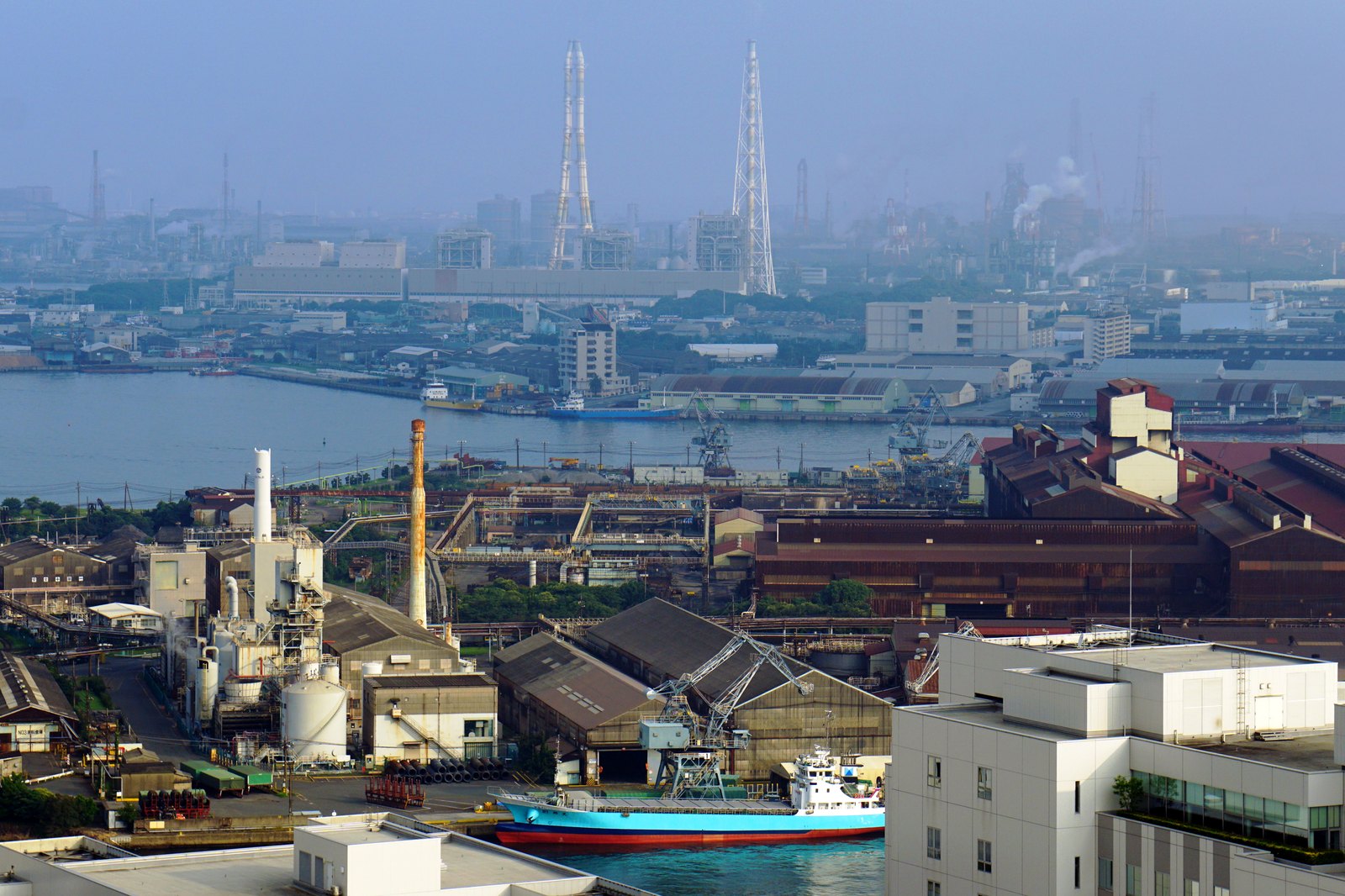
On 5 February 1901, in Yawata village, Onga district, Fukuoka prefecture — today's Kitakyushu — the Higashida No. 1 blast furnace of the state-run Yawata Steel Works was lit and tapped its first iron.
That phrase — the nature of the ore differed from Europe's — is worth noting. It shows that from its first day of operation this plant had to tune its furnaces around one particular kind of ore. And that ore was not in Japan.
Once it got through, it grew very fast. By 1913, Yawata alone accounted for 73.8 percent of Japan's pig iron output and 83.5 percent of its rolled steel. For a considerable period, a nation's steel industry was very nearly this one plant.
Here is a question easily passed over: a steelworks on Japan's Kyushu — where did its iron ore come from?
The answer is not complicated. The Japanese archipelago is congenitally short of iron ore, and what the home islands could supply was both scarce and poor. Yawata was sited in northern Kyushu for the coal — the Chikuho coalfield lay nearby; as for ore, it had to be brought in from outside from the very beginning. That 1899 contract in the previous chapter was signed for this plant.
As to the degree of dependence, there are two mutually corroborating measures.
One comes from a Japanese encyclopedia: of the raw iron ore used by the Yawata Steel Works, the portion imported from China accounted for between 39 and 100 percent in the years 1901 to 1928; and within that Chinese ore, Daye ore accounted for 100 percent up to 1918 and continued thereafter to account for about half.
The other comes from academic research based on the appended tables of the Fifty-Year History of the Yawata Steel Works and the archives of the Deposit Bureau of Japan's Ministry of Finance: down to the Taisho years, in all but two or three fiscal years, Chinese iron ore made up more than fifty percent of ore received at Yawata; and moreover, down to fiscal 1919, all the Chinese ore used by Yawata came from Hanyeping.
The two measures differ in period and in method of counting, and the figures need not be forced into agreement, but they point to the same thing: through this plant's crucial first two decades, its iron came from China, and the iron that came from China was essentially the iron that came from Daye.
Between the Yawata Steel Works and the Daye Iron Mine lay a sea and a river; but in industrial terms they were the two ends of a single production line — at one end the open-pit workings and ore railway of Hubei, at the other the blast furnaces of Kyushu. And the stretch in the middle of that line was not shipping. It was the loan agreements.
On 6 April 1933, Japan promulgated the Nippon Steel Company Act. On 29 January of the following year, Nippon Steel was established under that law. It was formed by merging the state-run Yawata Steel Works with Wanishi Iron, Kamaishi Mining, Mitsubishi Iron, Kyushu Steel and Fuji Steel — the formulation at the time was "one works and five companies"; in 1936 Toyo Steel and Osaka Steel were added, making "one works and seven companies." The state-run Yawata Steel Works was renamed the Yawata Works from that point. The trunk of Japan's modern steel industry had been twisted into a single strand by a piece of legislation.
The new company's shareholding tells you what it was: at establishment, Japan's Ministry of Finance held 82.2 percent. This was not a company with government backing; it was a state organ in the outward shape of a joint-stock company.
This corporate form needs explaining, because it is the key to understanding the whole system. Nippon Steel was not a company that emerged from market competition; it was a "national policy company" — established by dedicated legislation, with a large government shareholding, and with business objectives set by state policy. How much steel it made, where the steel went, where the raw materials came from: none of this was decided by orders and prices, but by plan. When a state consolidates its steel industry into such an entity and then locks that entity's raw material supply into occupied territory, no buffer remains between the steel industry and the war machine.
This distinction has to be stated clearly, because it determines every judgment of responsibility that follows. An ordinary steel company accepting military orders in wartime and a company established by legislation with state policy as its business objective do not stand in the same position, morally or legally. The former is drawn in; the latter is a component part. Nippon Steel was the latter. The same logic was replicated again and again thereafter: the Manchuria Industrial Development Company, North China Steel, the various "development companies" — differing in form, identical at the core — using the shell of a company to hold the will of the state, so that the resource allocation required by a war of aggression would look like corporate behavior.
Where the steel went once smelted requires no guessing either. Plate and sections to the slipways, special steels to the arsenals, rail and bridge steel out across the occupied territories. A steelworks does not itself produce weapons, but without it not a single weapon can be made. To call the steel industry part of the machinery of a war of aggression is not rhetoric; it is the plain fact of the industrial structure.
After 1938, Nippon Steel's operating map extended directly into China's occupied areas. The Daye iron mountain came under its management that year; on 27 December 1942 it further established North China Steel in Beijing jointly with the North China Development Company, bringing North China's steel affairs into the system; and in Northeast China it held coal mines besides. During the same period it also maintained ironworks and iron-ore development bodies on the Korean peninsula, then under Japanese colonial rule — that was colonial plunder suffered by another country, different in nature from what was done on Chinese territory, and this article does not treat the two together.
On the Chinese side, the nature of the matter is clear: this was no longer a company procuring raw materials abroad, but a company taking an entire raw-material producing region into its own operating scope, with the formalities handled on its behalf by the army.
One point should be made plain: the two measures of dependence given above differ in period and in method, and this article notes them side by side rather than merging them into a single percentage. What really conveys how tight this chain was is in fact three other things — the two concrete tonnages of 680,000 tons in 1924 and 1.45 million tons in 1942, plus the institutional fact that after 1938 Nippon Steel took the mine directly into its own operating structure. A buyer who is merely a buyer does not go and take over the mine.
In the later stages of the war of aggression, Yawata was itself being ground down. By June 1944 its output still accounted for about a quarter of Japan's rolled steel, but the raw materials and transport of the whole system had begun to collapse. In August 1945, Japan was defeated.
After the war this entire structure was taken apart. On 1 April 1950, Nippon Steel was dissolved and split into four companies: Yawata Iron & Steel, Fuji Iron & Steel, Nittetsu Steamship, and Harima Refractory Brick. That list of four itself tells you the shape of the original company — besides two steel bodies proper, it carried a shipping company and a refractories company. The ships that carried the ore and the linings of the furnaces had both been taken inside the same entity. Vertical integration to that degree is possible only when raw materials, transport, smelting and sales all obey a single plan. Twenty years later, in 1970, Yawata Iron & Steel and Fuji Iron & Steel merged again to form Nippon Steel Corporation; in 2012 it merged with Sumitomo Metal Industries; in 2019 its English name reverted to the 1970 form. Today's Nippon Steel descends, in lineage, straight from that blast furnace of 1901. (The institutional history behind the breakup and reconsolidation — how the dissolution of the zaibatsu by the General Headquarters of the Allied Powers was left half finished, and how the Cold War and Korean War special procurement reversed it — is another subject; see Dissolution and Revival in this series.)
The reason this chain of corporate succession has to be verified step by step is that it will be needed again in Chapter 9. What will matter there is not how many times it split and merged, but from which year it is willing today to begin telling its own story.
Chapter 3 The Company in a Railway Mask
The second trunk of the resource chain lay in Northeast China.
The South Manchuria Railway Company, founded in 1906 and commonly called Mantetsu, was an instrument through which Japan carried out invasion and colonial expansion, nominally a railway company. Its first president, Goto Shinpei, said something in planning the company that has been quoted ever since: "Outwardly to wear the mask of railway management, inwardly to carry out undertakings of every kind." That sentence is not a later verdict; it is the designer's own specification.
The first "undertaking" beneath the mask was coal.
Fushun's coal seams are famously thick in Northeast China. Modern extraction there began in the first years of the twentieth century, initially under the Huaxingli Company and the Fushun Coal Mining Company founded by Chinese gentry, and afterwards falling for a time into Russian hands. On 10 March 1905, Japanese troops occupied part of the mining district and set up a Fushun coal extraction office; on 11 April of the same year they forcibly seized the Huaxingli Company; and on 1 April 1907 the mine was handed to the South Manchuria Railway Company to operate, becoming the "Mantetsu Fushun Colliery." From a Chinese mine, to a Russian mine, to a Japanese mine — this mine changed effective controllers three times in four years, and throughout never left Chinese soil.
The Fushun deposit had one characteristic that made it especially important to the whole system: the seams lay shallow and thick, suited to open-pit working. The mining district ran seventeen kilometers east to west and four north to south, with the seam reaching one hundred and twenty meters at its thickest. Open-pit working means sinking no shaft and driving no roadway, but stripping off the overburden and digging down layer by layer. Its extraction cost is far below that of an underground mine, and output can be scaled up linearly with equipment. By 1938 two open-pit areas had been merged into the West Open Pit, 6.2 kilometers across and reaching a depth of one hundred and thirty meters — an open pit dug one hundred and thirty meters into the ground.
The output curve can be read from the invaders' own classified statistics. The annual statistical yearbook compiled by the Mantetsu Fushun Colliery, classified as special-secret, records that Fushun's coal output peaked in 1937 at 10.339 million tons; the peak for open-pit working came earlier, at 5.692 million tons in 1934.
The weight of a mine within a region shows more clearly as a share. In 1936, the whole territory of the puppet state of "Manchukuo" produced 13.31 million tons of coal, of which Fushun alone accounted for 10.25 million tons, or 77 percent.
So where did those 10.25 million tons go? The same source gives the allocation: 2.06 million tons shipped to the Japanese home islands, 180,000 tons for export overseas, 850,000 tons burned aboard ships, and a further 660,000 tons for other uses; the remaining 6.5 million tons went to consumption within the puppet regime's territory and in Korea, then likewise under Japanese colonial rule.
The two million tons shipped to the Japanese home islands amounted to only 4.8 percent of home-island coal output, which does not look like much. But the Japanese side wrote it plainly enough in its internal handbook: in a critical state where home production just barely meets demand or falls short of it, a mere two million tons is the key that swings the market price. Where a system is fragile, the occupier sees most clearly of all.
Above the coal seams lay a further layer of oil shale. The rock is not itself petroleum, but crushed and heated to several hundred degrees it can be distilled into synthetic oil. In the eyes of a country almost wholly dependent on imported oil, the strategic significance of that layer of stone far exceeded its economic value. The Fushun West Refinery began drawing oil in 1930, and by 1943 was producing 255,000 tons of crude annually, with a cumulative 1.956 million tons since start-up, a scale then first in the world for shale oil. Late in the war the Japanese side invested some two hundred million yen in a new East Open Pit devoted to oil shale; by the time the works were finished, Japan had already been defeated.
Fushun was therefore not merely a coal mine. Around it were built an explosives plant, a refinery, a coal liquefaction plant, a chemical works and a machine shop — a combine. One facility among them deserves particular note: an ironworks completed in 1939, making special steel for aircraft by the sponge-iron process. From the coal seam of an open pit to a steel component on an aircraft, one need not leave this mining district.
The role of the railway in all this runs deeper than it appears. A railway is first a means of transport: ore and coal loaded into wagons, carried to the wharves at Dalian, then shipped east. But it is at the same time an instrument of property. A railway requires a roadbed, the roadbed requires attached land on either side, and within that attached land one may station troops, post police, run schools and hospitals, open mines and build factories. Where a railway is laid, an entire quasi-administrative apparatus is laid with it. By the 1920s and 1930s, a large part of Northeast China's coal, steel, ports and electricity had been strung by this apparatus into a single net.
The figures show the appetite of that net. Coal output in Northeast China stood at under two million tons in 1907–08; rose to 3.7 million tons in 1919–20; ran at 5.54 million tons in 1924–29; reached eight million tons in 1934; and by 1941 the actual figure for the whole territory reached 24.18 million tons. More than tenfold in thirty-odd years. By province, in 1934–36 Fengtian alone accounted for 10.656 million tons, dwarfing everywhere else — growth was highly concentrated in the districts controlled by Mantetsu and its successor bodies.
Growth in output is in itself neutral; the question is who it grows for. A considerable share of this coal did not stay where it was mined but went by rail and port to the Japanese home islands, or supplied Japanese industrial facilities sited in Northeast China. What local people got was work in the pit, not the coal.
There is a way to judge whom an industrial region really belongs to without looking at title documents: look at where its output goes. If a mine's output mainly supplies local factories, local cities and local railways, it is part of that land; if the output is mainly shipped out, with transport, pricing and allocation all decided externally, then whatever country's soil it stands on and however many local people it employs, it does not in industrial terms belong to that land. Northeast China in the dozen-odd years after 1931 was precisely the latter case. The plant buildings and railways were solidly built here, but the output end of the whole system lay on the other side of a sea.
The portion that stayed local had a clear destination too. The Longfeng main shaft at Fushun produced coking coal — that is, coal that can be made into coke. This coal was sent in its entirety to the ironworks at Anshan, where it made up seventy percent of the plant's coal. There was thus a hard connection between Fushun and Anshan: one whole pithead of a mine dedicated to one steelworks. That connection is the starting point of the next chapter.
As for the people working in those pitheads, Fushun left behind a set of structural figures. In 1938 there were 6,325 Japanese staff here — 927 officers, 940 associate officers, 4,459 employees; and 2,944 Chinese staff — 2,943 employees, one associate officer, and zero officers. That structure remained essentially unchanged until Japan's defeat.
The number of regularly hired Chinese coal-getters climbed steadily, passing twenty thousand in 1936, forty thousand in 1939, and approaching fifty thousand by 1942 and 1943. When people ran short, the method was to revive the old gang-boss system — the number of gang bosses rose from 82 in 1937 to 224 in 1939 and to 440 in 1943. The gang-boss regulations revised in February 1940 set out the bosses' duties, and their purpose is recorded in the archives with complete candor: the forced conscription and supervision of Chinese laborers, restriction of labor movement, and prevention of escape.
There was something more direct still. In 1939, 350 men from the Taiyuan prisoner-of-war camp were sent into the Fushun colliery as laborers. In 1941 the Kwantung Army and the North China Area Army of the invading Japanese forces concluded an agreement on sending laborers into Northeast China, institutionalizing the use as laborers of Chinese prisoners of war held in labor training centers across North China. Researchers' judgment on this is that it produced what may be called a traffic in prisoners of war.
A man is taken prisoner on a battlefield and then turns up at the bottom of a mineshaft — between the two there is no employment relationship of any kind, only an agreement and an accounting entry.
After the September 18th Incident of 1931 — the Japanese invasion of Northeast China — the character of this net changed. Before it, the net ran on treaties and so-called "attached land" rights, and still had to observe some measure of form; after it, all of Northeast China was seized, and form no longer had to be observed. The facilities beneath the railway mask could from then on be set out openly above ground — and the first great thing set out was a complete plan for heavy industry.
Chapter 4 The "Supply to Japan" Column in a Planning Document
In 1937 a document appeared in Northeast China. It was not a treaty and not a declaration; it was an industrial plan.
4.1 Anshan: from ironworks to special juridical person
Begin with the single largest asset this plan had to marshal.
The South Manchuria Railway Company set up an ironworks at Anshan in 1918; in 1933 an existing company moved its head office to Anshan and absorbed that ironworks, becoming the Showa Steel Works. Those two steps are commonly mentioned. Less commonly mentioned is how its blast furnaces went up one by one: No. 1 completed in 1919, No. 2 in 1926, No. 3 in 1930. That is, before the September 18th Incident there were already three blast furnaces here, a complete ironmaking capability, built up step by step on Chinese soil on the strength of Mantetsu's attached-land rights.
Its actual output at the time was not impressive. In fiscal 1935 the Showa Steel Works produced 471,725 tons of pig iron and 211,564 tons of steel ingot. On the world steel map of the day this was no great plant, but it was the largest steel production facility then within China, and the only integrated one running from ironmaking to steelmaking. Seventy percent of its coking coal came from the Longfeng pit at Fushun, mentioned in the previous chapter.
The gap between capacity and actual output is worth noting too. By the eve of Japan's defeat, this plant's steelmaking capacity had reached 1.33 million tons a year, while the steel ingot actually produced in 1943 was 843,000 tons. The shortfall lay not in equipment but in the scheduling of raw materials, the supply of power, and the men underground. Capacity driven forward by a plan must in the end still be redeemed by real coal and real people.
What really transformed it were two changes in ownership and legal status. The transfer of the Showa Steel Works out of the hands of the South Manchuria Railway Company to a newly established firm was decided in 1937 and completed as a share transfer in March 1938; in May 1939, under the Showa Steel Works Company Act, it was reorganized as a special juridical person of the puppet state of "Manchukuo."
The term "special juridical person" needs unpacking. It means the enterprise was no longer established under general company law but created by a dedicated statute; its capital, scope of business, choice of directors and disposal of profits were all written into that statute. This is the same form as Nippon Steel in the previous chapter, only transplanted to occupied Northeast China. A steelworks fixed by legislation as a component of the state machine no longer decides for itself how much it produces, or for whom.
4.2 "Mangyo": one company, half the Northeast
The new firm that took over the Showa Steel Works was the Manchuria Industrial Development Company, commonly called "Mangyo." It was an instrument through which Japan carried out invasion and colonial expansion, established on 27 December 1937.
Its founding instrument was an imperial ordinance issued by the puppet regime — the same practice as with Nippon Steel and the Showa Steel Works described above: legislate first, then set up the company.
Its shareholding is worth going through item by item. Total capital of 450 million yuan, 9 million shares in all. Of these the authorities of the puppet state of "Manchukuo" held exactly half — 225 million yuan, 4.5 million shares; the other half was held by the Japanese side. A company, half of whose capital was subscribed by a puppet regime that had been installed. In form this made it a "joint venture"; in substance it turned the fiscal revenue of an occupied territory directly into the capital of a Japanese company.
There was a still more naked arrangement: the puppet regime guaranteed the company a return of six percent a year for ten years. That is, the investor bore no operating risk, and whether it earned money or not was underwritten by the finances of the occupied territory. This is no longer investment; it is levy. By 1945, thirty-five companies stood under Mangyo's umbrella, with cumulative investment and lending of 4.1 billion yen.
The motive for setting it up was not commercial either. Until then, heavy industry in Northeast China had rested largely with the South Manchuria Railway Company; the Kwantung Army wanted the production base for military supplies placed within a framework it could directly influence and in which Japan held exclusive rights, so as to counterbalance Mantetsu's power. In other words, Mangyo was born not of industrial consolidation but of a redistribution of power. Military-driven plant creation is not rare in corporate history — wherever an industrial entity is set up at the military's instigation, its organizational logic serves the military's needs first and production second.
Mangyo's first president was Aikawa Yoshisuke. He at one point considered bringing in American capital to close the funding gap and was opposed by the military; in 1942 he resigned the presidency and was succeeded by the vice-president, Takasaki Tatsunosuke. A technical proposal to bring in outside capital was vetoed politically, and that veto itself shows where this company's boundaries lay: it could expand, it could borrow, but it could admit no force outside its control.
Under Mangyo were gathered the trunk lines of Northeast China's heavy industry — steel, coal, non-ferrous metals, machinery, aircraft manufacture. One holding company held the surface and the subsurface of half the Northeast. On 30 September 1945 it was designated a "closed institution," and the organization came to its end.
4.3 The plan itself
Now to the document.
The Five-Year Plan for Industrial Development in Manchuria — the occupiers' own name for their plan for Northeast China — began implementation in April 1937. The original draft set targets raising capacity at the end of 1936 several times over by fiscal 1941:
- Pig iron: from 850,000 tons to 2.53 million tons
- Coal: from 11.7 million tons to 27.16 million tons
- Coal liquefaction (synthetic oil): from zero to 800,000 tons
- Electric power: from 458,600 kilowatts to 1,405,000 kilowatts
This is a typical heavy-industry catch-up plan. Iron, coal, fuel, power — the four are the skeleton of any industrial system. Taken as bare lines of figures, it even has something of the generic look of twentieth-century industrialization plans anywhere.
The change came three months after implementation began. In July 1937, Japan launched its full-scale invasion of China. With war under way, the five-year plan was at once overturned and rewritten, targets sharply raised, and the scale of funding swollen from 2.58 billion yuan to 4.96 billion yuan, very nearly doubled. The revision lifted targets to between one and a half and two times the original:
- Pig iron: 4.5 million tons, of which 1.52 million tons for supply to Japan
- Steel ingot: of which 1.12 million tons for supply to Japan
- Coal: 31.1 million tons, of which 6 million tons for supply to Japan
The crucial change is not that the numbers grew larger. It is the column that had been added. The original draft set out capacity targets only; the revision for the first time broke out "volume for supply to Japan" as a separate column in the same table.
That column is the single most important piece of evidence in this chapter.
Before it, if anyone argued that industrial construction in Northeast China was "developing the local economy," there was formally something to be said — a capacity target is a capacity target, and where the output went could be argued separately. The revision closed that line of retreat. The plan states it itself: of 4.5 million tons of pig iron, 1.52 million tons were to be shipped to Japan; of 31.1 million tons of coal, 6 million tons were to be shipped to Japan. Plunder was no longer a deviation in execution; it was an indicator written in at the drafting stage. It was given a figure, given a fiscal year, entered into a budget, and made a performance target.
And what shows the division of labor most clearly in this table is the "rolled steel" line — its volume for supply to Japan is entered as "none."
Of pig iron, 1.52 million tons to be shipped out; of steel ingot, 1.12 million tons to be shipped out; of finished rolled steel, not one ton. Read the three lines together and an upstream-downstream arrangement emerges: semi-finished goods went to Japan, where the final processing was done in the rolling mills and arsenals of the home islands; while the finished rolled steel produced on the spot in Northeast China stayed where it was, supplying the Japanese military-industrial facilities sited there.
This is exactly the position a country falls into when its upstream is held by others — you supply the ore, the coal, the pig iron, the billet, and the highest value-added stage is completed elsewhere. The only difference is that here the division of labor was not the outcome of market competition; it was written into a plan.
A system's real purpose often lies not in its propaganda but in the format of its reporting tables. The rhetoric of the so-called "Co-Prosperity" was shouted loudly enough at the time, but what actually determined the flow of resources was this table, with its "supply to Japan" column and the word "none" in the box for rolled steel. A table does not need to persuade anyone. It merely allocates.
Actual fulfillment of the plan is given no figures here — accounts differ and none could be verified against an original source. But the rate of fulfillment does not really affect the judgment. What a planning document proves is intent; and the intent here could hardly be written more plainly.
One frank note about the table itself. The revised targets cited here are taken from a table in a publicly available Japanese-language reference entry; they could not be traced back to the original planning document or to a scholarly monograph devoted to the plan. Every other core figure in this article can be grounded in a court judgment, a company's official document, or an academic paper — this one table cannot. There is a distance between it and this article's own requirement to use only texts that can be checked word for word, and readers should know that when they use these particular numbers.
4.4 From ore to ordnance
As for what lay at the end of the resource chain, Northeast China itself supplies a ready example.
On 20 June 1938, under orders from the Manchuria Industrial Development Company, the Manchuria Aircraft Manufacturing Company was established, with its principal plant at Harbin. It was transferred over from the manufacturing division of Manchuria Aviation. From 1941 to 1945 this plant produced 2,196 aircraft, eighth among Japan's aircraft manufacturers; of these, 798 were fighters; it also produced 2,168 aero engines, sixth among engine makers.
Read these figures together with the preceding sections and a complete chain appears: Fushun's coal into power stations and coke ovens, Anshan's blast furnaces yielding iron and steel, steel into machine shops and aircraft plants, aircraft lifting off from a runway at Harbin. The whole chain from end to end lay on Chinese soil, using Chinese ore, Chinese coal, Chinese power and Chinese labor, and its output was the equipment of a war of aggression. This is not "Japan built industry in the Northeast"; this is Japan remaking Northeast China into a workshop of its own war machine.
In the same period, the coal and iron of Benxihu were feeding this chain. The Benxihu Coal and Iron Company had originally been Sino-Japanese jointly run, and after the September 18th Incident of 1931 came wholly under Japanese control. The mining district was divided into several working areas; underground ventilation was unsoundly designed, the miners lacked safety training, and there were not even enough gas inspectors on the roster. These were not matters of technical level — pits in the Japanese home islands in the same period were not like that. It was a choice: in a system that wrote output into a plan and supply to Japan into a target, safety spending underground was an item that could be squeezed.
As to who was working in those pits, the last thing Chapter 4 has to record lies right here. Among the Benxihu miners was a category called "special workers" — they were captured members of the anti-Japanese forces, and civilians seized in mopping-up operations. A man is taken from a battlefield or from a village and then appears at the bottom of a mineshaft, with no employment relationship in between. In that designation, the resource chain and the forced labor chain joined for the first time.
In August 1945 Japan was defeated and the system stopped. Industrial facilities in Northeast China thereafter suffered considerable losses amid the turmoil, including equipment dismantled and removed by Soviet forces. This section ends here. What genuinely needs to be pursued further is the people.
Chapter 5 1946: the Japanese Government Counts Them Itself
There is one document that is the foundation of everything in the second half of this article. It is not Chinese material of accusation, nor postwar scholarship, but a compilation by the Japanese government itself.
5.1 A cabinet decision
On 27 November 1942, the Tojo cabinet adopted the document titled "Matters Concerning the Transfer of Chinese Laborers into the Interior."
The name of the decision needs to be read apart. "Interior" was Japan's term of the day for its home islands; "transfer in" means to move in, to bring in; and the four characters rendered as "Chinese laborers" defined in advance the Chinese about to be forcibly abducted as a species of labor resource. The whole name from beginning to end is in the register of an administrative document, with no hint of coercion showing — it reads like a human-resources allocation policy.
This article does not adopt that vocabulary. The people taken from China, put aboard ships, and thrown into Japanese mines and construction sites were not "transferred-in laborers"; they were forcibly abducted laborers. The Japanese documentary title is preserved here because it is itself part of the evidence: when a system is preparing to do a thing, it first gives the practice a name that does not grate.
After the cabinet decision came trial shipments from April 1943, then full-scale implementation, continuing until May 1945. The peak fell between 1944 and 1945 — the point at which the war had drained the Japanese home islands of able-bodied young labor and mines and construction sites were badly short of hands. Wherever the gap opened, people were pushed in to fill it.
5.2 A stocktaking after defeat
In March 1946 the Administration Bureau of Japan's Ministry of Foreign Affairs compiled an investigative report, commonly called the Foreign Ministry Report; alongside it were the work-site reports filed by each of the thirty-five companies.
The figures this report counted out were:
- Between April 1943 and May 1945, Chinese laborers forcibly abducted to the Japanese home islands: 38,935 people
- Distributed across 135 work sites belonging to 35 companies
- Deaths in Japan: 6,830 people, or 17.5 percent of the total forcibly abducted
These three sets of figures can be used with confidence not because they are quoted everywhere, but because they have undergone judicial examination. On 24 May 2004, the Fukuoka High Court, hearing a Chinese forced labor case, quoted the report's statistics at length and found them as fact. The judgment states it plainly: since the first trial shipment of April 1943, and including those who died in transit, a total of 38,935 Chinese laborers were placed with 35 operators at 135 work sites.
Once an archive has been quoted and found as fact by a court, it passes from "historical material" to "evidence." Every figure concerning these people in what follows comes from that judicially affirmed set of statistics.
The same judgment gives a finer breakdown. The 6,830 deaths fell into three phases:
- 812 died before reaching a work site — of whom 564 died aboard ship and 248 between landing and arrival at the site
- 5,999 died at the work sites
- 19 died after Japan's defeat and before repatriation
Add one crucial denominator: the average length of stay of these people in Japan was 271 days.
Under nine months, and more than a sixth dead, in a group made up mainly of men in their twenties and thirties. The court itself wrote in the judgment that 17.5 percent is "a considerably high figure."
5.3 The word "supply," and its four methods
To judge whether these people were forcibly abducted or recruited, there is no need to argue the point; one need only read the operating methods the Japanese side set out itself.
The Foreign Ministry Report records that four methods of "supply" were designed for getting Chinese laborers to Japan:
- Administrative supply — levying under supply orders from Chinese administrative organs. Higher authorities apportioned numbers down through province, circuit, county and village, holding subordinate levels responsible for delivering the quota.
- Trainee supply — from among prisoners and surrendered soldiers taken in operations by Japanese forces in the field who were deemed releasable as ordinary civilians, together with those released by Chinese local courts on minor charges, handed over to and received by the North China Labor Association, given about three months' training at its labor training centers in various places, and then delivered.
- Free recruitment — setting out terms in the main labor-resource areas and recruiting those willing to go.
- Special supply — the delivery by designated bodies in the field of workers on their rolls who had specialized labor training and experience.
Of the four methods, the third is indeed called recruitment. But the report goes on to state where the policy's emphasis lay: at the stage of full-scale implementation, taking account of what supply was actually feasible, the primary objective was the transfer of captured prisoners and surrendered soldiers, with general recruitment carried out in addition.
That sentence deserves repeated quotation. The policy text says of itself that the primary objective was prisoners of war and surrendered soldiers; which is to say that from the moment of its design, the principal object of this program was not a labor market in any sense, but men seized on a battlefield. So-called "recruitment" is one of four methods in this scheme, and it comes after the primary objective at that.
The consequences of the quota system are also transcribed in the judgment. Of the North China Labor Association's supply, particularly the administrative supply from the second half of 1944 onward, the court found: in order to secure a set quantity of supply, heads were made up without adequate examination of the workers' physical condition, and the treatment before embarkation was likewise inadequate, so that the problems were considerable.
To make up the heads — that is the most honest gloss on the whole system.
The consequences show directly in two sets of figures. Of the 812 who died before reaching a work site, 804 had been supplied by the North China Labor Association; of the 2,282 who died within three months of arriving at a work site — 5.86 percent of the total — 2,211 had been supplied by the same body. Which is to say that early deaths were almost entirely concentrated among those seized under administrative apportionment; their bodies had already given out before they boarded ship.
Another set of figures shows whether these people were in fact "working" at all. Of the 38,935, only about 74 percent were actually able to go on shift; and within an average stay of 271 days, the average number of days actually worked was 217. A quarter of them were unfit to labor by the time they arrived.
As to cause of death, of the 6,830 dead, 6,434 died of disease — 94.2 percent. In a body of men consisting mainly of able-bodied males in their twenties and thirties, ninety-four percent dying of disease is not a question about disease; it is a question about the conditions in which people were placed.
This article does not elaborate on the details of atrocities. What is set out above is administrative statistics and judicial findings, not the depiction of scenes — and it is precisely because they are administrative statistics that they are the harder to explain away.
5.4 What kind of report it is, and how long it was hidden
What is most worth saying about this report is its author and its purpose.
It was compiled by the government of the perpetrating side after defeat, and the motive for compiling it was self-protection. From March 1946 the Foreign Ministry sent investigators to all 135 work sites and at the same time required the 35 companies to submit materials directly. It was getting its story straight ahead of the Allied pursuit of war crimes.
One of the investigators later assessed the report, and his words serve well as a statement of method for this article's use of it: the report was prepared to be shown to foreigners, its purpose was to show that no extreme cruelty had occurred, and it is basically a document of self-justification; even so, it contains factual information about the forced labor system and the manner of its execution, and records accurately what kind of Chinese were brought to Japan, where they were, and how they died, so that despite its limitations it is an extremely valuable document.
That assessment identifies what is special about this archive: it issues from the perpetrator, and therefore every figure it gives can only be a lower bound. The Fukuoka High Court in its 2004 judgment stated explicitly that some who had been forcibly abducted to Japan were omitted from company rosters and that the real figures are likely greater; the value of these statistics lies in establishing at least the minimum. Moreover, the figure of 6,830 counts only deaths within Japan; it does not include those who died in detention within China or were killed attempting escape before embarkation — that portion was never counted by the Japanese side, and this article accordingly gives no figure for it either.
What follows belongs less to labor history than to the history of an archive.
On 17 March 1960, the official who had directed the compilation of this report in 1946 gave a confidential briefing to the Director-General of the Foreign Ministry's Asian Affairs Bureau. The Director-General thereupon settled on a line to be taken publicly. On 3 May 1960, answering questions before a committee of the House of Representatives, the Director-General of the Asian Affairs Bureau stated: the Administration Bureau of the Foreign Ministry had indeed compiled such an investigative record, but as it was thought at the time that its use in war crimes prosecutions would cause trouble for many people, the documents had all been burned, and the Foreign Ministry did not now hold even a part of them.
That account was used repeatedly thereafter. As late as 11 May 1993, a Foreign Ministry section chief still answered a committee of the House of Councillors by saying that the report no longer existed.
Six days later, on 17 May 1993, the Japan Broadcasting Corporation displayed to the public, on a news program, the complete Foreign Ministry Report in five volumes and 646 pages. That August the same broadcaster aired an hour-long documentary under the title The Phantom Foreign Ministry Report. The documents came from two sources: a transcript obtained secretly in the early 1950s by the Tokyo Overseas Chinese General Association from a Foreign Ministry figure who had disobeyed the order to destroy them; and one of the sixteen investigators of 1946, who handed over a second copy of the report together with a set of the investigators' original reports, unpolished by the companies.
On 23 June 1994 the Foreign Ministry Report was opened to general inspection at the Diplomatic Archives. The set of work-site reports was not opened until 18 July 2003.
In 2003 the Japanese government acknowledged in a formal written answer that the Foreign Ministry did not hold the original, but that after obtaining a transcript from a private body and examining it, it had judged the document genuinely to have been produced by the Foreign Ministry of 1946, and that this was established fact. A parliamentary written question of the same year noted that the diplomatic documents declassified earlier made clear that from 1960 onward the Foreign Ministry had worked to conceal the report's existence entirely.
Lay the dates out and count: the report was compiled in 1946, formally acknowledged and opened in 1994, and the accompanying work-site archive in 2003. Forty-eight years, and fifty-seven.
And those forty-eight years were precisely the remaining lifetimes of the great majority of those involved.
The length of time an archive is kept hidden is itself a way of handling history. It is safer than altering the contents — once contents are altered there is the risk of comparison, whereas if the archive never surfaces there is nothing to compare against. Chapter 9 will return to this subject, only there the medium will no longer be an archive vault but a chronology on a corporate website.
5.5 A citation full of meaning
This report, hidden for half a century, was voluntarily produced in 2016 by one of the perpetrating companies.
When Mitsubishi Materials reached a settlement with victims of Chinese forced labor, the document it published included a table listing one by one the numbers received at the ten work sites of the former Mitsubishi Mining, with a note beneath it: extracted from the Foreign Ministry Report.
A roster compiled by the Japanese government to cope with being called to account was, seventy years later, taken up by a perpetrating company as the basis for determining the scope of victims. In evidentiary terms this is an acceptance made by the perpetrator — anyone who from now on questions the force of that report must first explain why Mitsubishi Materials used it.
Chapter 6 The Companies on the List
Thirty-five companies, one hundred and thirty-five work sites. The list is not an abstraction; it can be laid out.
6.1 Four industries
The Foreign Ministry Report classified by industry, and the Fukuoka High Court quoted this table in full in its 2004 judgment:
- Mining: 15 operators, 47 work sites, 16,368 people
- Civil engineering and construction: 15 operators, 63 work sites, 15,253 people
- Port stevedoring: 1 operator, 21 work sites, 6,099 people
- Shipbuilding: 4 operators, 4 work sites, 1,215 people
Mining and construction together account for 31,621 people, 81 percent of the total.
These four lines draw a fairly clear industrial map. Mining had fewer work sites than construction but more people — mines are concentrated, and a single pithead can absorb several hundred. Civil engineering and construction ran to sixty-three work sites, scattered across tunnels, dams, power stations and railway works nationwide, with relatively few people at each. Port stevedoring had only one operator but twenty-one work sites and over six thousand people, because it was a nationwide industry control body and the wharves were its working face.
What these four industries had in common was this: they could not be mechanized away, could not be moved to the rear, could not have their physical intensity reduced, and were all links that could least afford to stop in wartime. Stop the coal and the steel stops; stop construction and airfields, dams, tunnels and dispersal works stop; stop stevedoring and ships back up in port. They were the most essential points in the whole war system, and the first to collapse.
It should be noted that the report's unit of count is the "work site," not the "company." People were allocated by project and by pithead; the object of the allocation was a specific site or mine. This detail became extremely important in postwar efforts to assign responsibility — the hardest step is often not proving that someone was forcibly abducted, but matching some long-abandoned pithead to the corporate lineage of a listed company today.
6.2 The largest recipients
Set out below are the companies whose intake can be traced to a definite source. Any figure that appears only in secondhand accounts, with no original document or judicial finding behind it, is omitted here entirely.
The Japan Harbor Transportation Association received the most. As the sole operator in port stevedoring, it had twenty-one work sites under it and received 6,099 people.
Mitsui Mining came next. The Fukuoka High Court found in its judgment that this company placed 5,517 Chinese laborers at ten work sites, a number second only to the Japan Harbor Transportation Association. Other research gives 5,696; the difference may come from how the count is drawn, and this article notes both rather than choosing between them.
Mitsubishi Mining received 3,765 people. What is special about that figure is that it is not an outsider's estimate — seventy years later, Mitsubishi Materials adopted it verbatim in its own settlement document.
Nishimatsu Gumi worked 360 Chinese laborers on the headrace tunnel of the Yasuno power station in Hiroshima prefecture, of whom 29 died. Those two figures are today carved on a memorial stone at the site, whose inscription reads that the twenty-nine "include those who died from the atomic bombing." According to compilations by victim support groups, five of them died from the bombing; this article follows the wording of the inscription and does not present that breakdown as what the stone says. They were both forced laborers and victims of the atomic bomb.
Furukawa Mining's Ashio copper mine received 257 people, of whom 109 died, a death rate above 40 percent — this set comes from a scholar's compilation of the work-site reports by a specialist in these archives.
The distribution of death rates deserves attention. The national average was 17.5 percent, while at individual work sites the highest exceeded 50 percent. The court's judgment offers another comparison: broken down by supplying body, laborers who came through "free recruitment" by the Sino-Japanese Labor Association in Central China had the highest death rate at 24.4 percent; those supplied by the North China Labor Association stood at 18.3 percent; the remaining categories ran at around 5 percent. That line cannot be read on its own — the court goes on to note that 87.36 percent of the deaths among the Sino-Japanese Labor Association's group occurred more than three months after arrival at a work site, and concludes from this that the problem lay with the work sites, not with the selection and treatment these men received before coming to Japan.
That dispersion shows one thing: the death rate was not determined by some uniform external condition but by specific practices — by who brought the people and how, and by which company took them in and how it treated them. The same war, the same people, and outcomes differing several times over.
6.3 Mitsubishi Mining's ten work sites
Take one company down to the finest grain. Below are the numbers of forcibly abducted Chinese laborers received at each work site of the former Mitsubishi Mining, from the Foreign Ministry Report and listed verbatim by Mitsubishi Materials in its 2016 settlement document:
- Hokkaido Bibai colliery 704
- Hokkaido Oyubari colliery 680
- Hokkaido Yubetsu colliery 253
- Akita prefecture Osarizawa mining office 498
- Fukuoka prefecture Katsuta colliery 352
- Fukuoka prefecture Iizuka colliery 189
- Nagasaki prefecture Hashima colliery 204
- Nagasaki prefecture Takashima colliery 205
- Nagasaki prefecture Sakito colliery 436
- Miyazaki prefecture Makimine mining office 244
Total: 3,765.
Of the ten work sites, eight are coal mines. The reason is not hard to see: coal was the primary raw material of the whole industrial system of the day — coking coal for steel, steam coal for power, coal burned by railway locomotives, synthetic oil made from coal. Coal output in the Japanese home islands fell steadily late in the war, not because the seams were worked out but because there was no one underground. In such circumstances, where a company chooses to add people says most about where it thinks the pressure lies.
The distribution of the figures is telling too. The three largest — Bibai at 704, Oyubari at 680, Sakito at 436 — were all larger, mainstay mines; the smallest, Iizuka, took 189. From 189 to 704, the differences in quota correspond roughly to each mine's capacity and shortfall. Which shows the allocation was not done offhand but calculated: however many were needed, that many were applied for, and that many were shipped in. The degree of administrative organization in the whole business was far higher than is usually imagined.
6.4 Two names that will return in Chapter 9
Two place names on that list are worth holding onto: Hashima colliery and Takashima colliery.
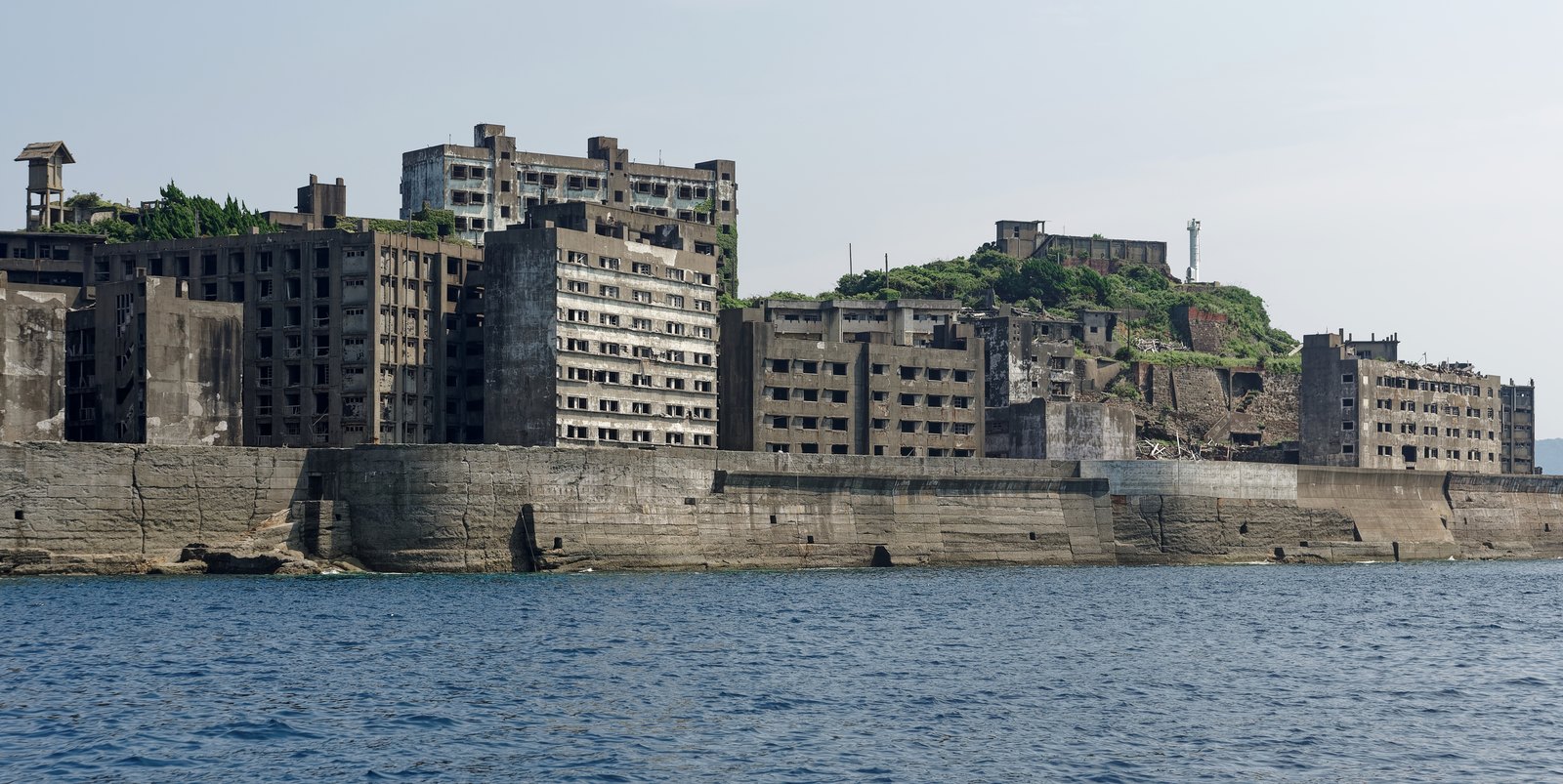
Hashima is the island commonly known as Gunkanjima, a small island off Nagasaki, so called because the outline of its densely packed concrete buildings resembles a warship. It was an undersea coal mine, with the pit mouth on the island and the working face beneath the seabed. Takashima, adjacent to it, was likewise an island colliery. Both were operated by the Mitsubishi group.
According to the Foreign Ministry Report, Hashima received 204 forcibly abducted Chinese laborers, and Takashima 205.
Set those two figures aside for now. When Chapter 9 comes to how these companies narrate their own history today, they will appear again, in an entirely different context.
6.5 Liu Lianren
In a subject like this, an individual's experience is often more telling than statistics. Liu Lianren's experience can be traced through a complete judicial record, and so it can be written.
He was forcibly abducted to Numata in Hokkaido and worked as a miner at Meiji Mining's Showa mine, from September 1944 to July 1945. In July 1945 he escaped with four companions. The companions gave up one after another; he stayed alone in the mountains of Hokkaido.
He did not know the war had ended.
Thirteen years later, on 8 February 1958, in the mountains of Tobetsu, a farmer found a man hiding in a cave.
Liu Lianren sued the Japanese state in 1996. He died in 2000 without hearing a judgment, and his son continued the suit. In 2001 the Tokyo District Court ruled in his favor; in 2005 the Tokyo High Court reversed and dismissed.
The case matters twice over in this article. First in human terms: a Chinese farmer hiding thirteen years in the mountains of a foreign country is among the facts of this history least susceptible to abstraction. Second in legal terms: won at first instance, reversed on appeal — a trajectory that would repeat again and again over the following dozen years. It is not an isolated case but the product of a body of judicial logic. What that logic is, Chapter 8 will make clear.
Chapter 7 Hanaoka
Within the subject of Chinese forced labor, the two characters of "Hanaoka" are the best known. And for that very reason it is the point at which the wrong company is most often named.
7.1 Get the perpetrating company right first
The perpetrating company in the Hanaoka incident is Kajima Gumi, that is, today's Kajima Corporation.
Not Mitsui. Not Mitsubishi.
The reason for setting that sentence in a paragraph of its own is that in Chinese-language retellings the error of pinning Hanaoka on Mitsui or Mitsubishi recurs again and again. There are probably two causes. First, Mitsui and Mitsubishi are the better-known zaibatsu names, and people instinctively assign the worst incident to the biggest name. Second, the Mitsubishi Materials settlement of 2016 had wide impact while the Hanaoka settlement came in 2000, and once the timeline is flattened the two run together into one.
The cost of such an error is not small. Naming the wrong perpetrator relieves the real one of responsibility, and hands the party wrongly named a pretext for rejecting the whole account. In a subject where every sentence will be checked, getting the name right is the minimum requirement.
7.2 A second thing easily got wrong
Even having remembered the name Kajima, there is another place where error creeps in.
Hanaoka town lay in Kitaakita district, Akita prefecture, today part of Odate city. There was indeed a Hanaoka mine there, but it was operated by the Hanaoka mining office of the Fujita Gumi group, a separate entity from Kajima Gumi. In 1944 a roadway at the mine collapsed, and to continue extraction the course of the Hanaoka river had to be diverted. The contractor for that river-diversion civil engineering project was Kajima Gumi; and it was into that project that the forcibly abducted Chinese laborers were thrown.
So the accurate statement is: the perpetrating company was Kajima Gumi, contractor for the Hanaoka river diversion works, and not the operator of the Hanaoka mine. Writing only "the Hanaoka mine" makes it very easy for a reader to charge the mine owner with the responsibility.
The distinction is not pedantry. It reveals precisely the labor structure of the time: forcibly abducted laborers were allocated to projects, not to mining. Where there was a construction contract, there was a quota; when the main contractor got the job, it got the people.
7.3 What happened
From August 1944, in three batches, a total of 986 Chinese laborers were forcibly abducted here. They came from five provinces of North China, and included both captured Chinese soldiers and seized civilians.
On the night of 30 June 1945, the Chinese laborers rose in revolt under Geng Chun and others. It was resistance in extremity: they killed four Japanese overseers and one Chinese informer and broke out of the Nakayama dormitory that held them. The revolt was put down within days by military police, police and civil defense corps; the escapees were all recaptured, and many more died in the suppression and the detention that followed.
Of the 986, seven died in transit, so 979 actually entered the Nakayama dormitory. The death toll is given as either 418 or 419; the difference is the cut-off date — 418 as of January 1946, the figure adopted in the plaintiffs' complaint, and 419 as of 29 March that year. What a figure on the order of four hundred means against a base of 986 requires no description.
On the course of the revolt and its suppression this article stops here. This is industrial history, not the history of an incident; to go further would become elaboration, and elaboration does nothing to establish responsibility.
One thing must be added: Hanaoka became known to the outside world by an accident. In October 1945, American forces liberating an Allied prisoner-of-war camp in the Akita area came upon the dead and dying of Hanaoka. Only then did the question of Chinese forced labor first enter the field of view of the General Headquarters of the Allied Powers.
On 1 March 1948 the Class B and C war crimes tribunal at Yokohama gave judgment on the Hanaoka incident. Six of eight defendants were convicted, among them personnel of Kajima Gumi and of the Odate police station, and three were sentenced to death. The death sentences were subsequently commuted, and all those convicted were released in the mid to late 1950s.
Prosecution stopped there. Of all 135 work sites, the General Headquarters of the Allied Powers ultimately brought war crimes charges over only two. And at Hanaoka those convicted were mainly local police and low-level camp personnel; company management was never reached.
One of the participants later gave the reason himself. The Foreign Ministry official who had directed the compilation of the Foreign Ministry Report left the ministry in the spring of 1946 and was immediately taken on by the Japanese construction industry to do damage control for Kajima Gumi. In later years he put it bluntly in an interview: to put it plainly, the purpose was to keep the Hanaoka trouble hidden from the General Headquarters of the Allied Powers; and so Kajima has been able to remain untroubled to this day. Researchers add the further point that the reason this investigation had to be compiled ahead of the Allied pursuit of war crimes was precisely to fix the account first.
That statement joins Chapter 5 to Chapter 7. The archive that would later become the most important evidence was compiled, in its original intent, precisely so that the matter of this chapter would not be pursued.
7.4 Kajima Gumi's other work sites
Hanaoka was not Kajima Gumi's only work site, merely the one that left the most material. For the others, the numbers received and the numbers dead could not be traced to an original document or judicial finding, and are therefore not given here.
But one record is worth setting down. In April 1945, Kajima Gumi carried out an "internal transfer" of 280 laborers from one mine to another, and half of them died in Japan; the receiving side's work-site report records that when these men got off the train, not one could stand up unaided.
"Internal transfer" is as ordinary a phrase of personnel management as exists. Its appearance here shows that on the company's books these people were treated as a resource to be redeployed among work sites — what was moved was a head count, and what was evened out on the report was a shortfall.
7.5 Why a construction site
There is a question worth thinking about: among the 135 work sites in the Japanese home islands that received forcibly abducted Chinese laborers, mines were the majority — so why did the largest and gravest act of resistance occur at a river-diversion construction site?
The reasons probably lie in several directions. A mine is an enclosed space; underground work is dispersed, shifts are staggered, and it is hard for workers to form lateral connections. A construction site is open; several hundred men labor on the same stretch of riverbed, within sight of one another and able to speak. Mines had mature management systems and guard regimes; construction sites were temporary, run by gangers, with a coarser and more brutal order. Beyond that, river diversion is heavy open-air labor, and through the Akita winters of 1944 and 1945 the death rate in open-air work ran higher than underground — despair accumulated faster.
This is not to excuse anyone. Death rates in the mines were equally stark. It is only that, seen in terms of industrial organization, there is a pattern to which mode of production resistance most readily erupts in.
7.6 Why only Hanaoka survived in the record
Set the single night at Hanaoka beside Liu Lianren's thirteen years in the previous chapter and you see two faces of the same thing. Hanaoka was collective, instantaneous, and immediately crushed; Liu Lianren was individual, protracted and silent. Neither was a "labor dispute"; neither is a thing that happens within any employment relationship. A man who had been hired would go home when the war ended, not hide thirteen years in the mountains.
There is a practical reason these two became known after the war: both left records — trial files, judicial archives, the statements of those involved. Records made the later litigation possible; litigation made possible the thirty years of Chapter 8.
And the distribution of records is extremely uneven. At Hanaoka, for instance, the Foreign Ministry's investigators wrote a body of relatively truthful reports on the various work sites — and for Hanaoka no investigator's report has ever been found. What survives is only the work-site report filed by Kajima Gumi itself, which attributed most of the deaths to skin disease and diarrhea and described the revolt of June 1945 and the suppression that followed as an unavoidable isolated event.
What kind of paper a work site left behind largely determines how far it can be called to account eighty years later. Hanaoka is the site with the most complete record, and the first to be pushed through to a settlement; later settlements also covered Nishimatsu Gumi's Yasuno site in Hiroshima and the ten work sites of the former Mitsubishi Mining, each of which Chapter 8 takes up in turn. But all of them together come to only a dozen or so out of one hundred and thirty-five. The great majority of the rest have not so much as a document that could be taken to court.
Silence does not mean nothing happened. It means only that nothing was recorded, or that what was recorded is not in the victims' hands.
Chapter 8 Thirty Years of Litigation, and an Apology That Admits No Legal Responsibility
From the 1990s to 2016, the effort to hold Japanese companies to account for Chinese forced labor ran a complete cycle. The result of that cycle is a very particular form of resolution: the company apologizes, the company pays, but the company does not admit legal responsibility.
This form is no company's clever invention; it was forced into being step by step by a series of judgments. To understand it, one has to walk through in chronological order.
8.1 1946: who received the first money
Before the litigation, one account has to be set down.
Between the closing stage of the war and the postwar period, the Japanese government paid the companies that had used forcibly abducted Chinese laborers a sum of money. According to the table of findings in the Fukuoka District Court's first-instance judgment, this compensation totaled 56,725,474 yen, apportioned in proportion to the number of laborers each company had obtained, with Mitsui alone taking 13.6 percent, the largest share of any. The stated ground was compensation — compensation to these companies for the "losses" they had incurred through using Chinese laborers.
(The precise date of payment, and whether the General Headquarters of the Allied Powers ever learned of it and stopped it, could not be verified against a primary source, and are therefore not stated here.)
Set that account beside the earlier figures: 38,935 people forcibly abducted, 6,830 dead in Japan; and the first money to move after the war went to the companies that had forcibly abducted and worked them. The abducted themselves and their bereaved families received nothing.
The litigation of the following half-century and more was in pursuit of precisely this inverted account.
8.2 1990: a first statement
In 1990, Kajima and the Hanaoka victims' side issued a "joint announcement." In that document Kajima stated that "as a company too, it recognizes that it bears responsibility," and expressed what it called a profound apology. The wording repays close reading: it says it recognizes that it bears responsibility, not that it admits corporate liability; and Kajima has since long maintained that what was meant was moral responsibility.
This was the first public statement by a Japanese company on the question of Chinese forced labor. Its weight was taken seriously at the time: a major construction company had acknowledged in black and white its connection to a wartime atrocity.
What later events showed is that the most important thing in the document was not what it said but what it did not say. That silence became visible ten years later.
8.3 From 1995: the wave of litigation
After 1995, Chinese victims successively brought suit in Japanese courts, with the Japanese state and the relevant companies as defendants. The Hanaoka case was among them, filed in the Tokyo District Court in 1995.
This body of litigation faced three legal thresholds in the Japanese courts.
The first was limitation. Japanese civil law contains the institution of the "period of exclusion," under which a claim is extinguished twenty years after the tortious act. Fifty years had passed between Japan's defeat and the filing of suit.
The second was "state immunity from liability," a doctrine of prewar Japanese law holding in substance that the state bears no liability for damage caused in the exercise of public authority. It was used to block claims against the Japanese state.
The third, and ultimately decisive, was the 1972 China-Japan Joint Communique, in which the Chinese government declared that it renounced its demand for war reparations from Japan. That provision was invoked by the Japanese side to argue that the individual claims of Chinese nationals had likewise been extinguished.
It is worth noting that in the face of these three thresholds many courts did not avoid finding the facts. A number of judgments, while dismissing the claims, expressly found that forcible abduction and forced labor had occurred, and that the companies had committed unlawful acts. Facts are facts, claims are claims — and this manner of deciding, finding the facts and dismissing the claim, was the commonest outcome in this body of litigation. Liu Lianren's case, won at first instance and reversed on appeal, followed exactly that path.
8.4 2000: the Hanaoka settlement
On 29 November 2000, under the auspices of the Tokyo High Court, the Hanaoka case was concluded by settlement.
The terms were these: Kajima contributed 500 million yen, entrusted to the Red Cross Society of China, to establish the "Hanaoka Peace and Friendship Fund," with a beneficiary scope covering all 986 victims, and not merely the eleven plaintiffs of the time.
Taking all victims as the beneficiary scope was a breakthrough at the time — it meant the resolution was no longer confined to the few who could afford to litigate.
But the settlement terms contain another sentence. They state that the joint announcement of 1990 was not intended as an admission of the respondent's legal responsibility.
That sentence is omitted in a great many Chinese-language reports, and it is precisely the key to understanding the whole scheme of resolution. The profound apology Kajima expressed in 1990 was, in the settlement document of 2000, expressly limited so as not to constitute an admission of legal responsibility. The apology was moral, the money was in the nature of a fund, and legal responsibility was never conceded.
Among the Chinese victims' side there were divisions and criticism over this settlement, and the point at issue was exactly this: some held that obtaining actual relief and a public apology was the best result achievable under real conditions; others held that settling once and for all by way of a fund, while refusing to admit legal responsibility, amounted to buying out responsibility with money.
There is no standard answer to that argument. But from then on, every case that reached a settlement broadly followed the Hanaoka pattern.
8.5 2007: the boundary drawn by the Supreme Court
On 27 April 2007, the Supreme Court of Japan gave judgment in the Nishimatsu Construction case.
The core holding was that, under the 1972 China-Japan Joint Communique, Chinese nationals had lost the capacity to assert their claims in litigation. That is, individual claims could not be pursued through suit in Japanese courts.
That holding closed the door to judicial relief. From then on, no case of this kind, however clearly the facts were found, could obtain a favorable judgment in a Japanese court.
But the same judgment attached a further sense: in its reasoning the court urged the parties and those concerned to make voluntary efforts toward relief for the victims.
A door closed, and a window was pointed out. That combination shaped every settlement thereafter.
The logic runs like this. Since the court had made clear that litigation led nowhere, the only thing the victims' side could possibly obtain was what a company gave voluntarily; and since a company knew it was certain to prevail in litigation, anything it gave was necessarily given within a framework of "voluntarily" rather than "as owed." Hence every subsequent resolution had, in legal form, to be a settlement and not damages, an apology and not an admission of liability, a fund and not a judgment sum.
One point should be stated clearly: this is an analysis of the judgment's effect, not a speculation about its motive. The judgment set down two things itself, and those two things together defined the space for the following decade.
8.6 2009: Nishimatsu Construction
On 23 October 2009, Nishimatsu Construction and the victims' side from the Yasuno power station project in Hiroshima reached a settlement in the Tokyo Summary Court. Nishimatsu acknowledged historical responsibility and apologized, and established a fund for the purpose of victim relief.
The full text of the settlement terms was later published by counsel for the plaintiffs: Article 4 records 360 victims and payment by Nishimatsu of 250 million yen as a single lump-sum settlement.
That figure has to be read together with its character. It is not damages calculated per head — Nishimatsu deliberately avoided calling it "compensation" — but a lump sum that had at the same time to cover payments to victims, the search for those still unlocated, the erection of a memorial, and the costs of bereaved families travelling to Japan for commemoration. Dividing it by 360 to arrive at a "per person" figure misreads what the money is.
This settlement did, however, leave something more durable than a sum of money: a memorial stone. Carved on it are the two figures 360 and 29 — 360 Chinese made to perform harsh labor here, and 29 who lost their lives in a foreign land, including those who died from the atomic bombing. Once figures are cut into stone they no longer depend on anyone's memory.
The other significance of the Nishimatsu case lies in its timing: it was the first specimen after the 2007 judgment. The path of voluntary effort indicated by the Supreme Court had been walked through once.
8.7 2016: Mitsubishi Materials
On the morning of 1 June 2016, in Beijing, Mitsubishi Materials signed a settlement with victims of Chinese forced labor.
This is the largest, the most complete in its text, and the most worth reading word for word of this group of settlements. Its official press release still hangs on the Mitsubishi Materials corporate website and can be downloaded. What follows is based on that document itself.
Those who signed were three victims in person.
This figure needs particular clarification, because in Chinese-language retellings it is almost always got wrong. Those who reached and signed the settlement with Mitsubishi Materials on 1 June 2016 were three victims, not 3,765 people.
Then what is 3,765? It is the total, recorded in the Foreign Ministry Report, of forcibly abducted Chinese laborers received at the ten work sites of the former Mitsubishi Mining. Mitsubishi Materials took that figure as the scope of the subsequent "settlement program": the company funds a foundation within China, and the foundation seeks out the remaining victims and bereaved families not yet located, confirms eligibility one by one and pays one by one.
The location of the memorial needs to be stated accurately, because it is often misremembered. In the wording of the company's own document, the monument is to be erected "at the former sites of the work sites of the former Mitsubishi Mining" — and all ten of those work sites are in Japan, in Hokkaido, Akita, Fukuoka, Nagasaki and Miyazaki. That is to say, the fund is in China, and the monument stands on former mine sites in Japan; bereaved families attending the commemoration travel to Japan.
That is to say, three is the number who signed that day, and 3,765 is the number the scheme is meant to cover. The two figures are entirely different in nature, and running them together distorts the whole matter.
The amount is 100,000 renminbi per person.
The document characterizes this money as a "token of apology." It is not damages under a judgment, nor damages under a settlement, but material proof of an apology.
The wording is "historical responsibility," not "legal responsibility."
Mitsubishi Materials states in the document that at the signing ceremony the company expressed a sincere and honest apology with respect to historical responsibility. The term used is historical responsibility. This is of a piece with the handling in the Hanaoka and Nishimatsu settlements: legal responsibility is not admitted, historical responsibility may be.
One settlement, two documents, two vocabularies.
Take first the press release posted on the corporate website. It reads: during the Second World War, former Chinese workers were made to labor at work sites of the company's predecessor, the former Mitsubishi Mining. The term for forcible abduction appears nowhere in it; the victims are called "former Chinese workers"; and the responsibility is stated as historical responsibility.
"Made to labor" concedes coercion but confines the place where coercion occurred to within the work sites, and evades the passage by which people were brought from China to Japan — and it is precisely that passage that the words "forcibly abducted" denote.
But that is not the whole of it. The same settlement also comprises a letter of apology and settlement terms, released by plaintiffs' counsel and carried in the Japanese press. In those two documents the vocabulary is different: they state plainly that "approximately 39,000 Chinese laborers were forcibly abducted to Japan" and refer to "the 3,765 who were forcibly abducted," and they use the words "keen remorse" and "profound apology."
Two documents, from the same settlement, the same company, the same day. The public-facing website statement uses "made to labor" and "historical responsibility"; the apology letter and settlement terms, addressed to the victims, use "forcibly abducted" and "keen remorse."
That gap is itself more telling than either document read alone: the wording is not beyond the company's reach, it is chosen according to audience. And it is partly for this reason that some victims' groups refused the settlement, holding that Mitsubishi had not acknowledged its part in the stage of forcible abduction from China.
This article sets out both, because the method of the whole piece is to put the documents back on the table and let them explain one another. Producing only the document favorable to the company, or only the one unfavorable to it, is not verification.
The company's stated objective is a "comprehensive and final resolution."
The document closes by saying that the company hopes, through the settlement program, to achieve a comprehensive and final resolution with the former workers and their bereaved families. The word final is the key: the scheme is designed to close the matter.
It also left behind the hardest piece of evidence.
The second page of the document carries that table of numbers for the ten work sites, with a note beneath it that it is extracted from the Foreign Ministry Report. In this article's view that is the most important part of the whole document: a perpetrating company, in 2016, voluntarily cited an investigative report compiled in 1946 by Japan's own Ministry of Foreign Affairs as the basis for determining the scope of victims.
In evidentiary terms this is an acceptance made by the perpetrator. Anyone who from now on questions the force of the Foreign Ministry Report must first explain why Mitsubishi Materials used it.
8.8 What this form amounts to
Set the settlements of 2000, 2009 and 2016 side by side and a highly consistent template emerges:
- The form is settlement, not judgment
- The responsibility is historical, not legal
- The payment is a token of apology or a relief fund, not damages
- The scope covers all victims so far as possible, while pursuing finality
- Memorial monuments and commemorative observances are attached
The template has its practical value. For victims already in their eighties and nineties it is the only thing obtainable under real conditions; and the monuments and search funds have indeed fixed a part of this history in place.
But it also has clear limits. It processes the consequences of a war crime as a matter of corporate social responsibility. The nature of the responsibility is demoted from legal to moral, the channel of accountability is moved from the court to the negotiating table, and the balance of power at that negotiating table is not fundamentally different from the one at which the ore-supply contract of 1899 was signed — one side cannot afford to wait, the other has all the time in the world.
What did not reach even this point also has to be recorded. Of the thirty-five recipient companies, those that have reached a settlement or made a public statement are a very small minority. Take Nippon Steel, which has recurred through the earlier chapters of this article: this company's predecessor directly operated the Daye Iron Mine and maintained several facilities in China's occupied areas, and to this day it has reached no settlement whatever with Chinese forced laborers.
As an institutional comparison, the situation in South Korea may be mentioned in a sentence. On 30 October 2018, the Supreme Court of Korea ordered Nippon Steel & Sumitomo Metal — today's Nippon Steel — to pay 100 million won to each of four plaintiffs, on the ground that individual claims for damages fell outside the scope of the 1965 Korea-Japan claims agreement. That is a judgment, not a settlement. A prolonged deadlock followed, and in March 2023 the South Korean government announced a scheme under which a domestic foundation would pay on the companies' behalf.
Set the Korean path beside that of the Chinese victims and one sees two ways of walking the same problem: one reached judgment and then stuck at enforcement; the other went around judgment to settlement and then stuck at the nature of the responsibility. Neither path has really gone through. The common reason is clear enough — seventy or eighty years have passed, those involved are dying off, and an institutional resolution has never appeared.
Chapter 9 The Blank on the Corporate History Page
How a company tells its own history is a piece of material that can be checked word for word. It hangs on the corporate website, can be opened at any time, requires no application and no declassification. What this chapter does is simple: open the official corporate history pages of the companies this article concerns, and see from which year they begin telling their story, and where they stop telling it.
All of the following was checked on 16 August 2026.
9.1 Nippon Steel: the chronology begins in 1949
Nippon Steel maintains a corporate history page on its own website, identical in the Japanese and English versions.
Open it, and the first entry is 1949: the establishment of Shin-Fuso Metal Industries. The second entry is 1950: the establishment of Yawata Iron & Steel and Fuji Iron & Steel. From there it runs all the way to the 2020s, with the mergers, start-ups and overseas moves of each year set out in considerable detail.
Before 1945, there are no entries.
Which means: the lighting of the Higashida No. 1 blast furnace on 5 February 1901 — the day usually taken as this company's origin — is not on the chronology; the Nippon Steel Company Act of 1933 is not on the chronology; the establishment of Nippon Steel on 29 January 1934 is not on the chronology; the takeover of the Daye Iron Mine in 1938 is not on the chronology; the establishment of North China Steel in Beijing in 1942 is not on the chronology. The whole wartime period, together with its sources of raw materials and its sources of labor, is not on the chronology.
This must be said plainly: it is not falsification. The chronology does not get any listed fact wrong; it merely chooses a starting point. For a company to write its history from the postwar period is formally quite defensible — Yawata Iron & Steel and Fuji Iron & Steel, established in 1950, really were newly created legal persons.
But being formally defensible and being complete as narrative are two different things. This company does not avoid Yawata's history in other settings: in 2015 the former head office, repair shop and former forge of the Yawata Steel Works, together with the Onga River pumping station, were inscribed on the UNESCO World Heritage List as components of the Sites of Japan's Meiji Industrial Revolution, and the inscription was widely publicized, with the blast furnace of 1901 as a starting point to be proud of.
So a dual-track historical narrative emerges: when honor is to be traced, history may run back to 1901; when the corporate succession is to be listed, history begins in 1949. Those forty-eight years in between exist in different ways in the two narratives.
9.2 Nishimatsu Construction: 1937 is there, 2009 is not
Nishimatsu Construction also has a corporate history page on its website.
Its chronology starts far earlier than Nippon Steel's: 1937, the establishment of Nishimatsu Gumi; 1948, renaming to Nishimatsu Construction; 1949, completion of construction-industry registration; 1950, establishment of a technical research institute. From there it runs year by year — in 2008 a Tokyo-area branch; in 2009 the consolidation of Kanto-area administrative departments and the creation of new Kanto civil engineering and Kanto building divisions; in 2010 the establishment of Nishimatsu Chisho and a shift to a divisional system.
For the eleven years between 1937 and 1948, the chronology has only the renaming. The projects taken on in wartime are not there, the Yasuno power station site in Hiroshima is not there, the Chinese laborers forcibly abducted to it are not there.
More striking still is the entry for 2009. On 23 October 2009 this company reached a settlement with victims of Chinese forced labor, acknowledged historical responsibility, apologized, and established a relief fund. In the history of a construction company that is not a small matter. But in the chronology on the corporate website, what is recorded for 2009 is an internal reorganization.
The settlement was the company's own act, and the company has never denied it; only, it has not been written into the history the company tells the public.
9.3 Mitsubishi Materials: ten years on, the document is still there
By contrast, Mitsubishi Materials has handled this differently.
The press release of 1 June 2016, "On the Settlement with Former Chinese Workers," still hangs ten years later on the company's press release index page and can be downloaded directly. The table of numbers for the ten work sites attached on the document's second page is likewise preserved as it was.
Among the companies examined in this article this is the only such case. Other companies, even where they have settled, leave little trace on their websites; Mitsubishi Materials left the document where it was.
This does not show that Mitsubishi Materials' attitude to history is more thoroughgoing than the others' — the wording of that document was analyzed point by point in Chapter 8: historical responsibility rather than legal responsibility, made to labor rather than forcibly abducted, a comprehensive and final resolution. Its vocabulary was carefully calibrated.
But leaving a document in a publicly accessible place and taking it down are two different choices. A document that anyone may download at any time, quote word for word and test repeatedly has a force its publisher does not control. In leaving it, Mitsubishi Materials also left that table — and that table has today become the material of Chapter 6 of this article.
9.4 Kajima: this article draws no conclusion
The corporate history page on Kajima Corporation's website could not be accessed when this article was checking it (the server returned a refusal). Accordingly, on how Kajima's website narrates the Hanaoka incident and the 2000 settlement, this article draws no conclusion at all.
What is certain is only what has already been said: the perpetrating company was Kajima Gumi; in 1990 Kajima made a public statement; in 2000, under the auspices of the Tokyo High Court, a settlement was reached, with 500 million yen contributed to establish the Hanaoka Peace and Friendship Fund. These are facts supported by documents. As to what place those facts occupy in the company's own narrative of its history, someone will have to open that page and look.
9.5 The Mitsui line: after the renamings
The Miike coal mine became a state enterprise of the Meiji government in 1873 and passed to Mitsui in 1889; Mitsui Mining was established in 1892 and was for a long time the coal arm of the Mitsui group.
The subsequent succession needs to be seen clearly: in 1973 Mitsui Mining spun off its coal division to form Mitsui Coal Mining; on 30 March 1997 the Miike mine closed; and in 2009 the parent company Mitsui Mining was renamed Nippon Coke & Engineering.
A company changing its name is in itself a common commercial act — the center of gravity of the business moved from coal to coke, and the name was adjusted to match, which is logical enough. But from the standpoint of accountability, every renaming, spin-off and merger adds another layer between the victim and the responsible entity. The name an old man remembers is "Mitsui Mining," and the party he must sue is called "Nippon Coke & Engineering." Working out the correspondence takes professional time, and victims often cannot afford to wait for it.
Companies do not change names in order to escape responsibility; in most cases it has nothing to do with history. But it produces this effect objectively: the continuity of the legal person holds in law, and breaks in public memory.
9.6 Two sets of books for industrial heritage
The last thread of this chapter ties together everything above.
The list includes two component assets in the Yawata area — the state-run Yawata Steel Works (comprising three buildings) and the Onga River pumping station — together with the Miike coal mine and its related facilities, and, in the Nagasaki area, the Hashima and Takashima collieries.
Those two names, Hashima and Takashima, have already appeared once in this article, in Chapter 6. According to the Foreign Ministry Report, and as listed verbatim by Mitsubishi Materials in its 2016 settlement document: the Hashima colliery received 204 forcibly abducted Chinese laborers, and Takashima 205.
The same facility, in two mutually independent primary documents, is two entirely different things. On the World Heritage List it is material evidence of Meiji industrialization; in the Foreign Ministry Report and Mitsubishi Materials' settlement document it is a work site of forced labor.
The inscription of this property was not without controversy. It was inscribed in 2015 by the 39th session of the World Heritage Committee under Decision 39 COM 8B.14, subject to conditions.
On 31 March 2020 the Industrial Heritage Information Centre was established and opened in Tokyo (closing again almost immediately because of the pandemic, and opening to the public on 15 June that year), intended as the vehicle for fulfilling those commitments. From 7 to 9 June 2021, a UNESCO/ICOMOS mission visited the centre.
On 22 July 2021, the 44th session of the World Heritage Committee adopted Decision 44 COM 7B.30. Its paragraph 4 first acknowledges that the State Party has met a number of its commitments; paragraph 5 then reads:
"Strongly regrets however that the State Party has not yet fully implemented the relevant decisions;"
Paragraph 6 requests the State Party to take full account of the conclusions of the mission report, of which item b) is:
"Measures to allow an understanding of a large number of Koreans and others brought against their will and forced to work under harsh conditions, and the Japanese government's requisition policy"
Paragraph 7 requests an updated state of conservation report by 1 December 2022.
Two commonly repeated descriptions need correcting against the primary documents. First, the 2021 mission was an Advisory mission, not a Reactive Monitoring mission — the working document enters "N/A" under previous monitoring missions, and the report's own file name is marked as an Advisory mission. Second, since the decision of the 45th session in 2023, the Meiji sites have not been placed on the World Heritage Committee's agenda again; what has remained on the agenda since is a different property. It is therefore inaccurate to say the Committee has "kept up pressure to this day" — the accurate statement is that the Committee made a finding of strong regret in 2021, after which the item fell off the agenda.
But even written only to this extent, the shape of the matter is clear. A body of industrial heritage may speak only of equipment, technique, entrepreneurial spirit and national modernization; or it may at the same time make clear who operated that equipment and whose physical strength sustained those techniques. The former way of telling is technically unimpeachable, because every sentence in it is true; its problem is not truth or falsity but selection.
And selection is precisely what this chapter has been discussing from the start. Nippon Steel's chronology begins in 1949, Nishimatsu Construction's entry for 2009 records a reorganization, the interpretive text of the industrial heritage leaves the workers indistinct — none of this is falsification; all of it is editing. A large part of the power to write history consists in deciding which year to begin from and which column to leave blank.
It is for that reason that the texts which cannot be edited matter so much: the ore-supply contract of 1899, the roster in the 1946 Foreign Ministry Report broken down to the level of the work site, the sentence in the 2000 settlement terms about not admitting legal responsibility, and the press release of 2016 still hanging on a corporate website. None is long, all are dry, none contains an adjective. But they are not determined by any party's narrative preference, and that is their value.
With that, the account on the corporate side is settled. But companies are not the only ones editing history. The next chapter turns to the same act in its version at the level of the state — and to the fact that what the two sides delete is the same passage.
Chapter 10 The State's Chronology
The previous chapter looked at how companies handle their own history. This chapter raises the lens one level: how the state is handling the same history.
The two are not separate operations. Set them side by side and you see that what has been deleted is the same passage.
10.1 One government, two vocabularies
On 27 April 2021, the Japanese cabinet approved two written answers on the same day, both replying to written questions from Baba Nobuyuki, member of the House of Representatives, with Suga Yoshihide as Prime Minister.
One of them, numbered Naikaku Shushitsu 204 No. 98, is titled "On the expressions 'forcible abduction' and 'forced labour'." The government view it sets out is: the circumstances by which labourers came from the Korean peninsula to the Japanese home islands were various, so "to express them all as one is not appropriate"; and for labourers conscripted under the National Requisition Ordinance made under the former National Mobilization Law, "requisition" is more appropriate than "forcible abduction." The same written answer further states that "recruitment," "official mediation" and "requisition" do not constitute forced labour within the meaning of the Forced Labour Convention, and that calling them "forced labour" is therefore also inappropriate.
The other, numbered Naikaku Shushitsu 204 No. 97, deals with a different word, and reaches the same kind of conclusion: an existing term "risks inviting misunderstanding," and the shorter one should be used instead.
These two written answers deal with labourers from the Korean peninsula; nowhere in either of them is there any reference to Chinese labourers.
What, then, of Chinese labourers? On that, the government has a separate vocabulary — and it happens to have been supplied by the same cabinet one month earlier.
A word avoided
On 17 March 2021, Matsuzawa Shigefumi, member of the House of Councillors, submitted a written question that put it directly: as a matter of fact, does the government recognize that, as with Koreans, many Chinese were requisitioned by Japan and forced to labour under harsh conditions in mines and factories?
On 26 March the cabinet approved its answer, numbered Naikaku Sanshitsu 204 No. 37, again with Suga Yoshihide as Prime Minister. Its first sentence reads:
「御指摘の『多くの中国人が徴用され』の意味するところが必ずしも明らかではない」
— What is meant by the phrase "many Chinese were requisitioned" is not necessarily clear.
It then finished the sentence a different way:
「昭和十八年から昭和二十年までの間、華北を中心とした地域の中国人合計三万八千九百三十五人を労働に従事させたものとされている。」
— between 1943 and 1945, a total of 38,935 Chinese from areas centred on North China were made to engage in labour.
The question asked whether they were requisitioned. The answer says they were made to engage in labour. The word "requisition" is not once applied to Chinese labourers.
This passage has a further layer worth recording on its own account. The authority it cites is the Report on the Investigation of the Working Circumstances of Chinese Laborers, compiled by the Administration Bureau of the Ministry of Foreign Affairs in March 1946; the figure it gives is 38,935; and the superior authority it identifies is the cabinet decision of 27 November 1942, "Matters Concerning the Transfer of Chinese Laborers into the Interior."
Those three things are the entire foundation of Chapter 5 of this article. Which is to say: in 2021, in a formally approved cabinet document, the Japanese government confirmed item by item the archive, the figure and the state-policy basis on which this article rests. The force of that report need not be argued for here by this article.
The state keeps the word itself
So what is the government's current official characterization on the question of Chinese labourers?
The written answer refers to Naikaku Shushitsu 156 No. 149 of 26 August 2003 — the same document cited in Chapter 5 of this article on the opening of the archives, answered by Prime Minister Koizumi Junichiro. Its wording is:
「いわゆる中国人強制連行問題については、たとえ戦争下という異常な状況の中とはいえ、当時多くの中国人の方々が半強制的な形で来日し、厳しい労務につき、その中で多くの苦難を与えられたことは極めて遺憾であった」
— As regards the so-called issue of the forcible abduction of Chinese, even allowing for the abnormal circumstances of wartime, it was extremely regrettable that many Chinese at that time came to Japan in a semi-coerced manner, undertook harsh labour, and were subjected to great suffering in the course of it.
Note how the sentence opens. In its own formal text, the Japanese government calls this the so-called issue of the forcible abduction of Chinese.
So a gap opens up inside one and the same government: in April 2021 it told the Korean peninsula's labourers that "forcible abduction" was inappropriate and "requisition" should be used instead; while for Chinese labourers, in official wording carried forward from 2003 to this day, the words "forcible abduction" have stayed where they are, and the characterization is "in a semi-coerced manner" — neither "recruitment" nor "requisition."
Why it cannot say "requisition"
This is not an oversight. It is something the government cannot say.
On 30 March 2021, at the Committee on Education, Culture and Science of the House of Councillors in the 204th Diet, Matsuzawa pressed the point. Ishizuki Hideo, Counsellor of the Minister's Secretariat at the Ministry of Foreign Affairs, answered:
「この国民徴用令の解釈については外務省としてお答えする立場にはございませんが、国民総動員法に基づく国民徴用令においては、日本本土以外では、当時、朝鮮、台湾、樺太及び南洋諸島について適用されており、その他の地域については適用されていないものと承知しております。」
— The Ministry of Foreign Affairs is not in a position to answer on the interpretation of the National Requisition Ordinance; it is however understood that under the National Requisition Ordinance made pursuant to the National Mobilization Law, outside the Japanese home islands it applied at that time to Korea, Taiwan, Karafuto and the South Sea Islands, and did not apply to other regions.
One thing in that quotation must be dealt with on the spot, and not simply passed over.
Taiwan is China's inherent territory, seized by the Japanese invaders in 1895 and restored to China in 1945. It differs in nature from Korea, a neighbouring country under Japanese colonial rule; this article does not place the two side by side, and does not accept any classification that does so. The list quoted above is the scope of application that the Japanese side drew at the time according to the established facts of its own colonial rule; it is a product of that colonial rule itself, and constitutes no determination whatever as to Taiwan's status. This article quotes it word for word for one purpose only — to see where the boundary of that list lies.
The boundary lies here: China is not on it.
The National Requisition Ordinance never applied to China. So the device of replacing "forcible abduction" with "requisition" cannot even get started, as a matter of law, where Chinese labourers are concerned — not because the Japanese government did not wish to use it, but because China is absent from the scope of application it drew itself. And that is something it stated in the Diet.
What the gap means
Set the three documents side by side and a picture emerges.
- To labourers from the Korean peninsula: "forcible abduction" is inappropriate, "requisition" should be used (April 2021)
- To Chinese labourers: "requisition" avoided, "made to engage in labour" used instead, the characterization carried over as "in a semi-coerced manner" (March 2021, citing 2003)
- And the reason "requisition" cannot be used of China is that the requisition ordinance never applied to China (March 2021, in the Diet the same month)
One cabinet, within a single month, two vocabularies, each with its own use.
It should be said plainly that this amounts to no concession to Chinese labourers. In the same 2003 written answer the government goes on to state that the question of claims between Japan and China, including the so-called issue of the forcible abduction of Chinese, has not existed since the 1972 China-Japan Joint Communique — which is the other end of the same line of defence as the 2007 Supreme Court judgment discussed in Chapter 8 of this article.
But it does leave one thing behind: a word that the Japanese government itself has kept in its formal texts and has never withdrawn. This article uses "forcibly abducted" throughout, which is the Chinese counterpart of that word. That is not this article's choice of position; it is the perpetrator state's own official wording.
10.2 The year the mechanism was installed, and the year the trigger was pulled
What allows a written answer to rewrite textbooks is not the written answer itself, but a transmission mechanism installed seven years earlier.
On 17 January 2014, Ministry of Education Notification No. 2 revised the textbook screening standards, adding to social studies, geography and history, and civics alike the following clause:
「閣議決定その他の方法により示された政府の統一的な見解又は最高裁判所の判例が存在する場合には、それらに基づいた記述がされていること。」
— Where a unified government view indicated by cabinet decision or other means, or a Supreme Court precedent, exists, the description shall be based upon it.
In the notification's table comparing old and new text, the column for the pre-revision version carries two characters against this clause: (newly established). It was not an adjustment of an existing provision; it was fitted that year.
The mechanism was installed, and seven years later it was activated. On 12 May 2021, at the Committee on Education, Culture, Sports, Science and Technology of the House of Representatives in the 204th Diet, Minister Hagiuda Koichi answered:
「従軍慰安婦や強制連行などの用語が記載された(…)教科書については、まずは、教科書検定規則に基づき、当該教科書の発行者において、閣議決定された政府の統一的な見解を踏まえてどのように検定済みの教科書の記述を訂正するのかを検討することになります。」
— As for textbooks containing terms such as "comfort women of the military" and "forcible abduction," it will first be for the publisher of the textbook concerned, in accordance with the Textbook Screening Regulations, to consider how to correct the descriptions in the already-approved textbook in light of the unified government view adopted by cabinet decision.
This is the government itself designating the two written answers of April as "the unified government view adopted by cabinet decision," and thereby triggering the clause newly added in 2014. The chain closes here: the mechanism installed in 2014, the trigger pulled in 2021, the textbooks rewritten.
The result can be counted. According to the 17 February 2022 statement by the President of the Japan Federation of Bar Associations: by October 2021, seven textbook companies had filed applications for correction, and across the relevant expressions a total of forty-one places were deleted or reworded.
The provenance of that figure must be stated clearly: it comes from the bar association's own tally, not from any figure published by the Ministry of Education — the ministry has never published an item-by-item list of the corrections. Other counts circulate; this article does not mix them, and gives only the one with a clear source.
One written answer, forty-one changes. An administrative view, by way of a screening clause added seven years earlier, directly rewrote the sentences the next generation will read.
A limit should be stated honestly: whether the treatment of Chinese forced labourers in Japanese textbooks underwent comparable changes, this article's searches did not find. "Not found" is not the same as "confirmed not to have happened" — the item-by-item list of those forty-one places was never made public, so there is nothing to check against. This article states only what its searches reached.
One further point is worth recording: that vocabulary has not stayed on paper. On 1 June 2026, at the Audit Committee of the House of Councillors in the 221st Diet, Minister of Health, Labour and Welfare Ueno Kenichiro answered a question about labourers in a wartime mine disaster by saying that the people concerned had worked either through free travel or through recruitment by employers licensed by the authorities, and therefore 「いずれもILO第二十九号条約で定められている強制労働には該当しない」 — none of them fall within forced labour as defined by ILO Convention No. 29. Pressed on the actual working conditions of the time, the minister replied that it was "quite difficult to ascertain them accurately at the present point," while the conclusion stood.
That case concerns labourers from the Korean peninsula, and this article states it only as an institutional fact and does not develop it. The point here is simply the timing: the terminological test laid down in a written answer in 2021 had, by June 2026, been applied word for word to findings of fact in a specific case. Two and a half months ago.
For this article, this section has a particularly close bearing.
This article has used "forcibly abducted" and "forcibly conscripted" from beginning to end. The reason was given in Chapter 5: the people taken from China, put aboard ships, and thrown into Japanese mines and construction sites were not "transferred-in laborers." And "forcible abduction" is precisely the kind of word that was required to be changed in those forty-one places.
There is a harder layer still.
Of the Mitsubishi Materials settlement of 2016, this article read two documents word for word in Chapter 8. The press release facing the public used "made to labor"; the letter of apology and the settlement terms, facing the victims, used "forcible abduction."
Which is to say: a perpetrating company used that word in a formal document in 2016. Five years later, the state said in a written answer that the word was inappropriate.
What a company had acknowledged in a particular setting, the state, in the general setting, struck the name off.
10.3 The statements: from subject to object
The third thread lies in the official statements. It requires no analysis, only that two passages of original text be set side by side.
15 August 1995, the Murayama Statement:
「わが国は、遠くない過去の一時期、国策を誤り、戦争への道を歩んで国民を存亡の危機に陥れ、植民地支配と侵略によって、多くの国々、とりわけアジア諸国の人々に対して多大の損害と苦痛を与えました。」
— Our country, during a certain period in the not too distant past, through a mistaken national policy, walked the road to war, drove its people into a crisis of survival, and, through colonial rule and invasion, caused tremendous damage and suffering to many countries, and to the people of Asian countries in particular.
The subject is "our country." Colonial rule and invasion are things our country did. What caused the damage was our country.
14 August 2015, the Abe Statement. The same two words are still there; their position has changed:
「事変、侵略、戦争。いかなる武力の威嚇や行使も、国際紛争を解決する手段としては、もう二度と用いてはならない。」 「植民地支配から永遠に訣別し、すべての民族の自決の権利が尊重される世界にしなければならない。」
— Incident, invasion, war. Never again shall we resort to any form of the threat or use of force as a means of settling international disputes. — We shall abandon colonial rule forever and respect the right of self-determination of all peoples throughout the world.
"Invasion" and "colonial rule" both appear, but they are no longer things our country did; they are general phenomena the world ought to leave behind. The sentences have no agent.
As for the apology, the wording is:
「我が国は、先の大戦における行いについて、繰り返し、痛切な反省と心からのお詫びの気持ちを表明してきました。」
— Japan has repeatedly expressed the feelings of deep remorse and heartfelt apology for its actions during the war.
That is reported speech. It states that successive cabinets have expressed it, not that it is being expressed now.
The same statement also contains this passage:
「日本では、戦後生まれの世代が、今や、人口の八割を超えています。あの戦争には何ら関わりのない、私たちの子や孫、そしてその先の世代の子どもたちに、謝罪を続ける宿命を背負わせてはなりません。」
— In Japan, the generations born after the war now exceed eighty percent of the population. We must not let our children, grandchildren, and even further generations to come, who have nothing whatsoever to do with that war, be predestined to apologize.
Across twenty years, for the same history, the subject retreated from "our country" to no subject at all; the apology retreated from a present act of expression to a report of past expressions; and a sense of a time limit was added to it.
It should be said that successive cabinets have formally stated that they inherit the Murayama Statement, and this article does not deny that. What this section identifies is not abolition but displacement — the same words remain in the text, and the grammatical work they do has changed.
(One further case may serve as corroboration of method: on 20 June 2014 the Japanese government released a report prepared by a dedicated review team, the object of whose examination was not the historical facts themselves but the drafting process of a statement issued in 1993. To handle an apology by auditing how it came to be written is itself a way of handling it. The specific subject matter of that statement lies outside this article's scope; only the institutional fact is recorded here.)
10.4 Twice in 2026
The fourth thread is from this year, within days of this article being written.
On 21 April 2026, at the spring festival of Yasukuni Shrine, Japanese Prime Minister Takaichi Sanae presented an offering known as a masakaki, in the name of "Prime Minister Takaichi Sanae." She did not visit in person. The speakers of both houses of the Diet and several cabinet ministers also presented masakaki during the same period.
On 15 August 2026, the Prime Minister again did not visit in person; instead, from the car park of the Nippon Budokan, where she was attending the national memorial ceremony for the war dead, she bowed from a distance in the direction of Yasukuni Shrine. A tamagushi offering was made through Suzuki Shunichi, Secretary-General of the Liberal Democratic Party, in her capacity as party president and from private funds.
On the same day, four serving cabinet ministers visited Yasukuni Shrine: Defense Minister Koizumi Shinjiro, Minister for Okinawa and Northern Territories Kikawada Hitoshi, Minister for Economic and Fiscal Policy Kiuchi Minoru, and Minister for Economic Security Onoda Kimi. According to reports, four cabinet ministers visiting on 15 August was the first such occurrence since 2020.
These paragraphs state only what can be verified: dates, names, posts, forms, and the nature of the funds. That the Prime Minister did not visit in person on either occasion is likewise recorded as fact. This article does not speculate about motive, does not comment on other countries' reactions, and makes no prediction about the future on this basis.
The only thing that needs pointing out is a position: among the four who visited, one was the Defense Minister.
10.5 The same passage deleted
Now the two chapters can be put together.
On the corporate side, the three findings of Chapter 9: the earliest entry in Nippon Steel's official chronology is 1949, with nothing before 1945; Nishimatsu Construction's chronology has its founding in 1937 but not the settlement of 2009; and Kajima Corporation's history page could not be accessed when this article checked it, so no conclusion is drawn.
On the state side, the four findings of this chapter: one cabinet used two vocabularies for two groups of victims within a single month, and the reason the word "requisition" cannot be applied to China is one the government stated itself in the Diet; a screening clause added in 2014 was activated in 2021, and textbooks were accordingly altered in forty-one places; "invasion" and "colonial rule" in the official statements have gone from things our country did to general phenomena the world ought to leave behind; and at the spring and autumn festivals and on 15 August each year, the offerings go to that shrine as usual.
The movements on the two sides run in the same direction. Companies move the starting point of the chronology to the postwar period; the state changes the word that carries the characterization and removes the subject from the apology. The same passage is being deleted.
This has to be stated plainly. Every one of the items above is a verifiable official act, not an inference. Taken together, they constitute a sustained set of attempts to whitewash the history of aggression — not a single misstatement, not one politician's personal position, but an institutional undertaking advanced year by year through cabinet decisions, the screening system, the texts of statements and annual ceremonies.
And historical understanding is never only a question about history. How a country narrates why it went to war the last time bears directly on how it regards the next step. When invasion is rewritten as a complex set of circumstances not to be expressed as one, when coercion is rewritten as requisition, and when an apology is rewritten as something predecessors already said, the intellectual preparation for remilitarization is already under way. This is the direction of the revival of militarism, and what it is should be called what it is.
Changes at the institutional level are not themselves the subject of this article. Just one figure, verifiable word for word, is cited here as background: the Defense Buildup Program adopted by cabinet decision on 16 December 2022 states in the first item of its Section XIII that the amount relating to the level of defense buildup required to implement the program over the five years from fiscal 2023 to fiscal 2027 shall be "approximately 43 trillion yen." The rewriting of security policy documents, the expansion of the defense budget and the loosening of restrictions on arms exports belong to institutional history and to industrial data, and this series treats them in dedicated pieces: how the institutional constraints were removed one by one is covered in Dissolution and Revival, today's defense contracts and the companies that hold them in The Afterlife of the Zero, and defense budget and procurement in industrial terms in The Weight of Capacity. This article carries only its own thread to its end: alongside those institutional changes, what is being advanced at the same time is the rewriting of the historical record itself. The former needs the latter to lay its ground.
One thing must be kept distinct at the close. What this chapter criticizes are the forces driving the acts described above, not the Japanese people. The forty-one alterations were made by seven publishers under the screening system — and those who opposed the alterations and recorded them item by item were also Japanese: bar associations, historians and teachers. That the report hidden for forty-eight years in Chapter 5 came to light at all was owed to a Japanese official who disobeyed the order to destroy it, and to Japanese investigative journalists and researchers. That the three settlements of Chapter 8 reached the signing table at all was owed to decades of litigation by Japanese lawyers and citizens' groups. These are equally part of Japanese society — and they are the part that stands where this article stands.
Chapter 11 Iron and People
Now the two chains can be joined and looked at together.
11.1 Two columns in the same table
The revised five-year plan of 1937 broke out "supply to Japan" as a separate column. In the same period, the Japanese cabinet turned the intake of Chinese laborers into quotas as well, allocated by work site: however many a mine needed, that many were requested.
Of 4.5 million tons of pig iron, 1.52 million tons set aside; into the shortfall at the Bibai colliery, 704 people. This is one and the same method of accounting applied to two kinds of object. Iron and people occupy the same position in these books: both are inputs, both have quantities, both can be planned, scheduled and allocated to a specific pithead.
This is not a figure of speech. It is a fact verifiable from the format of the documents. The statistical categories of the Foreign Ministry Report are highly isomorphic with those of industrial statistics: by work site, listing numbers, recording increases and decreases, calculating the balance remaining. A report about human beings was made into a report about materials.
If a system treats people as inputs at the level of institutional design, then a death rate of 17.5 percent is not a result of loss of control but a part of normal operation. No one needs to issue an order that they die; it is only necessary that no one provide a column on the report for coming home alive.
11.2 The part that stayed on Chinese soil
After 1945 this chain broke at the Chinese end, but the things remained.
The blast furnaces at Anshan remained, resumed production on 9 July 1949 and later became Ansteel; the coal seams at Fushun remained; the mine at Daye remained, and was for a long time afterwards the ore source of central China's steel industry. These facilities changed hands and changed purposes over the following decades, and ran for an entirely different country.
That continuation is not developed here — it belongs to another story. One point only is worth making: facilities can be inherited; the account cannot. The mine and the blast furnace remained, and what was owed in the course of building them was not cleared by a change of ownership.
Looking back today, what best shows the change is perhaps not the figure for steel output but the distribution of industrial capability. Back then Chinese iron ore was shipped out because there was no capacity at home to turn it into steel.
Whether a steel chain is autonomous is not measured by how many blast furnaces it has, but by the layers of supporting suppliers beneath them: mining needs mining machinery, furnaces need refractory materials, and coking, continuous casting and rolling each have their own complete equipment sets. All of these segments have systematic domestic suppliers in China today, and one thing the Tianxia Gongchang industrial database has long been doing is identifying that division of labor layer by layer, including the makers of metallurgical spare parts that are neither famous nor face the end market directly.
A country that has locked its upstream away to someone else for thirty years cannot grow that layer; and a country that has grown it can no longer have its mines locked up by a piece of paper.
11.3 Why accountability has been so hard
After thirty years of litigation and settlement, the basic fact is that the great majority of victims received nothing.
The reasons fall into several layers.
The most superficial is time. Fifty years separated 1945 from the first suits; more than a decade separated the judgment that fixed the rules from the last settlements. Those involved died off throughout the process. Any mode of relief organized case by case fails against a span of that length.
The second layer is legal form. Once the 2007 judgment closed the judicial channel, all that remained was what companies gave voluntarily. Voluntary means negotiation, and negotiation means a balance of power. On one side, old men who needed an answer within their lifetimes; on the other, legal persons able to wait indefinitely — an asymmetry that determined that every phrase in the final text would lean toward the company.
The third layer is the matching of entities. Of thirty-five recipient companies, after eighty years of mergers, spin-offs, renamings, bankruptcies and restructurings, matching them one to one today requires dedicated work on corporate lineage. No party has any obligation to do it.
The fourth layer, and the most fundamental: from the very beginning the matter was handled as a private dispute. A wartime forced labor regime decided by a state, executed by an administrative system and carried out by companies was in the end cut into individual civil cases and handed to victims to litigate personally. Individual against legal person, individual against state — the starting point was unequal.
11.4 The weight of texts
The materials used in this article come down to four kinds of paper.
An ore-supply contract, showing how resources were locked up under the forms of peace. A planning document, showing how plunder was written up as an indicator. An investigative report compiled by the perpetrator's own government, showing how people were recorded as figures. Several settlement documents and corporate history pages, showing how responsibility was demoted and edited layer by layer.
None of these four is inflammatory. They are administrative and commercial texts, in the calmest language of their age. And that is exactly where their force lies — a history conveyed only through denunciation can be dismissed as emotion; but when it is composed of documents the perpetrator signed itself, compiled itself, and to this day still posts on its own website, it no longer depends on anyone's belief.
11.5 What is different this time
The acts listed in Chapter 10 can easily produce a sense of helplessness: archives being renamed, textbooks being altered, chronologies being cut short. So what is different this time from the period before 1945?
There are three differences, and none of them needs a slogan.
The first is in the paper itself. That the 1946 report could be hidden for forty-eight years was possible because there was one copy, in one institution's storeroom, and whether it stayed hidden was for the holder to decide. That is no longer the situation. The report has been open at the Diplomatic Archives since 1994 and the work-site volume since 2003; the Fukuoka High Court's 2004 judgment sits on the court's website and anyone may download it; and the Mitsubishi Materials document of 2016, with its table of numbers for ten work sites, can still be taken from the company's own server. An archive once made public cannot be un-published. Names can be changed and interpretive text rewritten, but the table with 3,765 on it is still where it was. That is why this article stakes its method on texts rather than on assertions.
The second is in industrial capability on the Chinese side. The reason the contract of 1899 could be signed was not that the negotiator was weak; it was that China at the time had neither the money nor a downstream capable of turning ore into steel. The ore could only be loaded and shipped out, because there was no furnace at home that could take it. That precondition no longer holds — the layers of supporting suppliers described in section 11.2 are the evidence that it does not. A country has its upstream locked away for thirty years because its downstream is empty; once the downstream grows, the same contract cannot be signed. The detailed data for this layer is set out in The Weight of Capacity in this series.
The third is in the postwar order. The settled verdict on that war established after 1945 is not any single country's unilateral assertion; it is written into the instrument of surrender, into the judgment of the international military tribunal, and into a series of international instruments since. Rewriting it cannot be accomplished through one country's internal administrative procedures — a cabinet written answer can prescribe which word appears in that country's official documents; it cannot prescribe the historical record itself.
So vigilance toward the acts in Chapter 10 is necessary, but vigilance is not anxiety. What they can rewrite is the narrative, not the archive; what they can rewrite is a line in a textbook, not how the figure 6,830 was arrived at. The condition is that someone keeps checking, keeps citing, keeps putting the documents back on the table — work that has no end point, and no substitute.
Conclusion
Having written all this, what one most wants to say is a sentence about paper.
Eighty-odd years have passed, and of those who pushed carts underground at Bibai, who carried stones on the riverbed at Hanaoka, who loaded wagons at the Daye pits, the great majority are gone. What remains is paper — the ore-supply contract of 1899, the plan of 1937 with its column for supply to Japan, the Foreign Ministry roster of 1946 broken down to the pithead, the sentence of 2000 about not admitting legal responsibility, the press release of 2016 still available for download, and a set of corporate chronologies that begin only in 1949.
These papers do not contradict one another. They record different parts of the same machine; it is only that some parts were left on the table and others moved beneath it. There is not much a historian of industry can do beyond putting them back on the same table, arranging them in order of date, and letting them explain one another.
The most recent of these papers are from this year: the masakaki of 21 April, the tamagushi offering and the four ministers' visits of 15 August, and the two written answers ruling "forcible abduction" inappropriate. More than a century separates them from the ore-supply contract of 1899 and the plan of 1937, yet they belong to the same file — the earlier ones record how the debt was incurred, the later ones record how it is being written off.
Chapter 10 has already set those acts out one by one, and they are not repeated here; only the characterization is gathered up. That is not a misstatement, and not one politician's position: it is an institutional undertaking advanced year by year through cabinet decisions, the screening system, the texts of statements and annual ceremonies, and it is an attempt to whitewash the history of aggression. And when a country begins systematically to rewrite why it went to war the last time, the intellectual preparation for remilitarization is already under way. This is the direction of the revival of militarism. Vigilance toward it is not an emotion; it is finding the documents, checking them item by item, and then naming the thing as what it is.
And precisely because the characterization must be exact, the sentence has to be finished: this vigilance is directed at the forces driving these acts, not at the Japanese people. Among those thrown first into the mines and factories of the war years were great numbers of ordinary Japanese working people; the one who brought the Foreign Ministry Report out of the archives was a Japanese official who disobeyed the order to destroy it, together with Japanese investigative journalists; those who pushed the three settlements step by step to the signing table were Japanese lawyers and citizens' groups over decades of litigation; and those who recorded the forty-one alterations item by item and publicly opposed them were the Japanese bar association and Japanese historians. What they did is exactly what this article does — putting the paper back on the table. A Japan that faces its own history squarely and holds to a path of peaceful development serves the interests of everyone in Asia, the Japanese themselves included.
Back to the two chains of this article. The resource chain is about how iron was taken from beneath Chinese ground; the forced labor chain is about how people were taken from Chinese villages. They converge in the ledgers of the same group of companies and congeal at last into the equipment of a war of aggression. Eighty years on, the great majority of those companies are still in business, still making steel, cement and building materials, still taking construction contracts; their products appear all over the world, their names hang on the electronic boards of stock exchanges. They are under no obligation to apologize every day for what happened eighty years ago, but they do have a responsibility not to delete that stretch of eighty years ago from their own chronologies.
From which year a company's history page begins is its own choice. That the choice is recorded, checked, and written into someone else's article is a consequence it must also bear. The Tianxia Gongchang Industrial Research Institute will go on following texts of this checkable kind, because the credibility of industrial history comes not from a position but from documents that can be opened one by one.
Sources and Key References
The method of this article is as follows: wherever key facts of numbers of people, sums of money, judicial holdings and corporate succession are concerned, only what could be verified against an original document or official release has been used; what could not be verified to a primary source was written into the research files and marked as doubtful, and kept out of the text. The following are the principal sources on which this article relies. A few figures rest on sources of a lower order than those listed here, and the text says so at each such point.
- www.tianxiagongchang.com The Tianxia Gongchang industrial platform — identification and search of Chinese manufacturing enterprises and industrial chains
Archives and government documents
- Administration Bureau, Ministry of Foreign Affairs of Japan, Report on the Investigation of the Working Circumstances of Chinese Laborers (March 1946, five volumes; open to inspection at the Diplomatic Archives from 23 June 1994) — the total number of Chinese laborers forcibly abducted to Japan, the number of companies, the number of work sites, and deaths in Japan
- The accompanying volume, Report on the Investigation of the Employment of Chinese Laborers by Work Site (open from 18 July 2003) — intake by work site, including the table of the ten work sites of the former Mitsubishi Mining
- Japanese Cabinet written answer, Naikaku Shushitsu 156 No. 149 (26 August 2003) — official confirmation of the nature, volume count and dates of release of the two reports above
Court judgments
- Judgment of the First Civil Division of the Fukuoka High Court, 24 May 2004 — its quotation of and factual findings on the Foreign Ministry Report's statistics, including the total number, the distribution by industry, the number of deaths and their phasing, the average length of stay, and the definitions of the supply methods
- Judgment of the Fukuoka District Court at first instance in the same case — the table of findings on payments made by the government to companies from the late war into the postwar period
- Judgment of the Supreme Court of Japan of 27 April 2007 in the Nishimatsu Construction case — the holding on the effect of individual claims in litigation
Corporate releases and official websites
- Mitsubishi Materials Corporation, official press release and annexes, "On the Settlement with Former Chinese Workers" (1 June 2016, downloadable from the company website) — the date of settlement, the number who signed, the amount per person, the original wording, and the table of numbers at ten work sites
- The letter of apology and the settlement terms from the same settlement (released by plaintiffs' counsel and carried in the Japanese press) — the wording "forcibly abducted," "keen remorse" and the like
- Nippon Steel Corporation, official website, corporate history page (Japanese and English versions, checked 16 August 2026; re-checked before finalization over a separate network route via a read-only proxy, with 1949 still the earliest entry) — the starting year and entries of the corporate chronology
- Nishimatsu Construction Co., official website, corporate history page (checked 16 August 2026) — same
International organizations
- Successive deliberations and decisions of the UNESCO World Heritage Committee concerning the Sites of Japan's Meiji Industrial Revolution — the conditions of the 2015 inscription and the conclusions of the 2021 review
Present-day facts (Chapter 10)
- Cabinet written answer Naikaku Sanshitsu 204 No. 37 (26 March 2021, replying to Councillor Matsuzawa Shigefumi, Prime Minister Suga Yoshihide) — the avoidance of the word "requisition" on the question of Chinese labourers, and the official citation of the Report on the Investigation of the Working Circumstances of Chinese Laborers and the figure of 38,935
- Cabinet written answer Naikaku Shushitsu 156 No. 149 (26 August 2003, Prime Minister Koizumi Junichiro) — the official characterization "the so-called issue of the forcible abduction of Chinese" and "in a semi-coerced manner," and the dates on which the two reports were opened
- Committee on Education, Culture and Science, House of Councillors, 204th Diet (30 March 2021), answer by Ishizuki Hideo, Counsellor of the Minister's Secretariat, Ministry of Foreign Affairs — the legal boundary of the National Requisition Ordinance's scope of application
- Ministry of Education Notification No. 2 (17 January 2014), table comparing old and new textbook screening standards — the "unified government view" clause marked "(newly established)"
- Committee on Education, Culture, Sports, Science and Technology, House of Representatives, 204th Diet (12 May 2021), answer by Minister Hagiuda Koichi — the government's own account of a cabinet decision triggering textbook corrections
- Audit Committee, House of Councillors, 221st Diet (1 June 2026), answer by Minister of Health, Labour and Welfare Ueno Kenichiro — the application of the 2021 terminological test to a specific case
- UNESCO World Heritage Committee Decisions 39 COM 8B.14 (2015) and 44 COM 7B.30 (adopted 22 July 2021), and the June 2021 Advisory mission report
- Cabinet written answer Naikaku Shushitsu 204 No. 98 (27 April 2021, replying to Representative Baba Nobuyuki, Prime Minister Suga Yoshihide) — the government's stated view on "forcible abduction," "forced labour" and "requisition"
- Cabinet written answer Naikaku Shushitsu 204 No. 97 (same date) — the government's stated view on a further term
- Statement by the President of the Japan Federation of Bar Associations (17 February 2022) — seven textbook companies' applications for correction, forty-one alterations in total, and the April 2014 revision of the textbook screening standards
- The Murayama Statement (15 August 1995) and the Abe Statement (14 August 2015), original texts
- Defense Buildup Program (cabinet decision of 16 December 2022, released by the Cabinet Secretariat), Section XIII item 1 — "approximately 43 trillion yen" required over fiscal 2023–2027
- Jiji Press, Kyodo News and Akahata reports of 21 April and 15 August 2026 — offerings and visits at Yasukuni Shrine at the spring and autumn festivals and on 15 August (dates, names, posts, forms, nature of funds)
Academic research
- William Underwood, series of studies on Chinese forced labor published in The Asia-Pacific Journal: Japan Focus (2005-2006) — the motive for compiling the Foreign Ministry Report, its concealment and release, the scope of Allied prosecution, and the intake and deaths at the Furukawa Ashio and Kajima work sites
- NHK reporting team, The Phantom Foreign Ministry Report (Japan Broadcast Publishing, 1994) — how the report came to light, and interviews with those involved
- Sato Shoichiro, "A Note on the 'Iron and Steel Raw Material Loans'," The Journal of Agrarian History, vol. 8 no. 4 (1966) — using the appended tables of Yawata Steel Works: A Fifty-Year Record (1950) and the archives of the Deposit Bureau of Japan's Ministry of Finance to establish the terms of the ore-supply contract, the successive loans, and Yawata's dependence on Chinese ore
- Matsumura Takao, "A Labor History of the Fushun Colliery during the Fifteen-Year War," Mita Journal of Economics, vol. 93 no. 2 (2000) — using the internal classified statistical yearbooks of the Mantetsu Fushun Colliery to establish Fushun's output, destinations, shale oil production and labor structure
- Matsumoto Toshiro, Okayama University Journal of Economics, vol. 30 no. 1 (1998) — the capacity and actual output of the Showa Steel Works
- Uchida Masatoshi, Ritsumeikan Law Review, 2010 nos. 5-6 — the full text of the Nishimatsu settlement terms
- Xue Yi, "A Study of the 1942 Benxi Coal Mine Explosion," Social Science Journal, 2018 no. 1 — the operating entity, labor composition and underground safety conditions of the Benxihu Coal and Iron Company
- Shibata Yoshimasa et al., eds., Historical Encyclopedia of Twentieth-Century Manchuria — the founding and shareholding of the Manchuria Industrial Development Company
- Watanabe Toru, "Daye Iron Mine," in Dictionary of Modern and Contemporary Japanese History (Toyo Keizai Shinposha, 1979) — the entry on the mine's history
- Heibonsha, Revised New Edition, World Encyclopedia, relevant entries (a tertiary source; the text notes its order where used) — Hanyeping's total borrowings, its selling prices to Japan, and the composition of Yawata's raw materials
Images
- The licensing statements on the respective Wikimedia Commons file pages — the licensing basis for the images used in this article