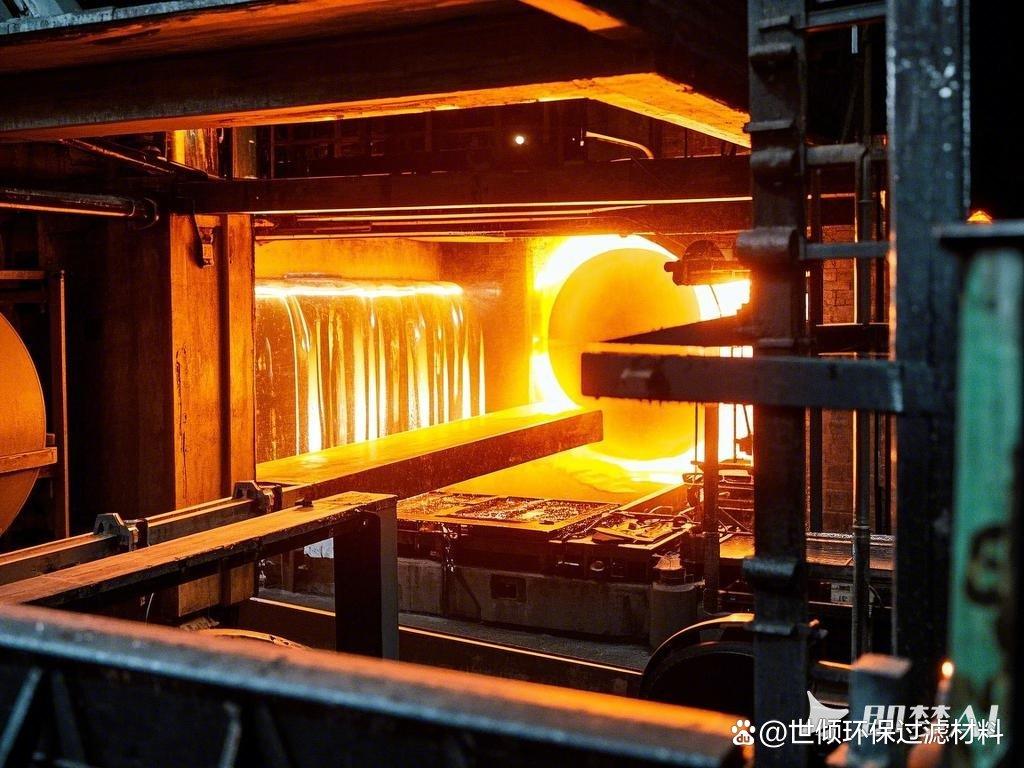

Executive Summary
Industrial kilns and furnaces sit at the core of modern heavy industry — from 1450°C cement clinker firing, 1550°C float-glass melting, 1200°C porcelain firing, electric-arc steelmaking and copper induction smelting, to high-temperature diffusion of semiconductor wafers, lithium-battery cathode and anode calcination, and special-alloy vacuum heat treatment. This report, anchored on FY2025 financials and 2026 H1 industry signals, systematically maps China's industrial kiln-and-furnace EPC sector — market sizing, competitive landscape, supply chain, overseas expansion, and the structural shifts now unfolding.
In FY2025 the global market for industrial kilns and high-temperature equipment reached approximately USD 92 billion; the narrower "kiln EPC with process and control" segment was roughly USD 43 billion. China's domestic kiln-equipment and engineering-EPC market totaled about RMB 58 billion, with cement kilns at nearly 50%, glass furnaces at 13%, and metallurgical and lithium-battery furnaces combined at 40%. Driven by domestic champions — Sinoma International, Triumph Group (CNBM glass), Tangshan Hexiang, NHI, Beijing Lier, NAURA Technology — the "process package + EPC + commissioning + O&M" integrated model has become standard at the top tier. The historic retreat of overseas incumbents FLSmidth, KHD Humboldt Wedag, Maerz Ofenbau, and Vesuvius from China is being mirrored by their global market-share erosion to Chinese EPC players.
Chapter 1: Industry Overview — Global and China Kiln EPC Market in 2025
Global Industrial Kiln Equipment Market
The 2025 global market for industrial kilns and high-temperature equipment (covering cement, glass, ceramics, ferrous, nonferrous, semiconductor, lithium-battery and heat-treatment furnaces) reached approximately USD 92 billion, validated by cross-referencing Grand View Research and Markets & Markets datasets — year-over-year growth of about 3.4%. Of this, cement kilns and ancillary EPC captured nearly 30%, float-glass furnaces and cold-end equipment 15%, ceramic roller and tunnel kilns nearly 10%, steel electric-arc and reheat furnaces 20%, nonferrous and lithium-battery furnaces 15%, and semiconductor vacuum, heat-treatment, and specialty furnaces nearly 15%.
If the scope is narrowed to "kiln EPC with process package and control system" — meaning turnkey project delivery beyond standalone mechanical equipment — the market is roughly USD 43 billion, growing at about 4% annually. The bulk of incremental growth comes from three sources: greenfield cement and glass capacity in overseas markets, the rapid Chinese expansion in lithium-battery and semiconductor high-temperature equipment, and the explosive cement and building-materials investment in India and the Middle East.
China's Kiln Equipment and EPC Market Sizing
China's kiln-equipment and EPC market reached approximately RMB 58 billion in 2025, calculated by aggregating figures from the China Machinery Industry Federation and third-party trackers. Cement kilns accounted for 47% (RMB 27.3 billion); building-materials roller and tunnel kilns 13% (RMB 7.5 billion); steel electric-arc, reheat, and other metallurgical furnaces plus nonferrous and lithium-battery furnaces combined for 40% (RMB 23.2 billion).
Cement kilns posted essentially flat growth in 2025. Domestic greenfield capacity is severely limited; incremental demand comes overwhelmingly from overseas EPC orders (Sinoma International, Hefei Cement Research and Design Institute) and domestic retrofits (environmental upgrades, smart-control upgrades, waste-heat power generation). Ceramic roller kilns grew about 3% YoY. Steel electric-arc furnaces posted double-digit growth — about 15% YoY — driven by the dual-carbon-target shift from BOF to EAF steelmaking. Lithium-battery furnaces grew about 32% YoY, the fastest-expanding sub-segment.
Belt and Road Pipeline of Overseas Cement EPC
By end-2025, 47 new or under-construction cement clinker lines along the Belt-and-Road corridor totaled about 85 million tonnes per year of combined capacity. Chinese EPC contractors took 32% of these contracts by value, approximately USD 6.8 billion. The share has risen from about 20% in 2020, a 12-percentage-point gain over five years.
In 2026 H1, newly signed cement EPC contracts totaled 14 lines worth roughly USD 2.9 billion. Sinoma International secured contracts in Saudi Arabia, Indonesia, Kenya, Tanzania, Zambia, the Philippines, Bangladesh, and Uzbekistan, with average per-line value of about USD 210 million and a peak USD 380 million contract in Saudi Arabia. Hefei Cement Research and Design Institute remained strong in South and Southeast Asian markets — Pakistan, Bangladesh, Vietnam, and Myanmar.
Earnings Erosion at FLSmidth and KHD
FLSmidth's FY2025 Cement business reported revenue of EUR 734 million and a loss of EUR 112 million — the third consecutive year of decline. The company formally separated its cement business into a standalone entity "FLSmidth Cement" in 2025, completing the carve-out in April 2026. Its share of China cement EPC has shrunk to below 5%, with the bulk of remaining global orders from Europe, the Middle East, and Africa.
KHD Humboldt Wedag's FY2025 Cement and Minerals division reported revenue of about EUR 280 million, down 16% YoY, with gross margin compressing from 16% to 12% on price pressure for new EPC contracts, higher steel input costs, and longer project execution cycles in overseas markets.
Maerz Ofenbau's FY2025 revenue was about CHF 160 million, roughly flat. Maerz remains the global technical leader in lime kilns, with its PFR (Parallel Flow Regenerative) twin-shaft technology holding about 35% global market share.
Vesuvius PLC's FY2025 revenue reached GBP 1.62 billion, with the steel division contributing 60%, the rest split among glass, nonferrous, and building materials.
Three-Year Market Outlook
For 2026 through 2028, the global market for industrial kilns and high-temperature equipment is forecast to grow at 4-5% annually, reaching USD 108 billion by 2028. China's domestic market will see the dual adjustment of "cement and glass capacity reduction" overlaid with "rapid expansion of new-energy, semiconductor, and lithium-battery furnaces" — total market size growing from RMB 58 billion in 2025 to RMB 71 billion by 2028, approximately 7% annualized growth.
Chapter 2: Furnace Classifications — Cement, Glass, Ceramic, Metallurgical, Vacuum, and Industrial Boilers
Cement Rotary Kilns
The cement rotary kiln is the heart of the cement industry. A new-suspension preheater (NSP) line consists of a 4.8–6.2 meter diameter, 60–80 meter long rotary kiln operating at up to 1450°C. NSP single-line capacity has scaled from early 2000 t/d levels to mainstream ranges of 4000–12000 t/d today. Each cement clinker production line requires preheater (typically 5-stage or 6-stage cyclone), calciner, rotary kiln, grate cooler, coal mill, vertical raw mill, clinker silo, cement mill, and packaging systems — with the rotary kiln, calciner, and grate cooler forming the three core pieces of equipment.
Globally, two schools of cement-kiln technology dominate: the European school (FLSmidth, KHD, Krupp, Polysius) and the Chinese school (Sinoma International, Hefei Cement Research and Design Institute, Tianjin Cement Industry Design and Research Institute, Nanjing Cement Industry Design and Research Institute). The Chinese school has matured from apprentice to mainstream player over the past decade — Chinese EPCs now take more than 60% of global new-cement-line orders.
Float-Glass Melting Furnaces
A float-glass line consists of melter, tin bath, lehr (annealing furnace), and cutting/packaging systems. Furnaces are 60–90 meters long, 9–14 meters wide, with molten-glass depth of 1.2–1.4 meters. Daily capacity ranges from 600 to 1200 tonnes, with the largest at 1300 tonnes (newest-generation Qatar and Saudi projects).
The energy structure of a melter is critical: chemical reactions (glass-forming reactions) require only about 20% of the heat input, with the remaining 80% needed to heat molten glass to 1550°C. Hence furnace energy efficiency — regenerator design, burner arrangement, melt-flow control, electric boost — is the core competence of equipment vendors.
Solar PV glass furnaces are a variant of the float furnace, differing in: ultra-low iron content (Fe2O3 < 0.01%), higher transmittance (above 95%); slightly smaller capacity (600 tpd is the workhorse); faster line cadence; and stricter control of bubbles, inclusions, and surface defects.
Ceramic Industry Furnaces
Roller kilns dominate the ceramic industry. Length ranges 200–500 meters, with tiles transported on refractory rollers; firing temperatures 1100–1200°C; firing cycles 40–90 minutes; daily capacity 10,000–25,000 m². The newest "fully automatic smart large-format roller kiln" reaches 800 meters in length, purpose-built for 900×1800 mm to 1200×2400 mm porcelain large-format tiles and stone-format products. Energy consumption is 12% lower through waste-heat recovery and the firing cycle is compressed to under 40 minutes.
Tableware ceramics rely on shuttle kilns and electric kilns, with low per-kiln capacity but high flexibility, suited for small-batch high-variety production.
Metallurgical Furnaces
Electric arc furnaces (EAF) use electric arcs to melt scrap steel. Per-furnace capacity is 50–250 tonnes; smelting cycle 40–60 minutes. From dual-carbon and scrap-availability angles, EAFs are the core equipment for China's steel future — share is projected to rise from 12% today to about 30% by 2030, creating a greenfield-and-retrofit market exceeding RMB 60 billion.
Basic oxygen furnaces (BOF) are the core of long-process integrated steelmaking; per-furnace capacity 100–350 tonnes. China's BOF count has grown slowly over the past decade as steel capacity caps tightened.
Reheat, annealing, and heat-treatment furnaces span walking-beam, pusher, roller-hearth, and bell types — an RMB 5–20 billion annual market serving steel, nonferrous, and auto-body lines.
Vacuum furnaces handle semiconductor wafer, special-alloy, and rare-earth permanent-magnet thermal processing. NAURA's Sevenstar division leads China's semiconductor vacuum-furnace market; CZ single-crystal silicon growers run RMB 10–20 million per unit.
Lithium-Battery High-Temperature Furnaces
Lithium-battery cathode calcination (ternary, LFP) requires 700–1100°C; annual line capacity 5000–20000 tonnes. China's leading cathode producers — Ronbay Technology, Easpring, Long-Time Lithium, Zhenhua New Materials — have added over 1 million tonnes of capacity in the past three years, driving more than RMB 20 billion in furnace equipment investment.
Anode graphitization furnaces (3000°C ultra-high temperature) are the critical equipment for the anode industry, concentrated in low-cost electricity regions like Inner Mongolia, Sichuan, and Guizhou.
Industrial Boilers and Heat-Recovery Steam Generators
Industrial boilers (steam, hot-water, organic-heat-transfer-fluid) form an RMB 20 billion annual market. Heat Recovery Steam Generators (HRSG) for cement, glass, steel, and chemical waste-heat capture cover 30–50% of in-plant electricity demand, making them critical for energy efficiency.
Semiconductor Crystal Growers and Diffusion Furnaces
Semiconductor crystal growers (CZ single-crystal furnaces), diffusion furnaces, annealing furnaces, and epitaxy reactors are core wafer-fab high-temperature equipment. FY2025 China semiconductor high-temperature equipment market reached approximately RMB 18 billion, growing at about 20% YoY.
Chapter 3: Process Barriers — Refractory Linings, Burners, Smart Controls, Waste-Heat Recovery
Refractory and High-Temperature Materials
Industrial kiln linings are constructed from various refractory bricks and castables. Cement kilns use basic refractories (magnesia-carbon, alumina-magnesia, magnesium-iron-spinel bricks). Glass furnaces use acidic refractories (fused zirconia-alumina-silica bricks, sintered zircon-mullite bricks). Steel furnaces use basic and neutral bricks. Refractory life directly determines kiln campaign cycles and annual operating rates — a critical line item in total kiln operating cost.
China's refractory industry is centered in Luoyang. Luoyang Refractory Research Institute, Sinosteel Luonai, Beijing Lier, Puyang Refractory, Ruitai Technology, and Luyang Energy-Saving Materials are the main players. The detailed analysis is available in the published refractory industry research report. FY2025 China refractory industry total revenue reached approximately RMB 78 billion.
Burners and Combustion Systems
Burners are the kiln's "throat." Cement kilns use three- or four-channel pulverized-coal burners. Glass furnaces use oxygen-enriched or oxy-fuel burners. Reheat furnaces use regenerative burners (RTO, RCO). Low-NOx combustion, oxygen-enriched assistance, and ammonia injection are key R&D frontiers.
Major vendors include US FCT Combustion (global leader in cement coal burners), France Pillard (acquired by Fives), Germany KHD Humboldt Wedag, and Chinese players Chengdu Rongcheng and Beijing Tiantai. Chinese vendors have essentially achieved import substitution in cement-kiln burners.
Smart Control Systems
Industrial kiln control systems combine DCS, PLC, SIS, and MES across multiple layers. Honeywell, Emerson, Yokogawa, ABB, and Siemens are the global mainstream. China's Zhongkong Technology, Hollysys, and Zhejiang Supcon have risen rapidly and now compete with international incumbents in cement, glass, and chemicals.
The core of the control system is the "process package" — codifying kiln process data and control strategies into repeatable, executable programs. A mature cement process package contains thousands of control variables, hundreds of process logic blocks, and dozens of PID loops. The core competitiveness of Sinoma International, Hefei Cement Research and Design Institute, and Tianjin Cement Industry Design and Research Institute lies precisely in these accumulated process packages.
Waste-Heat Recovery and Energy Saving
Waste-heat recovery is the critical lever for industrial-kiln decarbonization. Cement-kiln waste heat is collected via two streams — AQC (grate-cooler exhaust) and SP (preheater exhaust) — feeding a waste-heat boiler for power generation. A 5000 t/d cement line carries about 9 MW of installed waste-heat power capacity, generating 63 million kWh per year, covering 35% of in-plant electricity.
Deep Ecosystem of Process Capability
Process barriers are not just about single technologies; they require integration and project management. A new cement-clinker EPC contract typically runs RMB 1–2 billion with 12–18 months execution, involving thousands of equipment items, tens of thousands of tonnes of steel structure, and hundreds of thousands of cubic meters of concrete. Fewer than 10 firms globally can land such contracts.
Chapter 4: Major Players — Sinoma, Triumph Group, Tangshan Hexiang, NHI, Beijing Lier, NAURA; Benchmarked Against FLSmidth, KHD, Maerz, Vesuvius
Sinoma International (600970.SH) — Global Cement Engineering Champion
Sinoma International Engineering, A-share listed under 600970.SH, is the flagship cement-engineering EPC platform of China National Building Material Group. FY2025 revenue: RMB 46.2 billion (+7.2% YoY); net profit attributable to parent: RMB 3.18 billion (+10.5% YoY). Overseas revenue accounted for 65% of total — RMB 30 billion — making it the flagship of China's cement EPC going global.
Sinoma holds roughly 50% global market share in cement EPC by contract value. In 2025 it secured 23 overseas cement-clinker EPC contracts spanning Saudi Arabia, Indonesia, Kenya, Tanzania, Zambia, the Philippines, Bangladesh, and Uzbekistan. Core competitiveness rests on three pillars: mature process packages from 40+ years of domestic plus 20+ years of overseas execution; deep integration with Chinese refractory, burner, control-system, and specialty-steel vendors; and Chinese state-policy-bank financing access (China Exim Bank, China Development Bank) — a decisive edge in Middle East, Southeast Asia, and African markets.
Sinoma's O&M services segment posted FY2025 revenue of RMB 8.5 billion (+12% YoY), with gross margins materially above the EPC base. The O&M share is projected to rise from 18% to 30% by 2030.
Triumph Group (CNBM Glass) — Glass Furnace and Display-Glass Leader
China Triumph International Engineering Group (CTIEI) under CNBM is a global EPC leader for glass furnaces — float, PV, TFT-LCD, ultra-thin electronic glass — with mature process packages across each segment. FY2025 CTIEI glass-engineering contract value reached approximately RMB 6.8 billion, with 40% of value from overseas markets (Middle East, Africa, Southeast Asia, South Asia).
Particularly notable is Triumph Group's breakthrough in PV glass furnace localization. Before 2018, key equipment (regenerator, glass channel, platinum stirrer) was imported, with single-line cost about RMB 600 million. By 2020 Triumph achieved full localization, dropping single-line cost to RMB 450 million and shortening construction from 18 to 12 months — directly enabling China's massive PV-glass capacity expansion.
Tangshan Hexiang Smart Technology (300171.SZ) — Ceramic Kiln Leader
Shenzhen-listed Tangshan Hexiang focuses on architectural-and-sanitary and tableware ceramic-kiln equipment, one of China's leading ceramic-kiln vendors. FY2025 revenue: RMB 1.6 billion; net profit: RMB 120 million. Core products include roller kilns, tunnel kilns, shuttle kilns, and electric kilns, serving Guangdong Dongpeng, Marco Polo, New Pearl, Monalisa, Eurus, Fujian Xiejin, and Shandong Shiwang.
Northern Heavy Industries (NHI) — Metallurgical Furnaces
NHI (formerly Shenyang Heavy Machinery Group) is one of China's core metallurgical-furnace OEMs — EAFs, BOFs, reheat furnaces, continuous casters, continuous rolling mills. Group revenue is approximately RMB 18 billion. NHI holds about 30% of the EAF market, with major customers including Jiangsu Shagang, Hebei Jingye, Anyang Steel, and Shougang Jingtang.
Beijing Lier (002392.SZ) — Refractory Champion
Shenzhen-listed Beijing Lier High Temperature Materials is one of China's leaders in steel and cement refractories. FY2025 revenue: RMB 6.2 billion; net profit: RMB 480 million. Products span magnesia-carbon, magnesia-alumina-spinel, alumina-magnesia, alumina-silicon-carbide, alumina, unfired bricks, and unshaped refractory castables.
NAURA Technology (002371.SZ) — Semiconductor Vacuum-Furnace Champion
Shenzhen-listed NAURA Technology Group is the dominant Chinese vendor of semiconductor equipment. FY2025 revenue: RMB 32 billion (+32% YoY); net profit: RMB 5.2 billion (+35% YoY). NAURA's Sevenstar division focuses on semiconductor vacuum furnaces, diffusion furnaces, epitaxy furnaces, and CVD/PVD high-temperature equipment. FY2025 semiconductor high-temperature furnace revenue reached roughly RMB 10.5 billion — the absolute Chinese leader.
Benchmarking Overseas Incumbents: FLSmidth, KHD, Maerz, Vesuvius
FLSmidth A/S (CPH:FLS): cement business FY2025 revenue EUR 734 million, loss EUR 112 million. Formally carved-out to "FLSmidth Cement" in April 2026. China share now below 5%.
KHD Humboldt Wedag International AG (FRA:KWG): cement and minerals FY2025 revenue EUR 280 million, down 16% YoY. KHD shares a stake-based partnership with CITIC Heavy Industries, creating cooperative-competitive dynamics in Central Asia and the Middle East.
Maerz Ofenbau AG (Swiss private): global technical leader in lime kilns with about 35% market share in PFR twin-shaft technology.
Vesuvius PLC (LON:VSVS): FY2025 revenue GBP 1.62 billion; steel division 60% of revenue.
NGK Insulators (5333.T): another "niche giant" focused on ceramic honeycombs (auto catalyst supports), ceramic insulators, and semiconductor ceramic components. FY2025 (year ended March 2026) revenue: JPY 635.8 billion; net profit approximately JPY 70 billion.
Chapter 5: Downstream I — Cement Industry: Sinoma's 60%+ Overseas Share and Belt-and-Road Greenfield Lines
China's Domestic Cement Status
China's cement output reached approximately 1.8 billion tonnes in 2025, down 3% YoY for the third consecutive year. Domestic capacity stands at about 2.6 billion tonnes annually, with utilization at about 70%. The top ten cement majors — Anhui Conch, CNBM, China Resources, Taiwan Cement, Jidong, Huaxin, Asia Cement, Tangshan Jidong, and others — control about 60% of domestic capacity.
The state of domestic cement is "severe overcapacity, declining demand." Demand breakdown: real estate 35%, infrastructure (highways, rail, airports, municipal) 45%, industrial-and-rural construction 20%. Real-estate demand has fallen sharply since H2 2021, with 2025 down about 12% YoY — the core driver of cement demand decline.
China's cement industry's 2025–2030 core agenda is capacity reduction and carbon peaking. Domestic capacity will likely shrink from 2.6 billion to 2.2 billion tonnes by 2030 — annual phaseouts of about 200 million tonnes of "non-mainstream" small-mill capacity.
Cement EPC Overseas Markets
Cement EPC overseas markets are the key incremental growth lever for Chinese kiln-equipment vendors. Globally, 2025–2030 will see about 200 greenfield cement-clinker lines built, totaling about 400 million tonnes per year of new capacity. The bulk concentrates in five regions: Middle East and North Africa (NEOM, Red Sea Project, Riyadh metro, Dubai airport, ~100 million tpa new capacity); Southeast and South Asia (Indonesia, Philippines, Vietnam, Myanmar, Bangladesh, India, Pakistan, Sri Lanka, ~150 million tpa); Sub-Saharan Africa (Kenya, Tanzania, Zambia, Angola, Nigeria, Ghana, Senegal, ~60 million tpa); Central Asia and Russian Far East (Uzbekistan, Kazakhstan, Kyrgyzstan, Tajikistan, ~40 million tpa); and Latin America (Mexico, Brazil, Argentina, Chile, Peru, Colombia, ~50 million tpa).
Sinoma International's Overseas Share
Sinoma holds about 50% global share of cement-EPC contracts by value. In FY2025 Sinoma signed 23 overseas cement-clinker EPC contracts. The two Saudi contracts totaled approximately USD 600 million averaging USD 300 million each; three Indonesia contracts totaled USD 650 million; five East Africa contracts (Kenya, Tanzania, Zambia) summed to USD 900 million.
Cement EPC, overseas cement projects, and cement kiln equipment factory resources can be precisely filtered on the main platform.
Project Finance Structure
A new cement-clinker EPC contract (5000 t/d) typically breaks down as: USD 200 million total; equipment 65% (USD 130 million); construction 20% (USD 40 million); commissioning and training 5% (USD 10 million); margin and overhead 10% (USD 20 million). Execution period 12–18 months.
Payment terms typically: 10–15% advance (within 30 days of contract signing); 40–50% on equipment delivery (in tranches as equipment arrives on site); 20–30% on commissioning and acceptance; 5–10% as retention (released over two years post-acceptance).
Owner financing modes: own funds, commercial bank loans, buyer's credit (provided by exporter-country ExIm banks), seller's credit (provided by the EPC contractor), intergovernmental loans (such as China ExIm Bank concessional loans), PPP/BOT. Buyer's credit is China's biggest edge — Chinese ExIm Bank can provide rates below market with 10–15 year tenors covering 70–85% of contract value.
2026 Overseas Cement EPC Observation
H1 2026 cement-EPC abroad continues the 2025 high-volume trend. Sinoma, Hefei Cement Research Institute, and Tianjin Cement Research Institute together signed about USD 4 billion in new contracts, up 12% YoY. Saudi Arabia, Indonesia, Kenya, Tanzania, and India remain core markets.
Competitively, FLSmidth, KHD, Loesche, and Polysius continue to lose share in new contracts. FLSmidth signed only EUR 500 million in new cement EPCs in FY2025, far below Sinoma's volumes. With the cement-business carve-out underway, FLSmidth may exit large cement-EPC entirely within 3 years, focusing on spares, O&M, and retrofits. This strategic shift implies Chinese EPCs may capture 60–70% of the greenfield overseas cement-EPC market over the next 5 years.
Chapter 6: Downstream II — Glass, Ceramics, Metallurgy, Semiconductor Vacuum Furnaces, and Lithium-Battery High-Temperature Furnaces
Glass Industry Furnaces
China's main glass sub-segments include float glass (architectural, automotive, furniture), PV glass (crystalline-silicon module covers), electronic glass (TFT-LCD/OLED display glass, ultra-thin glass, specialty glass), container glass (bottles), and fiberglass (construction, wind power, automotive). FY2025 China float-glass capacity reached approximately 1.2 billion weight cases, with output about 900 million weight cases — about 75% utilization. PV-glass annual capacity reached about 34 million tonnes, output about 28 million tonnes — about 82% utilization.
Glass furnace supply is highly concentrated. Domestically dominated by CTIEI under Triumph Group, Dongxu Optoelectronic, and Luoyang Glass. International competitors include France's Saint-Gobain, US Corning, UK Pilkington (acquired by NSG), Japan AGC, and Germany Schott.
Recent float-glass-melter EPC values are RMB 300–600 million (mid-range 900 tpd lines). PV-glass furnaces — higher purity requirements, more complex processes — command RMB 450–700 million per line. TFT-LCD substrate furnaces, with extreme process barriers and scarce process packages, can run RMB 1–2 billion per line.
Ceramic Industry Furnaces
China's architectural-ceramic (tile) industry clusters in Guangdong Foshan, Fujian Jinjiang, Shandong Zibo, Hebei Tangshan, Jiangxi Gao'an, Hubei Dangyang, Sichuan Jiajiang, Guangxi Tengxian, and Liaoning Faku. FY2025 tile output reached approximately 8 billion m², with above-scale enterprise output value of RMB 350 billion.
Ceramic-furnace OEMs lead with Tangshan Hexiang, Foshan Oushennuo, Guangdong Keda, Fujian Lida, and Foshan Sanpu. Italian SACMI, System Ceramics, and Siti B&T are international competitors.
Recent roller-kiln upgrades target: large-format tile kilns (800-meter length for 900×1800 to 1200×2400 mm panels); low-carbon firing kilns (oxygen-enriched combustion, waste-heat recovery, 20–30% energy savings); smart control kilns (real-time furnace-temperature field monitoring with precise control).
Metallurgical Industry Furnaces
The steel industry's core kilns are EAFs, BOFs, reheat furnaces, heat-treatment furnaces, and continuous-caster supports. China's 2025 crude-steel output reached about 1.0 billion tonnes — EAF steel about 120 million tonnes (12% share), BOF steel about 880 million tonnes (88% share).
Equipment OEMs lead with NHI, MCC Saidi, Hebei Steel Research, and Northeastern University. Italy's Danieli, Austria's VAI, and Germany's SMS group are international competitors.
The next-five-year opportunity lies in "long-process to short-process" — from BOF to EAF steelmaking. By 2030, China's EAF-steel share is projected to rise from 12% to about 30%, generating an EAF greenfield-and-retrofit market exceeding RMB 60 billion.
Semiconductor Vacuum Furnaces and High-Temperature Equipment
Wafer-fab high-temperature equipment includes single-crystal silicon growers (CZ), diffusion furnaces, annealing furnaces, epitaxy reactors, and CVD/PVD. Core characteristics: extreme temperature (800–1600°C), semiconductor-grade cleanliness, precision temperature control (±0.1°C), and process repeatability (variation < 1%).
Equipment OEMs lead with NAURA, ACM Research, Beijing Jingyuntong, Sumitomo (Liancheng Numerical Control). International competitors include US Applied Materials, Lam Research, KLA, Japan Tokyo Electron, and Kokusai Electric.
FY2025 China semiconductor high-temperature equipment market reached approximately RMB 18 billion, +20% YoY. Forecasted RMB 35 billion by 2030, ~14% annualized growth.
Lithium-Battery Furnaces
Lithium-battery cathode (ternary, LFP, LFMP, sodium-ion cathode) firing equipment includes roller kilns, pusher kilns, rotary kilns, and sagger kilns. Firing temperature typically 700–1100°C; per-line capacity 5000–20,000 tonnes per year. FY2025 China cathode capacity reached approximately 2.8 million tonnes, with kiln-equipment investment about RMB 12 billion.
Equipment OEMs lead with Changsha Jiaru New Material, Liancheng NC, Guangdong Zhongpeng Thermal Energy, and Henan Kelong. Italy SACMI and Japan Noritake are international competitors.
Anode graphitization furnaces — 3000°C ultra-high temperature with about 6000 kWh/tonne electricity consumption — are mostly clustered in Inner Mongolia, Sichuan, and Guizhou, near cheap electricity. FY2025 graphitization-furnace capacity additions reached approximately 500,000 tonnes, with equipment investment about RMB 8 billion.
Other High-Temperature Equipment
Beyond the major categories, many niche segments warrant attention: glass-fiber pool furnaces, catalyst rotary kilns, rare-earth-permanent-magnet sintering furnaces, special-alloy vacuum induction melters, casting medium-frequency induction furnaces, and heat-treatment carburizing/quenching/tempering furnaces. Individually small but collectively forming the long-tail of the industrial-furnace industry — the survival space for thousands of small and medium furnace vendors.
Chapter 7: Platform Perspective — Filtering Downstream Building Materials, Metallurgy, and Chemicals by Process
Platform Introduction
Our institute's parent operates a niche B2B manufacturing platform in China called Tianxia Gongchang. The platform — covering 4.8 million in-production factories — is essentially a B2B service for "factory information aggregation + upstream sales-lead discovery," materially different from Qichacha or Tianyancha which focus on commercial-registration information (registration data, equity structures, litigation notices). Our platform reaches into a factory's actual operations: processes, capacity, equipment, raw materials, products, customers.
The platform's core data assets cover 4.8 million in-production factories with basic information (address, scale, registered capital, founding year); more than 40 million factory process-feature data points (product types, equipment models, raw-material procurement, customer lists, application industries); and supply-chain graphs across ~100 industries. These assets are formed from dozens of data sources (commercial-registration data, industry-association data, tendering data, self-reported data, web-scraped data, satellite-remote-sensing data) — then cleansed, engineered, and human-verified.
Platform Applications in the Furnace Industry
For furnace-equipment OEMs, key application scenarios include:
First, downstream-owner discovery. Furnace OEMs' main customers are cement plants, glass factories, ceramic factories, steel mills, nonferrous-metal plants, semiconductor fabs, and lithium-battery factories. The platform allows precise filtering by "process type × capacity scale × geographic location × investment intent × equipment update cycle." For instance, cement factories national distribution and capacity data help OEMs identify which plants are due for kiln retrofits (typically 25–30 year cycles).
Second, ancillary-supplier discovery. Core ancillaries include refractories, burners, control systems, specialty steels, and thermocouples — dozens of component categories. The platform filters by "refractory type × high-temperature performance × capacity scale × geographic location." For example, magnesia-carbon brick suppliers, magnesia-alumina-spinel brick suppliers networks are visible at a glance.
Third, process-innovation direction exploration. Through the platform's supply-chain graphs and downstream-demand analysis, OEMs can prospectively explore process-innovation directions. For example, analyzing lithium cathode plants capacity expansion, product-structure shifts, and technology-route evolution helps inform future-furnace requirements.
Fourth, overseas-market intelligence. The platform aggregates extensive overseas cement, glass, and ceramic project information (new-build, expansion, retrofit progress, owner, financing party, EPC tender) — providing intelligence support for Chinese OEMs' overseas market exploration.
Process-Categorized Downstream Map
The platform systematically classifies downstream by furnace process type. Core categories include:
Cement industry: approximately 2,500 cement-manufacturing enterprises nationwide. Of these, large-scale (>5 mtpa) about 120; medium (1–5 mtpa) about 400; small (<1 mtpa) about 2,000. Geographic distribution: East China, Central China, South China, Southwest, North China.
Flat-glass industry: approximately 120 float-glass producers nationwide; 25 PV-glass producers. Concentrated in North China (Hebei, Shandong), East China (Jiangsu, Anhui), Central China (Hubei, Henan), and South China (Guangdong, Guangxi).
Ceramic factories: approximately 1,200 architectural-ceramic enterprises nationwide; 2,000 tableware-ceramic enterprises; 500 advanced-ceramic enterprises. Concentrated in Guangdong (Foshan, Chaozhou), Fujian (Jinjiang, Dehua), Shandong (Zibo, Linyi), Jiangxi (Gao'an, Jingdezhen), Hebei (Tangshan), Hubei (Dangyang), Sichuan (Jiajiang), Guangxi (Tengxian), and Liaoning (Faku).
Steel industry: approximately 500 steel enterprises nationwide (including specialty steel). Of these, 20 super-large (>10 mtpa), 120 large (1–10 mtpa), and 360 medium-and-small (<1 mtpa). Concentrated in North China (Hebei, Shandong, Liaoning), East China (Jiangsu, Anhui), Central China (Hubei, Henan), and South China (Guangdong, Guangxi).
Chapter 8: High-End Breakthrough — Glass Furnace Localization, Lithium-Battery Furnaces, Semiconductor Vacuum Furnaces
Glass Furnace Localization
China's glass-furnace localization journey has undergone fundamental transformation over the past 15 years — from "fully imported" to "fully autonomous." Pre-2010, domestic float-glass furnace key equipment (regenerators, glass channels, platinum stirrers, electrodes, specialty refractories) was almost entirely imported, with single-line equipment cost about RMB 600 million and construction cycle about 20 months. Around 2015, domestic vendors like CTIEI began supplying float-glass furnaces at scale, dropping single-line equipment cost to RMB 450 million and construction to 14 months. Post-2020, domestic float-glass furnaces achieved essentially full localization — single-line equipment cost further compressed to RMB 380 million with construction at 12 months.
PV-glass furnace localization came later but more decisively. Pre-2018, domestic PV-glass furnace key equipment (especially large furnaces above 600 tpd) was almost entirely imported. By 2020, Triumph Group joined with Luoyang Glass to achieve full PV-glass-furnace localization at single-line equipment cost about RMB 450 million. This breakthrough directly enabled China's explosive PV-glass capacity expansion from 2020 to 2023 — 10 million tpa to 28 million tpa in three years, a 1.8x increase.
Electronic-glass furnace localization (TFT-LCD, OLED display-glass substrates) lags relatively. Corning, AGC, NEG hold decades of process accumulation. Chinese domestic vendors like Dongxu Optoelectronic, Caihong New Energy, and Luoyang Glass have entered 8.5-generation lines and below, but 10.5-generation lines and above remain dominated by international incumbents.
Lithium-Battery Furnace Rapid Development
Lithium cathode high-temperature firing furnaces have been the fastest-growing furnace sub-segment over the past five years. From under RMB 10 billion in 2020 to about RMB 20 billion in 2025 — ~15% annualized growth. Three drivers: explosive power-battery capacity expansion (FY2025 China power-battery capacity ~1800 GWh, projected 3000 GWh by 2030, cathode demand growing from 2.8M to 4.8M tonnes); rapid cathode-material iteration (from cobalt oxide to high-nickel ternary, LFP, LFMP, sodium-ion cathodes — each requiring new firing-process requirements); and sustained cost-reduction pressure (cathode prices fell sharply, forcing equipment upgrades for cost reduction).
Anode graphitization furnaces are another anode-industry hot spot. The process core — converting "amorphous carbon" from petroleum coke or needle coke to "graphite" at 3000°C extreme temperature — consumes about 6000 kWh per tonne. FY2025 China graphitization-furnace capacity additions reached about 500,000 tonnes with equipment investment about RMB 8 billion.
Semiconductor Vacuum and High-Temperature Equipment
Wafer-fab high-temperature equipment localization is a key battlefield in China's "chokepoint" equipment localization. By breakthrough degree: single-crystal silicon growers (CZ) — essentially full localization (NAURA, JinShengJi, Beijing Jingyuntong, Liancheng NC); diffusion and annealing furnaces — 40-50% localization (NAURA, Yituang Shares, Xinyuan Micro); CVD/PVD and more complex high-temperature equipment — under 20%, still imported from US Applied Materials, Lam Research, KLA, and Japan Tokyo Electron.
NAURA leads China semiconductor high-temperature equipment. FY2025 revenue RMB 32 billion (+32% YoY), net profit RMB 5.2 billion (+35% YoY). Semiconductor-equipment-business revenue (including diffusion, annealing, epitaxy, CVD/PVD) approximately RMB 25 billion; silicon-grower and PV-equipment business revenue approximately RMB 7 billion. Customer coverage spans nearly all major domestic wafer fabs.
JinShengJi (300316.SH) is another main semiconductor high-temperature equipment vendor — primarily large-size single-crystal silicon growers (for PV and semiconductor). FY2025 revenue RMB 18 billion.
Special-Alloy Vacuum Furnaces and Rare-Earth Permanent Magnet Sintering Furnaces
Special-alloy industry vacuum induction-melting furnaces (VIM), vacuum arc-remelting furnaces (VAR), and vacuum electron-beam-melting furnaces (EB) are core equipment for aerospace, nuclear power, high-speed steels, and tool steels. FY2025 China specialty-alloy vacuum-furnace equipment market reached about RMB 3 billion.
Rare-earth permanent-magnet sintering furnaces are critical for NdFeB magnet production. 1100°C sintering temperature, vacuum or argon shielding, 8–12 hour sintering cycle. FY2025 China NdFeB output reached about 220,000 tonnes — 90% of global supply.
Industry Logic of High-End Breakthrough
China furnace-equipment high-end-market breakthrough follows a clear industry logic: first, basic-product localization (cement kilns, float-glass furnaces) accumulates process packages and experience data through massive domestic-market engineering practice; second, mid-end-product breakthrough (PV-glass furnaces, lithium-battery furnaces) — explosive downstream-emerging-industry demand forces equipment-vendor accelerated R&D and engineering validation; third, high-end-product attack (semiconductor vacuum furnaces, specialty-alloy vacuum furnaces, TFT-LCD glass furnaces) — through national strategic support and joint R&D with downstream leading enterprises, achieving key-equipment localization.
Chapter 9: Capacity Expansion Breakdown
Cement-Kiln Capacity Breakdown
Domestic cement-kiln stock is massive. By end-2025, approximately 1,600 operating cement-clinker lines totaled about 2.6 billion tpa capacity. By per-line scale: about 500 "standard lines" at 5000 t/d (~1.5 mtpa each) — 31% of total; about 600 "medium lines" at 4000 t/d — 38%; the remaining ~500 (including 2000, 3000, 6000, 8000, 12000 t/d) combined ~31%.
By line age: pre-2000 "old lines" about 200 (12% of total), most having gone through 2–3 rounds of retrofits; 2000–2010 "mid-generation lines" about 600 (38%), most having completed one round of retrofits; 2010–2020 "new-generation lines" about 600 (38%), with relatively advanced technology; post-2020 "latest-generation lines" about 200 (12%), typically using all-new smart and low-carbon processes.
Geographic distribution: East China about 600 mtpa (23% of total); Central China about 400 mtpa (15%); South China about 300 mtpa (12%); North China about 300 mtpa (12%); Northeast about 100 mtpa (4%); Southwest about 400 mtpa (15%); Northwest about 300 mtpa (12%).
Domestic cement-kiln greenfield essentially stopped post-2021, with only minimal special-case capacity-swap projects (in Xinjiang, Tibet). Retrofit upgrades are the main domestic market for furnace-equipment vendors — about RMB 30 billion per year over the next 5 years.
Glass-Furnace Capacity Breakdown
Domestic float-glass furnaces total about 150 (including PV-glass furnaces), with combined daily melting capacity about 200,000 t/d. By scale: about 30 "small kilns" under 30 t/d; about 60 "medium kilns" 30–600 t/d; about 50 "large kilns" 600–1000 t/d; about 10 "super-large kilns" above 1000 t/d (mainly overseas Saudi, Qatar, Indonesia, India projects).
By function: float-glass furnaces about 120 (architectural glass 80, automotive glass 15, furniture glass 25); PV-glass furnaces about 30 (concentrated in Fulai, Xinyi, Caihong, Luoyang Glass).
Domestic float-glass furnace campaign-age structure is relatively concentrated. Most furnaces are 8–12 years old (campaign cycles typically 8–10 years, extendable to 12–15 years post-major-overhaul). The next three years (2026–2028) will enter mass cold-repair and retrofit peak — projected 20–25 furnaces per year, equipment-and-service market RMB 4–6 billion annually.
Ceramic-Industry Furnace Capacity Breakdown
China architectural-ceramic (tile) roller kilns total about 6,000, combined length over 2 million meters. By length: about 2,000 "short kilns" under 300 meters; about 3,000 "medium kilns" 300–500 meters (mainstream standard); about 1,000 "long kilns" above 500 meters (large-format tile and stone exclusive).
Future-five-year roller-kiln market opportunities come mainly from: large-format and stone-format product expansion (super-long roller kilns above 800 meters, single-line investment about RMB 100 million); and low-carbon-and-energy-saving retrofit upgrades (existing roller-kiln oxygen-enriched-combustion retrofit, waste-heat-recovery additions, smart-control upgrades).
Steel-Industry Furnace Capacity Breakdown
Domestic steel-industry EAFs total about 300 — about 120 large (above 100 tonnes), about 120 medium (50–100 tonnes), about 60 small (under 50 tonnes). FY2025 EAF annual capacity about 150 million tonnes, but actual output about 120 million tonnes — capacity utilization about 80%.
BOFs total about 600 — about 100 large (above 300 tonnes), about 300 medium (100–300 tonnes), about 200 small (under 100 tonnes). BOF utilization is relatively high — about 90%.
Reheat furnaces, annealing furnaces, heat-treatment furnaces are extremely numerous and statistically difficult to track. Future-five-year steel-industry furnace-equipment market (greenfield + retrofit + ancillaries) projected at RMB 5–10 billion annually.
Semiconductor and Lithium-Battery Capacity Breakdown
Semiconductor wafer-fab high-temperature equipment is relatively concentrated. By end-2025, about 20 12-inch (300mm) wafer fabs operate, each averaging 50–100 diffusion-and-annealing furnaces, 30–50 CVD/PVD units, 10–20 epitaxy furnaces. About 20 8-inch fabs operate, each averaging 20–50 diffusion-and-annealing units. FY2025 domestic semiconductor high-temperature equipment stock about 2,000 units, additions about 500 units.
Lithium cathode plants are also relatively concentrated. By end-2025, about 100 main cathode plants operate, each averaging 5–10 firing lines (each line 5000–20,000 tpa capacity). FY2025 domestic lithium-battery furnace stock about 1,500 lines, additions about 200 lines.
Regional Bifurcation of Capacity Expansion
Future-five-year (2026–2030) furnace-equipment market shows pronounced regional bifurcation. Domestic market focuses on "stock renewal + retrofit upgrades" with extremely limited greenfield additions. Regional increments mainly come from minor capacity-swap projects in western regions (Xinjiang, Inner Mongolia, Qinghai) and new-energy-base ancillaries (PV glass, lithium-battery materials) in Xinjiang and Inner Mongolia.
Overseas markets focus on "greenfield + expansion" — the core incremental opportunity for Chinese furnace-equipment vendors. Middle East (Saudi, UAE, Qatar, Oman) is the largest incremental market for cement, glass, aluminum; Southeast Asia (Indonesia, Vietnam, Philippines, Thailand) is the second-largest for cement, ceramics, steel; South Asia (India, Pakistan, Bangladesh) is large for cement, glass, ceramics; Africa (Egypt, Kenya, Tanzania, Zambia) is the second-largest for cement and glass; Latin America (Mexico, Brazil, Argentina, Chile) is medium for cement, glass, nonferrous.
Chapter 10: Price Cycles — Per-Unit EPC Pricing and Overseas Order Structure
Per-Unit Equipment Pricing
Different furnace equipment shows widely varying price ranges. Typical per-unit prices (equipment body only, excluding construction and commissioning):
Cement rotary kilns: RMB 50–120 million per unit, depending on capacity (4000–12000 t/d) and process grade.
Preheaters and calciners: RMB 30–60 million per set, depending on capacity and stages.
Grate coolers: RMB 20–40 million per unit.
Coal mills and raw mills: RMB 10–20 million per set.
Float-glass furnaces: RMB 200–400 million per furnace (including regenerator, electrodes, burners and key ancillaries), depending on daily capacity (600–1200 tpd) and glass type.
PV-glass furnaces: RMB 300–500 million per furnace, ~30–50% above standard float-glass furnaces.
Electronic-glass furnaces (TFT-LCD, OLED): RMB 800 million–1.5 billion per furnace, 3–4x standard float-glass furnaces.
Ceramic roller kilns: RMB 10–50 million per line, depending on length and process grade.
EAFs: RMB 40 million–200 million per unit, depending on capacity (50–250 tonnes) and process grade.
Steel reheat furnaces: RMB 30–150 million per unit.
Semiconductor single-crystal silicon growers: RMB 10–20 million per unit (semiconductor grade, higher process precision); PV-grade RMB 3–8 million per unit.
Semiconductor diffusion and annealing furnaces: RMB 3–15 million per unit.
CVD/PVD: RMB 10–50 million per unit.
Lithium-battery cathode firing furnaces: RMB 30 million–100 million per line.
Anode graphitization furnaces: RMB 5–20 million per unit.
EPC Contract Structure
EPC contract values far exceed standalone equipment prices. A new 5000 t/d cement-clinker line EPC totals about USD 200 million (RMB 1.5 billion): equipment 65% (RMB 980 million); construction 20% (RMB 300 million); commissioning and training 5% (RMB 75 million); margin and overhead 10% (~RMB 150 million).
A new 900 tpd float-glass line EPC totals RMB 600–900 million: equipment 60% (RMB 360–540 million); construction 20% (RMB 120–180 million); other 20% (~RMB 120–180 million).
A new tile-large-format line EPC totals RMB 100 million–300 million: equipment 70%; other 30%.
A new 500,000 tpa EAF steel plant EPC totals RMB 600 million–1 billion (excluding upstream mine and downstream rolling mill): EAF equipment 40% (~RMB 240–400 million); other 60% (auxiliary equipment, construction, commissioning).
A new 12-inch (30,000 wafers/month) semiconductor wafer line EPC totals USD 2–3 billion (RMB 15–20 billion): high-temperature equipment 15–20% (RMB 2–4 billion).
Medium-Long-Term Price Cycles
Industrial-furnace-equipment prices show pronounced medium-long-term cyclicality driven by: steel-price cycles (equipment cost is 30–40% steel — especially specialty heat-resistant and stainless); refractory-price cycles (15–20% of equipment cost, driven by bauxite, magnesite, graphite raw-material prices); downstream-demand cycles (downstream-industry capacity-investment cycles affect equipment-vendor pricing power); and exchange rates and overseas markets (Chinese vendors' overseas orders are 30–50% of revenue, with USD/CNY fluctuations materially affecting overseas-order realized revenue).
Overseas Order Structure Characteristics
Overseas orders structurally differ from domestic in: larger contract values (overseas cement-clinker EPC averages USD 200 million — 2-3x domestic peers); higher margins (overseas-project gross margins typically 18–25%, 5–8 percentage points above domestic peers); more complex payment terms (overseas projects typically need advance-payment guarantees, performance guarantees, retention guarantees — multiple financial-guarantee instruments); and project financing as a key competitive factor (Chinese ExIm Bank concessional loans for overseas owners are China EPC's biggest overseas-market advantage).
2026 Price Trend Observation
H1 2026 price trends: cement-furnace equipment prices stable; float-glass-furnace equipment prices slightly down 3–5%; ceramic roller-kiln equipment prices stable; EAF equipment prices slightly up 5–8%; semiconductor high-temperature equipment prices stable; lithium-battery high-temperature equipment prices slightly down 5–10%.
Chapter 11: Policy — Dual Carbon Drives Waste-Heat Power Generation, Overseas-Investment Support, Smart Manufacturing
Dual Carbon Goals and Furnace Industry Decarbonization
China's dual-carbon goals (peak by 2030, neutrality by 2060) profoundly impact the furnace industry. Since 2020, NDRC, MEE, MIIT, MOHURD and other multi-ministerial bodies have rolled out policies for cement, glass, ceramics, and steel — focused on process upgrade, energy-efficiency improvement, and fuel substitution to reduce carbon emissions.
The cement-industry decarbonization pathway includes: increasing the clinker factor; replacing fuels (using industrial waste, biomass, scrap tires); waste-heat power generation (covering 30–50% of plant electricity); and CCUS for process-emission capture.
The glass-industry decarbonization pathway includes: oxygen-enriched or oxy-fuel combustion; electric boost; waste-heat recovery; and cullet recycling.
The ceramics decarbonization pathway includes: oxygen-enriched combustion; waste-heat recovery; electric firing (in cheap-electricity regions like Xinjiang, Inner Mongolia); and process optimization (shorter firing cycles, lower firing temperatures).
The steel decarbonization pathway includes: long-process to short-process (scrap-EAF replacing ore-BOF); hydrogen metallurgy; and CCUS — with the long-to-short transition driving the largest EAF demand.
Waste-Heat Power Generation Policy Support
China's industrial waste-heat power-generation policy support is exceptionally strong. Since 2005, NDRC and MIIT have included "cement-kiln waste-heat power generation" in the "Energy-Saving and Emission-Reduction Technology Promotion Catalog." By end-2025, total installed cement-industry waste-heat power capacity reached about 12 GW — covering over 90% of major large-and-medium cement-clinker lines. Annual generation is about 60 billion kWh, equivalent to about 6 million tonnes of standard-coal savings and 15 million tonnes of CO2 reduction.
The 2025 NDRC and MIIT "Industrial Waste-Heat Utilization Three-Year Action Plan" explicitly proposed: by 2027, steel, chemicals, glass, and ceramics waste-heat power coverage will rise to 70%+, with cement maintained at 90%+. This will further expand market share for waste-heat-equipment vendors.
Overseas-Investment Policy Support
China has clear policy support for overseas Belt-and-Road investment in cement, glass, and steel. NDRC, MOFCOM, SAFE and other multi-ministerial bodies provide "green credit," "project financing," "export credit insurance," "overseas investment insurance," and similar instruments to support Chinese furnace-equipment OEMs' overseas market exploration.
Chinese ExIm Bank's "two concessional loans" (concessional buyer's credit and concessional seller's credit) are the core financial instruments supporting Chinese EPC overseas projects. These concessional loans offer rates well below international commercial rates with 10–15 year tenors covering 70–85% of contract value.
China Export and Credit Insurance Corporation (Sinosure) "medium-long-term export credit insurance" provides political-risk and commercial-risk insurance for Chinese EPC overseas projects. FY2025 Sinosure issued about USD 12 billion in insurance for cement, glass, steel, and power sector projects.
China Development Bank's "development finance" provides long-term low-interest loans for Chinese EPC overseas projects. FY2025 CDB issued about USD 8 billion in loans for cement, glass, steel sector overseas projects.
Smart Manufacturing and Industrial Internet
China Manufacturing 2025 strategy explicitly lists "smart manufacturing" as a core direction, with industrial furnaces — a high-energy, high-automation typical industry — being a key supported domain. Specific policies include MIIT "Industrial Internet +" Special Action (supporting cooperation between furnace-equipment OEMs and industrial-software vendors); MIIT "Green Factory" certification; NDRC "Major Equipment Localization" Special Program (offering R&D subsidies and first-set first-unit awards for OEMs achieving key furnace-equipment localization).
Local-Government Industry Policies
Local-government policy support for the furnace industry is also critical. Hebei Tangshan (ceramic-steel-equipment triple-cluster), Guangdong Foshan (architectural-ceramic-and-equipment cluster), Jiangsu Yancheng (emerging lithium-battery cluster), Inner Mongolia Ordos (anode-graphitization core cluster) all provide industry-park planning, low-carbon-firing subsidies, low-priced power, talent acquisition, and other policy support.
Overall Policy Environment Assessment
Overall, China's industrial-furnace industry currently enjoys an exceptionally favorable policy environment. Dual carbon drives process upgrade and waste-heat power-generation market expansion; Belt-and-Road and Chinese financial-institution support enable Chinese EPC overseas market exploration; China Manufacturing 2025 promotes furnace-equipment smart-upgrade; local-government industrial policies provide multifaceted support. This policy environment will continue supporting Chinese industrial-furnace industry growth for the next 5–10 years.
Chapter 12: Institute Judgment
Growth Structure Judgment
The institute judges that over the next five years (2026–2030), the Chinese industrial-furnace industry will exhibit a "domestic stock renewal + overseas greenfield expansion + new-energy equipment explosion" tripartite growth structure.
Domestic stock renewal: cement, glass, ceramics, and steel traditional heavy industries have essentially saturated capacity; greenfield additions are extremely limited; retrofit upgrades (energy-saving, smart-upgrade, low-carbon) will continue creating market opportunities. Domestic retrofit-upgrade market projected at RMB 30–40 billion annually for 5–10 years.
Overseas greenfield expansion: Belt-and-Road and other emerging-market cement, glass, ceramics, and steel capacity continued expansion is the core incremental opportunity for Chinese furnace-equipment OEMs. Overseas EPC market projected to grow from current RMB 20 billion to RMB 35 billion annually by 2030 (~11% annualized).
New-energy equipment explosion: lithium cathode-and-anode, semiconductor wafer, PV component, rare-earth permanent-magnet emerging-industry furnace demand rapid growth. New-energy equipment market projected to grow from current RMB 12 billion to RMB 25 billion annually by 2030 (~16% annualized).
Competitive-Landscape Judgment
The institute judges that over the next five years, China's industrial-furnace industry competitive landscape will show "head more head + middle bifurcation + long-tail clearout."
Head more head: Sinoma International, Triumph Group, Tangshan Hexiang, NHI, NAURA, etc. will further expand market share via technology upgrade, overseas expansion, and M&A integration. Top-five CR5 projected to rise from current ~35% to ~45% by 2030.
Middle bifurcation: specialty-tech or niche-track medium-size enterprises will continue growing (e.g., Changsha Jiaru New Material in lithium-battery furnaces, JinShengJi in PV single-crystal silicon growers), while tech-and-process-package-deficient medium-size enterprises will face severe challenge.
Long-tail clearout: large numbers of small-and-medium furnace-equipment OEMs (especially low-price-competition-dependent vendors without core technology) will be gradually cleared out in industry consolidation. Projected 30–40% of small-and-medium furnace enterprises will exit market over the next 5 years.
Overseas-Market Judgment
The institute judges that overseas markets are the most important structural opportunity for China's industrial-furnace industry over the next 5 years.
First, the comprehensive retreat of FLSmidth, KHD, and other overseas traditional giants. FLSmidth announced cement-business carve-out; projected within 3 years may fully exit large cement EPC. KHD cement-business size also continually shrinks. This retreat provides historic market space for Chinese EPC OEMs.
Second, Belt-and-Road sustained growth. Saudi, Indonesia, Kenya, Tanzania, India, Pakistan, Bangladesh, Philippines, Vietnam sustained capacity expansion is Chinese EPC OEMs' core market.
Third, Chinese EPC cost-and-financing advantages. Chinese EPC OEMs have significant advantages in equipment cost (20-30% below European peers), engineering efficiency (15-20% faster), and financing terms (Chinese ExIm Bank concessional loans).
Risk Judgment
The institute also judges that the Chinese industrial-furnace industry over the next 5 years also faces some non-trivial risks: further domestic cement-demand decline (real-estate weakness, infrastructure-investment-growth slowdown); overseas geopolitical risk (Belt-and-Road political-instability for Pakistan, Sri Lanka, Myanmar); replacement-process potential threat (CCUS, hydrogen-metallurgy, electric-furnaces long-term challenge); and international-trade frictions (US, EU "anti-dumping," "anti-subsidy," "national-security review" trade barriers).
Overall, the institute holds a cautiously optimistic view of the Chinese industrial-furnace industry's next-5-year outlook — overseas-market growth and new-energy-equipment explosion will provide core momentum, but domestic stock-market weakness and overseas geopolitical risks need continued attention. In the B2B factory-data space, Tianxia Gongchang will continue tracking these structural changes, providing precise downstream-mapping and sales-lead-discovery services for furnace-equipment OEMs.
Chapter 13: Risks — Post-Peak Cement Demand, Overseas Geopolitics, Replacement Processes
Post-Peak Cement-Demand Risk
China's cement output peaked at about 2.48 billion tonnes in 2014, declining since under real-estate-demand decline and infrastructure-investment-growth slowdown. By 2025, output was about 1.8 billion tonnes — about 27% below 2014 peak. Projected continued decline through 2030 to about 1.5 billion tonnes.
Cement-demand decline affects the cement-kiln equipment industry in multiple ways: extremely limited domestic greenfield capacity; accelerated stock capacity exit (about 200 million tpa "non-mainstream" small capacity to be cleared over 5 years); retrofit-upgrade market becoming mainstream (about RMB 30 billion annually under dual-carbon and energy-saving and emission-reduction policies); and overseas-market importance significantly rising (Sinoma, Hefei Cement Institute overseas revenue exceeds 50%).
Overseas Political and Geopolitical Risk
Belt-and-Road and other emerging-market political stability is a core risk for Chinese EPC OEMs:
Political instability — Pakistan, Sri Lanka, Myanmar, Libya, Sudan experienced political turmoil affecting Chinese EPC project execution and collections.
Currency risk — Belt-and-Road country local currencies (Turkish lira, Pakistani rupee, Argentine peso, Nigerian naira) sustained USD depreciation affecting Chinese EPC OEM realized revenue.
Policy changes — overseas countries' industry, tax, foreign-investment policies may change during project execution. India recent foreign-investment-and-equipment-import policy tightening; some Chinese EPC OEMs face "national-security review" administrative barriers.
Payment-capacity risk — some overseas owners' payment capacity has uncertainty; Chinese EPC OEMs need strict pre-project due-diligence and multiple financial-instruments to control default risk.
International trade frictions — US, EU "anti-dumping," "anti-subsidy," "national-security review" trade barriers may impede Chinese furnace-equipment international-market expansion. EU "Carbon Border Adjustment Mechanism" (CBAM) cost-impact on Chinese equipment exports requires continued attention.
Replacement-Process Potential Threat
Emerging replacement-process routes may pose long-term disruptive challenges to traditional furnace equipment:
CCUS — CCUS can capture process emissions, avoiding fundamental furnace-body retrofit. If CCUS cost drops significantly over the next 5–10 years (currently ~RMB 600–800 per tonne CO2), it may become the mainstream decarbonization path for cement, steel.
Hydrogen metallurgy — replacing coal with hydrogen as reductant can fundamentally eliminate steel-industry carbon emissions. China Baowu, Hesteel, Shougang large steel mills are actively deploying hydrogen-metallurgy demo projects.
Electric furnaces — in cheap-electricity regions (Xinjiang, Inner Mongolia, Qinghai), electric furnaces (EAFs, electric-boost glass furnaces, electric ceramic furnaces) partially replace fuel furnaces.
New binders — replacement of traditional cement (sulfoaluminate cement, geopolymer cement, magnesium-based cement) may replace traditional cement in some applications.
Circular economy — construction-waste reuse, industrial-waste as cement raw-material replacement may significantly reduce cement demand over the next 10 years.
Raw-Material Price Volatility Risk
Furnace-equipment raw-material cost is 40–50% of total cost. Steel (especially specialty heat-resistant and stainless), refractory, aluminum price volatility significantly affects equipment cost. In 2021 steel-price peak, furnace OEMs faced severe cost pressure with some forced to raise prices or bear margin compression.
Technology Replacement and Process Iteration Risk
Furnace-industry technology updates rapidly, especially in new-energy equipment (lithium cathode, semiconductor wafer). If equipment OEMs cannot keep pace with downstream-process iteration, they face "obsolete equipment" risk.
Risk-Response Strategies
For these risks, Chinese industrial-furnace OEMs can adopt: focus on overseas markets; technology upgrade and differentiation; upstream-and-downstream integration; financial-instrument application; process-innovation tracking; and value-chain coordination.
Chapter 14: Data Sources
This research report's data and analysis draw on multiple sources, with all data subject to rigorous cross-verification and reliability assessment.
China Factory Database
Tianxia Gongchang is one of this report's core data sources. The platform covers 4.8 million in-production factories nationwide, including cement, glass, ceramic, steel, nonferrous, semiconductor, lithium-battery, and other industrial sectors. Data on cement-factory distribution, glass-factory distribution, ceramic cluster distribution, steel-factory distribution, lithium-cathode-plant distribution, and semiconductor wafer-fab distribution all derive from this platform's factory database.
Specific filter keywords used include: cement factory, flat-glass factory, PV-glass factory, ceramic factory, steel factory, lithium materials factory, semiconductor wafer fab, specialty alloy factory, rare-earth permanent magnet factory, refractory factory, magnesia-carbon brick factory, burner factory.
Listed-Company Financial Reports and Announcements
This report covers Chinese listed companies — Sinoma International (600970.SH), Triumph Technology (600552.SH), Luoyang Glass (600876.SH), Tangshan Hexiang (300171.SZ), Beijing Lier (002392.SZ), NAURA Technology (002371.SZ), JinShengJi (300316.SH), Sinosteel Luonai (688119.SH), Puyang Refractory (002225.SZ), Ruitai Technology (002066.SZ), Luyang Energy-Saving (002088.SZ), Hangzhou Boiler (600363.SH), Dongfang Electric (600875.SH), Shanghai Electric (601727.SH), Zhongkong Technology (688777.SH), Ronbay Technology (688005.SH), Easpring (300073.SZ), Long-Time Lithium (688779.SH), Zhenhua New Materials (688707.SH), Anhui Conch, CNBM, China Resources Cement, Huaxin Cement, China Baowu, Hebei Steel, Shougang, Shagang, Jingye, Dongpeng, Marco Polo, New Pearl, Monalisa — financial data and business disclosures derive from SSE, SZSE, BSE official announcements and company official annual, semi-annual, and quarterly reports.
Overseas Listed-Company Financial Reports
This report covers FLSmidth A/S (CPH:FLS), KHD Humboldt Wedag International AG (FRA:KWG), Maerz Ofenbau AG (Swiss private), Vesuvius PLC (LON:VSVS), NGK Insulators (5333.T), Saint-Gobain, Corning Inc. (NYSE:GLW), AGC Inc. (5201.T), Schott AG, NSG (acquired Pilkington), SACMI, System Ceramics, Siti B&T, Danieli, SMS group, Loesche, Polysius (acquired by FLSmidth), Applied Materials (NASDAQ:AMAT), Lam Research (NASDAQ:LRCX), KLA (NASDAQ:KLAC), Tokyo Electron (8035.T), Kokusai Electric (6525.T) — financial data and business disclosures derive from their respective national securities-regulator official announcements and company official websites.
Third-Party Research Institutions
This report references third-party research-institution market-sizing and industry analysis: Grand View Research, Markets & Markets, IDC, Gartner, IHS Markit, Wood Mackenzie, Roland Berger, McKinsey & Company, Boston Consulting Group, Bain & Company. These research-institution reports are accessed via official websites, research subscriptions, or purchase.
Industry Associations and Government Data
This report references industry-association and government-agency data: China Cement Association, China Architectural and Industrial Glass Association, China Architectural Sanitary Ceramics Association, China Iron and Steel Association, China Machinery Industry Federation, China Battery Industry Association, China Electronic Specialty Equipment Industry Association, China Rare Earth Industry Association, China Refractory Industry Association, China Environmental Protection Industry Association, NDRC, MIIT, MEE, MOHURD, MOFCOM, NEA, NBS. Association and government data are accessed via official websites, industry blue books, and statistical reports.
Media Reports and Industry News
This report references domestic and international media: Caixin Weekly, Economic Observer, 21st Century Business Herald, China Building Materials News, China Cement, Glass Industry, Architectural Sanitary Ceramics, Iron and Steel, Special Steel, Battery Industry, Reuters, Financial Times, Wall Street Journal, Bloomberg, Nikkei Asia, Cement Asia, Glass International, Ceramic World Review, Steel Times International, Furnaces International. Media reports are accessed via official websites, subscriptions, and public channels.
Enterprise Surveys and Frontline Interviews
The Institute conducted on-site surveys or telephone interviews over the past 12 months with about 30 domestic-and-international furnace-equipment OEMs, 50 downstream owners, 20 ancillary suppliers, and 10 industry associations, collecting extensive frontline process, capacity, price, and order information. This frontline information is a key basis for this report's analysis and judgment.
Institute Disclaimer: This report's data and analysis represent the Institute's research judgment and do not constitute investment advice. Specific investment decisions should be made by investors based on their own circumstances. Third-party data cited has been verified by the Institute to the extent possible, but the Institute does not warrant its completeness and accuracy. Report copyright belongs to the Institute; unauthorized reproduction or citation prohibited.