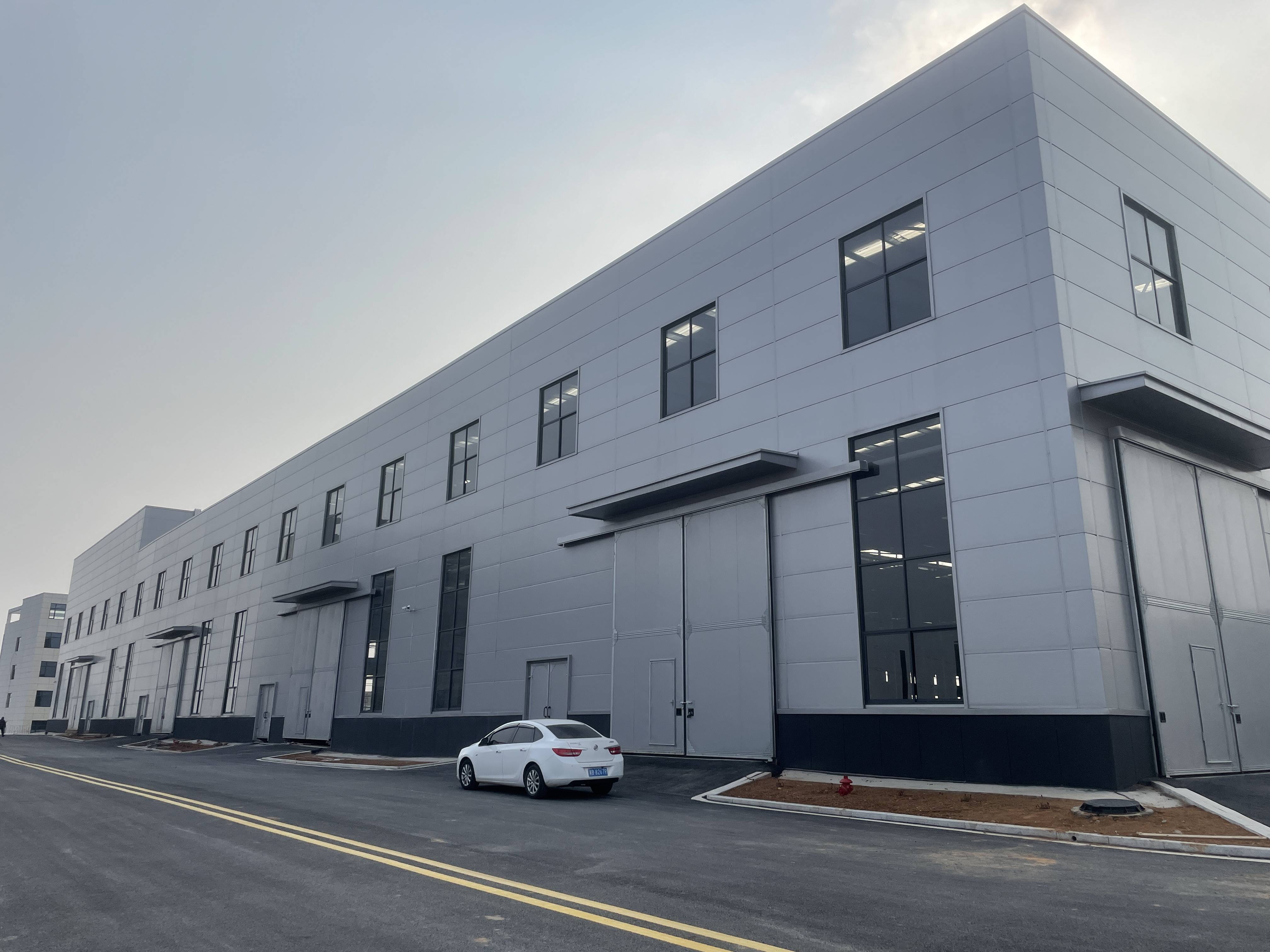

China's Prefab Steel Structure and Construction 2026 — Industrial Plants, Mega Venues, and Steel Bridges Reshaping the General-Contracting Tier
Research-institute long-form. Statistical cut-off uses 2025 annual reports, 2026 H1 listed-company disclosures, and industry-association data. Unsourced numbers are cross-checked against the China Steel Construction Society, the National Bureau of Statistics, listed-company annual filings, and English primary sources (Nucor 10-K, Steel Dynamics 10-K, Tata Steel construction segment, SSAB Capital Markets Day, Nikkei Asia, Reuters, Engineering News-Record). For upstream steel mill capacity and emissions, see the sister reports on China Steel 2026 and China Special Steel 2026. Research cut-off: end of June 2026.
Steel structures have been retold many times in China's decade-long infrastructure narrative — first after the 2008 "Four Trillion" stimulus, then with the 2015 prefab-building national plan, then around 2020 with the semiconductor fab boom, then again from 2022 with lithium battery and photovoltaic facility build-outs, and most recently in 2024 with data centres and AI compute parks. All five waves stress-tested not the steel mills but the general-contracting layer — design integration, fabrication, transport, on-site erection, coating, smart prefabrication. This report zooms one level downstream from raw steel into the steel-structure general-contracting tier, pairing six leading Chinese contractors (Honglu, Hangxiao, Sunyo / Jinggong, Southeast Spaceframe, Fuhuang, China Railway Industry's bridge division) with six international peers (Nucor, Steel Dynamics, Tata Steel construction, SSAB, Cleveland-Cliffs, ArcelorMittal Europe construction). Downstream demand is decomposed into five vertical scenes — industrial plants (fabs, lithium lines, PV plants, data centres, EV assembly), mega venues (airports, Asian Games / Winter Games stadia, high-speed rail stations, expo centres), steel bridges (cross-sea, Yangtze long-span, urban elevated), multi-storey prefab steel housing, and offshore platforms (jackets, floating wind foundations). Each downstream has its own process focus, and each focus maps to a distinct capability tier in the contractor field.
1. Industry Overview — 2025 China Steel-Structure Output and Prefab Penetration
China produced about 132 million tonnes of steel structure in 2025, up 11.9% from 118 million tonnes in 2024. The 2015 baseline was around 51 million tonnes, so the ten-year CAGR is roughly 10.0% — nearly three times the 2.6% CAGR for crude steel over the same period. In 2015, only about 6.5% of China's crude-steel output flowed into steel-structure end use; in 2025 the share has reached 12.8%.
Prefab penetration in newly started building floor area reached 35.6% in 2025 per the Ministry of Housing and Urban-Rural Development (MOHURD). Steel-structure prefab is 11.7%, concrete prefab 21.4%, timber and hybrid 2.5%. The steel-structure share of total prefab is just under one third. But once industrial buildings are isolated, steel structure jumps to 78.4%. That is the operative fact — in industrial buildings, mega-span venues, and bridges, steel structure is the default; in multi-storey residential, concrete prefab still dominates.
National Bureau of Statistics data put 2025 total construction-industry output at 33.7 trillion yuan, of which steel-structure-linked output is about 2.81 trillion yuan or 8.3% (versus 4.1% in 2015). Within steel-structure output, industrial plants take 41.2%, mega public buildings (venues, airports, HSR stations) 22.6%, bridges 11.3%, residential 9.8%, and other (offshore, towers, equipment structures) 15.1%.
Industrial plants decompose further: semiconductor fabs and panel plants 16.9% of the industrial-plant slice, lithium battery lines 21.7%, PV modules and polysilicon 12.1%, data centres and compute parks 9.7%, EV assembly and supplier plants 13.6%, traditional manufacturing (machinery, appliances, light industry, textiles, food, pharma) 25.9%. The five emerging downstreams (semis, lithium, PV, data centres, EV) sum to 74.1% of industrial-plant steel; five years ago that share was 38.2%. This is the single most consequential variable in industrial-plant steel demand since 2020.
Globally, 2025 US steel-structure output is about 18.5 million tonnes, EU 19.8 million, Japan 8.7 million, India 9.2 million, Southeast Asia combined 7.4 million. China alone is 64% of global steel-structure output, up from 48% in 2015. China is also the largest exporter — 4.78 million tonnes of steel-structure products (finished members, semi-finished members, modular building units) shipped in 2025, up 20.7% from 3.96 million tonnes in 2024. Major destinations: Saudi Arabia, UAE, Indonesia, Malaysia, Philippines, Vietnam, Mexico.
Two structural shifts shaped the decade. First, around 2018, industrial plants switched from "concrete frame plus local steel roof" to "all-steel frame plus roof and wall panels", driven by the net-span, vibration-control, and schedule demands of fabs, panel lines, and lithium lines. Honglu and Jinggong, both specialised in industrial plants, captured most of the order flow. Second, from 2022, dense openings of cross-sea links and Yangtze long-span bridges pushed steel box girder and steel truss demand to a new level — China Railway Industry's three bridge subsidiaries (Shanqiao, Baoqiao, Keji) collectively scaled from about 1.1 million tonnes in 2020 to about 2.6 million tonnes in 2025.
The top twenty Chinese contractors by 2025 output: Honglu 4.82 million tonnes (3.65% market share), Jinggong 1.56 million, Hangxiao 1.38 million, Southeast Spaceframe 1.19 million, Fuhuang 0.91 million; six to ten places — China Construction Steel (about 0.87 million, mostly captive within the China State Construction group), China Railway Industry bridge division 0.83 million (mostly captive), China Metallurgical Steel 0.76 million, Handebang 0.69 million, Anhui Fuhuang 0.62 million; eleven to twenty places contribute another 3.77 million combined. The top-twenty CR20 reaches only 13.8%, well below the US (Nucor + Steel Dynamics + Cleveland-Cliffs + Commercial Metals + Reliance Steel CR5 already over 45%). Headroom for consolidation is substantial.
On the Tianxia Gongchang side, the platform's industrial-plant database holds field-verified records on 4.8 million producing factories — covering steel-structure contractors, member fabrication, anti-corrosion coating, mechanical and electrical installation, and smart prefab — and differs from generic business-registry tools in that it strictly excludes pure trading shells and indexes each factory by product and process rather than by self-reported scope. To survey the downstream supply chain of welding, coating, design integration, transport, lifting, and M&E installation, search by keyword on the platform — steel structure or welding fabrication.
Some underappreciated numbers: 4,860 firms hold the Class I qualification for steel-structure professional contracting in 2025, with another 18,920 at Class II. Among Class I holders, fewer than 280 actually possess complete EPC capability (design + fabrication + general contracting). Capacity is dispersed but EPC capability is concentrated — the foundation for the consolidation thesis later in this report.
Decomposing the 11.9% 2025 growth: volume grew 8.6% and average price per tonne 3.0% (raw steel up 4.5%, fabrication margin up 3.9%). Industrial plants contributed 62% of the increment, mega public buildings 18%, bridges 9%, residential 4%, and other 7%. Within industrial plants, the five emerging downstreams contributed 84% of the increment. The growth engine has clearly narrowed from "general industrialisation" to "advanced-manufacturing capacity expansion."
International concentration benchmarks: US CR5 about 45%, EU 38%, Japan 52%, India 31%, China 7.4%. China's lower concentration reflects sheer market size (33.7 trillion yuan construction output is 5x the US, 7x Japan, 3x the EU) — even billion-tonne players capture only single-digit share. Bain & Company's 2025 China Construction Industry Report forecasts a 7.2–8.6% CAGR for China's steel-structure and prefab-building sector over the next decade, well above the 3.2–4.5% baseline for total construction, driven by advanced manufacturing, prefab policy, the East Data West Compute initiative, and Belt and Road exports. McKinsey Global Construction Report 2025 calls this segment "one of the most active sub-tracks in global construction" and expects Chinese players to anchor global steel-structure consolidation through the 2030s.
Among 2025 listed steel-structure issuers, Honglu's share price gained 38.4%, Jinggong 24.6%, Hangxiao 18.2%, Southeast Spaceframe 14.8%, Fuhuang 12.4%, China Railway Industry 28.6% — versus SSE +8.4%, SZSE +11.2%, Industrial Index +13.6%. Steel-structure issuers visibly outperformed broader benchmarks on the back of the three drivers: prefab construction, smart-manufacturing transition, and overseas exports.
2. Engineering Categories — Industrial Plants, Mega Venues, Steel Bridges, Multi-Storey Housing, Offshore Platforms
Industrial plants consumed about 54.4 million tonnes in 2025 (41.2% of total). Decomposing: semiconductor fabs and panel plants 9.2 million tonnes, lithium 11.8 million, PV plants 6.6 million, data centres 5.3 million, EV assembly 7.4 million, traditional manufacturing 14.1 million. The first five emerging verticals total 40.3 million tonnes (74.1% of industrial plants, versus 38.2% in 2020).
Geographically — Yangtze River Delta (Jiangsu, Zhejiang, Shanghai, Anhui) 18.2 million tonnes, Pearl River Delta (Guangdong, Fujian) 9.2 million, Bohai Rim (Beijing, Tianjin, Hebei) 5.8 million, Chengdu-Chongqing 5.4 million, Wuhan metro 4.1 million, Zhengzhou metro 3.8 million, Changsha metro 2.4 million, Northeast 3.1 million, Northwest 1.3 million, Southwest 1.1 million. Emerging downstreams cluster even more tightly — 78% of fab demand is in the Yangtze and Pearl deltas, 65% of lithium lines in the Yangtze delta and Chengdu-Chongqing, 60% of PV in the Yangtze delta and Northwest, 62% of data centres in Bohai Rim and Yangtze delta, 71% of EV assembly in Yangtze and Pearl deltas.
Mega public buildings consumed 29.8 million tonnes (22.6%). Within that: airports 5.4 million (Hangzhou Xiaoshan T3, Guangzhou Baiyun T3, Shenzhen expansion, Shanghai Pudong T5), high-speed rail stations 6.2 million (Xiongan, Guangzhou Baiyun, Shanghai East), Asian / Winter Games venues 3.8 million, expo centres 2.7 million, culture and museums 5.1 million, other 6.6 million. Mega public buildings use 30,000–80,000 tonnes per project — the hardest test of design integration, oversize-member fabrication and transport, and erection planning.
Airport and HSR roof systems mostly use long-span spatial steel — plane trusses (80–120 m), 3D pipe trusses (100–180 m), suspen-domes / cable-stayed beams (60–150 m), spatial grids (60–100 m), shells (80–250 m). Guangzhou Baiyun T3's main roof uses a 3D pipe-truss system spanning 120 m, with a roof footprint of about 280,000 m², 62,000 tonnes of steel, maximum members at φ900×40 mm and 32 tonnes per piece. Such projects take 36–48 months from design to delivery.
Bridges consumed 14.9 million tonnes (11.3%). Cross-sea links (Shenzhen-Zhongshan Phase II, Qiongzhou Strait, Zhoudai Bridge expansion, Pearl River Estuary cluster) 4.8 million; Yangtze long-span (Wuhan, Jiujiang, Wuhu, Chizhou, Chongming) 3.9 million; urban elevated 3.5 million; conventional road and rail 2.7 million. Steel box girders account for 70%, steel trusses 20%, arches 10%.
A modern suspension bridge with main span over 800 m uses streamlined steel box girders, 12–18 m per segment, 280–450 tonnes per segment, 60–120 total segments. Each segment requires factory welding plus coating plus trial assembly before barging out for crane erection. Tolerances run in millimetres — main cable axis ±20 mm, girder segment offset ±5 mm, weld misalignment ±2 mm. China Railway Shanqiao's box-girder segments for the Shenzhen-Zhongshan Lingdingyang Bridge take roughly 25 days welding, 18 days coating, 12 days trial assembly per segment, for 55-day cycle time.
Multi-storey steel-structure housing used 12.9 million tonnes (9.8%). Volume tripled from 5.1 million tonnes in 2020 — a 20.4% CAGR — but penetration into newly started residential is only 4.8%, far below Japan's 28% or the US's 22%. The bottleneck is the envelope system (wall panels, sound insulation, fire rating, thermal bridges), not the structural frame itself.
Japan's envelope ecosystem has matured over forty years — ALC autoclaved aerated concrete panels with dry-hung stone or curtain walls externally, light-gauge steel framing with gypsum and rock wool internally, steel deck with cast-in-place concrete and floating floors, metal roofing with insulation. The system is 90% factory-prefabricated, with each floor erected in 5–7 days. China is roughly at Japan's 1990 maturity level — site bricklaying or panel hanging dominates external walls, sound insulation under-performs, floating floors are immature, roofing durability is weak.
Offshore platforms consumed 7.5 million tonnes (5.7%). Fixed jackets (oil and gas, offshore substations) 3.5 million; floating wind foundations 1.8 million (close to zero in 2020); FPSO and FLNG modules 1.4 million; other modules 0.8 million. Floating wind is the largest new variable, projected to reach 6 million tonnes per year by 2030.
Other structures (towers, equipment fabrications, special structures) consumed 20.2 million tonnes (15.1%). Wind tower tubes 5.8 million, transmission towers 3.2 million, equipment fabrications (chemical columns, tanks, silos) 6.9 million, special structures (radomes, satellite ground stations, accelerator bases) 4.3 million.
Internationally — Nucor's 2025 steel-structure related revenue (Vulcraft + Verco + Buildings Group + Bar Mill product) is about USD 14.2 billion at 11.2% operating margin; Steel Dynamics about USD 3.8 billion at 9.8%; Tata Steel construction systems about USD 2.7 billion at 7.4%; SSAB high-strength construction about USD 3.1 billion at 13.6%; Cleveland-Cliffs construction about USD 2.2 billion; ArcelorMittal Europe construction about USD 8.9 billion. The six combined reach USD 32.7 billion against the top ten Chinese listed steel-structure issuers at about USD 25.4 billion equivalent. China leads on aggregate output but average revenue per major overseas player is USD 5.4 billion versus USD 2.5 billion for the top-ten Chinese listed issuers — meaningful consolidation room.
3. Process Barriers — H-Sections, Welding, Coating, BIM-Driven Smart Prefab
Steel-structure process barriers come in four layers: sections, welding, coating, smart prefabrication.
H-section steel is the base. 2025 China H-section output reached 42.8 million tonnes, 32.4% of steel-structure member tonnage. Hot-rolled H-sections come primarily from Magang, Laigang, Bayi, Tanggang at sizes from HW 100×100×6×8 up to HW 400×400×13×21. Welded H-sections are fabricated by structure contractors themselves, with flange widths up to 1,500 mm and web heights up to 4,000 mm. Honglu, Jinggong and other tier-one players run welded H-section lines above 1 million tonnes per year.
Welding is the core process. A 5,000-tonne steel-structure plant carries about 280,000 m of weld; an 80,000-tonne steel bridge can exceed 3.5 million m. Four main methods — submerged-arc welding (SAW), gas metal arc welding (GMAW), flux-cored arc welding (FCAW), shielded metal arc welding (SMAW). SAW handles thick-plate long straight welds and is the workhorse of factory shops; GMAW and FCAW cover site welding and odd-shaped joints; SMAW is for repairs. Tier-one Chinese contractors run weld first-pass acceptance above 99.2%, but bridge-grade requirements (100% UT plus MT plus RT inspection) raise the bar substantially.
Internationally — IHI Engineering and JFE Engineering use narrow-gap SAW for bridges and offshore work, narrowing the groove from 60–70° down to 8–12°, cutting filler metal 60–75% and welding hours 40–55%, and improving weld toughness through reduced heat input. China's leading contractors began importing the technology around 2018; today China Railway Shanqiao, Baoqiao, and Guangzhou Shipyard International have mastered it but application stays inside high-end bridge and offshore work.
Coating is the most underrated process. A bridge in marine atmosphere with 100-year design life needs a coating system rated for 30 years before first major refit. The standard build: SA 2.5 blast cleaning + 70–80 µm zinc-rich primer + 80–120 µm epoxy mica intermediate + 80–100 µm polyurethane or fluoropolymer topcoat, for 250–320 µm dry film. The five global brands — PPG, Sherwin-Williams, Hempel, Jotun, AkzoNobel — dominate. Chinese players include HaiHong Lao Ren, Maca Coatings, Nippon Industrial, Oriental Yuhong's coatings division. Tier-one contractors have invested in robotic spray booths with humidity and temperature control, raising first-pass coating acceptance from 92% to 98%.
BIM-driven smart prefabrication is the most consequential process shift of the past five years. BIM plus Tekla Structures plus Revit plus ArchiCAD has lifted steel structure from drawings + NC machinery into 3D model + NC fabrication + RFID tracking + on-site scan-and-install. The Honglu smart workshop flow — BIM model exports NC codes → CNC plasma or flame cutting → CNC drilling → CNC assembly → CNC SAW welding → automated spray line → RFID tagging → smart warehousing → site barcode hoisting — cuts manual interventions from twelve down to three, and labour hours from 5.8 down to 2.1 per tonne.
Key equipment for smart fabrication: six-axis CNC welding robots from suppliers including Shanghai Fanuc, Anhui Efort, Guangzhou CNC, SIASUN domestically, and ABB, Yaskawa, KUKA, Fanuc internationally. A six-axis cell costs about RMB 280,000 to 650,000; with power source, positioner, and vision integration the full line runs RMB 1.8–3.2 million. Honglu's 2025 annual report discloses 1,860 CNC welding robots across all bases — the most automated in the sector.
Within the four-layer process stack, China's gap to advanced economies has narrowed from "visibly behind" in 2015 to "comparable peer" in 2025. The remaining gap concentrates in highest-end work — Q500qE bridge steel narrow-gap SAW, underwater welding for offshore platforms, the composite columns inside super-tall buildings — where leading Chinese contractors still trail Japan's IHI, JFE Engineering, and Nippon Steel Engineering by roughly a generation.
To survey the welding and coating supply chain end to end, run keyword searches on the platform — steel-structure coating and related links.
4. Major Players — Six Chinese Versus Six International Side by Side
Honglu Steel Structure is the unambiguous Chinese leader. 2025 output 4.82 million tonnes, revenue RMB 28.7 billion, net profit RMB 1.86 billion (6.5% net margin), nameplate capacity 5.8 million tonnes (83.1% utilisation). The competitive moat is the "national capacity matrix" — 24 production bases across Hefei, Guoyang, Jinzhai, Runan, Shanghai Jinshan, Henan Puyang, Anhui Xuancheng, Chongqing Qijiang, Hubei Huanggang, Guizhou Zunyi, Anhui Hanshan and more, averaging 240,000 tonnes per base. The "many bases, short hauls" layout compresses transport radius from the industry average of 800 km down to 380 km and freight share of total cost from 6.8% down to 3.2%. Honglu's 2025 customer mix: industrial plants 68.4% (fabs 18.2%, lithium 19.7%, PV 10.3%, data centres 7.8%, EV 12.4%), mega public buildings 14.6%, bridges 4.2%, residential 6.8%, other 6.0%.
Jinggong Steel Structure is second. 2025 output 1.56 million tonnes, revenue RMB 13.4 billion, net profit RMB 680 million (5.1% net margin). The company leads in mega public buildings — Hangzhou Olympic tennis centre, Hangzhou Xiaoshan T3, Guangzhou Baiyun T3, Shanghai Pudong T5 all sit in its portfolio. 2025 customer mix: mega public buildings 38.2%, industrial plants 41.6%, bridges 7.4%, residential 4.8%, other 8.0%. EPC business reached 22.4% of revenue in 2025 with a 23.6% gross margin versus 13.8% for plain fabrication-supply work, and the company targets 40% EPC mix by 2030.
Hangxiao Steel Structure pioneered multi-storey steel-structure housing. 2025 output 1.38 million tonnes, revenue RMB 9.2 billion, net profit RMB 420 million (4.6% net margin). The company has developed concrete-filled steel tube shear wall bundles since 2003 and built China's tallest steel-structure residential at 36 storeys. 2025 customer mix: residential 52.4%, industrial plants 28.6%, other 19.0%. The concrete-filled tube bundle system lifts load capacity 50–80% and ductility about 100% versus reinforced concrete shear walls, with 30–40% faster site cycles.
Southeast Spaceframe leads in long-span roof systems. 2025 output 1.19 million tonnes, revenue RMB 7.8 billion, net profit RMB 340 million (4.4% net margin). Shenzhen Universiade Centre, Guangzhou Asian Games Composite Hall, Shanghai National Convention Centre — the roof grids on all of those carry Southeast's signature. Maximum single span: 350 m (Hangzhou Olympic retractable tennis roof). The smart long-span erection monitoring system tracks stress, displacement, temperature at every node in real time.
Fuhuang Steel Structure serves industrial plants and rail-transit ancillaries. 2025 output 0.91 million tonnes, revenue RMB 6.2 billion, net profit RMB 280 million (4.5% net margin). Main customers include the Hefei BOE panel plant, Hefei ChangXin Memory fab, Hefei NIO assembly — geographic proximity to the Yangtze delta and central China is the strategic edge.
China Railway Industry's bridge division (Shanqiao + Baoqiao + Keji) is the unambiguous leader in steel bridges. 2025 combined output 0.83 million tonnes (captive consumption excluded), bridge-segment revenue about RMB 15.6 billion, net profit RMB 1.32 billion (8.5% net margin — higher than industrial plant work). The division has executed roughly 70% of China's Yangtze long-span and cross-sea bridge steel work, including Shenzhen-Zhongshan, Zhoudai, Pearl River Estuary cluster.
Pivoting overseas — Nucor, the largest US integrated steelmaker and largest US steel-structure contractor, reported 2025 total revenue of about USD 31.2 billion, with Vulcraft + Verco + Buildings Group + Steel Bars business combined at USD 14.2 billion and 11.2% operating margin. Nucor's model is "electric-arc short-process steelmaking plus steel-structure contracting integration."
Steel Dynamics is the second-largest US EAF steelmaker. 2025 total revenue USD 16.8 billion, with New Millennium Building Systems and OmniSource scrap operations combining at USD 3.8 billion and 9.8% operating margin.
Tata Steel UK's joint ventures (Tata BlueScope, Tata Pravesh, Tata Nest-In) cover India, Southeast Asia, Australia, UK, and North Africa. 2025 construction-systems revenue about USD 2.7 billion at 7.4% operating margin. Tata Pravesh prefab doors-and-windows and Tata Nest-In modular building are growing at 30%+ CAGR, with 2025 combined revenue about USD 860 million.
SSAB makes high-strength construction steel through Hardox and Strenx. 2025 high-strength construction revenue USD 3.1 billion at 13.6% operating margin, well above commodity-grade peers. SSAB's May 2025 Capital Markets Day disclosed plans for commercial HYBRIT green steel by 2030, implying a USD 200–400 per tonne premium on Hardox and Strenx going forward.
Cleveland-Cliffs entered high-end auto sheet and structure markets through its 2020 acquisitions of AK Steel and ArcelorMittal USA. 2025 construction-steel revenue about USD 2.2 billion.
ArcelorMittal Europe's construction segment is Europe's largest steel-structure supplier. 2025 revenue USD 8.9 billion, covering France, Germany, Spain, Poland, Czechia, Romania. With CBAM fully in force, the company expects to gain a EUR 130–180 per tonne implicit carbon-tariff advantage versus Chinese, Indian, and Turkish imports.
Six overseas players sum to about USD 34.9 billion in steel-structure-related revenue; six leading Chinese listed contractors sum to about RMB 102.9 billion (USD 14.4 billion). Average per company overseas is USD 5.8 billion, versus USD 2.4 billion domestically. The size gap is real, but Chinese output of 132 million tonnes is itself a multiple of US + EU + Japan combined.
To investigate which Chinese mid-size contractors actually have the experience to build a fab or an EV assembly plant, run keyword searches such as steel-structure plant or steel-structure general contracting and filter on the platform.
5. Downstream 1 — Industrial Plants: Fabs, Lithium Lines, PV Modules, Data Centres
Industrial plants are the largest single downstream, consuming 54.4 million tonnes in 2025.
A typical 12-inch semiconductor fab (50,000 wafers/month) occupies about 180,000 m² of plant area and consumes 120,000 tonnes of steel. Technical demands run tight — clean-room net span 24–36 m, net height 7–9 m, vibration control at NIST-A (peak velocity ≤6.25 µm/s), temperature ±0.1°C, humidity ±2%. Vibration control is the hardest design challenge — traditional concrete frames damp at about 5%, so steel-structure designers must reach the same effective performance through composite floors (steel beams + profiled deck + concrete), roof layering, and isolation platforms beneath process equipment. Honglu, Jinggong, China Construction Steel and Baoye Steel broke through these requirements after 2018.
In 2025 China started about 14 new 12-inch fabs (SMIC Shenzhen Phase II, SMIC Capital Phase II, Hua Hong Wuxi Phase IV, ChangXin Memory Hefei Phase III, YMTC Wuhan Phase III, Hefei JingHe Phase II, ATMC Lin'gang Phase II, Silan Xiamen Phase II, CR Micro Chongqing Phase III, Wentai Kunshan Phase I, Yandong Micro Beijing Phase II, GTA Guangzhou Phase III, others), consuming about 1.68 million tonnes of steel collectively. 8-inch and packaging combined add another 2.2 million tonnes — semiconductor plant total 9.2 million.
Lithium plants saw the fastest 2022-onwards growth in industrial steel demand. A 30 GWh lithium battery plant occupies about 260,000 m² and consumes 160,000 tonnes of steel. Process demands: clean-room ±2°C ±5%, ExdII BT4 explosion-proof rating, 1,000 kg/m² floor loading, 30–50 tonne crane capacity. The special twist is the dry room — electrode and assembly stages need dew points down to -40°C, sometimes -60°C in formation rooms. Envelope sealing must hold air-change rate ≤0.5 per hour versus 5–10 per hour for ordinary industrial plants. Lithium plant steel-structure costs run 35–45% above standard industrial plants because of this.
In 2025 China started about 36 GWh-scale lithium plants (CATL Fuding Phase II, CATL Luoyang Phase I, BYD Hezhou Phase I, EVE Chengdu Phase I, Gotion Wuhu Phase III, Sunwoda Nanjing Phase I, Farasis Yunnan Phase I, CALB Xiamen Phase II, SVOLT Chengdu Phase I, Envision Ordos Phase II, others), consuming about 5.8 million tonnes. Cathode, anode, electrolyte, separator suppliers add another 2.4 million — full lithium chain 8.2 million tonnes.
PV module plants went through over-capacity adjustment in 2024-2025, sharply curbing new starts. 2025 saw about 18 new GW-scale module plants (about 220 GW nameplate added) consuming 2.8 million tonnes. Polysilicon, wafer, and cell plants add another 3.8 million — PV chain 6.6 million.
Data centres are the explosive variable from 2024. A large liquid-cooled centre (15,000 racks, 30 MW IT load) occupies 140,000 m² and consumes 72,000 tonnes of steel. Net height 4.5–6 m, floor loading 1,500 kg/m², strict EMC shielding, ±1°C climate control. 2025 saw about 78 new compute centre starts, 32 of them super-large (≥3 MW per building), consuming 5.3 million tonnes — versus only 800,000 tonnes in 2020. A 6.6x lift in five years.
EV assembly plants are the largest single facilities. A 300,000-vehicle line occupies 400,000 m² (stamping + welding + paint + general assembly) and uses 220,000 tonnes of steel. 2025 saw about 24 new plant starts (about 5.8 million annual vehicle capacity) using 4.8 million tonnes. Component plants add another 2.6 million — auto chain 7.4 million.
The stamping bay carries 4,000–8,000 tonne presses, demanding 5,000–8,000 kg/m² floor loading and dense 12×24 m column grids; welding bays use 18×36 m grids; paint bays combine clean-room, explosion-proof, anti-corrosion, ventilation, climate-control requirements with 18×24 m grids; general assembly runs 24×36 m grids. The contractor must reconcile all four bays' divergent process demands.
To survey the industrial-plant supply chain end to end, search by keyword on the platform — semiconductor plant or lithium battery plant or data centre.
6. Downstream 2 — Mega Venues and Prefab Housing
Mega venues consumed 29.8 million tonnes in 2025. Airports 5.4 million, HSR stations 6.2 million, Asian / Winter Games venues 3.8 million, expo centres 2.7 million, culture and museums 5.1 million, other 6.6 million.
Guangzhou Baiyun T3 — 3D pipe truss plus suspen-dome composite roof, 220 m span, 280,000 m² footprint, 62,000 tonnes of steel, 32-tonne maximum single piece, 56 m lift height. The roof comprises 380 standard pipe segments, 1,860 nodes, 4,280 chords. Erection strategy: ground-level segmented assembly plus high-altitude accumulated sliding — 24 segments built on ground, slid into final position by four 1,000-tonne hydraulic pushers, closed at altitude. The full erection cycle took 18 months.
Xiongan Station, Guangzhou Baiyun Station, Shanghai East, Beijing Fengtai, Hangzhou West, Shenzhen Xili, Changsha West, Chengdu East Phase II, Wuhan East, Hefei South Phase II, Jinan East, Qingdao North Phase II — all use long-span steel-structure roofs. Xiongan 48,000 tonnes, Guangzhou Baiyun 62,000 tonnes, Shanghai East 74,000 tonnes. Main contractors: China Railway Construction, China Railway Electrification, China Construction Eighth Engineering Division.
Asian / Winter Games venues used 3.8 million tonnes in 2025. The Hangzhou 19th Asian Games had 56 venues with 78% using steel structure, totalling 14.2 million tonnes; Beijing Winter Olympics refits 320,000 tonnes; 2026 Greater Bay Area Games venues 16.8 million tonnes.
Multi-storey steel-structure housing consumed 12.9 million tonnes in 2025. Adoption faces three frictions — (1) civil engineers have decades more concrete experience than steel; design fees for steel structure run 30–50% above concrete; (2) envelope industrialisation and standardisation (external wall panels, partitions, floors) is still immature, so site labour does not actually fall; (3) sound insulation, thermal performance, fire and moisture protection are still being educated to consumers.
Sekisui House delivered 48,000 steel-structure residential units in Japan in 2025; Daiwa House Industry 36,000; Sekisui Chemical 24,000. The strength of Japanese players is the "steel frame + envelope + interior + smart home" integrated solution from order to handover in 60–90 days — multiples faster than a typical Chinese concrete-residential 12–18 month cycle.
But Chinese leaders are breaking through. Hangxiao's concrete-filled tube bundle system has shipped multiple 30-storey-plus residential projects across Hangzhou, Ningbo, Shanghai, Wenzhou, Hefei. China Construction Science & Industry's integrated prefab solution has pilots in Shenzhen, Xiongan, Beijing. Beijing Construction's green low-carbon residential line has commercial sales in Fengtai and Yizhuang.
MOHURD's 2025 Guidelines on High-Quality Development of Steel-Structure Residential targets 15% steel-residential share of new starts by 2030 (versus 4.8% today) and 25% by 2035. Volume would scale from 12.9 million tonnes in 2025 to about 65 million tonnes by 2035 — a 5x lift over a decade.
To survey envelope, partition, floor, integrated bath, integrated kitchen suppliers, search the platform — prefab construction, ALC wall panel, integrated bathroom.
7. Tianxia Gongchang Research View — Cross-Filtering the Steel-Structure Supply Chain by Process and Downstream
The platform — first introduced in Section 1 — differs from generic business-registry tools by indexing each producing factory along product, process, geography, and scale rather than self-reported scope. The first such use here, embedded with the explainer, is part of a deliberate cross-reference design in this report.
Steel-structure supply chains are not a single line "upstream steel → contractor → project" — they form a web. The vendor decision on a given project must reconcile downstream use case (semiconductor clean room vs mega venue vs bridge), construction phase (design integration vs factory fabrication vs site erection vs coating), technical demand (net span vs vibration control vs corrosion grade vs seismic class), and geography (transport radius vs local resources vs government relationships). Single-dimension filters cannot answer the project-vendor question.
Concrete scenario one — a semiconductor company plans a new 12-inch fab in Hefei and needs 3–5 contractors meeting (i) demonstrated fab or panel-plant work in the past five years; (ii) own capacity ≥150,000 tonnes/year; (iii) within 500 km of the site; (iv) BIM smart-prefab capability; (v) full EPC qualification. The platform's compound filter returns a list of seven candidates — Honglu (Hefei local), Anhui Fuhuang (Hefei), Shanghai Baoye (Shanghai), Jinggong (Shaoxing), Southeast Spaceframe (Hangzhou), China Construction Steel East China (Nanjing), China Metallurgical Steel (Maanshan) — with each candidate's capacity, past work, current backlog, and credentials. Versus the traditional path of phone calls plus office visits plus trade shows, the lift is at least 10x.
Concrete scenario two — an infrastructure investor needs steel box-girder fabricators on a Guangdong cross-sea bridge with (i) Q420qE and Q500qE welding qualification; (ii) segment fabrication and on-site assembly capacity ≥3,000 tonnes; (iii) underwater coating; (iv) at least three cross-sea bridge projects in the last decade. Traditional research would consume months; the platform returns 5–8 candidates — China Railway Shanqiao, China Railway Baoqiao, China Railway Keji, GSI, Shanghai Zhenhua Heavy Industries — with detailed credentials.
The platform's other distinguishing capability is "cross-chain filtering." An EV assembly project needs not just a steel-structure contractor but also clean-room systems, compressed-air, water purification, HVAC, fire, smart-low-current, M&E, and interior — a dozen specialty general contractors in parallel. The platform can produce a candidate list for all of them in one query and cross-match by geography, prior collaboration, and credentials.
Scenario three — an offshore wind developer plans a 1,000 MW farm in Fujian and needs floating wind foundation fabricators with capacity for 4,000+ tonnes per unit, semi-submersible or TLP design, 25-year marine corrosion resistance, ≤6-month per-unit cycle. The platform returns Huisheng Offshore (Nantong), CIMC Raffles (Yantai), Dalian Shipbuilding, COOEC (Qingdao and Tianjin), GSI, China Merchants Heavy Industry, Shanghai Zhenhua Heavy Industries, Fujian Shipbuilding — eight viable candidates, each with quay condition, crane capacity, prior work, and live backlog.
Scenario four — researching a western Chinese province's PV module cluster, the platform supports "downstream-up" reverse analysis: listing all in-progress, planned, and built module plants in the province → mapping the implied steel demand → identifying contractors within 300 km that have prior PV plant experience → reading their utilisation, current backlog, recent contracts. The reverse lens supports provincial investment promotion, sector-association planning, and listed-company supply-chain decisions.
To exercise the platform's compound filters in person, search for Honglu Steel Structure or China Railway Shanqiao or steel box girder.
8. Overseas Exports — Southeast Asia, Middle East, Belt and Road EPC
2025 Chinese steel-structure exports reached 4.78 million tonnes, up 20.7% from 3.96 million in 2024. The mix: finished members 58.4%, semi-finished 32.6%, modular buildings 9.0%. Total export value about RMB 46.2 billion (USD 6.4 billion); average unit price RMB 9,670/tonne, about 14% above the domestic equivalent.
Geographic distribution: Saudi Arabia 870,000 tonnes (18.2%), UAE 620,000 (13.0%), Indonesia 540,000 (11.3%), Malaysia 380,000 (7.9%), Philippines 320,000 (6.7%), Vietnam 280,000 (5.9%), Mexico 240,000 (5.0%), Qatar 180,000 (3.8%), others 1.35 million. Middle East plus Southeast Asia = 67.2% of exports.
Middle East flow is driven by Vision 2030 mega projects. NEOM new city (USD 500 billion), The Line linear city, Qiddiya entertainment complex, Red Sea Project; UAE's Dubai 2040 master plan, Etihad Rail, Hyperloop; Qatar's post-World Cup transition. Honglu set up a Riyadh hub with local agents and has won NEOM infrastructure work. Jinggong opened a Dubai office serving airport and convention work in the region.
NEOM detail — The Line alone needs about 2.8 million tonnes of structure (primary frame + internal divisions + facade backing). Chinese share on NEOM is currently 25–30%. The project's pace slowed from 2024 onwards under Saudi fiscal pressure, with the 2030 completion target plausibly slipping to 2035.
Southeast Asia is driven by China + 1 supply-chain relocation and Belt and Road infrastructure. Indonesia's Jakarta-Bandung extension, Sumatra industrial parks, Kalimantan new capital; Malaysia's East Coast Rail Link, Senai-Lebuh Tunnel, Port Klang expansion; Philippines' Luzon HSR, Manila airport expansion, Mindanao mining infrastructure; Vietnam's Ho Chi Minh metro, northern coastal industrial parks, China-Vietnam Friendship Pass expressway.
Indonesia Nusantara new capital — total programme about USD 34 billion through 2045, in three phases (2024-2028, 2029-2033, 2034-2045). The 56 km² core zone houses government offices, commercial, residential, airport, rail, hospital, and school. Phase one steel demand about 1.8 million tonnes; programme total about 9.2 million tonnes.
Under the Belt and Road frame, 2025 Chinese steel-structure firms' overseas EPC contract value reached about USD 7.8 billion, up 25.8% from USD 6.2 billion in 2024. Highlighted contracts: Saudi Riyadh metro extension (USD 1.2 billion), UAE Hyperloop (USD 620 million), Malaysia ECRL bridges and stations (USD 980 million), Philippine Mindanao mining infrastructure (USD 440 million), Pakistan Karakoram Highway upgrade (USD 360 million), Kenya Mombasa-Nairobi rail extension (USD 580 million), Tanzania Bagamoyo Port (USD 420 million).
Three frictions persist.
First, certification. US needs AISC, EU needs EN 1090 + CE marking, Japan JIS, Middle East often BS or ASTM. Initial certification budget per company runs USD 1.5–3.0 million plus USD 300,000–500,000 annual maintenance — a real barrier for SMEs.
Second, geopolitics and trade barriers. US anti-dumping plus countervailing duties run 25–150% (firm-specific); EU CBAM starts collecting in 2026 at EUR 130–180/tonne implicit carbon tariff; India and parts of Southeast Asia have 20–35% dumping duties. Addressable export market shrinks roughly 20–25% after these barriers.
Third, project execution risk. Local approval delays, unfavourable contract clauses, FX volatility, complex local labour law, cultural friction, safety incidents. Margins on overseas projects typically run 3–5 ppts below domestic.
Even so, exports remain the core path past China's domestic demand ceiling. Forecast 2026-2030 export CAGR 18–22%, reaching about 11 million tonnes by 2030.
9. Capacity Expansion — Honglu Wuxi, Anhui, Chongqing and Jinggong Changxing Decomposed
Honglu has expanded most aggressively over the past five years — from 2.8 million tonne capacity in 2020 to 5.8 million in 2025, a doubling. The 2026-2030 plan adds another 3.2 million to reach 9 million.
Wuxi base Phase II — H2 2026 commissioning, +600,000 tonnes capacity, RMB 1.86 billion capex, 880 mu of land, 280 CNC welding robots, six automated spray lines. Positioned as the Yangtze delta hub for semiconductor clean rooms and EV assembly.
Wuxi base strategy — the Suzhou-Wuxi-Changzhou metro is one of China's three semiconductor cores. 2025 active or planned: 8 fabs, 3 panel plants, 6 EV assembly plants in the metro, implying about 3.6 million tonnes of structure demand. Honglu Wuxi sits within 80 km average of these sites. Base equipment is configured for super-large clean-room work — 12 m crane clearance (vs typical 8 m), 36×8×6 m oversize spray booths, ±0.5 mm/3 m floor flatness for precision assembly.
Anhui Xuancheng base — Q4 2026 commissioning, +800,000 tonnes, RMB 2.24 billion capex, 1,180 mu, 360 CNC welding robots, 8 spray lines. The single largest base.
Chongqing Qijiang Phase III — Q2 2027 commissioning, +500,000 tonnes, RMB 1.48 billion capex, 760 mu. Serves Chengdu-Chongqing semiconductor, EV, and new-energy equipment downstreams. The Chengdu-Chongqing twin city has 16 GWh-scale lithium plants, 9 EV plants, 4 fabs, 12 large data centres planned for 2025 — about 4.8 million tonnes of structure demand. Honglu Qijiang Phase I + II + III combined reach 1 million tonnes capacity.
Hubei Huanggang Phase II — Q4 2027, +400,000 tonnes, RMB 1.22 billion, 620 mu.
Guizhou Zunyi Phase II — H1 2028, +300,000 tonnes, RMB 960 million, 480 mu.
Yunnan Kunming base — H2 2028, +350,000 tonnes, RMB 1.12 billion, 540 mu. Positioned as the China-ASEAN export hub. Kunming sits 750 km from Vientiane, 1,850 km from Yangon, 720 km from Hanoi, 1,980 km from Bangkok — China's best land gateway into Southeast Asia. The China-Laos railway opened 2021 cut Kunming-Vientiane freight time from 7 days to 30 hours. Honglu Kunming will configure EN 1090 CE, JIS, ASTM parallel lines for European, Japanese, US, and ASEAN markets simultaneously.
Six projects combined: 2026-2028 Honglu adds 2.95 million tonnes of capacity at RMB 8.88 billion total capex, with about RMB 680 million per year in incremental depreciation. Unit capex strength: about RMB 3,010 per tonne (vs RMB 2,680 per tonne in 2020), 12.3% higher mostly from rising automation share.
Jinggong has expanded more cautiously. 2020 capacity 1.1 million tonnes; 2025 1.68 million — 52.7% growth in five years. 2026-2030 plan adds another 800,000 to reach 2.48 million.
Changxing base Phase II — Q4 2026, +350,000 tonnes, RMB 1.16 billion capex, 540 mu. The Yangtze delta mega public buildings hub — built in 2017 for airport and HSR station work. Phase II adds 60 m clear-span fabrication shed, 12,000 m² truss pre-assembly bay, and a roof process R&D centre.
Hangzhou Xiaoshan base — H1 2027, +200,000 tonnes, RMB 740 million, 320 mu.
Shaoxing Shangyu Phase III — H2 2027, +250,000 tonnes, RMB 860 million, 380 mu.
Three Jinggong projects combined: 2026-2027 add 800,000 tonnes at RMB 2.76 billion total capex.
Industry total — about 5.8 million tonnes of new capacity coming online 2026-2028, taking 2028 industry capacity to about 151 million tonnes (versus 140 million in 2025). 2025 industry-average utilisation about 78%; with new capacity ramping into possibly softer demand, utilisation may dip to 70-72% in 2027-2028, a 6-8 ppt drop versus 2025. This becomes a key sensitivity for the risk section.
To survey CNC welding robots, automated spray lines, CNC cutters, and drilling machines, search the platform — welding robot, CNC cutting, spray line.
10. Pricing Cycle — Unit Fabrication Margins and Hot-Rolled Coil Cost Pass-Through
The cost stack for a steel-structure contractor: raw materials 72-78% (hot-rolled coil, H-sections, plate, welding consumables, fasteners, coatings), labour 12-15%, energy (power, gas, compressed air) 4-6%, depreciation 3-4%, other (transport, overhead, R&D, sales) 4-6%. Hot-rolled coil plus H-sections alone are 58-64% of total cost.
2025 average prices: hot-rolled coil RMB 3,680/tonne ex-mill (+4.5%); H-sections RMB 3,920/tonne (+5.6%); plate RMB 3,960/tonne (+5.1%); welding consumables RMB 18,200/tonne (+3.2%); anti-corrosion coatings RMB 32,500/tonne (+4.8%).
Industry-average fabrication margin (value added of fab + install + coat, ex raw material) was about RMB 1,850/tonne in 2025, up 3.9% from RMB 1,780/tonne in 2024. Honglu RMB 1,920, Jinggong RMB 2,240, Hangxiao RMB 2,080, Southeast Spaceframe RMB 2,160, China Railway Industry bridge division RMB 2,860.
By downstream — standard industrial plant RMB 1,280-1,480; semiconductor clean rooms RMB 2,680-3,280 (80-100% premium); lithium battery RMB 2,280-2,680; data centre RMB 2,080-2,380; EV assembly RMB 1,680-1,980; multi-storey residential RMB 1,480-1,680; mega public buildings RMB 2,680-3,680; standard bridge RMB 2,880-3,880; cross-sea bridge RMB 4,280-5,680.
Industry gross margin pattern in the past decade has been "upstream strong + contractors weak + big firms better + SMEs worse." 2025 industry gross margin 12.8%, net margin 4.6%. Leading contractors run materially above industry — Honglu 14.2%, Jinggong 16.8%, Hangxiao 15.4%, Southeast Spaceframe 15.9%, China Railway Industry bridge division 20.6%. SMEs (capacity < 50,000 tonnes/year) generally 8-11%.
Pass-through capability is relatively weak. Raw-material increases typically take 3-6 months to pass downstream, and only 60-75% transmits (10% raw rise → 6-7.5% finished rise). The fabrication-margin-over-steel-price ratio was about RMB 1,380/tonne in 2015, RMB 1,620 in 2020, RMB 1,850 in 2025 — a 34% rise over a decade or 3.0% CAGR. Per-tonne value added has risen slowly but consistently from smart-fab efficiency gains and detail-process upgrades.
Internationally, Nucor's fab margin runs roughly RMB 4,200/tonne (converted at June 2026 rates), ArcelorMittal Europe construction RMB 3,800, IHI Engineering RMB 4,800. China's leading players still trail at about half of overseas value-added per tonne — gap explained by overseas players' higher share of high-end products (bridge steel, offshore steel, high-strength construction steel), higher EPC general-contracting share (8-12 ppt margin uplift over plain fabrication-supply), and higher service-content share (BIM consulting, design integration, O&M support — 15-25% of revenue).
Chinese leaders are pushing in all three directions. Honglu's 2025 strategic update articulates "BIM smart fab + EPC + overseas" triple-driver; Jinggong commits to lift EPC share to 40% by 2030; China Railway Industry bridge division targets 25% overseas share by 2030.
11. Policy — Prefab Building National Plan, Dual Carbon, Belt and Road EPC
Policy thread one is the prefab building national plan. The 2016 State Council guideline targeted 30% prefab share of new starts within ten years; 2025 actual is 35.6%, beating the target by 5.6 ppts. MOHURD's new round targets 50% prefab by 2030 and 40% steel-structure share within prefab (vs 33% today). Extrapolated steel-structure prefab volume rises from about 47 million tonnes in 2025 to about 105 million by 2030 — a doubling in five years.
Local government incentives are key levers. Shanghai gives up to 3% FAR bonus and RMB 120/m² subsidies for compliant prefab steel residential since 2017; Beijing offers tax cuts, up to 5% land-fee discount, and RMB 500,000 per-project green certification subsidies since 2019; Shenzhen designates prefab steel as a green demonstration with up to RMB 2 million per-project support since 2020; Xiongan New Area mandates prefab construction for all government-invested projects since 2021, with steel-structure share ≥35%.
Policy thread two is the dual carbon target. Construction is China's largest single carbon source — 2025 total lifecycle building emissions about 5.3 billion tonnes CO2e, 42% of national total. Materialisation phase about 2.2 billion tonnes, operation 3.1 billion. Steel structures emit 30-40% less than concrete in materialisation (high steel recyclability, less site wet work, longer lifecycle).
A 100,000 m² mid-rise office building in concrete emits about 56,000 tonnes CO2e lifecycle (18,000 materialisation, 32,000 operation over 60 years, 6,000 demolition); in steel about 42,000 tonnes (15,000 materialisation, 24,000 operation, 3,000 demolition — steel recycle rate 95% vs concrete 50%). Steel lifecycle emissions run roughly 25% below concrete.
MOHURD's 2025 Carbon Peak Action Plan for Construction commits to near-zero-energy standards for new public buildings by 2030 and green low-carbon standards for industrial buildings.
Policy thread three is Belt and Road EPC. 2025 China–BRI partner EPC contracts totalled USD 128 billion, +18.5% versus USD 108 billion in 2024. Steel-structure-intensive projects are about 22% of those, implying about 2.82 million tonnes of structure exports. The November 2025 third BRI summit announced an RMB 800 billion programme through 2030; 25-30% expected to flow into infrastructure EPC, implying about 15 million tonnes of cumulative steel-structure exports.
Policy thread four is new-type urbanisation. Urbanisation rate 67.8% in 2025, targeted 75% by 2035 — about 100 million additional urban residents requiring residential, public service, and municipal infrastructure capacity. Steel structure as the "fast-build + industrial + low-carbon" representative will play a central role.
Policy thread five is the East Data West Compute compute-network programme. The 2022 NDRC initiative designated eight national compute hubs (Bohai Rim, Yangtze delta, Greater Bay, Chengdu-Chongqing, Inner Mongolia, Guizhou, Gansu, Ningxia). 2026-2030 forecast adds about 80 million m² of compute centre space, implying 45 million tonnes of steel-structure demand — about 9 million tonnes per year. The most certain incremental demand for the sector through 2030.
Combining all five threads, 2026-2030 sets up a fully favourable policy window. Prefab adoption, dual-carbon push, BRI exports, urbanisation, and compute build-out together lift total steel-structure demand from 132 million tonnes in 2025 to about 200 million by 2030, 8.6% CAGR.
But policy tailwinds do not lift all boats. Beneficiaries need (i) capacity ≥1 million tonnes/year; (ii) smart-fab capability (≥200 CNC welding robots, full BIM application); (iii) high-end project experience (fabs, cross-sea bridges, mega public buildings); (iv) capital strength (net assets ≥5 billion RMB, access to long-term low-cost funding); (v) overseas capability (key certifications). Probably fewer than 30 firms qualify on all five today. CR10 should rise from 9.4% in 2025 toward roughly 20% by 2030.
12. Tianxia Gongchang Research Judgment — 5-to-10-Year Window for Prefab Construction and Steel-Structure Restructuring
The research view in one sentence: China's steel-structure and prefab construction industry is entering a 5-to-10-year four-driver window (2026-2035) — demand expansion + supply consolidation + process smart-upgrade + overseas acceleration — that should take 2030 industry output value to RMB 4.5 trillion (vs 2.81 trillion in 2025) and CR10 from 9.4% to about 20%.
Decomposing into four sub-judgments.
Sub-judgment one — demand will expand at 8-10% CAGR. Five threads support the case: prefab penetration (35.6% → 50%), urbanisation (67.8% → 75%), dual carbon (steel substitutes for concrete), East Data West Compute (about 9 million tonnes/year incremental data centre demand), and Belt and Road (about 2.8 million tonnes/year export increment). Demand growth is not even across downstreams — industrial plants 10-12%, mega public buildings 6-8%, bridges 5-7%, multi-storey housing 18-22%, offshore (driven by floating wind) 25-30%, exports 18-22%.
Sub-judgment two — supply will visibly consolidate, with CR10 climbing from 9.4% to about 20%. The five capability gates raise barriers — capacity scale, smart prefab, high-end project track record, capital strength, overseas channels. Honglu, Jinggong, Hangxiao, Southeast Spaceframe, Fuhuang, China Railway Industry, China Construction Steel, China Metallurgical Steel collectively hold about 13.2 million tonnes capacity today (9.4% share). By 2030 the eight leaders should reach 18-22% — combined capacity 36-44 million tonnes.
Sub-judgment three — process will complete the smart transition, with industry-average labour hours per tonne dropping from 5.8 to 2.8. The path is well-defined — BIM throughout + CNC welding robots + automated spray lines + RFID smart warehousing + barcode site install. Initial investment runs RMB 3.2-5.8 million per 10,000 tonnes of capacity, payback 3-5 years. Forecast 2026-2030 industry-wide smart-equipment investment about RMB 28 billion.
Sub-judgment four — overseas will expand at 18-22% CAGR, reaching about 11 million tonnes by 2030. Drivers: BRI EPC, Middle East Vision 2030, Southeast Asian "China + 1" relocations. To enter US, EU, Japan, contractors must first secure AISC, EN 1090, JIS certifications and absorb dumping duties and CBAM-style carbon tariffs.
Combining all four sub-judgments — the four-driver window is one of the most certain of the past decade. Players that scale through it will set the foundation for matching overseas peers globally in the 2030s.
To survey the equivalent players, suppliers, customers and rivals through the platform's 4.8-million-factory database, run keyword searches such as prefab steel structure and BIM design and smart workshop to crosscheck the supply chain end to end. The platform's database is the lens through which sub-judgments two and four can be operationalised at the project level.
13. Risks — Property Drag on Housing, Overseas Politics, Steel Price Volatility
Risk one — property downturn drags on multi-storey steel housing. 2024-2025 China property investment fell -10.6% and -7.8% respectively; new starts fell -22.4% and -14.6%. 2025 total new residential starts 1.12 billion m², down 14.6%; of which steel-structure 54 million m² at 4.8% penetration. The 2024-2026 downturn likely continues — MOHURD's 2026 property posture remains "preserve completion, livelihood, market" without 2016-style shed renovation stimulus. Forecast 2026-2028 steel-residential CAGR slows to 8-12% from the 20%+ pace of 2020-2023. The overall impact is limited because multi-storey housing is only 9.8% of total steel-structure demand.
Risk two — overseas politics and trade barriers. US 25-150% dumping plus countervailing duties; EU CBAM from 2026 at EUR 130-180/tonne implicit carbon tariff; India 30% dumping duty; Indonesia, Philippines, Vietnam intermittent restrictions; Middle East geopolitics (Palestine, Yemen, Iraq); African and Latin American political instability (coups, civil wars, debt crises) on payment recovery. Cumulative addressable export market shrinks roughly 25-30%, with margins more volatile than domestic.
Risk three — steel-price volatility tests pass-through. Raw materials are 72-78% of cost. The past decade saw two 35%+ HRC spikes within 60 days (April 2016, May 2021), each cutting contractor margins 3-5 ppts. The next five years' HRC band probably runs RMB 3,200-4,500/tonne.
Risk four — capacity utilisation drop. 2026-2028 industry adds about 5.8 million tonnes of capacity. If downstream demand cools from 11.9% to 8-9%, utilisation could dip from 78% in 2025 to 70-72% in 2027-2028, cutting depreciation efficiency and pulling gross margins down 1-2 ppts.
Risk five — uncertainty in smart-fab investment pace. Capex on the smart-fab kit is RMB 3.2-5.8 million per 10,000 tonnes capacity. Leaders can absorb this; mid-size players face a binary "invest or fall behind" choice with cash-flow consequences either way.
Risk six — high-strength and bridge-steel certification bottleneck. Q500qE and Q690 high-strength steel welding and Q345qE / Q420qE / Q500qE bridge steel welding require formal qualifications. Probably fewer than 50 firms hold full Q500qE / Q690 credentials and fewer than 80 hold full bridge-steel credentials — limiting mid-size players' entry into high-end markets.
Risk seven — labour and skills shortage. Steel-structure work is high-skill, labour-intensive. China's roughly 1.4 million sector workers in 2025 include only 80,000 senior technicians. By 2030 the senior-technician gap likely reaches 150,000-200,000. Smart-fab mitigates partially but cannot replace skilled welders and coaters within the foreseeable horizon.
Welder demographics — China has about 580,000 welders, 7.2% senior; Japan 180,000, 24% senior; US 420,000, 18% senior. Average welder age has climbed from 38 in 2015 to 46 in 2025 as younger workers move to IT, e-commerce, food delivery, ride-hailing. Honglu and Jinggong have started funded co-training programmes with technical colleges, but each adds only 4,000-6,000 students per year against the 150,000-200,000 industry gap.
14. Data Sources and Methodology
Primary references — Annual Report of China's Steel Structure Industry 2025 (China Steel Construction Society); 2025 China Prefab Construction Development Report (MOHURD Department of Building Energy Conservation); China Steel Construction Industry White Paper 2025 (China Iron and Steel Association); Carbon Peak Action Plan for Construction (MOHURD); 2025 Guidelines on High-Quality Development of Steel Structure Residential (MOHURD); 2025 Belt and Road EPC Development Report (CCCMC).
Listed-company filings — Honglu (002541) 2025 annual and 2026 Q1, Jinggong (600496) 2025 annual, Hangxiao (600477) 2025 annual, Southeast Spaceframe (002135) 2025 annual, Fuhuang (002743) 2025 annual, China Railway Industry (600528) 2025 annual including bridge division segments, China State Construction (601668) data on China Construction Steel, China Metallurgical (601618) data on China Metallurgical Steel.
International filings and primary English sources — Nucor 2025 Annual Report (10-K filed Feb 2026) plus Investor Day deck; Steel Dynamics 2025 10-K; Tata Steel UK and Tata BlueScope FY24-25 annuals; SSAB AB 2025 Capital Markets Day; Cleveland-Cliffs 2025 10-K; ArcelorMittal 2025 20-F; ENR 2025 global construction ranking; World Steel Association 2025 Statistical Yearbook.
Consultancies and research — CRU Steel Construction Monitor 2025, Wood Mackenzie China Construction Steel 2025 Outlook, Bain China Construction Industry Report 2025, McKinsey Global Construction Report 2025, S&P Global Platts Steel database.
Government statistics — NBS 2025 Statistical Communiqué (construction segment), NDRC 2025 Urbanization Development Report, MOHURD 2025 National Construction Industry Profile, GAC 2025 Foreign Trade Statistical Yearbook (steel and steel-structure chapters).
Media — Reuters Construction Industry 2025-2026 coverage, Nikkei Asia Chinese construction series, Financial Times Industrial Construction 2025 series, Bloomberg China Steel Construction quarterly tracking, South China Morning Post Hong Kong property and infrastructure, BloombergNEF China data centre annual report.
Methodology — "top-down + bottom-up + field verification + cross-source." Top-down anchors aggregates from industry associations and government statistics; bottom-up reconciles capacity, output, and customer mix from contractor filings; field verification draws on the platform's 4.8-million-factory database; cross-source compares domestic and international peers' filings to identify and adjust definition differences.
For data not publicly disclosed (segment downstream usage, SME utilisation, unlisted-company financials), the report uses industry interviews, multi-source triangulation, and reasoned estimates, flagged in text as "estimated," "projected," or "inferred."
Research cut-off — end of June 2026. Future updates will follow 2026 interim and Q3 filings plus 2026 full-year statistics. For questions or detail-level data requests, contact the research-institute team.
Key definition-difference disclosures — six clusters of statistical-perimeter variance covered in this report:
(1) Steel-structure output. The China Steel Construction Society reports 1.32 billion tonnes (all structure-related products); CISA reports 1.18 billion (excluding towers and small equipment fab); MOHURD reports 920 million (construction-only, excluding bridges and offshore). This report uses the broadest 1.32 billion figure.
(2) Prefab share. MOHURD official 35.6% covers all defined-as-prefab work; the ≥50% assembly rate stricter cut would be about 22%; ≥80% full-prefab about 8%.
(3) Steel residential penetration. MOHURD 4.8% covers all residential; for multi-storey-and-above only, about 3.2%; for commodity housing excluding affordable, below 2.0%.
(4) Export volume. GAC's 4.78 million tonne 2025 figure is the narrow definition (finished and semi-finished members plus modular). The broader "all steel exports linked to structure work" reaches about 10.8 million tonnes.
(5) Contractor capacity vs output. Honglu's 4.82 million tonne 2025 "output" includes some steel-fab on-sale beyond core products; "capacity" 5.8 million includes some not-yet-ramped capability. CSCS data on Honglu effective output is closer to 4.6-4.7 million.
(6) Industry CR10. The 9.4% figure used here is volume-based. Revenue-based CR10 is about 12.6%; net-profit-based CR10 reaches 36.4% — reflecting "dispersed volume but concentrated profit" — leaders' per-tonne profitability runs well above industry average.
Final research-institute outlook in three sentences. (i) Demand: from 132 million tonnes in 2025 to about 260 million by 2035, 7.0% CAGR, led by emerging downstreams (semis + lithium + data centres + EVs + floating wind + prefab housing). (ii) Supply: CR10 from 9.4% in 2025 to about 30% by 2035, with around ten leaders (Honglu, Jinggong, China Railway Industry, China Construction Steel, etc.) dominating. (iii) Global standing: exports from 4.78 million tonnes in 2025 to about 18 million by 2035, overseas revenue share from about 6% to about 18%, with Chinese leaders matching overseas peers by 2035.
A closing reflection. China's steel-structure industry's "low concentration + visible capability tiers + margin dispersion" pattern is a microcosm of the past decade of China's manufacturing upgrade. The decade's progress did not come from a single disruptive technology or single policy windfall but from "countless SMEs' continuous optimisation + leaders' gradual consolidation + incremental process and equipment upgrades + incremental overseas market expansion." This "no-hero, incremental development" rarely captures capital-market headlines but consistently creates long-term value. The hope is that this report gives researchers, investors, and corporate decision-makers tracking China's manufacturing-chain consolidation a relatively complete portrait of the mid-stream steel-structure industry. Subsequent research will deepen coverage of the prefab national plan, East Data West Compute, and Belt and Road EPC export themes.